If you would like to sign up for Open Culture’s free email newsletter, please find it here. It’s a great way to see our new posts, all bundled in one email, each day.
If you would like to support the mission of Open Culture, consider making a donation to our site. It’s hard to rely 100% on ads, and your contributions will help us continue providing the best free cultural and educational materials to learners everywhere. You can contribute through PayPal, Patreon, and Venmo (@openculture). Thanks!
Construction sites are hives of specialized activity, but there’s no particular training needed to ferry 500 lbs of stone several stories to the masons waiting above. All you need is the stamina for a few steep flights and a medieval treadwheel crane or “squirrel cage.”
The technology, which uses simple geometry and human exertion to hoist heavy loads, dates to ancient Roman times.
Retired in the Victorian era, it has been resurrected and is being put to good use on the site of a former sandstone quarry two hours south of Paris, where the castle of an imaginary, low ranking 13th-century nobleman began taking shape in 1997.
There’s no typo in that timeline.
Château de Guédelon is an immersive educational project, an open air experimental archeology lab, and a highly unusual working construction site.
With a project timeline of 35 years, some 40 quarrypeople, stonemasons, woodcutters, carpenters, tilers, blacksmiths, rope makers and carters can expect another ten years on the job.
That’s longer than a medieval construction crew would have taken, but unlike their 21st-century counterparts, they didn’t have to take frequent breaks to explain their labors to the visiting public.
A team of archeologists, art historians and castellologists strive for authenticity, eschewing electricity and any vehicle that doesn’t have hooves.
Research materials include illuminated manuscripts, stained glass windows, financial records, and existing castles.
The 1425-year-old Canterbury Cathedral has a non-reproduction treadmill crane stored in its rafters, as well as a levers and pulleys activity sheet for young visitors that notes that operating a “human treadmill” was both grueling and dangerous:
Philosopher John Stuart Mill wrote that they were “unequalled in the modern annals of legalized torture.”
Good call, then, on the part of Guédelon’s leadership to allow a few anachronisms in the name of safety.
Guédelon’s treadmill cranes, including a double drum model that pivots 360º to deposit loads of up to 1000 lbs wherever the stonemasons have need of them, have been outfitted with brakes. The walkers inside the wooden wheels wear hard hats, as are the overseer and those monitoring the brakes and the cradle holding the stones.
The onsite worker-educators may be garbed in period-appropriate loose-fitting natural fibers, but rest assured that their toes are steel-reinforced.
Château de Guédelon guide Sarah Preston explains the reasoning:
Obviously, we’re not trying to discover how many people were killed or injured in the 13th-century.
Learn more about Château de Guédelon, including how you can arrange a visit, here.
Growing up, there was always a special transgressive thrill in reading EC Comics, especially titles like Tales from the Crypt, The Vault of Horror, and The Haunt of Fear. That must have been even truer when they were first published in the nineteen-fifties than it was when they were reprinted in the nineteen-nineties, the period in which I myself thrilled to their distinctive mixture of grotesquerie, suggestiveness, moralism, and dark humor. By no means above indulging in either shock or schlock value, the publishers EC Comics also knew literary value when they saw it: in the work of Ray Bradbury, for example, to which they paid the ultimate tribute by swiping.
“EC Comics writer-editor Al Feldstein combined two science-fiction stories he’d read into a single tale, adapted it into the comics form, and assigned it to artist Wally Wood,” writes J. L. Bell at Oz and Ends, apparently “working on the belief that stealing from two stories at once wasn’t plagiarism but research.”
Bradbury’s response came swiftly: “You have not as of yet sent on the check for $50.00 to cover the use of secondary rights on my two stories THE ROCKET MAN and KALEIDOSCOPE which appeared in your WEIRD-FANTASY May-June ’52, #13, with the cover-all title of HOME TO STAY,” he wrote to EC. “I feel this was probably overlooked in the general confusion of office-work, and look forward to your payment in the near future.”
Bradbury’s “reminder” resulted in not just payment but a series of legitimate adaptations thereafter. His other stories to get the EC treatment include “A Sound of Thunder,” “Mars Is Heaven,” and the classic “There Will Come Soft Rains…” All of these stories are included in Fantagraphics’ new single-volume Home to Stay!: The Complete Ray Bradbury EC Stories, which you can see reviewed in this video. The book includes not just the 35 original comic-book stories (one of which you can read free here), but also “essays by leading scholars, EC experts, some big-name fans,” says the reviewer, whose channel EC Fan-Addict reveals him to be no casual enthusiast himself. Generations of kids have found in EC comics a gateway to “higher” reading material, Bradbury and much else besides, but those who get the taste for EC’s lighthearted grimness and earnest irony never really lose it.
Based in Seoul, Colin Marshall writes and broadcasts on cities, language, and culture. His projects include the Substack newsletterBooks on Cities, the book The Stateless City: a Walk through 21st-Century Los Angeles and the video series The City in Cinema. Follow him on Twitter at @colinmarshall or on Facebook.
In the nineteen-twenties, as George Orwell remembers it, “Paris was invaded by such a swarm of artists, writers, students, dilettanti, sight-seers, debauchees and plain idlers as the world has probably never seen. In some quarters of the town the so-called artists must actually have outnumbered the working population.” Along stretches of the Seine, “it was almost impossible to pick one’s way between the sketching-stools.” Legitimate or otherwise, these artists were genuine descendants of Claude Monet, at least in the sense that the latter pioneered painting en plein air, distilling art directly from the world all around him.
“When artists had to grind their own pigments or buy paints contained in fragile pig bladders,” says Evan “Nerdwriter” Puschak in the video essay above, “it was much easier to work in a studio. The advent of tubes of paint, like these flexible zinc tubes invented by John Rand in 1841, in which the paint would not dry out, enabled a portability that made outdoor painting easy and feasible.” As usual in modernity, a development in technology enabled a development in culture, but to show what kind of possibilities had been opened up took an artist of rare vision as well as rare brazenness: more specifically, an artist like Monet.
“Obsessed, most of all, with light and color, and the ways they register in the human mind,” Monet “rejected the popular conventions of his time, which prioritized line, color, and blended brushstrokes that concealed the artist’s hand in favor of several short, thick applications of solid color placed side by side, largely unblended.” His paintings, which we now credit with launching the Impressionist movement, show us not so much colors as “color relationships that seem to change and vibrate as your eye scans across the canvas.” But then, so does real life, whose constantly changing light ensures that “every few minutes, we experience a subtly different color palette.”
For Puschak, nowhere is Monet’s artistic enterprise more clearly demonstrated than in the so-called “Haystacks.” The series consists of 25 paintings depicting just what that name suggests (and which, belonging to Monet’s neighbor in Giverny, were well placed to catch his eye), each painted at a different time of day. Each image represents Monet’s attempt to capture the light colors just as he perceived them at a particular moment, straight from nature. Taken together, they constitute “maybe the definitive expression of the Impressionist movement” — as well as a reminder that, haystack or water lily, we never truly set eyes on the same thing twice.
Based in Seoul, Colin Marshall writes and broadcasts on cities, language, and culture. His projects include the Substack newsletterBooks on Cities, the book The Stateless City: a Walk through 21st-Century Los Angeles and the video series The City in Cinema. Follow him on Twitter at @colinmarshall or on Facebook.
As of this writing, Mank is David Fincher’s newest movie — but also, in a sense, his oldest. With Netflix money behind him, he and his collaborators spared seemingly no expense in re-creating the look and feel of a nineteen-forties film using the advanced digital technologies of the twenty-twenties. The idea was not just to tell the story of Citizen Kane scriptwriter Herman J. Mankiewicz, but to make the two pictures seem like contemporaries. As Fincher’s production designer Donald Graham Burt once put it, the director “wanted the movie to be like you were in a vault and came across Citizen Kane and next to it was Mank.”
CinemaStix creator Danny Boyd quotes Burt’s remarks in the video essay above, “When a Modern Director Makes a Fake Old Movie.” After establishing Fincher’s signature use of computer-generated imagery to create not large-scale spectacles but relatively subtle and often period-accurate details, Boyd explains the extensive digital manipulation involved in “aging” Mank.
Fincher’s artists added clouds, dust, “the gleam of vintage lamps,” grain and scratches, “lateral wobbling,” and much else besides. The cinematography itself pays constant homage to Citizen Kane’s then-groundbreaking angles and camera moves, even employing “old-school techniques that digital photography and a decent film budget have made increasingly obsolete” such as shooting day-for-night.
And yet, as most of the comments below Boyd’s video point out, the result of these considerable efforts falls short of convincing. Maybe it’s all the shades of gray between its blacks and whites; maybe it’s the smoothness of everything, including the camera moves; maybe it’s all the modern acting. (As the New Yorker’s Richard Brody puts it, “Our actors are of their time, and can hardly represent the past without investing it with the attitudes of our own day, which is why most new period pieces seem either thin or unintentionally ironic.”) If any filmmaker could overcome all these challenges, it would surely be one with Fincher’s background in visual effects, fascination with Old Hollywood, and notorious perfectionism. For all its success in other respects, Mank proves that one can no more make old movies than old friends.
Based in Seoul, Colin Marshall writes and broadcasts on cities, language, and culture. His projects include the Substack newsletterBooks on Cities, the book The Stateless City: a Walk through 21st-Century Los Angeles and the video series The City in Cinema. Follow him on Twitter at @colinmarshall or on Facebook.
As a child, Jeff De Boer, the son of a sheet metal fabricator, was fascinated by the European plate armor collection in Calgary’s Glenbow Museum:
There was something magical or mystical about that empty form, that contained something. So what would it contain? A hero? Do we all contain that in ourselves?
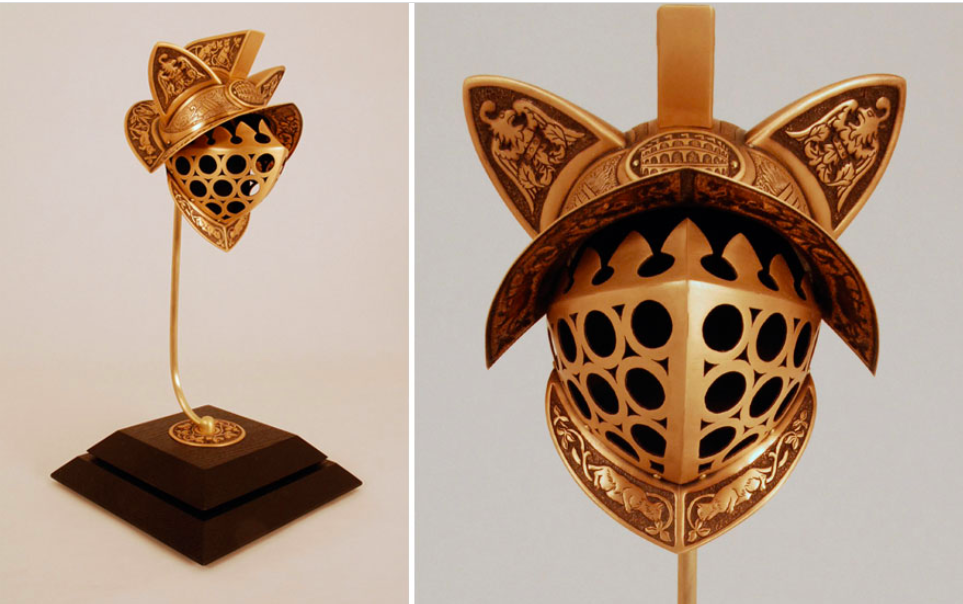
After graduating from high school wearing a partial suit of armor he constructed for the occasion, De Boer completed seven full suits, while majoring in jewelry design at the Alberta College of Art and Design.
A sculpture class assignment provided him with an excuse to make a suit of armor for a cat. The artist had found his niche.
Using steel, silver, brass, bronze, nickel, copper, leather, fiber, wood, and his delicate jewelry making tools, DeBoer became the cats’ armorer, spending anywhere from 50 to 200 hours producing each increasingly intricate suit of feline armor. A noble pursuit, but one that inadvertently created an “imbalance in the universe”:
The only way to fix it was to do the same for the mouse.
“The suit of armor is a transformation vehicle. It’s something that only the hero would wear,” De Boer notes.
Fans of David Petersen’s Mouse Guard series will need no convincing, though no real mouse has had the misfortune to find its way inside one of his astonishing, custom-made creations.
It’s not an altogether bad idea. The only reason I don’t do it is that hollow suit of armor like you might see in a museum, your imagination will make it do a million things more than if you stick a mouse in it will ever do. I have put armor on cats. I can tell you, it’s nothing like what you think it’s going to be. It’s not a very good experience for the cat. It does not fulfill any fantasies about a cat wearing a suit of armor.
Though cats were his entry point, De Boer’s sympathies seem aligned with the underdog — er, mice. Equipping humble, hypothetical creatures with exquisitely wrought, historical protective gear is a way of pushing back against being perceived differently than one wishes to be.
Accepting an Honorary MFA from his alma mater earlier this year, he described an armored mouse as a metaphor for his “ongoing cat and mouse relationship with the world of fine art…a mischievous, rebellious being who dares to compete on his own terms in a world ruled by the cool cats.”
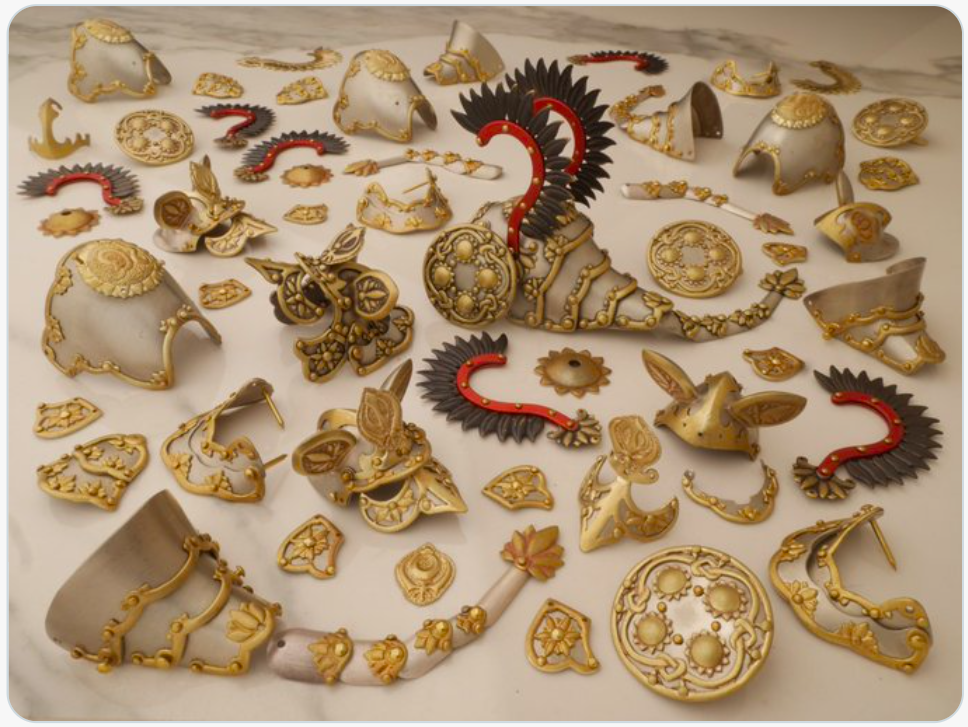
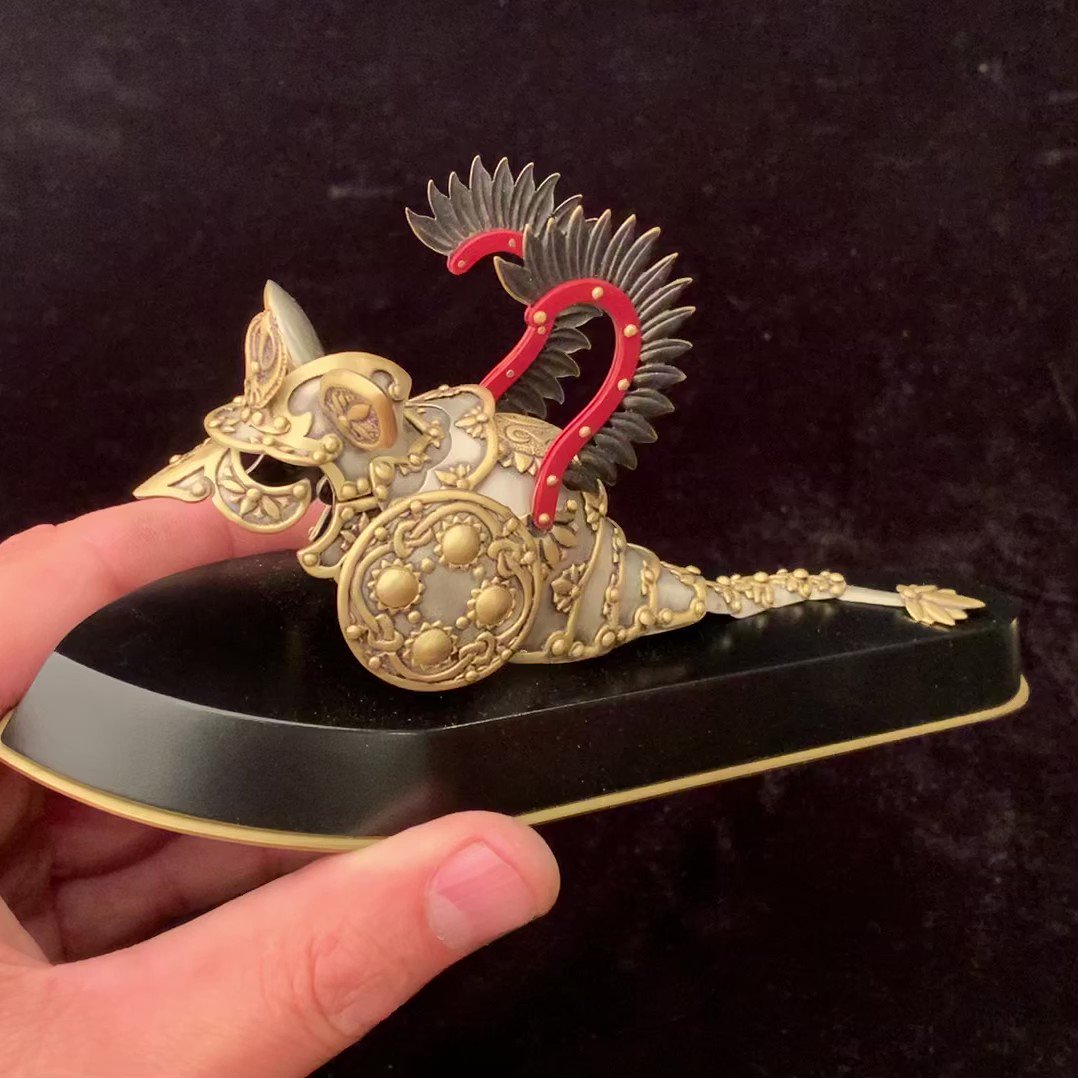
Each tiny piece is preceded by painstaking research and many reference drawings, and may incorporate special materials like the Japanese silk haori-himo cord lacing the shoulder plates to the body armor of a Samurai mouse family.
Additional creations have referenced Mongolian, gladiator, crusader, and Saracen styles — this last perfect for a Persian cat.
“I mean, “Why not?” he asks in his TED‑x Talk,Village Idiots & Innovation, below.
His latest work combines elements of Maratha and Hussar armor in a veritable puzzle of minuscule pieces.
See more of Jeff De Boer’s cat and mouse armor on his Instagram.
Though most of us see Francisco Goya’s Saturno devorando a su hijo, or Saturn Devouring His Son, at least every few months, we were never meant to see it all. The same is true of all fourteen of the so-called “Black Paintings,” which Goya executed late in his life on the walls of his villa outside Madrid. They now hang at the Prado where, as one tour guide put it to the Guardian’s Stephen Phelan, “some people can hardly even look at them.” When visitors enter the room that contains these often grim and bizarre visions, “they are always surprised. I don’t think I’ve ever seen a visitor whose expression hasn’t changed.”
What could have moved Goya to create such paintings? In the new Great Art Explained video essay above, gallerist and Youtuber James Payne lays out the relevant factors in Goya’s life and the turbulent society in which he lived. His Enlightenment views and penchant for brazen satire drew suspicion, as did his willingness to paint for French and pro-French clients during that country’s occupation of Spain.
At the age of 72 he ended up putting himself into a kind of countryside exile, taking up residence in an estate called the Quinta del Sordo (the “Villa of the Deaf,” and suitably enough, since Goya himself happened to have lost his hearing by that point).
It was in the Quinta del Sordo, and indeed on it, that Goya (or, according to certain theories, Goya’s son) set his artistic worldview free to realize its most grotesque and jaundiced forms. Even apart from Saturn’s act of cannibalistic filicide, Phelan writes, “a humanoid billy goat in a monkish cassock bleats a satanic sermon to a gasping congregation of witches. A desperately expressive little dog appears to plead for rescue, submerged up to its neck in a mud-colored mire beneath a gloomy, void-like firmament of negative space.” Known as El Perro, or The Dog, that last artwork is one of the most beloved in Spain — and, in its ascetic way, the most haunting Black Painting of all.
Based in Seoul, Colin Marshall writes and broadcasts on cities, language, and culture. His projects include the Substack newsletterBooks on Cities, the book The Stateless City: a Walk through 21st-Century Los Angeles and the video series The City in Cinema. Follow him on Twitter at @colinmarshall or on Facebook.
In the annals of modern popular music, one does not find a surfeit of flautists. Tim Weisberg, in partnership with singer-songwriter Dan Fogelberg, did score a modest his or two in the seventies. More incongruously, Jethro Tull’s Ian Anderson set his band apart with his decision to take up the flute not long before their earliest performances. But today, outside the realm of orchestral music, there is surely no higher-profile flautist than Lizzo. Though best known as a pop singer, she continues to put to use the flute skills she honed at the University of Houston, without which she wouldn’t have been able to handle a precious piece of American history.
Last month, writes the Library of Congress’ April Slayton, one of that institution’s librarians Carla Hayden “saw that the one and only Lizzo was coming to D.C. for a concert.” Given that “the Library has the world’s largest flute collection,” Hayden took the opportunity to point out that fact to the pop star on Twitter. “One of about 1,700 flutes in the collection, she teased, is the crystal flute made for President James Madison by Claude Laurent — a priceless instrument that Dolley Madison rescued from the White House in April 1814 as the British entered Washington, DC during the War of 1812.. Might she want to drop by and play a few bars?”
Indeed she did, with results you can see in the video above: at the Library itself, Lizzo tries out one of the collection’s many flutes; then she plays the crystal flute itself on onstage at Capitol One Arena, having been handed it by the instrument’s own security detail. “It’s like playing out of a wine glass,” she tells her thrilled audience. One wonders if the comparison would ever have occurred to its first owner: “It’s not clear if Madison did much with the flute other than admire it,” Slayton writes, “but it became a family heirloom and an artifact of the era.” Now it has become a uniting symbol of American culture past and present: however forward-looking the Founding Fathers were, we can safely say they never imagine twerking.
The Library of Congress has posted pictures of Lizzo’s visit on Flickr. See them here.
Based in Seoul, Colin Marshall writes and broadcasts on cities, language, and culture. His projects include the Substack newsletterBooks on Cities, the book The Stateless City: a Walk through 21st-Century Los Angeles and the video series The City in Cinema. Follow him on Twitter at @colinmarshall or on Facebook.
We're hoping to rely on loyal readers, rather than erratic ads. Please click the Donate button and support Open Culture. You can use Paypal, Venmo, Patreon, even Crypto! We thank you!
Open Culture scours the web for the best educational media. We find the free courses and audio books you need, the language lessons & educational videos you want, and plenty of enlightenment in between.