Discover the Sarajevo Haggadah, the Medieval Illuminated Manuscript That Survived the Inquisition, Holocaust & Yugoslav Wars

If you attend­ed a seder this month, you no doubt read aloud from the Hag­gadah, a Passover tra­di­tion in which every­one at the table takes turns recount­ing the sto­ry of Exo­dus.

There’s no defin­i­tive edi­tion of the Hag­gadah. Every Passover host is free to choose the ver­sion of the famil­iar sto­ry they like best, to cut and paste from var­i­ous retellings, or even take a crack at writ­ing their own.  

As David Zvi Kalman, pub­lish­er of the annu­al, illus­trat­ed Asu­fa Hag­gadah told the New York Times, “The Hag­gadah in Amer­i­ca is like Kit Kats in Japan. It’s a prod­uct that accepts a wide vari­ety of fla­vors. It’s prob­a­bly the most acces­si­ble Jew­ish book on the mar­ket.”

21st cen­tu­ry adap­ta­tions have includ­ed Mar­velous Mrs. Maisel, Sein­feld, Har­ry Pot­ter, and Curb Your Enthu­si­asm themed Hag­gadot.

There are Hag­gadot tai­lored toward fem­i­nists, Lib­er­tar­i­ans, inter­faith fam­i­lies, and advo­cates of the Black Lives Mat­ter move­ment.

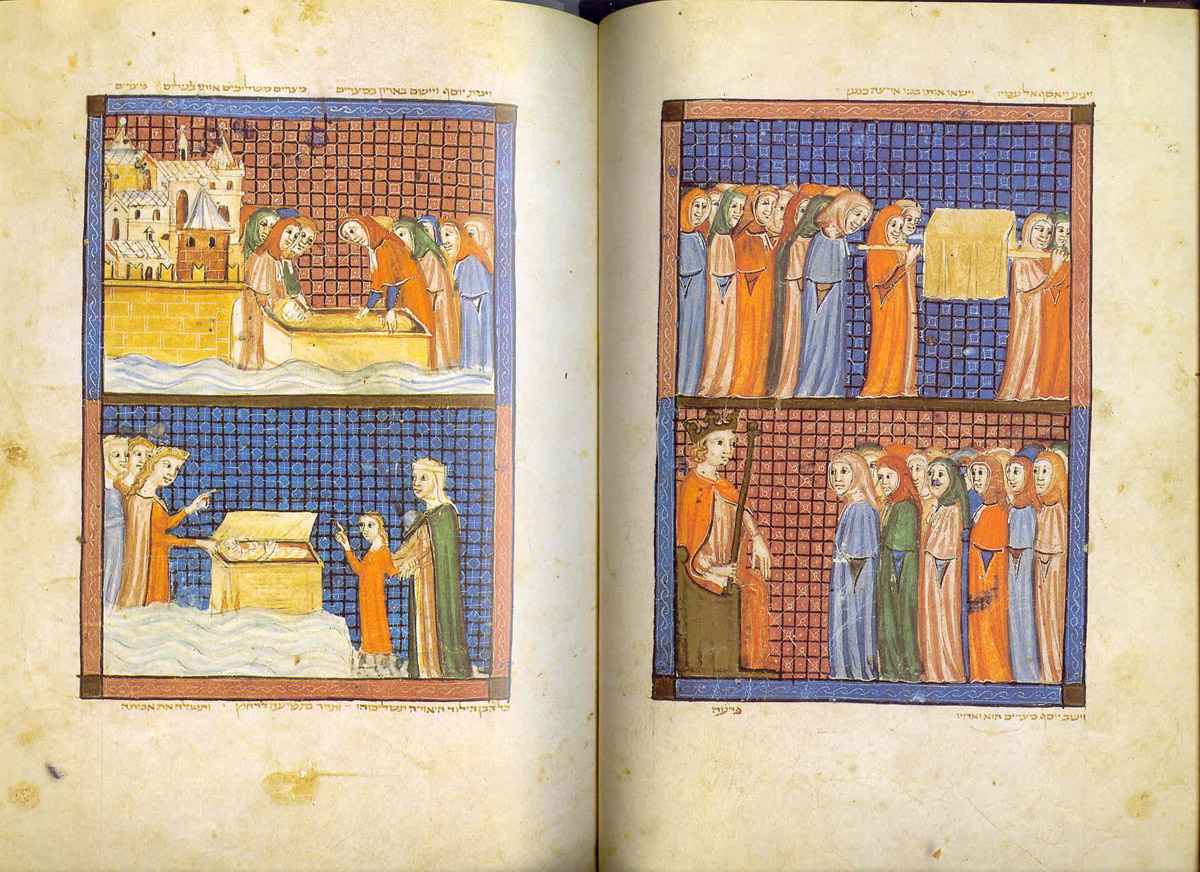
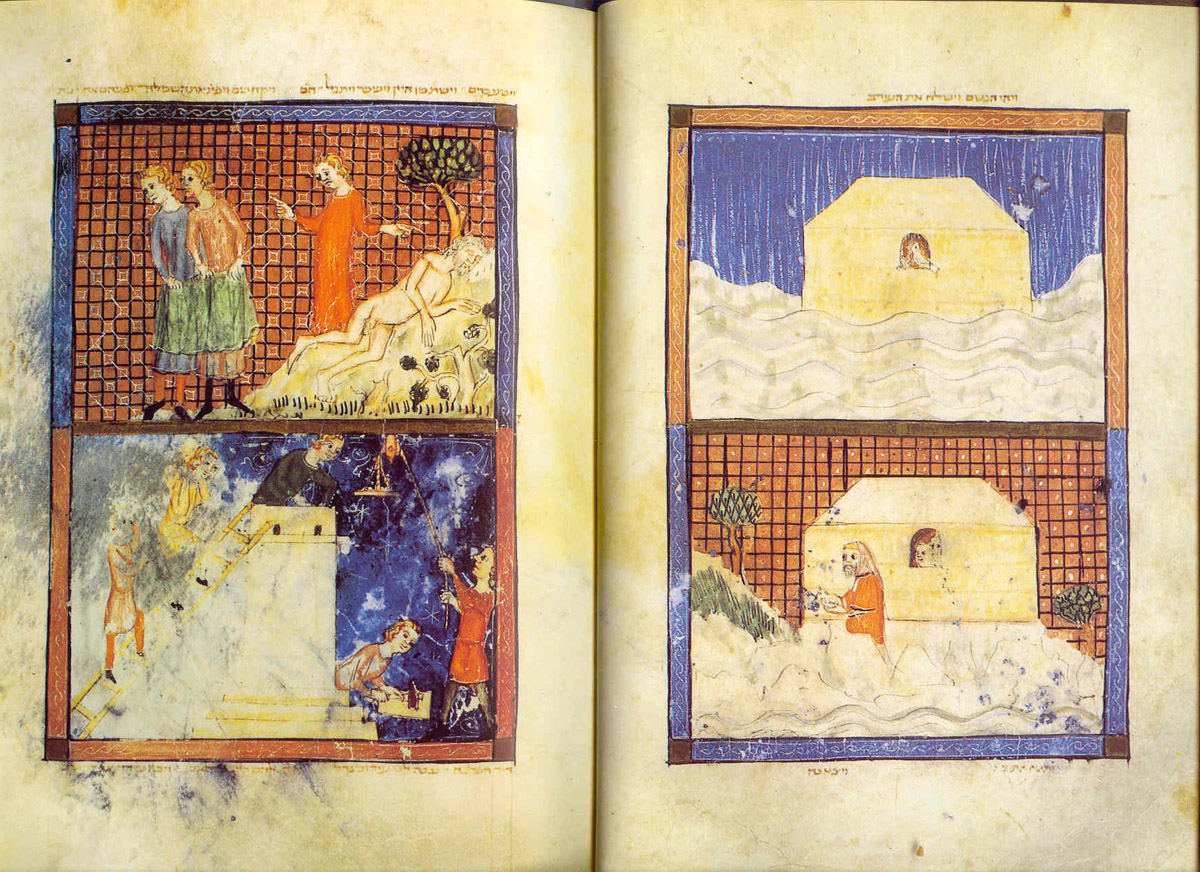
One of the old­est is the mirac­u­lous­ly-pre­served Sara­je­vo Hag­gadah, an illu­mi­nat­ed man­u­script cre­at­ed by anony­mous artists and scribes in Barcelona around 1350.
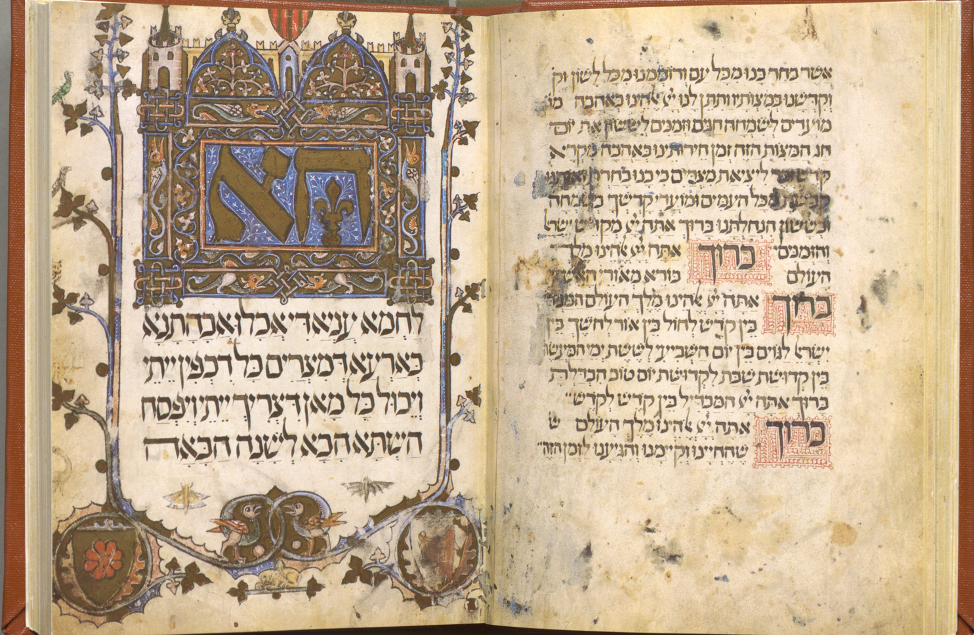
Though it bears the coats of arms of two promi­nent fam­i­lies, its prove­nance is not defin­i­tive­ly known.

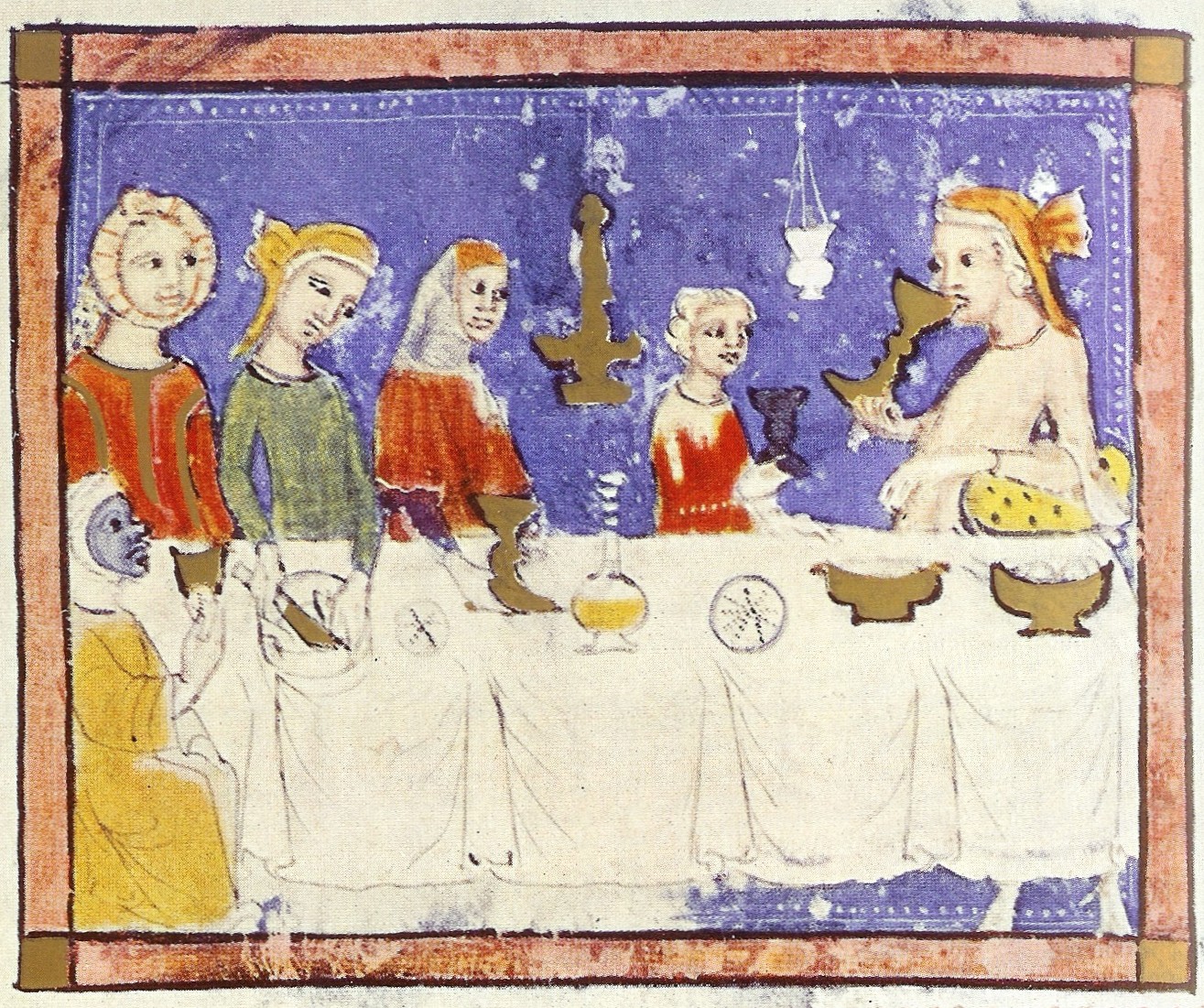
Leo­ra Bromberg of the Uni­ver­si­ty of Toronto’s Thomas Fish­er Rare Book Library notes that it is “espe­cial­ly strik­ing for its col­or­ful illu­mi­na­tions of bib­li­cal and Passover rit­u­al scenes and its beau­ti­ful­ly hand-scribed Sephardic let­ter­forms:”

As pre­cious as this Hag­gadah was, and still is, Hag­gadot are books that are meant to be used in fes­tive and messy settings—sharing the table with food, wine, fam­i­ly and guests. The Sara­je­vo Hag­gadah was no excep­tion to this; its pages show evi­dence that it was well used, with doo­dles, food and red wine stains mark­ing its pages.

Some brave soul took care to smug­gle this essen­tial vol­ume out with them when 1492’s Alham­bra Decree expelled all Jews from Spain.

The manuscript’s trav­els there­after are shroud­ed in mys­tery.

It sur­vived the Roman Inqui­si­tion by virtue of its con­tents. As per a 1609 note jot­ted on one of its pages, noth­ing there­in seemed to be aimed against the Church.
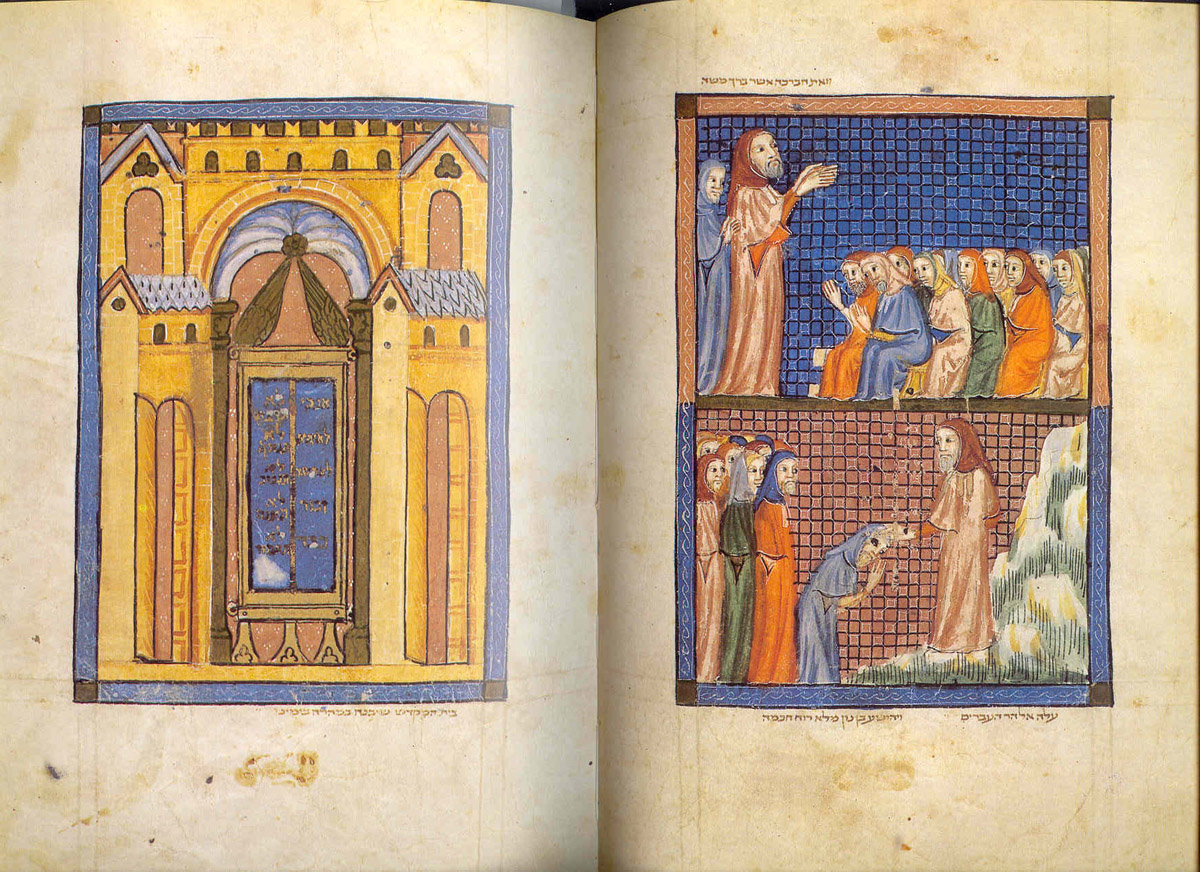
More hand­writ­ten notes place the book in the north of Italy in the 16th and 17th cen­turies, though its new own­er is not men­tioned by name.

Even­tu­al­ly, it found its way to the hands of a man named Joseph Kohen who sold it to the Nation­al Muse­um of Sara­je­vo in 1894.

It was briefly sent to Vien­na, where a gov­ern­ment offi­cial replaced its orig­i­nal medieval bind­ing with card­board cov­ers, chop­ping its 142 bleached calf­skin vel­lum down to 6.5” x 9” in order to fit them.

It had a nar­row escape in 1942, when a high-rank­ing Nazi offi­cial, Johann Fort­ner, vis­it­ed the muse­um, intent on con­fis­cat­ing the price­less man­u­script.  

The chief librar­i­an, Dervis Korkut, a Mus­lim, secret­ed the Hag­gadah inside his cloth­ing, reput­ed­ly telling  Fort­ner that muse­um staff had turned it over to anoth­er Ger­man offi­cer.

After that folk­lore takes over. Korkut either stowed it under the floor­boards of his home, buried it under a tree, gave it to an imam in a remote vil­lage for safe­keep­ing, or hid it on a shelf in the museum’s library.
What­ev­er the case, it reap­peared in the muse­um, safe and sound, in 1945.

The muse­um was ran­sacked dur­ing 1992’s Siege of Sara­je­vo, but the thieves, igno­rant of the Haggadah’s worth, left it on the floor. It was removed to an under­ground bank vault, where it sur­vived untouched, even as the muse­um sus­tained heavy artillery dam­age.

The pres­i­dent of Bosnia pre­sent­ed it to Jew­ish com­mu­ni­ty lead­ers dur­ing a Seder three years lat­er.

Short­ly there­after, the head of Sarajevo’s Jew­ish Com­mu­ni­ty sought the Unit­ed Nations’ sup­port to restore the Hag­gadah, and house it in a suit­ably secure, cli­mate-con­trolled set­ting. 

A num­ber of fac­sim­i­les have been cre­at­ed, and the orig­i­nal codex once again resides in the muse­um where it is stored under the pre­scribed con­di­tions, and dis­played on rare spe­cial occa­sions, as “phys­i­cal proof of the open­ness of a soci­ety in which fear of the Oth­er has nev­er been an incur­able dis­ease.”

UNESCO added it to its Mem­o­ry of the World Reg­is­ter in 2017, “prais­ing the courage of the peo­ple who, even in the dark­est of times dur­ing World War II, appre­ci­at­ed its impor­tance to Jew­ish Her­itage, as well as its embod­i­ment of diver­si­ty and inter­cul­tur­al har­mo­ny depict­ed in its illus­tra­tion:”

 Regard­less of their own reli­gious beliefs, they risked their lives and did all in their pow­er to safe­guard the Hag­gadah for future gen­er­a­tions. Its destruc­tion would be a loss for human­i­ty. Pro­tect­ing it is a sym­bol of the val­ues which we hold dear.

For those inter­est­ed, the Sara­je­vo Hag­gadah fig­ures cen­tral­ly in the best­selling 2008 nov­el Peo­ple of the Book, writ­ten by the Pulitzer Prize-win­ning author Geral­dine Brooks. You can read an New Times review here.

Relat­ed Con­tent 

How Illu­mi­nat­ed Medieval Man­u­scripts Were Made: A Step-by-Step Look at this Beau­ti­ful, Cen­turies-Old Craft

Turn­ing the Pages of an Illu­mi­nat­ed Medieval Man­u­script: An ASMR Muse­um Expe­ri­ence

The Medieval Mas­ter­piece, the Book of Kells, Has Been Dig­i­tized and Put Online

– Ayun Hal­l­i­day is the Chief Pri­ma­tol­o­gist of the East Vil­lage Inky zine and author, most recent­ly, of Cre­ative, Not Famous: The Small Pota­to Man­i­festo and Cre­ative, Not Famous Activ­i­ty Book. Fol­low her @AyunHalliday.

Horrifying 1906 Illustrations of H.G. Wells’ War of the Worlds

War1

H.G. Wells’ War of the Worlds has ter­ri­fied and fas­ci­nat­ed read­ers and writ­ers for decades since its 1898 pub­li­ca­tion and has inspired numer­ous adap­ta­tions. The most noto­ri­ous use of Wells’ book was by Orson Welles, whom the author called “my lit­tle name­sake,” and whose 1938 War of the Worlds Hal­loween radio play caused pub­lic alarm (though not actu­al­ly a nation­al pan­ic). After the occur­rence, reports Phil Klass, the actor remarked, “I’m extreme­ly sur­prised to learn that a sto­ry, which has become famil­iar to chil­dren through the medi­um of com­ic strips and many suc­ceed­ing and adven­ture sto­ries, should have had such an imme­di­ate and pro­found effect upon radio lis­ten­ers.”

War5

Sure­ly Welles knew that is pre­cise­ly why the broad­cast had the effect it did, espe­cial­ly in such an anx­ious pre-war cli­mate. The 1898 nov­el also star­tled its first read­ers with its verisimil­i­tude, play­ing on a late Vic­to­ri­an sense of apoc­a­lyp­tic doom as the turn-of-the-cen­tu­ry approached.

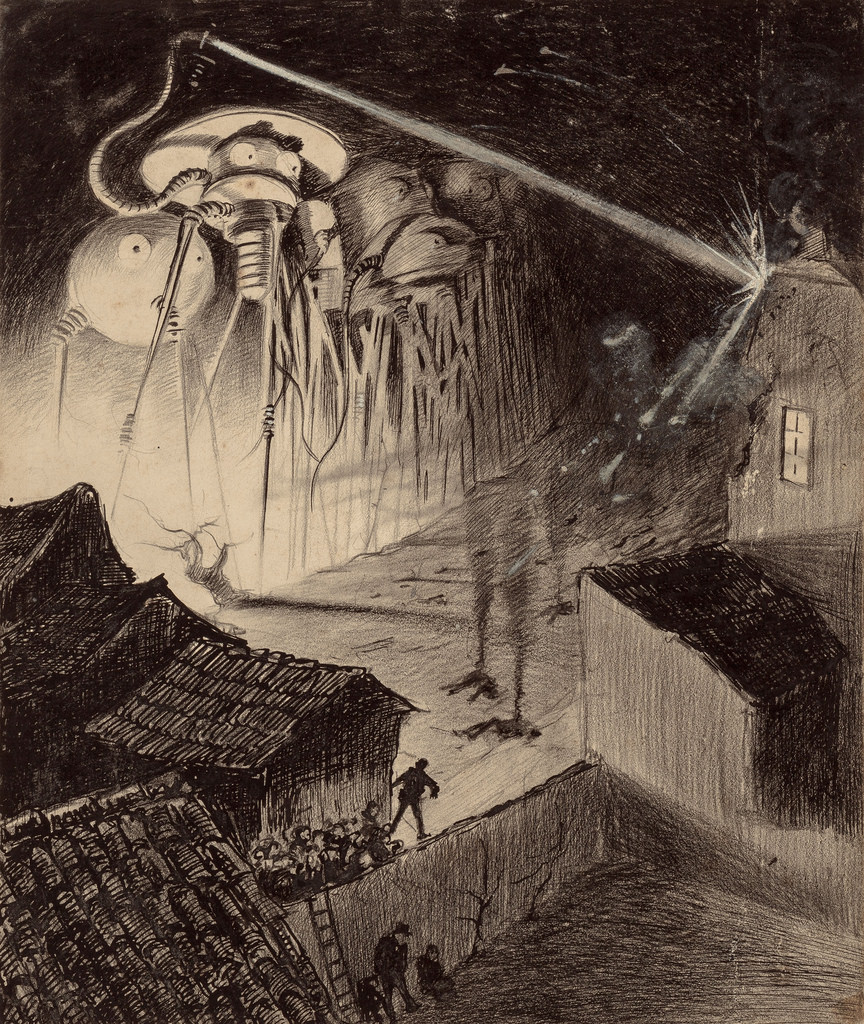
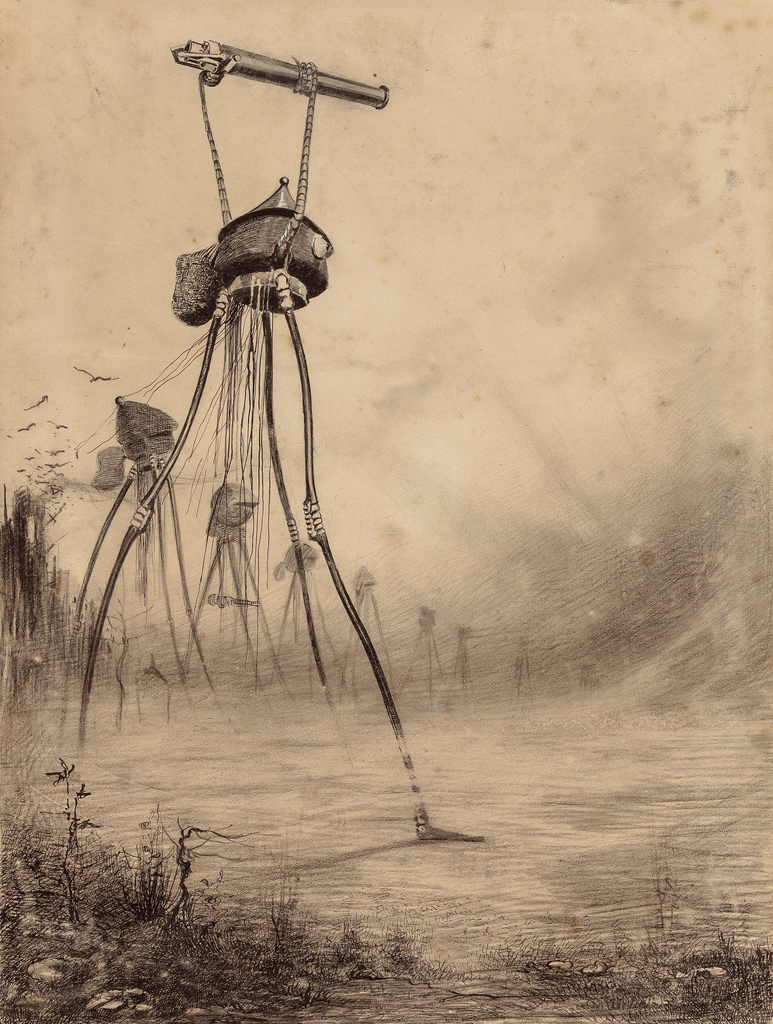
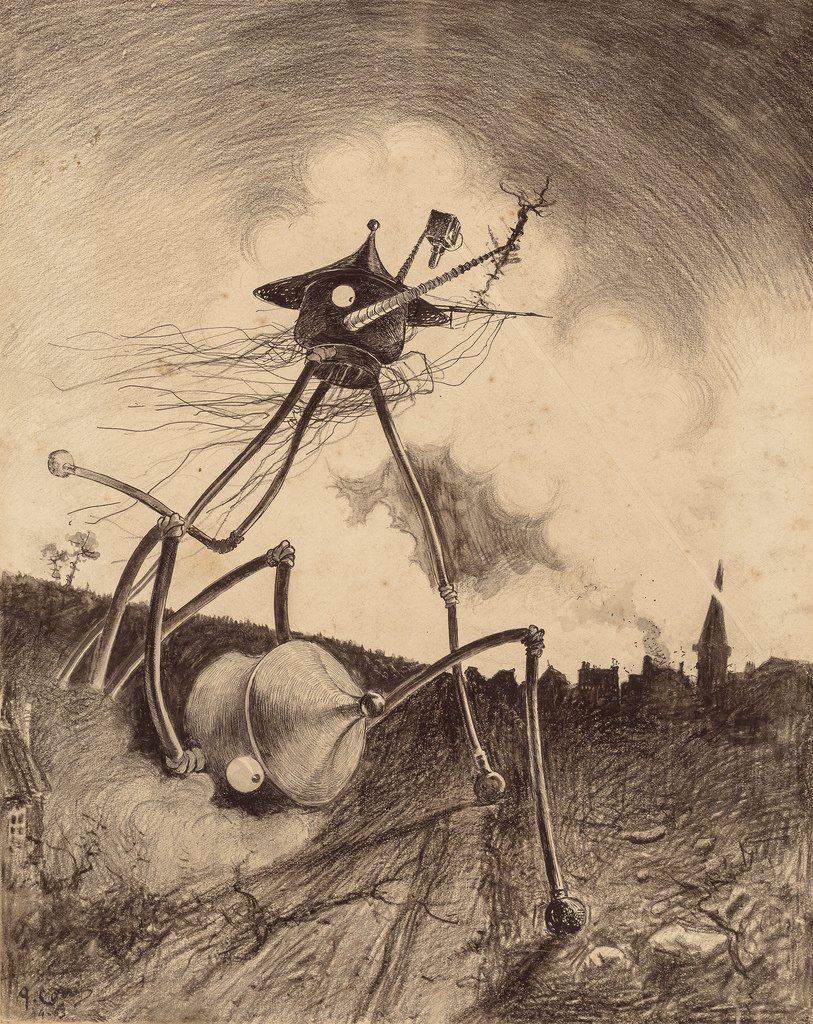
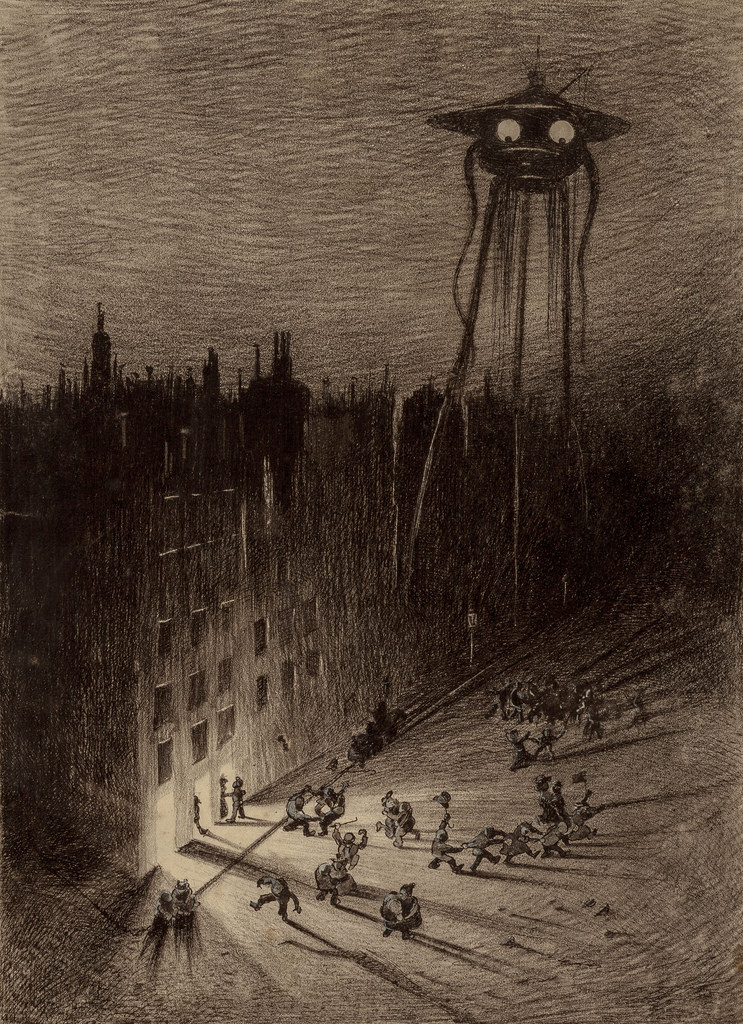
But what con­tem­po­rary cir­cum­stances eight years lat­er, we might won­der, fueled the imag­i­na­tion of Hen­rique Alvim Cor­rêa, whose 1906 illus­tra­tions of the nov­el you can see here? Wells him­self approved of these incred­i­ble draw­ings, prais­ing them before their pub­li­ca­tion and say­ing, “Alvim Cor­rêa did more for my work with his brush than I with my pen.”

War3

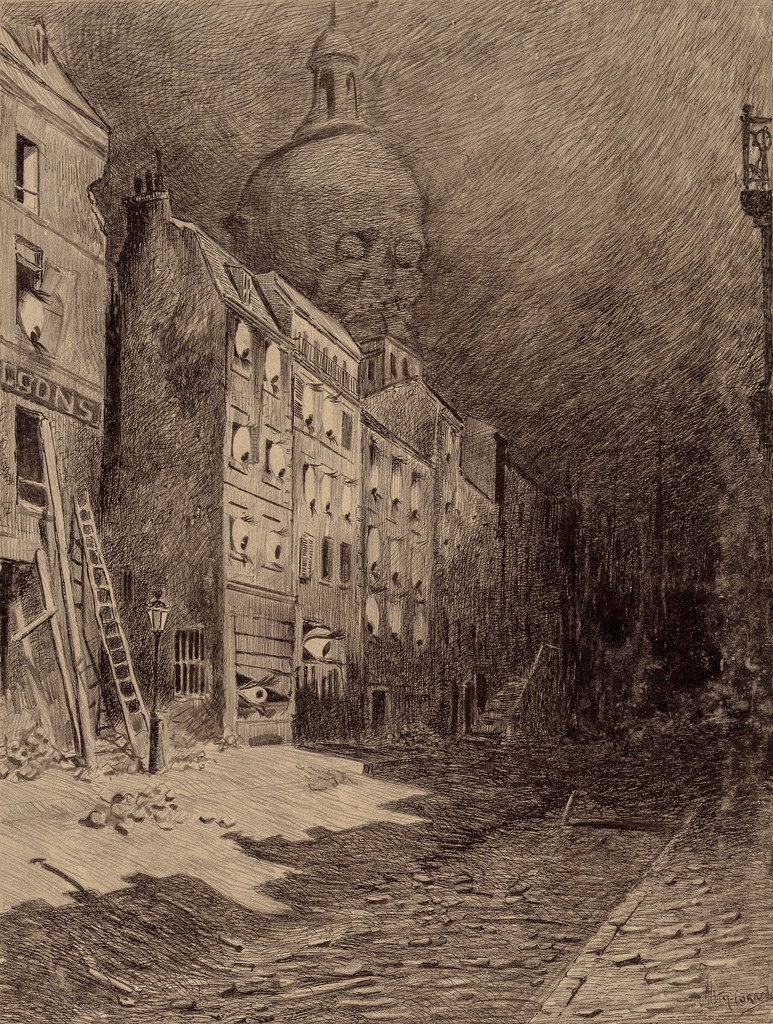
Indeed they cap­ture the nov­el­’s uncan­ny dread. Mar­t­ian tripods loom, ghast­ly and car­toon­ish, above blast­ed real­ist land­scapes and scenes of pan­ic. In one illus­tra­tion, a grotesque, ten­ta­cled Mar­t­ian rav­ish­es a nude woman. In a sur­re­al­ist draw­ing of an aban­doned Lon­don above, eyes pro­trude from the build­ings, and a skele­tal head appears above them. The alien tech­nol­o­gy often appears clum­sy and unso­phis­ti­cat­ed, which con­tributes to the gen­er­al­ly ter­ri­fy­ing absur­di­ty that emanates from these fine­ly ren­dered plates.

War2

Alvim Cor­rêa was a Brazil­ian artist liv­ing in Brus­sels and strug­gling for recog­ni­tion in the Euro­pean art world. His break seemed to come when the War of the Worlds illus­tra­tions were print­ed in a large-for­mat, lim­it­ed French edi­tion of the book, with each of the 500 copies signed by the artist him­self.

wells illustrated

Unfor­tu­nate­ly, Cor­rêa’s tuber­cu­lo­sis killed him four years lat­er. His War of the Worlds draw­ings did not bring him fame in his life­time or after, but his work has been cher­ished since by a devot­ed cult fol­low­ing. The orig­i­nal prints you see here remained with the artist’s fam­i­ly until a sale of 31 of them in 1990. (They went up for sale again recent­ly, it seems.) You can see many more, as well as scans from the book and a poster announc­ing the pub­li­ca­tion, at Mon­ster Brains and the British Library site.

War4

Note: An ear­li­er ver­sion of this post appeared on our site in 2015.

If you would like to sup­port the mis­sion of Open Cul­ture, con­sid­er mak­ing a dona­tion to our site. It’s hard to rely 100% on ads, and your con­tri­bu­tions will help us con­tin­ue pro­vid­ing the best free cul­tur­al and edu­ca­tion­al mate­ri­als to learn­ers every­where. You can con­tribute through Pay­Pal, Patre­on, and Ven­mo (@openculture). Thanks!

Relat­ed Con­tent:

The Very First Illus­tra­tions of H.G. Wells’ The War of the Worlds (1897)

Edward Gorey Illus­trates H.G. Wells’ The War of the Worlds in His Inim­itable Goth­ic Style (1960)

The War of the Worlds: Orson Welles’ 1938 Radio Dra­ma That Pet­ri­fied a Nation

Josh Jones is a writer and musi­cian based in Durham, NC. Fol­low him at @jdmagness

by | Permalink | Make a Comment ( 1 ) |

How to Spot a Communist by Using Literary Criticism: A 1955 Manual from the U.S. Military

In 1955, the Unit­ed States was enter­ing the final stages of McCarthy­ism or the Sec­ond Red Scare. Dur­ing this low point in Amer­i­can his­to­ry, the US gov­ern­ment looked high and low for Com­mu­nist spies. Enter­tain­ers, edu­ca­tors, gov­ern­ment employ­ees and union mem­bers were often viewed with sus­pi­cion, and many careers and lives were destroyed by the flim­si­est of alle­ga­tions. Con­gress, the FBI, and the US mil­i­tary, they all fueled the 20th cen­tu­ry ver­sion of the Salem Witch tri­als, part­ly by encour­ag­ing Amer­i­cans to look for Com­mu­nists in unsus­pect­ing places.

In the short Armed Forces Infor­ma­tion Film above, you can see the dynam­ic at work. Some Com­mu­nists were out in the open; how­ev­er, oth­ers “worked more silent­ly.” So how to find those hid­den com­mu­nists?

Not to wor­ry, the US mil­i­tary had that cov­ered. In 1955, the U.S. First Army Head­quar­ters pre­pared a man­u­al called How to Spot a Com­mu­nist. Lat­er pub­lished in pop­u­lar Amer­i­can mag­a­zines, the pro­pa­gan­da piece warned read­ers, “there is no fool-proof sys­tem in spot­ting a Com­mu­nist.” “U.S. Com­mu­nists come from all walks of life, pro­fess all faiths, and exer­cise all trades and pro­fes­sions. In addi­tion, the Com­mu­nist Par­ty, USA, has made con­cert­ed efforts to go under­ground for the pur­pose of infil­tra­tion.” And yet the pam­phlet adds, let­ting read­ers breathe a sigh of relief, “there are, for­tu­nate­ly, indi­ca­tions that may give him away. These indi­ca­tions are often sub­tle but always present, for the Com­mu­nist, by rea­son of his “faith” must act and talk along cer­tain lines.” In short, you’ll know a Com­mu­nist not by how he walks, but how he talks. Ask­ing cit­i­zens to become lit­er­ary crit­ics for the sake of nation­al secu­ri­ty, the pub­li­ca­tion told read­ers to watch out for the fol­low­ing:

While a pref­er­ence for long sen­tences is com­mon to most Com­mu­nist writ­ing, a dis­tinct vocab­u­lary pro­vides the more eas­i­ly rec­og­nized fea­ture of the “Com­mu­nist Lan­guage.” Even a super­fi­cial read­ing of an arti­cle writ­ten by a Com­mu­nist or a con­ver­sa­tion with one will prob­a­bly reveal the use of some of the fol­low­ing expres­sions: inte­gra­tive think­ing, van­guard, com­rade, hoo­te­nan­ny, chau­vin­ism, book-burn­ing, syn­cretis­tic faith, bour­geois-nation­al­ism, jin­go­ism, colo­nial­ism, hooli­gan­ism, rul­ing class, pro­gres­sive, dem­a­gogy, dialec­ti­cal, witch-hunt, reac­tionary, exploita­tion, oppres­sive, mate­ri­al­ist.

This list, select­ed at ran­dom, could be extend­ed almost indef­i­nite­ly. While all of the above expres­sions are part of the Eng­lish lan­guage, their use by Com­mu­nists is infi­nite­ly more fre­quent than by the gen­er­al pub­lic…

Rather chill­ing­ly, the pam­phlet also warned that Com­mu­nists revealed them­selves if and when they talked about “McCarthy­ism,” “vio­la­tion of civ­il rights,” “racial or reli­gious dis­crim­i­na­tion” or “peace.” In oth­er words, they were guilty if they sug­gest­ed that the gov­ern­ment was over­step­ping its bounds.

Accord­ing to Corliss Lam­on­t’s book, Free­dom Is As Free­dom Does, the First Army with­drew the pam­phlet after Mur­ray Kemp­ton slammed it in The New York Post and The New York Times wrote its own scathing op-ed. In 1955, the press could take those risks. The year before, Joseph Welch had faced up to Joe McCarthy, ask­ing with his immor­tal words, “Have you no sense of decen­cy, sir? At long last, have you left no sense of decen­cy?

Note: An ear­li­er ver­sion of this post appeared our site in 2013.

If you would like to sup­port the mis­sion of Open Cul­ture, con­sid­er mak­ing a dona­tion to our site. It’s hard to rely 100% on ads, and your con­tri­bu­tions will help us con­tin­ue pro­vid­ing the best free cul­tur­al and edu­ca­tion­al mate­ri­als to learn­ers every­where. You can con­tribute through Pay­Pal, Patre­on, and Ven­mo (@openculture). Thanks!

Relat­ed Con­tent:

Read the CIA’s Sim­ple Sab­o­tage Field Man­u­al: A Time­less Guide to Sub­vert­ing Any Orga­ni­za­tion with “Pur­pose­ful Stu­pid­i­ty” (1944)

Bertolt Brecht Tes­ti­fies Before the House Un-Amer­i­can Activ­i­ties Com­mit­tee (1947)

How the CIA Secret­ly Fund­ed Abstract Expres­sion­ism Dur­ing the Cold War


by | Permalink | Make a Comment ( 2 ) |

The History of Ancient Japan: The Story of How Japan Began, Told by Those Who Witnessed It (297‑1274)

Here in the twen­ty-first cen­tu­ry, many of us around the world think of Japan as essen­tial­ly unchang­ing. We do so not with­out cause, giv­en how much of what goes on there, includ­ing the oper­a­tion of cer­tain busi­ness­es, has been going on for cen­turies and cen­turies. But the polit­i­cal, cul­tur­al, reli­gious, eco­nom­ic, and eth­nic com­po­si­tion of the civ­i­liza­tion we’ve long known as Japan has, in fact, trans­formed a great deal over the course of its exis­tence. Some of the most dra­mat­ic changes occurred between the third and thir­teenth cen­turies, the span of time cov­ered by the video above.

“How Japan Began” comes from Voic­es of the Past, a Youtube chan­nel pre­vi­ous­ly fea­tured here on Open Cul­ture for its videos on a first-hand account of the destruc­tion of Pom­peii, an ancient Chi­nese his­to­ri­an’s descrip­tion of the Roman Empire, and how the first Japan­ese vis­i­tor to the Unit­ed States and Europe saw life there.

In telling the sto­ry of how ancient Japan (though most­ly in a time span that falls with­in Europe’s Mid­dle Ages) assumed some­thing like its cur­rent form, the video adheres to its usu­al method of direct­ly incor­po­rat­ing as many pri­ma­ry or close-to-pri­ma­ry sources as pos­si­ble: the Chi­nese Records or His­to­ry of the Three King­doms, eighth-cen­tu­ry court edicts and nation­al his­to­ries, the thir­teenth-cen­tu­ry émi­gré Chi­nese Bud­dhist monk Mugaku Sogen.

As for the rest of the nar­ra­tion, Voic­es of the Past cred­its Thomas Lock­ley, co-author of the book African Samu­rai: The True Sto­ry of Yasuke, a Leg­endary Black War­rior in Feu­dal Japan. Yasuke, whom we’ve also fea­tured before, arrived in Japan in 1579, three cen­turies after the events chron­i­cled in “How Japan Begin” — and thus quite deep indeed into the his­to­ry of a volatile land of reli­gious shifts, polit­i­cal ambi­tions, and (vol­un­tary or invol­un­tary) cul­tur­al exchanges, all amid an inter­nal state oscil­lat­ing between frag­men­ta­tion and con­sol­i­da­tion as well as an ever-chang­ing rela­tion­ship to the world at large. We can’t say what mix­ture of sta­bil­i­ty and insta­bil­i­ty will char­ac­ter­ize Japan’s next mil­len­ni­um, but we can hope its future chron­i­clers are up to the task.

Relat­ed con­tent:

The Entire His­to­ry of Japan in 9 Quirky Min­utes

When a UFO Came to Japan in 1803: Dis­cov­er the Leg­end of Utsuro-bune

The 17th Cen­tu­ry Japan­ese Samu­rai Who Sailed to Europe, Met the Pope & Became a Roman Cit­i­zen

Hear the First Japan­ese Vis­i­tor to the Unit­ed States & Europe Describe Life in the West (1860–1862)

1850s Japan Comes to Life in 3D, Col­or Pho­tos: See the Stereo­scop­ic Pho­tog­ra­phy of T. Ena­mi

A Japan­ese Illus­trat­ed His­to­ry of Amer­i­ca (1861): Fea­tures George Wash­ing­ton Punch­ing Tigers, John Adams Slay­ing Snakes & Oth­er Fan­tas­tic Scenes

Based in Seoul, Col­in Marshall writes and broad­casts on cities, lan­guage, and cul­ture. His projects include the Sub­stack newslet­ter Books on Cities, the book The State­less City: a Walk through 21st-Cen­tu­ry Los Ange­les and the video series The City in Cin­e­ma. Fol­low him on Twit­ter at @colinmarshall or on Face­book.

The Smithsonian Puts 4.5 Million High-Res Images Online and Into the Public Domain, Making Them Free to Use

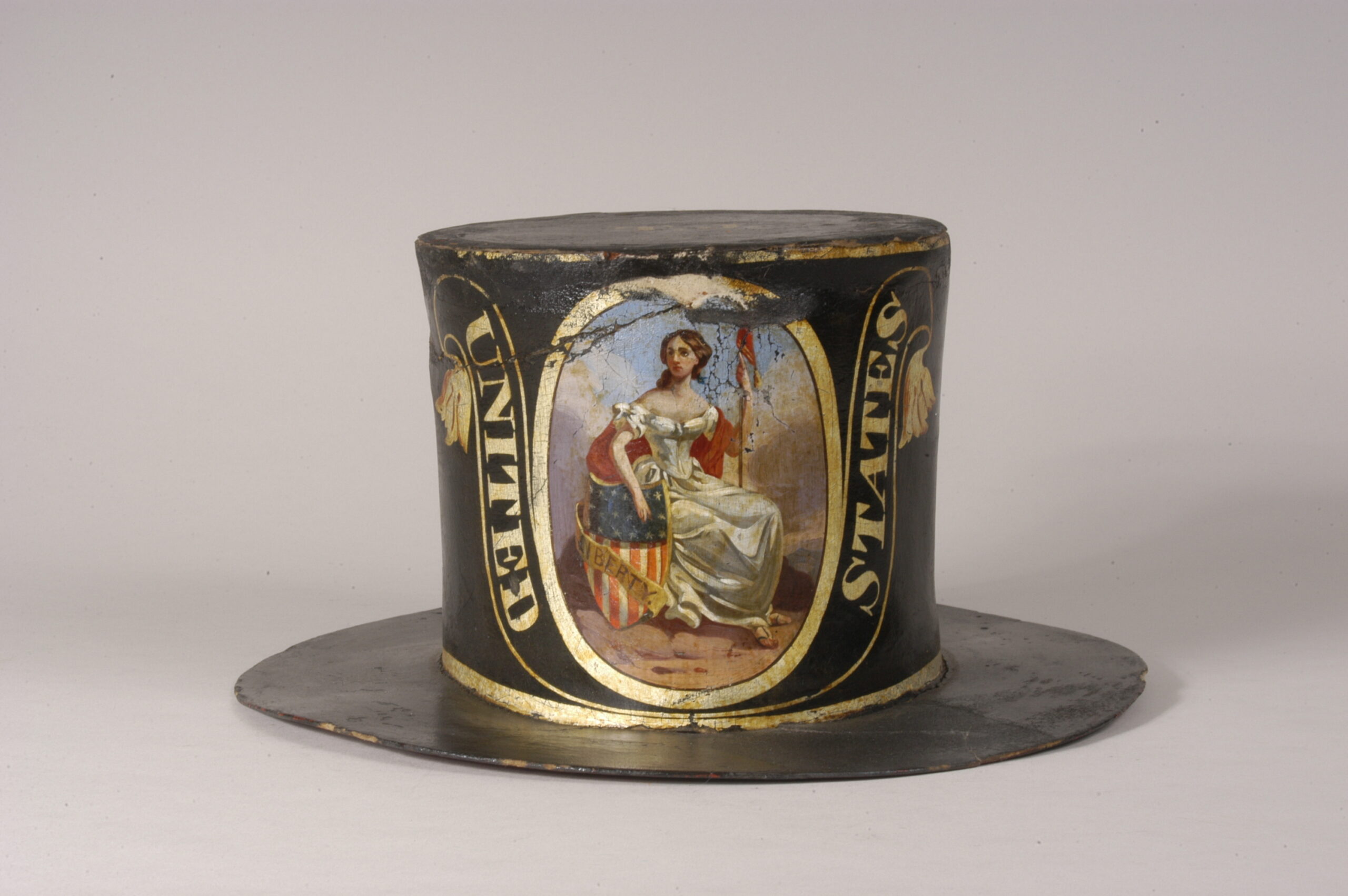
That vast repos­i­to­ry of Amer­i­can his­to­ry that is the Smith­son­ian Insti­tu­tion evolved from an orga­ni­za­tion found­ed in 1816 called the Columbian Insti­tute for the Pro­mo­tion of Arts and Sci­ences. Its man­date, the col­lec­tion and dis­sem­i­na­tion of use­ful knowl­edge, now sounds very much of the nine­teenth cen­tu­ry — but then, so does its name. Colum­bia, the god­dess-like sym­bol­ic per­son­i­fi­ca­tion of the Unit­ed States of Amer­i­ca, is sel­dom direct­ly ref­er­enced today, hav­ing been super­seded by Lady Lib­er­ty. Traits of both fig­ures appear in the depic­tion on the nine­teenth-cen­tu­ry fire­man’s hat above, about which you can learn more at Smith­son­ian Open Access, a dig­i­tal archive that now con­tains some 4.5 mil­lion images.

“Any­one can down­load, reuse, and remix these images at any time — for free under the Cre­ative Com­mons Zero (CC0) license,” write My Mod­ern Met’s Jes­si­ca Stew­art and Madeleine Muz­dakis. “A dive into the 3D records shows every­thing from CAD mod­els of the Apol­lo 11 com­mand mod­ule to Hor­a­tio Gree­nough’s 1840 sculp­ture of George Wash­ing­ton.”

The 2D arti­facts of inter­est include “a por­trait of Poc­a­hon­tas in the Nation­al Por­trait Gallery, an image of the 1903 Wright Fly­er from the Nation­al Air and Space Muse­um, and box­ing head­gear worn by Muham­mad Ali from the Nation­al Muse­um of African Amer­i­can His­to­ry and Cul­ture.”

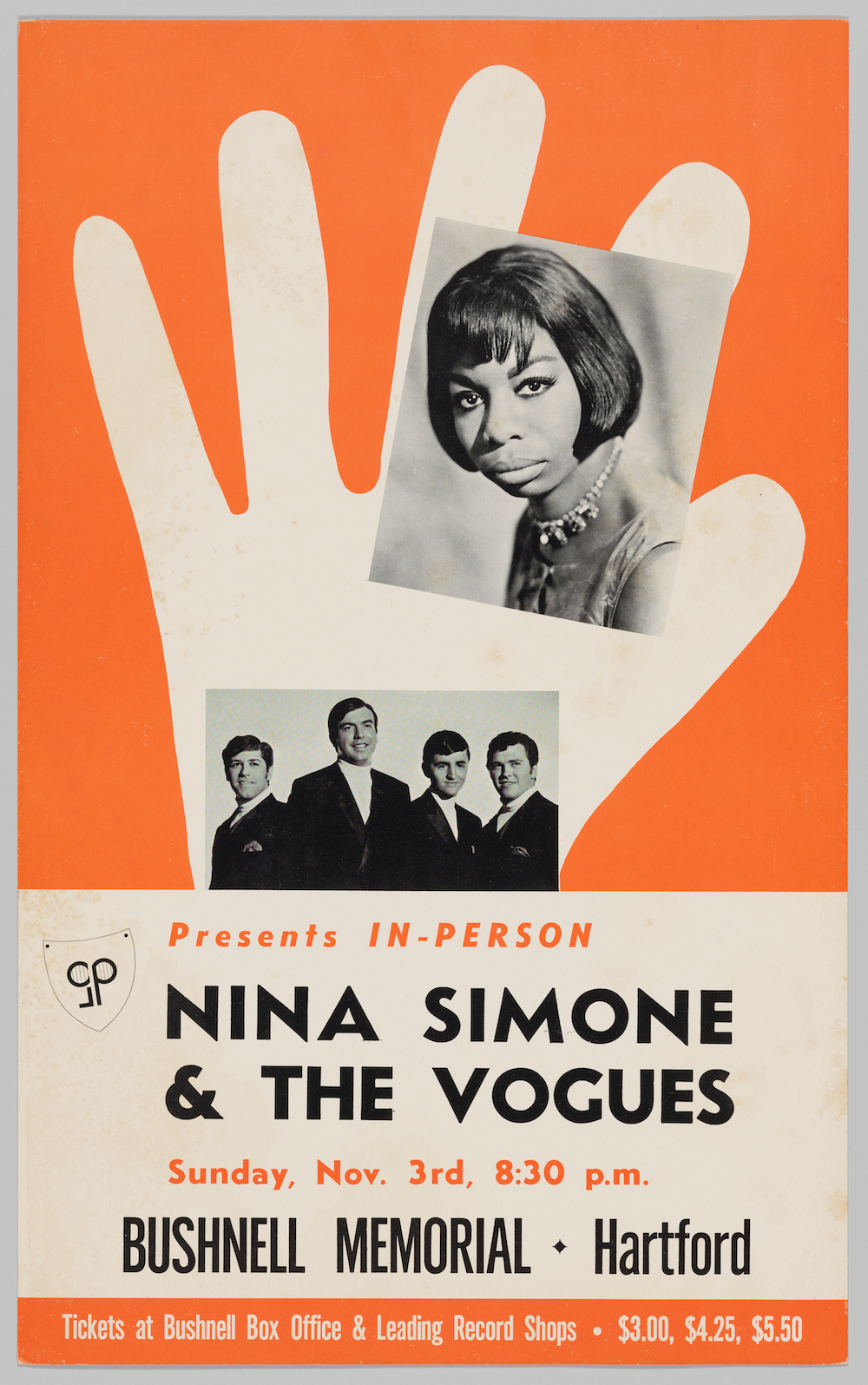
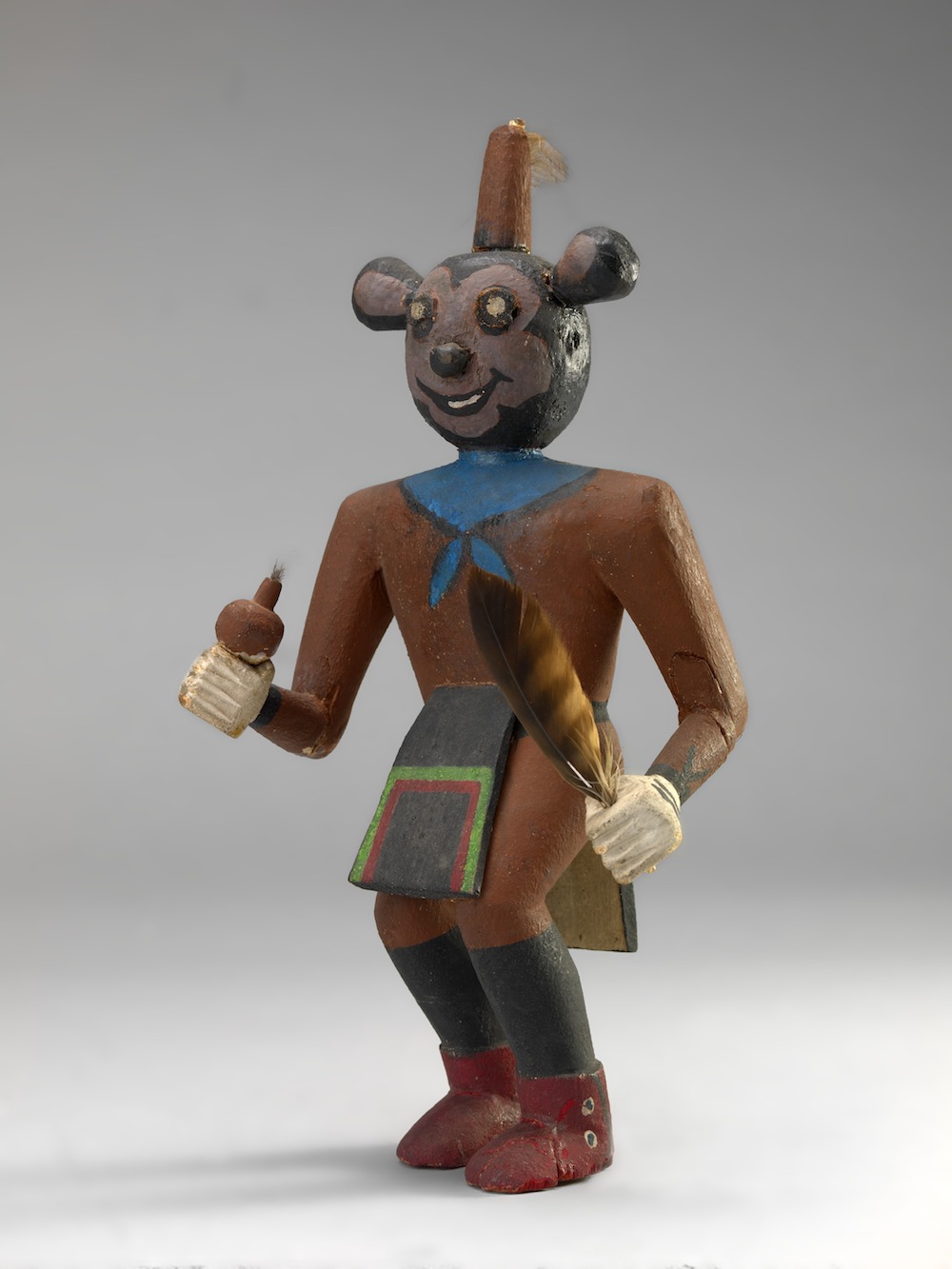
The NMAAHC in par­tic­u­lar has pro­vid­ed a great many items rel­e­vant to twen­ti­eth-cen­tu­ry Amer­i­can cul­ture, like James Bald­win’s inkwell, Chuck Berry’s gui­tar May­bel­lene, Pub­lic Ene­my’s boom­box, and the poster for a 1968 Nina Simone con­cert. The more obscure object just above, a Native Amer­i­can kachi­na fig­ure with the head of Mick­ey Mouse, comes from the Smith­son­ian Amer­i­can Art Muse­um. “When Dis­ney Stu­dios put a mouse hero on the sil­ver screen in the 1930s,” explain the accom­pa­ny­ing notes, “Hopi artists saw in Mick­ey Mouse a cel­e­bra­tion of Tusan Homichi, the leg­endary mouse war­rior who defeat­ed a chick­en-steal­ing hawk” — and were thus them­selves inspired, it seems, to sum up a wide swath of Amer­i­can his­to­ry in a sin­gle object.

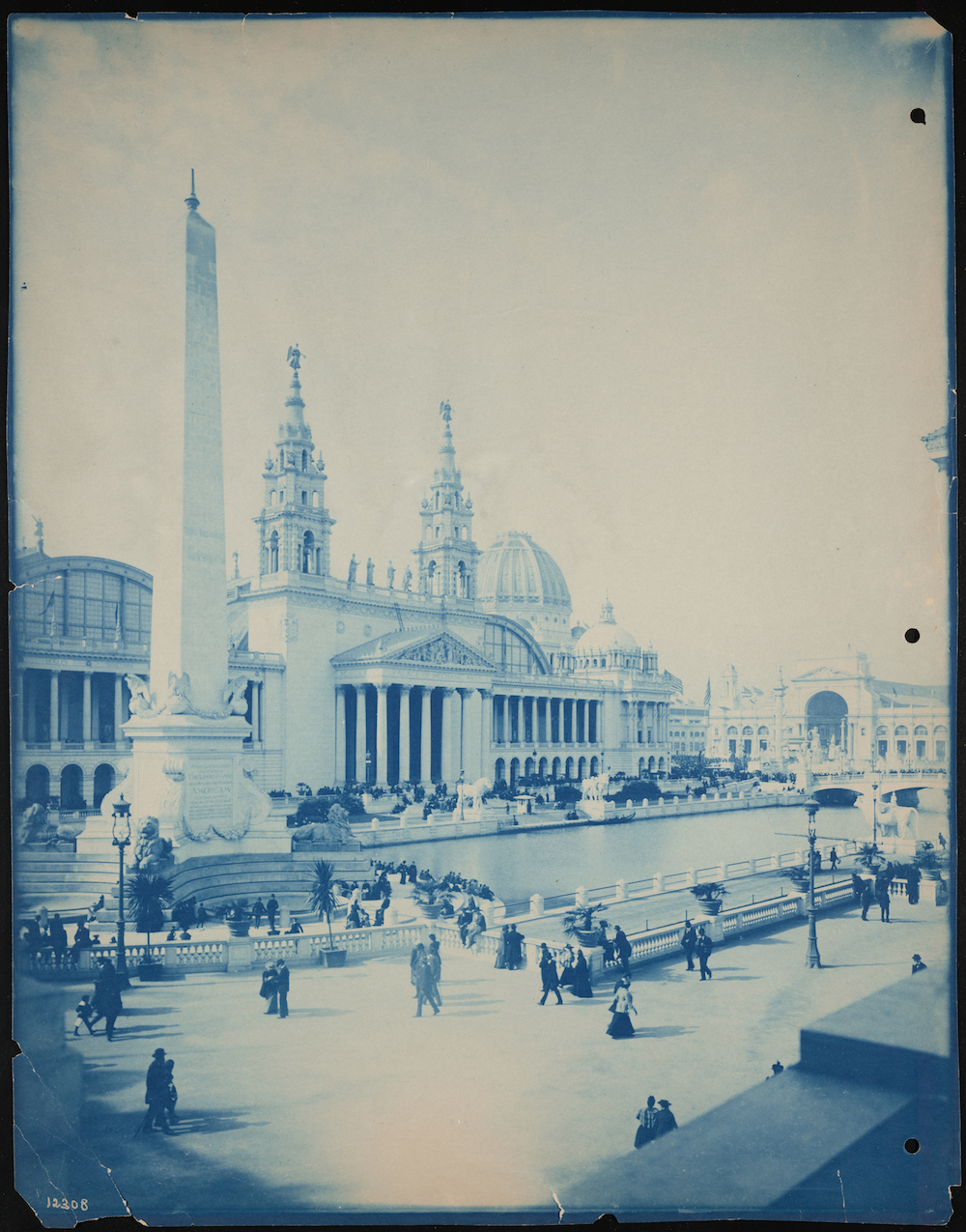
More items are being added to Smith­son­ian Open Access all the time, each with its own sto­ry to tell — and all acces­si­ble not just to Amer­i­cans, but inter­net users the world over. In that sense it feels a bit like the Chica­go World’s Fair of 1893, bet­ter known as the World’s Columbian Expo­si­tion, with its mis­sion of reveal­ing Amer­i­ca’s sci­en­tif­ic, tech­no­log­i­cal, and artis­tic genius to the whole of human civ­i­liza­tion. You can see a great many pho­tos and oth­er arti­facts of this land­mark event at Smith­son­ian Open Access, or, if you pre­fer, you can click the “just brows­ing” link and behold all the his­tor­i­cal, cul­tur­al, and for­mal vari­ety avail­able in the Smith­so­ni­an’s dig­i­tal col­lec­tions, where the spir­it of Colum­bia lives on.

via Kot­tke/My Mod­ern Met

Relat­ed con­tent:

The Library of Con­gress Launch­es the Nation­al Screen­ing Room, Putting Online Hun­dreds of His­toric Films

The Smith­son­ian Design Muse­um Dig­i­tizes 200,000 Objects, Giv­ing You Access to 3,000 Years of Design Inno­va­tion & His­to­ry

The Smith­son­ian Presents a Gallery of 6,000+ Rare Rock ‘n Roll Pho­tos on a Crowd­sourced Web Site, and Now a New Book

Why 99% Of Smithsonian’s Spec­i­mens Are Hid­den In High Secu­ri­ty

John Green’s Crash Course in U.S. His­to­ry: From Colo­nial­ism to Oba­ma in 47 Videos

Based in Seoul, Col­in Marshall writes and broad­casts on cities, lan­guage, and cul­ture. His projects include the Sub­stack newslet­ter Books on Cities, the book The State­less City: a Walk through 21st-Cen­tu­ry Los Ange­les and the video series The City in Cin­e­ma. Fol­low him on Twit­ter at @colinmarshall or on Face­book.

16-Year-Old Dave Grohl Demonstrates His Emerging Drumming Talent, Playing in His Punk Band “Mission Impossible” (1985)

Before Foo Fight­ers, before Nir­vana, before even Dain Bra­m­age, Scream and oth­er bands, Dave Grohl played in the Spring­field, Vir­ginia punk band Mis­sion Impos­si­ble. Above, we have footage of Grohl, only 16 years old, giv­ing us a pre­view of per­for­mances to come. The cam­era puts Grohl cen­ter stage around the 1:30 mark.

This July 1985 footage was cap­tured by Sohrab Habibion, who doc­u­ment­ed shows from the 1980s DC punk scene. His record­ings now reside at the Punk Archive at the DC Pub­lic Library. Like­wise, you can stream them on his YouTube chan­nel. Among oth­er things, you can watch vin­tage per­for­mances by Fugazi, GWAR, the Lemon­heads, Dain Bra­m­age (anoth­er Grohl band) & more. Stream them online.

If you would like to sup­port the mis­sion of Open Cul­ture, con­sid­er mak­ing a dona­tion to our site. It’s hard to rely 100% on ads, and your con­tri­bu­tions will help us con­tin­ue pro­vid­ing the best free cul­tur­al and edu­ca­tion­al mate­ri­als to learn­ers every­where. You can con­tribute through Pay­Pal, Patre­on, and Ven­mo (@openculture). Thanks!

via Laugh­ing Squid

Relat­ed Con­tent 

75 Post-Punk and Hard­core Con­certs from the 1980s Have Been Dig­i­tized & Put Online: Fugazi, GWAR, Lemon­heads, Dain Bra­m­age (with Dave Grohl) & More

Dis­cov­er an Archive of Taped New York City-Area Punk & Indie Con­certs from the 80s and 90s: The Pix­ies, Son­ic Youth, The Replace­ments & Many More

When John Belushi Booked the Punk Band Fear on SNL, And They Got Banned from the Show: A Short Doc­u­men­tary

Down­load 50+ Issues of Leg­endary West Coast Punk Music Zines from the 1970–80s: Dam­age, Slash & No Mag

Al Jaffee, the Longest Working Cartoonist in History, Dies at 102: Discover How He Invented the Iconic “Folds-Ins” for Mad Magazine

Note: Yes­ter­day, Mad Mag­a­zine leg­end Al Jaf­fee died at the age of 102. Below, we present our 2016 post fea­tur­ing Jaf­fee talk­ing about how he invent­ed the icon­ic Fold-ins for the satir­i­cal mag­a­zine.

Keep copy­ing those Sun­day fun­nies, kids, and one day you may beat Al Jaf­fee’s record to become the Longest Work­ing Car­toon­ist in His­to­ry.

You’ll need to take extra good care of your health, giv­en that the Guin­ness Book of World Records noti­fied Jaf­fee, above, of his hon­orif­ic on his 95th birth­day.

Much of his leg­endary career has been spent at Mad Mag­a­zine, where he is best-known as the father of Fold-ins.

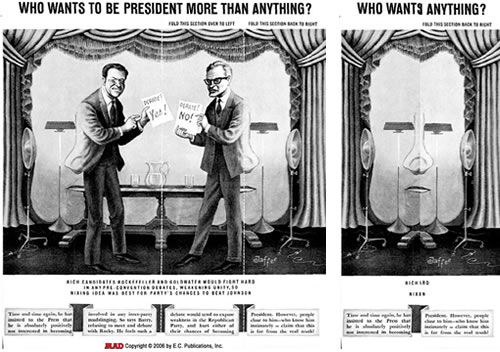
Con­ceived of as the satir­i­cal inverse of the expen­sive-to-pro­duce, 4‑color cen­ter­folds that were a sta­ple of glossier mags, the first Fold-In spoofed pub­lic per­cep­tion of actress Eliz­a­beth Tay­lor as a man-eater. Jaffe had fig­ured it as a one-issue gag, but edi­tor Al Feld­stein had oth­er ideas, demand­ing an imme­di­ate fol­low up for the June 1964 issue.

Jaffe oblig­ed with the Richard Nixon Fold-in, which set the tone for the oth­er 450 he has hand-ren­dered in sub­se­quent issues.

Al Jaffee Mad

For those who made it to adult­hood with­out the sin­gu­lar plea­sure of creas­ing Mad’s back cov­er, you can dig­i­tal­ly fold-in a few sam­ples using this nifty inter­ac­tive fea­ture, cour­tesy of The New York Times.

With all due respect, it’s not the same, just enough to give a feel for the thrill of draw­ing the out­er­most pan­el in to reveal the visu­al punch­line lurk­ing with­in the larg­er pic­ture. The print edi­tion demands pre­ci­sion fold­ing on the reader’s part, if one is to get a sat­is­fac­to­ry answer to the rhetor­i­cal text posed at the out­set.

Jaffe must be even more pre­cise in his cal­cu­la­tions. In an inter­view with Sean Edgar of Paste Mag­a­zine, he described how he turned a Repub­li­can pri­ma­ry stage shared by Nel­son Rock­e­feller and Bar­ry Gold­wa­ter into a sur­prise por­trait of the man who would become pres­i­dent five years hence:

The first thing I did was draw Richard Nixon’s face, not in great detail, just a very rough estab­lish­ment of where the eyes, nose and mouth would be, and the gen­er­al shape. I did an exag­ger­at­ed car­i­ca­ture of Nixon and then I cut it in half, and moved it apart. Once the face was cut in half, it didn’t have the integri­ty of a face any­more — it was sort of a half of face. Then I looked at what the eyes were like, and I said, ‘what can I make out of the eyes?’ He had these heavy eye­brows. I played around with many things, but I had to keep in mind all the time what the big pic­ture was. So there they (Gold­wa­ter and Rock­e­feller) were up on a stage some­where, doing a debate, and I thought, ‘What kind of stage prop can I put along­side these guys that would seem nat­ur­al there?’ I decid­ed that I could make eyes out of the lamps, and as far as the nose was con­cerned, that could come out of the fig­ures — their cloth­ing. Then I fig­ured the mouth; I could use some sort of table that could give me those two sides. That’s how it all came about. You have to have some kind of visu­al imag­i­na­tion to see the pos­si­bil­i­ties. I had to con­cen­trate on stuff that looked nat­ur­al on a stage.

Each Fold-In is a reflec­tion of the zeit­geist. Past pre­oc­cu­pa­tions have includ­ed Viet­nam, fem­i­nism, ille­gal drug use and, more recent­ly, the Jer­sey Shore.

via Gothamist

Relat­ed Con­tent:

A Gallery of Mad Magazine’s Rol­lick­ing Fake Adver­tise­ments from the 1960s

Watch Mad Magazine’s Edgy, Nev­er-Aired TV Spe­cial (1974)

A Look Inside Char­lie Heb­do, Their Cre­ative Process & the Mak­ing of a Fate­ful Car­toon

Chuck Jones’ 9 Rules For Draw­ing Road Run­ner Car­toons, or How to Cre­ate a Min­i­mal­ist Mas­ter­piece

Car­toon­ists Draw Their Famous Car­toon Char­ac­ters While Blind­fold­ed (1947)

Ayun Hal­l­i­day is an author, illus­tra­tor, and Chief Pri­ma­tol­o­gist of the East Vil­lage Inky zine. Fol­low her @AyunHalliday

by | Permalink | Make a Comment ( 4 ) |

Historical Italian Cooking: How to Make Ancient Roman & Medieval Italian Dishes

Italy is wide­ly cel­e­brat­ed for hav­ing vig­i­lant­ly pre­served its food cul­ture, with the result that many dish­es there are still pre­pared in more or less the same way they have been for cen­turies. When you taste Ital­ian food at its best, you taste his­to­ry — to bor­row the name of a Youtube chan­nel whose suc­cess has revealed a sur­pris­ing­ly wide­spread enthu­si­asm for the cui­sine of bygone eras. But some of Italy’s most glob­al­ly beloved comestibles aren’t quite as deeply root­ed in the past as peo­ple tend to assume: there are no records of tiramisu, for instance, before the nine­teen-six­ties; cia­bat­ta, the Ital­ian answer to the baguette, was invent­ed in the ear­ly nine­teen-eight­ies.

Nei­ther of them appear any­where in His­tor­i­cal Ital­ian Cook­ing, a bilin­gual blog in Eng­lish and Ital­ian that teach­es how to par­take in far more ven­er­a­ble culi­nary tra­di­tions. A vari­ety of peri­ods are rep­re­sent­ed: the nine­teenth cen­tu­ry (Neapoli­tan cala­mari, tagli­atelle and beef stew), the Renais­sance (cros­ti­ni with guan­ciale and sage, elder­flow­ers frit­ters), the Mid­dle Ages (monk’s stuffed-egg soup, quails with sumac), and even the time of ancient Rome (cut­tle­fish cakes, Horace’s lagana and chick­peas).

You can also see these and oth­er dish­es pre­pared on His­tor­i­cal Ital­ian Cook­ing’s Youtube chan­nel, which offers playlists orga­nized by era, region, and chief ingre­di­ent: Medieval Tus­can recipes, ancient fish recipes, ear­ly medieval recipes at the court of the Franks.

His­tor­i­cal Ital­ian Cook­ing’s most pop­u­lar video shows every step involved in mak­ing “the most famous ancient Mediter­ranean sauce, garum.” The recipe comes straight from De Re Coquinar­ia, the old­est known cook­book in exis­tence, which we’ve pre­vi­ous­ly fea­tured here on Open Cul­ture. If you’d like to try your hand at mak­ing this bold condi­ment, make sure you’ve got the time: you’ll have to let the fish it’s made of it sit for at least a few days, stir­ring it three or four times per day, though some recipes sug­gest con­tin­u­ing this process for three or four months before the garum is ready to eat. If, on fur­ther con­sid­er­a­tion, you’d pre­fer to make a piz­za, His­tor­i­cal Ital­ian Cook­ing can help with that as well: just make sure you’ve got enough lard and quails.

Relat­ed con­tent:

A Free Course from MIT Teach­es You How to Speak Ital­ian & Cook Ital­ian Food All at Once

The Futur­ist Cook­book (1930) Tried to Turn Ital­ian Cui­sine into Mod­ern Art

Tast­ing His­to­ry: A Hit YouTube Series Shows How to Cook the Foods of Ancient Greece & Rome, Medieval Europe, and Oth­er Places & Peri­ods

When Ital­ian Futur­ists Declared War on Pas­ta (1930)

Explore the Roman Cook­book, De Re Coquinar­ia, the Old­est Known Cook­book in Exis­tence

Ital­ian Advice on How to Live the Good Life: Cig­a­rettes, Toma­toes, and Oth­er Pic­turesque Small Plea­sures

Based in Seoul, Col­in Marshall writes and broad­casts on cities, lan­guage, and cul­ture. His projects include the Sub­stack newslet­ter Books on Cities, the book The State­less City: a Walk through 21st-Cen­tu­ry Los Ange­les and the video series The City in Cin­e­ma. Fol­low him on Twit­ter at @colinmarshall or on Face­book.

« Go BackMore in this category... »
Quantcast