Read along with the text of the 25th Amendment online here. And get some background from the Constitution Center here, and Vox’s explainer here.
Read along with the text of the 25th Amendment online here. And get some background from the Constitution Center here, and Vox’s explainer here.

I want every morning to be a new year’s for me. Every day I want to reckon with myself, and every day I want to renew myself. No day set aside for rest. I choose my pauses myself, when I feel drunk with the intensity of life and I want to plunge into animality to draw from it new vigour.
“Everyday is like Sunday,” sang the singer of our mopey adolescence, “In the seaside town that they forgot to bomb.” Somehow I could feel the grey malaise of post-industrial Britain waft across the ocean when I heard these words… the dreary sameness of the days, the desire for a conflagration to wipe it all away….
The call for total annihilation is not the sole province of supervillains and heads of state. It is the same desire Andrew Marvell wrote of centuries earlier in “The Garden.” The mind, he observed, “withdraws into its happiness” and creates “Far other worlds, and other seas; Annihilating all that’s made / To a green thought in a green shade.”
Is not annihilation what we seek each year on New Year’s Eve? To collectively wipe away the bad past by fiat, with fireworks? To welcome a better future in the morning, because an arbitrary record keeping system put in place before Marvell was born tells us we can? The problem with this, argued Italian Marxist party pooper and theorist Antonio Gramsci, is the problem with dates in general. We don’t get to schedule our apocalypses.
On January 1st, 1916, Gramsci published a column titled “I Hate New Year’s Day” in the Italian Socialist Party’s official paper Avanti!, which he began co-editing that year.
Every morning, when I wake again under the pall of the sky, I feel that for me it is New Year’s day.
That’s why I hate these New Year’s that fall like fixed maturities, which turn life and human spirit into a commercial concern with its neat final balance, its outstanding amounts, its budget for the new management. They make us lose the continuity of life and spirit. You end up seriously thinking that between one year and the next there is a break, that a new history is beginning; you make resolutions, and you regret your irresolution, and so on, and so forth. This is generally what’s wrong with dates.
The dates we keep, he says, are forms of “spiritual time-serving” imposed on us from without by “our silly ancestors.” They have become “invasive and fossilizing,” forcing life into repeating series of “mandatory collective rhythms” and forced vacations. But that is not how life should work, according to Gramsci.
Whether or not we find merit in his cranky pronouncements, or in his desire for socialism to “hurl into the trash all of these dates with have no resonance in our spirit,” we can all take one thing away from Gramsci’s critique of dates, and maybe make another resolution today: to make every morning New Year’s, to reckon with and renew ourselves daily, no matter what the calendar tells us to do. Read a full translation of Gramsci’s column at Viewpoint Magazine.
Related Content:
Woody Guthrie’s Doodle-Filled List of 33 New Year’s Resolutions From 1943
Marilyn Monroe’s Go-Getter List of New Year’s Resolutions (1955)
Josh Jones is a writer and musician based in Durham, NC. Follow him at @jdmagness
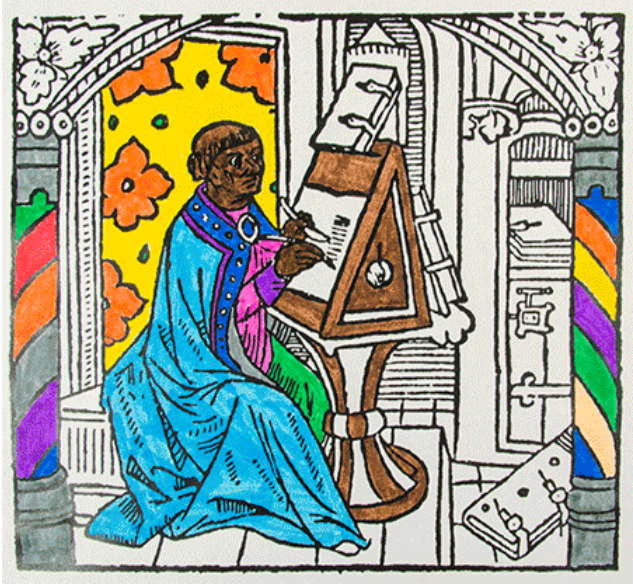
So, it’s been a year. For those of us in parts of the world where the pandemic still rages uncontained, it’s going to be an even longer winter. It may be utterly trivializing to speak of silver linings when it comes to clouds this size, but there’s no reason not to use our time wisely in quarantine, lockdown, cocooning, or whatever we’re calling it these days. For all of the enormous challenges, outrages, sorrows, and horrors of 2020, natural and manmade, we can be grateful for so many opportunities for personal growth.
“Those of us who are not sick, are not frontline workers, and are not dealing with other economic or housing difficulties” Rebecca Solnit writes, are given the task “to understand this moment, what it might require of us, and what it might make possible.” It is a moment, she says (echoing Heidegger’s ruminations on life after the dropping of the atomic bombs), in which “the impossible has already happened.”
Impossibles can be catastrophic and world changing disasters that “begin suddenly and never really end.” They can also be radical responses to disaster that open up possibilities we never imagined:
A disaster (which originally meant “ill-starred”, or “under a bad star”) changes the world and our view of it. Our focus shifts, and what matters shifts. What is weak breaks under new pressure, what is strong holds, and what was hidden emerges. Change is not only possible, we are swept away by it. We ourselves change as our priorities shift, as intensified awareness of mortality makes us wake up to our own lives and the preciousness of life. Even our definition of “we” might change as we are separated from schoolmates or co-workers, sharing this new reality with strangers. Our sense of self generally comes from the world around us, and right now, we are finding another version of who we are.
It is no exaggeration to say we have collectively witnessed the world change in a matter of a few months. Since Solnit wrote in April, we’ve had many more opportunities to meet circumstances wildly beyond our control. We are shaped by events, but how we respond, individually and together, also determines the kind of people we become.
We at Open Culture like to think we’ve contributed in some small way to our readers’ personal growth in the time of coronavirus, to their view of the world and their sense of who “we” are. Our readers responded most to messages of hope, resources for self-improvement and self-understanding, and cultural phenomena that have become sources of delight and inspiration no matter what’s going on. See our 15 top posts of 2020 below.
Let us know in the comments what other posts that didn’t make the list resonated with you in this time of sweeping change, and why. Perhaps it’s one more cosmic irony that the nightmarish year of 2020 also happens to be the number we use to symbolize perfect hindsight. But also tell us, readers, what did you learn this year, and how did you grow and change in ways you might have thought impossible a year ago?
Related Content:
The 150 Best Podcasts to Enrich Your Mind
1,500 Free Online Courses from Top Universities
Sign Up for Open Culture’s Free Daily Email
Josh Jones is a writer and musician based in Durham, NC. Follow him at @jdmagness.
One of the most pernicious, “dangerous, anti-human and soul-crushing” myths in the business world, writes Liz Ryan at Forbes, is the “idiotic nostrum” that has also crept into government and charitable work: “If you can’t measure it, you can’t manage it.” The received wisdom is sometimes phrased more cynically as “if you can’t measure it, it didn’t happen,” or more positively as “if you can’t measure it, you can’t improve it.”
But “the important stuff can’t be measured,” says Ryan. Don’t we all want to believe that? “Can’t Buy Me Love” and so forth. Maybe it’s not that simple, either. Take happiness, for example. We might say we disagree about its relative importance, but we all go about the business of trying to buy happiness anyway. In our hearts of hearts, it’s a more or less an unquestionable good. So why does it seem so scarce and seem to cost so much? Maybe the problem is not that happiness can’t be measured but that it can’t be commodified.
Buddhist economies like Bhutan, for example, run on a GHI (Gross National Happiness) index instead of GDP, and pose the question of whether the issue of national happiness is one of priorities. In other words, “you get what you measure.” In March, Laura Begley Bloom cited the 20 happiest countries in the world at Forbes, using the UN’s 2020 World Happiness Report, “a landmark survey of the state of global happiness,” as the report’s website describes it, “that ranks 156 countries by how happy their citizens perceive themselves to be.”
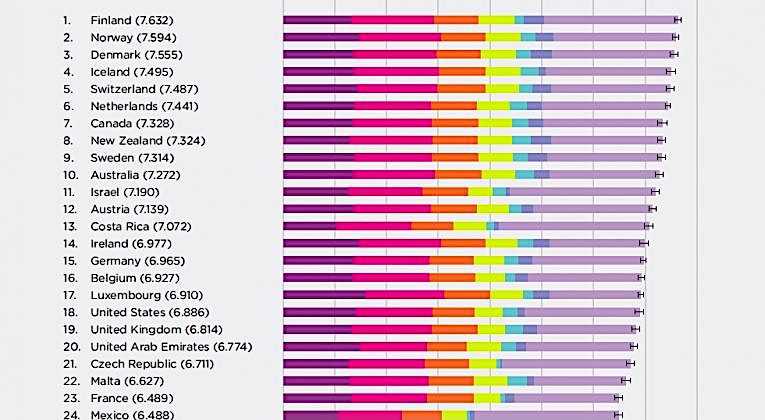
Happiness is measured across urban and rural environments and according to environmental quality and sustainable development metrics. The report uses six rubrics to assess happiness—levels of GDP, life expectancy, generosity, social support, freedom and corruption, and income. Their assessment relied on self-reporting, to give “a direct voice to the population as opposed the more top-down approach of deciding ex-ante what ought to matter.” The last chapter attempts to account for the so-called “Nordic Exception,” or the puzzling fact that “Nordic countries are constantly among the happiest in the world.”
Maybe this fact is only puzzling if you begin with the assumption that wealthy capitalist economies promote happiness. But the top ten happiest countries are wealthy “socialist friendly” mixed economies, as Bill Maher jokes in the clip at the top, saying that in the U.S. “the right has a hard time understanding we don’t want long lines for bread socialism, we want that you don’t have to win the lotto to afford brain surgery socialism.” This is comedy, not trenchant geo-political analysis, but it alludes to another significant fact.
Most of the world’s unhappiest countries and cities are formerly colonized places whose economies, infrastructures, and supply chains have been destabilized by sanctions (which cause long bread lines), bombed out of existence by wealthier countries, and destroyed by climate catastrophes. The report does not fully explore the meaning of this data, focusing, understandably, on what makes populations happy. But an underlying theme is the suggestion that happiness is something we achieve in real, measurable economic relation with each other, not solely in the pursuit of individualist ideals.
Related Content:
How Much Money Do You Need to Be Happy? A New Study Gives Us Some Exact Figures
Josh Jones is a writer and musician based in Durham, NC. Follow him at @jdmagness
The other day, I found myself reading about what life is like in countries that have successfully minimized the pandemic: worry free holidays, meeting friends and family without the danger of infection, a general air of normalcy thanks to a combination of rigorous public health efforts and public cooperation. I live in the U.S., where the political party currently in power (and desperate to keep it) convinced millions of my fellow citizens that the virus was a hoax, a scam, a political ploy. The reality of a virus-free existence seems like a fairy tale.
But perhaps, after a year of death, suffering, and lunacy, we will begin to see the tide turn once enough people get vaccinated… if we can overcome the massive wave of anti-science bias and disinformation about vaccines…. “The anti-vaccination movement is going to make Covid-19 more difficult to get under control,” says Scott Ratzan, distinguished lecturer at the CUNY Graduate School of Public Health and Health Policy.
Long before the vaccine arrived, Katherine O’Brien, a director at WHO, noted there was already a prominent “anti-vaccination voice” on social media. “We have to take this seriously,” she told The BMJ. “Vaccination isn’t just an individual choice; it protects those who can’t be vaccinated.” We’ve seen the term “herd immunity” misused a lot lately. What it essentially means is that a small number of people can be shielded from the virus if the vast majority get vaccinated. Or as WHO puts it, “herd immunity is achieved by protecting people from a virus, not by exposing them to it.”
All of this means there will likely never be a more critical moment to educate ourselves and others on the science of vaccines. We may not sway those faithful to a certain narrative, but it can help shift the conversation from fears of the unknown to the long history of the known when it comes to eradicating highly infectious, deadly diseases. A great way to start is with the basics, which you’ll find in the videos above from TED-Ed, Mechanisms of Medicine, and PBS. Watch them yourself, share them on social media, and keep the conversation about vaccines’ efficacy going.
In the TED-Ed lesson just above, we learn some more specific information about the key phases of developing a new vaccine: exploratory research, clinical testing, and manufacturing. You’ll find much more detailed information on the history of vaccines, spurious anti-vaccination claims, and the coronavirus vaccines now on the market and currently shipping around the world, at the award-winning site, The History of Vaccines, from the College of Physicians of Philadelphia.
The COVID-19 vaccine is a special kind of vaccine (mRNA) that works differently from most, and you can learn about how it works here. A quick primer on herd immunity appears at the bottom.
Related Content:
19th Century Maps Visualize Measles in America Before the Miracle of Vaccines
Josh Jones is a writer and musician based in Durham, NC. Follow him at @jdmagness.
Whatever your feelings about the sentimental, lighthearted 1960 Disney film Pollyanna, or the 1913 novel on which it’s based, it’s fair to say that history has pronounced its own judgment, turning the name Pollyanna into a slur against excessive optimism, an epithet reserved for adults who display the guileless, out-of-touch naïveté of children. Pitted against Pollyanna’s effervescence is Aunt Polly, too caught up in her grown-up concerns to recognize, until it’s almost too late, that maybe it’s okay to be happy.
Maybe we all have to be a little like practical Aunt Polly, but do we also have a place for Pollyannas? Can that not also be the role of the modern artist? David Byrne hasn’t been waiting for permission to spread joy in his late career. Contra the common wisdom of most adults, a couple years back Byrne began to gather positive news stories under the heading Reasons to Be Cheerful, now an online magazine.
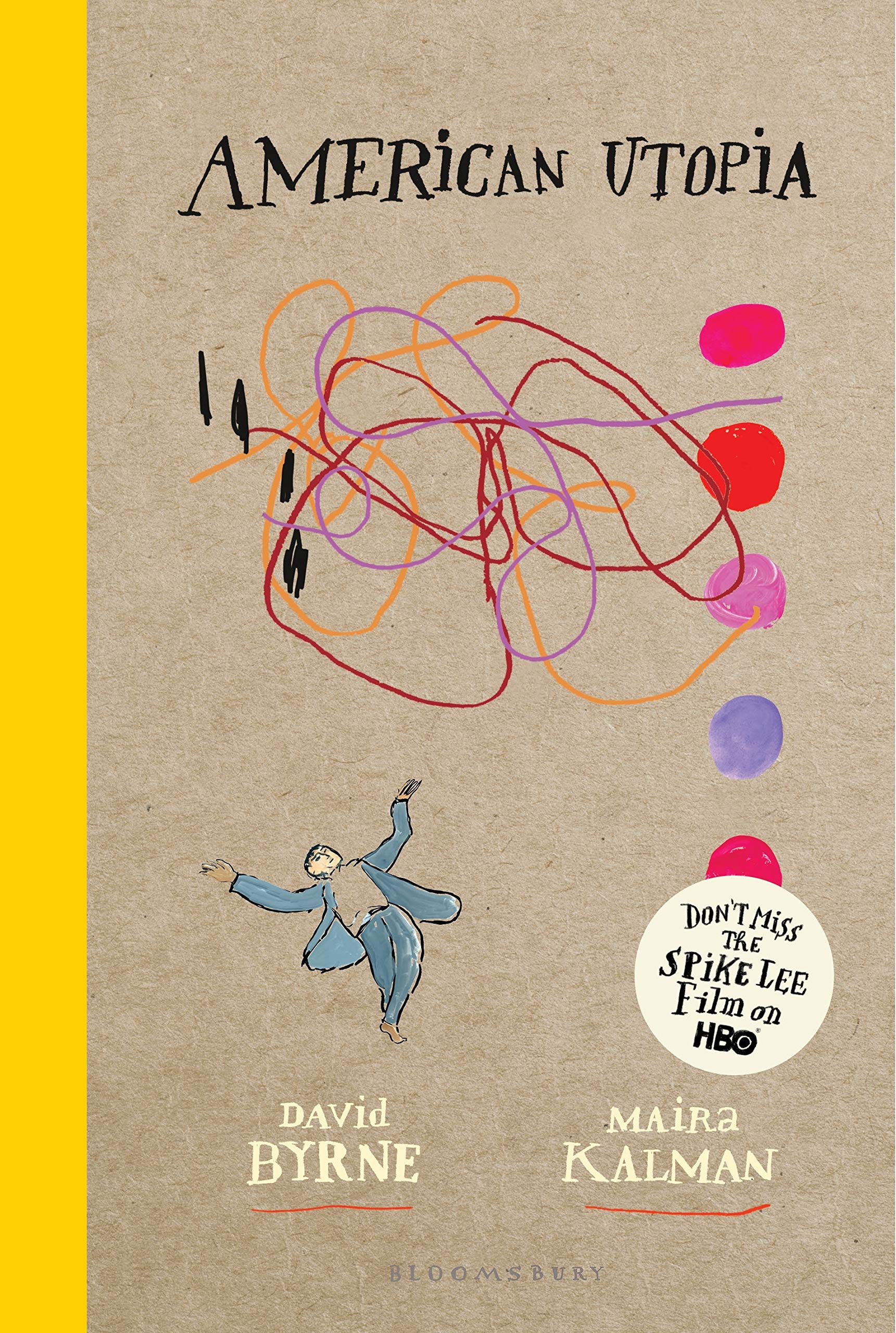
Then, Byrne had the audacity to call a 2018 album, tour, and Broadway show American Utopia, and the gall to have Spike Lee direct a concert film with the same title, and release it smack in the middle of 2020, a year all of us will be glad to see in hindsight. Byrne’s two-year endeavor can be seen as his answer to “American Carnage,” the grim phrase that began the Trump era.
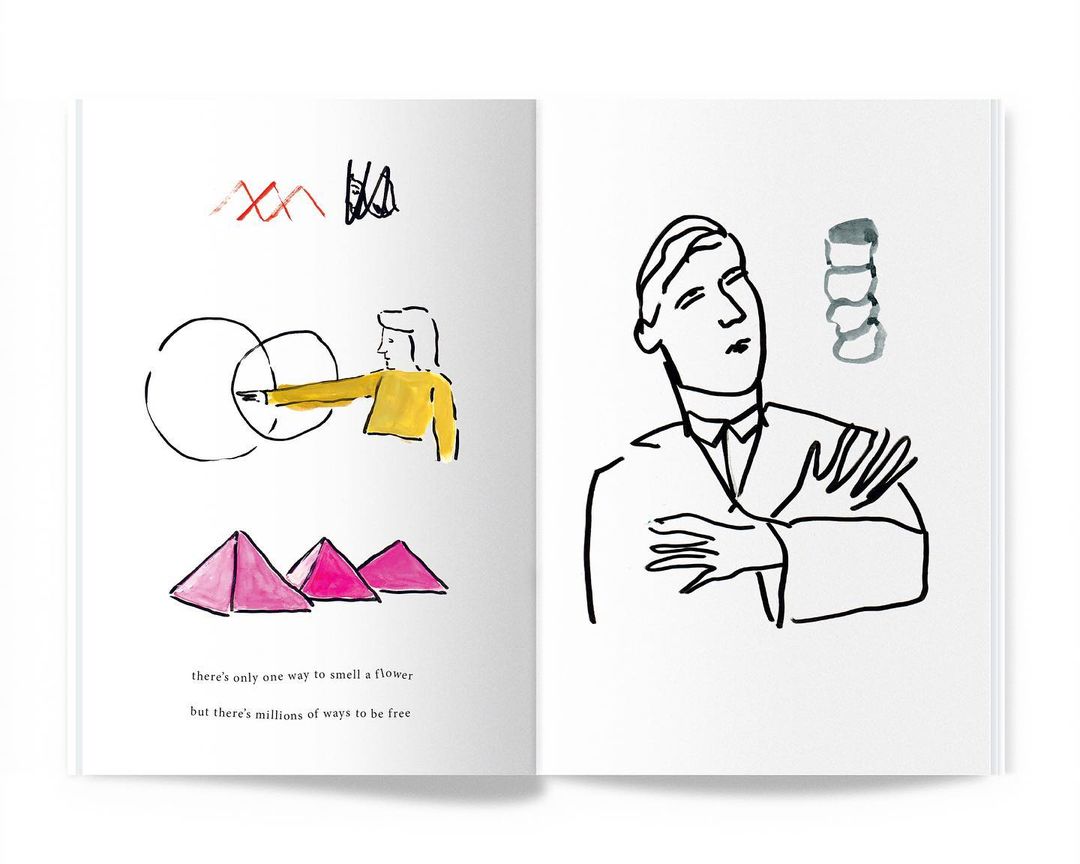
As if all that weren’t enough, American Utopia is now an “impressionistic, sweetly illustrated adult picture book,” as Lily Meyer writes at NPR, “a soothing and uplifting, if somewhat nebulous, experience of art.” Working with artist Maira Kalman, Byrne has turned his conceptual musical into something like a “book-length poem… filled with charming illustrations of trees, dancers, and party-hatted dogs.”
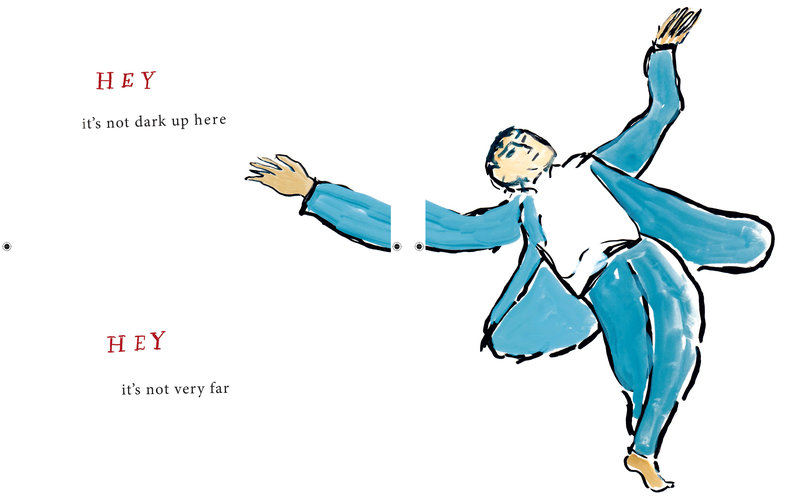
Byrne’s project is not naive, Maria Popova argues at Brain Pickings, it’s Whitmanesque, a salvo of irrepressible optimism against “a kind of pessimistic ahistorical amnesia” in which we “judge the deficiencies of the present without the long victory ledger of past and fall into despair.” American Utopia doesn’t articulate this so much as perform it, either with bare feet and gray suits onstage or the vivid colors of Kalman’s drawings, “lightly at odds,” Meyer notes, “with Byrne’s words, transforming their plain optimism into a more nuanced appeal.”
American Utopia the book, like the musical before it, was written and drawn before the pandemic. Do Byrne and Kalman still have reasons to be cheerful post-COVID? Just last week, they sat down with Isaac Fitzgerald for Live Talks LA to discuss it. You can see the whole, hour-long conversation just above. Kalman confesses she’s still in “quiet shock,” but finds hope in historical perspective and “incredible people out there doing fantastic things.”
Byrne takes us on one of his fascinating investigations into the history of thought, referencing a theorist named Aby Warburg who saw in the sum total of art a kind “animated life” that connects us, past, present, and future, and who reminded him, “Yes, there are other ways of thinking about things!” Perhaps the visionary and the Pollyannaish need not be so far apart. See several more of Kalman and Byrne’s beautifully optimistic pages from American Utopia, the book, at Brain Pickings.
Related Content:
David Byrne’s American Utopia: A Sneak Preview of Spike Lee’s New Concert Film
Watch Life-Affirming Performances from David Byrne’s New Broadway Musical American Utopia
Josh Jones is a writer and musician based in Durham, NC. Follow him at @jdmagness
Chances are you’ve looked at more graphs this past year than you did over the previous decade — not just while working at home, but while scrolling through cascades of often-troubling quantitative information during your “off” hours as well. This phenomenon has hardly been limited to the Americans who obsessed over the predictions of and returns from their presidential election last month, an event turned practically into a sideshow by the ongoing pandemic. Around the world, we’ve all wanted to know: Where did the coronavirus come from? What is it? Where is it going?
Apologies to Paul Gauguin, who didn’t even live to see the Spanish flu of 1918, a time when nobody could have imagined instantaneously and widely sharing visual renderings of data about that disease. The world of a century ago may not have had dynamic animated maps and charts, updated in real time, but it did have crochet. Whether or not it had then occurred to anyone as a viable medium for visualizing the spread of disease, it can be convincing today. This is demonstrated by Norwegian biostatistician Kathrine Frey Frøslie, who in the video above shows us her crocheted representations of various “R numbers.”
This now much-heard term, Frøslie’s explains, “denotes reproduction. If the R number is one, this means that each infected person will on average infect one new person during the course of the disease. If R equals two, each infected person will infect two persons,” and so on. Her crocheted version of R=1, with a population of ten, is small and narrow — it looks, in other words, entirely manageable. Such a disease “will always be always present, but the number of infected persons will be constant.” Her R=0.9, which steadily narrows in a way that resembles an unfinished Christmas stocking, looks even less threatening.
Alas, “for the coronavirus, the R is mostly larger than one.” In crocheted form, even R=1.1 is pretty formidable; when she brings out her R=1.5, “it is evident that we have a problem. Even the crochet patch kind of crumbles.” Then out comes R=2, which must have been quite a project: its ten original infections bloom into 2,560 new cases, all represented in almost organically dense folds of yarn. As for R=2.5, when Frøslie eventually gets it hoisted onto her lap, you’ll have to see it to believe it. Throughout 2020, of course, many of our at-home hobbies have grown to monstrous proportions — even those taken up by medical scientists.
via Metafilter
Related Content:
Simulating an Epidemic: Using Data to Show How Diseases Like COVID-19 Spread
Everything You Need To Know About Viruses: A Quick Visual Explanation of Viruses in 9 Images
The History of the Plague: Every Major Epidemic in an Animated Map
An Artist Crochets a Life-Size, Anatomically-Correct Skeleton, Complete with Organs
The Beautiful Math of Coral & Crochet
Based in Seoul, Colin Marshall writes and broadcasts on cities, language, and culture. His projects include the Substack newsletter Books on Cities, the book The Stateless City: a Walk through 21st-Century Los Angeles and the video series The City in Cinema. Follow him on Twitter at @colinmarshall, on Facebook, or on Instagram.
If any cultural, political, or technological phenomenon of the past couple of decades hasn’t been lampooned by South Park, it probably didn’t happen. But the 21st century has brought forth so much nonsense that even Trey Parker and Matt Stone, creators of that at once crude and multidimensionally satirical cartoon show, have had to expand into feature films and even onto Broadway to ridicule it all. The latest project takes the humbler but undeniably more relevant form of a Youtube series, and one modeled on the form of ultra-local television news. Sassy Justice comes hosted by anchor Fred Sassy, a flamboyant “consumer advocate” for the people of Cheyenne, Wyoming — and one possessed, come to think of it, of an oddly familiar face.
Fred Sassy is based on Sassy Trump, a creation of voice actor Peter Serafinowicz. Despite his formidable skills as an impressionist, the trouble Serafinowicz had nailing the sound and manner of the current U.S. President gave him the idea of dubbing over real footage of the man with deliberately invented character voices. This led to an interest in deepfakes, videos created using digital likenesses of real people without their actual participation.
The increasingly convincing look of these productions once had a lot of people spooked, as you’ll recall if you can cast your mind back to 2019. Deepfakes thus made perfect subject matter for a Parker-Stone project, but not long after they began collaborating with Serafinowicz on a deepfake-saturated Fred Sassy movie, the coronavirus pandemic put an end to production. From the ashes of that project rises Sassy Justice, which premiered last month.
This first episode (with a clip playlist here) also provides a glimpse of the surely enormous all-deepfake cast to come. Uncanny versions of Al Gore, Mark Zuckerberg (now a dialysis-center magnate), and Julie Andrews (as computer technician “Lou Xiang,” a reference that if you get, you get) all make appearances, as do those of White House regulars Jared Kushner, Ivanka Trump, and even Donald Trump, on whose voice Serafinowicz seems to have made progress. But “it’s impossible for a human to accurately mimic someone else’s voice to 100 percent,” as Sassy is assured by a Zoom interviewee, the oft-imitated actor Michael Caine — or is it? Less able than ever to tell real from the fake, let alone the deepfake, “we’re all going to have to trust our gut, that inner voice,” as Sassy advises in the episode’s final segment. “It’s all we have now.” But then, all effective satire is a little frightening.
Related Content:
The Zen Wisdom of Alan Watts Animated by the Creators of South Park, Trey Parker and Matt Stone
American History: An Off-Kilter 1992 Student Film from South Park Creator Trey Parker
Artificial Intelligence Creates Realistic Photos of People, None of Whom Actually Exist
Based in Seoul, Colin Marshall writes and broadcasts on cities, language, and culture. His projects include the Substack newsletter Books on Cities, the book The Stateless City: a Walk through 21st-Century Los Angeles and the video series The City in Cinema. Follow him on Twitter at @colinmarshall, on Facebook, or on Instagram.


Open Culture scours the web for the best educational media. We find the free courses and audio books you need, the language lessons & educational videos you want, and plenty of enlightenment in between.

©2006-2026 Open Culture, LLC.
All rights reserved.
