As we still say today, all roads lead to Rome. Or at least they did at the height of its power, which historians tend to place in the second century. It was in that century that the Greco-Egyptian polymath Ptolemy wrote his book Geography, whose description of all known lands inspired an unprecedentedly detailed world map. As Ptolemy’s map illustrates, “the Romans, for all their rhetoric about universal empire, were aware that the world was much larger than their domains.” So says ancient-history Youtuber Garrett Ryan in “The Most Distant Places Visited by the Romans,” a video essay from his channel Told in Stone.
Ryan explains what history has recorded of “the vast range and reach of Roman merchants and adventurers,” who made it to Africa, Scandinavia, India, and even China. Some may have been motivated by pure wanderlust (the ancient Roman equivalent of Eurail-hopping college graduates, perhaps) but surely most of them would have set out on such long, arduous, and even dangerous journeys with glory and wealth in mind.
It was the promise of spices, frankincense, and myrrh, for instance, that drew Roman traders to Arabia Felix (or modern-day Yemen), despite the region’s reputation for being “overrun by flying snakes.”
However impressive ancient Rome’s geographical knowledge, they clearly had yet to get the details straight. But they knew enough to bring back from a variety of far-flung lands not just tall tales but treasures unavailable elsewhere, turning the metropole into a reflection of the world. Few such items would have been as visible in Rome as silk, “an indispensable luxury used in everything from legionary standards to the robes of the emperors.” That material came from China, most often purchased through dealers in Central Asia and India. But some particularly adventurous Romans made it not just to the Middle Kingdom but into the very palace of the Chinese emperor. All those roads to Rome were, after all, two-way streets.
Based in Seoul, Colin Marshall writes and broadcasts on cities, language, and culture. His projects include the Substack newsletterBooks on Cities, the book The Stateless City: a Walk through 21st-Century Los Angeles and the video series The City in Cinema. Follow him on Twitter at @colinmarshall, on Facebook, or on Instagram.
The World Trade Center was not at first a beloved work of architecture, but over time it settled into its place on the New York skyline, gaining wide acceptance as an icon of the city. Its destruction on September 11, 2001 greatly intensified that symbolic power, especially as expressed by the image of Minoru Yamasaki’s Twin Towers. But as longtime New Yorkers (or at least longtime Lower Manhattanites) remember, the WTC consisted of more than a pair of skyscrapers. Dating from America’s era of “urban renewal,” with its ambitions of building cities within cities, it also incorporated several shorter office buildings, a hotel, and an underground shopping mall.
In other words, the WTC was a complex — which also happens to be just the adjective to describe the property-rights situation in the wake of its devastation. Talk of the imperative to rebuild began very soon indeed after September 11, but organizing a rise from the ashes was, predictably, easier said than done. As explained in “How the World Trade Center Was Rebuilt,”the video essay above from Youtube channel Neo, the Port Authority of New York and New Jersey first had to re-acquire the leases from all the different major tenants involved. And then there was the task of negotiating with Larry Silverstein.
Having developed the original 7 World Trade Center building in 1980, Silverstein long had his eye on the whole shebang. He finally managed to sign a 99-year lease-purchase agreement on the complex on July 24, 2001 — surely one of this century’s signal cases of bad timing. But he did jump into the task of rebuilding as soon as possible, completing the new 7 World Trade Center just five years later. According to the story told in the video, it would hardly be an exaggeration to characterize the project of redeveloping the WTC site as a grudge match between Silverstein and the Port Authority, with their dueling visions of the proper way to fill that highly-charged space.
That project continues still today, just over two decades after the terrorist attacks that brought the Twin Towers down. David Childs’ 1776-foot-tall “twisting glass monolith” One World Trade Center opened in 2014, but the much-delayed Ronald O. Perelman Performing Arts Center at the World Trade Center is still under construction, as is the new 2 World Trade Center. With its recent completion, Santiago Calatrava’s St. Nicholas Greek Orthodox Church joins his existing World Trade Center Transportation Hub. Topped by a structure called the Oculus, designed (if not flawlessly) to open to the sky once a year on September 11, that striking transit complex also includes an expansive Westfield shopping mall: a juxtaposition of memory and commerce with power of its own as a symbol of twenty-first century America.
Based in Seoul, Colin Marshall writes and broadcasts on cities, language, and culture. His projects include the Substack newsletterBooks on Cities, the book The Stateless City: a Walk through 21st-Century Los Angeles and the video series The City in Cinema. Follow him on Twitter at @colinmarshall, on Facebook, or on Instagram.
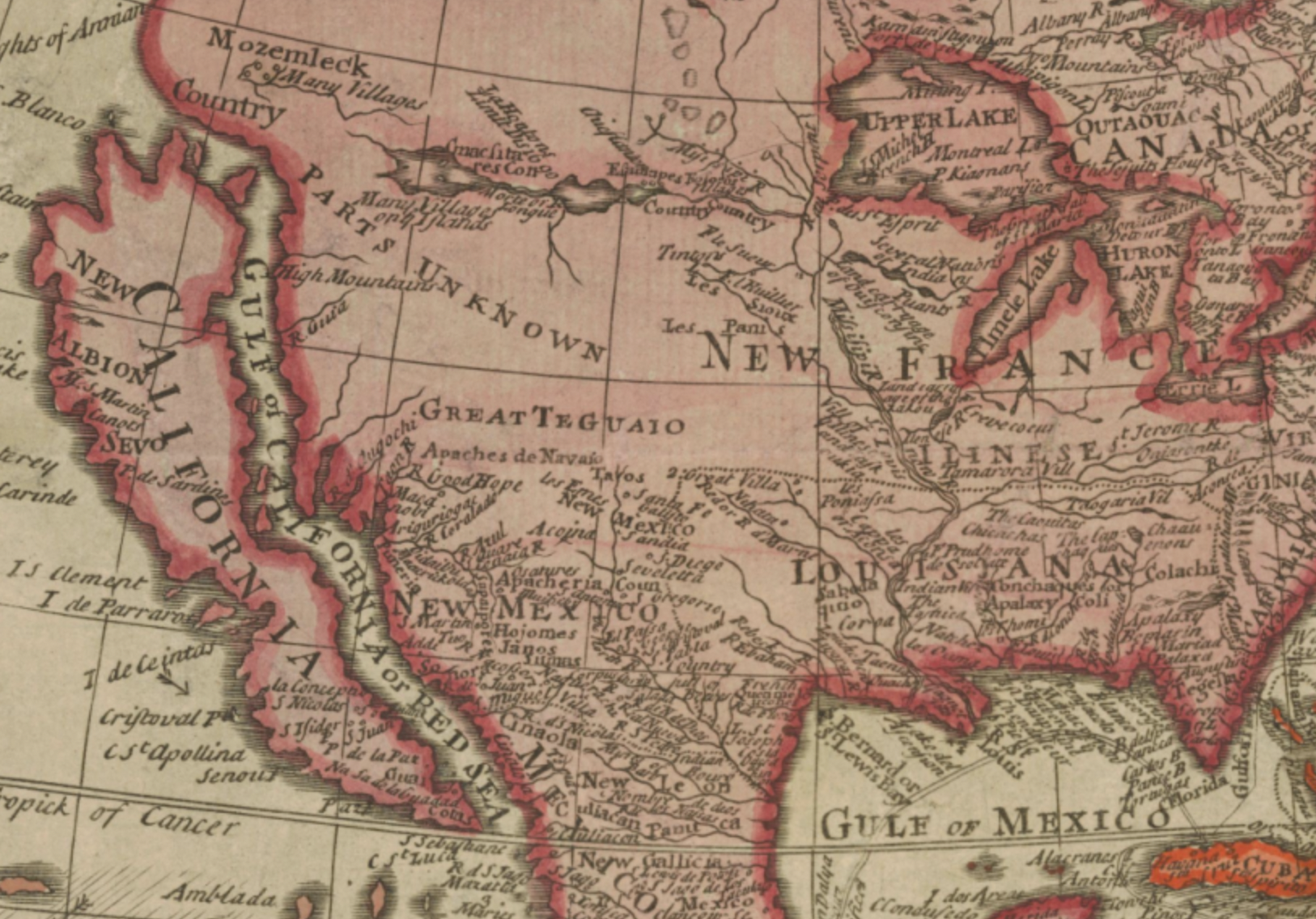
In the opening of John Carpenter’s Escape from L.A., an earthquake separates Los Angeles from the mainland, and the city is repurposed into “the deportation point for all people found undesirable or unfit to live in a new, moral America.” The film’s premise (like that of Escape from New York, which it follows) taps into a deeply held sentiment about its setting. Los Angeles has long been seen as an absurd concentration of all the qualities that make California unlike the rest of the United States. California remains a state apart in a metaphorical sense, but there was a time when it was also thought to be a state apart, literally: that is to say, an island.
The word California originates in a novel, published in 1510, called Sergas de Esplandián. In that book it refers to “an island populated by black women without any men existing there. On the entire island, there was no metal other than gold.” Author Garci Rodríguez de Montalvo’s tantalizing description of California — as well as of the “beautiful and robust bodies” of its women — got Spanish seafarers curious about the extent to which it could have been based in reality.
(At that time, the mass-printed novel was still an enrapturing new development.) This account comes from Youtuber Johnny Harris’ video above, “The Biggest Mapping Mistake of All Time,” which connects this fantastical literary invention to centuries of geographical misconception.
The conquistador Hernán Cortés seems to have been the first prominent figure to feel the pull of California. And he certainly wasn’t the last, despite never quite having managed to pin the place down. Spain’s most ardent California enthusiasts held so fast to the notion of its being an island that it spread elsewhere in Europe, and eventually to London. With the perception thus legitimized, California appeared disconnected from the North American coast on maps printed as far away as Japan. Harris credits California’s “mythical pull,” then as now, with making it “a place where people go to dream big” — and often “to chase dreams that aren’t grounded in any sense of reality.” Fortunately, he himself lives in Washington D.C., where delusions are wholly unknown.
Based in Seoul, Colin Marshall writes and broadcasts on cities, language, and culture. His projects include the Substack newsletterBooks on Cities, the book The Stateless City: a Walk through 21st-Century Los Angeles and the video series The City in Cinema. Follow him on Twitter at @colinmarshall, on Facebook, or on Instagram.
On many of my trips to Japan I’ve stayed at the Capsule Inn Osaka, which is exactly where and what it sounds like. To any foreigner the place would be an intriguing novelty, but to those interested in Japanese architecture it also has great historical value. Designed by architect Kurokawa Kisho, the Capsule Inn Osaka opened in 1979 as the world’s first capsule hotel, a form of lodging now widely regarded as no less quintessentially Japanese than the ryokan. At that point Kurokawa had already been advancing capsule as an architectural unit for years, contributing a “capsule house” and capsule-based corporate pavilions to the Osaka World Expo 1970, and even building a curious masterwork of the genre in Tokyo’s Nakagin Capsule Tower.
The other architects involved in Expo ’70 included Tange Kenzo, Kawazoe Noboru, Maki Fumihiko, Kikutake Kiyonori, and Isozaki Arata — all associated to one degree or another with Metabolism, an architectural movement inspired by the rapid economic growth, enormous urban expansion, and unprecedented technological change then transforming postwar Japan. The Metabolists “approached the city as a living organism consisting of elements with different metabolic cycles,” writes Lin Zhongjie in Kenzo Tange and the Metabolist Movement: Urban Utopias of Modern Japan. “To accommodate a city’s growth and regeneration, Metabolists advanced transformable technologies based on prefabricated components and the replacement of obsolete parts according to varying life cycles.”
When it opened in 1972, the Nakagin Capsule Tower did so as the first fully realized Metabolist project. Abroad in Japan host Chris Broad introduces it as “not only my favorite building in all of Tokyo, but in all of Japan.” He also contextualizes it within a brief history of Metabolism, as well as of the postwar Japanese society that fired up its practitioners’ aesthetically brazen, techno-Utopian ideals. Geared to the work-dominated, peripatetic lifestyle of what Kurokawa called “homo movens,” the Nakagin Capsule Tower actually consisted of two concrete cores onto which were bolted 140 capsules (architectural theorist Charles Jencks likened their aspect to “superimposed washing machines”), each a self-contained living space replete with cutting-edge amenities up to and including a bathtub ashtray Sony reel-to-reel tape player.
Kurokawa envisioned the capsules being replaced every 25 years over a lifetime of centuries. Alas, the difficulty of such an operation meant that the originals were simply left in, and by the end of the twentieth century many had badly deteriorated. “Ironically,” writes Lin, “Tokyo is growing and transforming itself so rapidly that it even outpaces the ‘metabolism’ that the Metabolists envisioned, and requires renewals on the scale of entire buildings instead of individual capsules.” First announced in 2007, the year of Kurokawa’s death, the building’s demolition began this past April, and it has occasioned such tributes as Studio Ito’s elegiac animation just above. The Nakagin Capsule Tower stood for half a century, long outliving Metabolism itself, but its capsules will now scatter across the world, suggesting that there was something to the biological metaphor all along.
Based in Seoul, Colin Marshall writes and broadcasts on cities, language, and culture. His projects include the Substack newsletterBooks on Cities, the book The Stateless City: a Walk through 21st-Century Los Angeles and the video series The City in Cinema. Follow him on Twitter at @colinmarshall, on Facebook, or on Instagram.
When it comes to chili, Texas, Kansas City and Cincinnati, will cede no quarter, each convinced that their particular regional approach is the only sane option.
Hot dogs? Put New York City and Chicago in a pit and watch them tear each other to ribbons.
But pizza?
There are so many geographic variations, even an impartial judge can’t see their way through to a clear victor.
The playing field’s thick as stuffed pizza, a polarizing Chicago local specialty that’s deeper than the deepest dish.
Wait, though. We all have an acquaintance who takes perverse pleasure in offbeat topping choices — looking at you, California — but other than that, isn’t pizza just sauce, dough, and cheese?
How much room does that leave for variation?
Plenty as it turns out.
Crusts, thick or thin, fluctuate wildly according to the type of flour used, how long the dough is proofed, the type of oven in which they’re baked, and philosophy of sauce placement.
(In Buffalo, New York, pizzas are sauced right up to their circumference, leaving very little crusty handle for eating on the fly, though perhaps one could fold it down the middle, as we do in the city 372 miles to the south.)
Sauce can also swing pretty wildly — sweet, spicy, prepared in advance, or left to the last minute — but cheese is a much hotter topic.
Detroit’s pizza is distinguished by the inclusion of Wisconsin brick cheese.
St. Louis is loyal to Provel cheese, a homegrown processed mix of cheddar, Swiss, and provolone and liquid smoke.
Miami pizzas cater to the palates of its Cuban population by mixing mozzarella with gouda, a cheese that was both widely available and popular before 1962’s rationing system was put in place.
In the land of opportunity, where smaller towns are understandably eager to claim their piece of pie, Weird History Food gives the nod to Old Forge, Pennsylvania, optimistically dubbed “the Pizza Capital of the World by Uncovering PA’s Jim Cheney, and Steubenville Ohio, home of the “oversized Lunchable” Atlas Obscura refers to as America’s most misunderstood pizza.
For good measure, watch the PBS Idea Channel’s History of Pizza in 8 slices, below, then rep your favorite local pizzeria in the comments.
Across vast swathes of the world, many of us — arguably too many of us — have grown accustomed to putting on little more than a T‑shirt and jeans every morning, regardless of our status in society. We all know it wasn’t always this way, but we may not fully understand just how much it wasn’t always this way. Throughout most of civilized human history, dressing didn’t just reflect one’s way of life, it practically constituted a way of life in itself. Thanks to Youtube channel Crow’s Eye Productions, we here in the twenty-first century can enjoy detailed, even cinematic re-creations of the dressing process in various eras and places the West, from Roman Britain to Renaissance Florence to 1969 London.
You can watch all 35 of these dressing videos in chronological order with this playlist. Many of the dressers, including such august personages as Prince Albert and Queen Victoria (on Christmas Day, no less), occupy elevated social positions.
But the maids and gardeners of the Victorian era had to get dressed too, and though their clothing may be simpler than that worn by the royals — or even by the middle class — it’s no less revealing of history. One could no doubt tell an even richer story of technological, economic, and cultural change over the centuries through the clothing of “the masses” than through the clothing of the elites.
Even war, that most traditional historical subject of all, has its connections with dress. This playlist features three videos on the dressing routines of soldiers, nurses, and young women during the First World War, as well as one on the members of the Women’s Land Army during the Second World War. Established in 1917, the WLA organized “Land Girls” to take over the agricultural work while the men who’d been doing it were out fighting on the front.
This was just the kind of effort necessitated by total war, as well as one that could only have been performed by women. It’s also, therefore, engagingly approachable by a series like this, with its primary focus on women’s dress — which, at least since the Great Male Renunciation, has had a pretty spectacular history of its own.
Based in Seoul, Colin Marshall writes and broadcasts on cities, language, and culture. His projects include the Substack newsletterBooks on Cities, the book The Stateless City: a Walk through 21st-Century Los Angeles and the video series The City in Cinema. Follow him on Twitter at @colinmarshall, on Facebook, or on Instagram.
Real estate is a perennially hot topic in New York City, as is gentrification.
Above, architect Michael Wyetzner, breaks down the defining features of several typical NYC apartments.
You’re on your own to truffle up the sort of rent a 340 square feet studio commands in an East Village tenement these days.
The ancestors would be shocked, for sure. My late mother-in-law never tired of causing young jaws to drop by revealing how she once paid $27/month for a 1 bedroom on Sheridan Square…and her mother, who immigrated at the turn of the century, couldn’t wait to put the Lower East Side behind her.
He may not truck in final sales figures, but Wyetzner drops in a wealth of interesting factual tidbits as he sketches layouts with a black Pentel Sign Pen. His tone is more Lower East Side Tenement Museum tour guide than the comments section of a real estate blog where salty New Yorkers flaunt their street cred.
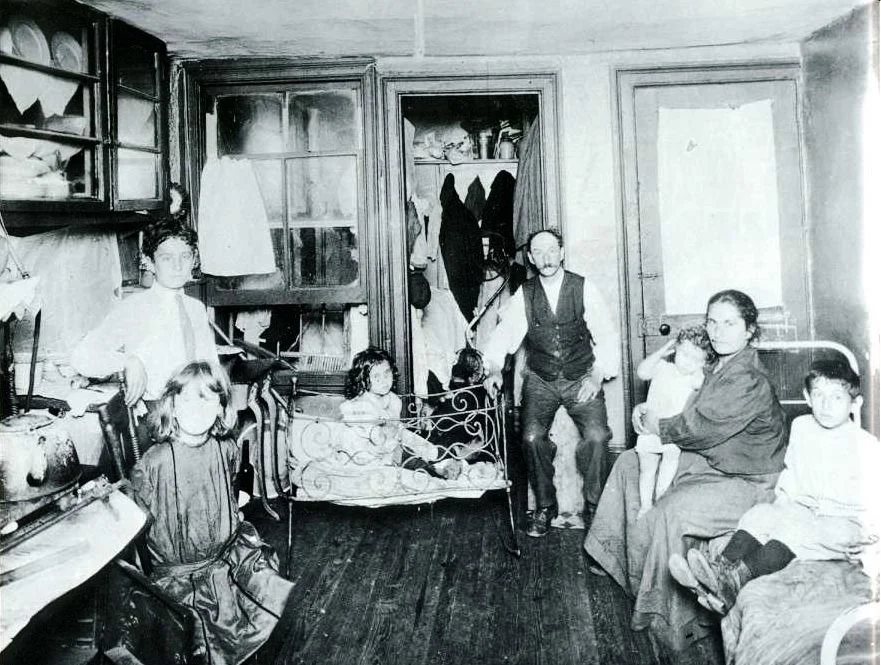
For instance, those enfilade tenement apartments–to employ the grand architectural term Wyetzner just taught us–were not only dark, but dangerously under-ventilated until 1901, when reforms stipulated that air shafts must be opened up between side by side buildings.
This public health initiative changed the shape of tenement buildings, but did little to stop the poverty and overcrowding that activist/photographer Jacob Riis famously documented in How the Other Half Lives.
(Another measure decreed that building owners must supply one indoor toilet …per 20 people!)
While we’re on the topic of toilets, did you know that there was a time when every brownstone backyard boasted its own privy?
Homeowners who’ve spent millions on what many conceive of as the most romantic of New York City buildings (then millions more on gut renovations) proudly display old bottles and other refuse excavated from the site where privys once stood. The former residents turn their outhouses into garbage chutes upon achieving indoor plumbing.
Laying aside its distinctive color, a brownstone’s most iconic feature is surely its stoop.
Stoops grabbed hold of the American public’s imagination thanks to Sesame Street, the Harlem photographs of Gordon Parks and the films of Spike Lee, who learned of Martin Luther King’s assassination as an 11-year-old, sitting on his.
“Not porch!,” he emphasized during a Tonight Show appearance. ”In Brooklyn, it’s stoops. Stoops!”
(Forgive me if I delve into NYC real estate prices for a sec: the Bed-Stuy brownstone from Lee‘s semi-autobiographical Crooklyn, above, just went on the market for $4.5 million.)
There’s no question that brownstone stoops make excellent hang out spots, but that’s not the reason they rose to prominence.
Without a back door to a rowhouse accessed through an alley, servants and workers would enter and exit a residence using the same front stoop the owners used—which wasn’t too popular, at least with the owners.
But a tall stoop set back from the sidewalk allowed for a side door that led to the lower level of the house. While the owners continued to go up and down the stoop to get to the parlor floor (and see and be seen by their neighbors), everyone else was relegated to the side…And of course, as New York entered the Gilded Age of busy streets filled with dust, ash, refuse, and enormous piles of horse manure, a very high stoop helped keep all the filth from getting into the house.
Flash forward a hundred and fifty some years, and, as Wyetzner notes, a stoop’s top step offers a highly scenic view of the Hefty bags the neighbors haul to the curb the night before New York’s Strongest roll through.
If you’re itching to play along from home, check out the New York Times’ regular feature The Hunt, which invites readers to trail a single, family, or couple deliberating between three properties in New York City.
A sample: “After a mouse infestation at her West Village rental, a single mother needed a better spot for her family, including a son with autism.”
Review the layouts and click here to see whether she chose a brand-new 127-unit building with a rooftop pool, a Harlem brownstone duplex with a backyard rights, or an updated one bedroom in a downtown co-op from 1910.
The past century has seen many stylistic changes in popular culture, none more dramatic than in music. We need only hear a few measures of a song to place it in the right decade. The sound of an era’s music reflects the state of its technology: whenever engineering can make possible tools like multitrack recorders, tape loops, samplers, and synthesizers — to say nothing of listening media like cylinders, vinyl records, and online streaming — the soundtrack of the zeitgeist has been transformed. But in living memory, surely no development has made quite so powerful an impact on popular music as the electric guitar.
“Almost all guitars currently on the market are either a direct descendant of, or very similar to, a handful of instruments that came to life during the span of one decade: the fifties.” With these words, Dutch Youtuber Paul Davids launches into a video journey through the evolution of the electric guitar as we know it, beginning in 1950 with the Fender Telecaster.
Davids doesn’t just explain the components and construction of that venerable instrument, he plays it — just as he does a variety of other electric guitars, each with a sound representative of its era. Even if you don’t know them by name, they’ll all sound familiar from a variety of musical contexts.
The invention of the electric guitar made possible the birth of rock and roll, which shows no few signs of frailty even here in the twenty-first century. The earliest models produced are ever more highly valued for their sound, their feel, and their apparent simplicity, a quality many rockers hold in the utmost regard. But despite long adhering to the same basic form, the electric guitar has incorporated a great variety of innovations — in its pickups, its vibrato systems, and much else besides — whose combinations and permutations have given rise to entire subgenres like surf, heavy metal, rockabilly, and grunge. Like rock itself, the electric guitar arrived having already attained a kind of perfection, but possessed too much vitality to stand still.
Based in Seoul, Colin Marshall writes and broadcasts on cities, language, and culture. His projects include the Substack newsletterBooks on Cities, the book The Stateless City: a Walk through 21st-Century Los Angeles and the video series The City in Cinema. Follow him on Twitter at @colinmarshall, on Facebook, or on Instagram.
We're hoping to rely on loyal readers, rather than erratic ads. Please click the Donate button and support Open Culture. You can use Paypal, Venmo, Patreon, even Crypto! We thank you!
Open Culture scours the web for the best educational media. We find the free courses and audio books you need, the language lessons & educational videos you want, and plenty of enlightenment in between.