If you want to learn to read hieroglyphics, you must first learn that (with apologies to the artists behind “You Never Knew”) there are no such things as hieroglyphics. There are only hieroglyphs, as the British Museum’s curator of ancient writing Ilona Regulski explains in the video just above, and hieroglyphic is the adjectival form. You may remember Regulski from another British Museum video we’ve featured here on Open Culture, about what the Rosetta Stone actually says — which she knows because she can actually read it, not just in the ancient Greek language, but in the ancient Egyptian one. Here, she explains how to interpret its once utterly mysterious symbols.
It would take an incurious viewer indeed not to be captivated by their first glimpse of hieroglyphs, which possess a kind of detail and beauty little seen in other writing systems. Or at least they do when carved into stone, Regulski explains; in more everyday contexts, the impressive arrangements of owls, ankhs, baskets, eyes, and bread loaves took on a more simplified, abstracted form.
Either way, it makes use of a complex and distinctive grammatical system about which we can draw a good deal of insight from examining a single inscription: in this case, an inscription on a lintel glorifying Amenemhat III, “one of the most famous kings of ancient Egypt.”
Those who feel their historical-linguistic curiosity piqued would do well to visit the British Museum’s current exhibition “Hieroglyphs: Unlocking Ancient Egypt,” which runs until February 19th of next year. If you can’t make it to London, you can still go a bit deeper with the video below. Drawn the Great Courses series “Decoding the Secrets of Egyptian Hieroglyphs,” it features Egyptologist Bob Brier’s breakdown of such relevant concepts as phonetics, determinatives, and ideograms, as well as guided exercises in sentence translation and name transliteration. After demonstrating admirable hieroglyphic penmanship (certainly compared to most moderns), Brier leaves us with a homework assignment — just the sort of thing the ancient Egyptians themselves were doing a few millennia ago.
Based in Seoul, Colin Marshall writes and broadcasts on cities, language, and culture. His projects include the Substack newsletterBooks on Cities, the book The Stateless City: a Walk through 21st-Century Los Angeles and the video series The City in Cinema. Follow him on Twitter at @colinmarshall or on Facebook.
It was the opinion voiced most loudly by the popular boys.
Dissenters pushed back at their own peril.
I didn’t know what YMCA was about, and I’m not convinced the ski jacketed, puka-necklaced alpha males at my school did either.
(My father, who sang along joyfully whenever it came on the car radio, definitely did.)
Disco’s been dead for a long time now.
In the four plus decades since disgruntled Chicago radio DJ Steve Dahl commandeered a baseball stadium for a Disco Demolition Night where fans tossed around homophobic and racist epithets while destroying records, there’s been notable social progress.
This progress is the lens that makes Noah Lefevre’s Polyphonic video essay The Untold History of Disco, and other investigations into the racial and sexual underpinnings of disco possible.
I certainly never heard of Stonewall as a kid, but many contemporary viewers, coming of age in a country that is, on the whole, much more LGBTQ-friendly than the world of their parents and grandparents, are familiar with it as a gay rights milestone.
Lefevre ties the birth of disco to the 1969 Stonewall Uprising, and a subculture born of necessity, wherein gay men improvised underground dance clubs where they could cut freely loose with same sex partners.
Instead of live dance music, these venues boasted DJs, crate diggers open to any groove that would keep the party going on the dance floor: psychedelic, classic soul, progressive soul, jazz fusion, Latin American dance music, African pop…
You can hear it in Jimmy Nolen’s chicken scratch lead guitar for James Brown and session drummer Earl Young’s open high hat and four-to-the-floor beat on Harold Melvin and the Blue Notes’ The Love I Lost.
It was supposed to be a secret, but I don’t know how secret it could have been when faggots and lesbians can come out of a church from midnight till sunrise.
As discotheque DJs began driving the record charts, mainstream producers took note, opening the gates for such monster hits as the Barry White-helmed Love Unlimited Orchestra’s Love’s Theme, Donna Summer’s Love to Love Ya, and Chic’s Le Freak.
A glitter-bedecked nude man rode a white horse into Bianca Jagger’s birthday party at Studio 54 on the stroke of midnight, while hinterland squares did The Hustle at their local Holiday Inns.
By the time celebs like the Rolling Stones and Rod Stewart starting horning in on the act, disco had already reached its tipping point.
(An unexpected pleasure of Lefevre’s video is seeing all those familiar record labels spinning just the way they did on our precious stereos — Atlantic! Casablanca! Polydor! RSO! Somebody pass me a Dr. Pepper and a yellow plastic insert!)
Radio DJ Rick Dees’ novelty hit with Disco Duck seemed so harmless at the time, but it was surely music to the mainstream “disco sucks” crowd’s ears. (Good luck to any punk who betrayed a fondness for Disco Duck )
Disco’s reign was brief — Lefevre notes that its end coincides with the beginning of the AIDS crisis — but its impact has been greater than many assume at first blush.
Disco’s emphasis on turntables and long play versions influenced hip hop and electronic dance music.
Nearly half a century after discomania seized the land, its deep connection to Black, Latino and LGBTQ history must not be tossed aside lightly.
Watch more of Noah Lefevre’s Polyphonic video essays here.
It’s bittersweet whenever a pioneering, long overlooked female scientist is finally given the recognition she deserves, especially so when the scientist in question is a person of color.
Chemist Alice Ball’s youth and drive — just 23 in 1915, when she discovered a gentle, but effective method for treating leprosy — make her an excellent role model for students with an interest in STEM.
But in a move that’s only shocking for its familiarity, an opportunistic male colleague, Arthur Dean, finagled a way to claim credit for her work.
We’ve all heard the tales of female scientists who were integral team players on important projects, who ultimately saw their role vastly downplayed upon publication or their names left off of a prestigious award.
But Dean’s claim that he was the one who had discovered an injectable water-soluble method for treating leprosy with oil from the seeds of the chaulmoogra fruit is all the more galling, given that he did so after Alice Ball’s tragically early death at the age of 24, suspected to be the result of accidental poisoning during a classroom lab demonstration.
Not everyone believed him.
Ball, the University of Hawaii chemistry department’s first Black female graduate student, and, subsequently, its first Black female chemistry instructor, had come to the attention of Harry T. Hollmann, a U.S. Public Health Officer who shared her conviction that chaulmoogra oil might hold the key to treating leprosy.
After her death in 1916, Hollmann reviewed Dean’s publications regarding the highly successful new leprosy treatment then referred to as the Dean Method and wrote that he could not see “any improvement whatsoever over the original [method] as worked out by Miss Ball:”
After a great amount of experimental work, Miss Ball solved the problem for me by making the ethyl esters of the fatty acids found in chaulmoogra oil.
Type “the Dean Method leprosy” into a search engine and you’ll be rewarded with a satisfying wealth of Alice Ball profiles, all of which go into detail regarding her discovery of what became known as the Ball Method, in use until the 1940s.
Kathleen M. Wong’s article on this trailblazing scientist in the Smithsonian Magazine delves into why Hollmann’s professional efforts to posthumously confer credit where credit was due were insufficient to secure Ball her rightful place in science history.
That began to change in the 1990s when Stan Ali, a retiree researching Black people in Hawaii, found his interest piqued by a reference to a “young Negro chemist” working on leprosy in The Samaritans of Molokai.
Ali teamed up with Paul Wermager, a retired University of Hawaii librarian, and Kathryn Waddell Takara, a poet and professor in the Ethnic Studies Department. Together, they began combing over old sources for any passing reference to Ball and her work. They came to believe that her absence from the scientific record owed to sexism and racism:
During and just after her lifetime, she was believed to be part Hawaiian, not Black. (Her birth and death certificates list both Ball and her parents as white, perhaps to “make travel, business and life in general easier,” according to the Honolulu Star-Bulletin.) In 1910, Black people made up just 0.4 percent of Hawaiʻi’s population.
“When [the newspapers] realized she was not part Hawaiian, but [Black], they felt they had made an embarrassing mistake, forgetting about it and hoping it would go away,” Ali said. “It did for 75 years.”
Their combined efforts spurred the state of Hawaii to declare February 28 Alice Ball Day. The University of Hawaii installed a commemorative plaque near a chaulmoogra tree on campus. Her portrait hangs in the university’s Hamilton Library, alongside a posthumously awarded Medal of Distinction.
(“Meanwhile,” as Carlyn L. Tani dryly observes in Honolulu Magazine, “Dean Hall on the University of Hawai‘i Mānoa campus stands as an enduring monument to Arthur L. Dean.)
Further afield, the London School of Hygiene and Tropical Medicine celebrated its 120th anniversary by adding Ball’s, Marie Sklodowska-Curie’s and Florence Nightingale’s names to a frieze that had previously honored 23 eminent men.
And now, the Godmother of Punk Patti Smith has taken it upon herself to introduce Ball to an even wider audience, after running across a reference to her while conducting research for her just released A Book of Days.
Things have really changed. I think we are living in a very beautiful period of time because there are so many female artists, poets, scientists, and activists. Through books especially, we are rediscovering and valuing the women who have been unjustly forgotten in our history. During my research, I came across a young black scientist who lived in Hawaii in the 1920s. At that time, there was a big leper colony in Hawaii. She had discovered a treatment using the oil from the seeds of a tree to relieve the pain and allow patients to see their friends and family. Her name was Alice Ball, and she died at just 24 after a terrible chemical accident during an experiment. Her research was taken up by a professor who removed her name from the study to take full credit. It is only recently that people have discovered that she was the one who did the work.
Auguste and Louis Lumière thought that cinema didn’t have a future. Fortunately, they came to that conclusion only after producing a body of work that comprises some of the earliest films ever made, as well as invaluable glimpses of the end of the nineteenth century and the dawn of the twentieth, an era that has now passed out of living memory. Using the motion-photography system that they developed themselves, the Lumière brothers captured life around them in not just their native France, but Switzerland, Italy, England, the United States, and even more exotic lands like Egypt, Turkey, and Japan — all of which you can see in the compilation video above.
The smooth color footage you see here is not, of course, what the Lumière brothers showed to their wide-eyed audiences well over a century ago. It all comes specially prepared by Youtuber Denis Shirayev, who specializes in enhancing old film with current technologies, some of them driven by machine learning.
For this compilation video’s first four and half minutes, Shirayev explains how he does it. But first, he offers a disclaimer: “Some people mistakenly think that the colors in this video are the original source colors, or that the source material had audio, or that the enhanced faces are real.” All that was in fact added later, and that’s where the artificial intelligence comes in: even in the absence of direct historical evidence, it can “guess” what the real details not captured by the Lumière bothers’ camera might have looked like. This is part of a process that also includes upscaling, stabilization, and conversion to 60 frames per second — a form of motion smoothing, in recent years the subject of a cinematic controversy the Lumière brothers certainly couldn’t have imagined.
After Shirayev’s remarks, you can start watching 21 Lumière brothers films after the 4:30 mark.
Based in Seoul, Colin Marshall writes and broadcasts on cities, language, and culture. His projects include the Substack newsletterBooks on Cities, the book The Stateless City: a Walk through 21st-Century Los Angeles and the video series The City in Cinema. Follow him on Twitter at @colinmarshall or on Facebook.
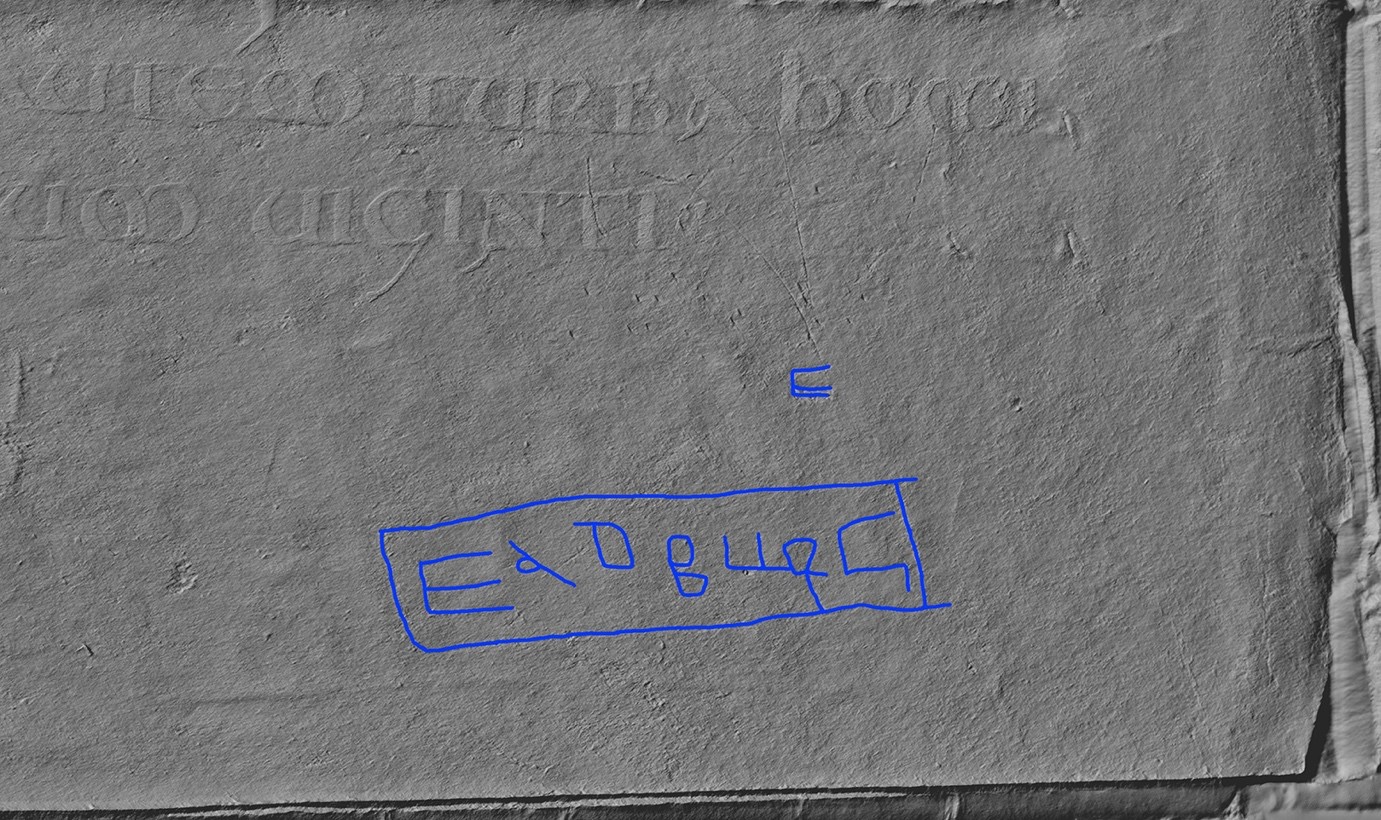
Most of us have doodled in the margins of our books at one time or another, and some of us have even dared to write our own names. But very of few us, presumably, would have expected our handiwork to be marveled at twelve centuries hence. Yet that’s just what has happened to the marginalia left by a medieval Englishwoman we know only as Eadburg, who some time in the eighth century committed her name — as well as other symbols and figures — to the pages of a Latin copy of the Acts of the Apostles.
Eadburg did this with such secrecy that only advanced twenty-first century technology has allowed us to see it at all. That the readers in the Middle Ages sometimes jotted in their manuscripts isn’t unheard of.
But unlike most of them, Eadburg seems to have favored a drypoint stylus — i.e., a tool with nothing on it to leave a clear mark — which would have made her writing nearly impossible to notice with the naked eye. To see all of them necessitated the use of a technique called “photometric stereo,” which Oxford University’s Bodleian Library Senior Photographer John Barrett explains in this blog post.
The scanning process collects images that “map the direction and height of the original’s surface, and are processed into renders showing only the relief of the original with the tone and color removed.” Subsequent steps of filtering and enhancement result in a digital reproduction of “the three-dimensional surface of the page,” which, with the proper enhancements, finally allows drypoint inscriptions to be seen. Eadburg’s name, reports the Guardian’s Donna Ferguson, was found “passionately etched into the margins of the manuscript in five places, while abbreviated forms of the name appear a further ten times.”
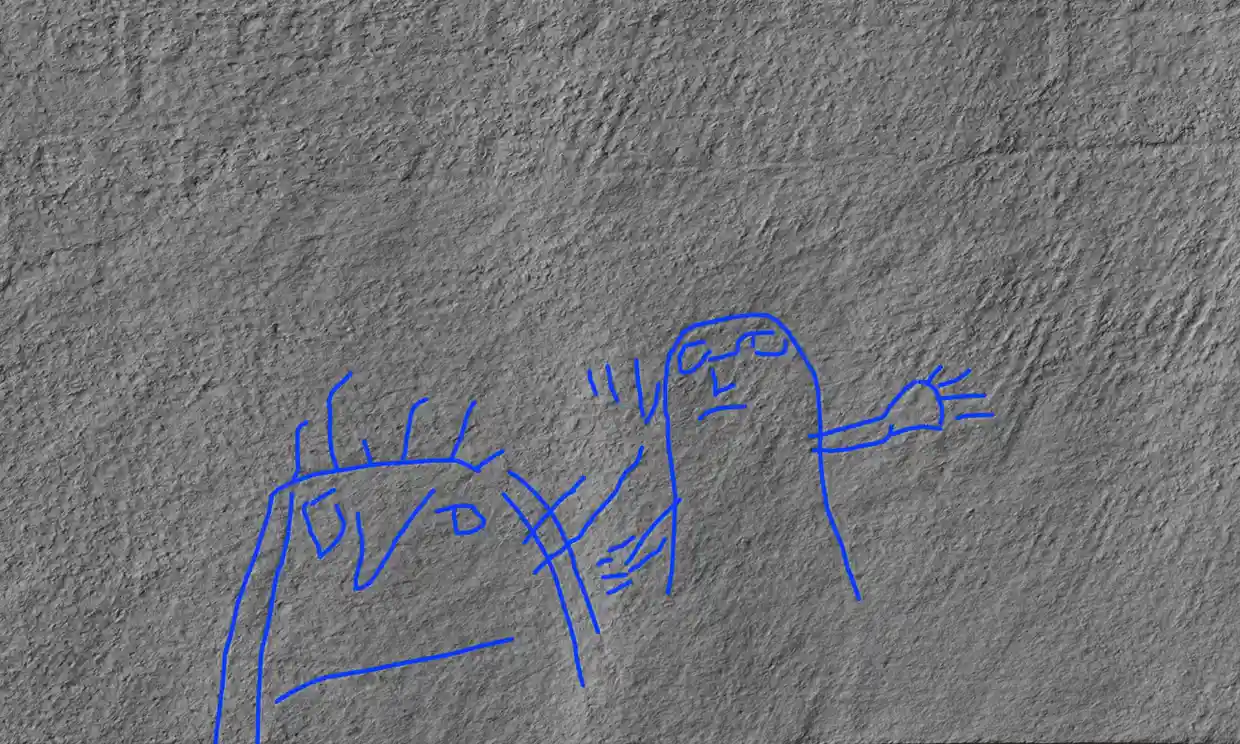
Other new discoveries in the manuscript’s pages include “tiny, rough drawings of figures — in one case, of a person with outstretched arms, reaching for another person who is holding up a hand to stop them.” What Eadburg meant by it all remains a matter of active inquiry, but then, so does her very identity. “Charter evidence suggests that a woman called Eadburg was abbess of a female religious community at Minster-in-Thanet, in Kent from at least 733 until her death sometime between 748 and 761,” writes Barrett, but she wasn’t the only Eadburg who could’ve possessed the book. All this contains a lesson for today’s marginalia-makers: if you’re going to sign your name, sign it in full.
Based in Seoul, Colin Marshall writes and broadcasts on cities, language, and culture. His projects include the Substack newsletterBooks on Cities, the book The Stateless City: a Walk through 21st-Century Los Angeles and the video series The City in Cinema. Follow him on Twitter at @colinmarshall or on Facebook.
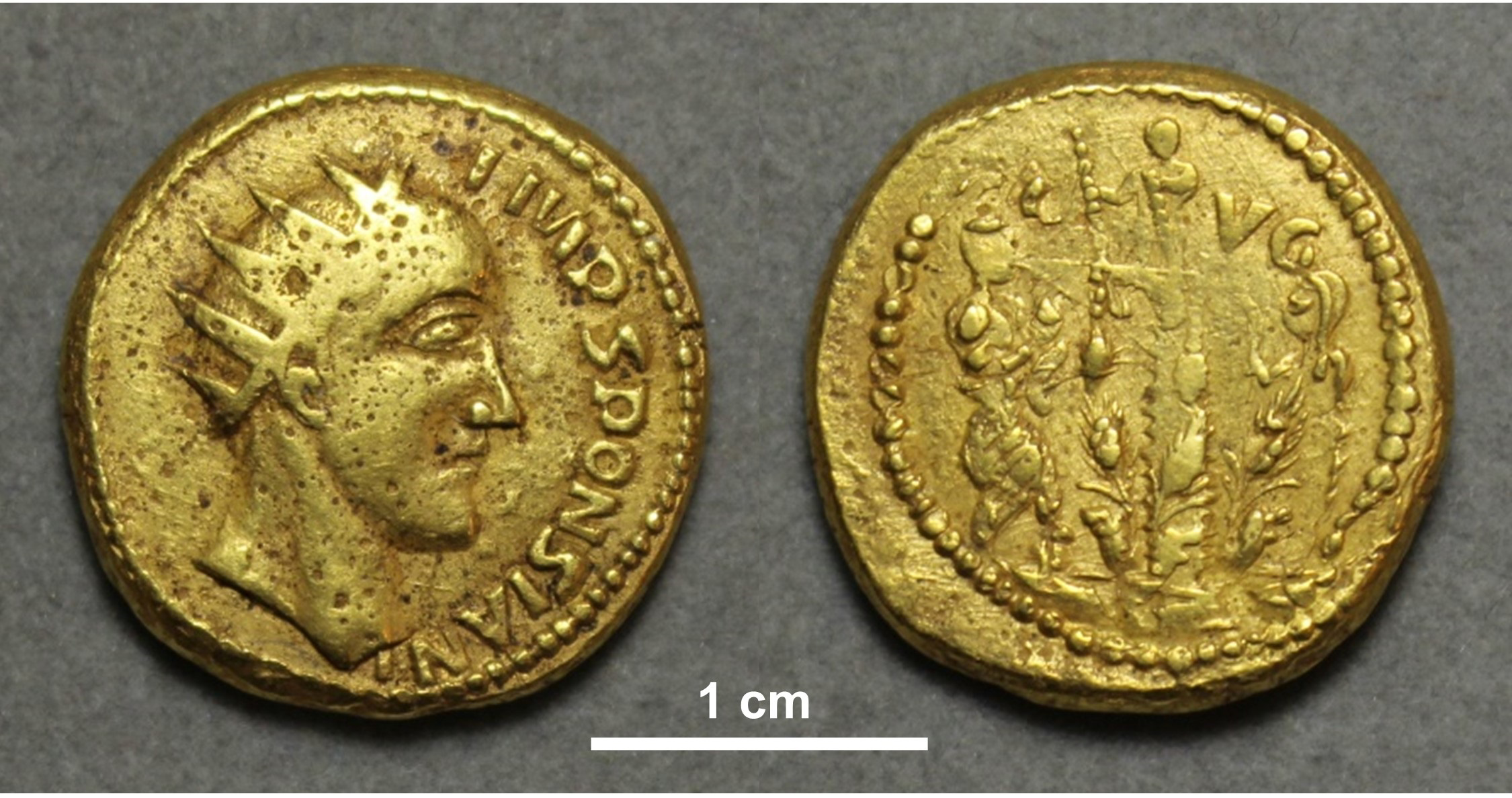
Image by Paul Pearson, University College London
You may think you know your Roman emperors, but do you recognize the face on the coin above? His name was Sponsian, or Sponsianus, and he lived in the middle of the third century. Or at least he did according to certain theories: vanishingly little is known about him, and in fact, this very gold piece (above) is the only evidence we have that he ever existed. Given that numismatists have long written the coin off as an eighteenth-century fake, it’s possible that emperor Sponsian could be a wholly apocryphal figure — but it’s become a bit less likely since the coin went under the electron microscope earlier this year.
“Using modern imaging technology, the researchers said they found ‘deep micro-abrasion patterns’ that were ‘typically associated with coins that were in circulation for an extensive period of time,’ ” writes the New York Times’ April Rubin.
“In addition, the researchers analyzed earthen deposits, finding what they called evidence that the coin had been buried for a long time before being exhumed.” In the details of their design, they’re also “uncharacteristic” of forgeries created in the eighteenth century. If this Sponsian-headed money is fraudulent, then, it’s at least authentically old, or at least much older than had long been assumed.
You can find the published research paper here, at the site of its journal PLOS ONE. Summarizing findings in the paper, a University College London site notes: “The coin … was among a handful of coins of the same design unearthed in Transylvania, in present-day Romania, in 1713. They have been regarded as fakes since the mid-19th-century, due to their crude, strange design features and jumbled inscriptions.” According to Professor Paul N. Pearson, the lead author of the research paper: “Scientific analysis of these ultra-rare coins rescues the emperor Sponsian from obscurity. Our evidence suggests he ruled Roman Dacia, an isolated gold mining outpost, at a time when the empire was beset by civil wars and the borderlands were overrun by plundering invaders.” Jesper Ericsson, a curator at The Hunterian at the University of Glasgow, adds: “we hope that this [research] encourages further debate about Sponsian as a historical figure” and sparks more research into “coins relating to [Sponsian] held in other museums across Europe.”
Based in Seoul, Colin Marshall writes and broadcasts on cities, language, and culture. His projects include the Substack newsletterBooks on Cities, the book The Stateless City: a Walk through 21st-Century Los Angeles and the video series The City in Cinema. Follow him on Twitter at @colinmarshall or on Facebook.
(Yes, you are allowed to pick more than one favorite.)
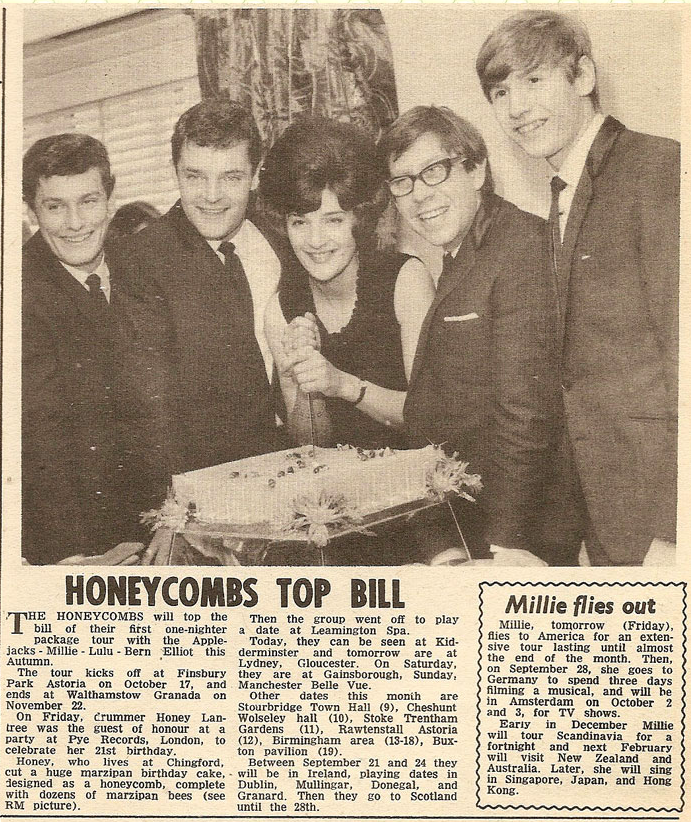
Things were decidedly different when drummer Honey Lantree, the only female member of the 60s British Invasion group the Honeycombs, took up the sticks.
Drums were not her original instrument. Her boyfriend, employer, and eventual bandmate Martin Murray was giving her a guitar lesson when she asked if she could take a whirl at his kit.
Murray recalled his surprise when she started whaling away like a vet:
She was just a born, natural drummer; she hadn’t played before and just went for it. I was aghast, staring at her, and said, “All right, you’re our new drummer.”
Lantree’s gender helped the Honeycombs secure press.
She snagged a celebrity endorsement for Carlton drums and turned 21 with a cake festooned with marzipan bees, and, more importantly, a #1 single, “Have I the Right.”
Of course, her gender also ensured that most of the coverage would focus on her appearance, with scant, if any mention of her musical talent.
Lantree was not the only member of the Honeycombs to find this galling.
As lead singer Denis D’Ell told the Record Mirror in 1965:
How can it be a gimmick just because we have a girl, Honey, on drums? Honey plays with us purely and simply because she is the right drummer for the job. If she wasn’t any good, she wouldn’t hold down the job.
On tour, we don’t have any troubles by having a girl with us. We just operate as a group. Perhaps it is that the novelty has worn off — we hope that fans soon will forget all about this so-called gimmick.
The following year, he quit, along with lead guitarist Alan Ward and Peter Pye, who had replaced Murray on rhythm guitar. Lantree and her brother, Honeycombs’ bassist John, soldiered on with new personnel until the 1967 death of producer Joe Meek.
Still, for a brief period, the Honeycombs’ recordings, tours, television appearances, and yes, press coverage made Lantree the most famous female drummer in the world.
Admittedly, the field was not particularly crowded. Just challenging in ways that outstripped the disproportionate focus on figures, boyfriends, and beauty tips.
Male fans dragged Lantree offstage during a concert in Cornwall, leading her to remark, “You expect this sort of thing but it’s still terrifying.”
Around the same time, another British band, the all-female Liverbirds, were invited to cross the pond for a coveted gig in Las Vegas…provided they’d play it topless. “Can you imagine me on the drums playing topless,” Sylvia Saunders, who shortly thereafter was forced to choose between the drums and a high risk pregnancy, gasped.
Although she is said to have inspired a number of young female musicians, including Karen Carpenter, Lantree, who died in 2018 at the age of 75, rarely shows up on curated lists of notable female drummers.
In a strange way, that spells progress — there are many more female drummers today than there were in the mid 60s, and mercifully more opportunities for them to be taken seriously as musicians.
The Rovers, Fidos, and Spots of the world have been regarded since time immemorial as man’s best friends. But they haven’t always been named Rover, Fido, and Spot: early fifteenth-century English dog owners preferred to give their pets names like Nosewise, Garlik, Pretyman, and Gaylarde. Or at least the author of a fifteenth-century English manuscript thought those names suitable for dogs at the time, according to a thread posted just a few days ago by Twitter user WeirdMedieval. Other canine monikers officially endorsed by the author (whose precise identity remains unclear) include Filthe, Salmon, Havegoodday, Hornyball, and Argument, none of which you’re likely to meet in the dog park today.
Meant to cover hunting dogs including “running hounds, terriers and greyhounds,” the compilation includes “numerous recognizable proper names, including several from history, mythology and Arthurian romance” like Absolon, Charlemayne, Nero, and Romulus. Some “have the quality of bynames or sobriquets. Some are descriptive, some are simple nouns, and others are compounds of different lexical elements.”
Dog names in the Middle Ages also came from the natural world (Dolfyn, Flowre, Fawkon), human professions (Hosewife, Tynker), and even the nationalities of Europe (Ducheman, German). You can learn more about the variety of pet names back then from this post at Medievalists.org. King Henry VIII “had a dog named Purkoy, who got its name from the French ‘pourquoi’ because it was very inquisitive.” In Switzerland of 1504, the most popular dog name was Furst (“Prince”). And as for cats, in medieval England they tended to be “known as Gyb — the short form of Gilbert,” while in France “they were called Tibers or Tibert,” named for a character in the Reynard the Fox fables. All of these sounded normal five or six centuries ago, but who among us is daring enough to reintroduce the likes of Synfull, Crampette, and Snacke into the trend-sensitive word of pet ownership in the 2020s?
Based in Seoul, Colin Marshall writes and broadcasts on cities, language, and culture. His projects include the Substack newsletterBooks on Cities, the book The Stateless City: a Walk through 21st-Century Los Angeles and the video series The City in Cinema. Follow him on Twitter at @colinmarshall or on Facebook.
We're hoping to rely on loyal readers, rather than erratic ads. Please click the Donate button and support Open Culture. You can use Paypal, Venmo, Patreon, even Crypto! We thank you!
Open Culture scours the web for the best educational media. We find the free courses and audio books you need, the language lessons & educational videos you want, and plenty of enlightenment in between.