Historian Timothy Snyder Presents 20 Lessons for Defending Democracy Against Tyranny in a New Video Series

Yale pro­fes­sor and his­to­ri­an Tim­o­thy Sny­der has sound­ed alarm bells about autoc­ra­cy and fas­cism for sev­er­al years now, in both his schol­ar­ly and pop­u­lar books about Russ­ian and Ger­man his­to­ry. Whether you’ve fol­lowed his warn­ings or just start­ed pay­ing atten­tion, it’s not too late to get caught up on the lessons he brings from his rig­or­ous stud­ies of 20th cen­tu­ry total­i­tar­i­an­ism. To make his rel­e­vant points more acces­si­ble, Sny­der has dis­tilled them over the years, aim­ing at the widest pop­u­lar audi­ence.

First, he pub­lished On Tyran­ny in 2017, draw­ing 20 lessons about unfree­dom from the lives of those under the Nazi, Sovi­et, and oth­er fas­cist and total­i­tar­i­an regimes. With­out argu­ing that his­to­ry repeats, exact­ly, Sny­der not­ed sim­i­lar­i­ties and dif­fer­ences to past events, and adapt­ed gen­er­al prin­ci­ples to the geopol­i­tics of the ear­ly 21st cen­tu­ry. These lessons get reit­er­at­ed and dis­tilled even fur­ther in an edi­tion of the best-sell­ing On Tyran­ny illus­trat­ed by artist Nora Krug.

Pub­lished in 2021 and reflect­ing four years of Trump­ism, the illus­trat­ed edi­tion con­tin­ues what we might call Sny­der’s Chom­skyan com­mit­ment to pub­lic intel­lec­tu­al­ism. Trump may be out of pow­er, but the threats to democ­ra­cy are wired in — in one judi­cial action after anoth­er, and in states like North Car­oli­na, where an ille­gal, racial­ly-ger­ry­man­dered state leg­is­la­ture has held pow­er for years, and now seeks to nul­li­fy fed­er­al elec­tions at state lev­el, with many oth­er states threat­en­ing to fol­low suit.

This kind of polit­i­cal seces­sion­ism impos­es the per­ma­nent will of a minor­i­ty on a rapid­ly chang­ing nation, ensur­ing that his­to­ry nev­er catch­es up with the elites, a cat­e­go­ry that includes lead­ers on both sides of the euphemistic “aisle.” For increas­ing num­bers of Amer­i­cans, polit­i­cal divi­sions are more apt­ly char­ac­ter­ized by bar­ri­cades, prison walls, or indi­vis­i­ble codes of silence(ing), repres­sion, and com­plic­i­ty. Sny­der meets this time of creep­ing (lop­ing?) fas­cism  with a YouTube series in which he speaks direct­ly to the cam­era.

He isn’t giv­ing up on more peo­ple pay­ing atten­tion to the big­ger pic­ture, and he’s nev­er giv­en up on effec­tive respons­es to 21st cen­tu­ry tyran­ny. Vot­ing alone has nev­er been enough, and it could be ren­dered mean­ing­less in the near future. The lessons — “Do not obey in advance”; “Defend insti­tu­tions”; “Beware the one-par­ty state” — may be famil­iar to us now, or they may not. But if they bear repeat­ing, it’s worth hear­ing them from Sny­der him­self, who clos­es some of the dis­tance between the intel­lec­tu­al and the pub­lic by step­ping away from print alto­geth­er — a medi­um per­haps unsuit­ed to the mal­leable demands of the online present.

How does the media affect, or become, Sny­der’s mes­sage, espe­cial­ly when it’s effec­tive­ly one-sid­ed­ly tele­vi­su­al, the medi­um of the 20th cen­tu­ry of fas­cism par excel­lence? Sny­der does not address these the­o­ret­i­cal ques­tions, except indi­rect­ly by way of a gener­ic book talk aes­thet­ic com­plete with rum­pled shirt, rustling lapel mic, and req­ui­site back­ground shelves of books you’ll find your­self try­ing to iden­ti­fy as you learn to “be wary of para­mil­i­taries.”

Being wary is one thing, but to what does Sny­der’s hyper vig­i­lance add up with­out the pow­er to make change where we are? Ah, but in ask­ing such a ques­tion, maybe we find we are already in the trap, obey­ing in advance by assum­ing pow­er­less­ness and freely giv­ing up con­trol. It’s our job as indi­vid­u­als to apply the rel­e­vant lessons where we can in our own lives, and to read (or watch) Sny­der crit­i­cal­ly, in rela­tion to oth­er trust­wor­thy voic­es with­in, and far out­side of, Ivy League aca­d­e­m­ic depart­ments.

We do not lack the infor­ma­tion we need to under­stand our moment through a his­tor­i­cal lens. But we often lack the knowl­edge to make sense of things at world-his­tor­i­cal scale. His­to­ri­ans like Sny­der can bridge the gap, and it’s good to take advan­tage of the freely-offered pro­fes­sion­al expe­ri­ence of skilled read­ers, researchers, and edu­ca­tors. In this instance, Sny­der’s approach seems well-tai­lored to counter innu­mer­able pre­sen­ta­tions that triv­i­al­ize WWII his­to­ry into over­fa­mil­iar­i­ty and per­verse spec­ta­cle… or what anoth­er anti-fas­cist pub­lic intel­lec­tu­al, Wal­ter Ben­jamin, iden­ti­fied as the aes­theti­ciza­tion of pol­i­tics — fas­cism-by-pas­sive-con­sumerism that leads us down the path to hor­rors we’d nev­er con­tem­plate out­right.…

Watch all 20 lessons above, or find them here.

Relat­ed Con­tent:

Noam Chom­sky Explains the Best Way for Ordi­nary Peo­ple to Make Change in the World, Even When It Seems Daunt­ing

20 Lessons from the 20th Cen­tu­ry About How to Defend Democ­ra­cy from Author­i­tar­i­an­ism, Accord­ing to Yale His­to­ri­an Tim­o­thy Sny­der

A Beau­ti­ful­ly Illus­trat­ed Edi­tion of On Tyran­ny: Twen­ty Lessons from the Twen­ti­eth Cen­tu­ry, the Best­selling Book by His­to­ri­an Tim­o­thy Sny­der

The Mak­ing of Mod­ern Ukraine: A Free Online Course from Yale Pro­fes­sor Tim­o­thy Sny­der

Josh Jones is a writer and musi­cian based in Durham, NC. Fol­low him at @jdmagness

When Mikhail Gorbachev, the Last Soviet Leader, Starred in a Pizza Hut Commercial (1998)

Mikhail Gor­bachev, the 8th and final leader of the Sovi­et Union, died last month at age 91, a news event that trig­gered respons­es rang­ing from “Who?” to “Wow, was he still alive?” The first response reflects poor­ly on the teach­ing of his­to­ry: jour­nal­ists report­ing on Gorbachev’s death have been oblig­ed to explain his sig­nif­i­cance to many Amer­i­can read­ers just a few decades after his name filled U.S. head­lines. But it’s also true that Gor­bachev left a thor­ough­ly ambigu­ous lega­cy that seems to grow only more mud­dled with time.

As his­to­ri­an Richard Sak­wa wrote on the 20th anniver­sary of the short-lived Sovi­et empire’s col­lapse, Gor­bachev is remem­bered in the U.S. — depend­ing on who’s remem­ber­ing — as either a “mag­nif­i­cent fail­ure” or a “trag­ic suc­cess.” Some for­mer Sovi­ets, espe­cial­ly those more par­tial to the author­i­tar­i­an­ism of a Stal­in or Putin, omit any pos­i­tive descrip­tions of Gorbachev’s major achieve­ment – to wit, reform­ing the U.S.S.R. out of exis­tence in the late 1980s with lit­tle need, real­ly, for Rea­gan’s extrav­a­gant nuclear pos­tur­ing.

Putin him­self calls the fall of the U.S.S.R. “the great­est geopo­lit­i­cal cat­a­stro­phe” of the pre­vi­ous cen­tu­ry, an assess­ment shared by many who agree with him on noth­ing else. At the end of the 80s, how­ev­er, an emerg­ing gen­er­a­tion of Rus­sians had no clear sense of what was hap­pen­ing as their coun­try fell apart. “I was 6 when the Sovi­et Union broke up,” Ana­toly Kur­manaev writes at The New York Times. “I had no idea at the time that the per­son most respon­si­ble for the over­whelm­ing changes trans­form­ing my home­town in Siberia was a man called Mikhail Gor­bachev. I remem­ber stand­ing in line for bread in the dying days of Com­mu­nism, but I don’t remem­ber much dis­cus­sion of his ‘per­e­stroi­ka.’ ”

Mixed admi­ra­tion and con­tempt for Gor­bachev trick­led down to a younger gen­er­a­tion a few years lat­er. “The snatch­es of con­ver­sa­tion I could hear were about peo­ple being fed up,” writes Kur­manaev, “not about the man with a dis­tinc­tive birth­mark sit­ting in the Krem­lin…. Iron­i­cal­ly, my first dis­tinct, inde­pen­dent mem­o­ry of Mr. Gor­bachev, as per­haps for many of my gen­er­a­tion, dates to a 1998 com­mer­cial for Piz­za Hut,” an ad made by the U.S. fast-food com­pa­ny to cel­e­brate the open­ing of a restau­rant near Red Square, and made by Gor­bachev because… well, also iron­ic, giv­en the ad’s premise… he need­ed the mon­ey.

Writ­ten by Tom Dar­byshire of ad agency BBDO, the com­mer­cial stages a debate between patrons at the restau­rant before Gor­bachev’s arrival calms things down. “Meant to be tongue-in-cheek,” Maria Luisa Paul writes at The Wash­ing­ton Post, the ad intend­ed to show that “piz­za is one of those foods that brings peo­ple togeth­er and bridges their dif­fer­ences,” says Dar­byshire. In yet anoth­er irony, Gor­bachev him­self — who nego­ti­at­ed for a year before agree­ing to the spot — refused to eat piz­za on cam­era, allow­ing his grand­daugh­ter the hon­or instead.

Though he would­n’t touch the stuff, Gor­bachev defend­ed him­self against crit­ics, includ­ing his own wife, Raisa, by say­ing “piz­za is for every­one. It’s not only con­sump­tion. It’s also social­iz­ing.” What was the talk at Gor­bachev’s local Piz­za Hut on the day he popped in with his grand­child to social­ize? Why, it was talk of Gor­bachev.

“Because of him, we have eco­nom­ic con­fu­sion!” one din­er alleges.

“Because of him, we have oppor­tu­ni­ty!” retorts anoth­er.

“Because of him, we have polit­i­cal insta­bil­i­ty,” the first responds.

An old­er woman breaks the impasse by stat­ing their obvi­ous mutu­al affini­ties for piz­za, to which all reply, “Hail to Gor­bachev!”

Try as they might, not even Piz­za Hut could heal the wounds caused by the coun­try’s eco­nom­ic con­fu­sion and polit­i­cal insta­bil­i­ty.

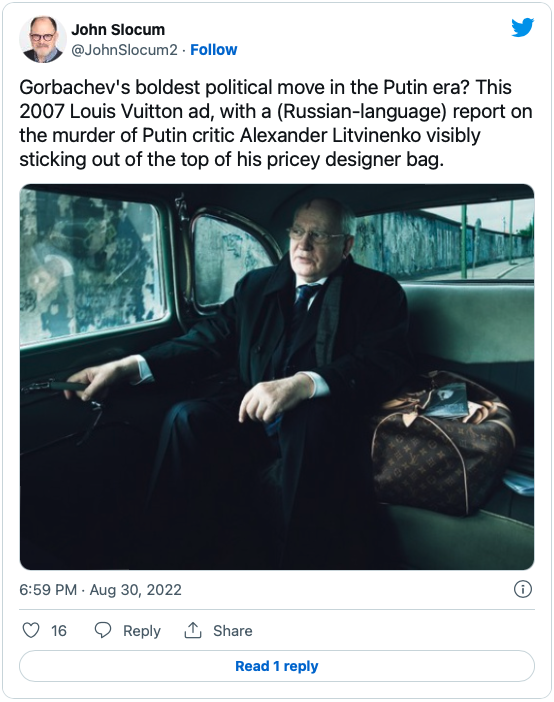
The ad has cir­cu­lat­ed on social media, and in his­to­ry class­es, before and after Gor­bachev’s death as an exam­ple of mass media that “still reflects his lega­cy,” writes Paul. Gor­bachev may be large­ly for­got­ten — at least in the U.S. — decades after the Piz­za Hut ad aired, but it would­n’t be his last attempt to leave his mark in adver­tis­ing, as we see in the 2007 Louis Vuit­ton ad above, fea­tur­ing a prod­uct much less acces­si­ble than piz­za to the aver­age Russ­ian.

Relat­ed Con­tent:

The His­to­ry of Sovi­et Rock: From the 70s Under­ground Rock Scene, to Sovi­et Punk & New Wave in the 1980s

The Sovi­et Union Cre­ates a List of 38 Dan­ger­ous Rock Bands: Kiss, Pink Floyd, Talk­ing Heads, Vil­lage Peo­ple & More (1985)

Long Before Pho­to­shop, the Sovi­ets Mas­tered the Art of Eras­ing Peo­ple from Pho­tographs — and His­to­ry Too

Josh Jones is a writer and musi­cian based in Durham, NC. Fol­low him at @jdmagness

Texas School Board Bans Illustrated Edition of The Diary of Anne Frank

Accord­ing to a recent sur­vey con­duct­ed by the Texas State Teach­ers Asso­ci­a­tion, 70% of sur­veyed teach­ers said they were seri­ous­ly think­ing about leav­ing the teach­ing pro­fes­sion. “Lin­ger­ing stress from the pan­dem­ic is a fac­tor, but it isn’t the only one. Inad­e­quate pay, polit­i­cal attacks on edu­ca­tors and the fail­ure of state lead­ers to pro­tect the health and safe­ty of stu­dents and school employ­ees also have com­bined to dri­ve down the morale of teach­ers to the low­est lev­el in recent mem­o­ry and endan­ger our pub­lic school sys­tem,” TSTA Pres­i­dent Ovidia Moli­na said.

We recent­ly saw how Texas’ edu­ca­tion­al sys­tem has become a vast polit­i­cal mine­field, with con­ser­v­a­tive leg­is­la­tors attempt­ing to ban 800+ books from school libraries–pri­mar­i­ly because the books make stu­dents feel “uncom­fort­able.” This week, the Keller Inde­pen­dent School Dis­trict in Fort Worth, Texas decid­ed to can­cel an acclaimed illus­trat­ed adap­ta­tion of The Diary of Anne Frank, echo­ing the recent deci­sion by a Ten­nessee School board to ban Maus, the Pulitzer-Prize win­ning graph­ic nov­el on the Holo­caust. The ban of The Diary of Anne Frank was trig­gered by a par­ent com­plaint, which the right-lean­ing school board decid­ed to hon­or. Why would think­ing peo­ple want to opt out of teach­ing in the Texas edu­ca­tion­al sys­tem? It’s not hard to imag­ine.

If you would like to sup­port the mis­sion of Open Cul­ture, con­sid­er mak­ing a dona­tion to our site. It’s hard to rely 100% on ads, and your con­tri­bu­tions will help us con­tin­ue pro­vid­ing the best free cul­tur­al and edu­ca­tion­al mate­ri­als to learn­ers every­where. You can con­tribute through Pay­Pal, Patre­on, and Ven­mo (@openculture). Thanks!

Relat­ed Con­tent 

Ten­nessee School Board Bans Maus, the Pulitzer-Prize Win­ning Graph­ic Nov­el on the Holo­caust; the Book Becomes #1 Best­seller on Ama­zon

The 850 Books a Texas Law­mak­er Wants to Ban Because They Could Make Stu­dents Feel Uncom­fort­able

Umber­to Eco Makes a List of the 14 Com­mon Fea­tures of Fas­cism

by | Permalink | Make a Comment ( 5 ) |

When Christopher Hitchens Vigilantly Defended Salman Rushdie After the Fatwah: “It Was a Matter of Everything I Hated Versus Everything I Loved”

I have often been asked if Christo­pher defend­ed me because he was my close friend. The truth is that he became my close friend because he want­ed to defend me. –Salman Rushdie

Salman Rushdie remains in crit­i­cal con­di­tion after suf­fer­ing mul­ti­ple stab wounds while on stage in New York, a shock­ing occur­rence but not quite sur­pris­ing giv­en that the author has lived with a death sen­tence over his head since 1989. (You can read the his­to­ry of that con­tro­ver­sy here.) The nation of Iran has denied any respon­si­bil­i­ty for the attack on the author, but it’s prob­a­bly safe to assume that his 1988 nov­el The Satan­ic Vers­es has some­thing to do with it, over thir­ty years after the fact.

“Even before the fat­wa,” Steven Erlanger writes in The New York Times“the book was banned in a num­ber of coun­tries, includ­ing India, Bangladesh, Sudan and Sri Lan­ka.” Protests of the nov­el result­ed in sev­er­al deaths and attacks on book­sellers. Rushdie had not set out to enrage much of the Islam­ic world, but nei­ther had he any inter­est in appeas­ing its con­ser­v­a­tive lead­ers. Always out­spo­ken, and a fero­cious crit­ic of British Empire as well as Islam­ic theoc­ra­cy, his career since the fat­wa has demon­strat­ed a com­mit­ment to free­ing the lit­er­ary arts from the dic­tates of church and state.

On the sub­ject of impe­ri­al­ism, Rushdie and the late Christo­pher Hitchens came to dis­agree after the U.S.‘s inva­sion of Iraq and Hitchens’ “U‑turn across the polit­i­cal high­way to join forces with the war-mak­ers of George W. Bush’s admin­is­tra­tion,” Rushdie writes in a Van­i­ty Fair appre­ci­a­tion for Hitchens’ after the lat­ter’s death. But his book God is Not Great “car­ried Hitch away from the Amer­i­can right and back toward his nat­ur­al, lib­er­al, ungod­ly con­stituen­cy”; a col­lec­tion of peo­ple who see the free expres­sion of ideas as a far prefer­able con­di­tion to the exis­tence of theo­crat­ic death squads.

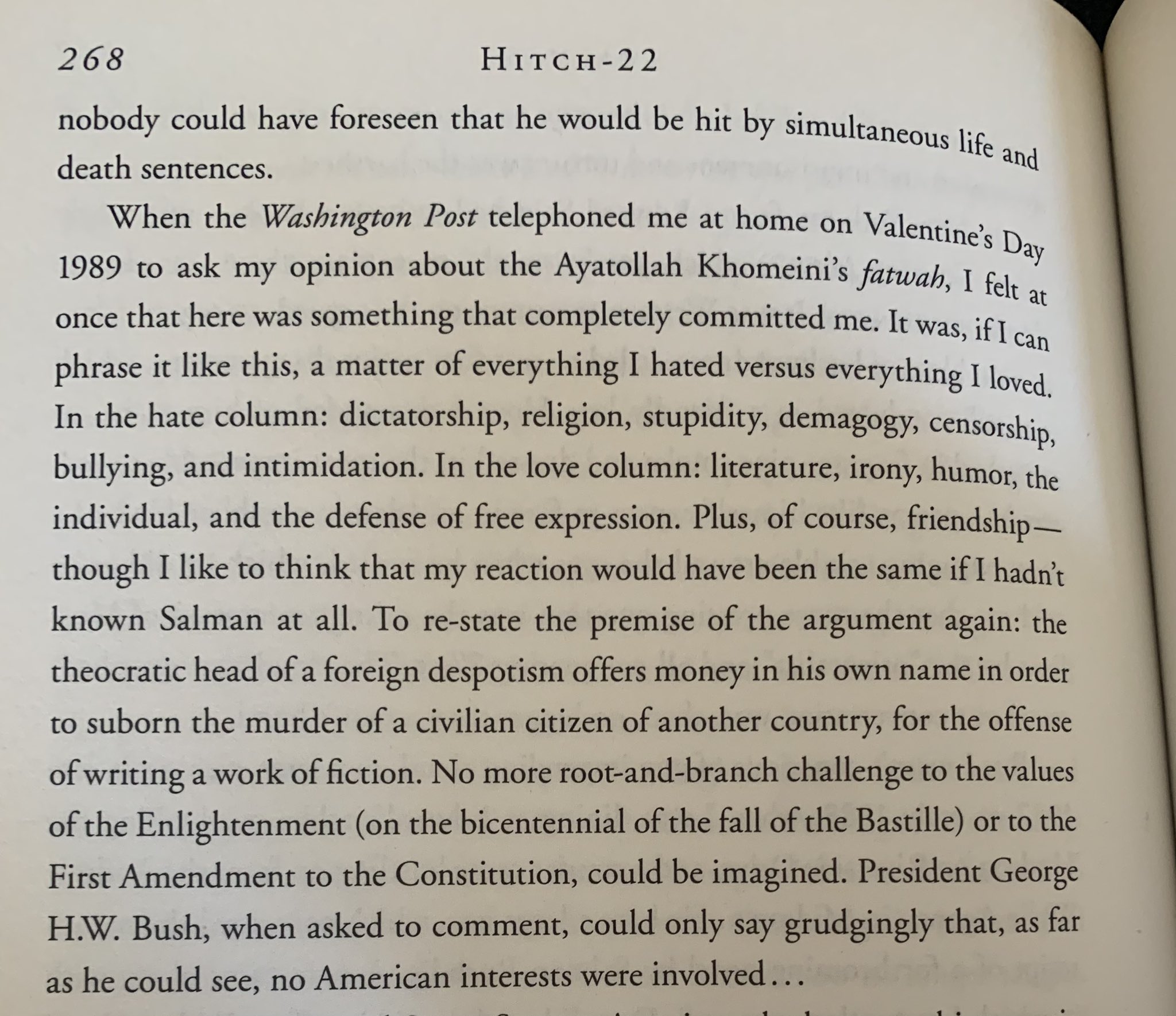
Wher­ev­er he fell at any giv­en time on the polit­i­cal spec­trum, Hitchens nev­er gave up his defense of Rushdie, one in which, as he wrote in his mem­oir, Hitch-22, he was com­plete­ly com­mit­ted from the start:

It was, if I can phrase it like this, a mat­ter of every­thing I hat­ed ver­sus every­thing I loved. In the hate col­umn: dic­ta­tor­ship, reli­gion, stu­pid­i­ty, dem­a­gogy, cen­sor­ship, bul­ly­ing, and intim­i­da­tion. In the love col­umn: lit­er­a­ture, irony, humor, the indi­vid­ual, and the defense of free expres­sion. Plus, of course, friend­ship– 

Hitchens was grave­ly dis­ap­point­ed in lib­er­al writ­ers like Arthur Miller who refused to pub­licly sup­port Rushdie out of fear, as he says in the tele­vi­sion inter­view at the top of the post. The ambiva­lent response of many on the left struck him as gross polit­i­cal cow­ardice and hypocrisy. He went on the attack, argu­ing round­ly on pop­u­lar shows like Ques­tion Time (below, with his broth­er Peter, Baroness Williams, and recent­ly deposed prime min­is­ter Boris John­son).

Hitchens “saw that the attack on The Satan­ic Vers­es was not an iso­lat­ed occur­rence,” Rushdie writes, “that across the Mus­lim world, writ­ers and jour­nal­ists and artists were being accused of the same crimes — blas­phe­my, heresy, apos­ta­sy, and their mod­ern-day asso­ciates, ‘insult’ and ‘offense.’ ” Rushdie had meant no offense, he writes, “I had not cho­sen the bat­tle.” But it seems to have cho­sen him:

It was at least the right bat­tle, because in it every­thing that I loved and val­ued (lit­er­a­ture, free­dom, irrev­er­ence, free­dom, irre­li­gion, free­dom) was ranged against every­thing I detest­ed (fanati­cism, vio­lence, big­otry, humor­less­ness, philis­tin­ism, and the new offense cul­ture of the age). Then I read Christo­pher using exact­ly the same every­thing-he-loved-ver­sus-every­thing-he-hat­ed trope, and felt… under­stood.

If the fat­wa against Rushdie made him infa­mous, it did not make him uni­ver­sal­ly beloved, even among his fel­low writ­ers, but he always had a fierce ally in Hitchens. Let’s hope Rushdie can pick up the fight for free expres­sion once again when he recov­ers from this bru­tal stab­bing.

Relat­ed Con­tent:

Christo­pher Hitchens Dis­miss­es the Cult of Ayn Rand: There’s No “Need to Have Essays Advo­cat­ing Self­ish­ness Among Human Beings; It Requires No Rein­force­ment”

Hear Salman Rushdie Read Don­ald Barthelme’s “Con­cern­ing the Body­guard” 

Jeff Koons and Salman Rushdie Teach New Cours­es on Art, Cre­ativ­i­ty & Sto­ry­telling for Mas­ter­Class

Josh Jones is a writer and musi­cian based in Durham, NC. Fol­low him at @jdmagness

Why You Should Read The Handmaid’s Tale: A Timely Animated Introduction

Prophe­cies are real­ly about now. In sci­ence fic­tion it’s always about now. What else could it be about? There is no future. There are many pos­si­bil­i­ties, but we do not know which one we are going to have.

Mar­garet Atwood

There is no need to explain why Mar­garet Atwood’s The Handmaid’s Tale has gone from read­ing like a warn­ing of the near-future to an alle­go­ry of the present after the U.S. Supreme Court’s rul­ing in Dobbs v. Jack­son Women’s Health Orga­ni­za­tion. Atwood’s sto­ry revolves around the fic­tion­al Repub­lic of Gilead, which takes over the U.S. after a fer­til­i­ty cri­sis dec­i­mates the pop­u­la­tion. Overnight, the fun­da­men­tal­ist Chris­t­ian theoc­ra­cy divides women into two broad class­es – Hand­maids: chat­tel who per­form the labor of forced birth through forced con­cep­tion; and the infer­tile who prop up the patri­ar­chal rul­ing class as wives, over­seers, or slave labor in the pol­lut­ed “colonies.”

It’s a bleak tale, a sto­ry far less about hero­ism than the TV series based on the book would have viewers–who haven’t read it–believe. (The 5th sea­son, slat­ed for this July, seems to have been delayed until Sep­tem­ber with­out expla­na­tion.) Why should we read The Hand­maid­’s Tale? Because it is not only a work of dystopi­an futur­ism, but also a nar­ra­tivized account of what has already hap­pened to women around the world through­out his­to­ry to the present. The nov­el is a prism through which to view the ways women have been oppressed through repro­duc­tive slav­ery with­out the sci-fi sce­nario of a pre­cip­i­tous loss of human fer­til­i­ty.

As Atwood has explained, “when I wrote The Hand­maid­’s Tale, noth­ing went into it that had not hap­pened in real life some­where at some time.” Some of the worst offens­es were not well-known. “Female gen­i­tal muti­la­tion was tak­ing place,” says Atwood, “but if I had put it in 1985 [when the nov­el was writ­ten] prob­a­bly peo­ple wouldn’t have known what I was talk­ing about. They do now.” But we can still choose to over­look the infor­ma­tion. “Ignor­ing isn’t the same as igno­rance,” Atwood says in the nov­el, “you have to work at it.” The quote opens the 2018 TED-Ed les­son by Nao­mi Mer­cer above on Atwood’s book, walk­ing us through its sources in his­to­ry.

The Hand­maid­’s Tale, the les­son points out, is an exam­ple of “Spec­u­la­tive Fic­tion,” a form of writ­ing con­cerned with “pos­si­ble futures.” This theme unites both utopi­an and dystopi­an nov­els. Atwood’s books trade in the lat­ter, but any read­er of the genre will tell you how quick­ly a more per­fect fic­tion­al union becomes a night­mare. The Cana­di­an writer has offered this lit­er­ary inevitabil­i­ty as an expla­na­tion for the mul­ti­ple crises of Amer­i­can democ­ra­cy:

The real rea­son peo­ple expect so much of Amer­i­ca in mod­ern times is that it set out to be a utopia. That didn’t last very long. Nathaniel Hawthorne nailed it when he said the first thing they did when they got to Amer­i­ca was build a scaf­fold and a prison.

What Atwood does­n’t men­tion, as many crit­ics have point­ed out, are the slave pens and auc­tion hous­es, or the fact that Gilead close­ly resem­bles the slave-hold­ing Amer­i­can South in its theo­crat­ic patri­ar­chal Chris­t­ian hier­ar­chy and ulti­mate con­trol of wom­en’s bod­ies. And yet, the nov­el com­plete­ly side­steps race by hav­ing the Repub­lic of Gilead ship all of the coun­try’s Black peo­ple to the Mid­west (pre­sum­ably for forced labor). They are nev­er heard from again by the read­er.

This tac­tic has seemed irre­spon­si­ble to many crit­ics, as has the show’s side­step­ping through col­or­blind cast­ing, and the wear­ing of red cloaks and white bon­nets in imi­ta­tion of the book and show as a means of protest. “When we rely too heav­i­ly on ‘The Hand­maid­’s Tale,’ which ignores the pres­ence of race and racism,” says activist Ali­cia Sanchez Gill, “it real­ly dehu­man­izes and dis­miss­es our col­lec­tive expe­ri­ences of repro­duc­tive trau­ma.” Atwood’s “pos­si­ble future” pil­lages slav­ery’s past and con­ve­nient­ly gets rid of its descen­dants.

The trau­ma Gill ref­er­ences includes rape and forced birth, as well as the forced ster­il­iza­tions of the eugen­ics move­ment, car­ried out with the impri­matur of the Supreme Court (and con­tin­u­ing in recent cas­es). Kel­li Midg­ley, who found­ed Hand­maids Army DC, offers one expla­na­tion for using The Hand­maid­’s Tale as a protest sym­bol. Though she agrees to leave the cos­tumes at home if asked by orga­niz­ers, she says “we are try­ing to reach a broad­er audi­ence for peo­ple who need this mes­sage. We don’t need to tell Black women that their rights are endan­gered. They always have been.”

Maybe a new mes­sage after Dobbs v. Jack­son Wom­en’s Health Orga­ni­za­tion is that an assault on any­one’s rights threat­ens every­one. Or as Atwood wrote in a Cana­di­an Globe and Mail op-ed in 2018, “depriv­ing women of con­tra­cep­tive infor­ma­tion, repro­duc­tive rights, a liv­ing wage, and pre­na­tal and mater­nal care – as some states in the US want to do – is prac­ti­cal­ly a death sen­tence, and is a con­tra­ven­tion of basic human rights. But Gilead, being total­i­tar­i­an, does not respect uni­ver­sal human rights.”

Relat­ed Con­tent:

Mar­garet Atwood Releas­es an Unburn­able Edi­tion of The Handmaid’s Tale, to Sup­port Free­dom of Expres­sion

Pret­ty Much Pop #10 Exam­ines Mar­garet Atwood’s Night­mare Vision: The Handmaid’s Tale

Hear Mar­garet Atwood’s Sto­ry “Stone Mat­tress,” Read by Author A. M. Homes 

Josh Jones is a writer and musi­cian based in Durham, NC. Fol­low him at @jdmagness

Mama Cass and John Denver Sing a Lovely Duet of “Leaving On a Jet Plane” (1972)

My issue is that it’s all very well to sit back and com­plain but when it’s your coun­try you have a respon­si­bil­i­ty. — Cass Elliot

What could be more heav­en­ly than Cass Elliot of The Mamas & The Papas and singer-song­writer John Den­ver har­mo­niz­ing on Denver’s “Leav­ing on a Jet Plane,” a tune many con­ceived of as a protest to the Viet­nam War, owing large­ly to folk trio Peter, Paul and Mary’s cov­er ver­sion.

Maybe some vot­er reg­is­tra­tion added to the mix?

Before break­ing into their duet on the late night TV musi­cal vari­ety show The Mid­night Spe­cial, Den­ver invit­ed Mama Cass to share a few words on her efforts to get out the vote in a pres­i­den­tial elec­tion year:

I’ve been trav­el­ing around the coun­try for the past year or so, talk­ing on a lot of col­lege cam­pus­es and try­ing to find out exact­ly what peo­ple are think­ing, and the thing that’s impressed me the most is, there is still in this coun­try, believe it or not, after all the talk, a tremen­dous amount of apa­thy on the part of peo­ple who maybe don’t like the way things are going and maybe want to change it, but don’t do any­thing about it, y’know?

It was August 19, 1972. The war in Viet­nam and the upcom­ing con­test between Pres­i­dent Richard Nixon and his Demo­c­ra­t­ic chal­lenger George McGov­ern were the top sto­ries. June’s Water­gate break in was a mount­ing con­cern.

Ear­li­er in the day, the New York Times report­ed that “Sen­a­tor George McGov­ern expects (South Viet­namese) Pres­i­dent Nguyễn Văn Thiệu and his “cohorts” to flee Saigon into exile and a Com­mu­nist-dom­i­nat­ed coali­tion to take con­trol of South Viet­nam if Mr. McGov­ern is elect­ed Pres­i­dent of the Unit­ed States on Nov. 7.”

Cass Elliot, a McGov­ern sup­port­er, had become much more vocal about her polit­i­cal activism fol­low­ing the 1968 break up of The Mamas & The Papas, as in this inter­view with Rolling Stone:

I think every­body who has a brain should get involved in pol­i­tics.  Work­ing with­in. Not crit­i­ciz­ing it from the out­side.  Become an active par­tic­i­pant, no mat­ter how fee­ble you think the effort is.  I saw in the Demo­c­ra­t­ic Con­ven­tion in Chica­go that there were more peo­ple inter­est­ed in what I was inter­est­ed in than I believed pos­si­ble.  It made me want to work.  It made me feel my opin­ion and ideas were not futile, that there would be room in an orga­nized move­ment of pol­i­tics for me to voice myself. 

She remained diplo­mat­ic on the Mid­night Spe­cial, telling view­ers that “I don’t think it’s so impor­tant who you vote for, you vote for who you believe in, but the impor­tant thing is to vote,” though it’s hard to imag­ine that any­one tun­ing in from home would mis­take her for a Nixon gal.

Ear­li­er in the year she had ush­ered at the Four For McGov­ern fundrais­ing con­cert at the LA Forum, was in the audi­ence at Madi­son Square War­ren Beatty’s Togeth­er for McGov­ern con­cert Gar­den, and attend­ed a par­ty Amer­i­cans Abroad for McGov­ern held in Lon­don.

Short­ly after the elec­tion (SPOILER: Her man lost), dur­ing an appear­ance on The Mike Dou­glas Show, above, she inti­mat­ed that she might be open to a career shift:

 I think I would like to be a Sen­a­tor or some­thing in twen­ty years.  I don’t think I real­ly know enough yet. I’m just 30 now and I would­n’t even be eli­gi­ble to run for office for anoth­er five years.  But I have a lot of feel­ings about things.  I know the way I would like to see things for this coun­try and in my trav­els, when I talk to peo­ple, every­body wants pret­ty much the same thing:  peace, enough jobs, no pover­ty and good edu­ca­tion.  And I’ve learned a lot.  It’s fun­ny.  So many peo­ple in show busi­ness go into pol­i­tics, and I used to say ‘What the heck do they know about it?’  But when you trav­el around, you real­ly do get to feel–not to be cliche–the pulse of the coun­try and what peo­ple want.  I’m con­cerned and it’s not good to be uncon­cerned and just sit there.

Lis­ten­ing to her dis­cuss Water­gate dur­ing her final vis­it to The Mike Dou­glas Show, short­ly before her 1974 death, real­ly makes us wish she was still here with us.

What we wouldn’t give to hear this out­spo­ken polit­i­cal observer’s take on the sit­u­a­tion our coun­try now finds itself in, espe­cial­ly with anoth­er five decades of expe­ri­ence under her belt.

Per­haps there’s an alter­nate uni­verse in which Cass Elliot is Pres­i­dent.

If you haven’t yet reg­is­tered to vote, now would be a great time to do so. It may not be too late to par­tic­i­pate in your state’s pri­ma­ry elec­tions. You know that’s what Cass would have want­ed.

Relat­ed Con­tent 

Tom Jones Per­forms “Long Time Gone” with Cros­by, Stills, Nash & Young–and Blows the Band & Audi­ence Away (1969)

Joni Mitchell Sings an Aching­ly Pret­ty Ver­sion of “Both Sides Now” on the Mama Cass TV Show (1969)

Janis Joplin & Tom Jones Bring the House Down in an Unlike­ly Duet of “Raise Your Hand” (1969)

- Ayun Hal­l­i­day is the Chief Pri­ma­tol­o­gist of the East Vil­lage Inky zine and author, most recent­ly, of Cre­ative, Not Famous: The Small Pota­to Man­i­festo.  Fol­low her @AyunHalliday.

Machiavelli’s The Prince Explained in an Illustrated Film

Nic­colò Machi­avel­li lived in a time before the inter­net, before radio and tele­vi­sion, before drones and weapons of mass destruc­tion. Thus one nat­u­ral­ly ques­tions the rel­e­vance of his polit­i­cal the­o­ries to the twen­ty-first cen­tu­ry. Yet in dis­cus­sions about the dynam­ics of pow­er, no name has endured as long as Machi­avel­li’s. His rep­u­ta­tion as a the­o­rist rests most­ly on his 1532 trea­tise Il Principe, or The Prince, in which he pio­neered a way of ana­lyz­ing pow­er as it was actu­al­ly wield­ed, not as peo­ple would have liked it to be. How, he asked, does a ruler — a prince — attain his posi­tion in a state, and even more impor­tant­ly, how does he main­tain it?

You can hear Machi­avel­li’s answers to these ques­tions explained, and see them illus­trat­ed, in the 43-minute video above. It breaks The Prince down into sev­en parts sum­ma­riz­ing as many of the book’s main points, includ­ing “Do not be neu­tral,” “Destroy, do not would,” and “Be feared.”

These com­mand­ments would seem to align with Machi­avel­li’s pop­u­lar image as an apol­o­gist, even an advo­cate, for bru­tal and repres­sive forms of rule. But his enter­prise has less to do with offer­ing advice than with describ­ing how real fig­ures of pow­er, princes and oth­er­wise, had amassed and retained that pow­er.

The video comes from Eudai­mo­nia, a Youtube chan­nel that has also fea­tured sim­i­lar­ly ani­mat­ed exege­ses of Sto­icism and Sun Tzu’s The Art of War. Its cre­ator makes these ancient sources of knowl­edge acces­si­ble with not just his car­toon­ish illus­tra­tions, but also his inclu­sion of illu­mi­nat­ing exam­ples from more recent his­to­ry. In the case of The Prince, these come from eras like the Russ­ian Rev­o­lu­tion, World War II, and even our own time of instant glob­al com­mu­ni­ca­tion, atten­tion-hun­gry media, and a seem­ing­ly weak polit­i­cal class. In much of the world, we live in a time much less nasty and brutish than Machi­avel­li’s. But look­ing at the effec­tive­ness (or lack there­of) of our own lead­ers, we have to admit that the prin­ci­ples of The Prince may not have gone out of effect.

To delve deep­er into the world of Machi­avel­li, you can watch a BBC doc­u­men­tary on the Renais­sance polit­i­cal the­o­rist below.

Relat­ed con­tent:

What Does “Machi­avel­lian” Real­ly Mean?: An Ani­mat­ed Les­son

How Machi­avel­li Real­ly Thought We Should Use Pow­er: Two Ani­mat­ed Videos Pro­vide an Intro­duc­tion

Salman Rushdie: Machiavelli’s Bad Rap

Intro­duc­tion to Polit­i­cal Phi­los­o­phy: A Free Yale Course

Allan Bloom’s Lec­tures on Machi­avel­li (Boston Col­lege, 1983)

6 Polit­i­cal The­o­rists Intro­duced in Ani­mat­ed “School of Life” Videos: Marx, Smith, Rawls & More

Based in Seoul, Col­in Mar­shall writes and broad­casts on cities, lan­guage, and cul­ture. His projects include the Sub­stack newslet­ter Books on Cities, the book The State­less City: a Walk through 21st-Cen­tu­ry Los Ange­les and the video series The City in Cin­e­ma. Fol­low him on Twit­ter at @colinmarshall, on Face­book, or on Insta­gram.


The Rolling Stones Play a Gig in Communist Warsaw and a Riot Ensues (1967)

My Name is called Dis­tur­bance.… – “Street Fight­ing Man”

More than two decades before Ger­man band the Scor­pi­ons blew their alleged­ly CIA-penned “Wind of Change” over the end of the Cold War; before the “hard rock Wood­stock” in Moscow; before Bruce Spring­steen rocked East Berlin and rang the “Chimes of Free­dom,” anoth­er band took the stage behind the Iron Cur­tain: one not par­tic­u­lar­ly well-known at the time for mak­ing geopo­lit­i­cal state­ments.

In 1967, the Rolling Stones record­ed and released Between the But­tons and major hits “Ruby Tues­day” and “Let’s Spend the Night Togeth­er.” They tried to com­pete with the Bea­t­les with stabs at psy­che­delia on Their Satan­ic Majesties Request. They did­n’t record what is some­times con­sid­ered their most polit­i­cal song, “Street Fight­ing Man,” for anoth­er two years, and that song — with its options of street fight­ing or singing for a rock and roll band — has nev­er been mis­tak­en for a peace anthem.

It was­n’t peace the band court­ed in their orig­i­nal plan to play Moscow. “They start­ed toy­ing with the idea of per­form­ing in Moscow and becom­ing the most con­tro­ver­sial rock band to play on the oth­er side of the Iron Cur­tain,” writes Woj­ciech Olek­si­ak at Culture.pl. “Both the Sovi­et Union and the UK denied their requests. How is it, Olek­si­ak asks, “that in 1967 — the mid­dle of the Cold War — Mick, Kei­th, Bri­an, Bill, and Char­lie came to Poland and per­formed in War­saw, at a huge hall known for being tra­di­tion­al­ly used for the Com­mu­nist Par­ty’s ple­nary con­gress­es?” You’ll find the answer in the video at the top from Band­splain­ing.

Just above, see footage of the con­cert itself, culled from news­reel footage and TV broad­casts. The uploader has done us the kind­ness of putting time­stamps in the video for the three songs shown here:

00:00 — Paint It Black

00:43 — 19th Ner­vous Break­down

01:06 — (I Can’t Get No) Sat­is­fac­tion

The Stones were “by no means the first west­ern group to play in com­mu­nist Poland,” writes Pol­ish musi­cian and jour­nal­ist Paweł Brodowsky, who was in the audi­ence. “By that time I had already seen The Ani­mals, The Hol­lies, Lulu, and Cliff Richard and the Shad­ows.” It did­n’t hurt that Władysław Jakubows­ki, the deputy direc­tor of Pagart — “a state-owned con­cert agency,” writes Sam Kemp at Far Out — “had some sym­pa­thy for Poland’s young music fans” (just as Gor­bachev would in the time of glas­nost). None of the oth­er acts caused any­thing like the chaos that would ensue when the Stones came to War­saw.

Bands allowed into the coun­try came from a list of names Jakubows­ki col­lect­ed from young Pol­ish jour­nal­ists. How Jakubows­ki achieved the required per­mis­sions from his high­er-ups is some­thing of a mys­tery, Olek­siek writes. Why the deputy direc­tor let the Stones into the coun­try even more so. Their rep­u­ta­tion for destruc­tion pre­ced­ed them: “He must have heard about The Rolling Stones’ wreck­ing of the Olympia, the most famous con­cert hall in Paris. He was a close friend of Bruno Coqua­trix, its direc­tor.” At any rate, the War­saw con­cert turned into a riot. The band could not be blamed, entire­ly.

Hear­ing about the Stones’ arrival, thou­sands of young fans lined up for tick­ets. “What most of them did­n’t know,” Kemp writes, “was that the bulk of them had already been reserved for com­mu­nist par­ty mem­bers and their fam­i­lies.” The hall was also packed beyond capac­i­ty, “with fans hang­ing off the edge of bal­conies.” Police fought to keep fans away from the stage and the seat­ed crowds of dour bureau­crats. Richards and Jag­ger antag­o­nized the cops with obscen­i­ties, mak­ing tick­et­less fans who’d breached the doors even more rabid.

Out­side, as you can see in the short Pol­ish doc­u­men­tary above, a full-blown riot with tear gas and dogs had bro­ken out. This was a time when riots seemed to break out every­where. (Mick Jag­ger has cit­ed the Paris upris­ings of 1968 as a source for “Street Fight­ing Man.”) But at the end of the six­ties, few oth­er bands could boast not only of play­ing the com­mu­nist East­ern Bloc, but of inspir­ing may­hem from the stage on both sides of the Cold War lines.

And yet, this is not the end of the sto­ry. The Stones returned to War­saw over fifty years lat­er, in 2018, this time with a point­ed polit­i­cal state­ment made at the behest of Lech Wałęsa, in oppo­si­tion to a rule lim­it­ing the age of judges to 65. “I am too old to be a judge but not too old to sing,” Jag­ger shout­ed in Pol­ish from the stage. He then launched into the band’s first song on the setlist. And, yes, it was my favorite and maybe yours too: “Street Fight­ing Man.”

Relat­ed Con­tent:

The Sto­ry of the Rolling Stones: A Selec­tion of Doc­u­men­taries on the Quin­tes­sen­tial Rock-and-Roll Band

A Char­lie Watts-Cen­tric View of the Rolling Stones: Watch Mar­tin Scorsese’s Footage of Char­lie & the Band Per­form­ing “Jumpin’ Jack Flash” and “All Down the Line”

The Rolling Stones Jam with Mud­dy Waters for the First and Only Time at Chicago’s Leg­endary Checker­board Lounge (1981)

Josh Jones is a writer and musi­cian based in Durham, NC. Fol­low him at @jdmagness

« Go BackMore in this category... »
Quantcast