If you’re not intimately familiar with his novels, then you assuredly know major films based on Dick’s work – Blade Runner, Total Recall, A Scanner Darklyand Minority Report. Today, we bring you another way to get acquainted with his writing. We’re presenting a selection of Dick’s stories available for free on the web. Below we have culled together 11 short stories from our collections. Some of the stories collected here have also found their way into the recently-published book, Selected Stories by Philip K. Dick, which features an introduction by Jonathan Lethem.
Today is the birthday of J.R.R. (John Ronald Reuel) Tolkien, author of the fantasy novels The Hobbit and The Lord of the Rings. He was born on January 3, 1892 to British parents in Bloemfontein, South Africa. His father died when he was 3 years old, and he moved with his mother to England. The young boy took an early liking to stories of magic and myth. In his 1947 book On Fairy Stories, Tolkien wrote:
I had very little desire to look for buried treasure or fight pirates, and Treasure Island left me cool. Red Indians were better: there were bows and arrows (I had and have a wholly unsatisfied desire to shoot well with a bow), and strange languages, and glimpses of an archaic mode of life, and above all, forests in such stories. But the land of Merlin and Arthur were better than these, and best of all the nameless North of Sigurd and the Volsungs, and the prince of all dragons. Such lands were pre-eminently desirable.
The urge to compose his own tales came early, but Tolkien became sidetracked by an interest in the subtleties of language. In a letter to W.H. Auden in 1955 he wrote:
I first tried to write a story when I was about seven. It was about a dragon. I remember nothing about it except a philological fact. My mother said nothing about the dragon, but pointed out that one could not say “A green great dragon,” but had to say “a great green dragon.” I wondered why, and still do. The fact that I remember this is possibly significant, as I do not think I ever tried to write a story again for many years, and was taken up with language.
Tolkien became a philologist. He studied English Language and Literature at Exeter College, Oxford and–after a harrowing experience in the trenches of World War I–embarked on an academic career. He became an expert on Anglo Saxon and Norse mythology.
But the misty forests of Tolkien’s childhood imagination never left him. One day in the early 1930s, he was at home grading a large stack of student papers when his mind began to wander. On a blank sheet in one of the papers, the professor found himself writing, “In a hole in the ground there lived a hobbit.” He didn’t know what a hobbit was, but soon found himself spinning a tale, which he told to his young children. In 1937 it was published as The Hobbit.
The popularity of The Hobbit, not only with children but with adults, led to requests for a sequel, and in 1954 and 1955 Tolkien’s epic trilogy, The Lord of the Rings was published. It went on to become one of the most popular works of fiction of the 20th century, with over 150 million copies sold worldwide–and counting.
In celebration of Tolkien’s 120th birthday, we present a fascinating film on the author from the BBC series In Their Own Words: British Novelists. The 27-minute film was first broadcast in March of 1968, when Tolkien was 76 years old, and includes interviews and footage of the old man at his haunts in Oxford. H/T The Writer’s Almanac.
The video above gives you mostly the prelude to the actual music. Then, in the first video below, Zappa gives a demo of the instruments. Next comes the Concerto for Two Bicycles, which features the show’s house orchestra joining the cacophonous fun. The clips run a good 15 minutes.
If you would like to support the mission of Open Culture, consider making a donation to our site. It’s hard to rely 100% on ads, and your contributions will help us continue providing the best free cultural and educational materials to learners everywhere. You can contribute through PayPal, Patreon, and Venmo (@openculture). Thanks!
Scientific discovery is an engine of economic and military power, and America has long prided itself on its leadership in research. But as astrophysicist Neil deGrasse Tyson points out in this video, there are some dark clouds on the horizon.
When you look at the trendline, Tyson says, scientific research in America is clearly in a state of decline compared to other regions, like Asia and Western Europe. “As everyone else understands the value of innovative investments in science and technology in ways that we do not,” says Tyson, “we slowly fade.”
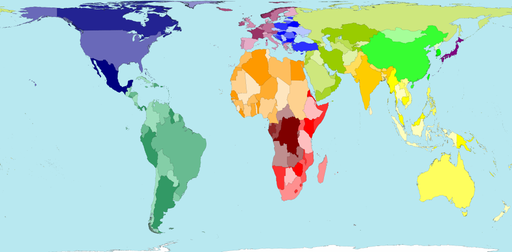
The maps Tyson uses are from Worldmapper.org. The one that he says represents change from “2000 to 2010” actually depicts growth in scientific research from 1990 to 2001. Danny Dorling, professor of Human Geography at the University of Sheffield and part of the team that created Worldmapper, confirmed Tyson’s error but said, “I think Neil’s got it roughly right. He should just have said ‘this is the trend to 2001 and it is not just likely it has continued, but it has probably accelerated.’ ”
Tyson’s comments are from a talk he gave in May at the University of Washington entitled, “Adventures of an Astrophysicist.” For a closer look at the maps he uses, see below.
The color-coded world map above can be used for reference when studying the maps below.
The map above represents territory sizes in proportion to the number of papers published in 2001 that were written by scientists living there. The number of scientific papers published by researchers living in America was more than three times greater than the number published in the second-highest-publishing country, Japan. For more information, including per capita data, see Worldmapper’s PDF poster.
The map above represents the growth in scientific research between 1990 and 2001. Territory sizes are proportional to the increase in scientific papers by authors working in those countries in 2001 compared to 1990. If there was no increase during that period, the country has no area on the map.
Despite the fact that the United States had the most published research in 2001 and a net increase in research betwen 1990 and 2001, its size is smaller on the map because of a significantly greater growth rate by countries like Japan, the Republic of Korea, Singapore, China and Germany. Although the data behind the maps are now a decade old, Dorling suggests that a current map might look similar. “If I had to guess,” he said, “it would look worse for the USA given the massive cuts in funding in California to some of the major state Universities there.”
You can find more on this map, including a printable PDF poster with per capita data by country, along with information on the sources and methodology behind its creation, by visiting Worldmapper.
Before we rush headlong into a new year, it’s worth pausing, ever so briefly, to consider the ground we covered in 2011. What topics resonated with you … and jazzed us? Today, we’re highlighting 10 thematic areas (and 46 posts) that captured the imagination. Chances are you missed a few gems here. So please join us on our brief journey back into time. Tomorrow, we start looking forward again.
1) Universities Offer More Free Courses, Then Start Pushing Toward Certificates: The year started well enough. Yale released another 10 stellar open courses. (Find them on our list of 400 Free Courses). Then other universities started pushing the envelope on the open course format. This fall, Stanford launched a series of free courses that combined video lectures with more dynamic resources — short quizzes; the ability to pose questions to Stanford instructors; feedback on your overall performance; a statement of accomplishment from the instructor, etc. A new round of free courses will start in January and February. (Get the full list and enroll here.) Finally, keep your eyes peeled for this: In 2012, MIT will offer similar courses, but with one big difference. Students will get an official certificate at the end of the course, all at a very minimal charge. More details here.
3) Books Intelligent People Should Read: Neil deGrasse Tyson’s list “8 (Free) Books Every Intelligent Person Should Read” ended up generating far more conversation and controversy than we would have expected. (Users have left 83 comments at last count.) No matter what you think of his rationale for choosing these texts, the books make for essential reading, and they’re freely available online.
4) Christopher Hitchens and Stephen Fry: Christopher Hitchens left us this past month. And, until his last day, Hitchens was the same old Hitch — prolific, incisive, surly and defiant, especially when asked about whether he’d change his position on religion, spirituality and the afterlife. All of this was on display when he spoke at the American Jewish University in Los Angeles last February. We covered his comments in a post called, No Deathbed Conversion for Me, Thanks, But it was Good of You to Ask. And even from the grave, Hitchens did more of the same, forcing us to question the whole modern meaning of Christmas.
The Truth Is a Cave in the Black Mountains — Read Online
And, since it’s certainly timely, we leave you with Gaiman’s New Year’s Eve message delivered to a crowd in Boston several years ago:
May your coming year be filled with magic and dreams and good madness. I hope you read some fine books and kiss someone who thinks you’re wonderful, and don’t forget to make some art — write or draw or build or sing or live as only you can. May your coming year be a wonderful thing in which you dream both dangerously and outrageously.
I hope you will make something that didn’t exist before you made it, that you will be loved and you will be liked and you will have people to love and to like in return. And most importantly, because I think there should be more kindness and more wisdom in the world right now — I hope that you will, when you need to, be wise and that you will always be kind. And I hope that somewhere in the next year you surprise yourself.
In 1952, John Cage composed his most controversial piece, 4′33,″ a four-and-a-half minute reflection on the sound of silence. Now fast forward eight years. It’s February, 1960, and we find the composer teaching his famous Experimental Composition courses at The New School in NYC, and paying a visit to the CBS game show “I’ve Got a Secret.” The TV show offered Cage something of a teachable moment, a chance to introduce the broader public to his brand of avant-garde music. Cage’s piece is called Water Walk (1959), and it’s all performed with unconventional instruments, save a grand piano. A water pitcher, iron pipe, goose call, bathtub, rubber duckie, and five unplugged radios — they all make the music. And the audience doesn’t quite know how to react, except with nervous laughter. It wasn’t particularly courteous. But, as one scholar has noted, it’s equally remarkable that prime time TV gave ten minutes of uninterrupted airtime to avant-garde music. You take the good with the bad.
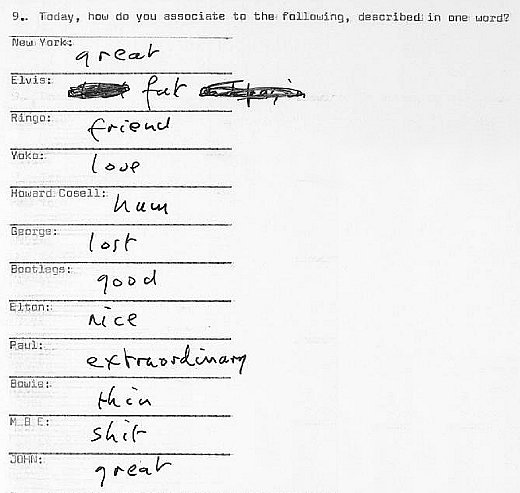
In 1976 a youthful fan named Stuart sent John Lennon a six-page list of questions. The former Beatle responded with answers, along with a child-like drawing of a lamb standing on a cloud, saying, “Hi Stuart.”
Stuart wanted to know a few things, like what sort of album Lennon was working on. “Until it’s been on tape,” Lennon replied, “I never know what it will be.” He also wondered if the famous musician was writing anything, like perhaps an autobiography. “Yes, I have been writing, but not an autobiography. I’ve noticed that people tend to DIE after writing their life story.”
The young fan included a list of words and names, along with the question: How would you characterize the following figures in one word?
John: “Great”
Paul: “Extraordinary”
George: “Lost”
Ringo: “Friend”
Elvis: “Fat”
Yoko: “Love”
Howard Cosell: “Hum”
Lennon signed off with, “It was a pleasure, hope ya dig it/John Lennon.”
“Civilization begins with distillation,” William Faulkner once said, and like many of the great writers of the 20th century — Ernest Hemingway, F. Scott Fitzgerald, James Joyce — the bard of Oxford, Mississippi certainly had a fondness for alcohol.
Unlike many of the others, though, Faulkner liked to drink while he was writing. In 1937 his French translator, Maurice Edgar Coindreau, was trying to decipher one of Faulkner’s idiosyncratically baroque sentences. He showed the passage to the writer, who puzzled over it for a moment and then broke out laughing. “I have absolutely no idea of what I meant,” Faulkner told Coindreau. “You see, I usually write at night. I always keep my whiskey within reach; so many ideas that I can’t remember in the morning pop into my head.”
Every now and then Faulkner would embark on a drunken binge. His publisher, Bennett Cerf, recalled:
The maddening thing about Bill Faulkner was that he’d go off on one of those benders, which were sometimes deliberate, and when he came out of it, he’d come walking into the office clear-eyed, ready for action, as though he hadn’t had a drink in six months. But during those bouts he didn’t know what he was doing. He was helpless. His capacity wasn’t very great; it didn’t take too much to send him off. Occasionally, at a good dinner, with the fine wines and brandy he loved, he would miscalculate. Other times I think he pretended to be drunk to avoid doing something he didn’t want to do.
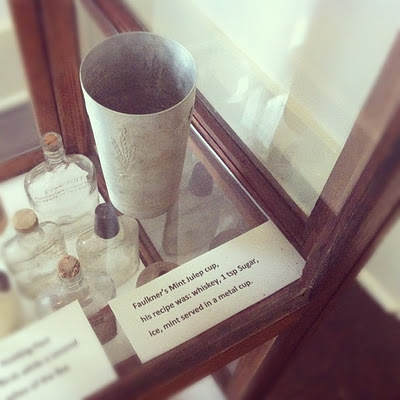
Wine and brandy were not Faulkner’s favorite spirits. He loved whiskey. His favorite cocktail was the mint julep. Faulkner would make one by mixing whiskey–preferably bourbon–with one teaspoon of sugar, a sprig or two of crushed mint, and ice. He liked to drink his mint julep in a frosty metal cup. (See image above.) The word “julep” first appeared in the late 14th century to describe a syrupy drink used to wash down medicine. Faulkner believed in the medicinal efficacy of alcohol. Lillian Ross once visited the author when he was ailing, and quoted him as saying, “Isn’t anythin’ Ah got whiskey won’t cure.”
On a cold winter night, Faulkner’s medicine of choice was the hot toddy. His niece, Dean Faulkner Wells, described the recipe and ritual for hot toddies favored by her uncle (whom she called “Pappy”) in The Great American Writers’ Cookbook, quoted last week by Maud Newton:
Pappy alone decided when a Hot Toddy was needed, and he administered it to his patient with the best bedside manner of a country doctor.
He prepared it in the kitchen in the following way: Take one heavy glass tumbler. Fill approximately half full with Heaven Hill bourbon (the Jack Daniel’s was reserved for Pappy’s ailments). Add one tablespoon of sugar. Squeeze 1/2 lemon and drop into glass. Stir until sugar dissolves. Fill glass with boiling water. Serve with potholder to protect patient’s hands from the hot glass.
Pappy always made a small ceremony out of serving his Hot Toddy, bringing it upstairs on a silver tray and admonishing his patient to drink it quickly, before it cooled off. It never failed.
In this video created by the Guardian, writer and award-winning documentary filmmaker Errol Morris talks about the nature of truth, art, and propaganda in photography. He draws examples from the photographs of Abu Ghraib and the Crimean War, both cited in his book Believing is Seeing, and he asks the viewer to consider a most fundamental question: how does a photograph relate to the physical world? Unlike a verbal or written statement, a photograph cannot be true or false. It simply is.
Then comes another argument worth considering — the idea that all photographs are posed. By way of example, Morris cites an instance where a photographer (in this case Roger Fenton) omits an elephant standing outside the frame. And it leads Morris to suggest that we shouldn’t take photos at face value. Rather we should do our due diligence to find out whether there isn’t always a metaphorical elephant looming beyond the frame. As Morris states, a photograph decontextualizes everything. It reveals to us a two dimensional reality that’s “been torn out of the fabric of the world.”
This video is part of the Guardian’s “Comment is Free” series, in which the world’s top thinkers, newsmakers, and people with stories to tell are interviewed. For more meditations on photography, give some time to Errol Morris’ speech at the Harvard Bookstore. Find the transcript here.
Eugene Buchko is a blogger and photographer living in Atlanta, GA. He maintains a photoblog, Erudite Expressions, and writes about what he reads on his reading blog.
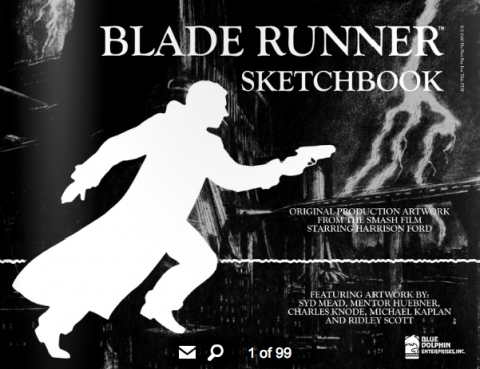
Coinciding with the release of Blade Runner in 1982, David Scroggy published the Blade Runner Sketchbook, a book with 100+ production drawings and artwork for Ridley Scott’s classic sci-fi film. The sketchbook features visual work by Scott himself, artist Mentor Huebner, and costume designer Charles Knode, but most notably a slew of drawings by artist, futurist, and illustrator Syd Mead.
As Comics Alliance notes, this sketchbook has been out of print for years and scant few paper copies remain available for purchase. So digital versions have filled the void online, and now comes this: a version that lets you revel in the Blade Runner artwork in full-screen mode. Enter the sketchbook by clicking the image above or below. (The book itself is hosted at Isuu.com). Once you get there, click the images and they’ll fill your screen.
Enjoy, and while you’re at it, don’t miss some related items:
We're hoping to rely on loyal readers, rather than erratic ads. Please click the Donate button and support Open Culture. You can use Paypal, Venmo, Patreon, even Crypto! We thank you!
Open Culture scours the web for the best educational media. We find the free courses and audio books you need, the language lessons & educational videos you want, and plenty of enlightenment in between.