The term apocryphal may sound antiquated, but any reasonably serious reader encounters it fairly often, even in recently published texts. In the modern usage, it usually describes words or events that, despite probably never having been spoken or taken place, tend to be cited as if they had. Hochelaga creator Tommie Trelawny says that the word comes from a Greek term meaning “hidden,” and was used to refer to disputed texts not included in the mainstream Bible. Some churches acknowledge these apocrypha, and others reject them. As for what the unpredictable and often bizarre material, even by biblical standards, in these “hidden books,” that’s what Trelawny explains in his new video above.
In the book of Tobit, a highly unfortunate man and woman receive salvation from the angel Raphael, who uses fish guts to cure their physical and demonic afflictions. In the book of Judith, the titular Israelite widow deceives and slays the Assyrian general Holofernes, a scene immortalized by Caravaggio (and rendered even more viscerally, as previously featured here on Open Culture, by Artemisia Gentileschi).
In one chapter of the book of Daniel, the titular prophet plays the lawyer in a kind of courtroom drama that has a couple of men getting their comeuppance for falsely accusing a woman of adultery; in another, he turns detective, investigating the matters of a statue said to come alive at night and a dragon being worshipped as a god.
There’s quite a bit more, all of it eventful, none of it universally accepted among the holy texts of Christianity. The peculiar status of the apocrypha dates back to the fourth century, when the scholar Jerome embarked upon a translation of the Bible into Latin. This first required gathering up all extant versions of the book, which didn’t necessarily agree with each other: one, written in Greek, included quite a few more books than the Bible in Hebrew. It was Jerome who, unable to confirm these extra books’ authenticity, labeled them “apocrypha,” placing them in a section that eventually got them regarded as a kind of second canon: “deleted scenes,” as Trelawny puts it, accompanying the feature that is the Bible. As for the extent to which they reflect the auteur’s true vision, that can only be — and remain — a matter of debate.
Based in Seoul, Colin Marshall writes and broadcasts on cities, language, and culture. He’s the author of the newsletterBooks on Cities as well as the books 한국 요약 금지 (No Summarizing Korea) and Korean Newtro.Follow him on the social network formerly known as Twitter at @colinmarshall.
When Clare Torry went into the studio to record her now-legendary vocals for Pink Floyd’s “Great Gig in the Sky,” the centerpiece of 1973’s Dark Side of the Moon, neither the singer nor the band was particularly impressed with each other. David Gilmour remembered the moment in an interview on the album’s 30th anniversary:
Clare Torry didn’t really look the part. She was Alan Parsons’ idea. We wanted to put a girl on there, screaming orgasmically. Alan had worked with her previously, so we gave her a try. And she was fantastic. We had to encourage her a little bit. We gave her some dynamic hints: “Maybe you’d like to do this piece quietly, and this piece louder.” She did maybe half a dozen takes, and then afterwards we compiled the final performance out of all the bits. It wasn’t done in one single take.
Asked the follow-up question “what did she look like?,” Gilmour replied, “like a nice English housewife.”
Torry, for her part, was hardly starstruck. “If it had been the Kinks,” she later said, “I’d have been over the moon.” She also remembers the session very differently. “They had no idea what they wanted,” she says. Told only “we don’t want any words,” she decided to “pretend to be an instrument.” She remembers “having a little go” and knocking out the session in a couple takes.
This Rashomon scenario involves not only faulty memory but also the legal question as to who composed the song’s melody and vocal concept—a question eventually decided, in 2004, in Torry’s favor, entitling her to royalties.
She clearly wasn’t about to become a touring member of the band, even after the album’s massive success and two subsequent tours. Still, while Torry may not have suited Gilmour’s physical preferences for female singers, and while she may not have thought much of Pink Floyd, she has appeared live with their different iterations over the years, including a show at the Rainbow Theatre in London just months after the album’s release (further up). Later, in 1987, Torry appeared again, this time with Roger Waters at Wembley Stadium on his K.A.O.S. on the Road Tour.
Torry would then join the David Gilmour-led Pink Floyd in 1990 for “Great Gig in the Sky” at Knebworth. I do not think she resembles an English housewife in the concert film at the top—or at least no more than the rest of the band look like middle-aged English husbands. But she still pulls off the soaring vocal, more or less, seventeen years after she first stepped into the studio, having little idea who Pink Floyd was or what would become of that fateful session.
Note: An earlier version of this post appeared on our site in 2020.
In a way, it always made sense that one of the most memorable visual distillations of Southern California life would have been painted by an Englishman. The purest appreciation for the wide-open lifestyle choices, freestyle built environment, unrepentant private wealth, and high-wattage sunshine of Los Angeles — especially as it was exaggerated, and indeed mythologized, in mid-twentieth century popular culture — could only be felt by someone from an infinitely more traditional, straitened, and damp part of the world. David Hockney, who died last week, wasn’t just an Englishman but a northern Englishman, who would have grown up surrounded by the kind of attitudes satirized in the “Four Yorkshiremen” sketch made famous by Monty Python. Little wonder he fell in love with the newest city of the New World.
Hockney gave that many artistic forms over decades of his long life and career. Practically anyone who knows his name can recognize A Bigger Splash, from 1967, a both idyllic and faintly eerie depiction of someone having just plunged into the swimming pool behind what now looks like a classic “midcentury modern” home accented with palm trees.
But fewer can call to mind the works from which it evolved, A Little Splash and The Splash, both of which Hockney painted the previous year; all together, they constitute a series originally inspired by a photograph on the cover of a swimming-pool maintenance guide from the late fifties. You can see the three paintings put in context in the Sotheby’s video at the top of the post, which reveals how Hockney’s image grew more abstracted, and more Los Angelized, with each iteration.
When it came time to paint the third version, Hockney first built up its arrangement of house, pool, diving board, and sky with blocks of flat (if characteristically bright) color. He then gradually nudged these shapes toward representation by adding detail. Discussing the making of the painting later in life, he liked to mention how much time he spent on the splash alone: a full week, at least, to render an event that lasts no longer than a second or two. There would be more Hockney swimming pools, each evocative in its own way, none more expensive than the nearly photorealistic Portrait of an Artist (Pool with Two Figures), from 1971, which went for $90.3 million at Christie’s in 2018. But it was only A Bigger Splash that went on to adorn the cover of Reyner Banham’s Los Angeles: The Architecture of Four Ecologies, still one of the most perceptive books about that city — and one written, naturally, by another besotted Brit.
Based in Seoul, Colin Marshall writes and broadcasts on cities, language, and culture. He’s the author of the newsletterBooks on Cities as well as the books 한국 요약 금지 (No Summarizing Korea) and Korean Newtro.Follow him on the social network formerly known as Twitter at @colinmarshall.
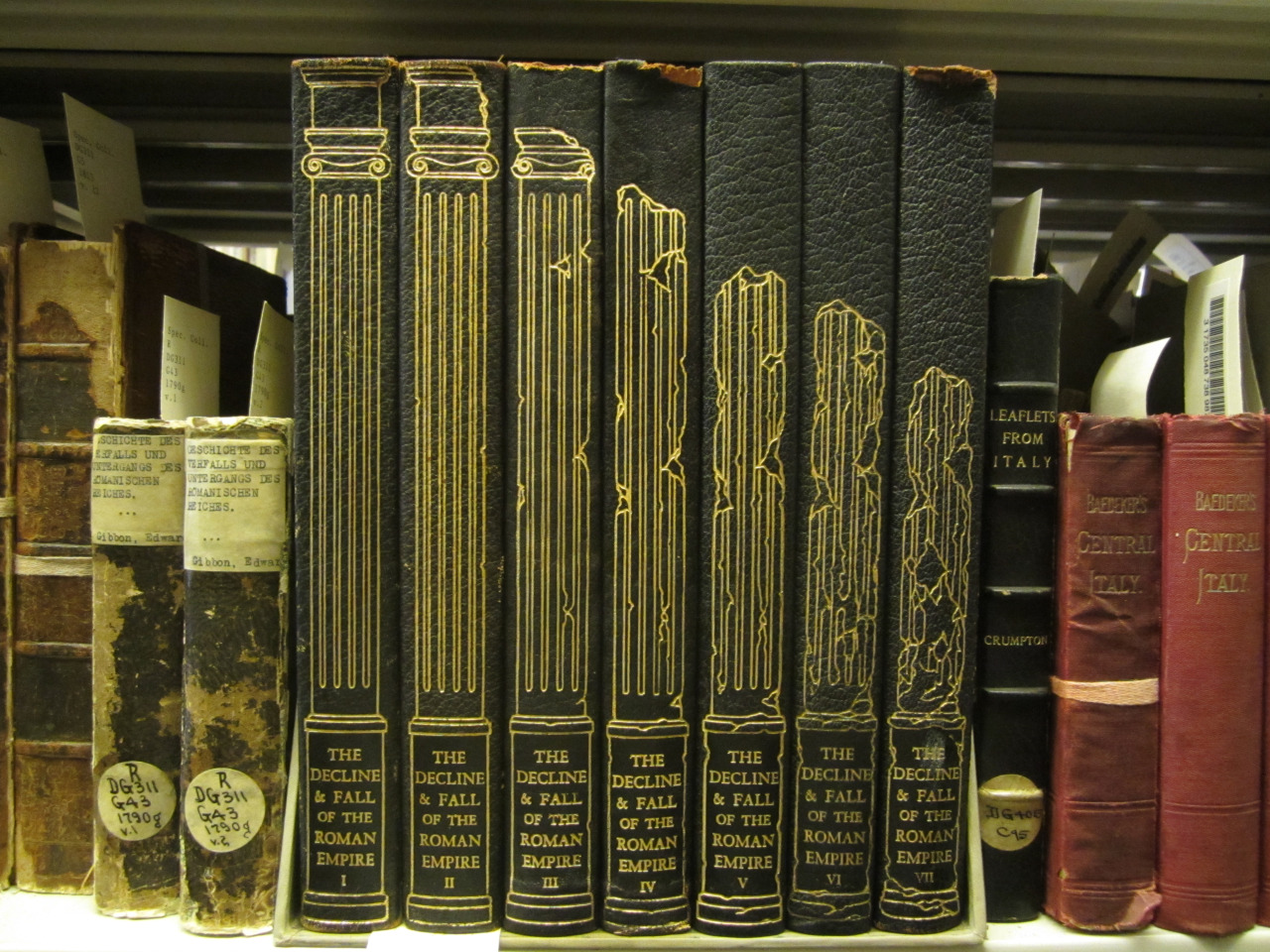
In 1929, the book publisher George Macy founded The Limited Editions Club (LEC), an imprint tasked with publishing finely illustrated limited editions of classic books. In the years to come, Macy worked with artists like Matisse and Picasso, and photographers like Edward Weston, to produce books with artistic illustrations on their inner pages. And sometimes The Limited Editions Club even turned its design focus to other parts of the book. Take for example this 1946 edition of Edward Gibbon’s The Decline and Fall of the Roman Empire and its pretty amazing spine design.
Created by Clarence P. Hornung, the design captures the essence of Gibbon’s classic, showing Roman pillars progressively crumbling as your eyes move from Volume 1 to Volume 7. George Macy later called the collection, which also features illustrations by the great 18th-century printmaker Giovanni Battista Piranesi, “the most herculean labor of our career.”
Note: an earlier version of this post appeared on our site in June 2015.
If you would like to support the mission of Open Culture, consider making a donation to our site. It’s hard to rely 100% on ads, and your contributions will help us continue providing the best free cultural and educational materials to learners everywhere. You can contribute through PayPal, Patreon, and Venmo (@openculture). Thanks!
Most of us who know the work of Roald Dahl grew up with it, eventually coming to consider the man a master of imaginative, often grotesque tales for children. A bit later on, when we heard that he’d also written books for adults, with titles like Kiss Kiss and Switch Bitch, some of us sought them out as a kind of forbidden literary fruit. What tends to escape notice is that he also wrote for teenagers — or, in any case, that certain of his stories were packaged for teenagers into the posthumous volume The Great Automatic Grammatizator, whose title story has gained a new relevance in our age of ChatGPT, as explained in the new Tibees video above.
First published in 1954, “The Great Automatic Grammatizator” concerns an enormously complex, wholly analog machine that can generate page after page of text at a then-unimaginable clip. Its inventor, a beaten-down young corporate employee called Adolph Knipe, designs it based on the same principles he’d used to create an electric calculator that pleased his boss, Mr. Bohlen. A frustrated writer of fiction by night, Knipe conceives of the Grammatizator as a tool of revenge against the magazine industry that spurned him. With the company’s backing to build the thing, he tells Bohlen, they could dominate the market for short stories almost without effort — and make their own prestigious names as authors to boot.
“It stands to reason that an engine built along the lines of the electric computer could be adjusted to arrange words (instead of numbers) in their right order according to the rules of grammar,” Dahl writes. “Give it the verbs, the nouns, the adjectives, the pronouns, store them in the memory section as a vocabulary, and arrange for them to be extracted as required. Then feed it with plots and leave it to write the sentences.” Though Bohlen accepts the technical proposition, he at first doubts the commercial one, at least until his employee informs him that magazines like the Saturday Evening Post, Collier’s, and Ladies’ Home Journal will pay for a story “anything up to twenty-five hundred dollars”: nearly $40,000 today.
Of course, 1954 was a different time. Today, the Saturday Evening Post, Collier’s, and Ladies’ Home Journal have all gone, as has the prospect of earning even a meager living through short stories. And a computer of this kind, as Dahl describes it, would have been an enormous, noisy device laden with buttons, dials, pedals, and stops, each of which the “writer” would use to control such variables as theme, style, tension, humor, and passion. “The quality may be inferior,” an increasingly power-mad Knipe admits of the machine’s output, “but that doesn’t matter. It’s the cost of production that counts.” All of us now possess Grammatizators of our own, far faster, cheaper, more versatile, and easier to use than anything Roald Dahl could have imagined. Yet how many of us can hope to be read more than 70 years in the future?
Based in Seoul, Colin Marshall writes and broadcasts on cities, language, and culture. He’s the author of the newsletterBooks on Cities as well as the books 한국 요약 금지 (No Summarizing Korea) and Korean Newtro.Follow him on the social network formerly known as Twitter at @colinmarshall.
Ask around for what everyone knows about Istanbul (other than that it used to be called Constantinople), and you’ll find that the presence of Hagia Sophia there comes right to many a mind. Less likely to be mentioned is its proneness to earthquakes, though it tends to rank just below Tokyo on lists of cities under the greatest threat from fault lines below. These two characteristics turn out to have a connection, manifest in the ongoing seismic retrofitting of Istanbul’s symbolic cathedral-turned-mosque-turned-museum turned-mosque-again. Hagia Sophia is one of the most celebrated religious buildings standing; keeping it that way requires a serious engineering effort, as explained in the new B1M video above.
Since it was first built in the fourth century, Hagia Sophia has actually sustained severe earthquake damage quite a few times, including a complete collapse of its cupola in the year 558 and partial collapses in the tenth and fourteenth centuries. The construction of its famous central dome, along with the smaller sub-domes that support it, gets a section of its own in the video.
Host Fred Mills also gives due mention to the eight green marble columns that support the upper floors of the cathedral, thought to have been recycled from the ruins of the Temple of Artemis (one of the Seven Wonders of the Ancient World), and the red stone set into the floor on which emperors were once crowned that would have been brought in from the Egyptian desert.
In these and other respects, Hagia Sophia isn’t just a site of pilgrimage and worship, but also a veritable built record of centuries upon centuries of Roman, Greek, Christian, and Islamic civilization. As evidenced by the scaffolding currently up to facilitate the project of readying it for the inevitable coming of the big one — or rather, the bigger one — the structure continues to change with time, though our era has an especially strong concern for preserving what have by now become historical features. Hence the efforts now being put into restoration: of the dome, naturally, but also of the floors, columns, and mosaics. If all goes well, Hagia Sophia will continue to stand as the most striking structure in Istanbul’s already dramatic urban and geographical setting for another millennium and a half, incorporating history all the while.
Based in Seoul, Colin Marshall writes and broadcasts on cities, language, and culture. He’s the author of the newsletterBooks on Cities as well as the books 한국 요약 금지 (No Summarizing Korea) and Korean Newtro.Follow him on the social network formerly known as Twitter at @colinmarshall.
Admit it, your list of favorite Bowie songs is full of the big hits. Hell, maybe it’s all hits; there’s no shame in that. Digging deep into the crates will yield many an overlooked surprise, many a subtle sleeper, cut-up classic, and electronic experiment. But if all you’ve got is Changesbowie—the 1990 compilation that became, for some generations, a definitive statement of his career—you’ve still got a collection of songs the likes of which have never been heard before or since in modern pop.
Completists may grouch, but even resident Bowie scholars/local record store clerks have an “Ashes to Ashes,” “’Heroes’,” “Changes,” or “Modern Love” in their top ten. Whether ardent or casual fans, we connect with Bowie’s music through milestones, both in his career and in our own lives. This truth has been exploited. In 2008, Mike Schiller at PopMatters bemoaned the fact that almost 20 Bowie compilation albums had been released, a few of which “don’t really seem to court any greater purpose whatsoever.”
Given this surfeit of Bowie compilations on the market, Schiller’s initial groaning reaction to news of yet another (“Oh, good Lord. Another David Bowie collection?”) seems apposite. Except this collection, iSELECT: BOWIE, released in 2008 to readers of the U.K.’s Mail on Sunday, then later in an official CDand digital edition, “is actually something special.” Bowie “picked the tracklist himself. Even more than that, the tracklist actually looks like something he’d have picked himself, rather than having a manager or publicist pick it for him.”
iSELECT: BOWIE
1. “Life On Mars?” (from the album Hunky Dory)
2. “Sweet Thing/Candidate/Sweet Thing” (from the album Diamond Dogs)
3. “The Bewlay Brothers” (from the album Hunky Dory)
4. “Lady Grinning Soul” (from the album Aladdin Sane)
5. “Win” (from the album Young Americans)
6. “Some Are” (currently exclusive to this compilation)
7. “Teenage Wildlife” (from the album Scary Monsters)
8. “Repetition” (from the album Lodger)
9. “Fantastic Voyage” (from the album Lodger)
10. “Loving The Alien” (from the album Tonight)
11. “Time Will Crawl (MM Remix)” (new remix by David Bowie)
12. “Hang On To Yourself [live]” (from the album Live Santa Monica ’72)
See the full tracklist above and hear a playlist of his picks at the top. If we put all our lists of favorites together, we might see a very high percentage of “Life on Mars?” picks. We’re in excellent company; it’s Bowie’s number one favorite song of his. But how many of his other picks might we choose? The eight-and-a-half minute “Sweet Thing”/”Candidate”/”Sweet Thing (Reprise)” from Diamond Dogs? “Win” from Young Americans or “The Bewlay Brothers” from Hunky Dory?
Aside from “Life on Mars?” and the far lesser-collected “Loving the Alien” and “Time Will Crawl,” none of his twelve selections were released as singles. There are no songs from two of the most acclaimed Bowie albums, Low and ’Heroes’, unless we count “Some Are” a bonus track included on the Low 1991 rerelease. There are two tracks from Lodger, the third and least accessible of his vaunted Berlin trilogy, and only one selection from Ziggy Stardust, and it ain’t “Ziggy Stardust.”
If anyone else handed you this list of favorite Bowie tracks, you’d be skeptical. Who puts “Hang On To Yourself” (Live Santa Monica ’72) above any of the studio tracks on that classic 1972 breakout album? David Bowie, that’s who. And who knows, if you’d asked him the day before or after, he might have picked twelve different songs. There’s no telling how seriously he took the exercise, but in the newspaper release, he did “casually [pen] his inspirations for the songs and the recording processes behind them,” notes Allmusic’s Jason Lymangrover.
On his choice of “Teenage Wildlife,” for example, Bowie commented: “So it’s late morning and I’m thinking, ‘New song and a fresh approach. I know. I’m going to do a Ronnie Spector. Oh yes I am. Ersatz just for one day.’ And I did and here it is. Bless. I’m still very enamoured of this song and would give you two ‘Modern Love’s for it anytime…” Bowie got to experience his own music in a way no one else could. iSELECT: BOWIEgets behind the greatest hits collections for a glimpse at the way he heard and remembered his catalogue.
Note: An earlier version of this post appeared on our site in 2019.
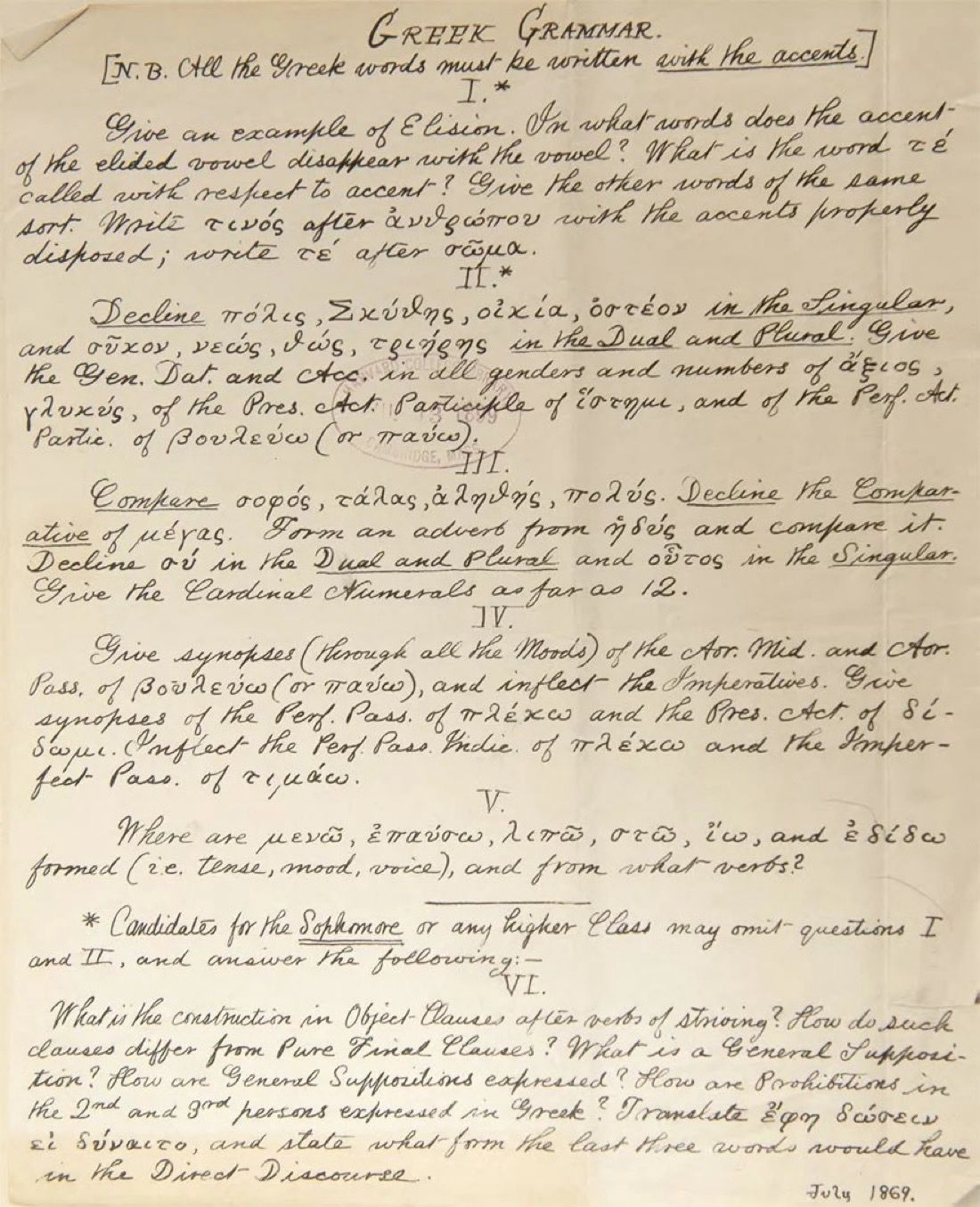
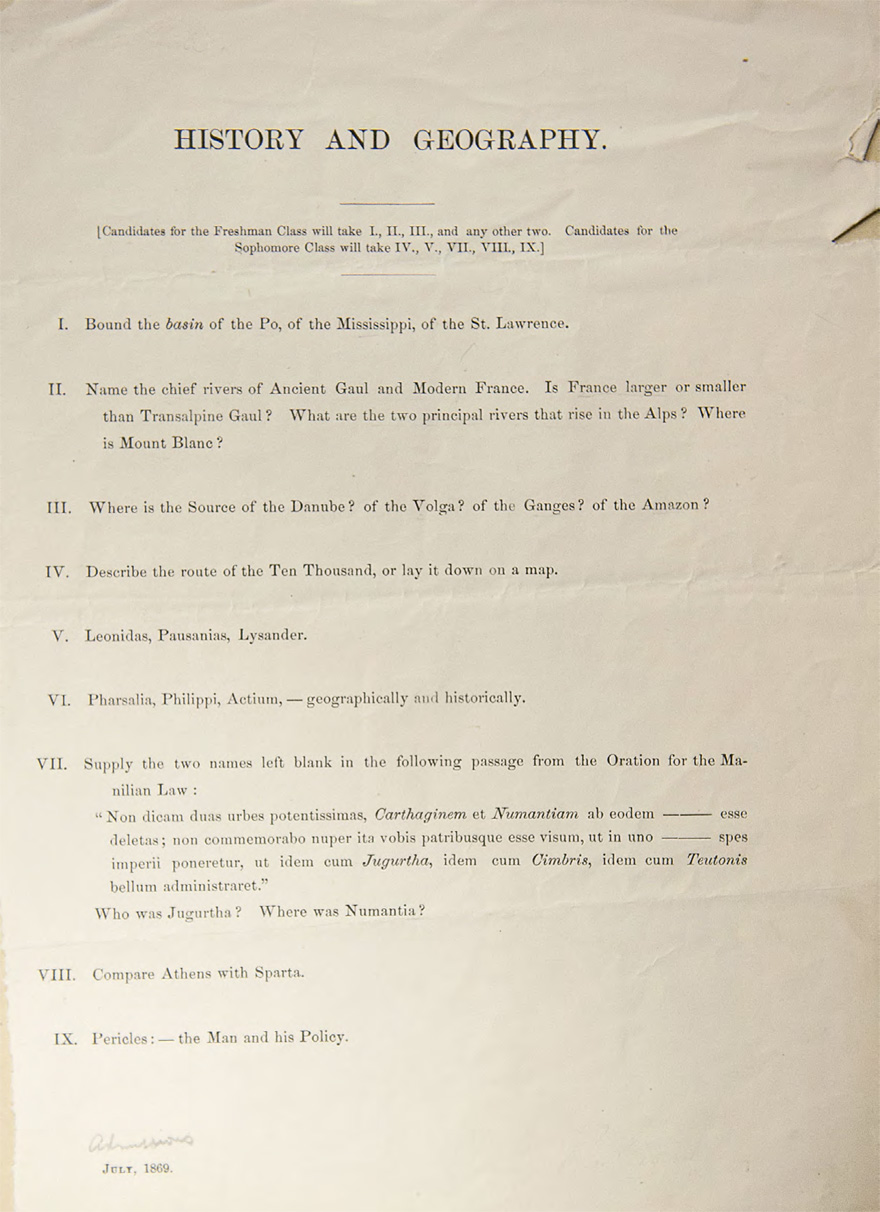
In 2025, Harvard once again began asking applicants to submit an SAT or ACT score. This was a reversal of the no-test-necessary policy that it and quite a few other American colleges and universities adopted during the COVID-19 pandemic. To some observers of higher education, the disappearance of the standardized-test requirement came as a shock, though in a sense, it wasn’t without precedent. Until the mid-nineteen-tens, Harvard had applicants take its own entrance exam, since no standardized test existed. One example from 1869, which you can see here, evaluated students on their proficiency in Latin, Greek, history and geography, arithmetic, algebra, and plane geometry.
The idea wasn’t so much to evaluate the test-taker’s reasoning abilities as to make sure he’d already undergone the expected education for his class. Even so, as the New York Times’ Alison Leigh Cowan notes, “colleges occasionally allowed prospects to correct deficiencies as a condition of admission.”
This reflects the very different role higher education played in American life a century and a half ago than it does today: back then, Harvard admitted 185 out of 210 applicants; last year, it admitted 1,968 out of 57,435. As the country industrialized, colleges and universities changed accordingly: existing ones grew, many new ones appeared, and a greater and greater percentage of students submitted to a process surrounding tertiary education that eventually came to seem machine-like itself.
To college-applying students today, the 1869 entrance exam may not look entirely unfamiliar, at least to the extent that it asks questions about mathematics. Chances are, however, that no current Harvard hopeful, no matter how intelligent, could actually pass the test, given the weight it places on classical languages. Throughout the nineteenth century and up until World War I, all young gentlemen got an education in Latin and ancient Greek. But when both started to vanish from college-admissions exams, especially after the SAT grew dominant in the nineteen-forties, so did the immediate incentive to learn them. Reflect though that does the exigencies of a rapidly changing technological society, it also makes one wonder how much someone with no grasp of Latin or Greek really understands English: a question to which the college students of recent decades provide dispiriting answers.
Based in Seoul, Colin Marshall writes and broadcasts on cities, language, and culture. He’s the author of the newsletterBooks on Cities as well as the books 한국 요약 금지 (No Summarizing Korea) and Korean Newtro.Follow him on the social network formerly known as Twitter at @colinmarshall.
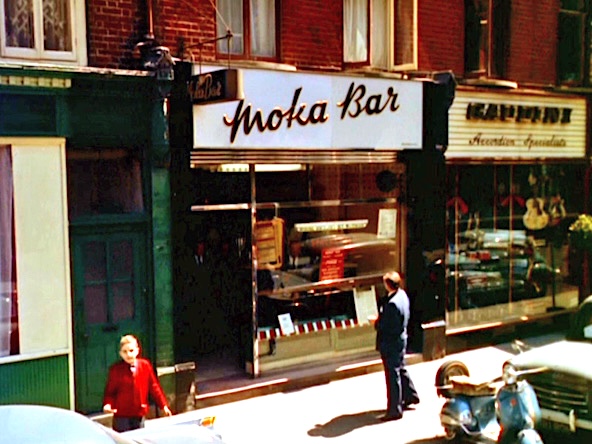
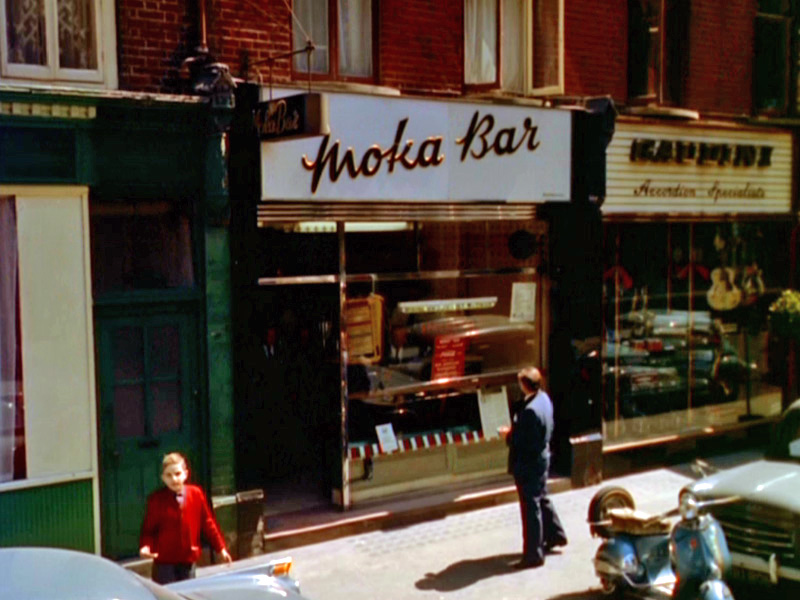
As we’ve noted before, the English coffeehouse has served as a staging ground for radical, sometimes revolutionary social change. Certainly this was the case during the Enlightenment, as it was with the salons in France. And yet, by the early 20th century it seems, coffee shops in London had grown scarcer and more humdrum. That is until 1953 when the Moka Bar, the UK’s first Italian espresso bar, opened in Soho. On his blog The Great Wen, Peter Watts describes its arrival as “a momentous event”:
London’s first proper coffee shop—one equipped with a Gaggia coffee machine—opened at 29 Frith Street. This was a place where teenagers too young for pubs could come and gather, and it is said by some that the introduction of this coffee bar prompted the youth culture explosion that soon changed social life in Britain forever.
“By 1972,” Watts writes, “coffee bars were everywhere and the teenage revolution was firmly established.” Places like the Moka Bar might seem like the ideal place for countercultural maven William S. Burroughs—a London resident from the late sixties to early seventies—to hobnob with young dissidents and outsiders. Burroughs, who so approvingly refers to the possibly apocryphal anarchist pirate colony of Libertatia in his Cities of the Red Night, would, one might think, appreciate the budding anarchism of British youth culture, which would flower into punk soon enough.
But rather than joining the coffee bar scene, the cantankerous Burroughs had taken to frequenting “plush gentlemen’s shops of the area, not to mention the ‘Dilly Boys,’ young male prostitutes who hustled for clients outside the Regent Palace Hotel.”
And he had grown increasingly disillusioned with London, fuming, writes Ted Morgan in Burroughs’ biography Literary Outlaw, “at what he was paying for his hole-in-the-wall apartment with a closet for a kitchen” and at the rising price of utilities. “Burroughs,” Morgan tells us, “began to feel that he was in enemy territory.” And he thought the Moka coffee bar should pay the price for his indignities.
There, “on several occasions a snarling counterman had treated him with outrageous and unprovoked discourtesy, and served him poisonous cheesecake that made him sick.” Burroughs “decided to retaliate by putting a curse on the place.” He chose a means of attack that he’d earlier employed against the Church of Scientology, “turning up… every day,” writes Watts, “taking photographs and making sound recordings.” Then he would play them back a day or so later on the street outside the Moka. “The idea,” writes Morgan, “was to place the Moka Bar out of time. You played back a tape that had taken place two days ago and you superimposed it on what was happening now, which pulled them out of their time position.”
Burroughs also connected the method to the Watergate recordings, the Garden of Eden, and the theories of Alfred Korzybski. The trigger for the magical operation was, in his words, “playback.” In a very strange essay called “Feedback from Watergate to the Garden of Eden,” from his collection Electronic Revolution, Burroughs described his operation in detail, a disruption, he wrote, of a “control system.”
Now to apply the 3 tape recorder analogy to this simple operation. Tape recorder 1 is the Moka Bar itself it is in pristine condition. Tape recorder 2 is my recordings of the Moka Bar vicinity. These recordings are access. Tape recorder 2 in the Garden of Eden was Eve made from Adam. So a recording made from the Moka Bar is a piece of the Moka Bar. The recording once made, this piece becomes autonomous and out of their control. Tape recorder 3 is playback. Adam experiences shame when his discgraceful behavior is played back to him by tape recorder 3 which is God. By playing back my recordings to the Moka Bar when I want and with any changes I wish to make in the recordings, I become God for this local. I effect them. They cannot affect me.
The theory made perfect sense to Burroughs, who believed in a Magical Universe ruled by occult forces and who experimented heavily with Scientology, Crowley-an Magick, and the orgone energy of Wilhelm Reich. The attack on the Moka worked, or at least Burroughs believed it did. “They are seething in there,” he wrote, “I have them and they know it.” On October 30th, 1972 the establishment closed its doors—perhaps a consequence of those rising rents that so irked the Beat writer—and the location became the Queens Snack Bar.
The audio-visual cut-up technique Burroughs used in his attack against the Moka Bar was a method derived by Burroughs and Brion Gysin from their experiments with written “cut-ups,” and Burroughs applied it to film as well. At the top of the post, see an interpretive “meditation” based on Burroughs’ use of audio/visual “magical weapons” and incorporating his recordings. On YouTube, you can watch “The Cut Ups,” a short film Burroughs himself made in 1966 with cinematographer Antony Balch, a disorienting illustration of the cut up technique.
Not limited to attacking annoying London coffeehouse owners, Burroughs’ supposedly magical interventions in reality were in fact the fullest expression of his creativity. As Ted Morgan writes, “the single most important thing about Burroughs was his belief in the magical universe. The same impulse that led him to put out curses was, as he saw it, the source of his writing.” Read much more about Burroughs’ theory and practice in Matthew Levi Stevens’ essay “The Magical Universe of William S. Burroughs,” and hear the author himself discourse on the paranormal, tape cut-ups, and much more in the lecture below from a writing class he gave in June, 1986.
Note: An earlier version of this post appeared on our site in 2014.
Though seldom heard these days, the term “desktop publishing” once opened a great many eyes to the promise of the personal computer. It meant that one could create a publication without owning a press or contracting with an outfit that did. Indeed, the whole process of writing, design, and printing could take place on one’s desk, provided one had furnished it with the right computer and accessories. From the mid-eighties through the early nineties, that meant an Apple Macintosh equipped with a LaserWriter printer and a copy of Aldus PageMaker. For the first time, ordinary computer users could create newsletters, brochures, and other documents assured that “what you see” onscreen is “what you get,” a feature abbreviated as WYSIWYG.
That’s not the only strange-looking piece of text encountered by early desktop publishers. Since PageMaker enabled users to create a layout before even having the words to fill it, it needed dummy text to occupy the empty spaces in order to provide a reasonable approximation of how the printed result would look. “Lorem ipsum dolor sit amet, consectetur adipiscing elit, sed do eiusmod tempor incididunt ut labore et dolore magna aliqua,” that dummy text begins, and it continues as long as its defined field allows, repeating itself as necessary. It may resemble Latin, but anyone with a decent understanding of that language won’t have to read much before noticing how oddly mangled it is. So where did this mysterious text, still familiar to all layout editors and graphic designers, actually come from?
Pursuing an answer to that question in her new video above, Rabbit Hole creator Emily Zhang talks to individuals with relevant experience including Laura Perry, the former creative director at Aldus (a company named, incidentally, for the fifteenth-century Venetian printer Aldus Manutius). It was she who first made Lorem ipsum digital, having previously used it as a wholly analog graphic designer in the form of rub-off Letraset sheets. She manually entered it straight into PageMaker off one such sheet, making occasional typos along the way. That was just another phase of transformation Lorem ipsum had been undergoing since Cicero’s words were first borrowed — and chopped up, and mixed with fragments of other languages — to create what became the industry-standard dummy text.
In the process of filling the gaps in this story, Zhang also talks to Richard McClintock, a professor of Latin long acknowledged as the premier expert on Lorem ipsum. Ultimately, she unearths a few truths that are new even to him, including an important one about the 1966 meeting at Letraset in which the idea was first floated of a single piece of dummy text that could substitute for most Western languages. It was James Mosley, the highly knowledgeable head librarian at the St. Bride Printing Library, who delivered Letraset the Cicero quotation originally known as Forum ipsum, “which had become garbled by more than one typesetter sitting at his bench since the mid-fifteen-hundreds.” Likely to remain in use as long as humanity puts words on pages — paper, digital, or whatever comes next — Lorem ipsum surely has a few more forms to take.
Based in Seoul, Colin Marshall writes and broadcasts on cities, language, and culture. He’s the author of the newsletterBooks on Cities as well as the books 한국 요약 금지 (No Summarizing Korea) and Korean Newtro.Follow him on the social network formerly known as Twitter at @colinmarshall.
Coverage of the refugee crisis peaked in 2015. By the end of the year, note researchers at the University of Bergen, “this was one of the hottest topics, not only for politicians, but for participants in the public debate,” including far-right xenophobes given megaphones. Whatever their intent, Daniel Trilling argues at The Guardian, the explosion of refugee stories had the effect of framing “these newly arrived people as others, people from ‘over there,’ who had little to do with Europe itself and were strangers.”
Such a characterization ignores the crucial context of Europe’s presence in nearly every part of the world over the past several centuries. And it frames mass migration as extraordinary, not the norm. The crisis aspect is real, the result of dangerously accelerated movement of capital and climate change. But mass movements of people seeking better conditions, safety, opportunity, etc. may be the oldest and most common feature of human history, as the Science Insider video shows above.
The yellow arrows that fly across the globe in the dramatic animation make it seem like early humans moved by bullet train. But when consequential shifts in climate occurred at a glacial pace—and economies were built on what people carried on their backs—mass migrations happened over the span of thousands of years. Yet they happened continuously throughout the last 200,000 to 70,000 years of human history, give or take. We may never know what drove so many of our distant ancestors to spread around the world.
But how can we know what routes they took to get there? “Thanks to the amazing work of anthropologists and paleontologists like those working on National Geographic’s Genographic Project,” Science Insider explains, “we can begin to piece together the story of our ancestors.” The Genographic Project was launched by National Geographic in 2005, “in collaboration with scientists and universities around the world.” Since then, it has collected the genetic data of over 1 million people, “with a goal of revealing patterns of human migration.”
The project assures us it is “anonymous, nonmedical, and nonprofit.” Participants submitted their own DNA with National Geographic’s “Geno” ancestry kits (and may still do so until next month). They can receive a “deep ancestry” report and customized migration map; and they can learn how closely they are related to “historical geniuses,” a category that, for some reason, includes Jesse James.
Do projects like these veer close to recreating the “race science” of previous centuries? Are they valid ways of reconstructing the “human story” of ancestry, as National Geographic puts it? Critics like science journalist Angela Saini are skeptical. “DNA testing cannot tell you that,” she says in an interview on NPR, but it can “make us believe that identity is biological, when identity is cultural.” National Geographic seems to disavow associations between genetics and race, writing, “science defines you by your DNA, society defines you by the color of your skin.” But it does so at the end of a video about a group of people bonding over their similar features.
Despite the significance modern humans have ascribed to variations in phenotype, race is a culturally defined category and not a scientific one, argues Joseph L. Graves, professor of biological sciences at the Joint School of Nanoscience and Nanoengineering. “Everything we know about our genetics has proven that we are far more alike than we are different. If more people understood that, it would be easier to debunk the myth that people of a certain race are ‘naturally’ one way or another,” or that refugees and asylum seekers are dangerous others instead of just like every other human who has moved around the world over the last 200,000 years.
Note: An earlier version of this post appeared on our site in 2019.
We're hoping to rely on loyal readers, rather than erratic ads. Please click the Donate button and support Open Culture. You can use Paypal, Venmo, Patreon, even Crypto! We thank you!
Open Culture scours the web for the best educational media. We find the free courses and audio books you need, the language lessons & educational videos you want, and plenty of enlightenment in between.