One of my favorite quotes about creativity comes from 20th-century electric bass virtuoso Jaco Pastorius: “You don’t get better, you grow.” The aspiration to get “better” implies a category of “best” – a height artists frequently despair of ever reaching. Pastorius rejected a state of perfection, which would mean stopping, going no further, freezing in place. “One can always learn more. One can always understand more. The question is to provide yourself with confidence.” That wisdom comes not from Jaco Pastorius but from 20th century French music teacher and composer Nadia Boulanger, who might not have approved of the libertine jazz phenom’s life, given her aristocratic conservatism, but heartily endorsed his wisdom about continuous creative growth.
Although deeply rooted in a classical tradition which strove for perfection, Boulanger taught, influenced, and championed some of the century’s most avant-garde composers, such as Igor Stravinsky, who broke violently with the past, as well as jazz greats like Quincy Jones, who took her lessons in an entirely different modern pop direction.
Indeed, Boulanger presided over “one of the most expansive periods in music history, particularly for America,” says the narrator of the Inside the Score documentary above, “How Nadia Boulanger Raised a Generation of Composers.” Aaron Copland, Leonard Bernstein, Charles Strauss, and even minimalists like Philip Glass… all studied with Boulanger at some point in their career.
Boulanger also took on many female students, like composer Lousie Talma, but she preferred to work with men. (The famously stern teacher once complimented a female student by calling her “Monsieur”). She had little regard for Romantic ideas about “genius,” and certainly not all of her students were as talented as the list of famous names associated with her, but for those with aspirations in the classical world, a visit to Boulanger’s Paris apartment constituted a rite of passage. “Aaron Copland and Virgil Thomson led the way in the ’20s,” notes Red Bull Music Academy, “transforming Boulanger’s clear, tart tonal exactness into a new version of hardy Americana.” She became such a stalwart presence in the world of 20th century composition that composer Ned Rorem once joked, “Myth credits every American town with two things: a 10-cent store and a Boulanger student.”
At age 90, in 1977, Boulanger was well known as the most famous music teacher in the world when director Bruno Monsaingeon caught up with her for the nearly hour-long interview above. See the aged but still incredibly sharp (no pun intended) legend still teaching, and struggling to put into words exactly how it is that music keeps us growing past mathematical limitations. “Can one actually define that?” she asks mid-sentence while instructing a student. “I am using words such as tenderness or tension. It’s all wrong. It is what the music itself is.…”
Learn much more about Boulanger’s extraordinary life and work as a music teacher and composer in the documentary Madamoiselle: A Portrait of Nadia Boulanger, further up, and in our previous post at the link below.
“Where’re you from?” one character asks another on the Firesign Theatre’s classic 1969 album How Can You Be in Two Places at Once When You’re Not Anywhere at All. “Nairobi, ma’am,” the other replies. “Isn’t everybody?” Like most of the countless multi-layered gags on their albums, this one makes a cultural reference, presumably to the discoveries made by famed paleoanthropologists Louis and Mary Leakey over the previous 20 years. Their discovery of fossils in Kenya and elsewhere did much to advance the thesis that humankind evolved in Africa, and that the process was happening more than 1.75 million years before.
Like all scientific breakthroughs, the Leakeys’ work only prompted more questions — or rather, created more opportunities for refining and adding detail to the relevant body of knowledge. Subsequent digs all over Africa have produced further evidence of how far our species and its predecessors go back, and where exactly the evolutionary progress happened.
Just this month, Nature published a new paper on the “age of the oldest known Homo sapiens from eastern Africa.” These new findings about known fossils, originally discovered in southwestern Ethiopia in 1967, suggest that the time has come for another revision of the long pre-history of humanity.
photo by Céline Vidal
The paper’s authors, writes Reuters’ Will Dunham, “used the geochemical fingerprints of a thick layer of ash found above the sediments containing the fossils to ascertain that it resulted from an eruption that spewed volcanic fallout over a wide swathe of Ethiopia roughly 233,000 years ago.” These fossils “include a rather complete cranial vault and lower jaw, some vertebrae and parts of the arms and legs.” After their initial discovery by the late Richard Leakey, son of Louis and Mary (and a man genuinely from Nairobi, born and raised), the fossils buried by this prehistoric Vesuvius were previously believed to be “no more than about 200,000 years old.”
Dunham quotes the paper’s lead author, University of Cambridge volcanologist Celine Vidal, as saying this discovery aligns with “the most recent scientific models of human evolution placing the emergence of Homo sapiens sometime between 350,000 to 200,000 years ago.” Though Vidal and her team’s analysis of the ash’s geochemical composition has determined the minimum age of Omo I, as these fossils are known, the maximum age remains an open question. Or at least, it awaits the efforts of researchers to date the “ash layer below the sediment containing the fossils” and render a more precise estimate. And when that’s established, it will then, ideally, become material for the next big absurdist comedy troupe.
Based in Seoul, Colin Marshall writes and broadcasts on cities and culture. His projects include the book The Stateless City: a Walk through 21st-Century Los Angeles and the video series The City in Cinema. Follow him on Twitter at @colinmarshall or on Facebook.
Before you get started, turn on the subtitles by clicking the “CC” button on the lower right side of the video.
Did you know that one out of every three people opens a door incorrectly. You–yes, you–might be doing it all wrong. But this Finnish instructional video from 1979 has you covered. Watch and learn. This clip will–as they say–open so many doors to you…
If you would like to support the mission of Open Culture, consider making a donation to our site. It’s hard to rely 100% on ads, and your contributions will help us continue providing the best free cultural and educational materials to learners everywhere. You can contribute through PayPal, Patreon, and Venmo (@openculture). Thanks!
Now through June 15th, 2022 you can get thought-provoking, independently published books for up to 90% off with code AD1958.
Our annual sale is one of the biggest university press book sales in the country. Every year we go through our overstock inventory and offer deep discounts on hundreds of books in subjects like history, fiction, art, science, travel, cooking, and more. Shop below or download a copy of our PDF catalog to get these amazing deals on scholarly and trade titles from the University of Chicago Press and our distributed publishers. Hurry! Supplies are limited on some books.
If you would like to support the mission of Open Culture, consider making a donation to our site. It’s hard to rely 100% on ads, and your contributions will help us continue providing the best free cultural and educational materials to learners everywhere. You can contribute through PayPal, Patreon, and Venmo (@openculture). Thanks!
Many know Benedict Cumberbatch as neurosurgeon-turned-Master of the Mystic Arts Doctor Strange. Originally created in the 1960s by Marvel Comics artist and writer Steve Ditko, the character has gained a new fan following through the films of the Marvel Cinematic Universe. In 2016’s Doctor Strange, the upcoming Doctor Strange in the Multiverse of Madness, and several other MCU pictures besides, he’s been played by Benedict Cumberbatch. Open Culture readers may know Cumberbatch better as the 21st-century detective protagonist of the BBC series Sherlock — or, even more likely, as a reader-out-loud of historical and literary letters.
The material in this correspondence, all of which Cumberbatch reads aloud for Letters of Note’s Letters Live project, varies considerable in both tone and content. Little of it resembles the comic-book or detective-novel material with which he has won mainstream fame. But like any good actor, Cumberbatch knows how to tailor his performative persona to each new context without losing the innate sensibility that sets him apart. At the same time, he clearly understands how to interpret not just different characters, realistic as well as fantastical, but also the personalities of real human beings who actually lived. Whatever other pleasures it offers, hearing Cumberbatch read letters underscores the fact that we could all do much worse than to be played by him in the movie of our life.
Based in Seoul, Colin Marshall writes and broadcasts on cities and culture. His projects include the book The Stateless City: a Walk through 21st-Century Los Angeles and the video series The City in Cinema. Follow him on Twitter at @colinmarshall or on Facebook.
Rock critic Lester Bangs described bubblegum pop as “the basic sound of rock ’n’ roll – minus the rage, fear, violence and anomie.” The short-lived genre had its roots in the Please Please Me era of the Beatles’ minus the sex and the sarcasm. But from the Beatles we can trace a pretty solid path to the Archies. Not that we deserved this band as an inevitability, but the cartoon concoction is one of a thousand variants from that infectious strain of post-war pop.
The Archie’s lasting legacy is one single: the bonafide earworm, “Sugar Sugar.” Written by Jeff Barry and Andy Kim, it was a real number one single (it knocked the Rolling Stones’ “Honky Tonk Woman” off the throne in 1969) sung by a completely fake band, namely the cast of Archie Comics, the five or six perpetual teenagers that have been around since 1941.
How we got there, we must go back to the Beatles. Once the Fab Four had started to quickly outgrow their innocent image, King Features turned the four into a Saturday Morning cartoon show in 1965 so their Richard Lester-inspired antics could continue apace. This then led producers Bob Rafelson and Bert Schneider to ask themselves: why use the Beatles when America could manufacture its own? The Monkees were born in 1966: three Americans and one Brit sorta-moptops who starred in a sitcom based around their own hilarious, failed attempts to be as good as John, Paul, George, and Ringo. Music Supervisor Don Kirshner came from a career at the Brill Building, launching the careers of Neil Diamond, Carole King, and Tony Orlando, and on the Monkees, he was in charge of seeking out songwriters for the group, along with studio musicians, calling in the band to sing only when necessary. This led to “Last Train to Clarksville” (Boyce and Hart), “Daydream Believer” (John Stewart) and “I’m a Believer” (Diamond), all solid hits. But that dismissiveness of the actors’ own talents led to tensions in the band, especially Michael Nesmith, who had his own country-leaning interests. Upon hearing “Sugar, Sugar” as a possible Monkees song, Nesmith absolutely refused. “It’s a piece of junk,” he told Kirshner. “I’m not doing it.”
Kirshner returned home knowing that the song could be a hit. His son Ricky was reading Archie comic books, and the idea formed-—why not turn the comic into a band, and have them perform the single. (The rights for the Archie characters at that time were very affordable.)
So take a rejected Monkees song, add a bit of Beatles-style, cheapo animation, and a guaranteed promotion machine (television) and “Sugar, Sugar” turned into a hit. Initially reluctant to play a fake band, pop radio started playing the single two months after its initial release, from May to July, and it would go on to spend 22 weeks in the chart, four of them at Number One. It was Billboard’s Number One song of the year for 1969, a year better known for the crumbling of the Summer of Love. Rape, murder, it was just a shot away. But so was that “candy girl” and that “honey, honey” and why wouldn’t people choose the latter?
The Archies released five albums in total, only the first featuring the comic characters on the cover. But they all continued in the bubble gum vein, written by a small stable of songwriters such as Ritchie Adams, Jeff Barry, Robert Levine, Gene Allen, and others. Rob Dante sang the lead vocals; Toni Wine sang both Betty and Veronica (the latter had the higher register).
Unlike the Monkees, who embraced the pop psychedelia in the culture and put out a grand folly of a movie called Head (with Frank Zappa! and Ringo Starr!), the Archies just kept banging out bubblegum until it turned into sunshine (the name of their third album) and the fad had passed. Fifty years later, “Sugar, Sugar,” remains a good pop song. Wilson Pickett even covered it, injecting some much needed soul into the proceedings.
The idea of a fake, cartoon pop group has never gone away. In fact, Damon Albarn’s Gorillaz project (which has been around for some 20 years now!) showed the benefits that can be had when cartoons take over the image and let the musicians work in the background. Can we give the Archies some of the credit? Chew on that, why don’t ya.
Ted Mills is a freelance writer on the arts who currently hosts the Notes from the Shed podcast and is the producer of KCRW’s Curious Coast. You can also follow him on Twitter at @tedmills, and/or watch his films here.
After several years of writing and performing songs influenced by such sources as authors Edward Gorey and Raymond Chandler, filmmaker Tim Burton, and murder ballads in the American folk tradition, Ellia Bisker and Jeffrey Morris, known collectively as Charming Disaster, began casting around for a single, existing narrative that could sustain an album’s worth of original tunes.
The result is Our Lady of Radium, a nine song exploration of Curie’s life and work.
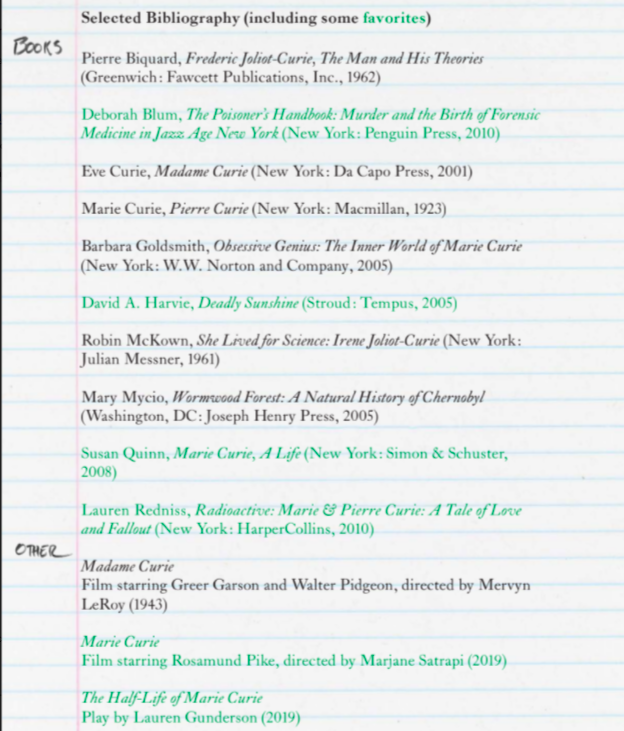
The crowdfunded album, recorded during the pandemic, is so exhaustively researched that the accompanying illustrated booklet includes a bibliography with titles ranging from David I. Harvie’s technically dense Deadly Sunshine: The History and Fatal Legacy of Radium to Deborah Blum’s The Poisoner’s Handbook, described by The New York Observer as “a vicious, page-turning story that reads more like Raymond Chandler than Madame Curie.”
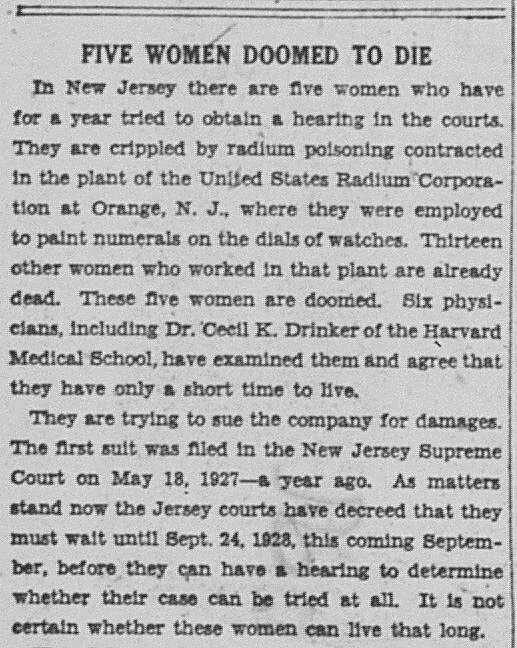
A chapter in the The Poisoner’s Handbook introduced Bisker and Morris to the Radium Girls, young workers whose prolonged exposure to radium-based paint in early 20th-century clock factories had horrific consequences.
Each girl procured a tray containing twenty-four watch dials and the material to be used to paint the numerals upon them so that they would appear luminous. The material was a powder, of about the consistency of cosmetic powder, and consisted of phosphorescent zinc sulphide mixed with radium sulphate…The powder was poured from the vial into a small porcelain crucible, about the size of a thimble. A quantity of gum arabic, as an adhesive, and a thinner of water were then added, and this was stirred with a small glass rod until a paintlike substance resulted. In the course of a working week each girl painted the dials contained on twenty-two to forty-four such trays, depending upon the speed with which she worked, and used a vial of powder for each tray. When the paint-like substance was produced a girl would employ it in painting the figures on a watch dial. There were fourteen numerals, the figure six being omitted. In the painting each girl used a very fine brush of camel’s hair containing about thirty hairs. In order to obtain the fine lines which the work required, a girl would place the bristles in her mouth, and by the action of her tongue and lips bring the bristles to a fine point. The brush was then dipped into the paint, the figures painted upon the dial until more paint was required or until the paint on the brush dried and hardened, when the brush was dipped into a small crucible of water. This water remained in the crucible without change for a day or perhaps two days. The brush would then be repointed in the mouth and dipped into the paint or even repointed in such manner after being dipped into the paint itself, in a continuous process.
The band found themselves haunted by the Radium Girls’ story:
Partly it’s that it seemed like a really good job — it was clean work, it was less physically taxing and paid better than factory or mill jobs, the working environment was nice — and the workers were all young women. They were excited about this sweet gig, and then it betrayed them, poisoning them and cutting their lives short in a horrible way.
There were all these details we learned that we couldn’t stop thinking about. Like the fact that radium gets taken up by bone, which then starts to disintegrate because radium isn’t as hard as calcium. The Radium Girls’ jaw boneswere crumbling away, because they (were instructed) to use their lips to point the brushes when painting watch faces with radium-based paint.
The radium they absorbed was irradiating them from inside, from within their own bones.
Radium decays into radon, and it was eventually discovered that the radium girls were exhaling radon gas. They could expose a photographic plate by breathing on it. Those images—the bones and the breath—stuck with us in particular.
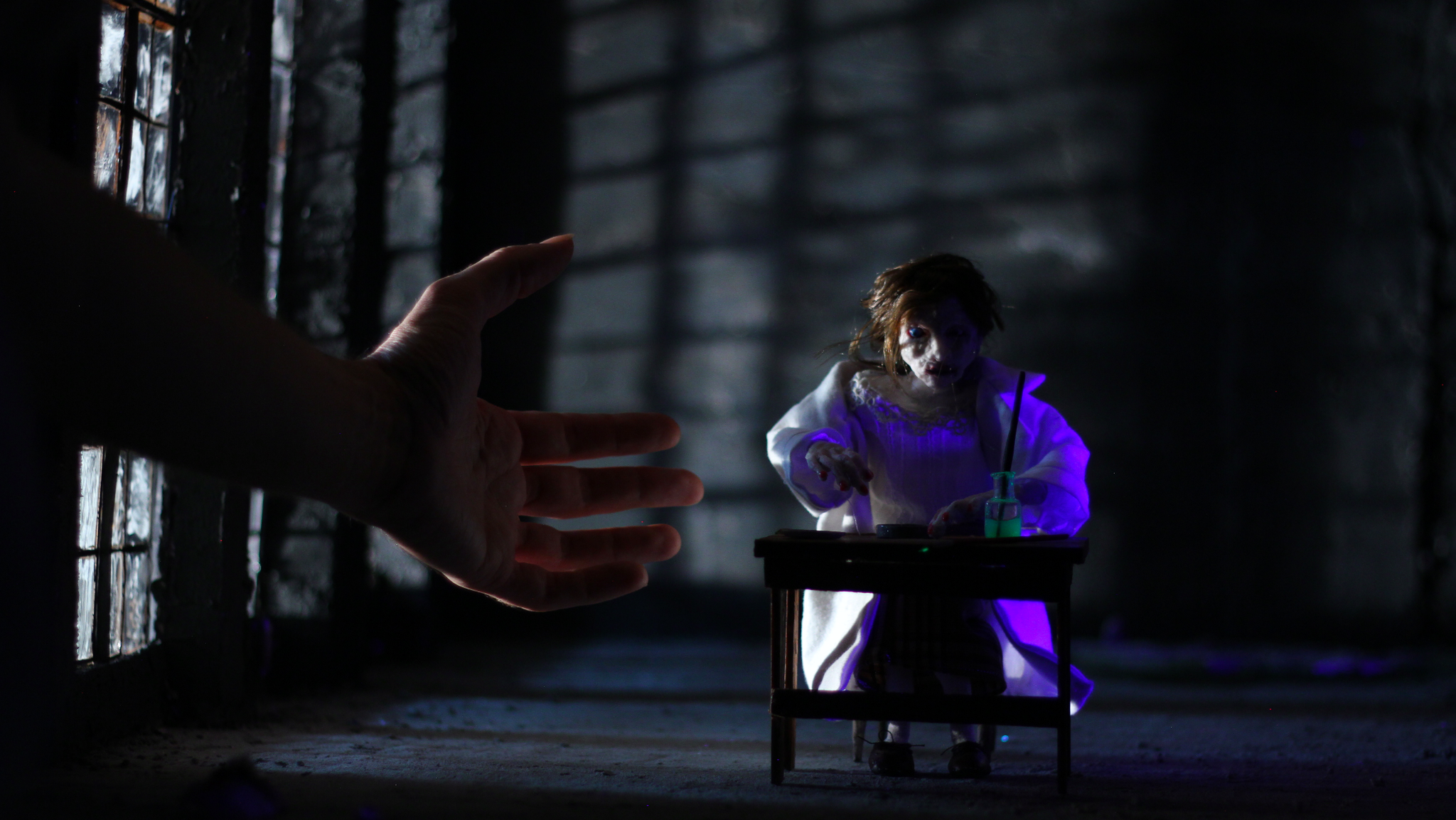
Fellow musician, Omer Gal, of the “theatrical freak folk musical menagerie” Cookie Tongue, heightens the sense of dread in his chilling stop-motion animation for Our Lady of Radium’s first music video, above. There’s no question that a tragic fate awaits the crumbling, uncomprehending little worker.
Before their physical symptoms started to manifest, the Radium Girls believed what they had been told — that the radium-based paint they used on the timepieces’ faces and hands posed no threat to their well being.
Compounding the problem, the paint’s glow-in-the-dark properties proved irresistible to high-spirited teens, as the niece of Margaret “Peg” Looney — 17 when she started work at the Illinois Radium Dial Company (now a Superfund Site) — recounted to NPR:
I can remember my family talking about my aunt bringing home the little vials (of radium paint.) They would go into their bedroom with the lights off and paint their fingernails, their eyelids, their lips and then they’d laugh at each other because they glowed in the dark.
Looney died at 24, having suffered from anemia, debilitating hip pain, and the loss of teeth and bits of her jaw. Although her family harbored suspicions as to the cause of her bewildering decline, no attorney would take their case. They later learned that the Illinois Radium Dial Company had arranged for medical tests to be performed on workers, without truthfully advising them of the results.
Eventually, the mounting death toll made the connection between workers’ health and the workplace impossible to ignore. Lawsuits such as La Porte v. United States Radium Corporation led to improved industrial safety regulations and other labor reforms.
Too late, Charming Disaster notes, for the Radium Girls themselves:
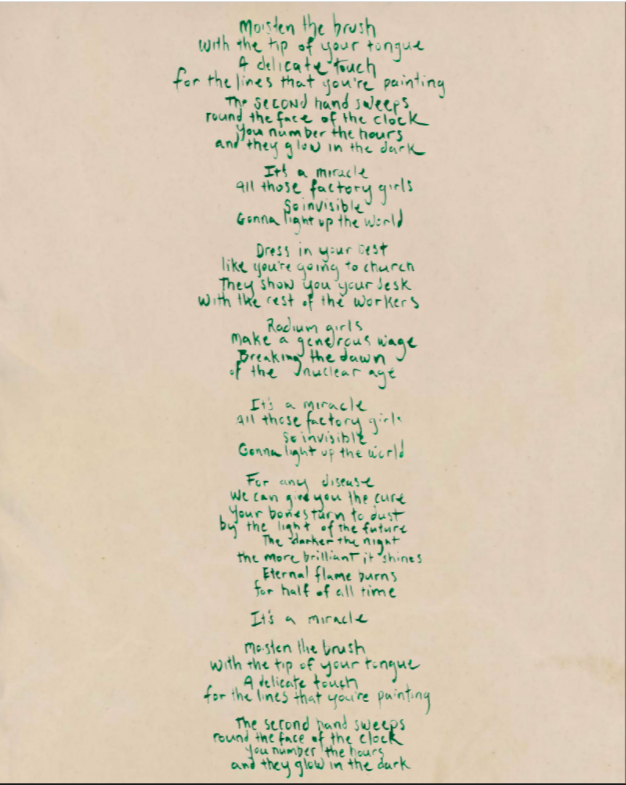
(Our song) Radium Girls is dedicated to the young women who were unwittingly poisoned by their work and who were ignored and maligned in seeking justice. Their plight led to laws and safeguards that eventually became the occupational safety protections we have today. Of course that is still a battle that’s being fought, but it started with them. We wanted to pay tribute to these young women, honor their memory, and give them a voice.
Preorder Charming Disaster’s Our Lady of Radiumhere.
If resistance to the Slave Power was the reserved watchword of your first election, the triumphant war cry of your re-election is Death to Slavery.
In 1864, Karl Marx and his International Working Men’s Association (the “First International”) sent an address to Abraham Lincoln, congratulating “the American people upon your re-election by a large majority.” As historian Robin Blackburn writes, “The US ambassador in London conveyed a friendly but brief response from the president. However, the antecedents and implications of this little exchange are rarely considered.” It was not the first time Marx and Lincoln had encountered each other. They never met personally, but their affinities led to what Blackburn calls an “unfinished revolution” — not a communist revolution in the U.S.; but a potential revolution for democracy.
Lincoln and Marx became mutual admirers in the early 1860s due to the latter’s work as a foreign correspondent for The New York Daily Tribune. From 1852 until the start of the Civil War, Marx, sometimes with Engels, wrote “over five hundred articles for the Tribune,” Blackburn notes. Fiercely anti-slavery, Marx compared Southern planters to the European aristocracy, “an oligarchy of 300,000 slaveholders.” Early in the war, he championed the Union cause, even before Lincoln decided on emancipation as a course of action. Marx believed, writes Blackburn, that ending slavery “would not destroy capitalism, but it would create conditions far more favorable to organizing and elevating labor, whether white or black.”
“Marx was intensely interested in the plight of American slaves,” Gillian Brockell writes at The Washington Post. “In January 1860, he told Engels that the two biggest things happening in the world were ‘on the one hand the movement of the slaves in America started by the death of John Brown, and on the other the movement of serfs in Russia.’ ” Lincoln was an “avid reader” of the Tribune and Marx’s articles. The paper’s managing editor, Charles A. Dana, an American socialist fluent in German who met Marx in 1848, would go on to become “Lincoln’s ‘eyes and ears’ as a special commissioner in the War Department” and later the Department’s Assistant Secretary.
Lincoln was not, of course, a Communist. And yet some of the ideas he absorbed from Marx’s Tribune writings — many of which would later be adapted for the first volume of Capital– made their way into the Republican Party of the 1850s and 60s. That party, writes Brockell, was “anti-slavery, pro-worker and sometimes overtly socialist,” championing, for example, the redistribution of land in the West. (Marx even considered emigrating to Texas himself at one time.) And at times, Lincoln could sound like a Marxist, as in the closing words of his first annual message (later the State of the Union ) in 1861.
“Labor is prior to and independent of capital,” the country’s 16th president concluded in the first speech since his inauguration. “Capital is only the fruit of labor, and could never have existed if labor had not first existed. Labor is the superior of capital, and deserves much the higher consideration.” That full, 7,000 word address appeared in newspapers around the country, including the Confederate South. The Chicago Tribune subtitled its closing arguments “Capital vs. Labor.”
Lincoln’s own position on abolition evolved throughout his presidency, as did his views on the position of the formerly enslaved within the country. For Marx, however, the questions of total abolition and full enfranchisement were settled long before the country entered the Civil War. The democratic revolution that might have begun under Lincoln ended with his assassination. In the summer after the president’s death, Marx received a letter from his friend Engels about the new president, Andrew Johnson: “His hatred of Negroes comes out more and more violently… If things go on like this, in six months all the old villains of secession will be sitting in Congress at Washington. Without colored suffrage, nothing whatever can be done there.” Hear the address Marx drafted to Lincoln for his 1865 re-election read aloud at the top of the post, and read it yourself here.
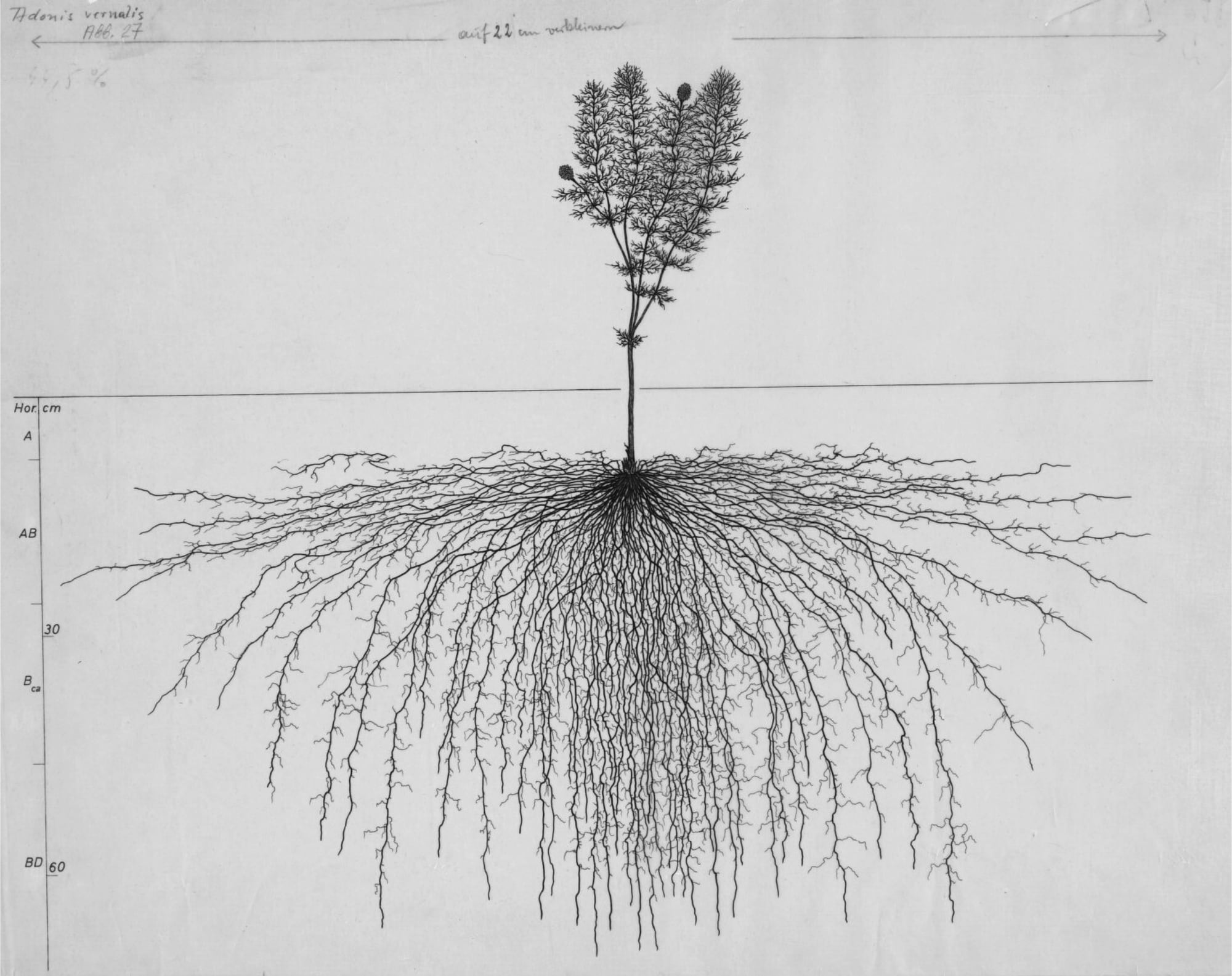
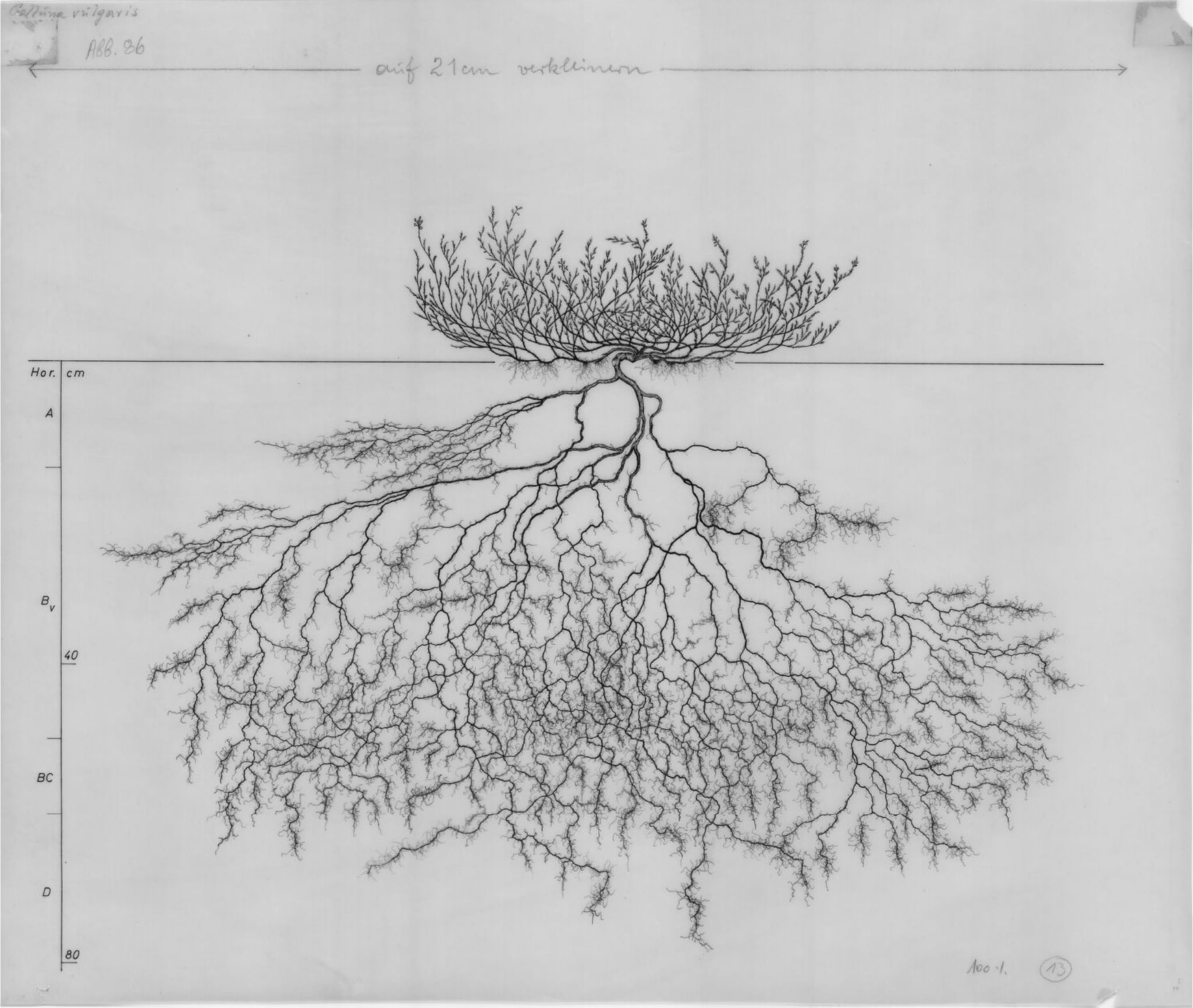
What goes on down below, underneath the soil? That you can see for yourself — and without having to pull up one of our fine flowering (or non-flowering) friends to do so — at Wageningen University’s online archive of root system drawings. “The outcome of 40 years of root system excavations in Europe,” says that site, the collection contains 1,180 diagrams of species from Abies alba (best known today as a kind of Christmas tree) to Zygophyllum xanthoxylon (a faintly scrubby-looking native of the arid and semi-arid regions of continents like Africa and Australia).
Thesite explains that “the drawings, their analysis and description were done by Univ. Prof. Dr. Erwin Lichtenegger (1928–2004) and Univ. Prof. Dr. Lore Kutschera (1917–2008), leader of Pflanzensoziologisches Institut, Klagenfurt, (now in Bad Goisern, Austria).”
Over the course of 40 years, writes TheWashington Post’s Erin Blakemore, Lichtenegger and Kustchera “collaborated on an enormous ‘root atlas’ that maps the underground trajectories of common European plants.” Created through “a laborious system of digging up and documenting the intricate systems,” these drawings are “also art in their own right, honoring the beauty of a part of plants most never give that much thought.”
Even the least botanically aware among us knows that plants have roots, but how many of us are aware of the scale and complexity those roots can attain? “Root systems allow plants to gather the water and minerals they use to grow,” writes Blakemore. “As the root system grows, it creates more and more pathways that allow water to get into the deep subsoil, and fostering the growth of microbes that benefit other life. Strong root systems can prevent erosion, protecting the land on which they grow. And the structures allow the soil to capture carbon.” Thus root systems, never a particular locus of coolness, have the distinction of doing their part to fight climate change. And thanks to Lichtenegger and Kustchera’s drawings, they underscore the capacity of art to reveal worlds hidden to most of us. View all of the images here.
Based in Seoul, Colin Marshall writes and broadcasts on cities and culture. His projects include the book The Stateless City: a Walk through 21st-Century Los Angeles and the video series The City in Cinema. Follow him on Twitter at @colinmarshall or on Facebook.
A good disaster story never fails to fascinate — and, given that it actually happened, the story of Pompeii especially so. Buried and thus frozen in time by the eruption of Mount Vesuvius in 79 AD, the ancient Roman town of 11,000 has provided an object of great historical interest ever since its rediscovery in 1599. Baths, houses, tools and other possessions (including plenty of wine bottles), frescoes, graffiti, an ampitheater, an aqueduct, the “Villa of the Mysteries”: Pompeii has it all, as far as the stuff of first-century Roman life goes.
The ash-preserved ruins of Pompeii, more than any other source, have provided historians with a window into just what life in that time and place was like. A Day in Pompeii, an exhibition held at the Melbourne Museum in 2009, gave its more than 330,000 visitors a chance to experience Pompeii’s life even more vividly. The exhibition included a 3D theater installation that featured the animation above. Watch it, and you can see Pompeii brought back to life with computer-generated imagery — and then, in snapshots over the course of 48 hours, entombed by Vesuvius again.
As inherently compelling as we find the story of Pompeii, modern drama has struggled to capture the power of the disaster that defines it. The late-1960s BBC show Up Pompeii!offered a comedic rendering of life in the city before the explosion, but more serious interpretations, like the 2014 Hollywood movie Pompeii, met with only lukewarm critical reception. Best, it seems, to stick to the words of Pliny the Younger, witness to the destruction and still its most evocative describer:
You could hear the shrieks of women, the wailing of infants, and the shouting of men; some were calling their parents, others their children or their wives, trying to recognize them by their voices. People bewailed their own fate or that of their relatives, and there were some who prayed for death in their terror of dying. Many besought the aid of the gods, but still more imagined there were no gods left, and that the universe was plunged into eternal darkness for evermore.
If you would like to support the mission of Open Culture, consider making a donation to our site. It’s hard to rely 100% on ads, and your contributions will help us continue providing the best free cultural and educational materials to learners everywhere. You can contribute through PayPal, Patreon, and Venmo (@openculture). Thanks!
We're hoping to rely on loyal readers, rather than erratic ads. Please click the Donate button and support Open Culture. You can use Paypal, Venmo, Patreon, even Crypto! We thank you!
Open Culture scours the web for the best educational media. We find the free courses and audio books you need, the language lessons & educational videos you want, and plenty of enlightenment in between.