The Library of Congress Makes Its Archives Free for DJs to Remix: Introducing the “Citizen DJ” Project
Since the beginning of hip hop and turntablism, the best DJs have been the best crate diggers, people who would spend hours flipping thru old vinyl, unknown titles, rare cuts, and sometimes seriously out-of-fashion, embarrassing old records for those brief moments of music that when looped, could be spun into modern magic.
At the same time, hip hop sampling has also been a minefield for copyright law, so much that modern DJs shy away from sampling lest they spend months and or years seeking clearing rights.
Artist and computer scientist Brian Foo knows where there are plenty of crates that have yet to be dug: the Library of Congress. Already the author of several projects that turn data into music, Foo received a grant from the Library this year to do something amazing with their collection and offer it to the public.
Citizen DJ is the result and currently you can play around with the beta version. The above video features Foo leading you through the site, and I highly recommend you watch it before diving in.
Sound sources come from the Library’s many collections: Edison sound recordings, Variety Stage recordings, Joe Smith’s interviews with early 20th century celebrities, a collection of American dialect recordings, government information films, and their more modern free music archives.
You can browse these as a color-coded graphic tapestry or as a list, with plenty of filters to narrow down your search. Once you find a sound you like you can chop it up in a sequencer and then bring in loops, change the bpm, and create some very, very odd modern music. (If you’re lucky it will also be funky!) Everything can be downloaded offsite into a (digital audio workstation) DAW of your choice.
Whatever you make, by the way, is yours to do with whatever you want, and that includes selling it as your own track. (Although it’s best-practice to credit the source and the Library).
Foo notes that the project is fully launching in late summer, but is really looking for your feedback, whether you are a professional musician or a curious citizen. (We also want to hear anything that you wind up making, so let us know.)
Related Content:
What Is Fair Use?: A Short Introduction from the Maker of Everything is a Remix
The Library of Congress Makes 25 Million Records From Its Catalog Free to Download
Ted Mills is a freelance writer on the arts who currently hosts the Notes from the Shed podcast and is the producer of KCRW’s Curious Coast. You can also follow him on Twitter at @tedmills, and/or watch his films here.
Read More...When David Bowie Launched His Own Internet Service Provider: The Rise and Fall of BowieNet (1998)
When we consider the many identities of David Bowie — Ziggy Stardust, Aladdin Sane, the Thin White Duke — we often neglect to include his transformation into an internet entrepreneur. In line with Bowie’s reputation for being ahead of his time in all endeavors, it happened several tech booms ago, in the late 1990s. Foreseeing the internet’s potential as a cultural and commercial force, he got ahead of it by launching not just his own web site (which some major artists lacked through the end of the century), but his own internet service provider. For $19.95 a month (£10.00 in the UK), BowieNet offered fans access not just to “high-speed” internet but to “David Bowie, his world, his friends, his fans, including live chats, live video feeds, chat rooms and bulletin boards.”
So announced the initial BowieNet press release published in August 1998, which also promised “live in-studio video feeds,” “text, audio and video messages from Bowie,” “Desktop themes including Bowie screensavers, wallpaper and icons,” and best of all, a “davidbowie e‑mail address (your na**@********ie.com).” While the dial-up of the internet connections of the day wasn’t quite equal to the task of reliably streaming video, many of BowieNet’s approximately 100,000 members still fondly remember the community cultivated on its message boards. “This was in effect a music-centric social network,” writes The Gardian’s Keith Stuart, “several years before the emergence of sector leaders like Friendster and Myspace.”
Unlike on the the vast social networks that would later develop, the man himself was known to drop in. Under the alias “Sailor,” writes Newsweek’s Zach Schonfeld, “Bowie would sometimes share updates and recommendations or respond to fan queries.” He might endorse an album (Arcade Fire’s debut Funeral earned a rave), express incredulity at rumors (of, say, his playing a concert with Paul McCartney and Michael Jackson to be beamed into outer space), crack jokes, or tell stories (of, say, the time he and John Lennon sat around calling into radio stations together). As Ars Technica’s interview with BowieNet co-founder Ron Roy confirms, Bowie didn’t just lend the enterprise his brand but was “tremendously involved from day one.” As Roy tells it, Bowie kept BowieNet fresh “by exploring new technologies to keep fans engaged and excited. He always preached [that] it’s about the experience, the new.”
It helped that Bowie wasn’t simply looking to capitalize on the rise of the internet. As the 1999 ZDTV interview at the top of the post reveals, he was already hooked on it himself. “The first thing I do is get e‑mails out of the way,” he says, describing the average day in his online life. “I’m e‑mail crazy. And then I’ll spend probably about an hour, maybe more, going through my site.” Even in the early days of “the controversial mp3 format,” he showed great enthusiasm for putting his music online. He continued doing so even after technology surpassed BowieNet, which discontinued its internet service in 2006. Now, as the coronavirus pandemic keeps much of the world at home, many high-profile artists have taken to the internet to keep the show going. David Bowie fans know that, were he still with us, he’d have been the first to do it — and do it, no doubt, the most interestingly.
Related Content:
Based in Seoul, Colin Marshall writes and broadcasts on cities, language, and culture. His projects include the book The Stateless City: a Walk through 21st-Century Los Angeles and the video series The City in Cinema. Follow him on Twitter at @colinmarshall, on Facebook, or on Instagram.
Read More...Watch Free Plays from Shakespeare’s Globe Theatre: Romeo & Juliet, Macbeth & More
As depressing articles about the upcoming Summer of COVID-19 begin to proliferate, our hopes for beach days, concert series, and summer camp begin to dim.
Here in New York City, the Public Theater’s announcement that it is cancelling the upcoming season of its famed Shakespeare in the Park was met with understandable sadness.
You don’t have to like Shakespeare to enjoy the ritual of entering Central Park shortly after dawn, prepared to sit online for several hours awaiting noon’s free ticket distribution, then returning to the Delacorte later that night with snacks and sweater and wine.
Performing a quick Internet search to brush up on the plot can enhance the experience, but—and I saw this as someone whose degree included a metric heinieload of The Bard—it can be equally satisfying to spend the final acts enjoying an impromptu, al fresco nap.
Bonus points if a raccoon runs across the stage at some point.
Alas all this must be denied us in the summer of 2020, but it’s still within our power to replicate that summer feeling in advance of the equinox, using the past productions that London’s Globe Theatre is screening on its YouTube channel as our starting place.
First up is Romeo & Juliet from 2009, starring Ellie Kendrick and Adetomiwa Edun, though according to the Independent’s Michael Coveney, the show belongs to Penny Layden as the Nurse:
Far removed from the fussing tradition of comic garrulity and the Patricia Routledge factor, Layden plays her as a scrubbed, middle-aged, sensible woman carrying a history of sadness. The bawdy assault on her by Philip Cumbus’s melancholy Mercutio is both shocking and plausible, and she retains her quiet dignity while at the same time mourning its sacrifice.
Back to New York City…
Prior to starting your screening, you’ll want to approximate a seat at the Delacorte (which, like the Globe, is authentically circular in shape). I recommend a metal folding chair.
Sprinkle a tablespoon or so of water onto the seat if you want to pretend it rained all afternoon leading up to the performance.
Definitely have some wine to pour into a plastic cup.
Slather yourself in insect repellent.
Silence your cell phone.
If your housemate’s cell phone goes off mid-performance, feel free to tsk and sssh and roll your eyes. Honestly, how hard is it to comply with the familiar instructions of the house manager’s speech?
At intermission, stand outside your own bathroom door for at least 15 minutes before letting yourself into a “stall” to use the facilities.
Doze all you want to…. arrange for your housemate to tsk and sssh at you from an appropriate distance, should your snoring become audible.
You have until Sunday, May 3 to stumble sleepily away from the screen, and pretend you’re wandering to the subway with 1799 other New Yorkers.
Then make plans to wake up at 5:30 and sit on the floor with a thermos of coffee for several hours, hoping that they won’t run out of tickets for The Two Noble Kinsmen before you make it to the top of the line.
(Spoiler alert: they won’t.)
Others in the Globe’s free series:
MacBeth, May 11 until UK schools reopen
The Winter’s Tale (2018), May 18 — May 31
The Merry Wives of Windsor (2019), June 1 — June 14
A Midsummer Night’s Dream (2013), June 15 — 28
Clicking the red “discover more” lozenge beneath each show’s photo on the Globe Watch’s landing page will lead you to a wealth of supporting materials, from pre-show chats with the Globe’s Post-Doctoral Research Fellow Will Tosh to photos, articles, and a student challenge specifically tailored to the times we find ourselves living through now.
Subscribe to the Globe’s YouTube channel to receive reminders.
Donate to the Globe here.
Americans can make a tax-deductible donation to The Public Theater here.
via My Modern Met
Related Content:
Take a Virtual Tour of Shakespeare’s Globe Theatre in London
Ayun Halliday is an author, illustrator, theater maker and Chief Primatologist of the East Village Inky zine. Depending on how long this thing goes on, she may look into giving Penny Layden a run for the money by live-streaming her solo show, NURSE. Follow her @AyunHalliday.
Read More...Vintage Book & Record Covers Brought to Life in a Mesmerizing Animated Video
The state of virtual and augmented reality technology has reached the threshold of a time in which VR meetings will be the norm. Apart from other applications, this may soon allow consumers to stroll through virtual aisles rather than clicking boxes on a screen, picking up products and viewing them from every angle. Still, designers recognize that an essence of the human experience is lost without the sense of touch. There may even be a future in which we wear clothes with haptic feedback systems embedded in them, to feel the pages of a virtual book beneath our fingers…
Yet our slow transition from the physical to the virtual world leaves out intangibles. Something is lost from both. Big box stores still devote significant floor space to books and records, for example. But I submit that a glossiness prevails in print design, perhaps a consequence of competing with screens. There’s a wabi-sabi quality to browsing a used bookstore or record shop in person, thumbing through an old collection of vintage paperbacks and LPs, that cannot be simulated or enhanced in any way. On the internet, however, where video is king, it can be made the subject of some hypnotic video art.
As the sensible majority of us are hopefully staying put for the long haul (if we can), we may find ourselves curiously edified by the video art of Henning M. Lederer. We’ve previously featured Lederer’s animations of mid-century minimalist book covers and vintage psychology and philosophy books. He turns the abstract geometric patterns beloved by book and record company designers of the latter half of the 20th century into moving images that hint at how proper cover design can set the imagination whirring (even if it’s a cover design for Basic Accounting).
If Lederer’s mesmerizing videos simulate anything, it’s the experience of wandering into a used bookstore next to a liberal arts college—full of professors’ fascinatingly outdated hand-me-downs—after having ingested a small quantity of LSD. Maybe you’ll have a slightly different association. But the point is that Lederer’s art suggests a scenario rather than attempting to recreate one. His studies of modernist cover designs also recall Marcel Duchamp’s Rotoreliefs, conceptual art pieces intended for popular use as optical illusions.
Duchamp’s spinning disks became features of early Surrealist cinema, iconic symbols of dreams on film. There is a mysterious opacity to his physical objects onscreen, just as Lederer’s book and record covers seem to have a weight of their own, a use of digital technology to highlight the strange uniqueness of physical objects, rather than their endless reproducibility.
Related Content:
157 Animated Minimalist Mid-Century Book Covers
Josh Jones is a writer and musician based in Durham, NC. Follow him at @jdmagness
Read More...See Web Cams of Surreally Empty City Streets in Venice, New York, London & Beyond
The lack of human presence in majorly polluted cities these past couple months has had some people seeing utopias as the skies begin to clear. But empty cities seem a little more dystopian to me. Dystopias are “a kind of surrealism,” writes Kim Stanley Robinson. They unearth the dreamlike dread beneath the veneer of the normal. No matter when they’re set, dystopias don’t depict the future so much as “the feeling of the present… heightened by exaggeration to a kind of dream or nightmare.” The events in dystopian fiction approach the truth of someone’s situation somewhere in the world and make visible what has been hidden.
We know ghost cities exist as ancient disasters like Pompeii and Herculaneum and modern ones like Pripyat, Ukraine, outside Chernobyl. But there are more of them than many of us know. Gleaming cities like Ashgabat, Turkmenistan, which broke ground in 1991 and contains the largest number of marble buildings in the world.
The 4.5 million square meter metropolis has almost no inhabitants, an enormous government folly. Towns and cities around the world have been abandoned for for all sorts of reasons, and they continue to as sea levels rise. Which is what makes viewing live camera footage of some of the world’s most iconic streets—almost completely emptied by the pandemic at the height of tourist season—so… surreal.
It’s true that people haven’t fled these cities, but made cozy bunkers of their apartments. Yet seeing the vacant streets live on camera, in Venice, London, New York, and elsewhere in the world, I get the uncanny feeling of looking at proto-surrealist painter Giorgio de Chirico’s The Enigma of a Day, a depiction of a shadowy, uninhabited street through which we expect the Italian version of a tumbleweed to roll. Surveillance technology has inadvertently become a medium of modernist art.
There is so much beauty in the live view at the top of the Ponte delle Guglie in Venice from the Hotel Filù Venezia, and there is also such lonely melancholy, depending on the time of day and where the shadows fall. See a live view of Times Square, above, and another Times Square view at EarthCam, where you can also catch a feed of a mostly empty Abbey Road (some times of day emptier than others, as in the early-morning screenshot below). Skyline Webcams hosts even more live camera views of Venice, including feeds from the Rialto Bridge and the Piazza San Marco, as well as live feeds from several sites in Padua and other places in Italy.
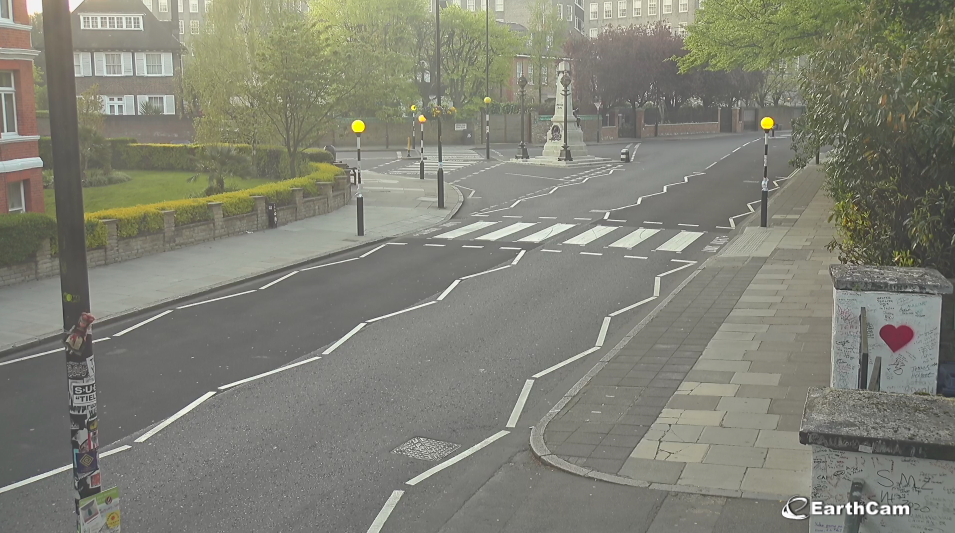
These real-time visions are transporting in their strangeness. Are we living in the present or the future? In a dystopian world, there isn’t any difference. All futures are foreclosed by catastrophe, “all distances in time and space are shrinking,” wrote Martin Heidegger, a thinker who understood disaster, and who fell in line behind it. In that same essay, “The Thing” (as translated by Albert Hofstader), the German philosopher made his famous comment, “the terrible has already happened.”
The terrible that has happened to us is not only a deadly pandemic. The virus is not likely to disappear on its own; who knows how long this will go on? But not far behind the current crisis are more climate events that threaten to empty streets. If we empty cities not only as indicative of temporarily social distancing, but as images of the possible near-future, maybe we’ll be far less inclined to come out of this surreal experience and get right back to business-as-usual.
Related Content:
Take a Virtual Tour of Venice (Its Streets, Plazas & Canals) with Google Street View
Google Lets You Take a 360-Degree Panoramic Tour of Street Art in Cities Across the World
Spring Break vs. COVID-19: Mapping the Real Impact of Ignoring Social Distancing
Josh Jones is a writer and musician based in Durham, NC. Follow him at @jdmagness
Read More...365 Free Movies Streaming on YouTube
The wail resounds in every corner of the house, you cannot stop it—the books have all been read, the new releases streamed, every video game played to the end multiple times. I’m bored… You gave up quarantine homeschool weeks ago. Just who did you think you were? Here’s an idea, parent at your wit’s end: sit the kids in front of Lone Wolf McQuade or Over the Top.
Tell them how everything used to look like that when you were young. No second or third screen to turn to when you lost interest. You’d catch a free movie on a Sunday afternoon—streaming in real time, as it were—on one of four or five channels. No pause, rewind, or save for later. (Play it up—maybe you didn’t live this, they don’t know that.)
Oh, and there were commercials every ten minutes or so—lots and lots and lots of ads. This is a lesson in media history—you’re an educator! They’ll readily admit how much better they have it as they watch Chuck Norris and Stallone rack up the kills on YouTube, free to stream (and pause, rewind, and save for later), with many fewer ad interruptions than in your day, and with 363 other films to watch and more to come.
But say you find this content objectionable, or… well, bad. You could certainly do much worse, believe me, as you’ll see in a cursory look at the many feature entertainments available to stream free with ads on YouTube. But, in all seriousness, you care about your children’s education, and with some careful digging, you’ll find quite a lot to give them a real cultural lesson, and to enlighten the grown-ups, too.
Learn, for example, about the Wrecking Crew, in a documentary of the same name, the famous cohort of studio musicians who played on hundreds of the best pop, rock, soul, etc. records in the 60s. As the Funk Brothers were to Motown, Booker T. & the MGs to Stax, so were the Wrecking Crew to the West Coast Sound (and the sound of Elvis, The Beach Boys, Frank Sinatra, Nat King Cole, the Mamas and the Papas, Sonny & Cher, Simon & Garfunkel, and so on).
And as the Wrecking Crew were to the West Coast so was Muscle Shoals to the deep South. The tiny Alabama town and its FAME Studios featured some of the greatest R&B, soul, and country rhythm players in the world, major contributors to records by Dylan, the Stones, Lynyrd Skynyrd, Aretha Franklin, Wilson Pickett, and so many more. There’s a film about them too. (We can’t embed the full movies here, but you’ll find them in the links below.)
There are many other quality educational entertainments about pop music history, like the Dave Grohl-directed Sound City. You’ll also find documentaries like Super Size Me, Capitalism: A Love Story, and Freakonomics. (An economics course!) Many other platforms have introduced free streaming movies with ads. In YouTube’s case, as AdAge notes, the move to streaming free films comes as a way to recoup advertisers who increasingly found their ads running “inside offensive videos, some with terrorist propaganda and hate speech.”
The company is cleaning up its image, and in the process becoming something like the TV channels of old, only with all the digital ease that makes streaming so convenient. “They are now a TV network,” says an executive for one video ad technology platform, moving away from low-quality, user-generated content and toward high dollar series and the goldmine of old movies. Advertising is everything, so, there’s another lesson for you—even in the new media business, history repeats.
See a list of recommended films available to stream free on YouTube, with ads, below. Enter the general collection here. And feel free to explore our collection, 4,000+ Free Movies Online: Great Classics, Indies, Noir, Westerns, Documentaries & More.
Freddie Mercury: The King of Queen
Related Content:
Download 6600 Free Films from The Prelinger Archives and Use Them However You Like
Josh Jones is a writer and musician based in Durham, NC. Follow him at @jdmagness
Read More...Why Did LEGO Become a Media Empire? Pretty Much Pop: A Culture Podcast #37
Why has a children’s toy become a brand attached to virtually every media type, partnering with the most ubiquitous franchises, and serving as a pastime for many adult hobbyists who will gut you if you call LEGO a “children’s toy.”
Brian Hirt (our resident AFOL, i.e. adult fan of LEGO) talks with co-hosts Erica Spyres and Mark Linsenmayer about creative play vs. following the printed directions, building purists vs. anthropomorphizers, LEGO qua corporate overlord, the LEGO films and competitive building TV show, and more.
Brian’s LEGO designs that we react to are the Mandelbrot fractal, baby Yoda, dreidel, and swimming pool. “AFOL” is but the first of many LEGO-specific initialisms; see the glossary.
Here are some articles we drummed up to prepare:
- “ ‘The Cult of LEGO’: Inside the World of a Devoted Community” by Maria Popova
- “If You’re an Adult Playing With Legos, Just Don’t. Here’s Why.” by Seth Garben
- “Lego Is the Perfect Toy Even if no one can really agree on what kind of toy it is anymore” by Genevieve Smith
- “Why Adults Are Using Lego to Battle Stress” from GameCentral
- “LEGO Writer Arie Kaplan Discusses Clicking with Star Wars and Batman” by Michal Schick
- “The LEGO Batman Movie Turns Bat Mythology Into a Giant Toybox” by Jesse Hassenger
- “Can LEGO Be Considered Art” by John Baichtal
- “How Does Someone Become a Full-Time LEGO Artist?” by Mariah Eakin
- “LEGO Turned Itself Around by Analyzing Overbearing Parents” by Mikkel Rasmussen
- “Minnesota Professor Explores Link Between Philosophy and Lego” by Richard Chin
- “Top 5 LEGO Podcasts You Must Follow in 2020” from Feedspot
Learn more at prettymuchpop.com. This episode includes bonus discussion that you can only hear by supporting the podcast at patreon.com/prettymuchpop. This podcast is part of the Partially Examined Life podcast network.
Pretty Much Pop: A Culture Podcast is the first podcast curated by Open Culture. Browse all Pretty Much Pop posts or start with the first episode.
Read More...Free Online Drawing Lessons for Kids, Led by Favorite Artists & Illustrators
When I became the Kennedy Center Education Artist-in-Residence, I didn’t realize the most impactful word in that title would be “Residence.” —illustrator Mo Willems
Even as schools regroup and online instruction gathers steam, the scramble continues to keep cooped-up kids engaged and happy.
These COVID-19-prompted online drawing lessons and activities might not hold much appeal for the single-minded sports nut or the junior Feynman who scoffs at the transformative properties of art, but for the art‑y kid, or fans of certain children’s illustrators, these are an excellent diversion.
Mo Willems, author of Knuffle Bunny and the Kennedy Center’s first Education Artist-in-Residence, is opening his home studio every weekday at 1pm EST for approximately twenty minutes worth of LUNCHDOODLES. Episode 5, finds him using a fat marker to doodle a Candyland-ish game board (sans treacle).
Once the design is complete, he rolls the dice to advance both his piece and that of his home viewer. A 5 lands him on the crowd-pleasing directive “fart.” Clearly the online instructor enjoys certain liberties the classroom teacher would be ill-advised to attempt.
Check out the full playlist on the Kennedy Center’s YouTube channel and download activity pages for each episode here.
#MoLunchDoodles
If the daily LUNCHDOODLES leaves ‘em wanting more, there’s just enough time for a quick pee and snack break before Lunch Lady’s Jarrett J. Krosoczka takes over with Draw Everyday with JJK, a basic illustration lesson every weekday at 2pm EST. These are a bit more nitty gritty, as JJK, the kid who loved to draw and grew up to be an artist, shares practical tips on penciling, inking, and drawing faces. Pro tip: resistant Star Wars fans will likely be hooked by the first episode’s Yoda, a character Krosoczka is well versed in as the author and illustrator of the Star Wars Jedi Academy series.
Find the complete playlist here.
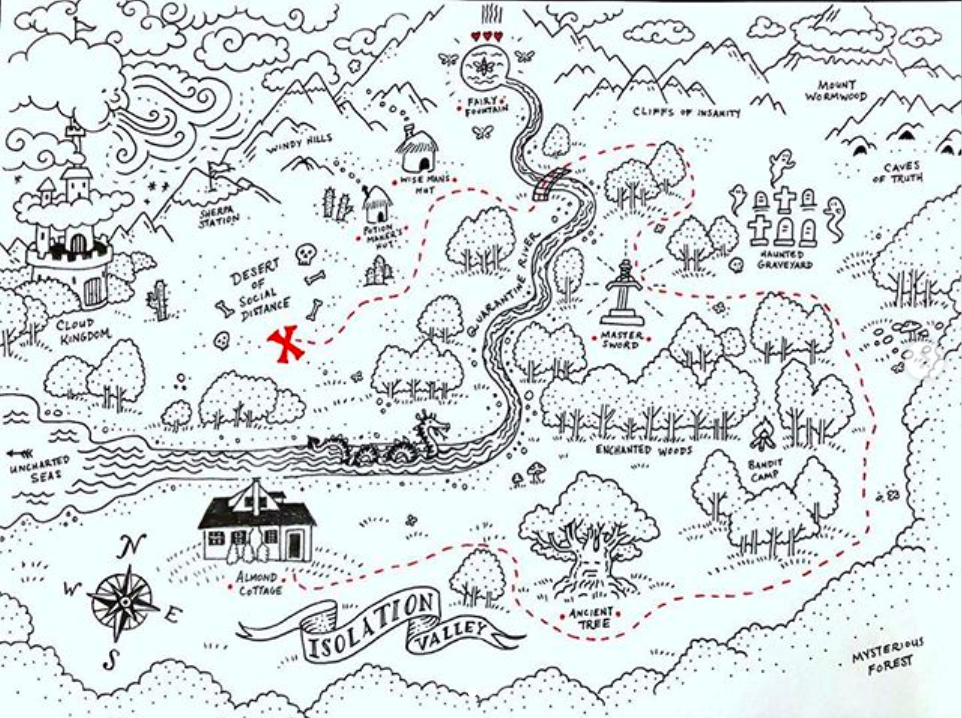
Illustrator Carson Ellis eschews video lessons to host a Quarantine Art Club on her Instagram page. Her most recent assignment is cartography based challenge, with helpful tips for creating an “impactful page turn” for those who wish to share their creations on Instagram:
DRAW A MAP: When we think of treasure maps, we think of sea monsters, islands with palm trees, pirate ships, anthropomorphic clouds blowing gales upon white-capped seas. YOUR map can be of anywhere: an enchanted wood, a dystopian suburb, your backyard, your apartment that has never felt so small, all of the above, none of the above. Or your map can be a traditional treasure map leading to a pirate’s hoard. It’s totally up to you. Three things that you MUST include are: a compass rose (very important—look this up if you don’t know what it is), the name of the place you are mapping, and a red X.
DRAW THE TREASURE: The first part of this assignment is to draw a map with a red X to mark the location of hidden treasure. The second part of this assignment is to draw the treasure. I don’t know what the treasure is. Only you know what the treasure is. Draw it on a separate piece of paper from the map.
BONUS POINTS: If you’re going to post this on instagram, I recommend formatting it with two images. Post the map first, then the treasure which the viewer will swipe to see. This will create what we in the kids book world call AN IMPACTFUL PAGE TURN. That’s the thing that happens when you’re reading a picture book and you turn the page to discover something funny or surprising. It’s kind of hard to explain, but you know a good page turn when you’ve experienced one.
#QuarantineArtClub
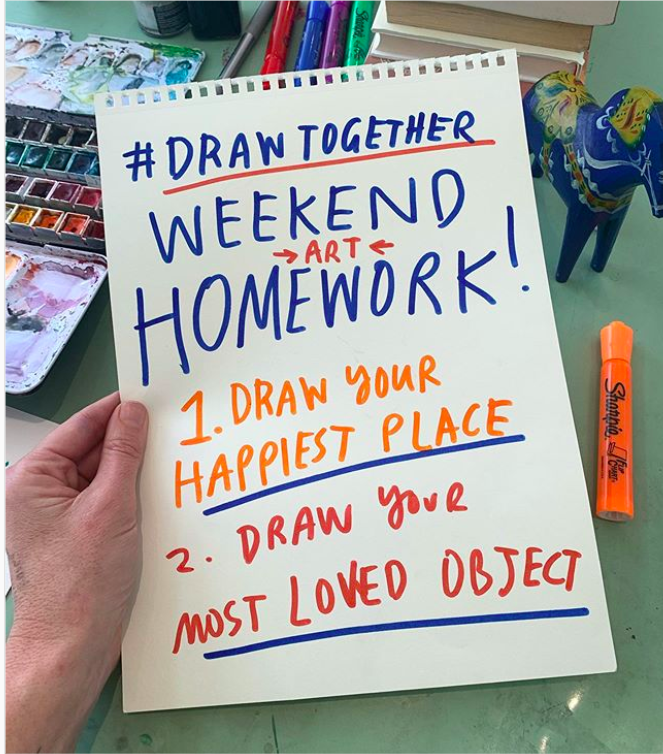
Wendy McNaughton, who specializes in drawn journalism, also likes the Instagram platform, hosting a live Draw Together session every school day, from 10–10.30 am PST. Her approach is a bit more freeform, with impromptu dance parties, special guests, and field trips to the backyard.
Her How to Watch Draw Together highlight is a hilarious crash course in Instagram Live, scrawled in magic marker by someone who’s possibly only now just getting a grip on the platform. Don’t see it? Maybe it’s the weekend, or “maybe ask a millennial for help?”
And bless E.B. Goodale, an illustrator, first time author and mother of a young son, who having counteracted the heartbreak of a cancelled book tour with a hastily launched week of daily Instagram Live Toddler Drawing Club meetings, made the decision to scale back to just Tuesdays and Thursdays:
It was fun doing it everyday but turned out to be a bit too much to handle given our family’s new schedule. We’re all figuring it out, right? I hope you will continue to join me in our unchartered territory next week as we draw to stay sane. Tune in live to make requests or watch it later and follow along at home.
(Her How to Draw a Cat tutorial, above, was likely intended for in-person bookstore events relating to her just published Under the Lilacs…)
#drawingwithtoddlers
Our personal favorite is Stickies Art School, whose online children’s classes are led not by multi-disciplinary artist Nina Katchadourian, whose Facebook page serves as the online institution’s home, but rather her senior tuxedo cat, Stickies.
Stickies, who comes to the gig with an impressive command of English, honed no doubt by frequent appearances on Katchadourian’s Instagram page, affects a diffident air to dole out assignments, the latest of which is above.
He allows his students ample time to complete their tasks—thus far all portraits of himself. The next one, to render Stickies in a costume of the artist’s choice, is due Wednesday by 9am, Berlin time.
Stickies also offers positive feedback on submitted work in delightful follow up videos, a responsibility that Katchadourian takes seriously:
There have been so many conversations at NYU Gallatin where I’m on the faculty about online teaching, how to do it, how to think of a studio course in this new form, etc, and I think perhaps that crossed over with the desire to cheer up some people with kids, many of whom are already Stickies fans, or so I have been told.
His child proteges are no doubt unaware that Stickies looked ready to leave the planet several weeks ago, a fact whose import will resonate with many pet owners in these dark days:
Maybe a third element was just being so glad he is still around, that having him actively “out there” feels good and life-affirming at the moment.
Stickies Art School is marvelous fun for adults to audit from afar, via Katchadourian’s public Facebook posts. If you are a parent whose child would like to participate, send her a friend request and mention that you’re doing so on behalf of your child artist.
Searching on the hashtag #artteachersofinstagram will yield many more resources.
Art of Education University has singled out 12 accounts to get you started, as well as lots of helpful information for classroom art teachers who are figuring out how to teach effectively online.
Related Content:
Learn to Draw Butts with Just Five Simple Lines
Cartoonist Lynda Barry Teaches You How to Draw
How to Draw the Human Face & Head: A Free 3‑Hour Tutorial
Ayun Halliday is an author, illustrator, theater maker and Chief Primatologist of the East Village Inky zine. Given the cancellation of everything, she’s taken to Instagram to document her social distance strolls through New York City’s Central Park, using the hashtag #queenoftheapeswalk Follow her @AyunHalliday.
Read More...Are Video Games an Effective Vehicle for Storytelling? Pretty Much Pop: A Culture Podcast #35 Featuring Don Marshall

Do you play video games for the plot? Given that most people don’t actually finish most games, it would be unexpected if storytelling were the most important element. On this episode of Pretty Much Pop: A Culture Podcast, your hosts Mark Linsenmayer, Erica Spyres, and Brian Hirt are joined by former video game professional (and current TV development executive) Donald E. Marshall to talk through types of plots (linear, “string-of-pearls,” and branching), ways of weaving story into a game, balancing gameplay and narrative, and more.
We touch on Death Stranding, Overwatch, The Last of Us, Skyrim, Fallout, Life Is Strange, Until Dawn, Erica, Bioshock, Telltale Games, Journey, Bandersnatch, Days Gone, Portal, and more. (That casual game Mark jokes about is Simon’s Cat Pop Time.)
Some articles and other sources:
- “When Video Games Tell Stories: A Model of Video Game Narrative Architectures” by Marcello Arnaldo Picucci (2014)
- “The Evolution of Video Games as a Storytelling Medium, and the Role of Narrative in Modern Games” by Chris Stone
- “Writing for Video Games: A Conversation with E. Lily Yu, Yoon Ha Lee, Robert Reed, Seth Dickinson, and Karl Schroeder” by Alvaro Zinos-Amaro
- “How to Write a Video Game Story” by Colin Campbell
- “A Hugo Award for Best Game or Interactive Experience” by Ira Alexandre
- The Dialog Podcast: s1e08 “Video Game Narrative Design and Writing Science Fantasy Novels with Carrie Patel”
You can also read some lists of games that supposedly have the best plots at GamesRadar, Ranker, and The Gamer.
Don is also a podcaster, having previously been a host of GeeksOn and now on The Big Fat Gay Podcast. Here’s info about the Wheel of Time TV show. One relevant GeeksOn episode is #102. Here’s info about the Wheel of Time TV show.
This episode includes bonus discussion that you can only hear by supporting the podcast at patreon.com/prettymuchpop. This podcast is part of the Partially Examined Life podcast network.
Pretty Much Pop: A Culture Podcast is the first podcast curated by Open Culture. Browse all Pretty Much Pop posts or start with the first episode.
Read More...
A 5‑Hour, One-Take Cinematic Tour of Russia’s Hermitage Museum, Shot Entirely on an iPhone
In 2002, Russian filmmaker Alexander Sokurov made cinema history with Russian Ark, which dramatizes a wide swath of his homeland’s history in a single, unbroken 96-minute shot. What’s more, he and his collaborators shot it all in a single location, one both rich with historical resonance and not exactly wide-open to movie shoots: St Petersburg’s State Hermitage Museum, whose complex includes the former Winter Palace, official residence of Russia’s emperors from 1732 to until the 1917 revolution. What viewer could forget Russian Ark’s breathtaking final scene, which opens as the camera floats into the midst of a grand ball set in 1913 — taking place in the very hall it would have in 1913?
Now, at least in terms of duration, Apple has gone to the Hermitage and done Sokurov one better: its new advertisement for the iPhone 11 Pro is a five-hour journey through the entire museum, shot by filmmaker Axinya Gog in one continuous take — all, of course, on the phone itself. Like Russian Ark, it constitutes a cinematic achievement not possible before recent technological advances. Sokurov demonstrated the new possibilities of digital video camera that could capture film-like images; Gog demonstrates the new possibilities of a camera-phone with not only the battery life to shoot five straight hours of video, but at a resolution that looks at least as good as the cutting-edge digital video of 2002.
Just above appears the trailer for the ad, which hints that what the full production might lack in storytelling ambitions compared to a film like Russian Ark, it makes up for in not just duration but other human elements. Gog’s camera — or rather, iPhone — captures a Hermitage Museum without the usual crowds, striking enough in itself, but also with the addition of skilled dancers and musicians (even beyond those who recorded the video’s score). This in addition to no fewer than 588 works of art spread across 43 galleries, including paintings by Rembrandt, Raphael, Caravaggio, and Rubens. The deeper you go, the more you’ll realize that, even if you’ve spent serious time in the Hermitage yourself, you’ve never had this kind of aesthetic experience there before. It may sound excessive to say “watch to the end,” but if any five-hour video has ever merited that insistence, here it is.
via Colossal
Related Content:
The Romanovs’ Last Spectacular Ball Brought to Life in Color Photographs (1903)
Based in Seoul, Colin Marshall writes and broadcasts on cities, language, and culture. His projects include the book The Stateless City: a Walk through 21st-Century Los Angeles and the video series The City in Cinema. Follow him on Twitter at @colinmarshall or on Facebook.
Read More...Support Us
We're hoping to rely on loyal readers, rather than erratic ads. Please click the Donate button and support Open Culture. You can use Paypal, Venmo, Patreon, even Crypto! We thank you!

About Us

Open Culture scours the web for the best educational media. We find the free courses and audio books you need, the language lessons & educational videos you want, and plenty of enlightenment in between.
Advertise With Us
FREE UPDATES!
GET OUR DAILY EMAIL
Get the best cultural and educational resources on the web curated for you in a daily email. We never spam. Unsubscribe at any time.
FOLLOW ON SOCIAL MEDIA
Open Culture editor Dan Colman scours the web for the best educational media. He finds the free courses and audio books you need, the language lessons & movies you want, and plenty of enlightenment in between.
Advertise With Us

