Carl Sagan Predicts the Decline of America: Unable to Know “What’s True,” We Will Slide, “Without Noticing, Back into Superstition & Darkness” (1995)

Image by Kenneth Zirkel, via Wikimedia Commons
There have been many theories of how human history works. Some, like German thinker G.W.F. Hegel, have thought of progress as inevitable. Others have embraced a more static view, full of “Great Men” and an immutable natural order. Then we have the counter-Enlightenment thinker Giambattista Vico. The 18th century Neapolitan philosopher took human irrationalism seriously, and wrote about our tendency to rely on myth and metaphor rather than reason or nature. Vico’s most “revolutionary move,” wrote Isaiah Berlin, “is to have denied the doctrine of a timeless natural law” that could be “known in principle to any man, at any time, anywhere.”
Vico’s theory of history included inevitable periods of decline (and heavily influenced the historical thinking of James Joyce and Friedrich Nietzsche). He describes his concept “most colorfully,” writes Alexander Bertland at the Internet Encyclopedia of Philosophy, “when he gives this axiom”:
Men first felt necessity then look for utility, next attend to comfort, still later amuse themselves with pleasure, thence grow dissolute in luxury, and finally go mad and waste their substance.
The description may remind us of Shakespeare’s “Seven Ages of Man.” But for Vico, Bertland notes, every decline heralds a new beginning. History is “presented clearly as a circular motion in which nations rise and fall… over and over again.”
Two-hundred and twenty years after Vico’s 1774 death, Carl Sagan—another thinker who took human irrationalism seriously—published his book The Demon Haunted World, showing how much our everyday thinking derives from metaphor, mythology, and superstition. He also foresaw a future in which his nation, the U.S., would fall into a period of terrible decline:
I have a foreboding of an America in my children’s or grandchildren’s time — when the United States is a service and information economy; when nearly all the manufacturing industries have slipped away to other countries; when awesome technological powers are in the hands of a very few, and no one representing the public interest can even grasp the issues; when the people have lost the ability to set their own agendas or knowledgeably question those in authority; when, clutching our crystals and nervously consulting our horoscopes, our critical faculties in decline, unable to distinguish between what feels good and what’s true, we slide, almost without noticing, back into superstition and darkness…
Sagan believed in progress and, unlike Vico, thought that “timeless natural law” is discoverable with the tools of science. And yet, he feared “the candle in the dark” of science would be snuffed out by “the dumbing down of America…”
…most evident in the slow decay of substantive content in the enormously influential media, the 30 second sound bites (now down to 10 seconds or less), lowest common denominator programming, credulous presentations on pseudoscience and superstition, but especially a kind of celebration of ignorance…
Sagan died in 1996, a year after he wrote these words. No doubt he would have seen the fine art of distracting and misinforming people through social media as a late, perhaps terminal, sign of the demise of scientific thinking. His passionate advocacy for science education stemmed from his conviction that we must and can reverse the downward trend.
As he says in the poetic excerpt from Cosmos above, “I believe our future depends powerfully on how well we understand this cosmos in which we float like a mote of dust in the morning sky.”
When Sagan refers to “our” understanding of science, he does not mean, as he says above, a “very few” technocrats, academics, and research scientists. Sagan invested so much effort in popular books and television because he believed that all of us needed to use the tools of science: “a way of thinking,” not just “a body of knowledge.” Without scientific thinking, we cannot grasp the most important issues we all jointly face.
We’ve arranged a civilization in which most crucial elements profoundly depend on science and technology. We have also arranged things so that almost no one understands science and technology. This is a prescription for disaster. We might get away with it for a while, but sooner or later this combustible mixture of ignorance and power is going to blow up in our faces.
Sagan’s 1995 predictions are now being heralded as prophetic. As Director of Public Radio International’s Science Friday, Charles Bergquist tweeted, “Carl Sagan had either a time machine or a crystal ball.” Matt Novak cautions against falling back into superstitious thinking in our praise of Demon Haunted World. After all, he says, “the ‘accuracy’ of predictions is often a Rorschach test” and “some of Sagan’s concerns” in other parts of the book “sound rather quaint.”
Of course Sagan couldn’t predict the future, but he did have a very informed, rigorous understanding of the issues of thirty years ago, and his prediction extrapolates from trends that have only continued to deepen. If the tools of science education—like most of the country’s wealth—end up the sole property of an elite, the rest of us will fall back into a state of gross ignorance, “superstition and darkness.” Whether we might come back around again to progress, as Giambattista Vico thought, is a matter of sheer conjecture. But perhaps there’s still time to reverse the trend before the worst arrives. As Novak writes, “here’s hoping Sagan, one of the smartest people of the 20th century, was wrong.”
Note: An earlier version of this post appeared on our site in 2017.
Related Content:
Carl Sagan Presents His “Baloney Detection Kit”: 8 Tools for Skeptical Thinking
Carl Sagan Issues a Chilling Warning to America in His Last Interview (1996)
Philosopher Richard Rorty Chillingly Predicts the Results of the 2016 Election … Back in 1998
Carl Sagan Warns Congress about Climate Change (1985)
Josh Jones is a writer and musician based in Durham, NC. Follow him at @jdmagness
Read More...Jean-Luc Godard Shoots Marianne Faithfull (RIP) Singing “As Tears Go By” in 1966
Note: Yesterday, Marianne Faithfull passed away at age 78. In her memory, we’re bringing back a favorite from deep in our archive. It originally appeared on our site in June 2012.
When you want to learn a thing or two about Jean-Luc Godard, you turn to New Yorker film critic Richard Brody. I do, anyway, since the man wrote the book on Godard: namely, Everything is Cinema: The Working Life of Jean-Luc Godard. He followed up our post on Godard’s film of Jefferson Airplane’s 1968 rooftop concert with a tweet linking us to a clip from Godard’s feature Made in U.S.A
That film came out in 1966, two years before the immortal Airplane show but well into Godard’s first major burst of daring creativity, which began with 1959’s Breathless and lasted at least until Sympathy for the Devil, his 1968 documentary on — or, anyway, including — the Rolling Stones. Brody pointed specifically to the clip above, a brief scene where Marianne Faithfull sings “As Tears Go By,” a hit, in separate recordings, for both Faithfull and the Stones.
Brody notes how these two minutes of a cappella performance from the 19-year-old Faithfull depict the “styles of the day.” For a long time since that day, alas, we American filmgoers hadn’t had a chance to fully experience Made in U.S.A. Godard based its script on Donald E. Westlake’s novel The Jugger but never bothered to secure adaptation rights, and the film drifted in legal limbo until 2009. But today, with that red tape cut, crisp new prints circulate freely around the United States. Keep an eye on your local revival house’s listings so you won’t miss your chance to witness Faithfull’s café performance, and other such Godardian moments, in their theatrical glory. The cinephilically intrepid Brody, of course, found a way to see it, after a fashion, nearly thirty years before its legitimate American release: “The Mudd Club (the White Street night spot and music venue) got hold of a 16-mm. print and showed it — with the projector in the room — to a crowd of heavy smokers. It was like watching a movie outdoors in London by night, or as if through the shrouding mists of time.”
If you would like to support the mission of Open Culture, consider making a donation to our site. It’s hard to rely 100% on ads, and your contributions will help us continue providing the best free cultural and educational materials to learners everywhere. You can contribute through PayPal, Patreon, and Venmo (@openculture). Thanks!
Related Content:
Watch David Bowie & Marianne Faithfull Rehearse and Sing Sonny & Cher’s “I Got You Babe” (1973)
Colin Marshall hosts and produces Notebook on Cities and Culture. Follow him on Twitter at @colinmarshall.
Read More...Google Unveils a Digital Marketing & E‑Commerce Certificate: 7 Courses Will Help Prepare Students for an Entry-Level Job in 6 Months

Several years ago, Google launched a series of Career Certificates that will “prepare learners for an entry-level role in under six months.” Their first certificates focused on Project Management, Data Analytics, User Experience (UX) Design, IT Support and IT Automation. And they have since released a certificate dedicated to Digital Marketing & E‑Commerce, which incorporates training on leveraging AI to enhance marketing strategies and e‑commerce operations.
Offered on the Coursera platform, the Digital Marketing & E‑Commerce Professional Certificate consists of seven courses, all collectively designed to help students “develop digital marketing and e‑commerce strategies; attract and engage customers through digital marketing channels like search and email; measure marketing analytics and share insights; build e‑commerce stores, analyze e‑commerce performance, and build customer loyalty.” The courses include:
- Foundations of Digital Marketing and E‑commerce
- Attract and Engage Customers with Digital Marketing
- From Likes to Leads: Interact with Customers Online
- Think Outside the Inbox: Email Marketing
- Assess for Success: Marketing Analytics and Measurement
- Make the Sale: Build, Launch, and Manage E‑commerce Stores
- Satisfaction Guaranteed: Develop Customer Loyalty Online
In total, this program “includes over 190 hours of instruction and practice-based assessments, which simulate real-world digital marketing and e‑commerce scenarios that are critical for success in the workplace.” Along the way, students will learn how to use tools and platforms like Canva, Constant Contact, Google Ads, Google Analytics, Hootsuite, HubSpot, Mailchimp, Shopify, and Twitter. The courses also focus on some timely AI topics–like how to kickstart marketing strategy ideas with AI, or use AI to help you understand your audience.
You can start a 7‑day free trial and explore the courses. If you continue beyond that, Google/Coursera will charge $49 USD per month. That translates to about $300 after 6 months.
Explore the Digital Marketing & E‑Commerce Professional Certificate.
Note: Open Culture has a partnership with Coursera. If readers enroll in certain Coursera courses and programs, it helps support Open Culture.
Read More...A 1933 Profile of Frida Kahlo: “Wife of the Master Mural Painter Gleefully Dabbles in Works of Art”
Walter Keane—supposed painter of “Big Eyed Children” and subject of a 2014 Tim Burton film—made a killing, attaining almost Thomas Kinkade-like status in the middlebrow art market of the 1950s and 60s. As it turns out, his wife, Margaret was in fact the artist, “painting 16 hours a day,” according to a Guardian profile. In some part, the story may illustrate how easy it was for a man like Walter to get millions of people to see what they wanted to see in the picture of success—a charismatic, talented man in front, his quiet, dutiful wife behind. Burton may not have taken too much license with the commonplace attitudes of the day when he has Christoph Waltz’s Walter Keane tell Margaret, “Sadly, people don’t buy lady art.”
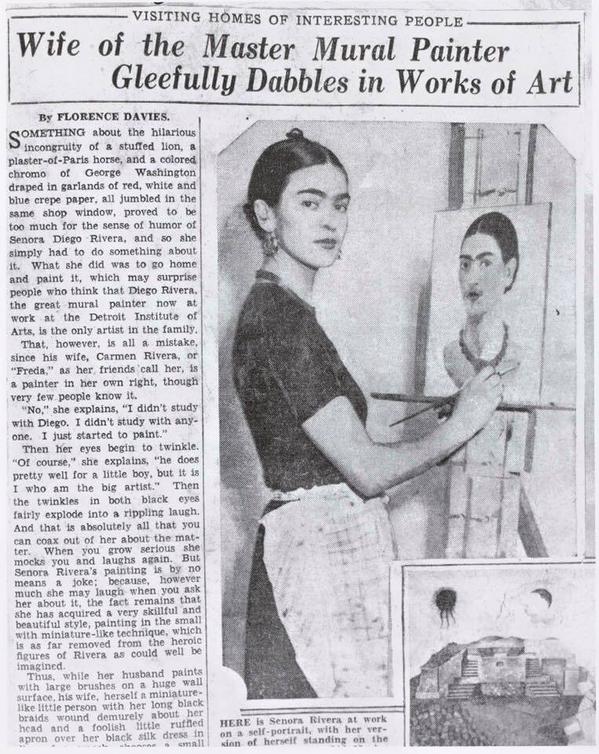
And yet, far from the Keanes’ San Francisco, and perhaps as far as a person can get from Margaret’s frustrated acquiescence, we have Frida Kahlo creating a body of work that would eventually overshadow her husband’s, muralist Diego Rivera. Unlike Walter Keane, Rivera was a very good painter who did not attempt to overshadow his wife. Instead of professional jealousy, he had plenty of the personal variety. Even so, Rivera encouraged Kahlo’s career and recognized her formidable talent, and she, in turn, supported him. In 1933, when Florence Davies—whom Kahlo biographer Gerry Souter describes as “a local news hen”—caught up with her in Detroit, Kahlo “played the cheeky, but adoring wife” of Diego while he labored to finish his famous Detroit mural project.
That may be so, but she did not do so at her own expense. Quite the contrary. Asked if Diego taught her to paint, she replies, “’No, I didn’t study with Diego. I didn’t study with anyone. I just started to paint.’” At which point, writes Davies, “her eyes begin to twinkle” as she goes on to say, “’Of course, he does pretty well for a little boy, but it is I who am the big artist.’” Davies praises Kahlo’s style as “skillful and beautiful” and the artist herself as “a miniature-like little person with her long black braids wound demurely about her head and a foolish little ruffled apron over her black silk dress.” And yet, despite Kahlo’s confidence and serious intent, represented by a prominent photo of her at serious work, Davies—or more likely her editor—decided to title the article, “Wife of the Master Mural Painter Gleefully Dabbles in Works of Art,” a move that reminds me of Walter Keane’s patronizing attitude.
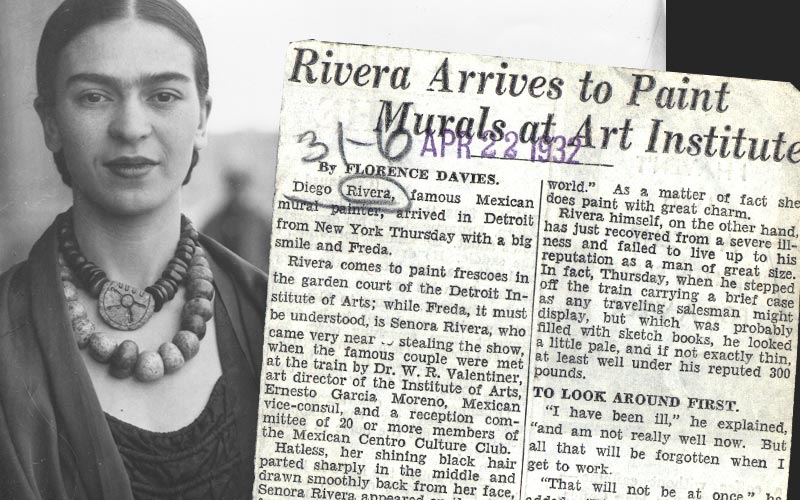
The belittling headline is quaint and disheartening, speaking to us, like the unearthed 1938 letter from Disney to an aspiring female animator, of the cruelty of casual sexism. Davies apparently filed another article on Rivera the year prior. This time the headline doesn’t mention Frida, though her fierce unflinching gaze, not Rivera’s wrestler’s mug, again adorns the spread. One sentence in the article says it all: “Freda [sic], it must be understood, is Senora Rivera, who came very near to stealing the show.” Davies then goes on to again describe Kahlo’s appearance, noting of her work only that “she does paint with great charm.” Six years later, Kahlo would indeed steal the show at her first and only solo show in the United States, then again in Paris, where surrealist maestro Andre Breton championed her work and the Louvre bought a painting, its first by a twentieth-century Mexican artist.
And Margaret Keane? She eventually sued Walter and now reaps her own rewards. You can buy one of her paintings here.
Note: An earlier version of this post appeared on our site in 2015.
Related Content:
Photos of a Very Young Frida Kahlo, Taken by Her Dad
A Brief Animated Introduction to the Life and Work of Frida Kahlo
Josh Jones is a writer and musician based in Durham, NC. Follow him at @jdmagness
Read More...Watch an Avant-Garde Bauhaus Ballet in Brilliant Color, First Staged in 1922
We credit the Bauhaus school, founded by German architect Walter Gropius in 1919, for the aesthetic principles that have guided so much modern design and architecture in the 20th and 21st centuries. The school’s relationships with artists like Paul Klee, Wassily Kandinsky, Laszlo Moholy-Nagy, and Ludwig Mies van der Rohe mean that Bauhaus is closely associated with Expressionism and Dada in the visual and literary arts, and, of course, with the modernist industrial design and glass and steel architecture we associate with Frank Lloyd Wright and Charles and Ray Eames, among so many others.
We tend not to associate Bauhaus with the art of dance, perhaps because of the school’s founding ethos to bring what they saw as enervated fine arts and crafts traditions into the era of modern industrial production. The question of how to meet that demand when it came to perhaps one of the oldest of the performing arts might have puzzled many an artist.
But not Oskar Schlemmer. A polymath, like so many of the school’s avant-garde faculty, Schlemmer was a painter, sculptor, designer, and choreographer who, in 1923, was hired as Master of Form at the Bauhaus theatre workshop.
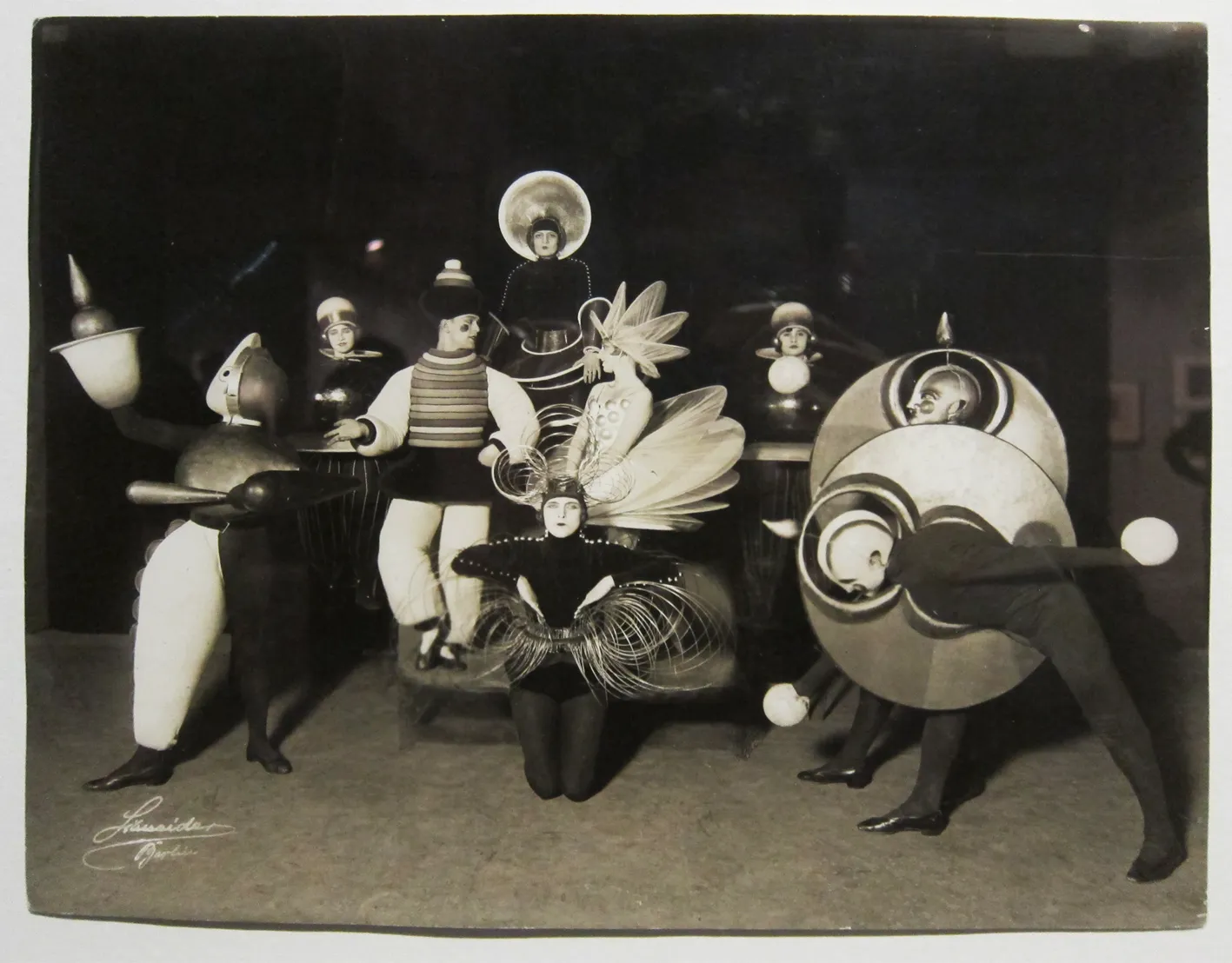
Before taking on that role, Schlemmer had already conceived, designed, and staged his most famous work, Das Triadische Ballett (The Triadic Ballet). “Schlemmer’s main theme,” says scholar and choreographer Debra McCall, “is always the abstract versus the figurative and his work is all about the conciliation of polarities—what he himself called the Apollonian and Dionysian. [He], like others, felt that mechanization and the abstract were two main themes of the day. But he did not want to reduce the dancers to automatons.” These concerns were shared by many modernists, who felt that the idiosyncrasies of the human could easily become subsumed in the seductive orderliness of machines.
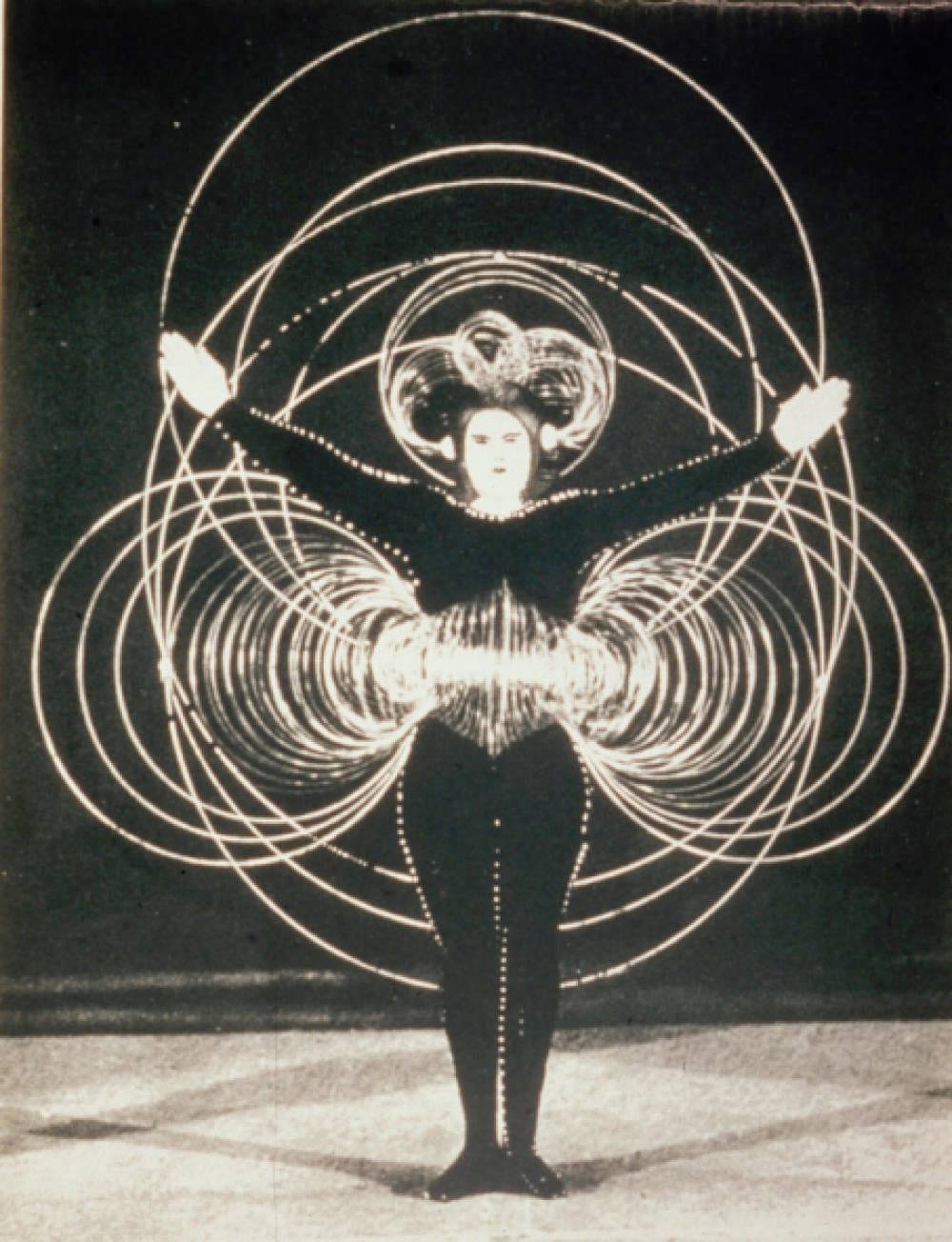
Schlemmer’s intentions for The Triadic Ballet translate—in the descriptions of Dangerous Minds’ Amber Frost—to “sets [that] are minimal, emphasizing perspective and clean lines. The choreography is limited by the bulky, sculptural, geometric costumes, the movement stiflingly deliberate, incredibly mechanical and mathy, with a rare hint at any fluid dance. The whole thing is daringly weird and strangely mesmerizing.” You can see black and white still images from the original 1922 production above (and see even more at Dangerous Minds). To view these bizarrely costumed figures in motion, watch the video at the top, a 1970 recreation in full, brilliant color.

For various reasons, The Triadic Ballet has rarely been restaged, though its influence on futuristic dance and costuming is considerable. The Triadic Ballet is “a pioneering example of multi-media theater,” wrote Jack Anderson in review of a 1985 New York production; Schlemmer “turned to choreography,” writes Anderson, “because of his concern for the relationships of figures in space.” Given that the guiding principle of the work is a geometric one, we do not see much movement we associate with traditional dance. Instead the ballet looks like pantomime or puppet show, with figures in awkward costumes tracing various shapes around the stage and each other.
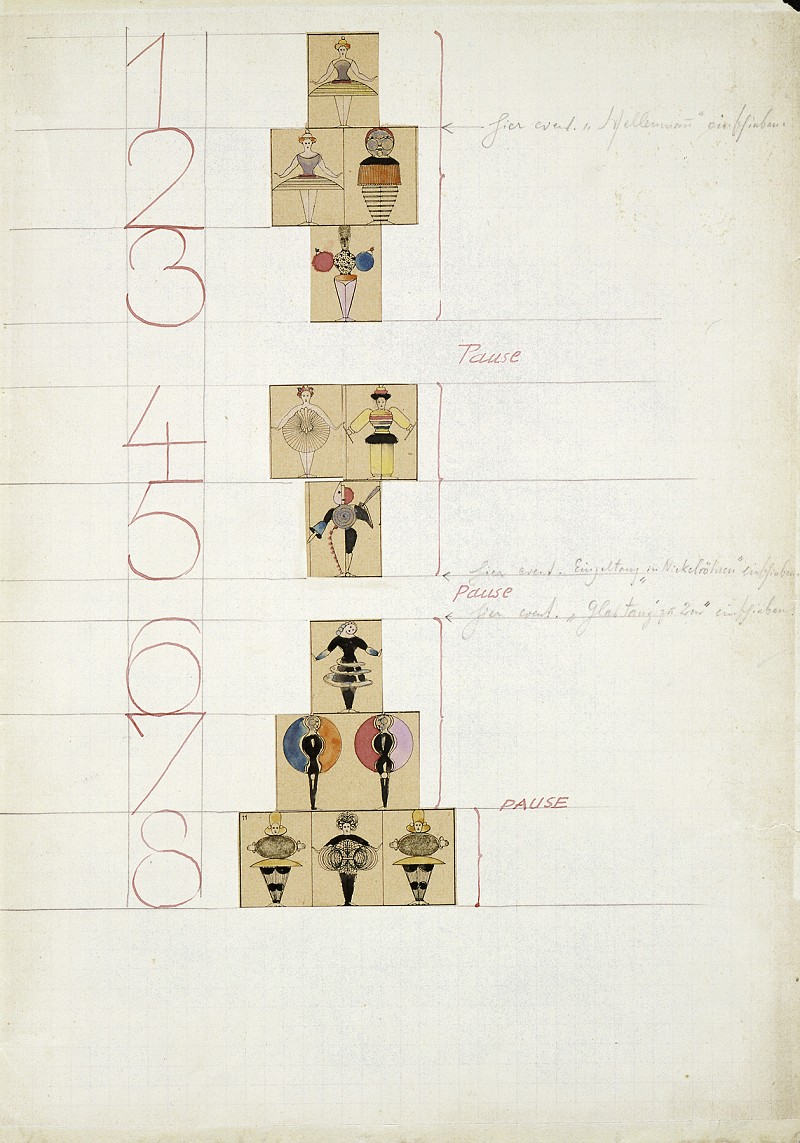
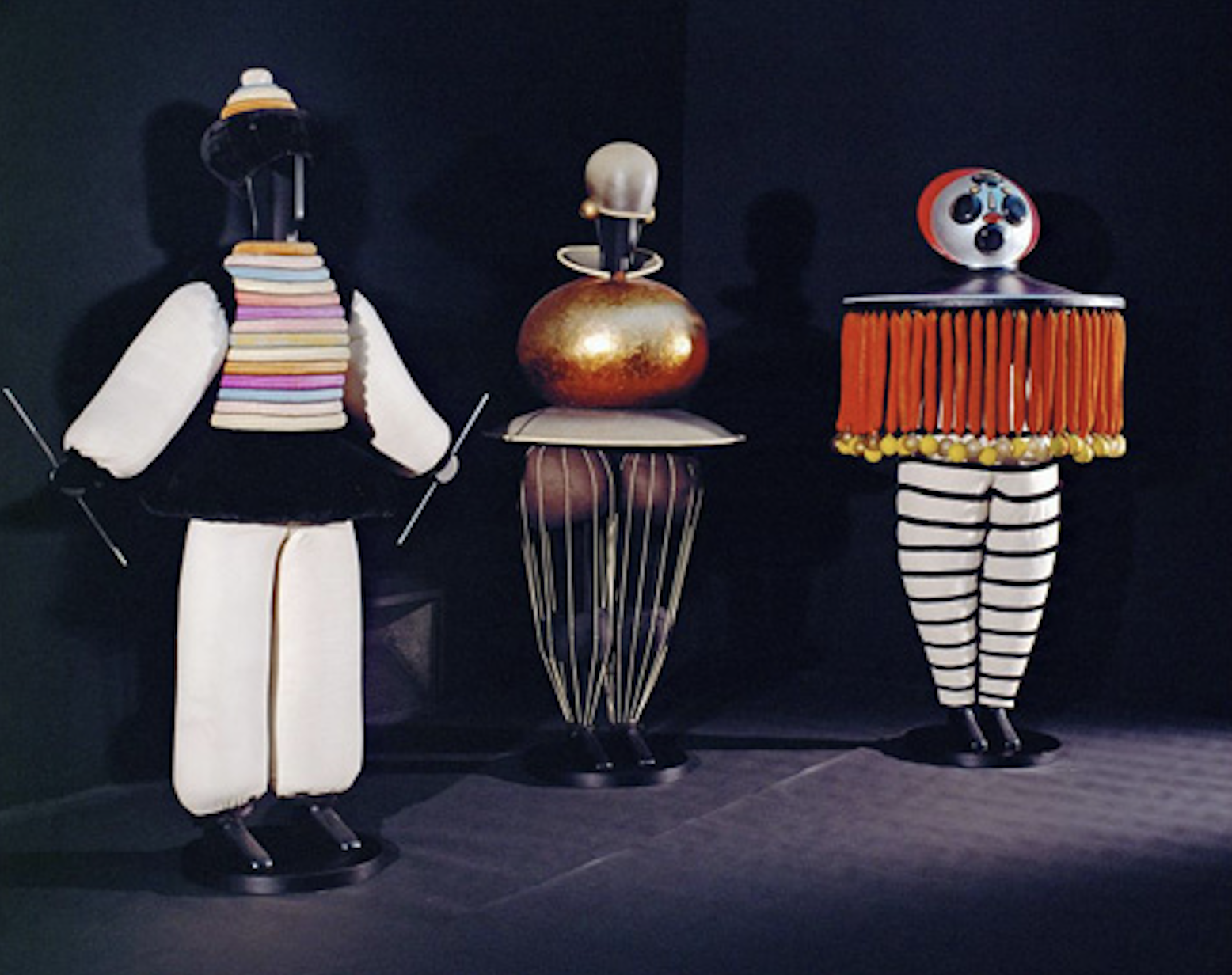
As you can see in the images further up, Schlemmer left few notes regarding the choreography, but he did sketch out the grouping and costuming of each of the three movements. (You can zoom in and get a closer look at the sketches above at the Bauhaus-archiv Museum.) As Anderson writes of the 1985 revived production, “unfortunately, Schlemmer’s choreography for these figures was forgotten long ago, and any new production must be based upon research and intuition.” The basic outlines are not difficult to recover. Inspired by Arnold Schoenberg’s Pierrot Lunaire, Schlemmer began to see ballet and pantomime as free from the baggage of traditional theater and opera. Drawing from the stylizations of pantomime, puppetry, and Commedia dell’Arte, Schlemmer further abstracted the human form in discrete shapes—cylindrical necks, spherical heads, etc—to create what he called “figurines.” The costuming, in a sense, almost dictates the jerky, puppet-like movements of the dancers. (These three costumes below date from the 1970 recreation of the piece.)
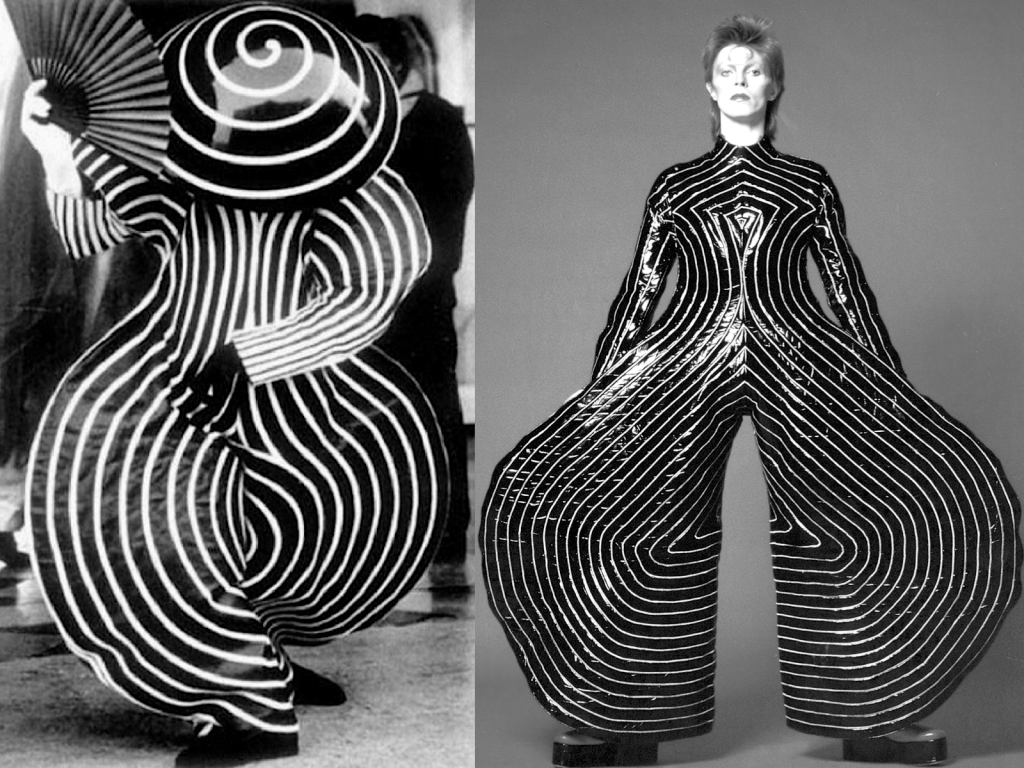
Schlemmer’s radical production has somehow not achieved the level of recognition of other avant-garde ballets of the time, including Schoenberg’s Pierrot Lunaire and Stravinsky’s, Nijinsky-choreographed The Rite of Spring. The Triadic Ballet, with music composed by Paul Hindemith, toured between 1922 and 1929, representing the ethos of the Bauhaus school, but at the end of that period, Schlemmer was forced to leave “an increasingly volatile Germany,” writes Frost. Revivals of the piece, such as a 1930 exhibition in Paris, tended to focus on the “figurines” rather than the dance. Schlemmer made many similar performance pieces in the 20s (such as a “mechanical cabaret”) that brought together industrial design, dance, and gesture. But perhaps his greatest legacy is the bizarre costumes, which were worn and copied at various Bauhaus costume parties and which went on to directly inspire the look of Fritz Lang’s Metropolis and the glorious excesses of David Bowie’s Ziggy Stardust stage show.
Note: An earlier version of this post appeared on our site in 2016.
Related Content:
32,000+ Bauhaus Art Objects Made Available Online by Harvard Museum Website
Bauhaus Ballet: A Dance of Geometry
Josh Jones is a writer and musician based in Durham, NC. Follow him at @jdmagness
Read More...Watch Bob Ross’ The Joy of Painting from Start to Finish: Every Episode from 31 Seasons in Chronological Order
Bob Ross the man died nearly thirty years ago, but Bob Ross the archetypal TV painter has never been more widely known. “With his distinctive hair, gentle voice, and signature expressions such as ‘happy little trees,’ he’s an enduring icon,” writes Michael J. Mooney in an Atlantic piece from 2020. “His likeness appears on a wide assortment of objects: paints and brushes, toasters, socks, calendars, dolls, ornaments, and even a Chia Pet.” Here in Korea, where I live, he’s universally called Bob Ajeossi, ajeossi being a kind of colloquial title for middle-aged men. It’s quite an afterlife for a soft-spoken public-television host from the eighties.
Ross quickly became a pop-cultural figure in that era, starring in semi-ironic MTV spots by the early nineties. But over the decades, writes Mooney, “the appreciation of Bob Ross has morphed into something nearly universally earnest.” It helps that he has “the ultimate calming presence,” which has drawn special appreciation here in the twenty-first century: “More than a decade before most therapists were telling clients to be mindful and present, Ross was telling his viewers to appreciate their every breath.” This meditative, positive mood pervades all of The Joy of Painting’s more than 400 recorded broadcasts, and they even deliver the soothing effects of what YouTube-viewing generations know as “unintentional ASMR.”
Now you can watch almost all those broadcasts on a single YouTube playlist, which includes all of The Joy of Painting’s 31 seasons, originally aired between 1983 and 1994. (The videos come from the official YouTube channel of The Joy of Painting and Bob Ross.) Despite having ended its run well before any of us had ever imagined watching video online, the show now feels practically made for the internet, what with not just its ASMR qualities, but also the parasocial friendliness of Ross’ personality, the instructional value and sheer quantity of its content, and the highly consistent format. Every time, Ross paints a complete picture from start to finish: usually a landscape featuring mighty mountains, freedom-loving clouds, and happy little trees, but occasionally something just different enough to keep it interesting. And so the man Mooney describes as “probably America’s most famous painter” lives on as a beloved YouTuber.
Related comment:
What Happened to the 1200 Paintings Painted by Bob Ross? The Mystery Has Finally Been Solved
Experience the Bob Ross Experience: A New Museum Open in the TV Painter’s Former Studio Home
Watch a Master Japanese Printmaker at Work: Two Unintentionally Relaxing ASMR Videos
Based in Seoul, Colin Marshall writes and broadcasts on cities, language, and culture. His projects include the Substack newsletter Books on Cities and the book The Stateless City: a Walk through 21st-Century Los Angeles. Follow him on the social network formerly known as Twitter at @colinmarshall.
Read More...How Marcel Marceau Used Mime to Save Children During the Holocaust
In 1972, Jerry Lewis made the ill-considered decision to write, direct, and star in a film about a German clown in Auschwitz. The result was so awful that he never allowed its release, and it quickly acquired the reputation—along with disasters like George Lucas’ Star Wars Holiday Special—as one of the biggest mistakes in movie history. Somehow, this cautionary tale did not dissuade the bold Italian comedian Roberto Benigni from making a film with a somewhat similar premise, 1997’s Life Is Beautiful, in which he plays a father in a concentration camp who entertains children with comic stunts and antics to distract them from the horrors all around them.
That film, by contrast, was a commercial and critical success and went on to win the Grand Prix at Cannes in 1998 and three Academy Awards the following year, a testament to Benigni’s sensitivity to his subject, in a screenplay partly based on the memoirs of Rubino Romeo Salmoni. It’s a wonder that another real-life story of a comic genius who used his talents not only to entertain children during WWII, but to save them from the Nazis has somehow never been made into a feature film—and especially surprising given the stature of the man in question: Marcel Marceau, the most famous mime in history.
As we learn in the Great Big Story video above, Marceau was 16 years old in 1940 when German soldiers marched into France. His “childhood ended all at once,” says Shawn Wen, author of a recent book about Marceau. His father died in Auschwitz and both Marceau and his brother “were involved in the war effort against the Nazis.” In one story, Marceau dressed a group of children from an orphanage as campers and walked them into Switzerland, entertaining them all the way, “to the point where they could pretend as if they were going on vacation rather than fleeing for their lives.”
In another story, Marceau somehow convinced a group of German soldiers to surrender to him. “It seems as if this natural knack for acting,” says Wen, “ended up becoming a part of his involvement in the war effort.” During the war, Marceau was “miming for his life,” and the lives of others. Mime has been the butt of many jokes over the years, but Wen sees in Marceau’s silent performances a means of bringing humanity together with an art that transcends language and nationality. Learn more about how Marceau began his mime career during the Nazi occupation at our previous post here.
Note: An earlier version of this post appeared on our site in 2018.
Related Content:
How Marcel Marceau Started Miming to Save Children from the Holocaust
Marcel Marceau Mimes the Progression of Human Life, From Birth to Death, in 4 Minutes
Josh Jones is a writer and musician based in Durham, NC. Follow him at @jdmagness
Read More...Explore the Newly-Launched Public Domain Image Archive with 10,000+ Free Historical Images
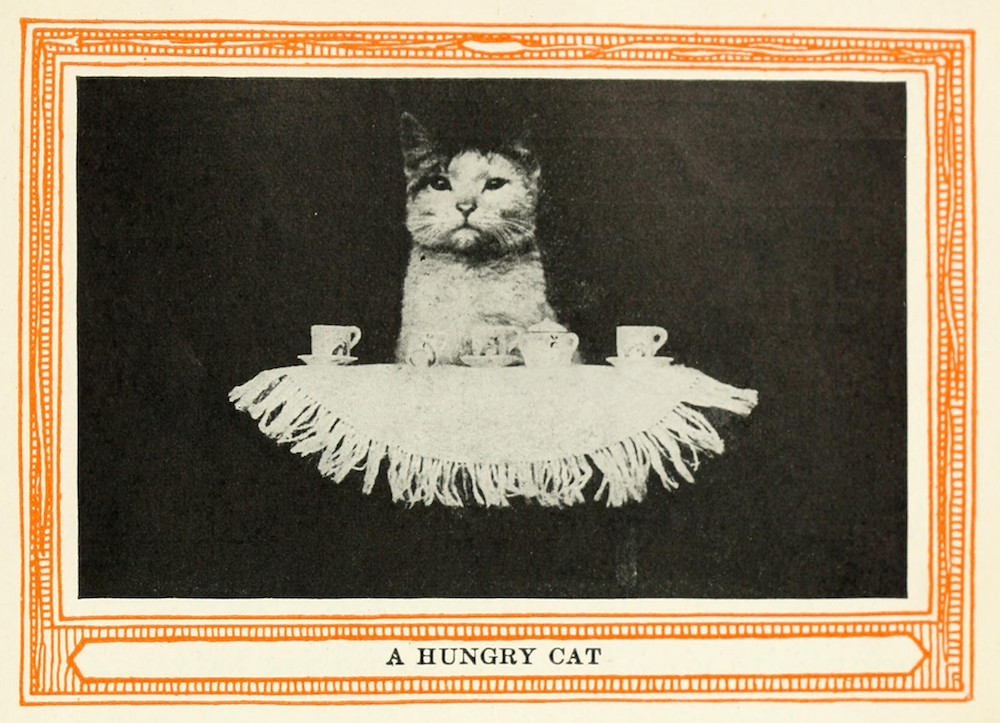
We’ve often featured the work of the Public Domain Review here on Open Culture, and also various searchable copyright-free image databases that have arisen over the years. It makes sense that those two worlds would collide, and now they’ve done so in the form of the just-launched Public Domain Image Archive (PDIA). The Public Domain Review invites us to use the site to “explore our hand-picked collection of 10,046 out-of-copyright works, free for all to browse, download, and reuse” — and note that the number will grow, given that “this is a living database with new images added every week.”

As with any portal of this kind, you can browse by category tags, the selection of which includes everything from architecture to decorations to occultism to war. But if you’d like to get a sense of the sheer formal, aesthetic, cultural, and historical variety of the PDIA, you might consider taking a first look through its “infinite view,” which allows you to scroll in all directions through a limitless labyrinth of copyright-free wonders: advertisements, Biblical scenes, old-time sportsmen, outer-space photos, mushrooms, medieval musical creatures, letterforms, and, well, labyrinths.
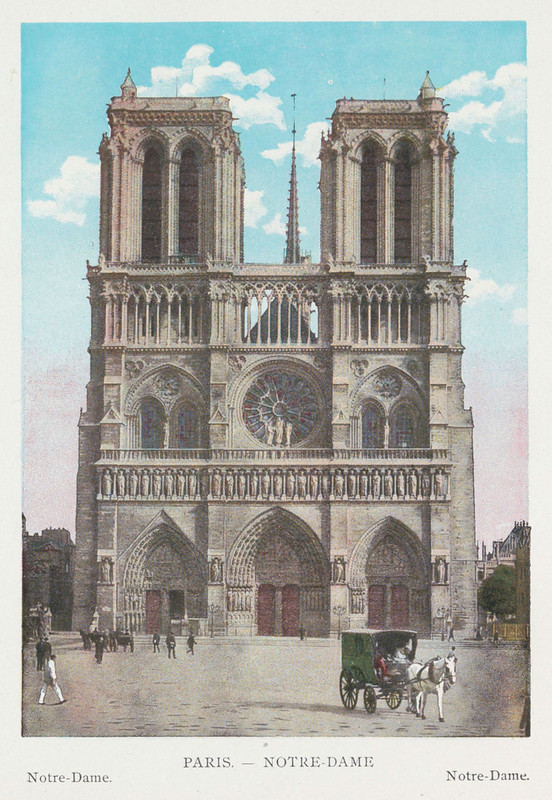
You might also recognize items you’ve seen here on Open Culture before, like the nature drawings of Ernst Haeckel, the modern art-lampooning children’s book The Cubies’ ABC, or the ghosts and monsters illustrated by ukiyo‑e master Hokusai. The PDIA provides more context than some public-domain image archives, even linking to relevant Public Domain Review posts, where you can read about such topics as Emily Noyes Vanderpoel’s color analysis charts (which also inspired a post of ours), the end of books (as predicted in 1894), and even “Cats and Captions before the Internet Age.” Having fallen into the public domain, all this material is, of course, available to use for any purpose you like — including just satisfying your own curiosity.
Related comments:
A Search Engine for Finding Free, Public Domain Images from World-Class Museums
Public.Work: A Smoothly Searchable Archive of 100,000+ “Copyright-Free” Images
Sea-Serpents, Vampires, Pirates & More: The Public Domain Review’s Second Book of Essays
Based in Seoul, Colin Marshall writes and broadcasts on cities, language, and culture. His projects include the Substack newsletter Books on Cities and the book The Stateless City: a Walk through 21st-Century Los Angeles. Follow him on the social network formerly known as Twitter at @colinmarshall.
Read More...The Night When Miles Davis Opened for the Grateful Dead (1970)
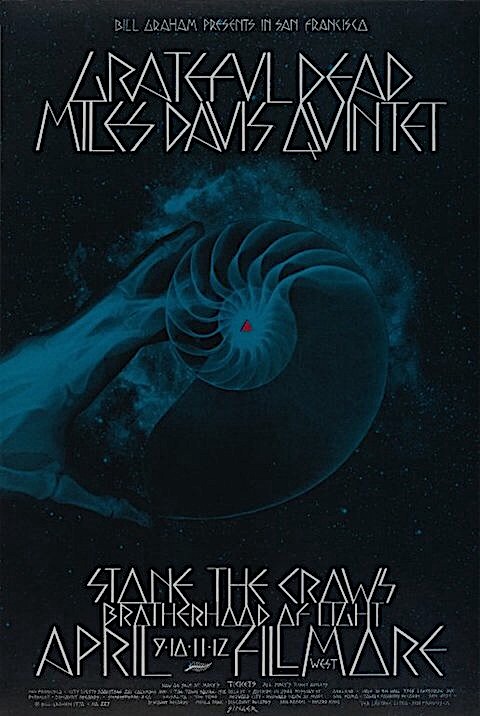
What’s that, you ask? Did Miles Davis open for the Grateful Dead at the Fillmore West? In what world could such a thing happen? In the world of the late sixties/early seventies, when jazz fused with acid rock, acid rock with country, and pop culture took a long strange trip. The “inspired pairing” of the Dead with Davis’ electric band on April 9–12, 1970, “represented one of [promoter] Bill Graham’s most legendary bookings,” writes the blog Cryptical Developments. I’ll say. Davis had just released the groundbreaking double-LP Bitches Brew and was “at somewhat of an artistic and commercial crossroads,” experimenting with new, more fluid compositions.
Aggressive and dominated by rock rhythms and electric instruments, the album became Davis’ best seller and brought him before young, white audiences in a way his earlier work had not. The band that Davis brought into the Fillmore West, comprising [Chick] Corea, [Dave] Holland, soprano sax player Steve Grossman, drummer Jack Dejohnette, and percussionist Airto Moreira, was fully versed in this new music, and stood the Fillmore West audiences on their ears.
I can only imagine what it would have been like to see that performance live. But we don’t have to imagine what it sounded like. You can hear Davis’s set below.
In his autobiography, Davis described it as “an eye-opening concert for me.” “The place was packed with these real spacy, high white people,” he wrote, “and when we first started playing, people were walking around and talking.” Once the band got into the Bitches Brew material, though, “that really blew them out. After that concert, every time I would play out there in San Francisco, a lot of young white people showed up at the gigs.”
Did the Dead become a crossover hit with jazz fans? Not exactly, but Davis really hit it off with them, especially with Jerry Garcia. “I think we all learned something,” Davis wrote: “Jerry Garcia loved jazz, and I found out that he loved my music and had been listening to it for a long time.” In his autobiography, the Dead’s Phil Lesh remembered having his mind blown by Davis and band: “As I listened, leaning over the amps with my jaw hanging agape, trying to comprehend the forces that Miles was unleashing onstage, I was thinking What’s the use. How can we possibly play after this? […] With this band, Miles literally invented fusion music. In some ways it was similar to what we were trying to do in our free jamming, but ever so much more dense with ideas – and seemingly controlled with an iron fist, even at its most alarmingly intense moments.” You can stream the Dead’s full performance from that night below. Think what must have been running through their minds as they took the stage after watching Miles Davis invent a new form of music right before their eyes.
Note: An earlier version of this post appeared on our site in 2014.
Related Content:
Miles Davis Opens for Neil Young and “That Sorry-Ass Cat” Steve Miller at The Fillmore East (1970)
When the Grateful Dead Played at the Egyptian Pyramids, in the Shadow of the Sphinx (1978)
In 1969 Telegram, Jimi Hendrix Invites Paul McCartney to Join a Super Group with Miles Davis
Josh Jones is a writer and musician based in Durham, NC. Follow him at @jdmagness
Read More...The World in a Cloverleaf: A World Map from 1581

In 1581, the medieval cartographer and Protestant theologian Heinrich Bünting created a symbolic map of the world that adorned his book Itinerarium Sacrae Scripturae (Travel Through Holy Scripture). Hand-colored and shaped like a three-leaf clover, the map put Jerusalem at its center, highlighting its central role in Christianity, Judaism, and Islam. From that center flowed three continents—Europe, Africa, and Asia—each surrounded by swirling waters teeming with ships, mermaids, and sea monsters. Then, off to one side, we find a barren “America,” otherwise known as the “New World.”
The three-leaf clover design likely symbolizes the Christian trinity, while also paying homage to the clover design found on the coat of arms of Bünting’s native hometown, Hanover. Beyond the map featured above, Bünting also designed some other notably unconventional maps. Take, for example, a map where Europe takes the form of a virgin queen, or a map of Asia that’s shaped like the winged horse Pegasus. You can view a copy of the Itinerarium Sacrae Scripturae online.
If you would like to support the mission of Open Culture, consider making a donation to our site. It’s hard to rely 100% on ads, and your contributions will help us continue providing the best free cultural and educational materials to learners everywhere. You can contribute through PayPal, Patreon, and Venmo (@openculture). Thanks!
Related Content
Explore the Hereford Mappa Mundi, the Largest Medieval Map Still in Existence (Circa 1300)
Europe’s Oldest Map: Discover the Saint-Bélec Slab (Circa 2150–1600 BCE)
Read More...Support Us
We're hoping to rely on loyal readers, rather than erratic ads. Please click the Donate button and support Open Culture. You can use Paypal, Venmo, Patreon, even Crypto! We thank you!

About Us

Open Culture scours the web for the best educational media. We find the free courses and audio books you need, the language lessons & educational videos you want, and plenty of enlightenment in between.
Advertise With Us
FREE UPDATES!
GET OUR DAILY EMAIL
Get the best cultural and educational resources on the web curated for you in a daily email. We never spam. Unsubscribe at any time.
FOLLOW ON SOCIAL MEDIA
Open Culture editor Dan Colman scours the web for the best educational media. He finds the free courses and audio books you need, the language lessons & movies you want, and plenty of enlightenment in between.
Advertise With Us



