When William S. Burroughs Appeared on Saturday Night Live: His First TV Appearance (1981)
Though he never said so directly, we might expect that Situationist Guy Debord would have included Saturday Night Live in what he called the “Spectacle”—the mass media presentation of a totalizing reality, “the ruling order’s nonstop discourse about itself, its never-ending monologue of self-praise.” The slickness of TV, even live comedy TV, masks carefully orchestrated maneuvers on the part of its creators and advertisers. In Debord’s analysis, nothing is exempted from the spectacle’s consolidation of power; it co-opts everything for its purposes. Even seeming contradictions within the spectacle—the skewering of political figures, for example, to their seeming displeasure—serve the purposes of power: The spectacle, wrote Debord, “is the opposite of dialogue.”
So I wonder, what he might have made of the appearance of cult writer and Beat pioneer William S. Burroughs on the comedy show in 1981? Was Burroughs—a mastermind of the counterculture—co-opted by the powers that be? The author of Junkie, Naked Lunch, and Cities of the Red Night also appeared in a Nike ad and several films and music videos, becoming a “presence in American pop culture,” writes R.U. Sirius in Everybody Must Get Stoned.
David Seed notes that Burroughs “is remembered by many members of the intelligentsia and glitterati as dinner partner for the likes of Andy Warhol, David Bowie, and Mick Jagger,” though he had “been a model for the political and social left.” Had he been neutered by the 80s, his outrageously anarchist sentiments turned to radical kitsch?
Or maybe Burroughs disrupted the spectacle, his droning, monotonous delivery giving viewers of SNL exactly the opposite of what they were trained to expect. The appearance was his widest exposure to date (immediately afterward, he moved from New York to Lawrence, Kansas). One of the show’s writers convinced producer Dick Ebersol to put Burroughs on. In rehearsal, writes Burroughs’ biographer Ted Morgan, Ebersol “found Burroughs ‘boring and dreadful,’ and ordered that his time slot be cut from six to three and a half minutes. The writers, however, conspired to let his performance stand as it was, and on November 7, he kicked off the show sitting behind a desk, the lighting giving his face a sepulchral gauntness.”
In the grainy video above, Burroughs reads from Naked Lunch and cut-up novel Nova Express, bringing the sadistic Dr. Benway into America’s living rooms, as the audience laughs nervously. Sound effects of bombs and strains of the national anthem play behind him as he reads. It stands as perhaps one of the strangest moments in live television. “Burroughs had positioned himself as the Great Outsider,” writes Morgan, “but on the night of November 7 he had reached the position where the actress Lauren Hutton could introduce him to an audience of 100 million viewers as America’s greatest living writer.” I’m sure Burroughs got a kick out of the description. In any case, the clip shows us a SNL of bygone days that occasionally disrupted the usual state of programming, as when it had punk band Fear on the show.
Perhaps Burroughs’ commercial appearances also show us how the counterculture gets co-opted and repackaged for middle-class tastes. Then again, one of the great ironies of Burroughs’ life is that he both began and ended it as “a true member of the midwestern tax-paying middle class.” The following year in Lawrence, Kansas, he “caught up on his correspondence.” One student in Montreal wrote, imagining him in “a male whorehouse in Tangier.” Burroughs replied, “No… I live in a small house on a tree-lined street in Lawrence, Kansas, with my beloved cat Ruski. My hobbies are hunting, fishing, and pistol practice.” Did Burroughs, who spent his life destroying mass culture with cut-ups and curses, sell out—as he once accused Truman Capote of doing—by becoming a celebrity?
Perhaps we should let him answer the charge. In answer to a fan from England who called him “God,” Burroughs wrote, “You got me wrong, Raymond, I am but a humble practitioner of the scrivener’s trade. God? Not me. I don’t have the qualifications. Old Sarge told me years ago: ‘Don’t be a volunteer, kid.’ God is always trying to foist his lousy job not someone else. You gotta be crazy to take it. Just a Tech Sergeant in the Shakespeare Squadron.” Burroughs may have used his celebrity status to his literary advantage, and used it to pay the bills and work with artists he admired and vice-versa, but he never saw himself as more than a writer (and perhaps lay magician), and he abjured the hero worship that made him a cult figure.
Note: An earlier version of this post appeared on our site in 2016.
Related Content
Beat Writer William S. Burroughs Spreads Counterculture Cool on Nike Sneakers, 1994
The “Priest” They Called Him: A Dark Collaboration Between Kurt Cobain & William S. Burroughs
Read More...Watch the Historic First Episode of Saturday Night Live with Host George Carlin (1975)
50 years of Saturday Night Live. It all started here with this first episode, aired on October 11, 1975. George Carlin hosted the show. Billy Preston and Janis Ian served up the music. Jim Henson staged an elaborate puppet show. And “the Not Ready for Prime Time Players” (Belushi, Aykroyd, Gilda, Jane, Chevy, Garrett, Laraine and the rest) provided the comedy, performing the first of 10,000 sketches that have since aired over SNL’s long history. SNL added the complete episode to its YouTube channel, and you can now watch how it all began. Enjoy!
Related Content
When William S. Burroughs Appeared on Saturday Night Live: His First TV Appearance (1981)
Saturday Night Live’s Very First Sketch: Watch John Belushi Launch SNL in October, 1975
5 Musical Guests Banned From Saturday Night Live: From Elvis Costello to Frank Zappa
David Bowie and Klaus Nomi’s Hypnotic Performance on SNL (1979)
Read More...
Jane Austen Used Pins to Edit Her Manuscripts: Before the Word Processor & White-Out
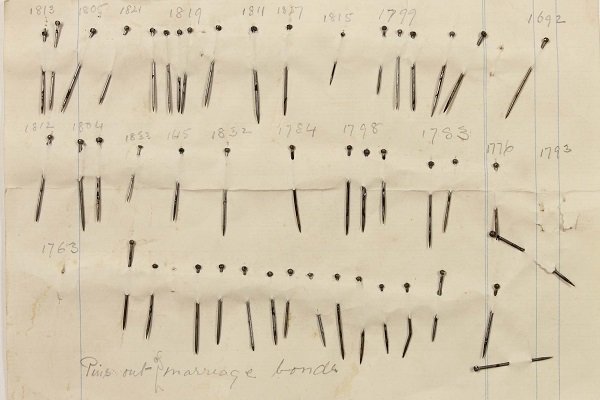
Before the word processor, before White-Out, before Post-It Notes, there were straight pins. Or, at least that’s what Jane Austen used to make edits in one of her rare manuscripts. In 2011, Oxford’s Bodleian Library acquired the manuscript of Austen’s abandoned novel, The Watsons. In announcing the acquisition, the Bodleian wrote:
The Watsons is Jane Austen’s first extant draft of a novel in process of development and one of the earliest examples of an English novel to survive in its formative state. Only seven manuscripts of fiction by Austen are known to survive. The Watsons manuscript is extensively revised and corrected throughout, with crossings out and interlinear additions.
Janeausten.ac.uk (the website where Austen’s manuscripts have been digitized) takes a deeper dive into the curious quality of The Watsons manuscript, noting:
The manuscript is written and corrected throughout in brown iron-gall ink. The pages are filled in a neat, even hand with signs of concurrent writing, erasure, and revision, interrupted by occasional passages of heavy interlinear correction.… The manuscript is without chapter divisions, though not without informal division by wider spacing and ruled lines. The full pages suggest that Jane Austen did not anticipate a protracted process of redrafting. With no calculated blank spaces and no obvious way of incorporating large revision or expansion she had to find other strategies – the three patches, small pieces of paper, each of which was filled closely and neatly with the new material, attached with straight pins to the precise spot where erased material was to be covered or where an insertion was required to expand the text.
According to Christopher Fletcher, Keeper of Special Collections at the Bodleian Library, this prickly method of editing wasn’t exactly new. Archivists at the library can trace pins being used as editing tools back to 1617.
You can find The Watsons online here:
- The Watsons, Morgan Library & Museum, New York — Facsimile
- The Watsons, Bodleian Library, Oxford — Facsimile
Note: An earlier version of this post appeared on our site in August, 2014.
If you would like to support the mission of Open Culture, consider making a donation to our site. It’s hard to rely 100% on ads, and your contributions will help us continue providing the best free cultural and educational materials to learners everywhere. You can contribute through PayPal, Patreon, and Venmo (@openculture). Thanks!
Related Content:
How Jane Austen Changed Fiction Forever
Take a Virtual Tour of Jane Austen’s Library
Jane Austen’s Music Collection, Now Digitized and Available Online
Read More...What It Was Like to Get a Meal at a Medieval Tavern
At least since The Canterbury Tales, the setting of the medieval tavern has held out the promise of adventure. For their customer base during the actual Middle Ages, however, they had more utilitarian virtues. “If you ever find yourself in the late medieval period, and you are in need of food and drink, you’d better find yourself an inn, tavern, or alehouse,” says Tasting History host Max Miller in the video above. The differences between them had to do with quality: the taverns were nicer than the alehouses, and the inns were nicer than the taverns, having begun as full-service establishments where customers could stay the night.
As for what inn‑, tavern‑, or alehouse-goers would actually consume, Miller mentions that the local availability of ingredients would always be a factor. “You might just get a vegetable potage; in some places it would just be beans and cabbage.”
Elsewhere, though, it could be “a fish stew, or something with really quality meat in it.” For the recipe of the episode — this being a cooking show, after all — Miller chooses a common medieval meat stew called bukenade or boknade. The actual instructions he reads contain words revealing of their time period: the Biblical sounding smyte for cut, for instance, or eyroun, the Middle English term that ultimately lost favor to eggs.
The customers of taverns would originally have drunk wine, which in England was imported from France at some expense. As they grew more popular, these businesses diversified their menus, offering “cider from apples and perry from pears,” as well as the premium option of mead made with honey. Alehouses, as their name would suggest, began as private homes whose wives sold ale, at least the excess that the family itself couldn’t drink. However informal they sound, they were still subject to the same regulations as other drinking spots, and alewives found to be selling an inferior product were subject to the same kind of public humiliations inflicted upon any medieval miscreant — the likes of whom we might recognize from any number of the high-fantasy tales we read today.
Related content:
How to Make Medieval Mead: A 13th Century Recipe
How to Make Ancient Mesopotamian Beer: See the 4,000-Year-Old Brewing Method Put to the Test
Based in Seoul, Colin Marshall writes and broadcasts on cities, language, and culture. His projects include the Substack newsletter Books on Cities and the book The Stateless City: a Walk through 21st-Century Los Angeles. Follow him on the social network formerly known as Twitter at @colinmarshall.
Read More...Horrifying 1906 Illustrations of H.G. Wells’ War of the Worlds: Discover the Art of Henrique Alvim Corrêa
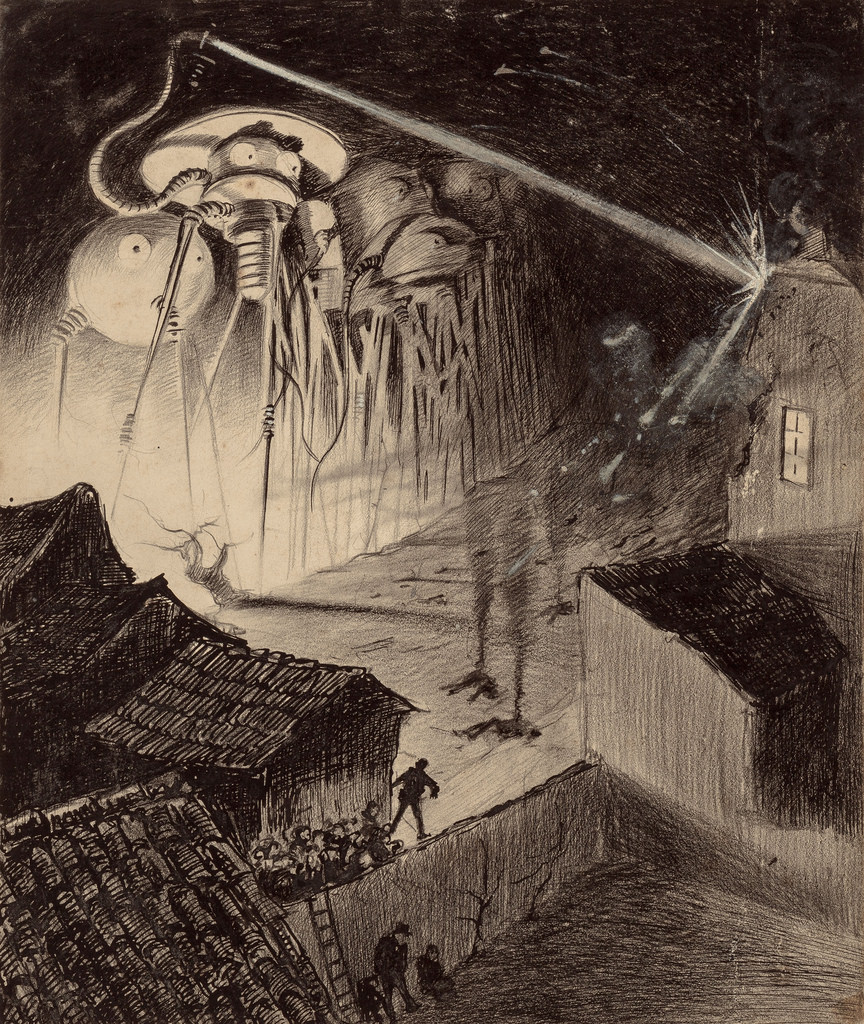
H.G. Wells’ War of the Worlds has terrified and fascinated readers and writers for decades since its 1898 publication and has inspired numerous adaptations. The most notorious use of Wells’ book was by Orson Welles, whom the author called “my little namesake,” and whose 1938 War of the Worlds Halloween radio play caused public alarm (though not actually a national panic). After the occurrence, reports Phil Klass, the actor remarked, “I’m extremely surprised to learn that a story, which has become familiar to children through the medium of comic strips and many succeeding and adventure stories, should have had such an immediate and profound effect upon radio listeners.”
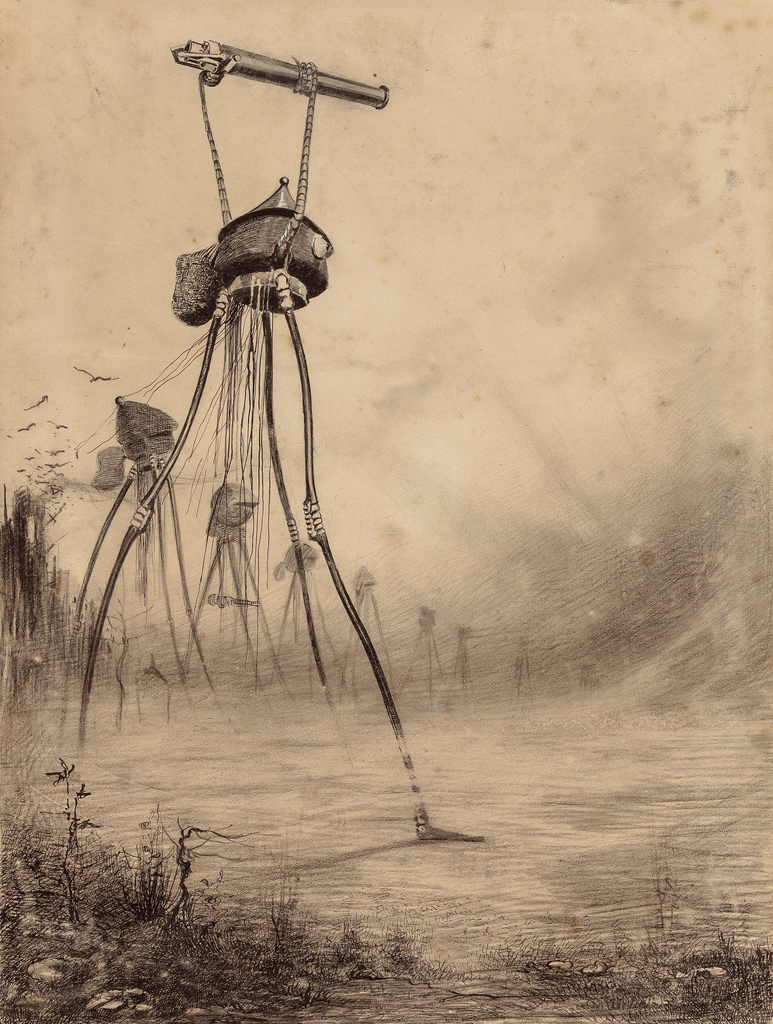
Surely Welles knew that is precisely why the broadcast had the effect it did, especially in such an anxious pre-war climate. The 1898 novel also startled its first readers with its verisimilitude, playing on a late Victorian sense of apocalyptic doom as the turn-of-the century approached.
But what contemporary circumstances eight years later, we might wonder, fueled the imagination of Henrique Alvim Corrêa, whose 1906 illustrations of the novel you can see here? Wells himself approved of these incredible drawings, praising them before their publication and saying, “Alvim Corrêa did more for my work with his brush than I with my pen.”
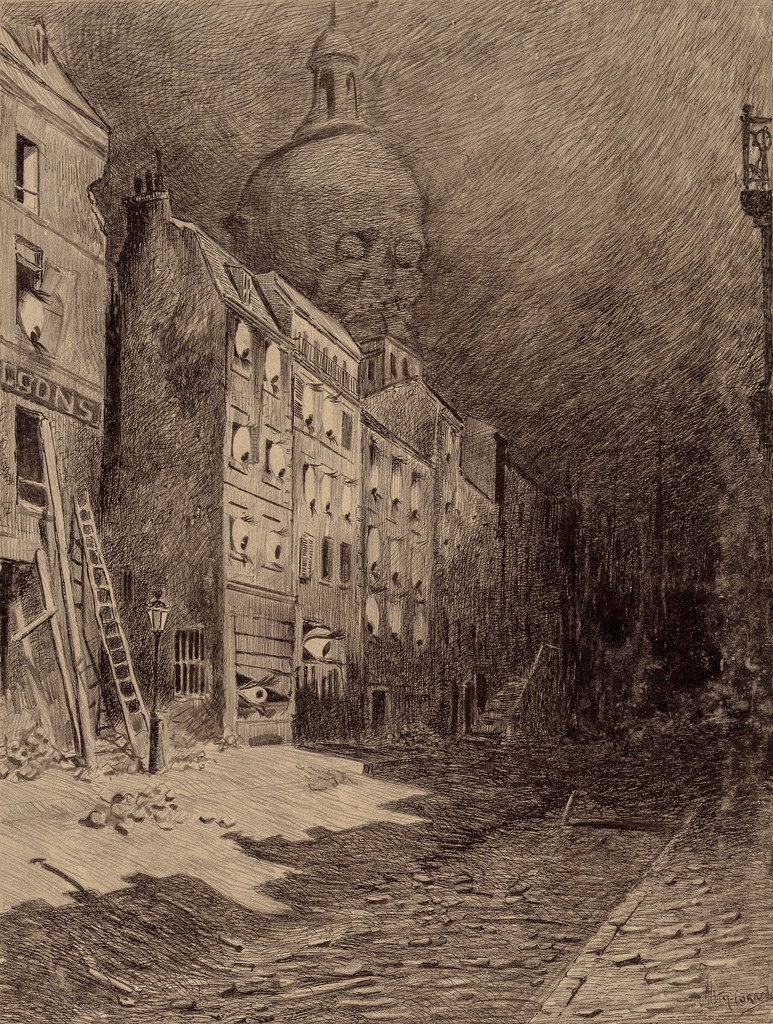
Indeed they capture the novel’s uncanny dread. Martian tripods loom, ghastly and cartoonish, above blasted realist landscapes and scenes of panic. In one illustration, a grotesque, tentacled Martian ravishes a nude woman. In a surrealist drawing of an abandoned London above, eyes protrude from the buildings, and a skeletal head appears above them. The alien technology often appears clumsy and unsophisticated, which contributes to the generally terrifying absurdity that emanates from these finely rendered plates.
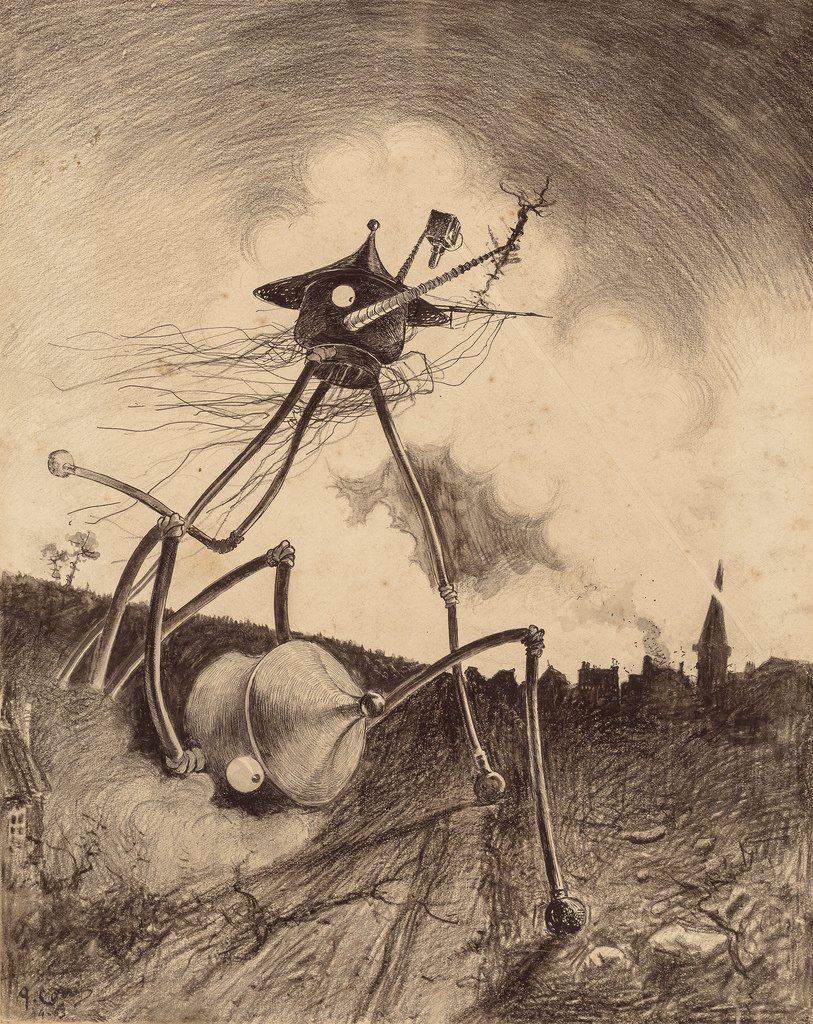
Alvim Corrêa was a Brazilian artist living in Brussels and struggling for recognition in the European art world. His break seemed to come when the War of the Worlds illustrations were printed in a large-format, limited French edition of the book, with each of the 500 copies signed by the artist himself.
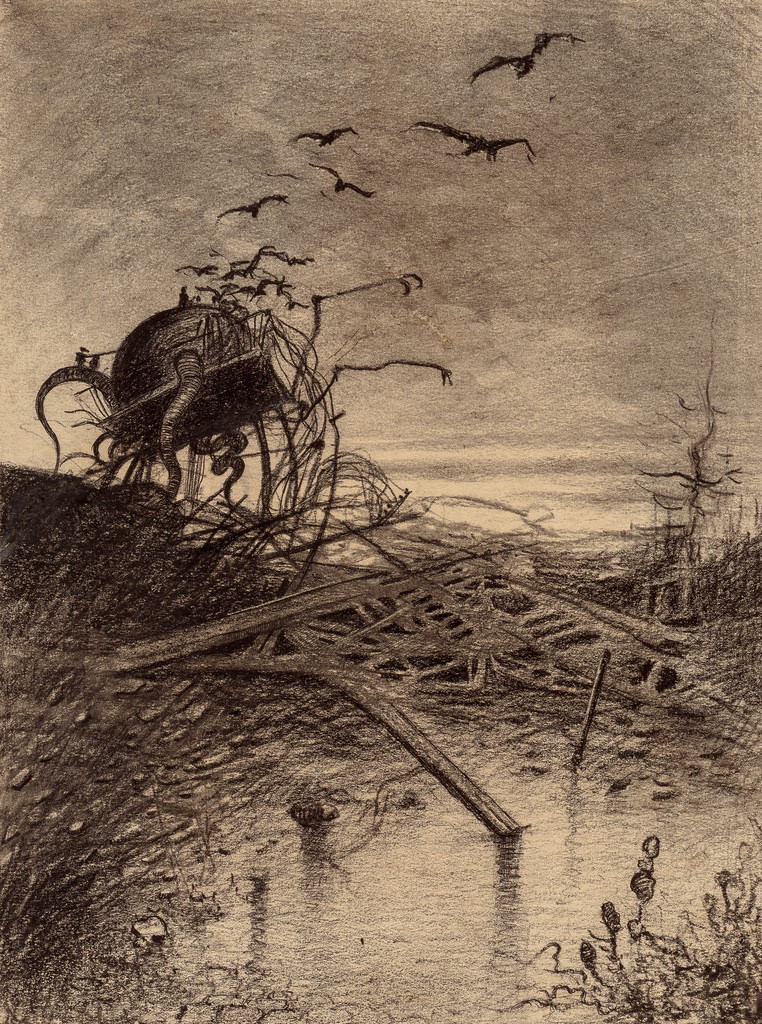
Unfortunately, Corrêa’s tuberculosis killed him four years later. His War of the Worlds drawings did not bring him fame in his lifetime or after, but his work has been cherished since by a devoted cult following. The original prints you see here remained with the artist’s family until a sale of 31 of them in 1990. You can see many more, as well as scans from the book and a poster announcing the publication, at The Public Domain Review and the Monster Brains site.
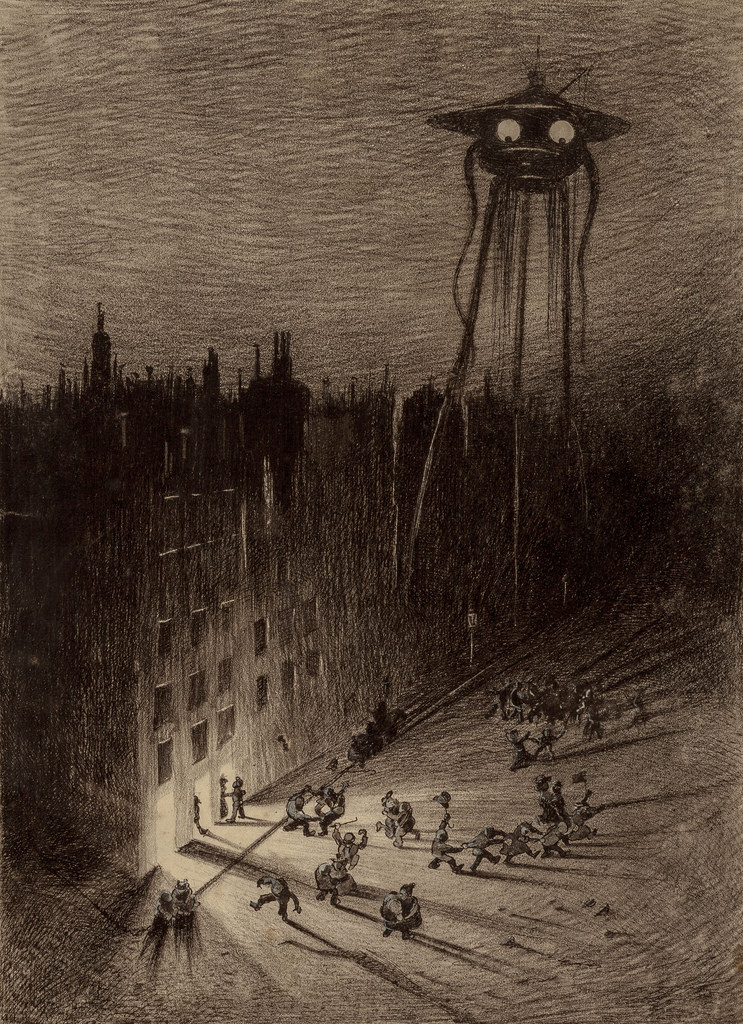
Note: An earlier version of this post appeared on our site in 2015.
Related Content:
The Very First Illustrations of H.G. Wells’ The War of the Worlds (1897)
Edward Gorey Illustrates H.G. Wells’ The War of the Worlds in His Inimitable Gothic Style (1960)
Josh Jones is a writer and musician based in Durham, NC. Follow him at @jdmagness
Read More...Hear an AI Chatbot, Masquerading as a Clueless Grandmother, Waste the Time of an Internet Scam Artist
And now for a good use of AI. The UK-based telecom company O2 has developed a chatbot (“named Daisy”) that performs a noble task. Impersonating an elderly grandmother, the chatbot engages with internet fraudsters and then systematically frustrates them and wastes their time. As part of a demo, notes The Guardian, Daisy wasted a series of fraudsters’ time for up to 40 minutes each–“when they could otherwise have been scamming real people.” The AI system was trained on real scam calls–according to Virgin Media O2’s marketing director, Simon Valcarcel–so it “knows exactly the tactics to look out for, exactly the type of information to give to keep the scammers online and waste time.” If you have three minutes to spare, you can listen to Daisy clown a scam artist above.
Related Content
Read More...See Vivaldi’s Four Seasons Visualized in Colorfully Animated Scores
Music is often described as the most abstract of all the arts, and arguably the least visual as well. But these qualities, which seem so basic to the nature of the form, have been challenged for at least three centuries, not least by composers themselves. Take Antonio Vivaldi, whose Le quattro stagioni, or The Four Seasons, of 1718–1720 evoke not just broad impressions of the eponymous parts of the year, but a variety of natural and human elements characteristic to them. In the course of less than an hour, its listeners — whether of the early eighteenth century or the early twenty-first — “see” spring, summer, autumn, and winter unfold vividly before their mind’s eye.
Now, composer Stephen Malinowski has visualized The Four Seasons in an entirely different way. As previously featured here on Open Culture, he uses his Music Animation Machine to create what we might call graphical scores, which abstractly represent the instrumental parts that make up widely loved classical compositions in time with the music itself.
On this page, you can watch four videos, with each one visualizing one of the piece’s concerti. Fans of the Music Animation Machine will notice that its formerly simple visuals have taken a big step forward, though what can look at first like a psychedelic light show also has a clear and legible order.
?si=xEQ3Twamh82m3Yhr
For “Spring” and “Autumn,” Malinowski animates performances by violinist Shunske Sato and musicians of the Netherlands Bach Society; for “Summer” and “Winter,” performances by Cynthia Miller Freivogel and early-music ensemble Voices of Music (previously featured here for their renditions of Bach’s Brandenburg Concertos and “Air on the G String,” Pachelbel’s Canon, and indeed The Four Seasons). Generally understandable at a glance — and in many ways, more illuminating than actually seeing the musicians play their instruments — these scores also use a system called “harmonic coloring,” which Malinkowski explains here. This may add up to a complete audiovisual experience, but if you’d also like a literary element, why not pull up The Four Seasons’ accompanying sonnets while you’re at it?
Related content:
Why We Love Vivaldi’s Four Seasons: An Animated Music Lesson
Watch All of Vivaldi’s Four Seasons Performed on Original Baroque Instruments
Vivaldi’s Four Seasons Brought to Life in Sand Animations by the Hungarian Artist Ferenc Cakó
Yes’ Rick Wakeman Explores Vivaldi’s Four Seasons, and Why It Was the First Concept Album
Based in Seoul, Colin Marshall writes and broadcasts on cities, language, and culture. His projects include the Substack newsletter Books on Cities and the book The Stateless City: a Walk through 21st-Century Los Angeles. Follow him on the social network formerly known as Twitter at @colinmarshall.
Read More...How Japanese Masters Turn Sand Into Swords: The Art of Traditional Sword Making from Start to Finish
We made sand think: this phrase is used from time to time to evoke the particular technological wonders of our age, especially since artificial intelligence seems to be back on the slate of possibilities. While there would be no Silicon Valley without silica sand, semiconductors are hardly the first marvel humanity has forged out of that kind of material. Consider the three millennia of history behind the traditional Japanese sword, long known even outside the Japanese language as the katana (literally “one-sided blade”) — or, more to the point of the Veritasium video above, the 1,200 years in which such weapons have been made out of steel. How Japanese Masters Turn Sand Into Swords
In explaining the science of the katana, Veritasium host Derek Muller begins more than two and a half billion years ago, when Earth’s oceans were “rich with dissolved iron.” But then, cyanobacteria started photosynthesizing that iron and creating oxygen as a by-product. This process dropped layers of iron onto the sea floor, which eventually hardened into layers of sedimentary rock.
With few such formations of its own, the geologically volcanic Japan actually came late to steel, importing it long before it could manage domestic production using the iron oxide that accumulated in its rivers, recovered as “iron sand.”
By that time, iron swords would no longer cut it, as it were, but the addition of charcoal in the heating process could produce the “incredibly strong alloy” of steel. Certain Japanese swordsmiths have continued to use steel made with the more or less traditional smelting process you can see performed in rural Shimane prefecture in the video. To the disappointment of its producer, Petr Lebedev, who participates in the whole process, the foot-operated bellows of yore have been electrified, but he hardly seems disappointed by his chance to take up a katana himself. He may have yet to attain the skill of a master swordsman, but understanding every scientific detail of the weapon he wields must make slicing bamboo clean in half that much more satisfying.
Related content:
A Hypnotic Look at How Japanese Samurai Swords Are Made
A Vintage Short Film about the Samurai Sword, Narrated by George Takei (1969)
A Demonstration of Perfect Samurai Swordsmanship
An Origami Samurai Made from a Single Sheet of Rice Paper, Without Any Cutting
Watch the Oldest Japanese Anime Film, Jun’ichi Kōuchi’s The Dull Sword (1917)
How Japanese Things Are Made in 309 Videos: Bamboo Tea Whisks, Hina Dolls, Steel Balls & More
Based in Seoul, Colin Marshall writes and broadcasts on cities, language, and culture. His projects include the Substack newsletter Books on Cities and the book The Stateless City: a Walk through 21st-Century Los Angeles. Follow him on the social network formerly known as Twitter at @colinmarshall.
Read More...When Charlie Chaplin Entered a Chaplin Look-Alike Contest & Came in 20th Place
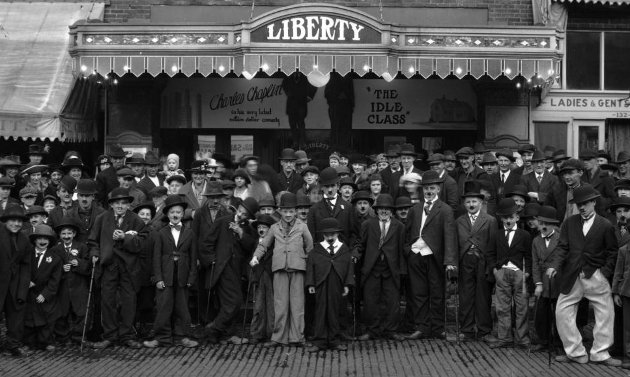
Charlie Chaplin started appearing in his first films in 1914—40 films, to be precise—and, by 1915, the United States had a major case of “Chaplinitis.” Chaplin mustaches were suddenly popping up everywhere–as were Chaplin imitators and Chaplin look-alike contests. A young Bob Hope apparently won one such contest in Cleveland. Chaplin Fever continued burning hot through 1921, the year when the Chaplin look-alike contest, shown above, was held outside the Liberty Theatre in Bellingham, Washington.
According to legend, somewhere between 1915 and 1921, Chaplin decided to enter a Chaplin look-alike contest, and lost, badly.
A short article called “How Charlie Chaplin Failed,” appearing in The Straits Times of Singapore in August of 1920, read like this:
Lord Desborough, presiding at a dinner of the Anglo-Saxon club told a story which will have an enduring life. It comes from Miss Mary Pickford who told it to Lady Desborough, “Charlie Chaplin was one day at a fair in the United States, where a principal attraction was a competition as to who could best imitate the Charlie Chaplin walk. The real Charlie Chaplin thought there might be a chance for him so he entered for the performance, minus his celebrated moustache and his boots. He was a frightful failure and came in twentieth.
A variation on the same story appeared in a New Zealand newspaper, the Poverty Bay Herald, again in 1920. As did another story in the Australian newspaper, the Albany Advertiser, in March, 1921.
A competition in Charlie Chaplin impersonations was held in California recently. There was something like 40 competitors, and Charlie Chaplin, as a joke, entered the contest under an assumed name. He impersonated his well known film self. But he did not win; he was 27th in the competition.
Did Chaplin come in 20th place? 27th place? Did he enter a contest at all? It’s fun to imagine that he did. But, a century later, many consider the story the stuff of urban legend. When one researcher asked the Association Chaplin to weigh in, they apparently had this to say: “This anecdote told by Lord Desborough, whoever he may have been, was quite widely reported in the British press at the time. There are no other references to such a competition in any other press clipping albums that I have seen so I can only assume that this is the source of that rumour, urban myth, whatever it is. However, it may be true.”
I’d like to believe it is.
Note: An earlier version of this post appeared on our site in early 2016.
Related Content:
6o+ Free Charlie Chaplin Films Online
Charlie Chaplin Films a Scene Inside a Lion’s Cage in 200 Takes
Read More...
How Wearing Ridiculously Long Pointed Shoes Became a Medieval Fashion Trend
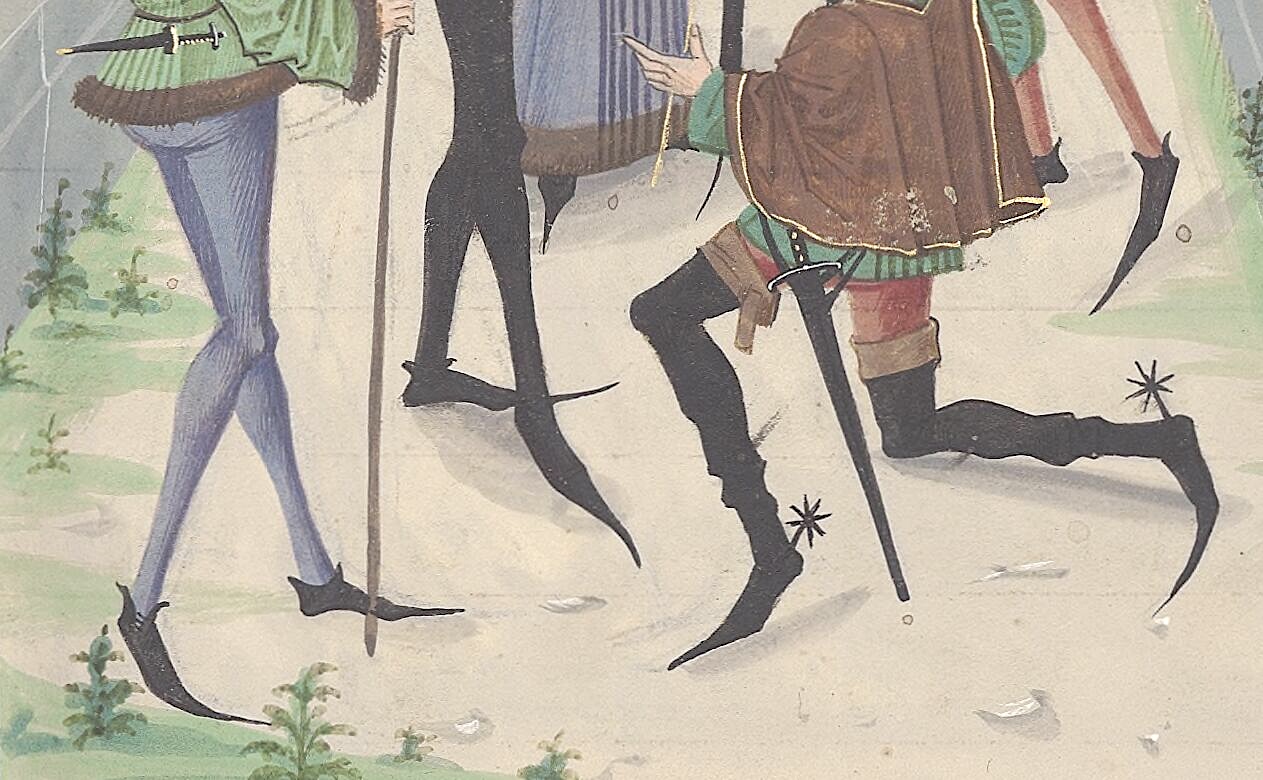
We can all remember seeing images of medieval Europeans wearing pointy shoes, but most of us have paid scant attention to the shoes themselves. That may be for the best, since the more we dwell on one fact of life in the Middle Ages or another, the more we imagine how uncomfortable or even painful it must have been by our standards. Dentistry would be the most vivid example, but even that fashionable, vaguely elfin footwear inflicted suffering, especially at the height of its popularity — not least among flashy young men — in the fourteenth and fifteenth centuries.
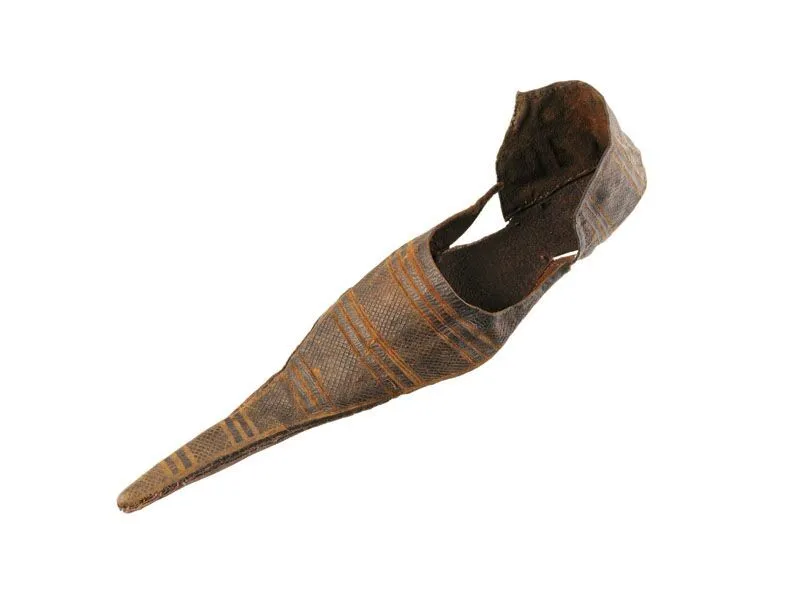
Called poulaines, a name drawn from the French word for Poland in reference to the footwear’s supposedly Polish origin, these pointy shoes appeared around the time of Richard II’s marriage to Anne of Bohemia in 1382. “Both men and women wore them, although the aristocratic men’s shoes tended to have the longest toes, sometimes as long as five inches,” writes Ars Technica’s Jennifer Ouellette. “The toes were typically stuffed with moss, wool, or horsehair to help them hold their shape.” If you’ve ever watched the first Blackadder series, know that the shoes worn by Rowan Atkinson’s hapless plotting prince may be comic, but they’re not an exaggeration.
Regardless, he was a bit behind the times, given that the show was set in 1485, right when poulaines went out of fashion. But they’d already done their damage, as evidenced by a 2021 study linking their wearing to nasty foot disorders. “Bunions — or hallux valgus — are bulges that appear on the side of the foot as the big toe leans in towards the other toes and the first metatarsal bone points outwards,” writes the Guardian’s Nicola Davis. A team of University of Cambridge researchers found signs of them being more prevalent in the remains of individuals buried in the fourteenth and fifteenth centuries than those buried from the eleventh through the thirteenth centuries.
Yet bunions were hardly the evil against which the poulaine’s contemporary critics inveighed. After the Great Pestilence of 1348, says the London Museum, “clerics claimed the plague was sent by God to punish Londoners for their sins, especially sexual sins.” The shoes’ lascivious associations continued to draw ire: “In 1362, Pope Urban V passed an edict banning them, but it didn’t really stop anybody from wearing them.” Then came sumptuary laws, according to which “commoners were charged to wear shorter poulaines than barons and knights.” The power of the state may be as nothing against that of the fashion cycle, but had there been a law against the bluntly square-toed shoes in vogue when I was in high school, I can’t say I would’ve objected.
Related content:
Elegant 2,000-Year-Old Roman Shoe Found in a Well
Exquisite 2300-Year-Old Scythian Woman’s Boot Preserved in the Frozen Ground of Siberia
Doc Martens Boots Adorned with Hieronymus Bosch’s “Garden of Earthly Delights”
How to Get Dressed & Fight in 14th Century Armor: A Reenactment
Based in Seoul, Colin Marshall writes and broadcasts on cities, language, and culture. His projects include the Substack newsletter Books on Cities and the book The Stateless City: a Walk through 21st-Century Los Angeles. Follow him on the social network formerly known as Twitter at @colinmarshall.
Read More...Support Us
We're hoping to rely on loyal readers, rather than erratic ads. Please click the Donate button and support Open Culture. You can use Paypal, Venmo, Patreon, even Crypto! We thank you!

About Us

Open Culture scours the web for the best educational media. We find the free courses and audio books you need, the language lessons & educational videos you want, and plenty of enlightenment in between.
Advertise With Us
FREE UPDATES!
GET OUR DAILY EMAIL
Get the best cultural and educational resources on the web curated for you in a daily email. We never spam. Unsubscribe at any time.
FOLLOW ON SOCIAL MEDIA
Open Culture editor Dan Colman scours the web for the best educational media. He finds the free courses and audio books you need, the language lessons & movies you want, and plenty of enlightenment in between.
Advertise With Us

