Leonard Cohen’s “Hallelujah” Performed by a Choir of 4,000 Singers
Throughout the years, we’ve featured performances of Choir!Choir!Choir!–a large amateur choir from Toronto that meets weekly and sings their hearts out. You’ve seen them sing Prince’s “When Doves Cry,” Soundgarden’s “Black Hole Sun” (to honor Chris Cornell), and Patti Smith’s “People Have the Power.” In their latest video, they revisit an old favorite: Leonard Cohen’s “Hallelujah,” a song released on the 1984 album Various Positions. Originally overlooked, Cohen’s “Hallelujah” has since become deeply woven into our cultural fabric. Over the past 40 years, some 300 musicians have covered “Hallelujah,” with Jeff Buckley offering perhaps the most celebrated version. Above, you can watch 4,000 singers come together and pay their own tribute to the song. This performance took place last year at the National Arts Centre in Ottawa, Canada. Enjoy!
Related Content
Leonard Cohen’s “Hallelujah” Played on Korean Instrument Dating Back to 6th Century
Watch David Byrne Lead a Massive Choir in Singing David Bowie’s “Heroes”
Street Artist Plays Leonard Cohen’s “Hallelujah” With Crystal Glasses
Patti Smith Sings “People Have the Power” with a Choir of 250 Fellow Singers
A Choir with 1,000 Singers Pays Tribute to Sinéad O’Connor & Performs “Nothing Compares 2 U”
Read More...The Scene That Reveals the Beauty of Classic Hollywood Cinema
1939 is widely considered the greatest year in Hollywood history. Back then, writes 1939: The Year in Movies author Tom Flannery, the so-called “Big Eight” major American studios “had a combined 590 actors, 114 directors and 340 writers under contract, each of whom worked an eight-hour shift every weekday,” plus half a day on Saturday. “It took an average of 22 days to shoot a movie, at an average cost of $300,000.” Annual grosses exceeding $700 million “made it easier to take a chance on ‘risky’ or commercially untested material.” From this industrial environment came forth one new feature for every single day of the year, including Gone With the Wind, The Wizard of Oz, Mr. Smith Goes to Washington, Stagecoach, and Young Mr. Lincoln.
There’s one problem with this framing: The Philadelphia Story didn’t come out until 1940. In his new video above, Evan Puschak, better known as the Nerdwriter, uses that celebrated picture — and in fact, just one of its scenes in particular — to reveal the commercial-artistic genius of old Hollywood.
This was not, we must note, an individual genius: “We’re used to thinking about movies as the vision of one person, an auteur director, but the studio system of Hollywood’s golden age didn’t really work like that.” Despite the talent of George Cukor, who went on to direct A Star Is Born and My Fair Lady, “there’s really no auteur here, but rather a collection of top-tier artists and craftsmen coming together to realize a great story and elevate great performances,” all of who make important contributions to the scene examined here.
The collaborators identified by Puschak include cinematographer Joseph Ruttenberg, art director Cedric Gibbons (designer of the Oscar statuette), and costume designer Adrian Greenberg (known mononymously as Adrian). Nor can he ignore the work of the film’s three principal performers, a certain Cary Grant, James Stewart, and Katharine Hepburn. It may have been Stewart who won the Academy Award for Best Actor for The Philadelphia Story, but it was Hepburn who ultimately gained the most: having been saddled with a reputation as “box-office poison” in the thirties due to her famously cold screen presence, she seized the chance to portray a character who suffers for similar qualities of personality and is ultimately redeemed. She got her comeback — and we have a shimmering, witty monument to the most golden of Hollywood’s ages.
Related content:
4,000+ Free Movies Online: Great Classics, Indies, Noir, Westerns, Documentaries & More
When a Modern Director Makes a Fake Old Movie: A Video Essay on David Fincher’s Mank
Raymond Chandler: There’s No Art of the Screenplay in Hollywood
Based in Seoul, Colin Marshall writes and broadcasts on cities, language, and culture. His projects include the Substack newsletter Books on Cities and the book The Stateless City: a Walk through 21st-Century Los Angeles. Follow him on the social network formerly known as Twitter at @colinmarshall.
Read More...The Complete History of the Music Video: From the 1890s to Today
If you want to understand the history of music videos, you must consider a lot of things that are not obviously music videos. The Buggles’ “Video Killed the Radio Star,” the first selection of MTV’s inaugural broadcast, must surely count as a music video — but then, it was produced a couple years earlier for the much different context of the British chart program Top of the Pops, much like Queen’s proto music video for “Bohemian Rhapsody” from 1975. But is Bob Dylan’s much-parodied card-dropping “performance” of “Subterranean Homesick Blues” from a decade earlier, shot for D. A. Pennebaker’s Dont Look Back, a music video? What about A Hard Day’s Night, the Beatles’ exuberantly narrative-light film from the year before?
All of these come up in the new history of the music video from YouTube channel Polyphonic above, which compiles into an over three-hour-long viewing experience all the episodes of its series on the subject. In its long historical view, the music video didn’t begin with the Fab Four, and not even with their epoch-making appearance on The Ed Sullivan Show.
One can trace it farther back, past Scopitone film jukeboxes (included in “the canon of Camp” by Susan Sontag in her famous essay); past Disney’s Fantasia (essentially eight animated classical music videos strung together); past even The Jazz Singer, the first feature-length musical “talkie,” which in 1927 put a definitive end to the era of silent film.
Perhaps the earliest identifiable predecessor of the music video is “The Little Lost Child,” which in 1894 was exhibited as an “illustrated song.” Its delivery of a narrative through projected still images accompanied by live piano was like nothing its audiences had experienced before, with an emotional power greater than the sum of its visual and musical parts. This was a brand new technology, and indeed, like any cultural history, that of the music video is also a technological history, one advanced by film, broadcast television, cable television, and in our time, internet streaming, which stayed the form’s looming prospect of pop-cultural irrelevance. Now, in the twenty-twenties, we must ask ourselves this: when TikTok users post themselves dancing, zooming in on pancakes, or skateboarding while drinking Ocean Spray, is it a music video?
Related content:
The 50 Greatest Music Videos of All Time, Ranked by AV Club
Michel Gondry’s Finest Music Videos for Björk, Radiohead & More: The Last of the Music Video Gods
Watch the First Two Hours of MTV’s Inaugural Broadcast (August 1, 1981)
David Bowie Releases 36 Music Videos of His Classic Songs from the 1970s and 1980s
Jim Jarmusch’s Anti-MTV Music Videos for Talking Heads, Neil Young, Tom Waits & Big Audio Dynamite
David Lynch’s Music Videos: Nine Inch Nails, Moby, Chris Isaak & More
Based in Seoul, Colin Marshall writes and broadcasts on cities, language, and culture. His projects include the Substack newsletter Books on Cities and the book The Stateless City: a Walk through 21st-Century Los Angeles. Follow him on the social network formerly known as Twitter at @colinmarshall.
Read More...Hunter S. Thompson Remembers Jimmy Carter’s Captivating Bob Dylan Speech (1974)
51 years ago, Hunter S. Thompson wrote Fear and Loathing on the Campaign Trail ’72, which “is still considered a kind of bible of political reporting,” noted Matt Taibbi in a 40th anniversary edition of the book. Fear and Loathing ’72 entered the canon of American political writing for many reasons. But if you’re looking for one bottom-line explanation, it probably comes down to this: Says Taibbi, “Thompson stared right into the flaming-hot sun of shameless lies and cynical horseshit that is our politics, and he described exactly what he saw—probably at serious cost to his own mental health, but the benefit to us was [his legendary book].”
Thompson may have reached some journalistic apogee with his coverage of the ’72 Nixon-McGovern campaign. But his political writing hardly stopped there. The Gonzo journalist covered the ’76 election for Rolling Stone magazine. And inevitably he crossed paths with Jimmy Carter (RIP), the eventual winner of the election. Above, Thompson recalls the day when Carter first made an impression upon him.
It happened at the University of Georgia School of Law on May 4, 1974. Speaking before a gathering of alumni lawyers, Carter upset their celebratory occasion when he dismantled the criminal justice system they were so proud of. And Carter particularly caught Thompson’s attention when he traced his sense of social justice back to a song written by Bob Dylan:
The other source of my understanding about what’s right and wrong in this society is from a friend of mine, a poet named Bob Dylan. After listening to his records about “The Ballad of Hattie Carol” and “Like a Rolling Stone” and “The Times, They Are a‑Changing,” I’ve learned to appreciate the dynamism of change in a modern society.
I grew up as a landowner’s son. But I don’t think I ever realized the proper interrelationship between the landowner and those who worked on a farm until I heard Dylan’s record, “I Ain’t Gonna Work on Maggie’s Farm No More.” So I come here speaking to you today about your subject with a base for my information founded on Reinhold Niebuhr and Bob Dylan.
You can read the full text of Carter’s speech here. It’s also worth watching a related clip below, where Thompson elaborates on Carter, his famous speech and his alleged mean streak that put him on the same plane as Muhammad Ali and Sonny Barger (the godfather of The Hells Angels).
Note: An earlier version of this post first appeared on our site in 2012. With the passing of President Carter, it seemed like a good time to bring it back.
Related Content
The 2,000+ Films Watched by Presidents Nixon, Carter & Reagan in the White House
Hunter Thompson Explains What Gonzo Journalism Is, and How He Writes It (1975)
Read More...
Benedict Cumberbatch Reads Kurt Vonnegut’s Letter of Advice to People Living in the Year 2088
There was a time when a company like Volkswagen could commission various luminaries to write letters to the future, then publish them in Time magazine as part of an ad campaign. In fact, that time wasn’t so very long ago: it was the year 1988, to be precise, when no less an optimistic (or optimistically bleak?) novelist than Kurt Vonnegut was still active. At some point between writing Bluebeard and Hocus Pocus, he composed a missive directed toward humanity a century hence (in 2088), which you can read even in this relatively early year of 2024 here.
Vonnegut begins with quotations from Shakespeare and St. John the Divine, explaining that “our century hasn’t been as free with words of wisdom as some others, I think, because we were the first to get reliable information about the human situation.” In his time, we knew full well “how many of us there were, how much food we could raise or gather, how fast we were reproducing, what made us sick, what made us die, how much damage we were doing to the air and water and topsoil on which most life forms depended, how violent and heartless nature can be, and on and on. Who could wax wise with so much bad news pouring in?”
Of special import to him was the revelation that “Nature was no conservationist. It needed no help from us in taking the planet apart and putting it back together some different way, not necessarily improving it from the viewpoint of living things.” Earth may have given rise to humanity, but it has not the capacity to care whether we or any other particular life form survives on it. And so we must take it upon ourselves to ensure our own well-being, which requires living in accordance with what Vonnegut calls “Nature’s stern but reasonable surrender terms”:
- Reduce and stabilize your population.
- Stop poisoning the air, the water, and the topsoil.
- Stop preparing for war and start dealing with your real problems.
- Teach your kids, and yourselves, too, while you’re at it, how to inhabit a small planet without helping to kill it.
- Stop thinking science can fix anything if you give it a trillion dollars.
- Stop thinking your grandchildren will be OK no matter how wasteful or destructive you may be, since they can go to a nice new planet on a spaceship. That is really mean, and stupid.
- And so on. Or else.
You can easily imagine these words uttered by Vonnegut himself, but how about by Benedict Cumberbatch? There’s no need to imagine: you can simply watch the new video above, taken from a recent Letters Live event. Cumberbatch is one of the series’ star readers, having previously interpreted letters by Nick Cave, Albert Camus, Alan Turing, and others onstage. This advice to the “ladies and gentlemen of AD 2088” has proven to be one of his hits; you can hear another, earlier reading here. Perhaps Vonnegut’s words bear repeating, but then, he always showed a sharp awareness that humanity has few qualities as persistent as the inability to listen.
Related content:
In 1988, Kurt Vonnegut Writes a Letter to People Living in 2088, Giving 7 Pieces of Advice
Benedict Cumberbatch & Ian McKellen Read Epic Letters Written by Kurt Vonnegut
22-Year-Old P.O.W. Kurt Vonnegut Writes Home from World War II: “I’ll Be Damned If It Was Worth It”
Based in Seoul, Colin Marshall writes and broadcasts on cities, language, and culture. His projects include the Substack newsletter Books on Cities and the book The Stateless City: a Walk through 21st-Century Los Angeles. Follow him on the social network formerly known as Twitter at @colinmarshall.
Read More...How Leonardo da Vinci Painted The Last Supper: A Deep Dive Into a Masterpiece
When Leonardo da Vinci was 42 years old, he hadn’t yet completed any major publicly viewable work. Not that he’d been idle: in that same era, while working for the Duke of Milan, Ludovico Sforza, he “developed, organized, and directed productions for festival pageants, triumphal processions, masks, jousting tournaments, and plays, for which he choreographed performances, engineered and decorated stage sets and props, and even designed costumes.” So explains gallerist and YouTuber James Payne in the new Great Art Explained video above, by way of establishing the context in which Leonardo would go on to paint The Last Supper.
For the definitive Renaissance man, “theatre was a natural arena to blend art, mechanics and design.” He understood “not only how perspective worked on a three-dimensional stage, but how it worked from different vantage points,” and this knowledge led to “what would be the greatest theatrical staging of his life”: his painting of Jesus Christ telling the Twelve Apostles that one of them will betray him.
This view of The Last Supper makes more sense if you see it not as a decontextualized image — the way most of us do — but as the mural Leonardo actually painted on one wall of Milan’s Convent of Santa Maria delle Grazie, whose space it extends (and where it makes more sense for everyone to be seated on one side of the table).
Payne goes in-depth on not just the visual techniques Leonardo used to make The Last Supper’s composition so powerful, but also the untested painting techniques that ended up hastening its deterioration. If you do go to Santa Maria delle Grazie, bear in mind that at best a quarter of the mural’s paint was applied by Leonardo himself. The rest is the result of a long restoration process, made possible by the existence of several copies made after the work’s completion. And indeed, it’s only thanks to one of those copies, whose maker included labels, that we know which Apostle is which. Unlike many of the creators of religious art before him, Leonardo didn’t make anything too obvious; rather, he expressed his formidable skill through the kind of subtlety accessible only to those who take their time.
Related Content:
What Makes Leonardo’s Mona Lisa a Great Painting?: An Explanation in 15 Minutes
How Did the Mona Lisa Become the World’s Most Famous Painting?: It’s Not What You Think
Why Leonardo da Vinci’s Greatest Painting is Not the Mona Lisa
Based in Seoul, Colin Marshall writes and broadcasts on cities, language, and culture. His projects include the Substack newsletter Books on Cities and the book The Stateless City: a Walk through 21st-Century Los Angeles. Follow him on the social network formerly known as Twitter at @colinmarshall.
Read More...Hear Orson Welles’ War of the Worlds Radio Broadcast from 1938: The Original Tale of Mysterious Objects Flying Over New Jersey
A month ago, drones were spotted near Morris County, New Jersey. Since then, reports of further sightings in various locations in the region have been lodged on a daily basis, and anxieties about the origin and purpose of these unidentified flying objects have grown apace. “We have no evidence at this time that the reported drone sightings pose a national security or public safety threat or have a foreign nexus,” declared the FBI and the Department of Homeland Security in a joint statement. But the very lack of further information on the matter has stoked the public imagination; one New Jersey congressman spoke of the drones having come from an Iranian “mothership” off the coast.
If this real-life news story sounds familiar, consider the fact that Morris County lies only about an hour up the road from Grovers Mill, the famous site of the fictional Martian invasion dramatized in Orson Welles’ 1938 radio adaptation of H. G. Wells’ The War of the Worlds. Presented like a genuine emergency broadcast, it “fooled many who tuned in late and believed the events were really happening,” writes Space.com’s Elizabeth Fernandez.
The unsettled nature of American life in the late nineteen-thirties surely played a part, given that, “wedged between two World Wars, the nation was in the midst of the Great Depression and mass unemployment.” Some listeners assumed that the Martians were in fact Nazis, or that “the crash landing was tied to some other environmental catastrophe.”
In the 86 years since The War of the Worlds aired, the story of the nationwide panic it caused has come in for revision: not that many people were listening in the first place, many fewer took it as reality, and even then, drastic responses were uncommon. But as Welles himself recounts in the video above, he heard for decades thereafter from listeners recounting their own panic at the suddenly believable prospect of Mars attacking Earth.“In fact, we weren’t as innocent as we meant to be when we did the Martian broadcast,” he admits. “We were fed up with the way in which everything that came over this new, magic box — the radio — was being swallowed,” and thus inclined to make “an assault on the credibility of that machine.” What a relief that we here in the 21st century are, of course, far too sophisticated to accept everything new technology conveys to us.
Related content:
Edward Gorey Illustrates H. G. Wells’ The War of the Worlds in His Inimitable Gothic Style (1960)
Hear Orson Welles’ Radio Performances of 10 Shakespeare Plays (1936–1944)
Horrifying 1906 Illustrations of H. G. Wells’ War of the Worlds
Carl Jung’s Fascinating 1957 Letter on UFOs
Based in Seoul, Colin Marshall writes and broadcasts on cities, language, and culture. His projects include the Substack newsletter Books on Cities and the book The Stateless City: a Walk through 21st-Century Los Angeles. Follow him on the social network formerly known as Twitter at @colinmarshall.
Read More...Binge-Watch Classic Television Programs Free: The Dick Van Dyke Show, The Lone Ranger, Dragnet, That Girl & More
Earlier this week, we featured the 99-year-old Dick Van Dyke’s performance in Coldplay’s new music video, full of visual references to the sitcom that made him a household name in the early nineteen-sixties. And a household name he remains these six decades later, though one does wonder how many of those who appreciate his extreme longevity — both cultural and biological — have ever seen an episode of The Dick Van Dyke Show. I myself only caught the occasional late-night rerun in childhood, but however much he indulged his characteristic goofiness, the thirty-something Van Dyke in the role of comedy writer Rob Petrie always struck me as the very image of mature adulthood.
Whether or not you saw it in the first place, you can now watch The Dick Van Dyke Show’s five seasons free on Youtube, starting with the first here. They’ve come available at a channel called FilmRise Television, on whose collection of playlists you’ll also find such pillars of mid-century American television as Dragnet, The Lone Ranger, Bonanza, and That Girl.
Hard though it may be to understand for anyone who came of age under the firehose of on-demand content these regularly scheduled entertainments became veritable cultural institutions when they originally aired on major networks in the fifties and sixties, with an influence that extended far beyond their already considerable viewership.
The millennial generation grew up regarding shows of this kind as hokey but sufficiently amusing diversions when nothing more irreverent or postmodern happened to be on. At worst, they felt like inferior predecessors of the then-current sitcoms and dramas we were watching in prime time. But then began the long “golden age” of prestige television, with its new levels of aesthetic and narrative complexity, which changed our very conception of television.
Today, watching The Dick Van Dyke Show or any of the other hits with which it shared the scarce airwaves feels almost exotic, like traveling to the past: a foreign country, as L. P. Hartley famously put it, where they do things differently — and a few of whose citizens are, fortunately, still around to entertain us.
Related content:
Dick Van Dyke Still Dancing at 96!
Based in Seoul, Colin Marshall writes and broadcasts on cities, language, and culture. His projects include the Substack newsletter Books on Cities and the book The Stateless City: a Walk through 21st-Century Los Angeles. Follow him on the social network formerly known as Twitter at @colinmarshall.
Read More...Watch the Surrealist Glass Harmonica, the Only Animated Film Ever Banned by Soviet Censors (1968)
The Soviet Union’s repressive state censorship went to absurd lengths to control what its citizens read, viewed, and listened to, such as the almost comical removal of purged former comrades from photographs during Stalin’s reign. When it came to aesthetics, Stalinism mostly purged more avant-garde tendencies from the arts and literature in favor of didactic Socialist Realism. Even during the relatively loose period of the Khrushchev/Brezhnev Thaw in the 60s, several artists were subject to “severe censorship” by the Party, writes Keti Chukhrov at Red Thread, for their “’abuse’ of modernist, abstract and formalist methods.”
But one oft-experimental art form thrived throughout the existence of the Soviet Union and its varying degrees of state control: animation. “Despite censorship and pressure from the Communist government to adhere to certain Socialist ideals,” writes Polly Dela Rosa in a short history, “Russian animation is incredibly diverse and eloquent.”
Many animated Soviet films were expressly made for propaganda purposes—such as the very first Soviet animation, Dziga Vertov’s Soviet Toys, below, from 1924. But even these display a range of technical virtuosity combined with daring stylistic experiments, as you can see in this io9 compilation. Animated films also served “as a powerful tool for entertainment,” notes film scholar Birgit Beumers, with animators, “largely trained as designers and illustrators… drawn upon to compete with the Disney output.”
Throughout the 20th century, a wide range of films made it past the censors and reached large audiences on cinema and television screens, including many based on Western literature. All of them did so, in fact, but one, the only animated film in Soviet history to face a ban: Andrei Khrzhanovsky’s The Glass Harmonica, at the top, a 1968 “satire on bureaucracy.” At the time of its release, the Thaw had encouraged “a creative renaissance” in Russian animation, writes Dangerous Minds, and the film’s surrealist aesthetic—drawn from the paintings of De Chirico, Magritte, Grosz, Bruegel, and Bosch (and reaching “proto-Python-esque heights towards the end”)—testifies to that.
At first glance, one would think The Glass Harmonica would fit right into the long tradition of Soviet propaganda films begun by Vertov. As the opening titles state, it aims to show the “boundless greed, police terror, [and] the isolation and brutalization of humans in modern bourgeois society.” And yet, the film offended censors due to what the European Film Philharmonic Institute calls “its controversial portrayal of the relationship between governmental authority and the artist.” There’s more than a little irony in the fact that the only fully censored Soviet animation is a film itself about censorship.
The central character is a musician who incurs the displeasure of an expressionless man in black, ruler of the cold, gray world of the film. In addition to its “collage of various styles and a tribute to European painting”—which itself may have irked censors—the score by Alfred Schnittke “pushes sound to disturbing limits, demanding extreme range and technique from the instruments.” (Fans of surrealist animation may be reminded of 1973’s French sci-fi film, Fantastic Planet.) Although Khrzhanovsky’s film represents the effective beginning and end of surrealist animation in the Soviet Union, only released after perestroika, it stands, as you’ll see above, as a brilliantly realized example of the form.
The Glass Harmonica will be added to our list of Animations, a subset of our collection, 4,000+ Free Movies Online: Great Classics, Indies, Noir, Westerns, Documentaries & More.
Related Content:
Soviet Animations of Ray Bradbury Stories: ‘Here There Be Tygers’ & ‘There Will Come Soft Rain’
Watch Dziga Vertov’s Unsettling Soviet Toys: The First Soviet Animated Movie Ever (1924)
Josh Jones is a writer and musician based in Durham, NC. Follow him at @jdmagness
Read More...What Ancient Greek Music Sounded Like: Listen to a Reconstruction That’s “100% Accurate”
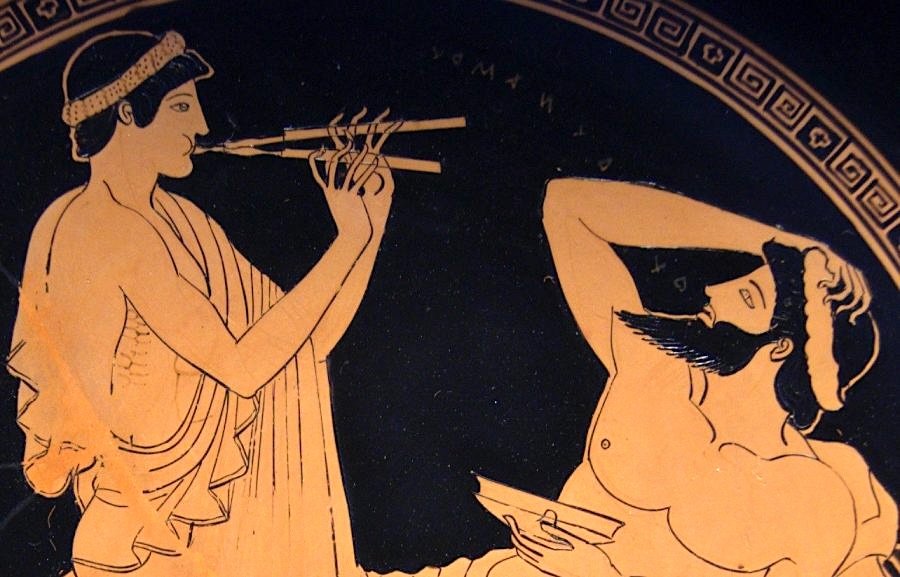
Between 750 BC and 400 BC, the Ancient Greeks composed songs meant to be accompanied by the lyre, reed-pipes, and various percussion instruments. More than 2,000 years later, modern scholars have finally figured out how to reconstruct and perform these songs with (it’s claimed) 100% accuracy.
Writing on the BBC website, Armand D’Angour, a musician and tutor in classics at Oxford University, notes:
[Ancient Greek] instruments are known from descriptions, paintings and archaeological remains, which allow us to establish the timbres and range of pitches they produced.
And now, new revelations about ancient Greek music have emerged from a few dozen ancient documents inscribed with a vocal notation devised around 450 BC, consisting of alphabetic letters and signs placed above the vowels of the Greek words.
The Greeks had worked out the mathematical ratios of musical intervals — an octave is 2:1, a fifth 3:2, a fourth 4:3, and so on.
The notation gives an accurate indication of relative pitch.
So what did Greek music sound like? Below you can listen to David Creese, a classicist from the University of Newcastle, playing “an ancient Greek song taken from stone inscriptions constructed on an eight-string ‘canon’ (a zither-like instrument) with movable bridges. “The tune is credited to Seikilos,” says Archaeology Magazine.
For more information on all of this, read D’Angour’s article over at the BBC.
Note: An earlier version of this post appeared on our site in October, 2013.
If you would like to support the mission of Open Culture, consider making a donation to our site. It’s hard to rely 100% on ads, and your contributions will help us continue providing the best free cultural and educational materials to learners everywhere. You can contribute through PayPal, Patreon, and Venmo (@openculture). Thanks!
Related Content:
Hear What Homer’s Odyssey Sounded Like When Sung in the Original Ancient Greek
Hear Homer’s Iliad Read in the Original Ancient Greek
Hear the Oldest Song in the World: A Sumerian Hymn Written 3,400 Years Ago
Hear The Epic of Gilgamesh Read in the Original Akkadian, the Language of Mesopotamia
Read More...Support Us
We're hoping to rely on loyal readers, rather than erratic ads. Please click the Donate button and support Open Culture. You can use Paypal, Venmo, Patreon, even Crypto! We thank you!

About Us

Open Culture scours the web for the best educational media. We find the free courses and audio books you need, the language lessons & educational videos you want, and plenty of enlightenment in between.
Advertise With Us
FREE UPDATES!
GET OUR DAILY EMAIL
Get the best cultural and educational resources on the web curated for you in a daily email. We never spam. Unsubscribe at any time.
FOLLOW ON SOCIAL MEDIA
Open Culture editor Dan Colman scours the web for the best educational media. He finds the free courses and audio books you need, the language lessons & movies you want, and plenty of enlightenment in between.
Advertise With Us

