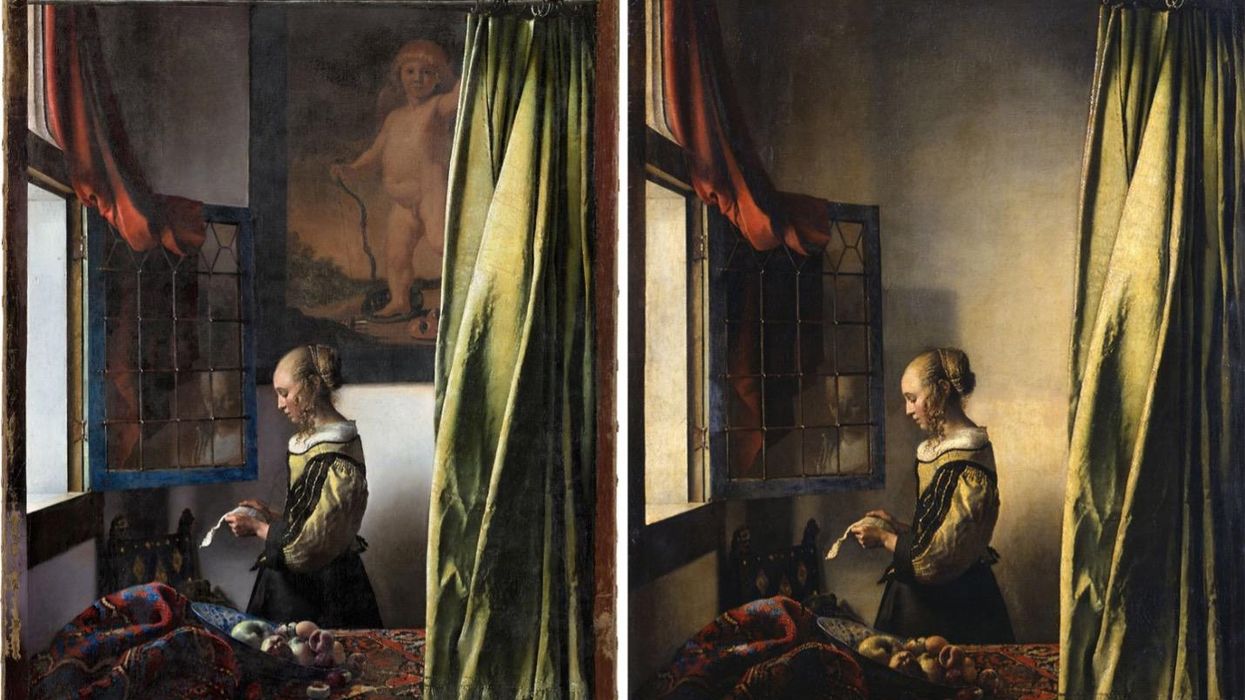
Elvis Presley Gets the Polio Vaccine on The Ed Sullivan Show, Persuading Millions to Get Vaccinated (1956)
No one living has experienced a viral event the size and scope of COVID-19. Maybe the unprecedented nature of the pandemic explains some of the vaccine resistance. Diseases of such virulence became rare in places with ready access to vaccines, and thus, ironically, over time, have come to seem less dangerous. But there are still many people in wealthy nations who remember polio, an epidemic that dragged on through the first half of the 20th century before Jonas Salk perfected his vaccine in the mid-fifties.
Polio’s devastation has been summed up visually in textbooks and documentaries by the terrifying iron lung, an early ventilator. “At the height of the outbreaks in the late 1940s,” Meilan Solly writes at Smithsonian, “polio paralyzed an average of more than 35,000 people each year,” particularly affecting children, with 3,000 deaths in 1952 alone. “Spread virally, it proved fatal for two out of ten victims afflicted with paralysis. Though millions of parents rushed to inoculate their children following the introduction of Jonas Salk’s vaccine in 1955, teenagers and young adults had proven more reluctant to get the shot.”
At the time, there were no violent, organized protests against the vaccine, nor was resistance framed as a patriotic act of political loyalty. But “cost, apathy and ignorance became serious setbacks to the eradication effort,” says historian Stephen Mawdsley. And, then as now, irresponsible media personalities with large platforms and little knowledge could do a lot of harm to the public’s confidence in life-saving public health measures, as when influential gossip columnist Walter Winchell wrote that the vaccine “may be a killer,” discouraging countless readers from getting a shot.
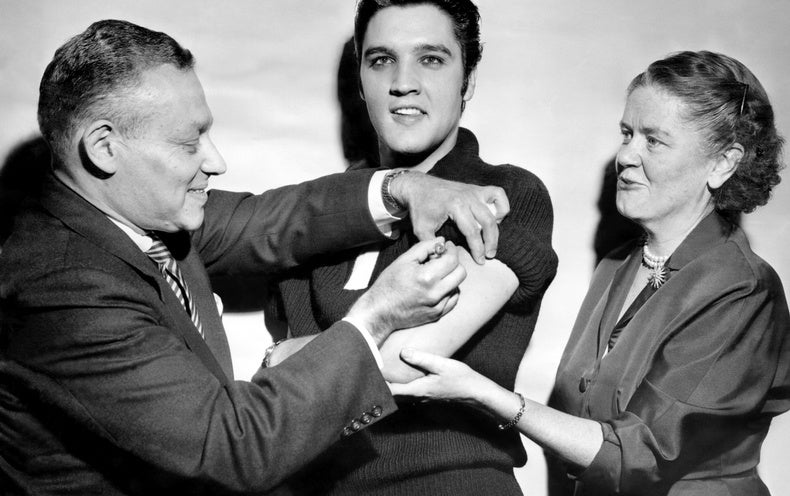
When Elvis Presley made his first appearance on Ed Sullivan’s show in 1956, “immunization levels among American teens were at an abysmal 0.6 percent,” note Hal Hershfield and Ilana Brody at Scientific American. To counter impressions that the polio vaccine was dangerous, public health officials did not solely rely on getting more and better information to the public; they also took seriously what Hershfield and Brody call the “crucial ingredients inherent to many of the most effective behavioral change campaigns: social influence, social norms and vivid examples.” Satisfying all three, Elvis stepped up and agreed to get vaccinated “in front of millions” backstage before his second appearance on the Sullivan show.
Elvis could not have been more famous, and the campaign was a success for its target audience, establishing a new social norm through influence and example: “Vaccination rates among American youth skyrocketed to 80 percent after just six months.” Despite the threat he supposedly posed to the establishment, Elvis himself was ready to serve the public. “I certainly never wanna do anything,” he said, “that would be a wrong influence.” See in the short video at the top how American public health officials stopped millions of preventable deaths and disabilities by admitting a fact propagandists and advertisers never shy from — humans, on the whole, are easily persuaded by celebrities. Sometimes they can even be persuaded for the good.
Related Content:
Yo-Yo Ma Plays an Impromptu Performance in Vaccine Clinic After Receiving 2nd Dose
Dying in the Name of Vaccine Freedom
How Do Vaccines (Including the COVID-19 Vaccines) Work?: Watch Animated Introductions
How Vaccines Improved Our World In One Graphic
Josh Jones is a writer and musician based in Durham, NC. Follow him at @jdmagness
Read More...The Very First Webcam Was Invented to Keep an Eye on a Coffee Pot at Cambridge University
The internet as we know it today began with a coffee pot. Despite the ring of exaggeration, that claim isn’t actually so far-fetched. When most of us go online, we expect something new: often not just something new to read, but something new to watch. This, as those of us past a certain age will recall, was not the case with the early World Wide Web, consisting as it mostly did of static pages of text, updated irregularly if at all. Younger readers will have to imagine even that being a cutting-edge thrill, but we didn’t really feel like we were living in the future until the fall of 1993, when XCoffee first went live.
This groundbreaking technological project “started back in the dark days of 1991,” writes co-creator Quentin Stafford-Fraser, “when the World Wide Web was little more than a glint in CERN’s eye.” At the time, Stafford-Fraser was employed as one of fifteen researchers in the “Trojan Room” of the University of Cambridge Computer Lab. “Being poor, impoverished academics, we only had one coffee filter machine between us, which lived in the corridor just outside the Trojan Room. However, being highly dedicated and hard-working academics, we got through a lot of coffee, and when a fresh pot was brewed, it often didn’t last long.”
It occurred to Stafford-Fraser to train an unused video camera from the Trojan Room on the coffee pot (and thus the amount of coffee available within), then connect it to a computer, specifically an Acorn Archimedes. His colleague Paul Jardetzky “wrote a ‘server’ program, which ran on that machine and captured images of the pot every few seconds at various resolutions, and I wrote a ‘client’ program which everybody could run, which connected to the server and displayed an icon-sized image of the pot in the corner of the screen. The image was only updated about three times a minute, but that was fine because the pot filled rather slowly, and it was only greyscale, which was also fine, because so was the coffee.”

XCoffee, the resulting program, was meant only to provide this much-needed information to Computer Lab members elsewhere in the building. But after the release of image-displaying web browsers in 1993, it found a much wider audience as the world’s first streaming webcam. Stafford-Fraser’s successors “resurrected the system, treated it to a new frame grabber, and made the images available on the World Wide Web. Since then, hundreds of thousands of people have looked at the coffee pot, making it undoubtedly the most famous in the world.” Stafford-Fraser wrote these words in 1995; in the years thereafter XCoffee went on to receive millions of views before its eventual shutdown in 2001.
In the Centre for Computing History video above, Stafford-Fraser shows the very Olivetti camera he originally used to monitor the coffee level. (He’d previously worked at the Olivetti Research Laboratory, whose parent company also owned Acorn Computers.) “We could see things at a distance before,” he says. “We could view television programs, we could look through telescopes.” But only after the Trojan Room’s coffee pot hit the internet could we “see what’s happening now, somewhere else in the world,” on demand. Thirty years after XCoffee’s development, we’re mesmerized by live-streaming stars and surrounded by “smart” home appliances, hoping for nothing so much as way to concentrate on our immediate surroundings again — to wake up, if you like, and smell the coffee.
Related Content:
See Web Cams of Surreally Empty City Streets in Venice, New York, London & Beyond
The Coffee Pot That Fueled Honoré de Balzac’s Coffee Addiction
Based in Seoul, Colin Marshall writes and broadcasts on cities, language, and culture. His projects include the Substack newsletter Books on Cities, the book The Stateless City: a Walk through 21st-Century Los Angeles and the video series The City in Cinema. Follow him on Twitter at @colinmarshall or on Facebook.
Read More...What Makes Basquiat’s Untitled Great Art: One Painting Says Everything Basquiat Wanted to Say About America, Art & Being Black in Both Worlds
They wouldn’t have let Jean-Michel into a Tiffany’s if he wanted to use the bathroom or if he went to buy an engagement ring and pulled a wad of cash out of his pocket.
– Stephen Torton, Jean-Michel Basquiat’s studio assistant
When Jean-Michel Basquiat’s Untitled (Skull) sold for $110.5 million in 2017 to Japanese billionaire Yusaku Maesawa, the artist joined the ranks of Da Vinci, De Kooning, and Picasso as one of the top selling painters in the world, surpassing a previous record set in 2013 by his mentor Andy Warhol’s work. Untitled dates from 1982, during “the young Basquiat’s mercurial early years,” writes Ben Davis at Artnet, “even before his first gallery show at Annina Nosei, when he was still a Caribbean-American kid from Brooklyn energetically bootstrapping himself into the limelight of the downtown art scene.” It is this period that most interests collectors like Maesawa.
Basquiat’s transition from graffiti artist to art world darling was dramatic, celebratory, and self-destructive, all characteristics of his work. But critical primitivism reduced him to a token — an art world attitude saw Basquiats as objects to be stripped of context, turned into decorative badges of authenticity and worldliness. “Maezawa’s head painting possesses a loud, gnashing, and confident aura,” Shannon Lee writes at Artsy. But the artist’s “use of skulls… is deeply rooted in his identity as a Black artist in America. They are strongly evocative of African masks, which have been so fetishized by the art market since modernists like Picasso appropriated them from their native contexts.”
But head/skull motifs in Basquiat’s work are not only statements of diasporic Black identity — they emerge through his thematic play of human embodiment, mental illness/health, the competitions of the graffiti world and the headgames of the art world, which Basquiat both mastered and critiqued as a canny outsider. “No subject is more powerful or more sought after in the oeuvre of Jean-Michel Basquiat,” notes Christie’s New York, “than the singular skull.” Though maybe not the most reproduced of Basquiat’s heads, 1982’s Untitled — argues the Great Art Explained video above — exemplifies the themes.
At only 22 years old, Basquiat produced “a single painting” that said “everything he wanted to say about America, about art and about being black in both worlds.” So singular is Untitled that it became its own one-painting show in 2018 when its new owner sent it on a tour of the world, beginning in the artist’s hometown at the Brooklyn Museum. Maesawa’s decision to share the painting presents a contrast to the way Basquiat has been treated differently by other owners of his work like Tiffany & Co., who explain their purchase and recent, controversial commercial use of his Equals Pi by citing his “affinity for the company’s statement blue color,” writes Tirhakah Love at Daily Beast — a color they trademarked ten years after Basquiat’s death.
The proprietary co-optation of Basquiat’s life and work to sell symbols of colonialism like diamonds, among other luxury goods — and the turning of his work into the ultimate luxury good — debases his purposes. Why show Equals Pi “as a prop to an ad?” asked his friend and former roommate Alexis Adler. “Loan it out to a museum. In a time where there were very few Black artists represented in Western museums, that was his goal: to get to a museum.” Find out in the Great Art Explained video how one of his most famous — and most expensive — works encapsulates that struggle through its vivid color and symbolic visual language.
Related Content:
The Story of Jean-Michel Basquiat’s Rise in the 1980s Art World Gets Told in a New Graphic Novel
Josh Jones is a writer and musician based in Durham, NC. Follow him at @jdmagness
Read More...
A 10-Course Introduction to Data Science from Johns Hopkins
Data is now everywhere. And those who can harness data effectively stand poised to innovate and make impactful decisions. This holds true in business, medicine, healthcare, education and other spheres of life.
Enter the 10-course Introduction to Data Science from Johns Hopkins. Offered on the Coursera platform, this course sequence covers “the concepts and tools you’ll need throughout the entire data science pipeline, from asking the right kinds of questions to making inferences and publishing results.” The program includes courses covering The Data Scientist’s Toolbox, R Programming, Getting and Cleaning Data, Developing Data Products and more. There’s also a Capstone Project where students can build a data product using real-world data.
Students can formally enroll in the Introduction to Data Science specialization and receive a certificate for each course they complete–a certificate they can share with prospective employers and their professional networks. They’ll also leave with a portfolio demonstrating mastery of the material covered in the sequence. Hopkins estimates that most learners can complete the sequence in 3–7 months, during which time students will be charged $49 per month.
Alternatively, students can audit individual courses for free. When you enroll in a course, look carefully for the Audit option. Note: Auditors cannot receive a certificate for each completed course.
If would like to formally enroll in the Introduction to Data Science sequence, you can start a 7‑Day Free Trial and size things up here.
Open Culture has a partnership with Coursera. If readers enroll in certain Coursera courses and programs, it helps support Open Culture.
Related Content:
Read More...Is the Famous Photo of Lee Harvey Oswald Posing with the Gun Used to Kill JFK a Fake?: 3D Forensic Analysis Reveals the Answer
As long as the 20th century remains in living memory, the assassination of President John F. Kennedy will continue to draw public interest. A great many Americans feel they still haven’t heard the “whole story” behind what happened on November 22, 1963; a few have dedicated their lives to finding out, growing less inclined to accept the possibility of a lone gunman the deeper they get into the documents. But that gunman, Lee Harvey Oswald, does figure directly into some of the material held up as evidence of a conspiracy. Take the “backyard photos” that depict him posing with what was ultimately found to be the very gun used to kill JFK.
Such images would seem strongly to implicate Oswald in the assassination, and the Warren Commission seems to have regarded them in just that way. But for nearly six decades now, some theorists have argued that the backyard photos are fake — an idea that began with Oswald himself, who before his own assassination insisted that he’d never seen them in his life, and that someone had “superimposed” his face onto another body.
The Vox video above lays out the main elements of one particular picture that have been called repeatedly into question: the angles of the shadows, the shape of Oswald’s chin, the length of the gun, and Oswald’s unusual posture.
“In the 1960s and 1970s, forensic experts tried just about everything to test the authenticity of this photo,” says the video’s narrator. They couldn’t find any evidence of fakery, but they didn’t have the 21st-century technology at the command of the UC Berkeley School of Information’s Hany Farid, a well-known specialist in the analysis of digital images. Farid and a team of researchers reconstructed Oswald’s body and weaponry (though not the copies of The Militant and The Worker, two ideologically opposed newspapers, he brandished in his other hand) and found that everything added up, from the seemingly misaligned shadows cast by the sun to the stability of his odd stance. If there was indeed a conspiracy to kill JFK, then, it wasn’t a conspiracy of proto-Photoshoppers.
Related Content:
2,800 JFK Assassination Documents Just Released by the National Archives
November 22, 1963: Watch Errol Morris’ Short Documentary About the Kennedy Assassination
Noam Chomsky on Commemorating the JFK Assassination: It “Would Impress Kim Il-Sung”
Based in Seoul, Colin Marshall writes and broadcasts on cities, language, and culture. His projects include the Substack newsletter Books on Cities, the book The Stateless City: a Walk through 21st-Century Los Angeles and the video series The City in Cinema. Follow him on Twitter at @colinmarshall or on Facebook.
Read More...How Agnès Varda Explores Beauty in Cléo from 5 to 7: a Video Essay
“We don’t see things as they are; we see them as we are.” That quote is usually attributed to Anaïs Nin, who counts among the most famous Parisiennes despite only having spent a relatively short stretch of her life there. Cléo Victoire must also occupy those same ranks, despite being a wholly fictional character. We know her as the protagonist of 1962’s Cléo from 5 to 7, the breakout feature by French New Wave auteur Agnès Varda — another of the great Parisiennes of our time, if one reluctant enough to have arrived for her education at the Sorbonne seeing Paris as a “grey, inhumane, sad city.” Still, as Cléo’s perambulations through and interactions with Paris reveal, Varda certainly knew how to use the place.
As the film plays out in real time, “we follow Cléo through an afternoon as she journeys across real locations in Paris, waiting for her dreaded test results to be ready.” So says Evan Puschak, better known as the Nerdwriter, in his new video essay “Through Agnes Varda’s Looking Glass.” A promising singer, Cléo has undergone a medical examination to determine whether or not she has cancer, and not until the final scene will she have the answer.
In the meantime, Varda takes the opportunity to “paint a complex picture of a complex woman on a stressful day in her life.” This stress prompts Cléo “to examine and ultimately confront her self-image,” a journey that takes her past, among other things, more than a few mirrors.
Beginning the film as a self-regarding character — in the most literal sense — Cléo never passes up a chance to check her own reflection, and thus confirm her own existence. “If she’s not a beautiful, healthy, up-and-coming singer,” as Puschak articulates the question that descends upon her, “who is she?” Composed only of outside perceptions, Cléo’s center cannot hold; eventually “she discards the identity she’s made for others. She ceases to be an object, looked at even by herself and becomes a subject, the one who looks.” Her crisis forces her to “observe the world as it is, not as a reflection of people’s expectation of her.” Varda’s cinematic vision of her transformation shows what it is to see things not as we are, but as they are.
Related Content:
How David Lynch Manipulates You: A Close Reading of Mulholland Drive
Based in Seoul, Colin Marshall writes and broadcasts on cities, language, and culture. His projects include the Substack newsletter Books on Cities, the book The Stateless City: a Walk through 21st-Century Los Angeles and the video series The City in Cinema. Follow him on Twitter at @colinmarshall or on Facebook.
Read More...A Restored Vermeer Painting Reveals a Portrait of a Cupid Hidden for Over 350 Years
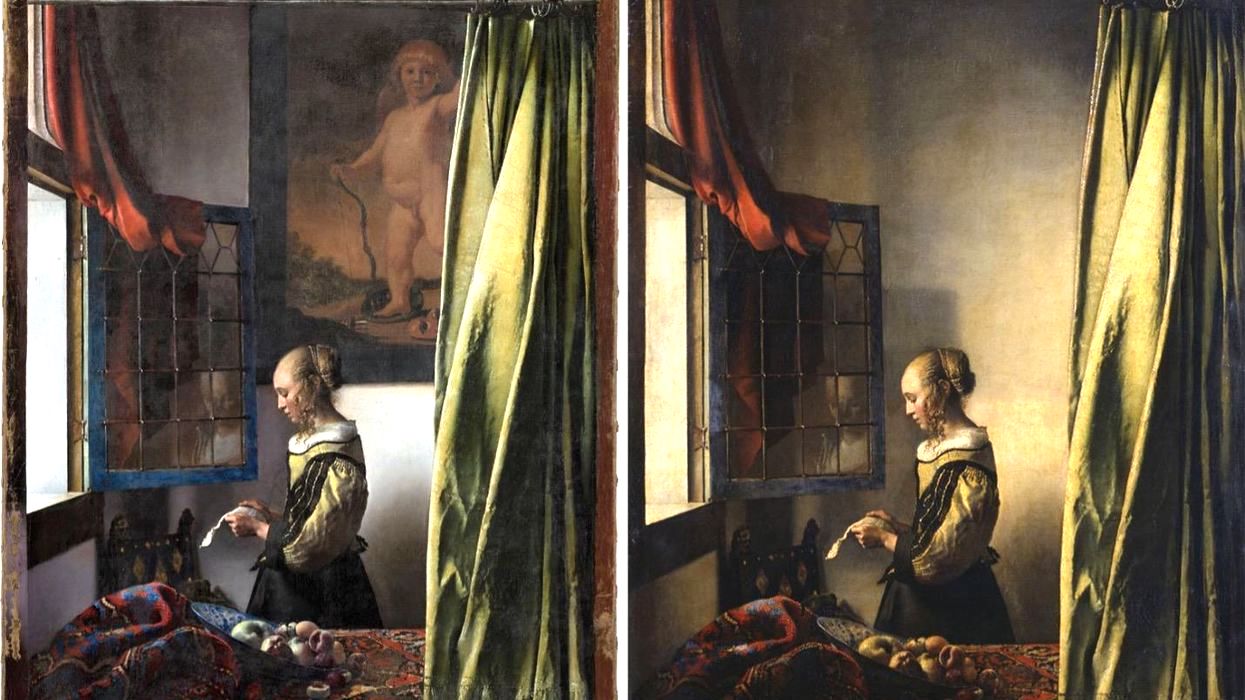
Botched art restorations make good headlines, but rarely are we asked to consider if a posthumous change to a great master’s work represents an improvement. And yet, when images of a restored Girl Reading a Letter at an Open Window by Jan Vermeer circulated recently, the world had the chance to compare the restored original painting, at the left, with an unknown painter’s revision, long thought to be Vermeer’s work. (Click here to view the paintings side by side in a larger format.) Several people announced that they preferred the doctored painting on the right, first attributed to Vermeer in 1880 (and previously attributed to Dutch masters Rembrandt and Hals).
As conservators found at the conclusion of a restoration project begun in 2017, it is the painting on the left that Vermeer intended as his final statement on the subject of a girl reading a letter at an open window. That painting puts the subject in a very different light. The naked Cupid behind the young woman — in place of an ambiguously dour patch of beige — revises over a century of art historical interpretation. “With the recovery of Cupid in the background, the actual intention of the Delft painter becomes recognizable,” says Stephan Koja, director of the Old Masters Picture Gallery.
Art historians and conservators had long known the other painting was underneath, having discovered it via X‑ray in 1979. But they assumed it was Vermeer himself who made the change. “As it was not uncommon for artists to paint over their work,” My Modern Met writes, “scholars initially accepted that Vermeer had simply changed his mind and decided to keep the wall bare.” Instead, thanks to the 2017 restoration project, “researchers were able to conclude that the overpainting was completed over several decades after the canvas was finished.”
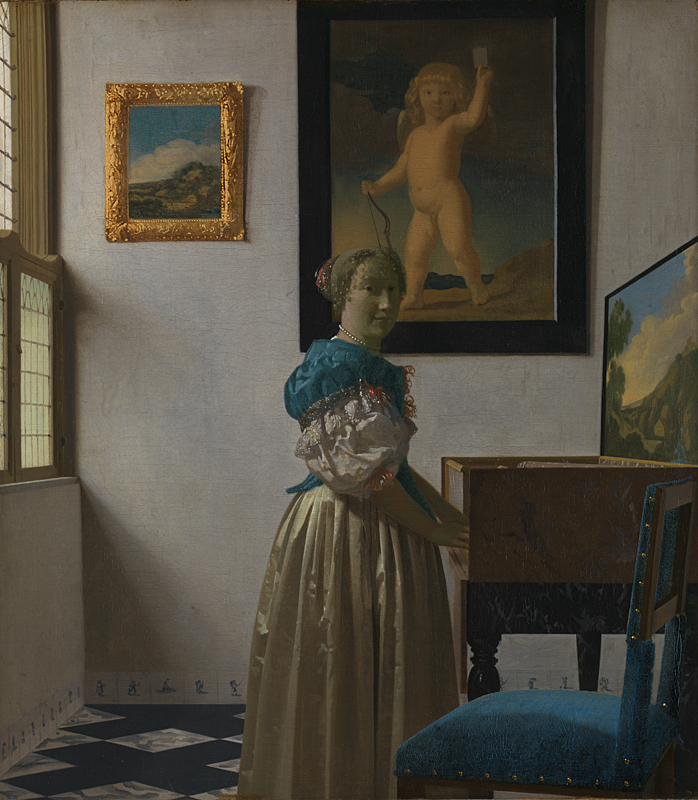
“Vermeer often incorporated empty backgrounds in his genre paintings,” a feature that has become something of a hallmark thanks to the fame of paintings like The Milkmaid. This is one reason the Cupid went undercover for so long, despite an unbalanced composition without it. But Vermeer also incorporated backgrounds filled with art, including the same Cupid painting, which appears in his lesser known A Young Woman Standing at a Virginal and may have been a painting he himself owned. “There has been much speculation,” the National Gallery notes, that this painting (and another, similarly titled work) represent “fidelity” and “a venal, mercenary approach to love.” What approach might be suggested by the newly restored Girl Reading a Letter at an Open Window?
via Colossal
Related Content:
A 10 Billion Pixel Scan of Vermeer’s Masterpiece Girl with a Pearl Earring: Explore It Online
Josh Jones is a writer and musician based in Durham, NC. Follow him at @jdmagness
Read More...Why Do We Dream?: An Animated Lesson
Why do we dream? It’s a question science still can’t answer, says the TED-Ed lesson above by Amy Adkins. Many neuroscientists currently make sense of dreaming as a way for the brain to consolidate memory at night. “This may include reorganizing and recoding memories in relation to emotional drives,” writes computational neuroscientist Paul King, “as well as transferring memories between brain regions.” You might imagine a defragging hard drive, the sorting and filing process happening while a computer sleeps.
But the brain is not a computer. Important questions remain. Why do dreams have such a powerful hold on us, not only individually, but — as a recent project collecting COVID dreams explores — collectively? Are dreams no more than gibberish, the mental detritus of the day, or do they convey important messages to our conscious minds? Several millennia before Freud’s The Interpretation of Dreams, “Mesopotamian kings recorded and interpreted their dreams on wax tablets.” A thousand years later, Egyptians catalogued one hundred of the most common dreams and their meanings in a dream book.
The ancients were convinced their dreams carried messages from beyond their consciousness. Many modern theorists beginning with Freud have seen dreams as purely self-referential, and neurotic. “We dream,” the lesson notes, “to fulfill our wishes.” Instead of messages from the gods, dreams are symbolic communication from unconscious repressed drives. Or, “we dream to remember,” as some contemporary neuroscientists claim, or “we dream to forget” as a neurobiological theory called “reverse learning” argued in 1983. Dreams are exercises for the brain, rehearsals, nighttime problem solving … the lesson touches briefly on each of these theories in turn.
But whatever answers science provides will hardly satisfy human curiosity about the content of our dreams. For this, perhaps, we should look elsewhere. We might turn, for example, to the Museum of Dreams, “a hub for exploring the social and political significance of dream-life.” Philosophical and scientific theories of dreaming are all speculative. “Rather than seek a definitive explanation, the Museum’s goal is to explore the generative and performative nature of dream-life — all the remarkable ways people have put their dreams to work.” Before we share and, yes, interpret our dreams with others, they remain, in Toni Morrison’s words, “unspeakable things unspoken.”
Related Content:
Do Octopi Dream? An Astonishing Nature Documentary Suggests They Do
Josh Jones is a writer and musician based in Durham, NC. Follow him at @jdmagness
Read More...Google Data Analytics Certificate: 8 Courses Will Help Prepare Students for an Entry-Level Job in 6 Months
During the pandemic, Google launched a series of Career Certificates that will “prepare learners for an entry-level role in under six months.” The new career initiative includes certificates concentrating on Project Management and UX Design. And now also Data Analytics, a burgeoning field that focuses on “the collection, transformation, and organization of data in order to draw conclusions, make predictions, and drive informed decision making.”
Offered on the Coursera platform, the Data Analytics Professional Certificate consists of eight courses, including “Foundations: Data, Data, Everywhere,” “Prepare Data for Exploration,” “Data Analysis with R Programming,” and “Share Data Through the Art of Visualization.” Overall this program “includes over 180 hours of instruction and hundreds of practice-based assessments, which will help you simulate real-world data analytics scenarios that are critical for success in the workplace. The content is highly interactive and exclusively developed by Google employees with decades of experience in data analytics.”
Upon completion, students–even those who haven’t pursued a college degree–can directly apply for jobs (e.g., junior or associate data analyst, database administrator, etc.) with Google and over 130 U.S. employers, including Walmart, Best Buy, and Astreya. You can start a 7‑day free trial and explore the courses here. If you continue beyond the free trial, Google/Coursera will charge $39 USD per month. That translates to about $235 after 6 months, the time estimated to complete the certificate.
Explore the Data Analytics Certificate by watching the video above. Learn more about the overall Google career certificate initiative here. And find other Google professional certificates here.
Note: Open Culture has a partnership with Coursera. If readers enroll in certain Coursera courses and programs, it helps support Open Culture.
Related Content:
Read More...ABBA Set to Release Their First Album in 40 Years: Hear Two New Tracks, and Get a Glimpse of Their Digital Live Show
45 years ago, ABBA’s music was inescapable. 25 years ago, it had become a seemingly unwelcome reminder of the inanities of the 1970s in general and the days of disco in particular. But now, it’s revered: rare is the 21st-century music critic who absolutely refuses to acknowledge the Swedish foursome’s mastery of pure pop songwriting and studio production. With current musicians, too, naming ABBA among their inspirations without embarrassment, the time has surely come for ABBA themselves to return to the spotlight — a spotlight that first illuminated them for the world in 1974, when their performance of “Waterloo” won the Eurovision Song Contest.
ABBA’s streak lasted until the early 1980s, ending in a hiatus that ultimately stretched out to some 40 years. Pop culture has changed quite a bit in that time, but technology much more so. The band have thus put together a thoroughly modern comeback involving not just a new album, but also a live show starring computer-generated versions of members Björn Ulvaeus, Benny Andersson, Agnetha Fältskog, and Anni-Frid Lyngstad — “Abbatars,” as Ulvaeus calls them.
Beginning next year, they’ll play ABBA’s hits in a custom-built 3,000-seat arena in London’s Olympic park, engineered to accompany each song with their own elaborate light show. Animated with motion-captured performances by the real ABBA, their appearance has been modeled after the way the band looked in the 1970s (if not quite the way they dressed).
Titled Voyage, this digital ABBA experience will open in 2022, thus solving the problem of touring that had long discouraged a reunion. “We would like people to remember us as we were,” Ulvaeus said in the late 2000s. “Young, exuberant, full of energy and ambition.” But with all four now-septuagenarian members still alive and able to make music, remaining wholly inactive seems to have started feeling like a shame. They made their return to the studio in 2018, recording the new songs “I Still Have Faith in You” and “Don’t Shut Me Down,” both of which will appear on the new album, also called Voyage, coming out in November. All this will bring back memories for longtime fans, as well as provide a thrilling experience for their many listeners too young to have experienced an ABBA show or album release before. But I can’t be the only member of my generation wondering if, twenty years from now, we’ll be buying tickets for a digitally re-created Ace of Base.
Related Content:
How ABBA Won Eurovision and Became International Pop Stars (1974)
Listen to ABBA’s “Dancing Queen” Played on a 1914 Fairground Organ
This Man Flew to Japan to Sing ABBA’s “Mamma Mia” in a Big Cold River
Based in Seoul, Colin Marshall writes and broadcasts on cities, language, and culture. His projects include the Substack newsletter Books on Cities, the book The Stateless City: a Walk through 21st-Century Los Angeles and the video series The City in Cinema. Follow him on Twitter at @colinmarshall or on Facebook.
Read More...Support Us
We're hoping to rely on loyal readers, rather than erratic ads. Please click the Donate button and support Open Culture. You can use Paypal, Venmo, Patreon, even Crypto! We thank you!

About Us

Open Culture scours the web for the best educational media. We find the free courses and audio books you need, the language lessons & educational videos you want, and plenty of enlightenment in between.
Advertise With Us
FREE UPDATES!
GET OUR DAILY EMAIL
Get the best cultural and educational resources on the web curated for you in a daily email. We never spam. Unsubscribe at any time.
FOLLOW ON SOCIAL MEDIA
Open Culture editor Dan Colman scours the web for the best educational media. He finds the free courses and audio books you need, the language lessons & movies you want, and plenty of enlightenment in between.
Advertise With Us