DEVO Co-Founder Jerry Casale Muses on Songwriting & Social Protest: Stream the Nakedly Examined Music Interview Online

This week’s Nakedly Examined Music podcast features a discussion of songwriting and social protest with Jerry Casale, the co-frontman of Devo since its formation in 1973.
Jerry developed the idea of “devolution” with his friend Bob Lewis in the late ’60s when attending Kent State University, and by his own account was radicalized to political action by the Kent State shootings in 1970. This took the form of what was originally a partnership with Mark Mothersbaugh to create visual art, but this quickly became a musical partnership as well. Mark had used his synthesizer skills to ape British progressive rock, while Jerry was more influenced by blues, having played bass in The Numbers Band and other outfits. The two started recording independently, bringing in Mark’s brother Bob (“Bob 1”) to play lead guitar and later adding Jerry’s brother Bob (“Bob 2”) to play rhythm guitar and more keyboards as well as drummer Alan Myers. Buoyed by heralded live shows in Ohio that included a particularly idiosyncratic and catchy take on The Rolling Stones’ “Satisfaction,” Devo was signed to a major label and released seven albums before coming to a gradual stop in after their album sales declined in the late ’80s given that Mark was doing more and more music for TV and film.
This created a dilemma for Jerry, who has regarded Devo as his life’s work and also regarded it as essentially a partnership with Mark. There have been many Devo live reunions (including one happening now), and there was a full new Devo album in 2010, but that leaves a lot of time to merely collect residuals from “Whip It” and run a winery in Napa.
In reaction to the falsehoods that launched the 2003 Iraq War, Jerry recorded a limited-release solo album under the name “Jihad Jerry and the Evildoers.” This work has now been repackaged to accompany the release of a brand new single (attributed to “DEVO’s Gerald V. Casale”) called “I’m Gonna Pay U Back,” written with current Devo drummer Josh Freese and featuring guitars by Oingo Boingo’s Steve Bartek. As Jerry has always thought of his videos as integral to his musical output, this new song features an elaborately storyboarded and textured video co-directed with Davy Force of Force! Extreme Ani-Mation.
This revival of the Jihad Jerry character created to criticize America’s paranoid post‑9/11 mindset allowed Jerry to visualize a conflict between Jihad Jerry and DEVO Jerry, in the Nakedly Examined Music interview, host Mark Linsenmayer engages Jerry about what these characters amount to and how exactly irony does (or does not) play into them. It was both a blessing and a curse for Devo that their various militaristic and/or robotic personas were so funny. The humor (and fun danceability) involved in songs like “Whip It,” “Mongoloid,” and “Freedom of Choice” meant they could gain an enduring foothold in popular culture, but on the other hand, they’ve been dismissed as merely jokes. Including themselves in the critique, acknowledging themselves as subject to the same human foibles, allowed them to create minimalist, anthemic songs that had a self-conscious stupidity and lampooned the pretensions of art rock. There was a clear connection between the musical styles that Devo sported and the message of this critique: They could all chant in unison that we are all degenerate conformists and use synthesizers and jerky rhythms to act out our dehumanization.
Jihad Jerry, i.e. Jerry wearing a theatrical turban and sunglasses, was given a specific backstory involving escaping Iranian theocracy, determined to use music as a weapon to fight prejudice and ignorance everywhere. Whatever the virtues of this character as a narrative device, it was a marketing disaster, raising ire both with American conservatives and with Muslims who felt they were being mocked, and so the character was retired in 2007. Jerry’s Nakedly Examined Music interview discusses “The Owl,” a track written during Jihad Jerry’s initial run, which confusingly has Jihad Jerry (a character) speaking narratively through the voice of a superhero character “The Owl,” who threatens physical violence on all boorish, selfish American evildoers. Now, given that there’s a character named Nite Owl in Alan Moore’s comic Watchmen, which is explicitly about the mental instability of those who appoint themselves the moral and physical guardians of society, it would be natural to think that irony is playing ask thickly in this new portrayal as it was for the Devo “smart patrol” characters, but in this interview, Jerry urges us to take the critique at face value, as a straightforward condemnation of American arrogance. Does the critique land better without the explicit self-incrimination? Or is the fact that Jihad Jerry is obviously a joke, the Owl as a superhero is obviously a joke, and the fact that we’re talking about characters talking through characters give Jerry Casale enough of a framework to be able to launch very direct attacks without being dismissed as shrill or condescending?
The latter portion of the interview turns to a lesser known Devo track “Fountain of Filth,” which Jerry says he wrote with his brother Bob Casale (who passed away in early 2014) during the recording sessions for Devo’s most famous album, 1980s Freedom of Choice. The song (in the form presented in the podcast) was included in the Hardcore Devo: Volume Two CD in 1991, and was performed live for the first time as part of the 2014 Hardcore Devo Live! tour. In Jerry’s introduction to the song in that concert and in this interview, he describes the “fountain” as all the misinformation and other commercial garbage that makes up much of American media. However, the lyrics of the song are ambiguous: “I’ve got a hunger that makes me want things… Nowhere are we safe… from the appeal of the eternal fountain of filth.” Like one of Devo’s well-known songs “Uncontrollable Urge” (written by Mark without Jerry), this could be a song not actually condemning the temptations, but laughing at prurient hysteria about temptation, i.e. a firmly ironic missive. The technique here is most likely irony that cuts in all directions: One can condemn the overreaction while still condemning the thing it was a reaction to, and a prudish fear of sexuality and full immersion in it are two sides of the same degenerate (i.e. “de-evolved”) coin.
The interview concludes with a 2016 single attributed to Jerry Casale with Italy’s Phunk Investigation that explicitly states this totalizing condemnation/celebration: “It’s All Devo.” Again, the song was released with an elaborate, evocative video, in this case using the art of Max Papeschi and direction by Maurizio Temporin.
Get more links related to this episodes on the Nakedly Examined Music website. Nakedly Examined Music is a podcast hosted by Mark Linsenmayer, who also hosts The Partially Examined Life Philosophy Podcast, Pretty Much Pop: A Culture Podcast, and Philosophy vs. Improv. He releases music under the name Mark Lint.
Read More...See Every Nuclear Explosion in History: 2153 Blasts from 1945–2015
There have been more than 2,000 nuclear explosions in all of history — which, in the case of the technology required to detonate a nuclear explosion, goes back only 76 years. It all began, according to the animated video above, on July 16, 1945, with the nuclear device code-named Trinity. The fruit of the labors of the Manhattan Project, its explosion famously brought to the mind of theoretical physicist Robert J. Oppenhemier a passage from the Bhagavad Gita: “Now I am become Death, destroyer of worlds.” But however revelatory a spectacle Trinity provided, it turned out merely to be the overture of the nuclear age.
Created by Ehsan Rezaie of Orbital Mechanics, the video offers a simple-looking but deceptively information-rich presentation of every nuclear explosion that has so far occurred. It belongs to a perhaps unlikely but nevertheless decisively established genre, the animated nuclear-explosion time-lapse, of which we’ve previously featured examples from Business Insider’s Alex Kuzoian and artist Isao Hasimoto here on Open Culture.
The size of each circle that erupts on the world map indicates the relative power of the explosion in its location (all information also provided in the scrolling text on the lower left); those detonated underground appear in yellow, those detonated underwater in blue, and those detonated in the atmosphere in red.
Trinity created an atmospheric explosion above New Mexico’s Jornada del Muerto desert. (Otherwise Oppenheimer wouldn’t have been able to witness it change the world.) So did Little Boy and Fat Man, the bombs dropped on Japan in World War II. Those remain the only detonations of nuclear weapons in combat, and thus the nuclear explosions everyone knows, but they, too, represent only the beginning. As the Cold War sets in, something of a testing volley emerges between the United States and the Soviet Union, culminating in the colossal red dot of 1961’s Tsar Bomba, still the most powerful nuclear weapon ever tested. With the USSR long gone today, the explosions have only slowed. But in recent years, as the data on which this video is based indicates, nuclear testing has turned into a one-player game — and that player is North Korea.
Related Content:
Every Nuclear Bomb Explosion in History, Animated
53 Years of Nuclear Testing in 14 Minutes: A Time Lapse Film by Japanese Artist Isao Hashimoto
200 Haunting Videos of U.S. Nuclear Tests Now Declassified and Put Online
Watch Chilling Footage of the Hiroshima & Nagasaki Bombings in Restored Color
Haunting Unedited Footage of the Bombing of Nagasaki (1945)
Based in Seoul, Colin Marshall writes and broadcasts on cities, language, and culture. His projects include the Substack newsletter Books on Cities, the book The Stateless City: a Walk through 21st-Century Los Angeles and the video series The City in Cinema. Follow him on Twitter at @colinmarshall or on Facebook.
Read More...Listen to Freddie Mercury & David Bowie on the Isolated Vocal Track for the Queen Hit ‘Under Pressure,’ 1981
In the summer of 1981, the British band Queen was recording tracks for their tenth studio album, Hot Space, at Mountain Studios in Montreux, Switzerland. As it happened, David Bowie had scheduled time at the same studio to record the title song for the movie Cat People. Before long, Bowie stopped by the Queen sessions and joined in. The original idea was that he would add backup vocals on the song “Cool Cat.” “David came in one night and we were playing other people’s songs for fun, just jamming,” says Queen drummer Roger Taylor in Mark Blake’s book Is This the Real Life?: The Untold Story of Freddie Mercury and Queen. “In the end, David said, ‘This is stupid, why don’t we just write one?’ ”
And so began a marathon session of nearly 24-hours–fueled, according to Blake, by wine and cocaine. Built around John Deacon’s distinctive bass line, the song was mostly written by Mercury and Bowie. Blake describes the scene, beginning with the recollections of Queen’s guitarist:
‘We felt our way through a backing track all together as an ensemble,’ recalled Brian May. ‘When the backing track was done, David said, “Okay, let’s each of us go in the vocal booth and sing how we think the melody should go–just off the top of our heads–and we’ll compile a vocal out of that.” And that’s what we did.’ Some of these improvisations, including Mercury’s memorable introductory scatting vocal, would endure on the finished track. Bowie also insisted that he and Mercury shouldn’t hear what the other had sung, swapping verses blind, which helped give the song its cut-and-paste feel.
“It was very hard,” said May in 2008, “because you already had four precocious boys and David, who was precocious enough for all of us. Passions ran very high. I found it very hard because I got so little of my own way. But David had a real vision and he took over the song lyrically.” The song was originally titled “People on Streets,” but Bowie wanted it changed to “Under Pressure.” When the time came to mix the song at Power Station studios in New York, Bowie insisted on being there. “It didn’t go too well,” Blake quotes Queen’s engineer Reinhold Mack as saying. “We spent all day and Bowie was like, ‘Do this, do that.’ In the end, I called Freddie and said, ‘I need help here,’ so Fred came in as a mediator.” Mercury and Bowie argued fiercely over the final mix.
At one point Bowie threatened to block the release of the song, but it was issued to the public on October 26, 1981 and eventually rose to number one on the British charts. It was later named the number 31 song on VH1’s list of the 100 greatest songs of the 1980s. “ ‘Under Pressure’ is a significant song for us,” May said in 2008, “and that is because of David and its lyrical content. I would have found that hard to admit in the old days, but I can admit it now.… But one day, I would love to sit down quietly on my own and re-mix it.”
After listening to the isolated vocal track above, you can hear the officially released 1981 mix below:
Note: An earlier version of this classic post appeared on our site in 2013.
Related Content:
Watch David Bowie & Annie Lennox in Rehearsal, Singing “Under Pressure,” with Queen (1992)
Watch Queen’s “Bohemian Rhapsody” Acted Out Literally as a Short Crime Film
Read More...Building Without Nails: The Genius of Japanese Carpentry
Traditional Japanese carpentry impresses us today, not so much with the tools its practitioners use as with the ones they don’t: nails, for example. Or glue, for that matter. Here on Open Culture we’ve previously featured introductions to Japanese wood joinery, the art of cutting wood in a manner such that pieces slide together and solidly interlock without the aid of any other materials. Though it may seem like magic, it’s really just physics — or rather, physics, and engineering, and the branches of biology relevant to growing the right wood. For the traditional Japanese carpenter himself, it all comes down to extensive training and practice.
Traditional Japanese carpentry need not even be done in Japan. Take Miya Shoji, the New York City shop profiled in the China Uncensored video above. Under current owner Hisao Hanafusa, who came to the United States in 1963, it makes and sells furniture crafted using canonical techniques, but in service of particular pieces quite unlike any found in Japan.
Part of the difference comes from the wood itself: as it would be sourced only locally in Japan, so it’s sourced only locally in the United States. This video shows the felling of a 300-year-old tree, killed by Dutch elm disease, and its transformation into slabs destined to become Miya Shoji tables.
Thereafter, the drying process could take twenty years. “By the time the wood hits the cutting bench, it is already nearing the end of its journey.” But the carpenter still has to craft the joints needed to hold the finished piece together “like a three-dimensional puzzle” — and with a set of hand tools, at that. The very same techniques have been used to construct temples in Japan that can stand for a millennium, and indeed go back even deeper into history than that, having evolved from carpentry performed in 6th- and 7th-century China. Here in the 21st century, connoisseurs of every nationality have come to appreciate the wabi-sabi aesthetic and transcendent simplicity of furniture so constructed — a simplicity that surely doesn’t come cheap.
Related Content:
See How Traditional Japanese Carpenters Can Build a Whole Building Using No Nails or Screws
Based in Seoul, Colin Marshall writes and broadcasts on cities, language, and culture. His projects include the Substack newsletter Books on Cities, the book The Stateless City: a Walk through 21st-Century Los Angeles and the video series The City in Cinema. Follow him on Twitter at @colinmarshall or on Facebook.
Read More...A Gigantic Violin Floats Down Venice’s Grand Canal with a String Quartet on Top
It looks like something out of a Fellini movie: a string quartet floating down the canals of Venice on a gigantic violin. Not a boat masquerading as a violin, like when you dress up your pet for Halloween and just slap some funny ears and coat on it, but an actual 39-foot long violin, made of several kinds of wood and metal by master boatbuilder/wood sculptor Livio De Marchi.
“Noah’s Violin,” as it is called, did have a tiny motor inside to propel it, and its trip down the Grand Canal was intended as a portent of a post-COVID world. De Marchi told the New York Times that the violin was a “sign of Venice restarting,” and like Noah’s Ark, would bring hope after the deluge.
Musicians on board played works by Vivaldi, who was also an inspiration to the woodworker/boatmaker, and who was likewise born in Venice. The surprise is not so much that a string quartet is playing on top of the violin, but that it all seems so sturdy and safe. There are no hand rails or life jackets to be seen. (According to the Times, wind blew some of the score into the canal, where it was quickly rescued).
De Marchi has made several surreal boats, starting with a large wooden replica of a paper ship, a floating origami crane, a large high-heeled shoe, and recently an all-wood recreation of a Ferrari that puttered up and and down the canal.
The violin boat was followed by crowds in gondolas and other tourist boats, floated about for an hour, and then was docked, where it was blessed by a priest. A museum in China and an Italian company expressed interest in finding the violin-boat a home.
Who knows what might happen to it, but why not strap some powerboat motors on it, hire Apocalyptica and let ‘er rip?
Related Content:
How Venice Works: 124 Islands, 183 Canals & 438 Bridges
A Relaxing 3‑Hour Tour of Venice’s Canals
Ted Mills is a freelance writer on the arts who currently hosts the Notes from the Shed podcast and is the producer of KCRW’s Curious Coast. You can also follow him on Twitter at @tedmills, and/or watch his films here.
Read More...View 103 Discovered Drawings by Famed Japanese Woodcut Artist Katsushika Hokusai
When westerners first discovered the work of Japanese woodcut artist Katsushika Hokusai, it was primarily through his late-career print The Great Wave off Kanagawa and the series from which it came, Thirty-Six Views of Mount Fuji, after the opening of Japan to international trade and the mass consumption of Japanese art in the late 19th century. Impressionists like Claude Monet and Vincent van Gogh went wild for Japanese prints; Claude Debussy composed La mer; artists, artisans, and architects on both sides of the Atlantic fell for all things Japonisme.
Hokusai died in 1849 and did not live to see this newfound international admiration. When he completed The Great Wave, he was in his seventies — a master of his craft who had himself absorbed significant influence from western painters.
During his “formative experience of European art,” John-Paul Stonard writes at The Guardian, Hokusai “learnt from European prints brought into Japan by Dutch traders.” He took these lessons in directions all his own, however. His Mount Fuji prints “could not have been further from anything being made in Europe at the time.”

Hokusai’s European and American enthusiasts saw only the barest glimpse of his body of work, which we can now fully appreciate in exhibitions in person and online. And we can now appreciate a series of drawings that have been hidden away for over seventy years and were hardly seen at all in the 200 years since their creation. Made for an unpublished encyclopedia titled Banmotsu eon daises zu (The Great Picture Book of Everything), “The drawings were long thought forgotten,” Valentina Di Liscia writes at Hyperallergic, “last recorded at an auction in Paris in 1948 before they resurfaced in 2019.”
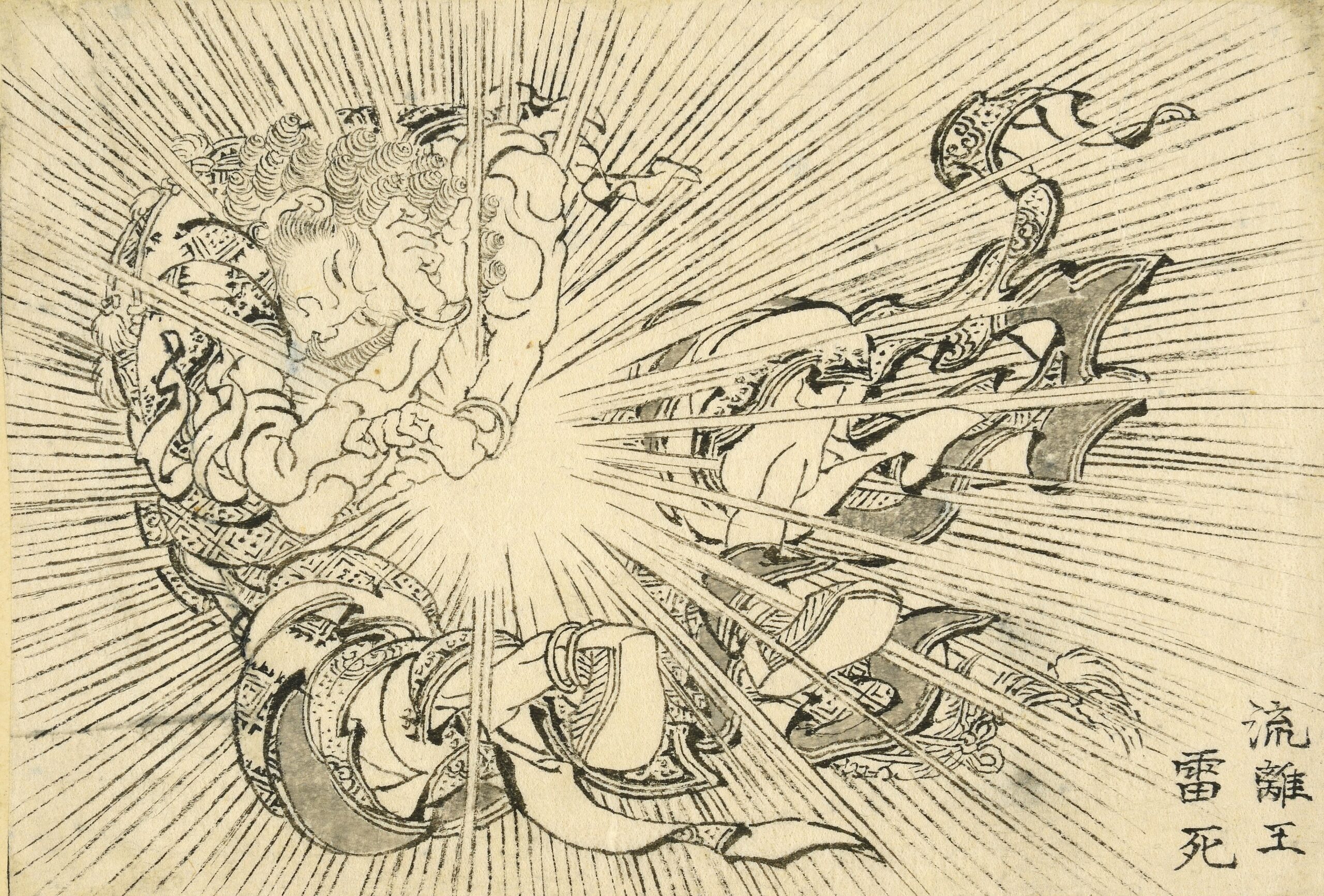
Made sometime between 1820 and the 1840s, “the meticulous, postcard-sized works are known as hanshita‑e, a term for the final drawings used to carve the key blocks in Japanese woodblock printing.” These are usually destroyed in the process, but since the prints were never made, for reasons unknown, “the delicate illustrations remained intact, mounted on cards and stored in a custom-made wooden box.” The drawings depict everything from “the typical inhabitants of lands in East, Southeast, and Central Asian and beyond” to one of the 33 manifestations of the bodhisattva Avalokiteśvara, “Dragon head Kannon.”
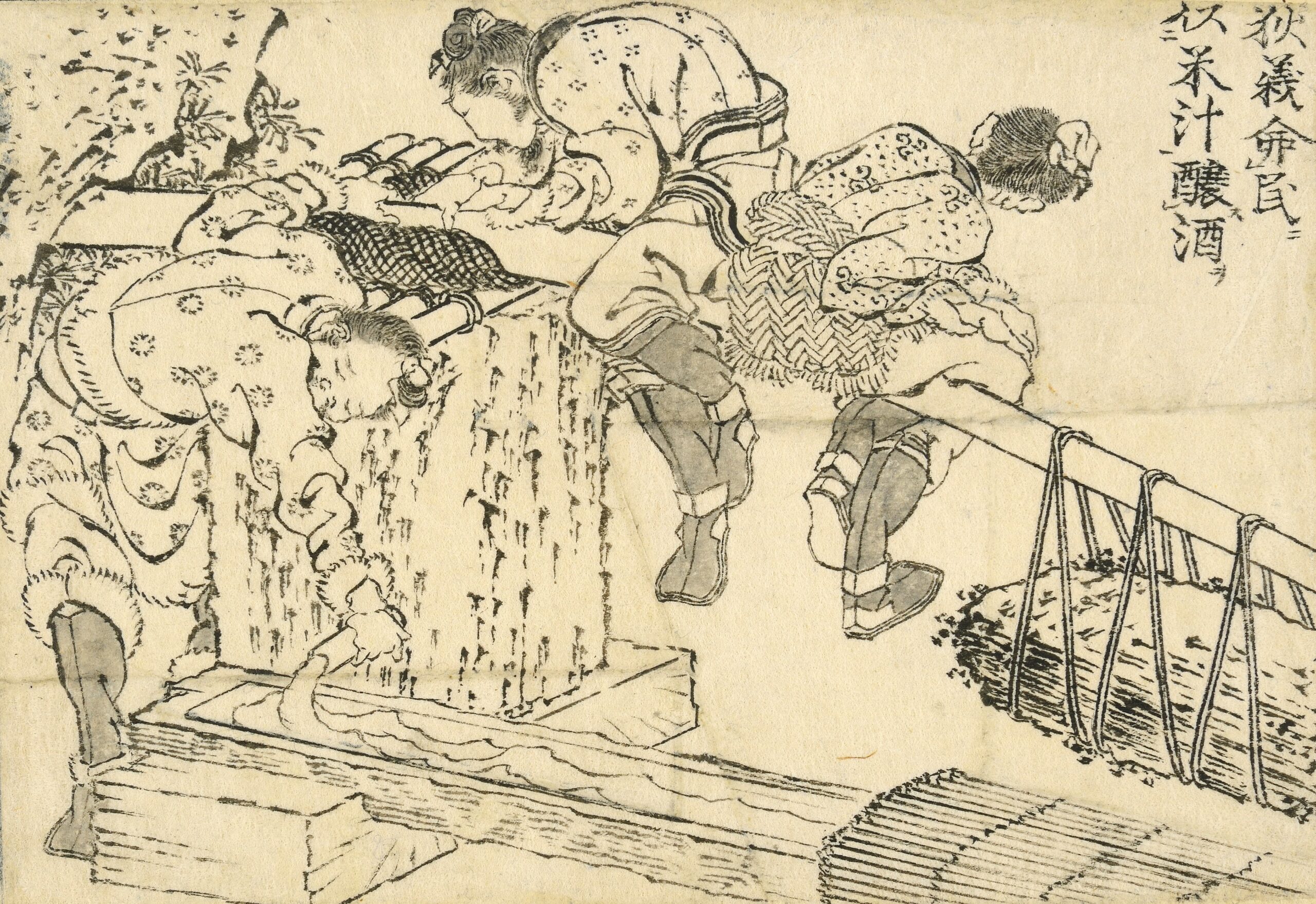
At the top, curator Alfred Haft walks us through his favorite drawings from the set, and you can see all 103 of the diminutive illustrations online at the British Museum. Formerly owned by the collector and Art Nouveau jeweler Henri Vever, the prints could have inspired many a western artist, but it seems they were hidden away and have been seen by very few eyes. Discover them yourself for the first time here.

Related Content:
Hokusai’s Iconic Print, “The Great Wave off Kanagawa,” Recreated with 50,000 LEGO Bricks
Josh Jones is a writer and musician based in Durham, NC. Follow him at @jdmagness
Read More...Why Do People Hate Modern Architecture?: A Video Essay
This month brought the 20th anniversary of September 11, 2001, which prompted people around the world to remember all that was lost on that day. The fallen Twin Towers of Minoru Yamasaki’s World Trade Center have only gained symbolic resonance over the past two decades, despite having been unloved when they still stood. “They often appeared to New Yorkers like a pair of middle fingers — to good development, to good economics, to good taste,” writes Gothamist’s Henry Stewart. “They brought all, high and low, rich and poor, together to hate.” Some critics of the World Trade Center made complaints rooted in politics, finance, and urban design; most just didn’t like how the thing looked.
For 28 years, what the World Trade Center in general and its Twin Towers in particular symbolized was all that the American public detested about what it thought of as the outlandish scale, aesthetic dreariness, and sheer inhumanity of “modern architecture.” But as Betty Chen of ARTiculations points out in the video above, there’s modern architecture, and then there’s Modern Architecture.
“A truly Modernist design,” she says, “adheres to a strict set of formal rules that upholds Modernism’s fundamental principle: form follows function.” Such Modernists as Walter Gropius, Ludwig Mies van der Rohe, and Le Corbusier subscribed to the notion that “architectural design should be disassociated from historic reference, be free of unnecessary ornamentation, and be simplified to the essentials of function.”
As versions of these principles for rebuilding a new postwar civilization — vulgarized versions, some might say — caught on in the middle of the 20th century, cities around the world set enthusiastically about putting up “empty boxes of nothingness.” Or so argued Modern Architecture’s detractors, who gained the cultural upper hand shortly thereafter. “If the first half of the 20th century is considered to be the age of Modern Architecture,” says Chen, “then the latter half of the century can be defined by a continual, unrelenting assault on Modern Architecture.” That assault included the demolition of another of Yamasaki’s mid-century projects, the Pruitt-Igoe housing complex, which began on March 16, 1972. Though carried out without murderous intent, it did involve a notable death: the death, as architect Charles Jencks famously declared, of architectural Modernism itself.
Related Content:
A Quick Animated Tour of Iconic Modernist Houses
1,300 Photos of Famous Modern American Homes Now Online, Courtesy of USC
Based in Seoul, Colin Marshall writes and broadcasts on cities, language, and culture. His projects include the Substack newsletter Books on Cities, the book The Stateless City: a Walk through 21st-Century Los Angeles and the video series The City in Cinema. Follow him on Twitter at @colinmarshall or on Facebook.
Read More...How Italian Physicist Laura Bassi Became the First Woman to Have an Academic Career in the 18th Century
The practice and privilege of academic science has been slow in trickling down from its origins as a pursuit of leisured gentleman. While many a leisured lady may have taken an interest in science, math, or philosophy, most women were denied participation in academic institutions and scholarly societies during the scientific revolution of the 1700s. Only a handful of women — seven known in total — were granted doctoral degrees before the year 1800. It wasn’t until 1678 that a female scholar was given the distinction, some four centuries or so after the doctorate came into being. While several intellectuals and even clerics of the time held progressive attitudes about gender and education, they were a decided minority.
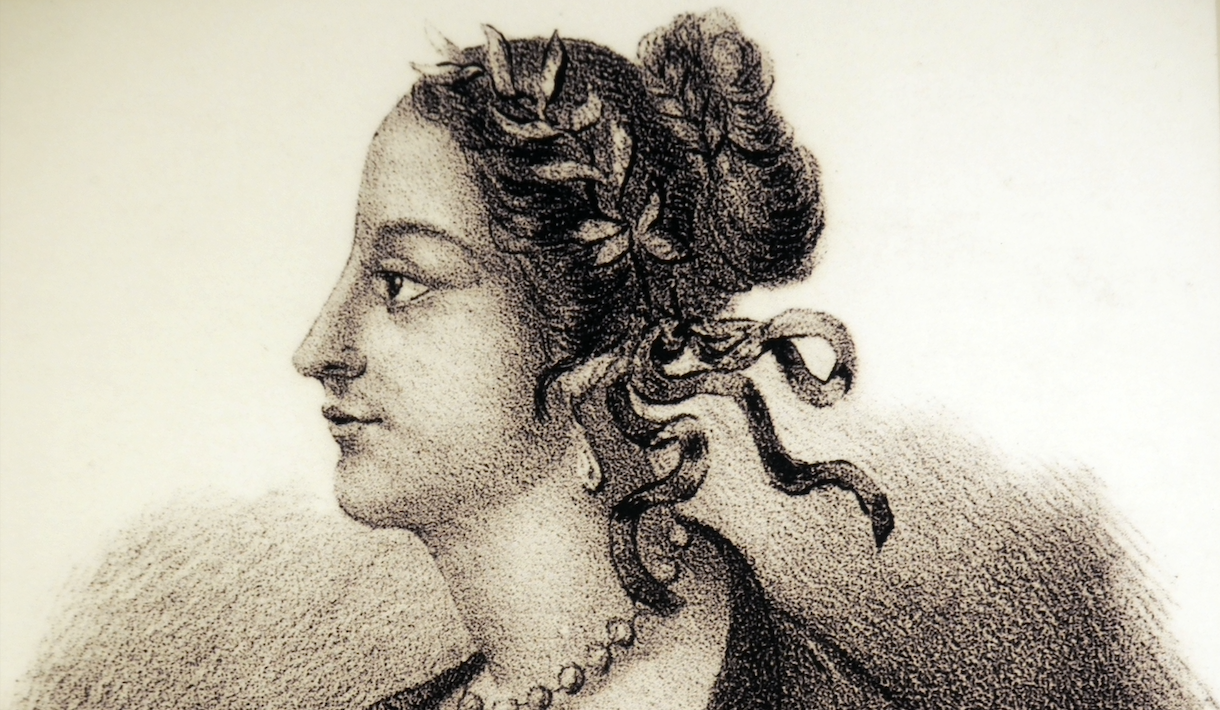
Curiously, four of the first seven women to earn doctoral degrees were from Italy, beginning with Elena Cornaro Piscopia at the University of Padua. Next came Laura Bassi, who earned her degree from the University of Bologna in 1732. There she distinguished herself in physics, mathematics, and natural philosophy and became the first salaried woman to teach at a university (she was at one time the university’s highest paid employee). Bassi was the chief popularizer of Newtonian physics in Italy in the 18th century and enjoyed significant support from the Archbishop of Bologna, Prospero Lambertini, who — when he became Pope Benedict XIV — elected her as the 24th member of an elite scientific society called the Benedettini.
“Bassi was widely admired as an excellent experimenter and one of the best teachers of Newtonian physics of her generation,” says Paula Findlen, Stanford professor of history. “She inspired some of the most important male scientists of the next generation while also serving as a public example of a woman shaping the nature of knowledge in an era in which few women could imagine playing such a role.” She also played the role available to most women of the time as a mother of eight and wife of Giuseppe Veratti, also a scientist.
Bassi was not allowed to teach classes of men at the university — only special lectures open to the public. But in 1740, she was granted permission to lecture at her home, and her fame spread, as Findlen writes at Physics World:
Bassi was widely known throughout Europe, and as far away as America, as the woman who understood Newton. The institutional recognition that she received, however, made her the emblematic female scientist of her generation. A university graduate, salaried professor and academician (a member of a prestigious academy), Bassi may well have been the first woman to have embarked upon a full-fledged scientific career.
Poems were written about Bassi’s successes in demonstrating Newtonian optics; “news of her accomplishments traveled far and wide,” reaching the ear of Benjamin Franklin, whose work with electricity Bassi followed keenly. In Bologna, surprise at Bassi’s achievements was tempered by a culture known for “celebrating female success.” Indeed, the city was “jokingly known as a ‘paradise for women,’” writes Findlen. Bassi’s father was determined that she have an education equal to any of her class, and her family inherited money that had been equally divided between daughters and sons for generations; her sons “found themselves heirs to the property that came to the family through Laura’s maternal line,” notes the Stanford University collection of Bassi’s personal papers.
Bassi’s academic work is held at the Academy of Sciences in Bologna. Of the papers that survive, “thirteen are on physics, eleven are on hydraulics, two are on mathematics, one is on mechanics, one is on technology, and one is on chemistry,” writes a University of St. Andrew’s biography. In 1776, a year usually remembered for the formation of a government of leisured men across the Atlantic, Bassi was appointed to the Chair of Experimental Physics at Bologna, an appointment that not only meant her husband became her assistant, but also that she became the “first woman appointed to a chair of physics at any university in the world.”
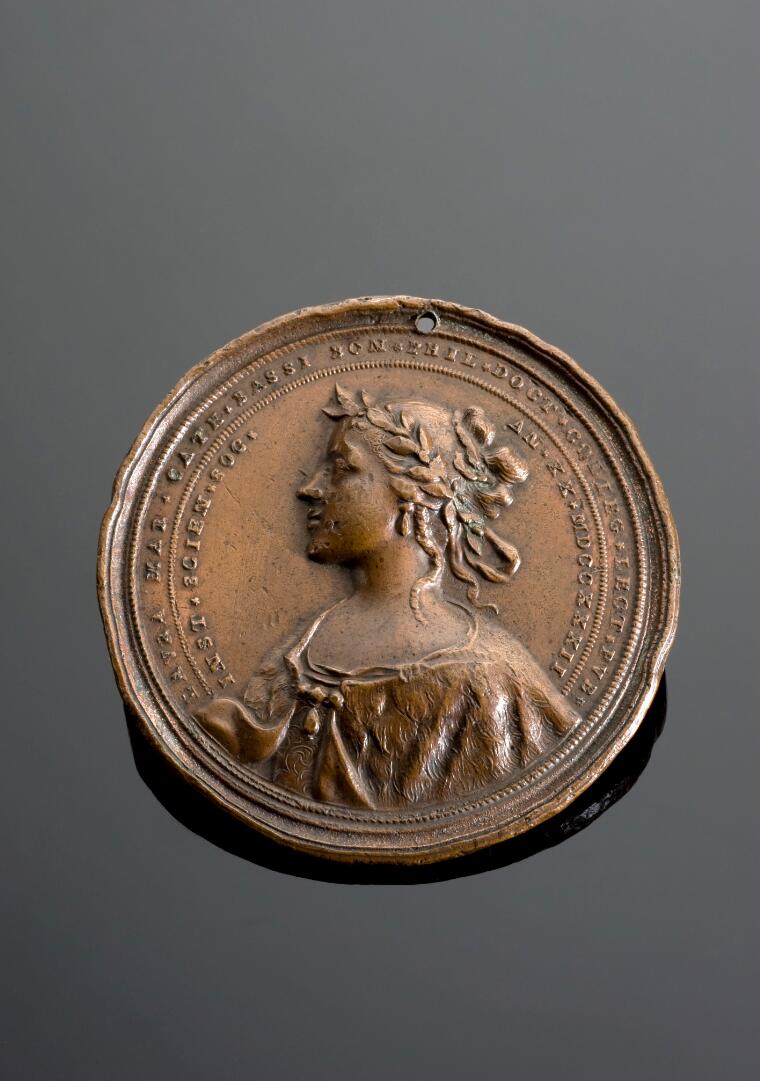
Bologna was proud of its distinguished daughter, but perhaps still thought of her as an oddity and a token. As Dr. Eleonora Adami notes in a charming biography at sci-fi illustrated stories, the city once struck a medal in her honor, “commemorating her first lecture series with the phrase ‘Soli cui fas vidisse Minervam,’” which translates roughly to “the only one allowed to see Minerva.” But her example inspired other women, like Cristina Roccati, who earned a doctorate from Bologna in 1750, and Dorothea Erxleben, who became the first woman to earn a Doctorate in Medicine four years later at the University of Halle. Such singular successes did not change the patriarchal culture of academia, but they started the trickle that would in time become several branching streams of women succeeding in the sciences.
Related Content:
Jocelyn Bell Burnell Changed Astronomy Forever; Her Ph.D. Advisor Won the Nobel Prize for It
Women Scientists Launch a Database Featuring the Work of 9,000 Women Working in the Sciences
Real Women Talk About Their Careers in Science
Josh Jones is a writer and musician based in Durham, NC. Follow him at @jdmagness
Read More...Alice in Wonderland Syndrome: The Real Perceptual Disorder That May Have Shaped Lewis Carroll’s Creative World
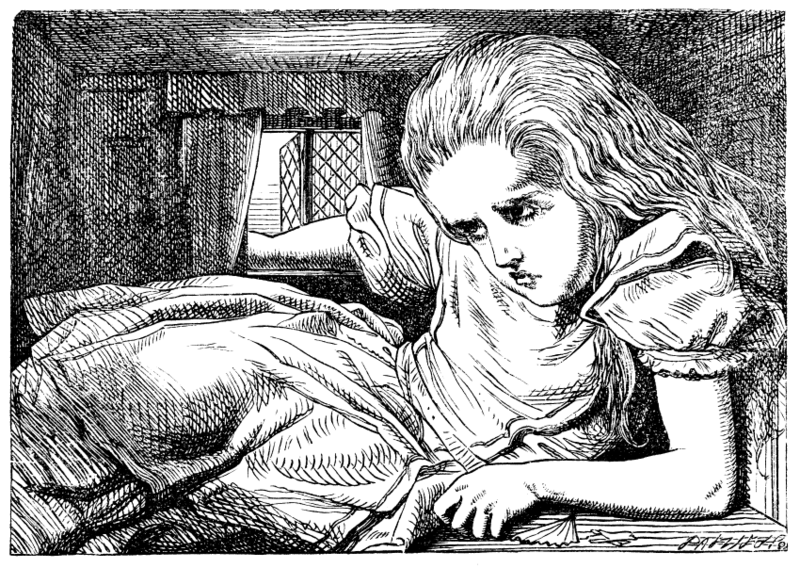
Alice’s Adventures in Wonderland isn’t just a beloved children’s story: it’s also a neuropsychological syndrome. Or rather the words “Alice in Wonderland,” as Lewis Carroll’s book is commonly known, have also become attached to a condition that, though not harmful in itself, causes distortions in the sufferer’s perception of reality. Other names include dysmetropsia or Todd’s syndrome, the latter of which pays tribute to the consultant psychiatrist John Todd, who defined the disorder in 1955. He described his patients as seeing some objects as much larger than they really were and other objects as much smaller, resulting in challenges not entirely unlike those faced by Alice when put by Carroll through her growing-and-shrinking paces.
Todd also suggested that Carroll had written from experience, drawing inspiration from the hallucinations he experienced when afflicted with what he called “bilious headache.” The transformations Alice feels herself undergoing after she drinks from the “DRINK ME” bottle and eats the “EAT ME” cake are now known, in the neuropsychological literature, as macropsia and micropsia.
“I was in the kitchen talking to my wife,” writes novelist Craig Russell of one of his own bouts of the latter. “I was hugely animated and full of energy, having just put three days’ worth of writing on the page in one morning and was bursting with ideas for new books. Then, quite calmly, I explained to my wife that half her face had disappeared. As I looked around me, bits of the world were missing too.”
Though “many have speculated that Lewis Carroll took some kind of mind-altering drug and based the Alice books on his hallucinatory experiences,” writes Russell, “the truth is that he too suffered from the condition, but in a more severe and protracted way,” combined with ocular migraine. Russell also notes that the sci-fi visionary Philip K. Dick, though “never diagnosed as suffering from migrainous aura or temporal lobe epilepsy,” left behind a body of work that has has given rise to “a growing belief that the experiences he described were attributable to the latter, particularly.” Suitably, classic Alice in Wonderland syndrome “tends to be much more common in childhood” and disappear in maturity. One sufferer documented in the scientific literature is just six years old, younger even than Carroll’s eternal little girl — presumably, an eternal seer of reality in her own way.
Related Content:
A Beautiful 1870 Visualization of the Hallucinations That Come Before a Migraine
Lewis Carroll’s Photographs of Alice Liddell, the Inspiration for Alice in Wonderland
Based in Seoul, Colin Marshall writes and broadcasts on cities, language, and culture. His projects include the Substack newsletter Books on Cities, the book The Stateless City: a Walk through 21st-Century Los Angeles and the video series The City in Cinema. Follow him on Twitter at @colinmarshall or on Facebook.
Read More...The Strange Magic of Jimi Hendrix’s “Voodoo Chile”
Poor Polyphonic. He was just about to deliver another perfectly mixed treatise on a classic rock magnum opus when the YouTube algorithm and the Jimi Hendrix Estate stepped in to stop him before publishing. So while you can watch this real-time explication of Hendrix’s more-than-just-a-jam “Voodoo Chile” with just the the graphics and the narration, you should cue up the 15 minute track however you can (for example on Spotify), and then press play when when the video gives the signal. (This might be the first YouTube explainer video to ask for copyright-skirting help.)
And anyway, you should have a copy of Electric Ladyland, right? It’s the one where Hendrix and the Experience really push all the boundaries, taking rock, blues, jazz, psychedelia, sci-fi, everything…all out as far as possible in the studio. It’s the one that introduced future members of the Band of Gypsies. And it’s the one that hints of everything that might have been, if Hendrix hadn’t passed away soon after.
Now, classic rock radio usually plays the much shorter and less laid back “Voodoo Child (Slight Return)” that closes the album. But this essay is about the longest track on Electric Ladyland, the one that ends side one. This is the track that Hendrix wanted to sound like a light night jam at New York club The Scene—and which he recorded after one particular night doing just that. He taped the audience effects soon after. Steve Winwood is on keyboards. Jack Casady from Jefferson Airplane plays bass. And Mitch Mitchell turns in one of his greatest performances and solos.
In the lyrics, Polyphonic notes, Hendrix connects the blues to his Cherokee heritage and to voodoo, to sex, and then beyond into science fiction landscapes. The song is a self-portrait, showing the past, the influence, the training, and then the potential that music, magic, and (let’s face it) LSD could bring. The band is vibing. Winwood drops riffs that are more British folk than Chicago blues. Hendrix strays far beyond the orbit of blues, swings past it one more time on his own slight return, and then explodes into stardust.
Polyphonic’s video also looks beautiful and perfectly intersperses his critique with the song’s main sections. It may have sounded like a jam, but Hendrix carefully designed it to flow the way it does. And Polyphonic follows suit. It is a highly enjoyable walk through a track (again find it on Spotify here) many already know, reawakening a sense of wonder about all its inherent, strange genius.
Related Content:
How Science Fiction Formed Jimi Hendrix
Jimi Hendrix’s Home Audio System & Record Collection Gets Recreated in His London Flat
Behold Moebius’ Many Psychedelic Illustrations of Jimi Hendrix
Ted Mills is a freelance writer on the arts who currently hosts the Notes from the Shed podcast and is the producer of KCRW’s Curious Coast. You can also follow him on Twitter at @tedmills, and/or watch his films here.
Read More...Support Us
We're hoping to rely on loyal readers, rather than erratic ads. Please click the Donate button and support Open Culture. You can use Paypal, Venmo, Patreon, even Crypto! We thank you!

About Us

Open Culture scours the web for the best educational media. We find the free courses and audio books you need, the language lessons & educational videos you want, and plenty of enlightenment in between.
Advertise With Us
FREE UPDATES!
GET OUR DAILY EMAIL
Get the best cultural and educational resources on the web curated for you in a daily email. We never spam. Unsubscribe at any time.
FOLLOW ON SOCIAL MEDIA
Open Culture editor Dan Colman scours the web for the best educational media. He finds the free courses and audio books you need, the language lessons & movies you want, and plenty of enlightenment in between.
Advertise With Us

