The Ukulele Orchestra of Great Britain Performs The Clash’s “Should I Stay Or Should I Go”
Over the years, we’ve featured The Ukulele Orchestra of Great Britain performing covers of various rock classics–from the Rolling Stones’ “Satisfaction” and Bowie’s “Heroes,” to Nirvana’s “Smells Like Teen Spirit” and Talking Heads’ “Psycho Killer.” Recorded in London back in 2005, this clip features the Orchestra performing The Clash’s ‘Should I Stay Or Should I Go.’ The performance is an outtake from the DVD, Anarchy in the Ukulele, which is available in digital format. Enjoy.
If you would like to support the mission of Open Culture, consider making a donation to our site. It’s hard to rely 100% on ads, and your contributions will help us continue providing the best free cultural and educational materials to learners everywhere. You can contribute through PayPal, Patreon, and Venmo (@openculture). Thanks!
Related Content:
Jimi Hendrix’s “Voodoo Child” Shredded on the Ukulele
George Harrison Explains Why Everyone Should Play the Ukulele
Read More...
Watch a Never-Aired TV Profile of James Baldwin (1979)
In 1979, just a couple of months into his stint with 20/20, ABC’s fledgling television news magazine, producer and documentarian Joseph Lovett was “beyond thrilled” to be assigned an interview with author James Baldwin, whose work he had discovered as a teen.
Knowing that Baldwin liked to break out the bourbon in the afternoon, Lovett arranged for his crew to arrive early in the morning to set up lighting and have breakfast waiting before Baldwin awakened:
He hadn’t had a drop to drink and he was brilliant, utterly brilliant. We couldn’t have been happier.
Pioneering journalist Sylvia Chase conducted the interview. The segment also included stops at Lincoln Center for a rehearsal of Baldwin’s play, The Amen Corner, and the Police Athletic League’s Harlem Center where Baldwin (and perhaps the camera) seems to unnerve a teen reporter, cupping his chin at length while answering his question about a Black writer’s chances:
There never was a chance for a Black writer. Listen, a writer, Black or white, doesn’t have much of a chance. Right? Nobody wants a writer until he’s dead. But to answer your question, there’s a greater chance for a Black writer today than there ever has been.
In the Manhattan building Baldwin bought to house a number of his close-knit family, Chase corners his mother in the kitchen to ask if she’d had any inkling her son would become such a success.
“No, I didn’t think that,” Mrs. Baldwin cuts her off. “But I knew he had to write.”
Baldwin speaks frankly about outing himself to the general public with his 1956 novel Giovanni’s Room and about what it means to live as a Black man in a nation that has always favored its white citizens:
The American sense of reality is dictated by what Americans are trying to avoid. And if you’re trying to avoid reality, how can you face it?
Nearly 35 years before Black Lives Matter’s formation, he tackles the issue of white fragility by telling Chase, “Look, I don’t mean it to you personally. I don’t even know you. I have nothing against you. I don’t know you personally, but I know you historically. You can’t have it both ways. You can’t swear to the freedom of all mankind and put me in chains.”
The finished piece is a superb, 60 Minutes-style profile that covers a lot of ground, and yet, 20/20 chose not to air it.
After the show ran Chase’s interview with Michael Jackson, producer Lovett inquired as to the delay and was told that no one would be interested in a “queer, Black has-been”:
I was stunned, I was absolutely stunned, because in my mind James Baldwin was no has-been. He was a classic American writer, translated into every language in the world, and would live on forever, and indeed he has. His courage and his eloquence continue to inspire us today.
On June 24, Joseph Lovett will moderate James Baldwin: Race, Media, and Psychoanalysis, a free virtual panel discussion centering on his 20/20 profile of James Baldwin, with psychoanalysts Victor P. Bonfilio and Annie Lee Jones, and Baldwin’s niece, author Aisha Karefa-Smart. Register here.
H/T to author Sarah Schulman
Related Content:
Watch the Famous James Baldwin-William F. Buckley Debate in Full, With Restored Audio (1965)
Listen to James Baldwin’s Record Collection in a 478-track, 32-Hour Spotify Playlist
Ayun Halliday is an author, illustrator, theater maker and Chief Primatologist of the East Village Inky zine. Follow her @AyunHalliday.
Read More...Wikipedia’s Surprising Power in Shaping Science: A New MIT Shows How Wikipedia Shapes Scientific Research

If you were in high school or college when Wikipedia emerged, you’ll remember how strenuously we were cautioned against using such an “unreliable source” for our assignments. If you went on to a career in science, however, you now know how important a role Wikipedia plays in even professional research. It may thus surprise you to learn that students still get more or less the same warning about what, two decades later, has become the largest encyclopedia and fifth most-visited web site in the world. “Many of us use Wikipedia as a source of information when we want a quick explanation of something,” say MIT’s citation guidelines. “However, Wikipedia or other wikis, collaborative information sites contributed to by a variety of people, are not considered reliable sources for academic citation.”
That quotation appears, somewhat ironically, in a recent MIT research paper called “Science is Shaped by Wikipedia: Evidence From a Randomized Control Trial.” Its authors, Neil C. Thompson from MIT and Douglas Hanley from the University of Pittsburgh, use both “Big Data” and experimental approaches to support their claim that “incorporating ideas into a Wikipedia article leads to those ideas being used more in the scientific literature.”
Testing the existence of an underlying causal relationship, they “commissioned subject matter experts to create new Wikipedia articles on scientific topics not covered in Wikipedia.” Half of these articles were added to Wikipedia, and half retained as a control group. “Reviewing the relevant journal articles published later, they find that “the word-usage patterns from the treatment group show up more in the prose in the scientific literature than do those from the control group.”
In other words, Wikipedia does indeed appear to shape science — or as Wharton professor Ethan Mollick put it on Twitter, “The secret heart of academia is… Wikipedia.” Expanding on the idea, he added that “Wikipedia is used like a review article,” which surveys the current state of a particular scientific field. “Review articles are extremely influential on the direction of scientific research, and while Wikipedia articles are generally less influential, there are more of them, they are more up-to-date, and they are free.” That last point — and the implied contrast to traditional, scientific journals with their often shockingly high subscription fees — becomes a key point in Thompson and Hanley’s advocacy for public repositories of knowledge in general, with their power to galvanize research across the whole world. The power of open culture is considerable; the power of open science, perhaps even more so.
You can read Hanley and Thompson’s study on the power of Wikipedia free online: “Science is Shaped by Wikipedia: Evidence From a Randomized Control Trial.”
Related Content:
Listen to Wikipedia: A Web Site That Turns Every Wikipedia Edit Into Ambient Music in Real Time
NASA’s New Online Archive Puts a Wealth of Free Science Articles Online
Royal Society Opens Online Archive; Puts 60,000 Papers Online
Free Online Courses: The Sciences
200 Free Textbooks: A Meta Collection
Based in Seoul, Colin Marshall writes and broadcasts on cities, language, and culture. His projects include the Substack newsletter Books on Cities, the book The Stateless City: a Walk through 21st-Century Los Angeles and the video series The City in Cinema. Follow him on Twitter at @colinmarshall or on Facebook.
Read More...Hear the Amati “King” Cello, the Oldest Known Cello in Existence (c. 1560)
The Stradivari family has received all of the popular acclaim for perfecting the violin. But we should know the name Amati — in whose Cremona workshop Antonio Stradivari apprenticed in the 17th century. The violin-making family was immensely important to the refinement of classical instruments. “Born around 1505,” writes Jordan Smith at CMuse, founder Andrea Amati “is considered the father of modern violinmaking. He made major steps forward in improving the design of violins, including through the development of sound-holes” into their now-familiar f‑shape.
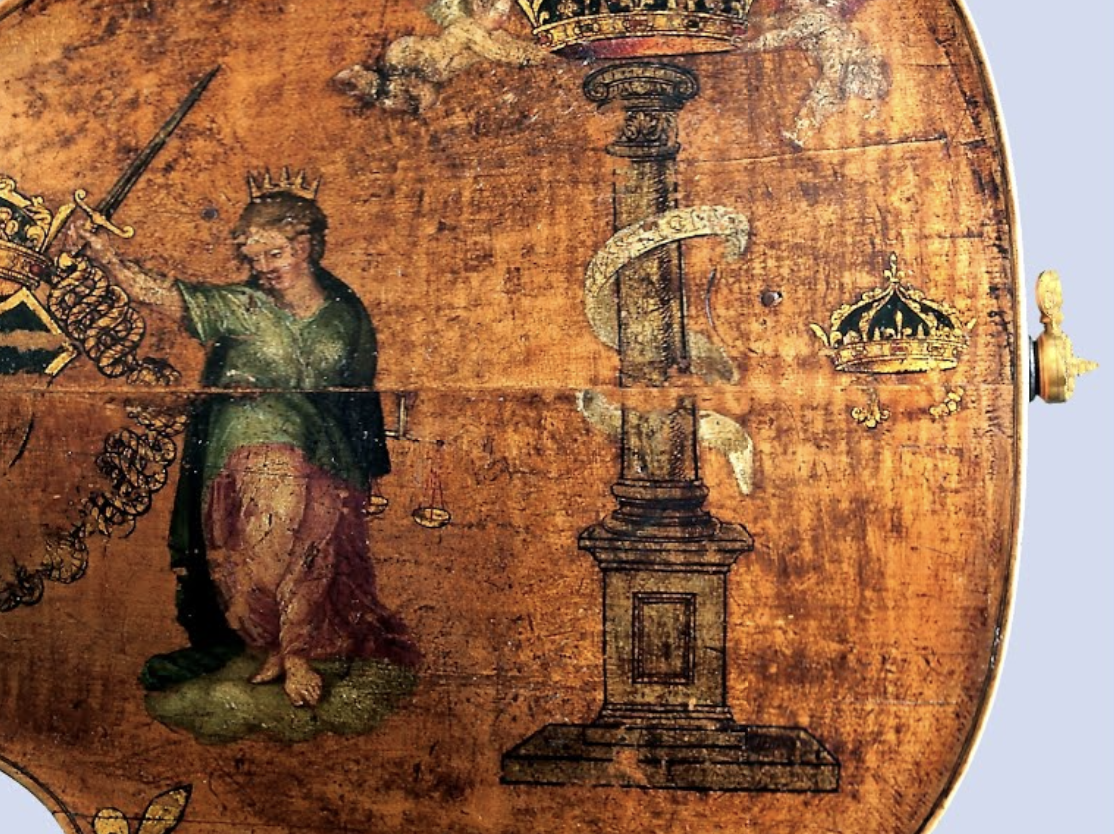
Among Amati’s creations is the so-called “King” cello, made in the mid-1500s, part of a set of 38 stringed instruments decorated and “painted in the style of Limoges porcelain” for the court of King Charles IX of France.
The instrument is now the oldest known cello and “one of the few Amati instruments still in existence.” And yet, calling the “King” a cello is a bit of a historical stretch. “The terminology referring to the early forms of cello is convoluted and inconsistent,” Matthew Zeller notes at the Strad. “Andrea Amati would likely have referred to the ‘King’ as the basso (bass violin).”
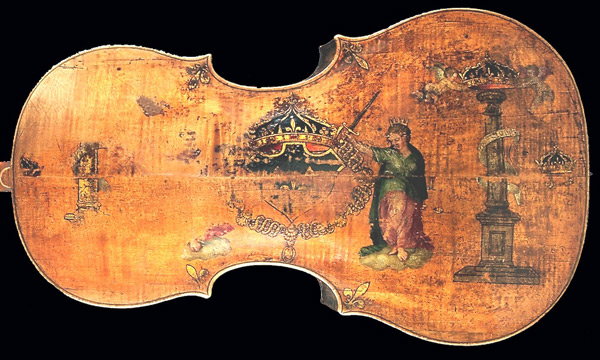
Images courtesy of National Music Museum
The instrument remained in the French court until the French Revolution, after which the basso fell out of favor and the “King” was “drastically reduced in size” through an alteration process that “stood at the forefront of musical instrument development during the last quarter of the 18th century and throughout the 19th,” a way transform obsolete forms into those more suitable for contemporary music. “By 1801,” Zeller writes, “the date that the ‘King’ might have been reduced, large-format bassos were obsolete, discarded in favour of the smaller-bodied cellos.”

Zeller has studied the extensive alteration of the “King” cello (including a new neck and enlargement from three strings to four) with CT scans of its joints and examinations of now-distorted decorations. The reduction means we cannot hear its original glory — and it was, by all accounts, a glorious instrument, “a member of a larger family of instruments of fixed measurements related together by profound mathematical, geometrical, and acoustical relationships of size and tone,” writes Yale conservator Andrew Dipper, “which gave the set the ability to perform, in unison, some of the world’s first orchestral music for bowed strings.”
We can, however, hear the “King” cello (briefly, at the top) in its current (circa 1801), form, and it still sounds stunning. Cellist Joshua Koestenbaum visited the cello at its home in the National Music Museum in Vermillion, South Dakota in 2005 to play it. “It didn’t take much effort to find the instrument’s naturally sweet, warm sound,” he says. “It was incredibly easy to play — comfortable, pleasurable, forgiving, and user-friendly…. I felt at home.” Learn more about the latest research on the “King” cello at Google Arts & Culture and the Strad.
Related Content:
Why Violins Have F‑Holes: The Science & History of a Remarkable Renaissance Design
Josh Jones is a writer and musician based in Durham, NC. Follow him at @jdmagness
Read More...A Beautiful, High-Resolution Map of the Internet (2021)
The beginnings of the Internet were uncharted territory, especially before the days of graphic browsers. You had a number, you dialed up to a location. Certain locations were named after their host universities or government sites and that made sense in an old-school telephone exchange way. But the rest was just a vast ocean of data, of strange lands, and many, many barriers. How big, exactly, is the internet? And how do we measure it? What is the “space” of cyberspace?
There have been maps that overlay the internet’s main landlines onto the map of the earth—this Vox article shows the spidery web growing from the first four locations of ARPANET until the whole world is connected. But that’s not how we think of it. Surely Open Culture is always where you, dear reader, reside, and this writer’s undisclosed location has nothing to do with it. Maybe the internet is really the space that it takes up in our minds, in our lives, and in the amount of internet traffic.

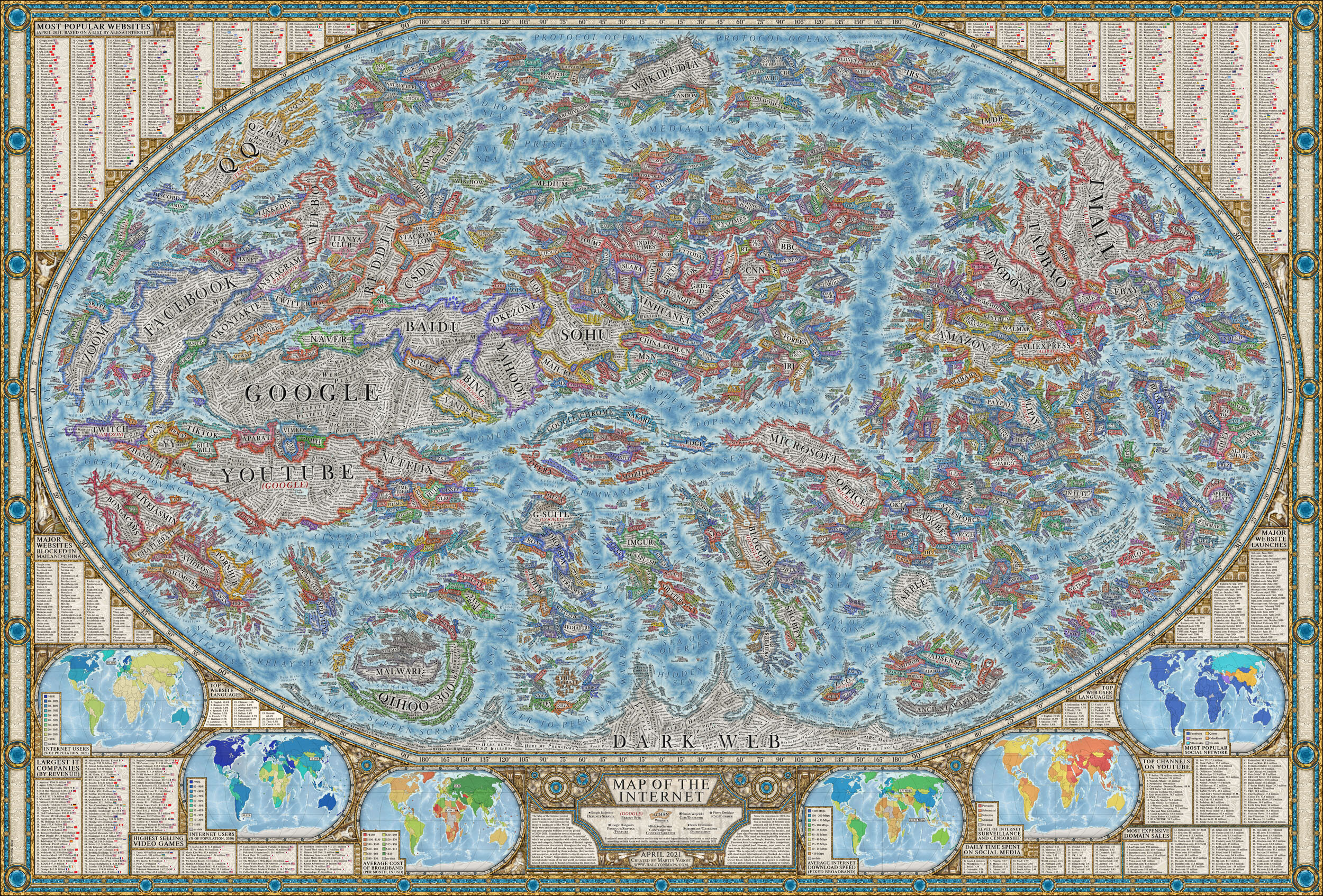
Amateur graphic designer Martin Vargic visualized those spaces as countries on a vast globe inspired by National Geographic Magazine. (Although National Geographic borrowed its cartographic style from some of the first printed maps of the world.) Vargic first published his map in 2014 when he was a student in Slovakia. And now he has decided to update the map for 2021. (See the map in high resolution here.) Large continents represent the main websites of the Internet: Facebook, Google, Apple, Amazon. The seas represent the aforementioned ocean of data under different names: Ocean of Information, North Connection Ocean, etc. To compare his relatively spare original map to the one he just released is to notice how much more crowded this world has become, and how divided.
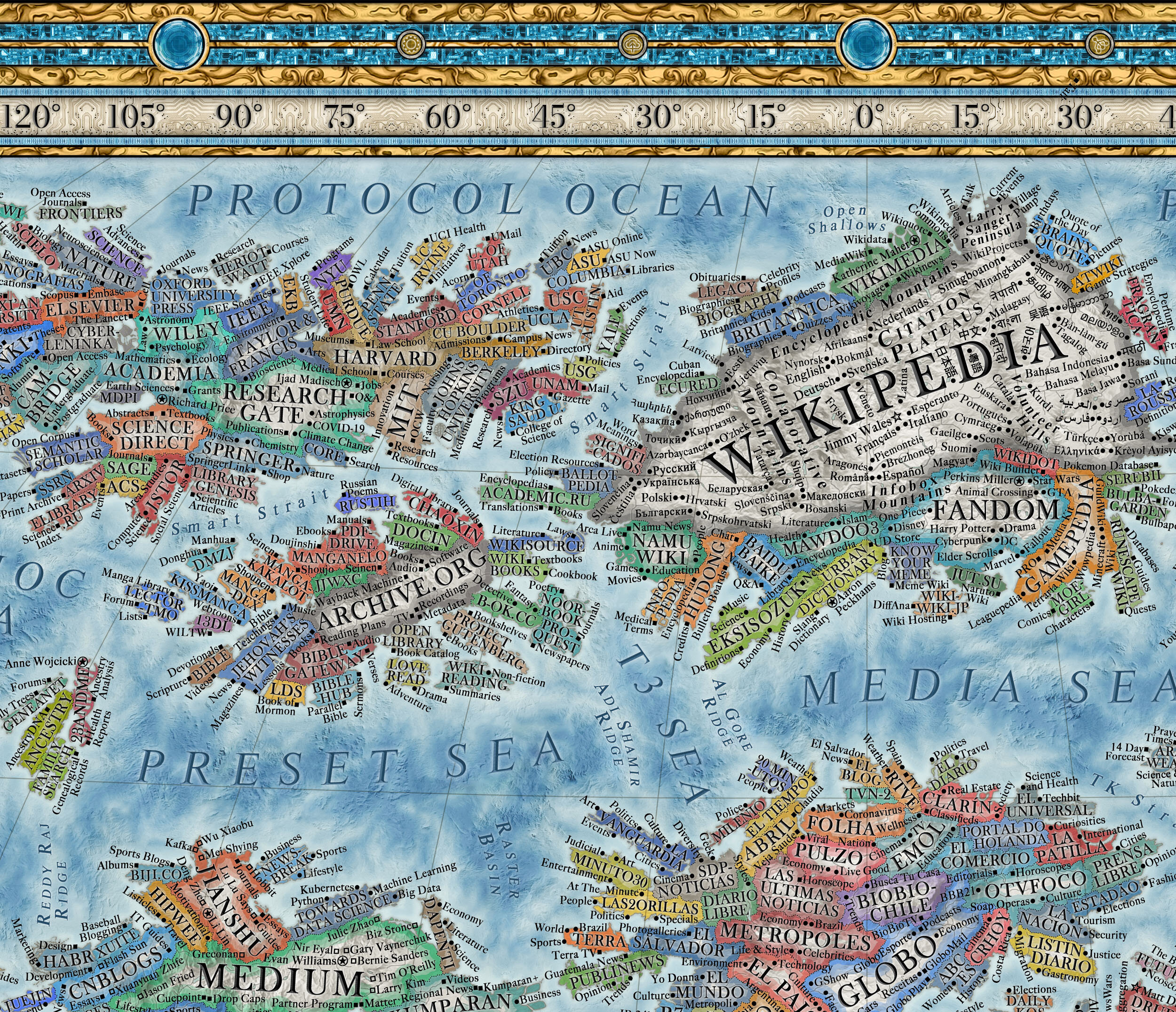
Vargic based the relative size of each website on its average traffic between January 2020 and January 2021, according to Alexa Rank, the Amazon-owned Alexa Internet’s measure of how popular a website is, calculated by unique users and page views.
However, the center of the map is now different. This now depicts the “core and backbone of the Internet as we know it,” Vargic said. This means a core of service providers surrounded by larger islands of web browsers (Chrome, Firefox, et al).
While the 2014 map considered website size as the main organizer and contained around 200 websites, this version contains 3,000. The north of the globe features country clusters: a grouping of academic, research, and free education sites (wikipedia, archive.org, etc.), governmental websites to the east and conspiracy QAnon lands to the west.
The Antarctica of the map? The Dark Web, where the Onion isn’t a parody news site and TOR isn’t the sci-fi/fantasy publisher.
You might find some of Vargic’s decisions odd, or you might just spend your time wondering how much of the internet is indeed an unknown land, with large “countries” you’ve never heard of, but with millions of “residents”. It might not be real, but Vargic’s map will put you in an exploratory mood while you light off for the territories. You can view it in a high resolution format here. Purchase it as a poster here.
Related Content:
The History of the Internet in 8 Minutes
How the Internet Archive Digitizes 3,500 Books a Day–the Hard Way, One Page at a Time
Ted Mills is a freelance writer on the arts who currently hosts the Notes from the Shed podcast and is the producer of KCRW’s Curious Coast. You can also follow him on Twitter at @tedmills, and/or watch his films here.
Read More...Yes’ Rick Wakeman Explores Vivaldi’s Four Seasons, and Why It Was the First Concept Album
In this 2015 production, Yes keyboardist Rick Wakeman revisits Antonio Vivaldi’s The Four Seasons, and makes the case for why “it was so far ahead of its time that it was actually the first ever concept album, making Vivaldi the world’s first rock superstar.”
“Uncovering the dark rumours surrounding the churches, orphanages and canals of Venice, Rick Wakeman sets out to investigate the extraordinary life of Antonio Vivaldi. From 18th century scandals to interviews with fellow musician Mike Rutherford, uncover the mystery behind one of the world’s favourite composers.” Rick Wakeman: Vivaldi’s Four Seasons appears on the “Rick Wakeman’s World” YouTube channel.
If you would like to support the mission of Open Culture, consider making a donation to our site. It’s hard to rely 100% on ads, and your contributions will help us continue providing the best free cultural and educational materials to learners everywhere. You can contribute through PayPal, Patreon, and Venmo (@openculture). Thanks!
Related Content:
Rick Wakeman’s Prog-Rock Opera Adaptation of George Orwell’s 1984
14-Year-Old Girl’s Blistering Heavy Metal Performance of Vivaldi
Vivaldi’s Four Seasons Brought to Life in Sand Animations by the Hungarian Artist Ferenc Cakó
Read More...
The Mistake Waltz: Watch the Hilarious Ballet by Legendary Choreographer Jerome Robbins
So often mistakes are the most memorable part of live performance.
In Jerome Robbins’ The Concert (or The Perils of Everybody), they’re built in.
The portion set to Chopin’s Waltz in E Minor, above, has earned the nickname The Mistake Waltz. It’s an anthology of screw ups that will be familiar to anyone who’s attended a few amateur ballet productions and school recitals.
When the entire ensemble is meant to be traveling in the same direction or synchronizing swanlike gestures, the one who’s egregiously out of step is a guaranteed standout… if not the audience’s flat out favorite.
Robbins generously spreads the clowning between all six members of the corps, getting extra mileage from the telegraphed irritation in every indiscreetly attempted correction.
Performed well, the silliness seems almost improvisational, but as with all of this legendary choreographer’s work, the spontaneous beats are very, very specific.
It only works if the dancers have the technical prowess and the comic chops to pull it off. Les Ballets Trockadero de Monte Carlo aside, this can present a sizable casting challenge.
Robbins also felt that The Concert should be presented sparingly, to keep the jokes from becoming stale.
Individual companies have some agency over their costumes, but other than that, it is executed just as it was in its 1956 debut with the New York City Ballet.
Former NYCB lead dancer Peter Boal, who was 10 when he played Cupid in Robbins’ Mother Goose, has made The Concert part of Pacific Northwest Ballet’s repertoire. He revealed another side of the exacting Robbins in a personal essay in Dance Magazine:
He had the unique ability to become kid-like in the studio, giggling with others and often laughing robustly at his own jokes. He was certainly his own best audience for The Concert. How many times had he seen those gags and yet fresh, spontaneous laughter erupted from him as if it was a first telling.
Related Content:
Ballet Dancers Do Their Hardest Moves in Slow Motion
Radiohead Ballets: Watch Ballets Choreographed Creatively to the Music of Radiohead
The Dance Theatre of Harlem Dances Through the Streets of NYC: A Sight to Behold
Ayun Halliday is an author, illustrator, theater maker and Chief Primatologist of the East Village Inky zine. Join her Necromancers of the Public Domain: The Periodical Cicada, a free virtual variety show honoring the 17-Year Cicadas of Brood X. Follow her @AyunHalliday.
Read More...
When Neil Young & Rick “Super Freak” James Formed the 60’s Motown Band, The Mynah Birds
At the height of Motown’s powers in the 1960s they were setting trends, not chasing them, but even that record company fell under the spell of the British Invasion. Sure, the jukebox R’n’B singles that made their way across the Atlantic were in the DNA of The Beatles, Rolling Stones, and the Who, but in the mid’60’s the label decided they needed a beat group of their own. That’s how one of the weirdest tales of pop music unfolded, and would have stayed a tiny footnote if it weren’t for the future fame of two of the Mynah Birds’ members: funk overlord Rick James and folk-rocker-noisemaker Neil Young.
Yes, for a brief period of time they were in the same band together in Toronto, Canada, part of an exploding beat group scene that was mostly all white. “I was an authentic R&B singer living in a city where white musicians were striving to play authentic R&B,” Rick James wrote in his autobiography quoted in Bandsplaining’s above video. “That added to my status. It also got me laid.”
James Ambrose Johnson Jr., had been in Canada for two years already, having escaped the Vietnam draft by fleeing north in 1964. Saved from a bar brawl by future members of The Band, Levon Helm and Garth Hudson, he entered the music scene and adopted the name Ricky Matthews, as a way to hide his identity. The Mynah Birds began in 1964 and even put out a single on Columbia that went nowhere. They tried (and failed) again in 1965, with an ever-changing line-up. Ricky Matthews though, remained the dynamic lead singer.
Enter Neil Young. As Rick James tells it, he was looking to change their sound and he saw Neil Young playing in a coffeehouse and asked him to join. (James’ recollection is in the above video.) However, Kevin Plummer in the Torontoist has a different version:
One day—most likely in the fall of 1965, but some say in early 1966—Young was walking down Yorkville Avenue with an amp on his shoulder. As he passed, Palmer struck up a conversation. The Mynah Birds were, once again, without a lead guitarist, so he asked Young to join—despite the fact that Young only owned the twelve-string acoustic. “I had to eat,” Young is quoted in John Einarson’s Neil Young: Don’t Be Denied (Quarry Press, 1992). “I needed a job and it seemed like a good thing to do. I still liked playing and I liked Bruce so I went along. There was no pressure on me. It was the first time that I was in a band where I wasn’t calling the shots.”
As Young and James were soon to share a basement apartment and a whole lot of drugs, the participants can be forgiven for their hazy memories.
The video also conflates their svengali (John Craig Eaton, a department store heir who bankrolled the band and gave them rehearsal space) with their manager (folk singer and fan Morley Shelman). Whether it was Eaton, Shelman, or just luck, within two months of having Young in the band, and a reputation for wild, amphetamine-driven concerts—the band had signed a seven-year contract with Motown, the first mostly-white act to do so.
Neil Young remembered the first album sessions in an interview with Cameron Crowe:
We went in and recorded five or six nights, and if we needed something, or if they thought we weren’t strong enough, a couple of Motown singers would just walk right in. And they’d Motown us! A couple of ’em would be right there, and they’d sing the part. They’d just appear and we’d all do it together. If somebody wasn’t confident or didn’t have it, they didn’t say, ‘Well, let’s work on this.’ Some guy would just come in who had it. Then everybody was grooving. And an amazing thing happened—we sounded hot. And all of a sudden it was Motown. That’s why all those records sounded like that.
Rick James was worried about entering the States and being arrested for avoiding the draft. But in Detroit he was safe. It was when he returned that the trouble began—he discovered that Shelman had apparently spent their advance on a fancy new motorbike and a not-so-fancy heroin habit. A fight broke out and Shelman retaliated by ratting James out. James turned himself in to the American authorities and the Mynah Birds’ career—at least the James/Young version—ended. Only four of the tracks recorded for the album were ever released, two at the time as a single, the other two in 2006 as part of a Rhino Records Motown retrospective. More are rumored to exist but they remain hidden away in a vault at best, destroyed at worst.
Young would move to California soon after and join Buffalo Springfield. James, once out of jail, would make his way back into the recording industry, ironically returning to Motown. Band members Goldy McJohn and Nick St. Nicholas would form Steppenwolf. And through it all, James and Young remained friends.
Related Content:
Catch Stevie Wonder, Ages 12–16, in His Earliest TV Performances
Ted Mills is a freelance writer on the arts who currently hosts the Notes from the Shed podcast and is the producer of KCRW’s Curious Coast. You can also follow him on Twitter at @tedmills, and/or watch his films here.
Read More...Who Designed the 1980s Aesthetic?: Meet the Memphis Group, the Designers Who Created the 80s Iconic Look
For those who remember the 1980s, it can feel like they never left, so deeply ingrained have their designs become in the 21st century. But where did those designs themselves originate? Vibrant, clashing colors and patterns, bubbly shapes; “the geometric figures of Art Deco,” writes Sara Barnes at My Modern Met, “the color palette of Pop Art, and the 1950s kitsch” that inspired designers of all kinds came from a movement of artists who called themselves the Memphis Group, after Bob Dylan’s “Stuck Inside of Mobile with the Memphis Blues Again,” a song “played on repeat during their first meeting” in a tiny Milan apartment. “I think you’d be hard-pressed to think of any other design phenomenon that can be located as specifically to a group of people,” says Yale Center of British Art’s Glenn Adamson in the Vox explainer above,
Founded in December 1980 by designer Ettore Sottsass — known for his red Olivetti Valentine typewriter — and several like-minded colleagues, the movement made a deliberate attempt to disrupt the austere, clean lines of the 70s with work they described as “radical, funny, and outrageous.” They flaunted what had been considered “good taste” with abandon. Memphis design shows Bauhaus influences — though it rejected the “strict, straight lines of modernism,” notes Curbed. It taps the anarchic spirit of Dada, without the edgy, anarchist politics that drove that movement. It is mainly characterized by its use of laminate flooring materials on tables and lamps and the “Bacterio print,” the squiggle design which Sottsass created in 1978 and which became “Memphis’s trademark pattern.”
Memphis design shared with modernism another quality early modernists themselves fully embraced: “Nothing was commercially successful at the time,” says Barbara Radice, Sottsass’s widow and Memphis group historian. But David Bowie and Karl Lagerfield were early adopters, and the group’s 80s work eventually made them stars. “We came from being nobodies,” says designer Martine Bedin. By 1984, they were celebrated by the city of Memphis, Tennessee and given the key to the city. “They were waiting for us at the airport with a band,” Bedin remembers. “It was completely crazy.” The Memphis Group had officially changed the world of art, architecture, and design. The following year, Sottsass left the group, and it formally disbanded in 1987, having left its mark for decades to come.
By the end of the 80s, Memphis’ look had become pop culture wallpaper, informing the sets, titles, and fashions of TV staples like Saved by the Bell, which debuted in 1989. “Although their designs didn’t end up in people’s homes,” notes Vox — or at least not right away — “they inspired many designers working in different mediums.” Find out above how “everything from fashion to music videos became influenced” by the loud, playful visual vocabulary of the Memphis Group artists, and learn more about the designers of “David Bowie’s favorite furniture” here.
Related Content:
Meet the Memphis Group, the Bob Dylan-Inspired Designers of David Bowie’s Favorite Furniture
Watch Brian Eno’s “Video Paintings,” Where 1980s TV Technology Meets Visual Art
Josh Jones is a writer and musician based in Durham, NC. Follow him at @jdmagness
Read More...Meet the Inventor of Karaoke, Daisuke Inoue, Who Wanted to “Teach the World to Sing”
Daisuke Inoue has been honored with a rare, indeed almost certainly unique combination of laurels. In 1999, Time magazine named him among the “Most Influential Asians of the Century.” Five years later he won an Ig Nobel Prize, which honors particularly strange and risible developments in science, technology, and culture. Inoue had come up with the device that made his name decades earlier, in the early 1970s, but its influence has proven enduring still today. It is he whom history now credits with the invention of the karaoke machine, the assisted-singing device that the Ig Nobel committee, awarding its Peace Prize, described as “an entirely new way for people to learn to tolerate each other.”
The achievement of an Ig Nobel recipient should be one that “makes people laugh, then think.” Over its half-century of existence, many have laughed at karaoke, especially as ostensibly practiced by the drunken salarymen of its homeland. But upon further consideration, few Japanese inventions have been as important.
Hence its prominent inclusion in Japanologist Matt Alt’s recent book Pure Invention: How Japan’s Pop Culture Conquered the World. As Alt tells its story, the karaoke machine emerged out of Sannomiya, Kobe’s red-light district, which might seem an unlikely birthplace — until you consider its “some four thousand drinking establishments crammed into a cluster of streets and alleys just a kilometer in radius.”
In these bars Inoue worked as a hiki-katari, a kind of freelance musician who specialized in “sing-alongs, retuning their performances on the fly to match the singing abilities and sobriety levels of paying customers.” This was karaoke (the Japanese term means, literally, “empty orchestra”) before karaoke as we know it. Inoue had mastered its rigors to such an extent that he became known as “Dr. Sing-along,” and the sheer demand for his services inspired him to create a kind of automatic replacement he could send to extra gigs. The 8 Juke, as he called it, amounted to an 8‑track car stereo connected to a microphone, reverb box, and coin slot. Pre-loaded with instrumental covers of bar-goers’ favorite songs, the 8 Jukes Inoue made soon started taking in more coins than they could handle.
“When I made the first Juke 8s, a brother-in-law suggested I take out a patent,” Inoue said in a 2013 interview. “But at the time, I didn’t think anything would come of it.” Having assembled his invention from off-the-shelf components, he didn’t think there was anything patentable about it, and unknown to him, at least one similar device had already been built elsewhere in Japan. But what Inoue invented, as Alt puts it, was “the total package of hardware and custom software that allowed karaoke to grow from a local fad into an enormous global business.” Had it been patented, says Inoue himself, “I don’t think karaoke would have grown like it did.” Would it have grown to have, as Alt puts it, “profound effects on the fantasy lives of Japanese and Westerners both”? And would Inoue have found himself onstage more than 30 years later at the Ig Nobels, leading a crowd of Americans in a round of “I’d Like to Teach the World to Sing”?
Related Content:
The 10 Commandments of Chindōgu, the Japanese Art of Creating Unusually Useless Inventions
This Man Flew to Japan to Sing ABBA’s “Mamma Mia” in a Big Cold River
Karaoke-Style, Stephen Colbert Sings and Struts to The Rolling Stones’ “Brown Sugar”
Based in Seoul, Colin Marshall writes and broadcasts on cities, language, and culture. His projects include the Substack newsletter Books on Cities, the book The Stateless City: a Walk through 21st-Century Los Angeles and the video series The City in Cinema. Follow him on Twitter at @colinmarshall or on Facebook.
Read More...Support Us
We're hoping to rely on loyal readers, rather than erratic ads. Please click the Donate button and support Open Culture. You can use Paypal, Venmo, Patreon, even Crypto! We thank you!

About Us

Open Culture scours the web for the best educational media. We find the free courses and audio books you need, the language lessons & educational videos you want, and plenty of enlightenment in between.
Advertise With Us
FREE UPDATES!
GET OUR DAILY EMAIL
Get the best cultural and educational resources on the web curated for you in a daily email. We never spam. Unsubscribe at any time.
FOLLOW ON SOCIAL MEDIA
Open Culture editor Dan Colman scours the web for the best educational media. He finds the free courses and audio books you need, the language lessons & movies you want, and plenty of enlightenment in between.
Advertise With Us