The Oldest Voices That We Can Still Hear: Hear Audio Recordings of Ghostly Voices from the 1800s
What history nerd doesn’t thrill to Thomas Edison speaking to us from beyond the grave in a 50th anniversary repeat of his groundbreaking 1877 spoken word recording of (those hoping for loftier stuff should dial it down now) Mary Had a Little Lamb?
The original represents the first time a recorded human voice was successfully captured and played back. We live in hope that the fragile tinfoil sheet on which it was recorded will turn up in someone’s attic someday.
Apparently Edison got it in the can on the first take. The great inventor later reminisced that he “was never so taken aback” in his life as when he first heard his own voice, issuing forth from the phonograph into which he’d so recently shouted the famous nursery rhyme:
Everybody was astonished. I was always afraid of things that worked the first time.
His achievement was a game changer, obviously, but it wasn’t the first time human speech was successfully recorded, as Kings and Things clarifies in the above video.
That honor goes to Édouard-Léon Scott de Martinville, whose phonautograph, patented in 1857, transcribed vocal sounds as wave forms etched onto lampblack-coated paper, wood, or glass.
Edison’s plans for his invention hinged on its ability to reproduce sound in ways that would be familiar and of service to the listening public. A sampling:
- A music player
- A device for creating audiobooks for blind people
- A linguistic tool
- An academic resource of archived lectures
- A record of telephone conversations
- A means of capturing precious family memories.
Léon Scott’s vision for his phonautograph reflects his preoccupation with the science of sound.
A professional typesetter, with an interest in shorthand, he conceived of the phonautograph as an artificial ear capable of reproducing every hiccup and quirk of pronunciation far more faithfully than a stenographer ever could. It was, in the words of audio historian Patrick Feaster, the “ultimate speech-to-text machine.”
As he told NPR’s Talk of the Nation, Léon Scott was driven to “get sounds down on paper where he could look at them and study them:”
…in terms of what we’re talking about here visually, anybody who’s ever used audio editing software should have a pretty good idea of what we’re talking about here, that kind of wavy line that you see on your screen that somehow corresponds to a sound file that you’re working with…He was hoping people would learn to read those squiggles and not just get the words out of them.
Although Léon Scott managed to sell a few phonautographs to scientific laboratories, the general public took little note of his invention. He was pained by the global acclaim that greeted Edison’s phonograph 21 years later, fearing that his own name would be lost to history.
His fear was not unfounded, though as Conan O’Brien, of all people, mused, “eventually, all our graves go unattended.”
But Léon Scott got a second act, as did several unidentified long-dead humans whose voices he had recorded, when Dr. Feaster and his First Sounds colleague David Giovannoni converted some phonautograms to playable digital audio files using non-contact optical-scanning technology from the Lawrence Berkeley National Laboratory.
Dr. Feaster describes the eerie experience of listening to the cleaned-up spoken word tracks after a long night of tweaking file speeds, using Léon Scott’s phonautograms of tuning forks as his guide:
I’m a sound recording historian, so hearing a voice from 100 years ago is no real surprise for me. But sitting there, I was just kind of stunned to be thinking, now I’m suddenly at last listening to a performance of vocal music made in France before the American Civil War. That was just a stunning thing, feeling like a ghost is trying to sing to me through that static.
Scanning technology also allowed historians to create playable digital files of fragile foil recordings made on Edison devices, like the St. Louis Tinfoil , made by writer and early adopter Thomas Mason in the summer of 1878, as a way of showing off his new-fangled phonograph, purchased for the whopping sum of $95.
The British Library’s Tinfoil Recording is thought to be the earliest in existence. It features an as-yet unidentified woman, who may or may not be quoting from social theorist Harriet Martineau… this garbled ghost is exceptionally difficult to pin down.
Far easier to decipher are the 1889 recordings of Prussian Field Marshall Helmuth Von Multke, who was born in 1800, the last year of the 18th century, making his the earliest-born recorded voice in audio history.
The nonagenarian recites from Hamlet and Faust, and congratulates Edison on his astonishing invention:
This phonograph makes it possible for a man who has already long rested in the grave once again to raise his voice and greet the present.
Related Content
Suzanne Vega, “The Mother of the MP3,” Records “Tom’s Diner” with the Edison Cylinder
A Beer Bottle Gets Turned Into a 19th Century Edison Cylinder and Plays Fine Music
400,000+ Sound Recordings Made Before 1923 Have Entered the Public Domain
– Ayun Halliday is the Chief Primatologist of the East Village Inky zine and author, most recently, of Creative, Not Famous: The Small Potato Manifesto and Creative, Not Famous Activity Book. Follow her @AyunHalliday.
Read More...RIP Norman Lear: Watch Full Episodes of His Daring 70s Sitcoms, Including All in the Family, Maude, The Jeffersons, and More
On the evening of January 12, 1971, CBS viewers across the United States sat down to a brand new sitcom preceded by a highly unusual disclaimer. The program they were about to see, it declared, “seeks to throw a humorous spotlight on our frailties, prejudices, and concerns. By making them a source of laughter, we hope to show — in a mature fashion — just how absurd they are.” Thereafter commenced the very first episode of All in the Family, which would go on, over nine full seasons, to define American television in the nineteen-seventies. It did so not just by daring to find comedy in the issues of the day — the Vietnam War, the generation gap, women’s lib, race relations, homosexuality — but also by spawning a variety of other major sitcoms like Maude, The Jeffersons, and Good Times.
Even if you didn’t live through the seventies, you’ve probably heard of these shows. Now you can watch full episodes on the official Youtube channel of Norman Lear, the television writer and producer involved in the creation of all of them and many others besides.
If you’ve ever seen Sanford and Son, Fernwood 2 Night, Diff’rent Strokes, or One Day at a Time (or if you happened to catch such short-lived obscurities as Hanging In, a.k.a. Pablo, and Sunday Dinner), you’ve seen one of his productions. His death this week at the age of 101 has provided the occasion to acquaint or reacquaint ourselves with Archie and Edith Bunker, George and Louise Jefferson, Florida and James Evans, and all the other characters from what we might now call the “Norman Lear multiverse.”
The best place to start is with the premiere of All in the Family, which introduces the Bunker clan and the central conflict of their household: that between boisterously prejudiced working-class patriarch Archie Bunker and his bleeding-heart baby-boomer son-in-law Michael “Meathead” Stivic. Later episodes introduce such secondary characters as Edith Bunker’s strong-willed cousin Maude Findlay, who went on to star in her own eponymous series the following year, and the Bunkers’ enterprising black next-door neighbors the Jeffersons, who themselves “moved on up” in 1975. (So far did the televisual Learverse eventually expand that Good Times and Checking In were built around the characters of Maude and the Jeffersons’ maids.)
An outspoken proponent of liberal causes, Lear probably wouldn’t have denied using his television work to influence public opinion on the issues that concerned him. Yet at their best, his shows didn’t reduce themselves to political morality plays, showing an awareness that the Archie Bunkers of the world weren’t always in the wrong and the Meatheads weren’t always in the right. By twenty-first-century standards, the jokes volleyed back and forth in All in the Family or The Jeffersons may seem blunt, not least when they employ terms now regarded as unspeakable on mainstream television. But they also have the forthrightness to go wherever the humor of the situation — that is to say, the truth of the situation — dictates, an uncommon quality among even the most acclaimed comedies this half-century later. Watch complete episodes of Norman Lear shows here.
Related content:
Watch Mad Magazine’s Edgy, Never-Aired TV Special (1974)
Watch Between Time and Timbuktu, an Obscure TV Gem Based on the Work of Kurt Vonnegut
Watch the Opening Credits of an Imaginary 70s Cop Show Starring Samuel Beckett
Based in Seoul, Colin Marshall writes and broadcasts on cities, language, and culture. His projects include the Substack newsletter Books on Cities, the book The Stateless City: a Walk through 21st-Century Los Angeles and the video series The City in Cinema. Follow him on Twitter at @colinmarshall or on Facebook.
Read More...A Busy Person’s Introduction to Large Language Models (LLMs)
You’re busy. You don’t have much time to figure out the deal with Large Language Models (aka LLMs). But you have some curiosity. Enter Andrej Karpathy and his presentation, “A Busy Person’s Introduction to Large Language Models.” It’s a one-hour tutorial that explains “the core technical component behind systems like ChatGPT, Claude, and Bard.” Designed for a general audience, the video explains what Large Language Models (LLMs) are, and where Karpathy sees them going. Andrej knows what he’s talking about. He currently works for OpenAI (the maker of ChatGPT), and, before that, he served as the director of artificial intelligence at Tesla.
As one YouTube commenter put it, “Andrej is hands-down one of the best ML [Machine Learning] educators out there.” At Stanford, he was the primary instructor for the first deep learning class, which has become one of the largest courses at the university. Enjoy.
Related Content
Generative AI for Everyone: A Free Course from AI Pioneer Andrew Ng
Neural Networks for Machine Learning: A Free Online Course Taught by Geoffrey Hinton
Read More...A Visit to Tianducheng, China’s Eerily Empty $1 Billion Copy of Paris
Not quite a century ago, Shanghai was known as “the Paris of the East.” (Or it became one of the cities to enjoy that reputation, at any rate.) Today, you can catch a high-speed train in Shanghai and, just an hour later, arrive in a place that has made a much more literal bid for that title: Tianducheng, a district modeled directly on the French capital, complete with not entirely unconvincing faux-Haussmannian apartment buildings and boulevards. Struggling to attract residents in the years after its construction on farmland at the outskirts of Hangzhou in 2007, Tianducheng soon came to be regarded as one of China’s over-ambitious ghost towns.
Bizarre as it may seem to those unfamiliar with recent trends in Chinese city-building, Tianducheng actually belongs to a kind of imitative tradition. “On the outskirts of Beijing, a replica of Jackson Hole, Wyoming, is outfitted with cowboys and a Route 66,” writes National Geographic’s Gulnaz Khan.
“Red telephone booths, pubs, and statues of Winston Churchill pepper the corridors of Shanghai’s Thames Town. The city of Fuzhou is constructing a replica of Stratford-upon-Avon in tribute to Shakespeare.” To get a sense of how Tianducheng fares today, have a look at “I Explored China’s Failed $1 Billion Copy of Paris,” the new video from Youtube travel channel Yes Theory.
The group of friends making this trip includes one Frenchman, who admits to a certain sense of familiarity in the built environment of Tianducheng, and even seems genuinely stunned by his first glimpse of its one-third-scale version of the Eiffel Tower. (It surely pleases visiting Parisians to see that the developers haven’t also built their own Tour Montparnasse.) But apart from Chinese couples in search of a wedding-photo spot, this ersatz Eiffel Tower doesn’t seem to draw many visitors, or at least not during the day. As Yes Theory’s travelers discover, the neighborhood doesn’t come alive until the evening, when such locals as have settled in Tianducheng come out and enjoy their unusual cityscape. The street life of this Champs-Élysées is a far cry indeed from the real one — but in its way, it also looks like a lot more fun.
Related content:
A 5‑Hour Walking Tour of Paris and Its Famous Streets, Monuments & Parks
A 3D Animation Reveals What Paris Looked Like When It Was a Roman Town
The Sights & Sounds of 18th Century Paris Get Recreated with 3D Audio and Animation
Based in Seoul, Colin Marshall writes and broadcasts on cities, language, and culture. His projects include the Substack newsletter Books on Cities, the book The Stateless City: a Walk through 21st-Century Los Angeles and the video series The City in Cinema. Follow him on Twitter at @colinmarshall or on Facebook.
Read More...How Central Park Was Created Entirely By Design & Not By Nature: An Architect Breaks Down America’s Greatest Urban Park
New Yorkers have a variety of sayings about how they want nothing to do with nature, just as nature wants nothing to do with them. As a counterpoint, one might adduce Central Park, whose 843 acres of trees, grass, and water have occupied the middle of Manhattan for a century and a half now. Yet that “most famous city park in the world,” as veteran New York architect Michael Wyetzner puts it in the Architectural Digest video above, is both nature and not. Though Central Park may feel as if it has existed since time immemorial, organically thriving in its space long before the towers that surround it, few large urban spaces had ever been so deliberately conceived.
In the video, Wyetzner (previously featured here on Open Culture for his explanations of New York apartments, subway stations, and bridges, as well as individual works of architecture like Penn Station and the Chrysler Building) shows us several spots in Central Park that reveal the choices that went into its design and construction.
Many were already present in landscape architects Frederick Law Olmsted and Calvert Vaux’s original plan, which they submitted to an open design competition in 1857. Of all the entries, only theirs refused to let the park be cut apart by transverse roads, opting instead to round automobile traffic underground and preserve a continuous experience of “nature” for visitors. (If only more recent urban parks could have kept its example in mind.)
Central Park would be welcome even if it were just a big of expanse of trees, grass, and water. But it also contains many distinctive built structures, such as the much-photographed mall leading to Bethesda Terrace, the “second-oldest cast-iron bridge in the United States,” the dairy that once provided fresh milk to New York’s children, and Belvedere Castle. That last is built at three-quarters scale, “which makes it appear further away than it actually is, and gives it this sort of magical fairy-tale quality,” the same trick that the builders of Disneyland would employ intensively about a century later. But the priorities of Walt Disney and his collaborators differed from the designers of Central Park, who, as Vaux once said, put “nature first, second, and third — architecture after a while.” If a mutually beneficial deal could be struck between those two phenomena anywhere, surely that place is New York City.
Related content:
The Lost Neighborhood Buried Under New York City’s Central Park
An Architect Breaks Down the Design of New York City Subway Stations, from the Oldest to Newest
An Immersive Architectural Tour of New York City’s Iconic Grand Central Terminal
Architect Breaks Down Five of the Most Iconic New York City Apartments
A Whirlwind Architectural Tour of the New York Public Library — “Hidden Details” and All
Based in Seoul, Colin Marshall writes and broadcasts on cities, language, and culture. His projects include the Substack newsletter Books on Cities, the book The Stateless City: a Walk through 21st-Century Los Angeles and the video series The City in Cinema. Follow him on Twitter at @colinmarshall or on Facebook.
Read More...Take a Virtual Tour of the Lascaux Cave Paintings
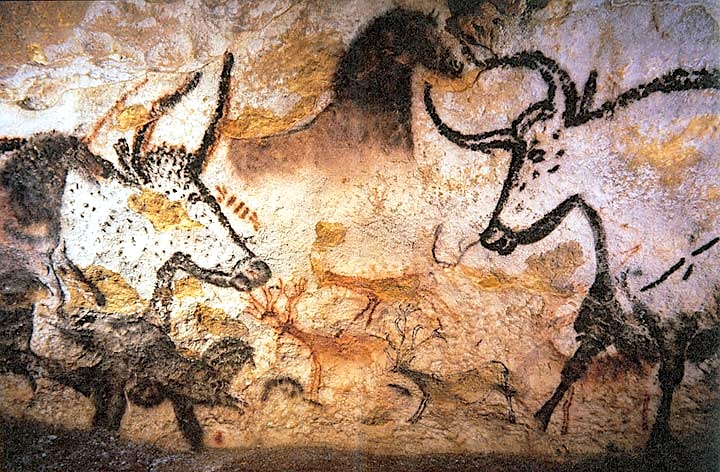
Image via Wikimedia Commons
The Lascaux Caves enjoyed a quiet existence for some 17,000 years.
Then came the summer of 1940, when four teens investigated what seemed to be a fox’s den on a hill near Montignac, hoping it might lead to an underground passageway of local legend.
Once inside, they discovered the paintings that have intrigued us ever since, expanding our understanding of prehistoric art and human origins, and causing us to speculate on things we’ll never have an answer to.
The boys’ teacher reached out to several prehistorians, who authenticated the figures, arranged for them to be photographed and sketched, and collected a number of bone and flint artifacts from the caves’ floors.
By 1948, excavations and artificial lights rendered the caves accessible to visitors, who arrived in droves — as many as 1,800 in a single day.
Less than 20 years later, The Collector’s Rosie Lesso writes, the caves were in crisis, and permanently closed to tourism:
…the heat, humidity and carbon dioxide of all those people crammed into the dark and airless cave was causing an imbalance in the cave’s natural ecosystem, leading to the overgrowth of molds and funguses that threatened to obliterate the prehistoric paintings.
The lights that had helped visitors get an eyeful of the paintings caused fading and discoloration that threatened their very existence.
Declaring this major attraction off limits was the right move, and those who make the journey to the area won’t leave entirely disappointed. Lascaux IV, a painstaking replica that opened to the public in 2016, offers even more verisimilitude than the previous model, 1983’s Lascaux II.
A handful of researchers and maintenance workers are still permitted inside the actual caves, now a UNESCO World Heritage site, but human presence is limited to an annual total of 800 hours, and everyone must be properly outfitted with sterile white overalls, plastic head coverings, latex gloves, double shoe covers, and LED forehead lamps with which to view the paintings.
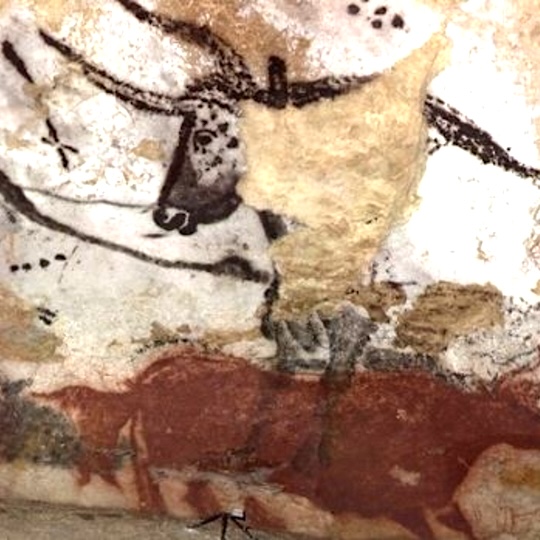

The rest of us rabble can get a healthy virtual taste of these visitors’ experience thanks to the digital Lascaux collection that the National Archeology Museum created for the Ministry of Culture.
An interactive tour offers close-up views of the famous paintings, with titles to orient the viewer as to the particulars of what and where — for example “red cow followed by her calf” in the Hall of the Bulls.

Click the button in the lower left for a more in-depth expert description of the element being depicted:
The flat red color used for the silhouette is of a uniformity that is seldom attained, which implies a repeated gesture starting from the same point, with complementary angles of projection of pigments. The outlines have been created with a stencil, and only the hindquarters, horns and the line of the back have been laid down with a brush…The fact that the artist used the same pigment for both figures without any pictorial transition between them indicates that the fusion of the two silhouettes was intentional, indicative of the connection between the calf and its mother. This duo was born of the same gesture, and the image of the offspring is merely the graphic extension of that of its mother.
The interactive virtual tour is further complimented by a trove of historic photographs and interviews, geological context, conservation updates and anthropological interpretations suggesting the paintings had a function well beyond visual art.
Begin your virtual interactive visit to the Lascaux Cave here.
Related Content
Was a 32,000-Year-Old Cave Painting the Earliest Form of Cinema?
Algerian Cave Paintings Suggest Humans Did Magic Mushrooms 9,000 Years Ago
40,000-Year-Old Symbols Found in Caves Worldwide May Be the Earliest Written Language
– Ayun Halliday is the Chief Primatologist of the East Village Inky zine and author, most recently, of Creative, Not Famous: The Small Potato Manifesto and Creative, Not Famous Activity Book. Follow her @AyunHalliday.
Read More...All the Rivers of the World Shown in Rainbow Colors: A Data Visualization to Explore

Even if you’ve never traveled the seas, you’ve surely known at least a few rivers in your time. And though you must be conscious of the fact that all of those rivers run, ultimately, to the sea, you may not have spent much time contemplating it. Now, thanks to the work of mapmaker and data analyst Robert Szucs, you won’t be able to come upon at a river without considering the particular sea into which it flows. He’s created what he calls “the first ever map of the world’s rivers divided into ocean drainage basins,” which appears just above.

This world map “shows, in different colors, all the rivers that flow into the Atlantic, Arctic, Indian or Pacific oceans, plus endorheic river basins which never reach the coast, mostly due to drying up in desert areas.”
Szucs has also broken it down into “a set of 43 maps in this style for different countries, states and continents,” all of them available to download (and to purchase as large-format posters) from his web site Grasshopper Geography.

We previously featured Szucs here on Open Culture back in 2017, when he published a river-and-stream-visualizing map of the United States made according to a similarly colorful and informative scheme. Examining that work of information design gave me a richer context in which to imagine the rivers around which I grew up in Washington State — the Sammamish, the Snoqualmie, the Columbia — as well as a clearer sense of just how much the United States’ larger, much more complex waterway network must have contributed to the development of the country as a whole.

Of course, having lived the better part of a decade in South Korea, I’ve lately had less reason to consider those particular geographical subjects. But Szucs’ new global ocean drainage maps have brought related ones to mind: it will henceforth be a rare day when I ride a train across the Han River (one of the more sublime everyday sights Seoul has to offer) and don’t imagine it making its way out to the Pacific — the very same Pacific that was the destination of all those rivers of my west-coast American youth. Oceanically speaking, even a move across the world doesn’t take you quite as far as it seems.
Related content:
All the Rivers & Streams in the U.S. Shown in Rainbow Colors: A Data Visualization to Behold
That Time When the Mediterranean Sea Dried Up & Disappeared: Animations Show How It Happened
A Radical Map Puts the Oceans — Not Land — at the Center of Planet Earth (1942)
Tour the Amazon with Google Street View; No Passport Needed
Based in Seoul, Colin Marshall writes and broadcasts on cities, language, and culture. His projects include the Substack newsletter Books on Cities, the book The Stateless City: a Walk through 21st-Century Los Angeles and the video series The City in Cinema. Follow him on Twitter at @colinmarshall or on Facebook.
Read More...Shane MacGowan & Sinéad O’Connor Duet Together, Performing a Moving Rendition of “Haunted” (RIP)
We’re taking you on a wistful trip down memory lane. Above, Shane MacGowan and Sinéad O’Connor perform “Haunted” on the British music show, The White Room. Originally recorded in 1986 with Cait O’Riordan on vocals, “Haunted” got a second lease on life in 1995 when MacGowan and O’Connor cut a new version, combining her ethereal vocals with his inimitable songwriting and whiskey-soaked voice. Below, they both appear in an interview recorded during the same period.
The two Irish musicians first met in London during the 1980s, starting a friendship that would have its ups and downs. Their collaboration on “Haunted” marked a high point. Then, in 1999, O’Connor called the police when she found MacGowan doing heroin at home. Angered at first, MacGowan later credited the intervention with helping him kick his habit. When Sinéad gave birth to her third child in 2004, she named him Shane, in honor of her friend.
MacGowan and O’Connor both died this year, just months apart from one another. As you watch their duet, you can’t help but feel the sand running through the hourglass. It leaves you feeling grateful for what we had, and sad for what we have lost. May they rest in peace.
A Map of All the Countries Mentioned in the Bible: What The Countries Were Called Then, and Now
“For most of the last two thousand years, the Bible has been virtually the only history book used in Western civilization,” writes Isaac Asimov in his Guide to the Bible. “Even today, it remains the most popular, and its view of ancient history is still more widely and commonly known than is that of any other.” As a result, “millions of people today know of Nebuchadnezzar, and have never heard of Pericles, simply because Nebuchadnezzar is mentioned prominently in the Bible and Pericles is never mentioned at all.” That same disproportionate recognition is accorded to “minor Egyptian pharaohs” like Shishak and Necho, “people whose very existence is doubtful” like Nimrod and the Queen of Sheba, and “small towns in Canaan, such as Shechem and Bethel.”
Asimov notes that “only that is known about such places as happens to be mentioned in the Bible. Ecbatana, the capital of the Median Empire, is remembered in connection with the story of Tobit, but its earlier and later history are dim indeed to most people, who might be surprised to know that it still exists today as a large provincial capital in the modern nation of Iran.” In the video from Hochelaga above, we learn that Iran, then called Persia, is celebrated in the Bible “for ending the Jewish exile and returning Israel to its homeland. The Book of Usaiah gives a special shout-out to its King, Cyrus the Great: he is given the title ‘anointed one,’ or ‘messiah.’ ”
Though “Persia has played a huge role in the history of the region, and at a time was one of the largest empires of its day,” it’s just one of the surprisingly many lands to receive Biblical acknowledgement. As Hochelaga creator Tommy Trelawny makes clear, “when the Bible was written, the countries as we know them today didn’t even exist.” But though the concept of the modern nation-state hadn’t yet come into being, the places that would give rise to a fair few of the nation-states in the twenty-first century certainly had: “shout-out to Egypt, Lebanon, Israel, Persia, Cyprus, Greece, Italy, and Spain, that still exist today, or at least go by the names that appear in the Bible.”

You may notice, Trelawny adds, that “many of these exotic lands are mentioned in the story of King Solomon’s temple, and how precious raw materials were imported from faraway places, from the strongest Lebanese cedars to the finest Indian ivories.” It hardly matters “whether King Solomon was even real; we know these geographical regions exist today, and that Biblical writers seemed to know of them as well.” As depicted in the Bible or other sources, the ancient world can seem scarcely recognizable to us. But if we make the necessary adjustments to our perspective, we can see a process of globalization not dissimilar to what we see in our own societies — whose fascination with distant lands and expensive luxuries seems hardly to have diminished over the millennia.
Related content:
Christianity Through Its Scriptures: A Free Course from Harvard University
Introduction to the Old Testament: A Free Yale Course
Introduction to New Testament History and Literature: A Free Yale Course
Ancient Israel: A Free Course from NYU
Based in Seoul, Colin Marshall writes and broadcasts on cities, language, and culture. His projects include the Substack newsletter Books on Cities, the book The Stateless City: a Walk through 21st-Century Los Angeles and the video series The City in Cinema. Follow him on Twitter at @colinmarshall or on Facebook.
Read More...RIP Shane MacGowan: Watch the Celtic Punk Rocker Perform with Nick Cave, Kirsty MacColl & the Dubliners
Shane MacGowan died yesterday, less than a month shy of his 66th birthday — and thus less than a month shy of Christmas, which happened to be the same day. Though coincidental, that association has made perfect sense since 1987, when the Pogues, the Celtic punk band fronted by MacGowan, released “Fairytale of New York.” That duet between MacGowan and Kirsty MacColl (the story of whose production we’ve previously featured here on Open Culture) still reigns supreme as the United Kingdom’s Christmas song, and by now it tends also to make it onto more than a few holiday-season playlists in America and across the world.
Given the popularity of “Fairytale of New York,” many listeners know MacGowan for nothing else. But he was, in fact, a figure of considerable importance to the punk rock of the nineteen-eighties and nineties, to which he brought not just a thoroughly Irish sensibility but also a strong sense of literary craft.
Few well-known punk rockers could inhabit a place with a song in the way he could, or tap into the proper vernacular to inhabit a particular character. (Even the words he gave MacColl to sing as a hard-bitten nineteen-forties woman of the streets have caused no end of struggles with censors.) For this reason, he had the respect of many another serious songwriter: Nick Cave, for instance, with whom he recorded a cover of “What a Wonderful World” in 1992.
During much of MacGowan’s lifetime, his musical achievements were at risk of being overshadowed by the harrowing facts of his life, including his massive, sustained consumption of drugs and alcohol and the variety of injuries and ailments it brought about. In 2015, British television even aired a special about the replacement of his long-lost teeth — which, to judge by the Pogues’ performance of the folk song “The Irish Rover” with the Dubliners above, were barely hanging on even in the late eighties. But in a way, this dissolute appearance was an inseparable part of a distinctive artistic spirit. Shane MacGowan was a rare thing in the world of punk rock (to say nothing of the world of hit Christmas songs): not just an Irish literary voice, but an Irish literary character.
Related content:
A Choir with 1,000 Singers Pays Tribute to Sinéad O’Connor & Performs “Nothing Compares 2 U”
James Joyce Plays the Guitar (1915)
Stream a Playlist of 68 Punk Rock Christmas Songs: The Ramones, The Damned, Bad Religion & More
Based in Seoul, Colin Marshall writes and broadcasts on cities, language, and culture. His projects include the Substack newsletter Books on Cities, the book The Stateless City: a Walk through 21st-Century Los Angeles and the video series The City in Cinema. Follow him on Twitter at @colinmarshall or on Facebook.
Read More...Support Us
We're hoping to rely on loyal readers, rather than erratic ads. Please click the Donate button and support Open Culture. You can use Paypal, Venmo, Patreon, even Crypto! We thank you!

About Us

Open Culture scours the web for the best educational media. We find the free courses and audio books you need, the language lessons & educational videos you want, and plenty of enlightenment in between.
Advertise With Us
FREE UPDATES!
GET OUR DAILY EMAIL
Get the best cultural and educational resources on the web curated for you in a daily email. We never spam. Unsubscribe at any time.
FOLLOW ON SOCIAL MEDIA
Open Culture editor Dan Colman scours the web for the best educational media. He finds the free courses and audio books you need, the language lessons & movies you want, and plenty of enlightenment in between.
Advertise With Us


