Every Wes Anderson Movie, Explained by Wes Anderson
That Wes Anderson is perhaps the most assiduous maker of short films today becomes clear when you look closely at his recent work. The four adaptations of “The Wonderful World of Henry Sugar” and three other Roald Dahl stories he made for Netflix were presented as a single anthology film; his slightly earlier feature The French Dispatch didn’t hide the essential separateness of its stories, each one based on an article for a fictionalized version of the New Yorker. Though both Anderson’s fans and critics readily note the increasingly elaborate constructions of his pictures, it’s worth remembering that his career began with a simple short: the thirteen-minute black-and-white version of Bottle Rocket that would evolve into his first full-length work.
Anderson tells the story of not just that first feature but also the twelve that would follow in the new video from Vanity Fair above, mentioning details even dedicated Andersonians may not know. The original, “very, very, very long” Bottle Rocket script got a severe cutting under the guidance of Hollywood producer James L. Brooks. Locations for Rushmore were scouted based on whether movements through them could properly be choreographed to certain British Invasion songs.
Anderson promised the late Gene Hackman that he’d have a “good time” on The Royal Tenenbaums, a promise that went not-quite-fulfilled. When he hired Seu Jorge to sing David Bowie songs for The Life Aquatic, he didn’t know he was already a pop singer in Brazil. When talking to him about The Darjeeling Limited, people tend to call it “The Darjeeling Express.”
Many of these recollections have to do with his inspirations, which for The Darjeeling Limited were specific subcontinental films like Jean Renoir’s The River, Louis Malle’s Phantom India, and Satyajit Ray’s Apu trilogy. Moonrise Kingdom was made possible when Anderson, long resident in France, came to “see America like some foreign country.” Writing The French Dispatch, he looked to the New Yorker as it was under its contrasting first editors, Harold Ross and William Shawn. Asteroid City originated as a kind of tribute to the Actors Studio in the nineteen-fifties. He describes his latest picture The Phoenician Scheme as having been inspired by the work of Luis Buñuel and written for Benicio del Toro, who plays a tycoon out of a “nineteen-fifties Italian movie” subject to “Biblical visions” during his frequent brushes with death. “I haven’t had the moment where I don’t know what I want to do next,” Anderson says at the end of the video. As sure as filmgoers may feel that they know just what to expect from him, he surely has many more surprises in store for us.
Related content:
A Complete Collection of Wes Anderson Video Essays
Why Do Wes Anderson Movies Look Like That?
Wes Anderson’s First Short Film: The Black-and-White, Jazz-Scored Bottle Rocket (1992)
Based in Seoul, Colin Marshall writes and broadcasts on cities, language, and culture. His projects include the Substack newsletter Books on Cities and the book The Stateless City: a Walk through 21st-Century Los Angeles. Follow him on the social network formerly known as Twitter at @colinmarshall.
Read More...The Dylatov Pass Incident: Has One of the Biggest Soviet Mysteries Been Solved?
Most of us would go out of our way not to set foot anywhere near a place the local natives refer to as “Dead Mountain.” That didn’t stop the Dyatlov Hiking Group, who set out on a sixteen-day skiing expedition across the northern Urals in late January of 1959. Experienced and intrepid, those ten young Soviet ski hikers had what it took to make the journey, at least if nothing went terribly wrong. A bout of sciatica forced one member of the group to turn back early, which turned out to be lucky for him. About a month later, the irradiated bodies of his nine comrades were discovered scattered in different areas of Dead Mountain some distance from their campsite, with various traumatic injuries and in various states of undress.
Something had indeed gone terribly wrong, but nobody could figure out what. For decades, the fate of the Dyatlov Hiking Group inspired countless explanations ranging widely in plausibility. Some theorized a freak weather phenomenon; others some kind of toxic airborne event; others still, the actions of American spies or even a yeti.
“In a place where information has been as tightly controlled as in the former Soviet Union, mistrust of official narratives is natural, and nothing in the record can explain why people would leave a tent undressed, in near-suicidal fashion,” writes the New Yorker’s Douglas Preston. Only in the late twenty-tens, when the Dyatlov Group Memorial Foundation got the case reopened, did investigators assess the contradictory evidence while making new measurements and conducting new experiments.
The probable causes were narrowed down to those explained by experts in the Vox video above: a severe blizzard and a slab of ice that must have shifted and crushed the tent. Densely packed by the wind, that massive, heavy slab would have “prevented them from retrieving their boots or warm clothing and forced them to cut their way out of the downslope side of the tent,” proceeding to the closest natural shelter from the avalanche they believed was coming. But no avalanche came, and they couldn’t find their way back to their camp in the darkness. “Had they been less experienced, they might have remained near the tent, dug it out, and survived,” writes Preston. “The skiers’ expertise doomed them.” Not everyone accepts this theory, but then, the idea that knowledge can kill might be more frightening than even the most abominable snowman.
Related content:
The Denali Experiment: A Test of Human Limits
The Curious Death of Vincent van Gogh
The Gruesome Dollhouse Death Scenes That Reinvented Murder Investigations
Based in Seoul, Colin Marshall writes and broadcasts on cities, language, and culture. His projects include the Substack newsletter Books on Cities and the book The Stateless City: a Walk through 21st-Century Los Angeles. Follow him on the social network formerly known as Twitter at @colinmarshall.
Read More...Talking Heads Release the First Official Video for “Psycho Killer”: Watch It Online
On social media, the Talking Heads teased a major announcement on June 5th, leading fans to wonder if a reunion—41 years after their last tour—might finally be in the offing. As one fan put it, “If this is a tour announcement, I am going to freak out!” Alas, we didn’t quite get that. (Maybe next time!) Instead, we got the first official music video for “Psycho Killer.” Directed by Mike Mills and starring Saoirse Ronan, the video helps commemorate the band’s first show at CBGB 50 years ago. You can watch the video above, and footage from CBGB in 1975 here.
If you would like to support the mission of Open Culture, consider making a donation to our site. It’s hard to rely 100% on ads, and your contributions will help us continue providing the best free cultural and educational materials to learners everywhere. You can contribute through PayPal, Patreon, and Venmo (@openculture). Thanks!
Related Content
The Talking Heads Play CBGB, the New York Club That Shaped Their Sound (1975)
Hear the Earliest Known Talking Heads Recordings (1975)
Read More...
How John Lennon Wrote the Beatles’ Best Song, “A Day in the Life”
If you’re under 60, you probably heard the line “I read the news today, oh boy” before encountering the song it opens. Even after you discovered the work of the Beatles, it may have taken you some time to understand what, exactly, it was that John Lennon read in the news. The “lucky man who made the grade” and “blew his mind out in a car” turn out to have been inspired by the young Guinness heir Tara Browne, who’d fatally wiped out in his Lotus Elan. The figure of 4,000 holes in the roads of Blackburn came from another page of the same edition of the Daily Mail. These are just two of the memorable images in “A Day in the Life,” which sonically reconstructs the fabric of the nineteen-sixties as the Beatles knew it.
In his new video below, Evan Puschak, better known as the Nerdwriter, calls “A Day in the Life” “arguably the Beatles’ best song.” Critic Ian MacDonald is rather less ambiguous in his book Revolution in the Head: The Beatles’ Records and the Sixties, proclaiming it “their finest single achievement.”
And if any single factor shaped its development, that factor was LSD. “A song about perception — a subject central both to late-period Beatles and the counterculture at large — ‘A Day in the Life’ concerned ‘reality’ only to the extent that this had been revealed by LSD to be largely in the eye of the beholder,” he writes. Lennon may have proven to be the group’s most dedicated enthusiast of that shortcut to enlightenment. It’s worth noting, as Puschak does, that it was Browne who first “turned on” Paul McCartney.
Though primarily John’s work, “A Day in the Life” wouldn’t be what it is without Paul’s double-time bridge, whose jauntily narrative ordinariness makes the verses all the more transcendent. The need for some kind of transition between these disparate John and Paul parts led to George Martin’s commissioning a 40-piece orchestra instructed to play from the lowest notes up to the highest, a collective glissando quadruple-recorded and mixed to sound like the end of the world. In theory, perhaps, all this — to say nothing of Lennon’s references to the Albert Hall, the House of Lords, and his own role in Richard Lester’s How I Won the War — shouldn’t work together. But the result, as MacDonald puts it, remains one of “the most penetrating and innovative artistic reflections of its era,” as experienced by the young men standing at its very center.
Related content:
The Experimental Movement That Created The Beatles’ Weirdest Song, “Revolution 9”
The Amazing Recording History of The Beatles’ “Here Comes the Sun”
The Making of the Last Beatles Song, “Now and Then”: A Short Film
Based in Seoul, Colin Marshall writes and broadcasts on cities, language, and culture. His projects include the Substack newsletter Books on Cities and the book The Stateless City: a Walk through 21st-Century Los Angeles. Follow him on the social network formerly known as Twitter at @colinmarshall.
Read More...Albert Einstein’s Grades: A Fascinating Look at His Report Cards
Albert Einstein was a precocious child.
At the age of twelve, he followed his own line of reasoning to find a proof of the Pythagorean Theorem. At thirteen he read Kant, just for the fun of it. And before he was fifteen he had taught himself differential and integral calculus.
But while the young Einstein was engrossed in intellectual pursuits, he didn’t much care for school. He hated rote learning and despised authoritarian schoolmasters. His sense of intellectual superiority was resented by his teachers.
In Subtle is the Lord: The Science and Life of Albert Einstein, author Abraham Pais tells a funny story from Einstein’s days at the Luitpold Gymnasium, a secondary school in Munich now called the Albert-Einstein-Gymnasium:
At the Gymnasium a teacher once said to him that he, the teacher, would be much happier if the boy were not in his class. Einstein replied that he had done nothing wrong. The teacher answered, “Yes, that is true. But you sit there in the back row and smile, and that violates the feeling of respect that a teacher needs from his class.”
The same teacher famously said that Einstein “would never get anywhere in life.”
What bothered Einstein most about the Luitpold was its oppressive atmosphere. His sister Maja would later write:
“The military tone of the school, the systematic training in the worship of authority that was supposed to accustom pupils at an early age to military discipline, was also particularly unpleasant for the boy. He contemplated with dread that not-too-distant moment when he will have to don a soldier’s uniform in order to fulfill his military obligations.”
When he was sixteen, Einstein’s parents moved to Italy to pursue a business venture. They told him to stay behind and finish school. But Einstein was desperate to join them in Italy before his seventeenth birthday. “According to the German citizenship laws,” Maja explained, “a male citizen must not emigrate after his completed sixteenth year; otherwise, if he fails to report for military service, he is declared a deserter.”
So Einstein found a way to get a doctor’s permission to withdraw from the school on the pretext of “mental exhaustion,” and fled to Italy without a diploma. Years later, in 1944, during the final days of World War II, the Luitpold Gymnasium was obliterated by Allied bombing. So we don’t have a record of Einstein’s grades there. But there is a record of a principal at the school looking up Einstein’s grades in 1929 to fact check a press report that Einstein had been a very bad student. Walter Sullivan writes about it in a 1984 piece in The New York Times:
With 1 as the highest grade and 6 the lowest, the principal reported, Einstein’s marks in Greek, Latin and mathematics oscillated between 1 and 2 until, toward the end, he invariably scored 1 in math.
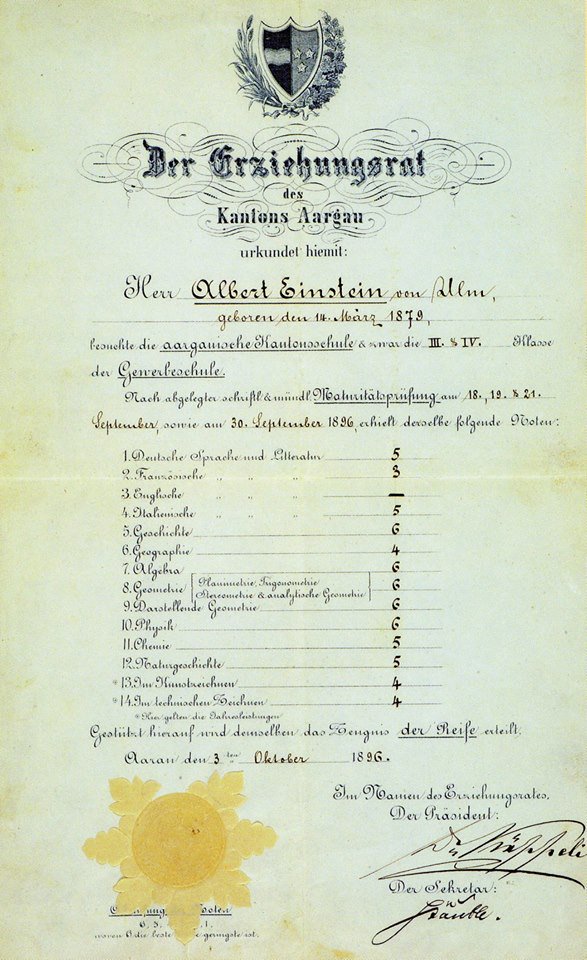
After he dropped out, Einstein’s family enlisted a well-connected friend to persuade the Swiss Federal Institute of Technology, or ETH, to let him take the entrance exam, even though he was only sixteen years old and had not graduated from high school. He scored brilliantly in physics and math, but poorly in other areas. The director of the ETH suggested he finish preparatory school in the town of Aarau, in the Swiss canton of Aargau. A diploma from the cantonal school would guarantee Einstein admission to the ETH.
At Aarau, Einstein was pleasantly surprised to find a liberal atmosphere in which independent thought was encouraged. “When compared to six years’ schooling at a German authoritarian gymnasium,” he later said, “it made me clearly realize how much superior an education based on free action and personal responsibility is to one relying on outward authority.”
In Einstein’s first semester at Aarau, the school still used the old method of scoring from 1 to 6, with 1 as the highest grade. In the second semester the system was reversed, with 6 becoming the highest grade. Barry R. Parker talks about Einstein’s first-semester grades in his book, Einstein: The Passions of a Scientist:
His grades over the first few months were: German, 2–3; French, 3–4; history, 1–2; mathematics, 1; physics, 1–2; natural history, 2–3; chemistry, 2–3; drawing, 2–3; and violin, 1. (The range is 1 to 6, with 1 being the highest.) Although none of the grades, with the exception of French, were considered poor, some of them were only average.
The school headmaster, Jost Winteler, who had welcomed Einstein into his home as a boarder and had become something of a surrogate father to him during his time at Aarau, was concerned that a young man as obviously brilliant as Albert was receiving average grades in so many courses. At Christmas in 1895, he mailed a report card to Einstein’s parents. Hermann Einstein replied with warm thanks, but said he was not too worried. As Parker writes, Einstein’s father said he was used to seeing a few “not-so-good grades along with very good ones.”
In the next semester Einstein’s grades improved, but were still mixed. As Toby Hendy of the YouTube channel Tibees shows in the video above, Einstein’s final grades were excellent in math and physics, but closer to average in other areas.
Einstein’s uneven academic performance continued at the ETH, as Hendy shows. By the third year his relationship with the head of the physics department, Heinrich Weber, began to deteriorate. Weber was offended by the young man’s arrogance. “You’re a clever boy, Einstein,” said Weber. “An extremely clever boy. But you have one great fault. You’ll never allow yourself to be told anything.” Einstein was particularly frustrated that Weber refused to teach the groundbreaking electromagnetic theory of James Clerk Maxwell. He began spending less time in the classroom and more time reading up on current physics at home and in the cafes of Zurich.
Einstein increasingly focused his attention on physics, and neglected mathematics. He came to regret this. “It was not clear to me as a student,” he later said, “that a more profound knowledge of the basic principles of physics was tied up with the most intricate mathematical methods.”
Einstein’s classmate Marcel Grossmann helped him by sharing his notes from the math lectures Einstein had skipped. When Einstein graduated, his conflict with Weber cost him the teaching job he had expected to receive. Grossmann eventually came to Einstein’s rescue again, urging his father to help him secure a well-paid job as a clerk in the Swiss patent office. Many years later, when Grossmann died, Einstein wrote a letter to his widow that conveyed not only his sadness at an old friend’s death, but also his bittersweet memories of life as a college student:
“Our days together come back to me. He a model student; I untidy and a daydreamer. He on excellent terms with the teachers and grasping everything easily; I aloof and discontented, not very popular. But we were good friends and our conversations over iced coffee at the Metropol every few weeks belong among my nicest memories.”
Note: An earlier version of this post appeared on our site in 2020.
Related Content:
Hear Albert Einstein Read “The Common Language of Science” (1941)
When Albert Einstein & Charlie Chaplin Met and Became Fast Famous Friends (1930)
Read More...The World’s Oldest Homework: A Look at Babylonian Math Homework from 4,000 Years Ago
Homework has lately become unfashionable, at least according to what I’ve heard from teachers in certain parts of the United States. That may complicate various fairly long-standing educational practices, but it doesn’t necessarily reflect an absolute drop in standards and expectations. Those of us who went to school around the turn of the millennium may remember feeling entombed in homework, an intensified version of what the generation that came of age amid the early Cold War’s pressure for “more science,” would have dealt with. But late baby boomers and early Gen-Xers in the sixties and seventies had a much lighter load, as did the generation educated under John Dewey’s reforms of the early twentieth century.
We can follow this line all the way back to the times of the Babylonians, 4,000 years ago. In the video above from her channel Tibees, science YouTuber Toby Hendy shows us a few artifacts of homework from antiquity and explains how to interpret them.
Inscribed in a clay tablet, their simple but numerous marks reveal them to be examples of math homework, that most loathed category today, and perhaps then as well. (Even when interpreted in modern language, the calculations may seem unfamiliar, performed as they are not in our base ten, but base 60 — shades of the “new math” to come much later.) That the Babylonians had fairly advanced mathematics, which Hendy demonstrates using some clay of her own, may be as much of a surprise as the fact that they did homework.
Not that they all did it. Universal schooling itself dates only from the industrial age, and for the Babylonians, industry was still a long way off. They did, however, take the considerable step of creating civilization, which they couldn’t have done without writing. The ancient assignment Hendy shows would’ve been done by a student at an eduba, which she describes as a “scribe school.” Scribe, as we know, means one who writes — which, in Babylon, meant one who writes in Sumerian. That skill was transmitted through the network of eduba, or “house where tablets are passed out,” which were usually located in private residences, and which turned out graduates literate and numerate enough to keep the empire running, at least until the sixth century BC or so. From certain destructive forces, it seems, no amount of homework can protect a civilization forever.
Related content:
An Ancient Egyptian Homework Assignment from 1800 Years Ago: Some Things Are Truly Timeless
A 4,000-Year-Old Student ‘Writing Board’ from Ancient Egypt (with Teacher’s Corrections in Red)
Behold the Oldest Written Text in the World: The Kish Tablet, Circa 3500 BC
Hear the Earliest Recorded Customer Complaint Letter: From Ancient Sumeria 1750 BC
Based in Seoul, Colin Marshall writes and broadcasts on cities, language, and culture. His projects include the Substack newsletter Books on Cities and the book The Stateless City: a Walk through 21st-Century Los Angeles. Follow him on the social network formerly known as Twitter at @colinmarshall.
Read More...A 3D Model Reveals What the Parthenon and Its Interior Looked Like 2,500 Years Ago
Standing atop the Acropolis in Athens as it has for nearly 2,500 years now, the Parthenon remains an impressive sight indeed. Not that those two and a half millennia have been kind to the place: one of the most famous ruins of the ancient world is still, after all, a ruin. But it does fire up visitors’ imaginations, filling their heads with visions of how it must have looked back in the fifth century BC, when it was a functioning temple and treasury. One enthusiast in particular, an Oxford archaeology professor named Juan de Lara, has spent four years using 3D modeling tools to create a 3D digital reconstruction of the Parthenon at the height of its glory, of which you can get glimpses in the video above and at the project’s official site.
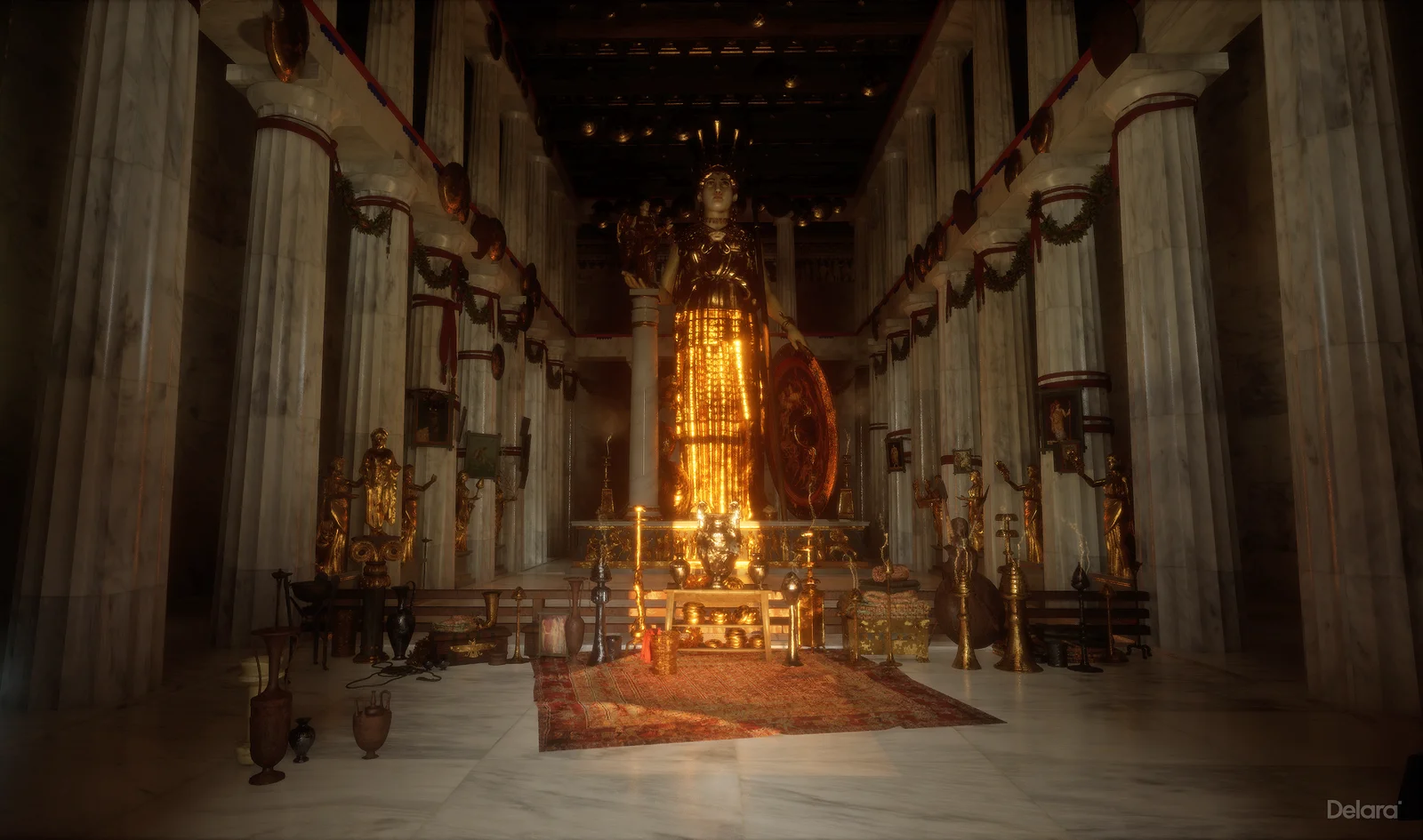
Image by Juan de Lara/The Parthenon 3D
The materials promoting Parthenon 3D, as it’s called, emphasize one element above all: its almost 40-foot-tall statue of the goddess Athena Parthenos, better known mononymically as Athena. The work of the renowned sculptor Phidias, who also handled the rest of the structure’s sculptural decoration, it ended up costing twice as much as the building itself.
Though now long lost, the Athena statue was well documented enough for de Lara to model its every detail, down to the folds in her golden robes and the cracks in her ivory skin. During the Panathenaic Festival, which came around every four years, sunlight would enter the Parthenon at just the right angle to cause a supernatural-looking illumination of the goddess against the surrounding darkness.
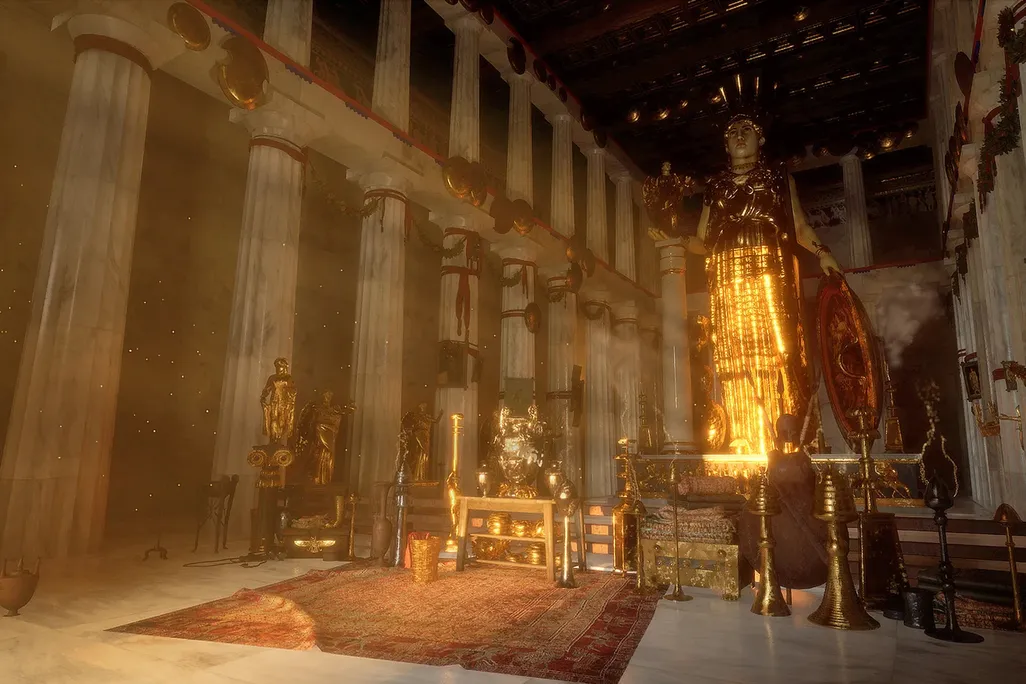
Image by Juan de Lara/The Parthenon 3D
Of course, that effect wasn’t accidental. Even if we consider the creation of the Parthenon to have been divinely inspired, we can best understand it as a work of man — and a meticulously thought-out work at that. For ancient Greek visitors, the illumination of Athena would have been enhanced by the placement of roof apertures, reflecting water pools, and reflective materials, whose original incorporation into the space would come as a surprise to most modern visitors. At present, Parthenon 3D offers the closest experience we have to a time machine set to the Parthenon as Phidias and architects Iktinos and Callicrates originally intended. But as de Lara’s research notes, the building also contained numerous incense burners, so perfect realism won’t be achieved until smells can go through the internet. Visit the Parthenon 3D site here.
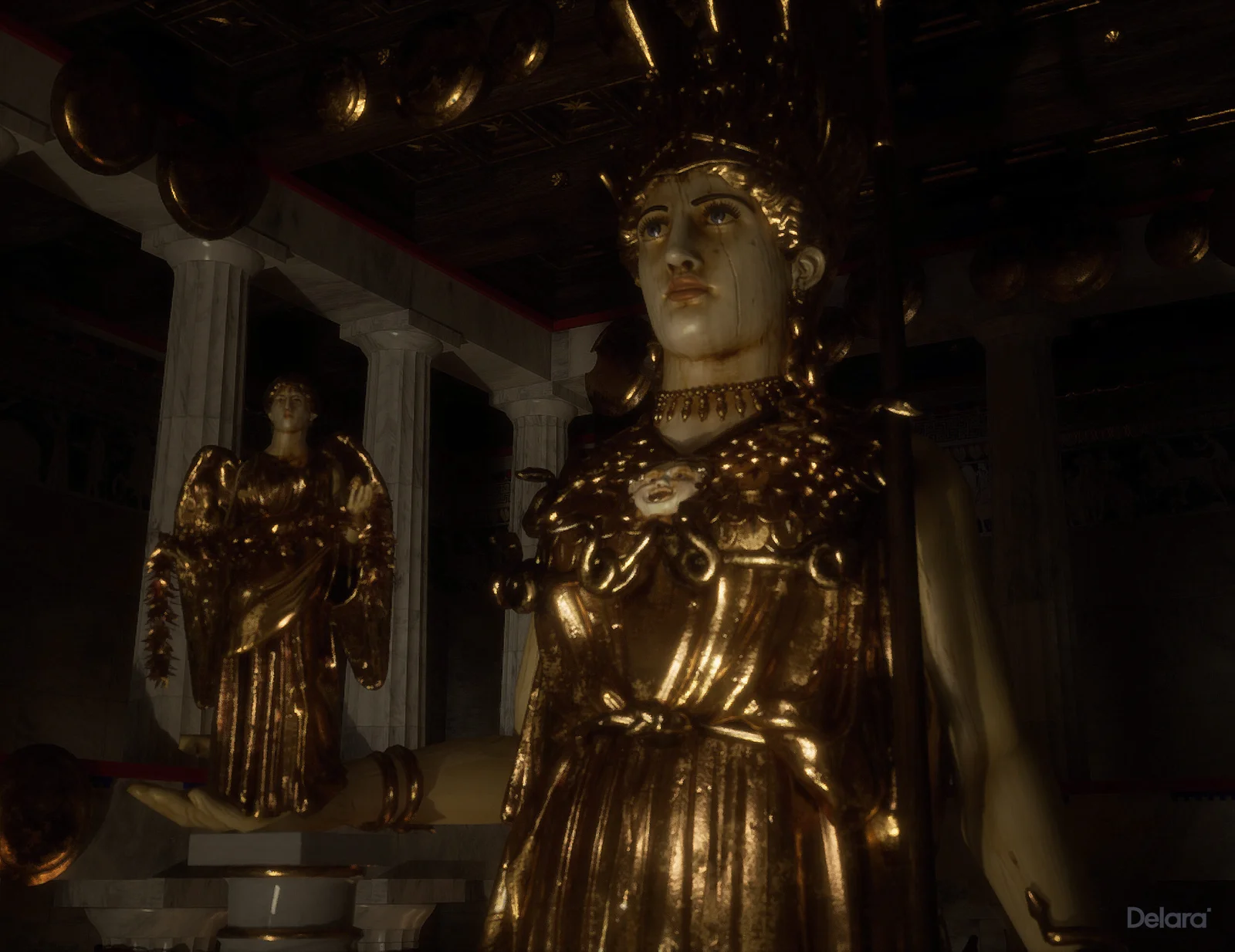
Image by Juan de Lara/The Parthenon 3D
Related content:
How the Parthenon Marbles Ended Up In The British Museum
A Virtual Tour of Ancient Athens: Fly Over Classical Greek Civilization in All Its Glory
Based in Seoul, Colin Marshall writes and broadcasts on cities, language, and culture. His projects include the Substack newsletter Books on Cities and the book The Stateless City: a Walk through 21st-Century Los Angeles. Follow him on the social network formerly known as Twitter at @colinmarshall.
Read More...Leo Tolstoy’s Family Recipe for Mac and Cheese
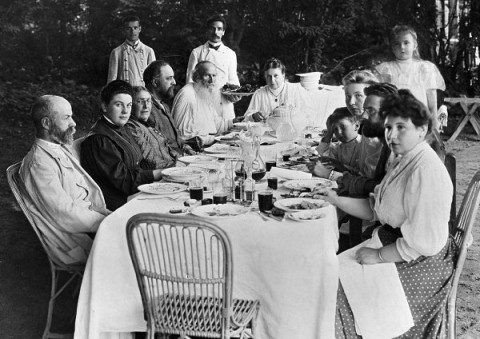
In 1874, Stepan Andreevich Bers published The Cookbook and gave it as a gift to his sister, countess Sophia Andreevna Tolstaya, the wife of the great Russian novelist, Leo Tolstoy. The book contained a collection of Tolstoy family recipes, the dishes they served to their family and friends, those fortunate souls who belonged to the aristocratic ruling class of late czarist Russia. 150 years later, this cookbook has been translated and republished by Sergei Beltyukov.
Leo Tolstoy’s Family Recipe Book features dozens of recipes, everything from Tartar Sauce and Spiced Mushrooms (what’s a Russian kitchen without mushrooms?), to Stuffed Dumplings and Green Beans à la Maître d’Hôtel, to Coffee Cake and Viennese Pie. The text comes with a translation, too, of Russian weights and measures used during the period. One recipe Mr. Beltyukov provided to us (which I didn’t see in the book) is for the Tolstoys’ good ole Mac ‘N’ Cheese dish. It goes something like this:
Bring water to a boil, add salt, then add macaroni and leave boiling on light fire until half tender; drain water through a colander, add butter and start putting macaroni back into the pot in layers – layer of macaroni, some grated Parmesan and some vegetable sauce, macaroni again and so on until you run out of macaroni. Put the pot on the edge of the stove, cover with a lid and let it rest in light fire until the macaroni are soft and tender. Shake the pot occasionally to prevent them from burning.
We’ll leave you with bon appétit! — an expression almost certainly heard in the homes of those French-speaking Russian aristocrats.
If you would like to support the mission of Open Culture, consider making a donation to our site. It’s hard to rely 100% on ads, and your contributions will help us continue providing the best free cultural and educational materials to learners everywhere. You can contribute through PayPal, Patreon, and Venmo (@openculture). Thanks!
Related Content:
Hear Leo Tolstoy Read From His Last Major Work in Four Languages, 1909
Leo Tolstoy Makes a List of the 50+ Books That Influenced Him Most (1891)
The Final Days of Leo Tolstoy Captured in Rare Footage from 1910
Thomas Edison’s Recordings of Leo Tolstoy: Hear the Voice of the Great Russian Novelist
Read More...How the First Rock Concert Ended in Mayhem (Cleveland, 1952)
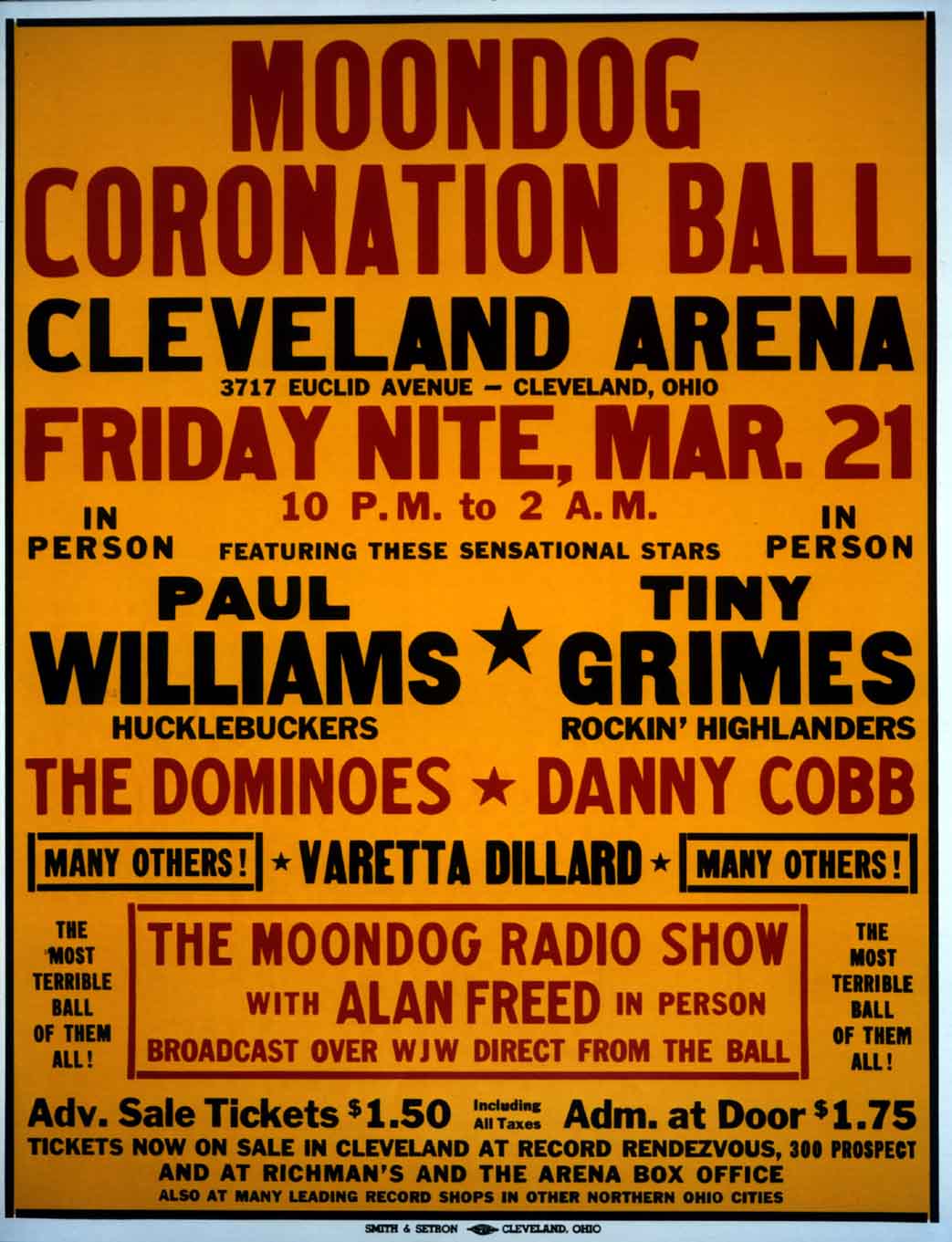
“America has only three cities: New York, San Francisco, and New Orleans. Everywhere else is Cleveland.” That observation tends to be attributed to Tennessee Williams, though it’s become somewhat detached from its source, so deeply does it resonate with a certain experience of life in the United States. But consider this: can every American city claim to be where rock and roll began — or at least the site of the very first rock and roll concert? Cleveland can, thanks to Alan Freed, a famous radio announcer of the nineteen-forties and fifties. The Moondog Coronation Ball he organized in 1952 may have ended in disaster, but it began a pop-cultural era that arguably continues to this day.
Having attained popularity announcing in a variety of radio formats, including jazz and classical music, Freed was awakened to the possibility of what was then known as rhythm and blues by a local record-store owner, Leo Mintz. It was with Mintz’s sponsorship that Freed launched a program on Cleveland’s WJW-AM, for which he cultivated a hepcat persona called “Moondog.” (Some credit the name to an album by Robby Vee and The Vees, and others to the avant-garde street musician Moondog and his eponymous “symphony.”) Starting at midnight, the show broadcast hours of so-called “race music” to not just its already-enthusiastic fan base, but also the young white listeners increasingly intrigued by its captivating, propulsive sounds.
Freed soon commanded enough of an audience to describe himself as “King of the Moondoggers.” When he announced the upcoming Moondog Coronation Ball, a show at Cleveland’s hockey arena featuring sets from such popular acts as Paul Williams and the Hucklebuckers, Tiny Grimes and the Rocking Highlanders (an all-black group whose signature kilts would surely stir up “cultural appropriation” discourse today), Varetta Dillard, and Danny Cobb, the Moondoggers turned out. About 20,000 of them turned out, in fact, twice what the venue could handle. A ticket misprint was to blame, but the damage had been done — or rather, it would be done, when the well-dressed but over-excited crowd stormed the arena and the authorities were called in to shut the show down by force.
In the event, only the first two acts ever took the stage. The planned coronation of the two most popular teenagers in attendance (a holdover from another cultural dimension entirely) never happened. But the spirit of rebelliousness witnessed at this first-ever rock concert was like a genie that couldn’t be put back in its bottle. However square his image, Freed, who popularized the term “rock and roll” as applied to music, was never much of a rule-follower in his professional life. His later implication in the payola bribe scandals of the late fifties sent his career into a tailspin, and his early death followed a few years later. But to judge by re-tellings like the one in the Drunk History video just above, he remains the hero of the story of the Moondog Coronation Ball — and thus a hero of rock and roll history.
Related content:
The Live Music Archive Lets You Stream/Download More Than 250,000 Concert Recordings–for Free
Based in Seoul, Colin Marshall writes and broadcasts on cities, language, and culture. His projects include the Substack newsletter Books on Cities and the book The Stateless City: a Walk through 21st-Century Los Angeles. Follow him on the social network formerly known as Twitter at @colinmarshall.
Read More...How Steven Soderbergh Directs a Scene & Makes It Great
Steven Soderbergh was one of the earliest filmmakers to break out in what’s now called the “Indiewood” movement of the nineteen-nineties. He was early enough, in fact, to have done so in the eighties, with the Palme d’Or-winning Sex, Lies, and Videotape. His subsequent films have been many and varied, even more so than those of his Indiewood peers Spike Lee, Robert Rodriguez, and Quentin Tarantino. Some, like Schizopolis, Bubble, The Girlfriend Experience, and Let Them All Talk, have been more “indie”; others, like, Out of Sight, Erin Brockovich, and the Ocean’s and Magic Mike series, have been more “Hollywood.” But wherever on the one-for-them-and-one-for-me spectrum he’s worked, never has he compromised on his craft.
To illuminate this dedication, Evan Puschak, known on YouTube as the Nerdwriter, breaks down a scene from Soderbergh’s latest picture in the video above. Black Bag, which came out this past March, is a mid-budget thriller, a form that has proven fruitful for the director in recent decades.
It’s proven creatively fruitful, at any rate, if not always financially; already, Soderbergh himself has publicly expressed his disappointment with the movie’s box-office performance. But if audiences have overlooked Black Bag, they haven’t done so due to its shoddy work. In even one minor, transitional scene under two minutes long, Puschak explains, we can identify numerous directorial choices that make everything work effectively.
Examining each of the scene’s eleven shots (a blessedly patient editing rhythm, by today’s standards), Puschak points out Soderbergh’s cuts, framings, camera placements, movements, and focal lengths, explaining the relevance of each to the story playing out. This isn’t just a fanboy’s auteurism: Soderbergh always operates his own camera and edits his own footage, crediting the jobs to pseudonyms. That this practice leaves his movies with a deep authorial stamp, whatever their subject matter or target audience, is obvious; what’s less clear is how he’s managed to keep it up while making a feature every year, on average, since Sex, Lies, and Videotape. If, after all this, you’re somehow not sold on watching Black Bag, just wait for Soderbergh’s next movie — which that most “efficient and creative cinematic problem solver” already finished shooting three months ago.
Related Content:
The Scene That Reveals the Beauty of Classic Hollywood Cinema
Based in Seoul, Colin Marshall writes and broadcasts on cities, language, and culture. His projects include the Substack newsletter Books on Cities and the book The Stateless City: a Walk through 21st-Century Los Angeles. Follow him on the social network formerly known as Twitter at @colinmarshall.
Read More...Support Us
We're hoping to rely on loyal readers, rather than erratic ads. Please click the Donate button and support Open Culture. You can use Paypal, Venmo, Patreon, even Crypto! We thank you!

About Us

Open Culture scours the web for the best educational media. We find the free courses and audio books you need, the language lessons & educational videos you want, and plenty of enlightenment in between.
Advertise With Us

FREE UPDATES!
GET OUR DAILY EMAIL
Get the best cultural and educational resources on the web curated for you in a daily email. We never spam. Unsubscribe at any time.
FOLLOW ON SOCIAL MEDIA

Open Culture editor Dan Colman scours the web for the best educational media. He finds the free courses and audio books you need, the language lessons & movies you want, and plenty of enlightenment in between.
Advertise With Us

