The World Record for the Shortest Math Article: 2 Words
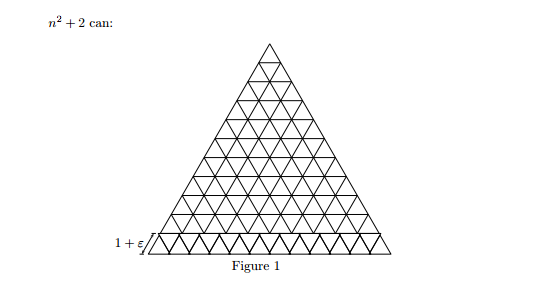
In 2004, John Conway and Alexander Soifer, both working on mathematics at Princeton University, submitted to the American Mathematical Monthly what they believed was “a new world record in the number of words in a [math] paper.”
Soifer explains: “On April 28, 2004 … I submitted our paper that included just two words, ‘n2 + 2 can’ and our two drawings. [See one of them above.]” The story then continues: “The American Mathematical Monthly was surprised, and did not know what to do about our new world record of a 2‑word article. Two days later, on April 30, 2004, the Editorial Assistant Mrs. Margaret Combs acknowledged the receipt of the paper”:
The Monthly publishes exposition of mathematics at many levels, and it contains articles both long and short. Your article, however, is a bit too short to be a good Monthly article… A line or two of explanation would really help.
Soifer writers: “The same day at the coffee hour I asked John [Conway], ‘What do you think?’ His answer was concise, ‘Do not give up too easily.’ Accordingly, I replied [to] The Monthly the same day”:
I respectfully disagree that a short paper in general—and this paper in particular—merely due to its size must be “a bit too short to be a good Monthly article.” Is there a connection between quantity and quality?… We have posed a fine (in our opinion) open problem and reported two distinct “behold-style” proofs of our advance on this problem. What else is there to explain?
Soifer adds: “The Monthly, apparently felt outgunned, for on May 4, 2004, the reply came from The Monthly’s top gun, Editor-in-Chief Bruce Palka”:
The Monthly publishes two types of papers: “articles,” which are substantive expository papers ranging in length from about six to twenty-five pages, and “notes,” which are shorter, frequently somewhat more technical pieces (typically in the one-to-five page range). I can send your paper to the notes editor if you wish, but I expect that he’ll not be interested in it either because of its length and lack of any substantial accompanying text. The standard way in which we use such short papers these days is as “boxed filler” on pages that would otherwise contain a lot of the blank space that publishers abhor. If you’d allow us to use your paper in that way, I’d be happy to publish it.
Soifer concludes: “John Conway and I accepted the ‘filler’, and in the January 2005 issue our paper was published.” Victory!
Get more of the backstory here.
Related Content:
The Shortest-Known Paper Published in a Serious Math Journal: Two Succinct Sentences
John Nash’s Super Short PhD Thesis: 26 Pages & Two Citations
The Map of Mathematics: Animation Shows How All the Different Fields in Math Fit Together
Read More...How a Papal Conclave Works, and Who Might Be the Next Pope
On Tuesday, the cardinals locked themselves into the Sistine Chapel, officially beginning the conclave to elect the 267th pope. First formalized by Pope Gregory X in 1274, the conclave (a word derived from the Latin words cum clave, meaning “with a key”) follows a highly scripted process honed over the past 800 years. How the conclave works, and how it came into being—all of that gets covered in the Religion for Breakfast video above. It’s hosted by the religious studies scholar Dr. Andrew M. Henry.
Below, you can also delve into the more recent history of papal elections. Created by Useful Charts, this video covers every papal conclave since 1958 and includes a prediction for who the next pope will be once the white smoke rises. Who is the next likely pontiff? No spoilers here. You’ll have to watch the video to find out.
If you would like to support the mission of Open Culture, consider making a donation to our site. It’s hard to rely 100% on ads, and your contributions will help us continue providing the best free cultural and educational materials to learners everywhere. You can contribute through PayPal, Patreon, and Venmo (@openculture). Thanks!
Related Content
Take a 3D Virtual Tour of the Sistine Chapel & Explore Michelangelo’s Masterpieces Up Close
Pope Francis Set to Release a Rock/Pop Album: Listen to the First Single
Pope John Paul II Takes Batting Practice in California, 1987
Read More...
See Vermeer’s Girl with a Pearl Earring in 3D in a New 108-Gigapixel Scan
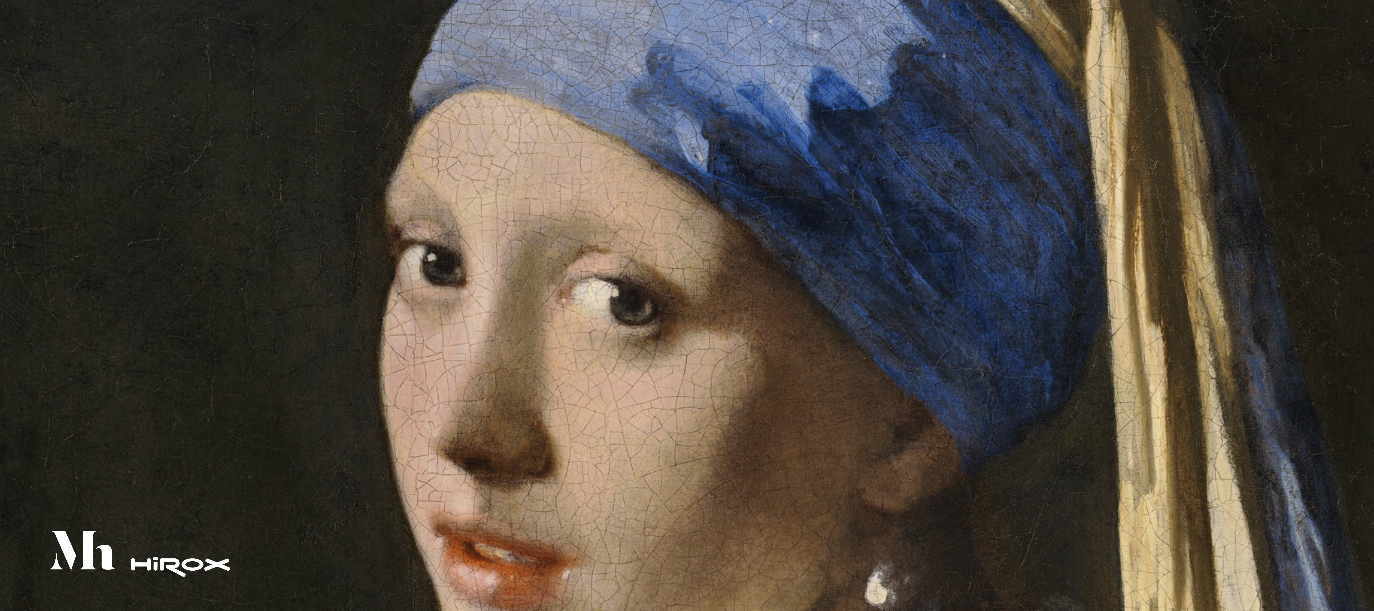
You may believe that you’ve had a close enough view of Johannes Vermeer’s Girl with a Pearl Earring. You may have gone to The Hague and seen the painting in person at the Mauritshuis. You may have zoomed into the ten billion-pixel scan we featured here on Open Culture in 2021. But if you haven’t spent time with the new 108 billion-pixel scan, can you really claim to have seen Girl with a Pearl Earring at all?
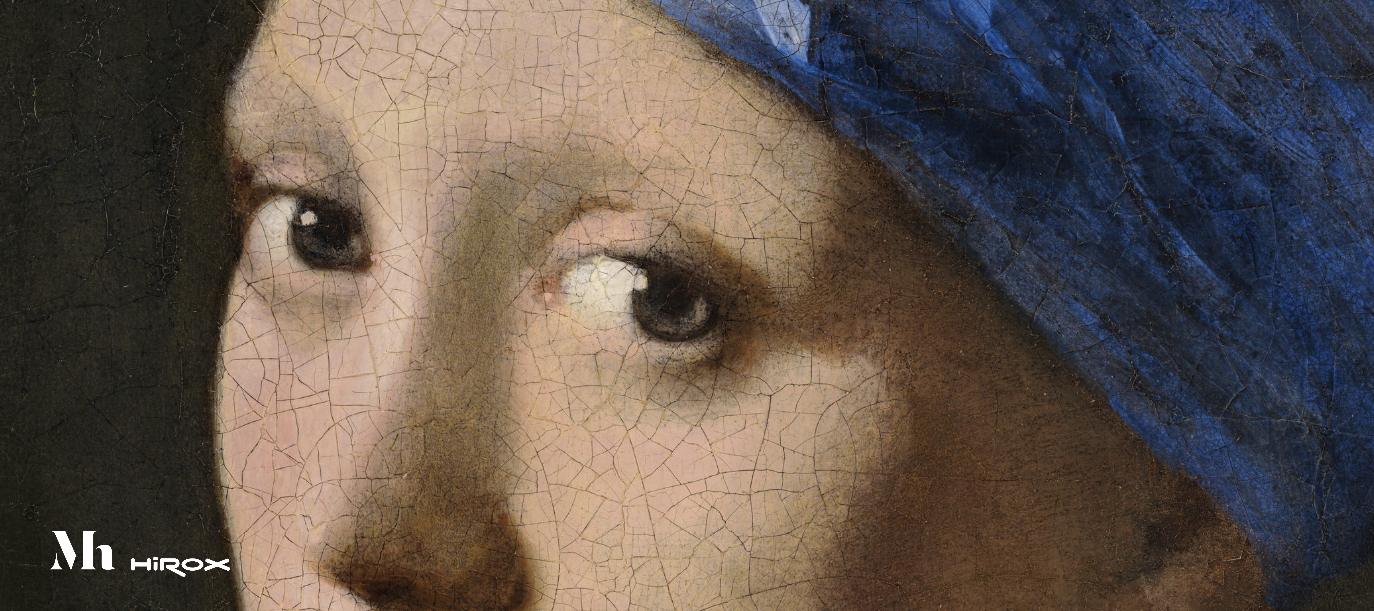
At that 108-gigapixel resolution, notes Jason Kottke, “each pixel is 1.3 microns in size — 1000 microns is 1 millimeter.” You can learn more about the technology behind the project in this making-of video produced by Hirox Europe, the local branch of the Japanese digital microscope company responsible for both the ten billion-pixel scan and this 108 billion-pixel one, which necessitated 88 hours of non-stop scanning this relatively small canvas of 15 inches by 17.5 inches, a process that resulted in 41,000 3D images.
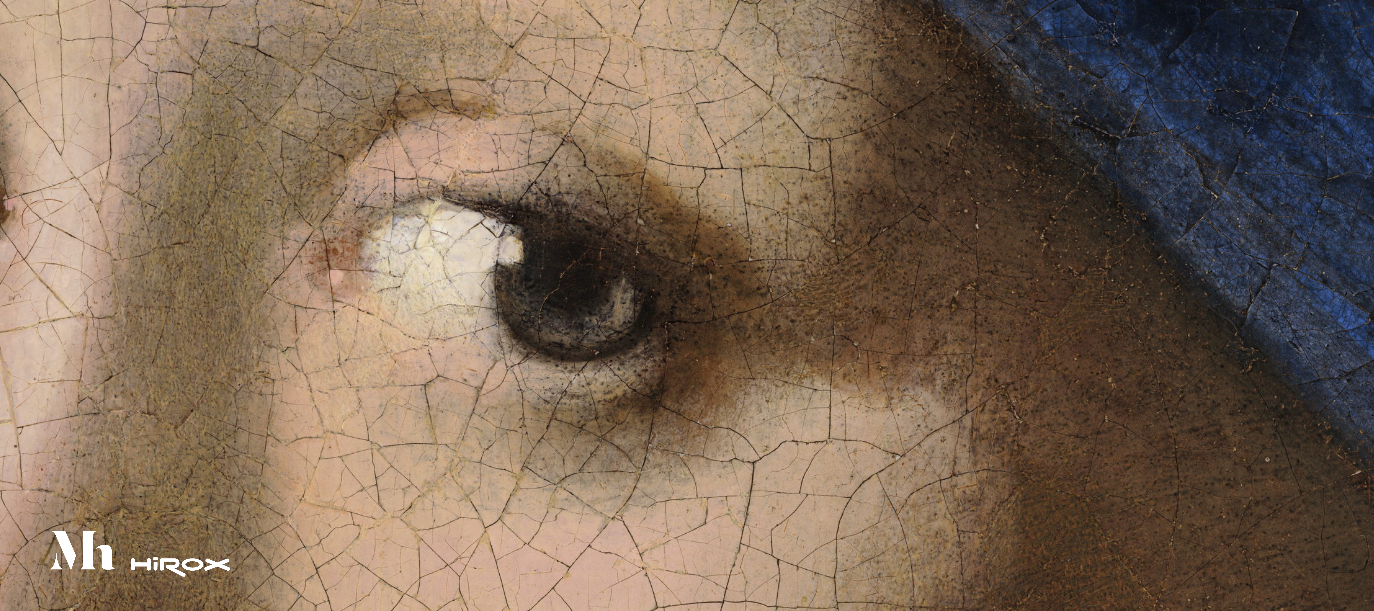
Yes, 3D images: though Girl with a Pearl Earring, known as “the Mona Lisa of the North,” may be known far and wide in flat representations on pages, screens, posters, and T‑shirts, it is, after all, a work of oil on canvas.
Vermeer achieved his ultra-realistic effects not just by putting the right colors in the right places, but applying them at the right thicknesses and with the right textures — all of which have been replicated in a “mega-sized” physical 3D print, 100 times larger than the original work, commissioned by the Mauritshuis for its Who’s that Girl? exhibition.
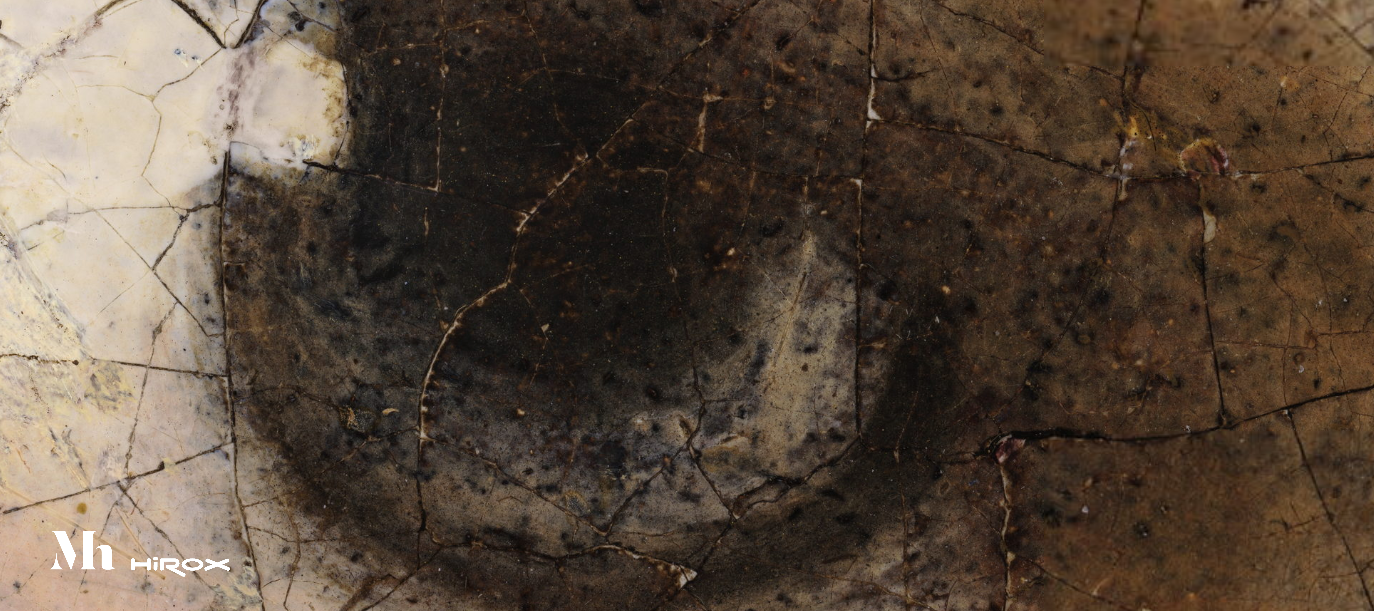
You can perform your own topographical examination of sections of the painting — the eyes, the lips, a fold of the turban, the earring, and even the reflection on the earring — by clicking the “3D” button at the bottom of the scan’s viewing interface. A look this close reveals much about how Vermeer created this world-famous image, as well as how it’s weathered the past 360 years. It does not reveal, of course, the answers to such long-standing mysteries as the identity of the subject or the motivations behind her striking presentation. Whether or not the girl with the pearl earring even existed, we can, at this point, be sure of one thing: she must feel seen. Enter the new 108 billion-pixel scan here.
via Kottke
Related content:
A Guided Tour Through All of Vermeer’s Famous Paintings, Narrated by Stephen Fry
Master of Light: A Close Look at the Paintings of Johannes Vermeer Narrated by Meryl Streep
What Makes Vermeer’s The Milkmaid a Masterpiece?: A Video Introduction
Based in Seoul, Colin Marshall writes and broadcasts on cities, language, and culture. His projects include the Substack newsletter Books on Cities and the book The Stateless City: a Walk through 21st-Century Los Angeles. Follow him on the social network formerly known as Twitter at @colinmarshall.
Read More...Stream Online Monty Python and the Holy Grail Free on Its 50th Anniversary
This year, YouTube celebrated its twentieth anniversary, prompting younger users to wonder what life could have been like before it. The fiftieth anniversary of Monty Python and the Holy Grail, which premiered in April of 1975, has inspired similar reflection among comedy enthusiasts. It can be difficult, at this point, to imagine oneself back in a culture not yet disrupted by Monty Python’s rigorously absurd logic, scattershot satire, and deliberate breaking of narrative and social convention — a culture, indeed, where that sort of thing could be feared too dangerous for television and film.
It was their BBC sketch series Monty Python’s Flying Circus that introduced this comedic sensibility first to Britain, and then to the world. Between that show’s third and fourth seasons, the Pythons — Graham Chapman, John Cleese, Eric Idle, Terry Jones, Michael Palin, and Terry Gilliam — took on the side project of creating their own cinematic re-interpretation of Arthurian legend.
With a modest budget furnished by Led Zeppelin, Pink Floyd, Jethro Tull’s Ian Anderson, and other investors connected to the music world, they plunged themselves into a grimy, unglamorous vision of the Middle Ages, punctuated by inexplicable anachronism and saturated with an iconoclastic disregard for received wisdom and trumped-up glory.
There the Pythons told a story that, while perhaps lacking in narrative structure — to say nothing of historical realism — more than compensates in sheer comic momentum. By all accounts, it holds up half a century on, even for those viewers who’ve already seen it so many times as to have involuntarily committed every joke to memory. In celebration of its anniversary, the film has become available to stream free (albeit not in all regions of the world) on the official YouTube Movies & TV channel, where the latest generations of Monty Python fans first discovered their work. Even if lines like “I fart in your general direction” no longer raise any transgressive frisson, there’s still little on that platform’s universe of content to match Monty Python and the Holy Grail’s multilayered silliness, whose place in the annals of comedy legend has long since been assured.
Related content:
Terry Gilliam’s Lost Animations from Monty Python and the Holy Grail Are Now Online
Monty Python’s Eric Idle Breaks Down His Most Iconic Characters
Monty Python and the Holy Grail Re-Imagined as an Epic, Mainstream Hollywood Film
Monty Python’s Best Philosophy Sketches
Based in Seoul, Colin Marshall writes and broadcasts on cities, language, and culture. His projects include the Substack newsletter Books on Cities and the book The Stateless City: a Walk through 21st-Century Los Angeles. Follow him on the social network formerly known as Twitter at @colinmarshall.
Read More...The 1924 Soviet Chess Match Where The Chess Pieces Were Real Soldiers and Horses
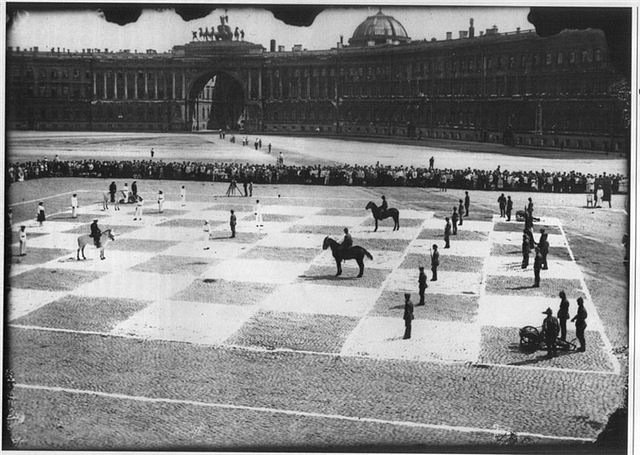
Let’s time travel back to Leningrad (aka St. Petersburg) in 1924. That’s when an unconventional chess match was played by Peter Romanovsky and Ilya Rabinovich, two chess masters of the day.
Apparently, they called in their moves over the telephone. And then real-life chess pieces—in the form of human beings and horses—were moved across a huge chessboard covering Palace Square. Members of the Soviet Union’s Red Army served as the black pieces; members of the Soviet navy were the white pieces. 8,000 onlookers watched the action unfold.
According to this online forum for chess enthusiasts, the 5‑hour match “was an annual event, designed to promote chess in the USSR.” The first such match was held in Smolensk in 1921, followed by matches in Kerch in 1922, Omsk in 1923 and then St. Petersburg in 1924. You can catch a glimpse of the match in the footage below.
?si=OaFBnWMUJ9YrqtwD
If you would like to support the mission of Open Culture, consider making a donation to our site. It’s hard to rely 100% on ads, and your contributions will help us continue providing the best free cultural and educational materials to learners everywhere. You can contribute through PayPal, Patreon, and Venmo (@openculture). Thanks!
Related Content:
A Free 700-Page Chess Manual Explains 1,000 Chess Tactics in Straightforward English
A Famous Chess Match from 1910 Reenacted with Claymation
A Brief History of Chess: An Animated Introduction to the 1,500-Year-Old Game
Read More...James Joyce, With His Eyesight Failing, Draws a Sketch of Leopold Bloom (1926)
James Joyce had a terrible time with his eyes. When he was six years old he received his first set of eyeglasses, and, when he was 25, he came down with his first case of iritis, a very painful and potentially blinding inflammation of the colored part of the eye, the iris. A short time later, he named his newborn daughter “Lucia,” after the patron saint of those with eye troubles.
For the rest of his life, Joyce had to endure a horrific series of operations and treatments for one or the other of his eyes, including the removal of parts of the iris, a reshaping of the pupil, the application of leeches directly on the eye to remove fluid–even the removal of all of Joyce’s teeth, on the theory that his recurring iritis was connected with the bacterial infection in his teeth, brought on by years of poverty and dental neglect.
After his seventh eye operation on December 5, 1925, according to Gordon Bowker in James Joyce: A New Biography, Joyce was “unable to see lights, suffering continual pain from the operation, weeping oceans of tears, highly nervous, and unable to think straight. He was now dependent on kind people to see him across the road and hail taxis for him. All day, he lay on a couch in a state of complete depression, wanting to work but quite unable to do so.”
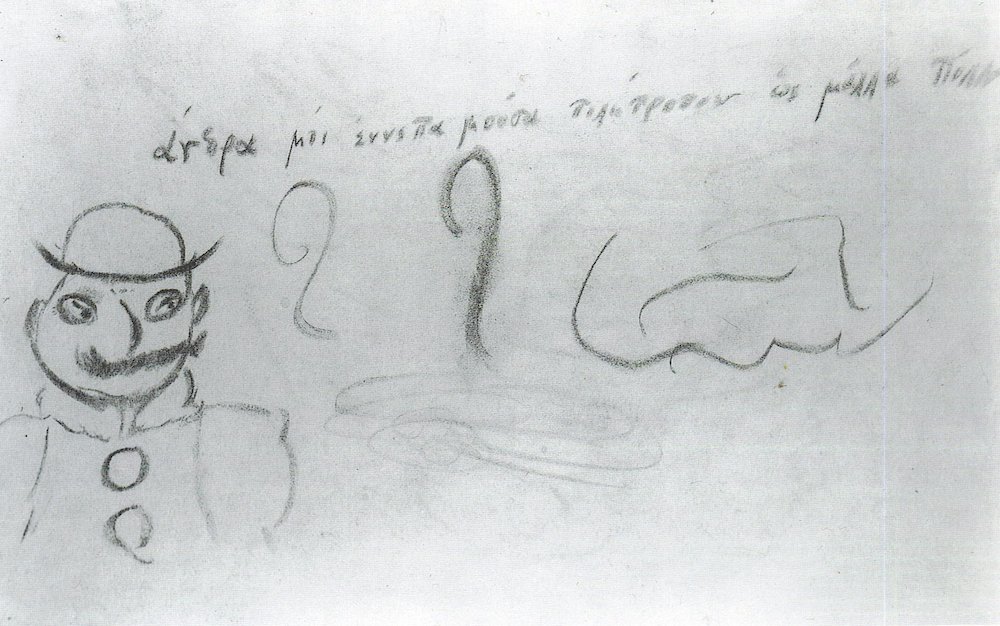
In early 1926, Joyce’s sight was improving a little in one eye. It was about this time (January 1926, according to one source) that Joyce paid a visit to his friend Myron C. Nutting, an American painter who had a studio in the Montparnasse section of Paris. To demonstrate his improving vision, Joyce picked up a thick black pencil and made a few squiggles on a sheet of paper, along with a caricature of a mischievous man in a bowler hat and a wide mustache–Leopold Bloom, the protagonist of Ulysses. Next to Bloom, Joyce wrote in Greek (“with a minor error in spelling and characteristically skewed accents,” according to R. J. Schork in Greek and Hellenic Culture in Joyce) the opening passage of Homer’s Odyssey: “Tell me, muse, of that man of many turns, who wandered far and wide.”
NOTE: Joyce’s drawing of Bloom is now in the Charles Deering McCormick Library of Special Collections at Northwestern University. Nutting was a significant source for the biography of Joyce that was written by Richard Ellmann, a professor at Northwestern. According to Scott Krafft, a curator at the library, Ellmann brokered a deal in 1960 for the library to purchase Nutting’s oil paintings of James and Nora Joyce, his pastel drawings of the Joyce children Giorgio and Lucia, along with Joyce’s sketch of Bloom, for a total of $500. The source for the January 1926 date of the Bloom sketch is an article, “James Joyce…a quick sketch” from the July 1976 edition of Footnotes, published by the Northwestern University Library Council. Our thanks to Scott Krafft.
Note: An earlier version of this post appeared on our site in 2013.
Related Content:
James Joyce: An Animated Introduction to His Life and Literary Works
What Makes James Joyce’s Ulysses a Masterpiece: Great Books Explained
James Joyce’s Crayon Covered Manuscript Pages for Ulysses and Finnegans Wake
Read the Original Serialized Edition of James Joyce’s Ulysses (1918)
Read More...The Ark Before Noah: Discover the Ancient Flood Myths That Came Before the Bible
The Lord said to Noah, there’s going to be a floody, floody; then to get those children out of the muddy, muddy; then to build him an arky, arky. This much we heard while toasting marshmallows around the campfire, at least if we grew up in a certain modern Protestant tradition. As adults, we may or may not believe that there ever lived a man called Noah who built an ark to save all the world’s innocent animal species from a sin-cleansing flood. But unless we’ve taken a deep dive into ancient history, we probably don’t know that this especially famous Bible story wasn’t the first of its particular subgenre. As explained in the Hochelaga video above, there are even older global-deluge tales to be reckoned with.
In fact, one such myth appears in the oldest known work of literature in human history, the Epic of Gilgamesh. “In it, the god Ea learns of this divine flood, and secretly warns the humans about this coming disaster,” says Hochelaga creator Tommie Trelawny. Thus informed, the king Utnapishtim builds a giant coracle, a kind of circular boat “used to navigate the rivers of Mesopotamia for centuries.”
Like Noah, Utnapishtim brings his family and a host of animals aboard, and after riding out the worst of the storm, finds that his craft has come to rest on a mountaintop. Also like Noah, he then sends birds out to find dry land. But ultimately, “the story takes a strange turn: instead of being pleased, the gods are angry,” though Ea does step in to take responsibility and make sure that Utnapishtim is rewarded.
There are other versions with other gods, floods, and ark-builders as well. In the Religion for Breakfast video just above, religious studies scholar Andrew Mark Henry compares the Biblical story of Noah and the Utnapishtim episode of the Epic of Gilgamesh with the “Sumerian flood story” from the second millennium BC and the two-centuries-older “Atrahasis epic.” All of these versions have a good deal in common, not least the executive decision by an exasperated higher being (or beings) to wipe out almost entirely the humanity they themselves created. Ironically, we moderns are likely to have first encountered this tale of godly wrath and subsequent mass destruction in lighthearted, even cheerful presentations. Whether ancient Sumerians also sang about it in youth groups, no clay tablet has yet revealed.
Related content:
A Map of All the Countries Mentioned in the Bible: What The Countries Were Called Then, and Now
Did the Tower of Babel Actually Exist?: A Look at the Archaeological Evidence
The Epic of Gilgamesh, the Oldest-Known Work of Literature in World History
Based in Seoul, Colin Marshall writes and broadcasts on cities, language, and culture. His projects include the Substack newsletter Books on Cities and the book The Stateless City: a Walk through 21st-Century Los Angeles. Follow him on the social network formerly known as Twitter at @colinmarshall.
Read More...What Was Smoot-Hawley, and Why Are We Doing It Again? Anyone? Anyone?
When most Americans think of the Smoot-Hawley Tariffs, they think of economic disaster. But if you ask why, most Americans may need a short refresher course. Below, you will find just that. Appearing on Derek Thompson’s Plain History podcast, Douglas Irwin (an economist and historian at Dartmouth) revisits the 1930 Smoot-Hawley Tariff Act, which raised tariffs on over 20,000 products imported into the United States. The law was passed despite warnings from executives like Henry Ford (who called the tariff act “an economic stupidity”) and a petition signed by 1,028 American economists, who argued that the tariffs would raise prices and spark a trade war, leaving the United States isolated. Their concerns were ultimately well-founded. The Smoot-Hawley Tariffs, supported by a Republican president and Congress, had the unintended consequence of deepening, not ending, the Great Depression.
Mark Twain allegedly said that “History doesn’t repeat itself, but it often rhymes.” But sometimes history may well repeat itself or come very close, and that’s where we seem to be headed right now. As in 1930, we have Republicans implementing new tariffs, but this time with the hope of re-engineering the world economy and bringing manufacturing back to America. Meanwhile, economists (even conservative ones) warn that these policies risk repeating the mistakes of Smoot-Hawley.
Below you can hear the assessment of the economic historian Niall Ferguson, who, in speaking with Bari Weiss, explains why Donald Trump’s tariffs will fail to re-industrialize America. The golden age of manufacturing in America is long gone, and it’s not coming back, partly thanks to automation. (Morgan Housel has more to say on that.) But even worse, the chaotic implementation of these policies risks triggering a trade war, “a major financial crisis comparable in scale to 2008,” or even a military crisis that an isolated America would be ill-equipped to handle. Speaking on Meet the Press this weekend, investor Ray Dalio ominously voiced very similar concerns, saying “something worse than recession” may be on the horizon.
For another take, you can hear Preet Bharara’s conversation with Justin Wolfers, where the Australian economist warns that Trump’s tariffs may have few benefits and mostly costs, some quite profound. By launching a trade war, America will trade less and find its global influence diminished, leaving a void that China can fill. Echoing Niall Ferguson, Wolfers also cautions that you can’t turn back the economic clock. He notes:
A hundred years ago, we had actually the same debate, but it was because we were moving from the land, from a predominantly agricultural economy, to a manufacturing-based economy. And we moved from an enormous share of the population working in agriculture to working in manufacturing, and that raised the American middle class.
There was a lot of nostalgia. Why aren’t we back on the land? And the subsequent stage of economic development is we move out of the factories, and we move and become engineers and computer scientists and software designers. And we’re in a much more cognitive economy.And we are not inhaling black soot in our mines or in our factories during the day. And that’s the future of the American economy. And it’s one that speaks well to the skills that Americans have.We’re the most educated workforce in the world. And so presumably the jobs of the future are those, the jobs we want are those that cater to the extreme productivity and education of American workers.
How have we reached the point where we’re running the same failed experiments again, all to reclaim an illusory bygone economic age? It’s a hard question to contemplate, but I ask that question again. Anyone? Anyone? Anyone?
Related Content
Free Online Economics & Finance Courses
Read More...Actor John Lithgow Reads 20 Lessons on Tyranny, Penned by Historian Timothy Snyder
In 2017, historian Timothy Snyder wrote the concise book On Tyranny: Twenty Lessons from the Twentieth Century, which went on to become a New York Times bestseller. A historian of fascism (then at Yale, now at U. Toronto), Snyder wanted to offer Americans a useful guide for resisting the country’s drift towards authoritarianism. It was handy then and even handier now–especially as the feds bear down on different institutions undergirding American civil society. Law firms, universities, corporations, media outlets–they’re all getting squeezed, and many have already violated the first of Snyder’s 20 lessons: “Do not obey in advance.” Above, you can hear actor John Lithgow read a condensed version of Snyder’s lessons. You can order a copy of his book online, or explore here a related video series that Snyder produced a few years back. Find a cheat sheet below.
1. Do not obey in advance
2. Defend institutions
3. Beware the one-party state
4. Take responsibility for the face of the world
5. Remember professional ethics
6. Be wary of paramilitaries
7. Be reflective if you must be armed
8. Stand out
9. Be kind to our language
10. Believe in truth
11. Investigate
12. Make eye contact and small talk
13. Practice corporeal politics
14. Establish a private life
15. Contribute to good causes
16. Learn from peers in other countries
17. Listen for dangerous words
18. Be calm when the unthinkable arrives
19. Be a patriot
20. Be as courageous as you can
Related Content
Umberto Eco’s List of the 14 Common Features of Fascism
Toni Morrison Lists the 10 Steps That Lead Countries to Fascism (1995)
Read More...The Map of Mathematics: Animation Shows How All the Different Fields in Math Fit Together
Back in December, you hopefully thoroughly immersed yourself in The Map of Physics, an animated video–a visual aid for the modern age–that mapped out the field of physics, explaining all the connections between classical physics, quantum physics, and relativity.
You can’t do physics without math. Hence we now have The Map of Mathematics. Created by physicist Dominic Walliman, this video explains “how pure mathematics and applied mathematics relate to each other and all of the sub-topics they are made from.” Watch the new video above. You can buy a poster of the map here. And you can download a version for educational use here.
If you would like to support the mission of Open Culture, consider making a donation to our site. It’s hard to rely 100% on ads, and your contributions will help us continue providing the best free cultural and educational materials to learners everywhere. You can contribute through PayPal, Patreon, and Venmo (@openculture). Thanks!
Related Content
John Coltrane Draws a Picture Illustrating the Mathematics of Music
The Math Behind Beethoven’s Music
Read More...
Support Us
We're hoping to rely on loyal readers, rather than erratic ads. Please click the Donate button and support Open Culture. You can use Paypal, Venmo, Patreon, even Crypto! We thank you!

About Us

Open Culture scours the web for the best educational media. We find the free courses and audio books you need, the language lessons & educational videos you want, and plenty of enlightenment in between.
Advertise With Us

FREE UPDATES!
GET OUR DAILY EMAIL
Get the best cultural and educational resources on the web curated for you in a daily email. We never spam. Unsubscribe at any time.
FOLLOW ON SOCIAL MEDIA

Open Culture editor Dan Colman scours the web for the best educational media. He finds the free courses and audio books you need, the language lessons & movies you want, and plenty of enlightenment in between.
Advertise With Us

