Shel Silverstein’s The Giving Tree: The Animated Film Narrated by Shel Silverstein Himself (1973)
Back in 1964, Shel Silverstein wrote The Giving Tree, a widely loved children’s book now translated into more than 30 languages. It’s a story about the human condition, about giving and receiving, using and getting used, neediness and greediness, although many finer points of the story are open to interpretation. Today, we’re rewinding the videotape to 1973, when Silverstein’s little book was turned into a 10-minute animated film. Silverstein narrates the story himself and also plays the harmonica.… which brings us to his musical talents. Don’t miss Silverstein, also a well-known songwriter, appearing on The Johnny Cash Show in 1970, and the two singing “A Boy Named Sue.” Silverstein wrote the song, and Cash made it famous. Thanks to Mark, co-editor of the philosophy blog/podcast The Partially Examined Life for sending these along.
If you would like to support the mission of Open Culture, consider making a donation to our site. It’s hard to rely 100% on ads, and your contributions will help us continue providing the best free cultural and educational materials to learners everywhere. You can contribute through PayPal, Patreon, and Venmo (@openculture). Thanks!
Related Content:
Watch Animations of Oscar Wilde’s Children’s Stories “The Happy Prince” and “The Selfish Giant”
Maurice Sendak Animated; James Gandolfini Reads from Sendak’s Story “In The Night Kitchen”
The Only Drawing from Maurice Sendak’s Short-Lived Attempt to Illustrate The Hobbit
Read More...Gnome Chomsky: The Indispensable Ornament for the Thinking Person’s Garden
Images via JustSayGnome
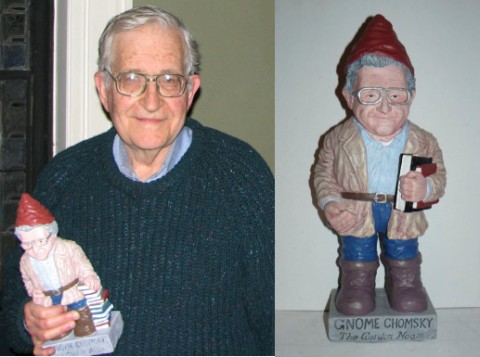
The Noam Chomsky Garden Gnome. That’s right, I said it, the Noam Chomsky Garden Gnome.
Over at justsaygnome.net, you can buy “Gnome Chomsky the Garden Noam.” Here’s is how it’s generally described:
Just over one foot in height, the fully painted Gnome Chomsky the Garden Noam (Version II) stands relaxed and confident in his classy gnome clothes, hat and glasses. Equipped with a couple books on an authoritative pillar, he’s ready to give your garden or home a big infusion of insightful gnome political perspective. A solid foundation base complete with a carved title assures that Garden Noam will be well-balanced and helps inform anyone who may not immediately recognize him of the identity of this handsome and scholarly gnome.
The gnome costs $228.00 painted and $124 unpainted (plus shipping). And if you’re interested, you can also get Howard the Zinn Monk and BerGnome Sanders.
In putting this post together, I spotted an old comic bit that took the idea of a Noam Garden Gnome as its premise. You can watch it below.
If you would like to support the mission of Open Culture, consider making a donation to our site. It’s hard to rely 100% on ads, and your contributions will help us continue providing the best free cultural and educational materials to learners everywhere. You can contribute through PayPal, Patreon, and Venmo (@openculture). Thanks!
Related Content:
Clash of the Titans: Noam Chomsky & Michel Foucault Debate Human Nature & Power on Dutch TV, 1971
Noam Chomsky Defines What It Means to Be a Truly Educated Person
Read More...Noam Chomsky on ChatGPT: It’s “Basically High-Tech Plagiarism” and “a Way of Avoiding Learning”
ChatGPT, the system that understands natural language and responds in kind, has caused a sensation since its launch less than three months ago. If you’ve tried it out, you’ll surely have wondered what it will soon revolutionize — or, as the case may be, what it will destroy. Among ChatGPT’s first victims, holds one now-common view, will be a form of writing that generations have grown up practicing throughout their education. “The essay, in particular the undergraduate essay, has been the center of humanistic pedagogy for generations,” writes Stephen Marche in The Atlantic. “It is the way we teach children how to research, think, and write. That entire tradition is about to be disrupted from the ground up.”
If ChatGPT becomes able instantaneously to whip up a plausible-sounding academic essay on any given topic, what future could there be for the academic essay itself? The host of YouTube channel EduKitchen puts more or less that very question to Noam Chomsky — a thinker who can be relied upon for views on education — in the new interview above. “For years there have been programs that have helped professors detect plagiarized essays,” Chomsky says. “Now it’s going to be more difficult, because it’s easier to plagiarize. But that’s about the only contribution to education that I can think of.” He does admit that ChatGPT-style systems “may have some value for something,” but “it’s not obvious what.”
As the relevant technology now stands, Chomsky sees the use of ChatGPT as “basically high-tech plagiarism” and “a way of avoiding learning.” He likens its rise to that of the smartphone: many students “sit there having a chat with somebody on their iPhone. One way to deal with that is to ban iPhones; another way to do it is to make the class interesting.” That students instinctively employ high technology to avoid learning is “a sign that the educational system is failing.” If it “has no appeal to students, doesn’t interest them, doesn’t challenge them, doesn’t make them want to learn, they’ll find ways out,” just as he himself did when he borrowed a friend’s notes to pass a dull college chemistry class without attending it back in 1945.
After spending most of his career teaching at MIT, Chomsky retired in 2002 to become a full-time public intellectual. The University of Houston’s Robert Zaretsky, who still teaches, recently offered his own, grimmer take on ChatGPT and education. “The college essay died years ago,” he argues. “It’s a mug’s game in which a student sends me an electronic file that, when open, spills out a jumble of words that the sender propounds to be a finished paper” — to which, presumably, the output of a machine-learning system would actually be far preferable. Most technological “disruptions” leave both positive and negative effects in their wake. If the college essay is indeed unsalvageable, perhaps ChatGPT will finally bring about its replacement with something more interesting.
Update: Chomsky has co-authored an op-ed in The New York Times called “The False Promise of ChatGPT”. Find it here.
Related content:
Noam Chomsky Explains Where Artificial Intelligence Went Wrong
Noam Chomsky Defines What It Means to Be a Truly Educated Person
Noam Chomsky Spells Out the Purpose of Education
Based in Seoul, Colin Marshall writes and broadcasts on cities, language, and culture. His projects include the Substack newsletter Books on Cities, the book The Stateless City: a Walk through 21st-Century Los Angeles and the video series The City in Cinema. Follow him on Twitter at @colinmarshall or on Facebook.
Read More...LEGO Releases the Most Elaborate Lord of the Rings Set: A 6,167-Piece Rivendell
Many of us built our first LEGO models in childhood and, a few years thereafter in adolescence, read our first Lord of the Rings novel. We continue to look fondly back on such formative cultural experiences in adulthood, and indeed, some of us retain a genuine appreciation for the artifacts themselves well into middle age.
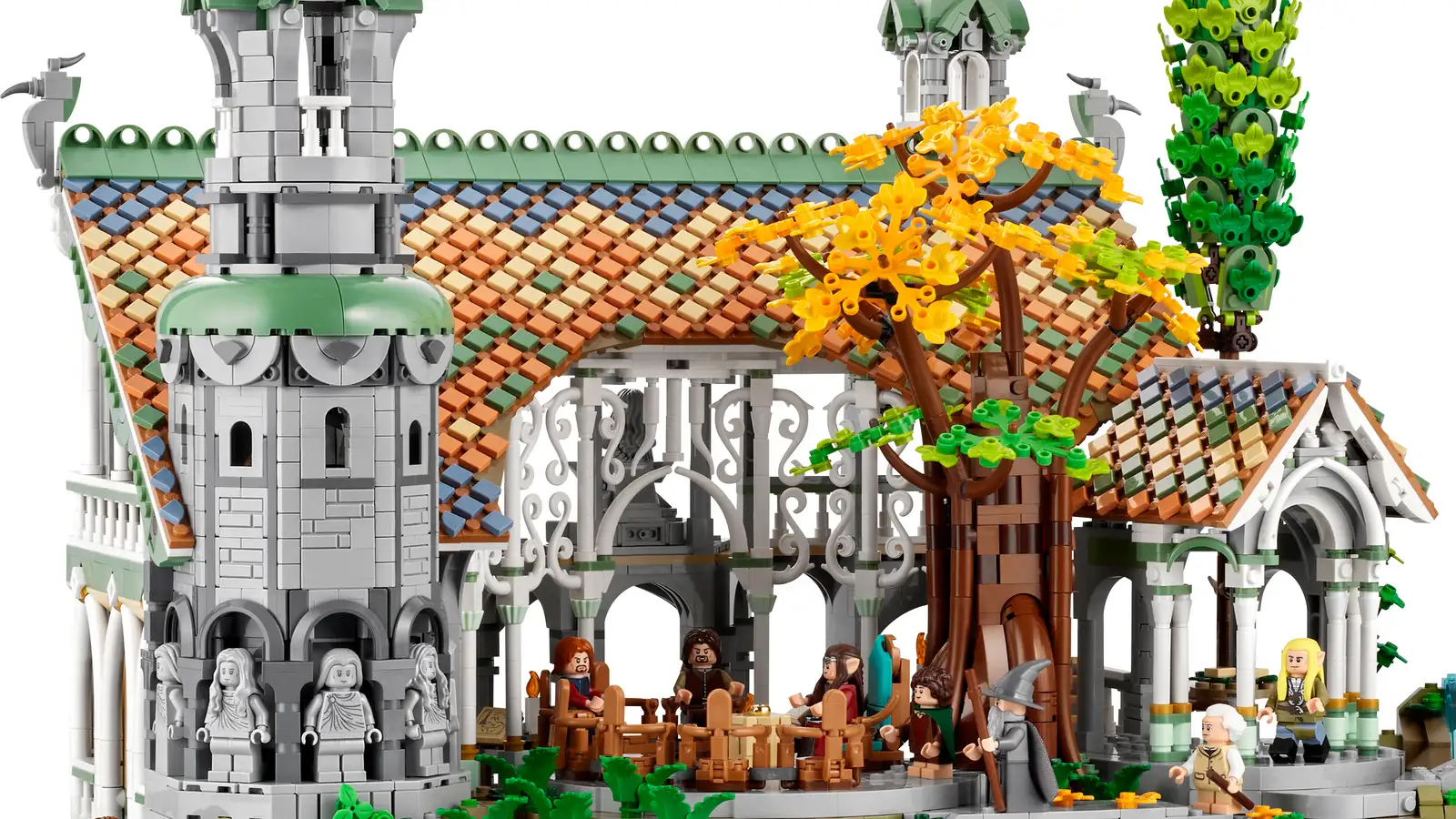
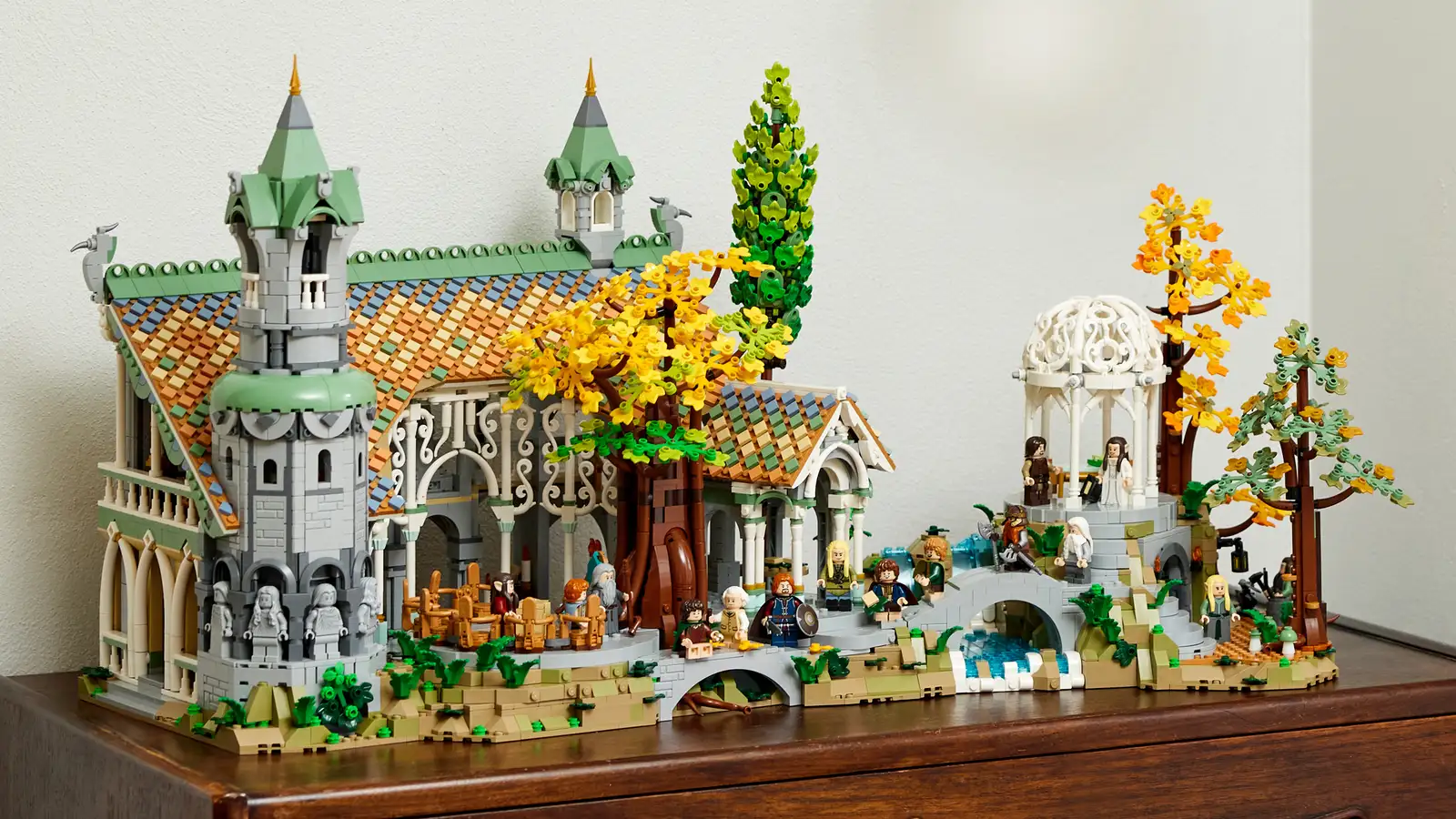
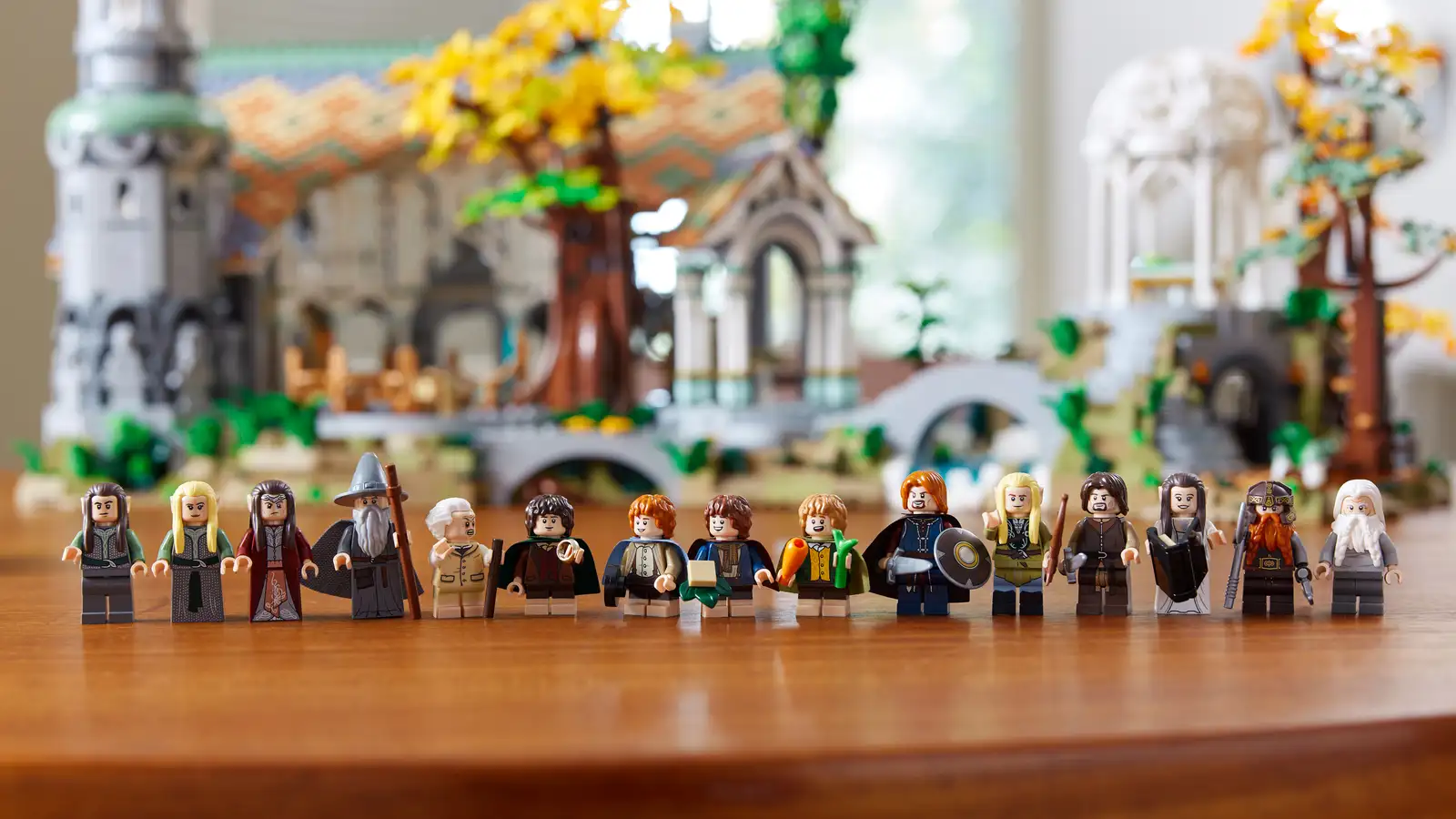
It is toward that very intersection of enthusiasm and means that LEGO has targeted its latest and largest Lord of the Rings-themed set: a 6,167-piece model of the Rivendell, the sanctuary located in the eponymous Elvish valley, which is set to retail for $500 USD.
This new LEGO Rivendell has room “for the entire Fellowship to debate The One Ring, and the shards of a particularly noteworthy sword,” writes The Verge’s Sean Hollister, and it includes “tiled rooftops, imaginative arches, and enough distinct spaces to recreate multiple scenes from the movies.”
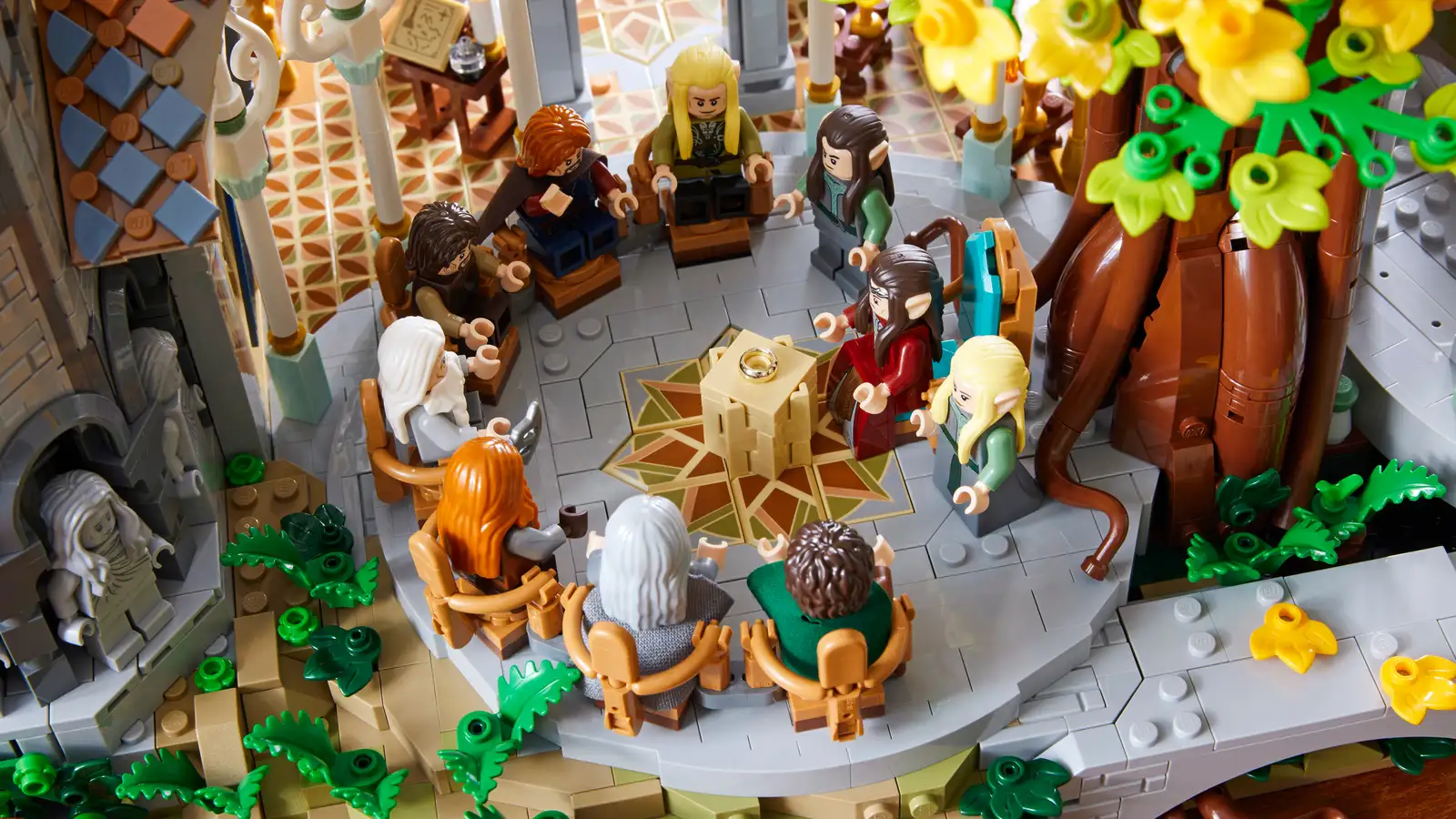
This marks a considerable improvement on the sets that came out at the time of Peter Jackson’s Lord of the Rings movies in the early 2000s: Andrew Liszewski at Gizmodo notes that “the largest one was a 1,300+-piece recreation of the Battle of Helm’s Deep that, by today’s LEGO standards, was relatively small. The collection also included a tiny 243-piece recreation of the Council of Elrond, which, understandably, left LOTR fans disappointed.”
You can see an in-depth review of the new Rivendell set in the video just above from LEGO Youtuber Bricksie. He has a great deal of praise for the details of its components, yet whatever resources LEGO can put toward an official consumer product, they can hardly match the power of sheer fan obsession.

If you want to experience a truly faithful re-creation of Rivendell in the medium of LEGO, you’ll have to attend a convention with Alice Finch and David Frank, builders of an elaborate model that includes no fewer than 200,000 bricks: a sprawling monument to the kind of quasi-religious (and sometimes lifelong) devotion inspired by both the imagination of Tolkien and the possibilities of LEGO.
Related content:
The Lord of the Rings Mythology Explained in 10 Minutes, in Two Illustrated Videos
Hokusai’s Iconic Print The Great Wave off Kanagawa Recreated with 50,000 LEGO Bricks
Cambridge University to Create a LEGO Professorship
Why Did LEGO Become a Media Empire? Pretty Much Pop: A Culture Podcast #37
Based in Seoul, Colin Marshall writes and broadcasts on cities, language, and culture. His projects include the Substack newsletter Books on Cities, the book The Stateless City: a Walk through 21st-Century Los Angeles and the video series The City in Cinema. Follow him on Twitter at @colinmarshall or on Facebook.
Read More...How Vinyl Records Are Made
The vinyl record–we’ve shown you how they were made way back in 1937, and also in 1956. But how about nowadays, during the renaissance of vinyl? Above, Wired visits Jack White’s Third Man Records vinyl pressing plant in Detroit, Michigan to “find out exactly what goes into the creation of a vinyl record; from cutting and pressing to making sure they sound great.” If you’re in the Detroit area, you can take a tour of Third Man Records’ pressing plant. Get more info here.
If you would like to support the mission of Open Culture, consider making a donation to our site. It’s hard to rely 100% on ads, and your contributions will help us continue providing the best free cultural and educational materials to learners everywhere. You can contribute through PayPal, Patreon, and Venmo (@openculture). Thanks!
Related Content
How Vinyl Records Are Made: A Primer from 1956
How Old School Records Were Made, From Start to Finish: A 1937 Video Featuring Duke Ellington
Read More...Bohemian Rhapsody Played on the Largest Pipe Organ in the World
Back in 2016, we showed you Queen’s “Bohemian Rhapsody” getting played on a 1905 fairground organ. But now we’re stepping it up a level, and letting you behold this: organist Joshua Stafford performing the same Queen classic on a Midmer-Losh pipe organ. Built with 33,112 pipes, it’s apparently the “largest pipe organ ever constructed, the largest musical instrument ever constructed, and the loudest musical instrument ever constructed.” You can find it in the Main Auditorium of the Boardwalk Hall in Atlantic City, NJ. Enjoy.
h/t Allie
If you would like to support the mission of Open Culture, consider making a donation to our site. It’s hard to rely 100% on ads, and your contributions will help us continue providing the best free cultural and educational materials to learners everywhere. You can contribute through PayPal, Patreon, and Venmo (@openculture). Thanks!
Related Content
1905 Fairground Organ Plays Queen’s “Bohemian Rhapsody,” and It Works Like a Charm
Download the Complete Organ Works of J.S. Bach for Free
Read More...Vintage Book & Record Covers Come to Life in a Mesmerizing Animated Video
Back in April 2020, animator Henning M. Lederer launched his “Books & Sleeves” project where he turns abstract geometric patterns, all featured on vintage book and record covers, into mesmerizing moving images. Above, you can watch the second installment of the project, which doesn’t disappoint.
In the past, we’ve also featured more of Lederer’s creative work–from his animations of mid-century minimalist book covers and vintage psychology and philosophy books, to his animation of a 1926 lithograph that famously portrays the human body as a modern factory. Be sure to give them all a watch.
If you would like to support the mission of Open Culture, consider making a donation to our site. It’s hard to rely 100% on ads, and your contributions will help us continue providing the best free cultural and educational materials to learners everywhere. You can contribute through PayPal, Patreon, and Venmo (@openculture). Thanks!
Related Content
Mythos: An Animation Retells Timeless Greek Myths with Abstract Modern Designs
Vintage Book & Record Covers Brought to Life in a Mesmerizing Animated Video
Read More...
Neil deGrasse Tyson, High School Wrestling Team Captain, Once Invented a Physics-Based Wrestling Move
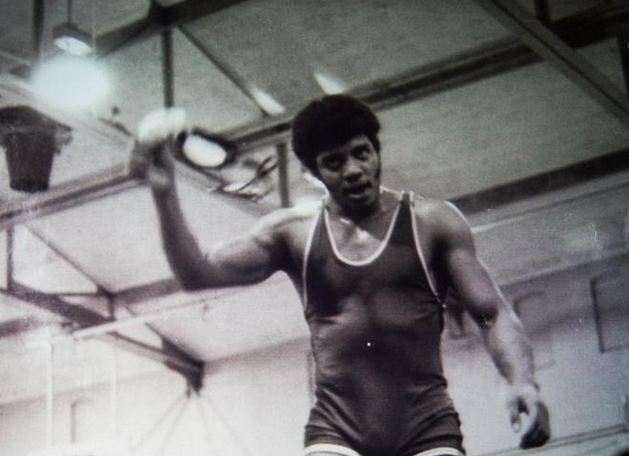
We know that Neil deGrasse Tyson was something of a wunderkind during his high school years. If you’re an OC regular, you’ve read all about how Carl Sagan personally recruited Tyson to study with him at Cornell. Deftly, politely, the young Tyson declined and went to Harvard.
There’s perhaps another side of the precocious Tyson you might not know as much about. The athletic side. While a student at The Bronx High School of Science, Tyson (class of 1976) wore basketball sneakers belonging to the Knick’s Walt “Clyde” Frazier. He ran an impressive 4:25 mile. And he captained the school’s wrestling team, during which time he conjured up a new-fangled wrestling move. In professional wrestling, Ric Flair had the dreaded Figure Four Leg Lock, and Jimmy Snuka, a devastating Superfly Splash. Tyson? He had the feared “Double Tidal Lock.” He explains and demonstrates the physics-based move in the video below, originally recorded at the University of Indianapolis.
Related Content:
Andy Warhol’s One Minute of Professional Wrestling Fame (1985)
Neil deGrasse Tyson Lists 8 (Free) Books Every Intelligent Person Should Read
When Samuel Beckett Drove Young André the Giant to School
Read More...The Rise & Fall of Roman Civilization: Every Year Shown in a Timelapse Map Animation (753 BC ‑1479 AD)
The Youtuber “EmperorTigerstar” specializes in documenting the unfolding of world historical events by stitching together hundreds of maps into timelapse films. In years past, we’ve featured his “map animations” of the U.S. Civil War (1861–1865), World War I (1914–1918), and World War II (1939–1945). Today, we’re highlighting a more ambitious project, an attempt to visually document the rise and fall of the Romans. The video covers 2,000 years of history, in just ten minutes.
Moving from 753 BC to 1479 AD, the animated map shows Rome’s territorial boundaries changing as the Roman Kingdom morphs into the Roman Republic and later the Roman Empire. Then the gravity of history takes over and we experience the gradual decline of Roman civilization. We see the bifurcation that splits the Empire into Western and Eastern (Byzantine) parts, until only a little piece remains.
If you would like to support the mission of Open Culture, consider making a donation to our site. It’s hard to rely 100% on ads, and your contributions will help us continue providing the best free cultural and educational materials to learners everywhere. You can contribute through PayPal, Patreon, and Venmo (@openculture). Thanks!
Related Content:
The History of Ancient Rome in 20 Quick Minutes: A Primer Narrated by Brian Cox
The Splendid Book Design of the 1946 Edition of Gibbon’s Decline and Fall of the Roman Empire
An 8‑Minute Animated Flight Over Ancient Rome
How to Make Roman Concrete, One of Human Civilization’s Longest-Lasting Building Materials
Read More...Liam Neeson Stars as Raymond Chandler’s Legendary Detective Philip Marlowe: Watch the Trailer for the New Film
Behold the new trailer for Marlowe, a new film directed by Neil Jordan. As the title suggests, the film centers around Philip Marlowe, the gumshoe detective that Raymond Chandler first unveiled in The Big Sleep in 1939. Between then and now, Marlowe has been portrayed in films by Humphrey Bogart, Robert Mitchum, Elliott Gould, and James Garner. Now, Liam Neeson takes his turn. Here’s how the producers pitch the film:
MARLOWE, a gripping noir crime thriller set in late 1930’s Los Angeles, centers around a street-wise, down on his luck detective; Philip Marlowe, played by Liam Neeson, who is hired to find the ex-lover of a glamorous heiress (Diane Kruger), daughter of a well-known movie star (Jessica Lange). The disappearance unearths a web of lies, and soon Marlowe is involved in a dangerous, deadly investigation where everyone involved has something to hide.
Marlowe arrives in theaters on February 15.
If you would like to support the mission of Open Culture, consider making a donation to our site. It’s hard to rely 100% on ads, and your contributions will help us continue providing the best free cultural and educational materials to learners everywhere. You can contribute through PayPal, Patreon, and Venmo (@openculture). Thanks!
Related Content
Raymond Chandler’s Ten Commandments for Writing a Detective Novel
Watch Raymond Chandler’s Long-Unnoticed Cameo in Double Indemnity
Read More...Support Us
We're hoping to rely on loyal readers, rather than erratic ads. Please click the Donate button and support Open Culture. You can use Paypal, Venmo, Patreon, even Crypto! We thank you!

About Us

Open Culture scours the web for the best educational media. We find the free courses and audio books you need, the language lessons & educational videos you want, and plenty of enlightenment in between.
Advertise With Us

FREE UPDATES!
GET OUR DAILY EMAIL
Get the best cultural and educational resources on the web curated for you in a daily email. We never spam. Unsubscribe at any time.
FOLLOW ON SOCIAL MEDIA

Open Culture editor Dan Colman scours the web for the best educational media. He finds the free courses and audio books you need, the language lessons & movies you want, and plenty of enlightenment in between.
Advertise With Us

