The History of Ancient Japan: The Story of How Japan Began, Told by Those Who Witnessed It (297‑1274)
Here in the twenty-first century, many of us around the world think of Japan as essentially unchanging. We do so not without cause, given how much of what goes on there, including the operation of certain businesses, has been going on for centuries and centuries. But the political, cultural, religious, economic, and ethnic composition of the civilization we’ve long known as Japan has, in fact, transformed a great deal over the course of its existence. Some of the most dramatic changes occurred between the third and thirteenth centuries, the span of time covered by the video above.
“How Japan Began” comes from Voices of the Past, a Youtube channel previously featured here on Open Culture for its videos on a first-hand account of the destruction of Pompeii, an ancient Chinese historian’s description of the Roman Empire, and how the first Japanese visitor to the United States and Europe saw life there.
In telling the story of how ancient Japan (though mostly in a time span that falls within Europe’s Middle Ages) assumed something like its current form, the video adheres to its usual method of directly incorporating as many primary or close-to-primary sources as possible: the Chinese Records or History of the Three Kingdoms, eighth-century court edicts and national histories, the thirteenth-century émigré Chinese Buddhist monk Mugaku Sogen.
As for the rest of the narration, Voices of the Past credits Thomas Lockley, co-author of the book African Samurai: The True Story of Yasuke, a Legendary Black Warrior in Feudal Japan. Yasuke, whom we’ve also featured before, arrived in Japan in 1579, three centuries after the events chronicled in “How Japan Begin” — and thus quite deep indeed into the history of a volatile land of religious shifts, political ambitions, and (voluntary or involuntary) cultural exchanges, all amid an internal state oscillating between fragmentation and consolidation as well as an ever-changing relationship to the world at large. We can’t say what mixture of stability and instability will characterize Japan’s next millennium, but we can hope its future chroniclers are up to the task.
Related content:
The Entire History of Japan in 9 Quirky Minutes
When a UFO Came to Japan in 1803: Discover the Legend of Utsuro-bune
The 17th Century Japanese Samurai Who Sailed to Europe, Met the Pope & Became a Roman Citizen
1850s Japan Comes to Life in 3D, Color Photos: See the Stereoscopic Photography of T. Enami
Based in Seoul, Colin Marshall writes and broadcasts on cities, language, and culture. His projects include the Substack newsletter Books on Cities, the book The Stateless City: a Walk through 21st-Century Los Angeles and the video series The City in Cinema. Follow him on Twitter at @colinmarshall or on Facebook.
Read More...Al Jaffee, the Longest Working Cartoonist in History, Dies at 102: Discover How He Invented the Iconic “Folds-Ins” for Mad Magazine
Note: Yesterday, Mad Magazine legend Al Jaffee died at the age of 102. Below, we present our 2016 post featuring Jaffee talking about how he invented the iconic Fold-ins for the satirical magazine.
Keep copying those Sunday funnies, kids, and one day you may beat Al Jaffee’s record to become the Longest Working Cartoonist in History.
You’ll need to take extra good care of your health, given that the Guinness Book of World Records notified Jaffee, above, of his honorific on his 95th birthday.
Much of his legendary career has been spent at Mad Magazine, where he is best-known as the father of Fold-ins.
Conceived of as the satirical inverse of the expensive-to-produce, 4‑color centerfolds that were a staple of glossier mags, the first Fold-In spoofed public perception of actress Elizabeth Taylor as a man-eater. Jaffe had figured it as a one-issue gag, but editor Al Feldstein had other ideas, demanding an immediate follow up for the June 1964 issue.
Jaffe obliged with the Richard Nixon Fold-in, which set the tone for the other 450 he has hand-rendered in subsequent issues.
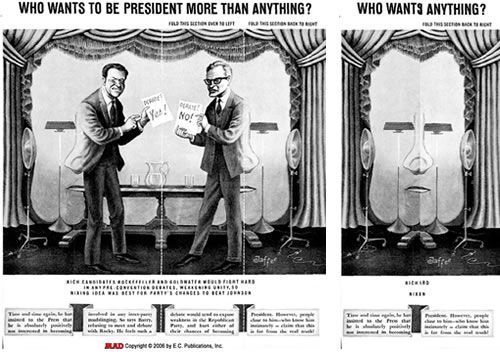
For those who made it to adulthood without the singular pleasure of creasing Mad’s back cover, you can digitally fold-in a few samples using this nifty interactive feature, courtesy of The New York Times.
With all due respect, it’s not the same, just enough to give a feel for the thrill of drawing the outermost panel in to reveal the visual punchline lurking within the larger picture. The print edition demands precision folding on the reader’s part, if one is to get a satisfactory answer to the rhetorical text posed at the outset.
Jaffe must be even more precise in his calculations. In an interview with Sean Edgar of Paste Magazine, he described how he turned a Republican primary stage shared by Nelson Rockefeller and Barry Goldwater into a surprise portrait of the man who would become president five years hence:
The first thing I did was draw Richard Nixon’s face, not in great detail, just a very rough establishment of where the eyes, nose and mouth would be, and the general shape. I did an exaggerated caricature of Nixon and then I cut it in half, and moved it apart. Once the face was cut in half, it didn’t have the integrity of a face anymore — it was sort of a half of face. Then I looked at what the eyes were like, and I said, ‘what can I make out of the eyes?’ He had these heavy eyebrows. I played around with many things, but I had to keep in mind all the time what the big picture was. So there they (Goldwater and Rockefeller) were up on a stage somewhere, doing a debate, and I thought, ‘What kind of stage prop can I put alongside these guys that would seem natural there?’ I decided that I could make eyes out of the lamps, and as far as the nose was concerned, that could come out of the figures — their clothing. Then I figured the mouth; I could use some sort of table that could give me those two sides. That’s how it all came about. You have to have some kind of visual imagination to see the possibilities. I had to concentrate on stuff that looked natural on a stage.
Each Fold-In is a reflection of the zeitgeist. Past preoccupations have included Vietnam, feminism, illegal drug use and, more recently, the Jersey Shore.
via Gothamist
Related Content:
A Gallery of Mad Magazine’s Rollicking Fake Advertisements from the 1960s
Watch Mad Magazine’s Edgy, Never-Aired TV Special (1974)
A Look Inside Charlie Hebdo, Their Creative Process & the Making of a Fateful Cartoon
Cartoonists Draw Their Famous Cartoon Characters While Blindfolded (1947)
Ayun Halliday is an author, illustrator, and Chief Primatologist of the East Village Inky zine. Follow her @AyunHalliday
Read More...Historical Italian Cooking: How to Make Ancient Roman & Medieval Italian Dishes
Italy is widely celebrated for having vigilantly preserved its food culture, with the result that many dishes there are still prepared in more or less the same way they have been for centuries. When you taste Italian food at its best, you taste history — to borrow the name of a Youtube channel whose success has revealed a surprisingly widespread enthusiasm for the cuisine of bygone eras. But some of Italy’s most globally beloved comestibles aren’t quite as deeply rooted in the past as people tend to assume: there are no records of tiramisu, for instance, before the nineteen-sixties; ciabatta, the Italian answer to the baguette, was invented in the early nineteen-eighties.
Neither of them appear anywhere in Historical Italian Cooking, a bilingual blog in English and Italian that teaches how to partake in far more venerable culinary traditions. A variety of periods are represented: the nineteenth century (Neapolitan calamari, tagliatelle and beef stew), the Renaissance (crostini with guanciale and sage, elderflowers fritters), the Middle Ages (monk’s stuffed-egg soup, quails with sumac), and even the time of ancient Rome (cuttlefish cakes, Horace’s lagana and chickpeas).
You can also see these and other dishes prepared on Historical Italian Cooking’s Youtube channel, which offers playlists organized by era, region, and chief ingredient: Medieval Tuscan recipes, ancient fish recipes, early medieval recipes at the court of the Franks.
Historical Italian Cooking’s most popular video shows every step involved in making “the most famous ancient Mediterranean sauce, garum.” The recipe comes straight from De Re Coquinaria, the oldest known cookbook in existence, which we’ve previously featured here on Open Culture. If you’d like to try your hand at making this bold condiment, make sure you’ve got the time: you’ll have to let the fish it’s made of it sit for at least a few days, stirring it three or four times per day, though some recipes suggest continuing this process for three or four months before the garum is ready to eat. If, on further consideration, you’d prefer to make a pizza, Historical Italian Cooking can help with that as well: just make sure you’ve got enough lard and quails.
Related content:
A Free Course from MIT Teaches You How to Speak Italian & Cook Italian Food All at Once
The Futurist Cookbook (1930) Tried to Turn Italian Cuisine into Modern Art
When Italian Futurists Declared War on Pasta (1930)
Explore the Roman Cookbook, De Re Coquinaria, the Oldest Known Cookbook in Existence
Based in Seoul, Colin Marshall writes and broadcasts on cities, language, and culture. His projects include the Substack newsletter Books on Cities, the book The Stateless City: a Walk through 21st-Century Los Angeles and the video series The City in Cinema. Follow him on Twitter at @colinmarshall or on Facebook.
Read More...How to Develop Photographs with Coffee
James Hoffmann knows something about coffee. He’s authored The World Atlas of Coffee and runs a prolific YouTube channel, where he covers everything from making coffee with the AeroPress and MokaPot, to brewing the perfect espresso and also providing basic coffee making tips & tricks. Pretty bread and butter stuff, if you can use that expression when talking about coffee. But he also covers some subjects at the margins of the coffee world–like how to develop photographs with coffee. Above, Hoffmann introduces you to Caffenol, a process whereby photographs can be developed with coffee and sometimes Vitamin C. To take a deeper dive into the subject, you’ll want to explore PetaPixel’s primer, Caffenol: A Guide to Developing B&W Film with Coffee.
If you would like to support the mission of Open Culture, consider making a donation to our site. It’s hard to rely 100% on ads, and your contributions will help us continue providing the best free cultural and educational materials to learners everywhere. You can contribute through PayPal, Patreon, and Venmo (@openculture). Thanks!
Related Content
The Birth of Espresso: The Story Behind the Coffee Shots That Fuel Modern Life
Deep Fried Coffee: A Very Disturbing Discovery
Read More...How Michelangelo’s David Still Draws Admiration and Controversy Today
Life imitates art, and by art, I mean, of course, The Simpsons. More than thirty years ago, the show took on the issue of censorship with a story in which Marge Simpson launches an impassioned campaign against cartoon violence, only to find herself on the other side of the fence when asked to support a protest against the exhibition of Michelangelo’s David. This episode returned to cultural relevance just last month, when a parent’s complaint about an image of that most renowned nude sculptures — indeed, that most renowned sculpture of any kind — being shown in a sixth-grade art-history class led to the firing of a Florida school principal.
It seems that the problem wasn’t just David: that same lesson included Botticelli’s painting The Birth of Venus, another glorification of the unclothed human body — and so much more besides, according to the Great Art Explained video about it previously featured here on Open Culture.
That same channel’s creator, gallerist James Payne, has also put out a video on David, which you can watch at the top of the post. Though commissioned as a depiction of the Goliath-slaying Biblical hero, Payne tells us, “in Michelangelo’s hands it becomes something else entirely,” a simultaneous study and expression of the potential of mankind.
David’s origin prefigured nothing of its legacy. Originally commissioned to decorate the Florence Cathedral (which already featured Brunelleschi’s ingenious dome), the sculpture had to be carved out of a much-less-than-pristine block of marble already owned by the institution, already missing chunks removed by sculptors who’d previously attempted the job. But to Michelangelo, as to all true artists, such limitations were the stuff of inspiration: the proportions of David’s body, and even his iconic pose, were ultimately dictated less by Michelangelo’s imagination than by the nature of the stone itself.
httvs://youtu.be/basNf0KaOrc
Michelangelo was also paying tribute to classical Greek and Roman sculpture, hence the statue’s nudity. But as Payne says, it is a myth that “Renaissance Europeans were comfortable with nude bodies in art, particularly when displayed in public.” Florence’s city fathers “had a garland of 28 gilded copper leaves made, to protect David’s modesty, and in later years he wore a fig leaf.” 2023 may not be the first of David’s 500 years of existence to subject him to alteration in order to protect the supposed sensitivities of his viewers, but never before, surely, has such an incident brought him on Saturday Night Live.
Related content:
Michelangelo’s David: The Fascinating Story Behind the Renaissance Marble Creation
New Video Shows What May Be Michelangelo’s Lost & Now Found Bronze Sculptures
What Made Botticelli’s The Birth of Venus a Revolutionary Painting
Based in Seoul, Colin Marshall writes and broadcasts on cities, language, and culture. His projects include the Substack newsletter Books on Cities, the book The Stateless City: a Walk through 21st-Century Los Angeles and the video series The City in Cinema. Follow him on Twitter at @colinmarshall or on Facebook.
Read More...Wes Anderson Goes Sci-Fi in 1950s America: Watch the Trailer for His New Film Asteroid City
Wes Anderson has been making feature films for 27 years now, and in that time his work has grown more temporally and geographically specific. Though shot in his native Texas in the late nineteen-nineties, his breakout picture Rushmore seemed to take place in no one part of the United States — and even more strikingly, no one identifiable era. Few filmgoers had seen anything like Anderson’s clean-edged retro sensibility before, and in subsequent projects like The Royal Tenenbaums and The Life Aquatic with Steve Zissou, it intensified considerably. Then, in 2012, came Moonrise Kingdom, which took the Andersonian aesthetic to a particular time and place: New England in the fall of 1965.
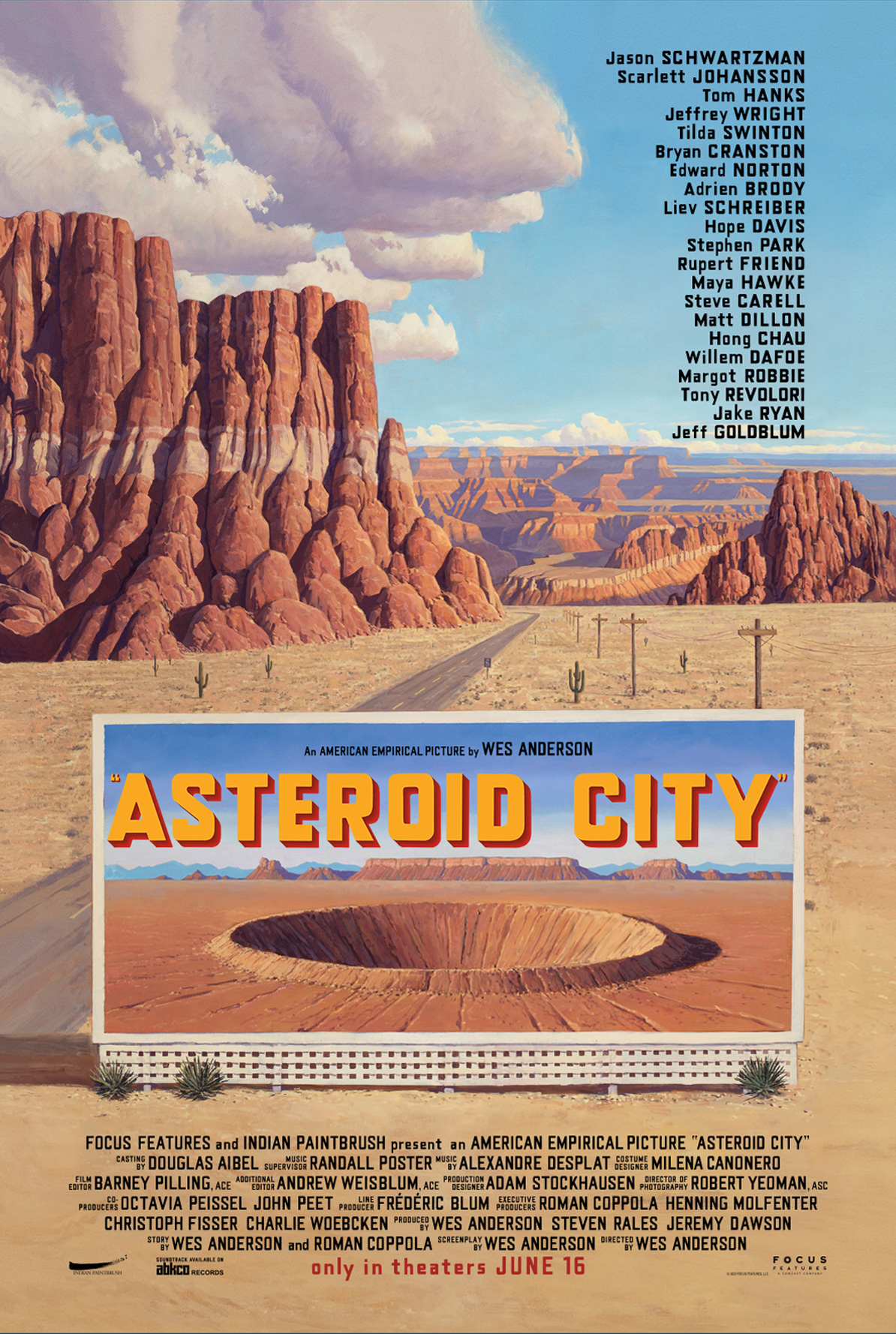
Since then, Anderson and his collaborators have told stories in their distinctive visions of Eastern Europe, Japan, and France — but always, explicitly or implicitly, in one period or another of the mid-twentieth century. Judging by its newly released trailer, the events of Anderson’s next film Asteroid City occur in perhaps the most mid-twentieth-century year imaginable, 1955, and in small-town America at that.
Or rather, very small-town America: Asteroid City itself appears to be located in the middle of the Arizona desert (though shot in Spain, in keeping with Anderson’s increasingly Europe-oriented production habits), and with nothing more exciting going on — apart from the occasional distant nuclear-weapons test — than an annual “junior stargazer competition.”
The film “tells the story of a beleaguered widower (Jason Schwartzman) who’s busy schlepping his four children across the country to see their grandfather (Tom Hanks) when their car suddenly breaks down,” writes The Verge’s Charles Pulliam-More. This strands the family in the titular town, with its “strange earthquakes that no one knows the true cause of, fears about whether aliens might be lurking among the humans living in Asteroid City, and multiple sightings of a celebrity (Scarlett Johansson).” As fans can already guess from this summary, the ensemble cast includes more than a few Anderson regulars, also including Edward Norton, Adrien Brody, Willem Dafoe, Jeff Goldblum, and Bob Balaban. A case of COVID-19 kept Bill Murray from participating, but even so, nobody who sees the trailer can doubt that the viewing experience of Asteroid City will be highly Andersonian indeed.
Related content:
Why Do Wes Anderson Movies Look Like That?
Wes Anderson’s Shorts Films & Commercials: A Playlist of 8 Short Andersonian Works
The Perfect Symmetry of Wes Anderson’s Movies
Based in Seoul, Colin Marshall writes and broadcasts on cities, language, and culture. His projects include the Substack newsletter Books on Cities, the book The Stateless City: a Walk through 21st-Century Los Angeles and the video series The City in Cinema. Follow him on Twitter at @colinmarshall or on Facebook.
Read More...The March of Intellect: Newspaper Cartoons Satirize the Belief in Technological Progress in 1820s England
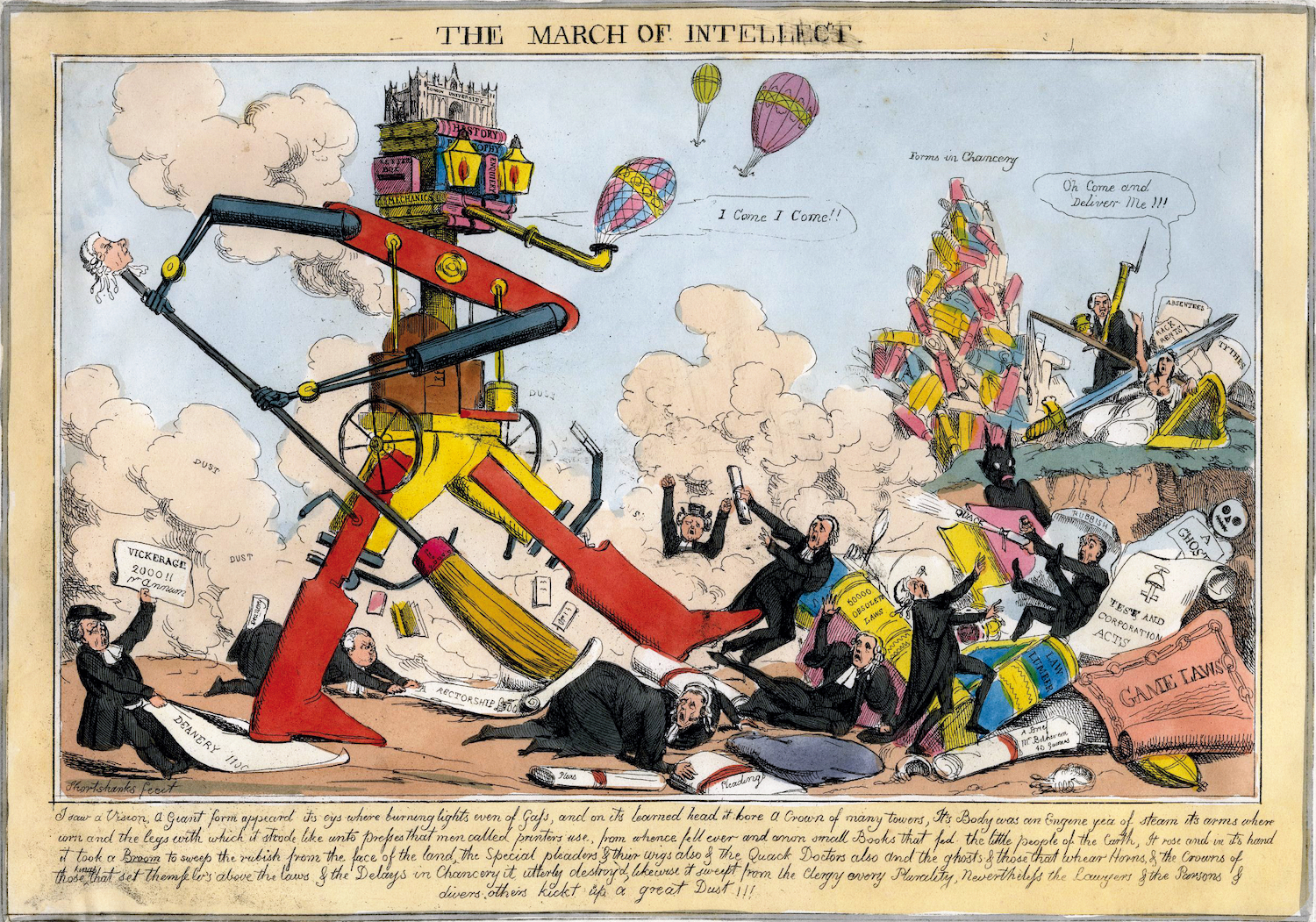
Before the Industrial Revolution, few had occasion to consider the impact of technology on their lives. A few decades in, however, certain segments of society thought about little else. That, in any case, is the impression given by the debate over what the English press of the early nineteenth century called the “March of Intellect,” a label for the apparently polarizing discourse that arose from not just the development of industrial technology but the dissemination of “useful knowledge” that followed in its wake. Was this sort of education an engine of progress, or simply of disorder?
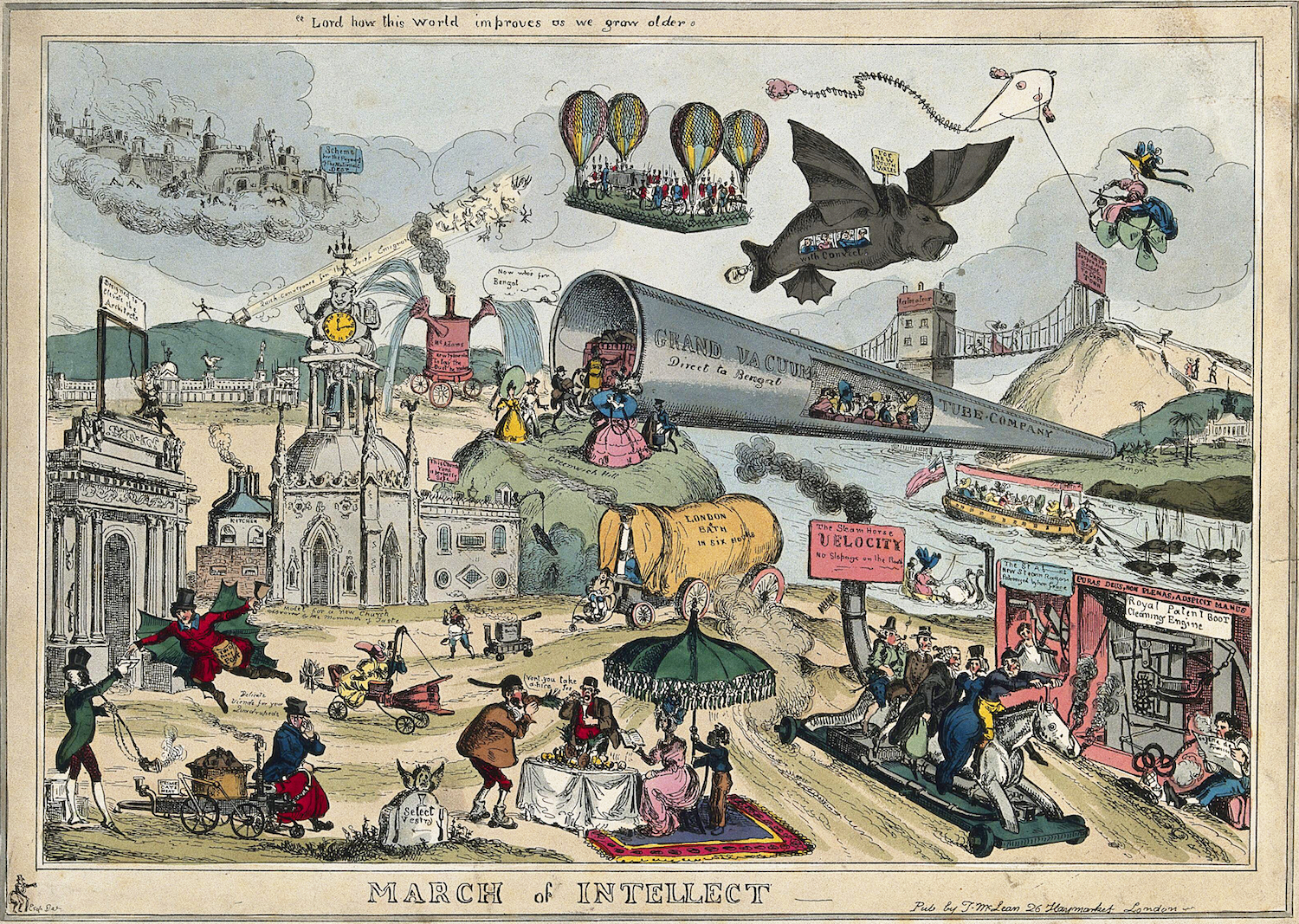
The March of Intellect’s most vivid legacy consists of a series of newspaper cartoons published in the eighteen-twenties. They depict a world, as Hunter Dukes writes at the Public Domain Review, where “extravagantly dressed ladies window-shop for pastel finery and forgo stairwells in favor of belt-driven slides” while “a child is moments away from being paved into the road by a carriage at full gallop”; where “men gorge themselves on pineapples and guzzle bottles at the Champagne Depot” and “postmen flit around with winged capes”; where “even convicts have it better: they embark for New South Wales on a gargoyle zeppelin, but still have panoramic views.”
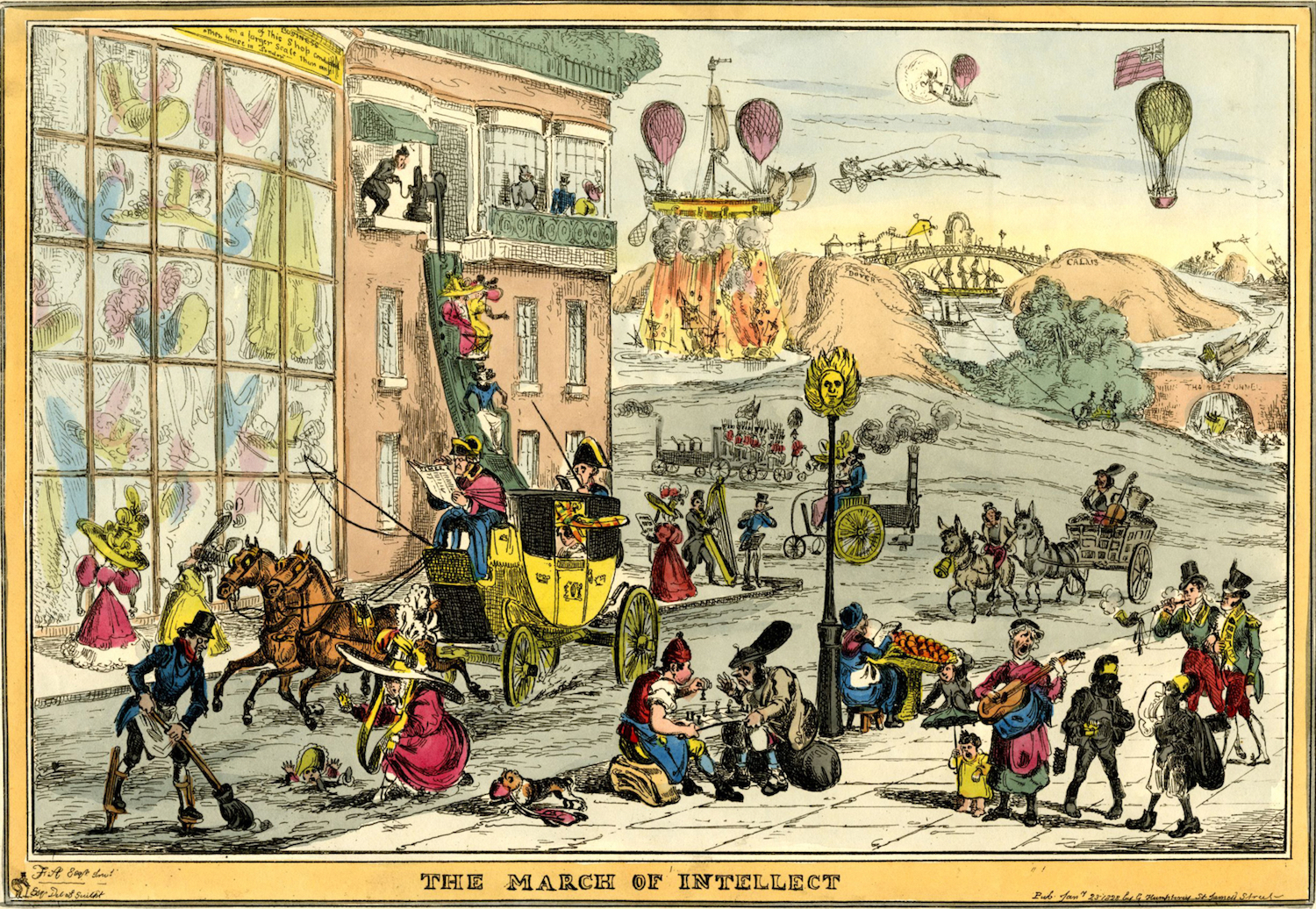
So far, so Victorian. One could argue more or less in favor of the world described above, as rendered by artist William Heath. But in the future as envisioned in the cartoon at the top of the post by Robert Seymour (now best known as the original illustrator of Charles Dickens’ The Pickwick Papers), the March of Intellect takes on a flamboyantly malign aspect.
In it “a jolly automaton stomps across society,” writes Dukes. “Its head is a literal stack of knowledge — tomes of history, philosophy, and mechanic manuals power two gas-lantern eyes. It wears secular London University as a crown.” It sweeps away “pleas, pleadings, delayed parliamentary bills, and obsolete laws. Vicars, rectors, and quack doctors are turned on their heads.”
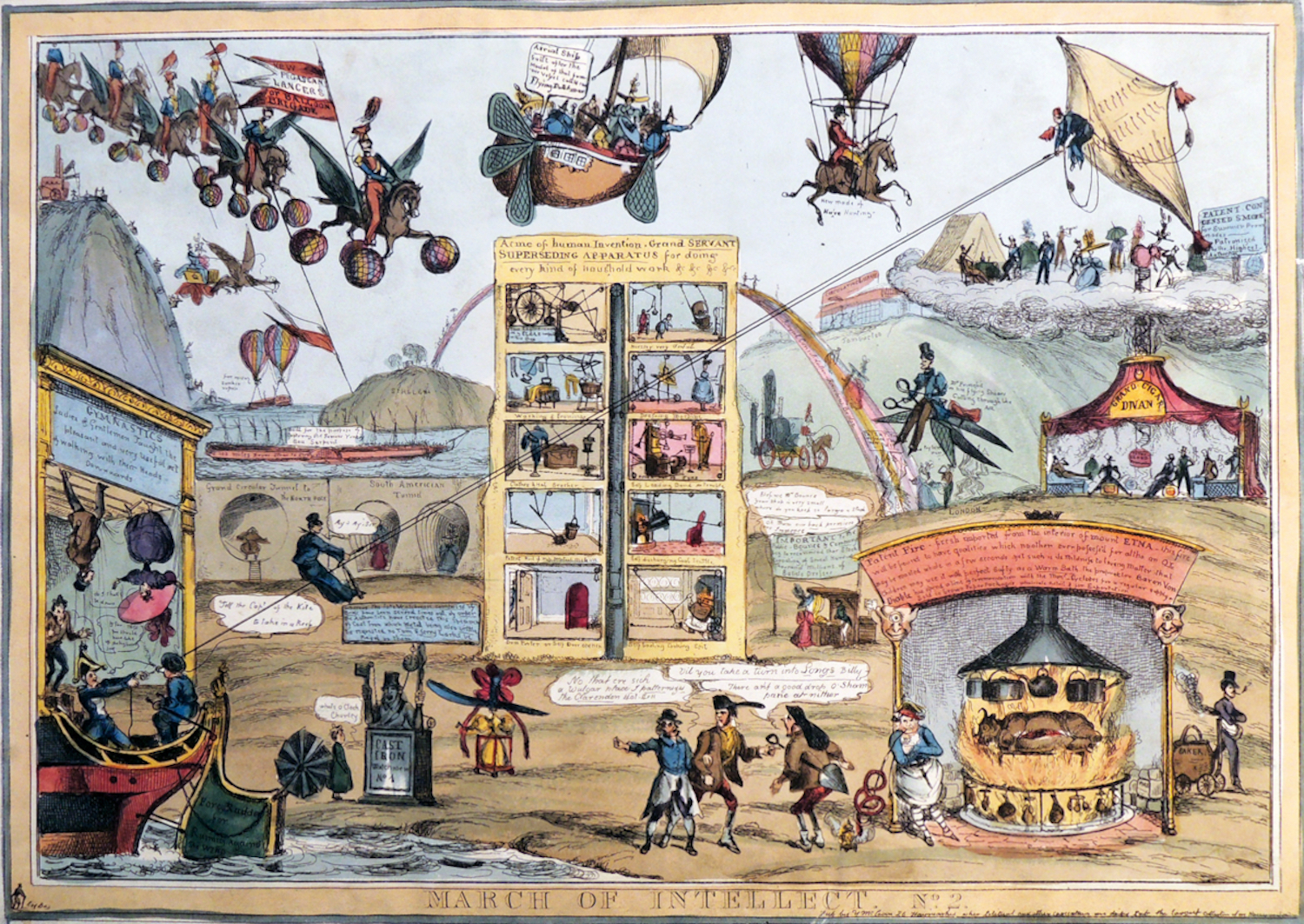
Nearly two centuries later, most would side instinctively with the participants in the March of Intellect debate who saw the provision of technical and scientific knowledge to then-less-educated groups — women, children, the working class — as an unambiguous good. Yet we may also feel trepidation about the technologies emerging in our own time, when, to name a current example, “artificially intelligent chatbots have fueled ongoing anxieties about the mechanization of intellectual labor.” Every day brings new apocalyptic speculations about the rise of powerful thinking machines running roughshod over humanity. If no artist today is illustrating them quite so entertainingly as Heath and Seymour did, so much the worse for our time.
Related content:
Based in Seoul, Colin Marshall writes and broadcasts on cities, language, and culture. His projects include the Substack newsletter Books on Cities, the book The Stateless City: a Walk through 21st-Century Los Angeles and the video series The City in Cinema. Follow him on Twitter at @colinmarshall or on Facebook.
Read More...Behold an Astonishing Near-Nightly Spectacle in the Lightning Capital of the World
Extreme weather conditions have become a topic of grave concern. Are floods, earthquakes, tornadoes and catastrophic storms the new normal?
Just for a moment, let’s travel to a place where extreme weather has always been the norm: Lake Maracaibo in northwestern Venezuela.
According to NASA’s Tropical Rainfall Measuring Mission’s lightning image sensor, it is the lightning capital of the world.
Chalk it up to the unique geography and climate conditions near the confluence of the lake and the Catatumbo River. At night, the moist warm air above the water collides with cool breezes rolling down from the Andes, creating an average of 297 thunderstorms a year.
Watching photographer Jonas Piontek’s short film documenting the phenomenon, above, it’s not surprising that chief among his tips for shooting lightning at night is a pointed warning to always keep a safe distance from the storm. While viewable from as far as 400 kilometers away, the area nearest the lightning activity can average 28 strikes per minute.
More than 400 years before Piontek shared his impressions with the world, Spanish poet Lope de Vega tapped Catatumbo lightning in his epic 1597 poem La Dragontea, crediting it, erroneously, with having thwarted Sir Francis Drake’s plans to conquer the city of Maracaibo under cover of night. His poetic license was persuasive enough that it’s still an accepted part of the myth.
The “eternal storm” did however give Venezuelan naval forces a genuine natural assist, by illuminating a squadron of Spanish ships on Lake Maracaibo, which they defeated on July 24, 1823, clearing the way to independence.
Once upon a time, large numbers of local fishermen took advantage of their prime position to fish by night, although with recent deforestation, political conflict, and economic decline decimating the villages where they live in traditional stilted houses, their livelihood is in decline.
Meanwhile the Eternal Storm has itself been affected by forces of extreme weather. In 2010, a drought occasioned by a particularly strong El Niño, caused lightning activity to cease for 6 weeks, its longest disappearance in 104 years.
Environmentalist Erik Quiroga, who is campaigning for the Catatumbo lightning to be designated as the world’s first UNESCO World Heritage Weather Phenomenon warns, “This is a unique gift and we are at risk of losing it.”
See more of Jonas Piontek’s Catatumbo lightning photographs here.
– Ayun Halliday is the Chief Primatologist of the East Village Inky zine and author, most recently, of Creative, Not Famous: The Small Potato Manifesto and Creative, Not Famous Activity Book. Follow her @AyunHalliday.
Read More...Behold 900+ Magnificent Botanical Collages Created by a 72-Year-Old Widow, Starting in 1772
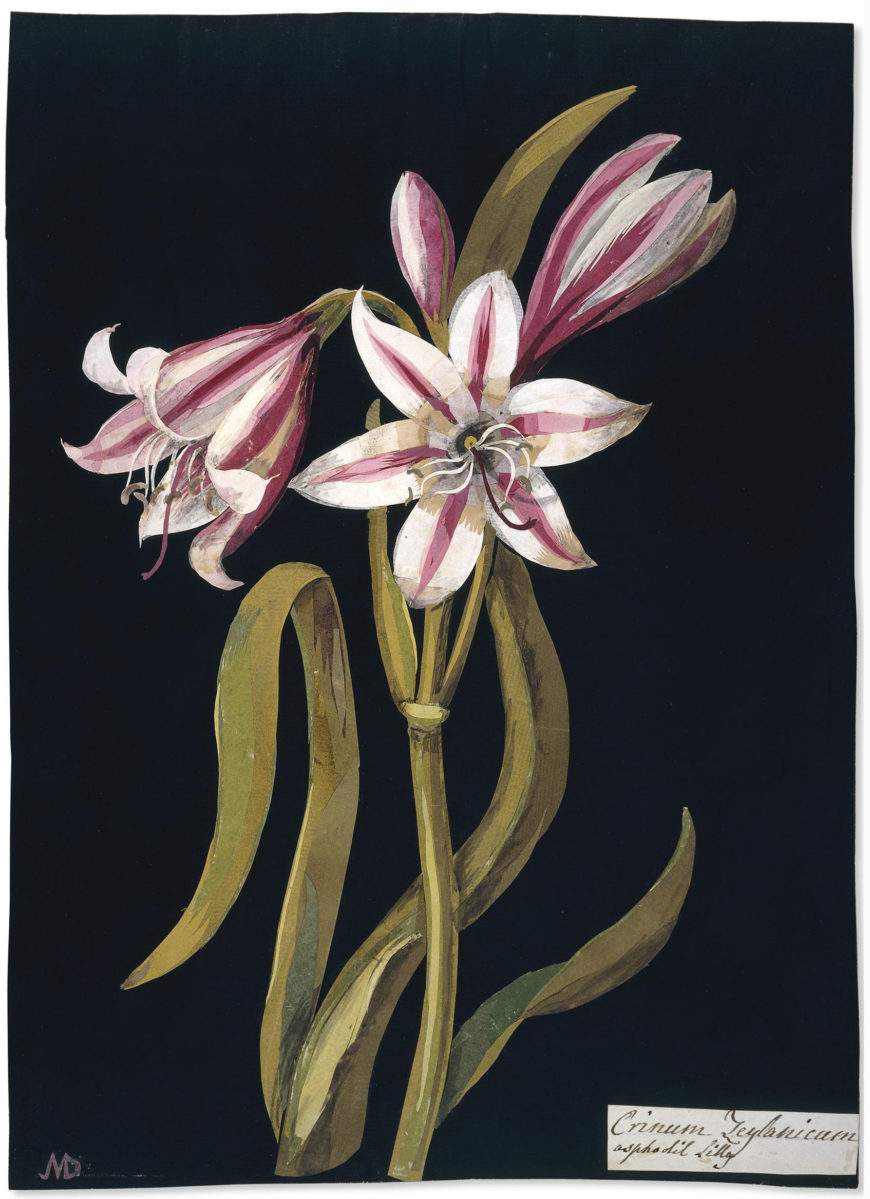
“I have invented a new way of imitating flowers,” Mary Delany, a 72-year-old widow wrote to her niece in 1772 from the grand home where she was a frequent guest, having just captured her hostess’ geranium’s likeness, by collaging cut paper in a nearly identical shade.
Novelty rekindled the creative fire her husband’s death had dampened.
Former pursuits such as needlework, silhouette cut outs, and shell decorating went by the wayside as she dedicated herself fully to her botanical-themed “paper mosaicks.”
Over the next decade Mrs. Delany produced 985 astonishingly floral representations from meticulously cut, hand colored tissue, which she glued to hand painted black backings, and labeled with the specimens’ taxonomic and common names, as well as a collection of numbers, date and provenance.
In the beginning, she took inspiration from a giant collection of botanical specimens amassed by the celebrated botanist Sir Joseph Banks, with whom she became acquainted while spending summers at Bulstrode, the Buckinghamshire estate of her friend Margaret Bentinck, duchess of Portland and a fellow enthusiast of the natural world.
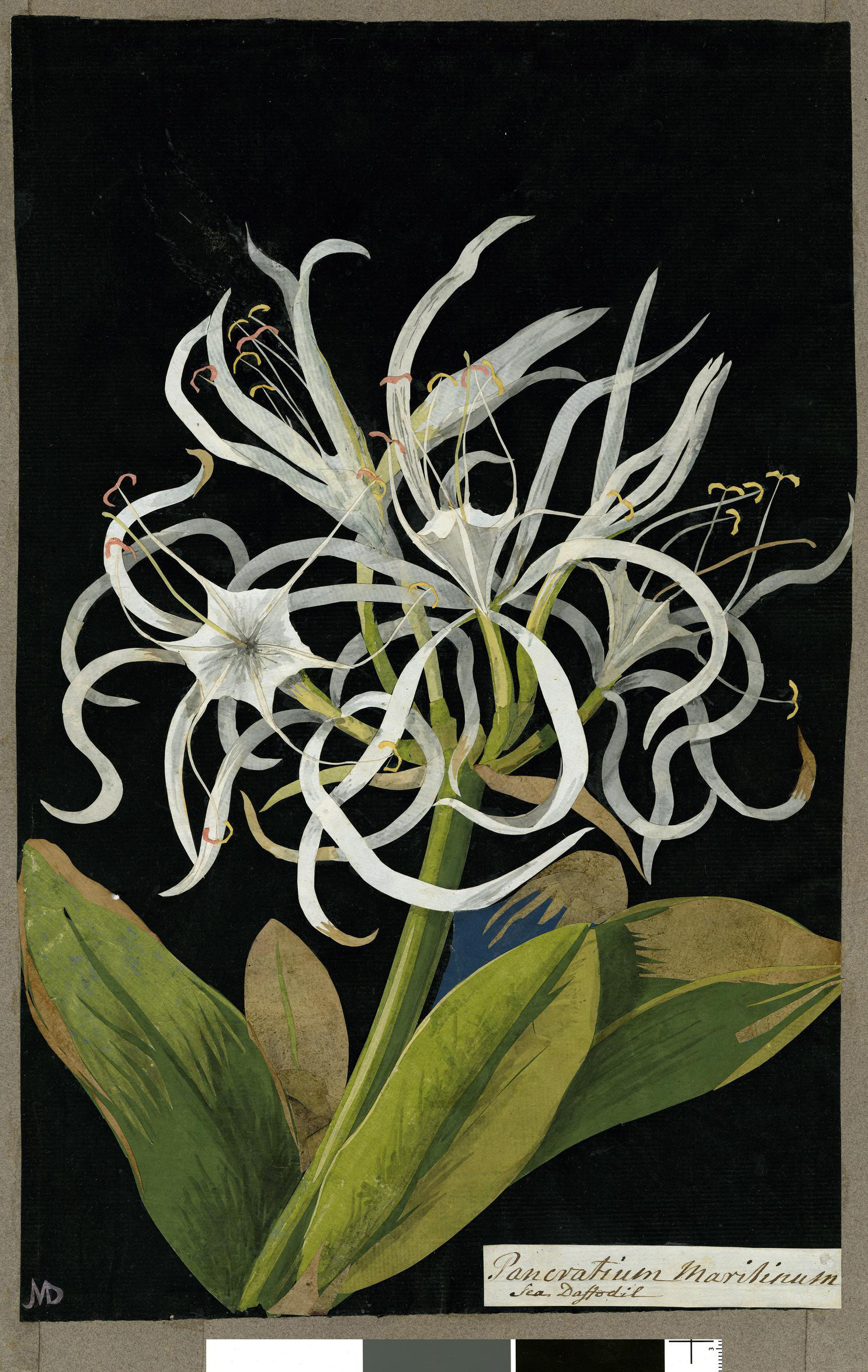
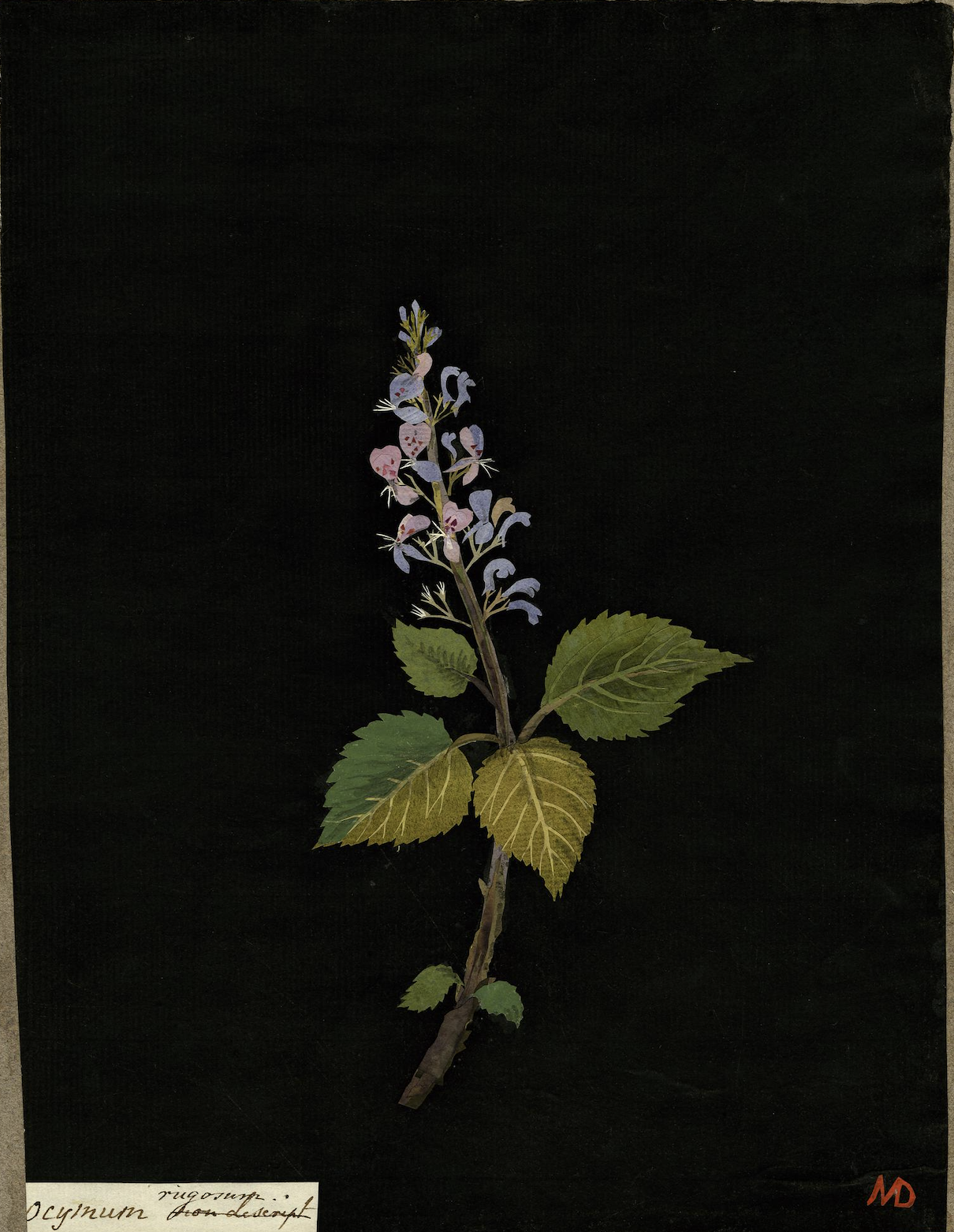
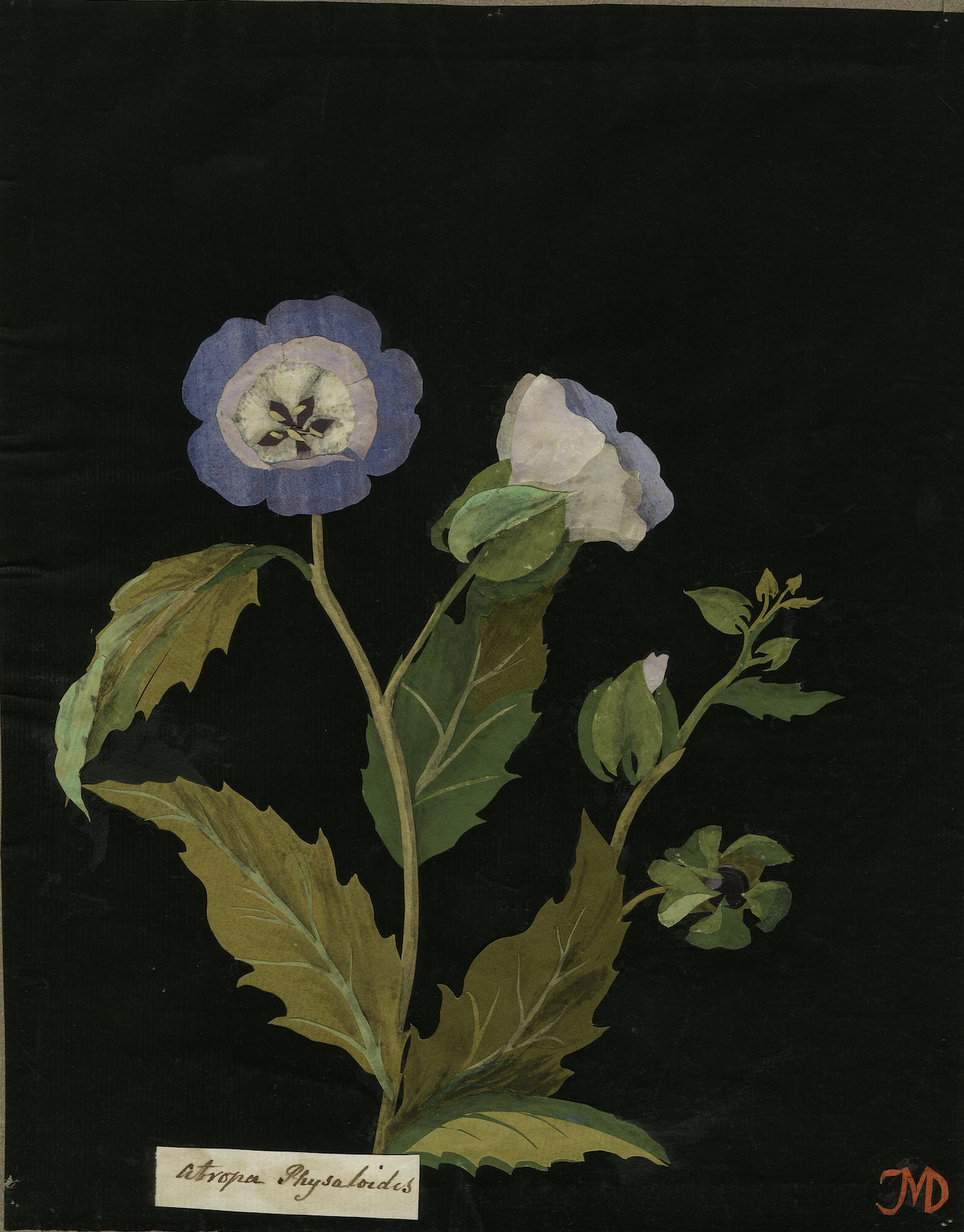
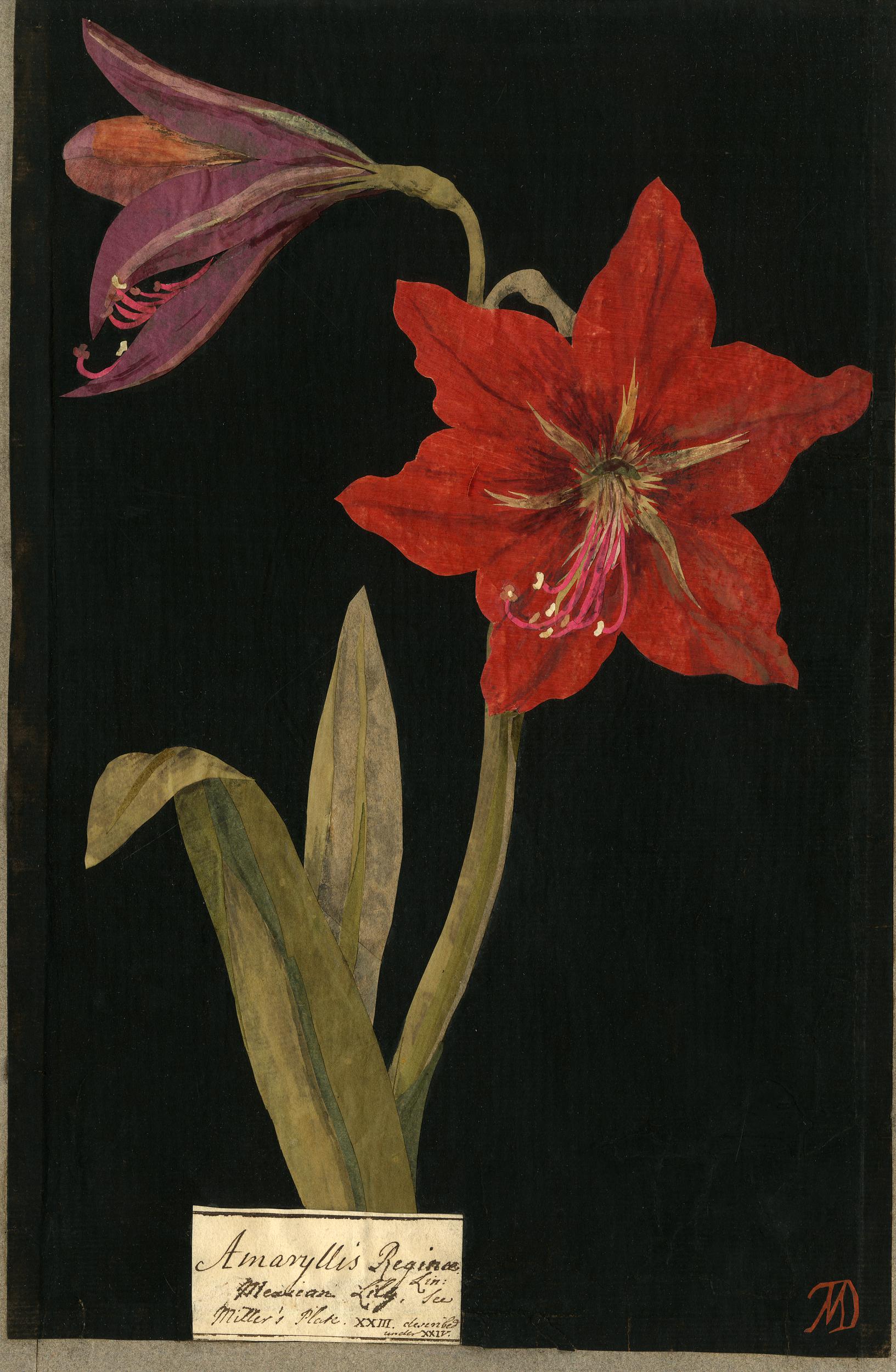
Bulstrode also provided her with abundant source material. The estate boasted botanic, flower, kitchen, ancient and American gardens, as well a staff botanist, the Swedish naturalist Daniel Solander charged with cataloguing their contents according to the Linnaean system.
Sir Joseph Banks commended Mrs. Delany’s powers of observation, declaring her assemblages “the only imitations of nature” from which he “could venture to describe botanically any plant without the least fear of committing an error.”
They also succeed as art.
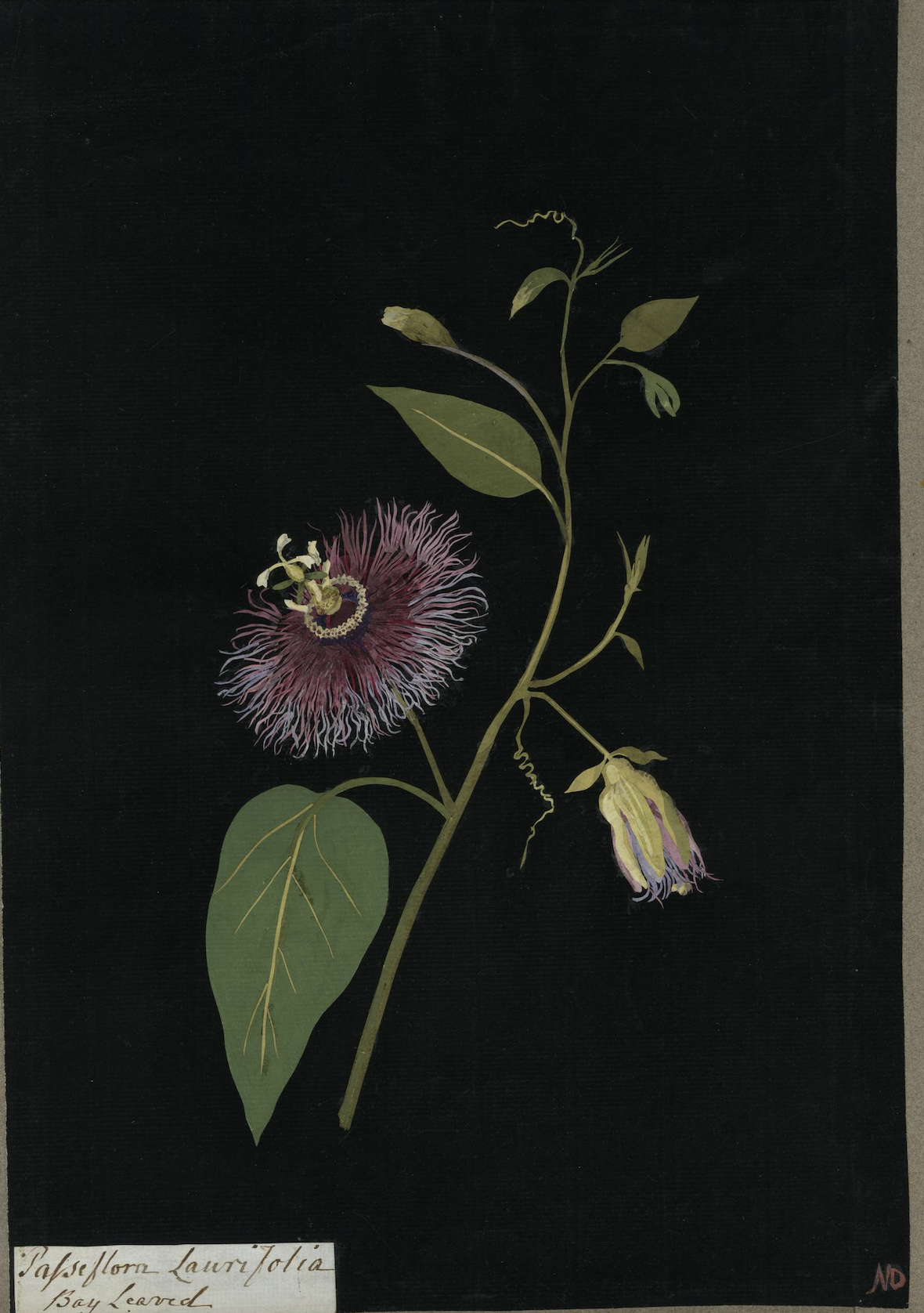
Molly Peacock, author of The Paper Garden: An Artist Begins Her Life’s Work at 72, appears quite overcome by Mrs. Delany’s Passiflora laurifolia — more commonly known as water lemon, Jamaican honeysuckle or vinegar pear:
The main flower head … is so intensely public that it’s as if you’ve come upon a nude stody. She splays out approximately 230 shockingly vulvular purplish pink petals in the bloom, and inside the leaves she places the slenderest of ivory veins also cut separately from paper, with vine tendrils finer that a girl’s hair. It is so fresh that it looks wet and full of desire, yet the Passiflora is dull and matte
Mrs. Delany’s exquisitely rendered paper flowers became high society sensations, fetching her no small amount of invitations from titled hosts and hostesses, clamoring for specimens from their gardens to be immortalized in her growing Flora Delanica.
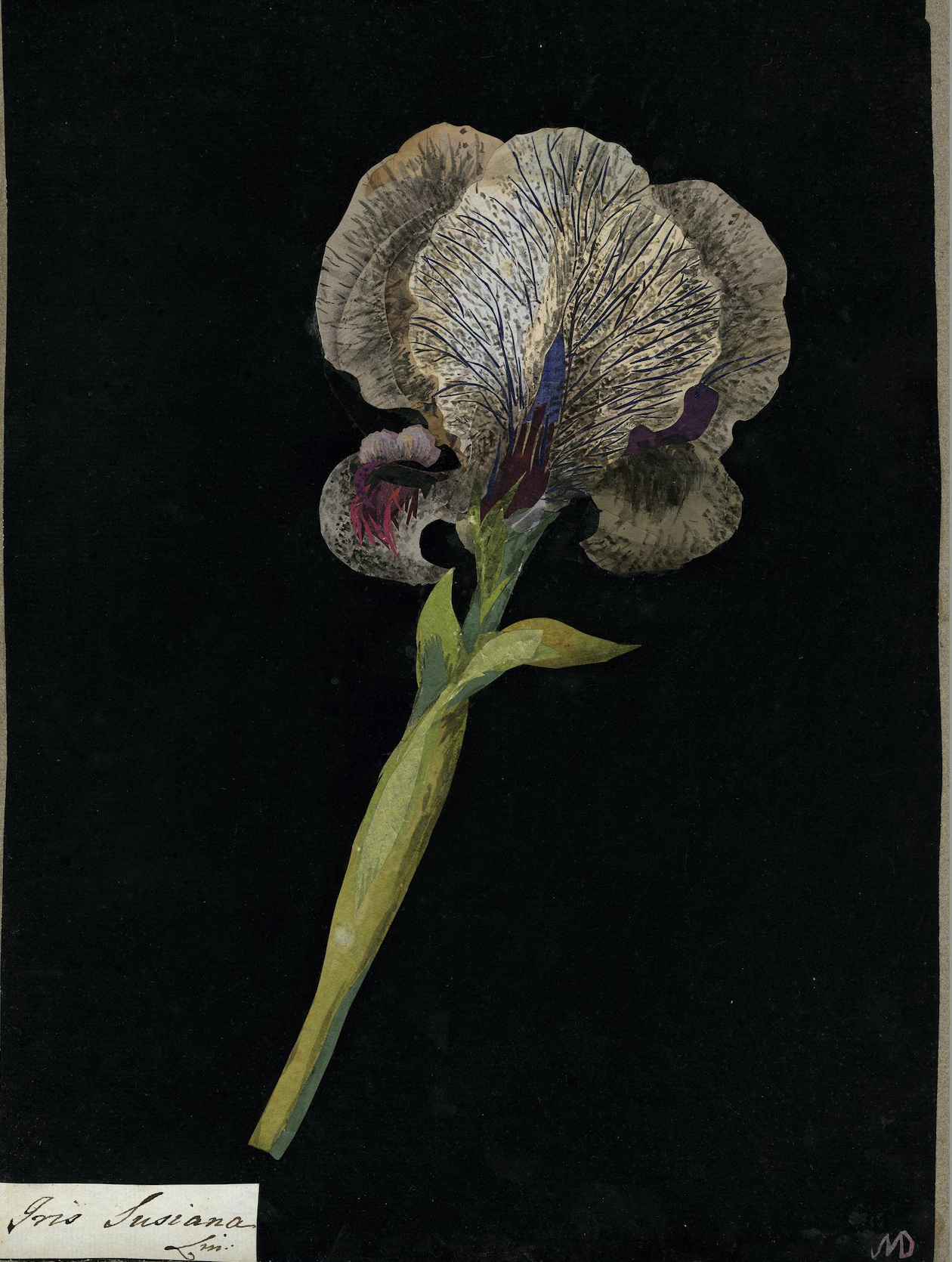
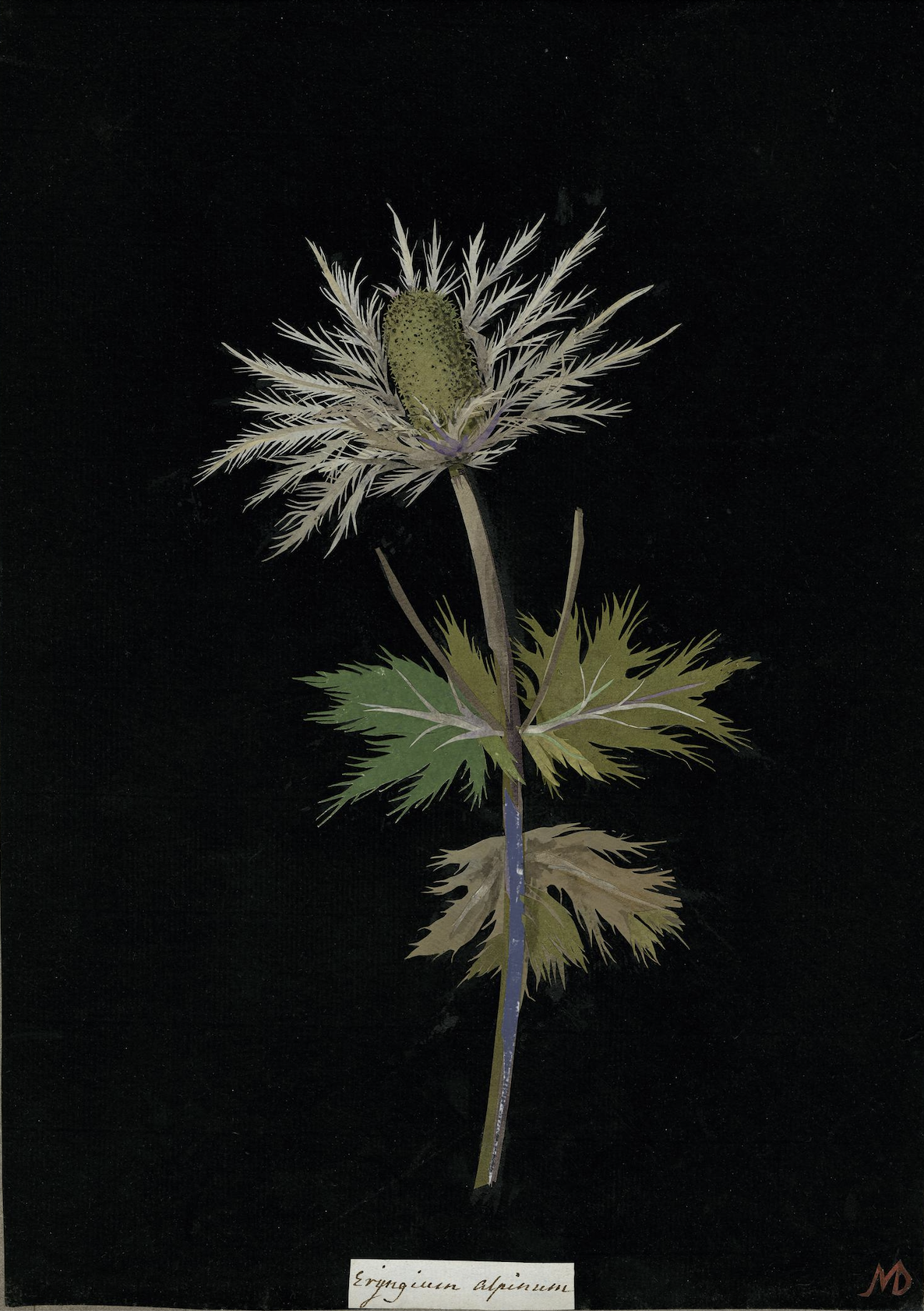
She also received donations of exotic plants at Balstrode, where greenhouses kept non-native plants alive, as she gleefully informed her niece in a 1777 letter, shortly after completing her work:
I am so plentifully supplied with the hothouse here, and from the Queen’s garden at Kew, that natural plants have been a good deal laid aside this year for foreigners, but not less in favour. O! How I long to show you the progress I have made.
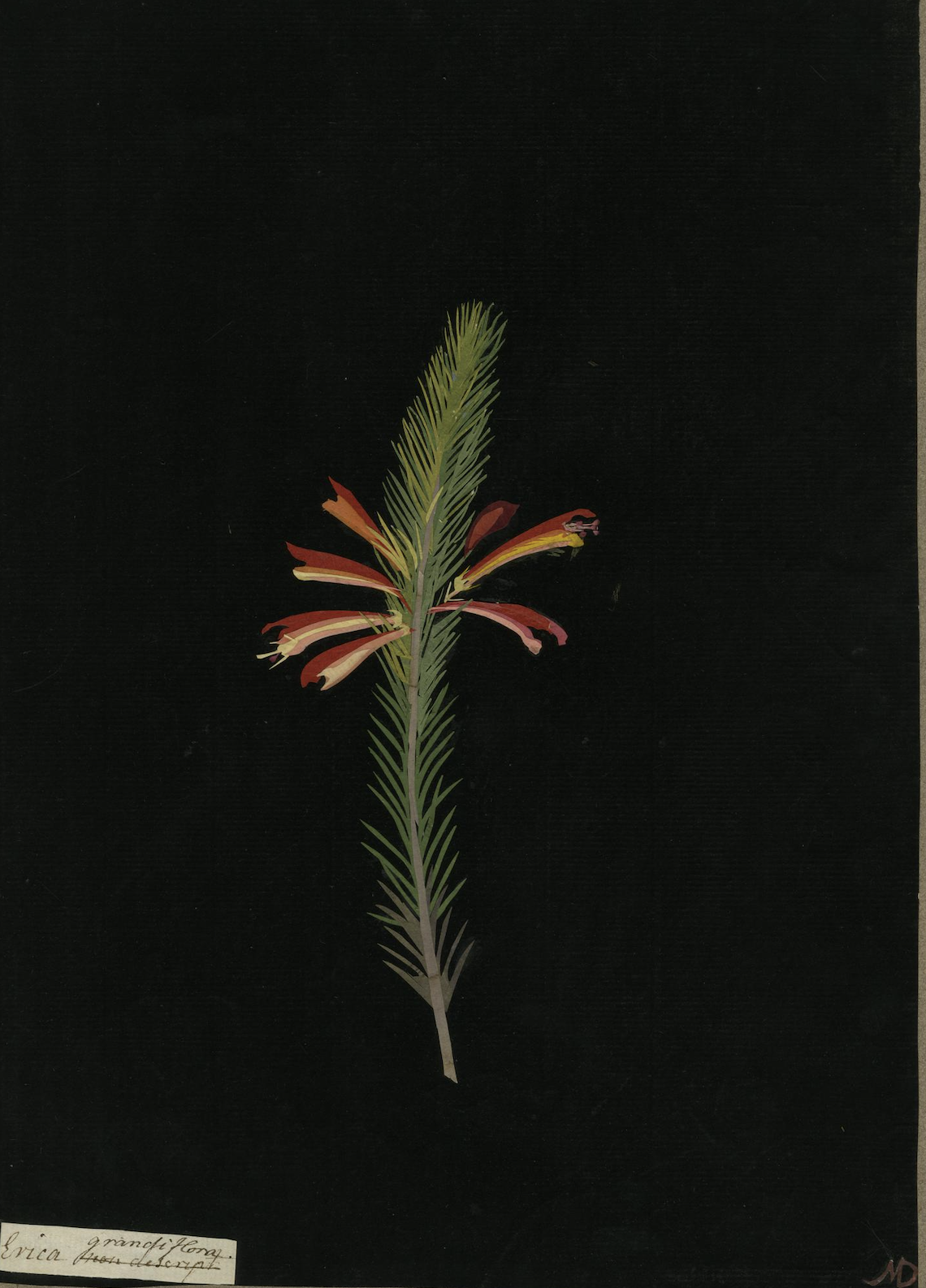
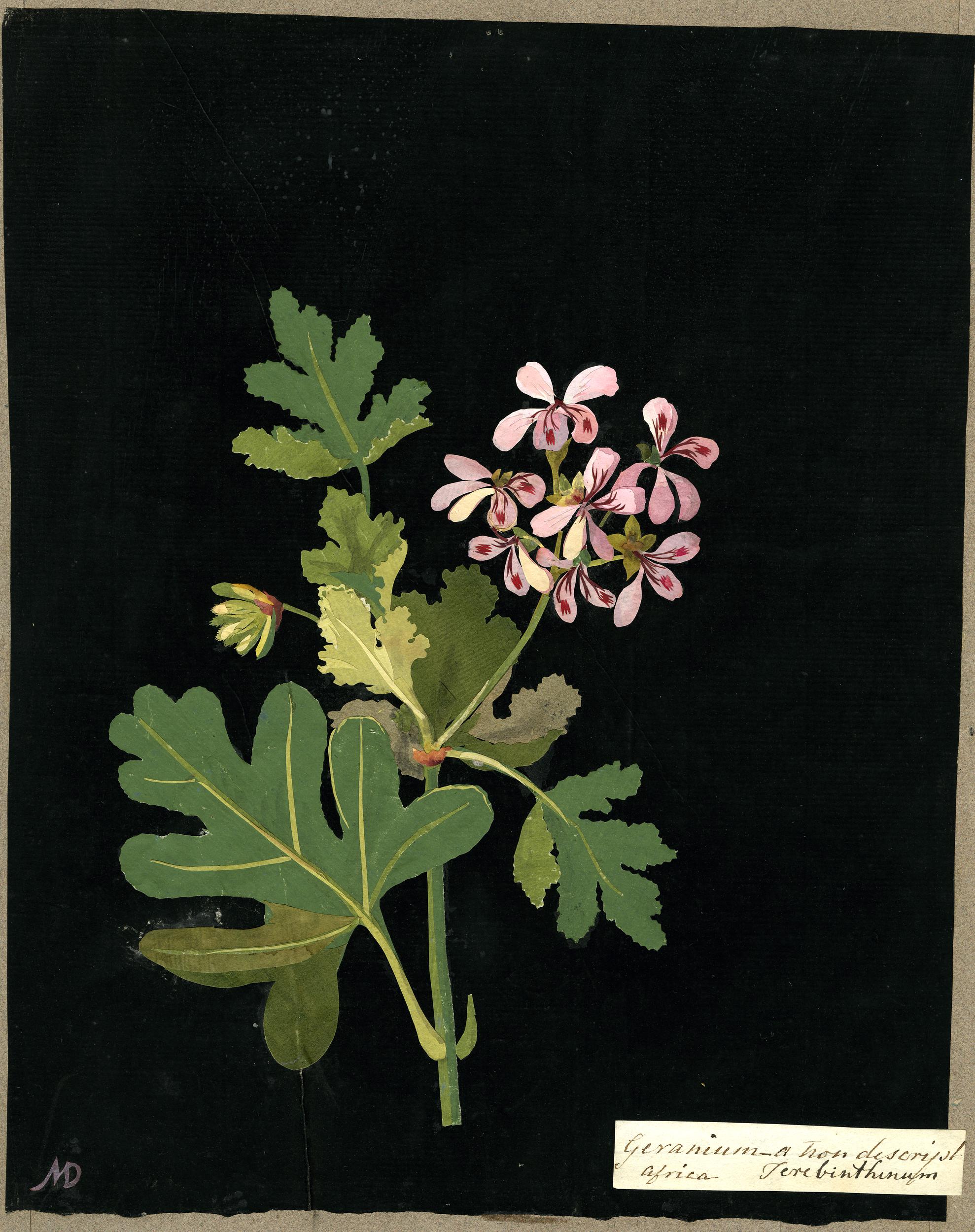
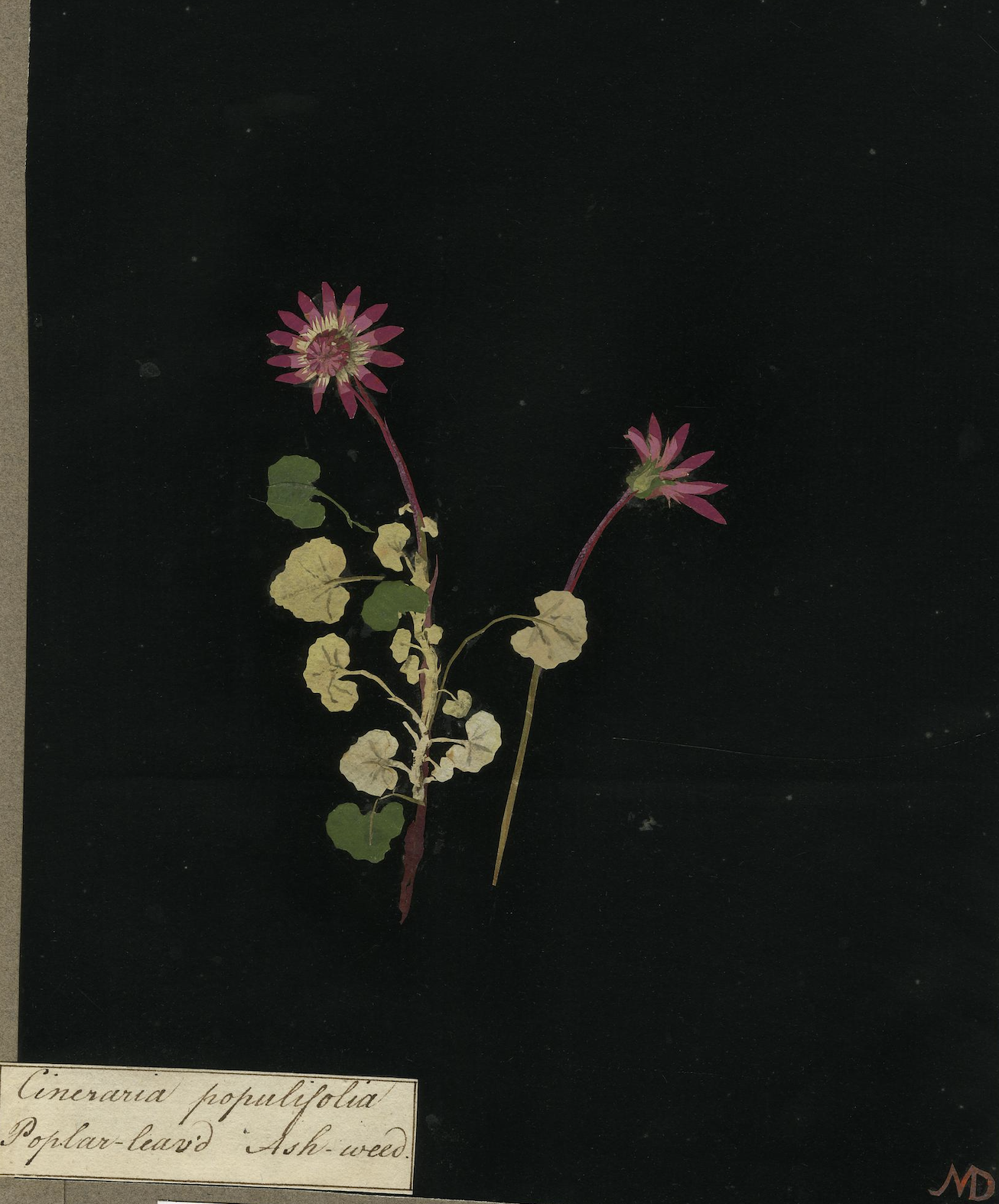
Her work was in such demand, that she streamlined her creation process from necessity, coloring paper in batches, and working on several pieces simultaneously.
Her failing eyesight forced her to stop just shy of her goal of one thousand flowers.
She dedicated the ten volumes of Flora Delanica to her friend, the duchess of Portland, mistress of Balstrode “(whose) approbation was such a sanction to my undertaking, as made it appear of consequence and gave me courage to go on with confidence.”
She also reflected on the great undertaking of her seventh decade in a poem:
Hail to the happy hour! When fancy led
My pensive mind this flow’ry path to tread;
And gave me emulation to presume
With timid art to trace fair Nature’s bloom.
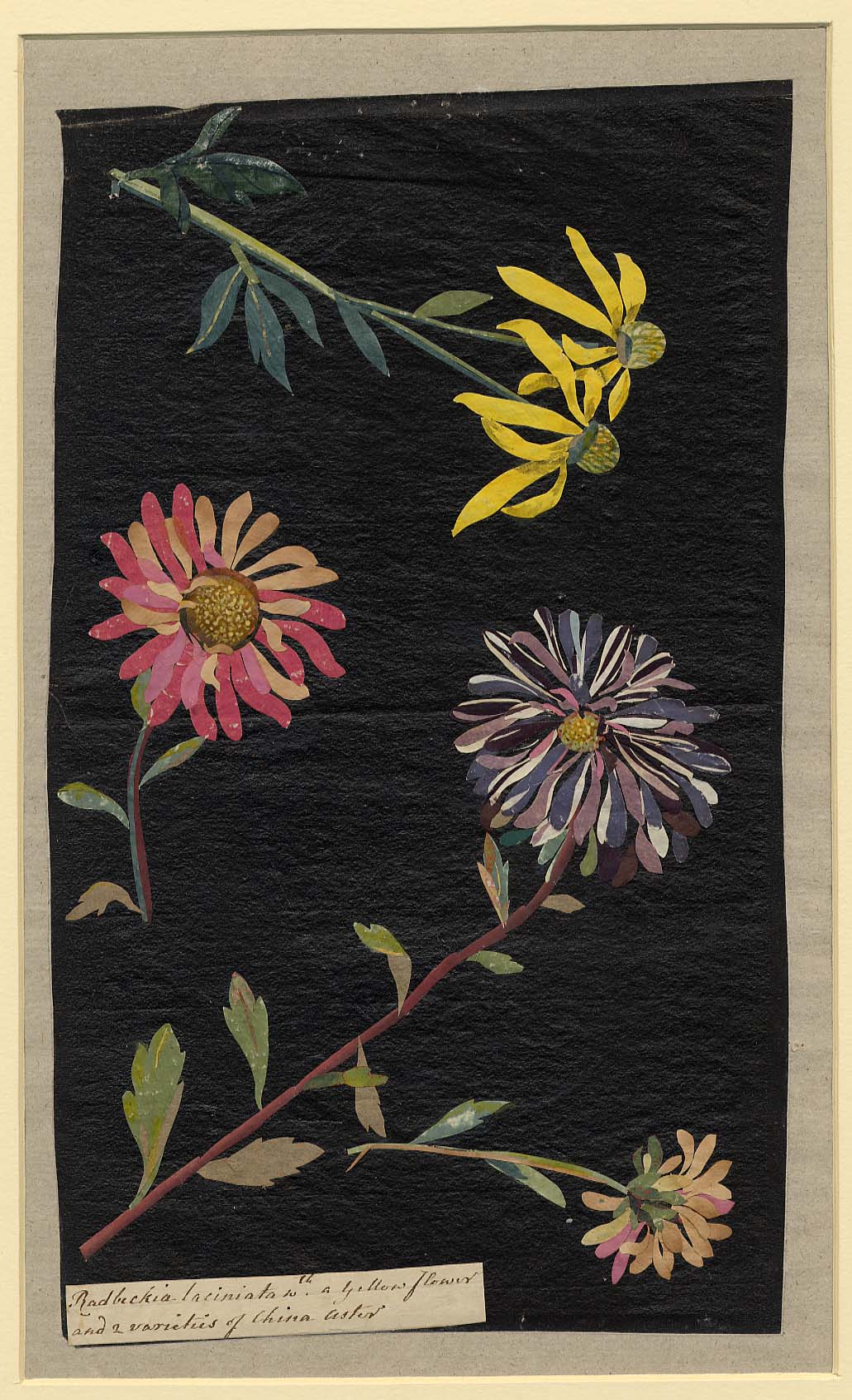
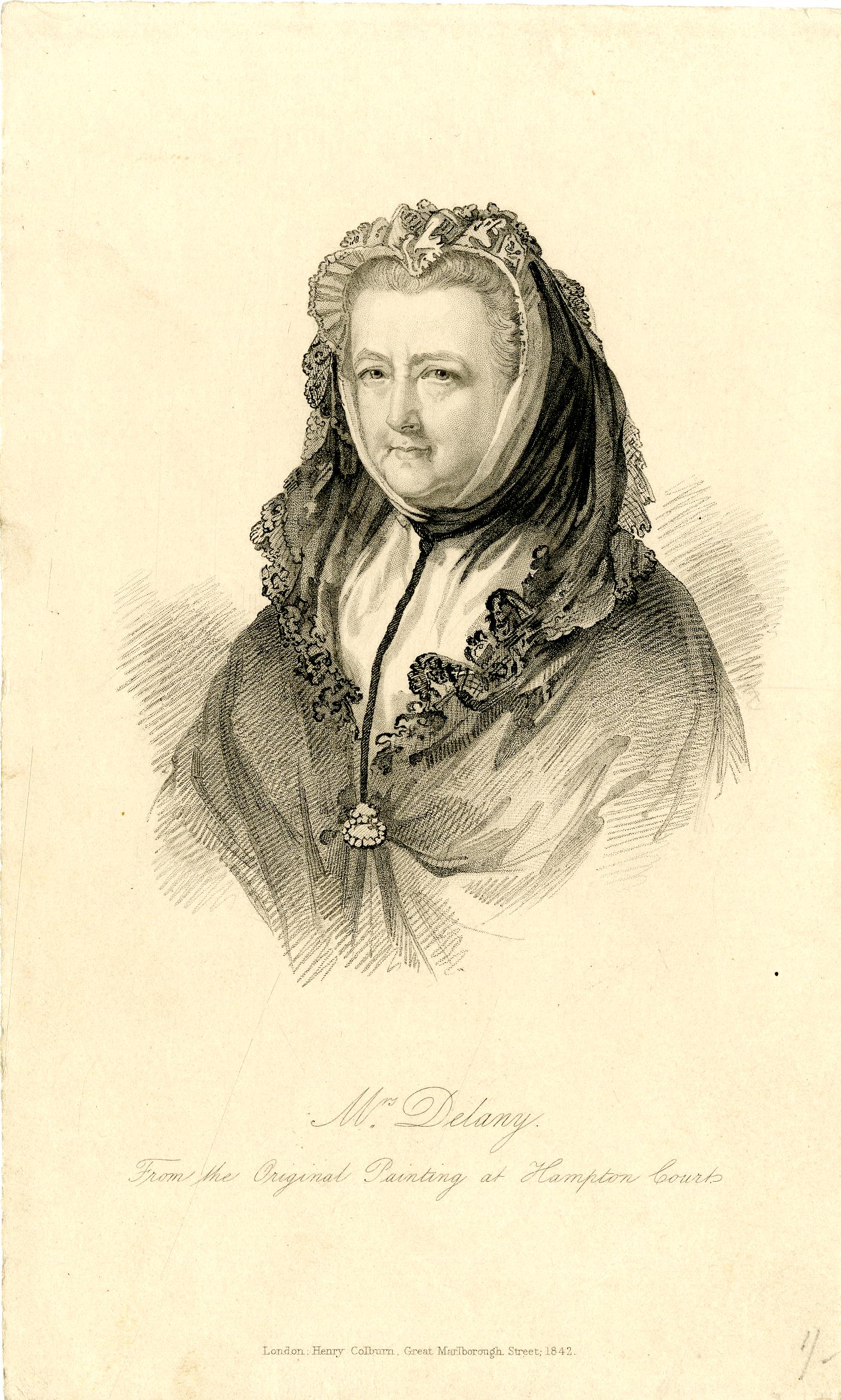
Explore The British Museum’s interactive archive of Mary Delany’s botanical paper collages here.
All images © The Trustees of the British Museum, republished under a Creative Commons license.
Related Content
Two Million Wondrous Nature Illustrations Put Online by The Biodiversity Heritage Library
A Beautiful 1897 Illustrated Book Shows How Flowers Become Art Nouveau Designs
– Ayun Halliday is the Chief Primatologist of the East Village Inky zine and author, most recently, of Creative, Not Famous: The Small Potato Manifesto and Creative, Not Famous Activity Book. Follow her @AyunHalliday.
Read More...The Art of Making Movie Trailers: A Longtime Movie Trailer Editor Breaks Down Classic Previews for Dr. Strangelove, Carrie, and Others
No art form is as subject to trend and fashion as the Hollywood film — except, perhaps, the Hollywood trailer. If you came of age as a moviegoer in the nineteen-nineties, as I did, you’ll remember hearing hundreds of gravelly-voiced promises of transportation to “a world where the sun burns cold, and the wind blows colder”; to “a world where great risks can bring extraordinary rewards”; to “a world where dreamers and believers are miraculously transformed into heavenly creatures.” Practically all of these lines were delivered by voice-over artist Don LaFontaine; when he died in 2008, the “in a world…” trailer went with him.
LaFontaine gets his due in the Vox video at the top of the post, which examines the art of the movie trailer through the eyes of editor Bill Neil. Neil’s own résumé includes the trailers for modern entries in various horror franchises, like remakes of The Texas Chainsaw Massacre and The Amityville Horror, as well as the 2018 Halloween.
This placed him well to cut one together for Nope by Jordan Peele, an auteur keen on putting old tropes of genre film to new ends. The project gave Neil a chance to exercise his own retro-repurposing instinct, and here he lays out a few of the sources — Carpenter’s The Fog, Steven Spielberg’s Close Encounters of the Third Kind — to which he paid homage while filling the trailer with intrigue.
With Nope, as with most every film, Neil made its trailer without seeing the finished product. Rather, he had to work with raw footage as it was being shot, which results in visible differences between the images in the trailer and those in the actual movie. (In some cases, scenes excerpted in a trailer end up cut out entirely.) Such restrictions have a way of inspiring editors to come up with new techniques, some of which become highly influential: in the video, Neil highlights the features of classic trailers for pictures like Dr. Strangelove, Carrie, and Alien, identifying the most enduring elements of their legacy in his craft.
When those movies came out in the nineteen-sixties, seventies, and early eighties, most trailers were seen in one place: the movie theater. (And in those days, as Neil notes, trailers were made not by specialized production houses, but employees in the studio or even the filmmakers themselves.) Then came the home-video era, which challenged editors with defeating the viewer’s instinct to hit fast-forward. Today, trailers reflect the dominance of what Neil calls the “bumper,” a flash of maximum excitement in the first few seconds that suggests “it’s gonna get crazy by the end” — on the theory that, because you’re probably watching on Youtube, you won’t hesitate to click that skip button otherwise.
Related content:
Watch 25 Alfred Hitchcock Trailers, Exciting Films in Their Own Right
Watch the 7 Hour Trailer for the 720 Hour Film, Ambiancé, the Longest Movie in History
Based in Seoul, Colin Marshall writes and broadcasts on cities, language, and culture. His projects include the Substack newsletter Books on Cities, the book The Stateless City: a Walk through 21st-Century Los Angeles and the video series The City in Cinema. Follow him on Twitter at @colinmarshall or on Facebook.
Read More...Support Us
We're hoping to rely on loyal readers, rather than erratic ads. Please click the Donate button and support Open Culture. You can use Paypal, Venmo, Patreon, even Crypto! We thank you!

About Us

Open Culture scours the web for the best educational media. We find the free courses and audio books you need, the language lessons & educational videos you want, and plenty of enlightenment in between.
Advertise With Us

FREE UPDATES!
GET OUR DAILY EMAIL
Get the best cultural and educational resources on the web curated for you in a daily email. We never spam. Unsubscribe at any time.
FOLLOW ON SOCIAL MEDIA

Open Culture editor Dan Colman scours the web for the best educational media. He finds the free courses and audio books you need, the language lessons & movies you want, and plenty of enlightenment in between.
Advertise With Us

