The Only Footage of Mark Twain: The Original & Digitally Restored Films Shot by Thomas Edison
We know what Mark Twain looked like, and we think we know what he sounded like. Just above see what he looked like in motion, strolling around Stormfield, his house in Redding, Connecticut—signature white suit draped loosely around his frame, signature cigar puffing white smoke between his fingers. After Twain’s leisurely walk along the house’s façade, we see him with his daughters, Clara and Jean, seated indoors. Below you can see the original murky version, featured on our site way back in 2010. A digital restoration (top) does wonders for the watchability of this priceless silent artifact, so vividly capturing the writer/contrarian/raconteur’s essence that you’ll find yourself reaching to turn the volume up, expecting to hear that familiar curmudgeonly drawl.
Shot by Thomas Edison in 1909, the short film is most likely the only moving image of Twain in existence. We might assume that Edison also recorded Twain’s voice, since we seem to know it so well, from portrayals of the great American humorist in pop cultural touchstones like Star Trek: The Next Generation and parodies by Alec Baldwin and Val Kilmer.
Kilmer’s surprisingly funny in the role, but he doesn’t come near the pitch perfect impersonation Hal Holbrook had given us for the better part of sixty years in his masterful Mark Twain Tonight. Holbrook’s vocal mannerisms have become a definitive model for actors playing Twain on stage and screen.
Given the number of Twain vocal impersonations out there, and Edison’s interest in documenting the author, we might be surprised to learn that no original recordings of his voice exist. Twain, we find out in the short film below, experimented with audio recording technology, but abandoned his efforts. It seems that none of the wax cylinders he worked with have survived—perhaps he destroyed them himself.
As narrator Rod Rawlings—himself a Twain impersonator and aficionado—informs us, what we do have is a recording made in 1934 by actor and playwright William Gillette, an able mimic of Twain, his patron and longtime neighbor. Like Holbrook, Gillette spent a good part of his career traveling from town to town playing Mark Twain. Below, you’ll hear Gillette address a class of students at Harvard, first in his own voice, then in the voice of the author, reading from “The Celebrated Jumping Frog of Calaveras County.” Gillette’s performance is likely the closest we’ll ever come to hearing the voice of the real Twain, whose major works appear in our collection of Free Audio Books and Free eBooks.
Related Content:
Mark Twain Wrote the First Book Ever Written With a Typewriter
Mark Twain’s Viciously Funny Marginalia Took Aim at Some Literary Greats
Josh Jones is a writer and musician based in Durham, NC. Follow him at @jdmagness.
Read More...Watch David Letterman’s Complete Interview with Volodymyr Zelenskyy
In a special episode of My Next Guest Needs No Introduction with David Letterman, the iconic TV host traveled to Kyiv to interview President Volodymyr Zelenskyy. The conversation took place in a protected subway station, in front of a small live audience. About Zelenskyy, Letterman said: “When you first learn about the guy, it seems impossible to not find him appealing, and his story to be astounding. You just don’t see actions and deeds like this, people behaving like this, on the right side of things.” Above, thanks to Netflix, you can watch the interview in its entirety.
If you would like to support the mission of Open Culture, consider making a donation to our site. It’s hard to rely 100% on ads, and your contributions will help us continue providing the best free cultural and educational materials to learners everywhere. You can contribute through PayPal, Patreon, and Venmo (@openculture). Thanks!
Related Content
How Volodymyr Zelenskyy Went from Playing a President on a Comedy TV Show to Very Real Life
How Ukraine’s Works of Art Are Being Saved in Wartime–Using the Lessons of World War II
Read More...The Map of Engineering: A New Animation Shows How All of the Different Fields in Engineering Fit Together
In his latest animation, physicist and science writer Dominic Walliman maps out the entire field of engineering and all of its subdisciplines. Civil engineering, chemical engineering, bio engineering, biomedical engineering, mechanical engineering, aerospace engineering, marine engineering, electrical engineering, computer engineering–they’re all covered here.
In the past, we’ve featured Walliman’s other educational animations that cover Biology, Physics, Chemistry, Mathematics, Quantum Computing, Computer Science, and more. Click the links to explore each video.
If you would like to support the mission of Open Culture, consider making a donation to our site. It’s hard to rely 100% on ads, and your contributions will help us continue providing the best free cultural and educational materials to learners everywhere. You can contribute through PayPal, Patreon, and Venmo (@openculture). Thanks!
Related Content
The Map of Mathematics: Animation Shows How All the Different Fields in Math Fit Together
The Map of Physics: Animation Shows How All the Different Fields in Physics Fit Together
The Map of Chemistry: New Animation Summarizes the Entire Field of Chemistry in 12 Minutes
Read More...American Gothic Explained: How Grant Wood Created His Iconic American Painting (1930)
“We should fear Grant Wood. Every artist and every school of artists should be afraid of him, for his devastating satire.” Gertrude Stein wrote those words after seeing American Gothic, the 1930 painting that would become one of the most iconic images created in the United States. Yet Wood himself “said he painted American Gothic to extol rural American values, real people in their well-ordered world: an image of reassurance during the onset of the Great Depression.” That’s how Art History School host Paul Priestley puts it in the video above, which asks of the painting, “Is it a satire, or a positive statement of American rural life?”
It could be neither; then again, it could be both. That very ambiguity goes some way to explaining American Gothic’s success — as well as its persistence in the culture through frequent and unceasing parody. Yet in its day, the painting also angered some of its viewers: “An Iowan farmer’s wife who’d seen the picture in the papers in 1930 telephoned Wood to express her anger,” says Priestly.
“She claimed she wished to come over and smash his head for depicting her countrymen as grim Bible-thumpers.” Wood maintained that he was one of them, “dressing in rugged overalls after the painting was completed and telling the press, ‘All the really good ideas I’d ever had come to me while I was milking a cow.’
Yet Wood was no farmer. A son of Cedar Rapids, he traveled extensively to Europe to study Impressionism and post-Impressionism. There he first saw the work of Jan van Eyck, whose combination of visual clarity and complexity inspired him to develop the signature look and feel of the movement that would come to be known as Regionalism. He became “half European artiste, half Iowan farm boy,” as Vox’s Phil Edwards puts it in the video just above, all the better to straddle his homeland’s widening divide between town and country. “In 1880, almost half of all Americans were on the farm,” but by 1920 more than half the population lived in cities. American Gothic came a decade later, and most of a century thereafter, it still makes Americans ask themselves — earnestly or sardonically — just what kind of people they are.
Related content:
The Models for “American Gothic” Pose in Front of the Iconic Painting (1942)
The Art Institute of Chicago Puts 44,000+ Works of Art Online: View Them in High Resolution
Whitney Museum Puts Online 21,000 Works of American Art, By 3,000 Artists
Based in Seoul, Colin Marshall writes and broadcasts on cities, language, and culture. His projects include the Substack newsletter Books on Cities, the book The Stateless City: a Walk through 21st-Century Los Angeles and the video series The City in Cinema. Follow him on Twitter at @colinmarshall or on Facebook.
Read More...Behold! The Very First Christmas Card (1843)
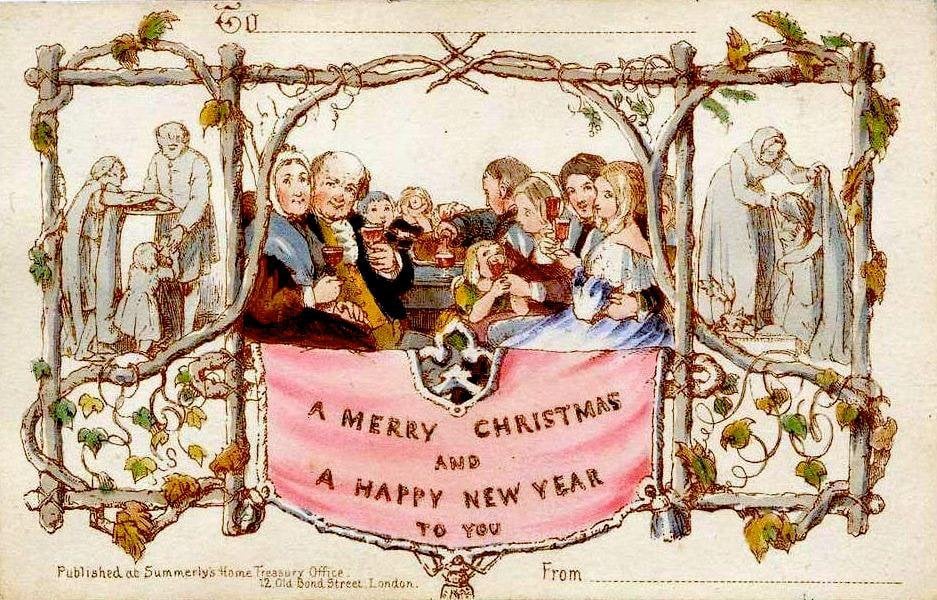
Christmas cards aren’t just an anachronism.
They’re almost an endangered species, the victim of the Internet, postal rate increases, and the jettisoning of any time consuming tradition whose execution has been found to bring the opposite of joy.
Above, Victoria and Albert Museum curators Alice Power and Sarah Beattie take us on a backwards trip to a time when the exchange of Christmas cards was a source of true social merriment.
Christmas cards must hold a special place in both the V&A’s collections and heart, given that the museum’s founder, Henry Cole, inadvertently invented them in 1843.
As a well respected man about town, he received a great many more holiday letters than he had time or inclination to respond to, but neither did he wish to appear rude.
So he enlisted his friend, painter J.C. Horsley, to create a festive illustration with a built-in holiday greeting, leaving just enough space to personalize with a recipient’s name and perhaps, a handwritten line or two.
He then had enough postcard-sized reproductions printed up to send to 1000 of his friends.
(It’s hell being popular…)
Talk about zeitgeist: Charles Dickens’ A Christmas Carol was first published that very same holiday season.
No wonder everyone wanted in on the fun.
Part of the reason the cards in the V&A’s collection are so well preserved is that their recipients prized them enough to keep them in souvenir albums.
Understandably. They’re very appealing little artifacts.
The upper crust could afford such fancy design elements as clever die-cut shapes, pop up elements, and translucent windows that encouraged the recipients to hold them up to actual windows.
Technological advances in the printing industry, and the creation of the cost-effective Penny Post allowed those whose budgets were more modest than Mr. Cole’s to participate too.
Their cards tended to be simpler in execution, though not necessarily concept.
In addition to the views we’ve come to expect — winter, Father Christmas, holly — the Victorians had a thing for jolly anthropomorphized food and some truly shameless puns.
Enjoy these Ghosts of Christmas Past, dear readers. We’re almost inspired to revive the tradition!
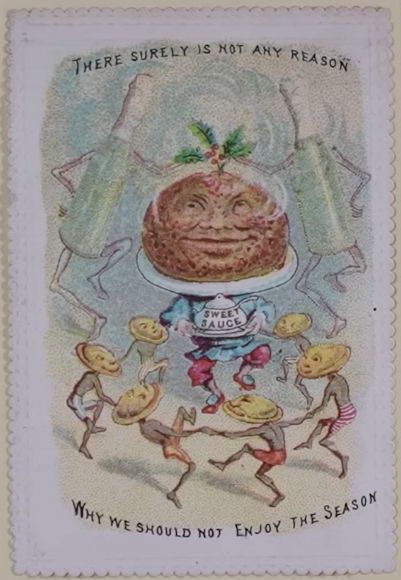

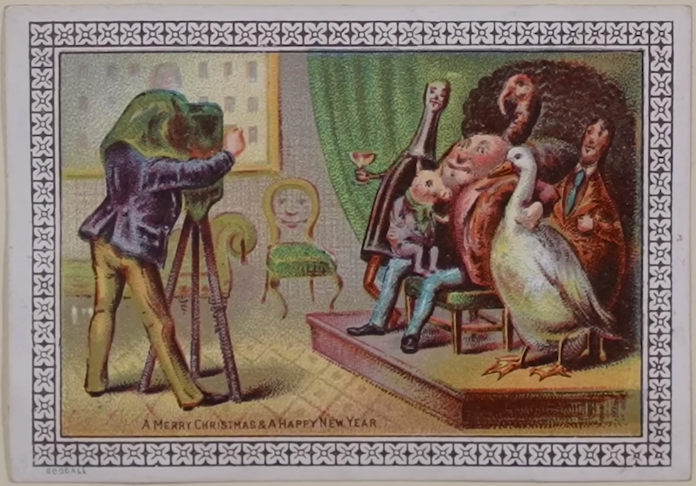
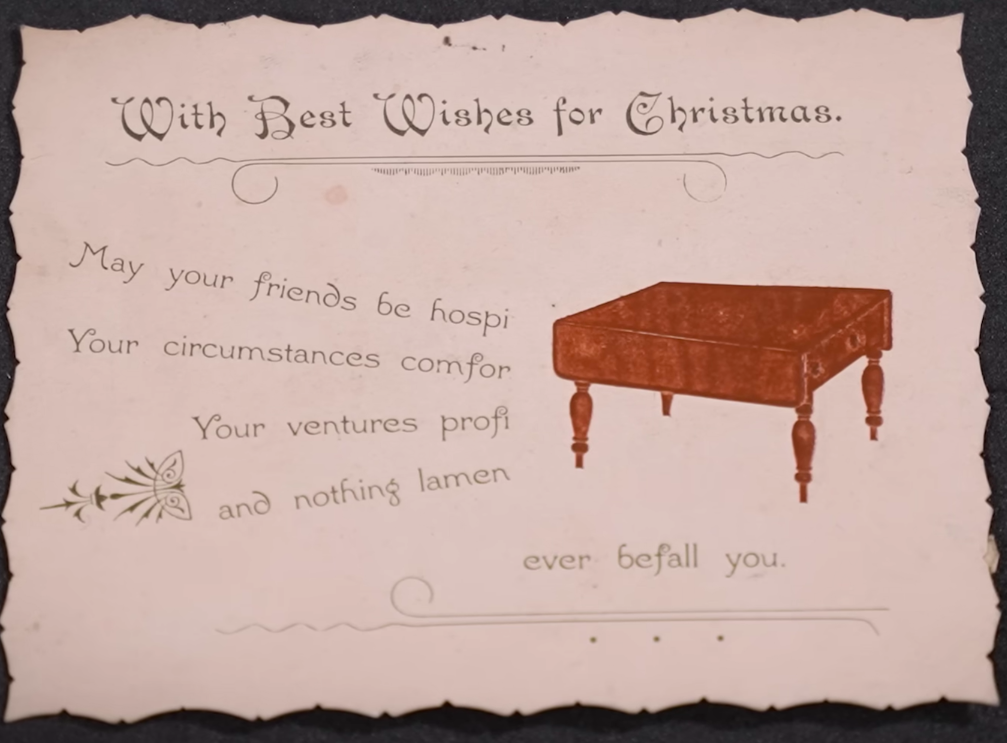
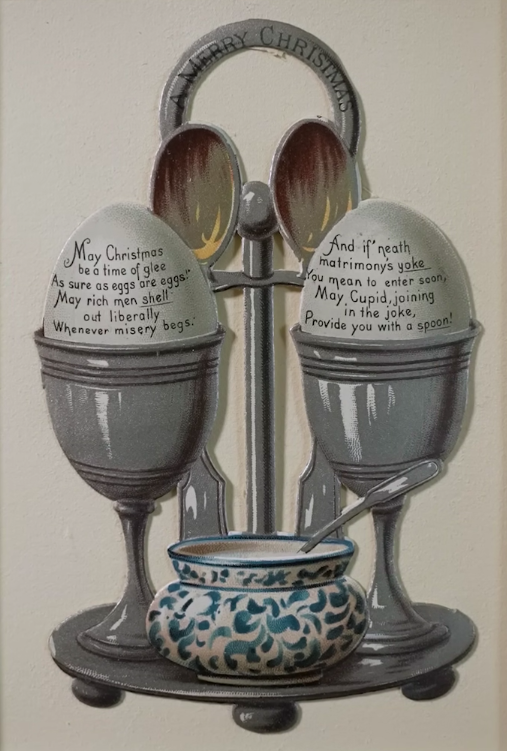
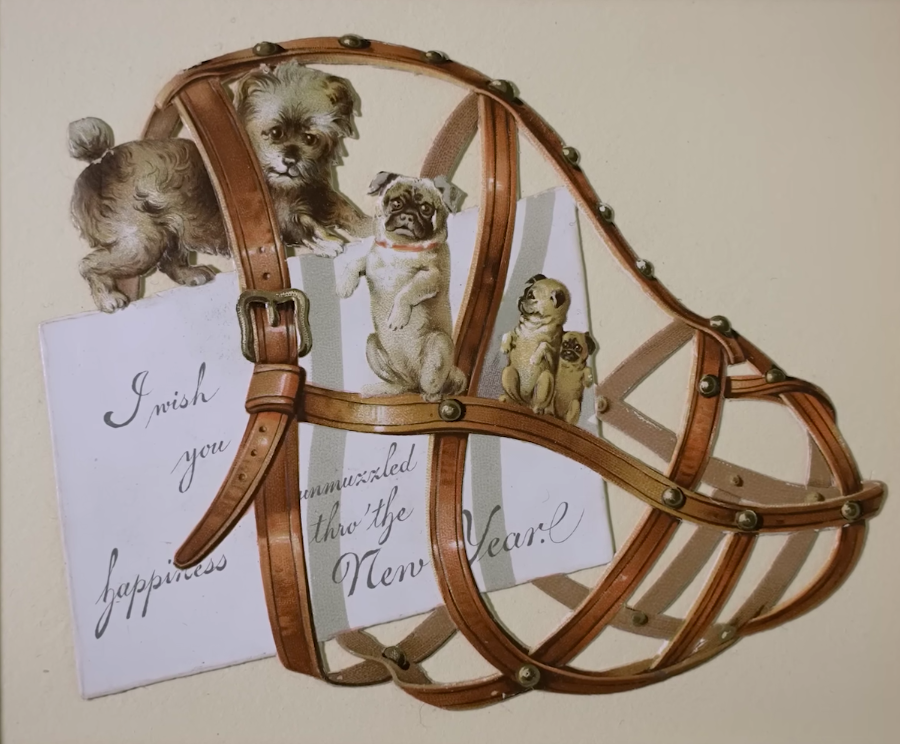
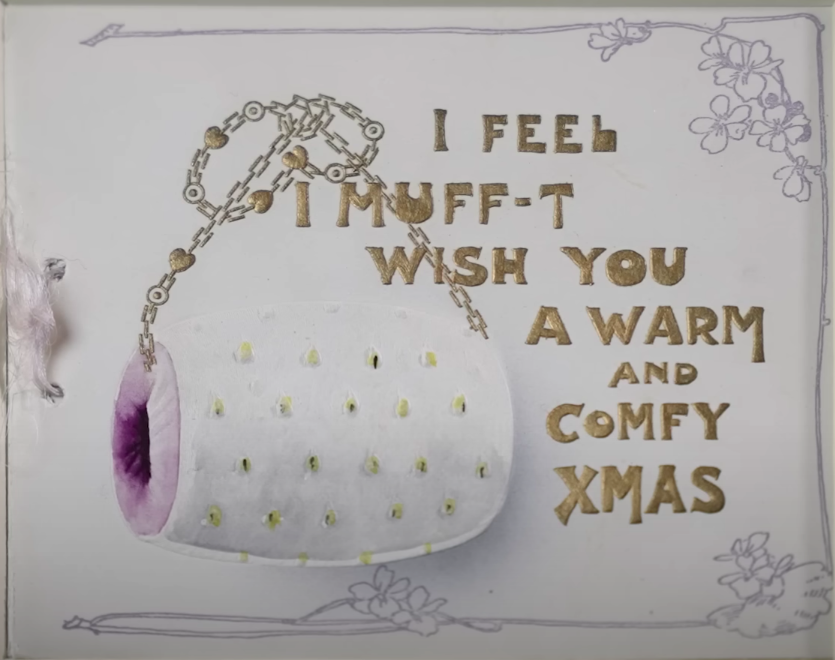
Read more about the advent of this tradition, including how it jumped the pond, in Smithsonian Magazine’s History of the Christmas Card.
Related Content
When Salvador Dalí Created Christmas Cards That Were Too Avant Garde for Hallmark (1960)
J.R.R. Tolkien Sent Illustrated Letters from Father Christmas to His Kids Every Year (1920–1943)
Langston Hughes’ Homemade Christmas Cards From 1950
Watch Terry Gilliam’s Animated Short, The Christmas Card (1968)
Hear Neil Gaiman Read A Christmas Carol Just Like Charles Dickens Read It
An Oscar-Winning Animation of Charles Dickens’ Classic Tale, A Christmas Carol (1971)
- Ayun Halliday is the Chief Primatologist of the East Village Inky zine and author, most recently, of Creative, Not Famous: The Small Potato Manifesto. Follow her @AyunHalliday.
Read More...Watch Björk, Age 11, Read a Christmas Nativity Story on an Icelandic TV Special (1976)
The holidays can be hard, starting in October when the red and green decorations begin muscling in on the Halloween aisle.
Most Wonderful Time of the Year, you say? Oh, go stuff a stocking in it, Andy Williams!
The majority of us have more in common with the Grinch, Scrooge, and/or the Little Match Girl.
Still, it’s hard to resist the preternaturally mature 11-year-old Björk reading the nativity story in her native Icelandic, backed by unsmiling older kids from the Children’s Music School in Reykjavík.
Particularly since I myself do not speak Icelandic.
The fact that it’s in black and white is merely the blueberries on the spiced cabbage.
It speaks highly of the Icelandic approach to education that a principal’s office regular who reportedly chafed at her school’s “retro, constant Beethoven and Bach bollocks” curriculum was awarded the plum part in this 1976 Christmas special for the National Broadcasting Service.
It would also appear that little Björk, the fiercely self-reliant latchkey kid of a Bohemian single mother, was far and away the most charismatic kid enrolled in the Barnamúsikskóli.
(Less than a year later her self-titled first album sold 7000 copies in Iceland—a modest amount compared to Adele’s debut, maybe, but c’mon, the kid was 11! And Iceland’s population at the time was a couple hundred thousand and change.)
As to the above performance’s religious slant, it wasn’t a reflection of her personal beliefs. As she told the UK music webzine Drowned in Sound in 2011:
…nature is my religion, in a way… I think everybody has their own private religion. I guess what bothers me is when millions have the same one. It just can’t be true. It’s just…what?
Still, it probably wasn’t too controversial that the programmers elected to cleave to the reason in the season. Icelandic church attendance may be low-key, but the overwhelming majority of its citizens identify as Lutheran, or some other Christian denomination.
(They also believe in elves and 13 formerly fearsome Yule Lads, descendants of the ogres Grýla and Leppalúði. By the time Björk appeared on earth, they had long since evolved, through a combination of foreign influence and public decree, into the kinder, gentler, not quite Santa-esque version, addressing the studio audience at the top of the act.)
Note: An earlier version of this post appeared on our site in 2015.
Related Content:
Hear the Album Björk Recorded as an 11-Year-Old: Features Cover Art Provided By Her Mom (1977)
Ayun Halliday is an author, illustrator, and Chief Primatologist of the East Village Inky zine. She is proud to originated the role of Santa’s mortal consort, Mary, in her Jewish husband Greg Kotis’ Nordic-themed holiday fantasia, The Truth About Santa. Follow her @AyunHalliday
Read More...How Will AI Change the World?: A Captivating Animation Explores the Promise & Perils of Artificial Intelligence
Many of us can remember a time when artificial intelligence was widely dismissed as a science-fictional pipe dream unworthy of serious research and investment. That time, safe to say, has gone. “Within a decade,” writes blogger Samuel Hammond, the development of artificial intelligence could bring about a world in which “ordinary people will have more capabilities than a CIA agent does today. You’ll be able to listen in on a conversation in an apartment across the street using the sound vibrations off a chip bag” (as previously featured here on Open Culture.) “You’ll be able to replace your face and voice with those of someone else in real time, allowing anyone to socially engineer their way into anything.”
And that’s the benign part. “Death-by-kamikaze drone will surpass mass shootings as the best way to enact a lurid revenge. The courts, meanwhile, will be flooded with lawsuits because who needs to pay attorney fees when your phone can file an airtight motion for you?” All this “will be enough to make the stablest genius feel schizophrenic.” But “it doesn’t have to be this way. We can fight AI fire with AI fire and adapt our practices along the way.” You can hear a considered take on how we might manage that in the animated TED-Ed video above, adapted from an interview with computer scientist Stuart Russell, author of the popular textbook Artificial Intelligence: A Modern Approach as well as Human Compatible: Artificial Intelligence and the Problem of Control.
“The problem with the way we build AI systems now is we give them a fixed objective,” Russell says. “The algorithms require us to specify everything in the objective.” Thus an AI charged with de-acidifying the oceans could quite plausibly come to the solution of setting off “a catalytic reaction that does that extremely efficiently, but consumes a quarter of the oxygen in the atmosphere, which would apparently cause us to die fairly slowly and unpleasantly over the course of several hours.” The key to this problem, Russell argues, is to program in a certain lack of confidence: “It’s when you build machines that believe with certainty that they have the objective, that’s when you get sort of psychopathic behavior, and I think we see the same thing in humans.”
A less existential but more common worry has to do with unemployment. Full AI automation of the warehouse tasks still performed by humans, for example, “would, at a stroke, eliminate three or four million jobs.” Russell here turns to E. M. Forster, who in the 1909 story “The Machine Stops” envisions a future in which “everyone is entirely machine-dependent,” with lives not unlike the e‑mail- and Zoom meeting-filled ones we lead today. The narrative plays out as a warning that “if you hand over the management of your civilization to machines, you then lose the incentive to understand it yourself or to teach the next generation how to understand it.” The mind, as the saying goes, is a wonderful servant but a terrible master. The same is true of machines — and even truer, we may well find, of mechanical minds.
Related content:
Discover DALL‑E, the Artificial Intelligence Artist That Lets You Create Surreal Artwork
Based in Seoul, Colin Marshall writes and broadcasts on cities, language, and culture. His projects include the Substack newsletter Books on Cities, the book The Stateless City: a Walk through 21st-Century Los Angeles and the video series The City in Cinema. Follow him on Twitter at @colinmarshall or on Facebook.
Read More...Beethoven’s Ode to Joy Played With 167 Theremins Placed Inside Matryoshka Dolls in Japan
A decade ago, in Tokyo, 167 musicians performed a Beethoven classic with the “Matryomin,” a new-fangled instrument that lodges a theremin inside a matryoshka. A matryoshka, of course, is one of those Russian nested dolls where you find wooden dolls of decreasing size placed one inside the other. As for the theremin, it’s a century-old electronic musical instrument that requires no physical contact from the player. You can watch its inventor, Leon Theremin, give it a demo in the vintage video below. And via this link you can see the Matryomin Ensemble performing a mesmerizing version of Amazing Grace. Enjoy.
If you would like to support the mission of Open Culture, consider making a donation to our site. It’s hard to rely 100% on ads, and your contributions will help us continue providing the best free cultural and educational materials to learners everywhere. You can contribute through PayPal, Patreon, and Venmo (@openculture). Thanks!
Related Content
Learn How to Play the Theremin: A Free Short Video Course
“Somewhere Over the Rainbow” Played on a 1929
Read More...480 Filmmakers Reveal the 100 Greatest Movies in the World
Nobody knows more about cinema than critics. But in an entirely different way, nobody knows more about cinema than directors. That, perhaps, is one of the reasons that Sight and Sound magazine has, for the past thirty years, conducted two separate once-in-a-decade polls to determine the greatest films of all time. Last week we featured the results of Sight and Sound’s latest critics poll here on Open Culture, but the outcome of the directors’ vote — whose electorate of 480 “spans experimental, arthouse, mainstream and genre filmmakers from around the world” — merits its own consideration.
As all the cinephile world knows by now, Chantal Akerman’s Jeanne Dielman, 23, quai du Commerce, 1080 Bruxelles came out on top of Sight and Sound’s critics poll this year. That temporally expansive masterwork of potatoes, veal cutlets, prostitution, and murder didn’t place quite so highly in the directors poll. It ranks at number four, below Ozu Yasujirō’s Tokyo Story, Francis Ford Coppola’s The Godfather, Orson Welles’ Citizen Kane, and — at number one — Stanley Kubrick’s 2001: A Space Odyssey, which, for those who make movies, evidently remains the “ultimate trip” that its late-sixties marketing campaign promised.
The roundup of individual ballots at World of Reel reveals that 2001’s supporters include a wide range of auteurs — Olivier Assayas, Bi Gan, Don Hertzfeldt, Gaspar Noé, Joanna Hogg, Edgar Wright, Martin Scorsese — not all of whose own work shows clear evidence of having been influenced by Kubrick and Arthur C. Clarke’s at once lavish and stark vision of mankind’s destiny in the realms beyond Earth. But 2001’s real achievement was less to tell its particular story, no matter how mind-blowing, than to expand the possibilities of cinema itself: to execute, as examined in the video essay above, a kind of cinematic hypnotism.
Of course, Kubrick is hugely admired by viewers and makers of movies alike. Barry Lyndon appears on both top-100 lists, though it seems as if critics favor The Shining more than filmmakers. The latter group cast more votes for Kubrick’s Cold-War comedy Dr. Strangelove or: How I Learned to Stop Worrying and Love the Bomb. Also among the dozens of titles only in the filmmakers’ top 100 include Abbas Kiarostami’s Where Is the Friend’s House? and Taste of Cherry, Kurosawa Akira’s Throne of Blood and Ikiru, Sergei Parajanov’s The Color of Pomegranates, and even Steven Spielberg’s Jaws — which, no less than 2001, surely appeals to any filmmaker’s innate sense of spectacle.
See the directors top 100 films here.
Related content:
Akira Kurosawa’s List of His 100 Favorite Movies
David Lynch Lists His Favorite Films & Directors, Including Fellini, Wilder, Tati & Hitchcock
Andrei Tarkovsky Creates a List of His 10 Favorite Films (1972)
Martin Scorsese Reveals His 12 Favorite Movies
Stanley Kubrick’s List of Top 10 Films: The First and Only List He Ever Created
The Ten Greatest Films of All Time According to 358 Filmmakers
Based in Seoul, Colin Marshall writes and broadcasts on cities, language, and culture. His projects include the Substack newsletter Books on Cities, the book The Stateless City: a Walk through 21st-Century Los Angeles and the video series The City in Cinema. Follow him on Twitter at @colinmarshall or on Facebook.
Read More...Support Us
We're hoping to rely on loyal readers, rather than erratic ads. Please click the Donate button and support Open Culture. You can use Paypal, Venmo, Patreon, even Crypto! We thank you!

About Us

Open Culture scours the web for the best educational media. We find the free courses and audio books you need, the language lessons & educational videos you want, and plenty of enlightenment in between.
Advertise With Us

FREE UPDATES!
GET OUR DAILY EMAIL
Get the best cultural and educational resources on the web curated for you in a daily email. We never spam. Unsubscribe at any time.
FOLLOW ON SOCIAL MEDIA

Open Culture editor Dan Colman scours the web for the best educational media. He finds the free courses and audio books you need, the language lessons & movies you want, and plenty of enlightenment in between.
Advertise With Us

