The 30 Greatest Films Ever Made: A Video Essay
Last week, we featured the results of this decade’s Sight and Sound poll to determine the greatest films of all time. Nobody could possibly agree with every single one of its rankings, but then, some of the joy of cinephilia lies in disagreement — and even more of it in doing a few rankings of one’s own. Such is the project of video essayist Lewis Bond in the video just above from his Youtube channel The Cinema Cartography. It presents a list of the thirty greatest films, beginning at number thirty and ending at number one, weaving through a variety of time periods, cultures, and aesthetics.
We would expect no less from The Cinema Cartography, previously featured here on Open Culture for videos on subjects like cities and places in film, cinematography, and animation, as well as on specific auteurs like David Lynch, Quentin Tarantino, and Andrei Tarkovsky. None of Tarantino’s films make the cut for the top thirty here, though they do face formidable competition, including Lynch’s Mulholland Dr. and both Andrei Rublev and Mirror by Tarkovsky — not to mention works from the likes of Stanley Kubrick, Orson Welles, Ingmar Bergman, Peter Greenaway, Martin Scorsese, Ozu Yasujirō, and Francis Ford Coppola.
“The idea of a canon, or any form of list, is both a meaningless as well as a obsessive endeavor,” says Lewis Bond in the video’s introduction. “Whatever the thought process was, these were the films that clearly, somewhere, resonate with me at my deepest level. For all I know, I could organize the exact same list in a year’s time, and every entry could be different.” No matter to what you devote your cultural life, you surely know the feeling, but you also know the value of seeing someone else’s set of preferences clearly arranged and articulately justified.
You may not feel exactly the same as Bond does about both My Dinner with Andre and the Lord of the Rings trilogy (a rare dual enthusiasm in any case), but seeing where he places them in relation to other movies can help to give you a sense of whether and how they could fit into your own personal canon — as well as the kind of context a film needs to earn its place. It’s easy to get a bit too obsessive about this sort of thing, which on some level just comes down to endlessly ordering and re-ordering a bunch of movies on a list. But as cinephiles know, our canons are ourselves: complex, idiosyncratic, subject to ceaseless change, and — so we hope, at least — coherent.
Related content:
The Ten Greatest Films of All Time According to 846 Film Critics
The Ten Greatest Films of All Time According to 358 Filmmakers
The Nine Greatest Films You’ve Never Seen
Quentin Tarantino Names His 20 Favorite Movies, Covering Two Decades
Based in Seoul, Colin Marshall writes and broadcasts on cities, language, and culture. His projects include the Substack newsletter Books on Cities, the book The Stateless City: a Walk through 21st-Century Los Angeles and the video series The City in Cinema. Follow him on Twitter at @colinmarshall or on Facebook.
Read More...The “Shadow” of a Hiroshima Victim, Etched into Stone, Is All That Remains After 1945 Atomic Blast

At 8:15 on the morning of August 6, 1945, a person sat on a flight of stone stairs leading up to the entrance of the Sumitomo Bank in Hiroshima, Japan. Seconds later, an atomic bomb detonated just 800 feet away, and the person sitting on the stairs was instantly incinerated. Gone like that. But not without leaving a mark.
As the Google Cultural Institute explains it, “Receiving the rays directly, the victim must have died on the spot from massive burns. The surface of the surrounding stone steps was turned whitish by the intense heat rays. The place where the person was sitting became dark like a shadow.”
That shadow lasted for years, until eventually rain and wind began to erode it. When a new Sumitomo Bank was built, the steps were relocated to the Hiroshima Peace Memorial Museum, where they’re now preserved. You can see the “Human Shadow Etched in Stone” above.
If you would like to support the mission of Open Culture, consider making a donation to our site. It’s hard to rely 100% on ads, and your contributions will help us continue providing the best free cultural and educational materials to learners everywhere. You can contribute through PayPal, Patreon, and Venmo (@openculture). Thanks!
Related Content:
Watch Chilling Footage of the Hiroshima & Nagasaki Bombings in Restored Color
Read More...The Chemist Alice Ball Pioneered a Treatment for Leprosy in 1915–and Then Others Stole the Credit for It

It’s bittersweet whenever a pioneering, long overlooked female scientist is finally given the recognition she deserves, especially so when the scientist in question is a person of color.
Chemist Alice Ball’s youth and drive — just 23 in 1915, when she discovered a gentle, but effective method for treating leprosy — make her an excellent role model for students with an interest in STEM.
But in a move that’s only shocking for its familiarity, an opportunistic male colleague, Arthur Dean, finagled a way to claim credit for her work.
We’ve all heard the tales of female scientists who were integral team players on important projects, who ultimately saw their role vastly downplayed upon publication or their names left off of a prestigious award.
But Dean’s claim that he was the one who had discovered an injectable water-soluble method for treating leprosy with oil from the seeds of the chaulmoogra fruit is all the more galling, given that he did so after Alice Ball’s tragically early death at the age of 24, suspected to be the result of accidental poisoning during a classroom lab demonstration.
Not everyone believed him.
Ball, the University of Hawaii chemistry department’s first Black female graduate student, and, subsequently, its first Black female chemistry instructor, had come to the attention of Harry T. Hollmann, a U.S. Public Health Officer who shared her conviction that chaulmoogra oil might hold the key to treating leprosy.
After her death in 1916, Hollmann reviewed Dean’s publications regarding the highly successful new leprosy treatment then referred to as the Dean Method and wrote that he could not see “any improvement whatsoever over the original [method] as worked out by Miss Ball:”
After a great amount of experimental work, Miss Ball solved the problem for me by making the ethyl esters of the fatty acids found in chaulmoogra oil.
Type “the Dean Method leprosy” into a search engine and you’ll be rewarded with a satisfying wealth of Alice Ball profiles, all of which go into detail regarding her discovery of what became known as the Ball Method, in use until the 1940s.
Kathleen M. Wong’s article on this trailblazing scientist in the Smithsonian Magazine delves into why Hollmann’s professional efforts to posthumously confer credit where credit was due were insufficient to secure Ball her rightful place in science history.
That began to change in the 1990s when Stan Ali, a retiree researching Black people in Hawaii, found his interest piqued by a reference to a “young Negro chemist” working on leprosy in The Samaritans of Molokai.
Ali teamed up with Paul Wermager, a retired University of Hawaii librarian, and Kathryn Waddell Takara, a poet and professor in the Ethnic Studies Department. Together, they began combing over old sources for any passing reference to Ball and her work. They came to believe that her absence from the scientific record owed to sexism and racism:
During and just after her lifetime, she was believed to be part Hawaiian, not Black. (Her birth and death certificates list both Ball and her parents as white, perhaps to “make travel, business and life in general easier,” according to the Honolulu Star-Bulletin.) In 1910, Black people made up just 0.4 percent of Hawaiʻi’s population.
“When [the newspapers] realized she was not part Hawaiian, but [Black], they felt they had made an embarrassing mistake, forgetting about it and hoping it would go away,” Ali said. “It did for 75 years.”
Their combined efforts spurred the state of Hawaii to declare February 28 Alice Ball Day. The University of Hawaii installed a commemorative plaque near a chaulmoogra tree on campus. Her portrait hangs in the university’s Hamilton Library, alongside a posthumously awarded Medal of Distinction.
(“Meanwhile,” as Carlyn L. Tani dryly observes in Honolulu Magazine, “Dean Hall on the University of Hawai‘i Mānoa campus stands as an enduring monument to Arthur L. Dean.)
Further afield, the London School of Hygiene and Tropical Medicine celebrated its 120th anniversary by adding Ball’s, Marie Sklodowska-Curie’s and Florence Nightingale’s names to a frieze that had previously honored 23 eminent men.
And now, the Godmother of Punk Patti Smith has taken it upon herself to introduce Ball to an even wider audience, after running across a reference to her while conducting research for her just released A Book of Days.
As Smith notes in an interview with Numéro:
Things have really changed. I think we are living in a very beautiful period of time because there are so many female artists, poets, scientists, and activists. Through books especially, we are rediscovering and valuing the women who have been unjustly forgotten in our history. During my research, I came across a young black scientist who lived in Hawaii in the 1920s. At that time, there was a big leper colony in Hawaii. She had discovered a treatment using the oil from the seeds of a tree to relieve the pain and allow patients to see their friends and family. Her name was Alice Ball, and she died at just 24 after a terrible chemical accident during an experiment. Her research was taken up by a professor who removed her name from the study to take full credit. It is only recently that people have discovered that she was the one who did the work.
Related Content
Jocelyn Bell Burnell Changed Astronomy Forever; Her Ph.D. Advisor Won the Nobel Prize for It
How the Female Scientist Who Discovered the Greenhouse Gas Effect Was Forgotten by History
- Ayun Halliday is the Chief Primatologist of the East Village Inky zine and author, most recently, of Creative, Not Famous: The Small Potato Manifesto. Follow her @AyunHalliday.
Read More...A Chinese Painter Specializing in Copying Van Gogh Paintings Travels to Amsterdam & Sees Van Gogh’s Masterpieces for the First Time
There are many reasons to look down on art forgery, from its illegality to its lack of originality. But much like any other human endeavor, you need a great deal of skill and stamina to do it well. Certain individual forgers have lived on in history: Han Van Meegeren, say, who tricked the Nazis with his Vermeers, or Elmyr de Hory, whose skills at imitating the styles of Picasso, Matisse, Modigliani, and Renoir landed him in Orson Welles’ F for Fake. If Zhao Xiaoyong doesn’t yet figure among the names of the best-known art forgers, it’s not because nobody’s made a movie about him.
That movie is Yu Haibo and Kiki Tianqi Yu’s documentary China’s Van Goghs, which you can watch just above. Much of it takes place in the village of Dafen in China’s Guangdong province, home to thousands and thousands of oil painters, all of whom make their living making replicas (in various sizes) of famous paintings by the likes of Leonardo, Rembrandt, Dalí, Basquiat, and — above all, it seems — Van Gogh. It speaks to the speed and scale of modern Chinese industry that this activity began only in 1989, but grew such that, at one point, Dafen was supplying 60 percent of the oil paintings in the world.
Zhao arrived in Dafen in the early nineteen-nineties, but still got into its nascent industry quite early on. “Back then, painting in the village hadn’t scaled up yet,” he writes in an essay at The World of Chinese. “I was moved the first time I saw the oil paintings there. They were so delicate. The people’s eyes and skin looked so vivid, so alive.” In Dafen’s small factories, “all of the painters there were rushing to fill orders, so nobody was going to hold my hand.” After his first batch of sales, he made himself a promise to “master the works of Van Gogh.”
At the time, Zhao would have had no way of knowing how close he would eventually get to those works. Even when he established himself to the point that he could start his own studio, the dream of visiting Van Gogh’s homeland — as opposed to selling copies of Van Gogh’s art to Van Gogh’s own countrymen — must have seemed far off. But then the documentarians came calling: “They wanted to make a film about my life. With their encouragement and support, I made a trip to Amsterdam.” (In the film, that trip begins at the 46:23 mark.)
Seeing the very same Van Goghs he’d copied countless many times before, Zhao encountered more “delicate brushstrokes and subdued colors” than he’d ever noticed before, among other physical signs that Van Gogh “must have been trying different things all the time.” After getting back to China, he found that his experience in Amsterdam had motivated him to paint not Van Gogh’s work but his own. “My wife had been with me for so many years, and we’d painted for so long, but she didn’t have a painting of herself, Zhou writes. “The first original painting I did was of my wife.” The future of Dafen may be in doubt, but Zhou’s commitment to art certainly isn’t.
Related content:
Meet Notorious Art Forger Han Van Meegeren, Who Fooled the Nazis with His Counterfeit Vermeers
What Happens When a Cheap Ikea Print Gets Presented as Fine Art in a Museum
Illustrations for a Chinese Lord of the Rings in a Stunning “Glass Painting Style”
Based in Seoul, Colin Marshall writes and broadcasts on cities, language, and culture. His projects include the Substack newsletter Books on Cities, the book The Stateless City: a Walk through 21st-Century Los Angeles and the video series The City in Cinema. Follow him on Twitter at @colinmarshall or on Facebook.
Read More...Ancient Roman Coins Reveal the Existence of a Forgotten Roman Emperor
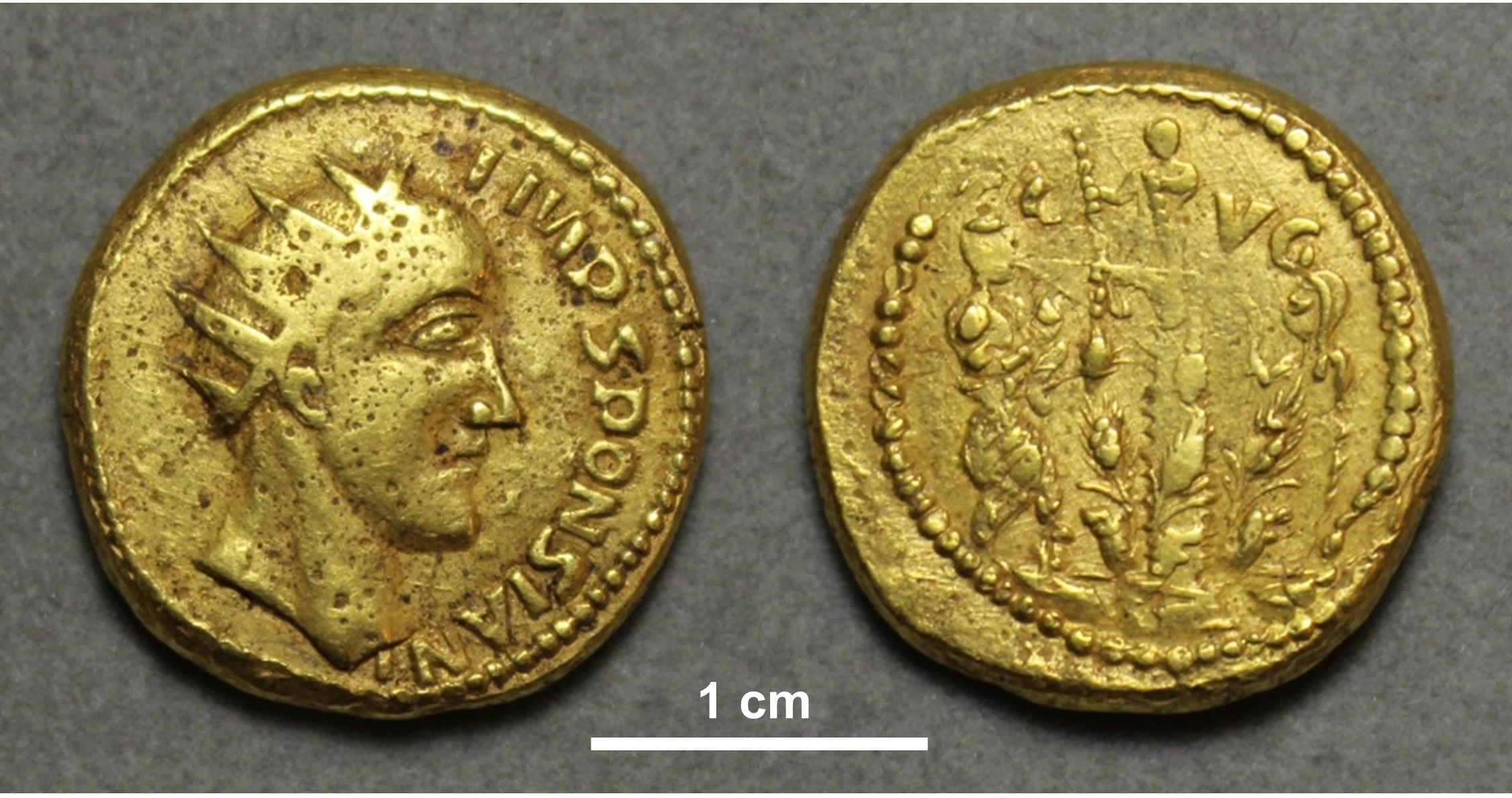
Image by Paul Pearson, University College London
You may think you know your Roman emperors, but do you recognize the face on the coin above? His name was Sponsian, or Sponsianus, and he lived in the middle of the third century. Or at least he did according to certain theories: vanishingly little is known about him, and in fact, this very gold piece (above) is the only evidence we have that he ever existed. Given that numismatists have long written the coin off as an eighteenth-century fake, it’s possible that emperor Sponsian could be a wholly apocryphal figure — but it’s become a bit less likely since the coin went under the electron microscope earlier this year.
“Using modern imaging technology, the researchers said they found ‘deep micro-abrasion patterns’ that were ‘typically associated with coins that were in circulation for an extensive period of time,’ ” writes the New York Times’ April Rubin.
“In addition, the researchers analyzed earthen deposits, finding what they called evidence that the coin had been buried for a long time before being exhumed.” In the details of their design, they’re also “uncharacteristic” of forgeries created in the eighteenth century. If this Sponsian-headed money is fraudulent, then, it’s at least authentically old, or at least much older than had long been assumed.
You can find the published research paper here, at the site of its journal PLOS ONE. Summarizing findings in the paper, a University College London site notes: “The coin … was among a handful of coins of the same design unearthed in Transylvania, in present-day Romania, in 1713. They have been regarded as fakes since the mid-19th-century, due to their crude, strange design features and jumbled inscriptions.” According to Professor Paul N. Pearson, the lead author of the research paper: “Scientific analysis of these ultra-rare coins rescues the emperor Sponsian from obscurity. Our evidence suggests he ruled Roman Dacia, an isolated gold mining outpost, at a time when the empire was beset by civil wars and the borderlands were overrun by plundering invaders.” Jesper Ericsson, a curator at The Hunterian at the University of Glasgow, adds: “we hope that this [research] encourages further debate about Sponsian as a historical figure” and sparks more research into “coins relating to [Sponsian] held in other museums across Europe.”
Keep tabs on the Sponsianus Wikipedia page to learn more about this long-lost Roman emperor.
Related content:
Modern Artists Show How the Ancient Greeks & Romans Made Coins, Vases & Artisanal Glass
How the Ancient Mayans Used Chocolate as Money
Based in Seoul, Colin Marshall writes and broadcasts on cities, language, and culture. His projects include the Substack newsletter Books on Cities, the book The Stateless City: a Walk through 21st-Century Los Angeles and the video series The City in Cinema. Follow him on Twitter at @colinmarshall or on Facebook.
Read More...A List of 1,065 Medieval Dog Names: Nosewise, Garlik, Havegoodday & More

The Rovers, Fidos, and Spots of the world have been regarded since time immemorial as man’s best friends. But they haven’t always been named Rover, Fido, and Spot: early fifteenth-century English dog owners preferred to give their pets names like Nosewise, Garlik, Pretyman, and Gaylarde. Or at least the author of a fifteenth-century English manuscript thought those names suitable for dogs at the time, according to a thread posted just a few days ago by Twitter user WeirdMedieval. Other canine monikers officially endorsed by the author (whose precise identity remains unclear) include Filthe, Salmon, Havegoodday, Hornyball, and Argument, none of which you’re likely to meet in the dog park today.
The complete list of 1,065 dog names is included in David Scott-Macnab’s academic paper “The Names of All Manner of Hounds: A Unique Inventory in a Fifteenth-Century Manuscript” (or here on Imgur).
Meant to cover hunting dogs including “running hounds, terriers and greyhounds,” the compilation includes “numerous recognizable proper names, including several from history, mythology and Arthurian romance” like Absolon, Charlemayne, Nero, and Romulus. Some “have the quality of bynames or sobriquets. Some are descriptive, some are simple nouns, and others are compounds of different lexical elements.”
Dog names in the Middle Ages also came from the natural world (Dolfyn, Flowre, Fawkon), human professions (Hosewife, Tynker), and even the nationalities of Europe (Ducheman, German). You can learn more about the variety of pet names back then from this post at Medievalists.org. King Henry VIII “had a dog named Purkoy, who got its name from the French ‘pourquoi’ because it was very inquisitive.” In Switzerland of 1504, the most popular dog name was Furst (“Prince”). And as for cats, in medieval England they tended to be “known as Gyb — the short form of Gilbert,” while in France “they were called Tibers or Tibert,” named for a character in the Reynard the Fox fables. All of these sounded normal five or six centuries ago, but who among us is daring enough to reintroduce the likes of Synfull, Crampette, and Snacke into the trend-sensitive word of pet ownership in the 2020s?
Related Content:
What People Named Their Cats in the Middle Ages: Gyb, Mite, Méone, Pangur Bán & More
An Animated History of Dogs, Inspired by Keith Haring
Cats in Medieval Manuscripts & Paintings
Based in Seoul, Colin Marshall writes and broadcasts on cities, language, and culture. His projects include the Substack newsletter Books on Cities, the book The Stateless City: a Walk through 21st-Century Los Angeles and the video series The City in Cinema. Follow him on Twitter at @colinmarshall or on Facebook.
Read More...When Salvador Dalí Dressed — and Angrily Demolished — a Department Store Window in New York City (1939)
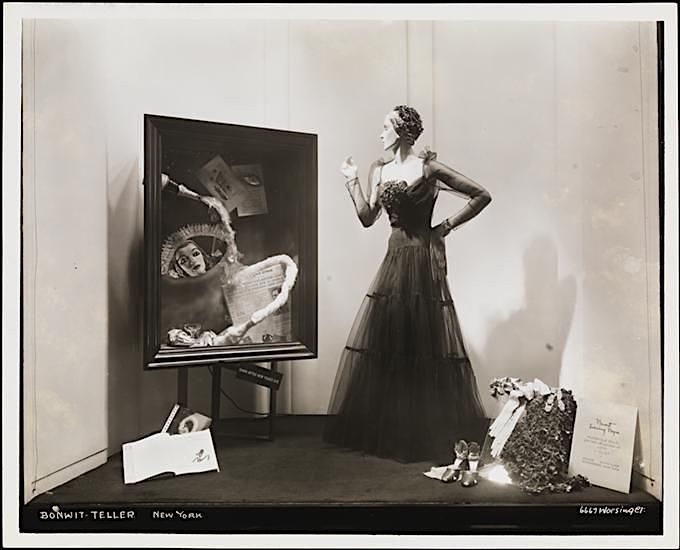
If you want to understand the history of art in twentieth-century America, you can’t overlook the corner of Fifth Avenue and 56th Street in New York City. No, not Trump Tower, but the building it replaced: Bonwit Teller, the luxury department store that had stood on the site since 1929. Then as now, any shop on Fifth Avenue has to find a way to set itself apart, and by 1939 Bonwit Teller had built a “reputation for having Manhattan’s screwiest window displays.” So says Time magazine, covering a minor debacle that year over one of the installations by “the world’s No. 1 surrealist, Salvador Dalí.”
Dalí had previously dressed Bonwit Teller’s windows without incident in 1936, riding high on the buzz from his first American exhibition that same year. When invited back by the store to create a new display, writes Tim McNeese in Salvador Dalí, “he decided to use the windows to depict the ‘Narcissus complex,’ ” divided into day and night. “In the Day window, Narcissus is personified,” says The Art Story. “Three wax hands holding mirrors reached out of a bathtub lined with black lambskin and filled with water. A mannequin entered the tub in a scant outfit of green feathers. For the Night window, the feet of a poster bed are replaced by buffalo legs and the canopy is topped by its pigeon-eating head. A wax mannequin sat nearby on a bed of coals.”
As for the public reaction, writes the New York Times’ Michael Pollak, “words were exchanged, not all of them complimentary, and the store’s staff made quick changes. The skinny-dipper in ‘Day’ was quickly replaced by an attired mannequin. Out went the sleeper in ‘Night’; in went a standing model.” As soon as he caught sight of the unauthorized modifications, Dalí took corrective action. McNeese quotes the artist’s own memory of the proceedings: “I dashed into the window to disarrange it, so that my name, signed in the window, should not be dishonored. I was never so surprised as when the bathtub just shot through the window when I pushed it and I was thereafter most confused.”
Dalí was charged with disorderly conduct but issued a suspended sentence since, as the judge put it, “These are some of the privileges that an artist with temperament seems to enjoy.” Nothing like this happened to Andy Warhol when he later dressed Bonwit Teller’s windows, writes i‑D’s Briony Wright, though “a commission for the department store in 1961 brought what could be considered his big break.” Those same windows also became opportunities for a host of other artists including Sari Dienes, James Rosenquist, Jasper Johns, and Robert Rauschenberg, the last two of whom collaborated on a display as Maston Jones. They had their own reasons for the pseudonym, but an artist of Dalí’s particular sensibility knows you don’t turn down a chance to get your name on Fifth Avenue.
Related content:
When Salvador Dali Met Sigmund Freud, and Changed Freud’s Mind About Surrealism (1938)
When Salvador Dalí Created a Surrealist Funhouse at New York World’s Fair (1939)
When Salvador Dalí Created Christmas Cards That Were Too Avant Garde for Hallmark (1960)
Based in Seoul, Colin Marshall writes and broadcasts on cities, language, and culture. His projects include the Substack newsletter Books on Cities, the book The Stateless City: a Walk through 21st-Century Los Angeles and the video series The City in Cinema. Follow him on Twitter at @colinmarshall or on Facebook.
Read More...A Relaxing, ASMR Re-Creation of People Cooking Thanksgiving Dinner in the 1820s
Americans today can acquire every element of their Thanksgiving dinner practically ready to eat, in need of little more than some heat before being set on the table. This very Thursday, in fact, many Americans will no doubt do just that. But it wasn’t an option two centuries ago, especially for those who lived on the wild frontier. To see how they’d have put their Thanksgiving dinner together, you’ll want to consult one Youtube channel in particular: Early American, previously featured here on Open Culture for its videos re-creating various meals as they would have been prepared circa 1820.
The creators of Early American, Justine Dorn and Ron Rayfield, also happen to be a married couple in real life. In their videos they appear to play historical versions of themselves, adhering to the domestic division of labor custom would have dictated in rural America of the early nineteenth century.
When Ron steps in the door with the fruits of a bountiful hunt, two rabbits and a duck, Justine knows just how to put them at the center of a full-fledged Thanksgiving dinner. This involves not just cooking the meat, but preparing a variety of accompaniments like cranberries, corn, mushroom gravy, and sweet potato pie.
All this happens at the hearth, which demands a set of skills (and a set of tools, including an hourglass) not normally possessed by home-cooking enthusiasts of the twenty-twenties. But the meal that results will surely look appetizing even to modern viewers. Though Abraham Lincoln made Thanksgiving a national holiday in 1863, George Washington first issued a proclamation for “a day of public thanksgiving and prayer” in 1789. And by that time, many of Thanksgiving’s dishes had already become established tradition. (Turkey and cranberry were linked together in the first American cookbook in 1796, NPR notes.) As always, Justine provides the original recipes (scant in detail though they often are) at the end. Use them well, it seems, and you can have a grand Thanksgiving feast even if you don’t bring home a turkey.
Related content:
The First American Cookbook: Sample Recipes from American Cookery (1796)
Read 800+ Thanksgiving Books Free at the Internet Archive
Marilyn Monroe’s Handwritten Turkey-and-Stuffing Recipe
F. Scott Fitzgerald’s 13 Tips for What to Do with Your Leftover Thanksgiving Turkey
Based in Seoul, Colin Marshall writes and broadcasts on cities, language, and culture. His projects include the Substack newsletter Books on Cities, the book The Stateless City: a Walk through 21st-Century Los Angeles and the video series The City in Cinema. Follow him on Twitter at @colinmarshall or on Facebook.
Read More...A Day at the Beach in Biarritz, France: Watch Video Restored & Colorized with AI (1928)
The Youtube channel GlamourDaze invites you to time travel back to a sunny beach in roaring 20s Biarritz France. And, to help you along, they’ve enhanced the original 1928 video with AI technology. Setting the stage, they write:
By the 1920’s, the coastal resort of Biarritz on the Côte Basque in France attracted the fashionable and wealthy during the summer and early autumn. Those who could afford it, stayed at the Hôtel du Palais which was originally a summer villa built for Empress Eugénie. Her visits turned Biarritz into a popular summer resort.
The film starts with clips from a hotel overlooking the beach, then a street fashion show. We then move down to the beach for a walk among the sunbathers and swimmers.
In just a few years over the 1920’s, women’s swimsuits had evolved considerably when compared to those seen in our recent video “A Day at the Beach c. 1921″.The roaring twenties saw seismic changes in clothing, style and social attitudes.
You can find more historical footage restored with AI in the Relateds below.
If you would like to support the mission of Open Culture, consider making a donation to our site. It’s hard to rely 100% on ads, and your contributions will help us continue providing the best free cultural and educational materials to learners everywhere. You can contribute through PayPal, Patreon, and Venmo (@openculture). Thanks!
Related Content
Footage of Flappers from 1929 Restored & Colorized with AI
Watch Scenes from Czarist Moscow Vividly Restored with Artificial Intelligence (May 1896)
Scenes of New York City in 1945 Colorized & Revived with Artificial Intelligence
Read More...The Isolated Vocal Tracks of the B‑52s “Roam”: Enjoy the Angelic Harmonies of Kate Pierson & Cindy Wilson
The B‑52s’ debut single “Rock Lobster” brought the party and a playful sense of the absurd
to New Wave.
The New York Times nailed the band’s appeal as “70s punks molded not from the syringes and leather of New York City, but from the campy detritus you might have found in the thrift stores and garage sales of their home of Athens, Ga.: bright clothes, toy pianos, old issues of Vogue, tall wigs and discarded vinyl:”
They channeled spy soundtracks, exotica, surf music, long-abandoned dance crazes and garage rock …The B‑52s were a sui generis clash of sounds that help bring punk to the suburban kids more likely to watch Saturday Night Live than visit CBGB: Fred Schneider’s sing-shout poetry, Cindy Wilson and Kate Pierson’s alien girl-group harmonies, Ricky Wilson’s tricky guitar riffs and Keith Strickland’s art-funky drums. Even demographically they were nothing like the new world of new wave being built by Talking Heads and Devo: 40 percent female, 60 percent Southern, 80 percent queer, 100 percent fun.
Their quirky sense of humor found favor with a wider audience thanks to 1989’s Cosmic Thing, with its irresistible “Love Shack.”
“It’s a fictitious place, but the whole idea is that everyone’s welcome to the party,” Kate Pierson told The Guardian.
“Roam,” Cosmic Thing’s other chart topper offers a similarly bouncy groove, well suited to road trips and other adventures. “We were on the bus,” Pierson explains:
We partied with each other – we had some epic bus parties, and the bus driver created a dance called the Bore Hog. We would do our concert then get on the bus and keep rolling. It was a wild ride though. We were tired of being this underground band – this was a confirmation of something.
Pierson and Cindy Wilson’s isolated “Roam” harmonies, above, strike us as aural confirmation of something else.
Not just Classic Pop’s apt description of the pair’s tight harmonies as a combination of “Appalachian folk music” and “teenage Motown fantasies of hairbrushes for microphones…”
With the instruments removed (and Schneider temporarily benched), “Roam” evinces a haunting quality that supports Cindy Wilson’s assertion that “it’s a beautiful song about death:”
It’s about when your spirit leaves your body and you can just roam.
Wilson, whose brother and bandmate, Ricky, died from AIDS in 1985 at the age of 32, recalled the recording process:
When we started jamming, it felt like Ricky was in the room with us. I was having a really hard time with the grieving and sorrow, but creating this music was such a wonderful thing. Ricky’s spirit was there and it was amazing. We did that music for ourselves, and it really helped me.
Imagine the afterlife as a great after party, where auto-tune hasn’t been invented yet, and the harmonies are truly angelic.
Roam if you want to
Roam around the world
Roam if you want to
Without wings, without wheels
Roam if you want to
Roam around the world
Roam if you want to
Without anything but the love we feel
Related Content
Very Early Concert Footage of the B‑52s, When New Wave Music Was Actually New (1978)
Two Very Early Concert Films of R.E.M., Live in ‘81 and ‘82
- Ayun Halliday is the Chief Primatologist of the East Village Inky zine and author of Creative, Not Famous: The Small Potato Manifesto and the soon to be released Creative, Not Famous Activity Book. Follow her @AyunHalliday.
Read More...Support Us
We're hoping to rely on loyal readers, rather than erratic ads. Please click the Donate button and support Open Culture. You can use Paypal, Venmo, Patreon, even Crypto! We thank you!

About Us

Open Culture scours the web for the best educational media. We find the free courses and audio books you need, the language lessons & educational videos you want, and plenty of enlightenment in between.
Advertise With Us

FREE UPDATES!
GET OUR DAILY EMAIL
Get the best cultural and educational resources on the web curated for you in a daily email. We never spam. Unsubscribe at any time.
FOLLOW ON SOCIAL MEDIA

Open Culture editor Dan Colman scours the web for the best educational media. He finds the free courses and audio books you need, the language lessons & movies you want, and plenty of enlightenment in between.
Advertise With Us

