Joni Mitchell Tells Elton John the Stories Behind Her Iconic Songs: “Both Sides Now,” “Carey” & More
When Joni Mitchell heard the great cabaret artist Mabel Mercer in concert, she was so struck by the older woman’s rendition of “Both Sides Now,” the enduring ballad Mitchell wrote at the tender age of 23, that she went backstage to show her appreciation:
… but I didn’t tell her that I was the author. So, I said, y’know, I’ve heard various recordings of that song, but you bring something to it, y’know, that other people haven’t been able to do. You know, it’s not a song for an ingenue. You have to bring some age to it.
Well, she took offense. I insulted her. I called her an old lady, as far as she was concerned. So I got out of there in a hell of a hurry!
But I think I finally became an old lady myself and could sing the song right.
This is just one of many candid treats to be found in Mitchell’s interview with Elton John, for his Apple Music 1 show Rocket Hour.
For the most part, Mitchell’s reminiscences coalesce around various iconic tracks from her nearly sixty years in the music industry.
“Carey,” off Mitchell’s 1971 album Blue, sparks memories of an exploding stove during a hippie-era sojourn in Matala on Crete’s south coast, with an Odyssey reference thrown in for good measure.
“Amelia” was hatched, as were most of the tunes on 1976’s Hejira, while Mitchell was on a solo road trip in a secondhand Mercedes, an experience that caused her to dwell on the first female aviator to cross the Atlantic solo. (She scribbled down lyrics that had come to her at the wheel whenever she pulled over for lunch.)
Regarding “Sex Kills” from 1994’s Turbulent Indigo, John quotes a Rolling Stone article in which Mitchell discussed the “ugliness” she was detecting in popular music:
I think it’s on the increase. Especially towards women. I’ve never been a feminist, but we haven’t had pop songs up until recently that were so aggressively dangerous to women.
“What did you mean by that?” John asks. “ People saying rap music with ‘my hos’ and stuff like that?”
“Oh, well, y’know, yeah,” Mitchell says, “Hos and booty, y’know, hahahah.”
She may not seem overly fussed about it now, but don’t get her started on what young women wear to the Grammys!
John also invited Mitchell to discuss three songs that have influenced her.
Her picks:
Lambert, Hendricks & Ross’s “Charleston Alley” (a musical epiphany as a high schooler at a college party)
Edith Piaf’s “Les Trois Cloches” (a musical epiphany as an 8‑year-old at a birthday party)
And Chuck Berry’s “Johnny B. Goode” (dancing ‘round the jukebox at Saskatoon swimming pool)
Circling back to “Both Sides Now,” Mitchell prefers the orchestral arrangement she recorded as an alto in 2002 to the original’s girlish soprano, with its possibly unearned perspective. (“It’s not a song for an ingenue…”)
When I performed it, the orchestra gathered around me and I’ve played with classical musicians before and they were always reading the Wall Street Journal behind their sheet music and they always treat you like it’s a condescension to be playing with you, but everybody, the men — Englishmen! — were weeping!
Perhaps you too will be moved to tears, as singer-songwriter Brandi Carlile was during a performance of “Both Sides Now” as part of the 2022 Newport Folk Festival’s Joni Jam, Mitchell’s first show in 22 years, owing to a period of major disillusionment with the music business as well as a 2015 brain aneurysm.
Tune into more episodes of Elton John’s Rocket Hour here.
Related Content
Songs by Joni Mitchell Re-Imagined as Pulp Fiction Book Covers & Vintage Movie Posters
Hear Demos & Outtakes of Joni Mitchell’s Blue on the 50th Anniversary of the Classic Album
- Ayun Halliday is the Chief Primatologist of the East Village Inky zine and author of Creative, Not Famous: The Small Potato Manifesto and the soon to be released Creative, Not Famous Activity Book. Follow her @AyunHalliday.
Read More...Hear 149 Vintage Halloween Radio Shows from the Golden Age of Radio
As Halloween radio broadcasts go, it would be hard to displace in American cultural memory the adaptation of H. G. Wells’ The War of the Worlds that aired in 1938. Not every Halloween special can be directed by a young Orson Welles, of course, but that’s hardly a reason to ignore the countless other Halloween broadcasts from the Golden Age of Radio. This year you can tune them in with the Youtube playlist above, which collects 149 such spookiest-time-of-the-season episodes from such beloved shows as Lum and Abner, The Aldrich Family, Fibber McGee and Molly, Our Miss Brooks, The Great Gildersleeve, The Jack Benny Program, The Shadow, and more.
Whether comedy, drama, or another genre besides, old-time radio programs tended to seize upon the theme of every holiday that came down the pike, and Halloween — with its costume parties, ever-present threat of pranks, and door-to-door demands — offered their writers and performers a once-in-a-year opportunity for unwonted degrees of mischief.
For normally lighthearted shows, it was also a chance to go at least a little bit dark; for a show like Suspense, whose long and often chilling run began with an Alfred Hitchcock production, most weeks were Halloween right up until the end of radio’s Golden Age. (This playlist features a broadcast from August of 1961 that still entertains in October of 2022.)
If you’d just like a soundtrack straight from the classic American airwaves for next Monday night (or a weekend party beforehand), have a listen to the newly uploaded vintage Halloween playlist just above. Its fifteen tracks include seasonally suitable songs from Tommy Dorsey, Glenn Miller, Bing Crosby, Ella Fitzgerald, Sammy Davis Jr., and Sarah Vaughan (not to mention its opener, a not-exactly-“Monster Mash” number from Bobby Pickett), with vintage advertisements and other broadcast ephemera in between. It was as true in radio’s heyday of the late nineteen-twenties through the early sixties as it is now: Halloween is the time to let blur the boundaries between light and dark, myth and reality, the ordinary and the grotesque — and to make more than a few corny gags while you’re at it.
Related content:
Hear Vincent Price, Horror Film Legend, Read 8+ Hours of Scary Stories
Happy Halloween! Louis Armstrong Performs Skeleton in the Closet (1936)
Hear 90+ Episodes of Suspense, the Iconic Golden Age Radio Show Launched by Alfred Hitchcock
Hear Orson Welles’ Iconic War of the Worlds Broadcast (1938)
Based in Seoul, Colin Marshall writes and broadcasts on cities, language, and culture. His projects include the Substack newsletter Books on Cities, the book The Stateless City: a Walk through 21st-Century Los Angeles and the video series The City in Cinema. Follow him on Twitter at @colinmarshall or on Facebook.
Read More...What Sex Was Like in Medieval Times?: Historians Look at How People Got It On in the Dark Ages
The adjective medieval tends to conjure up vivid and sometimes off-putting images, not least when applied to sex. But how many of us have any sense at all of what the real people of the Middle Ages got up to in bed? To get one, we could do worse than asking historian Eleanor Janega, teacher of the course Medieval Gender and Sexuality and host of the History Hit video above, “What Was Sex Really Like For Medieval People?” In it, Janega has first to make clear that, yes, medieval Europeans had sex; if they hadn’t, of course, many of us wouldn’t be here today. But we’d be forgiven for assuming that the seemingly absolute dominance of the Church quashed any and all of their erotic opportunities.
According to the medieval Church, Janega says, “the only time sex is acceptable is between two married people for procreative purposes.” Its many other restrictions included “no sex on Saturdays and Sundays in case you’re too turned on during mass; only have sex in the missionary position, because anything else subverts the natural relationship between men and women; don’t get fully naked during sex, because it’s just too exciting; in short, during sex, you should be trying to have the least amount of fun possible.” Strict and unambiguous though these rules were, “nobody really listened to them” — and what’s more, given the lack of private spaces, “sex was almost a public affair in the Middle Ages.”
So says Kate Lister, who researches the history of sexuality, and who turns up to bring her own knowledge of the subject to the party. “We tend to think about medieval people as being real prudes,” says Janega, but even scant historical records — and rather more copious erotic manuscript marginalia — show that “they were interested in all kinds of sex and romance that we would find completely unacceptable.” Lister adds that, “in many ways, we’re not open like the medieval people were. We don’t have public communal bathing. We don’t have sex in the same room as other people. We don’t go to a high-brow dinner party and tell pubic-hair jokes.” Or we don’t, at least, if we haven’t devoted our careers to the sexuality of the Middle Ages, a field of history clearly unfit for prudes.
Related content:
The Earliest Known Appearance of the F‑Word, in a Bizarre Court Record Entry from 1310
What Did People Eat in Medieval Times? A Video Series and New Cookbook Explain
Why Butt Trumpets & Other Bizarre Images Appeared in Illuminated Medieval Manuscripts
Medieval Monks Complained About Constant Distractions: Learn How They Worked to Overcome Them
The Turin Erotic Papyrus: The Oldest Known Depiction of Human Sexuality (Circa 1150 B.C.E.)
Based in Seoul, Colin Marshall writes and broadcasts on cities, language, and culture. His projects include the Substack newsletter Books on Cities, the book The Stateless City: a Walk through 21st-Century Los Angeles and the video series The City in Cinema. Follow him on Twitter at @colinmarshall or on Facebook.
Read More...Hear Moby Dick Read in Its Entirety by Tilda Swinton, Stephen Fry, John Waters & Many Others
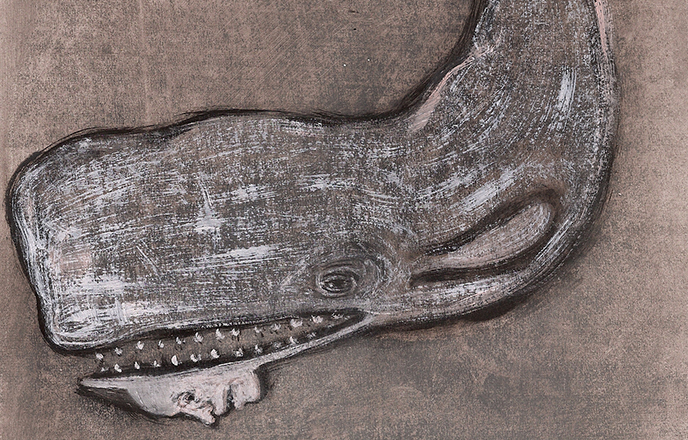
“Moby-Dick is the great American novel. But it is also the great unread American novel. Sprawling, magnificent, deliriously digressive, it stands over and above all other works of fiction, since it is barely a work of fiction itself. Rather, it is an explosive exposition of one man’s investigation into the world of the whale, and the way humans have related to it. Yet it is so much more than that.”
That’s how Plymouth University introduces Herman Melville’s classic tale from 1851. And it’s what set the stage for their web project launched back in 2012. Called The Moby-Dick Big Read, the project featured celebrities and lesser known figures reading all 135 chapters from Moby-Dick — chapters that you can start downloading (as free audio files) on iTunes, Soundcloud, RSS Feed, or the Big Read web site itself.
The project started with the first chapters being read by Tilda Swinton (Chapter 1), Captain R.N. Hone (Chapter 2), Nigel Williams (Chapter 3), Caleb Crain (Chapter 4), Musa Okwonga (Chapter 5), and Mary Norris (Chapter 6). John Waters, Stephen Fry, Simon Callow, Mary Oliver and even Prime Minister David Cameron read later ones.
If you want to read the novel as you go along, find the text over at Project Gutenberg.
Tilda Swinton’s narration of Chapter 1 appears right below:
An earlier version of this post appeared on our site in 2012.
If you would like to support the mission of Open Culture, consider making a donation to our site. It’s hard to rely 100% on ads, and your contributions will help us continue providing the best free cultural and educational materials to learners everywhere. You can contribute through PayPal, Patreon, and Venmo (@openculture). Thanks!
Related Content:
An Illustration of Every Page of Herman Melville’s Moby Dick
How Ray Bradbury Wrote the Script for John Huston’s Moby Dick (1956)
Read More...Meet the Physicist Who Has Created 1600+ Wikipedia Entries for Important Female & Minority Scientists
I find nothing more rewarding, honestly, than seeing people get recognized and championed for what they’ve done. — Dr. Jess Wade
As far as centuries go, the 21st one is a relatively good time to be a girl with an interest in STEM.
Modern science-loving girls find themselves born into a world where books and TV shows celebrating their interest proliferate. Their classrooms are festooned with posters of trailblazing female scientists. Even Barbie has ditched her bathing suit for a lab coat and a microscope.
You’d think Wikipedia would have kept pace in this climate.
And it has…thanks almost entirely to the efforts of Dr. Jess Wade, a 33-year-old Imperial College Research Fellow who spends her days investigating spin selective charge transport through chiral systems in the Department of Materials.
Her evenings, however, belong to Wikipedia.
That’s when she drafts entries for under recognized female scientists and scientists of color.
“I had a target for doing one a day, but sometimes I get too excited and do three,” she told The Guardian in 2018.
To date she’s added more than 1,600 names, striving to make their biographies as fully fleshed out as any of the write ups for the white male scientists who flourish on the site.
This requires some forensic digging. Discovering a subject’s maiden name is often the critical step to finding her PhD thesis and early influences.
A handful of Wade’s entries have been stricken for the truly maddening reason that their subjects are too obscure to warrant inclusion.
Wade’s own Wikipedia entry notes the hypocrisy of this logic, referring readers to a 2019 Chemistry World article in which she’s quoted:
When you make a page and it is disputed for deletion, it is not only annoying because your work is being deleted. It’s also incredibly intrusive and degrading to have someone discuss whether someone’s notable enough to be on Wikipedia – a website that has pages about almost every pop song, people who are extras in films no one has ever heard of and people who were in sports teams that never scored.
Below are just a few of the 1600+ female scientists she’s introduced to a wider audience. While history abounds with nearly invisible names whose discoveries and contributions have been inadequately recognized, or all too frequently attributed to male colleagues, these women are all contemporary.
Nuclear chemist Clarice Phelps was part of the team that helped discover, tennessine, the second heaviest known element.
Mathematician Gladys Mae West was one of the developers of GPS.
Physical chemist June Lindsey played a key role in the discovery of the DNA double helix.
Oceanographer and climate scientist Kim Cobb uses corals and cave stalagmites to inform projections of future climate change.
Vaccinologist Sarah Gilbert led the team that developed the Oxford/AstraZeneca vaccine (and inspired a Barbie created in her image, though you can be assured that the Wikipedia entry Wade researched and wrote for her came first.)
Wade’s hope is that a higher representation of female scientists and scientists of color on a crowdsourced, easily-accessed platform like Wikipedia will deal a blow to ingrained gender bias, expanding public perception of who can participate in these sorts of careers and encouraging young girls to pursue these courses of study. As she told the New York Times:
I’ve always done a lot of work to try to get young people — particularly girls and children from lower socioeconomic backgrounds and people of color — to think about studying physics at high school, because physics is still very much that kind of elitist, white boy subject.
Our science can only benefit the whole of society if it’s done by the whole of society. And that’s not currently the case.
Unsurprisingly, Wade is often asked how to foster and support girls with an interest in science, beyond upping the number of role models available to them on Wikipedia.
The way forward, she told NBC, is not attention-getting “whiz bang” one-off events and assemblies, but rather paying skilled teachers as well as bankers, to mentor students on their course of study, and also help them apply for grants, fellowships and other opportunities. As students prepare to enter the workforce, clearly communicated sexual harassment policies and assistance with childcare and eldercare become crucial:
Ultimately, we don’t only need to increase the number of girls choosing science, we need to increase the proportion of women who stay in science.
Listen to Jess Wade talk about her Wikipedia project on NPR’s science program Short Wave here.
Related Content:
Women Scientists Launch a Database Featuring the Work of 9,000 Women Working in the Sciences
- Ayun Halliday is the Chief Primatologist of the East Village Inky zine and author, most recently, of Creative, Not Famous: The Small Potato Manifesto. Follow her @AyunHalliday.
Behold the World’s Oldest Animation Made on a Vase in Iran 5,200 Years Ago
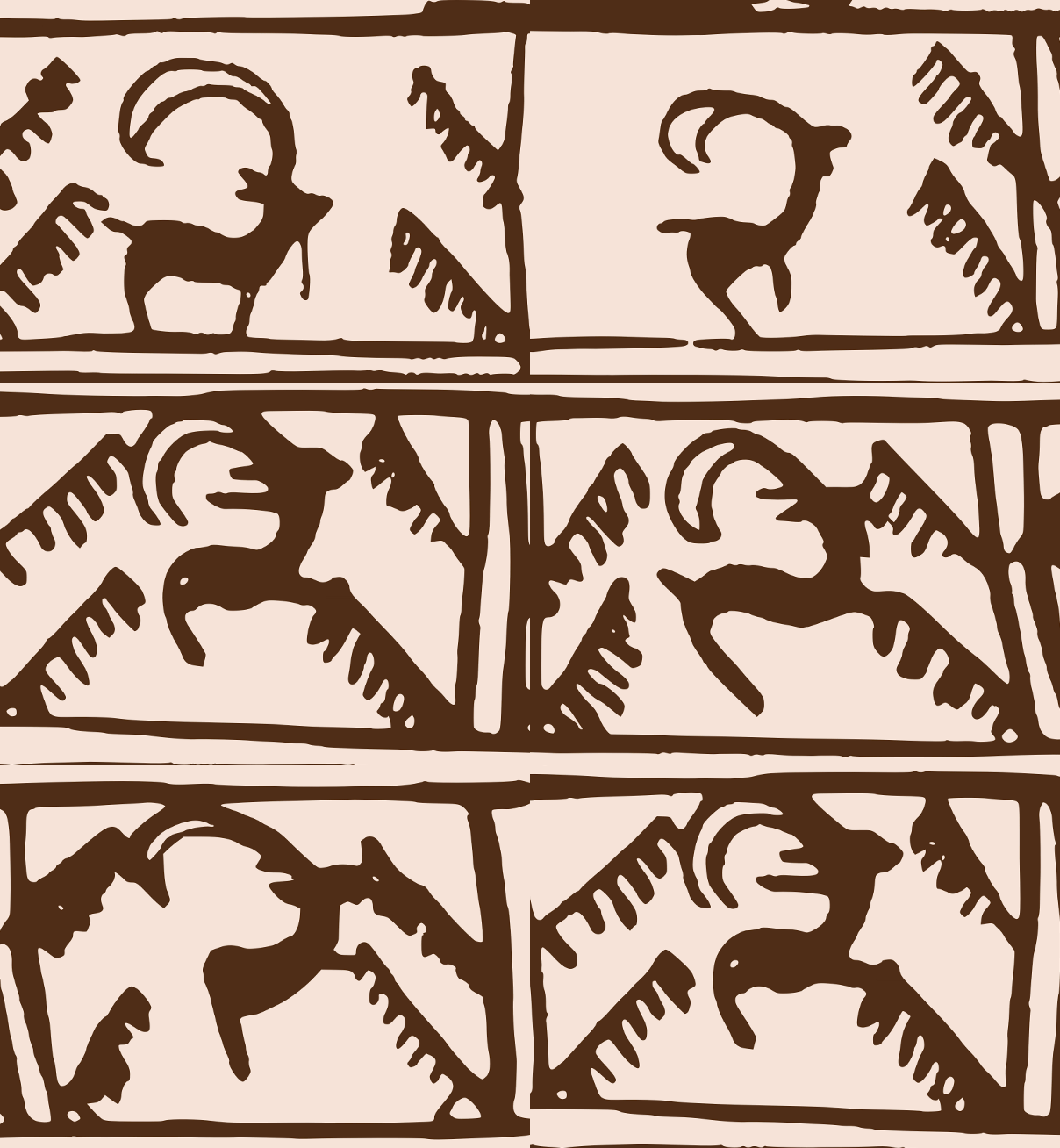
By some accounts, the history of animation stretches back to the turn of the twentieth century. Since that time, animators have brought an astounding variety of visions to artistic life. But looked at another way, this enterprise — which has so far culminated in feature-film spectacles by studios like Pixar and Ghibli — actually has it roots deep in antiquity. In order to find the first work of animation, broadly conceived, one must go to Shahr‑e Sukhteh, Iran’s famous “Burnt City.” Now a UNESCO World Heritage site, it dates back more than five millennia, about four of which it spent under a layer of ash and dust, which preserved a great many artifacts of interest within.
Shahr‑e Sukhteh was first excavated in 1967. About a decade later, an Italian archaeological team unearthed the pottery vessel bearing designs now considered the earliest example of animation. “The artifact bears five images depicting a wild goat jumping up to eat the leaves of a tree,” says the web site of the Circle of Ancient Iranian Studies. “Several years later, Iranian archaeologist Dr. Mansur Sadjadi, who became later appointed as the new director of the archaeological team working at the Burnt City discovered that the pictures formed a related series.” The animal depicted is a member of Capra aegagrus, “also known as ‘Persian desert Ibex’, and since it is an indigenous animal to the region, it would naturally appear in the iconography of the Burnt City.”
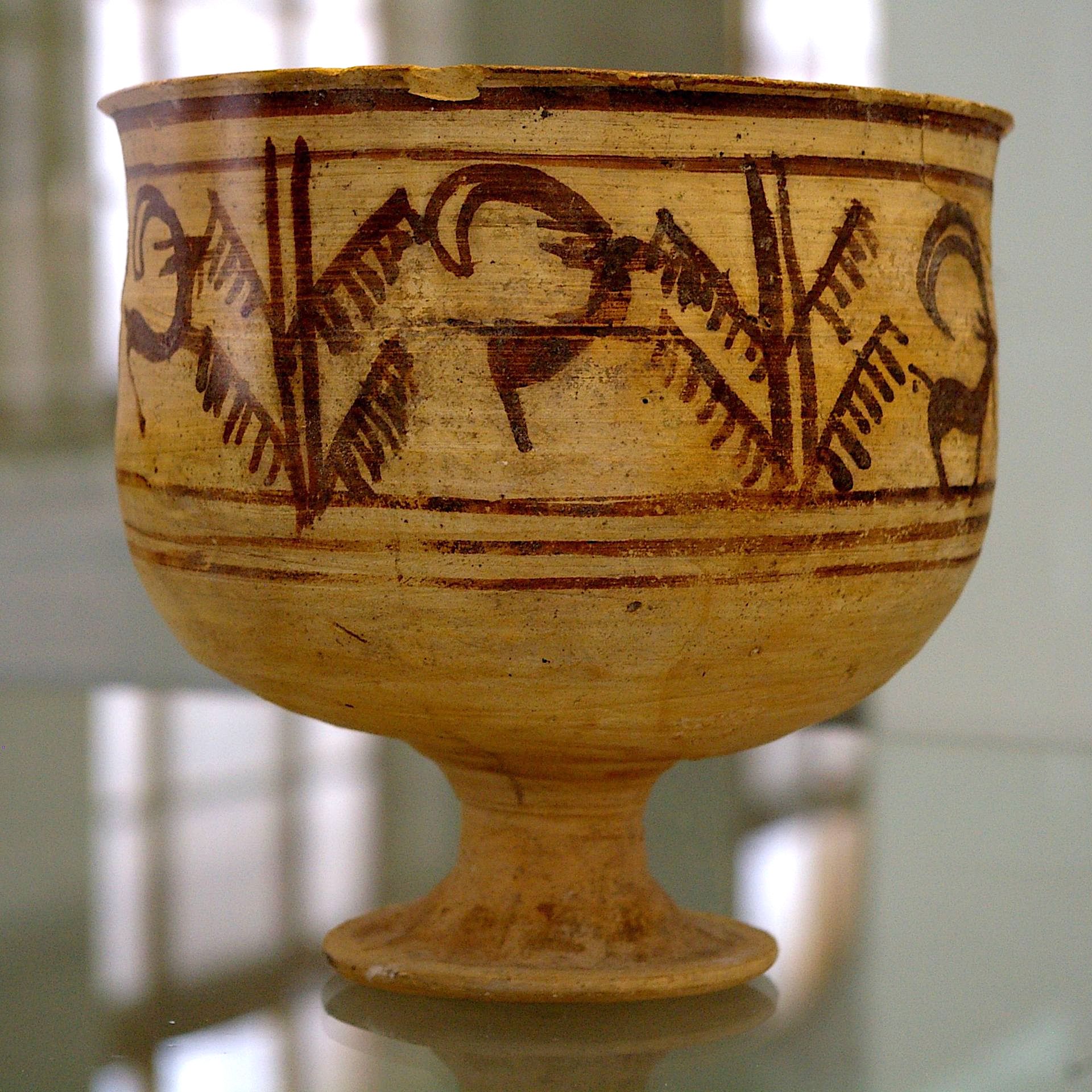
Image by Emesik, via Wikimedia Commons
This amusingly decorated goblet, now on display at the National Museum of Iran, is hardly the only find that reflects the surprising development of the early civilization that produced it. “The world’s first known artificial eyeball, with two holes in both sides and a golden thread to hold it in place, has been unearthed from the skeleton of a woman’s body in Shahr‑e Sukhteh,” says Mehr News. Excavations have also turned up “the oldest signs of brain surgery,” as well as evidence that “the people of Shahr‑e Sukhteh played backgammon,” or at least some kind of table game involving dice. But only the Burnt City’s pioneering work of flip-book-style art “means that the world’s oldest cartoon character is a goat.” Historians of animation, update your files accordingly.
Related content:
Watch Art on Ancient Greek Vases Come to Life with 21st-Century Animation
The Early Days of Animation Preserved in UCLA’s Video Archive
Early Japanese Animations: The Origins of Anime (1917–1931)
700 Years of Persian Manuscripts Now Digitized and Available Online
Was a 32,000-Year-Old Cave Painting the Earliest Form of Cinema?
Based in Seoul, Colin Marshall writes and broadcasts on cities, language, and culture. His projects include the Substack newsletter Books on Cities, the book The Stateless City: a Walk through 21st-Century Los Angeles and the video series The City in Cinema. Follow him on Twitter at @colinmarshall or on Facebook.
Read More...Why Monet Painted The Same Haystacks 25 Times
In the nineteen-twenties, as George Orwell remembers it, “Paris was invaded by such a swarm of artists, writers, students, dilettanti, sight-seers, debauchees and plain idlers as the world has probably never seen. In some quarters of the town the so-called artists must actually have outnumbered the working population.” Along stretches of the Seine, “it was almost impossible to pick one’s way between the sketching-stools.” Legitimate or otherwise, these artists were genuine descendants of Claude Monet, at least in the sense that the latter pioneered painting en plein air, distilling art directly from the world all around him.
“When artists had to grind their own pigments or buy paints contained in fragile pig bladders,” says Evan “Nerdwriter” Puschak in the video essay above, “it was much easier to work in a studio. The advent of tubes of paint, like these flexible zinc tubes invented by John Rand in 1841, in which the paint would not dry out, enabled a portability that made outdoor painting easy and feasible.” As usual in modernity, a development in technology enabled a development in culture, but to show what kind of possibilities had been opened up took an artist of rare vision as well as rare brazenness: more specifically, an artist like Monet.
“Obsessed, most of all, with light and color, and the ways they register in the human mind,” Monet “rejected the popular conventions of his time, which prioritized line, color, and blended brushstrokes that concealed the artist’s hand in favor of several short, thick applications of solid color placed side by side, largely unblended.” His paintings, which we now credit with launching the Impressionist movement, show us not so much colors as “color relationships that seem to change and vibrate as your eye scans across the canvas.” But then, so does real life, whose constantly changing light ensures that “every few minutes, we experience a subtly different color palette.”
For Puschak, nowhere is Monet’s artistic enterprise more clearly demonstrated than in the so-called “Haystacks.” The series consists of 25 paintings depicting just what that name suggests (and which, belonging to Monet’s neighbor in Giverny, were well placed to catch his eye), each painted at a different time of day. Each image represents Monet’s attempt to capture the light colors just as he perceived them at a particular moment, straight from nature. Taken together, they constitute “maybe the definitive expression of the Impressionist movement” — as well as a reminder that, haystack or water lily, we never truly set eyes on the same thing twice.
You can now purchase a copy of the Nerdwriter’s new book, Escape into Meaning: Essays on Superman, Public Benches, and Other Obsessions.
Related content:
How to Paint Water Lilies Like Monet in 14 Minutes
Rare 1915 Film Shows Claude Monet at Work in His Famous Garden at Giverny
1923 Photo of Claude Monet Colorized: See the Painter in the Same Color as His Paintings
1,540 Monet Paintings in a Two Hour Video
Based in Seoul, Colin Marshall writes and broadcasts on cities, language, and culture. His projects include the Substack newsletter Books on Cities, the book The Stateless City: a Walk through 21st-Century Los Angeles and the video series The City in Cinema. Follow him on Twitter at @colinmarshall or on Facebook.
Read More...When a Modern Director Makes a Fake Old Movie: A Video Essay on David Fincher’s Mank
As of this writing, Mank is David Fincher’s newest movie — but also, in a sense, his oldest. With Netflix money behind him, he and his collaborators spared seemingly no expense in re-creating the look and feel of a nineteen-forties film using the advanced digital technologies of the twenty-twenties. The idea was not just to tell the story of Citizen Kane scriptwriter Herman J. Mankiewicz, but to make the two pictures seem like contemporaries. As Fincher’s production designer Donald Graham Burt once put it, the director “wanted the movie to be like you were in a vault and came across Citizen Kane and next to it was Mank.”
CinemaStix creator Danny Boyd quotes Burt’s remarks in the video essay above, “When a Modern Director Makes a Fake Old Movie.” After establishing Fincher’s signature use of computer-generated imagery to create not large-scale spectacles but relatively subtle and often period-accurate details, Boyd explains the extensive digital manipulation involved in “aging” Mank.
Fincher’s artists added clouds, dust, “the gleam of vintage lamps,” grain and scratches, “lateral wobbling,” and much else besides. The cinematography itself pays constant homage to Citizen Kane’s then-groundbreaking angles and camera moves, even employing “old-school techniques that digital photography and a decent film budget have made increasingly obsolete” such as shooting day-for-night.
And yet, as most of the comments below Boyd’s video point out, the result of these considerable efforts falls short of convincing. Maybe it’s all the shades of gray between its blacks and whites; maybe it’s the smoothness of everything, including the camera moves; maybe it’s all the modern acting. (As the New Yorker’s Richard Brody puts it, “Our actors are of their time, and can hardly represent the past without investing it with the attitudes of our own day, which is why most new period pieces seem either thin or unintentionally ironic.”) If any filmmaker could overcome all these challenges, it would surely be one with Fincher’s background in visual effects, fascination with Old Hollywood, and notorious perfectionism. For all its success in other respects, Mank proves that one can no more make old movies than old friends.
Related content:
David Fincher’s Five Finest Music Videos: From Madonna to Aerosmith
Based in Seoul, Colin Marshall writes and broadcasts on cities, language, and culture. His projects include the Substack newsletter Books on Cities, the book The Stateless City: a Walk through 21st-Century Los Angeles and the video series The City in Cinema. Follow him on Twitter at @colinmarshall or on Facebook.
Read More...Artist Makes Astonishing Armor for Cats & Mice
As a child, Jeff De Boer, the son of a sheet metal fabricator, was fascinated by the European plate armor collection in Calgary’s Glenbow Museum:
There was something magical or mystical about that empty form, that contained something. So what would it contain? A hero? Do we all contain that in ourselves?
After graduating from high school wearing a partial suit of armor he constructed for the occasion, De Boer completed seven full suits, while majoring in jewelry design at the Alberta College of Art and Design.
A sculpture class assignment provided him with an excuse to make a suit of armor for a cat. The artist had found his niche.
Using steel, silver, brass, bronze, nickel, copper, leather, fiber, wood, and his delicate jewelry making tools, DeBoer became the cats’ armorer, spending anywhere from 50 to 200 hours producing each increasingly intricate suit of feline armor. A noble pursuit, but one that inadvertently created an “imbalance in the universe”:
The only way to fix it was to do the same for the mouse.
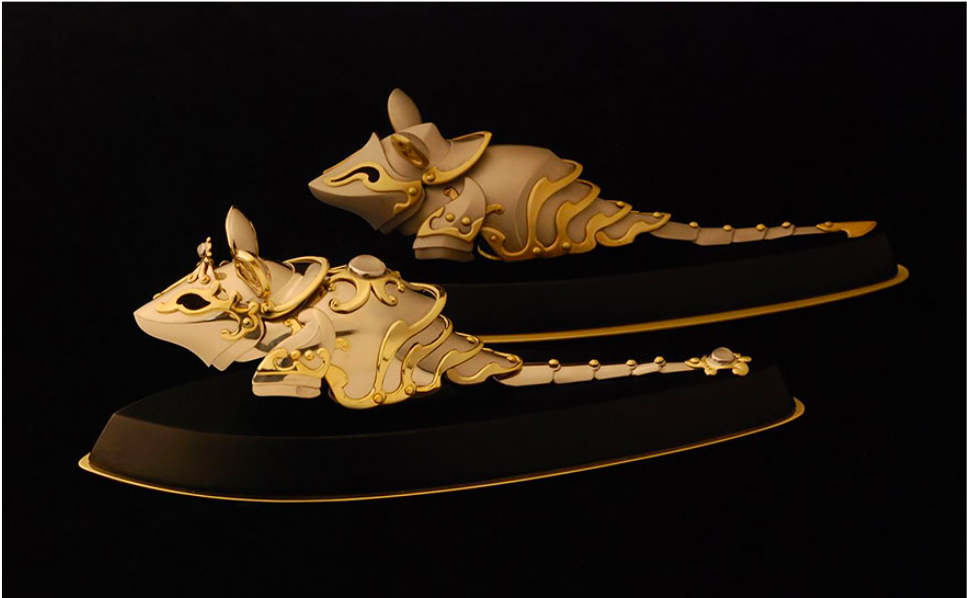
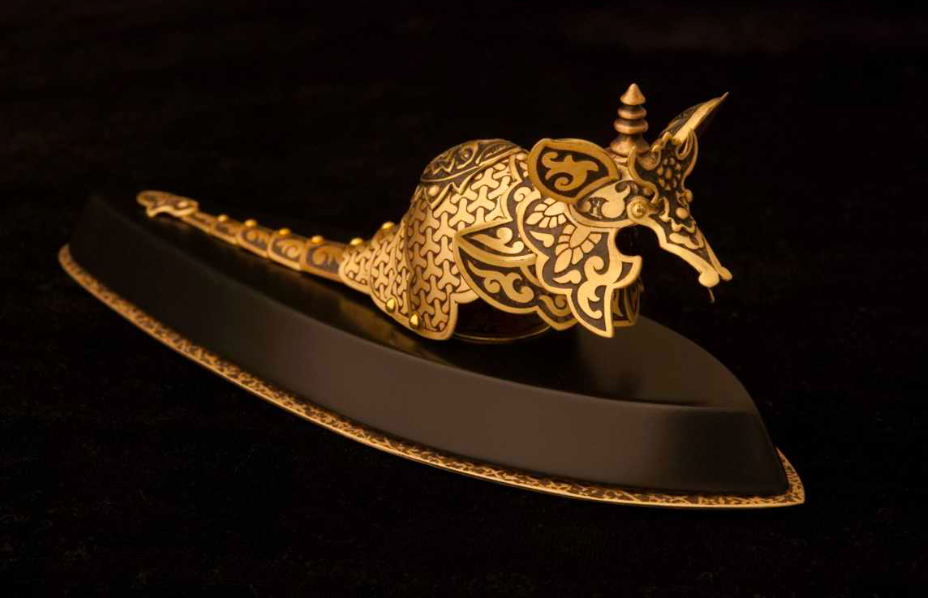
“The suit of armor is a transformation vehicle. It’s something that only the hero would wear,” De Boer notes.
Fans of David Petersen’s Mouse Guard series will need no convincing, though no real mouse has had the misfortune to find its way inside one of his astonishing, custom-made creations.
Not even a taxidermy specimen, he revealed on the Making, Our Way podcast:
It’s not an altogether bad idea. The only reason I don’t do it is that hollow suit of armor like you might see in a museum, your imagination will make it do a million things more than if you stick a mouse in it will ever do. I have put armor on cats. I can tell you, it’s nothing like what you think it’s going to be. It’s not a very good experience for the cat. It does not fulfill any fantasies about a cat wearing a suit of armor.
Though cats were his entry point, De Boer’s sympathies seem aligned with the underdog — er, mice. Equipping humble, hypothetical creatures with exquisitely wrought, historical protective gear is a way of pushing back against being perceived differently than one wishes to be.
Accepting an Honorary MFA from his alma mater earlier this year, he described an armored mouse as a metaphor for his “ongoing cat and mouse relationship with the world of fine art…a mischievous, rebellious being who dares to compete on his own terms in a world ruled by the cool cats.”
Each tiny piece is preceded by painstaking research and many reference drawings, and may incorporate special materials like the Japanese silk haori-himo cord lacing the shoulder plates to the body armor of a Samurai mouse family.
Additional creations have referenced Mongolian, gladiator, crusader, and Saracen styles — this last perfect for a Persian cat.

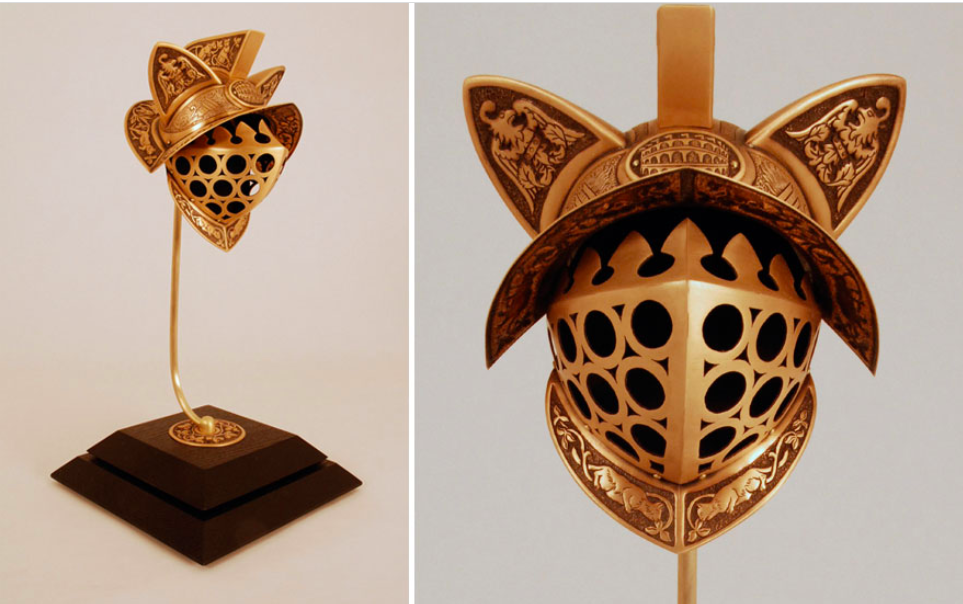
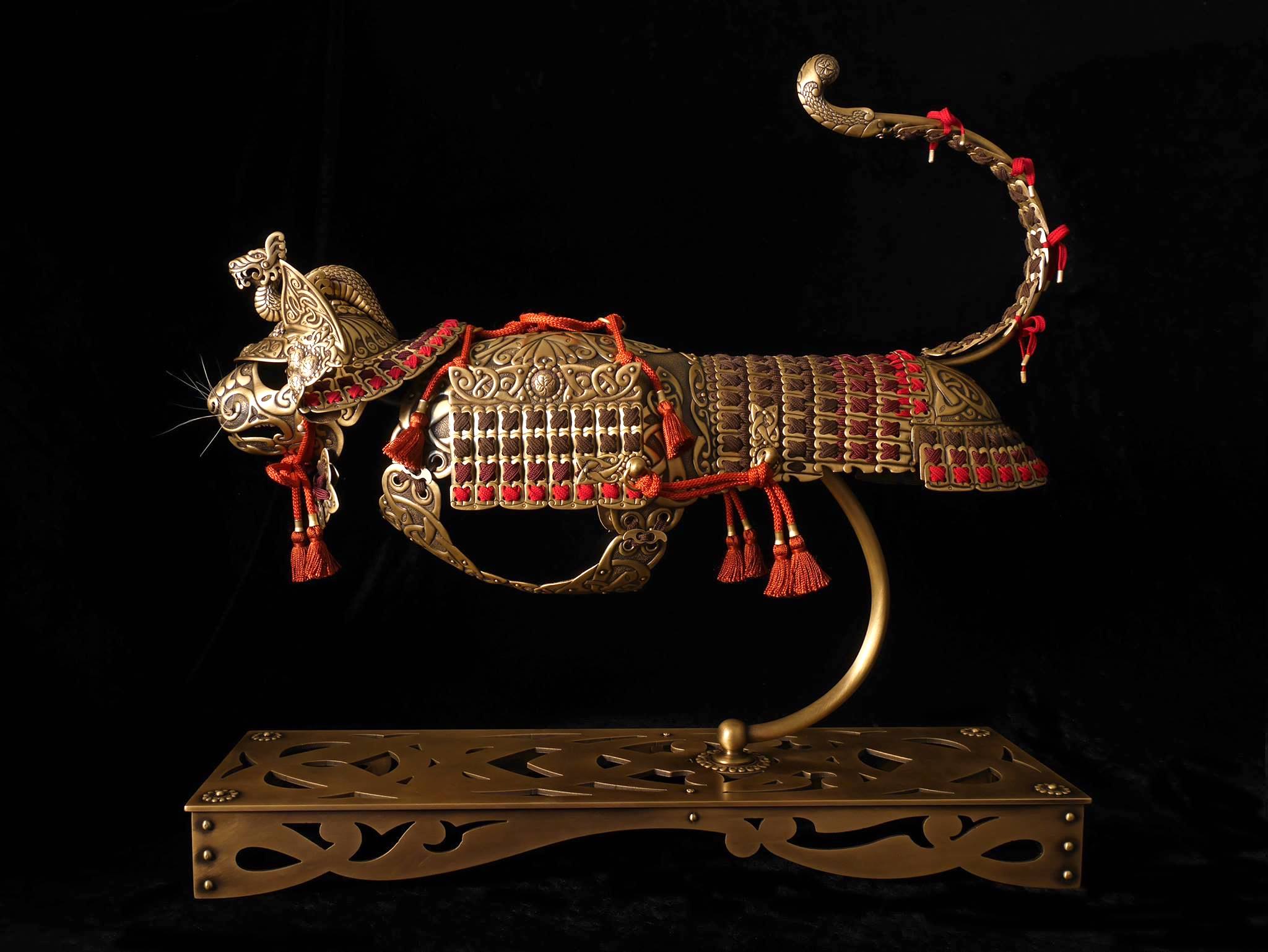
“I mean, “Why not?” he asks in his TED‑x Talk,Village Idiots & Innovation, below.
His latest work combines elements of Maratha and Hussar armor in a veritable puzzle of minuscule pieces.
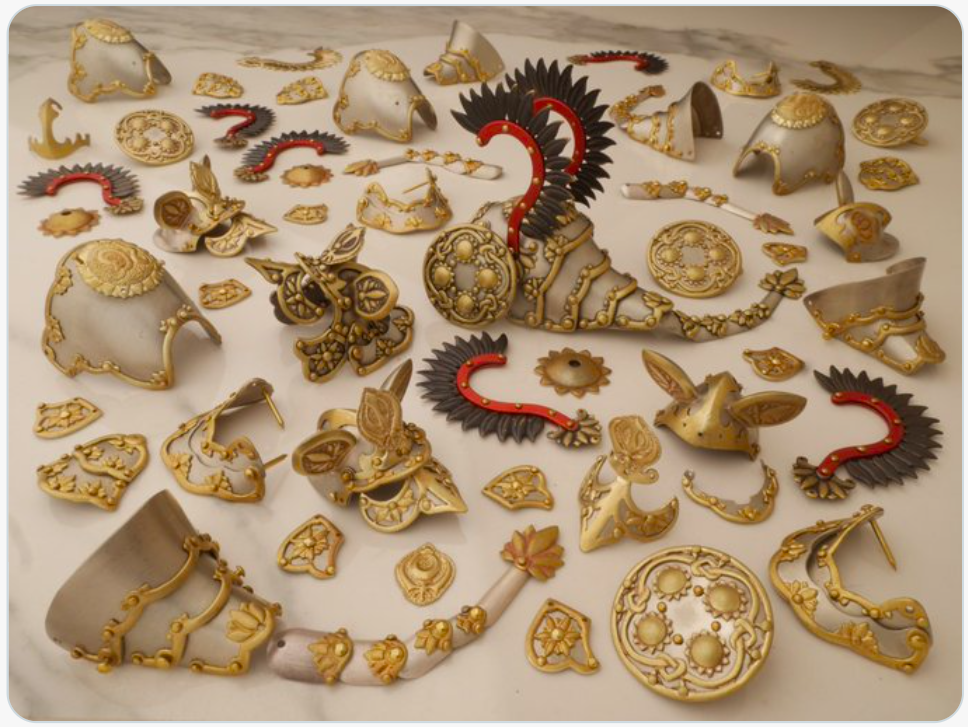
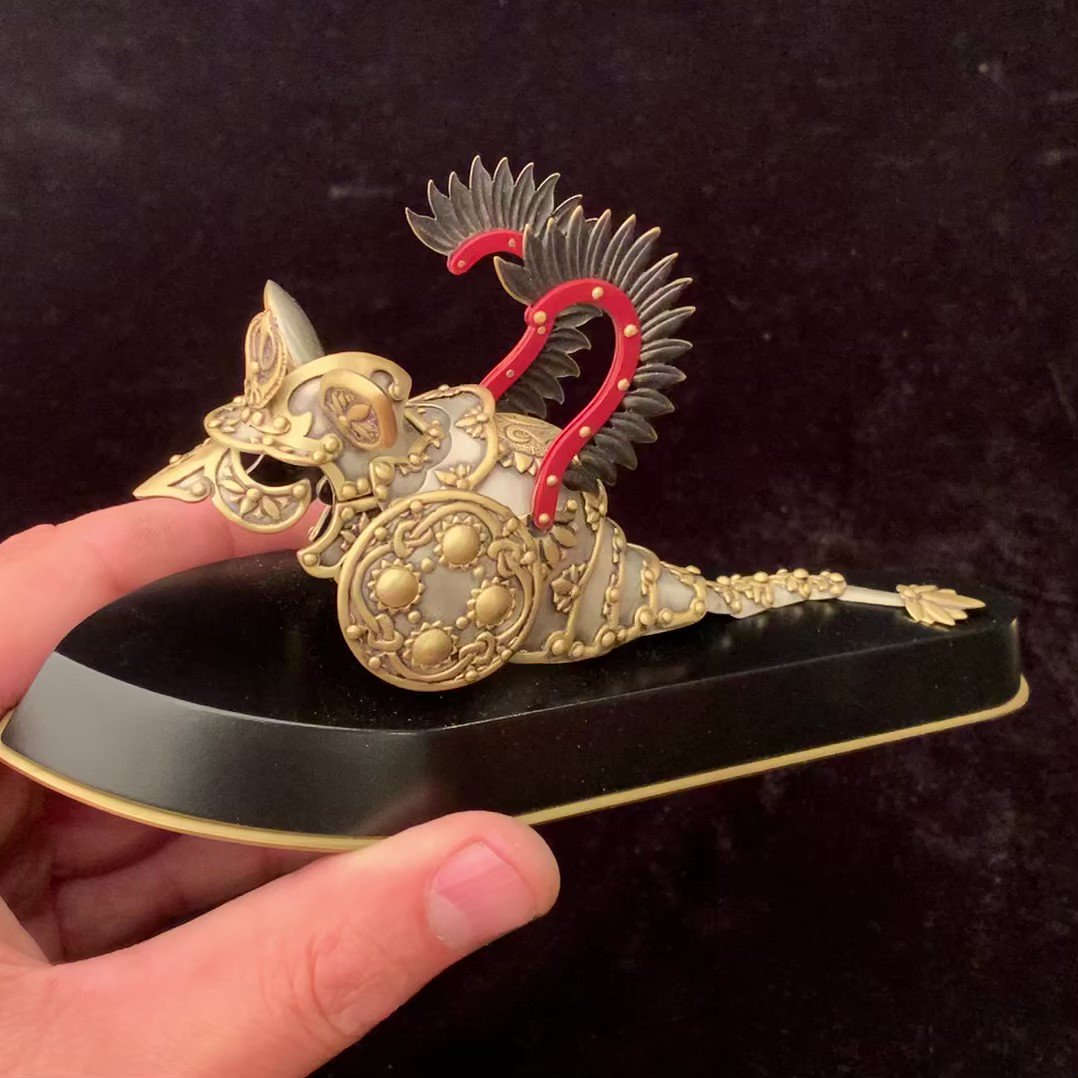
See more of Jeff De Boer’s cat and mouse armor on his Instagram.
Related Content
What’s It Like to Fight in 15th Century Armor?: A Surprising Demonstration
Cats in Medieval Manuscripts & Paintings
- Ayun Halliday is the Chief Primatologist of the East Village Inky zine and author, most recently, of Creative, Not Famous: The Small Potato Manifesto. Follow her @AyunHalliday.
Read More...How Writing Has Spread Across the World, from 3000 BC to This Year: An Animated Map
The oldest known writing systems first emerged in Mesopotamia, between 3400 and 3100 BC, and Egypt, around 3250 BC. The Latin alphabet, which I’m using to write this post and you’re using to read it, gradually took the shape we know between the seventh century BC and the Middle Ages. Over the eras since, it has spread outward from Europe to become the most widely used script in the world. These are important developments in the history of writing, but hardly the only ones. It is with all known writing systems that historical map animator Ollie Bye deals in the video above: not just those used today, but over the whole of the past five millennia.
The conquests of Alexander the Great; the Gallic Wars; the colonization of Latin America; the “scramble for Africa”: these and other major historical events are vividly reflected in the spread of certain writing systems.
Up until 1492 — after the expiration of eight and a half of the video’s eleven minutes — the map concerns itself only with Europe, Asia, and the northern three-quarters of Africa (as well as an inlaid section depicting the civilizations of what is now Central America). Thereafter it zooms out to include the New World, and indeed the whole world, though centuries pass before most of its blank spaces fill up with the colors that indicate the adoption of a dominant script.
Arabic and Persian appear in lime green, simplified Chinese in red, and Cyrillic in light blue. Before Bye’s animation reaches the middle twentieth century, most of the world has turned medium blue, which represents the now-mighty Latin alphabet. The use of these very letters for all written communication by such a wide variety of cultures merits a volumes-long history by itself. But perhaps most intriguing here is the persistence of relatively minor scripts: Cree, used among the natives of northern Canada; hiragana, katakana, and kanji in Japan; and also hangul in Korea — which I read and write myself every day of my life in Seoul, and to whose continued dominance here I can confidently attest.
Related content:
You Could Soon Be Able to Text with 2,000 Ancient Egyptian Hieroglyphs
Based in Seoul, Colin Marshall writes and broadcasts on cities, language, and culture. His projects include the Substack newsletter Books on Cities, the book The Stateless City: a Walk through 21st-Century Los Angeles and the video series The City in Cinema. Follow him on Twitter at @colinmarshall or on Facebook.
Read More...Support Us
We're hoping to rely on loyal readers, rather than erratic ads. Please click the Donate button and support Open Culture. You can use Paypal, Venmo, Patreon, even Crypto! We thank you!

About Us

Open Culture scours the web for the best educational media. We find the free courses and audio books you need, the language lessons & educational videos you want, and plenty of enlightenment in between.
Advertise With Us

FREE UPDATES!
GET OUR DAILY EMAIL
Get the best cultural and educational resources on the web curated for you in a daily email. We never spam. Unsubscribe at any time.
FOLLOW ON SOCIAL MEDIA

Open Culture editor Dan Colman scours the web for the best educational media. He finds the free courses and audio books you need, the language lessons & movies you want, and plenty of enlightenment in between.
Advertise With Us


