The Biggest Mistakes in Mapmaking History
As we all know by now, every world map is wrong. But some world maps are more wrong than others, and the earliest world maps together constitute an entertaining festival of geographical mistakes and misperceptions. Like so many pursuits, mapmaking has utilitarian roots. For millennia, as Kayla Wolf explains in the Ted-Ed lesson above, our ancestors all over the world made “functional maps, showing trade routes, settlements, topography, water sources, the shapes of coastlines, or written directions.” But some also made “what are known as cosmographies, illustrating the Earth and its position in the cosmos, often including constellations, gods, and mythic locations.”
Creators of early world maps tended to mix their functionality with their cosmography. Commissioned in Eurasia and North Africa from the Middle Ages into the seventeenth century, their mappae mundi were “meant to depict the world’s geography, but not necessarily to be useful for navigation. And given their maker’s incomplete knowledge of the world they were really hypotheses — some of which have been glaringly disproven.”
Take, for example, the Spanish maps that for more than a century “depicted the ‘Island of California’ detached from the rest of the continent” (one example of which still hangs today in the New York Public Library).
Even Gerardus Mercator, the cartographer responsible for the “Mercator projection” still used in world maps today, “speculated that the North Pole prominently featured the ‘Rupes Nigra,’ a giant magnetic rock surrounded by a whirlpool that explained why all compasses point north.” But all knowledge begins as speculation, in geography and cartography as anywhere else. We must also maintain an awareness of what we don’t know, which medieval mapmakers famously did with fantastical beasts: “a tiny copper globe created in the early 1500s,” for example, labels southeast Asia with the famous warning “Here be dragons.” And “as late as 1657, English scholar Peter Heylin lumped Australia together with Utopia.” The land down under is perhaps the “lucky country,” but Utopia is surely pushing it.
Related content:
Japanese Designers May Have Created the Most Accurate Map of Our World: See the AuthaGraph
Based in Seoul, Colin Marshall writes and broadcasts on cities, language, and culture. His projects include the Substack newsletter Books on Cities, the book The Stateless City: a Walk through 21st-Century Los Angeles and the video series The City in Cinema. Follow him on Twitter at @colinmarshall or on Facebook.
Read More...The Art of Translating Hamilton into German: “So Kribbeln Schmetterlinge, Wenn Sie Starten”
The city of Hamburg’s nickname is Tor zur Welt- the gateway to the world.
If the German language production of Lin-Manuel Miranda’s record breaking hiphop musical now in previews in that city’s St. Pauli Theater is as warmly received as the English original has been in London, Melbourne, and, of course, the US, it may earn itself with an additional one — Hamiltonburg.
Excitement has been building since early summer, when a dual language video mashup of the opening number placed the original Broadway cast alongside their German language counterparts.
One need not speak German to appreciate the similarities in attitude — in both performance, and internal assonances, a lyrical aspect of hip hop that Miranda was intent on preserving.
Translator Kevin Schroeder quipped that he and co-translator rapper Sera Finale embraced the motto “as free as necessary, as close as possible” in approaching the score, which at 46 numbers and over 20,000 words, more than doubles the word count of any other musical:
At least we had all these syllables. It gave us room to play around.
Good thing, as the German language abounds with multisyllabic compound nouns, many of which have no direct English equivalent.
Take schadenfreude which the creators of the musical Avenue Q summed up as “happiness at the misfortune of others.”
Or torschlusspanik — the sense of urgency to achieve or do something before it’s too late.
Might that one speak to a translating team who’ve devoted close to four years of their lives to getting everything — words, syllables, meter, sound, flow, position, musicality, meaning, and double meanings — right?
Before Schroeder and Finale were entrusted with this herculean task, they had to pass muster with Miranda’s wife’s Austrian cousin, who listened to their samples and pronounced them in keeping with the spirit of the original.
As translators have always done, Schroeder and Finale had to take their audience into account, swapping out references, metaphors and turns of phrase that could stump German theatergoers for ones with proven regional resonance.
In a round up demonstrating the German team’s dexterity, the New York Times’ Michael Paulson points to “Satisfied,” a song wherein Hamilton’s prospective sister-in-law recalls their first encounter:
ORIGINAL
So this is what it feels like to match wits
With someone at your level! What the hell is the catch?
It’s the feeling of freedom, of seeing the light
It’s Ben Franklin with a key and a kite
You see it right?
GERMAN
So kribbeln Schmetterlinge, wenn sie starten
Wir beide voll auf einem Level, offene Karten!
Das Herz in den Wolken, ich flieg’ aus der Bahn
Die Füße kommen an den Boden nich’ ran
Mein lieber Schwan!
ENGLISH TRANSLATION OF GERMAN
So that’s how butterflies tingle when they take off
We’re on the same level, all cards on the table!
My heart in the clouds, I’m thrown off track
My feet don’t touch the floor
My dear swan!
Miranda, who participated in shaping the German translation using a 3 column system remarkably similar to the compare and contrast content above, gives this change a glowing review:
That section sounds fantastic, and gives the same feeling of falling in love for the first time. The metaphor may be different, but it keeps its propulsiveness.
And while few German theatergoers can be expected to be conversant in Revolutionary War era American history, Germany’s sizeable immigrant population ensures that certain of the musical’s themes will retain their cultural relevance.
The Hamburg production features players from Liberia and Brazil. Other cast members were born in Germany to parents hailing from Ghana, the Philippines, Aruba, Benin, Suriname…and the United States.
For more of Michael Paulson’s insights into the challenges of translating Hamilton, click here.
Hamilton is in previews at Hamburg’s St. Pauli Theater, with opening night scheduled for October 6.
- Ayun Halliday is the Chief Primatologist of the East Village Inky zine and author, most recently, of Creative, Not Famous: The Small Potato Manifesto. Follow her @AyunHalliday.
Read More...Historian Timothy Snyder Presents 20 Lessons for Defending Democracy Against Tyranny in a New Video Series
Yale professor and historian Timothy Snyder has sounded alarm bells about autocracy and fascism for several years now, in both his scholarly and popular books about Russian and German history. Whether you’ve followed his warnings or just started paying attention, it’s not too late to get caught up on the lessons he brings from his rigorous studies of 20th century totalitarianism. To make his relevant points more accessible, Snyder has distilled them over the years, aiming at the widest popular audience.
First, he published On Tyranny in 2017, drawing 20 lessons about unfreedom from the lives of those under the Nazi, Soviet, and other fascist and totalitarian regimes. Without arguing that history repeats, exactly, Snyder noted similarities and differences to past events, and adapted general principles to the geopolitics of the early 21st century. These lessons get reiterated and distilled even further in an edition of the best-selling On Tyranny illustrated by artist Nora Krug.
Published in 2021 and reflecting four years of Trumpism, the illustrated edition continues what we might call Snyder’s Chomskyan commitment to public intellectualism. Trump may be out of power, but the threats to democracy are wired in — in one judicial action after another, and in states like North Carolina, where an illegal, racially-gerrymandered state legislature has held power for years, and now seeks to nullify federal elections at state level, with many other states threatening to follow suit.
This kind of political secessionism imposes the permanent will of a minority on a rapidly changing nation, ensuring that history never catches up with the elites, a category that includes leaders on both sides of the euphemistic “aisle.” For increasing numbers of Americans, political divisions are more aptly characterized by barricades, prison walls, or indivisible codes of silence(ing), repression, and complicity. Snyder meets this time of creeping (loping?) fascism with a YouTube series in which he speaks directly to the camera.
He isn’t giving up on more people paying attention to the bigger picture, and he’s never given up on effective responses to 21st century tyranny. Voting alone has never been enough, and it could be rendered meaningless in the near future. The lessons — “Do not obey in advance”; “Defend institutions”; “Beware the one-party state” — may be familiar to us now, or they may not. But if they bear repeating, it’s worth hearing them from Snyder himself, who closes some of the distance between the intellectual and the public by stepping away from print altogether — a medium perhaps unsuited to the malleable demands of the online present.
How does the media affect, or become, Snyder’s message, especially when it’s effectively one-sidedly televisual, the medium of the 20th century of fascism par excellence? Snyder does not address these theoretical questions, except indirectly by way of a generic book talk aesthetic complete with rumpled shirt, rustling lapel mic, and requisite background shelves of books you’ll find yourself trying to identify as you learn to “be wary of paramilitaries.”
Being wary is one thing, but to what does Snyder’s hyper vigilance add up without the power to make change where we are? Ah, but in asking such a question, maybe we find we are already in the trap, obeying in advance by assuming powerlessness and freely giving up control. It’s our job as individuals to apply the relevant lessons where we can in our own lives, and to read (or watch) Snyder critically, in relation to other trustworthy voices within, and far outside of, Ivy League academic departments.
We do not lack the information we need to understand our moment through a historical lens. But we often lack the knowledge to make sense of things at world-historical scale. Historians like Snyder can bridge the gap, and it’s good to take advantage of the freely-offered professional experience of skilled readers, researchers, and educators. In this instance, Snyder’s approach seems well-tailored to counter innumerable presentations that trivialize WWII history into overfamiliarity and perverse spectacle… or what another anti-fascist public intellectual, Walter Benjamin, identified as the aestheticization of politics — fascism-by-passive-consumerism that leads us down the path to horrors we’d never contemplate outright.…
Watch all 20 lessons above, or find them here.
Related Content:
The Making of Modern Ukraine: A Free Online Course from Yale Professor Timothy Snyder
Josh Jones is a writer and musician based in Durham, NC. Follow him at @jdmagness
Read More...Architect Breaks Down Five of the Most Iconic New York City Apartments
Real estate is a perennially hot topic in New York City, as is gentrification.
Above, architect Michael Wyetzner, breaks down the defining features of several typical NYC apartments.
You’re on your own to truffle up the sort of rent a 340 square feet studio commands in an East Village tenement these days.
The ancestors would be shocked, for sure. My late mother-in-law never tired of causing young jaws to drop by revealing how she once paid $27/month for a 1 bedroom on Sheridan Square…and her mother, who immigrated at the turn of the century, couldn’t wait to put the Lower East Side behind her.
He may not truck in final sales figures, but Wyetzner drops in a wealth of interesting factual tidbits as he sketches layouts with a black Pentel Sign Pen. His tone is more Lower East Side Tenement Museum tour guide than the comments section of a real estate blog where salty New Yorkers flaunt their street cred.
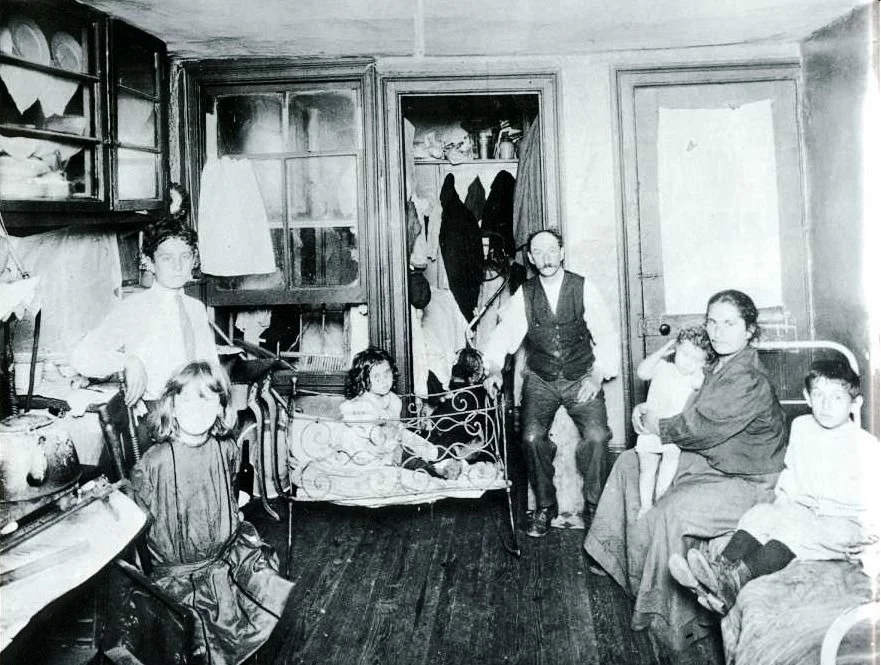
For instance, those enfilade tenement apartments–to employ the grand architectural term Wyetzner just taught us–were not only dark, but dangerously under-ventilated until 1901, when reforms stipulated that air shafts must be opened up between side by side buildings.
This public health initiative changed the shape of tenement buildings, but did little to stop the poverty and overcrowding that activist/photographer Jacob Riis famously documented in How the Other Half Lives.
(Another measure decreed that building owners must supply one indoor toilet …per 20 people!)
While we’re on the topic of toilets, did you know that there was a time when every brownstone backyard boasted its own privy?
Homeowners who’ve spent millions on what many conceive of as the most romantic of New York City buildings (then millions more on gut renovations) proudly display old bottles and other refuse excavated from the site where privys once stood. The former residents turn their outhouses into garbage chutes upon achieving indoor plumbing.
Laying aside its distinctive color, a brownstone’s most iconic feature is surely its stoop.
Stoops grabbed hold of the American public’s imagination thanks to Sesame Street, the Harlem photographs of Gordon Parks and the films of Spike Lee, who learned of Martin Luther King’s assassination as an 11-year-old, sitting on his.
“Not porch!,” he emphasized during a Tonight Show appearance. ”In Brooklyn, it’s stoops. Stoops!”
(Forgive me if I delve into NYC real estate prices for a sec: the Bed-Stuy brownstone from Lee‘s semi-autobiographical Crooklyn, above, just went on the market for $4.5 million.)
There’s no question that brownstone stoops make excellent hang out spots, but that’s not the reason they rose to prominence.
As Esther Crain writes in Ephemeral New York, the Commissioners’ Plan of 1811 which led to the city’s gridlike layout negated the possibility of alleys:
Without a back door to a rowhouse accessed through an alley, servants and workers would enter and exit a residence using the same front stoop the owners used—which wasn’t too popular, at least with the owners.
But a tall stoop set back from the sidewalk allowed for a side door that led to the lower level of the house. While the owners continued to go up and down the stoop to get to the parlor floor (and see and be seen by their neighbors), everyone else was relegated to the side…And of course, as New York entered the Gilded Age of busy streets filled with dust, ash, refuse, and enormous piles of horse manure, a very high stoop helped keep all the filth from getting into the house.
Flash forward a hundred and fifty some years, and, as Wyetzner notes, a stoop’s top step offers a highly scenic view of the Hefty bags the neighbors haul to the curb the night before New York’s Strongest roll through.
Wyetzner also provides the historical context behind such architecturally distinctive digs as SoHo’s astronomically priced light-filled lofts, the always desirable Classic Six residences on the Upper East and Upper West Sides, one-room studios both modern and original flavor, and our blighted public housing projects.
If you’re itching to play along from home, check out the New York Times’ regular feature The Hunt, which invites readers to trail a single, family, or couple deliberating between three properties in New York City.
A sample: “After a mouse infestation at her West Village rental, a single mother needed a better spot for her family, including a son with autism.”
Review the layouts and click here to see whether she chose a brand-new 127-unit building with a rooftop pool, a Harlem brownstone duplex with a backyard rights, or an updated one bedroom in a downtown co-op from 1910.
Related Content
New York Public Library Puts 20,000 Hi-Res Maps Online & Makes Them Free to Download and Use
- Ayun Halliday is the Chief Primatologist of the East Village Inky zine and author, most recently, of Creative, Not Famous: The Small Potato Manifesto. She has lived in all manner of New York City apartments, but hopes to never move again. Follow her @AyunHalliday.
Read More...Watch Opera Legend Marian Anderson’s Historic Performance on the Steps of the Lincoln Memorial (1939)
Nearly every Civil Rights icon becomes more of a symbol than a complex human being over time, a consequence of iconography in general. This has certainly been the case with opera singer Marian Anderson. “If Americans know one fact about the legendary African-American contralto Marian Anderson,” Kira Thurman writes at The New Yorker, “it’s that she sang in defiance on the steps of the Lincoln Memorial, in 1939.”
We probably also know that Anderson took to the steps of the monument again in 1963 to sing “He’s Got the Whole World in His Hands” before Martin Luther King, Jr.‘s “I Have a Dream Speech” at the March on Washington. In her official portrait at the National Portrait Gallery, she stands regally before the Lincoln Memorial’s columns in her fur coat, gazing resolutely into the middle distance, her hair gray with age and wisdom. It’s the defining image of an artist whose defiance has come to overshadow her art.
The image is an undoubtedly powerful one, a key moment in the seemingly unending struggle for justice in the United States, as well as “one of the most important musical events of the 20th century,” Anastasia Tsioulcas writes at NPR. Anderson “had never faced such an enormous crowd” — 75,000 people of all races and backgrounds. “She was terrified,” and later wrote, “I could not run away from this situation. If I had anything to offer, I would have to do so now.” She may have confessed to stage fright that day, but some characterizations do not do justice to her professionalism. Anderson did not fear crowds or bigotry.
When she sang at the Lincoln Memorial, Anderson was 42 years old and very much an international star. Four years earlier, she had returned from Europe “as one of the most revered people on the planet” and performed at the White House for Eleanor Roosevelt. It was Roosevelt who arranged the 1939 Lincoln Memorial concert — after resigning from the Daughters of the American Revolution when the all-white group refused to rent the 4,000-seat Constitution Hall to Howard University for their annual concert event for Anderson.
Roosevelt had and would continue to intervene in many such instances of racism, using her power for democratic good. Anderson, while not an activist, was not new to musical protest. In 1935, her application to sing at the Salzburg Festival in Austria had been similarly rejected, on the heels of a Nazi riot over Black baritone Aubrey Pankey’s performance in the city earlier that year. “What Anderson did next illustrates a pattern of behavior that she would deploy as a weapon throughout her career,” Thurman writes. “She showed up anyway.”
Anderson held a small concert for a few devoted listeners at Mozarteum concert hall, then a few days later in a hotel ballroom for “hundreds of elite musicians, who applauded her act of defiance,” and shared in it themselves. After this concert, famed conductor Arturo Toscanini met her backstage and said, “What I heard today one is privileged to hear only once in a hundred years.” Anderson, “became an international superstar overnight.” She built a reputation through bold acts of defiance, but her greatest contributions were always to music.
The “dignified, stoic, middle-aged Black woman” who appeared at the Lincoln Memorial was young once, writes Thurman, and as much a sensation in Europe as Josephine Baker. She’s been characterized as “modest” and self-effacing, but she was also ambitious, an incredibly talented child prodigy who knew she would find too many doors closed in the U.S. Like many Black artists of the early 20th century, she became a confident, celebrated ex-pat: “Walking down Salzburg’s hilly cobblestone streets during her first day in the Alpine city, in the summer of 1925, Anderson was trailed by a cadre of journalists everywhere she went.”
Ten years later, Anderson would find things very much changed in Europe, and find herself feeling as alienated in formerly welcoming Austria as she had in her home country. (She was mourned by her Austrian fans. One critic wrote of her last performance, “[her] music makes those people happy who have not yet given up their belief that all men are equal.”) By 1939, Anderson was a veteran not only of opera and music hall stages around the world, but of facing up to racism and discrimination.
“A quiet, humble person,” writes NPR’s Susan Stamberg, “Anderson often used ‘we’ when speaking about herself,” referring to the “many people whom we will never know,” she once said, but who make our lives possible. In the first song she sang at the Lincoln Memorial, “My Country, ‘Tis of Thee,” she changed the words of the third line from “of thee I sing” to “to thee we sing,” a move that “can be heard as an embrace, implying community and group responsibility.” It could also imply Anderson’s consciousness of herself and her community as marginalized outsiders in the country of their birth, or her sense of herself as addressing an integrated nation in that chilly, November outdoor crowd.
Related Content:
Hear the Highest Note Sung in the 137-Year History of the Metropolitan Opera
Hear Singers from the Metropolitan Opera Record Their Voices on Traditional Wax Cylinders
Josh Jones is a writer and musician based in Durham, NC. Follow him at @jdmagness
Read More...When John Singer Sargent’s “Madame X” Scandalized the Art World in 1884
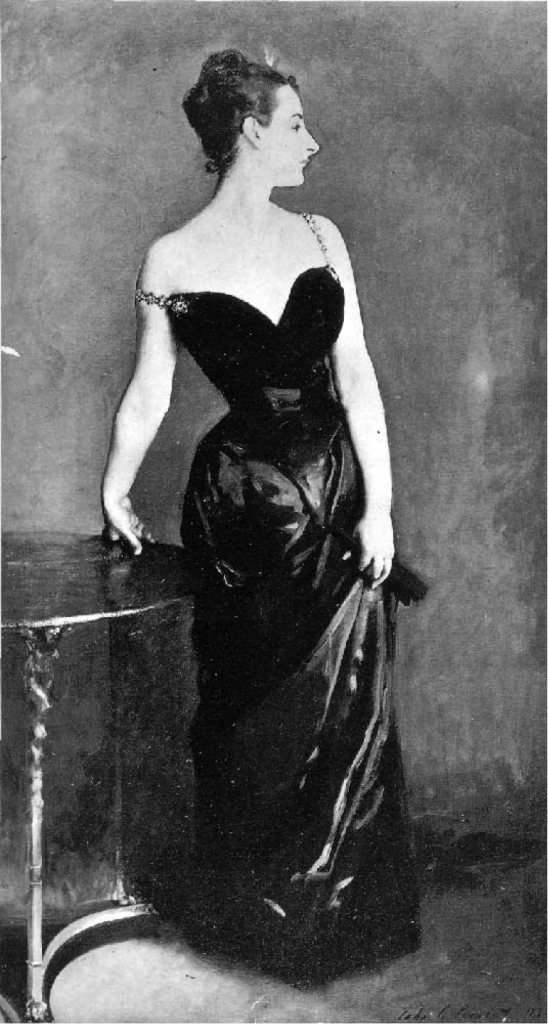
Anyone who’s ever walked the red carpet or posed for a high fashion shoot would count themselves lucky to create the sort of impression made by John Singer Sargent’s iconic portrait of Madame X.
Though not if we’re talking about the sort of impression the painting made in 1884, when the model’s haughty demeanor, plunging bodice, and unapologetic use of skin-lightening, possibly arsenic-based cosmetics got the Paris Salon all riled up.
Most scandalously, one of her gown’s jeweled straps had slipped from her shoulder, a costume malfunction this cool beauty apparently couldn’t be bothered to fix, or even turn her head to acknowledge.

Virginie Amélie Avegno Gautreau, the New Orleans-born Paris socialite (social climber, some would have sniffed) so strikingly depicted by Sargent, was horrified by her likeness’ reception at the Salon. Although Sargent had coyly replaced her name with an ellipses in the painting’s title, there was no doubt in viewers’ minds as to her identity.
John Sargent, Evan Charteris’ 1927 biography, shows Madame Gautreau very little mercy when recounting her attempts at damage control:
A demand was made that the picture should be withdrawn. It is not among the least of the curiosities of human nature, that while an individual will confess and even draw attention to his own failings, he will deeply resent the same office being undertaken by someone else. So it was with the dress of Madame Gautreau. Here a distinguished artist was proclaiming to the public in paint a fact about herself she had hitherto never made any attempt to conceal, one which had, indeed, formed one of her many social assets. Her resentment was profound.
Sargent, distraught that his portrait of the celebrated scenemaker had yielded the opposite of the hoped-for positive splash, refused to indulge her request to remove the painting from exhibition.
His friend, painter Ralph Wormeley Curtis, wrote to his parents of the scene he witnessed in Sargent’s studio when Madame Gautreau’s mother rolled up, “bathed in tears”, primed to defend her daughter:
(She) made a fearful scene saying “Ma fille est perdu — tout Paris se moque d’elle. Mon genre sera forcé de se battre. Elle mourira de chagrin” etc.
(My daughter is lost — all of Paris mocks her. My kind will be forced to fight. She will die of sorrow.)
John replied it was against all laws to retire a picture. He painted her exactly as she was dressed, that nothing could be said of the canvas than had been said of her appearance dans le monde etc. etc.
Defending his cause made him feel much better. Still we talked it all over till 1 o’clock here last night and I fear he has never had such a blow. He says he wants to get out of Paris for a time. He goes to Eng. in 3 weeks. I fear là bas he will fall into Pre‑R. Influence wh. has got a strange hold of him, he says since Siena.
As Charlotte, creator of the Art Deco YouTube channel, points out in a frenetic overview of the scandal, below, Sargent came out of this fiasco a bit better than Madame Gautreau, whose damaged reputation cost her friends as well as her queen bee status.
(In her essay, Virginie Amélie Avegno Gautreau: Living Statue, art historian Elizabeth L. Block corrects Charlotte’s assertion that the painting “destroyed Madame Gautreau’ life”. Contrary to popular opinion, within three years, she was making her theatrical debut, hosting parties, and was hailed by the New York Times as a “piece of plastic perfection.”)
Sargent did indeed decamp for England, where he found both creative and critical success. By century’s end, he was widely recognized as the most successful portrait painter of his day.
The portrait of Madame Gautreau remained enough of a sore spot that he kept it out of the public eye for more than twenty years, though shortly after its disastrous debut at the Salon, he did take another swipe at it, repositioning the suggestive shoulder strap to a more conventionally acceptable location, as the below photo, taken in his studio in 1885 confirms.

In 1905, he finally allowed it to see the light of day in a London exhibition, with subsequent engagements in Berlin, Rome and San Francisco.
In 1916, when the portrait was still on display in San Francisco, he wrote his friend Edward “Ned” Robinson, Director of The Metropolitan Museum of Art, offering to sell it for £1,000, saying, “I suppose it is the best thing I have done.”
“By the way,” he added, “I should prefer, on account of the row I had with the lady years ago, that the picture should not be called by her name.”
Even though Madame Gautreau had died the previous year, Robinson obliged, retitling the painting Portrait of Madame X, the name by which it and its glamorous model are famously known today.
Read Elizabeth L. Block’s fascinating essay, “Virginie Amélie Avegno Gautreau: Living Statue” here.
Read about the discoveries Metropolitan Museum of Art conservationists made during X‑radiography and infrared reflectography of the portrait here.
Completionists might even want to have a gander at Nicole Kidman done up to resemble Madame X for a 1998 Vogue spread shot by Steven Meisel.
Related Content
When Pablo Picasso and Guillaume Apollinaire Were Accused of Stealing the Mona Lisa (1911)
- Ayun Halliday is the Chief Primatologist of the East Village Inky zine and author, most recently, of Creative, Not Famous: The Small Potato Manifesto. Follow her @AyunHalliday.
Read More...Two Women in Their 90s Recall Their Teenage Years in Victorian 1890s London
Mud everywhere…and where there wasn’t mud, there was fog, and in between was us, enjoying ourselves. — Berta Ruck
Berta Ruck and Frances ‘Effy’ Jones were teenagers in the 1890s, and while their recollections of their formative years in muddy old London are hardly a portrait of Jazz Age wildness, neither are they in keeping with modern notions of stuffy Victorian mores.
Interviewed for the BBC documentary series Yesterday’s Witness in 1970, these nonagenarians are formidable personages, sharper than proverbial tacks, and unlikely to elicit the sort of agist pity embodied in the lyrics of a popular ditty Ruck remembers the Cockneys singing in the gutter after the pubs had closed for the night.
“Do you think I might dare to sing [it] now?” Ruck, then 91, asks (rhetorically):
She may have known better days
When she was in her prime
She may have known better days
Once upon a time…
(Raise your hand if you suspect those lyrics are describing a washed up spinster in her late 20s or early 30s.)
The 94-year-old Jones reaches back more than 7 decades to tell about her first job, when she was paid 8 shillings a week to sit in a storefront window, demonstrating a new machine known as a typewriter.
Some of her earnings went toward the purchase a bicycle, which she rode back and forth to work and overnight holidays in Brighton, scandalously clad in bloomers, or as Jones and her friends referred to them, “rational dress”.
Ruck, pegged by her headmistress as an “indolent and feckless girl”, went on to study at the Slade School of Art, before achieving prominence as a bestselling romance novelist, whose 90 some titles include His Official Fiancée, Miss Million’s Maid and In Another Girl’s Shoes.
We do hope at least one of these features a heroine resentfully brushing a skirt muddied up to the knees by passing hansom cabs, an imposition Ruck refuses to sweeten with the nostalgia.
As the British Film Institute’s Patrick Russell writes in 100 British Documentaries, the Yesterday’s Witness series, and Jones and Ruck’s episode, in particular, popularized the oral history approach to documentary, in which the director-interviewer is an invisible presence, creating the impression that the subject is speaking directly to the audience, unprompted:
The series’ makers successfully resisted any temptations to patronize or editorialize, and aimed at sympathetic curiosity rather than nostalgia. The two women tell their stories fluently, humorously, intelligently — offering considered retrospective comment on their generation’s assumptions, neither simply accepting nor rejecting them…Unlike textbooks, and other types of documentary, films like Two Victorian Girls gave the youth access to the modern past as privately experienced.
- Ayun Halliday is the Chief Primatologist of the East Village Inky zine and author, most recently, of Creative, Not Famous: The Small Potato Manifesto. Follow her @AyunHalliday.
Read More...Elton John Presents 14 of His Iconic Looks: From 1968 to Now
Elton John is packing up his fabulous outfits and hitting stages for the last time, making a graceful exit from the road at age 75 with his “Farewell Yellow Brick Road” tour. He will, of course, make a stop at Dodger Stadium, where he played one of his most famous concerts in 1975, striding onto the stage in a sequined Dodgers uniform, one of many shimmering costumes he would don during the 3‑hour marathon set.
When John played Dodger stadium, his songs had been “hitting the airwaves with a sense of fantastical futurism,” writes Far Out, “all packaged in flamboyant costumes and dressed in number one albums. Loved by critics and adored by fans, he resembled something entirely different.” Different from what?
John answered that question in a 2020 interview with Vogue: “I wasn’t glam rock. I wasn’t David Bowie. I was me being a blokey guy wearing these clothes. I had to have humor in my costume.” Thus, his turns as Donald Duck, Minnie Mouse, and the Statue of Liberty, all costumes “designed to complement the corresponding performance,” Janelle Okwodu writes at Vogue.
John may not have thought of himself as a glam rock superstar, but his legacy of sparkling, sequined outfits, platform boots, feather boas, and bluesy rock hits says otherwise. In the video above, see the retiring Rocketman break down his most iconic looks. “Let’s begin,” he says, “at the very beginning” — decades before designer Sean Dixon tailored 30 bespoke suits (at 90 hours each to make) for John’s 2018 Million Dollar Piano show.
In 1968, John donned bell bottoms, a three-button jacket, and a fedora for his first publicity shot. “That was probably all I could afford, and it shows,” he remarks. Not a single Swarovski crystal in sight. In the early 70s, it was denim, “and I absolutely loathe denim now.” In 1997, for his 50th birthday party, John appeared in glorious full drag ensemble made by Sandy Powell, but in his later years, he’s mostly dressed down.… which for Elton John means changing into an endless series of bespoke, bedazzled suits.
Now that he’s heading into retirement from performing, we may be entitled to wonder about his bathrobe collection.…
Related Content:
Elton John Takes Us Through the Creative Process of His Early Hit “Tiny Dancer” (1970)
Revisit Six of Elton John’s Most Iconic Concerts, Streaming in Their Entirety for 72 Hours
Josh Jones is a writer and musician based in Durham, NC. Follow him at @jdmagness
Read More...Dolly Parton Reads Free Bedtime Stories to Kids: Watch Readings from Goodnight with Dolly
However old you may be, you’re never too old to have a children’s book read aloud to you by a pajama clad Dolly Parton.
So snuggle up!
Every episode of Goodnight with Dolly finds the country music icon in bed, glamorously made up as ever, reading glasses perched on her nose.
She introduces herself not as Dolly Parton, but the Book Lady, an honorific bestowed by the child beneficiaries of the Imagination Library, the non-profit she founded in 1995 to foster children’s love of books and reading.
The selections are all titles that Imagination Library participants have received free in the mail, with the Book Lady’s compliments.
Once things get rolling, the camera shifts to the illustrations, with Dolly’s zesty narration as voice over.
She lowers her voice to play Grandpa in the late Floyd Cooper’s Max and the Tag-Along Moon and the freight train in the 90th anniversary edition of Watty Piper’s The Little Engine That Could.
If her dramatic recitations occasionally include a bungled preposition, we can’t imagine authors taking umbrage.
In addition to the millions of children who benefit from Imagination Library membership, authors and illustrators whose titles selected for inclusion reap incredible rewards in the form of increased visibility, sales, status, and of course, the good feeling that comes from being part of such a worthy project.
And we sincerely hope even the prickliest grammar sticklers won’t blow a gasket over the odd “ain’t” and regionalisms born of Dolly’s East Tennessee mountain roots. In addition to coming from an authentic place, they’re delivered with a lot of heart and zero affect.
Though a word of caution to parents planning to let Dolly take over tonight: the series may be billed as bedtime stories, but Parton’s mischievous sense of humor is liable to have a non-soporific effect.
“Are you still awake?” she crows directly into the camera after There’s a Hole in the Log on the Bottom of the Lake, author-illustrator Loren Long’s crowd pleasing comic spin on the cumulative camp song staple. “I want to throw you in a lake if you don’t get in bed!”
The Book Lady is also fond of sharing a high energy snippet of whatever song the evening’s tale has put her in mind of.
Matt de la Peña’s Last Stop on Market Street, with award winning illustrations by Christian Robinson, inspires a few lines from Poor Folks Town, from 1972.
Come on down
Have a look around
Rich folks livin’ in a poor folks town
We got no money but we’re rich in love
That’s one thing that we’ve got a‑plenty of
So come on down have a look around
At rich folks livin’ in a poor folks town
(“If that won’t put you to sleep, I don’t know what will,” she teases, after.)
After Dolly bids her listeners goodnight, the book’s author or illustrator is usually given a chance to have a word with the parents or caregivers, to stress how reading aloud deepens familial bonds and share childhood memories of being read to.
De la Peña, whose book features a grandmother pointing out the sort of non-monetary riches Dolly’s mother also valued, takes the opportunity to thank the self-effacing star’s efforts to “reach working class communities” — presumably through representation, as well as books intended to cultivate a lifelong love of reading.
Enjoy a playlist of Goodnight with Dolly episodes here.
Learn more about the Imagination Library here.
Related Content
Dolly Parton’s “Jolene” Slowed Down to 33RPM Sounds Great and Takes on New, Unexpected Meanings
- Ayun Halliday is the Chief Primatologist of the East Village Inky zine and author, most recently, of Creative, Not Famous: The Small Potato Manifesto. Follow her @AyunHalliday.
Read More...
How Cinema Inspired Edward Hopper’s Great Paintings, and How Edward Hopper Inspired Great Filmmakers
Edward Hopper is as American as blue jeans, Coca-Cola, and urban alienation, and American in essentially the same way: his work is rooted deeply enough in American culture to be identifiable with it, yet shallowly enough to allow adaptability into many other cultures as well. “All the paintings of Edward Hopper could be taken from one long movie about America, each one the beginning of a new scene.” These words come from the German filmmaker Wim Wenders, who paid direct tribute to Hopper a quarter-century ago in The End of Violence, and more recently re-created a host of his works in the 3D installation Two or Three Things I Know About Edward Hopper.
Wenders may be the paradigmatic Hopper fan of our time, in part because he makes movies, and in part because he isn’t American. That the influence of Hopper, the most cinematic of all American painters, manifests in films from all over the world is made clear in the Great Art Explained video essay above. (It supplements a previous episode on Hopper’s Nighthawks.)
Its creator James Payne turns up Hopper-inspired imagery in the work of such American auteurs as Jules Dassin, Woody Allen, John Huston, Terrence Malick, and David Lynch — but also, and even more richly, in the work of such foreign auteurs as Alfred Hitchcock, Dario Argento, Rainer Werner Fassbinder, Michelangelo Antonioni, and Roy Andersson.
“Hopper’s vision of American life has had a huge impact on how the rest of the world pictures the United States,” says Payne. “It is a world that, today, we still call ‘Hopperesque.’ He is what we think of as a quintessential American artist, yet he was also a major influence on so many non-American filmmakers who saw an intensity in Hopper, a sense of emptiness, and a lack of communication that we can all understand.” Such artists, in film or other media, “see that the psychology behind a Hopper painting can be translated into any culture, and any language” — including the language of K‑pop, itself well on the way to becoming world-dominating cultural form.
Related content:
How Edward Hopper “Storyboarded” His Iconic Painting Nighthawks
How Edward Hopper’s Paintings Inspired the Creepy Suspense of Alfred Hitchcock’s Rear Window
What Makes Edward Hopper’s Nighthawks a Great Painting?: A Video Essay
Based in Seoul, Colin Marshall writes and broadcasts on cities, language, and culture. His projects include the Substack newsletter Books on Cities, the book The Stateless City: a Walk through 21st-Century Los Angeles and the video series The City in Cinema. Follow him on Twitter at @colinmarshall, on Facebook, or on Instagram.
Read More...Support Us
We're hoping to rely on loyal readers, rather than erratic ads. Please click the Donate button and support Open Culture. You can use Paypal, Venmo, Patreon, even Crypto! We thank you!

About Us

Open Culture scours the web for the best educational media. We find the free courses and audio books you need, the language lessons & educational videos you want, and plenty of enlightenment in between.
Advertise With Us

FREE UPDATES!
GET OUR DAILY EMAIL
Get the best cultural and educational resources on the web curated for you in a daily email. We never spam. Unsubscribe at any time.
FOLLOW ON SOCIAL MEDIA

Open Culture editor Dan Colman scours the web for the best educational media. He finds the free courses and audio books you need, the language lessons & movies you want, and plenty of enlightenment in between.
Advertise With Us

