Joseph Campbell and the Power of Myth: Watch the Six-Part Series with Bill Moyers (1988)
The twenty-first century encourages us to regard ourselves as having evolved beyond heroes, to say nothing of myths. Such things were only useful in the pre-modern world, as yet unblessed by the conveniences, pleasures, and certainties of science and technology. What, then, explains how devoted people are to Star Wars? For scholar of mythology Joseph Campbell, author of The Hero with a Thousand Faces, George Lucas’ blockbuster space opera — and the trilogy it began — demonstrated modern man’s undiminished need for myth. Lucas returned the compliment, saying that could never have made it without the knowledge of archetypal heroes and their journeys he drew from Campbell’s work.
Campbell himself lays out this knowledge in the six interviews with journalist Bill Moyers that constitute The Power of Myth. That documentary series has just come available free to watch on the Youtube channel of distributor Kino Lorber, 34 years after its original broadcast on PBS in 1988.
At that time, Moyers says in an updated introduction, “when millions of people were yearning for a way of talking about religious experience without regard to a religious belief system, Campbell gave them the language for it.” For decades — for centuries, really — once-inviolable narratives of the world and man’s place in it had been breaking down. The inability to trace a mythological arc in their own lives has driven people in various directions: toward cults, toward health fads, toward therapy, toward pop culture.
In the mid-to-late twentieth century, this created the most opportune of conditions for Campbell’s rise as a public intellectual. Though formed by the Depression rather than the Age of Aquarius, he could adapt his teachings about ancient myth, as if by instinct, for listeners hoping to raise their consciousness. “Follow your bliss,” he said, thinking of the Hindu Upanishads, and the New Age made into a cliché. But the Campbell of The Power of Myth has much still-relevant wisdom to offer, even for those who feel plunged into a despair unique to our moment. “The world is a wasteland,” he admits. “People have the notion of saving the world by shifting it around and changing the rules and so forth.” But “the way to bring it to life is to find, in your own case, where your life is, and be alive yourself.” A hero’s journey awaits each of us, but never has there been so much to distract us from making it.
Related content:
Hear 48 Hours of Lectures by Joseph Campbell on Comparative Mythology and the Hero’s Journey
Based in Seoul, Colin Marshall writes and broadcasts on cities, language, and culture. His projects include the Substack newsletter Books on Cities, the book The Stateless City: a Walk through 21st-Century Los Angeles and the video series The City in Cinema. Follow him on Twitter at @colinmarshall, on Facebook, or on Instagram.
Read More...Every Style of Beer Explained: An Expert Breaks Down 100 Types of Beer, from Malty Lagers, to London Brown Ales, to Bock Beer
There was a time when one could hardly hope to enter polite society without knowing one’s Cabernets from one’s Pinots and one’s Chardonnays from one’s Rieslings. That time has not quite gone, exactly, and indeed, a greater variety of pleasures await the oenophile today than ever before. But in the twenty-first century, and especially in twenty-first century urban America, one must command a certain knowledge of beer. Even those who partake only of the occasional glass will, after a decade or two, develop a sense that they prefer a lager, say, or a stout, or the perennially trendy IPA. Yet many will also be at a loss to explain what they like about their preferred beer’s flavor, let alone its origins.
Enter Master Cicerone Pat Fahey, whose title bespeaks his vast knowledge of beer: of its nature, of its making, of its history. He puts his mastery of the subject on full display in the hourlong Wired video above, in which he breaks down every style of beer. Not most styles: every style, beginning with lagers malty and hoppy, moving through an even wider variety of ales, and ending with an extended consideration of lesser-known beers and their variations. Most all of us have sampled American lager, English porter, and even German pilsner. But can you remember when last you threw back a Flanders red ale, a doppelbock, or a wee heavy?
Fahey knows his beers, but he also knows how to talk about them to the general public. His explanatory technique involves providing generous amounts of context, not just about the parts of the world in which these beers originate (a geography and language lesson in itself) but about the ways they’ve been consumed and produced throughout history. Of that last he has a fair amount to work with, since the oldest recipe for beer, previously featured here on Open Culture, dates to 1800 B.C. The nearly four millennia of beer evolution since then have produced the formidable tap rows with which the bars of Portland, Austin, and San Diego confront us today — and which, with Fahey’s guidance, we can more credibly navigate.
Related content:
Beer Archaeology: Yes, It’s a Thing
Discover the Oldest Beer Recipe in History From Ancient Sumeria, 1800 B.C.
Watch Beer Ferment in Time-Lapse Motion, and Then Learn How to Make Beer with an Animated Video
An Archaeologist Creates the Definitive Guide to Beer Cans
Based in Seoul, Colin Marshall writes and broadcasts on cities, language, and culture. His projects include the Substack newsletter Books on Cities, the book The Stateless City: a Walk through 21st-Century Los Angeles and the video series The City in Cinema. Follow him on Twitter at @colinmarshall, on Facebook, or on Instagram.
Read More...Dolly Parton’s Imagination Library Has Given Away 186 Million Free Books to Kids, Boosting Literacy Worldwide
Dolly Parton created her Imagination Library, a non-profit which gives books to millions of children every month, with her father, Robert Lee Parton, in mind.
“I always thought that if Daddy had an education, there’s no telling what he could have been,” she mused in her 2020 book, Songteller: My Life in Lyrics:
Because he knew how to barter, he knew how to bargain. He knew how to make everything work, and he knew how to count money. He knew exactly what everything was worth, how much he was going to make from that tobacco crop, what he could trade, and how he could make it all work
Despite his business acumen, Parton’s father never learned to read or write, a source of shame.
Parton explains how there was a time when schooling was never considered a given for children in the mountains of East Tennessee, particularly for those like her father, who came from a family of 15:
Kids had to go to work in the fields to help feed the family. Because of the weather and because of conditions, a lot of kids couldn’t go to school.
I told him, “Daddy, there are probably millions of people in this world who don’t know how to read and write, who didn’t get the opportunity. Don’t be ashamed of that. Let’s do something special.”
Parton is convinced that her father, whose pride in her musical accomplishments was so great he drove over with a bucket of soapy water to clean the bronze statue her hometown erected in her honor, was prouder still of a nickname bestowed on her by the Imagination Library’s child beneficiaries — the Book Lady.
Together with the community partners who secure funding for postage and non-administrative costs, the Book Lady has given away some 186,680,000 books since the project launched in 1995.
Originally limited to children residing in Sevier County, Tennessee, the program has expanded to serve over 2,000,000 kids in the US, UK, Australia, Canada and the Republic of Ireland.
Participation can start well before a child is old enough to attempt their ABCs. Parents and guardians are encouraged to enroll them at birth.
The Imagination Library’s littlest participants’ love of books is fostered with colorful illustrations and simple texts, often rhymes having to do with animals or bedtime.
By the time a reader hits their final year of the program at age 5, the focus will have shifted to school readiness, with subjects including science, folktales, and poetry.
The books — all Penguin Random House titles — are chosen by a panel of early childhood literacy experts.
This year’s selection includes such old favorites as The Tale of Peter Rabbit, Good Night, Gorilla, and The Snowy Day, as well as Parton’s own Coat of Many Colors, based on the song in which she famously paid tribute to her mother’s tender resourcefulness:
Back through the years
I go wonderin’ once again
Back to the seasons of my youth
I recall a box of rags that someone gave us
And how my momma put the rags to use
There were rags of many colors
Every piece was small
And I didn’t have a coat
And it was way down in the fall
Momma sewed the rags together
Sewin’ every piece with love
She made my coat of many colors
That I was so proud of
The Imagination Library is clearly a boon to children living, as Parton once did, in poverty, but participation is open to anyone under age 5 living in an area served by an Imagination Library affiliate.
Promoting early engagement with books in such a significant way has also helped Parton to reduce some of the stigma surrounding illiteracy:
You don’t really realize how many people can’t read and write. Me telling the story about my daddy instilled some pride in people who felt like they had to keep it hidden like a secret. I get so many letters from people saying, “I would never had admitted it’ or “I was always ashamed.”
Learn more about Dolly Parton’s Imagination Library, which welcomes donations and inquiries from those who would like to start an affiliate program in their area, here.
- Ayun Halliday is the Chief Primatologist of the East Village Inky zine and author, most recently, of Creative, Not Famous: The Small Potato Manifesto. Follow her @AyunHalliday.
Read More...Orson Welles Reads the Abolitionist John Brown’s Final Speech After Being Sentenced to Death
Orson Welles was only 25 years old when he directed and starred in Citizen Kane, a film still widely considered the best ever made. Even then, he’d already been a household name for at least three years, since his controversially realistic radio adaptation of H. G. Wells’ The War of the Worlds. But Welles’ high profile at a young age came as a result of serious work at an even younger one. His earlier efforts include Marching Song, a never-produced stage play about the abolitionist John Brown, which he co-wrote with his former schoolmaster Roger Hill when he was just seventeen years old.
Published only in 2019, Marching Song proves that Welles had been working in the fragmented-biography narrative form well before Citizen Kane. It also shows the depth of his fascination with the figure of John Brown. As research, Welles and Hill visited historical sites including Harper’s Ferry, the Virginia town in which Brown, in October of 1859, led the raid on a federal armory meant as the first blow in a large-scale slave-liberation movement. As every American learns in school, Brown’s rebellion did not go as planned — not only did he lose more men than he’d expected to, he also gained the cooperation of fewer slaves than he’d expected to — and brought the country closer to civil war.
About two months later, Brown became the first person executed for treason in the history of the United States. That the verdict didn’t take him by surprise is evidenced by the eloquence of his last speech, delivered extemporaneously after his conviction. Devoutly religious, he used it to make a final appeal to a higher authority. “This court acknowledges, as I suppose, the validity of the law of God,” he said. “I see a book kissed here which I suppose to be the Bible, or at least the New Testament. That teaches me that ‘all things whatsoever I would that men should do to me, I should do even so to them.’ It teaches me, further, to ‘remember them that are in bonds, as bound with them.’ I endeavored to act up to that instruction.”
He then added, “I am yet too young to understand that God is any respecter of persons” — with the clear irony that he was at that point 59 years old, not to mention intimately familiar with the Bible. The gravity of the occasion, and of Brown’s demeanor, might have been too much for the teenage Welles to embody. But when he got older he did well indeed by the text of Brown’s last speech, a performance captured in the video above. He’d also managed, writes Mass Live’s Ray Kelly, to “stage Macbeth with an all-black cast in Harlem in 1936,” produce “the controversial Native Son on Broadway,” and use radio “to seek justice for blinded African-American veteran Isaac Woodard Jr.” Welles never had to face the gallows for his convictions, but could certainly channel the spirit of a man who was prepared to.
Related content:
The Anti-Slavery Alphabet: 1846 Book Teaches Kids the ABCs of Slavery’s Evils
How Karl Marx Influenced Abraham Lincoln and His Position on Slavery & Labor
When Orson Welles Became a Speech & Joke Writer for Franklin Delano Roosevelt
Based in Seoul, Colin Marshall writes and broadcasts on cities, language, and culture. His projects include the Substack newsletter Books on Cities, the book The Stateless City: a Walk through 21st-Century Los Angeles and the video series The City in Cinema. Follow him on Twitter at @colinmarshall, on Facebook, or on Instagram.
Read More...Three Female Artists Who Helped Create Abstract Expressionism: Lee Krasner, Elaine de Kooning & Helen Frankenthaler.
The three artists that gallerists James Payne and Joanne Shurvell have chosen to represent New York City in their series Great Art Cities Explained are as refreshing as they are surprising.
Andy Warhol?
Nope.
No.
Uh-uh.
These gents would be the obvious choice, though only one of the three — Basquiat was a native New Yorker.
Instead, Payne and Shurvell aim their spotlight at three NYC-born Abstract Expressionists.
Three female NYC-born Abstract Expressionists — Lee Krasner, Elaine de Kooning, and Helen Frankenthaler.
These women’s contributions to the movement were considerable, but Krasner and deKooning spent much of their careers overshadowed by celebrated husbands — fellow Abstract Expressionists Jackson Pollock and Willem de Kooning.
The New York-based Abstract Expressionism deposed Paris as the center of the art world, and was the most macho of movements. Krasner, Frankenthaler, and Elaine de Kooning often heard their work described as “feminine”, “lyrical”, or “delicate”, the implication being that it was somehow less than.
Hans Hofmann, an Abstract Expressionist who ran the 8th Street atelier where Krasner studied after training at Cooper Union, the Art Students League, and the National Academy of Design, and working for the WPA’s Federal Art Project, once praised one of her canvases by saying, “This is so good you would not believe it was done by a woman.”
Payne and Shurvell detail how the sociable Krasner, already established in the NYC art scene, shared important contacts with Pollock, with whom she became romantically entangled shortly after their work was shown alongside Picasso’s, Matisse’s , and Georges Braque’s in the pivotal 1942 French and American Painting exhibition at the McMillen Gallery.
She was an energetic promoter of his work, and a cheerleader when he flagged.
They married and moved to Long Island in an unsuccessful bid to put the kibosh on his drinking and extracurricular affairs. He commandeered a barn on the property for his studio, while she made do with a bedroom.
While Pollock ranged around large canvases laid on the barn floor, famously splattering, Krasner produced a Little Image series on a table, sometimes applying paint straight from the tube.
MoMA’s description of an untitled Little Image in their collection states:
Krasner likened these symbols to Hebrew letters, which she had studied as a child but could no longer read or write. In any case, she said, she was interested in creating a language of private symbols that did not communicate any one specific meaning.”
After Pollock died in a car crash while driving under the influence — his mistress survived — Krasner claimed the barn studio for her own practice.
It was a transformative move. Her work not only grew larger, it was informed by the full-body gestures that went into its creation.
Ten years later, she got her first solo show in New York, and MoMA gave her a retrospective in 1984, six months before her death.
In a wildly entertaining 1978 interview on Inside New York’s Art World, below, Krasner recalls how early on, her gender didn’t factor into how her work was received.
I start in high school, and it’s only women artists, all women. Then I’m at Cooper Union, woman’s art school, all women artists and even when I’m on WPA later on, there’s no — you know, there’s nothing unusual about being a woman and being an artist. It’s considerably later that all this begins to happen, specifically when the seat moves from Paris, which was the center, and shifts into New York, and I think that period is known as Abstract Expressionism, where we now have galleries, price, money, attention. Up ’til then it’s a pretty quiet scene. That’s when I’m first aware of being a woman and “a situation” is there.
Elaine de Kooning was an abstract portraitist, an art critic, a political activist, a teacher, and “the fastest brush in town”, but these accomplishments were all too often viewed as less of an achievement than being Mrs. Willem de Kooning, the female half of an Abstract Expressionist “it couple.”
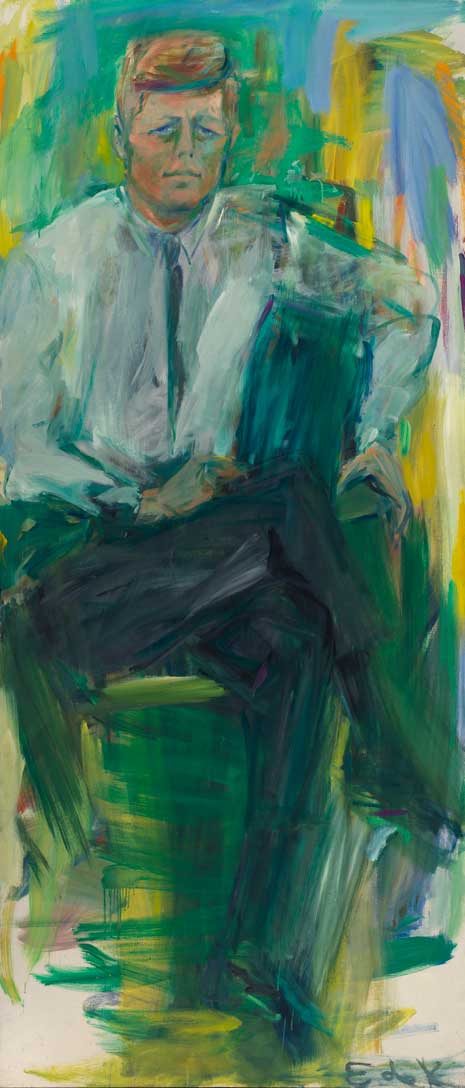
Great Art Cities Explained suggests that the twenty year period in which she and Willem were estranged — they reconciled when she was in her late 50s — was one of personal and artistic growth. She took inspiration from the bullfights she witnessed on her travels, turned a lusty female gaze on male subjects, and was commissioned to paint President Kennedy’s official portrait:
All my sketches from life as he talked on the phone, jotted down notes, read papers, held conferences, had to be made very quickly, catching features and gestures, half for memory, even as I looked, because he never sat still. It was not so much that he seemed restless, rather, he sat like an athlete or college boy, constantly shifting in his chair. At first this impression of youthfulness was a hurdle, as was the fact that he never sat still.
Like Krasner and Elaine de Kooning, Helen Frankenthaler was also part of an Abstract Expressionist golden couple, but fortune decreed she would not play a distant second fiddle to husband Robert Motherwell .
This surely owes something to her pioneering development of the “soak-stain” technique, wherein she poured turpentine-thinned oil paint directly onto unprimed canvas, laid flat.
Soak-stain pre-dated her marriage.

After a visit to Frankenthaler’s studio, where they viewed her landmark Mountains and Sea, above, abstract painters Kenneth Noland and Morris Louis also adopted the technique, as well as her penchant for broad, flat expanses of color — what became known as Color Field Painting.
Like Pollock, Frankenthaler scored a LIFE Magazine spread, though as Art She Says observes, not all LIFE artist profiles were created equal:
The dialogue between these two spreads appears to be a tale of socially-determined masculine energy and feminine composure. Though Pollock’s dominant stance is a key part of his artistic praxis, the issue is not that he is standing while she is sitting. Rather, it is that, with Pollock, we are allowed to glimpse into the intimate sides of his tortured and groundbreaking practice. In stark opposition, Parks’ images of Frankenthaler reinforce our need to see women artists as highly curated, polished figures who are as complete as the masterpieces that they produce. Even if those works appear highly abstracted and visceral, each stroke is perceived, at some level, to represent a calculated, perfected moment of visual enlightenment.
We’re intrigued by Frankenthaler’s 1989 remark to the New York Times:
There are three subjects I don’t like discussing: my former marriage, women artists, and what I think of my contemporaries.
For those who’d like to learn more about these three abstract painters, Payne and Shurvell offer the following book recommendations:
Women of Abstract Expressionism by Irving Sandler
Abstract Expressionism by David Anfam
Three Women Artists: Expanding Abstract Expressionism in the American West by Amy Von Lintel, Bonnie Roos, et al.
Lee Krasner: A Biography by Gail Levin
Fierce Poise: Helen Frankenthaler and 1950s New York by Alexander Nemerov
A Generous Vision: The Creative Life of Elaine de Kooning by Cathy Curtis
Elaine de Kooning: Portraits by Brandon Brame Fortune
Watch a playlist of other Great Art Cities Explained here.
Related Content
The Forgotten Women of Surrealism: A Magical, Short Animated Film
How the CIA Secretly Funded Abstract Expressionism During the Cold War
The Nazi’s Philistine Grudge Against Abstract Art and The “Degenerate Art Exhibition” of 1937
- Ayun Halliday is the Chief Primatologist of the East Village Inky zine and author, most recently, of Creative, Not Famous: The Small Potato Manifesto. Follow her @AyunHalliday.
Read More...What Americans Ate for Dessert 200 Years Ago: Watch Re-Creations of Original Recipes
Many of us avoid turning on the oven during a heatwave, but how do we feel about making cookies in a Dutch Oven heaped with glowing embers?
Justine Dorn, co-creator with other half, Ron Rayfield, of the Early American YouTube channel, strives to recreate 18th and early 19th century desserts in an authentic fashion, and if that means whisking egg whites by hand in a 100 degree room, so be it.
“Maybe hotter,” she wrote in a recent Instagram post, adding:
It’s hard work but still I love what I do. I hope that everyone can experience the feeling of being where you belong and doing what you know you were born to do. Maybe not everyone will understand your reasoning but if you are comfortable and happy doing what you do then continue.
Her historic labors have an epic quality, but the recipes from aged cookbooks are rarely complex.
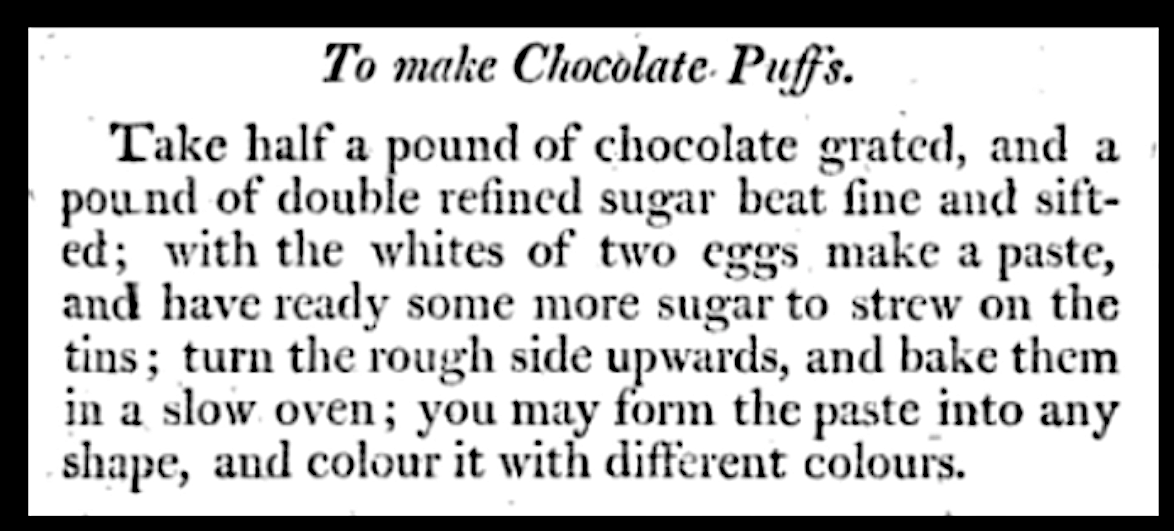
The gluten free chocolate cookies from the 1800 edition of The Complete Confectioner have but three ingredients — grated chocolate, caster sugar, and the aforementioned egg whites — cooked low and slow on parchment, to create a hollow center and crispy, macaron-like exterior.
Unlike many YouTube chefs, Dorn doesn’t translate measurements for a modern audience or keep things moving with busy editing and bright commentary.
Her silent, lightly subtitled approach lays claim to a previously unexplored corner of autonomous sensory meridian response — ASMR Historical Cooking.
The sounds of crackling hearth, eggs being cracked into a bowl, hot embers being scraped up with a metal shovel turn out to be compelling stuff.
So were the cookies, referred to as “Chocolate Puffs” in the original recipe.
Dorn and Rayfield have a secondary channel, Frontier Parrot, on which they grant themselves permission to respond verbally, in 21st century vernacular, albeit while remaining dressed in 1820s Missouri garb.
“I would pay a man $20 to eat this whole plate of cookies because these are the sweetest cookies I’ve ever come across in my life,” Dorn tells Rayfield on the Frontier Parrot Chat and Chew episode, below. “They only have three ingredients, but if you eat more than one you feel like you’re going to go into a coma — a sugar coma!”
He asserts that two’s his limit and also that they “sound like hard glass” when knocked against the table.
Early Americans would have gaped at the indulgence on display above, wherein Dorn whips up not one but three cake recipes in the space of a single episode.
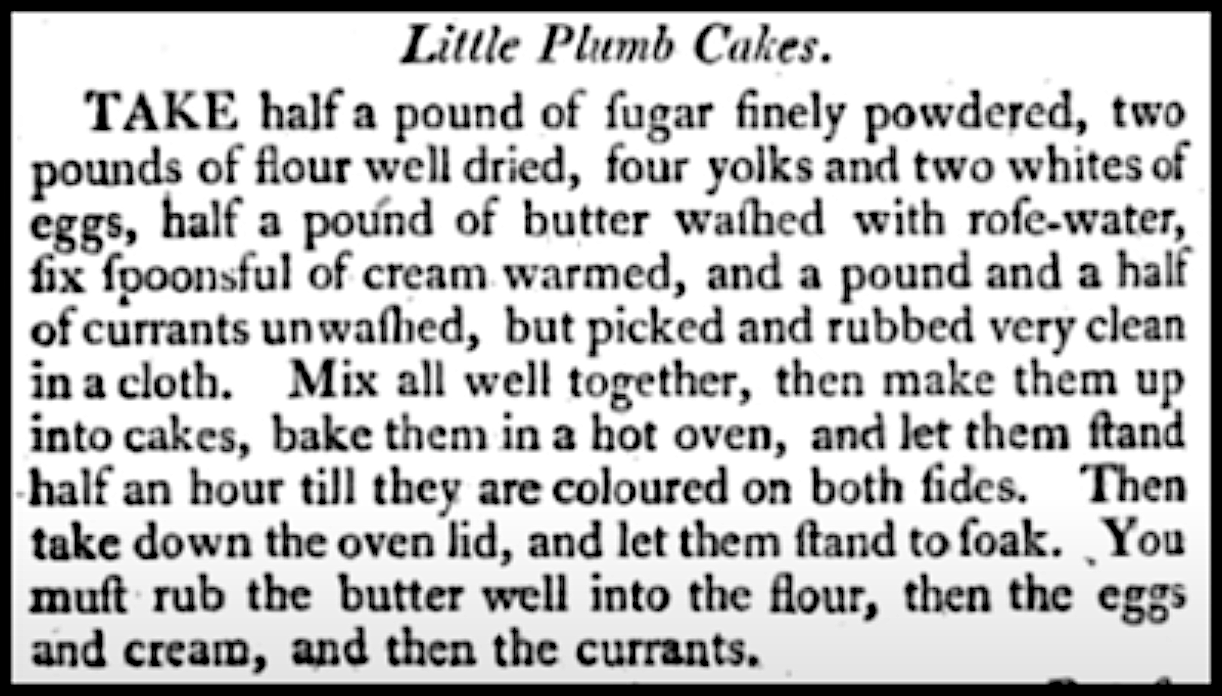
The plum cakes from the Housekeeper’s Instructor (1791) are frosted with an icing that Rayfield identifies on a solo Frontier Parrot as 2 cups of sugar whipped with a single egg white.
“We suffered for this icing,” Dorn revealed in an Instagram post. “SUFFERED. Ya’ll don’t know true pain until you whip icing from hand using only egg whites and sugar.”
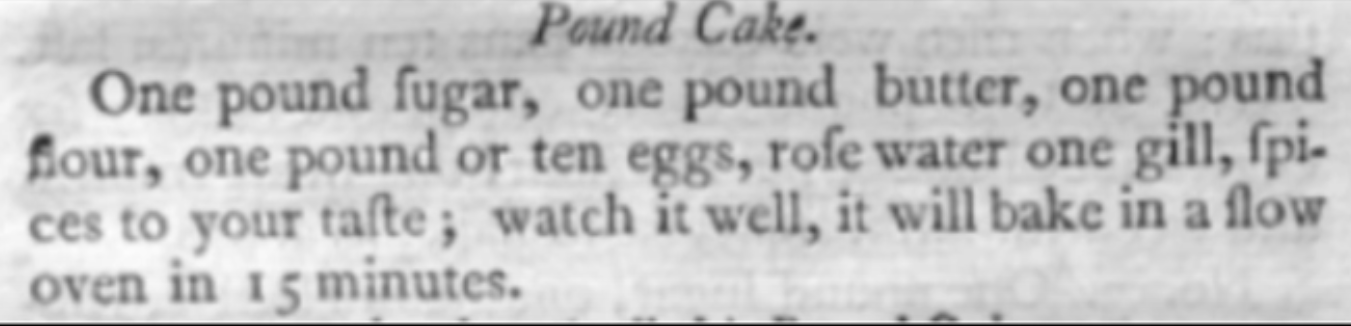
The flat little pound cakes from 1796’s American Cookery call for butter rubbed with rosewater.
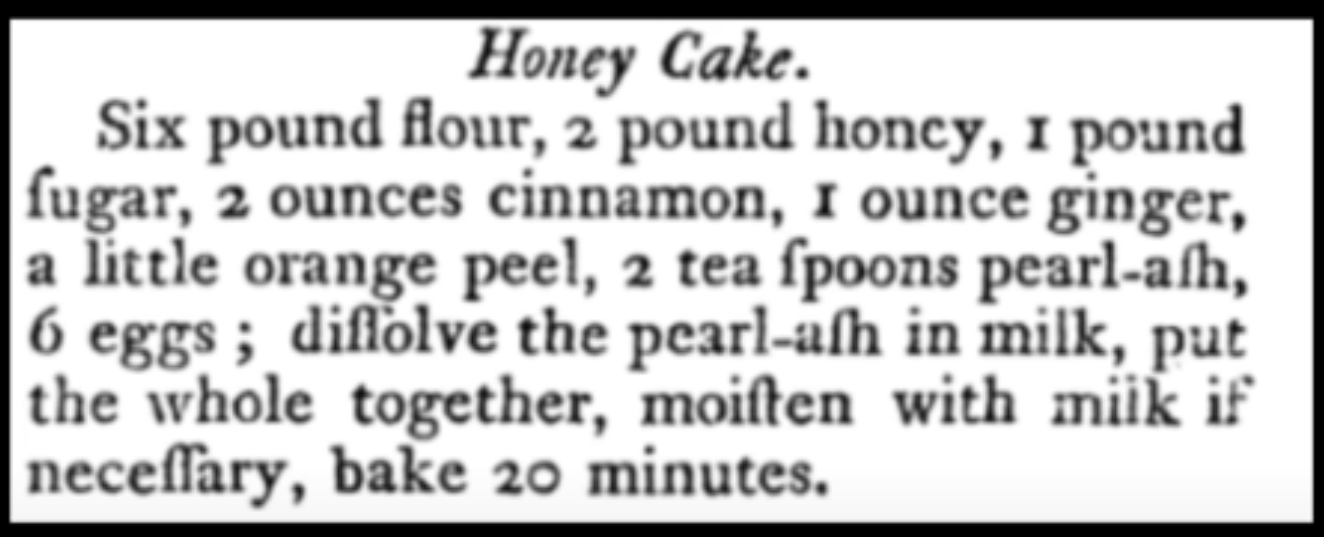
The honey cake from American Domestic Cookery, Formed on Principles of Economy, For the Use of Private Families (1871), gets a lift from pearl ash or “potash”, a German leavening agent that’s been rendered virtually obsolete by baking powder.
Those who insist on keeping their ovens off in summer should take a moment to let the title of the below episode sink in:
Making Ice Cream in the 1820s SUCKS. “
This dish doesn’t call for blood, sweat and tears,” Dorn writes of the pre-Victorian, crank-free experience, “but we’re gonna add some anyway.”
Find a playlist of Dorn’s Early American dessert reconstructions, including an amazing cherry raspberry pie and a cheap seed cake here.
Related Content
Thomas Jefferson’s Handwritten Vanilla Ice Cream Recipe
- Ayun Halliday is the Chief Primatologist of the East Village Inky zine and author, most recently, of Creative, Not Famous: The Small Potato Manifesto. Follow her @AyunHalliday.
Read More...The Last Cigarette Commercial Ever Aired on American TV (1971)
The slogan “You’ve come a long way, baby” still has some pop-cultural currency. But how many Americans under the age of sixty remember what it advertised? The line was first rolled out in 1968 to promote Virginia Slims, the then-new brand of cigarettes marketed explicitly to women. “Every ad in the campaign put a woman front and center, equating smoking Virginia Slims with being independent, stylish, confident and liberated,” says the American Association of Advertising Agencies. “The slogan itself spoke directly about the progress women all over America were fighting for.”
Such was the zeitgeist power of Virginia Slims that they became the very last cigarette brand ever advertised on American TV, at 11:59 p.m on January 2, 1971, during The Tonight Show Starring Johnny Carson. Richard Nixon had signed the Public Health Cigarette Smoking Act, which banned cigarette advertisements on broadcast media, on April 1, 1970. But it didn’t take effect immediately, the tobacco industry having managed to negotiate for itself one last chance to air commercials during the college football games of New Year’s Day 1971.
“The Philip Morris company has bought all commercial time on the first half hour of all the network talk shows tonight,” says ABC’s Harry Reasoner on a newscast from that same day. “That is, the last half hour on which it is legal to sell cigarettes on radio or television in the United States. This marks, as we like to say, the end of an era.” In tribute, ABC put together an assemblage of past cigarette commercials. That some will feel oddly familiar even to those of us who wouldn’t be born for a decade or two speaks to the power of mass media in postwar America. More than half a century later, now that cigarettes are seldom glimpsed even on dramatic television, all this feels almost surrealistically distant in history.
Equally striking, certainly by contrast to the manner of news anchors in the twenty-twenties, is the poetry of Reasoner’s reflection on the just-closed chapter of television history. “It isn’t like saying goodbye to an old friend, I guess, because the doctors have convinced us they aren’t old friends,” he admits. “But we may be pardoned, I think, on dim winter nights in the future, sitting by the fire and nodding and saying, ‘Remember L.S./M.F.T.? Remember Glen Gray playing smoke rings for the Camel caravan? Remember ‘Nature in the raw is seldom mild’? Remember all those girls who who had it all together?’ ”
Related content:
When the Flintstones Peddled Cigarettes
Cigarette Commercials from David Lynch, the Coen Brothers and Jean Luc Godard
Two Short Films on Coffee and Cigarettes from Jim Jarmusch & Paul Thomas Anderson
Glorious Early 20th-Century Japanese Ads for Beer, Smokes & Sake (1902–1954)
How Edward Munch Signaled His Bohemian Rebellion with Cigarettes (1895): A Video Essay
Based in Seoul, Colin Marshall writes and broadcasts on cities, language, and culture. His projects include the Substack newsletter Books on Cities, the book The Stateless City: a Walk through 21st-Century Los Angeles and the video series The City in Cinema. Follow him on Twitter at @colinmarshall, on Facebook, or on Instagram.
Read More...Watch a Complete Mini-Series Adaptation of Leo Tolstoy’s Anna Karenina
Not long after publishing his most beloved novel Anna Karenina, Leo Tolstoy gave away his wealth, renounced his aristocratic privileges, and embraced the life of a peasant. His extreme experiment in Christian anarchism notwithstanding, however, Tolstoy was fascinated by new technology and allowed himself to be photographed and filmed near the end of his life. On one occasion, he supposedly confessed a love of the cinema to his visitors and told them he was thinking of writing “a play for the screen” on a “bloody theme.”
“All the same,” argues Rosamund Bartlett at the OUP blog, Tolstoy “would probably have taken a dim view of the twenty odd screen adaptations of Anna Karenina.” The author died the year before the first filmed adaptation of his work, a silent French/Russian adaptation of Anna Karenina made in 1911. Five more would follow before Greta Garbo stepped into the role for a loose 1927 adaptation titled Love, then again a 1935 film version directed by Clarence Brown, with Fredric March as Vronsky and Garbo as the “most famous and critically-acclaimed of all the Annas Karenina,” Dan Sheehan writes at LitHub.
Garbo’s version is often considered the pinnacle of Tolstoy film adaptations — largely because of Garbo. Or as Graham Greene wrote then, “it is Greta Garbo’s personality which ‘makes’ this film, which fills the mold of the neat respectful adaptation with some kind of sense of the greatness of the novel.” The problem of adaptations — of great novels in general, and of Tolstoy’s in particular — is that they must reduce too much complexity, cut out too many characters and vital subplots, and boil down the wider themes of the book to focus almost solely on the tragic romance at its center.
Maybe this is what Tolstoy meant when he allegedly called the camera (“the little clicking contraption with the revolving handle”) a “direct attack on the old methods of literary art.” Novels were not meant to be films. They’re too loose and expansive. “We shall have to adapt ourselves to the shadowy screen and to the cold machine,” Tolstoy presciently noted, aware that film required an entirely different conception of narrative art. Adaptations of Anna continue to proliferate nonetheless in the 21st century, from Joe Wright’s 2012 adaptation with Kiera Knightley to, most recently, Netflix’s first Russian original drama series with Svetlana Khodchenkova as the title character.
Tolstoy scholars largely echo what I suspect Tolstoy himself might have thought of filmed versions of his novel. As Carol Apollonio put it in a recent online discussion, “If you want Anna Karenina, read it again (and again). If you want something else, then read or watch that, but don’t assume it has a lot to do with Tolstoy.” That said, we bring you yet another adaptation of Anna Karenina, just above, a mini-series from 2013 starring Vittoria Puccini, Santiago Cabrera, Benjamin Sadler, and Max von Thun. Its setting and costuming are period-correct, but does it meet the exacting literary standard of the original? Of course not.
Film versions of novels can’t approximate literature. But a good adaptation of Anna Karenina, whether set in 19th-century Russia, 21st-century Australia, or entirely — as in Joe Wright’s 2012 film — on a stage, can convey “the emotional tragedy of Anna’s story,” Apollonio writes. Adaptations shouldn’t just illustrate their sources faithfully, nor should they take so much license that the source becomes irrelevant. They are always tied in some way to the original, and thus in every cinematic Anna is a little bit of Tolstoy. But you’ll have to read, or reread, the novel to see how much of it the series above captures, and how much it frustratingly leaves out.
Related Content:
Watch an 8‑Part Film Adaptation of Tolstoy’s Anna Karenina Free Online
Watch the Hugely-Ambitious Soviet Film Adaptation of War and Peace Free Online (1966–67)
Josh Jones is a writer and musician based in Durham, NC. Follow him at @jdmagness.
Read More...The Inventive Artwork of Pink Floyd’s Syd Barrett
We’ve had fun at the expense of the multi-hyphenate: i.e. “I’m an actor-slash-drummer-slash-makeup-artist-slash-brand-ambassador,” etc…. And, fair enough. Few people are good enough at their one job to reasonably excel at two or three, right? But then again, we live in the kind of hyperspecialized world Henry Ford could only dream of, and consider ourselves highly favored if we’re allowed to be just the one thing long enough to retire and do nothing.
What if we could have multiple identities without being thought of as unserious, eccentric, or mentally ill?
Discussions of Syd Barrett, Pink Floyd’s founding singer and guitarist, never pass without reference to his mental illness and abrupt disappearance from the stage. But they also rarely engage with Barrett as an artist post-Pink Floyd: namely, his two underrated solo albums; and his output as a painter, the medium in which he began his career and to which he returned for the last thirty years of his life.
If Barrett were allowed a role other than crazy diamond (a role, we must allow, assigned to him by his former bandmates), we might see more of his work in gallery collections and exhibitions. One cannot say this about every famous musician who paints. For Barrett, art was not a hobby, and it called to him before music. It was in his student days at Cambridgeshire College of Arts and Technology that he met David Gilmour. From Cambridge he moved to Camberwell College of Arts in London and began to produce and exhibit mature student work (see here).
Barrett’s work “shows some of the advantages of an art school training,” wrote a reviewer of a 1964 exhibition. “He is already showing himself a sensitive handler of oil paint who wisely limits his palette to gain richness and density.” (Barrett had displayed a prodigious early talent for achieving these qualities in watercolor — see, for example, an impressive, impressionistic still-life of orange dahlias, auctioned off in 2021, made when the artist was only 15.)
His training gave him the confidence to break away from formal exercises during this period and experiment with different styles and subjects, from the disturbing, primitivist Lions to the hollow-eyed, Munch-like Portrait of a Girl. Barrett’s first student period ended in the mid-sixties, as Pink Floyd began to take off and Barrett “turned into a songwriter” (then-manager Andrew King later wrote) “it seemed like overnight.”
After his spell with Pink Floyd and brief solo recording career came to an end, Barrett moved back to Cambridge with his mother in 1978, dropped the nickname “Syd” and began painting again as Roger Barrett, avoiding any mention of life in music. From that year until he died, he worked in several styles and different media, painting striking abstractions and landscapes and even making his own furniture designs.
While he burned many canvases, many from this time survive. See a selected chronology of his work in the video above and in the photos here. Try to put aside the story of Syd Barrett the tragic Pink Floyd frontman, and let the work of Roger Barrett the artist inspire you.
Related Content:
Syd Barrett’s “Effervescing Elephant” Comes to Life in a New Retro-Style Animation
Understanding Pink Floyd’s Wish You Were Here, Their Tribute to Departed Bandmate Syd Barrett
Watch David Gilmour Play the Songs of Syd Barrett, with the Help of David Bowie & Richard Wright
Josh Jones is a writer and musician based in Durham, NC. Follow him at @jdmagness.
Read More...Visit Great Cities in the 1920s in Restored Color Film: New York City, London, Berlin, Paris, Venice & More
Woody Allen’s Midnight in Paris stars Owen Wilson as a Hollywood screenwriter on vacation in the French capital. Alas, the City of Lights as it is in the twenty-first century doesn’t satisfy him. When he walks his streets he thinks only of the nineteen-twenties, when a traveler in Paris could easily cross paths with the likes of Paul Gauguin, Henri Matisse, and Edgar Degas — as well as expatriates from Pablo Picasso and Djuna Barnes to F. Scott Fitzgerald and Ernest Hemingway. Or so he imagines, at any rate, and so he goes on to experience when he finds himself transported back in time to the city of the “Lost Generation” at each stroke of midnight.
With the video above, you, too, can take a trip to nineteen-twenties Paris — as well as nineteen-twenties New York, Chicago, San Francisco, London, Berlin, Stockholm, Copenhagen, Amsterdam, Nice, Geneva, Milan, and Venice. A compilation of period footage sourced from the Prelinger Archives, it lightly colorizes, adds ambient sound, and in other ways enhances its disparate materials to make them feel all of a piece.
And indeed, the clip plays almost as if shot by a single, and singularly ambitious, world traveler of one hundred years ago. That hypothetical traveler’s world is both ours — filled as it is with such recognizable and ever-photographable sites as the Eiffel Tower, the gondolas of Venice, and the non-latex-clad cyclists of Copenhagen — and not.
Whether traditional or modern, the dress of everyone on the street looks neater and more formal than that worn by urbanites in the main today. In some cities, horse-drawn carriages still make their way through the traffic of buses, trams, and waves of seemingly identical personal cars. (Ford manufactured more than two million Model Ts in 1923 alone.) The nineteen-twenties brought rapid urban development in both the New World and the Old, as well as rapid development in motion photography. Not for nothing was it the decade of the “city symphony” film; for equally good reason, it remains the decade of which many of us dream, even a century later, when we want to feel the exhilaration of modernity.
Related content:
Nerves of Steel!: Watch People Climb Tall Buildings During the 1920s.
Great New Archive Lets You Hear the Sounds of New York City During the Roaring Twenties
Footage of Cities Around the World in the 1890s: London, Tokyo, New York, Venice, Moscow & More
Download 6600 Free Films from The Prelinger Archives and Use Them However You Like
Based in Seoul, Colin Marshall writes and broadcasts on cities, language, and culture. His projects include the Substack newsletter Books on Cities, the book The Stateless City: a Walk through 21st-Century Los Angeles and the video series The City in Cinema. Follow him on Twitter at @colinmarshall, on Facebook, or on Instagram.
Read More...Support Us
We're hoping to rely on loyal readers, rather than erratic ads. Please click the Donate button and support Open Culture. You can use Paypal, Venmo, Patreon, even Crypto! We thank you!

About Us

Open Culture scours the web for the best educational media. We find the free courses and audio books you need, the language lessons & educational videos you want, and plenty of enlightenment in between.
Advertise With Us

FREE UPDATES!
GET OUR DAILY EMAIL
Get the best cultural and educational resources on the web curated for you in a daily email. We never spam. Unsubscribe at any time.
FOLLOW ON SOCIAL MEDIA

Open Culture editor Dan Colman scours the web for the best educational media. He finds the free courses and audio books you need, the language lessons & movies you want, and plenty of enlightenment in between.
Advertise With Us

