Behold a Book of Color Shades Depicted with Feathers (Circa 1915)
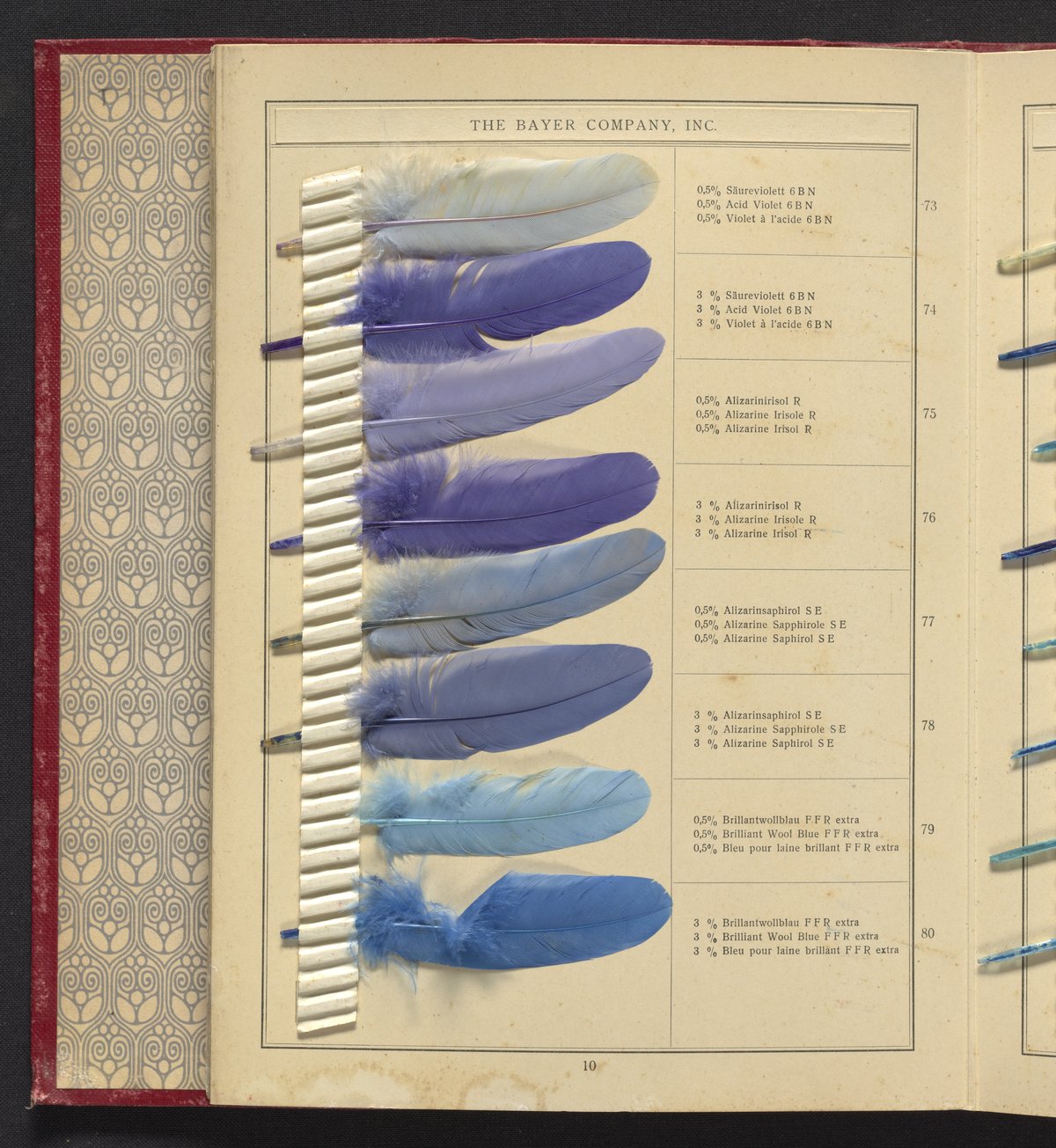
Perhaps the 143 colors showcased in The Bayer Company’s early 20th-century sample book, Shades on Feathers, could be collected in the field, but it would involve a lot of travel and patience, and the stalking of several endangered if not downright extinct avian species.
Far easier, and much less expensive, for milliners, designers and decorators to dye plain white feathers exotic shades, following the instructions in the sample book.
Such artificially obtained rainbows owe a lot to William Henry Perkin, a teenage student of German chemist August Wilhelm von Hofmann, who spent Easter vacation of 1856 experimenting with aniline, an organic base his teacher had earlier discovered in coal tar. Hoping to hit on a synthetic form of quinine, he accidentally hit on a solution that colored silk a lovely purple shade — an inadvertent eureka moment that ranks right up there with penicillin and the pretzel.
A Science Museum Group profile details what happened next:
Perkin named the colour mauve and the dye mauveine. He decided to try to market his discovery instead of returning to college.
On 26 August 1856, the Patent Office granted Perkin a patent for ‘a new colouring matter for dyeing with a lilac or purple colour stuffs of silk, cotton, wool, or other materials’.
Perkin’s next step was to interest cloth dyers and printers in his discovery. He had no experience of the textile trade and little knowledge of large-scale chemical manufacture. He corresponded with Robert and John Pullar in Glasgow, who offered him support. Perkin’s luck changed towards the end of 1857 when the Empress Eugénie, wife of Napoleon III, decided that mauve was the colour to wear. In January 1858, Queen Victoria followed suit, wearing mauve to her daughter’s wedding.
Cue an explosion of dye manufacturers across Great Britain and Europe, including Bayer, producer of the feather sample book. The survival of this artifact is somewhat miraculous given how vulnerable antique feathers are to environmental factors, pests, and improper storage.
(The sample book recommends cleaning the feathers prior to dying in a lukewarm solution of small amounts of olive oil soap and ammonia.)
The Science History Institute, owner of this unusual object, estimates that the undated book was produced between 1913 and 1918, the year the Migratory Bird Act Treaty outlawed the hunting of birds whose feathers humans deemed particularly fashionable.
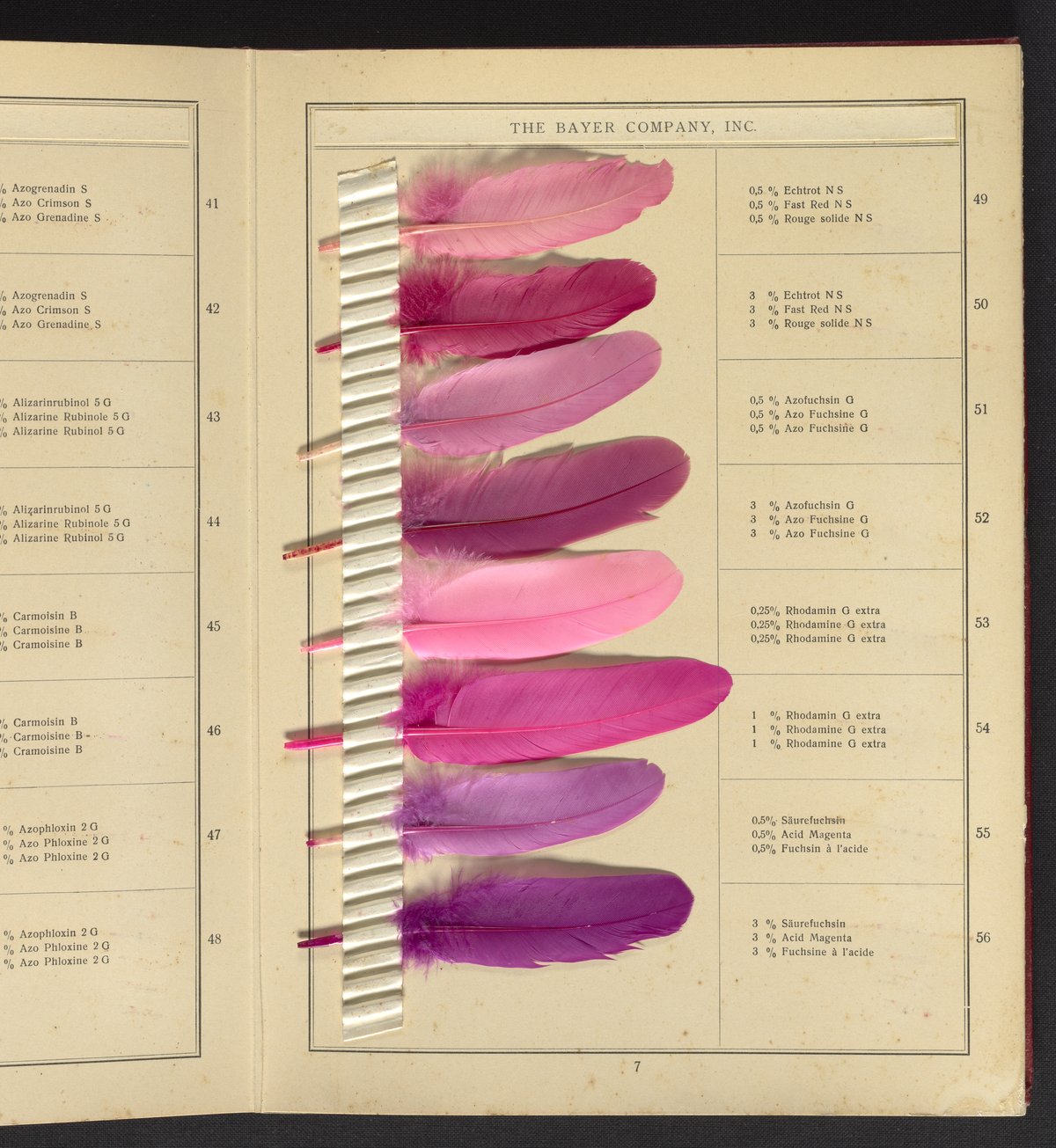
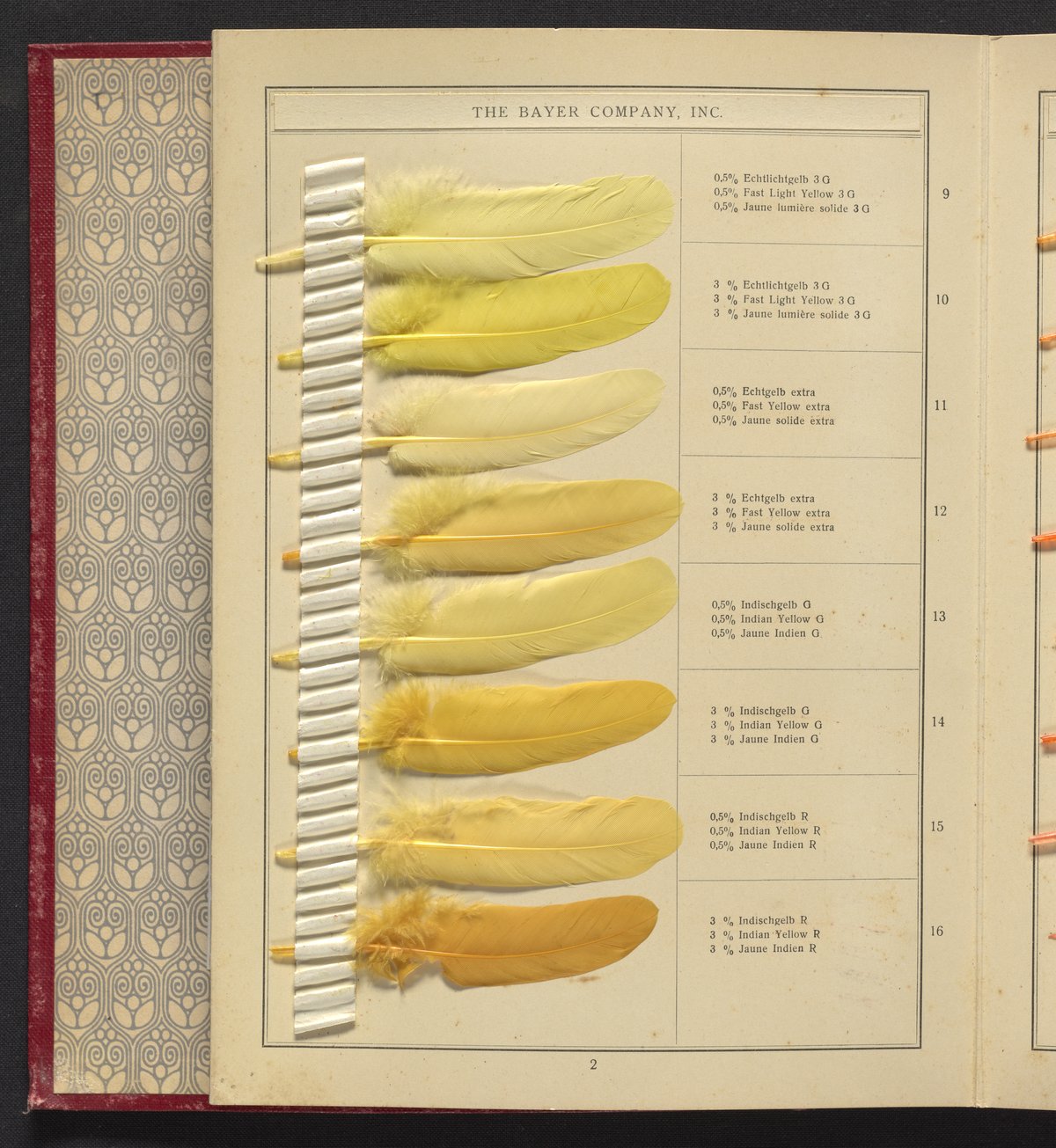
Peruse the Science History Institute of Philadelphia’s digitized copy of the Shades on Feathers sample book here.
Related Content
Download 435 High Resolution Images from John J. Audubon’s The Birds of America
The Bird Library: A Library Built Especially for Our Fine Feathered Friends
- Ayun Halliday is the Chief Primatologist of the East Village Inky zine and author, most recently, of Creative, Not Famous: The Small Potato Manifesto. Follow her @AyunHalliday.
Read More...Never-Seen Vincent Van Gogh Self-Portrait Discovered Behind an Earlier Painting
The name of Vincent Van Gogh is one of the very best known in the history of painting, and indeed the history of art. But that doesn’t mean the man himself enjoyed any success in his short lifetime. Though he was convinced that he was creating “the art of the future,” and seemingly right to believe it, the buyers of nineteenth-century European art didn’t see it quite that way. Consequently impoverished, Van Gogh had to resort to unconventional strategies to maintain his artistic productivity. Instead of professional models, for example, he hired peasants and people from the streets. And when he couldn’t paint them, he painted himself.
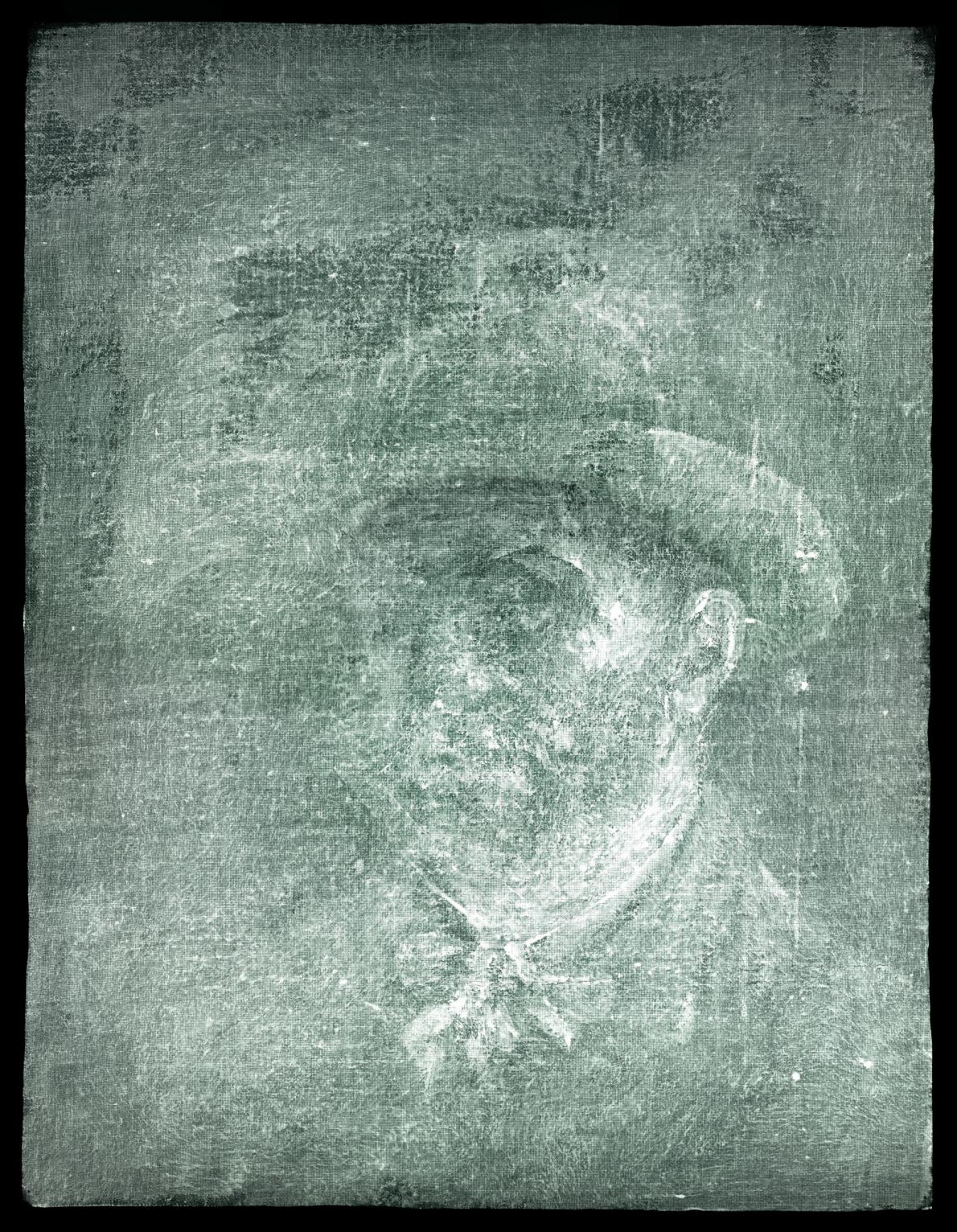
Van Gogh would also economize by re-using his canvases, a practice not unknown in his day. “However, instead of painting over earlier works,” writes Jordan Ogg at National Galleries Scotland, “he would turn the canvas around and work on the reverse.”
It seems he did this with the National Galleries Scotland’s own Head of a Peasant Woman, whose back side turns out to bear a hitherto unknown self-portrait hidden by “layers of glue and cardboard” for well over a century. X‑ray analysis has revealed “a bearded sitter in a brimmed hat with a neckerchief loosely tied at the throat. He fixes the viewer with an intense stare, the right side of his face in shadow and his left ear clearly visible.”
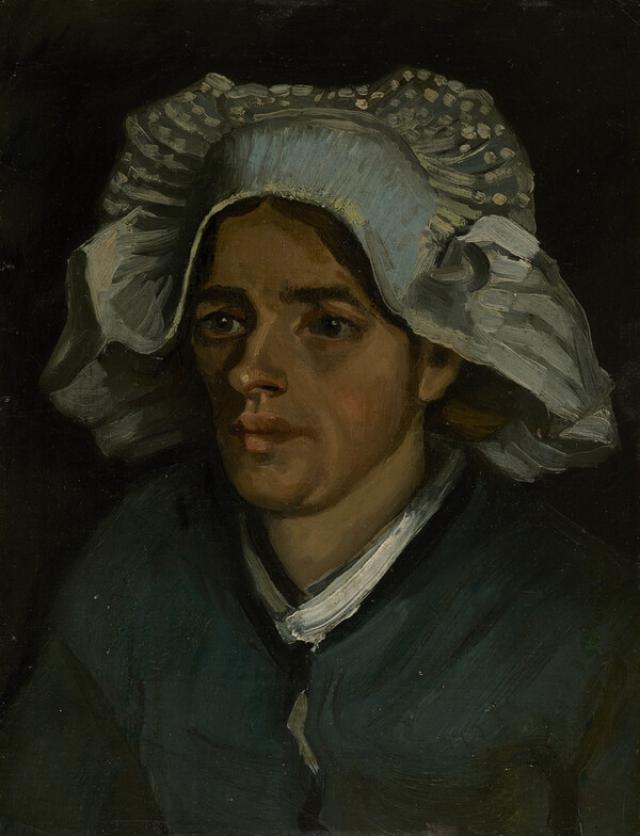
Even in its ghostly lack of detail, this face seems to be unmistakable. If it belongs to who we think it does, it will become the 36th known Van Gogh self-portrait. It would have been painted before 1884’s Head of a Peasant Woman, “during a key moment in Van Gogh’s career, when he was exposed to the work of the French impressionists after moving to Paris.” You can learn about the ongoing process of this lost self-portrait’s rediscovery in the video at the top of the post. Van Gogh expressed conviction that he was painting for later generations, but surely even he would be astounded at the excitement of twenty-first century curators about finding another of his self portraits — and one he saw fit to give the cardboard treatment at that.
Related content:
Vincent Van Gogh’s Self Portraits: Explore & Download a Collection of 17 Paintings Free Online
Behold the Newly Discovered Sketch by Vincent van Gogh Sketch, “Study for Worn Out” (1882)
Watch as Van Gogh’s Famous Self-Portrait Morphs Into a Photograph
Discovered: The Only Known Picture of Vincent Van Gogh as an Adult Artist? (Maybe, Maybe Not)
AI & X‑Rays Recover Lost Artworks Underneath Paintings by Picasso & Modigliani
A Restored Vermeer Painting Reveals a Portrait of a Cupid Hidden for Over 350 Years
Based in Seoul, Colin Marshall writes and broadcasts on cities, language, and culture. His projects include the Substack newsletter Books on Cities, the book The Stateless City: a Walk through 21st-Century Los Angeles and the video series The City in Cinema. Follow him on Twitter at @colinmarshall, on Facebook, or on Instagram.
Read More...The German Cast of Hamilton Sings the Title Track, “Alexander Hamilton” in German
Lin-Manuel Miranda’s Hamilton is coming to Hamburg in October 2022. And this video gives audiences a taste of what awaits them: The title track “Alexander Hamilton” sung in German. Enjoy…
If you would like to support the mission of Open Culture, consider making a donation to our site. It’s hard to rely 100% on ads, and your contributions will help us continue providing the best free cultural and educational materials to learners everywhere. You can contribute through PayPal, Patreon, and Venmo (@openculture). Thanks!
via Metafilter
Related Content
“Alexander Hamilton” Performed with American Sign Language
Lin-Manuel Miranda Breaks Down How He Wrote Hamilton‘s Big Hit, “My Shot”
A Whiskey-Fueled Lin-Manuel Miranda Reimagines Hamilton as a Girl on Drunk History
Read More...What Americans Ate for Breakfast & Dinner 200 Years Ago: Watch Re-Creations of Original Recipes
For all the other faults of the 2020s, most of humanity now enjoys culinary variety the likes of which it has never before known. Two centuries ago, the selection was considerably narrower. Back then the United States of America, yet to become the highly developed leader of “the free world,” remained for the most part a fairly hardscrabble land. This comes through in a book like Democracy in America, which Alexis de Tocqueville wrote after traveling across the county in the 1830s — or on a Youtube channel like Early American, which re-creates life as lived by Americans of decades before then.
Not long ago, Early American’s viewership exploded. This seems to have owed to cooking videos like the one at the top of the post, “A Regular Folks’ Supper 200 Years Ago.” The menu, on this imagined March day in 1820 Missouri, includes beef, mashed turnips, carrots, rolls, and boiled eggs: not a bad-looking spread, as it turns out, though its flavors may leave something to be desired for the twenty-first-century palate.
Many of Early American’s new commenters, writes channel co-creator Justine Dorn, are telling her “to add this seasoning and this and that,” but “then it would no longer be loyal to the actual original recipe, which is why you all are here to begin with.”
In the case of the regular folks’ supper, its recipes come straight from an 1803 volume called The Frugal Housewife. As for the johnnycakes featured in “Making a Working Class Breakfast in 1820,” you’ll find their recipe in Amelia Simmons’ American Cookery from 1796, the first known cookbook written by an American. The meal also includes a yeastless bread for which no proper recipe exists. However, Dorn writes, “there are several mentions of working class people who baked bread without yeast in the autobiographies of travelers in the eighteenth and early nineteenth centuries. Because of this we know that it was a common practice.”
Made from a modified family recipe passed down since the 1750s, this yeastless bread looks appealing enough, especially toasted over the fire and served with apple butter. But we must acknowledge that tastes have changed over the centuries. “I am not claiming that this food is good,” Dorn writes. “Sometimes it isn’t. A lot of the foods and seasonings that we take for granted today were very hard to get back then or were only seasonally available.” But with seasonal, “locally sourced” ingredients in vogue these days, it’s worth examining what, 200 years ago, really went into a simple Indian meal pudding or an early macaroni and cheese — albeit one prepared, in true 2020s fashion, ASMR-style.
Related Content:
The First American Cookbook: Sample Recipes from American Cookery (1796)
An Archive of 3,000 Vintage Cookbooks Lets You Travel Back Through Culinary Time
A Database of 5,000 Historical Cookbooks–Covering 1,000 Years of Food History–Is Now Online
Archive of Handwritten Recipes (1600 – 1960) Will Teach You How to Stew a Calf’s Head and More
Real Interviews with People Who Lived in the 1800s
Based in Seoul, Colin Marshall writes and broadcasts on cities, language, and culture. His projects include the Substack newsletter Books on Cities, the book The Stateless City: a Walk through 21st-Century Los Angeles and the video series The City in Cinema. Follow him on Twitter at @colinmarshall, on Facebook, or on Instagram.
Read More...Watch the Titanic Sink in Real-Time
Minute by minute timelines have become a staple of disaster reporting.
Knowing how the story ends puts the public in the position of helpless bystander, especially at those critical junctures when someone in a position of authority exercised poor judgment, resulting in a larger loss of life.
Youtuber Phillip W, creator of Titanic Animations, allows us to experience the famed luxury liner’s final two and half hours as a timestamped horror show, above, without resorting to theatrics, or a crowd pleasing fictional romance.
Verified crew orders, CQD reports, and vacant lifeboat seats provide ample drama alongside mesmerizing CGI recreations of the doomed luxury liner, its lighted portholes reflected in the dark water.
It took around 2 and a half hours for the Titanic to sink, just four days into her maiden voyage, after striking an iceberg around 11:40 pm.
As the Smithsonian National Museum of American History recounts:
The berg scraped along the starboard or right side of the hull below the waterline, slicing open the hull between five of the adjacent watertight compartments. If only one or two of the compartments had been opened, Titanic might have stayed afloat, but when so many were sliced open, the watertight integrity of the entire forward section of the hull was fatally breached.
Titanic Animations tracks myriad crew members from this moment on, using factual titles, lightly supplemented with sound effects of ocean noises, alarm bells, and period tunes that would’ve been in the repertoire of the band that famously did (or didn’t) play on. The head baker directs staff to carry armloads of bread to provision the lifeboats. These morsels of information and the relatively placid views affords our imagination free rein to fill in the confusion, panic and mounting desperation of those aboard.
This real time sinking animation is rendered without human figures, but Titanic Animation’s Twitter indicates that Phillip W has been hard at work on a new project that places crew and passengers on deck, a — forgive us — titanic undertaking that also finds him striving to recreate every rivet and ripple. A status update from earlier this spring reads, “2.5 months in. 52,035 frames completed.178,364 left to go.”
The original animation, above, took multiple years to complete:
A friend and I started working on the first version back in 2012/2013 and it was released in 2015. It’s been updated over the years, and now I’m the only one left after my friend departed after losing interest. So around 8–9 years, give or take, and about $8000 in research and renderfarms to complete.
If you’re inclined to mess around with your own Titanic animations, Philip W. has shared a Cinematic Filming Model of the Titanic’s exterior, featuring accurate porthole placements, telegraphs, funnels, rigging, ventilation equipment placements, lifeboats, and approximately 95,000 rivets.
Subscribe to Titanic Animations here. Those with an interest in 3D animation will appreciate archived livestreams that give a peek at the process.
Navigate to key moments in real time sinking animation using the links below.
00:00:00 — Intro
00:05:00 — Iceberg Collision
00:10:00 — 10 Degree List to Starboard
00:11:00 — Steam begins to escape the Funnels
00:15:45 — Mail Room begins to flood
00:25:00 — Midnight
00:30:00 — Squash Court begins to flood
00:37:15 — Lifeboats ordered to be readied
00:42:00 — Band Begins Playing
00:49:40 — Thomas Andrews relays news to Capt. Smith
00:51:40 — First Distress Call is Sent
01:01:18 — Distress Coordinates are Corrected
01:01:38 — Carpathia Makes Contact
01:04:00 — Boat 7 (First Boat) is Launched
01:06:00 — The Straus’ Refuse Entry to Boat 8
01:07:00 — Grand Staircase F‑Deck Begins Flooding
01:08:10 — Boat 5 is Launched
01:10:00 — Boxhall & Smith spot Carpathia
01:12:10 — 1st Distress Rocket Fired
01:15:00 — Grand Staircase E‑Deck Begins Flooding
01:20:00 — Boat 3 is Launched
01:21:00 — Titanic Begins Sending SOS
01:25:00 — 1AM Boat 8 is Launched
01:30:00 — Boat 1 is Launched
01:35:00 — Boat 6 is Launched
01:35:15 — Boiler Room 5 Floods
01:40:00 — Water Climbs Grand Staircase
01:44:30 — Boiler Room 4 is Abandoned
01:45:00 — Boat 16 is Launched
01:50:00 — Boat 14 is Launched
01:55:15 — Boats 9 and 12 are Launched
02:00:00 — Boat 11 is Launched
02:04:00 — Titanic lists to Port
02:05:00 — Boat 13 is Launched
02:06:00 — Boat 15 is Launched
02:09:00 — D‑deck Reception Room Floods
02:10:00 — Boat 2 is Launched
02:12:00 — Well Deck is Awash
02:14:00 — D‑Deck Reception Room Goes
02:15:00 — Boat 10 is Launched
02:15:10 — Boat 4 is Launched
02:25:00 — 2AM Boat C is Launched
02:26:10 - Power Begins to Fade
02:29:00 — Boat D is Launched
02:37:15 — Nearer My God to Thee
02:40:00 — Final Plunge
02:42:00 — Breakup
Related Content
Titanic Survivor Interviews: What It Was Like to Flee the Sinking Luxury Liner
The Titanic: Rare Footage of the Ship Before Disaster Strikes (1911–1912)
How the Titanic Sank: James Cameron’s New CGI Animation
- Ayun Halliday is the Chief Primatologist of the East Village Inky zine and author, most recently, of Creative, Not Famous: The Small Potato Manifesto. Follow her @AyunHalliday.
Read More...Watch an 8‑Part Film Adaptation of Tolstoy’s Anna Karenina Free Online
Earlier this week we featured Sergei Bondarchuk’s four-part film adaptation of Leo Tolstoy’s War and Peace. You can watch that most ambitious of all filmed versions of War and Peace free online on the Youtube channel of Mosfilm, the Soviet Union’s national studio. Though the U.S.S.R. may have gone, Mosfilm hasn’t. Under the direction of filmmaker Karen Shakhnazarov, the studio has soldiered on as a quasi-private production company and put out a variety of films, many of them rooted in Russian history and literature. Five years ago, Shakhnazarov himself directed an eight-part adaptation of another beloved Tolstoy novel, Anna Karenina.
War and Peace (watch here) has been made into four different films. But that’s nothing beside the at least seventeen Anna Karenina movies in existence, not counting Shakhnazarov’s. It was first released in a relatively short cut, its runtime truncated to a bit over two and a half hours, as Anna Karenina: Vronsky’s Story.
That version’s narrative focused, as you may have guessed, on the life of Anna’s irresistible aristocratic lover. Later, Russia‑1 television broadcast Shakhnazarov’s work in full as an eight-episode series simply titled Anna Karenina, which you can now watch free online, in full, at Mosfilm’s Youtube channel. Stream all parts above.
In a sense, this serial format is well suited to Tolstoy’s novel, originally published as it was in installments between 1875 and 1877. But even those who’ve read Anna Karenina’s thousand pages over and over again will have reasons to be surprised by Shakhnazarov’s version, which takes the story of family, class, infidelity, faith, and feudalism in directions of its own. It also incorporates material from outside Tolstoy’s oeuvre, such as “During the Japanese War” and “Stories About the Japanese War” by Vikenty Veresaev, a doctor, writer, and Tolstoy scholar who participated in the Russo-Japanese War of 1904. Like any “free adaptation,” Shakhnazarov’s version of Anna Karenina, will send its viewers back to the book — and ensure that they never read it quite the same way again.
Related content:
Watch the Hugely Ambitious Soviet Film Adaptation of War and Peace Free Online (1966–67)
The Art of Leo Tolstoy: See His Drawings in the War & Peace Manuscript & Other Literary Texts
Free Online: Watch Stalker, Mirror, and Other Masterworks by Soviet Auteur Andrei Tarkovsky
Based in Seoul, Colin Marshall writes and broadcasts on cities, language, and culture. His projects include the Substack newsletter Books on Cities, the book The Stateless City: a Walk through 21st-Century Los Angeles and the video series The City in Cinema. Follow him on Twitter at @colinmarshall, on Facebook, or on Instagram.
Read More...The Earliest Known Footage of New Orleans Discovered: See a Mardi Gras Parade in 1898
“America has only three great cities: New York, San Francisco, and New Orleans. Everywhere else is Cleveland.” This quotation has been repeated for decades — not least, unsurprisingly, in New Orleans. I saw and heard it often on my last trip there, and though attributions varied, most credited the remark to either Mark Twain or Tennessee Williams. According to Quote Investigator, no historical evidence points to either man as the line’s originator, though “the notion that only three cities in the U.S. were commendable or distinctive has a very long history.”
In 1895, for instance, the then-popular comedienne Vernona Jarbeau said that “there are only three cities in the United States that I would care to live in, and one of them is San Francisco.” But she said it, one should note, to a San Francisco newspaper; who’s to say the crowd-pleasing instinct wouldn’t have motivated a transposition of her preference elsewhere in America? New Orleans, then in existence for more than half a century, possessed an even longer-established distinctiveness. The embellished galleries of the French Colonial buildings in the 1898 film clip above, identify the city at a glance.
Even more New Orleanian, of course, is what’s going on in the street: the city’s signature festivity, the Mardi Gras parade. “The film is not only the oldest moving picture of a New Orleans Mardi Gras; it’s the oldest film of New Orleans,” writes Smithsonian.com’s Jane Recker. Recently rediscovered in Amsterdam’s Eye Filmmuseum, the two-minute clip shows us — on detail-absorbing 68-millimeter film — that “one float is pineapple-themed, with riders wearing hats shaped like pieces of pineapple and vests resembling pineapple skin. Another features the Rex, the ‘King of the Carnival,’ sitting atop a float decorated with tasseled globes.”
“Contemporary viewers will surely recognize the film’s parade as a Mardi Gras celebration, though the event features some distinct differences from the one that takes over the Big Easy’s streets today,” writes Artnet’s Sarah Cascone. “There are, for example, no beads, no barricades, no police. Onlookers don suits and top hats and parasols, a far more formal approach than that taken by 21st-century revelers.” Here in the 2020s their revelry has been interrupted by the COVID-19 pandemic, and only this year did New Orleans’ Mardi Gras parade tradition resume. Perhaps it’s too much to hope that the dress sense of spectators 124 years ago will make a comeback as well.
Related content:
Louis Armstrong Remembers How He Survived the 1918 Flu Epidemic in New Orleans
The Serial Killer Who Loved Jazz: The Infamous Story of the Axeman of New Orleans (1919)
Based in Seoul, Colin Marshall writes and broadcasts on cities, language, and culture. His projects include the Substack newsletter Books on Cities, the book The Stateless City: a Walk through 21st-Century Los Angeles and the video series The City in Cinema. Follow him on Twitter at @colinmarshall, on Facebook, or on Instagram.
Read More...The Timeline of World War II (Month by Month) Told With Scenes Made from Dozens of WWII Movies
We all learned a bit about the Second World War in school, or perhaps more than a bit. But for a great many of us, what we know of that period of history comes less from teachers and textbooks than it does from movies. World War II as a cinematic genre has existed since the early years of World War II itself, and at this point it has produced so many films that not even the most avid historically-minded cinephile could watch them all. Many such pictures, of course, take enormous liberties with their source material. But if you concentrate on just the most accurate parts of the most acclaimed movies about World War II, you can piece together a reasonably truthful portrayal of its events.
Such is the premise, at any rate, of the video above, “Timeline of WW2 in Films.” Created by Youtuber Salokin, it arranges clips from dozens of films released over the past half-century — Patton, Tora! Tora! Tora!, Battle of Britain, Dunkirk — in historical order.
Opening with footage from Roman Polanski’s The Pianist referring to the invasion of Poland in September 1939, it goes on to cover that year by drawing from the depiction of Soviet-Japanese border conflicts like the Battles of Khalkhin Go and Nomonhan in Kang Je-gyu’s My Way, then from the depiction of the titular fights on the Karelian Isthmus in Pekka Parikka’s The Winter War.
As Korean and Finnish productions, respectively, My Way and The Winter War offer perspectives on World War II different from the American one taken by Hollywood movies — Hollywood having once been the only motion-picture industry with the resources to re-create the war in a convincing manner. But the development of global film production in recent decades has also given rise to widely seen World War II movies from countries like Australia, Germany, Denmark, and Russia, to name a few countries whose films appear in this video. Not all of them agree perfectly with history as taught in the United States, but then, American World War II movie enthusiasts have unresolvable conflicts of their own: do you prefer Saving Private Ryan, for instance, or The Thin Red Line?
Related content:
Innovative Film Visualizes the Destruction of World War II: Now Available in 7 Languages
Watch World War II Rage Across Europe in a 7 Minute Time-Lapse Film: Every Day From 1939 to 1945
Quentin Tarantino’s World War II Reading List
Based in Seoul, Colin Marshall writes and broadcasts on cities, language, and culture. His projects include the Substack newsletter Books on Cities, the book The Stateless City: a Walk through 21st-Century Los Angeles and the video series The City in Cinema. Follow him on Twitter at @colinmarshall, on Facebook, or on Instagram.
Read More...Sir Ben Kingsley Reads a Letter Written by Gandhi to Hitler (in the Voice of Mahatma Gandhi)
Several years before Indian independence as World War loomed, Mahatma Gandhi found he had little sway in international politics even as he built his movement at home. The philosophy of satyagraha did not sound noble to the British in 1939, for example, when the Indian leader wrote a letter exhorting them to let the Germans take their country, their homes, and even their lives rather than fight back. That same year, he wrote to Hitler, addressing him as “Dear Friend” and writing, “It is quite clear that you are today the one person in the world who can prevent a war which may reduce humanity to a savage state.”
Gandhi’s first 1939 letter to Hitler implies that the Führer was the only world leader who wanted such a war. The Indian leader fully understood the stakes. “My sympathies are all with the Jews,” he’d written in a 1938 article. “If there ever could be a justifiable war, in the name of and for humanity, war against Germany to prevent the wanton persecution of a whole race would be completely justified.” Still, he concluded, “I do not believe in any war.” He stuck to his principles even after Germany’s invasion of Poland in 1939.
“Not deterred by the outbreak of war,” Alexander LaCasse writes at the Christian Science Monitor, “Gandhi wrote to Hitler a second time.” Just above, you can see Sir Ben Kingsley read that letter, in character as Gandhi and perhaps sounding much like Gandhi did when reading his letters aloud. Gandhi “took correspondence very seriously,” Nick Owen writes, and he “wrote — and was written to by — almost anyone.” In this much longer letter from 1940, Gandhi extols the practical virtues of non-violence and attempts some moral reasoning:
If not the British, some other power will certainly improve upon your method and beat you with your own weapon. You are leaving no legacy to your people of which they would feel proud. They cannot take pride in a recital of a cruel deed, however skillfully planned. I, therefore, appeal to you in the name of humanity to stop the war.
“There is no evidence to suggest Hitler ever responded to,” or even read, “either of Gandhi’s letters,” writes LaCasse. And maybe little evidence that Gandhi expected a response. “I am aware that your view of life regards such spoliations as virtuous acts,” he writes. “But we have been taught from childhood to regard them as acts degrading humanity.” He continues to profess Hitler a friend, writing “I own no foes. My business in life has been for the past 33 years to enlist the friendship of the whole of humanity.”
Before his death in 1948, Gandhi called the Holocaust “the greatest crime of our time.” According to a biographer, he also added, “the Jews should have offered themselves to the butcher’s knife. They should have thrown themselves into the sea from cliffs. It would have aroused the world and the people of Germany.” Had he suggested this in a letter to Europe’s Jews, it is unlikely they would have been persuaded.
Related Content:
When Mahatma Gandhi Met Charlie Chaplin (1931)
Mahatma Gandhi’s List of the 7 Social Sins; or Tips on How to Avoid Living the Bad Life
Josh Jones is a writer and musician based in Durham, NC. Follow him at @jdmagness
Read More...How to Get into a Creative “Flow State”: A Short Masterclass
Is “flow state” the new mindfulness? The phrase has gained a lot of currency lately. You may have heard it spoken of in rarified terms that sound like you have to be a full-time artist, professional athlete, or Albert Einstein to access it. On the other hand, we have award-winning journalist, human performance expert, and Flow Research Collective founder Steven Kotler explaining in a video that we featured recently how to achieve a flow state on command. So, does flow require a little or a lot of us? It requires, first and foremost, a shift in consciousness.
In the field of positive psychology, flow is most associated with theorist Mihaly Csikszentmihalyi, whose Creativity: Flow the Psychology of Discovery and Invention provided key contemporary insights into the idea. For Csikszentmihalyi, directing our activity toward material notions of security sets us up for disappointment. Flow states are best understood as actualized creativity we can manifest in almost any conditions: we can be “happy, or miserable, regardless of what is actually happening ‘outside,’ just by changing the contents of consciousness,” he said.
For Taoists, flow means according with the nature of things as they are, which takes a lot of keeping still and letting be. Goethe used the phrase “effortless effort” to describe creative flow. Kotler’s definition is a bit more operational: Flow, he says in his Mindvalley talk above, is an “optimalized state of consciousness where we feel our best and we perform our best.” One thing all notions of flow seem to share is a belief in the importance of what Kotler calls “non-time,” or what the Taoist calls “the doing of non-doing,” a pleasurable resting state without distraction. (Kotler takes his “non-time” between 4 and 7:30 in the morning.)
Kotler himself arrived at the flow state “through an unusual door” — which he illustrates in his talk with an MRI of a skull in profile and list titled “The Cost of Doing Business.” For an ambitious freelance journalist, that meant “2 fractured kneecaps, 2 shattered arms, 1 snapped wrist, 2 mangled ankles,” and the list goes on (including 5 concussions): a description of injuries incurred while following extreme athletes around the world. What he saw, he says, were people who had everything going against them — little education, little natural ability, and histories of “destroyed homes.”
The athletes he followed were traumatized people who would not necessarily be candidates for world-changing innovation. Yet here they were, “extending the limits of kinesthetic possibility” — doing the previously impossible by achieving flow states. Kotler’s descriptions of flow are often very Yang, we might say, focusing on “peak performance” and favoring sports examples. But his claims for flow also sound like deeply healing medicine. He talks about “triggering” flow states to “overcome PTSD, addiction, and heartbreak.” Like Csikszentmihalyi, he saw firsthand how flow states can heal trauma.
We can achieve this “altered state of consciousness” by surfing or skydiving. We can also achieve it while solving equations, translating foreign languages, or knitting scarves. As Csikszentmihalyi points out, it is not the content of an experience — or the expense in airline tickets and broken bones — that matters so much as our state of absorption in activities we love and practice regularly, which take us away from thoughts about our ever-present problems and open up the space for possibility.
Related Content:
How to Enter a ‘Flow State’ on Command: Peak Performance Mind Hack Explained in 7 Minutes
Josh Jones is a writer and musician based in Durham, NC. Follow him at @jdmagness
Read More...Support Us
We're hoping to rely on loyal readers, rather than erratic ads. Please click the Donate button and support Open Culture. You can use Paypal, Venmo, Patreon, even Crypto! We thank you!

About Us

Open Culture scours the web for the best educational media. We find the free courses and audio books you need, the language lessons & educational videos you want, and plenty of enlightenment in between.
Advertise With Us

FREE UPDATES!
GET OUR DAILY EMAIL
Get the best cultural and educational resources on the web curated for you in a daily email. We never spam. Unsubscribe at any time.
FOLLOW ON SOCIAL MEDIA

Open Culture editor Dan Colman scours the web for the best educational media. He finds the free courses and audio books you need, the language lessons & movies you want, and plenty of enlightenment in between.
Advertise With Us

