Color Footage of the Liberation of Paris, Shot by Hollywood Director George Stevens (1944)
The above footage of Paris’ liberation in August 1944 looks and feels not dissimilar to a Hollywood movie. Part of its power owes to its being in color, a vanishingly rare quality in real film of World War II. But we must also credit its having been shot by a genuine Hollywood filmmaker, George Stevens. Having got his start in pictures as a teenager in the early nineteen-twenties (not long before making the cinematic-historical accomplishment of figuring out how to get Stan Laurel’s light-colored eyes to show up on film), Stevens became a respected director in the following decade. Swing Time, Gunga Din, The More the Merrier: with hits like that, he would seem to have had it made.
But it was just then, as F. X. Feeney tells it in the DGA Quarterly, that the war became unignorable. “The dangerous artistry of Leni Riefenstahl’s 1935 valentine to Adolf Hitler, Triumph of the Will, moved Stevens to volunteer for frontline service in World War II despite his being old enough to dodge a uniform and sit things out.”
In vivid color, Stevens and his U.S. Army Signal Corps crew shot “the D‑Day landings, where he was one of the first ashore; the liberation of Paris; the snowy ruins of bombed-out villages en route to the Battle of the Bulge; and, most unforgettably, the liberation of the death camp at Dachau.” (Even the celebratory events in Paris had their harrowing moments, such as the sniper attack captured at 11:54.)
Stevens went to war a filmmaker and came home a filmmaker. The long postwar act of his career opened with no less acclaimed a picture than I Remember Mama, and went on to include the likes of A Place in the Sun, Shane, and The Diary of Anne Frank, whose material no doubt resonated even more with Stevens given what he’d seen in Europe. Not all of it, of course, was the aftermath of death and destruction. These Paris liberation clips alone offer glimpses of such admirable figures as resistance fighter Simone Segouin, Generals de Gaulle and Leclerc, and even Lieutenant Colonel Stevens himself. He appears presiding over the shoot just as he must once have done back in California — and, with the war’s end in sight, as he must have known he would do again.
Related content:
How France Hid the Mona Lisa & Other Louvre Masterpieces During World War II
See Berlin Before and After World War II in Startling Color Video
31 Rolls of Film Taken by a World War II Soldier Get Discovered & Developed Before Your Eyes
Based in Seoul, Colin Marshall writes and broadcasts on cities, language, and culture. His projects include the Substack newsletter Books on Cities, the book The Stateless City: a Walk through 21st-Century Los Angeles and the video series The City in Cinema. Follow him on Twitter at @colinmarshall, on Facebook, or on Instagram.
Read More...Karl Marx & the Flaws of Capitalism: Lex Fridman Talks with Professor Richard Wolff
Lex Fridman, a Russian-American computer scientist and artificial intelligence researcher, hosts a popular podcast where he often interviews academics and helps them reach a surprisingly large audience. In recent weeks, he’s had long and wide-ranging conversations with NYU social psychologist Jonathan Haidt, Princeton historian Stephen Kotkin (on the history of Russia and the Ukraine war), and Stanford historian Norman Naimark (on genocide). Above you can now find his conversation with Marxist economist, Richard Wolff.
Fridman prefaces the lengthy conversation by saying, “This is a heavy topic, in general, and for me personally, given my family history in the Soviet Union, in Russia and Ukraine. Today, the words Marxism, Socialism and Communism are used to attack and divide, much more than to understand and learn. With this podcast, I seek the latter. I believe we need to study the ideas of Karl Marx, as well as their various implementations throughout the 20th and 21st centuries.… We need to consider seriously the ideas we demonize, and to challenge the ideas we dogmatically accept as true, even when doing so is at times unpleasant and dangerous.”
You can listen to their engaging conversation above, or find it on various podcasts platforms. Along the way, Wolff underscores the glaring deficiencies of capitalism, and why populists on the left and right are now looking for alternatives. And Fridman asks whether capitalism, despite its faults, may still be the best option we have. Wolff and Fridman undoubtedly have different worldviews, but the conversation is civil and deep, and worth your time.
Related Content
A Short Animated Introduction to Karl Marx
5 Free Online Courses on Marx’s Capital from Prof. David Harvey
Marxism by Raymond Geuss: A Free Course
Read More...The Biology of Bonsai Trees: The Science Behind the Traditional Japanese Art Form
The art of bonsai originated in China. As subsequently refined in Japan, its techniques produce miniature trees that give aesthetic pleasure to people all around Asia and the wider world beyond. This appreciation is reflected in the couple-on-the-street interview footage incorporated into “The Biology Behind Bonsai Trees,” the video above from Youtuber Jonny Lim, better known as The Backpacking Biologist. Not only does Lim gather positive views on bonsai around Los Angeles, he also finds in that same city a bonsai nursery run by Bob Pressler, who has spent more than half a century mastering the art.
Even Pressler admits that he doesn’t fully understand the biology of bonsai. Lim’s search for scientific answers sends him to “something called the apical meristem.” That’s the part of the tree made of “stem cells found at the tips of the shoots and roots.” Stem cells, as you may remember from their long moment in the news a few years ago, have the potential to turn into any kind of cell.
The cells of bonsai are the same size as those of regular trees, research has revealed, but thanks to the deliberate cutting of roots and resultant restriction of nutrients to the apical meristem, their leaves are made up of fewer cells in total. Lim draws an analogy with baking cookies of different sizes: “The components are exactly the same. The only difference is that bonsais have less starting material.”
Having gained his own appreciation for bonsai, Lim also waxes poetic on how these miniature trees “still grow on the face of adversity, and they do so perfectly.” But as one commenter replies, “Why recreate adversity?” Claiming that the process is “crippling trees for just aesthetics,” this individual presents one of the known cases against bonsai. But that case, according to the experts Lim consults, is based on certain common misconceptions about the processes involved: that the wires used to position limbs “torture” the trees, for example. But as others point out, do those who make these anti-bonsai arguments feel just as pained about the many lawns that get mown down each and every week?
Related content:
The Art & Philosophy of Bonsai
The Art of Creating a Bonsai: One Year Condensed Condensed Into 22 Mesmerizing Minutes
Based in Seoul, Colin Marshall writes and broadcasts on cities, language, and culture. His projects include the Substack newsletter Books on Cities, the book The Stateless City: a Walk through 21st-Century Los Angeles and the video series The City in Cinema. Follow him on Twitter at @colinmarshall, on Facebook, or on Instagram.
Read More...George Harrison Breaks Down Abbey Road Track-By-Track on the Day of Its Release (September 26, 1969)
By the time the Beatles finished The White Album, it seemed they might not ever make another record together. “The group was disintegrating before my eyes,” recording engineer Geoff Emerick remembers. “It was ugly, like watching a divorce between four people. After a while, I had to get out.” Emerick left, but thankfully the band hung in a while longer and managed to patch things up in the studio to make their final record.
When they called Emerick to work on Abbey Road, they promised to get along for what would turn out to be their last album. (Emerick points out that on the cover they’re walking away from Abbey Road studios.) Not only did they manage to avoid personal conflict, but more importantly “the musical telepathy between them was mind-boggling.” As if to seal the moment of accord forever, they ended the album, and the Beatles, with a medley.
Abbey Road shows every member of the band rising to their full songwriting potential, especially George Harrison, who fully came into his own with “Something,” a song everyone knew would be “an instant classic.” Harrison became more confident and talkative in interviews, sitting down on the day of Abbey Road’s release with Australian music writer and John Lennon friend Ritchie York to offer his impressions of each track.
In the enhanced audio interview above, Harrison briefly comments, track-by-track, on what he thinks of each song and the album as a whole. What is perhaps most interesting, given Emerick’s comment about “musical telepathy,” is how the music seems to come from somewhere else, a kind of intuition or channeling that transcends the individual personalities of each Beatle.
Take Ringo’s “Octopus’s Garden,” a song Harrison loves. “On the surface,” he says, “it’s just — it’s like a daft kids’ song. But the lyrics are great, really. For me, y’know, I find very deep meaning in the lyrics, which Ringo probably doesn’t see, but all the things like… ‘We’ll be warm beneath the storm.’… Which is really great, y’know, because it’s like this level is a storm, and it’s always — y’know, if you get sort of deep in your consciousness, it’s very peaceful. So Ringo’s writing his cosmic songs without noticing!”
The genius of Lennon, says Harrison, comes through particularly in his timing, “but when you question him as to what it is, he doesn’t know. He just does it naturally.” As for the album as a whole, Harrison says, “it all gels, it fits together and that, but… it’s a bit like it’s somebody else, y’know?.… It doesn’t feel as though it’s us.… It’s more like just somebody else.”
Harrison doesn’t say much about the recording process, but he does talk about the songwriting and influences on the album. When he wrote “Something,” he says, he imagined “somebody like Ray Charles doing it.” He calls Paul’s “Maxwell’s Silver Hammer,” which Lennon hated, an “instant sort of whistle-along tune” that people will either love or hate.
The conversation eventually moves to Harrison’s feelings about The White Album and other topics. Where he really opens up is near the end when the subject of India comes up. We see him walking away from Abbey Road on his own path. When York asks him about “the Indian scene,” Harrison replies, “I dunno, it’s like it’s karma, my karma.… I’m just pretending to be, y’know, a Beatle. Whereas there’s a greater job to be done.”
Hear the interview in full above and read a transcript here.
Related Content:
Watch George Harrison’s Final Interview and Performance (1997)
Josh Jones is a writer and musician based in Durham, NC. Follow him at @jdmagness
Read More...How Wealthy Women (Like the Mona Lisa) Got Dressed in Renaissance Florence
“The inhabitants of fifteenth-century Florence included Brunelleschi, Ghiberti, Donatello, Masaccio, Filippo Lippi, Fra Angelico, Verrocchio, Botticelli, Leonardo, and Michelangelo,” writes essayist and venture capitalist Paul Graham. “There are roughly a thousand times as many people alive in the U.S. right now as lived in Florence during the fifteenth century. A thousand Leonardos and a thousand Michelangelos walk among us.” But “to make Leonardo you need more than his innate ability. You also need Florence in 1450”: its community of artists, and indeed everyone of all classes who constituted its uncommonly fruitful society.
Florence’s cultural flourishing lasted into the sixteenth century. Above, you can see a morning in the life of one Florentine of the 1500s recreated in a video by Crow’s Eye Productions. Previously featured here on Open Culture for their re-creations of the dressing processes of the fourteenth, seventeenth, and eighteenth centuries, they show us this time how a woman would put herself together — or by the help, be put together — in turn-of-the-sixteenth-century Florence, which, “like many other Italian regions, had developed its own distinctive fashion style.” The camurra gown, the separate golden sleeves, the informal guarnello over-gown: all evoke this particular time and place.
As each garment and accessory is applied to the model, she may begin to look oddly familiar. “In 1503, a silk merchant from Florence, Francesco del Giocondo, commissioned a portrait of his young wife to adorn a wall in their new home, and perhaps to celebrate the safe arrival of their third child,” the video’s narrator tells us. “The artist commissioned was Leonardo da Vinci.” His portrait of Madonna Giacondo is “an intimate portrayal of a young married woman,” expensively but modestly dressed, wearing a smile “that seems intended for Francesco’s eyes only.” Yet until Leonardo’s death, the picture never left his own possession — perhaps because he sensed it had a destiny much greater than the wall of the del Giocondos’ bedchamber.
Related content:
How Fashionable Dutch Women (Like the Girl with a Pearl Earring) Got Dressed in 1665
How Ladies & Gentlemen Got Dressed in the 18th Century: It Was a Pretty Involved Process
What Makes Leonardo’s Mona Lisa a Great Painting?: An Explanation in 15 Minutes
Original Portrait of the Mona Lisa Found Beneath the Paint Layers of da Vinci’s Masterpiece
How Did the Mona Lisa Become the World’s Most Famous Painting?: It’s Not What You Think
Based in Seoul, Colin Marshall writes and broadcasts on cities, language, and culture. His projects include the Substack newsletter Books on Cities, the book The Stateless City: a Walk through 21st-Century Los Angeles and the video series The City in Cinema. Follow him on Twitter at @colinmarshall, on Facebook, or on Instagram.
Read More...Ambient Kyoto: Brian Eno Stages His First Large-Scale Exhibition in Japan
If you live in Kyoto or are traveling to Japan in the next two months or, who knows, maybe you have a whole lotta miles saved up on your credit card, Brian Eno has a career-spanning exhibition going on at the former welfare centre of the Kyoto Chuo Shinkin Bank.
The above live stream recording features a selection of previously released ambient work, along with a panel of Japanese “Eno Experts” chatting about the musician/producer/artist/thinker. They play selections on vinyl, show clips from rare Eno documentaries, even manage to dig up a LaserDisc of Thursday Afternoon and a CD-Rom of Head Candy.
Ambient Kyoto is Eno’s first large-scale exhibition in Japan, and features the installations “77 Million Paintings,” “The Ship,” his constantly shifting “Light Boxes,” a stream of “The Lighthouse,” Eno’s SONOS channel of his unreleased archive, and a new work called “Face to Face,” which the exhibition site describes thus:
This work began with a small group of photographs of the faces of 21 real people, each in a single still image. Using special software, the image slowly changes pixel by pixel from one real face to another. This creates a long chain of “new humans” between the real faces of each and every one, such as those who didn’t actually exist, intermediate humans, and more than 36,000 new faces, 30 per second. can do.
Yes, you say, that’s all very nice, but what’s on sale at the gift shop? Here you won’t be disappointed. There’s vinyl and CD albums, an exhibit catalog, t‑shirts, tote bags, and boxes of Eno and Peter Schmidt’s Oblique Strategies. And only in Japan can you get this: a box of Japanese sweets designed to look like one of his light installations.
The exhibit is affordable (around $20) and you can stay as long as you like. Eno continues to fascinate and make art in spaces where he’s often the first to start exploring—-certainly in terms of ambient and generative art he has been a pioneer. In an interview near the end of the eight-hour live stream he describes his career:
“I just don’t see anybody else doing [these installations]. And I know it’s powerful. So I think wow, I’ve got this all to myself. So instead of shooting arrows at somebody else’s target, which I’ve never been very good at, I make my own target around wherever my arrow’s happened to have landed.”
Learn more about the exhibition here.
Related Content:
Listen to “Brian Eno Day,” a 12-Hour Radio Show Spent With Eno & His Music (Recorded in 1988)
Brian Eno’s Advice for Those Who Want to Do Their Best Creative Work: Don’t Get a Job
Ted Mills is a freelance writer on the arts who currently hosts the Notes from the Shed podcast and is the producer of KCRW’s Curious Coast. You can also follow him on Twitter at @tedmills, and/or watch his films here.
Read More...Watch the First Movie Ever Streamed on the Net: Wax or the Discovery of Television Among the Bees (1991)
When the World Wide Web made its public debut in the early nineteen-nineties, it fascinated many and struck some as revolutionary, but the idea of watching a film online would still have sounded like sheer fantasy. Yet on May 23rd, 1993, reported the New York Times’ John Markoff, “a small audience scattered among a few dozen computer laboratories gathered” to “watch the first movie to be transmitted on the Internet — the global computer network that connects millions of scientists and academic researchers and hitherto has been a medium for swapping research notes and an occasional still image.”
That explanation speaks volumes about how life online was perceived by the average New York Times reader three decades ago. But it was hardly the average New York Times reader who tuned into the internet’s very first film screening, whose feature presentation was Wax or the Discovery of Television Among the Bees. Completed in 1991 by artist David Blair, this hybrid fiction and essay-film offered to its viewers what Times critic Stephen Holden called “a multi-generational family saga as it might be imagined by a cyberpunk novelist. It flashes all the way back to the story of Cain and Abel and the Tower of Babel and forward to the narrator’s own death, birth and rebirth in an act of violence.”
Jacob Maker, the narrator, was once a humble missile-guidance system engineer. But increasing disenchantment with his line of work pushed him into the apiarian arts, in homage to his famous beekeeper grandson Jacob Hive Maker. That the latter is played by William S. Burroughs suggests that Wax has the makings of a “cult classic,” as does the film’s construction, in large part out of found footage, juxtaposed and manipulated into a digital psychedelia. Its narrative — amusing, reference-rich, and bewilderingly complex for an 85-minute runtime — has Jacob mentally overtaken by his own bees, who implant a television into his brain and reprogram him as an assassin.
With Wax, writes Screen Slate’s Sean Benjamin, “Blair laid an extrapolation of La Jetée atop a bedrock of Thomas Pynchon and came out with something closest to early Peter Greenaway — yet ultimately singular.” And on an internet that could only broadcast it “at the dream-like rate of two frames a second” in black-and-white, it must have made for a singular viewing experience indeed. Back then, as Markoff wrote, “digital broadcasting was not yet ready for prime time.”
Today, in our age of streaming, digital broadcasting has displaced prime time, and it feels only proper that we can watch Wax on Youtube, where Blair has uploaded it as part of a larger, ongoing, and not-easily-grasped ongoing digital film project. “There is a sense in which we have all had televisions implanted in our heads,” Holden reflected in 1992. “Who really knows what those endless reruns are doing to us?” Even now, the internet has only just begun to transform not just how we watch movies, but how we communicate, conduct our daily lives, and even think. We can all see something of ourselves in Jacob Maker — and on today’s internet, we can see it much more clearly.
Related content:
The Very First Webcam Was Invented to Keep an Eye on a Coffee Pot at Cambridge University
Darwin: A 1993 Film by Peter Greenaway
Mesmerizing Timelapse Film Captures the Wonder of Bees Being Born
The First Music Streaming Service Was Invented in 1881: Discover the Théâtrophone
4,000+ Free Movies Online: Great Classics, Indies, Noir, Westerns, Documentaries & More
Based in Seoul, Colin Marshall writes and broadcasts on cities, language, and culture. His projects include the Substack newsletter Books on Cities, the book The Stateless City: a Walk through 21st-Century Los Angeles and the video series The City in Cinema. Follow him on Twitter at @colinmarshall, on Facebook, or on Instagram.
Read More...The History of the Byzantine Empire (or East Roman Empire): An Animated Timeline Covering 1,100 Years of History
The history of Rome is, more or less, the history of the modern world. But the Roman world seemed to shrink during the Neoclassical period, an Enlightenment-era movement to purify the arts. Where Rome once encompassed a global empire, it began to inhabit a narrow range of ideas, imposed by humanist scholars, French Jacobins, bourgeois revolutionaries in the North American colonies, and the courts of Louis XVI, George III, and Napoleon. Neoclassical art was an ennobling artifice in a time when European empires were swallowing up the globe. (It was later the favored style of Mussolini and, more recently, Donald Trump.) Academics and statesmen redefined the cultural boundaries of ancient Rome to suit the agendas of their age.
Elites of the Ottoman Empire in the 16th and 17th century, for example, believed there was no separation between themselves and ancient Rome. They called themselves Rūmī, Romans, inheritors of the Empire. Western Europeans, however, exclusively used the terms Ottomans or Turks, in rhetoric designed to evoke fears of dangerous, threatening others. Similarly, the Eastern, or Byzantine, Empire, ruled from Constantinople by Constantine and his successors, never thought of itself as anything other than Roman, and certainly not as “Byzantine,” a word that comes from the city’s ancient name, Byzantium.
As the poster of the video above writes, “the empire this video is about was neither called ‘Byzantine’ nor ‘Eastern Roman,’ but simply ‘Roman/Romaioi’ but its contemporaries. ‘Byzantine empire’ is a made up term that appeared in the course of the 16th century.” Originally meant to suggest the Greek influence on the late Roman Empire, the word became a way of bracketing off the late empire as strange and exotic. Then it became a pejorative adjective meaning “excessively complicated.” Not coincidentally, this also happened to be the opinion of the Neoclassicists when it came to the late Roman Empire. Neoclassical ideals emphasized order, perfection, simplicity, virtue, rationality, all qualities retroactively applied to the Rome of antiquity, but not to the “Eastern” Empire.
Like many a term of abuse, both the Ottoman Empire and Byzantine Empire were reclaimed by nationalists who had no desire to identify with ancient Rome. During the Crimean War, Greek nationalists embraced the Byzantine Empire as a historical reality and a vision of a future restoration once Istanbul had been reclaimed. The inhabitants of Constantinople and many of the territories under its sway during the period covered by the animated timeline above, however, just called themselves Romans. “Indeed, the ‘Byzantine’ sovereigns,” the video notes, “never ceased to consider themselves as the legitimate successors of the Roman empire which had been divided in 395 and whose Western part had fallen in 476.”
Related Content:
An Animated History of the Ottoman Empire (1299 – 1922)
Josh Jones is a writer and musician based in Durham, NC. Follow him at @jdmagness
Read More...Remembering Dave Smith (RIP), the Father of MIDI & the Creator of the 80s’ Most Beloved Synthesizer, the Prophet‑5
Some founders rest on their laurels, build industries around themselves like a cocoon, and never escape or outgrow the big achievement that made their name. Some, like Dave Smith — the so-called “father of MIDI,” and one of the most innovative synthesizer pioneers of the last several decades – don’t stop creating for long enough to collect dust. You may never have heard of Smith, but you’ve heard his technology. Before pioneering MIDI (Musical Instrument Digital Interface), the digital standard that allows hundreds of electronic instruments to play nicely with each other across computer and software makers, Smith founded Sequential Circuits and built one of the most revered synthesizers ever made, the Prophet‑5, invented in 1977 and essential to the sound of the 1980s and beyond.
Smith’s keyboards made appearances on stage, video, and albums throughout the decade. Duran Duran’s Nick Rhodes used the Prophet‑5 on the band’s first album and “virtually every record I have made since then,” he said in a statement. “Without Dave’s vision and ingenuity,” Rhodes went on, “the sound of the 1980s would have been very different, he truly changed the sonic soundscape of a generation.”
Sequential synths appeared on albums by bands as disparate as The Cure and Daryl Hall & John Oates, who demonstrate the dream-like, ethereal capabilities of the Prophet‑5 — the first fully programmable polyphonic analog synth — in “I Can’t Go for That (No Can Do).” The Prophet‑5 also drove the sound of Radiohead’s Kid A, and indie dance darlings Hot Chip wrote they would be “nothing without what [Smith] created.” Few vintage synths are as desirable as the Prophet‑5.
The original Prophet is “not immune to the dark side of vintage synths,” writes Vintage Synth Explorer, including problems such as unstable tuning and a lack of MIDI. Smith fixed that issue himself with new iterations of the Prophet and other synths featuring his most famous post-Prophet‑5 technology. “Like so many brilliant and creative people,” the MIDI Association writes, Smith “always focused on the future.” He was “not actually a big fan of being called the ‘Father of MIDI.’ ” Many people contributed to the development of the technology, especially Roland founder Ikutaro Kakehashi, who won a technical Grammy with Smith in 2013 for the protocol that made its debut as a new standard in 1983.
Smith preferred making hardware instruments and “almost begrudgingly accepted interviews about his contributions to MIDI.…. He was also not a big fan of organizations, committees and meetings.” He was a synth lover’s synth maker, a designer and engineer with a “deep understanding of what musicians wanted,” says Rhodes. Collaborations with Yamaha and Korg produced more software innovations in the 90s, but in the 2000s, Smith returned to Sequential Circuits and debuted the Prophet X, Prophet‑6, and OB‑6 with Tom Oberheim. The two designers collaborated in 2021 on the Oberheim OB-X8 and Smith introduced it just weeks before his death.
He had traveled a long way from inventing the Prophet‑5 in 1977 and presenting a paper in 1981 to the Audio Engineering Society on what he then called a Universal Synthesizer Interface. Smith himself never seemed to stop and look back, but lovers of his famous instruments are happy we still can, and that electronic instruments and computers can talk to each other easily thanks to MIDI. Few of those instruments sound as good as the original, however. See a demonstration of the Prophet-5’s range of sounds in the video just above and hear more tracks that show off the synth in the list here.
Related Content:
The Story of the SynthAxe, the Astonishing 1980s Guitar Synthesizer: Only 100 Were Ever Made
Wendy Carlos Demonstrates the Moog Synthesizer on the BBC (1970)
Thomas Dolby Explains How a Synthesizer Works on a Jim Henson Kids Show (1989)
Josh Jones is a writer and musician based in Durham, NC. Follow him at @jdmagness
Read More...The Vincent van Gogh “Starry Night” LEGO Set Is Now Available: It’s Created in Collaboration with MoMA
Vincent Van Gogh’s The Starry Night is one of the most popular and easily recognized paintings on earth. If you haven’t seen it person, you’ve probably seen it reproduced on a postcard, a tote bag, or a t‑shirt.
Musician Sheldon Clarke was a Starry Night virgin when he started working as a security officer at the Museum of Modern Art:
I knew nothing about Vincent or Starry Night before I started working here. And I remember the first time I stood at that painting…first of all, I was so amazed at the reaction of the public. There was always a group of people just fighting to look at it or take pictures or take selfies and I was just curious to know like, who is this painter and why is everyone so excited to see this piece?
Now, Clarke is sufficiently well versed to hold forth on both the nature of the artwork and circumstances in which the artist created it. He is, with Senior Paintings Conservator Anny Aviram, Associate Curator Cara Manes, and Robert Kastler, director of Imaging and Visual Resources, one of four MoMA staffers to give some context, while trying their hands at the new Starry Night LEGO set.
A collaboration between MoMA and LEGO, the set reinterprets Van Gogh’s thick impasto brushwork in 2316 tiny plastic bricks, including a mini figure of the artist, equipped with paintbrush, palette, easel, and an adjustable arm for positioning him at sufficient distance to gain perspective on his world famous work.

The set is the winning entry in a LEGO Ideas competition. Designer Truman Cheng, a 25-year-old LEGO fan and PhD candidate focusing on medical robotics and magnetic controlled surgical endoscopes. He had long wanted to render The Starry Night in LEGO, bu its execution required a lightbulb moment:
One day, I was just playing with LEGO parts, and I realized that stacking LEGO plates together at random intervals looks a lot like van Gogh’s iconic brush strokes. I couldn’t help but wonder what the full painting would look like with this build style.
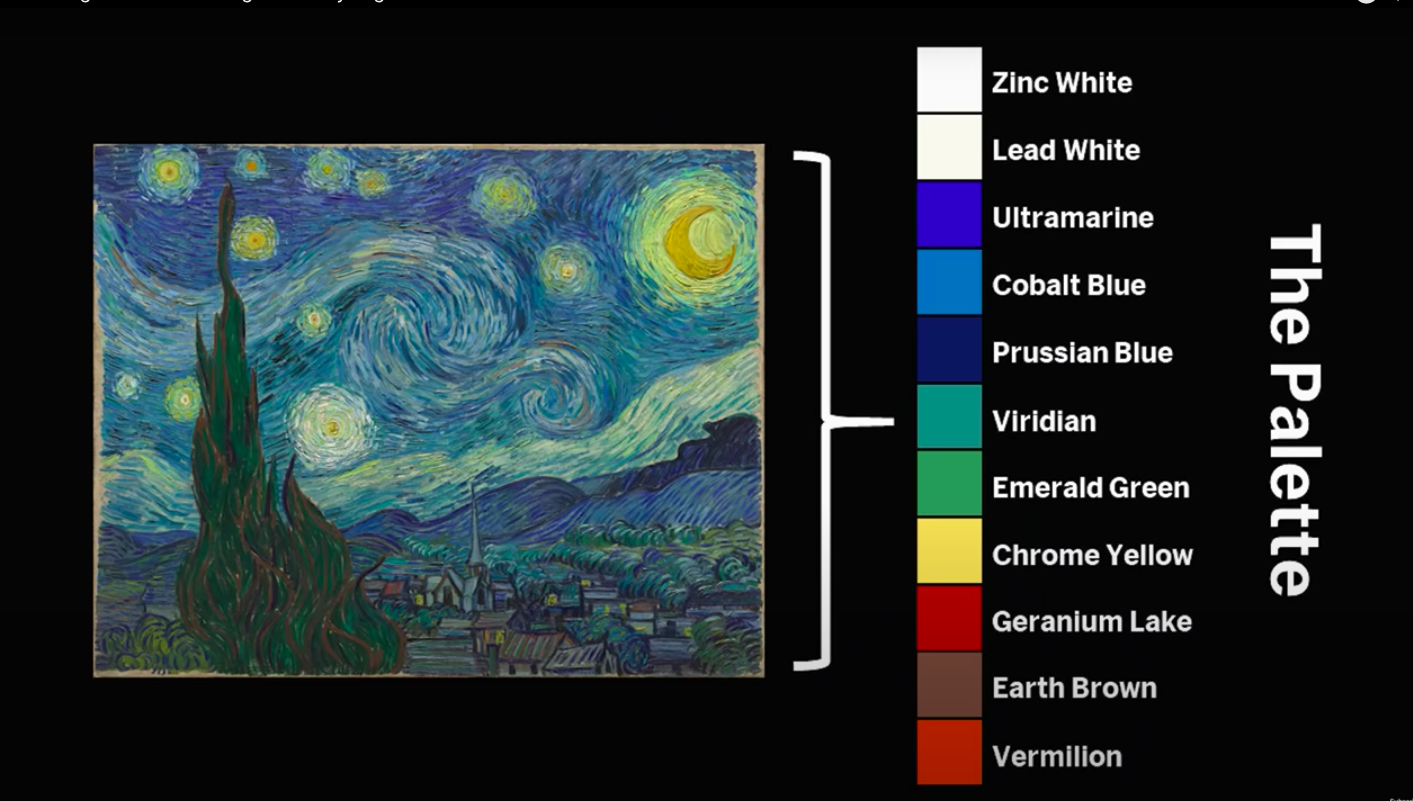
As Aviram and Kastler point out, the set cleaves faithfully to Van Gogh’s limited palette. Some LEGO fans report that building up the blue background layers is the most challenging aspect of assembling the 11”x14.5” kit:
I’m 54 and the colors, being kind of close, were playing games with my eyes. LOL This is my favorite LEGO of all time! In closing, if you haven’t heard the song, Vincent by Don McLean, I suggest you take a listen to this song as you stare at this LEGO masterpiece.
Order LEGO’s Vincent van Gogh - The Starry Night set from Amazon.
Related Content
Vincent Van Gogh’s “The Starry Night”: Why It’s a Great Painting in 15 Minutes
The Unexpected Math Behind Van Gogh’s “Starry Night”
Zoom Into a Super High Resolution Photo of Van Gogh’s “The Starry Night”
- Ayun Halliday is the Chief Primatologist of the East Village Inky zine and author, most recently, of Creative, Not Famous: The Small Potato Manifesto. Follow her @AyunHalliday.
Read More...Support Us
We're hoping to rely on loyal readers, rather than erratic ads. Please click the Donate button and support Open Culture. You can use Paypal, Venmo, Patreon, even Crypto! We thank you!

About Us

Open Culture scours the web for the best educational media. We find the free courses and audio books you need, the language lessons & educational videos you want, and plenty of enlightenment in between.
Advertise With Us

FREE UPDATES!
GET OUR DAILY EMAIL
Get the best cultural and educational resources on the web curated for you in a daily email. We never spam. Unsubscribe at any time.
FOLLOW ON SOCIAL MEDIA

Open Culture editor Dan Colman scours the web for the best educational media. He finds the free courses and audio books you need, the language lessons & movies you want, and plenty of enlightenment in between.
Advertise With Us

