Play “Artle,” an Art History Version of Wordle: A New Game from the National Gallery of Art
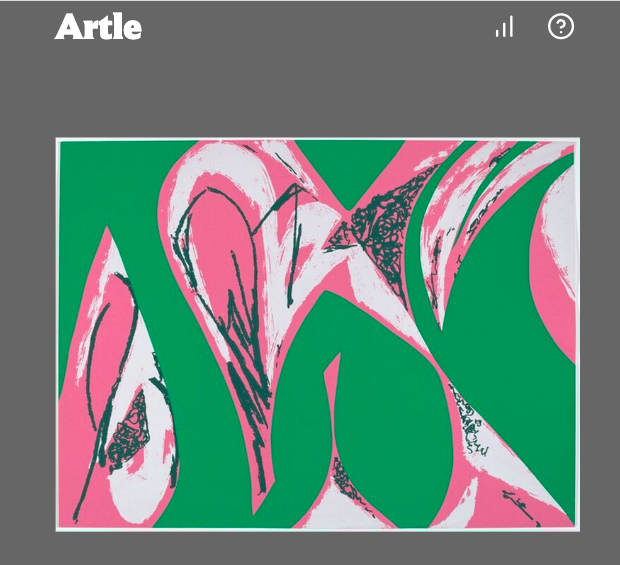
Are you one of the hundreds of thousands who’ve gotten themselves hooked on Wordle, the free online game that gives players six chances to guess a five-letter word of the day?
Its popularity has spawned a host of imitators, including Quordle, Crosswordle, Absurdle and Lewdle, which has carved itself a niche in the vulgar and profane.
Even the National Gallery of Art is getting in on the action with Artle, wherein players get four attempts to correctly identify an artist du jour by examining four of their pieces, drawn from its vast collection of paintings, photographs, sculptures and other works.
The Gallery provides a bit of an assist a few letters into every guess, especially helpful to those taking wild shots in the dark.

Before you commit to Georgia O’Keeffe, you may want to consider some 80 other George and Georges variants who pop up as you type, including Georges Braque, George Grosz, Georgine E. Mason, George Joji Miyasaki, George Segal, Georges Seurat, and Georg Andreas Wolfgang the Elder.
Hats off if you can readily identify all of these artists’ work on sight. That’s an impressive command of art history you’ve got there!
As with Wordle, a button provides a streamlined invitation to boast about your prowess on social media after you’ve completed your daily Artle. Return visitors can keep track of their stats in the upper right hand corner.
There’s no shame in failing to identify an artist in four tries, just a free opportunity to further your education a bit with titles and links to the four works you just spent time viewing.
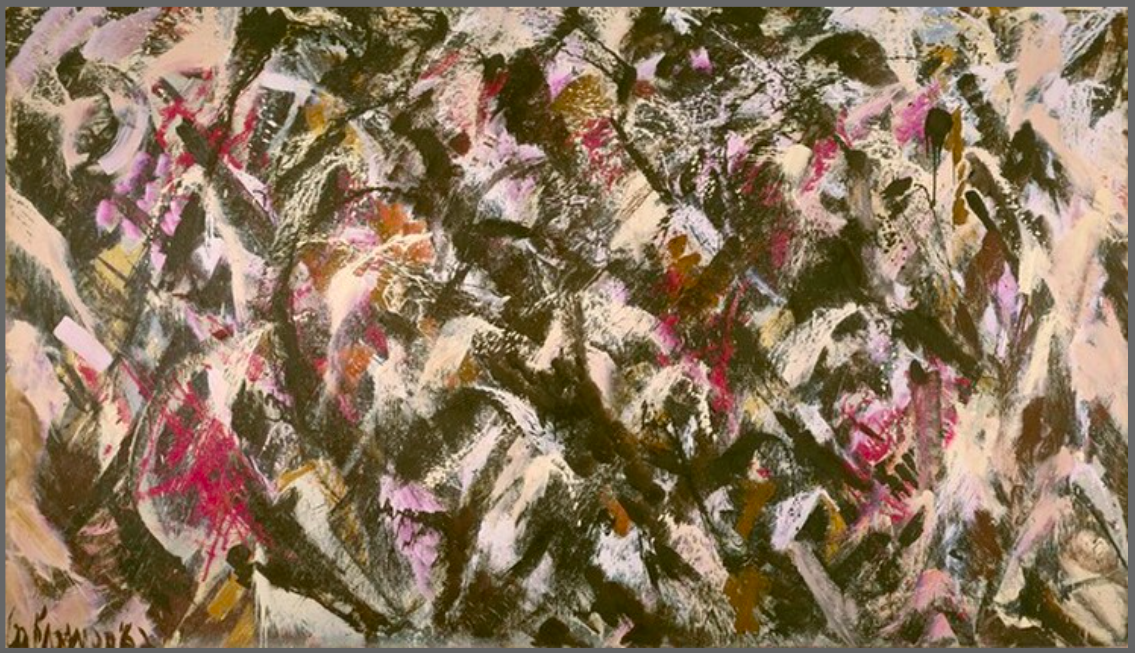
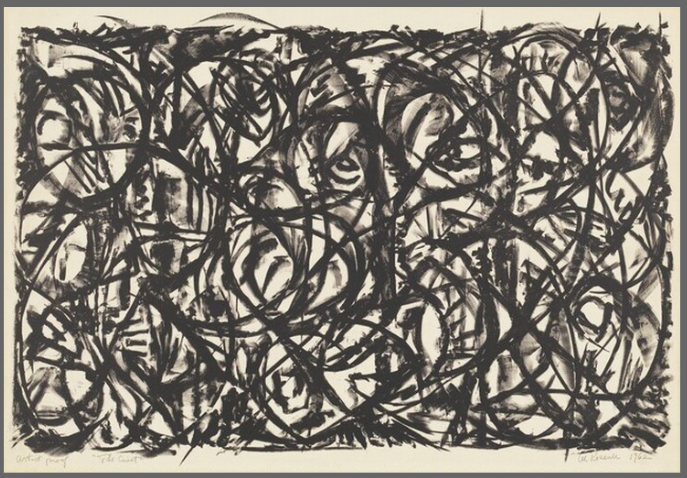
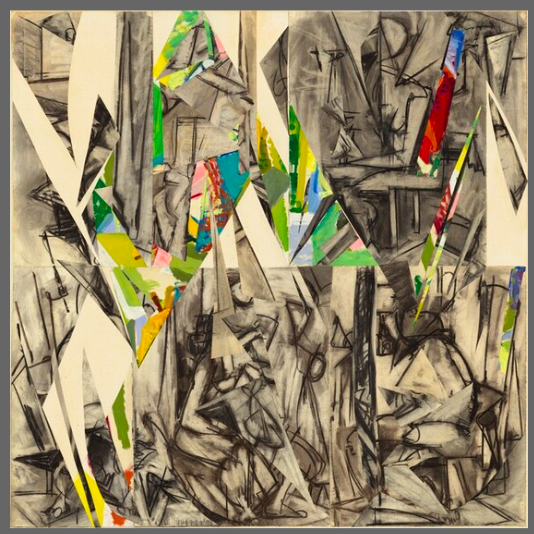
The examples we’ve included from Thursday, June 2’s puzzle are Free Space (Deluxe), pink, The Civet, Imperative, and Cobalt Night by….
Your guess?

Play Artle here — like Wordle and multivitamins, just one a day.
Related Content
Google’s Free App Analyzes Your Selfie and Then Finds Your Doppelganger in Museum Portraits
Construct Your Own Bayeux Tapestry with This Free Online App
- Ayun Halliday is the Chief Primatologist of the East Village Inky zine and author, most recently, of Creative, Not Famous: The Small Potato Manifesto. Follow her @AyunHalliday.
Read More...A First Glimpse of Moonage Daydream, the New “Immersive Cinematic Experience” David Bowie Film
Above you can get a first glimpse of Moonage Daydream–a new film that The Guardian calls a “glorious, shapeshifting eulogy to David Bowie.” Directed by Brett Morgen (otherwise known for Cobain: Montage of Heck), the film creates for viewers “an immersive cinematic experience” and “an audio-visual space odyssey,” using never-before-seen concert footage. Moonage Daydream “not only illuminates the enigmatic legacy of David Bowie but also serves as a guide to living a fulfilling and meaningful life in the 21st Century.”
Premiering at the Cannes Film Festival this month, the film will arrive at theaters in September, and then stream on HBO and HBO Max next spring. You can read more about the film and its production at Rolling Stone.
If you would like to support the mission of Open Culture, consider making a donation to our site. It’s hard to rely 100% on ads, and your contributions will help us continue providing the best free cultural and educational materials to learners everywhere. You can contribute through PayPal, Patreon, and Venmo (@openculture). Thanks!
Related Content
David Bowie on Why It’s Crazy to Make Art–and We Do It Anyway (1998)
Bowie’s Bookshelf: A New Essay Collection on The 100 Books That Changed David Bowie’s Life
When David Bowie Launched His Own Internet Service Provider: The Rise and Fall of BowieNet (1998)
Read More...Watch Hannah Arendt’s Final Interview (1973)
Even before the election of Donald Trump, as some critics began to see the possibility of a win, talk turned to historical names of anti-fascism: George Orwell, Sinclair Lewis, and, especially, Hannah Arendt, author of The Origins of Totalitarianism, On Revolution, and Eichmann in Jerusalem, her series of articles for The New Yorker about the trial of the Nazi’s chief bureaucrat. Arendt closely observed authoritarian regimes and their aftermath, detailing the way ideology seeps in through banal political careerism.
Since 2016, her warnings have seemed all-too-prescient, especially after a coup attempt last January that has been all-but hand-waved out of political memory by the GOP and its media apparatus, while candidates who deny the legitimacy of election outcomes they don’t like increasingly get their names on ballots. The degree to which Arendt saw the political conditions of her time, and maybe ours, with clarity has less to do with foreknowledge and more with a deep knowledge of the past. Corruption, tyranny, deceit, in all their many forms, have not changed much in their essential character since the records of antiquity were set down.
“Dark times,” she wrote in the 1968 preface to her collection of essays Men in Dark Times, “are not only not new, they are no rarity in history, although,” she adds, “they were perhaps unknown in American history, which otherwise has its fair share, past and present, of crime and disaster.” Had her assessment changed a few years later, in what would be her final interview, above, in 1973 (aired on French TV in 1974)? Had dark times come for the U.S.? The Yom Kippur War had just begun, the seemingly-endless Vietnam War dragged on, and the Watergate scandal had hit its crescendo.
Still, Arendt continued to feel a certain guarded optimism about her adopted country, which, she says, is “not a nation-state” like Germany or France:
This country is united neither by heritage, nor by memory, nor by soil, nor by language, nor by origin from the same. There are no natives here. The natives were the Indians. Everyone else are citizens. And these citizens are united only by one thing and this is true: That is, you become a citizen in the United States by a simple consent to the Constitution. The constitution – that is a scrap of paper according to the French as well as the German common opinion, & you can change it. No, here it is a sacred document. It is the constant remembrance of one sacred act. And that is the act of foundation. And the foundation is to make a union out of wholly disparate ethnic minorities and religions, and (a) still have a union, and (b) do not assimilate or level down these differences. And all of this is very difficult to understand for a foreigner. It’s what a foreigner never understands.
Whether or not Americans understood themselves that way in 1973, or understand ourselves this way today, Arendt points to an ideal that makes the democratic process in the U.S. unique; when, that is, it is allowed to function as ostensibly designed, by the consent of the governed rather than the tyranny of an oligarchy. Arendt died two years later, as the war in Vietnam finally came to an inglorious end. You can watched her full televised interview — with English translations by the uploader, Philosophy Overdose — above, or find it published in the book, Hannah Arendt: The Last Interview and Other Conversations.
What would Arendt have had to say to our time of MAGA, COVID-19 and election denialism, mass political racism, misogyny, homophobia, and xenophobia? Perhaps her most succinct statement on how to recognize the dark times comes from that same 1968 preface:
I borrow the term from Brecht’s famous poem ‘To Posterity,’ which mentions the disorder and the hunger, the massacres and the slaughterers, the outrage over injustice and the despair ‘when there was only wrong and no outrage,’ the legitimate hatred that makes you ugly nevertheless, the well-founded wrath that makes the voice grow hoarse. All this was real enough as it took place in public; there was nothing secret or mysterious about it. And still, it was by no means visible to all, nor was it at all easy to perceive it; for, until the very moment when catastrophe overtook everything and everybody, it was covered up not by realities but by the highly efficient talk and double-talk of nearly all official representatives who, without interruption and in many ingenious variations, explained away unpleasant facts and justified concerns. When we think of dark times and of people living and moving in them, we have to take this camouflage, emanating from and spread by ‘the establishment’ – or ‘the system,’ as it was then called – also into account. If it is the function of the public realm to throw light on the affairs of men by providing a space of appearances in which they can show in deed and word, for better or worse, who they are and what they can do, then darkness has come when this light is extinguished by ‘credibility gaps’ and ‘invisible government,’ by speech that does not disclose what is but sweeps it under the carpet, by exhortations, moral and otherwise, that, under the pretext of upholding old truths, degrade all truth to meaningless triviality.
Related Content:
Josh Jones is a writer and musician based in Durham, NC. Follow him at @jdmagness
Read More...William Blake: The Remarkable Printing Process of the English Poet, Artist & Visionary
Few artists have anticipated, or precipitated, the fragmented, heroically individualist, and purposefully oppositional art of modernity like William Blake, a man to whom the cliché ahead of his time can be applied with perfect accuracy. Blake strenuously opposed the rationalist Deism and Neoclassical artistic values of his contemporaries, not only in principle, but in nearly every part of his artistic practice. His politics were correspondingly radical: in opposition to empire, racism, poverty, patriarchy, Christian dogma, and the emerging global capitalism of his time.
Nowhere do we see Blake’s visual radicalism more in evidence, argues Julia M. Wright in a 2000 essay for the journal Mosaic, than in his Laocoön, a work that not only seems to presage the modernist collaging of text and image, from Braque to Rauschenberg, but also looks toward hypertext with its nonlinearity, fragmentation, and intertextuality: “By combining as many as four different media in Laocoön — drawing, writing, engraving, and sculpture [in his depiction of the classical original] — Blake puts into play their different properties, engaging the debate in theory as well as practice.”
Through an art of visual pastiche, Blake resists the Neoclassical idea that visual art and poetry were mutually exclusive formal pursuits that could not coexist. (View a larger image here to read the poems and slogans that surround the image.)
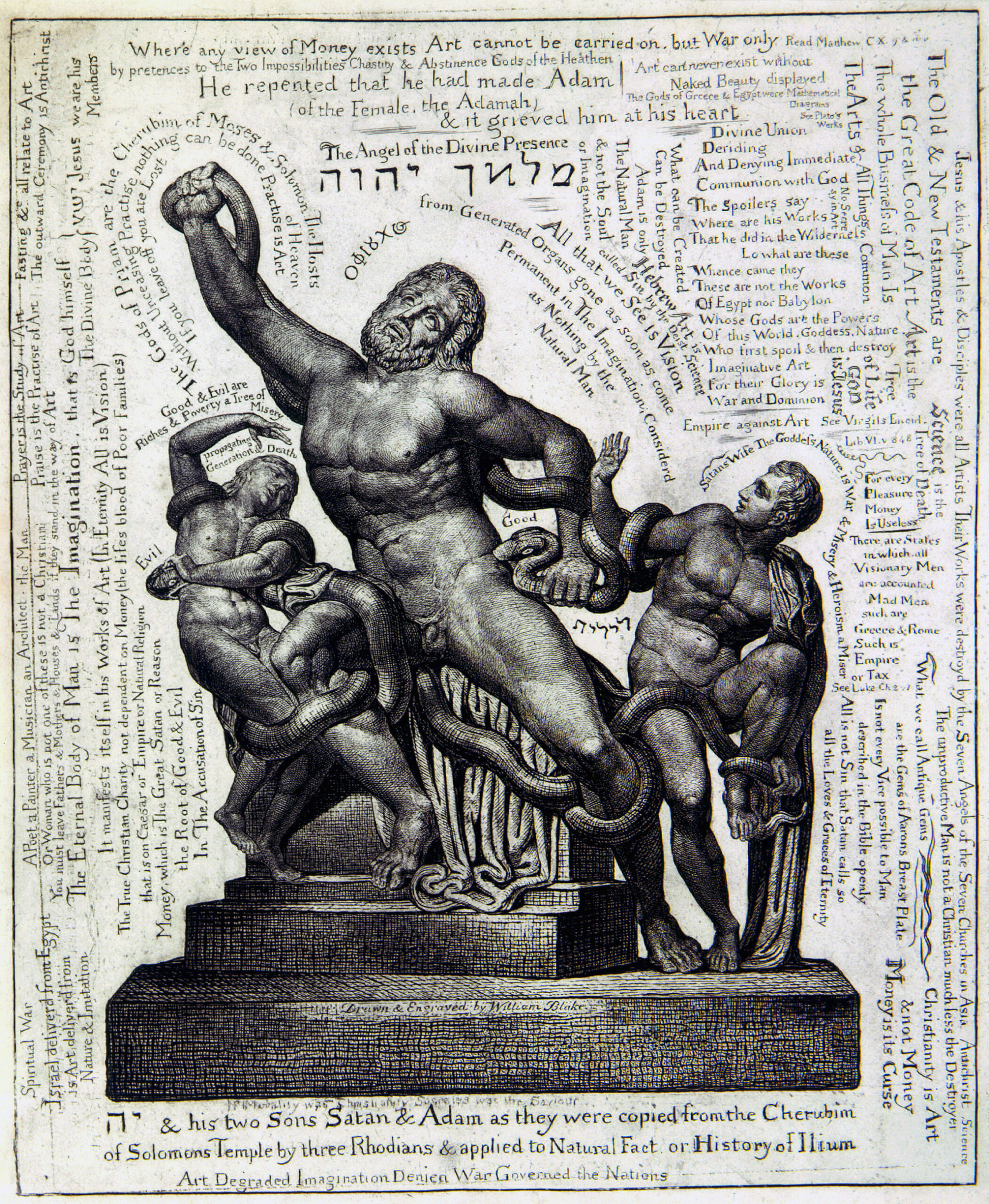
We can see the influence of Blake’s radicalism everywhere, from zine art to the Blakes reproduced on the skin of special edition Doc Martens (the artist was also an enthusiastic defender of the Gothic over the Classical, Wright points out). An art like Blake’s demanded a radical process, and he conceived one through his professional skills as an engraver, an art he began learning at the age of twelve. “Right from his earliest childhood,” notes the British Library video at the top, “Blake was driven by two extraordinary and powerful aspirations. On the one hand as a poet, on the other as a painter… so how was he going to bring these two together in a form that would enable him to publish his own images in illustration of his own poems?”
The video demonstrates “Blake’s innovation” as an engraver and printer. The printing process at that point involved a number of different specialized workers, some responsible for setting text, and others for separately printing images in blank spaces left on the pages. Blake’s process “enabled him, with the exception of the paper, to be responsible for every stage in the production process, from writing the poems, making the drawings, using the stop-out varnish to write his text, etching and printing the impressions.”
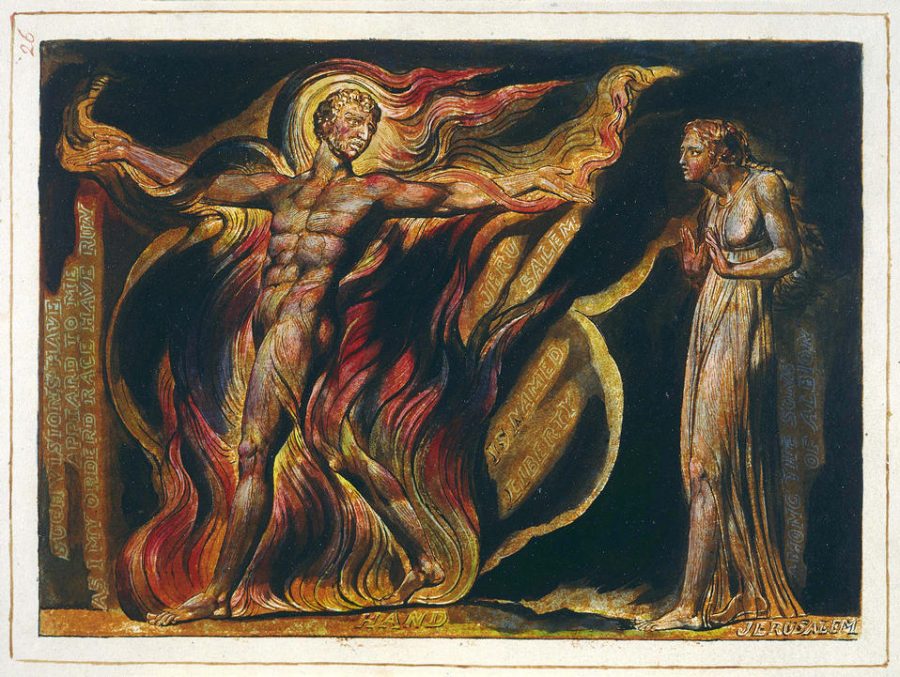
He began working out his methods as a teenager, and they allowed tremendous creative freedom throughout his life to create personal works of art like the “Illuminated Books” (from which the other two images here come): containers of his complex mythology and some of his most passionate engravings. You can learn even more about Blake’s DIY printing process in the video further up from Ashmolean Museum. Blake’s futuristic art drew heavily from the past — from Renaissance masters like Michelangelo, for example — as a means of creating an alternate art history, one that opposed the values of domination and oppressive systems of order.
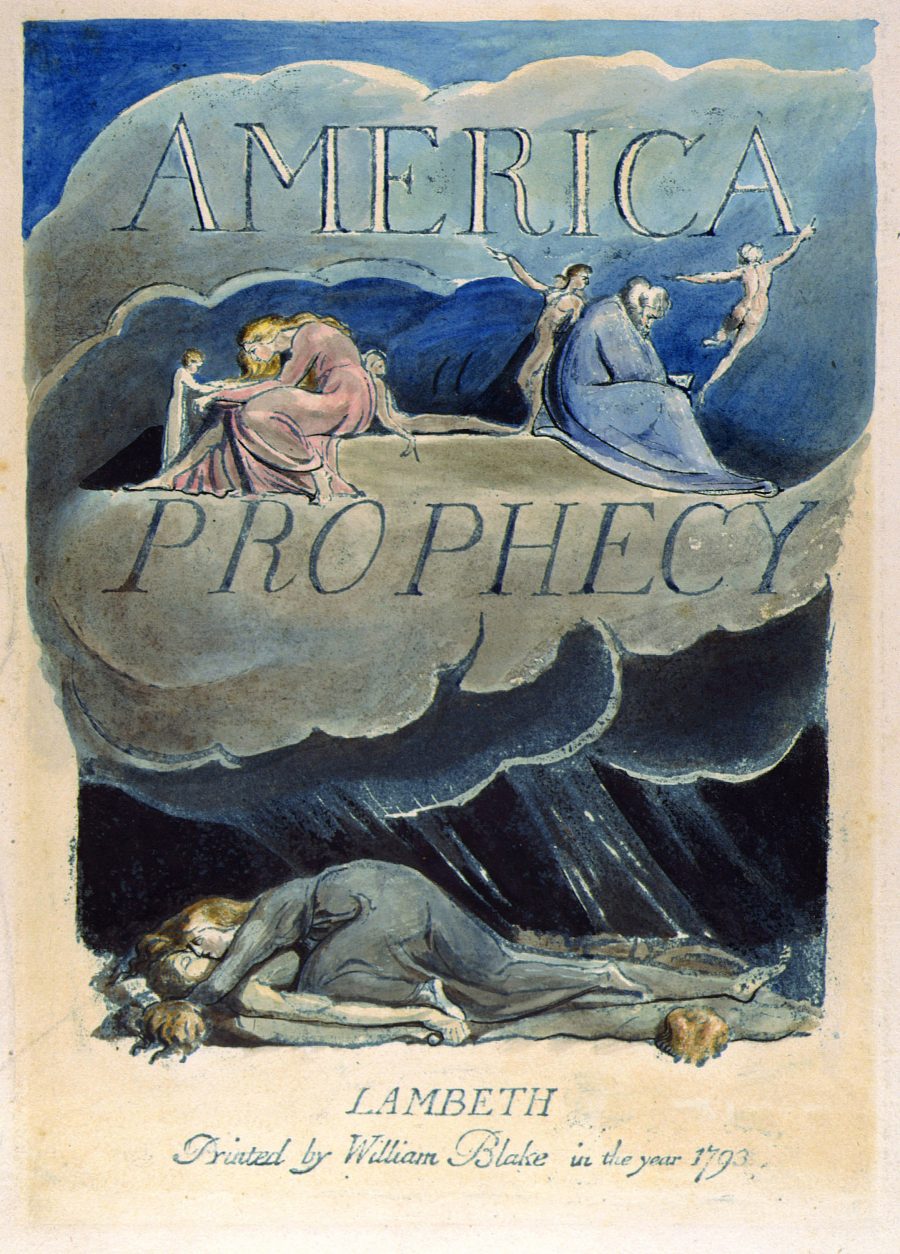
His formal and political radicalism is perhaps one reason Blake became one of the first artists to populate an online archive, with the launch of the Blake Archive all the way back in 1996, “conceived as an international [free] public resource that would provide unified access to major works of visual and literary art that are highly disparate, widely dispersed, and more and more often severely restricted as a result of their value, rarity, and extreme fragility.” Visit the Blake Archive here to see high resolution scans of hundreds of Blake’s prophetic works, all created from start to finish by his own hand, and learn more about his personal and commercial illustrations at the links below.
Related Content:
William Blake’s Hallucinatory Illustrations of John Milton’s Paradise Lost
Josh Jones is a writer and musician based in Durham, NC. Follow him at @jdmagness
Read More...Helen Keller Was a “Firebrand” Socialist (or How History Whitewashed Her Political Life)
We expect that histories of famous figures will prune their lives, sand down rough edges, rewrite and revise awkward and inconvenient facts. What we may not expect – at least in the U.S. – is that decades of a famous person’s life will be redacted from the record. This is essentially what happened, however, to the biography of Helen Keller even before her death in 1968. Perhaps the main offender remains playwright William Gibson’s 1957 The Miracle Worker, adapted from the 1903 autobiography she wrote at 23. Ostensibly about Keller, the story centers instead, beginning with its title, on her teacher, Anne Sullivan.
The play (and 1962 film with Anne Bancroft and Patty Duke reprising their stage parts), portrays Keller as a child, a role she was perpetually assigned by her critics throughout her adult life. She authored and published 14 books and dozens of essays during her 87 years, delivered hundreds of speeches, and maintained a friendship and correspondence with many important figures of the day. But in addition to the usual sexism, she had to contend with those who thought her disability rendered her unfit to express opinions on matters such as politics. They asked that she “confine my activities to social service and the blind,” she wrote in a sardonic reply.
Keller’s political vision was written off as “a Utopian dream, and one who seriously contemplates its realization indeed must be deaf, dumb, and blind.” What did she see in her mind that made critics rush to belittle her? An end to war and Jim Crow; women’s suffrage, labor rights; an end to poverty and the preventable childhood illnesses it engendered.… In a word, Helen Keller was a socialist — and a publicly committed one. “That we know so little of her avowed socialism is astonishing, because she was an extroverted firebrand who delivered hundreds of radical speeches during” — writes Eileen Jones at Jacobin, quoting the 2020 documentary Her Socialist Smile — “ ‘a fifty-year run on the lecture circuit.’ ”
Keller published frequent articles on the newly formed Soviet Union, Eugene Debs and the IWW (including “Why I Became an IWW” in 1916), and “Why Men Need Woman Suffrage” (in 1913). “Turning the yellowing pages of radical newspapers and magazines from 1910 to the early 1920’s,” writes historian Philip Foner in an introduction to her collected socialist writings, “one frequently finds the name Helen Keller beneath speeches, articles, and letters dealing with major social questions of the era. The vision which runs through most of these writings is the vision of socialism.”
Mark Twain may have been the first to call Anne Sullivan a “miracle worker” and Keller “a miracle,” but he treated Keller “not as a freak,” she wrote, but as an equal and shared many of her views. He helped fund her education at Radcliffe College (then a part of Harvard ) and encouraged her to speak and publish. Keller joined the socialist party at age 29, in 1909, and in 1912, she published an article in The New York Call titled “How I Became a Socialist.” The answer, she writes: “by reading.” As would be the case throughout her life, Keller felt the need to take a defensive posture: critics had accused John and Anne Macy (formerly Sullivan) of corrupting her, to which she replied that she neither shared Mr. Macy’s propagandistic variety of Marxism nor did Mrs. Macy share either of their views.
Keller’s political writing is now widely available thanks to the internet, and can no longer be suppressed by educators who want to use her childhood and disability but ignore most of her adult life. Even students watching the PBS American Masters documentary Becoming Helen Keller (see clip at the top) will learn that, gasp, yes, she was a socialist. Dig deeper, and they’ll find her views were unique and significant to the U.S. left: Keith Rosenthal writes at International Socialist Review:
She was a serious political thinker who made important contributions in the fields of socialist theory and practice.… [S]he was a pioneer in pointing the way toward a Marxist understanding of disability oppression and liberation—this reality has been overlooked and censored. The mythological Helen Keller that we are familiar with has aptly been described as a sort of “plaster saint;” a hollow, empty vessel who is little more than an apolitical symbol for perseverance and personal triumph.
Get to know the real Helen Keller — or a seriously overlooked (at least) side of her life — in her political writings here, here, and here and watch a video introduction to her politics by Historically Fantastic further up.
via Jacobin
Related Content:
Watch Helen Keller & Teacher Annie Sullivan Demonstrate How Helen Learned to Speak (1930)
Josh Jones is a writer and musician based in Durham, NC. Follow him at @jdmagness
Read More...Real Interviews with People Who Lived in the 1800s
The nineteenth century is well and truly gone. That may sound like a trivial claim, given that we’re now living in the 2020s, but only in recent years did we lose the last person born in that time. With Tajima Nabi, a Japanese woman who died in 2018 at the age of 117 years, went our last living connection to the nineteenth century (1900, the year of Tajima’s birth, technically being that century’s last year.) Luckily that same century saw the invention of photography, sound recording, and even motion pictures, which offered certain of its inhabitants a means of preserving not just their memories but their manner. You can view a collection of just such footage, restored and colorized, at the Youtube channel Life in the 1800s.
In the channel’s playlist of interview clips you’ll find first-hand memories of, if not the particular decade of the eighteen-hundreds, then at least of the eighteen-fifties through the eighteen-nineties. Take the inventor Elihu Thomson, interview subject in the video at the top of the post. Born in England in 1853, Thomson emigrated with his family to the United States in 1857.
They settled in Philadelphia, where Thomson found himself “forced out of school at eleven” because he wasn’t yet old enough to enter high school. Some advisors said, “Keep him away from books and let him develop physically.” To which the young Thompson responded, “If you do that, you might as well kill me now, because I’ve got to have my books.”
One of those books was full of “chemistry experiments and electrical experiments,” and carrying them out himself gave Thomson his “first knowledge of electricity” — a phenomenon of great importance to the development that would happen throughout the rest of the nineteenth century and into the twentieth. Albert L. Salt also got in on the ground floor, having started working for Western Electric at age fourteen in 1881 and eventually become the president of Western Electric’s appliance subsidiary Graybar. But of course, not everyone had such a professional ladder available: take the elderly interviewees in the footage just above, who were born into slavery the eighteen-forties and eighteen-fifties.
The more distant a time grows, the more it tends to flatten in our perception. In the absence of deliberate historical research, we lack a sense of the various texture of eras out of living memory. In the United States of America alone, the nineteenth century encompassed both great technological innovation and the days of the Wild West. The latter was the realm known to Civil War veteran and photographer William Henry Jackson, who in the interview above remembers the American west “before the cowboys came in” — not the time of the cowboys, but before. Could Florence Pannell, whose memories of Victorian England we previously featured here on Open Culture, have imagined his world? Could he have imagined hers? See more interviews here.
Related content:
A 108-Year-Old Woman Recalls What It Was Like to Be a Woman in Victorian England
What the First Movies Really Looked Like: Discover the IMAX Films of the 1890s
A Rare Smile Captured in a 19th Century Photograph
Hand-Colored Photographs of 19th Century Japan
Based in Seoul, Colin Marshall writes and broadcasts on cities, language, and culture. His projects include the Substack newsletter Books on Cities, the book The Stateless City: a Walk through 21st-Century Los Angeles and the video series The City in Cinema. Follow him on Twitter at @colinmarshall or on Facebook.
Read More...When Orson Welles Became a Speech & Joke Writer for Franklin Delano Roosevelt
As someone who had mastered radio, film, and stage at such a young age, it shouldn’t be a surprise that Orson Welles once flirted with the idea of running for office. It never happened, but Welles got pretty close in 1944 by ghost-writing speeches for Franklin Delano Roosevelt’s re-election campaign. This in-depth article at Smithsonian by Erick Trickey goes into greater detail about this mix of entertainment and politics, and shows how both have always influenced each other.
In the final four months of 1944, America was still at war with Japan and Germany, and Roosevelt was seeking an unprecedented fourth term to bring the war to a close. Roosevelt’s Republican challenger Thomas Dewey questioned the ailing president’s stamina and wellness for the job, along with accusations of corruption and incompetence.
Welles was still Hollywood’s golden boy, with a career that had taken off during Roosevelt’s second term with his infamous War of the Worlds radio play, picking up on America’s pre-war paranoia. It had continued through 1941’s Citizen Kane and its thinly veiled attack on William Randolph Hearst and other oligarchs. Welles’ voice carried authority and gravitas. He was also married to Rita Hayworth at the time, and enjoying the upside of Hollywood success.
Roosevelt engaged the left-wing Welles in the last month of the campaign and soon the actor was traveling the country and delivering speeches at rallies for FDR. In one stop he called Republicans “the partisans of privilege, the champions of monopoly, the old opponents of liberty, the determined adversaries of the small business and the small farm.”
Welles also supplied ideas and jokes for FDR’s speeches. When Dewey and other Republicans attacked FDR’s dog Fala, Welles’ penned this: “Well, of course, I don’t resent attacks, and my family doesn’t resent attacks — but Fala does resent them. You know, Fala is Scotch, and being a Scottie, as soon as he learned that the Republican fiction writers, in Congress and out, had concocted a story that I had left him behind on the Aleutian Islands and had sent a destroyer back to find him — at a cost to the taxpayers of 2 or 3 or 8 or $20 million — his Scotch soul was furious. He has not been the same dog since.”
The American public seemed to agree that going after a pet was a bit too much. The nationally broadcast speech turned FDR’s fortunes around. And at FDR’s final rally at Fenway Park in Boston, the president introduced both Welles (“The Dramatic Voice”) and Frank Sinatra (“The Voice”). Welles spoke out against GOP elitism: “By free enterprise they want exclusive right to freedom. They are stupid enough to think that a few can enjoy prosperity at the expense of the rest.”
Days later, FDR won 53 percent of the popular vote and took the electoral college, 432–99. In one sense though, Dewey’s attacks on FDR’s health were founded: Roosevelt died five months later on April 12, 1945.
FDR had written to Welles to thank him for the rally, but also wrote about that April’s meeting of the United Nations. The man had the weight of the free world upon his shoulders, and Welles felt it. The artist wrote a eulogy for FDR for the New York Post:
Desperately we need his courage and his skill and wisdom and his great heart. He moved ahead of us showing a way into the future. If we lose that way, or fall beside it, we have lost him indeed. Our tears would mock him who never wept except when he could do no more than weep. If we despair. because he’s gone — he who stood against despair — he had as well never have lived, he who lived so greatly.
You can read it online here.
Related Content:
Hear Orson Welles’ Iconic War of the Worlds Broadcast (1938)
Rare Video Shows FDR Walking: Filmed at the 1937 All-Star Game
Listen to Eight Interviews of Orson Welles by Filmmaker Peter Bogdanovich (RIP)
The Hearts of Age: Orson Welles’ Surrealist First Film (1934)
Ted Mills is a freelance writer on the arts who currently hosts the Notes from the Shed podcast and is the producer of KCRW’s Curious Coast. You can also follow him on Twitter at @tedmills, and/or watch his films here.
Read More...How Postwar Italian Cinema Created La Dolce Vita and Then the Paparazzi
Those who love the work of Federico Fellini must envy anyone who sees La Dolce Vita for the first time. But today such a viewer, however overwhelmed by the lavish cinematic feast laid before his eyes, will wonder if giving the intrusive tabloid photographer friend of Marcello Mastroianni’s protagonist the name “Paparazzo” isn’t a bit on the nose. Unlike La Dolce Vita’s first audiences in 1960, we’ve been hearing about real-life paparazzi throughout most all of our lives, and thus may not realize that the word itself originally derives from Fellini’s masterpiece. Each time we refer to the paparazzi, we pay tribute to Paparazzo.
In the video essay above, Evan Puschak (better known as the Nerdwriter) traces the origins of paparazzi: not just the word, but the often bothersome professionals denoted by the word. The story begins with the dictator Benito Mussolini, an “avid movie fan and fanboy of film stars” who wrote “more than 100 fawning letters to American actress Anita Page, including several marriage proposals.” Knowing full well “the emotional power of cinema as a tool for propaganda and building cultural prestige,” Mussolini commissioned the construction of Rome’s Cinecittà, the largest film-studio complex in Europe when it opened in 1937 — six years before his fall from power.
During the Second World War, Cinecittà became a vast refugee camp. When peacetime returned, with “the studio space being used and Mussolini’s thumb removed, a new wave of filmmakers took to the streets of Rome to make movies about real life in postwar Italy.” Thus began the age of Italian Neorealism, which brought forth such now-classic pictures as Roberto Rossellini’s Rome, Open City and Vittorio De Sica’s Bicycle Thieves. In the nineteen-fifties, major American productions started coming to Rome: Quo Vadis, Roman Holiday, Ben-Hur, Cleopatra. (It was this era, surely, that inspired an eleven-year-old named Martin Scorsese to storyboard a Roman epic of his own.) All of this created an era known as “Hollywood on the Tiber.”
For a few years, says Puschak, “the Via Veneto was the coolest place in the world.” Yet “while the glitterati cavorted in chic bars and clubs, thousands of others struggled to find their place in the postwar economy.” Some turned to tourist photography, and “soon found they could make even more money snapping photos of celebrities.” It was the most notorious of these, the “Volpe di via Veneto” Tazio Secchiaroli, to whom Fellini reached out asking for stories he could include in the film that would become La Dolce Vita. The newly christened paparazzi were soon seen as the only ones who could bring “the gods of our culture down to the messy earth.” These six decades later, of course, celebrities do it to themselves, social media having turned each of us — famous or otherwise — into our own Paparazzo.
Related content:
Federico Fellini Introduces Himself to America in Experimental 1969 Documentary
Cinecittà Luce and Google to Bring Italy’s Largest Film Archive to YouTube
Mussolini Sends to America a Happy Message, Full of Friendly Feelings, in English (1927)
Based in Seoul, Colin Marshall writes and broadcasts on cities, language, and culture. His projects include the Substack newsletter Books on Cities, the book The Stateless City: a Walk through 21st-Century Los Angeles and the video series The City in Cinema. Follow him on Twitter at @colinmarshall, on Facebook, or on Instagram.
Read More...Footage of Flappers from 1929 Restored & Colorized with AI
The flapper is the Roaring 20s’ enduring emblem — a liberated, young woman with bobbed hair, rolled down stockings, and a public thirst for cocktails.
(My grandmother longed to be one, and succeeded, as best one could in Cairo, Illinois, only to marry an older man at the age of 17, and give birth to my father a few months before the stock market crashed, bringing the frivolity of the decade to an abrupt halt.)
Our abiding affection for the flapper is stoked on F. Scott Fitzgerald’s Jazz Age novella, The Great Gatsby, and its many stage and screen adaptations, with their depictions of wild parties featuring guests like Miss Baedecker (“When she’s had five or six cocktails she always starts screaming like that”) and Lucille (“I never care what I do, so I always have a good time.”)
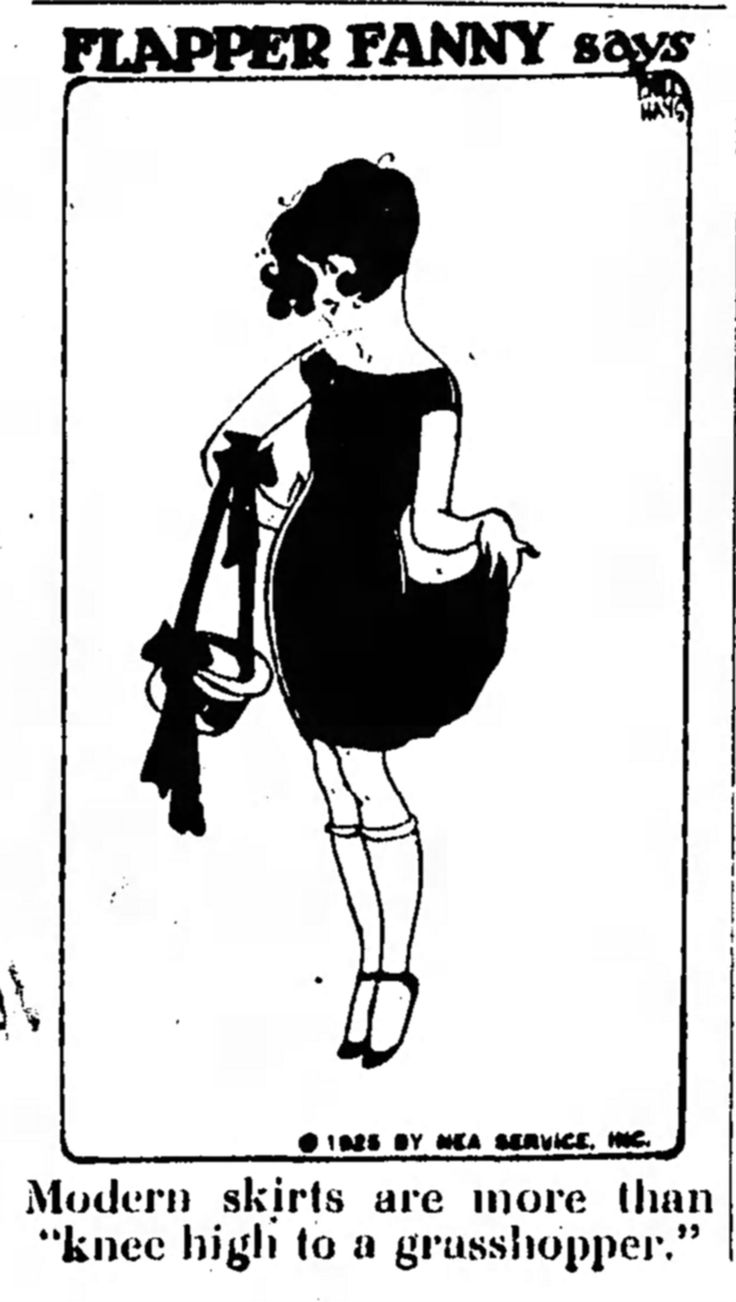
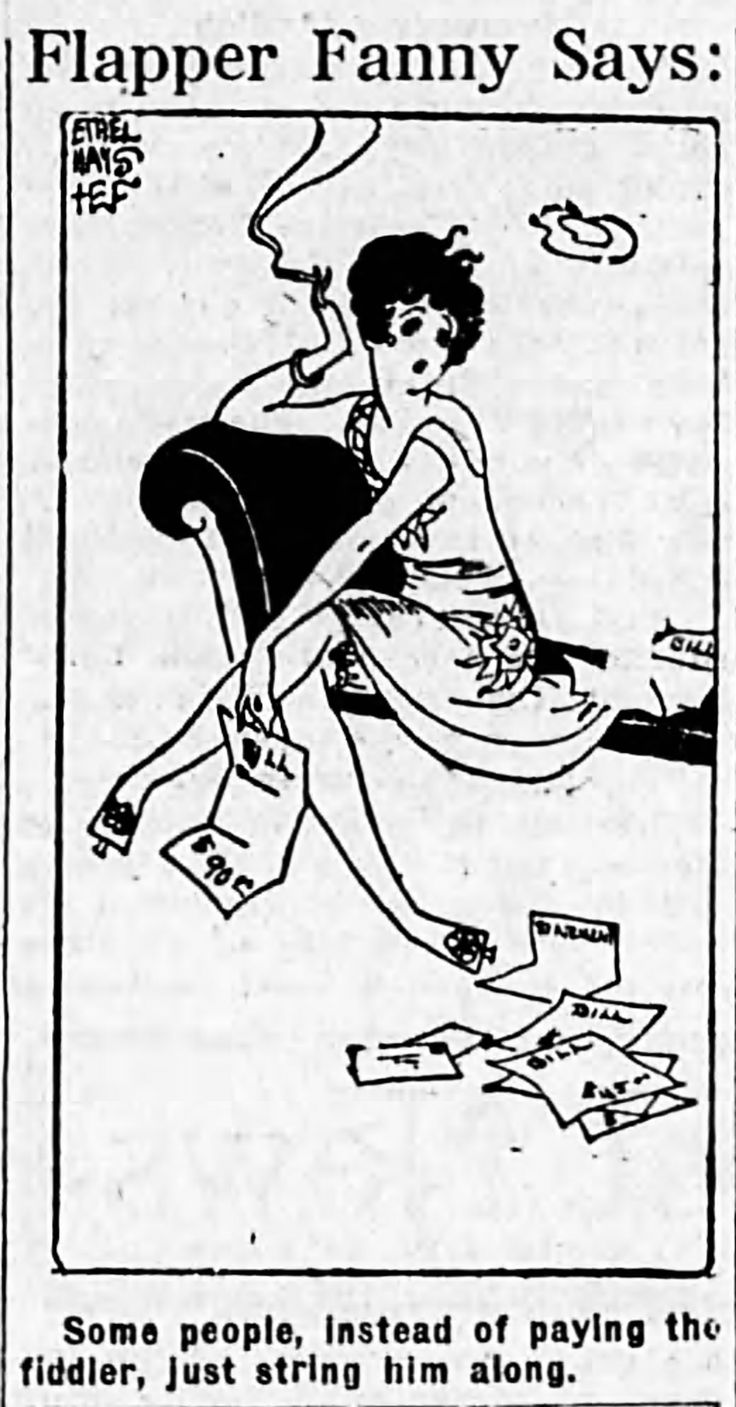
The vintage fashion blog Glamour Daze’s newly colorized footage of a 1929 fashion show in Buffalo, New York, at the top of this post, presents a vastly more sedate image than Fitzgerald, or Ethel Hays, whose single-panel daily cartoon Flapper Fanny was wildly popular with both young women and men of the time.
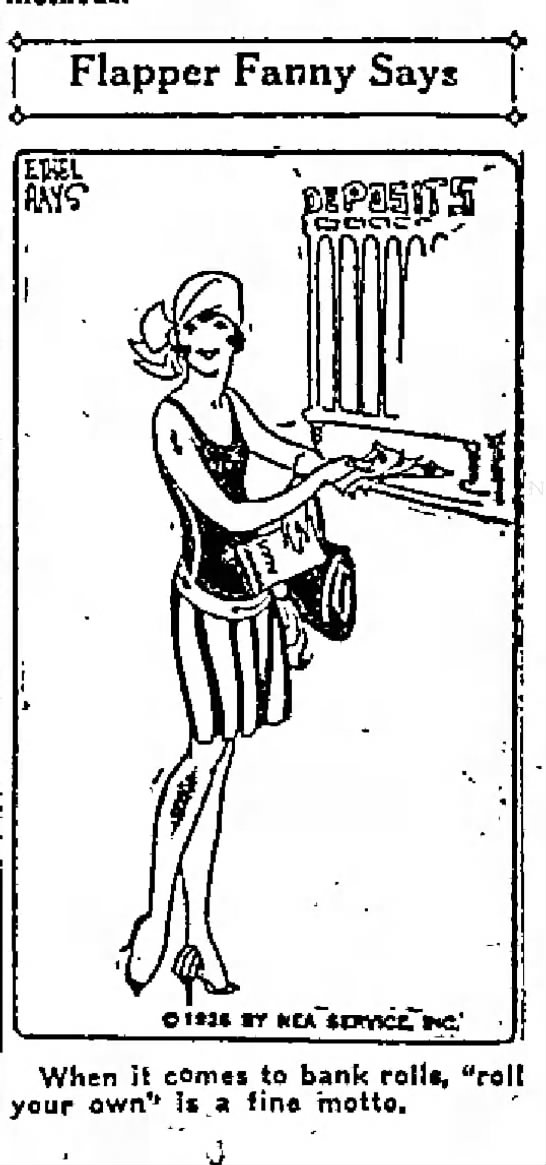
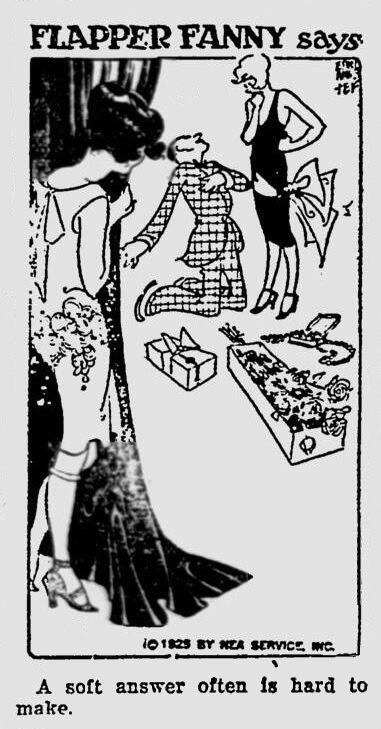
The scene it presents seems more wholesome than one might have found in New York City, with what Fitzgerald dubbed its “wild promise of all the mystery and the beauty in the world”. The models seem more eager amateurs than runway professionals, though lined up jauntily on a wall, all exhibit “nice stems.”
My young grandmother would have gone ga ga for the cloche hats, tea dresses, bathing suits, lounging pajamas, golf and tennis ensembles, and evening gowns, though the Deep Exemplar-based Video Colorization process seems to have stained some models’ skin and teeth by mistake.
The original black and white footage is part of the University of South Carolina’s Fox Movietone News collection, whose other fashion-related clips from 1929 include presentations featuring Washington debutantes and college coeds.
Added sound brings the period to life with nary a mention of the Charleston or gin, though if you want a feel for 20s fashion, check out the collection’s non-silent Movietone clip devoted to the latest in 1929 swimwear — this is a modernistic beach ensemble of rayon jersey with diagonal stripes and a sun back cut…
It’s the cat’s pajamas. As is this playlist of hits from 1929.
Explore Glamour Daze’s guide to 1920s fashion history here.
Watch the original black and white footage of the Buffalo, New York fashion show here.
- Ayun Halliday is the Chief Primatologist of the East Village Inky zine and author, most recently, of Creative, Not Famous: The Small Potato Manifesto. Follow her @AyunHalliday.
Read More...The Last Morning in Pompeii & The Night Pompeii Died: A New Video Series Explores the End of the Doomed Roman City
We’re still learning what happened in Pompeii in 79 AD. In the broad sense, of course, we know exactly what happened: the volcano Mount Vesuvius erupted, overwhelming the city (as well as Herculaneum) with heat and entombing it in ash. But what exactly was going on in Pompeii’s last days? Absent the power of time travel, we can never know for sure. But the disaster that ended the life of Pompeii also preserved that life more or less as it was, resulting in a harrowing snapshot made of ruins and remains uncommonly intact by the standards of ancient Rome. It is to Mount Vesuvius that we thus owe a good deal of our knowledge about the texture of everyday life in the Roman Empire.
History Youtuber Garrett Ryan explains all this in a new three-part miniseries, which consists of the videos “The Last Morning in Pompeii,” “The Night Pompeii Died,” and “The Victims of Vesuvius.” We’ve previously featured Ryan’s channel Told in Stone here on Open Culture for its episodes on subjects like ancient Roman aqueducts and ancient Roman drugs.
Here, he uses his formidable all-around knowledge of ancient Roman life to paint a verbal picture of how average Pompeiians might have lived out their final day in the city. During its course, what in the morning would have felt like nothing more than odd rumblings would — in accordance with the archetypal tale of disaster — turn into an inferno by nightfall.
As in his other videos, Ryan shows as much concern with what we know as how we know it. In the case of Pompeii and Herculaneum, the historical evidence includes no fewer than 1,500 recovered bodies, with hundreds or even thousands still buried. The vividness of the image constituted by these citizens and their surroundings — a vividness enhanced by the practice of making realistic plaster casts from their impressions in the ash — would lead any visitor at the ruins to imagine for himself stories of the lives of Pompeiians. So it seems to have gone with Ryan, who after gazing into Vesuvius’ crater beheld the sprawl of modern-day Naples, which has “crept up to the very foot of the volcano, awaiting the next eruption.” The underlying story, told in geological time, is still nowhere near its end.
Related content:
Pompeii Rebuilt: A Tour of the Ancient City Before It Was Entombed by Mount Vesuvius
Archaeologists Discover an Ancient Roman Snack Bar in the Ruins of Pompeii
A Drone’s Eye View of the Ruins of Pompeii
Based in Seoul, Colin Marshall writes and broadcasts on cities, language, and culture. His projects include the Substack newsletter Books on Cities, the book The Stateless City: a Walk through 21st-Century Los Angeles and the video series The City in Cinema. Follow him on Twitter at @colinmarshall, on Facebook, or on Instagram.
Read More...Support Us
We're hoping to rely on loyal readers, rather than erratic ads. Please click the Donate button and support Open Culture. You can use Paypal, Venmo, Patreon, even Crypto! We thank you!

About Us

Open Culture scours the web for the best educational media. We find the free courses and audio books you need, the language lessons & educational videos you want, and plenty of enlightenment in between.
Advertise With Us

FREE UPDATES!
GET OUR DAILY EMAIL
Get the best cultural and educational resources on the web curated for you in a daily email. We never spam. Unsubscribe at any time.
FOLLOW ON SOCIAL MEDIA

Open Culture editor Dan Colman scours the web for the best educational media. He finds the free courses and audio books you need, the language lessons & movies you want, and plenty of enlightenment in between.
Advertise With Us


