Hear 11-Year-Old Björk Sing “I Love to Love”: Her First Recorded Song (1976)
Several years back, we featured an eleven-year-old Björk reading a nativity story in her native Icelandic, backed by unsmiling older kids from the Children’s Music School in Reykjavík. In this new find, also dating from 1976, you can hear that same eleven-year-old Björk singing in English, in what marks her first recording. Above, she sings the Tina Charles song “I Love to Love” for a school recital. According to Laughing Squid, the “teachers were so impressed with her voice, they sent the recording to the national radio station where it received a great deal of play.” Soon thereafter (in 1977) came her first album, featuring cover art provided by her mom. We’ve previously explored that here on OC.
If you would like to support the mission of Open Culture, consider making a donation to our site. It’s hard to rely 100% on ads, and your contributions will help us continue providing the best free cultural and educational materials to learners everywhere. You can contribute through PayPal, Patreon, and Venmo (@openculture). Thanks!
Related Content
Watch Björk, Age 11, Read a Christmas Nativity Story on a 1976 Icelandic TV Special
Hear the Album Björk Recorded as an 11-Year-Old: Features Cover Art Provided By Her Mom (1977)
Read More...A Flying Car Took to the Skies Back in 1949: See the Taylor Aerocar in Action
“A secret question hovers over us, a sense of disappointment, a broken promise we were given as children about what our adult world was supposed to be like,” the late anthropologist David Graeber once wrote in the Baffler. This refers to “a particular generational promise — given to those who were children in the fifties, sixties, seventies, or eighties — one that was never quite articulated as a promise but rather as a set of assumptions about what our adult world would be like.” In the confusingly disappointing future we now inhabit, one question hovers above them all: “Where, in short, are the flying cars?”
Even those of us not yet born in the mid-20th century can sense the cultural import of the flying car to that era, and not just from its science fiction. Chuck Berry was singing about flying cars back in 1956: His song “You Can’t Catch Me” tells of racing down the New Jersey Turnpike in a custom-made “airmobile,” a “Flight DeVille with a powerful motor and some hideaway wings.”
This wasn’t wholly fantastical, given that an actual flying car had been built seven years earlier. Demonstrated in the newsreel from that year at the top of the post, the Aerocar came designed and built by a solo inventor, former World War II pilot Moulton Taylor of Longview, Washington, who in 1959 would appear on the popular game show I’ve Got a Secret.
The program’s panelists attempt to guess the nature of Taylor’s invention as he puts it together onstage, for the Aerocar required some assembly. Though considerably more complicated than the push-button mechanism imagined by Berry, the process took only five minutes to convert from automobile to airplane, or so the inventor promised. Despite securing the Civil Aviation Authority’s approval for mass production, Taylor couldn’t find a sufficient number of buyers, and in the end only built six Aerocars. But one of them still flies, as seen on the first episode of the 2008 series James May’s Big Ideas. “I wouldn’t have flown it if I’d seen the wings were attached with elaborate paperclips,” writes the former Top Gear co-host, “but by the time I realized this, we were already at 2,000 feet.”
“As an airplane, it was actually pretty good,” May admits, “but then, it would be, because an airplane is what it was.” As a car, “it was diabolical. Worse than the Beetle, to be honest, and not helped by the requirement to drag all the unwanted airplaney bits behind you on a trailer.” Still, the experience of flying in the Aerocar clearly thrilled him, as it would any car or plane enthusiast. Even in a non-airworthy state the Aerocar certainly thrills Matthew Burchette, curator at Seattle’s Museum of Flight. In the video above he introduces the museum’s Aerocar III, the last one Taylor built. “If you’re about my age, you really wanted your jetpack,” says the gray-haired Burchette, though a flying car would also have done the trick. Alas, more than half a century after Taylor’s ambitious project, humanity seems to have made no apparent progress in that department; jetpacks, however, seem to be coming along nicely.
Related Content:
Newly Unearthed Footage Shows Albert Einstein Driving a Flying Car (1931)
The Timeless Beauty of the Citroën DS, the Car Mythologized by Roland Barthes (1957)
A Harrowing Test Drive of Buckminster Fuller’s 1933 Dymaxion Car: Art That Is Scary to Ride
178,000 Images Documenting the History of the Car Now Available on a New Stanford Web Site
NASA Puts 400+ Historic Experimental Flight Videos on YouTube
Based in Seoul, Colin Marshall writes and broadcasts on cities, language, and culture. His projects include the Substack newsletter Books on Cities, the book The Stateless City: a Walk through 21st-Century Los Angeles and the video series The City in Cinema. Follow him on Twitter at @colinmarshall, on Facebook, or on Instagram.
Read More...The Polygraph: The Proto-Photocopy Machine Machine Invented in 1803 That Changed Thomas Jefferson’s Life
Today we associate the word polygraph mainly with the devices we call “lie detectors.” The unhidden Greek terms from which it originates simply mean “multiple writing,” which seems apt enough in light of all those movie interrogation scenes with their juddering parallel needles. But the first “polygraph machine” meriting the name long predates such cinematic clichés, and indeed cinema itself. Patented in 1803 by an Englishman named John Isaac Hawkins, it consisted essentially of twin pens, mounted side-by-side and connected by means of levers and springs so as always to move in unison. The result, in theory, was that it would make an identical copy of a letter even as the writer wrote it.
“The polygraph was pushing technology to the absolute limit,” but for years “it was nearly impossible to make it work correctly.” So says Charles Morrill, a guide at Thomas Jefferson’s estate Monticello, in the video above.
Despite the prolonged technical difficulties, the third president of the United States of America fell in love with the polygraph, “a device to duplicate letters, just the thing if you’re carrying on multiple conversations with different people all over the world. You want to keep a copy of the letter to catch yourself up, to see what you had written to cause a response” — and, of special concern to a national politician, to check on the exact degree to which the press was misquoting you.
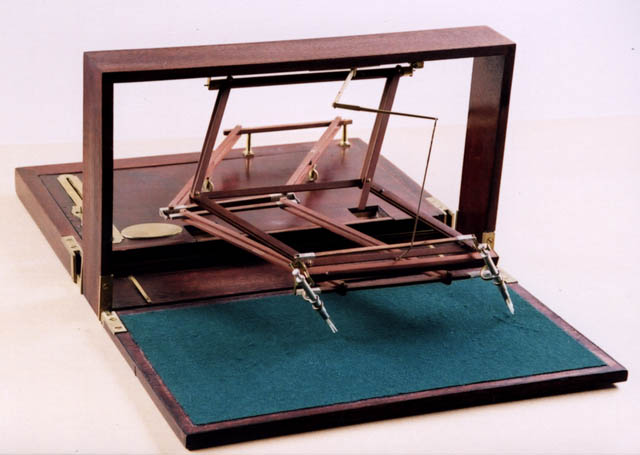
Image by the Smithsonian, via Wikimedia Commons
Jefferson wrote nearly 20,000 letters, one of them a complaint to John Adams about suffering “under the persecution of Letters,” a condition ensuring that “from sun-rise to one or two o’clock, I am drudging at the writing table.” That the polygraph reduced this drudgery somewhat made it, in Jefferson’s words, “the finest invention of the present age.” Like technological early adopters today, Jefferson acquired each new model as it came out, the device having been continually retooled by American rights-holder Charles Willson Peale. By 1809 Peale had improved the polygraph to the point that Jefferson could write that it “has spoiled me for the old copying press the copies of which are hardly ever legible … I could not, now therefore, live without the Polygraph.” Imagine how he would’ve felt had Monticello been wired for e‑mail.
Related Content:
Thomas Jefferson’s Handwritten Vanilla Ice Cream Recipe
The First Music Streaming Service Was Invented in 1881: Discover the Théâtrophone
Based in Seoul, Colin Marshall writes and broadcasts on cities, language, and culture. His projects include the Substack newsletter Books on Cities, the book The Stateless City: a Walk through 21st-Century Los Angeles and the video series The City in Cinema. Follow him on Twitter at @colinmarshall, on Facebook, or on Instagram.
Read More...Hear Legendary BBC Composer Delia Derbyshire’s Electronic Version of Bach’s “Air on a G String”
When the warm, warbly, slightly-out-of-tune sounds of the early Moog synthesizer met the delicate figures of Bach’s concertos, suites, preludes, fugues, and airs in Wendy Carlos’ 1968 Switched-on Bach, the result reinvigorated popular interest in classical music and helped launch the careers of seventies Moog synthesists like composer of instrumental hit “Popcorn,” Gershon Kingsley; occultist and composer of TV themes and jingles, Mort Garson; and pioneering disco producer Giorgio Moroder. These were not the kind of musicians, nor the kind of music, of which Carlos approved. She was mortified to have her album marketed as a novelty record or, later, as instrumental pop.
The reclusive Carlos’ interpretations of Beethoven and moody originals defined the sound of Stanley Kubrick’s A Clockwork Orange and The Shining. This soundtrack work may be one of the few things Carlos has in common with legendary BBC Radiophonic Workshop composer and creator of the eerie Doctor Who theme, Delia Derbyshire. But where Carlos’ film scores evoke an ominous, otherworldly grandeur, Derbyshire’s soundtracks, made for radio and television, use more primitive electronic techniques to conjure weirder, and in some ways creepier, atmospheres.
The 1971 compilation album BBC Radiophonic Music, for example, contains music from three of the Workshop’s most prominent composers—Derbyshire, John Baker, and David Cain—and features one of her most famous themes, “Ziwzih Ziwzih Oo-Oo-Oo,” which critic Robin Carmody described as “her most terrifying moment, tumbling into a nightmare, the sound of childhood at its most chilling.” The work she did for the Radiophonic Workshop was not intended to be particularly musical at all. Workshop employees were instead expected to be technicians of sound, employing new audio technologies for purely dramatic effect.
“The only way into the workshop was to be a trainee studio manager,” Derbyshire remarked in a 2000 interview. “This is because the workshop was purely a service department for drama. The BBC made it quite clear that they didn’t employ composers and we weren’t supposed to be doing music.” Nonetheless, she applied her tape loops, oscillators, and other musique concrete techniques to at least one classical piece, Bach’s “Air on a G String.” The resulting interpretation sounds entirely different from Carlos’ electric Bach. It is, Carmody writes, “an ice-cold nocturnal rewrite… the stuff of a seven-year-old child’s most unforgettable nightmares.” The piece does not seem to have been made for a BBC production. Derbyshire herself dismissed the recording as “rubbish,” though she admitted “it has a fair number of admirers.”
Soon after its release, in a 1:44 snippet on the compilation album, Derbyshire left the Workshop to pursue her own musical direction. She composed music for the stage and screen, then became disillusioned with the music industry altogether. The availability of the analog synthesizers popularized by Carlos’ record had rendered her way of making music obsolete. But as the many recent tributes to Derbyshire’s legacy testify, her work has been as influential as that of the early analog synth composers, on everyone from the Beatles to contemporary experimental artists. Derbyshire’s playful weirdness has been oft-imitated over the decades, but no one has ever interpreted Bach quite like this before or since.
Related Content:
Two Documentaries Introduce Delia Derbyshire, the Pioneer in Electronic Music
The Fascinating Story of How Delia Derbyshire Created the Original Doctor Who Theme
Josh Jones is a writer and musician based in Durham, NC. Follow him at @jdmagness
Read More...David Lynch Explains How Simple Daily Habits Enhance His Creativity
At first glance, Madame Bovary and Blue Velvet would seem to have little in common, as would their creators. But the artistic life Gustave Flaubert led and the one David Lynch now leads share a basic precept: “Be regular and orderly in your life,” as the former once put it, “so that you may be violent and original in your work.” Lynch has spoken about his ways as an artistic creature of habit many times over the years, as demonstrated by the interview clip above. “Some people have heard the story that I went to Bob’s Big Boy for seven years every day at 2:30 and had the same thing,” he told Jay Leno in 1992. “That was my longest habit pattern, I think.”
Lynch’s regularity at that Los Angeles burger joint is just one of the routines that has structured his existence. “I like habitual behavior because it’s a known factor,” he says, “and then your mind is free to think about other things.” When life has an order, he later told Charlie Rose, “then you’re free to mentally go off any place. You’ve got a safe sort of foundation, and a place to spring off from.”
More recently, on a phone Q&A for the David Lynch Foundation, the auteur described his routine thus: “I wake up and I brush my teeth and I use the bathroom. Then I have a cappuccino and some cigarettes. Then I mediate, and then I have either some amrit nectar or a small smoothie with protein powder and blueberries and peaches. And then I go to work.”
However contradictory they may seem, Lynch’s long-standing twin loves of smoking and meditation both express themselves as routine actions. And if the backgrounds of his Youtube videos — including his little-varying daily Los Angeles weather reports — are anything to go by, he performs them in the kind of uncluttered physical space he’s long preferred: “The purer the environment,” as he puts it, “the more fantastic the interior world can be.” His 1980s and 90s comic strip The Angriest Dog in the World took place in such an environment, its nearly unchanging visuals and increasingly bizarre text an artistic correlative to his ideas about daily life and the imagination. But whatever their interest in his methods, Lynch’s fans want to know one thing above all: what the imagination of this least angry of all artists will bring forth next.
Related Content:
An Animated David Lynch Explains Where He Gets His Ideas
The Daily Routines of Famous Creative People, Presented in an Interactive Infographic
Based in Seoul, Colin Marshall writes and broadcasts on cities, language, and culture. His projects include the Substack newsletter Books on Cities, the book The Stateless City: a Walk through 21st-Century Los Angeles and the video series The City in Cinema. Follow him on Twitter at @colinmarshall, on Facebook, or on Instagram.
Read More...Behold One of the Earliest Known Color Charts: The Table of Physiological Colors (1686)
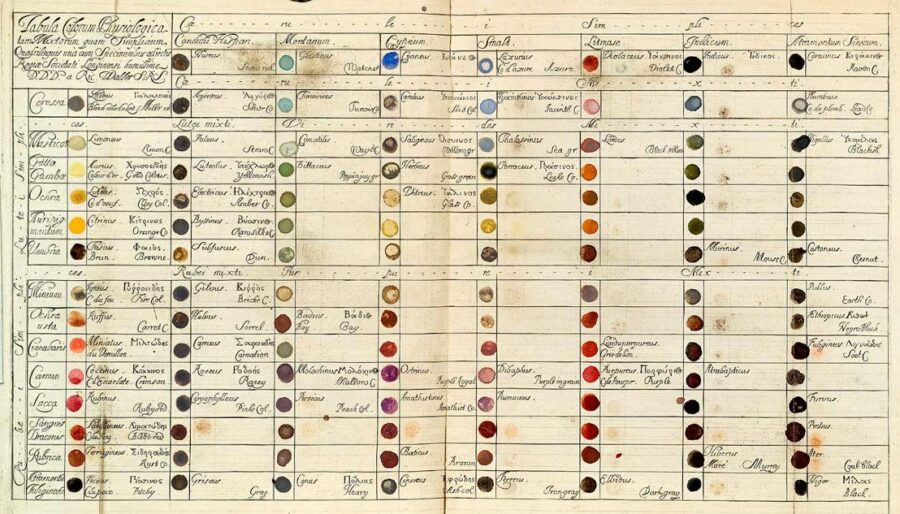
The period called the Enlightenment produced a revolution in which one sense, vision, became privileged above all others. As a result, Sachiko Kusukawa writes at The Royal Society Journal of the History of Science, “science is supremely visual. Indeed, one might say, excessively so.” Kusukawa situates English naturalist and illustrator Richard Waller at the beginning of her history about how sight came to dominate, and Sarah Lowengard places Waller’s color chart, presented at the Royal Society in 1686, at a formative moment in “the creation of color in Eighteenth-Century Europe.”
That’s not to say, of course, that color didn’t exist before charts like Waller’s, but it didn’t exist in neat taxonomies that divided color discretely, named and categorized it, and mapped the natural world by means of color theory. Waller’s “‘Table of Physiological Colors Both Mixt and Simple’ would permit unambiguous descriptions of the colors of natural bodies. To describe a plant, for example, one could compare it to the chart and use the names found there to identify the colors of the bark, wood, leaves, etc. Similar applications of the information collected in the chart might also extend to the arts and trades, he suggested.”
The naturalist approach to color would inform the artificial creation of color, helping “manufacturers to produce consistent dyes and paints,” notes the Smithsonian Libraries. Waller’s system was not precise enough for the task, but many others, including board game pioneer Milton Bradley, picked up his work and refined it, producing not only scientific and industrial color guides, but also pedagogies like Bradley’s Elementary Color textbook for children. Keith Moore, Head of Library & Information Services at the Royal Society, traces Waller’s color dots through the arts, “from the low art Ben-Day dots in the vintage comic books I used to read as a child to the high art pointillism and divisionism pioneered by Georges Seurat.”
Dozens of color systems, wheels, charts, and tables appeared over the next few hundred years, from the elaborate to the very simple. All of them have encountered the same basic issue, namely the subjectivity of visual perception. “Waller’s visual system exhibits the same conceptual problem… that plagued nearly all eighteenth-century classification systems. Which colors can be included and what is their ‘correct’ order? The answer was always tempered by available coloring materials and choice of media.” As more pigments became available, so too did more colors in the color charts.
Is the making of color classification systems more of a science or an art? It depends, perhaps, on what they’re used for, but “color remains elusive to scientists and color experts,” the Smithsonian points out, over 400 years after Waller’s chart. Since then, however, the language of color has evolved, as he envisioned, into a practical and poetic syntax and vocabulary.
See a larger version of the chart here and read about it in detail in Lowengard’s excellent article.
Related Content:
A Pre-Pantone Guide to Colors: Dutch Book From 1692 Documents Every Color Under the Sun
The Vibrant Color Wheels Designed by Goethe, Newton & Other Theorists of Color (1665–1810)
Josh Jones is a writer and musician based in Durham, NC. Follow him at @jdmagness
Read More...Eno: A 1973 Mini-Doc Shows Brian Eno at the Beginning of His Solo Career
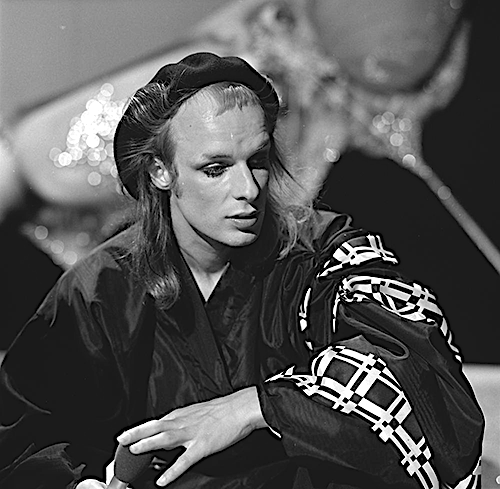
Image via Wikimedia Commons
We’ve seen bits and pieces of the 1973 mini-doc Eno over the years, as it is such a rare and wonderful glimpse into the very beginnings of Brian Eno’s career, and being the go-to footage for any doc about the man. Over the course of the film, we see Eno assembling/recording “The Paw-Paw Negro Blowtorch”, the second track on his debut album Here Come the Warm Jets. Right from the beginning, we see that Eno was true to his word and using the recording studio as an instrument. With Derek Chandler by his side engineering, we see Eno layering one sound after another, removing others, much like a painter. If you know the track, you notice it take form and shape, but there are things that would later be “painted over,” like a sitar solo (!) where the wigged out oscillator solo now sits. The film opens with Eno playing an arpeggiated bass line on a piano that also doesn’t make it into the song. (The bass instead is supplied by Busta Jones, seen playing a two note riff with a lot of feeling.) Chris Spedding stops by to play “something purely Duane Eddy” on his guitar, asking Eno “you’ll treat it later?” “Probably,” says Eno. (More like definitely).
“I have attempted to replace the element of skill considered necessary in music with the element of judgement,” Eno says early in the film, and a listen to the finished track reveals that judgement. And what do you know–the sitar *is* there, as are the piano lines, like a space in the canvas where the original sketch can be seen.
We also get an amazing, extended glimpse at Eno’s notebooks, which have popped up in various books on Eno, including More Dark Than Shark and Visual Music. From the profane to the profound, from drawings of genitals to detailed analog system diagrams, it’s all here, and as far as we know the notebooks, which he started at 14, continue to this day.
The film also makes the case for a later Eno theory, that of the “scenius,” which he once described thus: “‘Scenius stands for the intelligence and the intuition of a whole cultural scene. It is the communal form of the concept of the genius.’”
For Eno in 1973, the scenius is the Portobello Road area where he can browse thrift stores, run into friends, and check in on designer/girlfriend Carol McNicoll, who made all Eno’s glam outfits. And he also talks about how Robert Fripp just stopped by on his way home one night and recorded side one of their team-up album No Pussyfooting.
All in all a terrific look into the beginning of an artistic legacy, and a film that desperately needs a pristine new transfer. (And no, you will never convince me that the Portsmouth Sinfonia is any good.)
Related Content:
Brian Eno Reveals His Favorite Film Soundtracks
Brian Eno Explains the Loss of Humanity in Modern Music
Ted Mills is a freelance writer on the arts who currently hosts the Notes from the Shed podcast and is the producer of KCRW’s Curious Coast. You can also follow him on Twitter at @tedmills, and/or watch his films here.
Read More...Watch the Making of Japanese Woodblock Prints, from Start to Finish, by a Longtime Tokyo Printmaker
There are a few names anyone interested in Japanese woodblock printing today can’t help but hear sooner or later: Utagawa Hiroshige, Katsushika Hokusai, Kitagawa Utamaro, David Bull. That last, you may have guessed, is not the name of an 18th-century Japanese man. In fact, David Bull still walks among us today, especially if we happen to live in the old Asakusa section of Tokyo, where he keeps his woodblock-print studio Mokuhankan.
Born in England and raised in Canada, Bull discovered the world of ukiyo‑e, those Japanese “pictures of the floating world,” in his late twenties. Just a few years after first trying his hand, without formal training, at making his own prints, he moved to the Japanese capital to dedicate himself to the form. Today, on his personal site and Youtube channel, he offers a wealth of English-language resources on the art and craft of the Japanese woodblock print.
In the video up top, he provides expert commentary on the making of one particular print by a young Mokuhankan printer named Natsuki Suga. The work is broken into ten stages, beginning with the application of the basic orange background color, moving on through the addition of sky blues and tea-field greens (not to mention shadows, shadows, and “more shadows”), all the way through to the final embossing of the title and artist’s name. The result, revealed at the end in a stage-by-stage time lapse, is a vivid and idyllic scene aesthetically balanced between ukiyo‑e tradition and the present-day art styles.
In the video just above, you can see Bull himself provide commentary as he makes a woodblock print of his own — in real time, from start to finish, with no cuts. Originally shot as a live Twitch stream, it shows Bull’s entire process from blank block to completed print, which takes nearly three and a half hours. That may actually seem like a surprisingly short time in which to create a work of art, but then, Bull has been at this for nearly 40 years.
Bull’s experience also comes through in his ability to explain his techniques and tell stories about the Japanese woodblock’s artistic development as well as his own. What may seem like a video of interest only to ukiyo‑e specialists has in fact racked up, as of this writing, more than 1.2 million views on Youtube alone. But then, it isn’t entirely unknown for a soft-spoken artist dedicated to a highly specific form to win a wide audience with his educational productions. “I’m completely certain that Bob Ross hasn’t died,” as one commenter puts it. “He just got a new haircut.”
Related Content:
Enter a Digital Archive of 213,000+ Beautiful Japanese Woodblock Prints
Download 2,500 Beautiful Woodblock Prints and Drawings by Japanese Masters (1600–1915)
Download Hundreds of 19th-Century Japanese Woodblock Prints by Masters of the Tradition
See Classic Japanese Woodblocks Brought Surreally to Life as Animated GIFs
Based in Seoul, Colin Marshall writes and broadcasts on cities, language, and culture. His projects include the Substack newsletter Books on Cities, the book The Stateless City: a Walk through 21st-Century Los Angeles and the video series The City in Cinema. Follow him on Twitter at @colinmarshall, on Facebook, or on Instagram.
Read More...Hear a Rare First Recording of Janis Joplin’s Hit “Me and Bobby McGee,” Written by Kris Kristofferson
“You can’t think of that song without thinking of Janis,” says Kris Kristofferson of Janis Joplin’s raw, bittersweet, posthumously released “Me and Bobby McGee.” Kristofferson, who wrote the song, only heard Joplin’s version after her death, when he returned to California after playing the Isle of Wight in 1970. He met the producer of Joplin’s last album, Pearl, in L.A., who told him to come to the studio “to play me her recording of ‘Bobby McGee.’ And it just blew me away. Just blew me away.” Above, you can hear a rare recording, possibly the first take, and possibly one of the early versions Kristofferson heard in the studio.
Many people have assumed Kristofferson wrote the song for Joplin, but that’s not the case: he didn’t know she was recording it at all. It was written, in 1969, about a woman, Barbara “Bobby” McKee, who worked as a secretary in songwriter Fred Foster’s building. Foster gave Kristofferson the title “Me and Bobby McKee,” Kristofferson misheard the last name, assumed it was a man, and wrote the famous lyrics, inspired not by Barbara but by Federico Fellini’s La Strada, in which Anthony Quinn and Giulietta Masina travel together on a motorcycle as a performing duo. (The Louisiana references come in because Kristofferson was working as a helicopter pilot in the Gulf at the time.)
In La Strada, Quinn “got to the point where he couldn’t put up with [Masina] anymore and left her by the side of the road while she was sleeping,” says Kristofferson. Later, when he finds out she has died, he “goes to a bar and gets in a fight. He’s drunk and ends up howling at the stars on the beach.” In a parallel to this mournful scene, Tom Breihan at Stereogum describes how Kristofferson, after hearing Joplin’s version of the song, “spent the rest of the day walking around Los Angeles, crying. He probably wasn’t alone. A lot of people probably cried when they heard Joplin singing ‘Me and Bobby McGee.’” A lot of people still do.
A long list of famous singers has covered the song, originally recorded by Roger Miller—just about anyone you might name in folk and country. But Joplin “made it her own,” Kristofferson says, and it’s no empty cliché. Written as a country song, Joplin doesn’t quite sing it that way, and she “doesn’t really sing it as blues or psychedelic rock either,” writes Breihan. “Instead, she just lets it rip, her phrasing immediate and instinctive,” howling at the stars like Anthony Quinn. “Joplin might’ve never hitchhiked across the country with anyone named Bobby McGee,” but she “did what great interpreters do.” She made the song “about Janis Joplin, because that’s what Janis Joplin made it.”
Related Content:
Watch Janis Joplin’s Final Interview Get Reborn as an Animated Cartoon
Janis Joplin’s Last TV Performance & Interview: The Dick Cavett Show (1970)
Janis Joplin & Tom Jones Bring the House Down in an Unlikely Duet of “Raise Your Hand” (1969)
Josh Jones is a writer and musician based in Washington, DC. Follow him @jdmagness
Read More...The Spinal Tap Stonehenge Debacle
This has to share some comedic DNA with a presidential press conference held at the Four Seasons–Four Seasons Total Landscaping, that is. Classic.
Related Content:
Ian Rubbish (aka Fred Armisen) Interviews the Clash in Spinal Tap-Inspired Mockumentary
Read More...Support Us
We're hoping to rely on loyal readers, rather than erratic ads. Please click the Donate button and support Open Culture. You can use Paypal, Venmo, Patreon, even Crypto! We thank you!

About Us

Open Culture scours the web for the best educational media. We find the free courses and audio books you need, the language lessons & educational videos you want, and plenty of enlightenment in between.
Advertise With Us

FREE UPDATES!
GET OUR DAILY EMAIL
Get the best cultural and educational resources on the web curated for you in a daily email. We never spam. Unsubscribe at any time.
FOLLOW ON SOCIAL MEDIA

Open Culture editor Dan Colman scours the web for the best educational media. He finds the free courses and audio books you need, the language lessons & movies you want, and plenty of enlightenment in between.
Advertise With Us


