Revisit “Turn-On,” the Innovative TV Show That Got Canceled Right in the Middle of Its First Episode (1969)
It may give you pause, at least if you’re past a certain age, to consider the disappearance of the word computerized. Like portable, it has fallen out of use due to the sheer commonness of the concept to which it refers: in an age when we all carry portable computers in our pockets, neither portability nor computerization are any longer notable in themselves. But there was a time when to call something computerized lent it a futuristic, even sexy air. Back in 1969, just a few months before the United States’ decisive victory in the Space Race, ABC aired “the First Computerized TV Show,” a half-hour sketch-comedy series called Turn-On. Or rather, it would’ve been a series, had it lasted past its first broadcast.
Turn-On was created by Ed Friendly and George Schlatter, the producers of Rowan & Martin’s Laugh-In on NBC. With that sketch comedy show having quickly become a major cultural phenomenon, Friendly and Schlatter used their new project to purify and greatly intensify its concept: the sketches became shorter, some of them lasting mere seconds; the material became more topical and risqué; the humor became more absurd, at times verging on nonsensical.
But Turn-On’s most striking break from convention was the elimination of the role of the host, replacing them with a formidable-looking computer console that was ostensibly generating the show according to the instructions of its anonymous programmers.
Though its central computer was a fiction, Turn-On really did use technology in ways never before seen or heard on television. Instead of a laugh track, it was saturated with the novel sounds of the Moog synthesizer (whose capabilities had been popularly demonstrated the previous year by Wendy Carlos’ Switched-On Bach). Instead of proper sets, its troupe performed against the kind of white void later associated with Gap commercials; often, that space would separate into comic-strip panels right onscreen. Its dance sequences even made use of an early motion-capture system. Alas, none of these innovations saved the show from being pulled off the air just fifteen minutes into its debut by Cleveland’s WEWS. That decisive rejection set off a cascade, and several stations on the west coast subsequently elected not to broadcast it at all.
Schlatter remains a defender of Turn-On, blaming its rejection on a vindictive fan of the show whose time slot it took, the declining prime-time rural soap opera Peyton Place. Now that both the first and never-aired second episodes have surfaced on Youtube, you can watch and judge them for yourself, assuming you can handle a frenzied disjointedness that makes TikTok videos feel stately by comparison. The objects of these often-absurd salvos — campus protests, anti-communism, “the new math,” nuclear annihilation, the pill, Richard Nixon — may be dated, but at this historical distance, we can better appreciate what Ernie Smith at Tedium calls a “sharp commentary on an increasingly direct and impersonal culture.” And if we also take Turn-On as a statement on the nature of entertainment generated by artificial intelligence, we can credit it with a certain prescience as well.
via Boing Boing
Related content:
Watch Steve Martin Make His First TV Appearance: The Smothers Brothers Comedy Hour (1968)
Based in Seoul, Colin Marshall writes and broadcasts on cities, language, and culture. His projects include the Substack newsletter Books on Cities, the book The Stateless City: a Walk through 21st-Century Los Angeles and the video series The City in Cinema. Follow him on Twitter at @colinmarshall or on Facebook.
Read More...Death-Cap Mushrooms are Terrifying and Unstoppable: A Wild Animation
Mushrooms are justly celebrated as virtuous multitaskers.
They’re food, teachers, movie stars, design inspiration…
…and some, as anyone who’s spent time playing or watching The Last of Us can readily attest, are killers.
Hopefully we’ve got some time before civilization is conquered by zombie cordyceps.
For now, the ones to watch out for are amanita phalloide, aka death cap mushrooms.
The powerful amatoxin they harbor is behind 90 percent of mushroom-related fatalities worldwide. It causes severe liver damage, leading to bleeding disorders, brain swelling, and multi-organ failure in those who survive.
A death cap took the life of a three-year-old in British Columbia who mistook one for a tasty straw mushroom on a foraging expedition with his family near their apartment complex.
In Melbourne, a pot pie that tested positive for death caps resulted in the deaths of three adults, and sent a fourth to the hospital in critical condition.
As the animators feast on mushrooms’ limitless visual appeal in the above episode of The Atlantic’s Life Up Close series, author Craig Childs delivers some sobering news:
We did it to ourselves. Humans are the ones who’ve enabled death caps to spread so far beyond their native habitats in Scandinavia and parts of northern Europe, where the poisonous fungi feed on the root tips of deciduous trees, springing up around their hosts in tidy fairy rings.
When other countries import these trees to beautify their city streets, the death caps, whose fragile spores are incapable of traveling long distances when left to their own devices, tag along.
They have sprouted in the Pacific Northwest near imported sweet chestnuts, beeches, hornbeams, lindens, red oaks, and English oaks, and other host species.
As biochemist Paul Kroeger, cofounder of the Vancouver Mycological Society, explained in a 2019 article Childs penned for the Atlantic, the invasive death caps aren’t popping up in deeply wooded areas.
Rather, they are settling into urban neighborhoods, frequently in the grass strips bordering sidewalks. When Childs accompanied Krueger on his rounds, the first of two dozen death caps discovered that day were found in front of a house festooned with Halloween decorations.
Now that they have established themselves, the death caps cannot be rousted. No longer mere tourists, they’ve been seen making the jump to native oaks in California and Western Canada.
Childs also notes that death caps are no longer a North American problem:
They have spread worldwide where foreign trees have been introduced into landscaping and forestry practices: North and South America, New Zealand, Australia, South and East Africa, and Madagascar. In Canberra, Australia, in 2012, an experienced Chinese-born chef and his assistant prepared a New Year’s Eve dinner that included, unbeknownst to them, locally gathered death caps. Both died within two days, waiting for liver transplants; a guest at the dinner also fell ill, but survived after a successful transplant.
Foragers should proceed with extreme caution.
Related Content
The Beautifully Illustrated Atlas of Mushrooms: Edible, Suspect and Poisonous (1827)
Algerian Cave Paintings Suggest Humans Did Magic Mushrooms 9,000 Years Ago
– Ayun Halliday is the Chief Primatologist of the East Village Inky zine and author, most recently, of Creative, Not Famous: The Small Potato Manifesto and Creative, Not Famous Activity Book. Follow her @AyunHalliday.
Read More...Robert Reich’s UC Berkeley Course on Wealth & Poverty Is Free Online
Once the Secretary of Labor under the Clinton Administration, Robert Reich spent 17 years teaching at UC Berkeley. This past spring, he taught his final course there, and it’s now available online. Above, you can stream 14 lectures from “Wealth and Poverty,” a course “designed to provide students with a deeper understanding of both the organization of the political economy in the United States and of other advanced economies, and why the distribution of earnings, wealth, and opportunity have been diverging in the United States and in other nations.” Usually attended by 750 Berkeley undergraduates, the course is also “intended to provide insights into the political and public-policy debates that have arisen in light of this divergence, as well as possible means of reversing it.”
“Wealth and Poverty” will be added to our list of free Economics courses, a subset of our larger collection, 1,700 Free Online Courses from Top Universities.
If you would like to support the mission of Open Culture, consider making a donation to our site. It’s hard to rely 100% on ads, and your contributions will help us continue providing the best free cultural and educational materials to learners everywhere. You can contribute through PayPal, Patreon, and Venmo (@openculture). Thanks!
Related Content
Robert Reich Debunks Three Economic Myths by Drawing Cartoons
Read More...
Neuroscientists Reconstruct a Pink Floyd Song from Listeners’ Brain Activity, with a Little Help from AI
Anyone who’s worked in an operating room knows that many surgeons like to put on music while they do their job, and that their working soundtracks often include surprising artists. It hardly requires a leap of imagination to assume that there are more than a few scalpel-wielding Pink Floyd fans out there — scalpel-wielding Pink Floyd fans who will surely feel their musical taste vindicated by a study that involved playing “Another Brick in the Wall (Part 1)” to patients undergoing epilepsy-related neurosurgery. Afterward, with help from artificial intelligence, the researchers were able to reconstruct the song from those patients’ recorded brainwaves.
That this turns out to be possible offers “a first step toward creating more expressive devices to assist people who can’t speak,” writes the New York Times’ Hana Kiros. “Over the past few years, scientists have made major breakthroughs in extracting words from the electrical signals produced by the brains of people with muscle paralysis when they attempt to speak. But a significant amount of the information conveyed through speech comes from what linguists call ‘prosodic’ elements, like tone.”
It is the musical elements of speech, one might say, that have so far eluded reproduction by existing brain-machine interfaces, whose sentences “have a robotic quality akin to how the late Stephen Hawking sounded when he used a speech-generating device,” as Robert Sanders writes in Berkeley News.
You can hear a clip of “Another Brick in the Wall (Part 1)” as generated from the researchers’ AI work with brainwave data in the Euronews video above. Indistinct though it may sound, the song will come through recognizably even to the ears of casual Pink Floyd fans (irked though they’ll be by the video’s accompanying it with the cover image from The Dark Side of the Moon). They may also feel the urge to continue listening to the rest of The Wall, especially “Another Brick in the Wall (Part 2),” with its school-choir delivered declaration that we don’t need no mind control. But as for just-dawning technologies that allow us to control things with our minds — well, that wouldn’t be so bad, would it?
Related content:
Neurosymphony: A High-Resolution Look into the Brain, Set to the Music of Brain Waves
The Neuroscience of Bass: New Study Explains Why Bass Instruments Are Fundamental to Music
How Pink Floyd Built The Wall: The Album, Tour & Film
Based in Seoul, Colin Marshall writes and broadcasts on cities, language, and culture. His projects include the Substack newsletter Books on Cities, the book The Stateless City: a Walk through 21st-Century Los Angeles and the video series The City in Cinema. Follow him on Twitter at @colinmarshall or on Facebook.
Read More...Paul Simon Plays a Partially-Finished Version of “Still Crazy After All These Years” for Dick Cavett, Then Tries to Figure Out How to Finish It (1974)
It’s hard to imagine one of today’s nationally known singer-songwriters voluntarily sharing an unfinished composition on late night TV, then asking for advice on how to wrap things up.
That’s exactly what Paul Simon did on The Dick Cavett Show on September 5, 1974, when he shared the first two verses of “Still Crazy After All These Years,” accompanying himself on acoustic guitar:
I met my old lover
On the street last night
She seemed so glad to see me
I just smiled
And we talked about some old times
And we drank ourselves some beers
Still crazy after all these years
Still crazy after all these years
I’m not the kind of man
Who tends to socialize
I seem to lean on
Old familiar ways
And I ain’t no fool for love songs
That whisper in my ears
Still crazy after all these years
Still crazy after all these years
Next, he presented Cavett and the studio audience with options, warning that they would be musical choices, “because lyrically, I really don’t know what I have to say.”
Simon quickly demonstrated what a follow up might sound like in G major or G sharp minor, explaining that the wisest move from a music theory standpoint, would be an as yet unused C natural or C sharp, to subliminally refresh listener’s ears, a tactic he likened to the comedic Rule of Threes.
When the song was released the following year, the key had gone up to G and the guitar had morphed into piano backed by the Muscle Shoals Rhythm Section, with a jazzy sax solo after the bridge.
All in all, a slicker, less introspective sound.
In an interview with American Songwriter, Simon not only delves further into Still Crazy’s chord progressions, he pegs its famously enigmatic lyrics as an unhappy assessment of his personal life at the time of their writing:
That was a long time ago. I’ve long since stopped feeling that way. I probably wouldn’t describe myself that way. I probably wouldn’t think that way at all.
The words are personal. It sounds like I was talking about where I was then. I have the same instinct as all writers: if something from my life works, I use it. If I have to change it and exaggerate it because that works, I’ll change it and exaggerate it.
I’m not committed to telling the truth. I’m committed to finding what the truth is in the song. But that’s not a commitment to telling everyone what’s going on with you. That’s very common.
True. But would he still agree to perform the song in a turkey suit if threatened with the sobriquet “Mr. Alienation”?
Here are the lyrics that stuck, from the album that shares the song’s title:
I met my old lover
On the street last night
She seemed so glad to see me
I just smiled
And we talked about some old times
And we drank ourselves some beers
Still crazy after all these years
Still crazy after all these years
I’m not the kind of man
Who tends to socialize
I seem to lean on
Old familiar ways
And I ain’t no fool for love songs
That whisper in my ears
Still crazy after all these years
Still crazy after all these years
Four in the morning
Crapped out
Yawning
Longing my life away
I’ll never worry
Why should I?
It’s all gonna fade
Now I sit by my window
And I watch the cars
I fear I’ll do some damage
One fine day
But I would not be convicted
By a jury of my peers
Still crazy
Still crazy
Still crazy after all these years
Related Content
Paul Simon Tells the Story of How He Wrote “Bridge Over Troubled Water” (1970)
Jazz Virtuoso Oscar Peterson Gives Dick Cavett a Dazzling Piano Lesson (1979)
Paul Simon Deconstructs “Mrs. Robinson” (1970)
– Ayun Halliday is the Chief Primatologist of the East Village Inky zine and author, most recently, of Creative, Not Famous: The Small Potato Manifesto and Creative, Not Famous Activity Book. Follow her @AyunHalliday.
Read More...Albert Einstein Appears in Remarkably Colorized Video & Contemplates the Fate of Humanity After the Atomic Bomb (1946)
We lived in one world before August 6, 1945, and have lived in another ever since. Nobody understood this more clearly than Albert Einstein, who had advocated for the research that culminated in that day. “A letter from Dr. Einstein in 1939 informed President Roosevelt that the Germans were engaged in the development of an atomic bomb and urged that science and technology in the United States be mobilized on a similar effort,” says a 1946 New York Times article. “This [1939] letter gave the first impetus to the development of the Atomic Bomb.” This story was included by way of context of a new call to action by Einstein and other prominent scientists, one meant to secure humanity’s future in a world with the bomb.
“Our world faces a crisis as yet unperceived by those possessing power to make great decisions for good or evil,” declares a telegram sent by Einstein to what the Times calls “several hundred prominent Americans.” “The unleashed power of the atom has changed everything save our modes of thinking and we thus drift toward unparalleled catastrophe. We scientists who released this immense power have an overwhelming responsibility in this world life-and-death struggle to harness the atom for the benefit of mankind and not for humanity’s destruction.”
Hence the formation of the Emergency Committee of Atomic Scientists, chaired by Einstein and including as members such figures as Hans A. Bethe, who’d directed the Theoretical Division at Los Alamos, and Leo Szilard, Einstein’s collaborator on the 1939 letter to Roosevelt.
Szilard also appears along Einstein in the colorized short film clip above, in which they listen to a version of their telegram read aloud “We beg you to support our efforts to bring realization to America that mankind’s destiny is being decided today, now, this moment,” reads the announcer. The telegram itself specifies that “we need two hundred thousand dollars at once for a nation-wide campaign to let the people know that a new type of thinking is essential if mankind is to survive and move toward higher levels.” In other words, one mindset had enabled the creation of nuclear weapons, and quite another was needed to prevent them from ever being used again. In 1954, the year before his death, Einstein wrote that “I made one great mistake in my life — when I signed the letter to President Roosevelt recommending that atom bombs be made.” It’s one kind of ambition to change the mind of a politician, and quite another to change the mind of humanity.
Related content:
Albert Einstein in Four Color Films
Hear Albert Einstein Read “The Common Language of Science” (1941)
Albert Einstein Explains Why We Need to Read the Classics
Based in Seoul, Colin Marshall writes and broadcasts on cities, language, and culture. His projects include the Substack newsletter Books on Cities, the book The Stateless City: a Walk through 21st-Century Los Angeles and the video series The City in Cinema. Follow him on Twitter at @colinmarshall or on Facebook.
Read More...Alfred Hitchcock’s Strict Rules for Watching Psycho in Theaters (1960)
Psycho, one of Alfred Hitchcock’s iconic films, didn’t come together very easily. Hitchcock’s studio, Paramount Pictures, didn’t like anything about the film and denied him a proper budget. So the director went solo and funded the film through his television company Shamley Productions. The budget was tight — less than $1,000,000. Costs were firmly controlled. Hence why, in 1960, the film was shot in black and white.
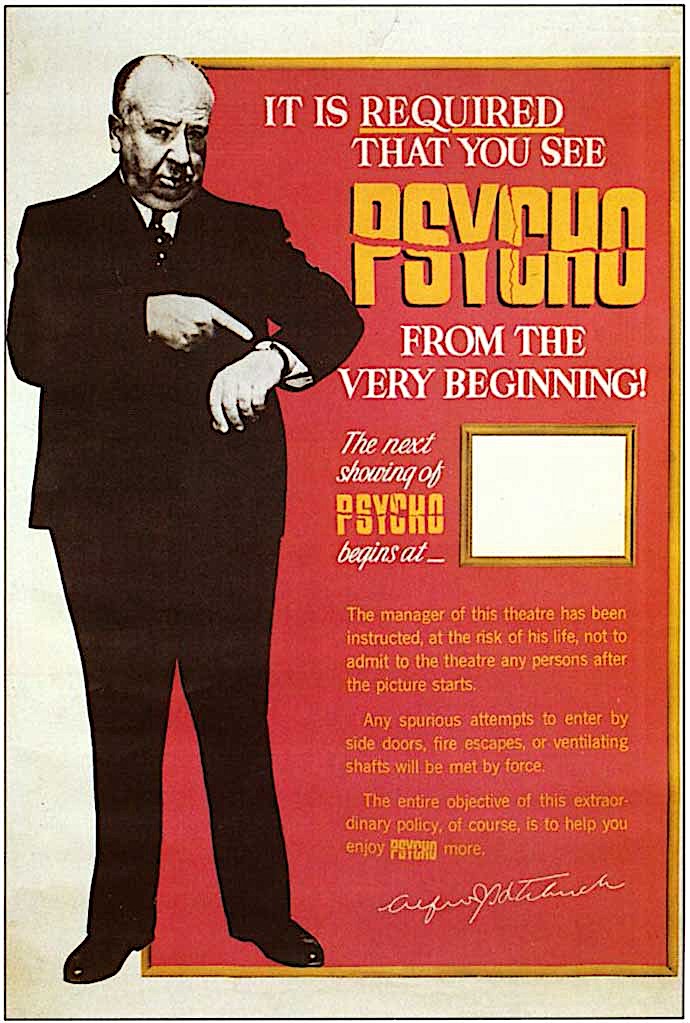
When Psycho hit theaters, Hitchcock controlled the promotion. The stars — Anthony Perkins and Janet Leigh — didn’t make the usual rounds in the media. Critics weren’t given private screenings. And Hitchcock created buzz for the film when he exerted directorial control over the viewing experience of the audience. Showings of the film began on a tightly-controlled schedule in theaters in New York, Chicago, Boston, and Philadelphia. And a firm “no late admission” policy was put in place. You either saw the film from the very beginning, or you didn’t see it all. Signs appeared in front of cinemas reading:
We won’t allow you to cheat yourself. You must see PSYCHO from the very beginning. Therefore, do not expect to be admitted into the theatre after the start of each performance of the picture. We say no one — and we mean no one — not even the manager’s brother, the President of the United States, or the Queen of England (God bless her)!
Theater managers initially balked at the idea, fearing financial losses. But Hitchcock had his way. And he was right. Long lines formed outside the theaters. Psycho enjoyed critical and commercial success, so much so the film was re-released in 1965.
Note: An earlier version of this post appeared on our site in 2012.
If you would like to support the mission of Open Culture, consider making a donation to our site. It’s hard to rely 100% on ads, and your contributions will help us continue providing the best free cultural and educational materials to learners everywhere. You can contribute through PayPal, Patreon, and Venmo (@openculture). Thanks!
Related Content:
The 5 Essential Rules of Film Noir
Watch Alfred Hitchcock Make Cameo Appearances in 37 of His Films
Alfred Hitchcock Reveals The Secret Sauce for Creating Suspense
Read More...How the Avant-Garde Art of Gustav Klimt Got Perversely Appropriated by the Nazis
On paper, the Nazis shouldn’t have liked Gustav Klimt. As gallerist and Youtuber James Payne says in his new Great Art Explained video above, their denunciatory “Degenerate Art Exhibition” of 1937 included the work of “Paul Klee, Otto Dix, Pablo Picasso, Marc Chagall, and Piet Mondrian, as well as Egon Schiele and Oskar Kokoschka” — but somehow not Klimt, “who, at one time or another, had been described as morally questionable, obscene, or even pornographic, and was friends with Jewish patrons, intellectuals, and artists.” And it isn’t as if the Nazis just ignored his work; in fact, they actively pressed a few of his paintings into the service of their ideology.
The search for those paintings, and thus an answer to the question of how they could have been given a pro-Nazi spin, takes Payne to Vienna (this video being part of his Great Art Cities sub-series). It was there that the 22-year-old Klimt — along with his brother Ernst and their friend Franz Mach — received the career-making commission, straight from the emperor himself, to paint a series of ten historical murals on the ceilings and walls of the city’s storied Burgtheater. This made possible Klimt and Mach’s next major mural project for the University of Vienna, though the former’s contributions were rejected by the officials, and later deliberately destroyed by German forces retreating at the war’s end.
Having died in 1918, Klimt never learned of his work’s ultimate fate (much less its more recent reconstruction with artificial intelligence). Even by the time the Nazis rose to power, he’d been dead long enough for them to appropriate his art, and even the much more daring art he made after the University of Vienna debacle. Take his Beethoven Frieze from 1902, a “34-meter-long homage to Beethoven’s Ninth Symphony as interpreted by Richard Wagner: Hitler’s favorite piece of music, often played at Nazi rallies, interpreted by his favorite composer.” That Klimt “celebrates the triumph of idealism over materialism” seems to have represented enough of a philosophical overlap to be useful to the Third Reich.
“In 1943, in Vienna, the Nazis even sponsored the largest-ever retrospective of Klimt’s art.” Indeed, Payne identifies “a Teutonic quality to Klimt’s work that would have appealed to the Nazi aesthetic.” But he could also be portrayed as “part of the Austrian folk tradition” with “German philosophical roots,” and like conventional Nazi artists, Klimt made much use of classical icons and nude bodies. Yet there is little in his life or worldview of which the Nazis could possibly have approved, and even his work itself suggests that he knew full well the dangers of popular appeal. “If you cannot please everyone with your actions and art, you should satisfy a few,” says the quotation from the poet and philosopher Friedrich Schiller incorporated into Klimt’s 1899 painting Nuda Veritas. “To please many is dangerous.”
Related content:
The Nazis’ Philistine Grudge Against Abstract Art and The “Degenerate Art Exhibition” of 1937
Based in Seoul, Colin Marshall writes and broadcasts on cities, language, and culture. His projects include the Substack newsletter Books on Cities, the book The Stateless City: a Walk through 21st-Century Los Angeles and the video series The City in Cinema. Follow him on Twitter at @colinmarshall or on Facebook.
Read More...Why Hiroshima, Despite Being Hit with the Atomic Bomb, Isn’t a Nuclear Wasteland Today
Jan Morris visited Hiroshima in 1959, fourteen years after its devastation by the United States’ atomic bomb. “The city has long been rebuilt, and a new population has flooded in to replace the victims of the holocaust,” she wrote, “but for all the bright new buildings and the broad boulevards, no Pompeii is more surely frozen in its attitude of disaster, and no Mont Pelée more permanently scarred.” Despite the robust urban form and activity around her, she felt “for all the world as though the tall new buildings are not there at all, and the islands of the Ota delta are still blackened and smoking. Assured indeed must be the visitor who has not, just for a fleeting foolish moment, wondered if the stones of Hiroshima were still radioactive, or eyed the running water thoughtfully.”
Today, the very name of Hiroshima still evokes one thing and one thing only, at least to most foreigners. But if those foreigners actually make the trip to that once-destroyed city, it will probably strike them as even more incongruously alive than it did Morris those six decades ago.
Some would imagine that, given that the dropping of the bomb known as “Little Boy” remains just within living memory — its 78th anniversary passed just last Sunday — Hiroshima would be an abandoned nuclear wasteland. Here to explain why it flourishes instead is Youtuber Kyle Hill, whose new video above explains the difference between the long-term effects of nuclear devastation on Hiroshima and those on a place like the region of the Chernobyl nuclear power plant.
“For all the destruction it caused, the Little Boy bomb was terribly inefficient,” Hill says. “Of the bomb’s 64 kilograms of uranium, less than one kilogram underwent fission. This means that “every joule of energy that devastated Hiroshima, a fireball so hot it etched ‘negatives’ of people into concrete, a blast wave so intense, it shattered windows 200 kilometers away, came from less than a gram of matter converted directly into energy.” To the much more powerful nuclear weapons developed since there can be no comparison, even considering that Little Boy (like “Fat Man,” which hit Nagasaki) was detonated high in the air, not on the ground, thus causing relatively little lasting contamination. As a result, there’s no need to feel radiation-related hesitation about visiting Hiroshima. If you go, by all means visit the Hiroshima Peace Memorial Museum, but don’t forget to enjoy an okonomiyaki or two as well.
If you would like to support the mission of Open Culture, consider making a donation to our site. It’s hard to rely 100% on ads, and your contributions will help us continue providing the best free cultural and educational materials to learners everywhere. You can contribute through PayPal, Patreon, and Venmo (@openculture). Thanks!
Related Content:
Watch Chilling Footage of the Hiroshima & Nagasaki Bombings in Restored Color
A Look Into the Wondrous Life & Expansive Work of the Late Jan Morris, Who Wrote the Entire World
Based in Seoul, Colin Marshall writes and broadcasts on cities, language, and culture. His projects include the Substack newsletter Books on Cities, the book The Stateless City: a Walk through 21st-Century Los Angeles and the video series The City in Cinema. Follow him on Twitter at @colinmarshall or on Facebook.
Read More...How to Be a Stoic in Your Everyday Life: Philosophy Professor Massimo Pigliucci Explains
To a viewer on the internet, TED Talks and TEDx talks may seem more or less the same. That makes sense, since the main difference between them isn’t of format, but physical location: TED talks take place at official TED conferences, and TEDx talks at TED-licensed but independently-organized events. The latter are more numerous, and also more geographically varied. Take the talk above from TEDxAthens, the ideal place for speaker Massimo Pigliucci to deliver his opening historical sketch, which he begins by asking his audience to “imagine, if you will, that you’re walking down the streets of Athens 24 centuries ago, give or take.”
In such a setting, “you might meet this guy: Zeno of Citium.” A once-prosperous merchant stranded by a shipwreck, he’d wound up in the Greek metropolis, where he spent his days hanging around bookstores. One day “he read Xenophon’s Memorabilia, which is a book about Socrates, and he was so intrigued that he turned to the bookseller and said, ‘Where I can find me one of these people, one of these philosopher folks?’ ” Luckily for Zeno, the streets of Athens were crawling with philosophers at the time, and it was under their tutelage that he developed his own philosophical acumen to a level that prepared him to found his own school: Stoicism, so named because its members met in the stoa, where the markets set up.
The early Stoics were concerned with everyday life, and how it can be lived “according to nature”: the world’s nature, but also our own. Then, as now, a great many people suffered unnecessarily out of confusion as to where the world ended and they began. They had, in other words, no clear sense of what was under their control and what wasn’t, a condition that the core teachings of Stoicism are designed to rectify. “The idea is that you can do things, you can make decisions about your health, your reputation, et cetera, et cetera, but ultimately, you don’t control the outcome,” Pigliucci explains. In practice, this means that “we should try to walk through life by internalizing our goals — not worry about the outcomes, because those are outside our control, but worry about our intentions and our efforts, because those are very much under our control.”
“Worry” may not be quite the appropriate term. It connotes, in any case, a self-defeating habit that would hardly be condoned by history’s best-known proponents of Stoicism, like the first century Roman statesman and man of letters Seneca, the second-century Roman emperor Marcus Aurelius, and especially the Greek ex-slave Epictetus, whose life bridged those eras. Epictetus believed, as Pigliucci puts it, that “a great part of happiness lies in the serenity,” in “the idea that you always walk through life by knowing that you’ve done your best, and that nothing else could be done on top of that.” We can learn more about how, exactly, to do our best from the work these Stoics left behind, all of which is free online: Epictetus’ Enchiridion, Marcus Aurelius’ Meditations, the collection of Seneca’s writings previously featured here on Open Culture.
Of course, we could also read Pigliucci’s own book, How to Be A Stoic: Using Ancient Philosophy to Live a Modern Life, or even watch “Think Like a Stoic: Ancient Wisdom for Today’s World,” his series from The Great Courses (which is also available through Audible free to its members). Pigliucci is but one of the host of practitioners willing to introduce us to the principles of Stoicism, even these 24 centuries — give or take — after its invention. But whether on the streets of ancient Athens or in the digital labyrinths of the 21st century, the best teachers of this particular philosophy are the vicissitudes of life itself. Whether we can meet them with virtue and equanimity is up to us — and indeed, to put it Stoically, the only thing that’s ever been up to us.
Related content:
Three Huge Volumes of Stoic Writings by Seneca Now Free Online, Thanks to Tim Ferriss
350 Animated Videos That Will Teach You Philosophy, from Ancient to Post-Modern
Based in Seoul, Colin Marshall writes and broadcasts on cities, language, and culture. His projects include the Substack newsletter Books on Cities, the book The Stateless City: a Walk through 21st-Century Los Angeles and the video series The City in Cinema. Follow him on Twitter at @colinmarshall or on Facebook.
Read More...Support Us
We're hoping to rely on loyal readers, rather than erratic ads. Please click the Donate button and support Open Culture. You can use Paypal, Venmo, Patreon, even Crypto! We thank you!

About Us

Open Culture scours the web for the best educational media. We find the free courses and audio books you need, the language lessons & educational videos you want, and plenty of enlightenment in between.
Advertise With Us
FREE UPDATES!
GET OUR DAILY EMAIL
Get the best cultural and educational resources on the web curated for you in a daily email. We never spam. Unsubscribe at any time.
FOLLOW ON SOCIAL MEDIA
Open Culture editor Dan Colman scours the web for the best educational media. He finds the free courses and audio books you need, the language lessons & movies you want, and plenty of enlightenment in between.
Advertise With Us

