Stephen King Creates a List of His 10 Favorite Novels

Image by The USO, via Flickr Commons
If you’ve ever had to name your ten favorite of anything, you know how much trickier such a list is to compose than it sounds. Not because you don’t know of ten books, movies, albums, or what have you, of course, but because you don’t know if the favorites that come to mind today would also come to mind tomorrow. Stephen King, a man apparently often asked for top-however-many lists (see the related posts below for more examples), acknowledges this truth in his approach to the task, as when he drew up this top-ten-favorite-books list for Goodreads:
- Lord of the Flies by William Golding
- Ship of Fools by Katherine Anne Porter
- Watership Down by Richard Adams
- The Orphan Master’s Son by Adam Johnson
- The Hair of Harold Roux by Thomas Williams
- Blood Meridian by Cormac McCarthy
- Invisible Man by Ralph Ellison
- 1984 by George Orwell
- American Pastoral by Philip Roth
- The Lord of the Rings by J.R.R. Tolkien
“Any list like this is slightly ridiculous,” King admits. “On another day, ten different titles might come to mind, like The Exorcist, or All the Pretty Horses in place of Blood Meridian. On another day I’d be sure to include Light in August or Scott Smith’s superb A Simple Plan. The Sea, the Sea, by Iris Murdoch. But what the hell, I stand by these. Although Anthony Powell’s novels should probably be here, especially the sublimely titled Casanova’s Chinese Restaurant and Books Do Furnish a Room. And Paul Scott’s Raj Quartet. And at least six novels by Patricia Highsmith. What about Patrick O’Brian? See how hard this is to let go?”
Thus King, as prolific in his appreciation of novels as he is in his writing of novels, expands his number of selections from ten to at least 28. You can actually compare this list to one he made on another day by having a look at another “all-time favorite book list” of his we featured a few years ago. The common titles between them include Lord of the Flies, Blood Meridian, and 1984. (Light in August and the Raj Quartet also made it onto the list proper.) We might draw from King’s lists the lesson that we shouldn’t sweat tasks like this too much: the important thing isn’t to nail down an unchanging personal canon, but to spread the love across the aesthetic and intellectual spectrum (how many of us would think to name the likes of Roth, Tolkien, Orwell, and Porter all in one place?) and, even more important than that, to simply keep reading.
Related content:
Stephen King’s Top 10 All-Time Favorite Books
Stephen King’s Top 20 Rules for Writers
Stephen King Creates a List of 96 Books for Aspiring Writers to Read
Stephen King’s 22 Favorite Movies: Full of Horror & Suspense
Based in Seoul, Colin Marshall writes and broadcasts on cities and culture. His projects include the book The Stateless City: a Walk through 21st-Century Los Angeles and the video series The City in Cinema. Follow him on Twitter at @colinmarshall or on Facebook.
Read More...Doc Martens Now Come Adorned with William Blake’s Art, Thanks to a Partnership with Tate Britain

On a recent trip to Portland, I found myself at the city’s flagship Pearl District Dr. Martens’ store and was instantly transported back to much younger days when I scrimped and saved to buy my first pair of “Docs” at the local DC punk boutique. Big and clunky, the boots and shoes have been associated with outsider and alternative culture for decades (and, sadly, through no fault of their own, with neo-Nazis, as a recent Portland controversy reminded). The brand has since applied its “AirWair” sole to styles much less evocative of leather-clad punks, but the originals–the eight-eye “1460” boot and three-eye “1461” shoe–will forever retain their iconic status, in the classic colors of black and “oxblood” red.
“Originally a modest work-boot that was even sold as a gardening shoe,” as the company’s history tells it, the nearly indestructible footwear first achieved cult status in working-class British subcultures in the early days of “glam, punk, Two Tone, and early goth.”
The flamboyance of the Dr. Martens’ clientele gave it license to experiment with unorthodox styles, like shiny patent leather in eye-popping colors, an animal print series and, most recently, an artist series, featuring 1460s and 1461s covered in leather reproductions of paintings by artists like Hieronymus Bosch, Giannicola Di Paolo, and William Hogarth (unfortunately all sold out on their website).

One of the recent additions to this pantheon seems like a perfect fit: the William Blake Docs, offering your “choice of gnostic kicks for a night out,” as Dangerous Minds quips. A partnership with Tate Britain, the boot version is wrapped in Blake’s Satan Smiting Job with Sore Boils (c. 1826) and the shoe displays The House of Death (c. 1795). See both paintings below.
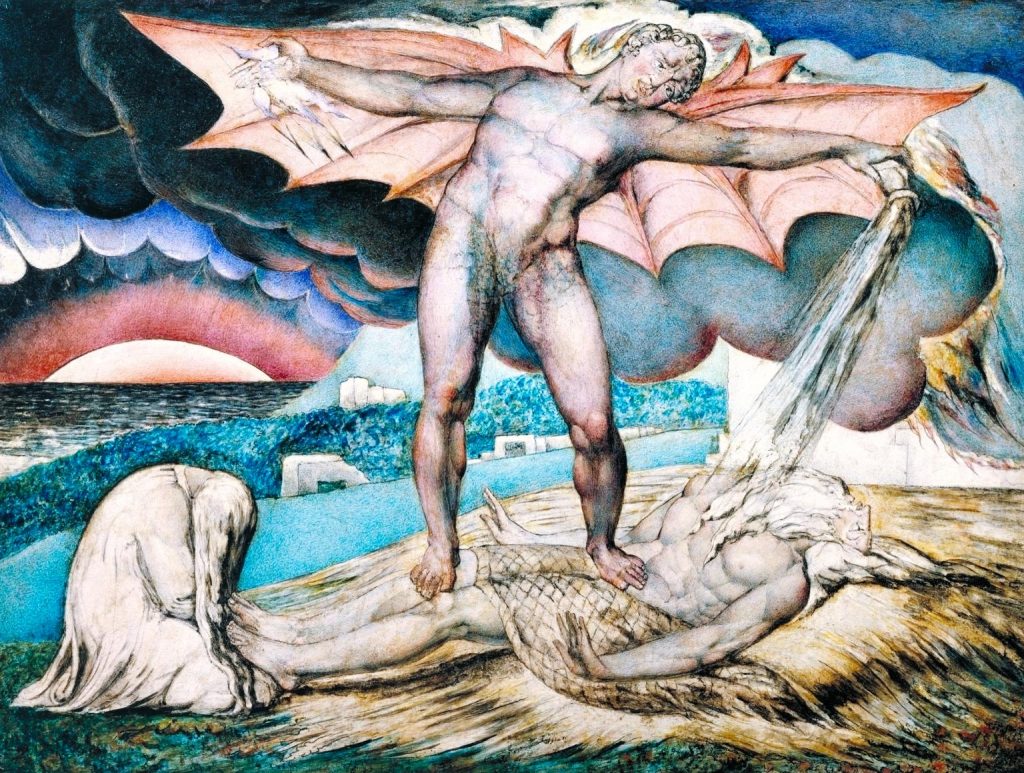
Like another new addition to the artist series—with artwork from J.M.W. Turner—the Blake Dr. Martens draw on the work of a violently original English artist with solidly working-class roots. Unlike his contemporary Turner, Blake spent most of his days in obscurity, creating a DIY visual and poetic mythology rich enough to counter the religious and philosophical hegemony of the day, which was a totally punk rock thing to do in the 18th century.
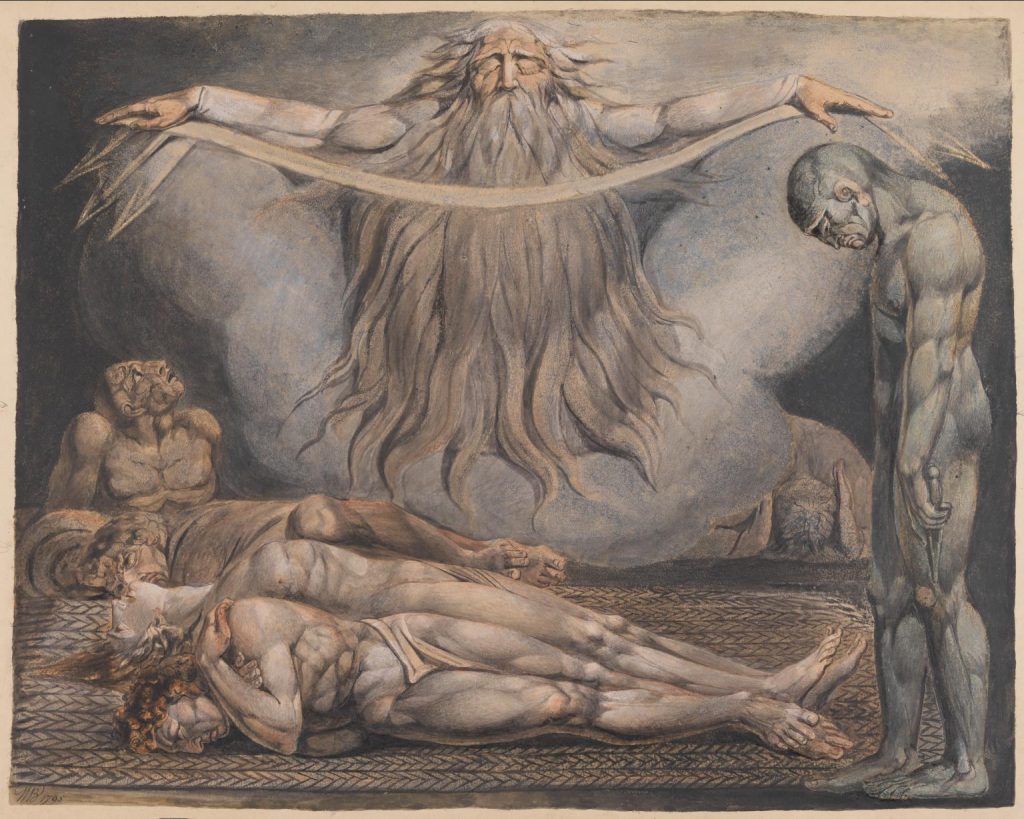
“I must create a system, or be enslaved by another man’s,” Blake wrote. Does the stamping of his iconoclastic artwork on a culturally iconic, commercially successful boot (and shoe, and leather satchel, and T‑shirt) mean that he’s been absorbed into exactly the kind of system he spent his life opposing? Isn’t that just punk’s eternal dilemma.…
See a short film from Tate Britain celebrating their collaboration with Dr. Martens at the shoemaker’s website and see much more William Blake in the Related Content links below.
If you want to snag your own William Blake Dr. Martens, you can find the 3‑Eye Oxfords and 1460 Boot on Amazon.
Related Content:
William Blake’s Hallucinatory Illustrations of John Milton’s Paradise Lost
William Blake’s Masterpiece Illustrations of the Book of Job (1793–1827)
William Blake’s Last Work: Illustrations for Dante’s Divine Comedy (1827)
Josh Jones is a writer and musician based in Durham, NC. Follow him at @jdmagness
Read More...Enter “The Magazine Rack,” the Internet Archive’s Collection of 34,000 Digitized Magazines

Before we kept up with culture through the internet, we kept up with culture through magazines. That historical fact may at first strike those of us over 30 as trivial and those half a generation down as irrelevant, but now, thanks to the Internet Archive, we can all easily experience the depth and breadth of the magazine era as something more than an abstraction or an increasingly distant memory. In keeping with their apparent mission to become the predominant archive of pre-internet media, they’ve set up the Magazine Rack, a downloadable collection of over 34,000 digitized magazines and other monthly publications.
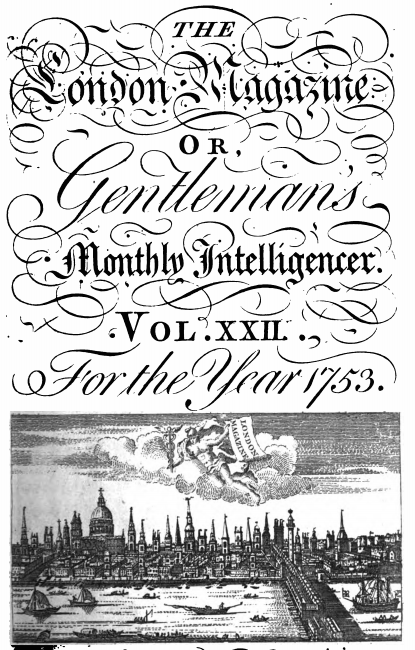
Magazines haven’t gone away, of course, and at the Internet Archive’s Magazine Rack you can do just what you might have done at a traditional magazine rack: flip through brand new issues of publications like Tech Advisor, Aviation History, and America’s Civil War. But quite unlike a traditional magazine rack, where recency was all, you can also read back issues — in some cases quite far-back issues, stretching all the way to the mid-18th century. The London Magazine, or, Gentleman’s Monthly Intelligencer vol. XXII for the Year 1753, the oldest magazine on these digital shelves, offers such articles as “Remarkable accidents,” “Danger of the empire’s being without a head,” and “Life and character of Christina, queen of Sweden.”
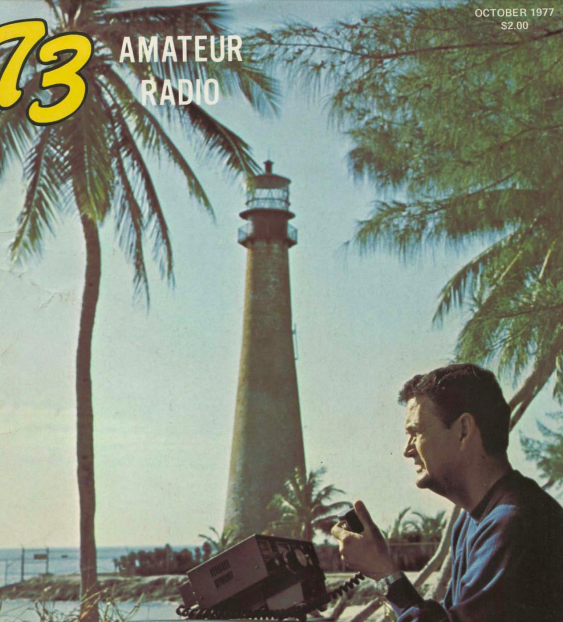
As British magazines of the past go, it also delighted me personally to find in the Magazine Rack many issues of Computer and Video Games (also known as CVG) which did much, given its inexplicable availability at the library of the Seattle suburb where I grew up, to shape my worldview. Other titles catering to “nerdy” interests, broadly speaking, have — perhaps predictably — been archived with a special extensiveness: computer and gaming magazines have their own vast sections, but the collections of early Scientific American, sci-fi fan magazine Starlog, vintage men’s magazines (some, of course, NSFW), and the long-running amateur radio journal 73 Magazine come not far behind.

The Magazine Rack also contains plenty of publications of the kind we tend to reference here on Open Culture, including quite a few titles devoted to pulp fiction, the influential Moebius- and H.R. Giger-featuring “adult fantasy magazine” Heavy Metal, the Hugo Award-winning science fiction magazine IF, and the made-for-PDF-format international art magazine Revolutionart. Spend enough browsing time there and you’ll remember — or learn — that, especially in the print-saturated twentieth century, magazines didn’t just let us keep up with the culture, they helped create it.
Related Content:
Read 1,000 Editions of The Village Voice: A Digital Archive of the Iconic New York City Paper
Based in Seoul, Colin Marshall writes and broadcasts on cities and culture. His projects include the book The Stateless City: a Walk through 21st-Century Los Angeles and the video series The City in Cinema. Follow him on Twitter at @colinmarshall or on Facebook.
Read More...When David Bowie Became Nikola Tesla: Watch His Electric Performance in The Prestige (2006)
Only two major actors have played inventor Nikola Tesla in pop culture: one is John C. Reilly and the other is David Bowie. As much as I love this episode of Drunk History, let’s talk about the Starman himself, who Christopher Nolan cast as Tesla in his 2006 film The Prestige.
By 2005, Bowie was in seclusion. As elucidated in the recent BBC doc, The Last Five Years, the singer was recuperating from a heart attack on his Reality tour, a tour that would turn out to be his last.
Nolan begged Bowie to take the role:
Tesla was this other-worldly, ahead-of-his-time figure, and at some point it occurred to me he was the original Man Who Fell to Earth. As someone who was the biggest Bowie fan in the world, once I made that connection, he seemed to be the only actor capable of playing the part…It took me a while to convince him, though—he turned down the part the first time. It was the only time I can ever remember trying again with an actor who passed on me.
Bowie relented and above you can see his best moment in the film (or *the* best moment in the film)–where Tesla enters through a shower of electricity to greet Robert (Hugh Jackman) and Alley (Andy Serkis). It’s a rock star entrance, for sure.
Nolan continues:
The experience of having him on set was wonderful. Daunting, at first. He had a level of charisma beyond what you normally experience, and everyone really responded to it. I’ve never seen a crew respond to any movie star that way, no matter how big. But he was very gracious and understood the effect he had on people. Everyone has fond memories of getting to spend time with him or speak to him for a little bit. I only worked with him briefly—four or five days—but I did manage to sneak a couple moments to chat with him, which are very treasured memories of mine. Normally when you meet stars, no matter how starry they are, when you see them as people, some of that mystique goes away. But not with David Bowie. I came away from the experience being able to say I was still his biggest fan, and a fan who had the very miraculous opportunity to work with him for a moment. I loved the fact that after having worked with him, I had just the same fascination with his talent and his charisma. I thought that was quite magical.
Despite a very brief role in a film called August and an appearance around the same year on Ricky Gervais’ Extras, this would be Bowie’s last major film role, and really his last filmed appearance until 2013, when he shot promos for The Next Day.
A look at the YouTube comments suggest that many viewers watched The Prestige and had no idea who was playing Tesla. And that might have just tickled the man, playing a magician in recluse high up in the mountains, more in communication with the invisible gods than the mortals.
Related Content:
Watch David Bowie Star in His First Film Role, a Short Horror Flick Called The Image (1967)
Ricky Gervais Creates Outlandish Comedy with David Bowie
David Bowie Sings in a Wonderful M.C. Escher-Inspired Set in Jim Henson’s Labyrinth
Ted Mills is a freelance writer on the arts who currently hosts the artist interview-based FunkZone Podcast and is the producer of KCRW’s Curious Coast. You can also follow him on Twitter at @tedmills, read his other arts writing at tedmills.com and/or watch his films here.
Read More...Brian Eno’s Advice for Those Who Want to Do Their Best Creative Work: Don’t Get a Job
“Once upon a time, artists had jobs,” writes Katy Waldman in a recent New York Times Magazine piece. “Think of T.S. Eliot, conjuring ‘The Waste Land’ (1922) by night and overseeing foreign accounts at Lloyds Bank during the day, or Wallace Stevens, scribbling lines of poetry on his two-mile walk to work, then handing them over to his secretary to transcribe at the insurance agency where he supervised real estate claims.” Or Willem de Kooning painting signs, James Dickey writing slogans for Coca-Cola, William Carlos Williams writing prescriptions, Philip Glass installing dishwashers – the list goes on.
Waldman suggests that we consider day jobs not just bill-paying grinds but delivery systems for “the same replenishing ministries as sleep or a long run: relieving creative angst, restoring the artist to her body and to the texture of immediate experience.” Brian Eno thinks differently. “I often get asked to come and talk at art schools,” he says in the clip above, “and I rarely get asked back, because the first thing I always say is, ‘I’m here to persuade you not to have a job.’ ”
That doesn’t mean, he emphasizes, that you should “try not to do anything. It means try to leave yourself in a position that you do the things you want to do with your time, and where you take maximum advantage of whatever your possibilities are.”
Easier said than done, of course, which is why Eno wants to “work to a future where everybody is in a position to do that,” enacting some form of universal basic income, the general idea of which holds that society will function better if it guarantees all its members a certain standard of living regardless of employment status. But if that standard rises too high, might it run the risk of softening the rigors and loosening the limitations needed to encourage true creativity? Musician Daniel Lanois, who has worked with Eno on the production of several U2 albums as well as ambient music projects, describes learning that lesson from his collaborator in the Louisiana Channel video just above.
“At the peak of my sonic experimentations with Brian Eno, we only ever used four boxes,” says Lanois. “That’s when we started getting these really beautiful textures and human-like sounds from machines. We got to be experts at those few tools.” The limitations under which they worked in the studio may not have followed from any particular philosophy, but the actual experience taught them how a richer artistic result can arise, paradoxically, from more straitened circumstances. Since the beginning of art, its practitioners have always had to find innovative ways around obstacles, whether those obstacles have to do with technology, sides, time, money, or anything else besides. As Lanois reassuringly puts it, “I can imagine that if you have limitation, even financial limitation, that might be okay, man.”
Related Content:
William Faulkner Resigns From His Post Office Job With a Spectacular Letter (1924)
Charles Bukowski Rails Against 9‑to‑5 Jobs in a Brutally Honest Letter (1986)
Brian Eno Explains the Loss of Humanity in Modern Music
The Genius of Brian Eno On Display in 80 Minute Q&A: Talks Art, iPad Apps, ABBA, & MoreBrian Eno on Why Do We Make Art & What’s It Good For?: Download His 2015 John Peel Lecture
The Employment: A Prize-Winning Animation About Why We’re So Disenchanted with Work Today
Hear Alan Watts’s 1960s Prediction That Automation Will Necessitate a Universal Basic Income
Based in Seoul, Colin Marshall writes and broadcasts on cities and culture. His projects include the book The Stateless City: a Walk through 21st-Century Los Angeles and the video series The City in Cinema. Follow him on Twitter at @colinmarshall or on Facebook.
Read More...Patti Smith’s 40 Favorite Books

Image of Patti Smith performing in Rio de Janeiro by Daigo Oliva
As a little girl, Patti Smith found liberation in words — first through the bedtime prayers she made up herself, and later in books. “I was completely smitten by the book,” she writes in her memoir, Just Kids. “I longed to read them all, and the things I read of produced new yearnings.”
Smith found a role model in Jo, the tomboy writer in Louisa May Alcott’s Little Women. “She gave me the courage of a new goal,” writes Smith, “and soon I was crafting little stories and spinning long yarns for my brother and sister.” As a teenager she discovered the French Symbolist poets Charles Baudelaire and especially Arthur Rimbaud, who inspired her and helped shape her own artistic persona as a poet and punk rocker.
Despite her fame as a rock ’n’ roll musician, Smith has always described herself as essentially a bookish person. It was around the time of Smith’s appearance at the 2008 Melbourne International Arts Festival, according to Vertigo, that Smith released this list of her favorite books. Not surprisingly, it’s an eclectic and fascinating group of books:
- The Master and Margarita
 by Mikhail Bulgakov
- Journey to the East by Hermann Hesse
- The Glass Bead Game by Hermann Hesse
- Heart of Darkness by Joseph Conrad
- Moby Dick by Herman Melville
- Billy Budd by Herman Melville
- Songs of Innocence by William Blake
- The Wild Boys by William Burroughs
- Howl by Allen Ginsberg
- A Season in Hell by Arthur Rimbaud
- Illuminations by Arthur Rimbaud
- Wittgenstein’s Poker by David Edmonds and John Eidinow
- Villette by Charlotte Bronte
- The Process by Brion Gysin
- Cain’s Book by Alexander Trocchi
- Coriolanus by William Shakespeare
- The Happy Prince by Oscar Wilde
- The Sheltering Sky by Paul Bowles
- Against Interpretation by Susan Sontag
- The Oblivion Seekers by Isabelle Eberhardt
- The Women of Cairo by Gérard de Nerval
- Under the Volcano by Malcolm Lowry
- Dead Souls by Nikolai Gogol
- The Book of Disquiet by Fernando Pessoa
- The Death of Virgil by Hermann Broch
- Raise High the Roof Beam, Carpenters by J.D. Salinger
- Franny and Zooey by J.D. Salinger
- The Scarlet Letter by Nathaniel Hawthorne
- A Night of Serious Drinking by René Daumal
- Swann in Love by Marcel Proust
- A Happy Death by Albert Camus
- The First Man by Albert Camus
- The Waves by Virginia Woolf
- Big Sur by Jack Kerouac
- Anything by H.P. Lovecraft
- Anything by W.G. Sebald
- The Thief’s Journal or anything by Jean Genet
- The Arcades Project or anything by Walter Benjamin
- Poet in New York by Federico García Lorca
- The Lost Honor of Katharina Blum by Heinrich Böll
- The Palm-Wine Drinkard by Amos Tutuola
- Ice or anything by Anna Kavan
- The Divine Proportion by H.E. Huntley
- Nadja by André Breton
 by Mikhail Bulgakov
 by Hermann Hesse
 by Hermann Hesse
 by Joseph Conrad
 by Herman Melville
 by Herman Melville


 by William Blake
 by William Burroughs
 by Allen Ginsberg
 by Arthur Rimbaud

 by Arthur Rimbaud
 by David Edmonds and John Eidinow
 by Charlotte Bronte
 by Brion Gysin
 by Alexander Trocchi
 by William Shakespeare
 by Paul Bowles
 by Susan Sontag
 by Gérard de Nerval
 by Malcolm Lowry
 by Fernando Pessoa
 by Hermann Broch
 by J.D. Salinger
 by J.D. Salinger
 by René Daumal
 by Albert Camus
 by Albert Camus
 by Virginia Woolf
 or anything by Jean Genet
 or anything by Walter Benjamin
 by Heinrich Böll
 by Amos Tutuola
 or anything by Anna Kavan
 by H.E. Huntley
 by André Breton
Smith’s reading recommendations have no doubt evolved since the list was given. Earlier this year a writer for Elle asked what books she would suggest. “I could recommend a million,” Smith responded. “I would just say read anything by [Roberto] Bolaño. Re-read all the great classics. Read The Scarlet Letter, read Moby Dick, read [Haruki] Murakami. But Roberto Bolaño’s 2666 is the first masterpiece of the 21st century.”
You can find a number of the texts listed above in our collection, 800 Free eBooks for iPad, Kindle & Other Devices.
Note: An earlier version of this post appeared on our site in April 2015.
Related Content:
Hayao Miyazaki Picks His 50 Favorite Children’s Books
29 Lists of Recommended Books Created by Well-Known Authors, Artists & Thinkers
Read More...How Bill Gates Reads Books
If you’re a dedicated reader of our site, you know that we’ve periodically highlighted Bill Gates’ favorite books. (See his lists from 2015, 2016 and 2017, plus this recommendation made earlier this year.) You also know that his reading diet skews heavily towards non-fiction–towards books like Enlightenment Now by Steven Pinker, Sapiens: A Brief History of Humankind by Noah Yuval Harari, and Mindset: The New Psychology of Success by Carol S. Dweck.
That’s what Gates likes to read. But how about how he reads? How does Gates get the most out of his time spent reading? As he explains in the Quartz video above, it boils down to this:
- Take Notes in the Margins: That simple step helps ensure that you’re really paying attention and engaging critically with the text. It lets you “take in new knowledge and attach it to knowledge you already have.”
- Don’t Start What You Can’t Finish: Gates doesn’t explain why you should never cut your losses. Maybe it’s a form of self-discipline. Maybe it’s a fear of missing out on what a book promises to deliver. Or maybe it’s the sunk cost fallacy. Either way, Gates does recommend picking your books carefully before you get started.
- Paper Books, Not eBooks: Better for marginalia, for sure.
- Block Out an Hour of Reading Time: You can’t read a serious book in a short sitting. To really engage with a book, give it a good hour each day. A tall order, I known, in our age of ever-declining attention spans.
To be sure, you have your own reading practices to recommend. Please don’t hesitate to add them to the comments section below.
If you would like to support the mission of Open Culture, consider making a donation to our site. It’s hard to rely 100% on ads, and your contributions will help us continue providing the best free cultural and educational materials to learners everywhere. You can contribute through PayPal, Patreon, and Venmo (@openculture). Thanks!
Related Content:
Bill Gates, Book Critic, Names His Top 5 Books of 2015
Six Books (and One Blog) Bill Gates Wants You to Read This Summer
Take Big History: A Free Short Course on 13.8 Billion Years of History, Funded by Bill Gates
View Bill Gates’ Mobile Library: The Books & Courses That Help Him Change The World
Read More...The 1,700+ Words Invented by Shakespeare*
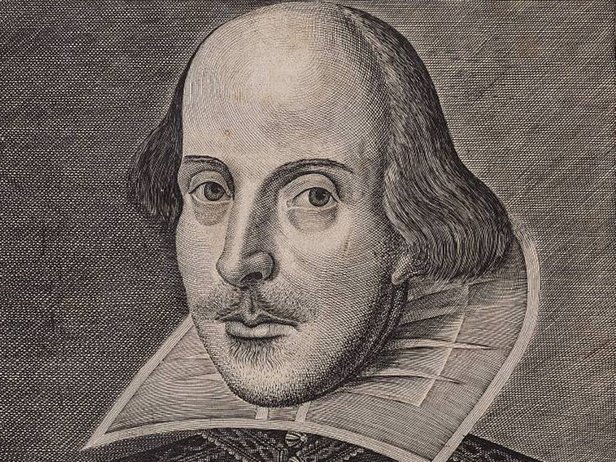
One of the favorite reference books on my shelves isn’t a style guide or dictionary but a collection of insults. And not just any collection of insults, but Shakespeare’s Insults for Teachers, an illustrated guide through the playwright’s barbs and put-downs, designed to offer comic relief to the beleaguered educator. (Books and websites about Shakespeare’s insults almost constitute a genre in themselves.) I refer to this slim, humorous hardback every time discussions of Shakespeare get too ponderous, to remind myself at a glance that what readers and audiences have always valued in his work is its lightning-fast wit and inventiveness.
While perusing any curated selection of Shakespeare’s insults, one can’t help but notice that, amidst the puns and bawdy references to body parts, so many of his wisecracks are about language itself—about certain characters’ lack of clarity or odd ways of speaking. From Much Ado About Nothing there’s the colorful, “His words are a very fantastical banquet, just so many strange dishes.” From The Merchant of Venice, the sarcastic, “Goodly Lord, what a wit-snapper you are!” From Troilus and Cressida, the derisive, “There’s a stewed phrase indeed!” And from Hamlet the subtle shade of “This is the very coinage of your brain.”
Indeed, it can often seem that Shakespeare—if we grant his historicity and authorship—is often writing self-deprecating notes about himself. “It is often said,” writes Fraser McAlpine at BBC America, that Shakespeare “invented a lot of what we currently call the English language…. Something like 1700 [words], all told,” which would mean that “out of every ten words,” in his plays, “one will either have been new to his audience, new to his actors, or will have been passingly familiar, but never written down before.” It’s no wonder so much of his dialogue seems to carry on a meta-commentary about the strangeness of its language.
We have enough trouble understanding Shakespeare today. The question McAlpine asks is how his contemporary audiences could understand him, given that so much of his diction was “the very coinage” of his brain. Lists of words first used by Shakespeare can be found aplently. There’s this catalog from the exhaustive multi-volume literary reference The Oxford English Dictionary, which lists such now-everyday words as “accessible,” “accommodation,” and “addiction” as making their first appearance in the plays. These “were not all invented by Shakespeare,” the list disclaims, “but the earliest citations for them in the OED” are from his work, meaning that the dictionary’s editors could find no earlier appearance in historical written sources in English.
Another shorter list links to an excerpt from Charles and Mary Cowden Clarke’s The Shakespeare Key, showing how the author, “with the right and might of a true poet… minted several words” that are now current, or “deserve” to be, such as the verb “articulate,” which we do use, and the noun “co-mart”—meaning “joint bargains”—which we could and maybe should. At ELLO, or English Language and Linguistics Online, we find a short tutorial on how Shakespeare formed new words, by borrowing them from other languages, or adapting them from other parts of speech, turning verbs into nouns, for example, or vice versa, and adding new endings to existing words.
“Whether you are ‘fashionable’ or ‘sanctimonious,’” writes National Geographic, “thank Shakespeare, who likely coined the terms.” He also apparently invented several phrases we now use in common speech, like “full circle,” “one fell swoop,” “strange bedfellows,” and “method in the madness.” (In another BBC America article, McAlpine lists 45 such phrases.) The online sources for Shakespeare’s original vocabulary are multitude, but we should note that many of them do not meet scholarly standards. As linguists and Shakespeare experts David and Ben Crystal write in Shakespeare’s Words, “we found very little that might be classed as ‘high-quality Shakespearean lexicography’” online.
So, there are reasons to be skeptical about claims that Shakespeare is responsible for the 1700 or more words for which he’s given sole credit. (Hence the asterisk in our title.) As noted, a great many of those words already existed in different forms, and many of them may have existed as non-literary colloquialisms before he raised their profile to the Elizabethan stage. Nonetheless, it is certainly the case that the Bard coined or first used hundreds of words, writes McAlpine, “with no obvious precedent to the listener, unless you were schooled in Latin or Greek.” The question, then, remains: “what on Earth did Shakespeare’s [mostly] uneducated audience make of this influx of newly-minted language into their entertainment?”
McAlpine brings those potentially stupefied Elizabethans into the present by comparing watching a Shakespeare play to watching “a three-hour long, open air rap battle. One in which you have no idea what any of the slang means.” A good deal would go over your head, “you’d maybe get the gist, but not the full impact,” but all the same, “it would all seem terribly important and dramatic.” (Costuming, props, and staging, of course, helped a lot, and still do.) The analogy works not only because of the amount of slang deployed in the plays, but also because of the intensity and regularity of the boasts and put-downs, which makes even more interesting one data scientist’s attempt to compare Shakespeare’s vocabulary with that of modern rappers, whose language is, just as often, the very coinage of their brains.
Related Content:
Do Rappers Have a Bigger Vocabulary Than Shakespeare?: A Data Scientist Maps Out the Answer
What Shakespeare’s English Sounded Like, and How We Know It
Josh Jones is a writer and musician based in Durham, NC. Follow him at @jdmagness.
Read More...Japanese Designer Creates Incredibly Detailed & Realistic Maps of a City That Doesn’t Exist

When he first spent time in Japanese cities, urban design and history professor Barrie Shelton “was baffled, irritated, and even intimidated by what I saw. Yet at the same time I found myself energized, animated, and indeed inspired by them. The effect was liberating and my intuition was quick to suggest that further exploration of their chaotic vitality might be extremely rewarding.” That exploration involved visits to “alleys, shrine and temple precincts, highways, railway stations (and their ‘magnetic’ fields), roof-tops, observation decks, arcades, underground streets, bars, gardens,” and so on, and no less essentially included “almost compulsive poring over city maps (old and new).”

It all culminated in Shelton’s book Learning from the Japanese City, a study that can help any Westerner better understand the likes of Tokyo, Osaka, Kyoto, Kanazawa, Hiroshima, Fukuoka, or indeed Nagomuru City. You won’t find that last, however, on any map of Japan, nor will you find it in the country itself. It exists in the land of Naira, which itself exists in the mind of Japanese graphic designer and cartographer Imaizumi Takayuki. Imaizumi’s painstaking, ongoing work has produced maps of Nagomuru City that look at it in different ways in different eras, which you can browse on Let’s Go to the Imaginary Cities! On this page you can explore scrollable maps of the city by first selecting one of its thirty regions; just below that, you can also download a large PDF map of the entire metropolis.

Imaizumi’s urban cartographic vision is so richly realized that it has produced art exhibitions, a book, and even a variety of physical artifacts. On one page, for instance, you’ll find photographs of the contents of several imaginary wallets lost on the imaginary streets of Nagomuru City by its imaginary citizens. On another appear the imaginary cash cards issued by the imaginary Nagomuru Bank, complete with a pair of imaginary mascots without which, as anyone with any experience of Japan knows, no card would be complete. These artifacts and others have all come as a result of the project Imaizumi began at just ten years old, a brief history of which Japanese-readers can take in here.

“If I can imagine a fictive nation,” writes Roland Barthes in Empire of Signs, “I can give it an invented name, treat it declaratively as a novelistic object,” then “isolate somewhere in the world (faraway) a certain number of features (a term employed in linguistics), and out of all these features deliberately form a system. It is this system which I call: Japan.” Imaizumi chose to call his system Nagomuru City, but one imagines that all its carefully created and positioned features and details — the train lines and stations, the shrines and temples, the housing developments, the convenience stores, all the things celebrated in both Empire of Signs and Learning from the Japanese City — would have fired up Barthes’ imagination just as much as did the real Japan.
via Metafilter
Related Content:
Invisible Cities Illustrated: Three Artists Paint Every City in Italo Calvino’s Classic Novel
William Faulkner Draws Maps of Yoknapatawpha County, the Fictional Home of His Great Novels
Japanese Designers May Have Created the Most Accurate Map of Our World: See the AuthaGraph
Artist Re-Envisions National Parks in the Style of Tolkien’s Middle Earth Maps
Based in Seoul, Colin Marshall writes and broadcasts on cities and culture. His projects include the book The Stateless City: a Walk through 21st-Century Los Angeles and the video series The City in Cinema. Follow him on Twitter at @colinmarshall or on Facebook.
Read More...The Models for “American Gothic” Pose in Front of the Iconic Painting (1942)
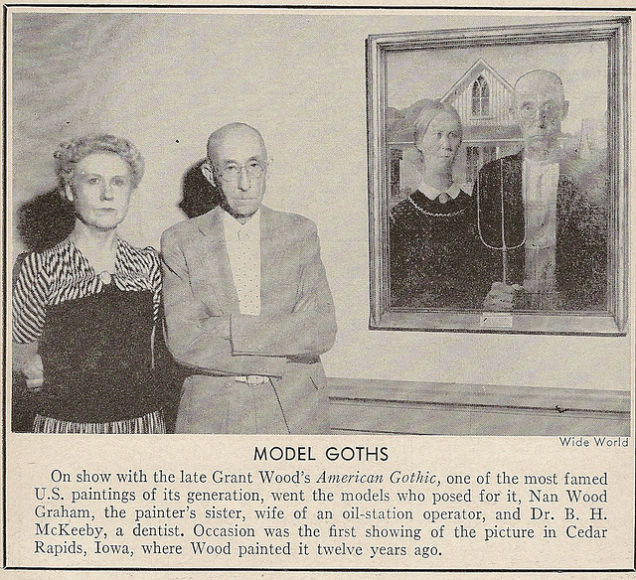
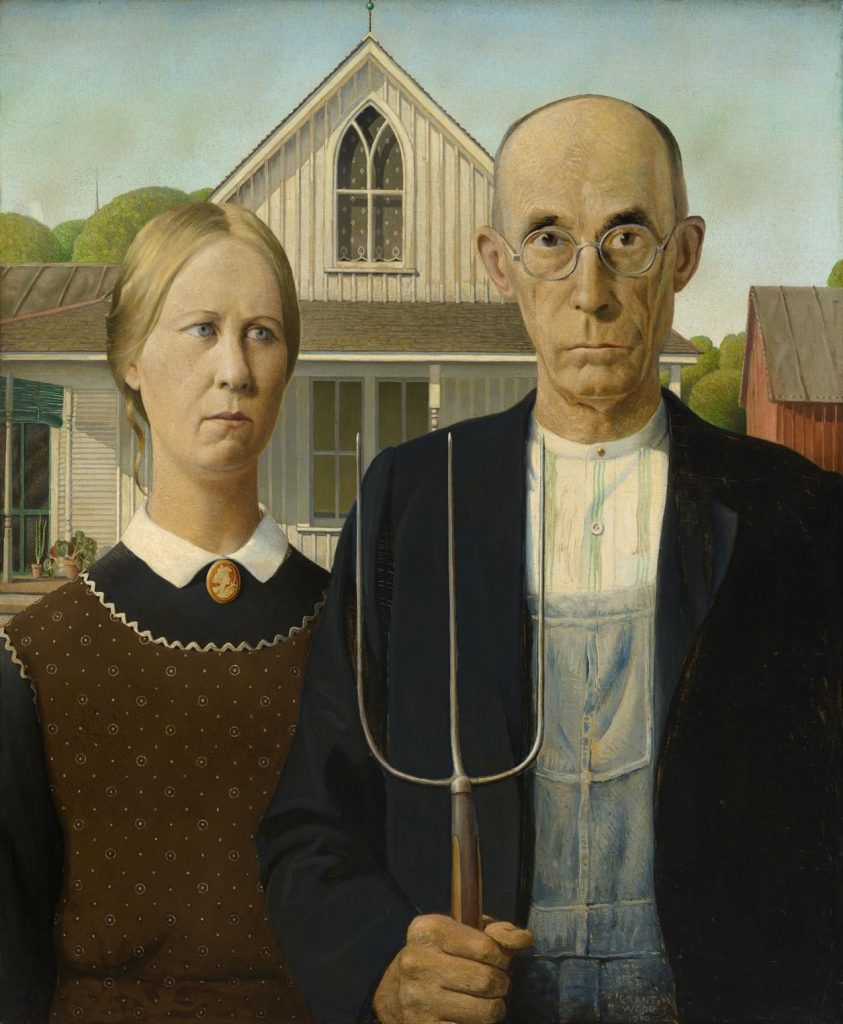
Grant Wood’s “American Gothic” now hangs at the Art Institute of Chicago. And on the museum’s website you’ll find a little background information introducing you to the iconic 1930 painting:
The impetus for the painting came while Wood was visiting the small town of Eldon in his native Iowa. There he spotted a little wood farmhouse, with a single oversized window, made in a style called Carpenter Gothic. [See it here.] “I imagined American Gothic people with their faces stretched out long to go with this American Gothic house,” he said. He used his sister and his dentist as models for a farmer and his daughter, dressing them as if they were “tintypes from my old family album.” The highly detailed, polished style and the rigid frontality of the two figures were inspired by Flemish Renaissance art, which Wood studied during his travels to Europe between 1920 and 1926. After returning to settle in Iowa, he became increasingly appreciative of midwestern traditions and culture, which he celebrated in works such as this. American Gothic, often understood as a satirical comment on the midwestern character, quickly became one of America’s most famous paintings and is now firmly entrenched in the nation’s popular culture. Yet Wood intended it to be a positive statement about rural American values, an image of reassurance at a time of great dislocation and disillusionment. The man and woman, in their solid and well-crafted world, with all their strengths and weaknesses, represent survivors.
Above, you can see Wood’s sister and dentist–otherwise known as Nan Wood Graham and Dr. B.H. McKeeby–posing in front of “American Gothic” in 1942. That’s when the painting first went on display in its hometown, Cedar Rapids, Iowa. It’s a fairly meta moment. Graham and McKeeby look downright dour in the picture, just as in the painting.
Grant Wood died of pancreatic cancer in ’42, and his sister eventually moved to Northern California, where she became the caretaker of his legacy. She did, after all, owe him a debt. “Grant made a personality out of me,” she said. “I would have had a very drab life without [American Gothic].”
If you would like to support the mission of Open Culture, consider making a donation to our site. It’s hard to rely 100% on ads, and your contributions will help us continue providing the best free cultural and educational materials to learners everywhere. You can contribute through PayPal, Patreon, and Venmo (@openculture). Thanks!
Related Content:
Whitney Museum Puts Online 21,000 Works of American Art, By 3,000 Artists
Smithsonian Digitizes & Lets You Download 40,000 Works of Asian and American Art
Read More...Support Us
We're hoping to rely on loyal readers, rather than erratic ads. Please click the Donate button and support Open Culture. You can use Paypal, Venmo, Patreon, even Crypto! We thank you!

About Us

Open Culture scours the web for the best educational media. We find the free courses and audio books you need, the language lessons & educational videos you want, and plenty of enlightenment in between.
Advertise With Us

FREE UPDATES!
GET OUR DAILY EMAIL
Get the best cultural and educational resources on the web curated for you in a daily email. We never spam. Unsubscribe at any time.
FOLLOW ON SOCIAL MEDIA

Open Culture editor Dan Colman scours the web for the best educational media. He finds the free courses and audio books you need, the language lessons & movies you want, and plenty of enlightenment in between.
Advertise With Us