Watch 11-Year-Old Billy Preston Duet with Nat King Cole: A Star is Born (1957)
The Beatles aren’t the only fab talents causing a stir in the recently released Beatles documentary, Get Back.
As has been widely noted, soul singer Billy Preston lights up every scene he’s in.
One of the 60’s finest session keyboardists, Preston contributed to the Beatles’ Let It Be and Abbey Road albums, and joined them for their famous final gig on the roof of Apple Records.
He also served as a leveling influence when tensions within the band frequently exploded into fits of temper.
“It’s interesting to see how nicely people behave when you bring a guest in,” George Harrison observed.
In addition to his successful solo career, with a number of funk and R&B hits, Preston gigged for a host of all time greats: Ray Charles, Little Richard, Sam Cooke, Miles Davis, Aretha Franklin, the Rolling Stones…the list goes on.
A childhood prodigy who never took a music lesson, by 10, he was backing gospel luminaries like Mahalia Jackson, James Cleveland, and Andraé Crouch.
A year later, he entered America’s living rooms, when he appeared on The Nat King Cole Show, above, to duet with TV’s first national Black variety show host on “Blueberry Hill,” a 40s tune Fats Domino had popularized earlier in the decade.
“You have a very excellent career ahead of you,” Cole predicts, following their performance.
Daughter Natalie Cole later enthused that the celebrated crooner “lets this kid have all the glory,” though the self-possessed pre-teen holds his own ably, alternating between organ and his own impressive pipes.
Within the year, Cole and Preston shared the big screen, and a memorable part, when they were cast as “The Father Of The Blues” W.C. Handy, as a child and adult, in the 1958 movie St Louis Blues.
As an adult, Preston’s star was tarnished by addiction, arrests and self-sabotaging behavior that his manager, Joyce Moore, and half-sister Lettie, said was most deeply rooted in his mother’s refusal to believe that he was being sexually abused by the pianist of a summer touring company, and later a local pastor.
It’s part of a lurid, longer tale, calling to mind other promising, oft-prodigious young talents who never managed to get out from under damage inflicted by adults when they were children.
He was 9.
Related Content:
Watch Paul McCartney Compose The Beatles Classic “Get Back” Out of Thin Air (1969)
Ayun Halliday is the Chief Primaologist of the East Village Inky zine and author, most recently, of Creative, Not Famous: The Small Potato Manifesto. Follow her @AyunHalliday.
Read More...Mark Rothko’s Seagram Murals: What Makes Them Great Art
It is precisely the possibility of exercising choice wherein our lot differs from that of the artists of the past. For choice implies responsibility to one’s conscience, and, in the conscience of the artist, the Truth of Art is foremost. — Mark Rothko
Born Marcus Rothkowitz in 1903, the painter Mark Rothko immigrated with his family from Russia at age 10, fleeing the persecution of Jews in his home country. He grew up poor in Portland, Oregon, won a scholarship to Yale in 1921, but “found himself once more an outsider, stigmatized as a Jew,” says James Payne in the Great Art Explained video above. Feeling alienated and disaffected, he dropped out and moved to New York (to the dismay of his family), “to wander around,” he later wrote, ”bum about, starve a bit,” and paint. He co-founded a group of modern artists who exhibited frequently together and won critical attention, but Rothko struggled financially into middle age and only began selling his work during the “color field” period that made him famous in the 1950s.
It wasn’t until 1958 that Rothko received his first major commission, for what would become the Seagram Murals, so-called because they were meant for the luxurious Four Seasons restaurant in the newly-built Seagram Building on Park Avenue, a glittering symbol of New York’s opulence, designed by architects Mies van der Rohe and Philip Johnson and filled with paintings by Rothko’s contemporaries. Rothko spent two years working on the project, a series of paintings to fill the restaurant’s smaller, exclusive dining room. He produced a total of 30 panels, seven of which were to fit together in the restaurant. Then, almost two years after receiving the commission for $35,000 (roughly $334,000 today), he abruptly changed his mind, returned the money, and withdrew the works.
Ten years after Rothko’s decision, “on the 25th of February 1970,” Payne tells us, “the Tate gallery in London received nine Mark Rothko canvases” — panels from the Seagram Murals collection — “a generous donation from the artist himself. A few hours later, Rothko was found dead in his studio on East 69th Street in Manhattan. The 66-year old painter had taken his own life…. His suicide would change everything, and shape the way we respond to his work.” But perhaps it’s not that tragic event that best provides us with an understanding of the artist’s motivations. “Rothko’s contract with society was not torn up that day in 1970,” argues Jonathan Jones at The Guardian, “but a decade earlier, in 1959,” when Rothko, “intense, solitary, leftwing, used to poverty and failure,” conceived of an art to “harrow” well-heeled diners at the Four Seasons.
Rothko explicitly modeled the Seagram Mural project after what he called the “somber vault” of Michelangelo’s Laurentian Library in Florence, which he visited on a trip to Italy in 1959. “He achieved just the kind of feeling I’m after,” said Rothko. “He makes the viewers feel that they are trapped in a room where all the doors and windows are bricked up, so that all they can do is butt their heads forever against the wall.” Abandoning the brighter color schemes of his past works, he turned to blacks, reds, and maroons, a palette drawn from mosaic walls he’d seen in a Pompeiian villa. Rothko reportedly told journalist John Fischer, an editor at Harper’s, “I hope to ruin the appetite of every son of a bitch who ever eats in that room.” Aware of how his color field paintings moved viewers, often to tears, he hoped the murals would amplify the effect to an unpalatable degree.
Instead, when Rothko himself dined at the Four Seasons for the first and only time, he spoiled his own appetite for the commission. “Anybody who will eat that kind of food for those kinds of prices will never look at a painting of mine,” he told his assistant. That very evening he withdrew the paintings. “The fact that Rothko accepted the commission in the first place is puzzling,” Shira Wolfe writes at Artland. “He was revolted by capitalist America, and felt disdain towards anyone who contributed to it – and the Four Seasons Restaurant, in New York’s swankiest skyscraper, was destined to become the very epitome of America’s capitalism.” From its beginnings, the artist “felt ambivalent about the commission, and had a contract drawn up which would allow him to back out of the deal and retrieve his paintings if necessary.”
It was the necessity of choice, even in the face of poverty and obscurity, that most moved Rothko, as he wrote in a manuscript from the 1940s, posthumously published by his son Christopher Rothko as The Artist’s Reality: Philosophies of Art. In the book, Rothko contrasts the modern artist’s fate with that of artists of the past who lived by the whims of dukes, kings, and popes.
It will be pointed out that the artist’s lot is the same today, that the market, through its denial or affording of the means of sustenance, exerts the same compulsion. Yet there is this vital difference: the civilizations enumerated above had the temporal and spiritual power to summarily enforce their demands. The Fires of Hell, exile, and, in the background, the rack and stake, were correctives if persuasion failed. Today the compulsion is Hunger, and the experience of the last four hundred years has shown us that hunger is not nearly as compelling as the imminence of Hell and Death. Since the passing of the spiritual and temporal patron, the history of art is the history of men who, for the most part, have preferred hunger to compliance, and who have considered the choice worthwhile. And choice it is, for all the tragic disparity between the two alternatives.
Rothko was “obviously torn between his hatred for the wealth and greed of capitalism and his desire to create his own special place for his art,” writes Wolfe. In the year after his death, just such a place would open, a mural project that realized a very different set of intentions.
Originally a collaboration between Philip Johnson and Rothko – until the architect bowed out due to the painter’s peculiar vision – the non-sectarian Rothko Chapel in Houston debuted in late February 1971. An octagonal, cloistered building with fourteen large Rothko murals, the Chapel was commissioned by collector and patron Dominique de Menil when she saw the Seagram Murals taking shape in Rothko’s purpose-built New York studio. It’s possible, and perhaps morbidly tempting, to judge Rothko’s work by the tragedy of his final personal act, but he had more to say in his work after death. In the Seagram Murals, Rothko attempted to realize a philosophy of art he had articulated years earlier in The Artist’s Reality: “The law of Authority,” whether that of the Church, the State, or the Market, “has this saving grace; it can be circumnavigated.”
Related Content:
The MoMA Teaches You How to Paint Like Pollock, Rothko, de Kooning & Other Abstract Painters
Josh Jones is a writer and musician based in Durham, NC. Follow him at @jdmagness
Read More...
Albertus Seba’s Cabinet of Natural Curiosities: Discover One of the Most Prized Natural History Books of All Time (1734–1765)
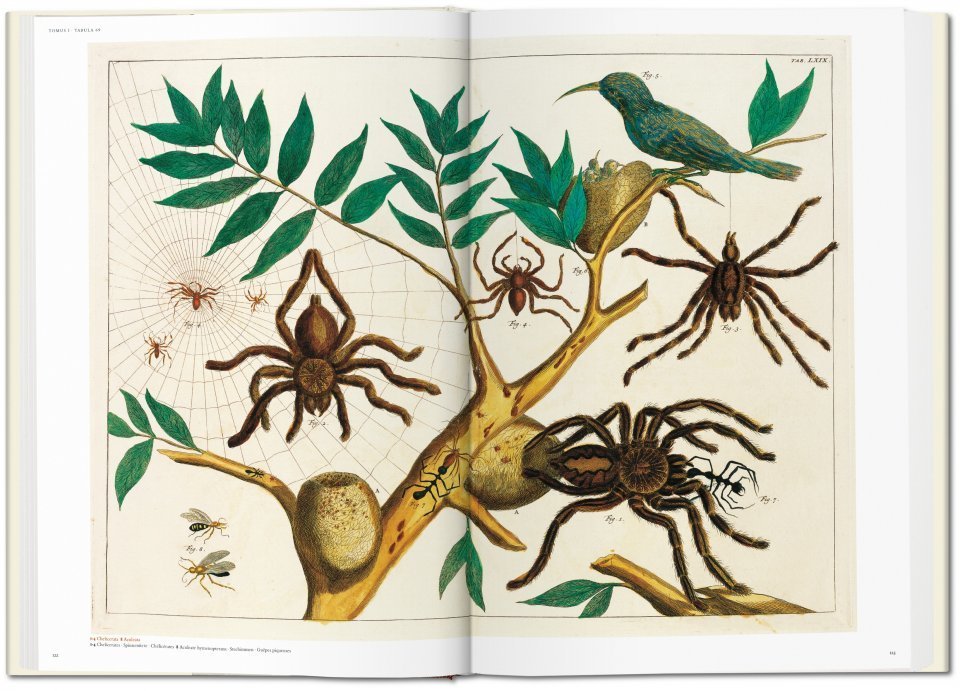
In the eighteenth century, a European could know the world in great detail without ever leaving his homeland. Or he could, at least, if he got into the right industry. So it was with Albertus Seba, a Dutch pharmacist who opened up shop in Amsterdam just as the eighteenth century began. Given the city’s prominence as a hub of international trade, which in those days was mostly conducted over water, Seba could acquire from the crew members of arriving ships all manner of plant and animal specimens from distant lands. In this manner he amassed a veritable private museum of the natural world.
The “cabinets of curiosities” Seba put together — as collectors of wonders did in those days — ranked among the largest on the continent. But when he died in 1736, his magnificent collection did not survive him. He’d already sold much of it twenty years earlier to Peter the Great, who used it as the basis for Russia’s first museum, the Kunstkammer in St. Petersburg.
What remained had to be auctioned off in order to fund one of Seba’s own projects: the Locupletissimi rerum naturalium thesauri accurata descriptio, or “Accurate description of the very rich thesaurus of the principal and rarest natural objects,” pages of which you can view at the Public Domain Review and the Metropolitan Museum of Art.
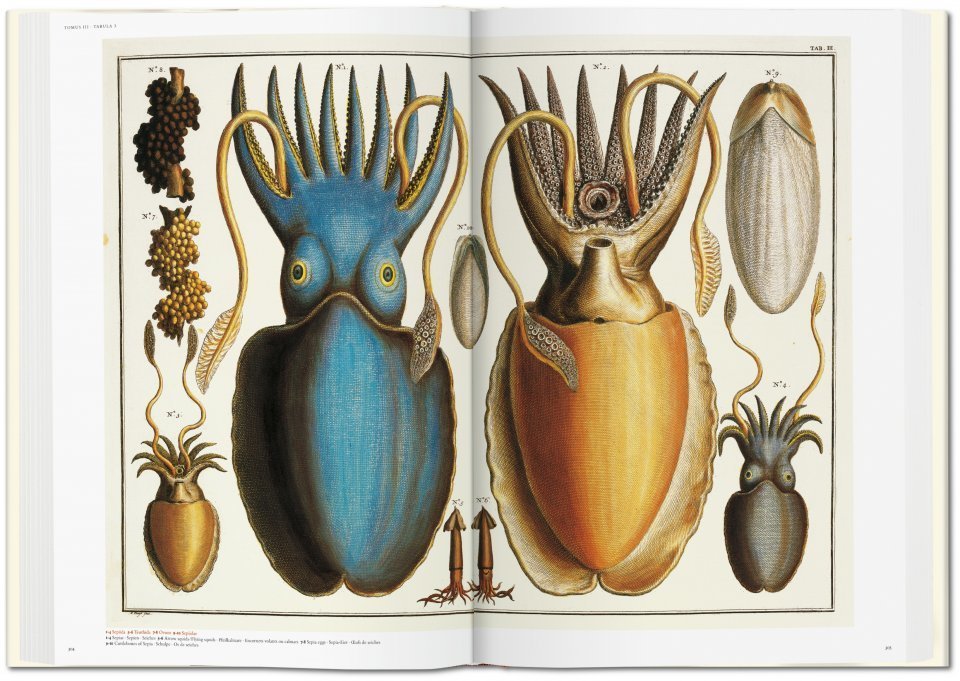
This four-volume set of books constituted an attempt to catalog the variety of living things on Earth, a formidable endeavor that Seba was nevertheless well-placed to undertake, rendering each one in engravings made lifelike by their depth of color and detail. The lavish production of the Thesaurus (more recently replicated in the condensed form of Taschen’s Cabinet of Natural Curiosities) presented a host of challenges both physical and economic. But there was also the intellectual problem of how, exactly, to organize all its textual and visual information. As originally published, it groups its specimens by physical similarities, in a manner vaguely similar to the much more influential system published by Swedish scientist Carl Linnaeus in 1735.
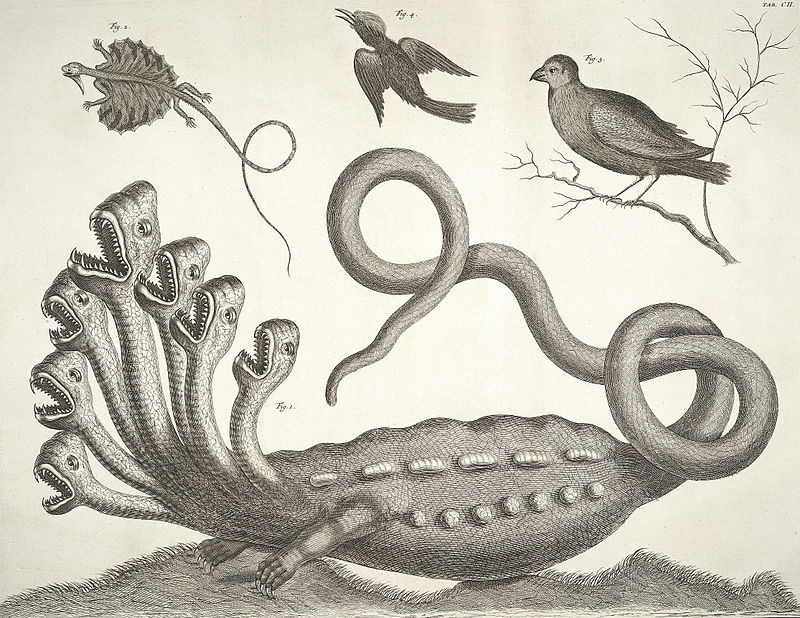
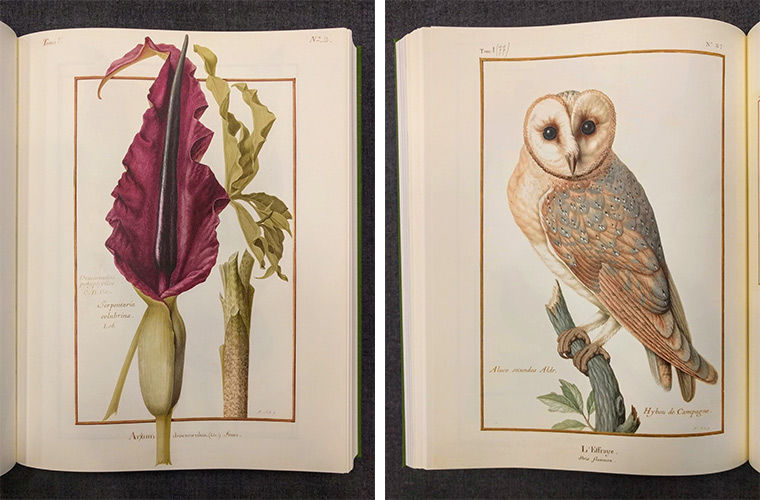
Linnaeus, as it happens, twice visited Seba to examine the latter’s famous collection. It surely had an influence on his thinking on how to name everything in the biological realm: not just the likes of trees, owls, snakes, and jellyfish, but also the “paraxoda,” creatures whose existence was suspected but not confirmed. These included not only the hydra and the phoenix, but also the rhinoceros and the pelican.

Eighteenth-century Europeans possessed much more information about the world than did their ancestors, but facts were still more than occasionally intermixed with fantasy. Given the strangeness of what had recently been documented, no one dared put limits on the strangeness of what hadn’t.
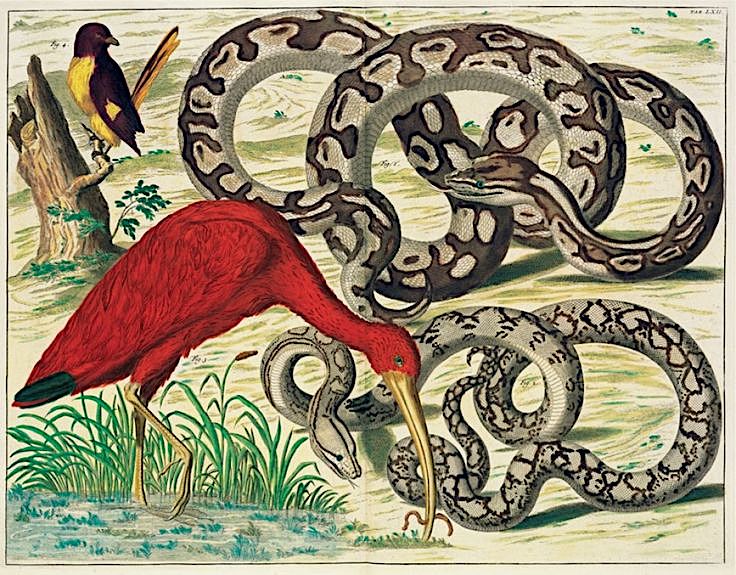
Note: A number of the vibrant images on this page come from the Taschen edition.
Related Content:
Based in Seoul, Colin Marshall writes and broadcasts on cities and culture. His projects include the book The Stateless City: a Walk through 21st-Century Los Angeles and the video series The City in Cinema. Follow him on Twitter at @colinmarshall or on Facebook.
Read More...Breaking Down the Beatles’ Get Back Documentary: Stream Episode #111 of the Pretty Much Pop Podcast

Your host Mark Linsenmayer is joined by musician David Brookings, Gig Gab podcast host Dave Hamilton, and OpenCulture writer Colin Marshall to discuss Peter Jackson’s documentary Get Back and the enduring popularity of The Beatles.
This was recorded on 12/8, the anniversary of John Lennon’s death. We consider the arc of their career, the various post-mortem releases that keep our interest, why Beatles solo work remains a cult interest, and much more.
Follow @davidbrookings. Hear him sing every Beatles song. Hear him talking about his own tunes with Mark on Nakedly Examined Music.
Follow @DaveHamilton. Hear him on PMP talking about Live Music.
Follow @colinmarshall. Hear him on PMP talking about Scorsese films.
This episode includes bonus discussion you can access by supporting the podcast at patreon.com/prettymuchpop or by choosing a paid subscription through Apple Podcasts. This podcast is part of the Partially Examined Life podcast network.
Pretty Much Pop: A Culture Podcast is the first podcast curated by Open Culture. Browse all Pretty Much Pop posts.
Read More...What Makes Salvador Dalí’s Iconic Surrealist Painting “The Persistence of Memory” a Great Work of Art
Salvador Dalí painted melting clocks. This is not as drastic an oversimplification as it sounds: after first painting such a counterintuitive image, “Dalí, who knew the importance of branding, would use the melting clocks for his entire career.” So says no less an expert than James Payne, the gallerist and video essayist behind the Youtube channel Great Art Explained. In its latest episode Payne takes on the unrelentingly prolific Dalí’s most famous canvas of all, The Persistence of Memory. Completed in 1931, this work of art has by now spent about half a century adorning the walls of college dorm rooms, among other spaces inhabited by viewers interested in the alteration of their own perceptive faculties.
The Persistence of Memory doesn’t mark Dalí’s first use of melting clocks, though it’s without doubt his most important. Yet “despite its huge cultural impact,” says Payne, the painting is “quite small, about the size of a sheet of paper.” Against the background of “a huge desert landscape with vast depths of field, reduced to a shrunken world” — one harboring references to Goya, De Chirico, and Bosch — it vividly realizes a moment in the process of metamorphosis.
“A key concept in the Surrealist movement,” metamorphosis is here “exemplified by the paradox of Dalí’s rendering of the hardest and most mechanical objects, watches, into a soft and flaccid form.” Like all of the artist’s best work, it thus “exploits the ambiguity of our perceptual process and plays with our own fears.” But what do the melting clocks mean?
That, to Dalí’s own mind, is the wrong question: “I am against any kind of message,” he declared in one of his many television appearances. Indeed, his frequent appearances on television (What’s My Line?, The Mike Wallace Interview, The Dick Cavett Show) and in other media assured that, at a certain point, “Dalí the artist had become a prisoner of Dalí the celebrity.” But his appearances in the spotlight also gave him the chance to disseminate the chaff of conflicting explanations of his own work. Perhaps the melting clocks refer to Einstein’s then-novel theory of relativity; perhaps they symbolize impotence. Or it may all come down to Dalí’s obsession with death, which even in 1931 had long since taken both his mother and the younger brother of whom he believed himself a reincarnation. In the event, Dalí couldn’t escape mortality. None of us can, of course, and that, as much as anything else, may illuminate why The Persistence of Memory never quite passes into the realm of kitsch.
Related Content:
Walk Inside a Surrealist Salvador Dalí Painting with This 360º Virtual Reality Video
Salvador Dalí Explains Why He Was a “Bad Painter” and Contributed “Nothing” to Art (1986)
Salvador Dalí’s Melting Clocks Painted on a Latte
Based in Seoul, Colin Marshall writes and broadcasts on cities and culture. His projects include the book The Stateless City: a Walk through 21st-Century Los Angeles and the video series The City in Cinema. Follow him on Twitter at @colinmarshall or on Facebook.
Read More...George Orwell’s Nineteen Eighty-Four Will Be Retold from a Woman’s Point of View
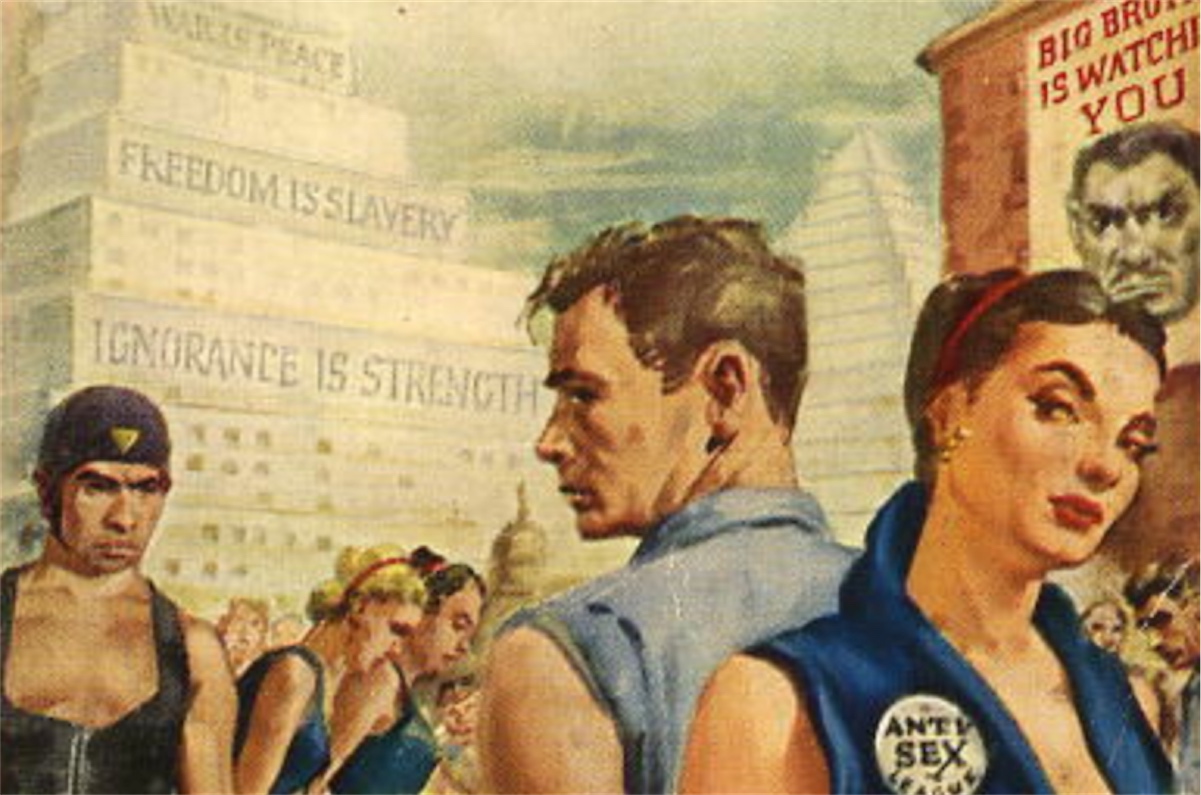
Nineteen Eighty-Four has been a byword for totalitarian dystopia longer than most of us have been reading books. But apart from its the title and certain words from its invented “newspeak” — doubleplusgood, unperson, thoughtcrime — how deeply is George Orwell’s best-known novel embedded into the culture? Most of us recognize the name Winston Smith, and many of us may even remember details of his job at the Ministry of Truth, where the facts of history are continually rewritten to suit ever-shifting political exigencies. But how much do we know about the other major character: Julia, Winston’s fellow ministry employee who becomes his clandestine co-dissident and forbidden lover?
“In some ways she was far more acute than Winston, and far less susceptible to Party propaganda,” writes Orwell in Nineteen Eighty-Four. “But she only questioned the teachings of the Party when they in some way touched upon her own life. Often she was ready to accept the official mythology, simply because the difference between truth and falsehood did not seem important to her.” Julia’s amorality throws the rigidity of Winston’s own attitudes into contrast, and also shows up their impracticality. Now, in the hands of novelist Sandra Newman, Julia will become not just star of the story but its narrator.
Or so it looks, at least, from the brief passage quoted in the Guardian’s announcement of Julia, a re-telling of Nineteen Eighty-Four approved by Orwell’s estate and to be published in time for the 75th anniversary of the original. Though it has no firm publication date yet, Julia will come out some time after Newman’s next book The Men, in which, as the Guardian’s Alison Flood puts it, “every single person with a Y chromosome vanishes from the world.” It will join an abundance of recent retellings from the woman’s point of view, including everything from “Pat Barker’s The Silence of the Girls, a version of the Iliad from the perspective of Briseis, to Maggie O’Farrell’s Hamnet, which centers on the life of Shakespeare’s wife.”
Entrusting a literary property to a writer of another era, culture, and sensibility is a tricky business, but there arguably has never been a more opportune time to put out a book like Julia. It seems the dystopia-hungry public has never been readier to identify the “Orwellian” in life, nor more responsive to re-interpretations and expansions of long-established bodies of popular myth. And what with women having conquered the world of fiction, there will naturally be great interest in Julia’s take on life under Big Brother — as well as in its inevitable television adaptation.
Related content:
George Orwell’s 1984 Staged as an Opera: Watch Scenes from the 2005 Production in London
Aldous Huxley to George Orwell: My Hellish Vision of the Future is Better Than Yours (1949)
George Orwell’s Final Warning: Don’t Let This Nightmare Situation Happen. It Depends on You!
Based in Seoul, Colin Marshall writes and broadcasts on cities and culture. His projects include the book The Stateless City: a Walk through 21st-Century Los Angeles and the video series The City in Cinema. Follow him on Twitter at @colinmarshall or on Facebook.
Read More...Taschen Publishes the First 21 Stories of Spider Man in a High Resolution, Extra-Large Format Art Book
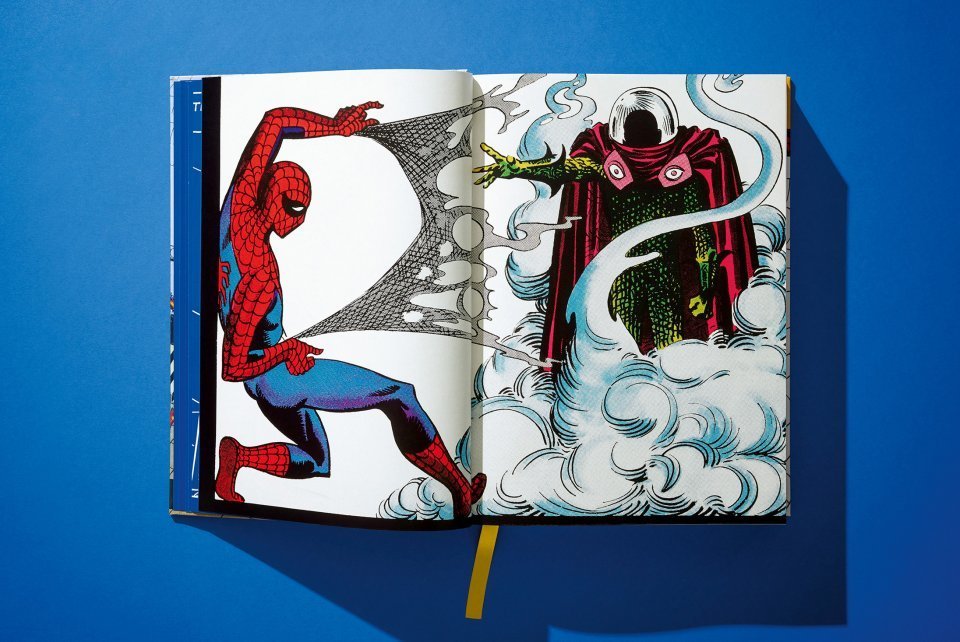
Marvel Comics and art book publisher TASCHEN have announced an agreement to publish Marvel’s rarest classic comics “in their original glory, in an extra-large format.” And it all starts with Spider Man. The first volume in the Marvel-TASCHEN series reproduces the first 21 stories of Spider Man, originally published between 1962–1964. TASCHEN has attempted to “create an ideal representation of these books as they were produced at the time of publication.” The editions feature super-high-resolution photographs of each page, “using modern retouching techniques to correct problems with the era’s inexpensive, imperfect printing.”
You can explore the new Spider Man editions here. The next titles in ‘The Marvel Comics Library’ series will be Avengers. Vol. 1. 1963–1965, Fantastic Four. Vol. 1. 1961–1963 and Captain America. They’re scheduled for release in 2022 and 2023. Keep an eye out…
If you would like to support the mission of Open Culture, consider making a donation to our site. It’s hard to rely 100% on ads, and your contributions will help us continue providing the best free cultural and educational materials to learners everywhere. You can contribute through PayPal, Patreon, and Venmo (@openculture). Thanks!
Related Content:
Every Spider-Man Movie and TV Show Explained By Kevin Smith
Hear an Hour of the Jazzy Background Music from the Original 1967 Spider-Man Cartoon
The Mathematics of Spiderman and the Physics of Superheroes
Free: Download 15,000+ Free Golden Age Comics from the Digital Comic Museum
How to Make Comics: A Four-Part Series from the Museum of Modern Art
Read More...Edvard Munch’s Famous Painting “The Scream” Animated to Pink Floyd’s Primal Music
In this short video, Romanian animator Sebastian Cosor brings together two haunting works from different times and different media: The Scream, by Norwegian Expressionist painter Edvard Munch (1863–1944), and “The Great Gig in the Sky,” by the British rock band Pink Floyd.
Munch painted the first of four versions of The Scream in 1893. He later wrote a poem describing the apocalyptic vision behind it:
I was walking along the road with two Friends
the Sun was setting — the Sky turned a bloody red
And I felt a whiff of Melancholy — I stood
Still, deathly tired — over the blue-black
Fjord and City hung Blood and Tongues of Fire
My Friends walked on — I remained behind
– shivering with anxiety — I felt the Great Scream in Nature
Munch’s horrific Great Scream in Nature is combined in the video with Floyd’s otherworldly “The Great Gig in the Sky,” one of the signature pieces from the band’s 1973 masterpiece, Dark Side of the Moon. The vocals on “The Great Gig” were performed by an unknown young songwriter and session singer named Clare Torry.
Torry had been invited by producer Alan Parsons to come to Abbey Road Studios and improvise over a haunting piano chord progression by Richard Wright, on a track that was tentatively called “The Mortality Sequence.” The 25-year-old singer was given very little direction from the band. “Clare came into the studio one day,” said bassist Roger Waters in a 2003 Rolling Stone interview, “and we said, ‘There’s no lyrics. It’s about dying — have a bit of a sing on that, girl.’ ”
Forty-two years later, that “bit of a sing” can still send a shiver down anyone’s spine. For more on the making of “The Great Gig in the Sky,” and Torry’s amazing contribution, see the clip below to hear Torry’s story in her own words.
If you would like to support the mission of Open Culture, consider making a donation to our site. It’s hard to rely 100% on ads, and your contributions will help us continue providing the best free cultural and educational materials to learners everywhere. You can contribute through PayPal, Patreon, and Venmo (@openculture). Thanks!
Related Content:
30,000 Works of Art by Edvard Munch & Other Artists Put Online by Norway’s National Museum of Art
Explore 7,600 Works of Art by Edvard Munch: They’re Now Digitized and Free Online
Pink Floyd’s David Gilmour Sings Shakespeare’s Sonnet 18
The Night Frank Zappa Jammed With Pink Floyd … and Captain Beefheart Too (Belgium, 1969)
Read More...‘The Character of Physical Law’: Richard Feynman’s Legendary Course Presented at Cornell, 1964
Lecture One, The Law of Gravitation:
“Nature,” said physicist Richard Feynman, “uses only the longest threads to weave her patterns, so that each small piece of her fabric reveals the organization of the entire tapestry.”
With those words Feynman ended the first of his famous 1964 Messenger Lectures at Cornell University, a talk entitled “The Law of Gravitation, an Example of Physical Law.” (See above.) The lectures were intended by Feynman as an introduction, not to the fundamental laws of nature, but to the very nature of such laws. The lectures were later transcribed and collected in The Character of Physical Law, one of Feynman’s most widely read books. In the introduction to the Modern Library edition, writer James Gleick gives a brief assessment of the charismatic man at the lectern:
Feynman, then forty-six years old, did theoretical physics as spectacularly as anyone alive. He was due to win the Nobel Prize the next year for his groundbreaking work in the 1940s in quantum electrodynamics, a theory that tied together in an experimentally perfect package all the varied phenomena at work in light, radio, magnetism, and electricity. He had taken the century’s early, half-made conceptions of waves and particles and shaped them into tools that ordinary physicists could use and understand. This was esoteric science–more so in the decades that followed–and Feynman was not a household name outside physics, but within his field he had developed an astounding stature. He had a mystique that came in part from sheer pragmatic brilliance–in any group of scientists he could create a dramatic impression by slashing his way through a difficult problem–and in part, too, from his personal style–rough-hewn, American, seemingly uncultivated.
All seven of Feynman’s lectures were recorded by the British Broadcasting Corporation and presented as part of BBC Two’s “Further Education Scheme.” In 2009 Bill Gates bought the rights to the videos and made them available to the public on Microsoft’s Project Tuva Web site.
Since then the series has become available on YouTube for easier viewing. As you scroll down the page you can access the videos which, “more than any other recorded image or document,” writes physicist Lawrence Krauss in Quantum Man: Richard Feynman’s Life in Science, “capture the real Feynman, playful, brilliant, excited, charismatic, energetic, and no nonsense.”
You can find the remaining video lectures below:
Lecture Two, The Relation of Mathematics to Physics:
Lecture Three, The Great Conservation Principles:
Lecture Four, Symmetry in Physical Law:
Lecture Five, The Distinction of Past and Future:
Lecture Six, Probability and Uncertainty–The Quantum Mechanical View of Nature:
Lecture Seven, Seeking New Laws:
You can find this course indexed in our list of Free Online Physics Courses, a subset of our collection, 1,700 Free Online Courses from Top Universities.
Related Content:
The “Feynman Technique” for Studying Effectively: An Animated Primer
How Richard Feynman’s Diagrams Revolutionized Physics
Read More...Punks, Goths, and Mods on TV (1983)
The Rivethead preoccupation with fashion is inescapably related to their anxiety over being confused for subcultures they profess to hate: Goths, Punks, Metalheads, Death Rockers… The fact that so many subcultures claim black as their color of choice contributes to the confusion.
There are two points upon which theorists of post-industrial British subcultures generally agree: 1) No matter the music or the fashion, the boundaries between one subculture and another were rigorously, even violently, enforced (hence the wars between the mods and rockers), and; 2) The music and fashions of every subculture were subject to cooptation by the machinery of capitalism, to be mass produced, packaged, and sold as off-the-rack commodity, a phenomenon that occurred almost as soon as punks, mods, rockers, goths, teddy boys, skinheads, New Romantics, etc. began appearing on television — as in the post-Grundy Irish TV appearance of four young individuals above from 1983.
The interviewer introduces these punks, goths, and mods by referring first to their employment — or lack of employment — status, and then to the number of children in their family. Comments dripping with class disdain sit alongside a characterization of various subcultures as “gangs” — the Hell’s Angels thrown in among them just to drive the point home. Of course, there’s more to say about the denizens of early-80s UK subcultural street corners — more than these four representatives have to say themselves. It is communicated through performance rather than verbal exposition, through the affiliations of clothing, music, and pose — as in the mini-historical slideshow of late-20th century British subcultures below, from the 50s to the 80s.
In 1979, British theorist Dick Hebdige published what many considered the definitive analysis of these working-class scenes, which frequently centered around forms of racial and cultural exchange — as with mods who loved jazz or punks who loved ska and dub reggae; or racial and cultural exclusion — as with fascist skinheads and chauvinist teddy boys who glorified the past, while other subcultural ideologies looked to the future (or, as the case may be, no future).
Hebdige’s Subculture: the Meaning of Style begins with a story about French writer Jean Genet, humiliated in prison by homophobic guards over his possession of a tube of Vaseline:
Like Genet, we are interested in subculture – in the expressive forms and rituals of those subordinate groups – the teddy boys and mods and rockers, the skinheads and the punks – who are alternately dismissed, denounced and canonized; treated at different times as threats to public order and as harmless buffoons.
The irony of subcultures is that they identify with social outsiders, while re-enforcing boundaries that create exclusivity (cf. the quote at the top, from Hebdige-inspired Subcultures List). When the novelty and shock recedes, they become ripe fodder for commercial cooptation, even luxury branding.
What we usually don’t get from tame retrospectives, or from patronizing mass media of the time, are deviant outsiders like Genet who cannot be reabsorbed into the system because their very existence poses a threat to the social order as so construed. So much of the fashion and music of post-war Britain was directly created or inspired by West Indian migrants of the Windrush generation, for example. In too many popular representations of postwar British subcultures, that essential part of the working class UK subculture story has been entirely left out.
Related Content:
A History of Punk from 1976–78: A Free Online Course from the University of Reading
The History of Punk Rock in 300 Tracks: A 13-Hour Playlist Takes You From 1965 to Present
Josh Jones is a writer and musician based in Durham, NC. Follow him at @jdmagness
Read More...Support Us
We're hoping to rely on loyal readers, rather than erratic ads. Please click the Donate button and support Open Culture. You can use Paypal, Venmo, Patreon, even Crypto! We thank you!

About Us

Open Culture scours the web for the best educational media. We find the free courses and audio books you need, the language lessons & educational videos you want, and plenty of enlightenment in between.
Advertise With Us
FREE UPDATES!
GET OUR DAILY EMAIL
Get the best cultural and educational resources on the web curated for you in a daily email. We never spam. Unsubscribe at any time.
FOLLOW ON SOCIAL MEDIA
Open Culture editor Dan Colman scours the web for the best educational media. He finds the free courses and audio books you need, the language lessons & movies you want, and plenty of enlightenment in between.
Advertise With Us

