An Origami Samurai Made from a Single Sheet of Rice Paper, Without Any Cutting
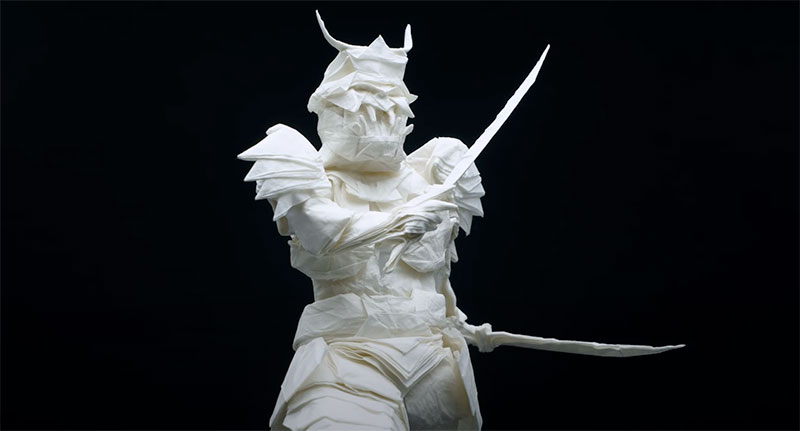
Origami artist Juho Könkkölä spent 50 hours folding an origami samurai from a single square sheet of paper, with no cutting or ripping used in the process. He describes his process on Reddit:
Folded from a single square sheet of 95cm x 95cm Wenzhou rice paper without any cutting. The finished size of the work is 28cm x 16cm x 19cm. Only dry and wet folding techniques were used to fold the model. It took 2 months to design and 1 month to fold, although I was working on few other projects during that time too.
It took some effort and experimentation to fold the texture for the armor, while trying to simplify it to be somewhat manageable to fold. I folded 4 rough test attempts in total, and all of them took 3 days to fold each. There are several hundreds of steps to fold it from the square and there are probably thousands of individual folds. The asymmetry in the design allowed me to include sword on only one arm, while being able to make the character look symmetric.
Find the finished product below. Watch the creative process, from start to finish, above.
If you would like to support the mission of Open Culture, consider making a donation to our site. It’s hard to rely 100% on ads, and your contributions will help us continue providing the best free cultural and educational materials to learners everywhere. You can contribute through PayPal, Patreon, and Venmo (@openculture). Thanks!
Related Content:
MIT Creates Amazing Self-Folding Origami Robots & Leaping Cheetah Robots
Designer Creates Origami Cardboard Tents to Shelter the Homeless from the Winter Cold
Download Classic Japanese Wave and Ripple Designs: A Go-to Guide for Japanese Artists from 1903
Read More...George Harrison “My Sweet Lord” Gets an Official Music Video, Featuring Ringo Starr, Al Yankovic, Patton Oswalt & Many Others
To help celebrate the 50th anniversary of George Harrison’s classic solo album, All Things Must Pass, the classic track, “My Sweet Lord,” has now received an official music video. And it features a number of cameo appearances–from other former Beatles (Ringo Starr), to family members (Olivia Harrison and Dhani Harrison), to other guests (Mark Hamill, Fred Armisen, Al Yankovic, Rosanna Arquette). Enjoy.
Featuring In Order of Appearance:
Mark Hamill
Fred Armisen
Vanessa Bayer
Moshe Kasher
Natasha Leggero
Jeff Lynne
Reggie Watts
Darren Criss
Patton Oswalt
Al Yankovic
David Gborie
Sam Richardson
Atsuko Okatsuka
Rosanna Arquette
Brandon Wardell
Ringo Starr
Joe Walsh
Jon Hamm
Brett Metter
Anders Holm
Dhani Harrison
Rupert Friend
Angus Sampson
Taika Waititi
Eric Wareheim
Tim Heidecker
Kate Micucci
Riki Lindhome
Alyssa Stonoha
Mitra Jouhari
Sandy Honig
Olivia Harrison
Aimee Mullins
Courtney Pauroso
Natalie Palamides
Shepard Fairey
Claudia O’Doherty
Tom Scharpling
Paul Scheer
Sarah Baker
Related Content
George Harrison Explains Why Everyone Should Play the Ukulele
Watch George Harrison’s Final Interview and Performance (1997)
Read More...
The True Meaning of Queen’s Rock Epic “Bohemian Rhapsody”
We’ve all given at least a little thought to “Bohemian Rhapsody.” I myself happen to have given it more than a little, since I and all my classmates had to learn the song and sing it together back in seventh-grade music class. But I haven’t given it as much thought as music Youtuber Polyphonic, whose exegesis “The True Meaning of Bohemian Rhapsody” appears above. “The apex of the 1970s rock experiment,” Queen’s six-minute rock epic “somehow manages to take the transformative structure of progressive rock and shove it into a form that could be a radio rock staple and sell out arenas worldwide.” It also delivers “an operatic breakdown, a legendary guitar solo, and iconic lyrics that perfectly walk the line between grounded and cryptic.”
Like all the best lyrics — and especially all the best lyrics of elaborately produced 1970s rock — the words to “Bohemian Rhapsody” invite all manner of readings. Polyphonic opts to take the concept of reading more literally, visually rendering his interpretation of the song through a set of tarot cards.
Within this traditional framework, he makes the thoroughly modern choice of grounding these often fantastical- or even bizarre-sounding lyrics in the sexual identity of Queen’s lead singer. Born in Zanzibar to a conservative Indian family, the boy who would become Freddie Mercury would have had more than one reason to feel out of place in the world. Do we have here an artistic sublimation of his personal isolation, alienation, and self-reinvention?
When it was released in 1975, “Bohemian Rhapsody” met with a critical reception here and there impressed, but on the whole indifferent or perplexed. Perhaps the song was simply too much, not just musically but culturally: it draws in a seemingly haphazard manner from the realms of cowboys, of opera, of Christianity, and of much else besides. But to Polyphonic, all these elements reflect the central theme of Mercury’s survival in and ultimate defiance of a hostile world. “In the end,” his character realizes, “people’s minds are not going to change, and his own identity isn’t going to change, so there’s no use hanging on in fear. Armed with this knowledge, Freddie Mercury completes his magnificent transformation and ascends to rock godhood.” Such an interpretation was far from my own mind in middle school, admittedly, but there were no doubt other students who could feel the powerful inspiration this sonic spectacle continues to offer.
Related Content:
1910 Fairground Organ Plays Queen’s “Bohemian Rhapsody,” and It Works Like a Charm
Watch Queen’s “Bohemian Rhapsody” Acted Out Literally as a Short Crime Film
Based in Seoul, Colin Marshall writes and broadcasts on cities and culture. His projects include the book The Stateless City: a Walk through 21st-Century Los Angeles and the video series The City in Cinema. Follow him on Twitter at @colinmarshall or on Facebook.
Read More...The Dune Franchise Tries Again — Pretty Much Pop: A Culture Podcast #110
The world now has another Dune film, and this time Warner Bros. is serious about a franchise, with at least one sequel planned and a prequel TV series in the works. With thousands of years worth of world building, the books by Frank Herbert and the world now being fleshed out by his son Brian Herbert with Kevin J. Anderson offer more source material than Star Wars for potential filmmakers to play with, but is this world anywhere near as fun?
Your hosts Mark Linsenmayer and Brian Hirt are joined by Brian Casey (brother of The Partially Examined Life’s Dylan Casey) and Three if By Space senior editor Erin Conrad to talk about whether this series is really adaptable to the screen at all, and we consider past attempts by David Lynch and Alejandro Jodorowsky (rather slighting the tedious TV version). Is the new version more successful? More feminist? Less colonialist?
Is the lore just too packed into the books to convey adequately? When Frank Herbert jumps forward 3000 years, is that a path that moviegoers will want to follow, even if familiar characters can still be present as talkative ancestral memories in new characters’ heads or come back as clones?
For points of comparison, we touch on not only Star Wars, but Outlander, Picard, The Orville, Game of Thrones, Lord of the Rings, Walking Dead, The Dark Tower, and more.
Some articles that fed into our discussion include:
- “Dune: science fiction’s answer to Lord of the Rings” by Alison Flood
- “Spice World: WIRED Traces the Dune Legacy”
- “Denis Villeneuve Gave ‘Dune’ Writer Mandatory Goal: Focus on the Women Characters” by Zack Sharf
- “Why Is ‘Dune’ a Sci-Fi Film With No Computers? Let’s Explain” by Chase Hutchinson
- “What Draws Us to the Reactionary Darkness of ‘Dune’?” By Chris Dite
- “Race Consciousness: Fascism and Frank Herbert’s ‘Dune’ ” by Jordan S. Carroll
Follow Erin @ErinConrad2.
This episode includes bonus discussion you can access by supporting the podcast at patreon.com/prettymuchpop or by choosing a paid subscription through Apple Podcasts. This podcast is part of the Partially Examined Life podcast network.
Pretty Much Pop: A Culture Podcast is the first podcast curated by Open Culture. Browse all Pretty Much Pop posts.
Read More...Before Bauhaus: How Goth Became Goth
“You look so goth today” one might say to a friend wearing too much eyeliner or black nail polish or leather pants. But goth is so much more than just a look, the maker of the above video claims, walking viewers through a brief history of the blues, rock, punk, post-punk, and new romantic waves made to the sound and style of what came to be called goth rock (though none of these artists described themselves that way). The video essay claims goth has been hijacked by ersatz pretenders like Marilyn Manson and My Chemical Romance, who might look the part but bear little resemblance sonically or culturally to forebears like The Doors, The Cure, The Birthday Party, or (this video’s stopping point) goth rock darlings Bauhaus.
Maybe the distinctions seem like trivial subcultural squabbling, but the essay raises an interesting question about the origin of the word “goth” as a subculturally descriptive term. It’s easy to see how someone might mistake oughties emo rockers for 80s goths; it’s perhaps more of a stretch to see how 70s and 80s goth rock carried forth the creative spirit of a medieval architectural style or a 19th-century literary genre. Superficially, we might say the operative link is “dark and scary,” but if that’s all it takes to be “goth,” then we’re back to goth as costume rather than a set of artistic tenets. Examining the Gothic a bit more closely may give us clues to the distinctiveness of Goth.
Author Nick Groom identifies a historical tension within the Gothic. First used in the 16th century to describe the ornate pan-European style that arose back in the 12th century, the term was pejorative, implying that the glories of Rome had been replaced by the barbarism of the German Goths (despite the fact that Gothic style originated in France). The Gothic was revived in the 18th and 19th centuries — at first almost single-handedly by Horace Walpole, who wrote the first Gothic novel and turned his home, Strawberry Hill, into a Gothic theme park of sorts. By this point, says Groom above, the Gothic had taken on dual connotations in English usage — positively, the Gothic was a rebellious spirit: The Magna Carta was Goth. Martin Luther was Goth.
On the other hand, the Gothic referred to the occult, to Medieval Catholic rites and superstitions, to ancient ruins, monsters, and gargoyles. This is the Gothic with which we’re familiar, but it comes to us — via Walpole, Bram Stoker, Edgar Allan Poe, etc. — as kitsch. “Gothic fiction began as a sophisticated joke,” John Mullan observes of Walpole’s weird novel, The Castle of Otranto. For all its investment in the darker regions of human experience, the Gothic, and thereby the Goth, has always had a certain sense of humor about itself, creating cavernous sounds that evoke cathedral acoustics, performed with an ironic theatricality that dramatizes literary, Romantic excesses — qualities, it must be said, few bands before or since embodied quite so succinctly as goth rock darlings Bauhaus.
Related Content:
An Animated History of Goth
“A Brief History of Goths”: From the Goths, to Gothic Literature, to Goth Music
Three-Hour Mixtape Offers a Sonic Introduction to Underground Goth Music
Josh Jones is a writer and musician based in Durham, NC. Follow him at @jdmagness
Read More...How George Martin Defined the Sound of the Beatles: From String Quartets to Backwards Guitar Solos
Peter Jackson’s new documentary series Get Back allows its viewers to spend about eight hours watching the Beatles at work in the studio. In that time, a fair few non-Beatles linger in the frame as well: from Yoko Ono to keyboardist Billy Preston to a couple of grumpy young policeman trying to shut down the climactic rooftop concert. If you’ve seen Get Back, you’ll also have noticed one fellow somewhat taller, older, and more tastefully dressed than everyone else, who, though often in the studio, seems not to have had much to do. This, as every Beatles aficionado knows, is George Martin: the EMI record producer who, seven years earlier, had been tasked with helping the not-yet-Fab Four start properly recording their songs.
From then on Martin kept working closely with John, Paul, George, and Ringo, and that, as Polyphonic argues in the video above, grants him rightful claim to the coveted title of “Fifth Beatle.” Martin, he explains, “was the producer, composer, and arranger for most of the Beatles’ career, and his contributions are directly responsible for some of the band’s most iconic songs.” Take “Yesterday,” a simple guitar-based number enriched, at Martin’s suggestion, by a string quartet. Though Paul initially balked at this no doubt square-sounding addition, he was persuaded by the results. For the first time but not the last, the contrast between the musical backgrounds of band and producer — the former being obsessed with American rock-and-roll and the latter having come out of the BBC’s classical-music department — paid off.
The following year, Martin contributed an even more powerful (and Psycho-inspired) string arrangement to “Eleanor Rigby” as well as “all kinds of studio experimentation,” including the run-in-reverse guitar solo on “I’m Only Sleeping” and the hypnotic tape loops on “Tomorrow Never Knows.” Despite not belonging to a generation especially invested in the psychedelic experience, he made possible the mind-blowing sonic textures of songs like “Strawberry Fields Forever” and “I Am the Walrus.” The unusual variety of sound in the latter owes a great deal to Martin’s technical know-how and willingness to experiment: “If I said ‘I want the radio on it,’ George would make it so that I could mix it in, and the radio would be coming through the machines,” John remembers in the 1975 interview clip below.
John acknowledges that Martin didn’t just realize the Beatles’ unconventional musical ideas, but contributed his own more traditional but no less effective ones: “He’d also come up with things like: ‘Well, have you heard an oboe?’ ” Because “he taught us a lot, and I’m sure we taught him a lot,” not much in the Beatles’ record catalog is ascribable simply to him or them. By the time of Get Back, the Beatles had decided to return to their live-performing roots by recording an album without studio overdubs, and much fewer orchestras and backward tape loops. Those sessions put Martin in the background, but thereafter he “returned triumphantly” on Abbey Road. From the orchestration on “Here Comes the Sun” to the “ethereal harpsichord riff” on “Because” to “some of the greatest moments ever recorded” on the side-two medley, that album stands as perhaps the most compelling testament to the achievements of the Fab Five.
Related Content:
Hear the Unique, Original Compositions of George Martin, Beloved Beatles Producer (RIP)
George Martin, Legendary Beatles Producer, Shows How to Mix the Perfect Song Dry Martini
Based in Seoul, Colin Marshall writes and broadcasts on cities and culture. His projects include the book The Stateless City: a Walk through 21st-Century Los Angeles and the video series The City in Cinema. Follow him on Twitter at @colinmarshall or on Facebook.
Read More...Watch the 1907’s Nightmare-Inducing Short Film The Dancing Pig, Now Fully Colorized
One could argue that cinema audiences in the 1900s were less sophisticated than they are today. Marshaling the evidence, one might make an Exhibit A of Le Cochon Danseur (The Dancing Pig), a Pathé-produced silent short that showcases the figure of the title. “Apparently based on a Vaudeville act,” writes the Independent’s Clarisse Loughrey, “it sees a pig dressed in a fancy tuxedo attempt to seduce a young lady, who in turn rips off his clothes and forces him to dance despite his shameful nakedness.”
Just how deeply the original French audiences thrilled to these proceedings is lost to history; but then, so is the name of the film’s director. This aura of mystery made Le Cochon Danseur an object of fascination a century after its release. But that wasn’t the only factor in play: the design of the pig costume remains impressive today, let alone when considered by the presumed standards of 1907.
The filmmakers must have known this, since the film’s ending cuts — in a time when editing of any kind was a rarity in the cinema — to a close-up of the oversized porcine head expressing a well-articulated look of satisfaction.
We see the pig “flapping his ears, boggling his eyes, flailing his tongue, and chuckling evilly, bearing his sharp, scary teeth,” as the Villains Wiki puts it. “This implies that he possibly ate the woman and revealed himself to be a horrid monster.” It is this final sequence that has made the dancing pig “a popular Internet meme villain” over the past decade and a half. You’ve almost certainly spotted him once or twice, though probably not the colorized version seen in the restored and enhanced video at the top of the post. The original black-and-white film, the inspiration for so many memes and so many nightmares, appears just above.
“Somehow, I feel like I’m actually looking at a hellish human-pig hybrid, not just a 20th-century human in a 20th-century version of a mascot suit,” writes cinephile Tristan Ettleman in his own consideration of the picture. Perhaps Le Cochon Danseur has proven even more compelling to us fully connected 21st-century sophisticates than it did to its first viewers. Or perhaps it simply taps into a universal truth of existence: to paraphrase a much-quoted observation attributed to Margaret Atwood, giant anthropomorphic pigs are afraid women will laugh at them. Women are afraid giant anthropomorphic pigs will eat them.
Related Content:
Watch The Insects’ Christmas from 1913: A Stop Motion Film Starring a Cast of Dead Bugs
Footage of the Last Known Tasmanian Tiger Restored in Color (1933)
Based in Seoul, Colin Marshall writes and broadcasts on cities and culture. His projects include the book The Stateless City: a Walk through 21st-Century Los Angeles and the video series The City in Cinema. Follow him on Twitter at @colinmarshall or on Facebook.
Read More...18 Male Leonard Cohen Fans Over the Age of 65 Star in an Oddly Moving A Cappella Version of “I’m Your Man”
It’s going to be a tearjerker, I think — artist Candice Breitz
Watch 18 diehard Leonard Cohen fans over the age of 65 ardently fumbling their way through the title track of his 1988 album, I’m Your Man, for a deep reminder of how we are transported by the artists we love best.
These men, selected from a pool of over 400 applicants, don’t appear overly bothered by the quality of their singing voices, though clearly they’re giving it their all.
Instead, their chief concern seems to be communing with Cohen, who had died the year before, at the age of 82.
Artist Candice Breitz zeroed in on the likeliest candidates for this project using a 10-page application, in which interested parties were asked to describe Cohen’s role in their lives.
Almost all were based in Cohen’s hometown of Montreal.
Many have been fans since they were teenagers.
Participant Fergus Keyes described meeting Cohen at a 1984 signing for his poetry collection, Book of Mercy:
He told me he liked my name. He asked if he could use it in some future song. I said yes and he wrote it down in his little notebook. I said to him, ‘Sometimes I don’t understand what you’re saying.’ And he said there was no wrong way of interpreting it, because he wrote for others and whatever we interpret is right.
There’s definitely a variety of interpretations on display, above, in an excerpt of Breitz’ 40-minute work, I’m Your Man: A Portrait of Leonard Cohen.
In person, it’s displayed as an installation in-the-round, with viewers free to roam around in the middle, as each participant is projected on his own life-size video monitor for the duration.
They’re our men.
Some standing stiffly.
Others with eyes tightly shut.
Some cannot resist the temptation to act out certain choice lines.
One joyful uninhibited soul beams and dances.
They keep time with their hands, feet, heads… a seated man taps his cane.
One whistles, confidently filling the space most commonly occupied by an instrumental, while the majority of the others fidget.
There are suit jackets, a couple of Cohen-esque fedoras, a t‑shirt from a 2015 Cohen event, and what appears to be a linen gown, topped with a chunky sweater vest.
Breitz’s only requirement of the participants was that they memorize the lyrics to the I’m Your Man album in its entirety, prior to entering the recording studio.
Each man laid his track down solo, singing along while listening to the album on earbuds, unaware of exactly how his contribution would be used. Several professed shock to discover, on opening night, that synchronous editing had transformed them into members of an a cappella choir.

The project may strike some viewers as funny, especially when an individual or group flubs a lyric or veers off tempo, but the purpose is not mockery. Breitz worked to establish trust, and the participants’ willingness to extend it gives the piece its emotional foundation.
Victor Shiffman, co-curator of the 2017 Cohen exhibit A Crack in Everything at the commissioning Musée d’art contemporain de Montréal, told the Montreal Gazette:
They are not precisely singers. They are just passionate, ardent fans; their goal was to communicate their devotion and love for Leonard by participating in this tribute. It is not about hitting the notes. The emotion comes through in the conviction these men portray and in the dedication they show in having put themselves out there. There is so much beauty in that work; it disarms us.
Having centered similar fan-based multichannel video experiments around such works as Bob Marley’s Legend and John Lennon’s Working Class Hero, Breitz explained the casting of the Cohen project to CBC Arts:
I was really interested in this moment in life when one starts to look back and contemplate what kind of a life one has lived and what kind of life one wishes to continue living as one approaches the end of that life. And I think that even when he was a young man, Cohen was somebody who thought about and wrote about mortality in very profound ways. So what I decided to do was to invite a group of Cohen fans who really would be up to the project of interpreting that complexity.
Prior to the work’s premiere, Breitz gathered the group for a toast, suggesting that the occasion was doubly special in that it was highly unlikely they would meet again.
Sometimes artists are unaware of the powerful force they unleash.
Rather than going their separate ways, the participants formed friendships, reunite for non-solo Cohen singalongs, and in the words of one man, became “a real brotherhood… once you establish that connection, everything else disappears.”
Related Content:
Three Leonard Cohen Animations
Watch 4 Music Videos That Bring to Life Songs from Leonard Cohen’s Final Album, Thanks for the Dance
Ayun Halliday is the Chief Primaologist of the East Village Inky zine and author, most recently, of Creative, Not Famous: The Small Potato Manifesto. Follow her @AyunHalliday.
Read More...Rick Rubin: The Invisibility of Hip Hop’s Greatest Producer
New York-born, L.A.-based record producer Rick Rubin started his musical career as a guitarist, first in a short-lived high school band, then in the punk band Hose, touring the country with 80s hardcore stalwarts like Hüsker Dü and the Meat Puppets. It was an auspicious beginning for the major producer Rubin would become in later years, behind albums by Weezer, Red Hot Chili Peppers, Slayer, Danzig, Metallica… the list goes on. Not all of his work has been beloved, but hardly any of it has been ignored. Rubin’s won 9 Grammy awards since 1998, including one this year for the Strokes’ The New Abnormal and one in 2009 for Producer of the Year; in 2007 he appeared on the cover of The New York Times Magazine, covered in a white blanket and signature flowing beard, meditating over the headline “Can Rick Rubin Save the Music Business?”
Rubin revitalized Johnny Cash’s career, capturing the singer’s achingly poignant last recordings in six classic albums. He has appeared in documentaries over the past few years with Cash, Dave Grohl, and Paul McCartney he’s been a guest of David Letterman’s My Next Guest Needs No Introduction with David Letterman; he’s had a four-part documentary made about him in 2019 called Shangri-La.… And he is also – of course – all over contemporary hip-hop, producing Jay Z’s “99 Problems” and pivotal albums by Kanye West and Eminem. This is no surprise, considering he was a major figure of the genre’s origins, taking time between Hose gigs to found and co-run Def Jam Records with Russell Simmons and produce seminal albums by LL Cool J, Public Enemy, Run‑D.M.C., and the Beastie Boys.
Given all of the above, in what sense can anyone claim Rick Rubin is “invisible”? Just such an argument is made in the video above by Soulr. It’s a compelling one, due mainly to Rubin’s presence, a steady calming force – the result of years of transcendental meditation and a relaxed approach to work that favors conversation over control. “Despite his reputation as a solid-gold hitmaker,” a WNYC profile noted, “Rubin remains stubbornly modest. He attributes his success to his one rule in the studio. ‘We don’t talk about what’s going to get on the radio [or] how are we going to make our release date,’ he says. ‘We talk about how we make this song as good as it can be.’” In letting the artist’s vision emerge, Rubin lets himself disappear, playing the role of therapist, as he himself describes it:
If you really listen to what people say, usually they tell you everything. I just really pay attention to what people say, and through that I can reflect back thoughts that they’ve told me about themselves that they don’t know about themselves. And allow them to unlock those doors to get to the places they want to go artistically.
In a clip taken from Shangri-La, we see star rapper Tyler, the Creator tell Rubin, “You’re so goddamn free.” As Judy Berman writes in a Time review of that Rubin-produced documentary, “coming from an artist whose entire career has been a series of shocks to the mainstream, that’s high praise indeed.” The clip also sets the tenor for the fan-made documentary above. There isn’t a significant amount of criticism, to say the least, of Rubin’s role in the so-called “loudness wars” or charges from bands like Muse that he’s hardly involved in sessions at all. Those charges may indeed come from people who do not understand how a man “behind hundreds and hundreds of beloved records… doesn’t appear to do much, while doing everything at the same time.” Find out how Rubin has used his powers of invisibility for the good of popular music. His superpower, the video’s narrator tells us, is “simply his ability to listen.”
Related Content:
How Jazz Became the “Mother of Hip Hop”
Josh Jones is a writer and musician based in Durham, NC. Follow him at @jdmagness
Read More...Watch 11-Year-Old Billy Preston Duet with Nat King Cole: A Star is Born (1957)
The Beatles aren’t the only fab talents causing a stir in the recently released Beatles documentary, Get Back.
As has been widely noted, soul singer Billy Preston lights up every scene he’s in.
One of the 60’s finest session keyboardists, Preston contributed to the Beatles’ Let It Be and Abbey Road albums, and joined them for their famous final gig on the roof of Apple Records.
He also served as a leveling influence when tensions within the band frequently exploded into fits of temper.
“It’s interesting to see how nicely people behave when you bring a guest in,” George Harrison observed.
In addition to his successful solo career, with a number of funk and R&B hits, Preston gigged for a host of all time greats: Ray Charles, Little Richard, Sam Cooke, Miles Davis, Aretha Franklin, the Rolling Stones…the list goes on.
A childhood prodigy who never took a music lesson, by 10, he was backing gospel luminaries like Mahalia Jackson, James Cleveland, and Andraé Crouch.
A year later, he entered America’s living rooms, when he appeared on The Nat King Cole Show, above, to duet with TV’s first national Black variety show host on “Blueberry Hill,” a 40s tune Fats Domino had popularized earlier in the decade.
“You have a very excellent career ahead of you,” Cole predicts, following their performance.
Daughter Natalie Cole later enthused that the celebrated crooner “lets this kid have all the glory,” though the self-possessed pre-teen holds his own ably, alternating between organ and his own impressive pipes.
Within the year, Cole and Preston shared the big screen, and a memorable part, when they were cast as “The Father Of The Blues” W.C. Handy, as a child and adult, in the 1958 movie St Louis Blues.
As an adult, Preston’s star was tarnished by addiction, arrests and self-sabotaging behavior that his manager, Joyce Moore, and half-sister Lettie, said was most deeply rooted in his mother’s refusal to believe that he was being sexually abused by the pianist of a summer touring company, and later a local pastor.
It’s part of a lurid, longer tale, calling to mind other promising, oft-prodigious young talents who never managed to get out from under damage inflicted by adults when they were children.
He was 9.
Related Content:
Watch Paul McCartney Compose The Beatles Classic “Get Back” Out of Thin Air (1969)
Ayun Halliday is the Chief Primaologist of the East Village Inky zine and author, most recently, of Creative, Not Famous: The Small Potato Manifesto. Follow her @AyunHalliday.
Read More...Support Us
We're hoping to rely on loyal readers, rather than erratic ads. Please click the Donate button and support Open Culture. You can use Paypal, Venmo, Patreon, even Crypto! We thank you!

About Us

Open Culture scours the web for the best educational media. We find the free courses and audio books you need, the language lessons & educational videos you want, and plenty of enlightenment in between.
Advertise With Us
FREE UPDATES!
GET OUR DAILY EMAIL
Get the best cultural and educational resources on the web curated for you in a daily email. We never spam. Unsubscribe at any time.
FOLLOW ON SOCIAL MEDIA
Open Culture editor Dan Colman scours the web for the best educational media. He finds the free courses and audio books you need, the language lessons & movies you want, and plenty of enlightenment in between.
Advertise With Us

