Punks, Goths, and Mods on TV (1983)
The Rivethead preoccupation with fashion is inescapably related to their anxiety over being confused for subcultures they profess to hate: Goths, Punks, Metalheads, Death Rockers… The fact that so many subcultures claim black as their color of choice contributes to the confusion.
There are two points upon which theorists of post-industrial British subcultures generally agree: 1) No matter the music or the fashion, the boundaries between one subculture and another were rigorously, even violently, enforced (hence the wars between the mods and rockers), and; 2) The music and fashions of every subculture were subject to cooptation by the machinery of capitalism, to be mass produced, packaged, and sold as off-the-rack commodity, a phenomenon that occurred almost as soon as punks, mods, rockers, goths, teddy boys, skinheads, New Romantics, etc. began appearing on television — as in the post-Grundy Irish TV appearance of four young individuals above from 1983.
The interviewer introduces these punks, goths, and mods by referring first to their employment — or lack of employment — status, and then to the number of children in their family. Comments dripping with class disdain sit alongside a characterization of various subcultures as “gangs” — the Hell’s Angels thrown in among them just to drive the point home. Of course, there’s more to say about the denizens of early-80s UK subcultural street corners — more than these four representatives have to say themselves. It is communicated through performance rather than verbal exposition, through the affiliations of clothing, music, and pose — as in the mini-historical slideshow of late-20th century British subcultures below, from the 50s to the 80s.
In 1979, British theorist Dick Hebdige published what many considered the definitive analysis of these working-class scenes, which frequently centered around forms of racial and cultural exchange — as with mods who loved jazz or punks who loved ska and dub reggae; or racial and cultural exclusion — as with fascist skinheads and chauvinist teddy boys who glorified the past, while other subcultural ideologies looked to the future (or, as the case may be, no future).
Hebdige’s Subculture: the Meaning of Style begins with a story about French writer Jean Genet, humiliated in prison by homophobic guards over his possession of a tube of Vaseline:
Like Genet, we are interested in subculture – in the expressive forms and rituals of those subordinate groups – the teddy boys and mods and rockers, the skinheads and the punks – who are alternately dismissed, denounced and canonized; treated at different times as threats to public order and as harmless buffoons.
The irony of subcultures is that they identify with social outsiders, while re-enforcing boundaries that create exclusivity (cf. the quote at the top, from Hebdige-inspired Subcultures List). When the novelty and shock recedes, they become ripe fodder for commercial cooptation, even luxury branding.
What we usually don’t get from tame retrospectives, or from patronizing mass media of the time, are deviant outsiders like Genet who cannot be reabsorbed into the system because their very existence poses a threat to the social order as so construed. So much of the fashion and music of post-war Britain was directly created or inspired by West Indian migrants of the Windrush generation, for example. In too many popular representations of postwar British subcultures, that essential part of the working class UK subculture story has been entirely left out.
Related Content:
A History of Punk from 1976–78: A Free Online Course from the University of Reading
The History of Punk Rock in 300 Tracks: A 13-Hour Playlist Takes You From 1965 to Present
Josh Jones is a writer and musician based in Durham, NC. Follow him at @jdmagness
Read More...How Well Can You Move in Medieval Armor?: Medievalist Daniel Jaquet Gives It a Try in Real Life
If you’ve ever run a marathon in costume, or for that matter, boarded public transportation with a large musical instrument or a bulky bag of athletic equipment, you know that gear can be a burden best shed.
But what if that gear is your first, nay, best line of defense against a fellow knight fixing to smite you in the name of their liege?
Such gear is non-optional.
Curious about the degree to which 15th-century knights were encumbered by their protective plating, medievalist Daniel Jaquet commissioned a top armor specialist from the Czech Republic to make a suit specific to his own personal measurements. The result is based on a 15th century specimen in Vienna that has been studied by the Wallace Collection’s archaeometallurgist Alan Williams. As Jaquet recalled in Sciences et Avenir:
We had to make compromises in the copying process, of course, because what interested me above all was to be able to do a behavioral study, to see how one moved with this equipment on the back rather than attaching myself to the number of exact rivets…we knew the composition and the hardness of the parts that we could compare to our replica.
The accomplished martial artist tested his mobility in the suit with a variety of highly public, modern activities: reaching for items on the highest supermarket shelves, jogging in the park, scaling a wall at a climbing gym, taking the Metro …
It may look like showboating, but these movements helped him assess how he’d perform in combat, as well as lower stress activities involving sitting down or standing up.
Out of his metal suit, Jaquet has been known to amuse himself by analyzing the verisimilitude of Game of Thrones’ combat scenes. (Conclusion: some liberties were taken, armor-wise, in that gruesome face off between the Mountain and the Viper.)
An invitation to travel to New York City to present at the Metropolitan Museum of Art offered an unexpected testing opportunity, compliments of the airline’s baggage restrictions:
For reasons of weight, space and cost, the solution to wear the armor over me was considered the best.
(The TSA officers at Newark were not amused...)

His armored experience sheds light on those of early 15th-century knight Jean le Maingre, aka Boucicaut, whose impressive career was cut short in 1415, when he was captured by the English at the Battle of Agincourt.
Boucicaut kept himself in tip top physical condition with a regular armored fitness regimen. His chivalric biography details gearing up for exercises that include running, chopping wood, vaulting onto a horse, and working his way up a ladder from the underside, without using his feet.
Jaquet duplicates them all in the above video.
(Reminder to those who would try this at home, make sure you’re capable of performing these exercises in lightweight shorts and t‑shirt before attempting to do them in armor.)
Like Boucicault’s, Jaquet’s armor is bespoke. Those who’ve struggled to lift their arms in an off-the-rack jacket will appreciate the trade off. It’s worth spending more to ensure sufficient range of movement.
In Boucicault’s day, ready-made pieces of lesser quality could be procured at markets, trading fairs, and shops in populous areas. You could also try your luck after battle, by stripping the captive and the dead of theirs. Size was always an issue. Too small and your movement would be restricted. Too big, and you’d be hauling around unnecessary weight.
Jaquet describes his load as being on par with the weight 21st-century soldiers are required to carry. Body armor is a lifesaver, according to a 2018 study by the Center for a New American Security, but it also reduces mobility, increases fatigue, and reduces mission performance.
Gizmodo’s Jennifer Ouellette finds that medieval knights faced similar challenges:
The legs alone were carrying an extra 15 to 18 pounds, so the muscles had to work that much harder to overcome inertia to set the legs in motion. There is also evidence that the thin slits in the face mask, and tight chest plate, restricted oxygen flow even further.
Read a detailed, scholarly account of Jaquet’s armor experiment in Historical Methods: A Journal of Quantitative and Interdisciplinary History.
For those looking for a lighter read, here is Jaquet’s account of taking a commercial flight in armor (and some best practice tips for those attempting the same.)
- Ayun Halliday is the Chief Primatologist of the East Village Inky zine and author, most recently, of Creative, Not Famous: The Small Potato Manifesto. Follow her @AyunHalliday.
Related Content
What It’s Like to Actually Fight in Medieval Armor
How to Make and Wear Medieval Armor: An In-Depth Primer
Read More...Stephen Fry Explains How to Deal with Bullying
Stephen Fry got sent off to a faraway boarding school at the age of seven. His subsequent years of student life far from home taught him, among other things, a set of effective strategies to deflect bullying. (“I suppose it all began when I came out of the womb,” he once said when asked at what point he acknowledged his sexuality, and that must have given him plenty of time to consider what it was to stand outside the mainstream.) The particular line he recommends delivering in the Q&A clip above (recorded at The Oxford Union) may not be for everyone, but he also has a larger point to make, and he makes it with characteristic eloquence. The eternal threat of bullying, he says, is “why nature gave us, or enough of a percentage of us, wit — or at least what might pass for it.”
Wit, which Fry possesses in a famous abundance, must surely have carried him through a great many situations both professional and personal. A modern-day intellectual and aesthetic heir to Oscar Wilde, Fry has the advantage of having lived in a time and place without being subject to the kind of punishment visited on the author of “The Ballad of Reading Gaol.” But that doesn’t mean he’s had an easy time of it. He cites an “ancient metaphor” he’s kept in mind: “No matter how dark it is, the smallest light is visible; no matter how light it is, a bit of dark is nothing.” The challenges he’s faced in life — none of them a million miles, presumably, from the kind endured by those seen to be different in other ways — have sent him to the wells of history, philosophy, and even mythology.
“We have to return to Nietzsche,” Fry says, and specifically The Birth of Tragedy. “He argued that tragedy was born out of ancient Greece, out of a spirit that the Athenians had as they grew up as a special tribe that somehow managed to combine two qualities of their twelve Olympic deities.” Some of these qualities were embodied in Athena, goddess of wisdom, and Apollo, god of harmony, music, mathematics, and rhetoric. But then we have Dionysius, “god of wine and festival and riot. Absolute riot.” Tragedies, according to Nietzsche, “look at the fact that all of us are torn in two,” with part of us inclined toward Athenian and Apollonian pursuits, where another part of us “wants to wrench our clothes off, dive into the grapes, and make slurping, horrible noises of love and discord.”
This all comes down to the thoroughly modern myth that is Star Trek. On the Enterprise we have Mr. Spock, who embodies “reason, logic, calculation, science, and an absolute inability to feel”; we have Bones, “all gut reaction”; and “in the middle, trying to be a perfect mix of the two of them,” we have Captain Kirk, “who wanted the humanity of Bones, but some of the reasoning judgment of Spock.” The Enterprise, in a word, is us: “Each one of us, if we examine ourselves, knows there is an inner beast who is capable of almost anything — in mind, at least — and there is an inner monk, an inner harmonious figure.” Each side keeps getting the better of the other, turning even the bullied into bullies on occasion. The best you can do, in Fry’s view, is to “go forth, be mad, be utterly proud of who you are — whatever you are — and for God’s sake, try everything.”
Related Content:
Stephen Fry: What I Wish I Knew When I Was 18
Stephen Fry on Coping with Depression: It’s Raining, But the Sun Will Come Out Again
How Blondie’s Debbie Harry Learned to Deal With Superficial, Demeaning Interviewers
PBS Short Video “Bad Behavior Online” Takes on the Phenomenon of Cyberbullying
Based in Seoul, Colin Marshall writes and broadcasts on cities and culture. His projects include the book The Stateless City: a Walk through 21st-Century Los Angeles and the video series The City in Cinema. Follow him on Twitter at @colinmarshall or on Facebook.
Read More...When the Colosseum in Rome Became the Home of Hundreds of Exotic Plant Species
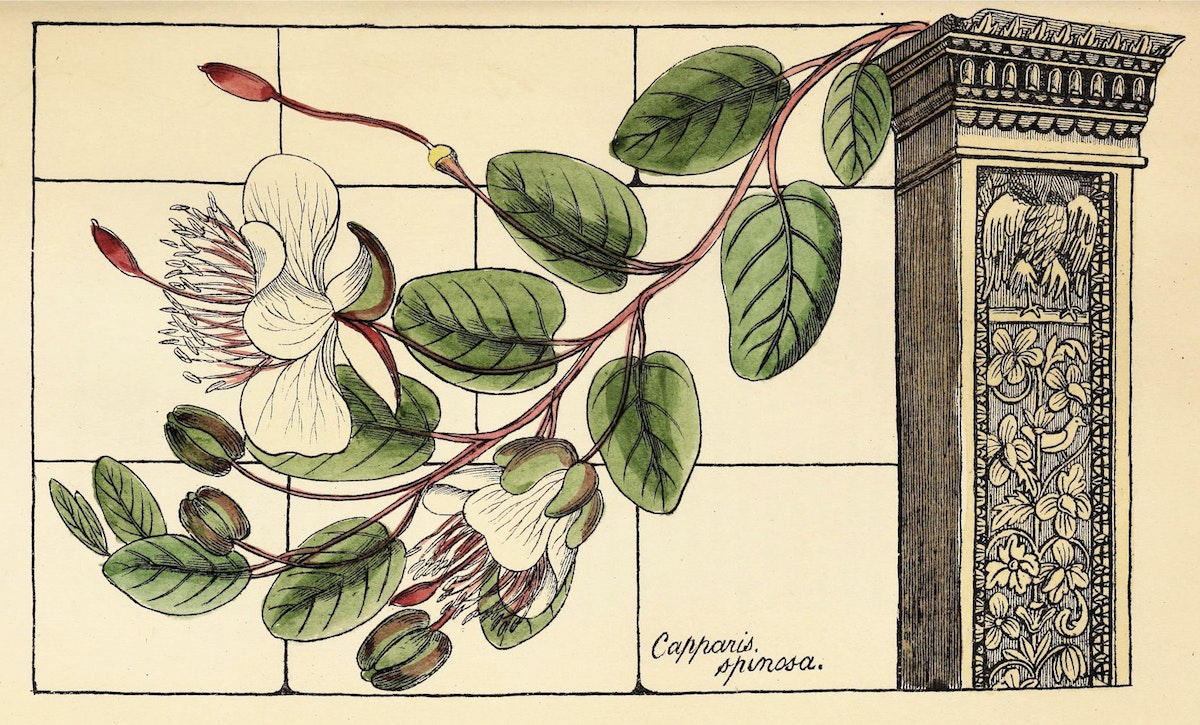
The Colosseum is one of the most popular tourist attractions in Italy, and thus one of the most popular tourist attractions in all of Europe. But the nature of its appeal to its many visitors has changed over the centuries. In the Atlantic, novelist and podcaster Paul Cooper notes that, “the belief that Christian martyrs had once been fed to the lions in the arena,” for example, once made it a renowned site of religious pilgrimage. (This “despite little evidence that Christians were ever actually killed in the arena.”) But in that same era, the Colosseum was also a site of botanic pilgrimage: amid its ruins grew “420 species of plant,” including some rare examples “found nowhere else in Europe.”
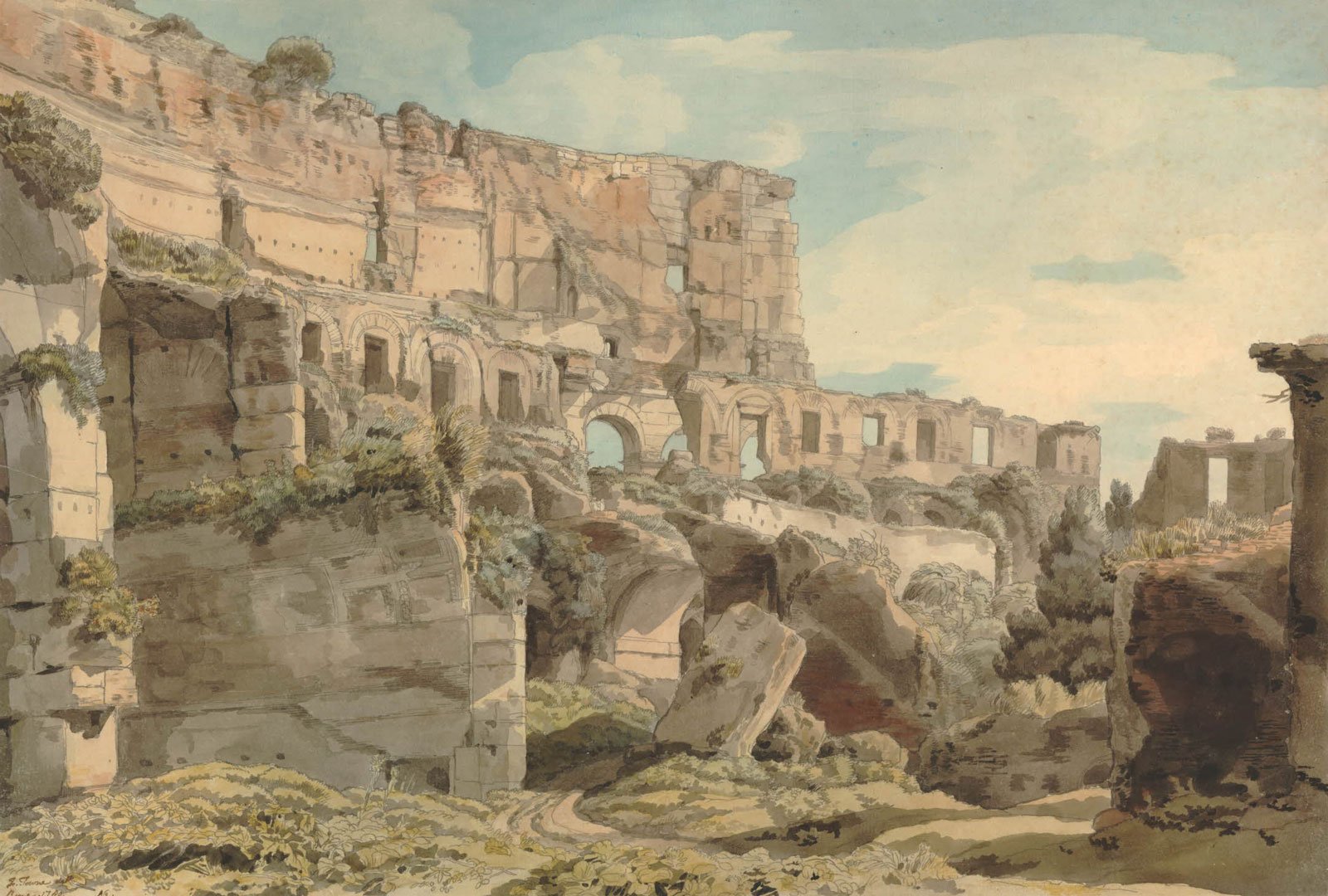
Notable tourists who took note of the Colosseum’s rich plant life include Charles Dickens, who beheld its “walls and arches overgrown with green,” and Percy Bysshe Shelley, who wrote of how “the copsewood overshadows you as you wander through its labyrinths, and the wild weeds of this climate of flowers bloom under your feet.”
Cooper quotes from these writings in his Atlantic piece, and in an associated Twitter thread also includes plenty of renderings of the Colosseum as it then looked during the 18th and 19th centuries. He even selected images from Flora of the Colosseum of Rome, or, Illustrations and descriptions of four hundred and twenty plants growing spontaneously upon the ruins of the Colosseum of Rome (readable free online at the Internet Archive), the 1855 work of a less well-known Englishman named Richard Deakin.
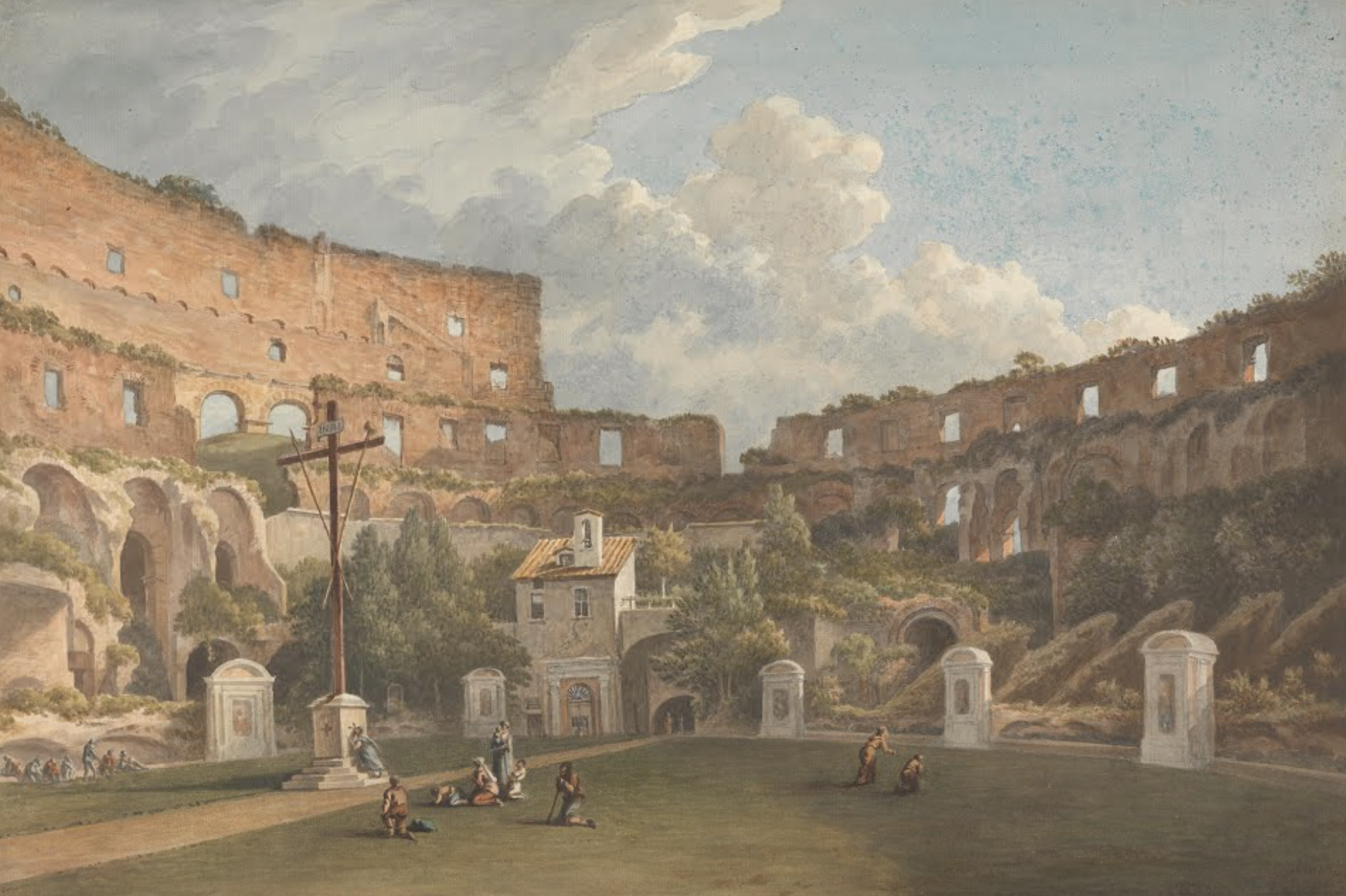
A botanist, Deakin did the hard work of cataloging those hundreds of plant species growing in the Colosseum back in the 1850s. The intervening 170 or so years have taken their toll on this biodiversity: as Nature reported it, only 242 of these species were still present in the early 2000s, due in part to “a shift towards species that prefer a warmer, drier climate” and the growth of the surrounding city. In its heyday in the first centuries of the last millennium, the arena lay on the outskirts of Rome, whereas it feels central today. Pay it a visit, and you both will and will not see the Colosseum that Dickens and Shelley did; but then, they never knew it as, say, Titus or Domitian did. In recent years there have been moves to restore and even improve ancient features like the retractable floor; why not double down on the exotic flora while we’re at it?
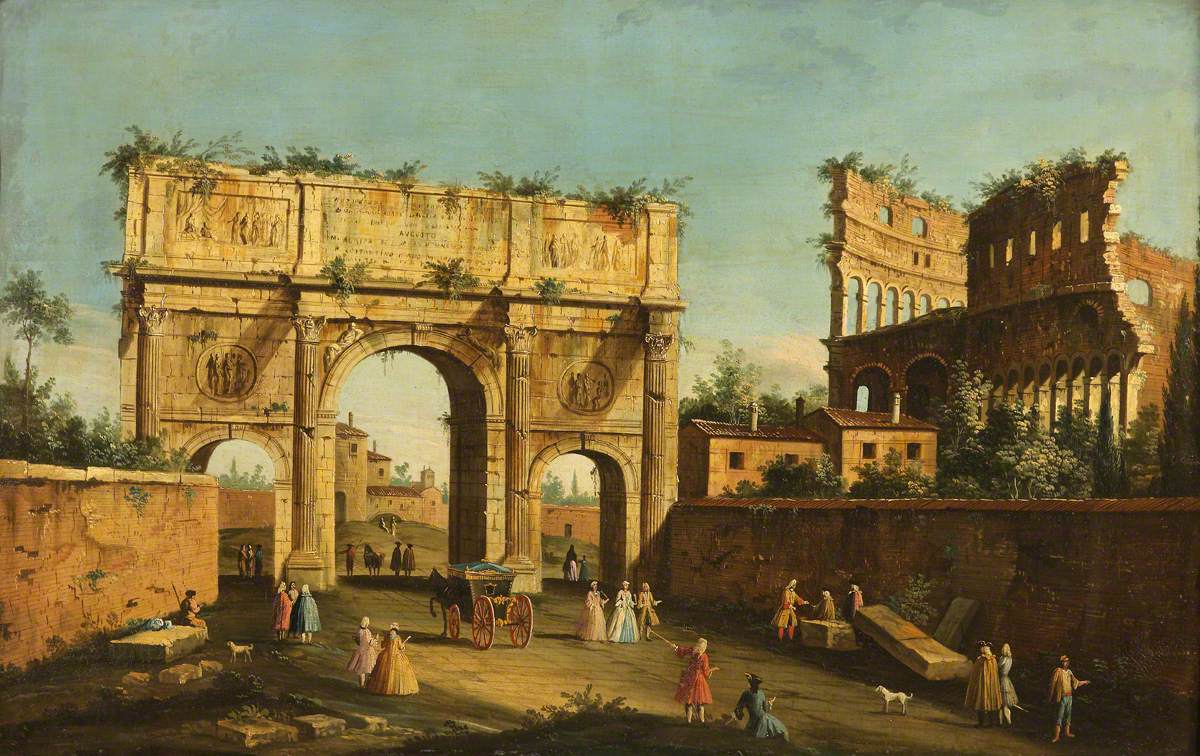
via The Atlantic
Related content:
Rome’s Colosseum Will Get a New Retractable Floor by 2023 — Just as It Had in Ancient Times
Building The Colosseum: The Icon of Rome
With 9,036 Pieces, the Roman Colosseum Is the Largest Lego Set Ever
Based in Seoul, Colin Marshall writes and broadcasts on cities and culture. His projects include the book The Stateless City: a Walk through 21st-Century Los Angeles and the video series The City in Cinema. Follow him on Twitter at @colinmarshall or on Facebook.
Read More...Pink Floyd’s Entire Studio Discography is Now on YouTube: Stream the Studio & Live Albums
Approached with little prior knowledge, Pink Floyd is an enigma. A stadium rock band renowned for massive laser light shows and a pioneering use of quadraphonic and holophonic sound, they are also best appreciated at home — alone or with a few true fans — on a pair of high fidelity stereo speakers or headphones, under the hazy purplish-greenish glow of a blacklight poster. The experience of their classic albums is paradoxically one of “shared solitary contemplation”; their live shows are an expansion of the home listening environment, where fans first received an “education from cousins and older brothers of friends as to the seriousness (and stoner sacrament) of The Dark Side of the Moon,” as Martin Popoff writes in Pink Floyd: Album by Album. Both enormously popular and daringly experimental, it’s hard to place them comfortably in one camp or another.
Listeners who came to the band during their 1970s heyday, “in the years between The Dark Side of the Moon and The Final Cut,” Bill Kopp writes, “were largely unaware of what the band had done before the period….. The fact highlights a remarkable feature of Pink Floyd’s popularity: casual fans knew of the band’s work from The Dark Side of the Moon onward; more serious students of the group were familiar with the band’s 1967 debut, The Piper at the Gates of Dawn, made when Pink Floyd was led by its founder, Roger Keith ‘Syd’ Barrett.”
The split is curious because the 70s space rock version of the band who made the third best-selling album of all time owed so much to its psychedelic founder, who slipped completely from view as he slipped away from the music industry.
As Andy Mabbett writes in his book Pink Floyd: The Music and the Mystery:
Barrett’s withdrawal from music had long ago become a source of intrigue, one of the most mystifying sagas in rock, but his contribution to the group as their first singer, guitarist and songwriter was crucial to there ever being a Pink Floyd in the first place. Syd might not have played much of a role in the classic recordings Pink Floyd produced in the Seventies, but everyone — not least the group themselves — long ago realized that all this might never have happened were it not for Syd’s initial inspiration.
At their best, during the golden years of Dark Side and Wish You Were Here, the band remembered their history while expanding their early avant-blues rock into the outer reaches of space. Dark Side contained their first hit singles since their 1967 debut and introduced new fans to Barrett indirectly via the lyrics of “Brain Damage” (originally called “Lunatic”) and the “Shine on You Crazy Diamond” suite. The cynicism and sense of doom that seemed to take over as Roger Waters became the band’s primary songwriter found its foil in Barrett’s continued influence — in his absence — on the band during the early 70s.
But in the 70s one had to work particularly hard to get caught up on the early mythos of Pink Floyd, tracking down LPs of albums like Meddle, Atom Heart Mother, and Ummagumma. As early albums were reissued on tape and CD, it became a little easier to familiarize oneself with Pink Floyd’s many historical phases — from experimental psych-rock pioneers to stadium-filling prog-rock superstars. These days, that experience can be had in an afternoon on YouTube. The band has put their studio discography and three live performances online and you can find links below (with a few choice cuts above).
Studio
The Piper at the Gates of Dawn
Live
Is There Anybody Out There? The Wall Live 1980–81
Does the ridiculous ease of finding this music now clear up the enigma of Pink Floyd? Maybe. Or maybe no amount of streaming convenience will dispel “the mystery,” Mabbett writes, “that grew around their reluctance to be photographed or interviewed for much of the Seventies, the lack of singles during the same crucial period, the imaginative album packaging, the crisp live sound, the spectacular theatrical shows — and, of course, a special magic that cannot be copied no matter how much money or equipment is available.”
Related Content:
A Live Studio Cover of Pink Floyd’s The Dark Side of the Moon, Played from Start to Finish
Josh Jones is a writer and musician based in Durham, NC. Follow him at @jdmagness
Read More...The Quirky Self-Portraits of 18th Century Painter Joseph Ducreux
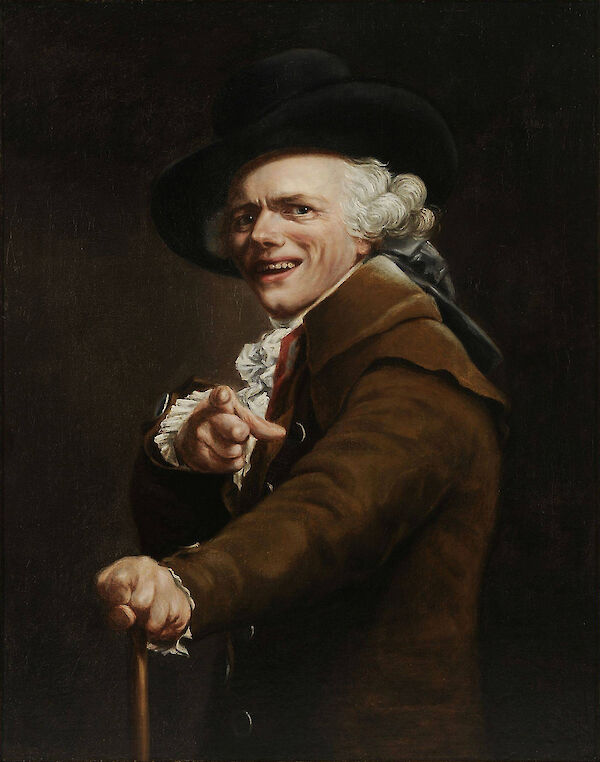
We all know him, the dapper cross between a smarmy office bro and smug, pull-my-finger uncle; leaning on his walking stick, hat pushed back at a rakish angle, pointing at the viewer with a leer.… The 18th-century painting, titled Self-Portrait in the Guise of a Mocker, enjoyed a brief but rich second life for a couple years as a 21st century meme, first appearing online in a 2009 image macro with the caption “Disregard Females, Acquire Currency,” an overly stuffy, thus hilarious, rephrasing of Notorious B.I.G.’s “Get Money” lyrics. Thousands of imitations followed. Within a couple years, Steve Buscemi’s face got photoshopped in place of the grinning bon vivant, and the meme began its decline.
But whose face was it, pre-Buscemi, giving us that toothy grin and point, “like a man catching sight of an old friend across a crowded room,” the Public Domain Review writes, “or a politician trying to charm a voter.” The gentleman in question, in fact, happened to be the artist, Joseph Ducreux, a highly skilled oil painter whose miniature of Marie Antoinette in 1769 won him a baronetcy and the title of primer peintre de la reine (First Painter to the Queen).
This was an honor not given to any old slouch. Ducreux worked alongside such masters as Élisabeth Vigée Le Brun and Jacques-Louis David, despite the fact that he was not a member of the Royal Academy of Painting and Sculpture, unheard of at the time for a court painter.
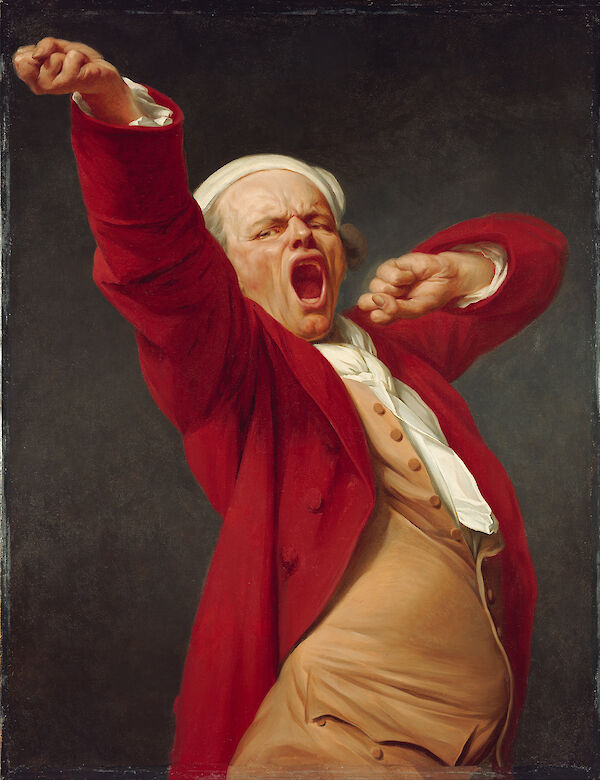
During the French Revolution, Ducreux hid out in London, where he made the last portrait of Louis XVI before the king’s beheading. Afterward, he returned and, through his friendship with David, resumed his career as a portrait painter, as well as an eccentric self-portraitist, an avocation he’d taken up in the 1780s and 90s to satisfy his curiosity about the theory of physiognomy, a pseudoscience that attempted to divine a person’s character and personality from their facial expressions and bodily postures.
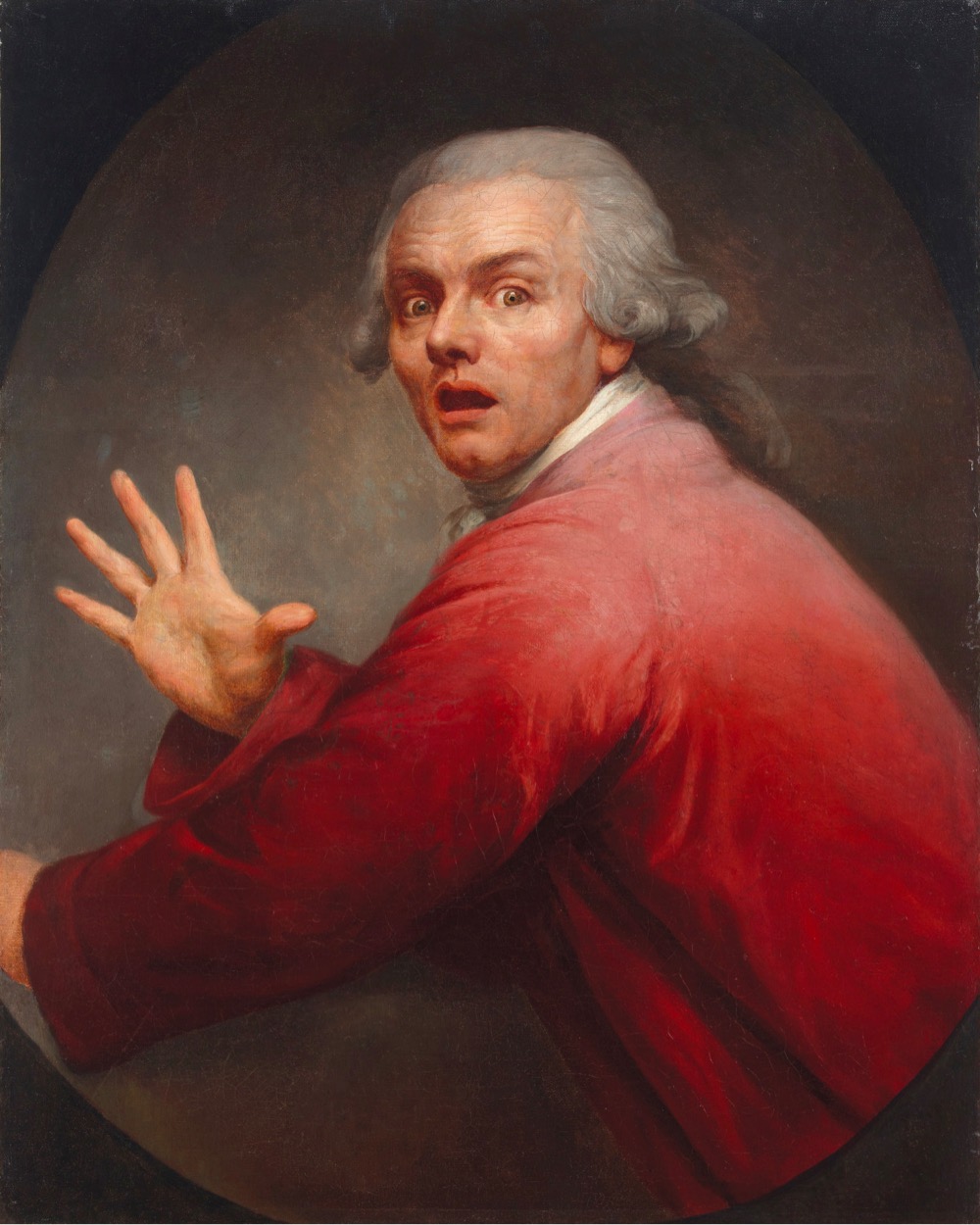
These were remarkable paintings for their time, but they were not made with Tumblr or Twitter in mind. Given that they were made before the age of photography and painted on large canvases in oils, the process of creating these goofy selfies would have been painstaking and time-consuming — hardly the kind of effort a working artist applies to a joke.

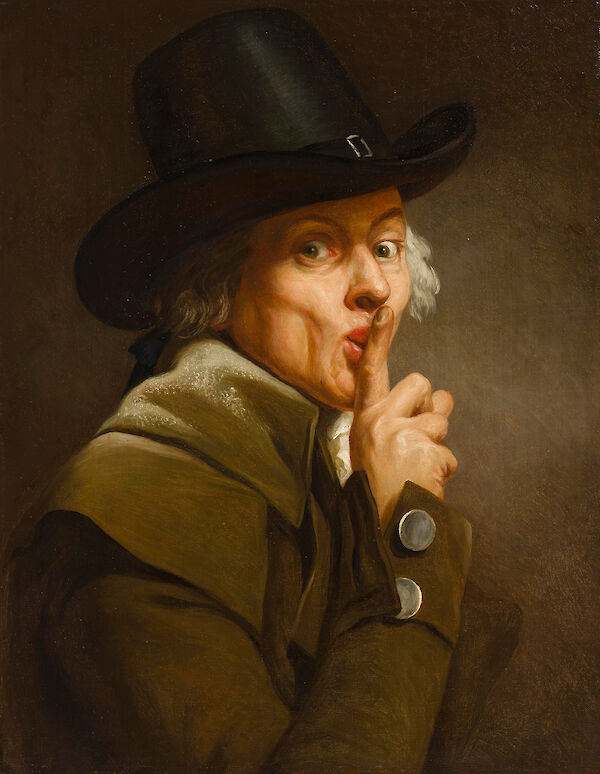
Humorous as they are, and no doubt Ducreux had a healthy sense of humor, the portraits were also meant to serve a scientific purpose of a sort, and they show an artist pushing past the conservative traditions of portraiture in his day, chafing at the sedate royal postures and placid expressions that were supposed to telegraph the aristocracy’s inner nobility. We might suspect that throughout his career as a court painter, Ducreux himself had reasons to suspect otherwise about his subjects. But he only had permission to practice his theories on himself.
Related Content:
The Intimacy of Frida Kahlo’s Self-Portraits: A Video Essay
Vincent Van Gogh’s Self Portraits: Explore & Download a Collection of 17 Paintings Free Online
Josh Jones is a writer and musician based in Durham, NC. Follow him at @jdmagness
Read More...How Peter Jackson Used Artificial Intelligence to Restore the Video & Audio Featured in The Beatles: Get Back
Much has been made in recent years of the “de-aging” processes that allow actors to credibly play characters far younger than themselves. But it has also become possible to de-age film itself, as demonstrated by Peter Jackson’s celebrated new docu-series The Beatles: Get Back. The vast majority of the material that comprises its nearly eight-hour runtime was originally shot in 1969, under the direction of Michael Lindsay-Hogg for the documentary that became Let It Be.
Those who have seen both Linday-Hogg’s and Jackson’s documentaries will notice how much sharper, smoother, and more vivid the very same footage looks in the latter, despite the sixteen-millimeter film having languished for half a century. The kind of visual restoration and enhancement seen in Get Back was made possible by technologies that have only emerged in the past few decades — and previously seen in Jackson’s They Shall Not Grow Old, a documentary acclaimed for its restoration of century-old World War I footage to a time-travel-like degree of verisimilitude.
“You can’t actually just do it with off-the-shelf software,” Jackson explained in an interview about the restoration processes involved in They Shall Not Grow Old. This necessitated marshaling, at his New Zealand company Park Road Post Production, “a department of code writers who write computer code in software.” In other words, a sufficiently ambitious project of visual revitalization — making media from bygone times even more lifelike than it was to begin with — becomes as much a job of traditional film-restoration or visual-effects as of computer programming.
This also goes for the less obvious but no-less-impressive treatment given by Jackson and his team to the audio that came with the Let It Be footage. Recorded in large part monaurally, these tapes presented a formidable production challenge. John, Paul, George, and Ringo’s instruments share a single track with their voices — and not just their singing voices, but their speaking ones as well. On first listen, this renders many of their conversations inaudible, and probably by design: “If they were in a conversation,” said Jackson, they would turn their amps up loud and they’d strum the guitar.”
This means of keeping their words from Lindsay-Hogg and his crew worked well enough in the wholly analog late 1960s, but it has proven no match for the artificial intelligence/machine learning of the 2020s. “We devised a technology that is called demixing,” said Jackson. “You teach the computer what a guitar sounds like, you teach them what a human voice sounds like, you teach it what a drum sounds like, you teach it what a bass sounds like.” Supplied with enough sonic data, the system eventually learned to distinguish from one another not just the sounds of the Beatles’ instruments but of their voices as well.
Hence, in addition to Get Back’s revelatory musical moments, its many once-private but now crisply audible exchanges between the Fab Four. “Oh, you’re recording our conversation?” George Harrison at one point asks Lindsay-Hogg in a characteristic tone of faux surprise. But if he could hear the recordings today, his surprise would surely be real.
Related Content:
Watch Paul McCartney Compose The Beatles Classic “Get Back” Out of Thin Air (1969)
Artificial Intelligence Program Tries to Write a Beatles Song: Listen to “Daddy’s Car”
Based in Seoul, Colin Marshall writes and broadcasts on cities and culture. His projects include the book The Stateless City: a Walk through 21st-Century Los Angeles and the video series The City in Cinema. Follow him on Twitter at @colinmarshall or on Facebook.
Read More...Dave Grohl & Greg Kurstin Cover The Ramones “Blitzkrieg Bop” to Celebrate Hannukah: Hey! Oy! Let’s Goy!
As mentioned earlier this week, Foo Fighters frontman Dave Grohl and producer Greg Kurstin have launched The Hanukkah Sessions, a festive music series where they cover a song–one for each night of Hanukkah–originally created by a Jewish musician. Above, watch them pay tribute to two nice Jewish boys from Queens named Jeffery Hyman and Thomas Erdelyi, aka the great Joey and Tommy Ramone. Hey! Oy! Let’s Goy!
If you would like to support the mission of Open Culture, consider making a donation to our site. It’s hard to rely 100% on ads, and your contributions will help us continue providing the best free cultural and educational materials to learners everywhere. You can contribute through PayPal, Patreon, and Venmo (@openculture). Thanks!
Related Content
The Ramones, a New Punk Band, Play One of Their Very First Shows at CBGB (1974)
The Ramones Play New Year’s Eve Concert in London, 1977
Read More...Behold the Glass Armonica, the Unbelievably Fragile Instrument Invented by Benjamin Franklin
We’re all familiar with keyboard instruments. Many of us have also heard (or indeed made) music, of a kind, with the rims of wine glasses. But to unite the two required the truly American combination of genius, wherewithal, and penchant for folly found in one historical figure above all: Benjamin Franklin. As we’ve previously noted here on Open Culture, the musically inclined Franklin invented an instrument called the glass armonica (alternatively “glass harmonica”) — or rather he re-invented it, having seen and heard an early example played in London. Essentially a series of differently sized bowls arranged from large to small, all rotating on a shaft, the glass armonica allows its player to make polyphonic music of a downright celestial nature.
The playing, however, is easier written about than done. You can see that for yourself in the video above, in which guitarist Rob Scallon visits musician-preservationist Dennis James. Not only does James play a glass armonica, he plays a glass armonica he built himself — and has presumably rebuilt a few times as well, given its scarcely believable fragility.
Transportation presents its challenges, but so does the act of playing, which requires a routine of hand-washing (and subsequent re-wetting, with distilled water only) that even the coronavirus hasn’t got most of us used to. But even in the hands of a first-timer like Scallon, who makes sure to take his turn at the keyboard-of-bowls, the glass armonica sounds like no other instrument even most of us in the 21st century have heard. In the hands of one of its few living virtuosos, of course, the glass armonica is something else entirely.
“If this piece didn’t exist,” says James, holding a piece of sheet music, “I wouldn’t be sitting here.” He refers to Adagio & Rondo for glass armonica in C minor (KV 617), composed by none other than Wolfgang Amadeus Mozart. “In 1791, the last year of his life, Mozart wrote a piece for the German armonica player, Marianne Kirchgässner,” writes Timoty Judd at The Listeners’ Club. Like every glass armonica piece, according to James, one ends it by dropping suddenly into complete silence: “It’s the only instrument, up until that point, that could to that: die away to absolutely nothing.” Alas, writes James, not long after the debut of Mozart’s composition rumors circulated that “the strange, crystalline tones of Benjamin Franklin’s new instrument were a threat to public health.” A shame though that seems today, it does suit the multitalented Franklin’s ancillary reputation as an inveterate troublemaker.
Related Content:
Bach’s Most Famous Organ Piece Played on Wine Glasses
Based in Seoul, Colin Marshall writes and broadcasts on cities and culture. His projects include the book The Stateless City: a Walk through 21st-Century Los Angeles and the video series The City in Cinema. Follow him on Twitter at @colinmarshall or on Facebook.
Read More...Catherine the Great of Russia Sends a Letter Urging Her Fellow Russians to Get Inoculated Against Smallpox (1787)
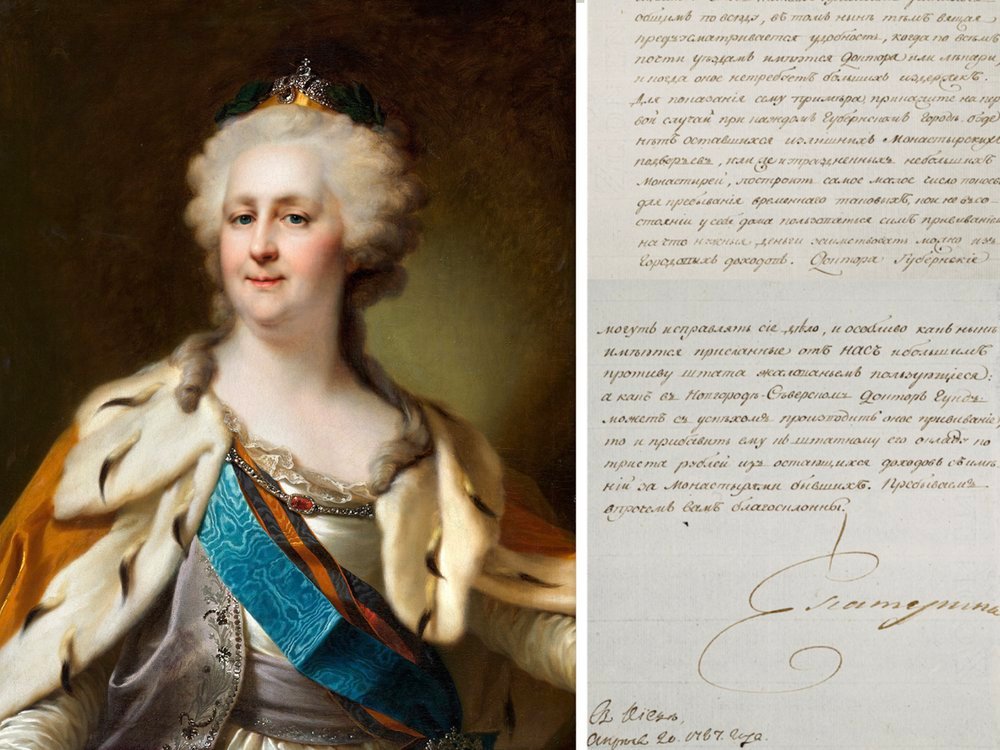
I got my booster shot the other week and through the miracles of modern science I barely knew a needle was in me before the pharmacist told me it was over. (I also didn’t feel any after effects, but your mileage may vary.) I mention this because before needles, before injectable vaccines, there was something called variolation.
Since ancient times, smallpox had a habit of decimating populations, disappearing, and reappearing elsewhere for another outbreak. It killed rulers and peasants alike. Symptoms included fever, vomiting, and most abhorrent, a body covered with fluid-filled blisters. It could blind you, and it could kill you. In variolation, a physician would take the infectious fluid from from a blister or scab on an infected person and rub it into scratches or cuts on a healthy patient’s skin. This would lead to a mild—but still particularly unpleasant—case of smallpox, and inoculate them against the virus.
But one can also see how the practice of variolation—introducing a diluted version of the virus in order for the immune system to do its work—points towards the science of vaccines.
One supporter of variolation was Catherine the Great, as evidenced by a letter in her hand promoting it across Russia from 1787. The letter just sold for $1.3 million, alongside a portrait of the monarch by Dmitry Levitsky.
Addressed to a governor-general, Catherine the Great instructs him to make variolation available to everybody in his province.
“Among the other duties of the Welfare Boards in the Provinces entrusted to you,” she writes, “one of the most important should be the introduction of inoculation against smallpox, which, as we know, causes great harm, especially among the ordinary people.” She further orders inoculation centers be set up in convents and monasteries, funded by town revenues to pay doctors.
Catherine had a personal stake in all this. Her husband, Peter III caught the disease before he became emperor, and was left disfigured and scarred for life. When she got a chance to inoculate herself in 1768 she took it, calling in a Scottish doctor, Dr. Thomas Dimsdale, to perform the variolation. The procedure took place in secret, with a horse at the ready in case the procedure caused terrible side effects and he had to hot foot it out of Russia. That didn’t happen, and after a brief convalescence, Catherine revealed what she had done to her countrymen.
“My objective was, through my example, to save from death the multitude of my subjects who, not knowing the value of this technique, and frightened of it, were left in danger.”
Yet, despite her own bravery, 20 years later smallpox continued to rampage through Russia, hence the letter.
Nine years later in 1796, Dr. Edward Jenner found that the cowpox virus—which only caused mild, cold-like symptoms in humans—could inoculate humans against smallpox. Despite initial rejections from the scientific community, his discovery led to vaccination supplanting variolation. And it’s the reason we now use the word “vaccine”—it comes from the Latin word for cow.
Related Content:
How Vaccines Improved Our World In One Graphic
The History of the Plague: Every Major Epidemic in an Animated Map
Ted Mills is a freelance writer on the arts who currently hosts the Notes from the Shed podcast and is the producer of KCRW’s Curious Coast. You can also follow him on Twitter at @tedmills, and/or watch his films here.
Read More...Support Us
We're hoping to rely on loyal readers, rather than erratic ads. Please click the Donate button and support Open Culture. You can use Paypal, Venmo, Patreon, even Crypto! We thank you!

About Us

Open Culture scours the web for the best educational media. We find the free courses and audio books you need, the language lessons & educational videos you want, and plenty of enlightenment in between.
Advertise With Us
FREE UPDATES!
GET OUR DAILY EMAIL
Get the best cultural and educational resources on the web curated for you in a daily email. We never spam. Unsubscribe at any time.
FOLLOW ON SOCIAL MEDIA
Open Culture editor Dan Colman scours the web for the best educational media. He finds the free courses and audio books you need, the language lessons & movies you want, and plenty of enlightenment in between.
Advertise With Us

