How Egyptian Papyrus Is Made: Watch Artisans Keep a 5,000-Year-Old Art Alive
In 2013, French Egyptologist Pierre Tallet discovered in an excavation site near the Red Sea “entire rolls of papyrus, some a few feet long and still relatively intact, written in hieroglyphics as well as hieratic, the cursive script the ancient Egyptians used for everyday communication,” Alexander Stille writes at Smithsonian. The scrolls contained the “Diary of Merer,” the journals of an official who led a transportation crew, and who observed the building of the largest of the pyramids. It has been called “the greatest discovery in Egypt in the 21st century.”
The discovery of the diary entries and other papyri at the site “provide a never-before-seen snapshot of the ancients putting finishing touches on the Great Pyramid.” It is also significant since Tallet found “the oldest known papyri in the world” and has helped give researchers greater insight into how papyrus was used by ancient Egyptians for careful record-keeping — in both the language of priests and scribes and that of ordinary merchants — since around 3000 BC.
Papyrus was “produced exclusively in Egypt, where the papyrus plant grew” notes University of Michigan Libraries, but “papyrus (the writing material) was exported throughout the classical world, and it was the most popular writing material for the ancient Greeks and Romans,” becoming the most used platform for writing by the first century AD. That changed with the introduction of parchment and, later, paper; “the large plantations in Egypt which used to cultivate high-grade papyrus for manufacture disappeared,” as did the knowledge of papyrus-making for around 1000 years.
But papyrus (the paper) has come back, even if wild papyri plants are disappearing as Egypt’s climate changes. While scholars in the 20th century tried, unsuccessfully, to reconstruct papyrus-making using ancient sources like Pliny’s Natural History, Egyptian craftspeople in the 1970s reinvented the process using their own methods, as you can see in the Business Insider video above. “The industry thrived, selling papyrus art to tourists,” the video notes, but it has fallen on hard times as the plants go extinct and demand falls away.
Learn above how modern Egyptian papyrus-makers, scribes, and illustrators ply their trade — a fairly good indicator of how the ancients must have done it. There may be little demand for papyrus, or for parchment, for that matter, and maybe paper will finally go the way of these obsolete communications technologies before long. But as long as there are those who retain the knowledge of these arts, we’ll have an intimate physical connection to the writers, artists, and bureaucrats of empires past.
Related Content:
Learn to Play Senet, the 5,000-Year Old Ancient Egyptian Game Beloved by Queens & Pharaohs
Josh Jones is a writer and musician based in Durham, NC. Follow him at @jdmagness
Read More...An Illustrated History of Depeche Mode by Anton Corbijn
Last year, photographer Anton Corbijn released a new book, MOOD/MODE, showcasing work outside the boundaries of the rock photography world in which he’d made his name. But no matter whom he’s photographing, Corbijn brings a high seriousness to the endeavor that he explains as part of his religious upbringing in the book’s introduction. “My Protestant background always marked & influenced my portrait photography. Mankind. Humanity. Empathy,” he writes, were the ideals he absorbed as a child. Such beliefs “kept me from doing work that lacked a deeper purpose.”
Corbijn grew up in a small village outside Rotterdam, Jean-Jacques Naudet writes. “His father and many other male members of his family were pastors. Life was strict and simple, on Sunday everybody dressed in black. Religion was omnipresent.”
He moved away to the city and began taking photos of the music scene at 17. But the look and feel of his early life never left him. It was this aesthetic that attracted Depeche Mode, one of Corbijn’s longest-running musical collaborators and a band who were no strangers to brooding in black and making religious references and appeals to humanity.

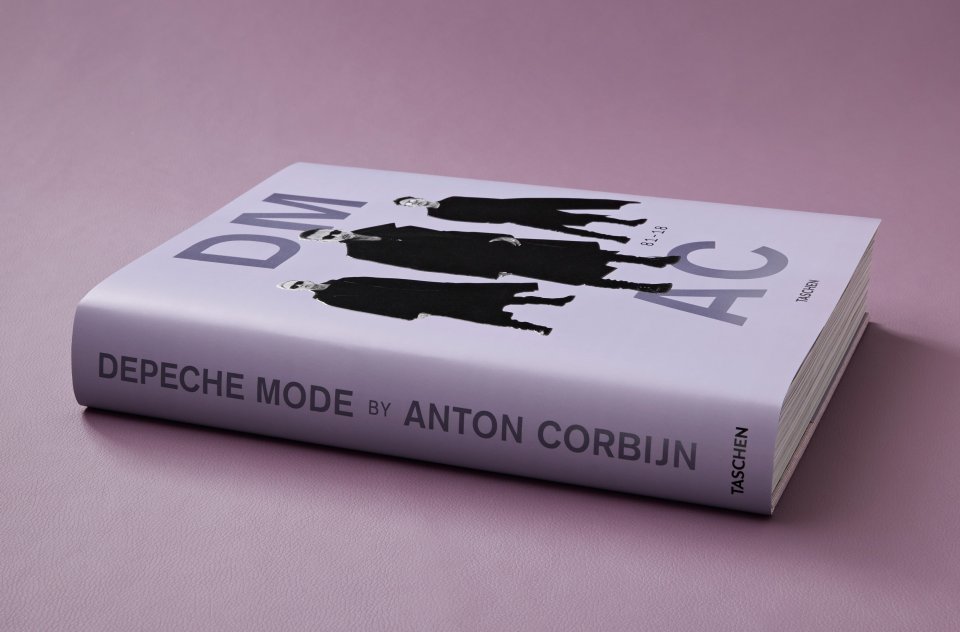
“We were seen as just a pop band,” says Depeche Mode’s Martin Gore. “We thought that Anton had a certain seriousness, a certain gravity to his work, that would help us get away from that.” Corbijn first helped them refine their look in mid-80s and “was able to give the Depeche Mode sound, that we were beginning to create, a visual identity,” says singer Dave Gahan. That identity is now the subject of a new book from Taschen that collects “over 500 photographs from Anton Corbijn’s personal archives,” notes the arts publisher, “some never seen before, as well as stage set designs, sketches, album covers, and personal observations” about the “world’s biggest cult band.”
Corbijn became such an integral part of Depeche Mode’s success, the band considered him “a veritable unseen member of the group,” writes Post-Punk.com, mediating their image not only through photography but also live projections and, of course, music videos. They were able to achieve “a kind of cult status,” says Gore in the mini-documentary above, which also has an interview with Corbijn. The photographer walks us through his history with the legendary synth pioneers (whom he did not like at first), beginning with the first image he shot of them in 1981, when founder Vince Clarke was still in the band.
Clarke leans behind Gahan’s left shoulder, the full band framed by a stone arch. To Gahan’s right is an enormous crucifix. It set a tone for the working relationship to come. “There has to be an element of the person in the photograph,” says Corbijn of his portraiture, “but there also has to be an element of the photographer.” It took another few years after that first shoot, he tells The Guardian, but he realized “how good their music and my visuals actually went together.… They had soul.” You can order a copy of the new book, Depeche Mode by Anton Corbijn from Taschen here.


Related Content:
Lost Depeche Mode Documentary Is Now Online: Watch Our Hobby is Depeche Mode
Depeche Mode Releases a Goosebump-Inducing Cover of David Bowie’s “Heroes”
Read More...
A Duck Gets a Prosthetic Leg & Waddles Along
Waddles the Duck was born with a mangled left leg. So what does his caretaker–Ben Weinman, the guitarist of Suicidal Tendencies–do? Gets him a 3D printed prosthetic, with the help of Derrick Campana, a Certified Pet Prostheticist at Bionic Pets, notes Laughing Squid. And, for a brief moment, the world’s ok.
If you would like to support the mission of Open Culture, consider making a donation to our site. It’s hard to rely 100% on ads, and your contributions will help us continue providing the best free cultural and educational materials to learners everywhere. You can contribute through PayPal, Patreon, and Venmo (@openculture). Thanks!
Read More...Søren Kierkegaard – Subjectivity, Irony and the Crisis of Modernity: A Free Online Course from the University of Copenhagen

The University of Copenhagen and Jon Stewart, PhD present Søren Kierkegaard – Subjectivity, Irony and the Crisis of Modernity, a course exploring the work of Denmark’s great philosopher. The course description reads as follows:
It is often claimed that relativism, subjectivism and nihilism are typically modern philosophical problems that emerge with the breakdown of traditional values, customs and ways of life. The result is the absence of meaning, the lapse of religious faith, and feeling of alienation that is so widespread in modernity.
The Danish thinker Søren Kierkegaard (1813–55) gave one of the most penetrating analyses of this complex phenomenon of modernity. But somewhat surprisingly he seeks insight into it not in any modern thinker but rather in an ancient one, the Greek philosopher Socrates.
In this course created by former associate professor at the Søren Kierkegaard Research Centre, Jon Stewart, we will explore how Kierkegaard deals with the problems associated with relativism, the lack of meaning and the undermining of religious faith that are typical of modern life. His penetrating analyses are still highly relevant today and have been seen as insightful for the leading figures of Existentialism, Post-Structuralism and Post-Modernism.
You can take Søren Kierkegaard for free by selecting the audit option upon enrolling. If you want to take the course for a certificate, you will need to pay a fee.
Søren Kierkegaard has been added to our list of Free Philosophy Courses, a subset of our collection, 1,700 Free Online Courses from Top Universities.
Related Content
Existential Philosophy of Kierkegaard, Sartre, Camus Explained with 8‑Bit Video Games
Read More...The Bob Ross Virtual Art Gallery: A New Site Presents 403 Paintings from The Joy of Painting Series
“We don’t make mistakes. We have happy accidents,” the late Bob Ross soothed fans painting along at home, while brushing an alarming amount of black onto one of his signature nature scenes.
His mellow on-camera demeanor and flowing, wet-on-wet oil painting style were perfectly calibrated to help tightly-wound viewers relax into a right-brained groove.
The creators of the Bob Ross Virtual Art Gallery take a more left brained approach.

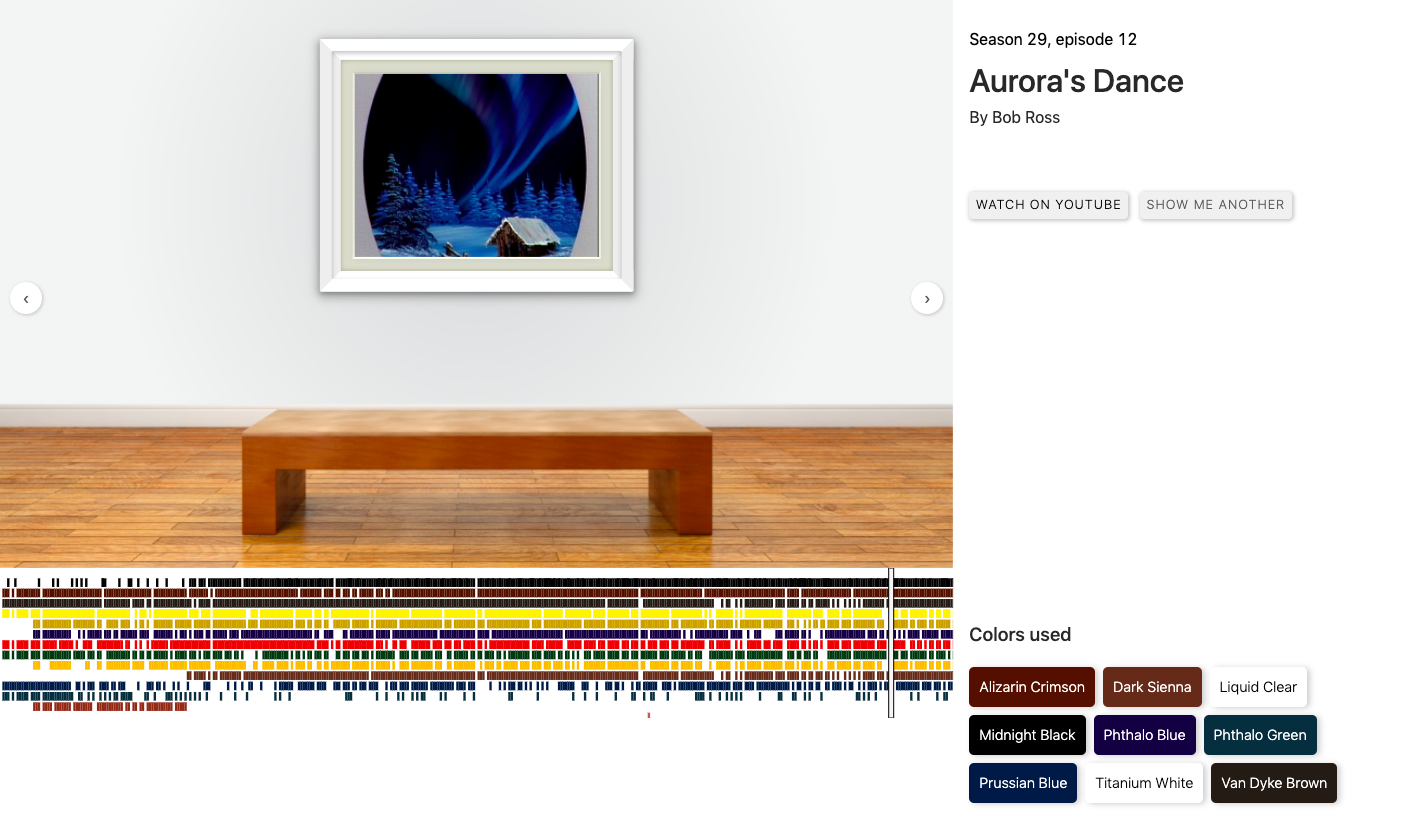
Having collected data on Ross’ evergreen series, The Joy of Painting, they analyzed it for frequency of color use over the show’s 403 episodes, as well as the number of colors applied to each canvas.
For those keeping score, after black and white, alizarin crimson was the color Ross favored most, and 1/4 of the paintings made on air boast 12 colors.
The data could be slightly skewed by the contributions of occasional guest artists such as Ross’ former instructor, John Thamm, who once counseled Ross to “paint bushes and trees and leave portrait painting to someone else.” Thamm availed himself of a single color — Van Dyke Brown — to demonstrate the wipe out technique. His contribution is one of the few human likenesses that got painted over the show’s 11-year public television run.
The Bob Ross Virtual Art Gallery has several options for viewing the data.

Mouse over a grid of grey rectangles to see the 403 artworks presented in chronological order, along with titles and episode numbers.
(This has all the makings of a thumping good memory game, à la Concentration… flip all the rectangles, study them, then see if you can navigate back to all the cabins or meadows.)
A bar graph, similarly composed of rectangles, reveals the colors that went into each painting.
Another chart analyzes Ross’ use of color over time, as he moved away from Burnt Umber and eased up on Pfthalo Green.

Indian Red was accorded but a single use, in season 22’s first episode, “Autumn Images.” (“Let’s sparkle this up. We’re gonna have fall colors. Let’s get crazy.”)
For art lovers craving a more traditional gallery experience, site creator Connor Rothschild has installed a virtual bench facing a frame capable of displaying all the paintings in random or chronological order, with digital swatches representing the paints that went into them and YouTube links to the episodes that produced them.
And for those who’d rather gaze at data science, the code is available on GitHub.
Explore the Bob Ross Virtual Art Gallery here. Scroll down to take advantage of all the options.
Related Content:
Experience the Bob Ross Experience: A New Museum Open in the TV Painter’s Former Studio Home
Bob Ross’ Christmas Special: Celebrate, Relax, Nod Off
Ayun Halliday is an author, illustrator, theater maker and Chief Primatologist of the East Village Inky zine. Join her Necromancers of the Public Domain: The Periodical Cicada, a free virtual variety show honoring the 17-Year Cicadas of Brood X. Follow her @AyunHalliday.
Read More...Yes’ Rick Wakeman Explores Vivaldi’s Four Seasons, and Why It Was the First Concept Album
In this 2015 production, Yes keyboardist Rick Wakeman revisits Antonio Vivaldi’s The Four Seasons, and makes the case for why “it was so far ahead of its time that it was actually the first ever concept album, making Vivaldi the world’s first rock superstar.”
“Uncovering the dark rumours surrounding the churches, orphanages and canals of Venice, Rick Wakeman sets out to investigate the extraordinary life of Antonio Vivaldi. From 18th century scandals to interviews with fellow musician Mike Rutherford, uncover the mystery behind one of the world’s favourite composers.” Rick Wakeman: Vivaldi’s Four Seasons appears on the “Rick Wakeman’s World” YouTube channel.
If you would like to support the mission of Open Culture, consider making a donation to our site. It’s hard to rely 100% on ads, and your contributions will help us continue providing the best free cultural and educational materials to learners everywhere. You can contribute through PayPal, Patreon, and Venmo (@openculture). Thanks!
Related Content:
Rick Wakeman’s Prog-Rock Opera Adaptation of George Orwell’s 1984
14-Year-Old Girl’s Blistering Heavy Metal Performance of Vivaldi
Vivaldi’s Four Seasons Brought to Life in Sand Animations by the Hungarian Artist Ferenc Cakó
Read More...
Tasting History: A Hit YouTube Series Shows How to Cook the Foods of Ancient Greece & Rome, Medieval Europe, and Other Places & Periods
The food of our ancestors has come back into fashion, no matter from where your own ancestors in particular happened to hail. Whether motivated by a desire to avoid the supposedly unhealthy ingredients and processes introduced in modernity, a curiosity about the practices of a culture, or simply a spirit of culinary adventure, the consumption of traditional foods has attained a relatively high profile of late. So, indeed, has their preparation: few of us could think of a more traditional food than bread, the home-baking of which became a sweeping fad in the United States and elsewhere shortly after the onset of the COVID-19 pandemic.
Max Miller, for example, has baked more than his own share of bread at home. Like no few media-savvy culinary hobbyists, he’s put the results on Youtube; like those hobbyists who develop an unquenchable thirst for ever-greater depth and breadth (no pun intended) of knowledge about the field, he’s gone well beyond the rudiments.
18th-century Saly Lunn buns, medieval trencher, Pompeiian panis quadratus, even the bread of ancient Egypt: he’s gone a long way indeed beyond simple sourdough. But in so doing, he’s learned — and taught — a great deal about the variety of civilizations, all of them heartily food-eating, that led up to ours.
“His show, Tasting History with Max Miller, started in late February,” writes Devan Sauer in a profile last year for the Phoenix New Times. “Since then, Tasting History has drawn more than 470,000 subscribers and 14 million views.” Each of its episodes “has a special segment where Miller explains the history of either the ingredients or the dish’s time period.” These periods come organized into playlists like “Ancient Greek, Roman, & Mesopotamian Recipes,” “The Best of Medieval & Renaissance Recipes,” and “18th/19th Century Recipes.” In his clearly extensive research, “Miller looks to primary accounts, or anecdotal records from the people themselves, rather than historians. He does this so he can get a better glimpse into what life was like during a certain time.”
If past, as L.P. Hartley put it, is a foreign country, then Miller’s historical cookery is a form of not just time travel, but regular travel — exactly what so few of us have been able to do over the past year and a half. And though most of the recipes featured on Tasting History have come from Western, and specifically European cultures, its channel also has a playlist dedicated to non-European foods such as Aztec chocolate; the kingly Indian dessert of payasam; and hwajeon, the Korean “flower pancakes” served in 17th-century snack bars, or eumshik dabang. He’s also prepared the snails served at the thermopolium, the equivalent establishment of the first-century Roman Empire recently featured here on Open Culture. But however impressive Miller’s knowledge, enthusiasm, and skill in the kitchen, he commands just as much respect for having mastered Youtube, the true Forum of early 21st-century civilization.
Related Content:
What Did People Eat in Medieval Times? A Video Series and New Cookbook Explain
Cook Real Recipes from Ancient Rome: Ostrich Ragoût, Roast Wild Boar, Nut Tarts & More
How to Bake Ancient Roman Bread Dating Back to 79 AD: A Video Primer
How to Make the Oldest Recipe in the World: A Recipe for Nettle Pudding Dating Back 6,000 BC
Based in Seoul, Colin Marshall writes and broadcasts on cities, language, and culture. His projects include the Substack newsletter Books on Cities, the book The Stateless City: a Walk through 21st-Century Los Angeles and the video series The City in Cinema. Follow him on Twitter at @colinmarshall or on Facebook.
Read More...What Happened During the 1921 Tulsa Massacre, One of the Worst Episodes of Racial Violence in U.S. History
In February 1915, Thomas Dixon, author of popular novel The Clansman, and D.W. Griffith, the director who adapted the book into the film Birth of a Nation, lobbied then-president Woodrow Wilson for a screening at the White House. The two were sure their story would get a warm reception from the “well documented racist” and onetime scholar who produced a five-volume History of the American People, in which he portrayed the South as “overrun by ex-slaves who were undeserving of freedom,” as Boston University journalism professor Dick Lehr remarks.
Whether or not Wilson actually uttered the words attributed to him afterward (“It’s like writing history with lightning”), he approved the film’s message and rebuffed Black leaders who were “appalled and outraged,” says Lehr. The moment was pivotal for the birth of the Civil Rights movement, he argues in a recent book. Following the country’s entry into World War I, it also lit the fires of what novelist, composer and executive director of the NAACP James Weldon Johnson called “Red Summer”… a summer of lynchings, lootings, burnings, shootings and other violence.
Mass lynchings — ignored or misconstrued as “race riots” for decades, though now properly referred to as massacres — took place all over the country between 1917 and 1923 under various pretexts, “in at least 26 cities,” Deneen Brown writes at National Geographic, “including Washington, D.C.; Chicago, Illinois; Omaha, Nebraska; Elaine, Arkansas; Charleston, South Carolina; Columbia, Tennessee; Houston, Texas,” and — the bloodiest and most destructive of them all — Tulsa, Oklahoma, an event many learned about for the first time when the current president proclaimed its 100th anniversary, May 31st, a “Day of Remembrance.”
On May 31 and June 1, 1921, the mob who rampaged through the Tulsa neighborhood of Greenwood, a prosperous black community just a generation removed from slavery, killed over 300 Black residents, “dumping their bodies into the Arkansas River or burying them in mass graves. More than a hundred businesses were destroyed, as well as a school, a hospital, a library, and dozens of churches. More than 1,200 Black-owned houses burned.” The attackers rained death from above: a report by a state-appointed commission found “Tulsa was likely the first city” in the country “to be bombed from the air.”
“The economic losses in the Black community amounted to more than $1 million,” Brown notes, a figure that cannot account for personal losses that resonated through generations, like those described by the massacre’s oldest living survivor, who testified recently before a House subcommittee. Sonali Kolhatkar writes:
107-year-old Viola Fletcher… testified to Congress a few weeks ahead of the 100th anniversary and recalled growing up as a child in Greenwood in “a beautiful home” with “great neighbors and… friends to play with.” “I had everything a child could need. I had a bright future ahead of me,” she said. A few weeks after Fletcher turned seven, the armed men struck on May 31, 1921. After recounting the “violence of the white mob,” and her memories of seeing “Black bodies lying in the street” and “Black businesses being burned,” she went on to describe the grinding poverty she was thrown into as a result of the massacre.
Fletcher never made it past the fourth grade in school. The promising future that her family had worked hard to give her was obliterated in the ashes of the Tulsa Race Massacre. “Most of my life I was a domestic worker serving white families. I never made much money. To this day I can barely afford my everyday needs,” she told lawmakers during her testimony.
That the anniversary now falls on Memorial Day (then celebrated on May 30th) seems a bitter irony given that much of the backlash toward Black communities came from fear of those returning Black soldiers who stood up against the everyday violence of Jim Crow when they returned from overseas. Birth of a Nation inspired a reborn Ku Klux Klan and its supporters to turn that fear into a crusade, a kind of pre-emptive collective retaliation.
“During the massacres, they murdered and maimed people indiscriminately, unprovoked,” says Alice M. Thomas, a Carnegie scholar and a professor in the School of Law at Howard University. “They went into homes, stole personal belongings, and burned down homes. They used the massacres as a cover to murder without sanction, maim without sanction, and steal without sanction. No one, to this day, has been held accountable.”
Red Summer was primarily driven by what now gets coded as “economic anxiety.” Karlos K. Hill, professor of African and African American Studies at the University of Oklahoma, explains that “the Greenwood District [of Tulsa] was perhaps the wealthiest Black community in the country… a symbol of what was possible even in Jim Crow America.” Referred to as “Black Wall Street” — the moniker given to many other such communities — Greenwood posed a threat: “The fear was, if Black people could have economic and political equality, then social equality would follow right behind.”
Rather than face the frightening prospect of an actual democracy, thousands of white Americans lashed out in Red Summer, burning Black Wall Streets to the ground nationwide. After a century of denial, the U.S. is only beginning to reckon with the massacres, and specifically, with Tulsa. The president’s proclamation marks a historic step in the right direction. In the Vox video above, learn more about a story “you won’t find in most history books.”
As NPR notes, you can also watch another documentary on the Tulsa massacre on PBS.
Related Content:
Take The Near Impossible Literacy Test Louisiana Used to Suppress the Black Vote (1964)
Josh Jones is a writer and musician based in Durham, NC. Follow him at @jdmagness
Read More...The Art of Creating a Bonsai: One Year Condensed Condensed Into 22 Mesmerizing Minutes
To be a good writer, one must be a good reader. This is made true by the need to absorb and assess the work of other writers, but even more so by the need to evaluate one’s own. Writing is re-writing, to coin a phrase, and effective re-writing can only follow astute re-reading. This condition applies to other arts and crafts as well: take bonsai, the regarding of which constitutes a skill in and of itself. To craft an aesthetically pleasing miniature tree, one must first be able to see an aesthetically pleasing miniature tree — or perhaps to feel one. “Bonsai trees (and inspiring art in general) give me a ‘feeling’ that is hard to describe,” as practitioner Bucky Barnes puts it in the video above. “I’m not getting it from this tree yet, so I know I need to continue tweaking.”
That tree is a Japanese larch bonsai, Barnes’ year of work on which the video compresses into a mere 22 minutes. The work is more than a matter of water and sunlight: aspects that must be considered and aggressively modified, include the plant’s viewing and potting angle, the number and direction of its branches, and even the structure of roots spreading through the soil below.
Barnes breaks out a range of clippers, knives, pastes, brushes, and wires — part of a suite of tools that, at least for the masters back in bonsai’s homeland of Japan, can get expensive indeed. To us laymen, the tree that results from this year of work looks pretty respectable, but by bonsai standards its existence has only just begun. Over the coming decades — or even the coming centuries — it could take on other qualities altogether. When well maintained, bonsai only improve with age.
As demonstrated in the video just above, however, not every bonsai receives such maintenance. A product of the same Youtube channel, Bonsai Releaf, “Restoring a Neglected Chinese Juniper Bonsai” begins with a tree that, to many of its nearly four million viewers so far, probably doesn’t look too bad. Barnes sees things differently: beginning by sketching the tree, apparently a standard stage of his professional bonsai-viewing process, he sets about correcting a host of deficiencies like “lower branches competing for light,” excessive upward or downward growth (as well as something called “weak crotch growth”), and dead tissue not delineated from living. This laborious operation requires an even wider tool set, encompassing Dremels and even flames. But by the video’s end, anyone can see the difference in the tree itself — and more importantly, feel it.
Related Content:
The Art & Philosophy of Bonsai
Based in Seoul, Colin Marshall writes and broadcasts on cities, language, and culture. His projects include the Substack newsletter Books on Cities, the book The Stateless City: a Walk through 21st-Century Los Angeles and the video series The City in Cinema. Follow him on Twitter at @colinmarshall or on Facebook.
Read More...The Mistake Waltz: Watch the Hilarious Ballet by Legendary Choreographer Jerome Robbins
So often mistakes are the most memorable part of live performance.
In Jerome Robbins’ The Concert (or The Perils of Everybody), they’re built in.
The portion set to Chopin’s Waltz in E Minor, above, has earned the nickname The Mistake Waltz. It’s an anthology of screw ups that will be familiar to anyone who’s attended a few amateur ballet productions and school recitals.
When the entire ensemble is meant to be traveling in the same direction or synchronizing swanlike gestures, the one who’s egregiously out of step is a guaranteed standout… if not the audience’s flat out favorite.
Robbins generously spreads the clowning between all six members of the corps, getting extra mileage from the telegraphed irritation in every indiscreetly attempted correction.
Performed well, the silliness seems almost improvisational, but as with all of this legendary choreographer’s work, the spontaneous beats are very, very specific.
It only works if the dancers have the technical prowess and the comic chops to pull it off. Les Ballets Trockadero de Monte Carlo aside, this can present a sizable casting challenge.
Robbins also felt that The Concert should be presented sparingly, to keep the jokes from becoming stale.
Individual companies have some agency over their costumes, but other than that, it is executed just as it was in its 1956 debut with the New York City Ballet.
Former NYCB lead dancer Peter Boal, who was 10 when he played Cupid in Robbins’ Mother Goose, has made The Concert part of Pacific Northwest Ballet’s repertoire. He revealed another side of the exacting Robbins in a personal essay in Dance Magazine:
He had the unique ability to become kid-like in the studio, giggling with others and often laughing robustly at his own jokes. He was certainly his own best audience for The Concert. How many times had he seen those gags and yet fresh, spontaneous laughter erupted from him as if it was a first telling.
Related Content:
Ballet Dancers Do Their Hardest Moves in Slow Motion
Radiohead Ballets: Watch Ballets Choreographed Creatively to the Music of Radiohead
The Dance Theatre of Harlem Dances Through the Streets of NYC: A Sight to Behold
Ayun Halliday is an author, illustrator, theater maker and Chief Primatologist of the East Village Inky zine. Join her Necromancers of the Public Domain: The Periodical Cicada, a free virtual variety show honoring the 17-Year Cicadas of Brood X. Follow her @AyunHalliday.
Read More...
Support Us
We're hoping to rely on loyal readers, rather than erratic ads. Please click the Donate button and support Open Culture. You can use Paypal, Venmo, Patreon, even Crypto! We thank you!

About Us

Open Culture scours the web for the best educational media. We find the free courses and audio books you need, the language lessons & educational videos you want, and plenty of enlightenment in between.
Advertise With Us
FREE UPDATES!
GET OUR DAILY EMAIL
Get the best cultural and educational resources on the web curated for you in a daily email. We never spam. Unsubscribe at any time.
FOLLOW ON SOCIAL MEDIA
Open Culture editor Dan Colman scours the web for the best educational media. He finds the free courses and audio books you need, the language lessons & movies you want, and plenty of enlightenment in between.
Advertise With Us

