Design Thinking for the Greater Good: A Free Online Course from the University of Virginia
Design Thinking for the Greater Good: Innovation in the Social Sector shows how and why human-centered design is a powerful tool. Offered by the Darden School of Business at the University of Virginia, the course lets students “view design thinking success stories from around the world, in areas as diverse as government, health care, and education.” Throughout the course, students will “learn the tools, techniques and mindset needed to use design thinking to uncover new and creative solutions in the social sector.”
You can take Design Thinking for the Greater Good for free by selecting the audit option upon enrolling. If you want to take the course for a certificate, you will need to pay a fee.
Design Thinking for the Greater Good has been added to our list of Business Courses, a subset of our collection, 1,700 Free Online Courses from Top Universities.
Related Content
Free: A Crash Course in Design Thinking from Stanford’s Design School
Download 20 Free eBooks on Design from O’Reilly Media
Read More...Digital Transformation: A Free Online Course from the University of Virginia & Boston Consulting Group
Digital Transformation is a hot topic. But what exactly is digital transformation, and what does it mean for companies? This course developed at the Darden School of Business at the University of Virginia, and led by Darden faculty and Boston Consulting Group experts, will examine the pace of digital change and the imperative it creates for businesses. Students will then examine “what it takes to win in the digital age and how to identify key areas to digitize, including strategy, core processes, and technology.”
By the end of this course, students will be able to:
- describe the underlying economics of innovation, technology, and market disruptions.
- weigh the pros and cons of current digital technologies driving advancement.
- utilize BCG’s digital transformation framework as a “how-to” for digitizing your organization.
You can take Digital Transformation for free by selecting the audit option upon enrolling. If you want to take the course for a certificate, you will need to pay a fee.
Digital Transformation has been added to our list of Business Courses, a subset of our collection, 1,700 Free Online Courses from Top Universities.
Related Content
For a complete list of online courses, please visit our complete collection, 1,700 Free Online Courses from Top Universities.
For a list of online certificate programs, visit 200 Online Certificate & Microcredential Programs from Leading Universities & Companies, which features programs from our partners Coursera, Udacity, FutureLearn and edX.
And if you’re interested in Online Mini-Masters and Master’s Degrees programs from universities, see our collection: Online Degrees & Mini Degrees: Explore Masters, Mini Masters, Bachelors & Mini Bachelors from Top Universities.
Read More...Keith Richards Shows Us How to Play the Blues, Inspired by Robert Johnson, on the Acoustic Guitar
To me Robert Johnson’s influence — he was like a comet or a meteor that came along and, BOOM, suddenly he raised the ante, suddenly you just had to aim that much higher.
As Keith Richards tells it, the first time he met Brian Jones, the two “went around to his apartment crash-pad,” where all Jones had was “a chair, a record player, and a few records, one of which was Robert Johnson.” Jones put on the record, and the moment changed Richards’ life. He wasn’t so much interested in the devil at the crossroads. The first question he asked — “Who’s that?” — was followed by, “Yeah, but who’s the other guy playing with him? That, too, was Robert Johnson, playing rhythm with his thumb while bending and sliding with his fingers, the fancy guitar work that earned him the envy of fellow bluesmen, and led to the rumor his skills came from hell.
“One of the staples of Johnson’s style is his ability to sound at times like two guitar players,” writes Andy Aledort at Guitar World, “combining driving rhythms on the lower strings with melodic figures with the higher strings.” Like every other British guitarist of his generation, Richards was enchanted. “I’ve never heard anybody before or since use the form and bend it quite so much to make it work for himself…. The guitar playing — it was almost like listening to Bach. You know, you think you’re getting a handle on playing the blues, and then you hear Robert Johnson….”
The legendary bluesman became not only Richards’ hero, but also his teacher. “We all felt there was a certain gap in our education,” he tells The Guardian, “so we all scrambled back to the 20s and 30s to figure out how Charlie Patton did this, or Robert Johnson, who, after all, was and still probably is the supremo.”
Figuring out what Johnson did still consumes his biggest fans. Since his recordings were intentionally sped up, interpreters of his music must make their best guesses about his tunings, which “can be broken down into four categories: standard tuning, open G, open D and drop D,” Aledort notes. (There are other arguments for alternate tunings.) Richards frequently used open tunings like Johnson’s before he learned 5‑string open G from Ry Cooder, on songs, for example, like “Street Fighting Man.” At the top, he gives us his interpretation of Johnson’s “32–20 Blues,” in standard tuning.
And just above, Keef offers a brief lesson on how to play the blues, mumbling and growling over a 12-bar vamp. The music took him over, he says, “it’s just something you’ve got to do. You have no choice. I mean, we had other things to do and everything, but once you got bitten by the bug, you had to find out how it’s done, and every three minutes of soundbite would be like an education.”
What did their blues heroes think of the Stones? The band never got to meet Robert Johnson, of course, but he might have been appreciative. “I got the chance to sit around with Muddy Waters and Bobby Womack,” says Keith, “and they just wanted to share ideas.” Johnson didn’t leave much behind to learn from, but his keenest students found exactly what they needed in his few haunting recordings.
Related Content:
Robert Johnson Finally Gets an Obituary in The New York Times 81 Years After His Death
Josh Jones is a writer and musician based in Durham, NC. Follow him at @jdmagness
Read More...The World’s First Bass Guitar (1936)
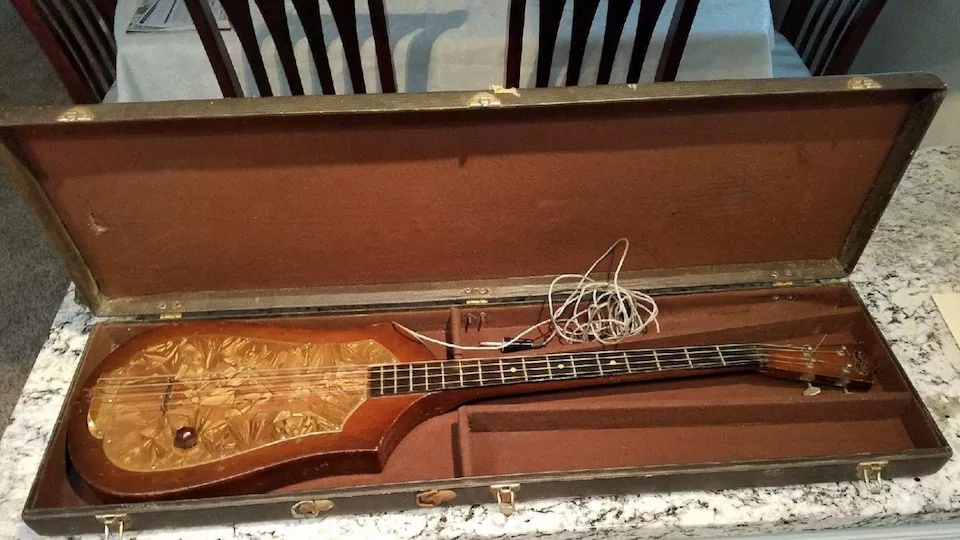
Image via Ebay
The big, stand-up double bass or “bull fiddle,” as it’s been called, dates to the 15th century. The design has evolved, but its four strings and EADG tuning have remained standard features of basses for several hundred years of classical and, later, jazz, country, and early rock and roll. Its booming tone and unwieldy size notwithstanding, the venerable instrument is a member of the violin family. So, when did the four-string bass become a bass guitar?
Leo Fender’s 1951 Precision Bass is frequently cited as the first — “such a special instrument,” writes the Fender company, that “if Clarence Leo Fender were to be remembered for nothing else, surely it would be the Precision — an instrument — indeed a whole new kind of instrument — that simply didn’t exist before he invented it.”
Prior to Fender’s innovation, it was thought that the earliest examples of electric basses were stand-up models like Regal’s Electrified Double Bass and Rickenbacker’s Electro-Bass-Viol, both dating from 1936.
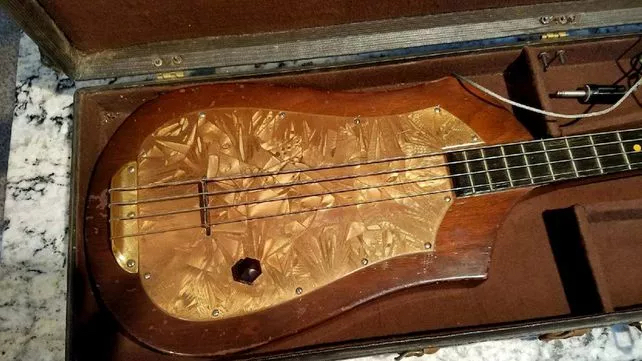
Image via Ebay
But as historian and writer Peter Blecha found out, the first electric bass guitar actually appeared that same year, invented in ‘36 by “musician/instructor/basement tinkerer” Paul H. Tutmarc, “a pioneer in electric pickup design who marketed a line of electric lapsteel guitars under the Audiovox brand out of the unlikely town of Seattle.” Throughout the thirties and forties, notes Guitar World, Tutmarc “made a number of guitars and amplifiers under the Audiovox brand.” In 1935, he invented a “New Type Bull Fiddle,” an electric stand-up bass. The Seattle Post-Intelligencer announced it at the time as good news for the “poor bass-fiddler… who has to lug his big bull-fiddle home” at the end of the night.
The following year, Tutmarc combined his instrument-making skills into the world’s first bass guitar, the Audiovox 736 Electric Bass Fiddle, a true original and a “radical design breakthrough,” Blecha writes. Tutmarc’s instrument solved the bassist’s problems of being inaudible in a big band setting and being barely able to carry one’s instrument to and from a gig. The 736 did not catch on outside Seattle, but it did get out a lot around the city.
Tutmarc “gave the bass to his wife Lorraine, who used it while performing with the Tutmarc family band. [He] also sold copies to various gospel, Hawaiian, and country players.” (The bass cost around $65, or $1,150 today, with a separate amp that sold for $95.) Now, there are only three known Audiovox 736s in existence: one held by a private collector, another at Seattle’s Museum of Pop Culture, and a third auctioned a few years ago on Ebay for $23,000.
Did Leo Fender see one of Tutmarc’s creations when he invented the first truly mass-market electric bass guitar? Perhaps, but it hardly matters. It was Fender’s instrument that would catch on — for good — fifteen years after the Audiovox 736, and it was Tutmarc’s fate to be largely forgotten by musical history, “destined to remain obscure,” Blecha writes, “to the extent that, in the wake of Leo Fender’s Precision Bass… the very existence of a previous electric fretted bass (played horizontally) was effectively forgotten.” See an introduction and demonstration of the first bass guitar just above.
Related Content:
Behold the First Electric Guitar: The 1931 “Frying Pan”
The Neuroscience of Bass: New Study Explains Why Bass Instruments Are Fundamental to Music
Legendary Studio Musician Carol Kaye Presents 150 Free Tips for Practicing & Playing the Bass
Josh Jones is a writer and musician based in Durham, NC. Follow him at @jdmagness
Read More...That Far Corner: Frank Lloyd Wright in Los Angeles–A Free Online Documentary
From KCET (the public broadcaster serving SoCal) comes the documentary, That Far Corner: Frank Lloyd Wright in Los Angeles. “During his time spent in Southern California in the late 1910s and early 1920s, Frank Lloyd Wright accelerated the search for L.A.‘s authentic architecture that was suitable to the city’s culture and landscape. Writer/Director Chris Hawthorne, architecture critic for the Los Angeles Times, explores the houses the legendary architect built in Los Angeles. The documentary also delves into the critic’s provocative theory that these homes were also a means of artistic catharsis for Wright, who was recovering from a violent tragic episode in his life.” You can watch That Far Corner online. It will also be added to our list of Free Documentaries, a subset of collection 4,000+ Free Movies Online: Great Classics, Indies, Noir, Westerns, Documentaries & More.
If you would like to support the mission of Open Culture, consider making a donation to our site. It’s hard to rely 100% on ads, and your contributions will help us continue providing the best free cultural and educational materials to learners everywhere. You can contribute through PayPal, Patreon, and Venmo (@openculture). Thanks!
Related Content:
How Frank Lloyd Wright’s Son Invented Lincoln Logs, “America’s National Toy” (1916)
Frank Lloyd Wright Creates a List of the 10 Traits Every Aspiring Artist Needs
Frank Lloyd Wright Reflects on Creativity, Nature and Religion in Rare 1957 Audio
The Modernist Gas Stations of Frank Lloyd Wright and Mies van der Rohe
The Frank Lloyd Wright Lego Set
Read More...Art Historian Provides Hilarious & Surprisingly Efficient Art History Lessons on TikTok
@_theiconoclassIf youse come at me again for my Australian pronunciation I swear 😂 #arthistory #arthistorytiktok #baroque♬ original sound — AyseDeniz
Art Historian Mary McGillivray believes art appreciation is an acquired skill. Her TikTok project, The Iconoclass, is bringing those lacking formal art history education up to speed.
The 25-year-old Australian’s pithy observations double as surprisingly sturdy mnemonics, useful for navigating world class collections both live and online.
Some highlights from her whirlwind guide to the Baroque period, above:
If it looks like the chaos after blackout where everyone is stumbling around in the dark under one solitary emergency light, it’s a Caravaggio.
If there’s at least one person looking to the camera like they’re on The Office, it’s a Velázquez.
If there’s a room with some nice furniture, a window, and some women just going about their everyday business, it’s a Vermeer.
Rather than the traditional chronological progression, McGillivray mixes and matches, often in response to comments and Patreon requests.
When a commenter on the Baroque TikTok took umbrage that she referred to Artemisia Gentileschi by first name only, McGillivray followed up with an educational video explaining the convention from the 17th-century perspective.
@_theiconoclassReply to @rajendzzz her dad was hot, comment if you agree #baroque #artemisia #arthistoryclass♬ Guilty Love — Ladyhawke & Broods
At the urging of a Patreon subscriber, she leaps across four centuries to discover an unexpected kinship between Cubism and Renaissance painters, using George Braque’s Man with a Guitar and Sandro Botticelli’s Four Scenes from the Early Life of Saint Zenobius. One is attempting to escape the shackles of perspective by showing surfaces not visible when regarding a subject from a single point. The other is using a single space to depict multiple moments in a subject’s life simultaneously.
@_theiconoclass#arthistory #arthistorytiktok #renaissance #cubism #medievaltiktok♬ original sound — Finian Hackett
McGillivray is willing to be seen learning along with her followers. She’s open about the fact that she prefers Giotto and Fra Angelico to contemporary art (as perhaps befits an art historian whose face is more 1305 than 2021). Artist Dominic White’s wearable, environmental sculpture Hoodie Empathy Suit doesn’t do much for her until a conversation with the exhibiting gallery’s director helps orient her to White’s objectives.
@_theiconoclassWant to see me tackle more contemporary art? Big thanks to @mprg_vic ❤️🪶#arthistorytiktok #arthistory #contemporaryart #artgallery♬ original sound — Mary McGillivray
She tips her hand in an interview with Pedestrian TV:
I’m not very interested in deciding what is art and what isn’t. The whole “what is art” question has never been very important to me. The questions I prefer to ask are: Why was this image made?
She recommends art critic John Berger’s 1972 four-part series Ways of Seeing to fans eager to expand beyond the Iconoclass:
It’s got all the things you would expect from a 1970s BBC production – wide collared shirts, long hair, smoking on television – plus some of the most influential insights into how we look at art and also how we look at the world around us.
Watch Mary McGillivray’s The Iconoclass here. Support her Patreon here.
@_theiconoclassWant a part two? 😏😘 #arthistorytiktok #arthistorymajor #learnontiktok♬ Rasputin (Single Version) — Boney M.
Related Content:
Free Art & Art History Courses
An Introduction to 100 Important Paintings with Videos Created by Smarthistory
Steve Martin on How to Look at Abstract Art
Ayun Halliday is an author, illustrator, theater maker and Chief Primatologist of the East Village Inky zine. Join her June 7 for a Necromancers of the Public Domain: The Periodical Cicada, a free virtual variety honoring the 17-Year Cicadas of Brood X. Follow her @AyunHalliday.
Read More...The Art of Balancing Stones: How Artists Use Simple Materials to Make Impossible Sculptures in Nature
Not so long ago, a wave of long-form entreaties rolled through social media insisting that we stop building rock cairns. Like many who scrolled past them, I couldn’t quite imagine the offending structures they meant, let alone recall constructing one myself. The cairns in question turned out, mundanely, to be those little stacks of flat rocks seen in parks, alongside trails and streams. They’re as common in South Korea, where I live, as they seem to be in the United States. Both countries also share a great enthusiasm for Instagram, and it’s the apparent Instagrammability of these cairns that has increased their number (and consequent ecological and cultural harm) in recent years.
No matter how many likes they garner, these common cairns require little or no skill in the building. The same can hardly be said of rock balancing, an art that demands a great deal more discipline and patience than many an influencer can muster. The Wired video at the top of the post profiles one of the most famous living rock-balancers, a Canadian named Michael Grab.
“One of my core drives is to make the formation as impossible as possible,” he says, referring to the apparent defiance of gravity performed by all the rocks he finds and arranges into stacks, arcs, orbs, and other unlikely shapes. In fact, it is gravity alone that holds his artworks together — and repeatedly destroys them in the countless trials and errors before their completion.
Yes, Grab has an Instagram account: Gravity Glue, on which he showcases his precariously solid sculptures as well as their natural contexts. So does Jonna Jinton, a Swedish “artist, photographer and Youtuber” who also balances rocks. “It’s such a great way to also balance myself,” she says in the short video just above, “and to create something beautiful at the same time.” For her, the art has become a form of meditation: “As I try to find a tiny, tiny little balance point, my thoughts are completely silent, and that’s a very good feeling.” Jinton doesn’t say whether she personally ensures the destruction of her works, as Grab does. But doing so, as one should note before entering the rock-balancer lifestyle, may keep you on the better side of the ecological recommendations and indeed the law. But then the aforementioned anti-cairnism seemed to hit its zenith in early 2020, since which time, it’s fair to say, the world has had more pressing concerns.
Related Content:
Discover the Japanese Museum Dedicated to Collecting Rocks That Look Like Human Faces
Watch a Masterpiece Emerge from a Solid Block of Stone
A Modern Drummer Plays a Rock Gong, a Percussion Instrument from Prehistoric Times
Based in Seoul, Colin Marshall writes and broadcasts on cities, language, and culture. His projects include the Substack newsletter Books on Cities, the book The Stateless City: a Walk through 21st-Century Los Angeles and the video series The City in Cinema. Follow him on Twitter at @colinmarshall or on Facebook.
Read More...Why Do Tech Billionaires Make for Good TV Villains? Pretty Much Pop #93 Considers “Made for Love,” et al.

The tech genius has become the go-to bad guy in recent films: They’re our modern mad scientists with all imaginable resources and science at their command, able to release dystopic technology to surveil, control, and possibly murder us. Even Lex Luthor was made into a “tech bro” in Batman v. Superman.
Your Pretty Much Pop hosts Mark Linsenmayer, Erica Spyres, and Brian discuss the HBO Max series Made for Love starring Cristin Milioti, as well as Alex Garland’s Devs, Mike Judge’s Silicon Valley, and Jed Rothestein’s documentary WeWork: Or the Making and Breaking of a $47 Billion Unicorn. How does this trope work in comedy vs. serious media? How does it relate to real-life tech moguls? Can women be villains of this sort, or is a critique of toxic masculinity part of this sort of depiction?
To learn more, read what we read:
- “HBO’s New Series Found a Better Way to Satirize Silicon Valley” by Matthew Dessem
- “Made for Love’s Billy Magnussen Is Deconstructing Douchebags and Other Toxic Tech Men” by Jackson McHenry
- “‘Made for Love’ and the Rise of the Tech-Bro Billionaire Villain” by Kayleigh Donaldson
- “Why Made For Love Changed Byron Gogol (& The Book’s Dolphin Lust Storyline) For HBO Max” by Shannon Carlin
- “10 Movies and TV Shows You Can Watch to Understand Why Tech is One of the Most Powerful Industries in History” by Katie Canales
- “9 Entertaining Movies and Shows Based on Silicon Valley, on Netflix, Disney + Hotstar and Amazon Prime Video” by Deepali Singh
- “Hollywood’s Best and Worst Depictions of Silicon Valley” by Chandra Steele
Hear more of this podcast at prettymuchpop.com. This episode includes bonus discussion that you can access by supporting the podcast at patreon.com/prettymuchpop. This podcast is part of the Partially Examined Life podcast network.
Pretty Much Pop: A Culture Podcast is the first podcast curated by Open Culture. Browse all Pretty Much Pop posts.
Read More...Development Economics: A Free Online Course from Marginal Revolution University
Why are some countries rich and others poor? This fundamental question has been on the mind of economists since Adam Smith wrote The Wealth of Nations in 1776. It’s also the question explored in Development Economics, a free course from Marginal Revolution University, an entity created by Tyler Cowen and Alex Tabarrok, two economics professors at George Mason University.
This course is non-technical and accessible to a beginner. If students pass a final exam, they can earn a “Development Economics” certificate to put on their profile.
Find more courses from Marginal Revolution U on our list Free Online Economics Courses, a subset of our meta collection, 1,700 Free Online Courses from Top Universities.
Related Content:
Mastering Econometrics: A Free Online Course
Read More...
Cryptocurrency and Blockchain: An Introduction to Digital Currencies–A Free Online Courses from the University of Pennsylvania
From Jessica Wachter (Professor in Quantitative Finance at the Wharton School of Business at the University of Pennsylvania) comes Cryptocurrency and Blockchain: An Introduction to Digital Currencies. The course description for Cryptocurrency and Blockchain reads:
What is Cryptocurrency and how is it an innovative and effective method of currency? This course was designed for individuals and organizations who want to learn how to navigate investment in cryptocurrencies. Professors Jessica Wachter and Sarah Hammer will guide you through developing a framework for understanding both Cryptocurrency and Blockchain. You’ll learn how to define a currency, analyze the foundations of digital signatures and blockchain technology in cryptocurrency, and accurately assess the risks of cryptocurrency in a modern investment portfolio. By the end of this course, you’ll have a deep understanding of the realities of Cryptocurrency, the intricacies of Blockchain technology, and an effective strategy for incorporating Cryptocurrency into your investment plans. No prerequisites are required, although “Fintech: Foundations, Payments, and Regulations” from Wharton’s Fintech Specialization is recommended.
You can take Cryptocurrency and Blockchain for free by selecting the audit option upon enrolling. If you want to take the course for a certificate, you will need to pay a fee.
Cryptocurrency and Blockchain has been added to our list of Free Finance and Economics Courses, a subset of our collection, 1,700 Free Online Courses from Top Universities.
Related Content:
Bitcoin and Cryptocurrency Technologies: A Free Course from Princeton
The Princeton Bitcoin Textbook Is Now Free Online
What Is Blockchain? Three Videos Explain the New Technology That Promises to Change Our World
Read More...Support Us
We're hoping to rely on loyal readers, rather than erratic ads. Please click the Donate button and support Open Culture. You can use Paypal, Venmo, Patreon, even Crypto! We thank you!

About Us

Open Culture scours the web for the best educational media. We find the free courses and audio books you need, the language lessons & educational videos you want, and plenty of enlightenment in between.
Advertise With Us
FREE UPDATES!
GET OUR DAILY EMAIL
Get the best cultural and educational resources on the web curated for you in a daily email. We never spam. Unsubscribe at any time.
FOLLOW ON SOCIAL MEDIA
Open Culture editor Dan Colman scours the web for the best educational media. He finds the free courses and audio books you need, the language lessons & movies you want, and plenty of enlightenment in between.
Advertise With Us

