The Exquisite, Ephemeral Paper Cuttings of Hans Christian Andersen
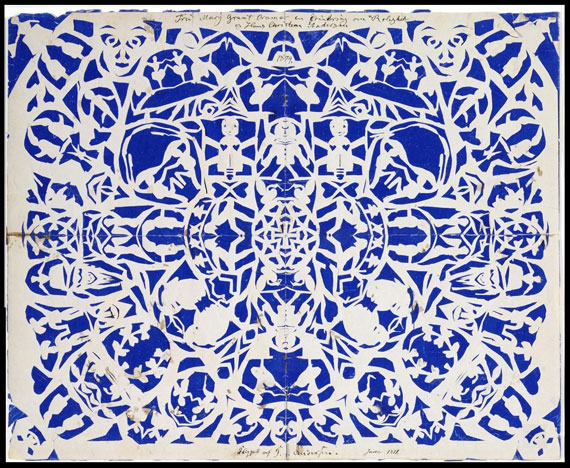
Quick, name a melancholy Dane.
For most of us, the choice comes down to Hamlet or Hans Christian Andersen, author of such bittersweet tales as “The Little Match Girl,” “The Steadfast Tin Soldier,” and “The Little Mermaid.”
Andersen’s personal life remains a matter of both speculation and fascination.
Was he gay? Asexual? A virgin with a propensity for massive crushes on unattainable women, who engaged prostitutes solely for conversation?
No one can say for sure.
What we know definitively is that he was a jolly and talented paper cutter.
He enchanted party guests of all ages with improvised stories as he snipped away, unfolding the sheet at tale’s end, a souvenir for some lucky young listener.
“You can imagine how many of them must have got torn or creased,” says art historian Detlef Klein, who co-curated the 2018 exhibition Hans Christian Andersen, Poet with Pen and Scissors. “You could often bend the figures a little, blow at them and then move them across the tabletop.”
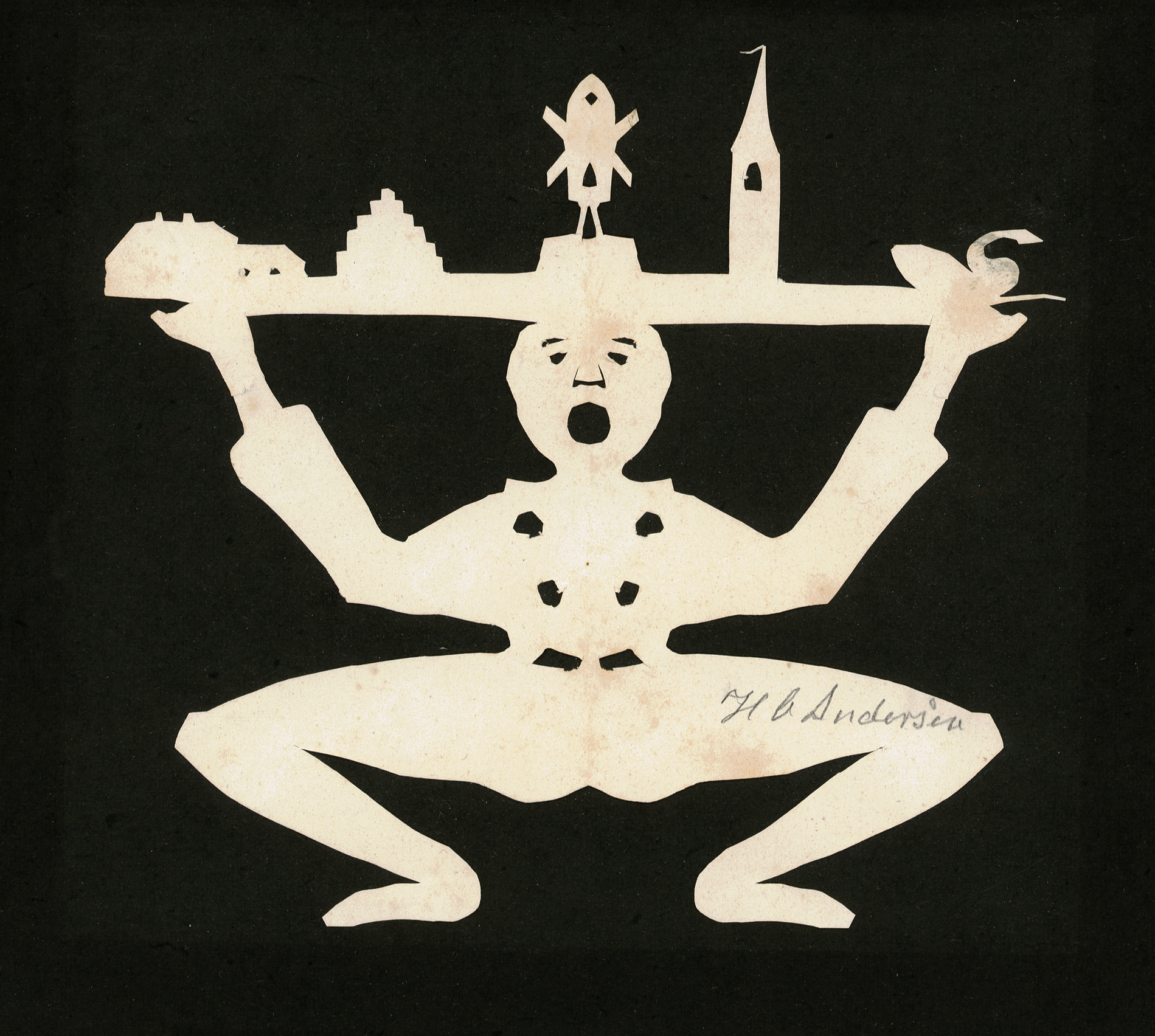
Amazingly, 400 some survive, primarily in the Odense City Museums’ large collection.
Pierrots, dancers, and swans were frequent subjects. Spraddle-legged creature’s bellies served as proscenium theaters. Even the simplest feature some tricky, spindly bits—tightropes, umbrellas, delicate shoes.…
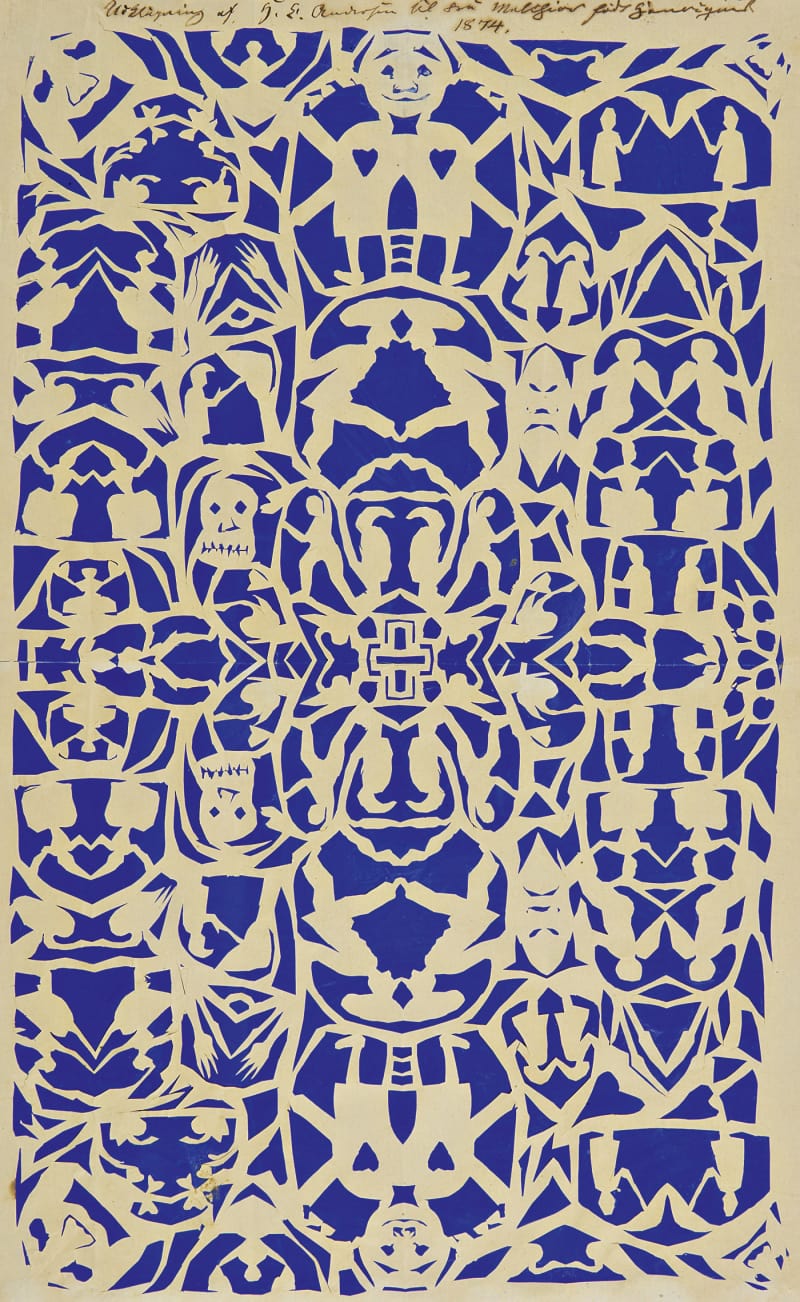
The most intricate pieces, like Fantasy Cutting for Dorothea Melchior below, were thoughtful homemade presents for close friends. (The Melchiors hosted Andersen’s 70th birthday party and he died during an extended visit to their country home.)
The cuttings bring fairy tales to mind, but they are not specific to the published work of Andersen. No Thumbelina. No Ugly Duckling. Not a mermaid in sight.
As Moy McCrory, senior lecturer in creative writing at the University of Derby, writes:
Andersen knew that his written work would outlast him: he was famous and successful, as were his tales. Yet he continued to work in these transient materials, their cheapness and availability making them of no value apart from their appeal to sentiment…Why work in a form that ought to have left no traces? I suggest that this showed how Andersen reacted to his fame, and to his own sense of being forever on the margins of the lived life. He moved amongst the educated and the famous, was friendly with Dickens, was patronized by nobles, but was outside those circles. His education was gained at some pains to himself, years after the usual dates for these activities (he would not even pass nowadays as a “mature student”, since his completion of elementary school only took place when he was a young adult). He was always placed outside the normal bounds of the society he kept.
Readers, we challenge you to play Pygmalion and release a fairy tale based on the images below.
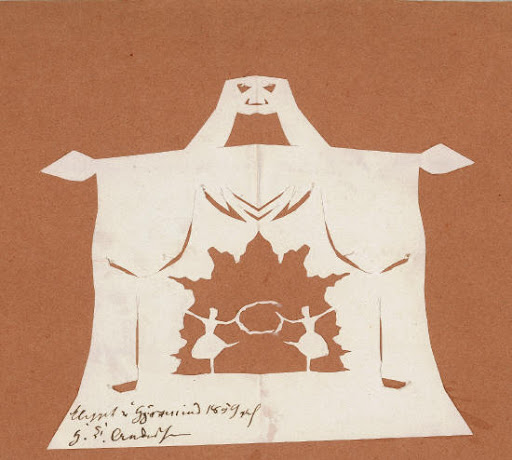


All images, with the exception of The Royal Library Copenhagen’s The Botanist, directly above, are used with the permission of Odense City Museums, in accordance with a Creative Commons License.
Explore the Odense City Museums’ collection of Hans Christian Andersen’s papercuts here.
Bonus reading for those in need of a laugh: “The Saddest Endings of Hans Christian Andersen Stories” by the Toast’s Daniel M. Lavery.
Related Content:
Watch Animations of Oscar Wilde’s Children’s Stories “The Happy Prince” and “The Selfish Giant”
Enter an Archive of 6,000 Historical Children’s Books, All Digitized and Free to Read Online
Ayun Halliday is an author, illustrator, theater maker and Chief Primatologist of the East Village Inky zine. Follow her @AyunHalliday.
Read More...When Jack Johnson, the First Black Heavyweight Champion, Defeated Jim Jeffries & the Footage Was Banned Around the World (1910)
“Being born Black in America… we all know how that goes.…”
—Miles Davis, liner notes for A Tribute to Jack Johnson
When Muhammad Ali saw James Earl Jones play a fictionalized Jack Johnson on Broadway in Howard Sackler’s Pulitzer Prize-winning The Great White Hope in 1968, he reportedly exclaimed, “You just change the time, date and the details and it’s about me!” In Johnson’s time, however, most white heavyweight fighters flat-out refused to fight Black boxers. Heavyweight champion Jim Jeffries swore he would retire “when there were no white men left to fight.” He left the sport in 1905, refusing to fight Johnson even after Johnson had knocked his younger brother out in 1902 and taunted him from the ring, saying, “I can whip you, too.”
After Jeffries retired undefeated, the next heavyweight world champion, Tommy Burns, agreed to fight Johnson in 1908 and lost when police stopped the fight. Two years later, lured out of retirement by the press and a $40,000 purse, Jeffries finally agreed to fight Johnson, who was then the heavyweight champion of the world. By that time, the bout had been framed as an existential racial crisis. Johnson was “the white man’s despair” and his challenger “The Great White Hope.” Jeffries played the part, saying, “I am going into this fight for the sole purpose of proving that a white man is better than a Negro.”
Novelist Jack London dreamed of a magical scenario in which the full force of European history would inhabit Jeffries’ body. He “would surely win” because he had “30 centuries of tradition behind him — all the supreme efforts, the inventions and the conquests, and, whether he knows it or not, Bunker Hill and Thermopylae and Hastings and Agincourt.” Bluster and mythmaking do not win boxing matches. Out of shape and outclassed in the ring, Jeffries lost in 15 rounds in front of 22,000 fans on July 4, 1910, in what was known as the “Fight of the Century.” Johnson walked away with $117,000 and held the title for another five years.
Johnson’s victory was a triumph for African Americans, who staged parades and celebrations, and a profound defeat for “white boxing fans who hated seeing a black man sit atop the sport,” notes a Johnson biography. They took out their rage in “race riots” that evening, attacking Black people in cities around the country as collective punishment for a perceived collective humiliation. Hundreds of people were injured and around 20 killed. The videos above from Vox and Black History in Two Minutes (featuring Henry Louis Gates Jr.) tell the story.
White boxing fans’ rage had been building since the Burns fight, Vox explains, stoked by the newest form of mass media, commercial motion pictures, which came of age at the same time as professional boxing. Film reels of prizefights circulated the country at the turn of the century, and paying audiences cheered their heroes on the screen: “Boxing, going back centuries, has been wrapped up in themes of identity and pride.” Boxers represented their community, their nationality, their race. Spectators “imagined,” says American University historian Theresa Runstedtler, “that boxers in the ring, particularly for interracial fights, were almost engaged in this kind of ‘Darwinian struggle’” for dominance.
As a result of the violence on July 4, authorities attempted to ban film of the Johnson vs. Jeffries fight, and “police were instructed to break up screening events.” The ostensible reason was that the film caused “rioting,” as though the perpetrators could not themselves be held responsible, and as if the film were itself incendiary. But what it showed, the Black press of the time pointed out, was nothing more or less than a fair fight, something Jeffries and boxing legend John L. Sullivan immediately conceded in the press afterward. (“I could never have whipped Johnson at my best,” said Jeffries.)
In truth, “white authorities were worried,” says Runstedtler, “about the symbolic implications…. They worried that any demonstration of Black victory and any demonstration of white weakness or defeat would undercut the narratives of white supremacy, not just in the United States,” but also in colonies abroad. The film had to be banned worldwide, but the fight to suppress it only pushed it underground where it proliferated. Finally, in 1912, Congress banned the distribution of all prize-fight films, with Southern members of Congress “especially interested in the proposed law,” it was reported, “because of the race feeling stirred up by the exhibition of the Jeffries-Johnson moving pictures.”
Aside from the extremely fragile reaction to a boxing film, what might strike us now about the violence and the controversy surrounding the screenings is the vehemence of racist invective among many commentators, who mostly followed London’s lead in openly extolling white supremacy. This was not at all unusual for the time. The narrative was woven into the fight before it began. And when the “Great White Hope” went down, he did not do so as an individual contender, standing or falling on his own merit. The fight’s announcer, in audio paired with the fight reel above, pronounced him “humiliated, beaten, a betrayer of his race.”
Related Content:
Muhammad Ali Gives a Dramatic Reading of His Poem on the Attica Prison Uprising
Josh Jones is a writer and musician based in Durham, NC. Follow him at @jdmagness
Read More...Radiohead Ballets: Watch Ballets Choreographed Creatively to the Music of Radiohead
Since Radiohead’s last release, A Moon-Shaped Pool, members of the band have been absorbed in other projects. They’ve turned their band’s website into an archive for their discography and a library for rarities and ephemera — sending not-so-subtle signals their time together has reached a natural end, even if drummer Phil Selway said in 2020 “there are always conversations going on…. We’ll see. We’re talking.”
Two of the band’s most prominent members, guitarist Jonny Greenwood and frontman Thom Yorke, devoted their talents to film scores, a medium Greenwood has explored for many years: in the theatrical violence of There Will Be Blood, for example, the horrific aftermath of We Need to Talk about Kevin, and the almost balletic bloodiness of You Were Never Here. Yorke, meanwhile, scored Luca Guadagnino’s remake of Dario Argento’s Suspiria, a film in which ballet dancers’ bodies are broken and bloodied by black magic.
Greenwood, Yorke and company excel at conjuring atmospheres of dread, despair, and disorientation, traits that suit them well for arthouse film. They might not have seemed a natural fit, however, for ballet. And yet, Jason Kottke reports, the two are “together at last” — or at least as of 2016, when choreographer Robert Bondara toured Take Me With You, a piece scored to several Radiohead songs, including In Rainbows’ “Reckoner,” which you can see interpreted above by two dancers from the Polish National Ballet.
The performance is an athletic response to a kinetic track, in choreography not unlike pairs figure skating at times. It is not, however, the first time the band has inspired a ballet. In 2005, Romanian dancer and choreographer Edward Clug created a modern interpretation of Shakespeare set to songs from OK Computer and Kid A. Radio and Juliet debuted in Slovenia, toured the world, celebrated its hundredth performance in 2012, and was scheduled to open in Moscow in 2020.
Clug drew on a prior connection: OK Computer’s “Exit Music (For a Film)” was written for, but not used in, the 1996 Baz Luhrmann film adaptation of Shakespeare’s play. After Radio and Juliet, Clug once again drew inspiration from his favorite band (“They are the soundtrack to my other side; listening to them feels like I’m finding a self that I haven’t met yet.”) Clug’s piece “Proof” (preview above), set to “Feral” from The King of Limbs, debuted in 2017, his first for the Nederlands Dans Theater. If we are to have no more Radiohead, here’s hoping at least we’ll see more Radiohead ballets.
Related Content:
Radiohead’s Thom Yorke Performs Songs from His New Soundtrack for the Horror Film, Suspiria
Josh Jones is a writer and musician based in Durham, NC. Follow him at @jdmagness
Read More...Watch The True History Of The Traveling Wilburys, a Free Film Documenting the Making of the 1980s Super Group
“It really had very little to do with combining a bunch of famous people,” says Tom Petty about the Traveling Wilburys. “It was a bunch of friends that just happened to be really good at making music.”
One of the most modest supergroups of the 20th century, one that fate and chance threw together for a very brief period, the Traveling Wilburys made music that sits outside the usual histories of 1980s music, featuring five men in different states of their careers. Tom Petty was about to have a comeback, George Harrison had just had one, Jeff Lynne was no longer having chart hits as ELO, but he was shaping the sound of the late 1980s as a producer, Roy Orbison was *about* to have a posthumous comeback, and Bob Dylan was…doing whatever Dylan does—every album he put out in the ‘80s had an equal number of detractors and comeback claimants. Put it this way: the Traveling Wilburys didn’t feel like a nostalgia act, and neither did it feel like a marketing idea. It was actually lightning in a bottle.
“It was George’s band,” Lynne says in the above mini documentary, but it wasn’t really formed as one. It just sort of *evolved*.
As he explains early in the doc, Harrison was having dinner with Roy Orbison and Jeff Lynne and invited them along to a studio in Los Angeles the next day. He had the hankering to make a tune, and they wound up using Bob Dylan’s home studio—the normally reclusive Dylan actually picked up the phone on the first ring and gave the okay. And Harrison’s guitar was over at Tom Petty’s house, so he came along as well. The song they recorded that day was “Handle with Care,” which fell together like magic. (Dylan provided the title after looking over at a cardboard box).
Harrison sat on the song for a while, having no idea what to do with it. The only thing he could do, was to record nine more songs and call it an album. Which, once they had found time in everybody’s schedule, they did. The songs were recorded at the home studio of Dave Stewart (of the Eurythmics) and finalized back in London with Harrison and Lynne. The group gave themselves the assignment of one song written and recorded per day. That the record isn’t a mish-mash of jamming, leftover ideas, and covers, and instead has a legitimate amount of classic singles and career-highlight moments is a testament to the friendship between the five (and drummer Jim Keltner, who knew them all).
Friends indeed, but it doesn’t mean they weren’t also big fans of each other. What’s cool to watch in the doc is how in awe they all seem: George is amazed by Bob’s cryptic scrawled lyrics and his ability to nail a song on essentially the first take. Tom Petty is in awe of George’s democratic ways with choosing who gets to sing one of the songs, regardless of who wrote it—really, how do you follow Roy Orbison’s version of a song? But Tom Petty still had a go.
The album maintains that friendly vibe in the recording: microphones were mobile to catch music wherever it happened. Jim Keltner played rhythm on the inside of the kitchen’s refrigerator. Songs were written in the kitchen. And after the work was done, the music would continue. “A lot of ukuleles till dawn,” says Harrison.
Roy Orbison only made it into the first music video off of the album, “Handle With Care.” He passed away just after the album went platinum in 1988, and appears as an empty rocking chair on the next video, “The End of the Line.”
The four remaining Wilburys would reunite for one more album (jokingly titled Volume 3 by prankster Harrison), but the first album still sounds timeless, five friends just having a good time together.
The True History Of The Traveling Wilburys will be added to our collection of Free Documentaries, a subset of our collection, 4,000+ Free Movies Online: Great Classics, Indies, Noir, Westerns, Documentaries & More.
Related Content:
The Story of WHER, America’s Pioneering, First All-Woman Radio Station (1955)
Ted Mills is a freelance writer on the arts who currently hosts the Notes from the Shed podcast and is the producer of KCRW’s Curious Coast. You can also follow him on Twitter at @tedmills, and/or watch his films here.
Read More...Download 280 Pictographs That Put Japanese Culture Into a New Visual Language: They’re Free for the Public to Use

“One of the biggest considerations when traveling to Japan is its inscrutable language,” writes Designboom’s Juliana Neira. But then, one might also consider making that language more scrutable — and making one’s experience in Japan much richer — by learning some of it. Kanji, the Chinese characters used in the written Japanese language, may at first look like small, often bewilderingly complex pictures, and many assume they visually evoke the meanings they express. In fact, to use the linguistic terms, they’re not pictograms, representations of thoughts or ideas, but logograms, representations of words or parts of words.

Resemble miniature works of art though they often do, kanji aren’t entirely unsystematic. This helps beginning learners get a handle on the first and most essential characters of the thousands they’ll eventually need to know.
So does the fact that some of them, in origin, really are pictographic — that is, they look like the meaning of the word they represent — or at least pictographic enough to make them teachable through images. The Japanese word for “mountain,” to cite an elementary example, is 山; “river” is 川; “tree” is 木. Alas, most of us who enjoy the 山, 川, and 木 of Japan — to say nothing of the 書店 and 喫茶店 in its cities — haven’t been able to visit them at all in this past pandemic year.

“After experiencing years of tourism growth, tourists to Japan are down over 95% due to the pandemic,” writes Spoon & Tamago’s Johnny Waldman. “Graphic designer Kenya Hara and his firm Nippon Design Center have self-initiated a project to release over 250 pictograms — free for anyone to use — in support of tourism in Japan from a visual design perspective.” Collectively bannered the Experience Japan Pictograms, these clear and evocative icons represent a wide range of the places and activities one can enjoy in the Land of the Rising Sun: skiing and surfing, calligraphy and open-air hot-spring bathing, Ginza and Asakusa, Tokyo’s Skytree and Osaka’s Tsūtenkaku Tower.

The Experience Japan Pictograms hardly fail to include the glories of Japanese cuisine — sushi, tempura, soba, and even the Japanified hanbāgā — which piques so many foreigners’ interest in Japan to begin with. Click on any of them and you’ll see a brief cultural and historical explanation of the item, activity, place, or concept in question, along with the relevant Japanese term (in kanji where applicable) and its pronunciation. You can also download them in the color scheme of your choice and use them for any purposes you like, including commercial ones. The more widely adopted they are, the more convenient Japanese tourism will become for those who don’t read Japanese. Those who do can hardly deny the pleasure of having another Japanese language to learn — and a truly pictographic one at that.
via Spoon & Tamago
Related Content:
Vintage 1930s Japanese Posters Artistically Market the Wonders of Travel
The Hobo Code: An Introduction to the Hieroglyphic Language of Early 1900s Train-Hoppers
Google Makes Available 750 Icons for Designers & Developers: All Open Source
Based in Seoul, Colin Marshall writes and broadcasts on cities, language, and culture. His projects include the Substack newsletter Books on Cities, the book The Stateless City: a Walk through 21st-Century Los Angeles and the video series The City in Cinema. Follow him on Twitter at @colinmarshall or on Facebook.
Read More...Journey’s Road Crew Performs a Pretty Flawless Version of “Separate Ways”
You never know what the YouTube recommendation algorithm will serve up next. Above, we have Journey’s road crew performing “Separate Ways” as part of a concert soundcheck. And it turns out the crew has some real chops. At least according to the YouTube comments, the crew/band features Scott Appleton on guitar. (In recent years, he has served as the guitar tech for Rush’s Alex Lifeson.) And on drums, we seemingly have Jim Handley, a Nashville-based drummer who performs in the Journey tribute band, Resurrection. The actual performance starts around the 30 second mark. Enjoy.
If you would like to support the mission of Open Culture, consider making a donation to our site. It’s hard to rely 100% on ads, and your contributions will help us continue providing the best free cultural and educational materials to learners everywhere. You can contribute through PayPal, Patreon, and Venmo (@openculture). Thanks!
Related Content:
Quarantined Family Re-Creates Journey’s “Separate Ways” Video Shot-by-Shot
Read More...RIP Radical Poet and Revolutionary Publisher Lawrence Ferlinghetti (1919–2021)
“Democracy is not a spectator sport,” Lawrence Ferlinghetti proclaimed on the wall of his City Lights bookstore, a San Francisco fixture since the poet, activist, and publisher founded the landmark with Peter D. Martin in 1953. Ferlinghetti, who died on Monday at age 101, was himself a fixture, a venerated steward of the counterculture. (See him read “Last Prayer,” above, in a clip from The Last Waltz). On his 100th birthday–on which the city instituted an annual “Lawrence Ferlinghetti Day”–Chloe Veltman interviewed him, describing the poet as “frail and nearly blind… but his mind is still on fire.” It was the same mind that started a publishing house in the 50s with the intent to stir an “international dissident ferment.”
Ferlinghetti and Martin started their bookstore with a mission: “to break literature out of its stuffy, academic cage,” Veltman writes, out of “its self-centered focus on what he calls ‘the me me me,’ and make it accessible to all.” City Lights was the first all-paperback bookstore, opened at a time, he says, when “paperbacks weren’t considered real books.”
For Ferlinghetti, literature and democracy were not separate pursuits. The idea was radical, and so were his patrons. “A bookstore is a natural place for poets to hang out,” Ferlinghetti told NPR’s Tom Vitale, “and they started showing up there”–“They” being East Coast Beats like Ginsberg, Kerouac, and the great, unsung Bob Kaufman.
Like a Northern California Shakespeare and Company, Ferlinghetti’s City Lights became the physical embodiment of a literary movement, especially after the infamous publication of Allen Ginsburg’s Howl and Other Poems, for which Ferlinghetti stood trial for obscenity, an event that “propelled the Beat generation into the international spotlight,” writes Evan Karp. “For the first and–arguably–only time, literature became a popular movement in the U.S.” Young people around the country realized that poetry was relevant to their politics (and lives), and vice versa.
Ferlinghetti published his own first book of poetry, Pictures of the Gone World, in the same year he published Ginsberg’s, but he has not received his critical due alongside the other Beats, despite the fact that his second book, 1958’s A Coney Island of the Mind, “sold more than 1 million copies over the year, ranking perhaps second to Howl as the most popular book of modern American poetry,” Fred Kaplan notes at Slate. (See him read the book’s first poem, “In Goya’s Greatest Scenes We Seem to See…,” from his City Lights office, above.)
Ferlinghetti himself never wanted to be identified with the movement. In a 2013 documentary, he emphatically says, “don’t call me a Beat. I was never a Beat poet.” He described his poetry as an “insurgent art”:
If you would be a poet, create works capable of answering the challenge of
apocalyptic times, even if this meaning sounds apocalyptic.
You are Whitman, you are Poe, you are Mark Twain, you are Emily Dickinson and Edna St. Vincent Millay, you are Neruda and Mayakovsky and Pasolini, you are an American or a non-American, you can conquer the conquerors with words.…
His purpose, he writes, was to pierce a culture he calls “a freeway fifty lanes wide / a concrete continent / spaced with bland billboards / illustrating imbecile illusions of happiness.” From his Navy service in WWII–in which he saw the aftermath of Nagasaki weeks after the dropping of the atomic bombs–to the last days of the Trump administration, he kept his keen eye on America’s abuses. His “poetry is notoriously critical of politicians and the status quo,” Karp writes, and he was “unafraid to name names and take stances publicly” as a writer and a lifelong activist.
“Gerald Nicosia, the critic,” Vitale points out, “says Ferlinghetti’s two greatest accomplishments were fighting censorship, and inaugurating a small press revolution.” What did Ferlinghetti himself think of his place in the culture? “In Plato’s republic, poets were considered subversive, a danger to the republic,” he told The New York Times in 1998. “I kind of relish that role.” As for what might finally shake the country out of the anti-democratic spirit that has held its people hostage to corporations and a hostile government, he was not sanguine: “It would take a whole new generation not devoted to the glorification of the capitalist system,” he said. “A generation not trapped in the me, me, me.”
Related Content:
2,000+ Cassettes from the Allen Ginsberg Audio Collection Now Streaming Online
Josh Jones is a writer and musician based in Durham, NC. Follow him at @jdmagness
Read More...The Complete Works of Hilma af Klint Get Published for the First Time in a Beautiful, Seven-Volume Collection

If you are a regular Open Culture reader, you’ve probably seen our many posts on Hilma af Klint, the Swedish abstract painter who might have been recognized, before Wassily Kandinsky, as the first 20th century abstractionist; that is, if she had shown any of her work before her death in obscurity in 1944 (the same year that Kandinsky died, it happens). Instead, af Klint instructed that her paintings not be exhibited until twenty years after her death. Then, another 22 years went by before anyone would see her enigmatic canvases. They first went on display in a 1986 Los Angeles show called, after Kandinsky, “The Spiritual in Art.”
Comparisons seem inevitable, but where the great Russian abstractionist theorized about art and spirit, af Klint encountered it in person, she claimed in her Theosophical accounts, in which she writes of meeting five “high masters” in a séance and receiving instructions for her new style. She was a channel, a vessel, and a medium for the spirits, as she saw it.
“The pictures were painted directly through me, without any preliminary drawings, and with great force. I had no idea what the paintings were supposed to depict; nevertheless, I worked swiftly and surely, without changing a single brush stroke.” She showed her paintings to occultist Rudolph Steiner, who told her to hide them away for the next half century. Discouraged she stopped painting for four years.
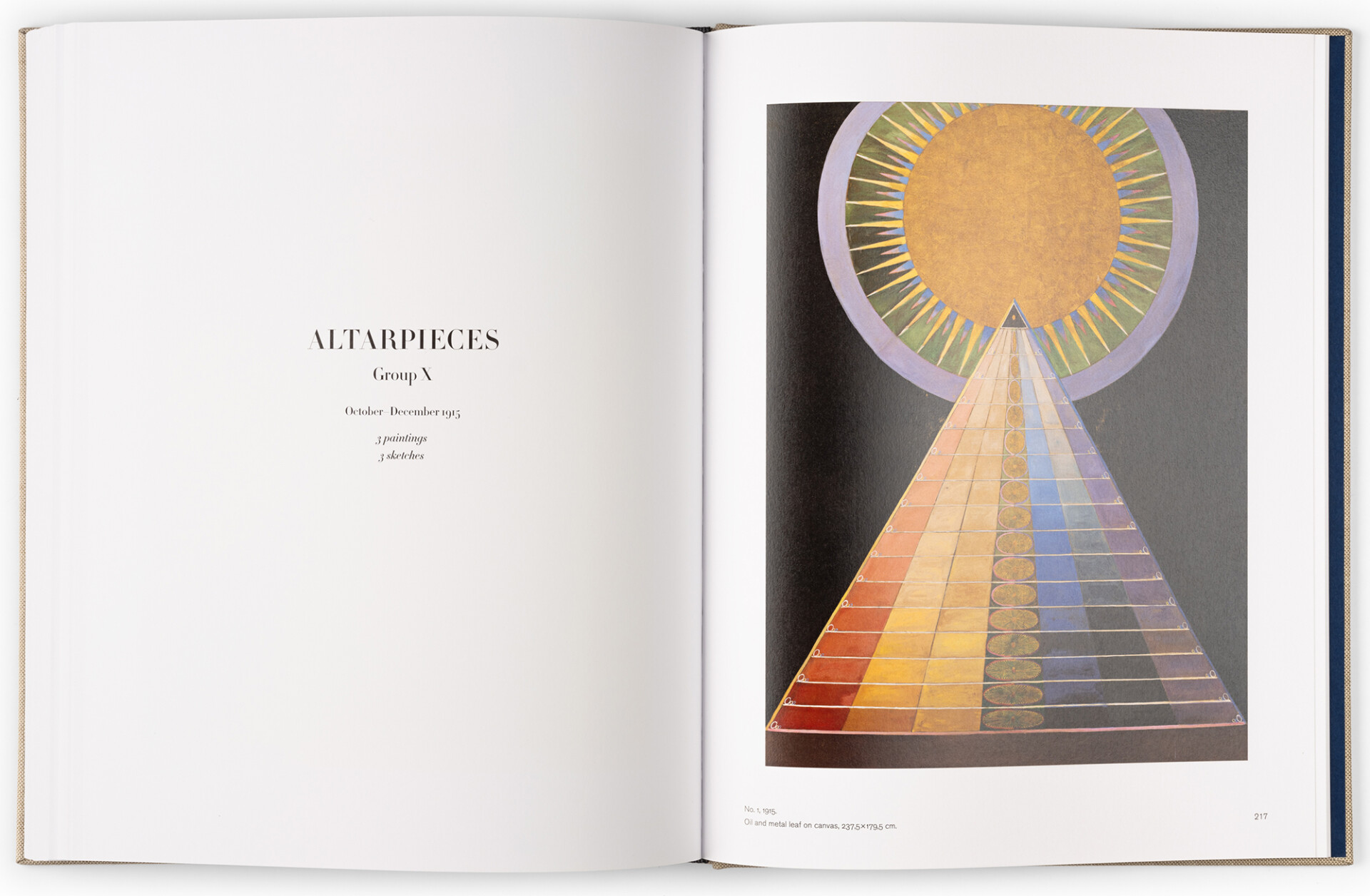
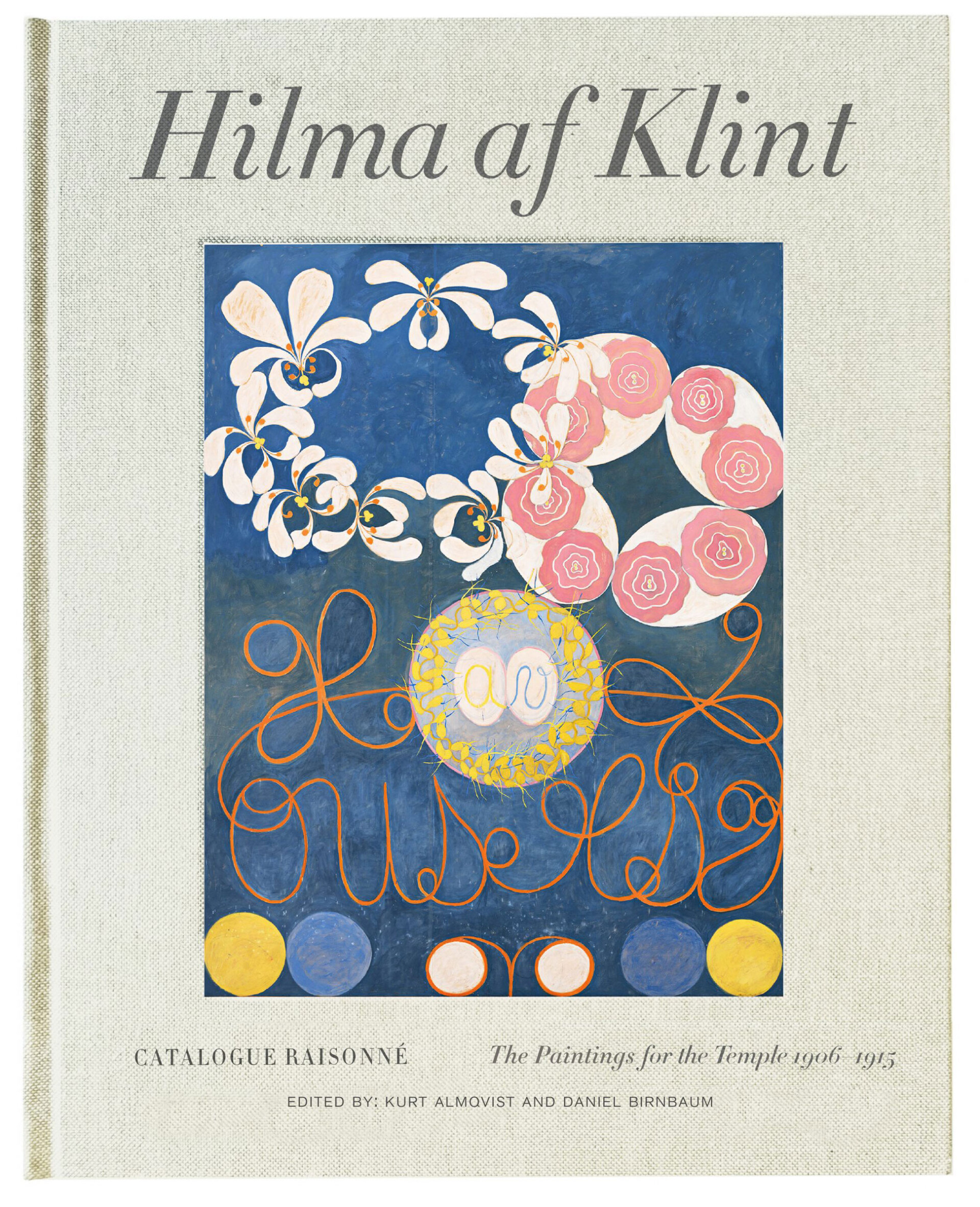
“Af Klint spent her time tending to her blind, dying mother,” writes Dangerous Minds. “She then returned to painting but kept herself and more importantly her work removed from the world.” She was not in conversation with other modern artists. She was in conversation with an unseen world, her own psyche, and a small group of women with whom she regularly conducted séances. Throughout her life, “the prolific Swedish artist created more than 1,600 works,” Grace Ebert writes at Colossal, “an impressive output now collected in Hilma AF Klint: The Complete Catalogue Raisonné: Volumes I‑VII.”
The seven-volume series, published by Bokförlaget Stolpe, “is organized both chronologically and by theme, beginning with the spiritual sketches af Klint made in conjunction with The Five, a group of women who attended séances in hopes of obtaining messages from the dead.” “What makes [af Klint’s] art interesting,” says Daniel Birnbaum, co-editor of the collection, “is that the works are highly interconnected.” Such a comprehensive accounting, a “catalogue raisonné,” is necessary “to see the different cycles, motifs, and symbols that recur in a fascinating way.”
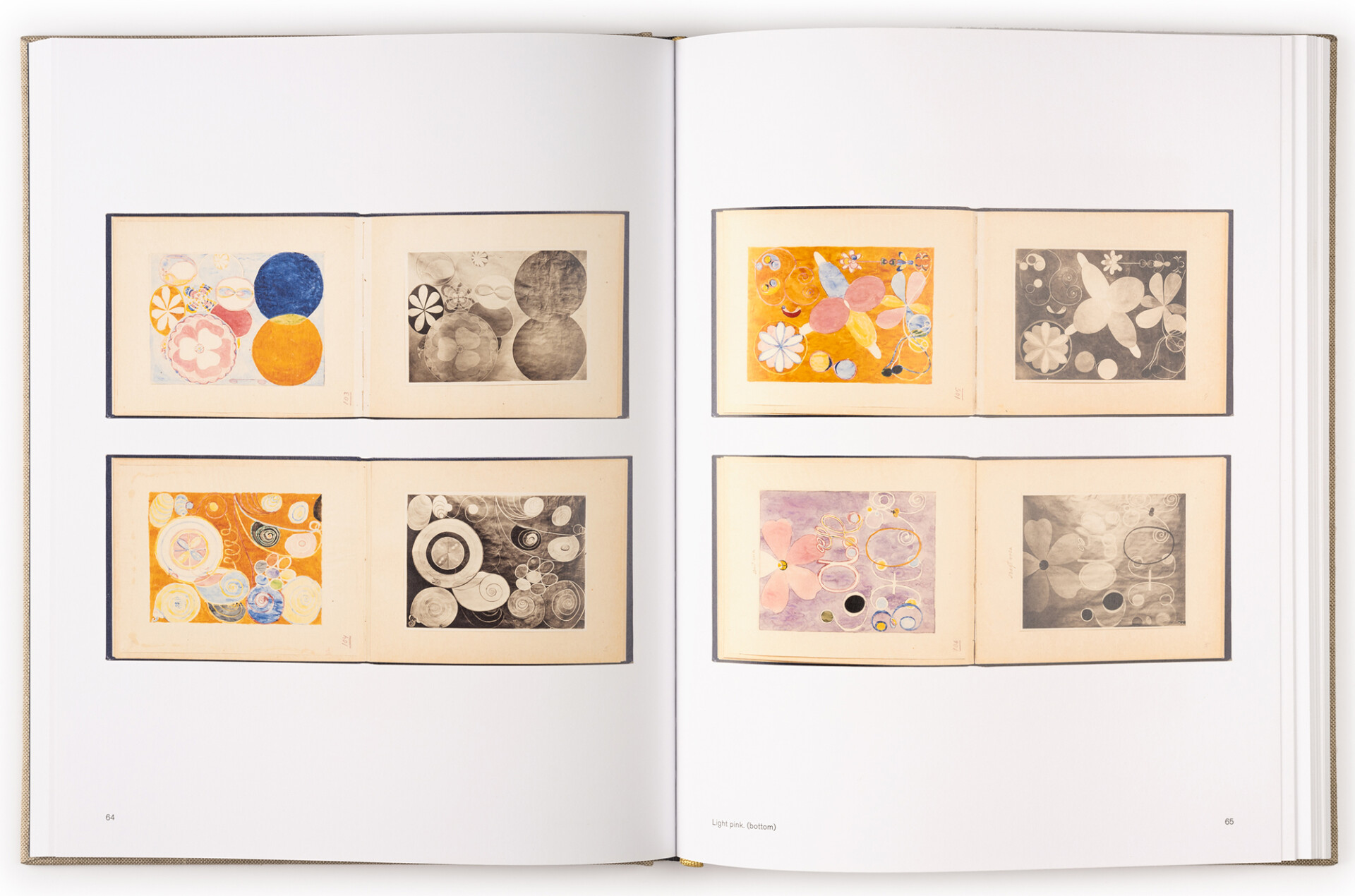
We see such recurring patterns in the work of af Klint’s avant-garde contemporaries, as well, of course, especially in her very famous contemporary Kandinsky. But who knows how her esoteric sources and extremely retiring nature would have been received by the avant-garde movements of her time? Given that even the most extroverted women artists in those movements—from Dada, to Surrealism, to the Bauhaus School, to Abstract Expressionism—have been left out of the story time and again, it’s likely that even had the world known of Hilma af Klint in life, she would not have been appreciated or well-remembered.
But whether we credit the actions of “high masters” or the arbitrary asynchronies of cultural history, it’s clear af Klint’s moment has finally arrived. For “the first time,” Artnet notes, her “dazzling spiritual oeuvre…. will be presented in its totality.”
via Colossal
Related Content:
The Life & Art of Hilma Af Klint: A Short Art History Lesson on the Pioneering Abstract Artist
New Hilma af Klint Documentary Explores the Life & Art of the Trailblazing Abstract Artist
Discover Hilma af Klint: Pioneering Mystical Painter and Perhaps the First Abstract Artist
Josh Jones is a writer and musician based in Durham, NC. Follow him at @jdmagness
Read More...Watch Badiou, the First Feature-Length Film on France’s Most Famous Living Philosopher
Above you can watch Badiou, the first feature-length film on France’s most famous living philosopher. On the film’s accompanying website, the directors–Gorav Kalyan and Rohan Kalyan–write:
Nietzsche wrote that all philosophy is a biography of the philosopher. The life of philosopher Alain Badiou suggests that the reverse of this is also true: from one’s life story, we might deduce an entire system of thought.
From his birth in Morocco, to the events of May 1968 in Paris, to his twilight years as a nomadic public intellectual, Badiou’s own biography is perhaps his most complex and thought-provoking work. He is a man who demands to be considered the ally of both Plato and Sartre, St. Paul and Lucifer, the mathematician and the poet.
With intimate access, Gorav and Rohan Kalyan have produced the first feature-length documentary about Alain Badiou. By addressing the inherent contradictions in Badiou’s life and work through cinematic means, the filmmakers are confronted by the inherent contradictions of cinema itself: thought vs action, interiority vs exteriority, presence vs absence. And in order to bring to their complex subject a sense of empathy, clarity, and critique, they must ask a question as old as the medium: can cinema think?
Badiou has been made available through Rohan Kalyan’s Vimeo page, and it will be added to our collection of Free Documentaries, a subset of our collection, 4,000+ Free Movies Online: Great Classics, Indies, Noir, Westerns, Documentaries & More.
If you would like to support the mission of Open Culture, consider making a donation to our site. It’s hard to rely 100% on ads, and your contributions will help us continue providing the best free cultural and educational materials to learners everywhere. You can contribute through PayPal, Patreon, and Venmo (@openculture). Thanks!
Related Content:
Philosopher Alain Badiou Performs a Scene From His Play, Ahmed The Philosopher (2011)
Michel Foucault and Alain Badiou Discuss “Philosophy and Psychology” on French TV (1965)
Read More...Watch Orson Welles’ Intoxicating Wine Commercials That Became an 80s Cultural Phenomenon
“We will sell no wine before its time”: some Americans respond to this phrase with a chuckle of recognition, others by asking who’ll sell what wine before when. The difference must be generational, since those alive to watch television in the late 1970s and early 80s can’t have avoided hearing those words intoned on a regular basis — and in no less powerful a voice than Orson Welles’. Coming up on forty years after Citizen Kane, the former boy-wonder auteur had fallen on hard times. Struggling to complete his feature The Other Side of the Wind (little knowing that Netflix would eventually do it for him), he relied on acting work to raise professional and personal funds. He’d done it before, but now the productions offering him the most lucrative roles happened to be commercials for cheap wine.
Despite having been cast into the wilderness by Hollywood, if to some degree willingly, Welles still had cultural cachet — exactly what the higher-ups at the mass-market California wine producer Paul Masson thought their brand needed. Making use of Welles’ late-period public image as a Falstaffian gourmand, Paul Masson commissioned a series of television commercials and print advertisements in which he personally endorses a range of their varietals.
In comparing Paul Masson’s “Emerald Dry” to Beethoven’s Fifth Symphony and Gone With the Wind, two works of art known for their prolonged gestation periods, Welles also implicitly acknowledged his own artistic reputation for making films of genius, if films of genius few and far between.
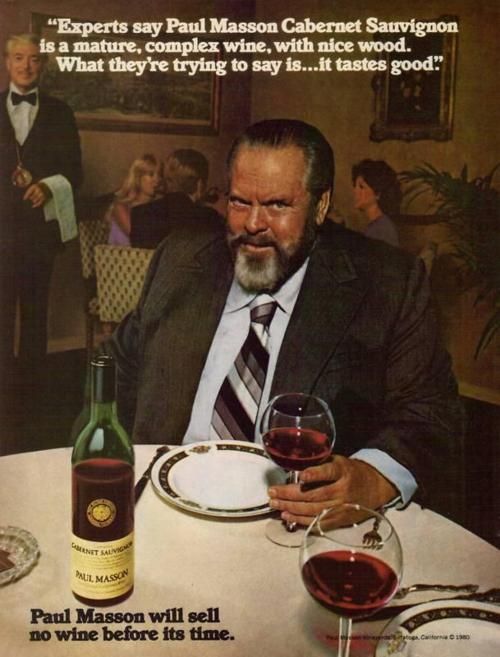
Though Welles balked at the effrontery of a script comparing Paul Masson wine to a Stradivarius violin, he wasn’t without genuine appreciation for the product. “Orson liked Paul Masson’s cabernet,” said John Annarino, the adman at DDB Needham who handled the Paul Masson account. “He often called the ad agency and instructed, ‘Send more red.’ ” He also happened to be a highly experienced booze salesman: “As early as 1945 he had done a radio spot for Cresta Blanca Wines,” writes Inside Hook’s Aaron Goldfarb. “By 1972 he was doing print work with Jim Beam bourbon. By 1975 he was hawking Carlsberg Lager. That same year, he pitched Domecq Sherry, Sandeman port (in which he portrayed their ‘Sandeman Don’ character) and Nikka Japanese Whiskey, which were a huge hit overseas.”
The campaign got Paul Masson a substantial bump in sales, but it stuck DDB Needham with a somewhat difficult star. This is evidenced not just by anecdotes from the set but surviving footage that shows Welles, far from disdainful of the wine at hand, seemingly too satisfied by it to deliver his lines properly. Much like the string of increasingly bitter complaints captured during the voiceover recording of a Findus frozen peas commercial, Welles’ seemingly drunken takes for Paul Masson — and even the finished spots — have gone viral in the internet age. Racking up millions upon millions of views on Youtube, these videos have begun to bring “We will sell no wine before its time,” a catchphrase much-referenced in the 80s, back into the zeitgeist. But then, don’t some things only improve with age?
Related Content:
An Animation of Orson Welles’ Famous Frozen Peas Rant
Orson Welles Teaches Baccarat, Craps, Blackjack, Roulette, and Keno at Caesars Palace (1978)
The Improbable Time When Orson Welles Interviewed Andy Kaufman (1982)
Based in Seoul, Colin Marshall writes and broadcasts on cities, language, and culture. His projects include the Substack newsletter Books on Cities, the book The Stateless City: a Walk through 21st-Century Los Angeles and the video series The City in Cinema. Follow him on Twitter at @colinmarshall or on Facebook.
Read More...Support Us
We're hoping to rely on loyal readers, rather than erratic ads. Please click the Donate button and support Open Culture. You can use Paypal, Venmo, Patreon, even Crypto! We thank you!

About Us

Open Culture scours the web for the best educational media. We find the free courses and audio books you need, the language lessons & educational videos you want, and plenty of enlightenment in between.
Advertise With Us
FREE UPDATES!
GET OUR DAILY EMAIL
Get the best cultural and educational resources on the web curated for you in a daily email. We never spam. Unsubscribe at any time.
FOLLOW ON SOCIAL MEDIA
Open Culture editor Dan Colman scours the web for the best educational media. He finds the free courses and audio books you need, the language lessons & movies you want, and plenty of enlightenment in between.
Advertise With Us

