A Short Biography of Keith Haring Told with Comic Book Illustrations & Music
Singer-songwriter-cartoonist Jeffrey Lewis is a worthy exemplar of NYC street cred.
Born, raised, and still residing on New York City’s Lower East Side, he draws comics under the “judgmental” gaze of The Art of Daniel Clowes: Modern Cartoonist and writes songs beneath a poster of The Terminator onto which he grafted the face of Lou Reed from a stolen Time Out New York promo.
Billing himself as “among NYC’s top slingers of folk / garagerock / antifolk,” Lewis pairs his songs with comics during live shows, projecting original illustrations or flipping the pages of a sketchbook large enough for the audience to see, a practice he refers to as “low budget films.”
He’s also an amateur historian, as evidenced by his eight-minute opus The History of Punk on the Lower East Side, 1950–1975 and a series of extremely “low budget films” for the History channel, on topics such as the French Revolution, Marco Polo, and the fall of the Soviet Union.
His latest effort is a 3‑minute biography of artist Keith Haring, above, for the Museum of Modern Art Magazine’s new Illustrated Lives series.
While Lewis isn’t a contemporary of Haring’s, they definitely breathed the same air:
While Haring was spending a couple of formative years involved with Club 57 and PS 122, there was little six-year-old me walking down the street, so I can remember and draw that early ’80s Lower East Side/East Village without much stretch. My whole brain is made out of fire escapes and fire hydrants and tenement cornices.
Lewis gives then-rising stars Jean-Michel Basquiat and performance artist Klaus Nomi cameo appearances, before escorting Haring down into the subway for a literal lightbulb moment.
In Haring’s own words:
…It seemed obvious to me when I saw the first empty subway panel that this was the perfect situation. The advertisements that fill every subway platform are changed periodically. When there aren’t enough new ads, a black paper panel is substituted. I remember noticing a panel in the Times Square station and immediately going aboveground and buying chalk. After the first drawing, things just fell into place. I began drawing in the subways as a hobby on my way to work. I had to ride the subways often and would do a drawing while waiting for a train. In a few weeks, I started to get responses from people who saw me doing it.
After a while, my subway drawings became more of a responsibility than a hobby. So many people wished me luck and told me to “keep it up” that it became difficult to stop. From the beginning, one of the main incentives was this contact with people. It became a rewarding experience to draw and to see the drawings being appreciated. The number of people passing one of these drawings in a week was phenomenal. Even if the drawing only remained up for only one day, enough people saw it to make it easily worth my effort.
Towards the end of his jam-packed, 22-page “low budget film,” Lewis wanders from his traditional approach to cartooning, revealing himself to be a keen student of Haring’s bold graphic style.
The final image, to the lyric, “Keith’s explosive short lifetime and generous heart speak like an infinite fountain from some deep wellspring of art,” is breathtaking.
Spend time with some other New York City icons that have cropped up in Jeffrey Lewis’ music, including the Chelsea Hotel, the subway, the bridges, and St. Mark’s Place.
Watch his low budget films for the History Channel here.
Related Content:
Keith Haring’s Eclectic Journal Entries Go Online
An Animated History of Dogs, Inspired by Keith Haring
The Story of Jean-Michel Basquiat’s Rise in the 1980s Art World Gets Told in a New Graphic Novel
Ayun Halliday is an author, illustrator, theater maker and Chief Primatologist of the East Village Inky zine. Follow her @AyunHalliday.
Read More...The Joy of Painting with Bob Ross & Banksy: Watch Banksy Paint a Mural on the Jail That Once Housed Oscar Wilde
It would be difficult to think of two artists who appear to have less in common than Bob Ross and Banksy. One of them creates art by pulling provocative stunts, often illegal, under the cover of anonymity; the other did it by painting innocuous landscapes on public television, spending a decade as one of its most recognizable personalities. But game recognize game, as they say, in popular art as in other fields of human endeavor. In the video above, Banksy pays tribute to Ross by layering narration from an episode of The Joy of Painting over the creation of his latest spray paint strike, Create Escape: an image of Oscar Wilde, typewriter and all, breaking out jail — on the actual exterior wall of the decommissioned HM Prison Reading.
“The expansive and unblemished prison wall was a daring and perfect spot for a Banksy piece,” writes Colossal’s Christopher Jobson. “It’s best known for its most famous inmate: Oscar Wilde served two years in the prison from 1895–1897 for the charge of ‘gross indecency’ for being gay.” This experience resulted in the poem The Ballad of Reading Gaol, which we’ve previously featured here on Open Culture as read by Wilde himself.
Where Wilde converted his misfortune into verbal art, Banksy references it to make a visual statement of characteristic brazenness and ambiguity. As with most of his recent pieces, Create Escape has clearly been designed to be seen not just by passersby in Reading, but by the whole world online, which The Joy of Painting with Bob Ross & Banksy should ensure.
“I thought we’d just do a very warm little scene that makes you feel good,” says Ross in voiceover. But what we see are the hands of a miner’s-helmeted Banksy, presumably, preparing his spray cans and putting up his stencil of Wilde in an inmate’s uniform. “Little bit of white,” says Ross as a streak of that color is applied to the prison wall. “That ought to lighten it just a little.” In fact, every sample of Ross’ narration reflects the action, as when he urges thought “about shape and form and how you want the limbs to look,” or when he tells us that “a nice light area between the darks, it separates, makes everything really stand out and look good.” With his signature high-contrast style, Banksy could hardly deny it, and he would seem also to share Ross’ feeling that in painting, “I can create the kind of world that I want to see, and that I want to be part of.”
Related Content:
Experience the Bob Ross Experience: A New Museum Open in the TV Painter’s Former Studio Home
Banksy Strikes Again in London & Urges Everyone to Wear Masks
Banksy Debuts His COVID-19 Art Project: Good to See That He Has TP at Home
Hear Oscar Wilde Recite a Section of The Ballad of Reading Gaol (1897)
Based in Seoul, Colin Marshall writes and broadcasts on cities, language, and culture. His projects include the Substack newsletter Books on Cities, the book The Stateless City: a Walk through 21st-Century Los Angeles and the video series The City in Cinema. Follow him on Twitter at @colinmarshall or on Facebook.
Read More...“The Cinematic Universe”: A Video Essay on How Films Cinematize Cities & Places, from Manhattan to Nashville, Rome Open City to Taipei Story
Los Angeles in Chinatown, Rome in Rome Open City, Manhattan in Manhattan: you could say that each of these films’ cities becomes a character in the story. You could say it, but you’d be making a cinematic observation that has, at this point, become severely clichéd. What do we actually mean when we call a setting something more than a setting? This question is at the heart of “The Cinematic Universe,” the new video essay from The Cinema Cartography, a MUBI-sponsored series by Channel Criswell creator Lewis Bond and Luiza Liz Bond. It explores not just how cities appear in film — a subject, to some of us, hardly without interest of its own — but the “cinemazation” of place itself.
Many count Fargo among the Coen Brothers’ masterpieces, but who counts it among the great city films? Its geographical scope exceeds the boundaries of the North Dakotan metropolis, granted, but more importantly, its concerns run deeper than telling a tale of kidnapping and extortion there. In a picture like Fargo, says Bond, “something has invaded what the place truly was and altered its very being”; its ostensible genre story is “elevated by the fact that it’s the least likely and least accommodating place for a crime narrative to take place.” Where “most people’s concern lies in staying warm, inertia “makes it nearly impossible for any progression to occur at all,” as both the people and the land have become frozen.
Far from Fargo’s icy highways and snow-covered lots, Robert Altman’s Nashville depicts another America entirely. Less a portrait of the Tennessean capital than a series of “colossal showcases of humanity,” the film’s bustling action and overlapping voices, noises, and songs suggests the existence of a grander, even more flamboyant socio-cultural pageant carrying on, unseen and unheard, throughout the rest of the country. “We can learn a bit more about the United States as long as we understand Nashville first,” says Bond, and the same holds for a much quieter, smaller-scale movie like Edward Yang’s Taipei Story. “The more we learn about its people, the deeper the anatomy of the city reveals itself,” and the more clearly we see a changing Taiwan whose citizens “can’t decide, on either micro- or macrocosmic levels, where they want to be.”
A film can be about its city, but it can also be about the society that created that city. A film can be about a place, but it can also be about a place in time — that is, a place remembered, as in Gillo Pontecorvo’s The Battle of Algiers, Francois Truffaut’s The 400 Blows, or Victor Erice’s The Spirit of the Beehive. For some auteurs, the realization of a vision demands not just the return to a place in memory or the use of a place as it is, but the creation of a place unlike any seen before. In building a whole city for his magnum opus, Jacques Tati inhabited the role of the auteur to its fullest, crafting in cinema “a modern world we’re more than familiar with now, and how the change of the old world to the new can bring change within its people.” Playtime “is not a film where the setting is the character,” says Bond. “The main character is the futility of how we interact with our settings.” Naturally, it’s a comedy.
Related Content:
Watch Dziga Vertov’s A Man with a Movie Camera, the 8th Best Film Ever Made
Vancouver Never Plays Itself
Based in Seoul, Colin Marshall writes and broadcasts on cities, language, and culture. His projects include the Substack newsletter Books on Cities, the book The Stateless City: a Walk through 21st-Century Los Angeles and the video series The City in Cinema. Follow him on Twitter at @colinmarshall or on Facebook.
Read More...Watch 12 Seasons of the Dick Cavett Show, 18 Seasons of Johnny Carson & Many Other Classic Shows on Shout! Factory
Dick Cavett was sometimes called the “thinking man’s Johnny Carson,” and he came up in a similar fashion—a stand-up, a joke writer for hire— until he was given a chance to host a late night show. But compare a Cavett episode to any late night host today, and it feels like a very different time. Sure, stars were booked to talk about their upcoming movie or album or television show, but Cavett was so laid back, so chatty and conversant, that it often felt like you were eavesdropping. It’s a style you find more on podcasts these days than television—Cavett is genuinely inquisitive. He never got high ratings because of it, but he certainly got an impressive guest list.
We’ve been writing about some of the clips here on Open Culture, but Shout! Factory, the DVD company that has pivoted to streaming, offers full episodes of Dick Cavett’s show to watch for free. They sometimes have ads, but these days so do most YouTube channels we feature. (Of the episodes I let run, I didn’t really see any commercials so your mileage may vary as they say).
And what a cultural trove is there on their site: a selected history of Cavett’s show, arranged into themed “seasons” that stretch from 1969 to 1995. There’s “Rock Icons” (Sly Stone, Janis Joplin, John Lennon and Yoko Ono, George Harrison, David Bowie, Frank Zappa, etc.),
“Hollywood Greats” (Alfred Hitchcock, Groucho Marx, Betty Davis, et al), authors, sports icons, politicians, visionaries (from Jim Henson to Terry Gilliam), film directors (including Akira Kurosawa, Jean-Luc Godard, and Ingmar Bergman), and one called “Black History Month” although it’s from different months and different years, featuring interviews with Shirley Chisholm, Alice Walker, and James Earl Jones. (Let’s also mention that Cavett’s interview with John Cassavetes, Peter Falk, and Ben Gazzara is one of the most anarchic television interviews in history). Enter the Cavett collection here.
Along similar lines, Shout! Factory features 18 themed “seasons” of The Tonight Show with Johnny Carson, the man who refined the talk show template that late night has followed ever since. There’s “Animal Antics” with Carson encountering various zoo animals brought on by Joan Embery and Jim Fowler; a wide selection of stand-up comedians—The Tonight Show was considered the big break for any comedian (and sometimes future host); and a selection of Hollywood legends. (View the episodes here.)
In fact, the whole website is a fantastic time-suck of the first order: a huge assortment of Mystery Science Theater 3000, episodes of Ernie Kovacs, The Prisoner and its prequel of sorts Secret Agent, and much more.
And a special mention to hosting the first season of Soul! the 1968–69 performance/variety hour that exclusively focused on the African-American experience. In its heyday, Soul! was watched by nearly three-quarters of the Black population. And why not: guests included Muhammad Ali, James Baldwin, Bill Withers, Al Green, Gladys Knight, Harry Belafonte, Ruby Dee and Ossie Davis, and jazz legends Lee Morgan, Horace Silver, and Bobbi Humphrey.
Explore the entire Shout! Factory media collection.
Related Posts:
Carl Sagan Issues a Chilling Warning to America in His Final Interview (1996)
Ted Mills is a freelance writer on the arts who currently hosts the Notes from the Shed podcast and is the producer of KCRW’s Curious Coast. You can also follow him on Twitter at @tedmills, and/or watch his films here.
Read More...Haruki Murakami Has Created New T‑Shirts Featuring Words & Imagery from Norwegian Wood, 1Q84 and More

Haruki Murakami is a novelist, but for some time his name has been no less a global brand than, say, Uniqlo’s. Though both the man and the clothing company happen to have come into existence in Japan in 1949, this comparison goes beyond mere nationality. In their homeland, both Uniqlo and Murakami came into their own in the 1980s, the decade when the former opened its first casual-wear shop and the latter published the name-making A Wild Sheep Chase and the cultural phenomenon that was Norwegian Wood. Having assiduously cultivated markets outside Japan, both have become internationally known in the 21st century: just as Uniqlo now has shops all over the world, Murakami’s books have been translated into at least 50 languages.

Therefore, perhaps Murakami and Uniqlo’s convergence was only a matter of time. “Haruki Murakami and Uniqlo have teamed up for a line of T‑shirts inspired by the author’s novels like Norwegian Wood and 1Q84, as well as his radio program,” writes Spoon & Tamago’s Johnny Waldman.
With graphics contributed by sources like illustrator and frequent Murakami collaborator Masaru Fujimoto, “the collection showcases the world of his masterpiece novels, his love for music, and of course cats.” The reverse of the Murakami Radio shirt, seen at the top of the post, even features this unambiguous quotation of the man himself: “Books, music, and cats have been my friends from way back.”
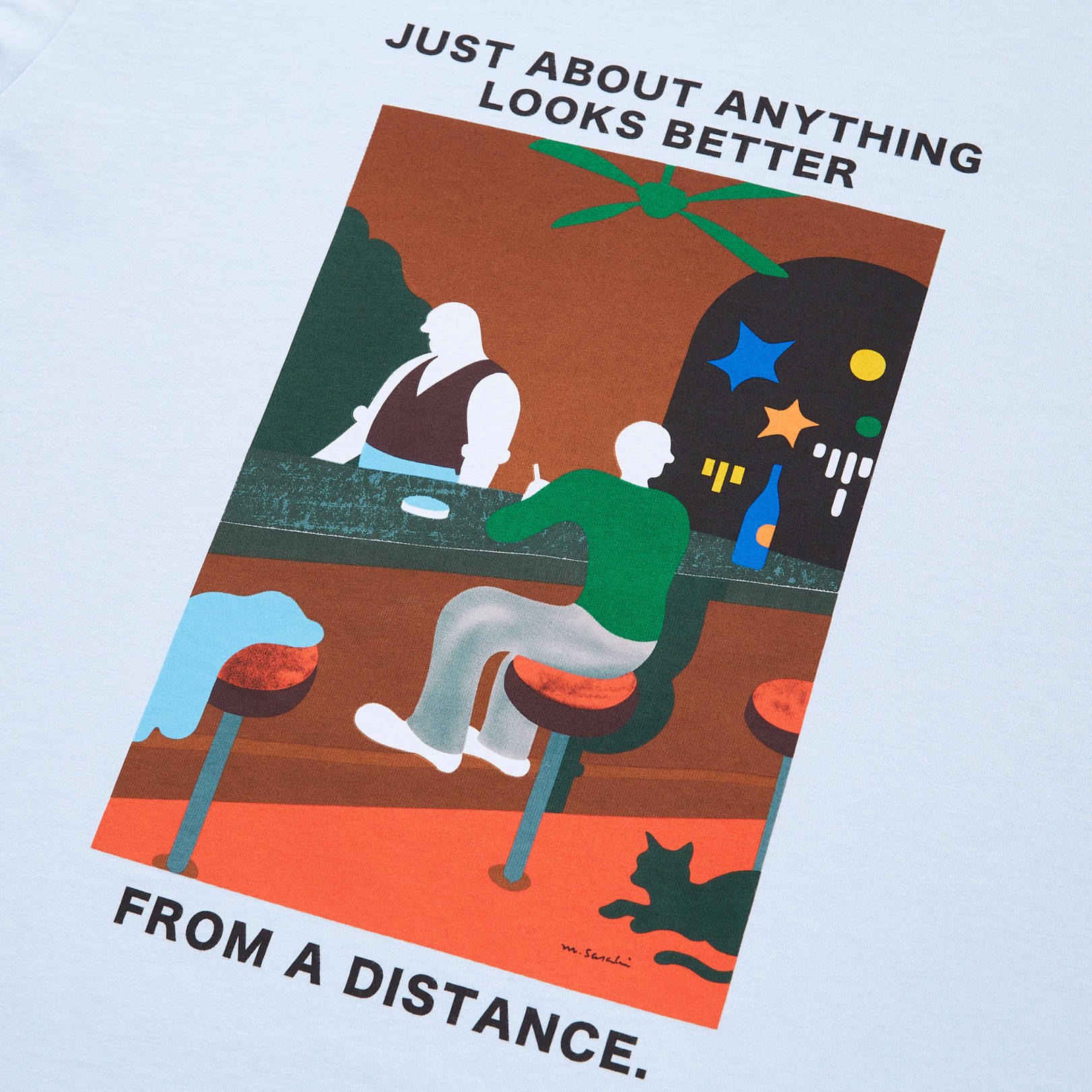
More than a few of Murakami’s fans could no doubt say the same. They’ll also delight in the nuances of the words and images on the seven other Murakami shirts Uniqlo has created for sale from March 15th. Many have read Norwegian Wood, but relatively few will notice that Uniqlo’s shirt based on that book comes in the very same red-and-green color scheme as its two-volume Japanese first edition. Far from drawing only on the popularity of such big hits, the collection also pays tribute to Murakami’s lesser-known works: his sophomore effort Pinball, 1973, for instance, which went without a major English translation for 35 years.

Still unpublished outside Asia are most of Murakami’s essays, which he’s been writing on music, food, travel, and a variety of other subjects nearly as long as he’s been a novelist. But this November, Knopf will publish Murakami T: The T‑Shirts I Love, a book documenting his impressive collection including T‑shirts “from The Beach Boys concert in Honolulu to the shirt that inspired the beloved short story ‘Tony Takitani,’ ” all “accompanied by short, frank essays that have been translated into English for the first time.” Writing essays or fiction, whatever the language in which they appear, Murakami’s work remains broadly appealing yet distinctively his own, belonging at once everywhere and nowhere in the world — more than a bit, come to think of it, like Uniqlo’s clothing. On March 15, purchase the shirts online here.
via Spoon & Tamago
Related Content:
Based in Seoul, Colin Marshall writes and broadcasts on cities, language, and culture. His projects include the Substack newsletter Books on Cities, the book The Stateless City: a Walk through 21st-Century Los Angeles and the video series The City in Cinema. Follow him on Twitter at @colinmarshall or on Facebook.
Read More...When Sci-Fi Legend Ursula K. Le Guin Translated the Chinese Classic, the Tao Te Ching
Brenda (laughing): Can you imagine a Taoist advertising agency? “Buy this if you feel like it. If it’s right. You may not need it.”
Ursula: There was an old cartoon in The New Yorker with a guy from an advertising agency showing his ad and the boss is saying “I think you need a little more enthusiasm Jones.” And his ad is saying, “Try our product, it really isn’t bad.”
Perhaps no Chinese text has had more lasting influence in the West than the Tao Te Ching, a work so ingrained in our culture by now, it has become a “changeless constant,” writes Maria Popova. “Every generation of admirers has felt, and continues to feel, a prescience in these ancient teachings so astonishing that they appear to have been written for their own time.” It speaks directly to us, we feel, or at least, that’s how we can feel when we find the right translation.
Admirers of the Taoist classic have included John Cage, Franz Kafka, Bruce Lee, Alan Watts, and Leo Tolstoy, all of whom were deeply affected by the millennia-old philosophical poetry attributed to Lao Tzu. That’s some heavy company for the rest of us to keep, maybe. It’s also a list of famous men. Not every reader of the Tao is male or approaches the text as the utterances of a patriarchal sage. One famous reader had the audacity to spend decades on her own, non-gendered, non-hierarchical translation, even though she didn’t read Chinese.
It’s not quite right to call Ursula Le Guin’s Tao Te Ching a translation, so much as an interpretation, or a “rendition,” as she calls it. “I don’t know Chinese,” she said in an interview with Brenda Peterson, “but I drew upon the Paul Carus translation of 1898 which has Chinese characters followed by a transliteration and a translation.” She used the Carus as a “touchstone for comparing other translations,” and started, in her twenties, “working on these poems. Every decade or so I’d do another chapter. Every reader has to start anew with such an ancient text.”
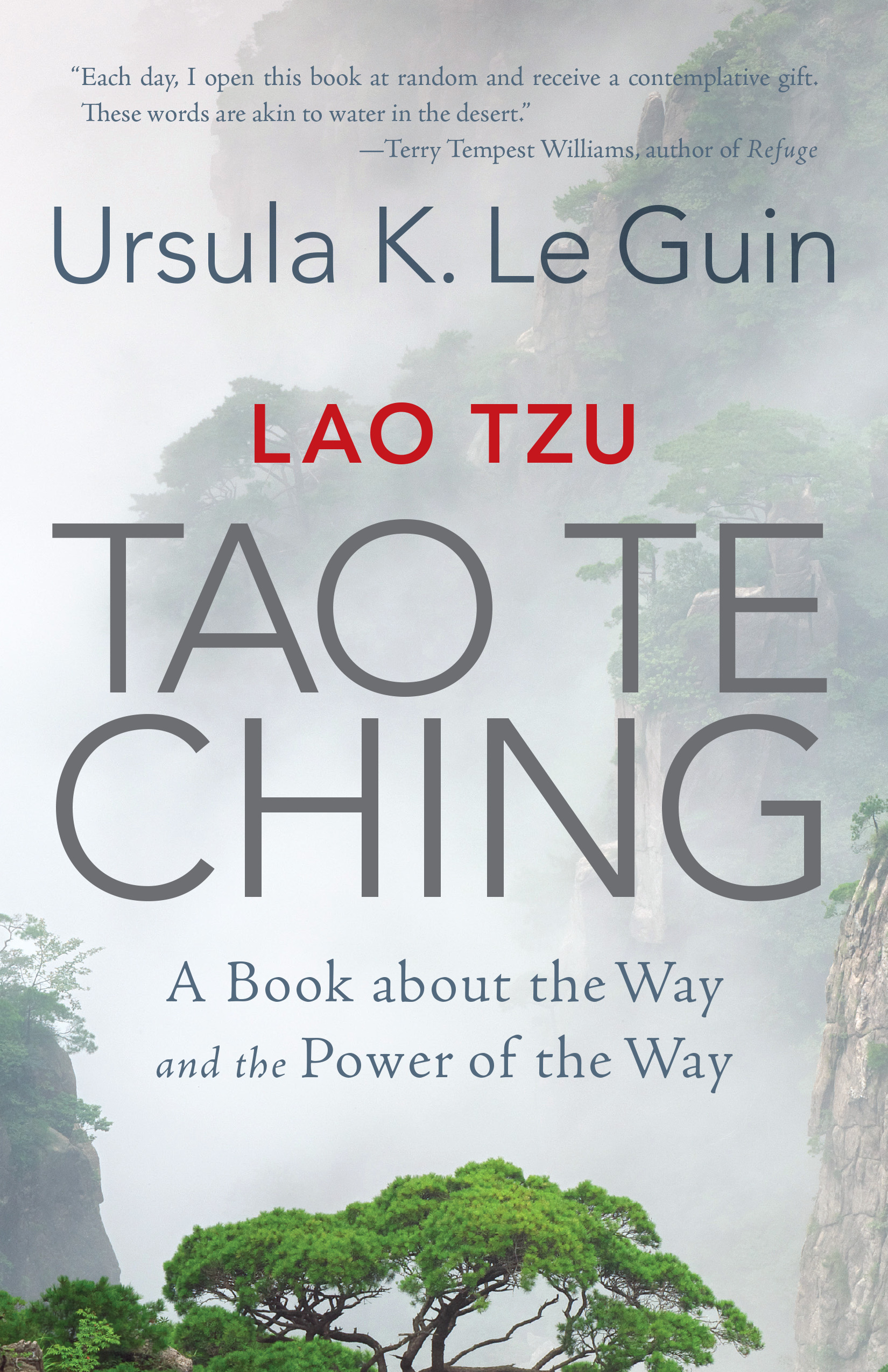
Le Guin drew out inflections in the text which have been obscured by translations that address the reader as a Ruler, Sage, Master, or King. In her introduction, Le Guin writes, “I wanted a Book of the Way accessible to a present-day, unwise, unpowerful, perhaps unmale reader, not seeking esoteric secrets, but listening for a voice that speaks to the soul.” To immediately get a sense of the difference, we might contrast editions of Arthur Waley’s translation, The Way and Its Power: a Study of the Tao Te Ching and Its Place in Chinese Thought, with Le Guin’s Tao Te Ching: A Book about the Way and the Power of the Way.
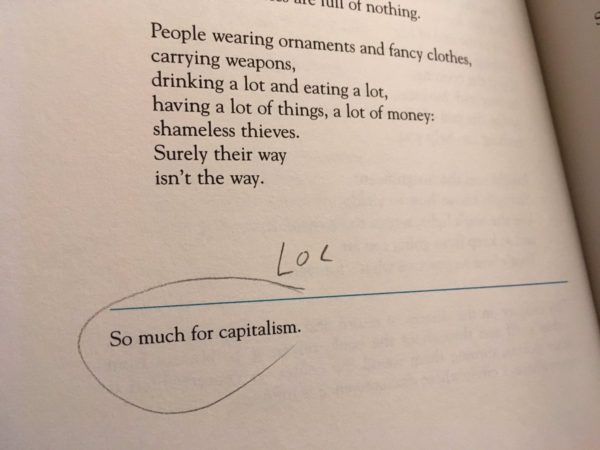
Waley’s translation “is never going to be equaled for what it does,” serving as a “manual for rulers,” Le Guin says. It was also designed as a guide for scholars, in most editions appending around 100 pages of introduction and 40 pages of opening commentary to the main text. Le Guin, by contrast, reduces her editorial presence to footnotes that never overwhelm, and often don’t appear at all (one note just reads “so much for capitalism”), as well as a few pages of endnotes on sources and variants. “I didn’t figure a whole lot of rulers would be reading it,” she said. “On the other hand, people in positions of responsibility, such as mothers, might be.”
Her version represents a lifelong engagement with a text Le Guin took to heart “as a teenage girl” she says, and found throughout her life that “it obviously is a book that speaks to women.” But her rendering of the poems does not substantially alter the substance. Consider the first two stanzas of her version of Chapter 11 (which she titles “The uses of not”) contrasted with Waley’s CHAPTER XI.
Waley
We put thirty spokes together and call it a wheel;
But it is on the space where there is nothing that the
usefulness of the wheel depends.
We turn clay to make a vessel;
But it is on the space where there is nothing that the
usefulness of the vessel depends.Le Guin
Thirty spokes
meet in the hub.
Where the wheel isn’t
is where is it’s useful.Hollowed out,
clay makes a pot.
Where the pot’s not
is where it’s useful.
Le Guin renders the lines as delightfully folksy oppositions with rhyme and repetition. Waley piles up argumentative clauses. “One of the things I love about Lao Tzu is he is so funny,” Le Guin comments in her note,” a quality that doesn’t come through in many other translations. “He’s explaining a profound and difficult truth here, one of those counterintuitive truths that, when the mind can accept them, suddenly double the size of the universe. He goes about it with this deadpan simplicity, talking about pots.”
Such images captivated the earthy anarchist Le Guin. She drew inspiration for the title of her 1971 novel The Lathe of Heaven from Taoist philosopher Chuang Tzu, perhaps showing how she reads her own interests into a text, as all translators and interpreters inevitably do. No translation is definitive. The borrowing turned out to be an example of how even respected Chinese language scholars can misread a text and get it wrong. She found the “lathe of heaven” phrase in James Legge’s translation of Chuang Tzu, and later learned on good authority that there were no lathes in China in Chuang Tzu’s time. “Legge was a bit off on that one,” she writes in her notes.
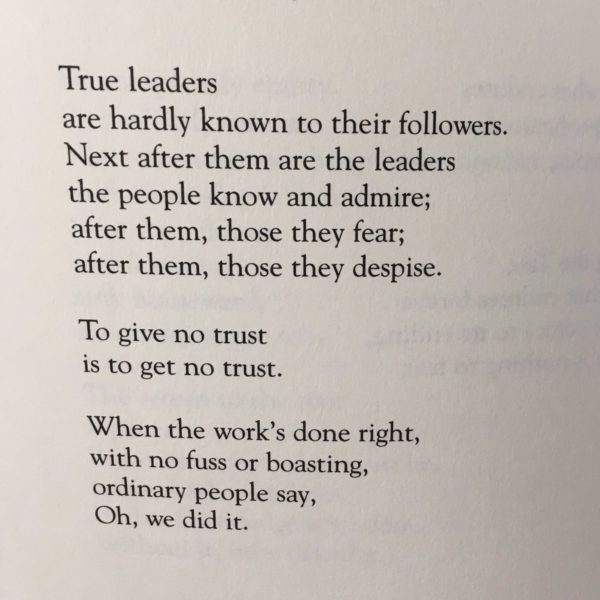
Scholarly density does not make for perfect accuracy or a readable translation. The versions of Legge and several others were “so obscure as to make me feel the book must be beyond Western comprehension,” writes Le Guin. But as the Tao Te Ching announces at the outset: it offers a Way beyond language. In Legge’s first few lines:
The Tao that can be trodden is not the enduring and
unchanging Tao. The name that can be named is not the enduring and
unchanging name.
Here is how Le Guin welcomes readers to the Tao — noting that “a satisfactory translation of this chapter is, I believe, perfectly impossible — in the first poem she titles “Taoing”:
The way you can go
isn’t the real way.
The name you can say
isn’t the real name.Heaven and earth
begin in the unnamed:
name’s the mother
of the ten thousand things.So the unwanting soul
sees what’s hidden,
and the ever-wanting soul
sees only what it wants.Two things, one origin,
but different in name,
whose identity is mystery.
Mystery of all mysteries!
The door to the hidden.
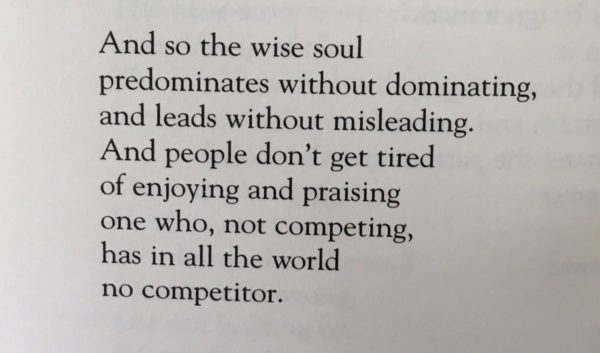
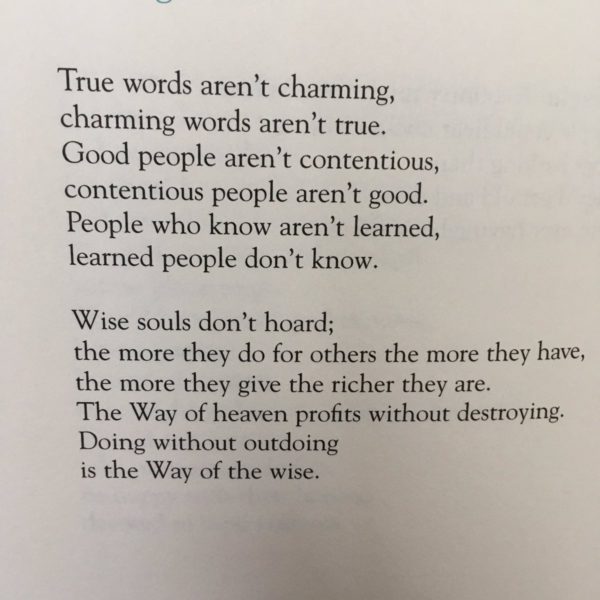
All images of the text courtesy of Austin Kleon.
Related Content:
Ursula K. Le Guin Names the Books She Likes and Wants You to Read
Ursula K. Le Guin’s Daily Routine: The Discipline That Fueled Her Imagination
Ursula K. Le Guin Stamp Getting Released by the US Postal Service
Josh Jones is a writer and musician based in Durham, NC. Follow him at @jdmagness
Read More...The Last Interview Book Series Features the Final Words of Cultural Icons: Borges to Bowie, Philip K. Dick to Frida Kahlo
Where were you when you heard that Hunter S. Thompson had died? The uniquely addled, uniquely incisive taker of the strange trip that was 20th-century America checked out sixteen years ago last month, a span of time in which we’ve also lost a great many other influential figures cultural and countercultural. The departed include many of Thompson’s colleagues in letters: societal diagnosticians like David Foster Wallace and Christopher Hitchens; conjurers of the fantastical and the familiar like Ursula K. Le Guin and Gabriel García Márquez; and specialists in other fields — Oliver Sacks from neurology, Anthony Bourdain from the kitchen, Nora Ephron from Hollywood — who on the page entertained us as they shared their expertise.
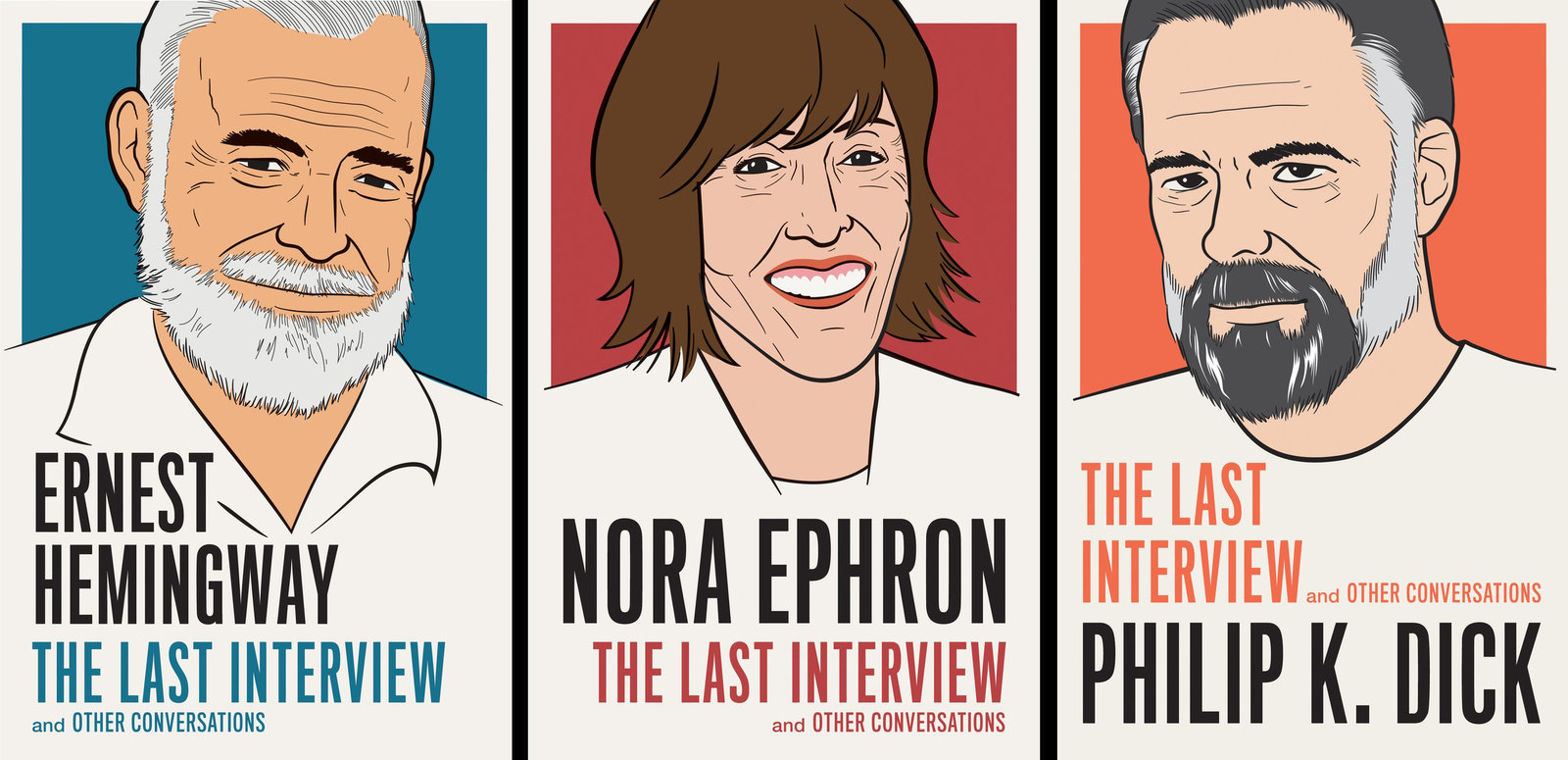
All of these writers have passed into esteemed company: not just that of luminaries from bygone eras, but of volumes in Melville House’s Last Interview series. “Can you think of three writers who, on the face of it, would have had less to say to each other at a dinner party?” asks NPR’s Maureen Corrigan, reviewing Last Interview volumes on Ephron, Ernest Hemingway, and Philip K. Dick.
“Hemingway would have knocked back the booze and gone all moody and silent; the notoriously paranoid Dick would have been under the table checking for bugging devices and Ephron would’ve channeled what she called ‘the truly life-saving technique’ taught to her by her Hollywood screenwriter parents to get through a rough time: the mantra, ‘Someday this will be a story!’ ”
With a range of deceased icons, including Marilyn Monroe and Martin Luther King, Jr., Julia Child and Jorge Luis Borges, Fred Rogers and Frida Kahlo, the Last Interview books cast a wide net for such an aesthetically and intellectually unified project. “Each volume offers, besides useful insights into its particular author’s work, what an old friend would call ‘civilized entertainment,’ ” writes Michael Dirda in The Washington Post. “Nearly all the titles actually contain several interviews, and some add introductions. For instance, the Roberto Bolaño opens with a 40-page critical essay.” In some cases the interviewers are as notable as the interviewees: “Two of Lou Reed’s questioners — the multi-talented novelists Neil Gaiman and Paul Auster — are now probably as well known as the legendary co-founder of the Velvet Underground.”
From the world of music the series includes not just Reed but David Bowie and Prince, two other one-man cultural forces who left us in the past decade, as well as their equally irreplaceable predecessors Johnny Cash and Billie Holiday. At the moment you can buy the entire Last Interview collection on Amazon (in Kindle format) for USD $344, which comes out to about $10 per book with 34 volumes in total. You may find this an economical solution, a way to explore the final thoughts of figures featured more than once here on Open Culture.
Related Content:
Orson Welles’ Last Interview and Final Moments Captured on Film
Hear Leonard Cohen’s Final Interview: Recorded by David Remnick of The New Yorker
Carl Sagan Issues a Chilling Warning to America in His Final Interview (1996)
Janis Joplin’s Last TV Performance & Interview: The Dick Cavett Show (1970)
Based in Seoul, Colin Marshall writes and broadcasts on cities, language, and culture. His projects include the Substack newsletter Books on Cities, the book The Stateless City: a Walk through 21st-Century Los Angeles and the video series The City in Cinema. Follow him on Twitter at @colinmarshall or on Facebook.
Read More...Why the Flood of Musician Memoirs? An Exploration by Pretty Much Pop: A Culture Podcast #84
There’s been an explosion of rock and roll autobiographies in recent years, with pretty much every music legend (and many others) being invited by some publisher or other to write or dictate their story. What’s the particular appeal of this kind of recounting, what’s the connection between writing and reading these books on the one hand and producing and listening to the actual music on the other? Do we get a roughly equivalent benefit from a biography, documentary, or film depiction of the person’s life?
Your hosts Mark Linsenmayer, Erica Spyres, and Brian Hirt along with guest Laura Davis-Chanin, author of her own music memoir, each picked a book, covering Elvis Costello, Carrie Brownstein, Ozzy Osbourne, and Debbie Harry respectively. Reflecting on these reading experiences we compare the author’s purposes in writing the book, how confessional or drug-addled or twisted the story is, what is emphasized and what’s not, and what resonated in the story beyond the idiosyncratic recounting of that person’s life.
Check out Laura’s two books, hear her talk about her musical adventures on Nakedly Examined Music, and hear her discuss classic literature on Phi Fic.
Some of the NEM episodes where Mark talked with guests about their auto-biographies featured Chris Frantz of Talking Heads, Jim Peterik of Survivor, Andy Powell of Wishbone Ash, Danny Seraphine of Chicago and John Andrew Fredrick of The Black Watch.
We didn’t use much research for this episode, but you can read lists of particularly good music memoirs from Rolling Stone and The Guardian. The Oakland Press has an article about music biographies and autobiographies emerging at the end of 2020.
Hear more of this podcast at prettymuchpop.com. This episode includes bonus discussion that you can access by supporting the podcast at patreon.com/prettymuchpop. This podcast is part of the Partially Examined Life podcast network.
Pretty Much Pop: A Culture Podcast is the first podcast curated by Open Culture. Browse all Pretty Much Pop posts.
Read More...The Little-Known Female Scientists Who Mapped 400,000 Stars Over a Century Ago: An Introduction to the “Harvard Computers”

Image via Wikimedia Commons
As team names go, the Harvard Computers has kind of an oddball ring to it, but it’s far preferable to Pickering’s Harem, as the female scientists brought in under the Harvard Observatory’s male director were collectively referred to early on in their 40-some years of service to the institution.
A possibly apocryphal story has it that Director Edward Pickering was so frustrated by his male assistants’ pokey pace in examining 1000s of photographic plates bearing images of stars spotted by telescopes in Harvard and the southern hemisphere, he declared his maid could do a better job.
If true, it was no idle threat.
In 1881, Pickering did indeed hire his maid, Williamina Fleming, to review the plates with a magnifying glass, cataloguing the brightness of stars that showed up as smudges or grey or black spots. She also calculated—aka computed—their positions, and, when possible, chemical composition, color, and temperature.
The newly single 23-year-old mother was not uneducated. She had served as a teacher for years prior to emigrating from Scotland, but when her husband abandoned her in Boston, she couldn’t afford to be fussy about the kind of employment she sought. Working at the Pickerings meant secure lodging and a small income.
Not that the promotion represented a financial windfall for Fleming and the more than 80 female computers who joined her over the next four decades. They earned between 25 to 50 cents an hour, half of what a man in the same position would have been paid.
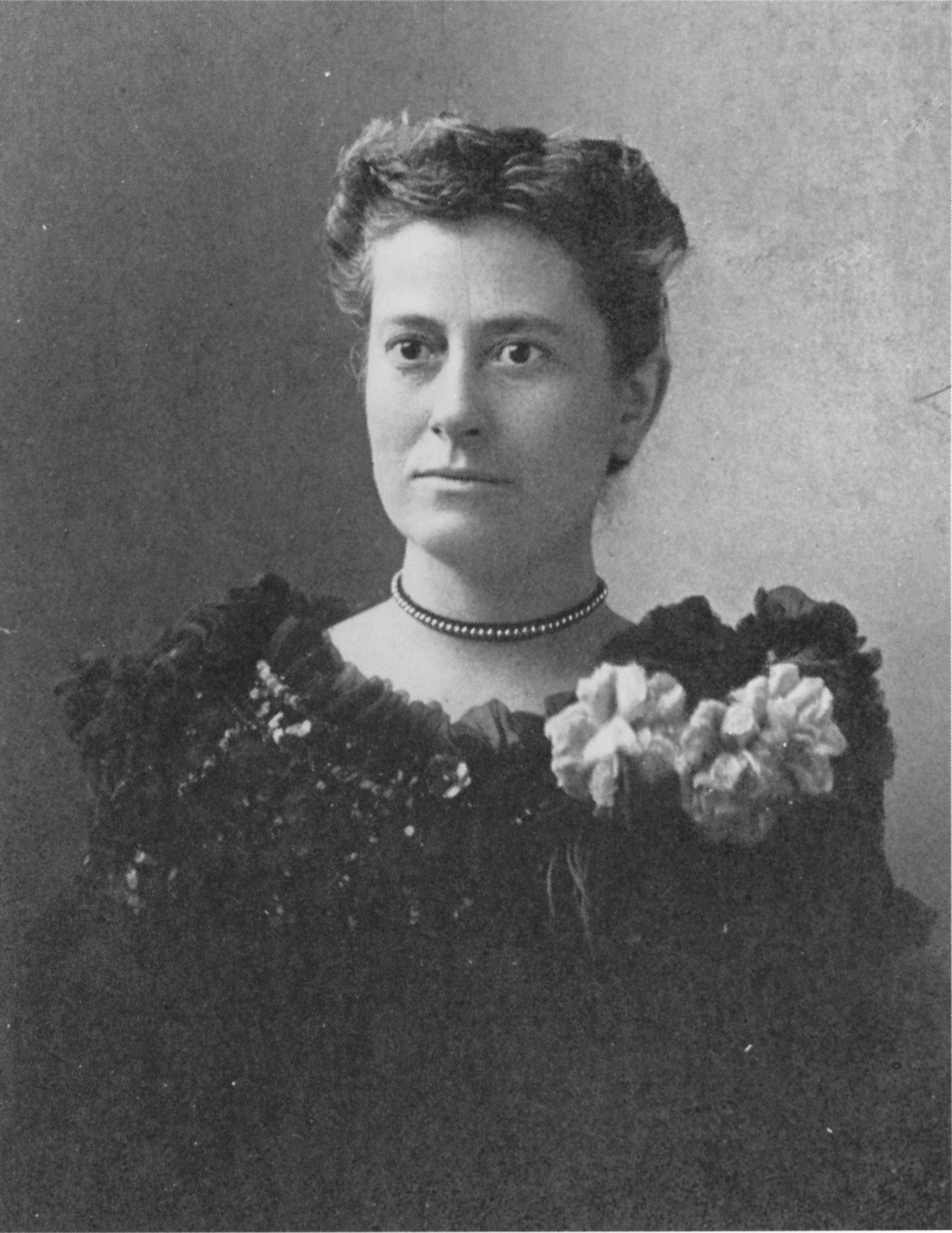
Image via Wikimedia Commons
At one point Fleming, who as a single mother was quite aware that she was burdened with “all housekeeping cares …in addition to those of providing the means to meet their expenses,” addressed the matter of her low wages with Pickering, leaving her to vent in her diary:
I am immediately told that I receive an excellent salary as women’s salaries stand.… Does he ever think that I have a home to keep and a family to take care of as well as the men?… And this is considered an enlightened age!
Harvard certainly got its money’s worth from its female workforce when you consider that the classification systems they developed led to identification of nearly 400,000 stars.
Fleming, who became responsible for hiring her coworkers, was the first to discover white dwarfs and the Horsehead Nebula in Orion, in addition to 51 other nebulae, 10 novae, and 310 variable stars.
An impressive achievement, but another diary entry belies any glamour we might be tempted to assign:
From day to day my duties at the Observatory are so nearly alike that there will be little to describe outside ordinary routine work of measurement, examination of photographs, and of work involved in the reduction of these observations.
Pickering believed that the female computers should attend conferences and present papers, but for the most part, they were kept so busy analyzing photographic plates, they had little time left over to explore their own areas of interest, something that might have afforded them work of a more theoretical nature.
Another diary entry finds Fleming yearning to get out from under a mountain of busy work:
Looking after the numerous pieces of routine work which have to be kept progressing, searching for confirmation of objects discovered elsewhere, attending to scientific correspondence, getting material in form for publication, etc, has consumed so much of my time during the past four years that little is left for the particular investigations in which I am especially interested.
And yet the work of Fleming and other notable computers such as Henrietta Swan Leavitt and Annie Jump Cannon is still helping scientists make sense of the heavens, so much so that Harvard is seeking volunteers for Project PHaEDRA, to help transcribe their logbooks and notebooks to make them full-text searchable on the NASA Astrophysics Data System. Learn how you can get involved here.
Related Content:
Women Scientists Launch a Database Featuring the Work of 9,000 Women Working in the Sciences
Real Women Talk About Their Careers in Science
Ayun Halliday is an author, illustrator, theater maker and Chief Primatologist of the East Village Inky zine. Follow her @AyunHalliday.
Read More...What Are the Real Causes of Zoom Fatigue? And What Are the Possible Solutions?: New Research from Stanford Offers Answers
The technology we put between ourselves and others tends to always create additional strains on communication, even as it enables near-constant, instant contact. When it comes to our now-primary mode of interacting — staring at each other as talking heads or Brady Bunch-style galleries — those stresses have been identified by communication experts as “Zoom fatigue,” now a subject of study among psychologists who want to understand our always-connected-but-mostly-isolated lives in the pandemic, and a topic for Today show segments like the one above.
As Stanford researcher Jeremy Bailenson vividly explains to Today, Zoom fatigue refers to the burnout we experience from interacting with dozens of people for hours a day, months on end, through pretty much any video conferencing platform. (But, let’s face it, mostly Zoom.) We may be familiar with the symptoms already if we spend some part of our day on video calls or lessons. Zoom fatigue combines the problems of overwork and technological overstimulation with unique forms of social exhaustion that do not plague us in the office or the classroom.
Bailenson, director of Stanford University’s Virtual Human Interaction Lab, refers to this kind of burnout as “Nonverbal Overload,” a collection of “psychological consequences” from prolonged periods of disembodied conversation. He has been studying virtual communication for two decades and began writing about the current problem in April of 2020 in a Wall Street Journal op-ed that warned, “software like Zoom was designed to do online work, and the tools that increase productivity weren’t meant to mimic normal social interaction.”
Now, in a new scholarly article published in the APA journal Technology, Mind, and Behavior, Bailenson elaborates on the argument with a focus on Zoom, not to “vilify the company,” he writes, but because “it has become the default platform for many in academia” (and everywhere else, perhaps its own form of exhaustion). The constituents of nonverbal overload include gazing into each others’ eyes at close proximity for long periods of time, even when we aren’t speaking to each other.
Anyone who speaks for a living understands the intensity of being stared at for hours at a time. Even when speakers see virtual faces instead of real ones, research has shown that being stared at while speaking causes physiological arousal (Takac et al., 2019). But Zoom’s interface design constantly beams faces to everyone, regardless of who is speaking. From a perceptual standpoint, Zoom effectively transforms listeners into speakers and smothers everyone with eye gaze.
On Zoom, we also have to expend much more energy to send and interpret nonverbal cues, and without the context of the room outside the screen, we are more apt to misinterpret them. Depending on the size of our screen, we may be staring at each other as larger-than-life talking heads, a disorienting experience for the brain and one that lends more impact to facial expressions than may be warranted, creating a false sense of intimacy and urgency. “When someone’s face is that close to ours in real life,” writes Vignesh Ramachandran at Stanford News, “our brains interpret it as an intense situation that is either going to lead to mating or to conflict.”
Unless we turn off the view of ourselves on the screen — which we generally don’t do because we’re conscious of being stared at — we are also essentially sitting in front of a mirror while trying to focus on others. The constant self-evaluation adds an additional layer of stress and taxes the brain’s resources. In face-to-face interactions, we can let our eyes wander, even move around the room and do other things while we talk to people. “There’s a growing research now that says when people are moving, they’re performing better cognitively,” says Bailenson. Zoom interactions, conversely, can inhibit movement for long periods of time.
“Zoom fatigue” may not be as dire as it sounds, but rather the inevitable trials of a transitional period, Bailenson suggests. He offers solutions we can implement now: using the “hide self-view” button, muting our video regularly, setting up the technology so that we can fidget, doodle, and get up and move around.… Not all of these are going to work for everyone — we are, after all, socialized to sit and stare at each other on Zoom; refusing to participate might send unintended messages we would have to expend more energy to correct. Bailenson further describes the phenomenon in the BBC Business Daily podcast interview above.
“Videoconferencing is here to stay,” Bailenson admits, and we’ll have to adapt. “As media psychologists it is our job,” he writes to his colleagues in the new article, to help “users develop better use practices” and help “technologists build better interfaces.” He mostly leaves it to the technologists to imagine what those are, though we ourselves have more control over the platform than we collectively acknowledge. Could we maybe admit, Bailenson writes, that “perhaps a driver of Zoom fatigue is simply that we are taking more meetings than we would be doing face-to-face”?
Read about the “Zoom Exhaustion & Fatigue Scale (ZEF Scale)” developed by Bailenson and his colleagues at Stanford and the University of Gothenburg here. Then take the survey yourself, and see where you rank in the ZEF categories of general fatigue, visual fatigue, social fatigue, motivational fatigue, and emotional fatigue.
Related Content:
How Information Overload Robs Us of Our Creativity: What the Scientific Research Shows
In 1896, a French Cartoonist Predicted Our Socially-Distanced Zoom Holiday Gatherings
Josh Jones is a writer and musician based in Durham, NC. Follow him at @jdmagness
Read More...Support Us
We're hoping to rely on loyal readers, rather than erratic ads. Please click the Donate button and support Open Culture. You can use Paypal, Venmo, Patreon, even Crypto! We thank you!

About Us

Open Culture scours the web for the best educational media. We find the free courses and audio books you need, the language lessons & educational videos you want, and plenty of enlightenment in between.
Advertise With Us
FREE UPDATES!
GET OUR DAILY EMAIL
Get the best cultural and educational resources on the web curated for you in a daily email. We never spam. Unsubscribe at any time.
FOLLOW ON SOCIAL MEDIA
Open Culture editor Dan Colman scours the web for the best educational media. He finds the free courses and audio books you need, the language lessons & movies you want, and plenty of enlightenment in between.
Advertise With Us



