Increasing Disabled/Other-Abled Representation in Media — Pretty Much Pop: A Culture Podcast #83

At least 20% of us have some sort of disability, yet such conditions are reflected by only tiny portion of TV and film characterizations, and what characters are portrayed typically get played by non-disabled actors. Depictions often focus on what it’s like to live with the condition. This can of course be socially beneficial, but we don’t want to essentialize people as their conditions, so it’s even more useful to feature disabled actors and characters when the plot is not about their disability.
Pretty Much Pop hosts Mark Linsenmayer, Erica Spyres, and Brian Hirt are joined by playwright Kayla Dryesse to talk about hurdles to representation, disability culture, whether “disability” is even the right word, negative stereotypes (no less than five James Bond villains are in wheelchairs!), and issues in portraying disability related to theater, comedy, horror, and superheroes. Some shows mentioned include Speechless, Atypical, Everything’s Gonna Be Okay, Breaking Bad, Glee, The Stand, The Witches, and The Great British Bake-Off.
Learn more from these articles:
- “Road Map for Inclusion: Changing the Face of Disability in Media” by Judith Heumann
- “Problematic Representation of People with Disabilities in the Media” by Devon McDevitt
- “What Is Disability Culture?” by Steven E. Brown
- “Scary Is How You Act, Not Look, Disability Advocates Tell Filmmakers” by Cara Buckley
- “Deaf Professionals Sign Letter Calling Out ‘The Stand’ for Lack of Inclusion: ‘Enough is enough’ ” by David Oliver
- “Stepping Backwards with Disability Humor? The Case of NY Gov. David Paterson’s Representation on ‘Saturday Night Live’ ” by Beth Haller and Amy Becker
- “18 Inspiring Netflix Shows Committed to Representing People With Disabilities” by Corinne Sullivan
- “28 Movies, Books, TV Shows (and More) That Explore Disability Culture” from NY Times
Also, watch Stella Young’s TED talk, called “I’m Not Your Inspiration, Thank You Very Much;” the episode of Drunk History about 504 accessibility; and Stevie Wonder’s SNL parody of a camera commercial.
Hear more of this podcast at prettymuchpop.com. This episode includes bonus discussion that you can access by supporting the podcast at patreon.com/prettymuchpop. This podcast is part of the Partially Examined Life podcast network.
Pretty Much Pop: A Culture Podcast is the first podcast curated by Open Culture. Browse all Pretty Much Pop posts.
Read More...The Roman Roads of Gaul Visualized as a Modern Subway Map
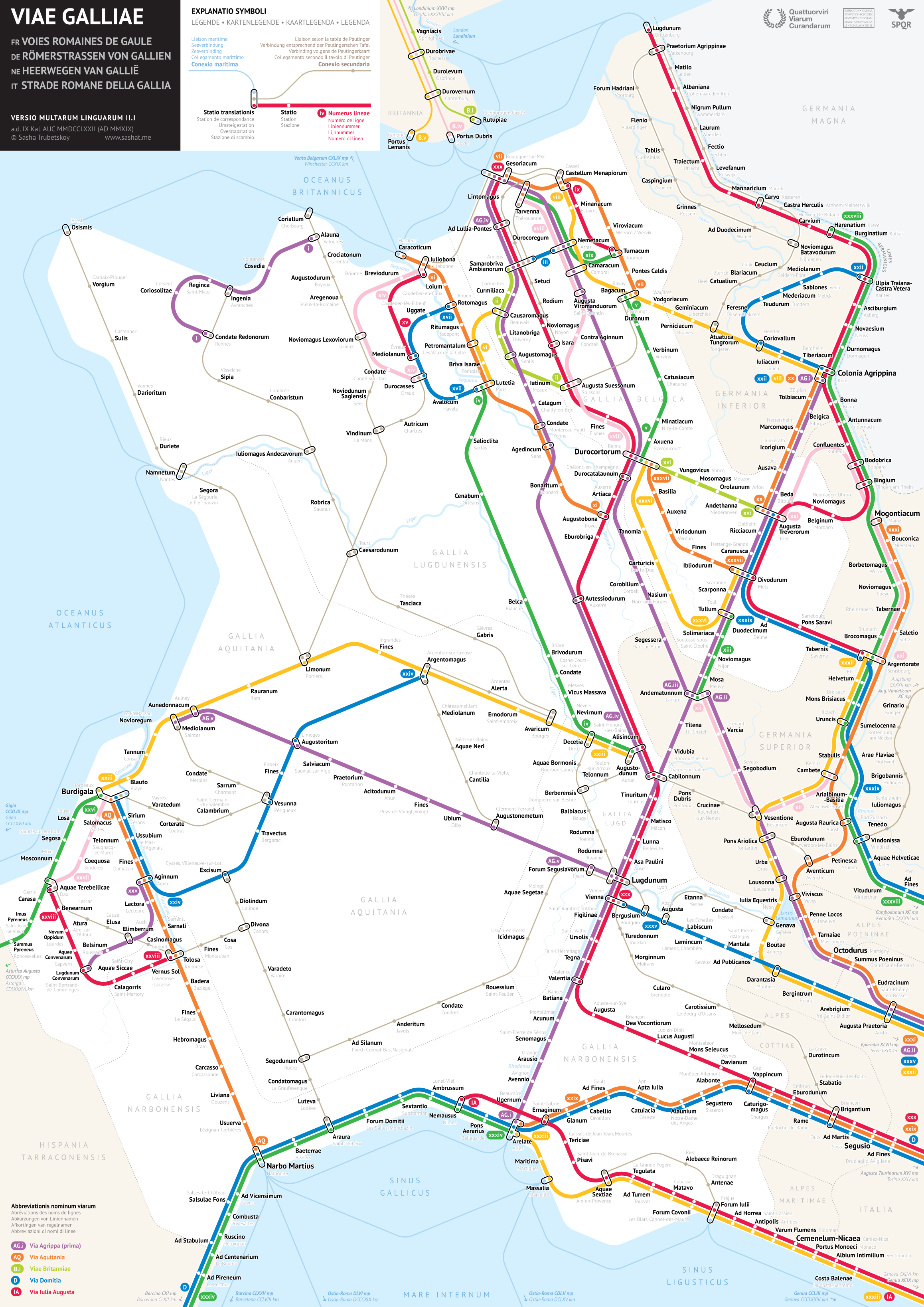
At a casual glance, some travelers may take the map above for a depiction of France’s enviable intercity high-speed rail network Train à Grande Vitesse, better known as TGV. In reality, its content predates that system’s inauguration in the early 1980s — and by nearly two millennia at that. This is in fact a map of Gaul, a region of Europe that, most broadly defined, included modern-day France, Luxembourg, and Belgium, as well as parts of Switzerland, Italy, the Netherlands, and Germany. Ruled by Rome for five centuries until the fall of the Roman Empire itself, Gaul was run through with a number of Roman roads, a subject of fascination for many archaeologically inclined historians.
They’ve also become a subject of fascination for a young data scientist and graphic designer by the name of Sasha Trubetskoy. His work, much featured here on Open Culture, includes maps of the Roman Roads of Britain, Italy, Spain and Portugal, as well as, at a larger scale, those of the entire empire.
“This was an interesting map to make, but I can’t say it was fun all the time,” writes Trubetskoy. “Generally I enjoyed the process, but it was far more challenging than I had anticipated.” You can hear him describe some of the challenges involved, and even show how solving them played out in his design process, in his three-hour explanatory live stream now archived on Youtube.
You can download Trubetskoy’s Roman Roads of Gaul map from his site, and even buy a high-resolution file suitable for printing as a poster (USD $9). “As far as I can tell, it’s done,” writes Trubetskoy of the work, wisely — or from frustrating personal experience — acknowledging that, despite or because of the centuries of distance between us and the relevant historical and geographical facts, those facts could still change. Just as ancient history cannot both make its way to us and maintain absolutely perfect fidelity to the past, so the kind of practical visual design embodied in a subway map necessitates a great deal of simplification and approximation to be useful. And speaking of the graphic arts, just imagine how useful this particular map would’ve been to Asterix.
Related Content:
Ancient Rome’s System of Roads Visualized in the Style of Modern Subway Maps
The Roman Roads of Britain Visualized as a Subway Map
All the Roman Roads of Italy, Visualized as a Modern Subway Map
Based in Seoul, Colin Marshall writes and broadcasts on cities, language, and culture. His projects include the Substack newsletter Books on Cities, the book The Stateless City: a Walk through 21st-Century Los Angeles and the video series The City in Cinema. Follow him on Twitter at @colinmarshall or on Facebook.
Read More...The 69 Pages of Writing Advice Denis Johnson Collected from Flannery O’Connor, Jack Kerouac, Stephen King, Hunter Thompson, Werner Herzog & Many Others
The internet is full of inspirational quotations about writing, many of them from accomplished and respectable writers. But what need could such writers have of inspirational quotations themselves? Surely true literary art flows from its authors without need of encouraging words, demand though it may sustained periods of labor, frustration, and even suffering. These days, more than a few who seek to create such art spend time studying not just its past masterworks but its living masters. “Some years ago,” the novelist Karan Mahajan recently tweeted, “I was lucky to take a class with Denis Johnson, who dressed like a card-shark, in flashy jackets and (unlike a card-shark) wept over sentences. He gave my class a 69-page list of writing quotes he returned to frequently.”
Johnson’s list, which you can see in PDF form here, shows that at least one of our era’s most celebrated writers swore by the kind of writing advice most of us scroll past every day. Though somewhat eccentrically formatted, it rounds up a great deal of valuable wisdom from novelists, poets, and playwrights — as well as philosophers, sculptors, filmmakers, and other figures besides — from different lands and different times.
In it you’ll find these reflections on the art, craft, and life of writing, among many others:
- “In genius we perceive our own rejected thoughts, returning to us with a kind of alienated majesty.” — Ralph Waldo Emerson
- Simplicity is not an end in art, but we usually arrive at simplicity as we approach the true sense of things.” — Constantin Brâncuși
- The first and most obvious characteristic of fiction is that it deals with reality through what can be seen, heard, smelt, tasted, and touched.” ― Flannery O’Connor
- “Writing, ideally, is recognizing your bad writing.” — August Wilson
- “One is always seeking the touchstone that will dissolve one’s deficiencies as a person and as a craftsman. And one is always bumping up against the fact that there is none except hard work, concentration, and continued application.” — Paul William Gallico
- “But what is art, really, but a good instinct for staying alive in your own alley?” — Hunter S. Thompson
- There is a microscopically thin line between being brilliantly creative and acting like the most gigantic idiot on earth. — Cynthia Heimel
- “A writer is a person for whom writing is more difficult than it is for other people.” — Thomas Mann
- “I learned never to empty the well of my writing, but always to stop when there was still something there in the deep part of the well, and let it refill at night from the springs that fed it.” — Ernest Hemingway
- “First thought best thought.” — Jack Kerouac
- “The job boils down to two things: paying attention to how the real people around you behave and then telling the truth about what you see.” — Stephen King
- “The important thing is that there should be a space of time, say four hours a day at least, when a professional writer doesn’t do anything else but write. He doesn’t have to write, and if he doesn’t feel like it, he shouldn’t try. He can look out of the window or stand on his head or writhe on the floor. But he is not to do any other positive thing, not read, write letters, glance at magazines, or write checks. Write or nothing.” — Raymond Chandler
- “I know this, with a sure and certain knowledge: a man’s work is nothing but this slow trek to rediscover, through the detours of art, those two or three great and simple images in whose presence his heart first opened.” — Albert Camus
- “Don’t look back.” – Bob Dylan
Over the course of these 69 pages, certain themes emerge: the importance of writing with one’s “blood,” the unimportance of critics, the value of simplicity, the danger of adjectives (and other excess description), the necessity of letting nothing block the flow of the first draft. While many of these quotations offer practical advice — much of it about consistently putting in the hours, both conscious and unconscious — some approach from a more oblique angle not just “writing” as a pursuit but the living of life itself. “To fail to embrace my dreams now would be a disgrace so great that sin itself could not find a name for it,” writes Werner Herzog in the diary he kept during the agonized making of Fitzcarraldo. If this inspired the author of Jesus’ Son and Tree of Smoke, it ought to inspire the rest of us as well.
Related Content:
19 Quotes on Writing by Gore Vidal. Some Witty, Some Acerbic, Many Spot On
Stephen King’s 20 Rules for Writers
Kurt Vonnegut’s Eight Tips on How to Write a Good Short Story
7 Tips From Ernest Hemingway on How to Write Fiction
Write Only 500 Words Per Day and Publish 50+ Books: Graham Greene’s Writing Method
Based in Seoul, Colin Marshall writes and broadcasts on cities, language, and culture. His projects include the Substack newsletter Books on Cities, the book The Stateless City: a Walk through 21st-Century Los Angeles and the video series The City in Cinema. Follow him on Twitter at @colinmarshall or on Facebook.
Read More...Anthony Bourdain Talks About the Big Break That Changed His Life–at Age 44
Anthony Bourdain talking about his big break is my favorite video right now pic.twitter.com/83Zaiyp6CC
— writer (@Yoh31) February 20, 2021
In 1999, Anthony Bourdain’s career seemed to have stalled. While his “principal vocation remained his position as executive chef” at New York’s Les Halles, restless intelligence and wanderlust kept him looking for other opportunities. “He was 43 years old, rode hard and put up wet,” writes Elizabeth Nelson at The Ringer, “a recovering addict with a number of debts and a penchant for finding trouble in failing restaurants across the city.” He had fought for and won an undeniable measure of success, but he hardly seemed on the threshold of the major celebrity chefdom he would maintain until his death twenty years later in 2018.
Then, “in the spring of 2000, his sublimated literary ambitions suddenly caught up with and then quickly surpassed his cooking.” Bourdain’s memoir Kitchen Confidential “became an immediate sensation,” introducing his iconoclasm, acerbic wit, and outrageous confessional style to millions of readers, who would soon become viewers of his try-anything travelogue series, A Cook’s Tour, No Reservations, The Layover, and Parts Unknown, as well as loyal readers of his subsequent books, and even fiction like as Gone Bamboo, a crime novel soon to become a TV series.
How did Bourdain first get his winning personality before the masses? It all started with a 1999 New Yorker article called “Don’t Eat Before Reading This,” the predecessor to Kitchen Confidential and an essay that begins with what we might now recognize as a prototypically Bourdainian sentence: “Good food, good eating, is all about blood and organs, cruelty and decay.” In the interview clip above, from Bourdain’s final, 2017 interview with Fast Company, he talks about how the story led to his “huge break” just a couple days after it ran, when a Bloomsbury editor called with an offer of “the staggeringly high price of fifty thousand dollars to write a book.”
Everyone who loves Bourdain’s writing—and who loved his generous, ecumenical culinary spirit—knows why Kitchen Confidential changed his life overnight, as he says. Yes, “food is pain,” as he writes in the book’s “First Course,” but also, “food is sex”—”the delights of Portuguese squid stew, of Wellfleet oysters on the halfshell, New England clam chowder, of greasy, wonderful, fire-red chorizo sausages, kale soup, and a night when the striped bass jumped right out of the water and onto Cape Cod’s dinner tables.” Bourdain’s prose lingers over every delight, preparing us for the escapades to come.
In Kitchen Confidential, the exhaustion, “sheer weirdness,” and constant “threat of disaster,” that attend New York kitchen life (and life “inside the CIA”—the Culinary Institute of America, that is), becomes fleshed out with scenes of culinary decadence the likes of which most readers had never seen, smelled, or tasted. Fans craved more and more from the chef who wrote, in 1999, just before he would become a bestselling household name, “my career has taken an eerily appropriate turn: these days, I’m the chef de cuisine of a much loved, old-school French brasserie/bistro where… every part of the animal—hooves, snout, cheeks, skin, and organs—is avidly and appreciatively prepared and consumed.”
Read Bourdain’s New Yorker essay here and see his full 2017 interview with Fast Company just above.
via @Yoh31
Related Content:
Josh Jones is a writer and musician based in Durham, NC. Follow him at @jdmagness
Read More...Bruce Springsteen & Barack Obama Release a New Podcast, “Renegades: Born in the USA”
Yesterday, Barack Obama and Bruce Springsteen unveiled the first two episodes of an 8‑part podcast called “Renegades: Born In The USA.” The podcast (available on Spotify) is “a series of conversations between President Barack Obama and Bruce Springsteen about their lives, music, and enduring love of America—despite all its challenges.” The conversations were taped at Springsteen’s home between July and December of 2020. To hear the episodes, you will seemingly need to create a Spotify account, if you don’t have one already.
If you would like to support the mission of Open Culture, consider making a donation to our site. It’s hard to rely 100% on ads, and your contributions will help us continue providing the best free cultural and educational materials to learners everywhere. You can contribute through PayPal, Patreon, and Venmo (@openculture). Thanks!
Related Content:
The 150 Best Podcasts to Enrich Your Mind
President Obama Names His Favorite Books, Movies & Songs of 2018
Read More...The Life & Death of an Espresso Shot in Super Slow Motion
Some YouTuber posted online a pretty nice clip of an espresso shot being pulled from a La Marzocco FB80 espresso machine at 120 frames per second. They recommend muting the sound, then putting on your own music. I gave it a quick shot with the famous soundtrack for Kubrick’s 2001: A Space Odyssey. And I’ll be damned, it syncs up pretty well. Have a better soundtrack to recommend? Feel free to let us know in the comments section below.
If you would like to support the mission of Open Culture, consider making a donation to our site. It’s hard to rely 100% on ads, and your contributions will help us continue providing the best free cultural and educational materials to learners everywhere. You can contribute through PayPal, Patreon, and Venmo (@openculture). Thanks!
Related Content:
Coffee Entrepreneur Renato Bialetti Gets Buried in the Espresso Maker He Made Famous
Philosophers Drinking Coffee: The Excessive Habits of Kant, Voltaire & Kierkegaard
“The Vertue of the COFFEE Drink”: An Ad for London’s First Cafe Printed Circa 1652
Read More...Wired Co-Founder Kevin Kelly Gives 36 Lectures on Our Future World: Education, Movies, Robots, Autonomous Cars & More
Given recent events, 2019 may now seem to us like the distant past. But to those who were thinking hard about the future the year before last, nothing that has happened since has been wholly unexpected — and especially not to those who’d already been thinking hard about the future for decades. Take Kevin Kelly, co-founder of Wired magazine and writer on technology as well as a host of other subjects. It was in 2019 that state telecommunications company China Mobile commissioned him to give a series of 36 short video lectures on the “Future of X”: not the future of the internet in China and the future of India in competition with China, but a range of topics that will surely affect us all, no matter our part of the world.
Self-driving cars, virtual reality, 5G, robots: Kelly has given consideration to all these much-discussed technologies and the roles they may come to play in our lives. But the important thing about them isn’t to know what form they’ll take in the future, since by definition no one can, but to develop habits of mind that allow you to grasp as wide a variety of their possibilities as you can right now.
The future, as Kelly frames it in his talk on uncertainties, consists of “known knowns,” “known unknowns,” and “unknown unknowns.” Those last, better known as “black swans,” are events “completely unexpected by anybody” that “change the world forever.” As examples of possible black swans to come he names World War Three, the discovery of cheap fusion energy, and, yes, a pandemic.
Societal preparation for the future, to Kelly’s mind, will involve developing “a very systematic way of collecting these unknown unknowns and turning them into known unknowns.” Personal preparation for the future, according to his talk on schools and learning, will involve ceaseless acquisition and refinement of knowledge and understanding.
If we want to thrive in an uncertain future, he argues, we should “adopt a method of learning called deliberate practice, falling forward or failing forward,” in which we keep pushing ourselves into unknown intellectual territory, always remaining “newbies” at something, assisted all the while by technology.
Just a couple of decades into the 21st century, we’ve already caught a glimpse of what technology can do to optimize our learning process — or simply to enable learning where it wouldn’t happen otherwise. “I don’t imagine that we’re going to go away from a classroom,” Kelly says, but we also “have the online video world, and more and more people today are learning how to do an amazing variety of things, that we wouldn’t have thought would work on video.”
Of course, since he spoke those words, one black swan in particular has pushed much of humanity away from the classroom, and we’ve found out a good deal more about what kind of learning works (and doesn’t) over the internet. The future, it seems, is now.
You can watch the full playlist of videos, all 36 of them, below. We also recommend his very insightful book, The Inevitable: Understanding the 12 Technological Forces That Will Shape Our Future.
Related Content:
What Technology Wants: Kevin Kelly @ Google
The Best Magazine Articles Ever, Curated by Kevin Kelly
Octavia Butler’s Four Rules for Predicting the Future
Based in Seoul, Colin Marshall writes and broadcasts on cities, language, and culture. His projects include the Substack newsletter Books on Cities, the book The Stateless City: a Walk through 21st-Century Los Angeles and the video series The City in Cinema. Follow him on Twitter at @colinmarshall or on Facebook.
Read More...De-Stress with 30 Minutes of Relaxing Visuals from Director Hayao Miyazaki
What does it mean to describe something as relaxing?
Most of us would agree that a relaxing thing is one that quiets both mind and body.
There’s scientific evidence to support the stress-relieving, restorative effects of spending time in nature.
Even go-go-go city slickers with a hankering for excitement and adventure tend to understand the concept of “relaxing” as something slow-paced and surprise-free.
HBO Max is touting its collection of animation master Hayao Miyazaki’s films with 30 Minutes of Relaxing Visuals from Studio Ghibli, above.
Will all of us experience those 30 minutes as “relaxing”?
Maybe not.
Studio Ghibli fans may find themselves gripped by a sort of trivia contest competitiveness, shouting the names of the films that supply these pastoral visions—Ponyo! Grave of the Fireflies!! Howl’s Moving Castle!!!
Fledgling animators may feel as if they’ve swallowed a stone—no matter how hard I try, nothing I make will approach the beauty on display here.
Sticklers—and there are plenty leaving comments on YouTube—may be irritated to realize that it’s actually not 30 but 6 minutes of visuals, looped 5 times.
Insomniacs (such as this reporter) may wish there was more looping and less content. The selected scenery is tranquil enough, but the clips themselves are brief, leading to some jarring transitions.
(One possible workaround for those hoping to lull themselves to sleep: fiddle with the speed settings. Played at .25 and muted, this compilation becomes very relaxing, much like artist Douglas Gordon’s video installation, 24 Hour Psycho. Leave the sound up and the lapping waves, gentle winds, and chuffing trains turn into something worthy of a slasher flick.
Finally, with so much attention focussed on Mars these days, we can’t help imagining what alien life forms might make of these earthly visions—ahh, this green, sheep-dotted pasture does lower my stress level… wait, WTF was THAT!? Nothing on my home planet prepared me for the possibility of a monstrous winged house comprised of overgrown bagpipes and chicken legs lumbering through the countryside!
We concede that 30 Minutes of Relaxing Visuals from Studio Ghibli is a pleasant thing to have playing in the background as we wait for COVID restrictions to be lifted… but ultimately, you may find these 36 minutes of music from Studio Ghibli films more genuinely relaxing.
via Kottke
Related Content:
A Magical Look Inside the Painting Process of Studio Ghibli Artist Kazuo Oga
Ayun Halliday is an author, illustrator, theater maker and Chief Primatologist of the East Village Inky zine. Follow her @AyunHalliday.
Read More...Paul Simon Deconstructs “Mrs. Robinson” (1970)
There’s nothing like having a deadline. When Simon and Garfunkel were called on by director Mike Nichols to provide music for his 1967 comedy The Graduate, the film was already being edited, and the duo were working on the movie studio clock. To hear Simon tell it in this interview with Dick Cavett (from the same interview we featured earlier this week), it was that crunch time that produced one of their best songs, and their biggest hit, “Mrs. Robinson.”
In fact, the song stitched together two unrelated sketches. The first was the guitar fill that starts the song, which was Simon just riffing over a chase scene. “But it wasn’t working,” he says. The other, the chorus, was a fragment: “And here’s to you Mrs. Robinson, Jesus loves you more than you will know.”
“For no particular reason, the words just came into my head,” Simon tells Cavett. The next line mentioned Mrs. Roosevelt, and who knows where Simon might have gone with the song if Mike Nichols hadn’t told him to ditch anything political and keep with just the one character.
If you have the soundtrack to The Graduate, you’ll notice that the version of “Mrs. Robinson” only has scat singing in the verses, just making it up as they went along. There was no time to flesh out the track, and it fit in the movie better than any of the songs Mike Nichols had licensed already from the duo. It would be one of many prescient choices for the classic comedy, including casting the unknown Jewish 30-year-old Dustin Hoffman for the main role instead of the very white choices the studio was trying to push on the director.
It was only three months after the film came out that Simon and Garfunkel recorded the full version with the lyrics in the verses. It became their second number one single in 1968 and was the first rock song to win a Grammy for Record of the Year. But true to the original soundtrack version, it keeps its opening verse word-free.
And it’s an odd song. Simon describes the writing as stream of consciousness. Though Mrs. Robinson is indeed a character in the film, played by Anne Bancroft, the lyrics rarely reference the film, except for “It’s a little secret just the Robinson’s affair/Most of all you’ve got to hide it from the kids.” (And even here Simon seems to be singing about hiding prescription drugs). Instead Simon creates an elliptical narrative for Mrs. Robinson, placing her at the center of a story set…at a sanitarium, perhaps? The story jumps all around, but Mrs. Robinson remains confused, out of sorts, suffering the alienation of the suburban wife, nostalgic for an imaginary past. It’s where Joe DiMaggio comes in, called out like a savior (“a nation turns its lonely eyes to you”) when the “Jesus loves you” exhortations don’t work. Later, Simon would explain the DiMaggio reference as, “I thought of him as an American hero and that genuine heroes were in short supply.” (Simon was more of a Mickey Mantle fan, but DiMaggio had better syllables).
The good thing about writing in this stream of consciousness, Simon tells Cavett, is “You find out what was in your mind was relevant even though at the time it didn’t seem so.” The song sounds chipper, but those lyrics are the story of a society about to come apart, which it would do several months later in 1968. Like The Graduate, with its satire about suburbia, loosening morals, hypocrisy, and “plastics” both as a career choice and a way of describing society, the song is a revelation of a world to come.
Related Content:
Art Garfunkel Lists 1195 Books He Read Over 45 Years, Plus His 157 Favorites (Many Free)
Paul Simon Tells the Story of How He Wrote “Bridge Over Troubled Water” (1970)
Ted Mills is a freelance writer on the arts who currently hosts the Notes from the Shed podcast and is the producer of KCRW’s Curious Coast. You can also follow him on Twitter at @tedmills, and/or watch his films here.
Read More...4,000 Priceless Scrolls, Texts & Papers From the University of Tokyo Have Been Digitized & Put Online
The phrase “opening of Japan” is a euphemism that has outlived its purpose, serving to cloud rather than explain how a country closed to outsiders suddenly, in the mid-19th century, became a major influence in art and design worldwide. Negotiations were carried out at gunpoint. In 1853, Commodore Matthew Perry presented the Japanese with two white flags to raise when they were ready to surrender. (The Japanese called Perry’s fleet the “black ships of evil men.”) In one of innumerable historical ironies, we have this ugliness to thank for the explosion of Impressionist art (van Gogh was obsessed with Japanese prints and owned a large collection) as well as much of the beauty of Art Nouveau and modernist architecture at the turn of the century.
We may know versions of this already, but we probably don’t know it from a Japanese point of view. “As our global society grows ever more connected,” writes Katie Barrett at the Internet Archive blog, “it can be easy to assume that all of human history is just one click away. Yet language barriers and physical access still present major obstacles to deeper knowledge and understanding of other cultures.”
Unless we can read Japanese, our understanding of its history will always be informed by specialist scholars and translators. Now, at least, thanks to cooperation between the University of Tokyo General Library and the Internet Archive, we can access thousands more primary sources previously unavailable to “outsiders.”
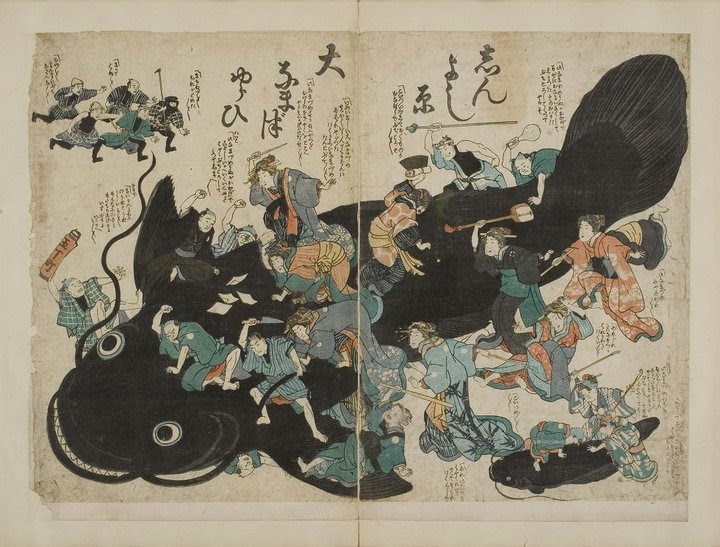
“Since June 2020,” notes Barrett, “our Collections team has worked in tandem with library staff to ingest thousands of digital files from the General Library’s servers, mapping the metadata for over 4,000 priceless scrolls, texts, and papers.” This material has been digitized over decades by Japanese scholars and “showcases hundreds of years of rich Japanese history expressed through prose, poetry, and artwork.” It will be primarily the artwork that concerns non-Japanese speakers, as it primarily concerned 19th-century Europeans and Americans who first encountered the country’s cultural products. Artwork like the humorous print above. Barrett provides context:
In one satirical illustration, thought to date from shortly after the 1855 Edo earthquake, courtesans and others from the demimonde, who suffered greatly in the disaster, are shown beating the giant catfish that was believed to cause earthquakes. The men in the upper left-hand corner represent the construction trades; they are trying to stop the attack on the fish, as rebuilding from earthquakes was a profitable business for them.
There are many such depictions of “seismic destruction” in ukiyo‑e prints dating from the same period and the later Mino-Owari earthquake of 1891: “They are a sobering reminder of the role that natural disasters have played in Japanese life.”
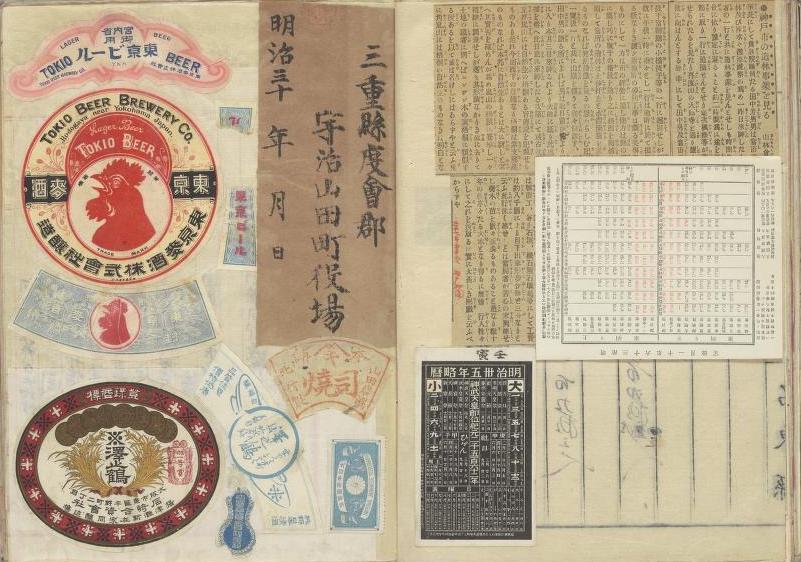
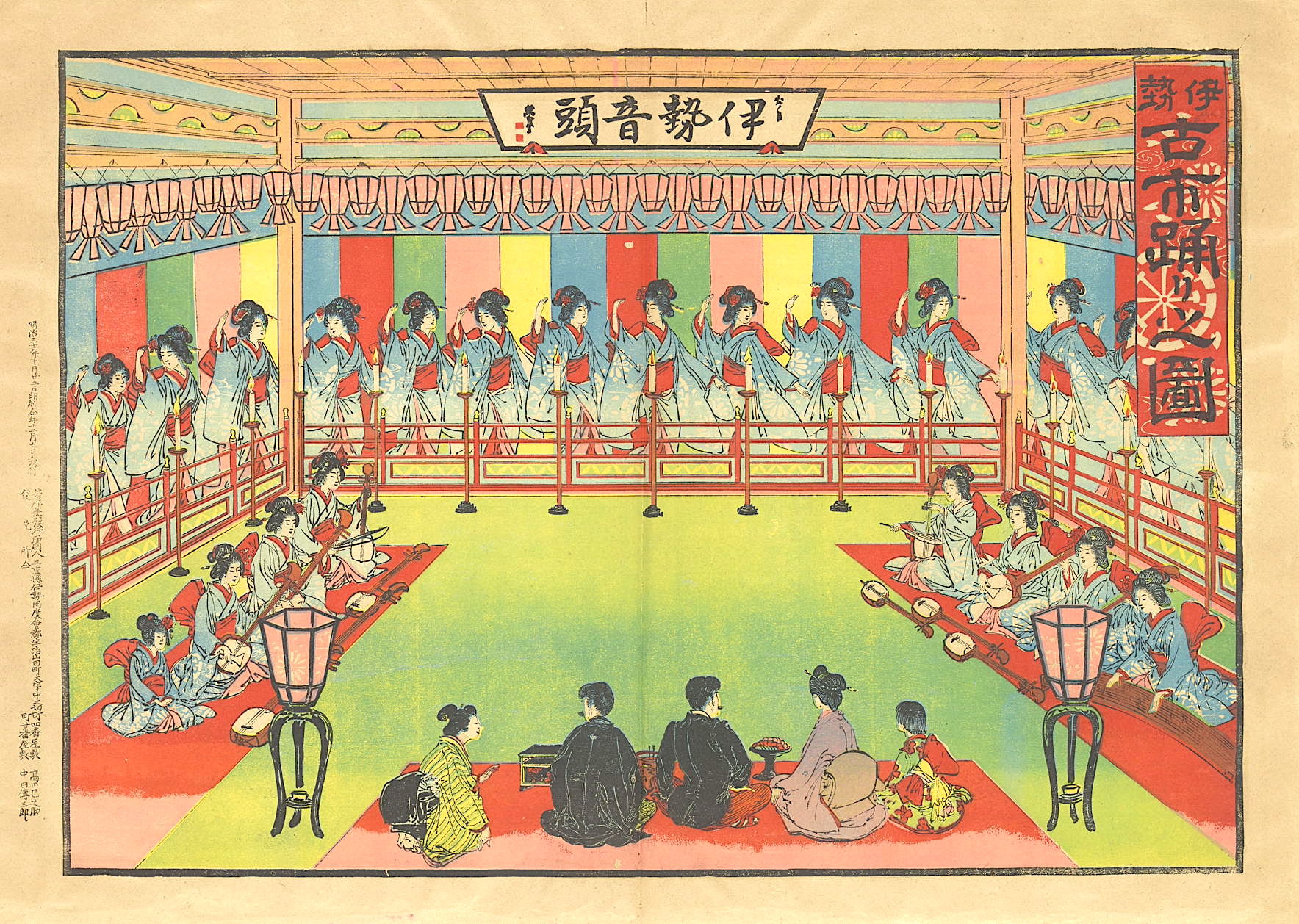
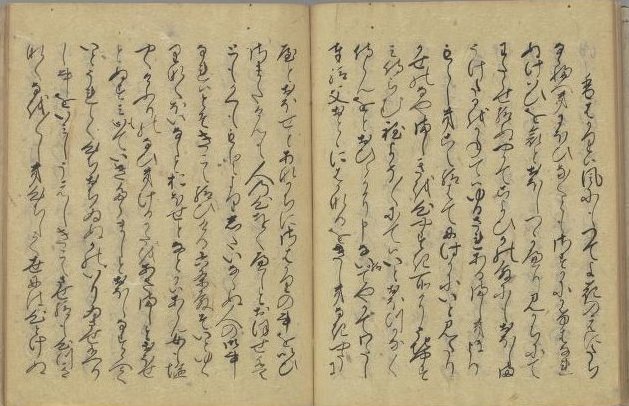
You can see many more digitized artifacts, such as the charming book of Japanese ephemera above, at the Internet Archive’s University of Tokyo collection. Among the 4180 items currently available, you’ll also find many European prints and engravings held in the library’s 25 collections. All of this material “can be used freely without prior permission,” writes the University of Tokyo Library. “Among the highlights,” Barrett writes, “are manuscripts and annotated books from the personal collection of the novelist Mori Ōgai (1862–1922), an early manuscript of the Tale of Genji, [below] and a unique collection of Chinese legal records from the Ming Dynasty.” Enter the collection here.
Related Content:
Watch Vintage Footage of Tokyo, Circa 1910, Get Brought to Life with Artificial Intelligence
Download Classic Japanese Wave and Ripple Designs: A Go-to Guide for Japanese Artists from 1903
Josh Jones is a writer and musician based in Durham, NC. Follow him at @jdmagness
Read More...Support Us
We're hoping to rely on loyal readers, rather than erratic ads. Please click the Donate button and support Open Culture. You can use Paypal, Venmo, Patreon, even Crypto! We thank you!

About Us

Open Culture scours the web for the best educational media. We find the free courses and audio books you need, the language lessons & educational videos you want, and plenty of enlightenment in between.
Advertise With Us
FREE UPDATES!
GET OUR DAILY EMAIL
Get the best cultural and educational resources on the web curated for you in a daily email. We never spam. Unsubscribe at any time.
FOLLOW ON SOCIAL MEDIA
Open Culture editor Dan Colman scours the web for the best educational media. He finds the free courses and audio books you need, the language lessons & movies you want, and plenty of enlightenment in between.
Advertise With Us

