Watch 26 Free Episodes of Jacques Pépin’s TV Show, More Fast Food My Way
You need never endeavor to make any of the recipes world renowned chef Jacques Pépin produced on camera in his 2008 series More Fast Food My Way.
The helpful hints he tosses off during each half hour episode more than justify a viewing.
The menu for the episode titled “The Egg First!,” above, includes Red Pepper Dip, Asparagus Fans with Mustard Sauce, Scallops Grenobloise, Potato Gratin with Cream, and Jam Tartines with Fruit Sherbet so simple, a child could make it (provided they’re set up with good quality poundcake in advance.)
Delicious… especially when prepared by a culinary master Julia Child lauded as “the best chef in America.”
And he’s definitely not stingy with matter-of-fact advice on how to peel asparagus, potatoes and hard boiled egg, grate fresh nutmeg with a knife, and dress up store bought mayo any number of ways.
His recipes (some available online here) are well suited to the current moment. The ingredients aren’t too difficult to procure, and each episode begins with a fast, easy dish that can be explained in a minute, such as Mini Croques-Monsieur, Asian Chicken Livers, or Basil Cheese Dip.
Many of the dishes harken to his childhood in World War II-era Lyon:
When we were kids, before going to school, my two brothers and I would go to the market with my mother in the morning. She had a little restaurant… There was no car, so we walked to the market—about half a mile away—and she bought, on the way back, a case of mushrooms which was getting dark so she knew the guy had to sell it, so she’d try to get it for half price… She didn’t have a refrigerator. She had an ice box: that’s a block of ice in a cabinet. In there she’d have a couple of chickens or meat for the day. It had to be finished at the end of the day because she couldn’t keep it. And the day after we’d go to the market again. So everything was local, everything was fresh, everything was organic. I always say my mother was an organic gardener, but of course, the word ‘organic’ did not exist. But chemical fertilizer did not exist either.
If you have been spending a lot of time by yourself, some of the episode themes may leave a lump in your throat—Dinner Party Special, Game Day Pressure, and Pop Over Anytime, which shows how to draw on pantry staples and convenience foods to “take the stress out of visitors popping in.”
The soon to be 85-year-old Pépin (Happy Birthday December 18, Chef!) spoke to Zagat earlier about the pandemic’s effect on the restaurant industry, how we can support one another, and the beauty of home cooked meals:
People—good chefs—are wondering how they will pay their rent. It is such a terrible feeling to have to let your employees go. In a kitchen, or a restaurant, we are like a family, so it is painful to separate or say goodbye. That said, it is important to be optimistic. This is not going to last forever.
Depending on where you are, perhaps this is a chance to reconnect with the land, with farmers, with the sources of food and cooking. This is a good time to plant a garden. And gardening can be very meditative. Growing food is not just for the food, but this process helps us to reconnect with who we are, why we love food, and why we love cooking. With this time, cook at home. Cook for your neighbor and drop the food off. Please your family and your friends and your own palate with food, for yourself. This is not always easy for a chef with the pressure of running a restaurant. Cooking is therapeutic…
Many people now are beginning to suffer economically. But if you can afford it, order take-out, and buy extra for your neighbors. If you can afford it, leave a very large tip. Think about the servers and dishwashers and cooks that may not be able to pay their rent this month. If you can be more generous than usual, that would be a good idea. We need to do everything we can to keep these restaurants in our communities alive.
…this moment is a reassessment and re-adjustment of our lives. Some good things may come of it. We may have the opportunity to get closer to one another, to sit as a family together at the table, not one or two nights a week, but seven! We may not see our friends, but we may talk on the phone more than before. Certainly, with our wives and children we will be creating new bonds. We will all be cooking more, even me. This may be the opportunity to extend your palate, and to get your kids excited about cooking and cooking with you.
Watch a playlist of Jacques Pépin: More Fast Food My Way (they’re all embedded below) courtesy of KQED Public Television, which has also shared a number of free downloadable recipes from the program here.
Attention last minute holiday shoppers: the companion cookbook would make a lovely gift for the chef in your life (possibly yourself.)
Related Content:
Julia Child Marathon: 201 Episodes of “The French Chef” Streaming Free (for a Limited Time)
Ayun Halliday is an author, illustrator, theater maker and Chief Primatologist of the East Village Inky zine. She most recently appeared as a French Canadian bear who travels to New York City in search of food and meaning in Greg Kotis’ short film, L’Ourse. Follow her @AyunHalliday.
Read More...A Detailed, Track-by-Track Analysis of the Doctor Who Theme Music

Looking for the definitive guide to the original theme music for the long-running BBC science fiction series Doctor Who, composed in 1963 by Ron Grainer and realised by Delia Derbyshire and the BBC Radiophonic Workshop? Good news, there’s a website that provides just that.
According to BoingBoing, the “writers here — Danny Stewart, Ian Stewart, and Josef Kenny — break down the musical score of each track, pointing out cool details I’d never noticed (like the fact that there are two separate bass tracks that form a nifty counterpoint with each other). They include clips of all the individual tracks isolated so you can hear exactly what they’re describing.” Begin exploring here, and find more Doctor Who Theme Music posts in the Relateds right down below.
If you would like to support the mission of Open Culture, consider making a donation to our site. It’s hard to rely 100% on ads, and your contributions will help us continue providing the best free cultural and educational materials to learners everywhere. You can contribute through PayPal, Patreon, and Venmo (@openculture). Thanks!
via BoingBoing
Related Content:
The Fascinating Story of How Delia Derbyshire Created the Original Doctor Who Theme
Two Documentaries Introduce Delia Derbyshire, the Pioneer in Electronic Music
Read More...Study Less, Study Smart: A Longtime Psych Professor Explains How to Study (or Do Any Intellectual Work) Effectively
If you’ve left formal education, you no doubt retain a few good memories from your years as a student. None of them, safe to say, involve studying — assuming you managed to get any studying done in the first place. The unfortunate fact is that few of us ever really come to grips with what it means to study, apart from sitting by oneself with a textbook for hours on end. Despite its obvious inefficiency as a learning method, we’ve all found ourselves doing that kind of “studying” at one time or another. Having taught psychology classes for 40 years, Pierce College professor Marty Lobdell has seen thousands of students laboring, indeed suffering, under similar studying-related assumptions, and in his 8.7‑million-times-viewed talk “Study Less, Study Smart,” he sets out to correct them. He has also dispensed his wisdom in a book by the same title.
Not many of us can get much out of a textbook after a few hours with it, or indeed, after more than about thirty minutes. It’s thus at such an interval that Lobdell suggests taking a regular five-minute break to listen to music, play a game, talk to a friend, meditate — to do anything but study — in order to recharge your ability to focus and head off these diminishing returns of absorption. At the end of each entire study session, you’d do well to schedule a bigger reward in order to reinforce the behavior of engaging in study sessions in the first place. Ideally, you’ll enjoy this reward in a different place than you do your studying, which itself shouldn’t be a room that comes with its own distracting primary use, like the bedroom, kitchen, or living room.
Even if you have a dedicated study area (and better yet, a dedicated study lamp that you turn on only while hitting the books), you won’t get much accomplished there if you rely on simply reading texts over and over again in hopes of eventually memorizing their contents. Lobdell recommends focusing primarily on not facts but the broader concepts that organize those facts. An effective means of checking whether you understand a concept is to try explaining it in your own words: Richard Feynman premised his “notebook technique” for learning, previously featured here on Open Culture, on just such a process. You’ll also want to make use of the notes you take in class, but only if you take them in a useful way, which necessitates a process of expansion and revision immediately after each class.
Lobdell has much more advice to offer throughout the full, hourlong talk. In it he also covers the value of study groups; the more questionable value of highlighting; genuine remembering versus simple recognition; the necessity of a good night’s sleep; the “survey, question, read, recite, review” approach to textbooks; and the usefulness of mnemonics (even, or perhaps especially, silly ones). If you’re a student, you can make use of Lobdell’s techniques right away, and if you once were a student, you may find yourself wishing you’d known about them back then. But properly adapted, they can benefit the intellectual work you do at any stage of life. Never, after all, does concentration become less valuable, and never can we claim to have learned something unless we can first make it understood to others – or indeed, to ourselves.
If you want the cliff notes version of the Study Less, Study Smart lecture, watch the video below:
Related Content:
The “Feynman Technique” for Studying Effectively: An Animated Primer
Richard Feynman’s Technique for Learning Something New: An Animated Introduction
What’s a Scientifically-Proven Way to Improve Your Ability to Learn? Get Out and Exercise
Based in Seoul, Colin Marshall writes and broadcasts on cities, language, and culture. His projects include the Substack newsletter Books on Cities, the book The Stateless City: a Walk through 21st-Century Los Angeles and the video series The City in Cinema. Follow him on Twitter at @colinmarshall, on Facebook, or on Instagram.
Read More...When Italian Futurists Declared War on Pasta (1930)
We must fight against puddles of sauce, disordered heaps of food, and above all, against flabby, anti-virile pastasciutta. —poet Filippo Tommaso Marinetti
Odds are Filippo Tommaso Marinetti, the father of Futurism and a dedicated provocateur, would be crestfallen to discover how closely his most incendiary gastronomical pronouncement aligns with the views of today’s low-carb crusaders.
In denouncing pasta, “that absurd Italian gastronomic religion,” his intention was to shock and criticize the bourgeoisie, not reduce bloat and inflammation.
He did, however, share the popular 21st-century view that heavy pasta meals leave diners feeling equally heavy and lethargic.
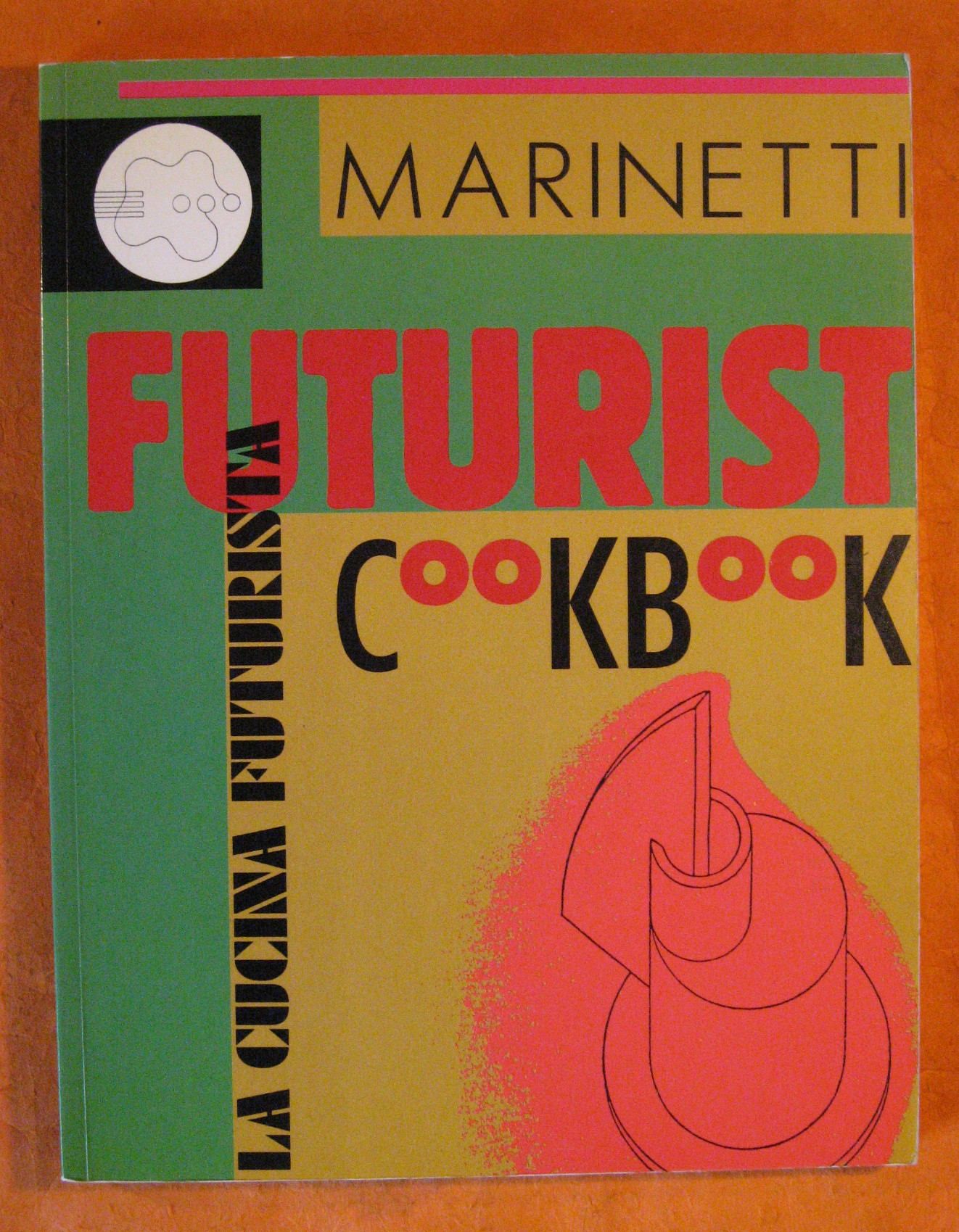
As he declared in 1930 in The Futurist Cookbook:
Futurist cooking will be free of the old obsessions with volume and weight and will have as one of its principles the abolition of pastasciutta. Pastasciutta, however agreeable to the palate, is a passéist food because it makes people heavy, brutish, deludes them into thinking it is nutritious, makes them skeptical, slow, pessimistic… Any pastascuittist who honestly examines his conscience at the moment he ingurgitates his biquotidian pyramid of pasta will find within the gloomy satisfaction of stopping up a black hole. This voracious hole is an incurable sadness of his. He may delude himself, but nothing can fill it. Only a Futurist meal can lift his spirits. And pasta is anti-virile because a heavy, bloated stomach does not encourage physical enthusiasm for a woman, nor favour the possibility of possessing her at any time.
Bombast came naturally to him. While he truly believed in the tenets of Futurism—speed, industry, technology, and the cleansing effects of war, at the expense of tradition and the past—he gloried in hyperbole, absurdity, and showy pranks.
The Futurist Cookbook reflects this, although it does contain actual recipes, with very specific instructions as to how each dish should be served. A sample:
RAW MEAT TORN BY TRUMPET BLASTS: cut a perfect cube of beef. Pass an electric current through it, then marinate it for twenty-four hours in a mixture of rum, cognac and white vermouth. Remove it from the mixture and serve on a bed of red pepper, black pepper and snow. Each mouthful is to be chewed carefully for one minute, and each mouthful is divided from the next by vehement blasts on the trumpet blown by the eater himself.
Intrepid host Trevor Dunseith documents his attempt to stage a faithful Futurist dinner party in the above video.
Guests eat salad with their hands for maximum “pre-labial tactile pleasure” before balancing oranges stuffed with antipasto on their heads to randomize the selection of each mouthful. While not all of the flavors were a hit, the party agreed that the experience was—as intended—totally novel (and 100% pasta free).
Marinetti’s anti-pasta campaign chimed with Prime Minister Benito Mussolini’s goal of eliminating Italy’s economic dependence on foreign markets—the Battle for Grain. Northern farmers could produce ample supplies of rice, but nowhere near the amount of wheat needed to support the populace’s pasta consumption. If Italians couldn’t grow more wheat, Mussolini wanted them to shift from pasta to rice.
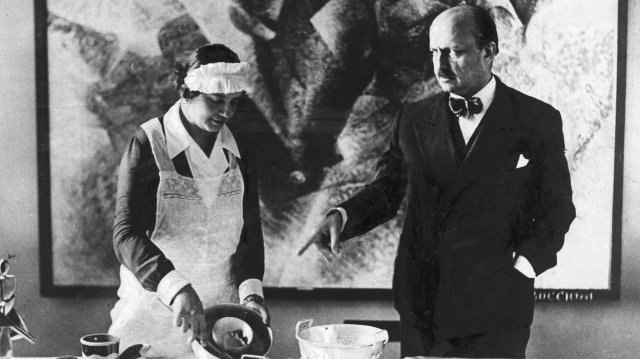
F.T. Marinetti by W. Seldow, 1934
Marinetti agreed that rice would be the “patriotic” choice, but his desired ends were rooted in his own avant-garde art movement:
… it is not just a question of replacing pasta with rice, or of preferring one dish to another, but of inventing new foods. So many mechanical and scientific changes have come into effect in the practical life of mankind that it is also possible to achieve culinary perfection and to organize various tastes, smells and functions, something which until yesterday would have seemed absurd because the general conditions of existence were also different. We must, by continually varying types of food and their combinations, kill off the old, deeply rooted habits of the palate, and prepare men for future chemical foodstuffs. We may even prepare mankind for the not-too-distant possibility of broadcasting nourishing waves over the radio.
Futurism’s ties to fascism are not a thing to brush off lightly, but it’s also important to remember that Marinetti believed it was the artist’s duty to put forward a bold public personae. He lived to ruffle feathers.
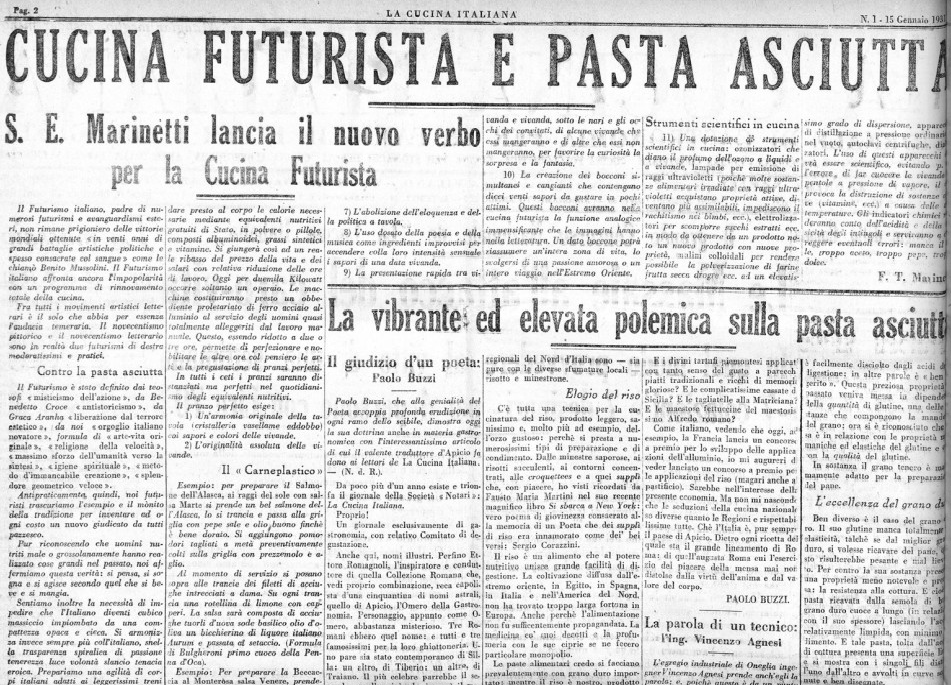
Mission accomplished. His anti-pasta pronouncements resulted in a tumult of public indignation, both locally and in the States.
The Duke of Bovino, mayor of Naples, reacted to Marinetti’s statement that pasta is “completely hostile to the vivacious spirit and passionate, generous, intuitive soul of the Neapolitans” by saying, “The angels in Heaven eat nothing but vermicelli al pomodoro.” Proof, Marinetti sniped back, of “the unappetizing monotony of Paradise and of the life of the Angels.”
He agitated for a futuristic world in which kitchens would be stocked with ”atmospheric and vacuum stills, centrifugal autoclaves (and) dialyzers.”
His recipes, as Trevor Dunseith discovered, function better as one-time performance art than go-to dishes to add to one’s culinary repertoire.
There is a reason why Julia Child’s Coq a Vin and Tarte Tatin endure while Marinetti’s Excited Pig and Black Shirt Snack have fallen into disuse.
Uh… progress?
As Daniel A. Gross writes in the Science History Institute’s Distillations:
Marinetti supported Fascism to the extent that it too advocated progress, but his allegiance eventually wavered. To Marinetti, Roman ruins and Renaissance paintings were not only boring but also antithetical to progress. To Mussolini, by contrast, they were politically useful. The dictator drew on Italian history in his quest to build a new, powerful nation—which also led to a national campaign in food self-sufficiency, encouraging the growing and consumption of such traditional foods as wheat, rice, and grapes. The government even funded research into the nutritional benefits of wheat, with one scientist claiming whole-wheat bread boosted fertility. In short, the prewar dream of futurist food was tabled yet again.
Get your own copy of Filippo Tommaso Marinetti’s The Futurist Cookbook here.
via Mental Floss
Related Content:
Salvador Dalí’s 1973 Cookbook Gets Reissued: Surrealist Art Meets Haute Cuisine
Recipes from the Kitchen of Georgia O’Keeffe
Ayun Halliday is an author, illustrator, theater maker and Chief Primatologist of the East Village Inky zine. See her as a French Canadian bear who travels to New York City in search of food and meaning in Greg Kotis’ short film, L’Ourse. Follow her @AyunHalliday.
Read More...The Art of Traditional Japanese Wood Joinery: A Kyoto Woodworker Shows How Japanese Carpenters Created Wood Structures Without Nails or Glue
Anyone can develop basic woodworking skills — and, per the advice of Nick Offerman, perhaps everyone should. Those who do learn that things of surprising functionality can be made just by cutting pieces of wood and nailing or gluing them together. Fewer, however, have the patience and dedication to master woodworking without nails or glue, an art that in Japan has been refined over many generations. Traditional Japanese carpenters put up entire buildings using wood alone, cutting the pieces in such a way that they fit together as tightly as if they’d grown that way in the first place. Such unforgiving joinery is surely the truest test of woodworking skill: if you don’t do it perfectly, down comes the temple.
“At the end of the 12th century, fine woodworking skills and knowledge were brought into Japan from China,” writes Yamanashi-based woodworker Dylan Iwakuni. “Over time, these joinery skills were refined and passed down, resulting in the fine wood joineries Japan is known for.”
As it became a tradition in Japan, this carpentry developed a canon of joining methods, several of which Iwakuni demonstrates in the video at the top of the post. Can it be a coincidence that these most trustworthy joints — and the others featured on Iwakuni’s joinery playlist, including the seemingly “impossible” shihou kama tsugi — are also so aesthetically pleasing, not just in their creation but their finished appearance?
In addition to his Youtube channel, Iwakuni maintains an Instagram account where he posts photos of joinery not just in the workshop but as employed in the construction and maintenance of real buildings. “Joineries can be used to replace a damaged part,” he writes, “allowing the structure to stand for another hundreds of years.” To do it properly requires not just a painstakingly honed set of skills, but a perpetually sharpened set of tools — in Iwakuni’s case, the visible sharpness of which draws astonished comment from woodworking aficionados around the world. “Blimey,” as one Metafilter user writes, “it’s hard enough getting a knife sharp enough to slice onions.” What an audience Iwakuni could command if he expanded from woodworking Youtube into cooking Youtube, one can only imagine.
Related Content:
See How Traditional Japanese Carpenters Can Build a Whole Building Using No Nails or Screws
20 Mesmerizing Videos of Japanese Artisans Creating Traditional Handicrafts
Based in Seoul, Colin Marshall writes and broadcasts on cities, language, and culture. His projects include the Substack newsletter Books on Cities, the book The Stateless City: a Walk through 21st-Century Los Angeles and the video series The City in Cinema. Follow him on Twitter at @colinmarshall, on Facebook, or on Instagram.
Read More...Buddhist Monk Covers Metallica’s ”Enter Sandman,” Then Meditates
Since the start of the pandemic, we’ve periodically featured Kossan, a Japanese Buddhist monk who has a penchant for singing punk, metal and rock classics, accompanied by gongs, drums and other instruments. In the past, he’s covered the Ramones’ “Teenage Lobotomy,” “Queen’s “We Will Rock You,” and the Beatles’ “Yellow Submarine”–not to mention Judas Priest’s “Breaking the Law.” In his latest clip, Kossan offers a unique take on Metallica’s 1991 classic “Enter Sandman,” then winds down, of course, with a little meditation. Enjoy.
If you would like to support the mission of Open Culture, consider making a donation to our site. It’s hard to rely 100% on ads, and your contributions will help us continue providing the best free cultural and educational materials to learners everywhere. You can contribute through PayPal, Patreon, and Venmo (@openculture). Thanks!
Related Content:
Buddhist Monk Covers Judas Priest’s “Breaking the Law,” Then Breaks Into Meditation
Meditation for Beginners: Buddhist Monks & Teachers Explain the Basics
Read More...Jimi Hendrix’s Home Audio System & Record Collection Gets Recreated in His London Flat
A visit to William Faulkner’s house once convinced me I’d seen his ghost. Millions of people commune with Elvis’s spirit at Graceland each year. Some lucky person will end up with Toni Morrison’s personal library, and maybe also her Tribeca condo. No matter how well we think we know a favorite artist, there’s nothing like connecting with the spaces and things they left behind. Since 2016, Jimi Hendrix devotees have been able to make a pilgrimage to the London apartment he shared with his girlfriend, Kathy Etchingham, between 1968 and 1969.
The flat on 23 Brook Street has been set up the way it was when Hendrix lived there, thanks to Handel & Hendrix in London, who also maintain the house of George Frideric Handel just next door. The only other connection between the two artists is Hendrix’s ownership of two copies of Handel’s Messiah, “both of which show signs of wear and tear,” the foundation notes, and “which would have been uncanny listening so near to where it was composed.” Jimi tastefully decorated the apartment to his tastes, and told Etchingham it was “my first real home of my own.”
Hendrix’s home was made complete by a 100-plus collection of LPs and a high-end audio system that has recently been recreated in collaboration with the makers of the original components: Bang & Olufsen, Lowther, and LEAK supply the same or similar models of turntable, speaker, and amplifier, respectively, on which Jimi listened to Handel next door to the ghost of Handel. Hearing those records in Jimi’s space, the way he heard them, says Nabihah Iqbal in a video that debuted on Hendrix’s birthday, November 27th, is “a time-traveling experience.”
Iqbal chooses her favorites from the collection—Bob Dylan, Ravi Shankar, Muddy Waters, Django Reinhardt—discussing them as they quietly play in the background. For the full Hendrix experience, we’d need to crank the vintage amplifier to 11. He liked to listen loud. Etchingham “recalled that they had to ‘stick a ha’penny with sellotape onto the turntable arm… otherwise it would jump up and down the louder it got.” He would occasionally blow the reinforced speakers during parties and have to take them in for repair.
The flat also functioned as a composition room, and Hendrix’s friends stopped by to jam. (Richie Havens debuted his “anti-war anthem ‘Handsome Johnny’ to a small party in the flat on Hendrix’s Epiphone acoustic guitar.”) Handel & Hendrix in London have revived the practice with their Hendrix Flat Sessions, inviting musicians to play in the space. Above, Marcus Machado talks about what Hendrix means to him and jams a version of “Voodoo Child (Slight Return)” while sitting on Hendrix’s bed.
See several more Hendrix Flat Sessions here. The records in Hendrix’s collection “cover blues, jazz, folk, rock, psychedelia and even a handful of classical LPs.” See Iqbal’s selections, with annotations from Handel & Hendrix in London, here. The Hendrix Flat is currently open to the public on Saturdays.
Related Content:
How Science Fiction Formed Jimi Hendrix
Behold Moebius’ Many Psychedelic Illustrations of Jimi Hendrix
Josh Jones is a writer and musician based in Durham, NC. Follow him at @jdmagness
Read More...Comic Book Writer Fred Van Lente Touts “Comic Supremacy” on Pretty Much Pop: A Culture Podcast #72

Fred Van Lente has written for more than 15 years for his own Evil Twin Comics, Marvel and other outlets. In this episode of Pretty Much Pop, he joins your hosts Mark Linsenmayer, Erica Spyres, and Brian Hirt to discuss comics as an idiosyncratic form of literature.
In the realm of non-fiction, Ryan started with the beloved Action Philosophers! series in 2004 with illustrator Ryan Dunlavey, and this team has gone on to create the very successful Comic Book History of Comics, plus more recently Action Presidents, Action Activists (available free in association with the NYC Department of Education’s Civics for All program), and have just begun releasing The Comic Book History of Animation. While the non-fiction comics format is common in places like Japan, and has a storied history in America, having been used to train soldiers in World War II, this is still something of a novelty in America as comics still struggle to overcome their reputation in (as Ryan puts it) “trash for morons.” Given that visual content is well known to help people learn as compared to text alone, the use of tools like Action Presidents in classrooms shouldn’t be surprising.
The interview also gets into Ryan’s fiction work, from Cowboys & Aliens, which was turned into a 2011 Jon Favreau/Steven Spielberg film entirely without Ryan’s involvement, to titles like Marvel Zombies and X‑Men Noir which use alternate dimension versions of popular characters to tell stories too dark and/or whimsical to have much possibility of ever being transferred to the screen. Despite comics’ reputation as being basically like elaborate film story-boards, their low overhead is exactly what distinguishes them so strongly from film: Their creativity is unlimited by budget, and creators can take tremendous risks. Whatever the mainstream palatability of (alternate dimension) Peter Parker eating Aunt May’s brain, this has been one of the most popular things that Ryan’s been involved with among comic book readers.
Learn more about Fred’s work at fredvanlente.com. You can read there about how Fred constructs scripts; the one Mark refers to with the mysteriously changed coat is right there highlighted at the top of this page, and there are also several sample scripts including the one for Action Philosophers: Immanuel Kant that demonstrates Fred’s methods for vividly explaining a complex idea.
Hear more of this podcast at prettymuchpop.com. This episode includes bonus discussion you can access by supporting the podcast at patreon.com/prettymuchpop. This podcast is part of the Partially Examined Life podcast network.
Pretty Much Pop: A Culture Podcast is the first podcast curated by Open Culture. Browse all Pretty Much Pop posts.
Read More...Are You Happy, David Lynch?
Filmmaker David Lynch answers a basic life question from Mary Anne Hobbs, BBC Radio 6 DJ, during a fan Q&A. The accompanying video apparently comes from The Art Life documentary trailer.
The source of Lynch’s happiness? Most likely meditation. Find more on that below.
Related Content:
David Lynch Visualizes How Transcendental Meditation Works with Sharpie & Big Pad of Paper
David Lynch Muses About the Magic of Cinema & Meditation in a New Abstract Short Film
David Lynch Creates a Very Surreal Plug for Transcendental Meditation
An Animated David Lynch Explains Where He Gets His Ideas
Read More...Don’t Think Twice: A Poignant Film Documents How Bob Dylan & The Beatles Bring Joy to a Dementia Patient
It’s often said the sense of smell is most closely connected to long-term memory. The news offers little comfort to us forgetful people with a diminished sense of smell. But increasingly, neuroscientists are discovering how sound can also tap directly into our deepest memories. Patients with Alzheimer’s and dementia seem to come alive, becoming their old selves when they hear music they recognize, especially if they were musicians or dancers in a former life.
“Sound is evolutionarily ancient,” Nina Kraus, a neuroscientist at Northwestern University, tells NPR. “It is deeply, deeply rooted in our nervous system. So the memories that we make, the sound-to-meaning connections that we have and that we’ve made throughout our lives are always there. And it’s a matter of being able to access them.” The earworms we find ourselves humming all day; the songs we never forget how to sing… these are keys to a storehouse of memory.
Stories documenting dementia patients in the presence of music usually focus, understandably, on those who have lost brain function due to old age. In “Don’t Think Twice,” the short documentary above, we meet John Fudge, who sustained a traumatic brain injury when he fell from the white cliffs of Dover and split his head open at 24 years old. “The extent of his injuries weren’t revealed,” writes Aeon, “until decades later, when doctors decided to perform a brain scan after John slipped into a deep depression.”
He was found to have extensive brain damage, “including a progressive form of dementia” called Semantic Dementia that leaves sufferers aware of their deterioration while being unable to express themselves. John’s wife Geraldine “compares his brain to an oak tree, its limbs of knowledge being slowly trimmed away, causing John great mental anguish.” In the short film, however, we see how “his musical abilities” are one “as-yet untrimmed branch.”
John himself explains how he “nearly died three times” and Geraldine assists with her observations of his experience. “It’s all there,” she says, “it’s just bits of it have sort of been blanked out…. Over the years, John’s semantic understanding of the world will deteriorate.” When a young volunteer named Jon from the Hackney Befriending Service stops by, the gloom lifts as John engages his old passion for playing songs by the Beatles and Bob Dylan.
Follow the moving story of how John and Jon became fast friends and excellent harmonizers and see more inspiring stories of how music can change Alzheimer’s and dementia patients’ lives for the better at the links below.
Related Content:
How Music Can Awaken Patients with Alzheimer’s and Dementia
Dementia Patients Find Some Eternal Youth in the Sounds of AC/DC
Former Ballerina with Dementia Gracefully Comes Alive to Tchaikovsky’s Swan Lake
Josh Jones is a writer and musician based in Washington, DC. Follow him @jdmagness
Read More...Support Us
We're hoping to rely on loyal readers, rather than erratic ads. Please click the Donate button and support Open Culture. You can use Paypal, Venmo, Patreon, even Crypto! We thank you!

About Us

Open Culture scours the web for the best educational media. We find the free courses and audio books you need, the language lessons & educational videos you want, and plenty of enlightenment in between.
Advertise With Us
FREE UPDATES!
GET OUR DAILY EMAIL
Get the best cultural and educational resources on the web curated for you in a daily email. We never spam. Unsubscribe at any time.
FOLLOW ON SOCIAL MEDIA
Open Culture editor Dan Colman scours the web for the best educational media. He finds the free courses and audio books you need, the language lessons & movies you want, and plenty of enlightenment in between.
Advertise With Us

