A Biostatistician Uses Crochet to Visualize the Frightening Infection Rates of the Coronavirus
Chances are you’ve looked at more graphs this past year than you did over the previous decade — not just while working at home, but while scrolling through cascades of often-troubling quantitative information during your “off” hours as well. This phenomenon has hardly been limited to the Americans who obsessed over the predictions of and returns from their presidential election last month, an event turned practically into a sideshow by the ongoing pandemic. Around the world, we’ve all wanted to know: Where did the coronavirus come from? What is it? Where is it going?
Apologies to Paul Gauguin, who didn’t even live to see the Spanish flu of 1918, a time when nobody could have imagined instantaneously and widely sharing visual renderings of data about that disease. The world of a century ago may not have had dynamic animated maps and charts, updated in real time, but it did have crochet. Whether or not it had then occurred to anyone as a viable medium for visualizing the spread of disease, it can be convincing today. This is demonstrated by Norwegian biostatistician Kathrine Frey Frøslie, who in the video above shows us her crocheted representations of various “R numbers.”
This now much-heard term, Frøslie’s explains, “denotes reproduction. If the R number is one, this means that each infected person will on average infect one new person during the course of the disease. If R equals two, each infected person will infect two persons,” and so on. Her crocheted version of R=1, with a population of ten, is small and narrow — it looks, in other words, entirely manageable. Such a disease “will always be always present, but the number of infected persons will be constant.” Her R=0.9, which steadily narrows in a way that resembles an unfinished Christmas stocking, looks even less threatening.
Alas, “for the coronavirus, the R is mostly larger than one.” In crocheted form, even R=1.1 is pretty formidable; when she brings out her R=1.5, “it is evident that we have a problem. Even the crochet patch kind of crumbles.” Then out comes R=2, which must have been quite a project: its ten original infections bloom into 2,560 new cases, all represented in almost organically dense folds of yarn. As for R=2.5, when Frøslie eventually gets it hoisted onto her lap, you’ll have to see it to believe it. Throughout 2020, of course, many of our at-home hobbies have grown to monstrous proportions — even those taken up by medical scientists.
via Metafilter
Related Content:
Simulating an Epidemic: Using Data to Show How Diseases Like COVID-19 Spread
Everything You Need To Know About Viruses: A Quick Visual Explanation of Viruses in 9 Images
The History of the Plague: Every Major Epidemic in an Animated Map
An Artist Crochets a Life-Size, Anatomically-Correct Skeleton, Complete with Organs
The Beautiful Math of Coral & Crochet
Based in Seoul, Colin Marshall writes and broadcasts on cities, language, and culture. His projects include the Substack newsletter Books on Cities, the book The Stateless City: a Walk through 21st-Century Los Angeles and the video series The City in Cinema. Follow him on Twitter at @colinmarshall, on Facebook, or on Instagram.
Read More...The Map of Doom: A Data-Driven Visualization of the Biggest Threats to Humanity, Ranked from Likely to Unlikely
Surely you’ve learned, as I have, to filter out the constant threats of doom. It’s impossible to function on high alert all of the time. But one must stay at least minimally informed. To check the news even once a day is to encounter headline after headline announcing DOOM IS COMING! Say that we’re all desensitized, and rather than react, we evaluate: In what way will doom arrive? How bad will the doom be? There are many competing theories of doom. Which one is most likely, and how can we understand them in relation to each other?
For this level of analysis, we might turn to Dominic Walliman, physicist and proprietor of Domain of Science, the YouTube channel and website that has brought us entertaining and comprehensive maps of several scientific fields, such as biology, chemistry, mathematics, computer science, and quantum physics. Is ranking apocalypses a scientific field of study, you might wonder? Yes, when it is a data-driven threat assessment. Walliman surveyed and analyzed, as he says in his introduction, “all of the different threats to humanity that exist.”

When the pandemic hit last winter, “we as a society were completely unprepared for it,” despite the fact that experts had been warning us for decades that exactly such a threat was high on the scale of likelihood. Are we focusing on the wrong kinds of doom, to the exclusion of more pressing threats? Instead of panicking when the coronavirus hit, Walliman cooly wondered what else might be lurking around the corner. “Crikey,” says the New Zealander upon the first reveal of his Map of Doom, “there’s quite a lot aren’t there?”
Not content to just collect disasters (and draw them as if they were all happening at the same time), Walliman also wanted to find out which ones pose the biggest threat, “using some real data.” After the Map of Doom comes the Chart of Doom, an XY grid plotting the likelihood and severity of various crises. These include ancient stalwarts like super volcanoes; far more recent threats like nuclear war and catastrophic climate change; cosmic threats like asteroids and collapsing stars; terrestrial threats like widespread societal collapse and extra-terrestrial threats like hostile aliens….

At the top of the graph, at the limit of “high likelihood,” there lies the “already happening zone,” including, of course, COVID-19, climate change, and volatile extreme weather events like hurricanes and tsunamis. At the bottom, in the “impossible to calculate” zone, we find sci-fi events like rogue AI, rogue black holes, rogue nano-bots, hostile aliens, and the collapse of the vacuum of space. All theoretically possible, but in Walliman’s analysis mostly unlikely to occur. As in all of his maps, he cites his sources on the video’s YouTube page.
If you’re not feeling quite up to a data presentation on mass casualty events just now, you can download the Map and Chart of Doom here and peruse them at your leisure. Pick up a Map of Doom for the wall at Walliman’s site, and while you’re there, why not buy an “I survived 2020” sticker. Maybe it’s premature, and maybe in poor taste. And maybe in times of doom we need someone to face the facts of doom squarely, turn them into cartoon infographics of doom, and claim victories like living through another calendar year.
Related Content:
M.I.T. Computer Program Alarmingly Predicts in 1973 That Civilization Will End by 2040
In 1704, Isaac Newton Predicts the World Will End in 2060
Josh Jones is a writer and musician based in Durham, NC. Follow him at @jdmagness
Read More...The Hertella Coffee Machine Mounted on a Volkswagen Dashboard (1959): The Most European Car Accessory Ever Made

Current auto-industry wisdom holds that no car without cup holders will sell in America. Though this also seems to have become increasingly true across the rest of the world, I like to imagine there still exists a country or two whose driving public holds fast against that particular design vulgarism. Such places would, of course, lie deep in unreconstructed Europe, where nobody can go long without coffee. The solution? The Hertella Auto Kaffeemachine, the first and only known dashboard-mounted coffee maker.
Manufactured specifically for the Volkswagen Beetle, this highly civilized automobile accessory has, 60 years after its introduction, nearly vanished from existence. Judging by the few known examples, it never had the time to evolve past its technical shortcomings. For one, it lacks a power switch: “As soon as you plug it into the cigarette lighter, it just gets hot,” writes The Drive’s Peter Holderith. “And as far as the type of coffee machine that it is, well, you would have to be pretty desperate for caffeine to make coffee in this thing.”
“I always thought they were a percolator, or espresso machine like a Moka… but nope,” says Dave Hord of Classic Car Adventures, who purchased his own Hertella Auto Kaffeemachine from an owner in Serbia. It seems “you fill the vessel with water, put your coffee in the (double layer) screen, and heat up the unit. I presume you heat the unit up with the coffee in it, which means this basically brews coffee as though it’s tea.” Perhaps only a transcontinental road-tripper in 1959 would grow desperate enough to drink it.
Still, as Holderith notes, “the machine does have a few clever features. The porcelain cups that came with it apparently had a metal disc on the bottom of them that allowed them to stick to the machine magnetically” and the unit itself “mounts to the dash with a simple bracket, allowing for the pot to quickly be removed and cleaned when necessary.” Perhaps today’s car designers, a group once again looking to the past for inspiration, will resume the pursuit of dashboard brewing begun by the Hertella Auto Kaffeemachine. If not, Wes Anderson can surely find a use for the thing.
Related Content:
The Coffee Pot That Fueled Honoré de Balzac’s Coffee Addiction
Wake Up & Smell the Coffee: The New All-in-One Coffee-Maker/Alarm Clock is Finally Here!
The Timeless Beauty of the Citroën DS, the Car Mythologized by Roland Barthes (1957)
178,000 Images Documenting the History of the Car Now Available on a New Stanford Web Site
10 Essential Tips for Making Great Coffee at Home
Based in Seoul, Colin Marshall writes and broadcasts on cities, language, and culture. His projects include the Substack newsletter Books on Cities, the book The Stateless City: a Walk through 21st-Century Los Angeles and the video series The City in Cinema. Follow him on Twitter at @colinmarshall, on Facebook, or on Instagram.
Read More...Marina Abramović’s Method for Overcoming Trauma: Go to a Park, Hug a Tree Tight, and Tell It Your Complaints for 15 Minutes
One of the most renowned of Chinese poets, Du Fu, survived the devastating An Lushan rebellion that nearly brought down the Tang Dynasty and resulted in an incredible loss of life around the country. His poems are full of grief, as translator David Hinton notes. The opening of “Spring Landscape” contains “possibly the most famous line in Chinese poetry,” and a painful comment on humanity’s place in the natural world.
The country in ruins, rivers and mountains
continue. The city grows lush with spring.Blossoms scatter tears for us, and all these
separations in a bird’s cry startle the heart.
The poem presents a tragic irony. Nature invites us in, seems to promise comfort and refuge. “Du Fu tells us that birds seem to cry for us, and blossoms weep,” writes Madeleine Thien at The New York Review of Books. But “of course, this is a fairy-tale view, and ‘in the knowledge of its falsity, heartbreaking.’”
Is nature indifferent to human suffering? It would seem so to the broken-hearted Confucian poet. But nature is not devoid of fellow feeling. Trees talk to each other, create social worlds and families, and communicate with the other plants and animals around them. Japanese researchers have shown that the oils trees secrete can measurably lower stress levels, reduce hostility and depression, and boost immunity. Trees may not weep, but they care.
Trees are also, says performance artist Marina Abramović in the short video above, “perfectly silent listeners”—a rare and valuable quality in times of stress. “They have intelligence. They have feelings.” And for this reason, a tree is the ideal companion when we need an ear.
You can complain to them. And I started this a long time ago when I was in the Amazon with the native Indians. You know, they will go to the Sequoia tree, which is one of the oldest on the planet. And they will make a dance for the tree. These dances for the tree are so incredibly moving an emotional. So I thought, Wow! Why don’t I create an exercise that really works for me?
Abramović’s tree therapy is one part of her “Abramović Method,” notes Paper, “a set of techniques that enables artists to get to higher states of consciousness.” She recommends it for anyone who’s reeling from the traumas of this year. In our own age of devastation and isolation, it certainly couldn’t hurt, and perhaps we know more than Du Fu did about how nature supports our emotional lives.
So “please, go to the park near you,” the artist implores. “Pick the tree you like. Hold the tree tight. Really tight. And just pour your heart into it. Complain to the tree for a minimum of 15 minutes. It’s the best healing that you can do.” Included in the video is a testimonial from an ex-rugby player, who found the Complaining to Trees method transformative. “There is something in it,” he says. “It’s almost like you become part of the tree as well.” Trees are not people. They don’t dispense advice. They listen and console in their own mysteriously ancient, silent way.
Related Content:
Josh Jones is a writer and musician based in Durham, NC. Follow him at @jdmagness
Read More...Why Butt Trumpets & Other Bizarre Images Appeared in Illuminated Medieval Manuscripts
In illuminated manuscripts, Medieval Europe can seem more like Monty Python and the Holy Grail than the grim tales of grey-faced, mildewed kings, monks, knights, and peasants turned out by the Hollywood dozen. Yes, life could be brutal, bloody, disease-ridden, but it could also be absurdist and unintentionally hilarious, qualities that reach their apex in the weirdness of Hieronymus Bosch’s “painful, horrible” musical instruments in his Garden of Earthly Delights.
While Bosch painted his nightmarish cacophonies, Medieval scribes’ cats peed and left inky footprints on 15th century manuscripts, within whose illustrated pages, rabbits play church organs, valiant knights do battle with giant snails, and a naked man blows a trumpet with his rear end (a precursor to the man in Bosch’s painting with a flute stuck in his rear.) “These bizarre images,” TED Ed notes, “painted with squirrel-hair brushes on vellum or parchment by monks, nuns, and urban craftspeople, populate the margins of the most prized books from the Middle Ages.”
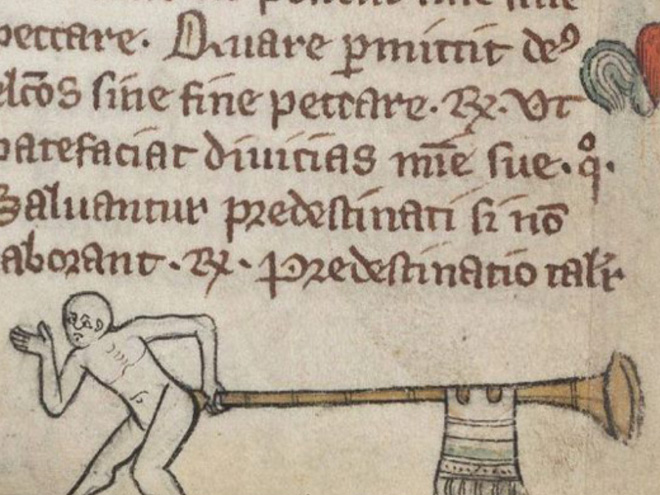
The animated video lesson at the top by Michelle Brown “explores the rich history and tradition of illuminated manuscripts” in their eccentricity and seeming silliness. The animal motifs in marginal illustrations were neither aimless doodles nor inside jokes. They were allegorical figures descended from the menageries of Medieval bestiaries, repeated thematically to represent human vices and virtues. Rabbits, for example, represented lust, and their music-making was a virtuous sublimation of the same.
These associations weren’t always so clear, especially when they were explicitly religious. The porcupine picking fruit from its spine could represent either devil or savior, depending on context. The unicorn, which can only be killed with its head in the lap of a virgin, might stand for sexual temptation or the sacrifice of Christ. But the few readers in this manuscript culture would have recognized the references and allusions, although, like all signs, the illustrations communicate several different, even contradictory, meanings at once.

And what of the butt trumpet? It is “likely shorthand to express disapproval with, or add an ironic spin to, the action in the text.” The butt trumpet, ladies and gentlemen, is as advertised: that most venerable of expressions, the fart joke, to which there is no witty reply and which—as scatological humor can do—might be slyly subversive political critique. Literate or not, Medieval Europeans spoke a language of symbols that stood in for whole folk traditions and theologies. The butt trumpet, however, is just objectively, crudely funny, probably as much to the artists who drew them as to those of us, hundreds of years later, encountering them for the first time. See several more examples here and learn more about Medieval and Renaissance manuscripts here.
Related Content:
Why Knights Fought Snails in Illuminated Medieval Manuscripts
Josh Jones is a writer and musician based in Durham, NC. Follow him at @jdmagness
Read More...Why Japan Has the Oldest Businesses in the World?: Hōshi, a 1300-Year-Old Hotel, Offers Clues
Perhaps, when the state of the world once again permits reasonably convenient travel, you plan to visit Japan. If so, you’d do well to consider staying at one of the country’s ryokan, the traditional inns often located at hot springs. No accommodations could appeal more deeply to those in search of “old Japan,” and many ryokan deliver on that adjective in the most literal sense. Take the Nisiyama Onsen Keiunkan, whose 1300 years of operation at its hot spring in Yamanashi Prefecture make it the oldest hotel in the world. But it has yet to get the documentary treatment by Fritz Schumann, a German filmmaker with an eye for Japan previously featured here on Open Culture for his video on the “mountain monks” of Yamagata.
Schumann has, however, made a subject of the second-oldest hotel in the world, Komatsu’s Hōshi ryokan, founded in the year 718. That Japan boasts both the word’s oldest and second-oldest hotels should surprise nobody who knows the nature of its businesses. “The country is home to more than 33,000 with at least 100 years of history — over 40 percent of the world’s total, according to a study by the Tokyo-based Research Institute of Centennial Management,” write The New York Times’ Ben Dooley and Hisako Ueno.
“Over 3,100 have been running for at least two centuries. Around 140 have existed for more than 500 years. And at least 19 claim to have been continuously operating since the first millennium.” These shinise, or “old shops,” include brands like Nintendo, founded as a playing-card company, and soy-sauce maker Kikkoman.
Dooley and Uneo highlight Ichiwa, a shop that has sold mochi — those slightly sweet rice-based confections often molded into aesthetically pleasing shapes — for over a millennium. “Like many businesses in Japan,” Ichiwa “takes the long view — albeit longer than most. By putting tradition and stability over profit and growth, Ichiwa has weathered wars, plagues, natural disasters, and the rise and fall of empires. Through it all, its rice flour cakes have remained the same.” At BBC’s Worklife, Bryan Lufkin examines Tsuen Tea, a fixture of suburban Kyoto since the year 1160, back when Kyoto was still Japan’s capital, a history that grants the city pride of place among traditionalists. There, writes Lufkin, “many long-standing businesses also tout a dedication to good customer service as an element that keeps them thriving.”
In Kyoto, or anywhere else in Japan, this is “especially the case with ryokan,” which “treat guests like family.” Like many things Japanese, this aspect of the ryokan experience will both surprise first-time visitors and be just what they expected. Whether in their look and feel, their settings, their standard of service — or rather, in a combination of all those qualities and others besides — ryokan offer something available nowhere else in the world. So do Japan’s other shinise, which also set themselves apart by having amassed the resources (financial, familial, and otherwise) to keep going through hard times. This past year has been another such hard time, and with the ongoing pandemic still causing a great deal of human and economic damage around the world, we might look to Hōshi and its long-lived kind for lessons on how do to business in the future.
Related Content:
How Soy Sauce Has Been Made in Japan for Over 220 Years: An Inside View
Discover the Japanese Museum Dedicated to Collecting Rocks That Look Like Human Faces
Wabi-Sabi: A Short Film on the Beauty of Traditional Japan
20 Mesmerizing Videos of Japanese Artisans Creating Traditional Handicrafts
Based in Seoul, Colin Marshall writes and broadcasts on cities, language, and culture. His projects include the Substack newsletter Books on Cities, the book The Stateless City: a Walk through 21st-Century Los Angeles and the video series The City in Cinema. Follow him on Twitter at @colinmarshall, on Facebook, or on Instagram.
Read More...Behold the Steampunk Home Exercise Machines from the Victorian Age
The pandemic has resulted in a lot of people reinventing their fitness regimens, investing in pricey items like Mirror and Peloton bikes to turn homes into home gyms.
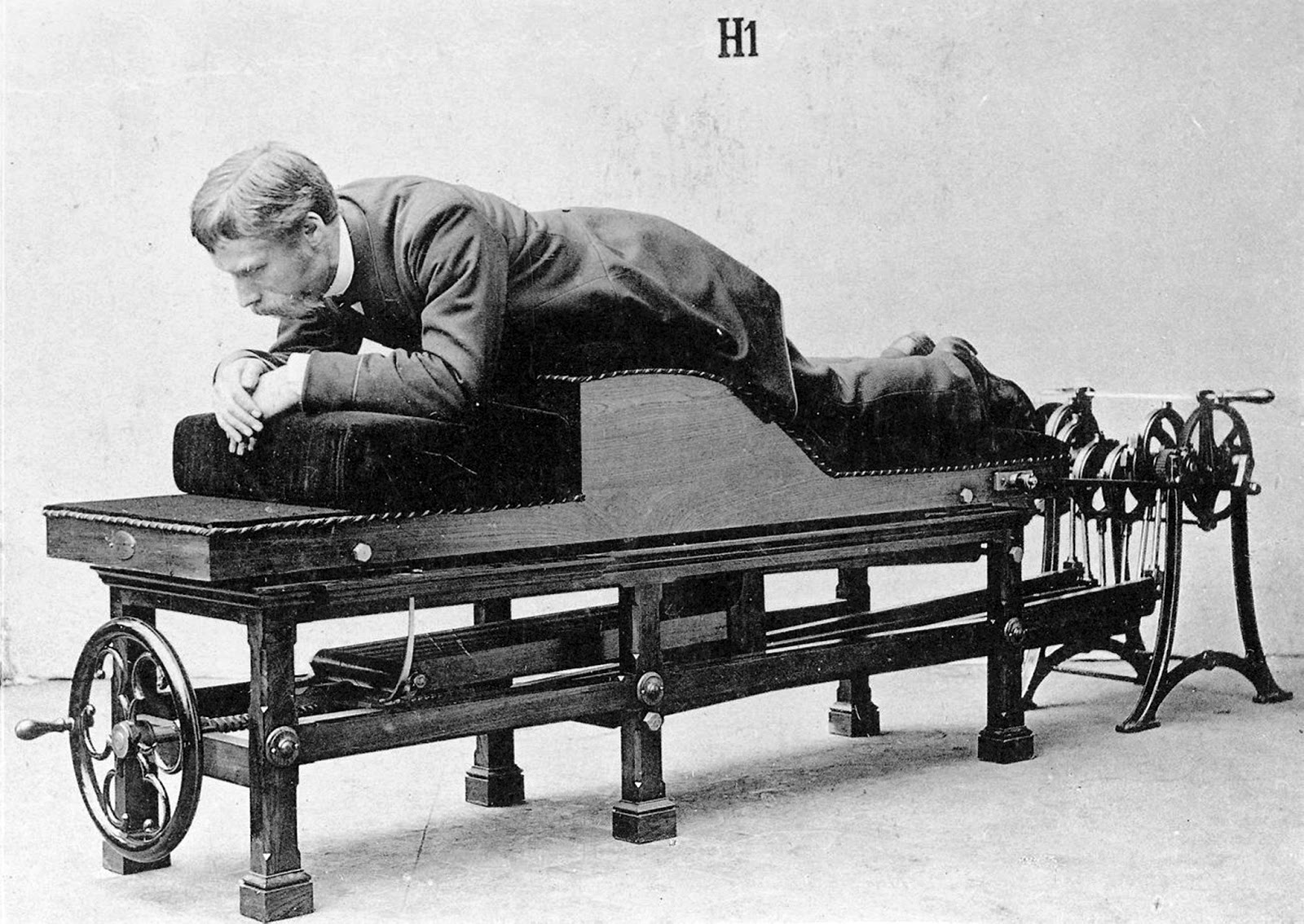
Personally, we’re saving our pennies until some Etsy seller replicates the mechanical therapy systems of Dr. Gustav Zander (1835–1920).

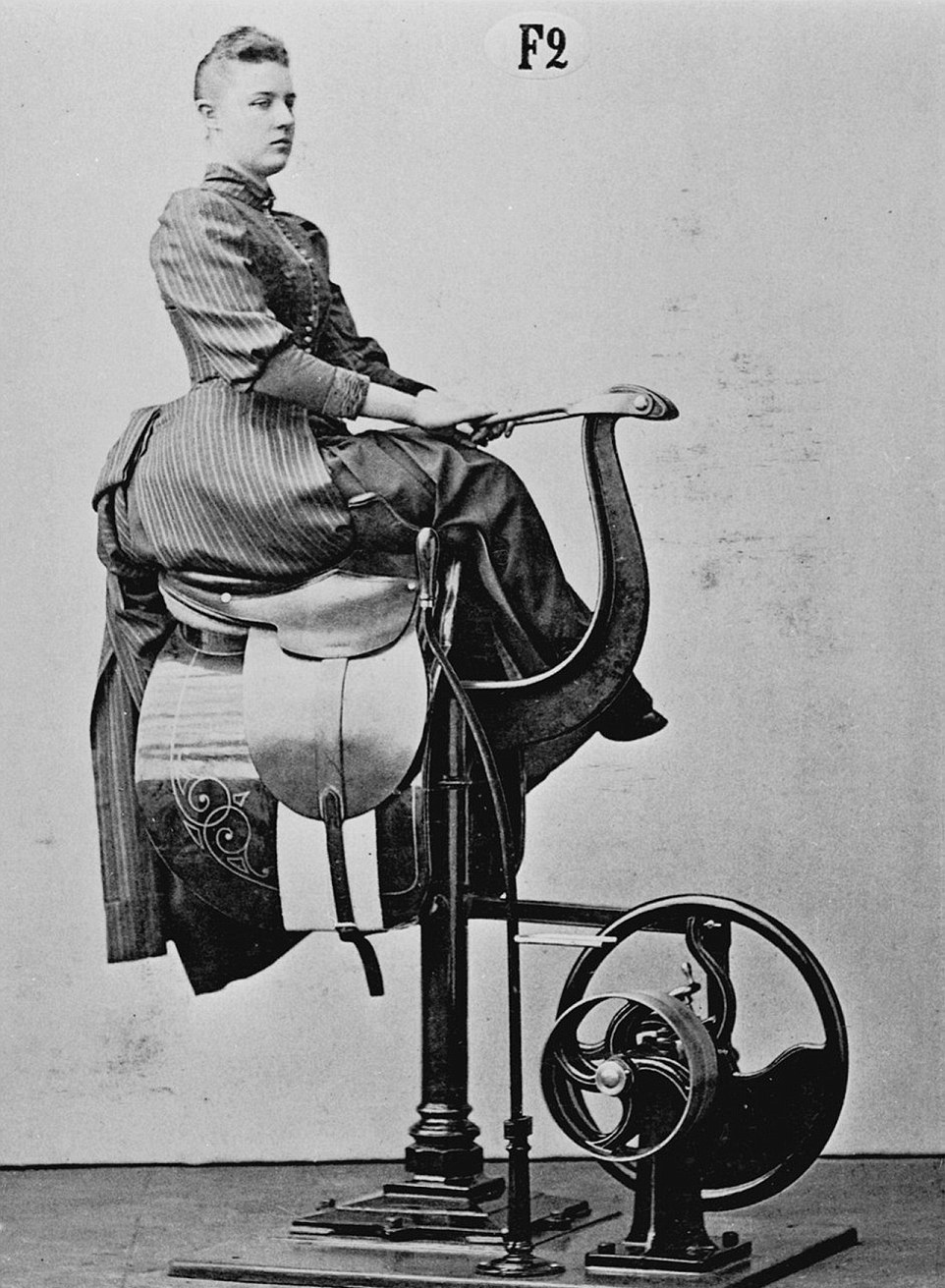
From the mid-19th century through WWI, these machines were at the forefront of gym culture. Their function is extremely similar to modern strength training equipment, but their design exudes a dashing steampunk flair.
If the thing that’s going to help us work off all this sourdough weight is going to wind up colonizing half our apartment, we want something that will go with our maximalist thrift store aesthetic.
We might even start working out in floor length skirts and three piece suits in homage to Zander’s original devotees.
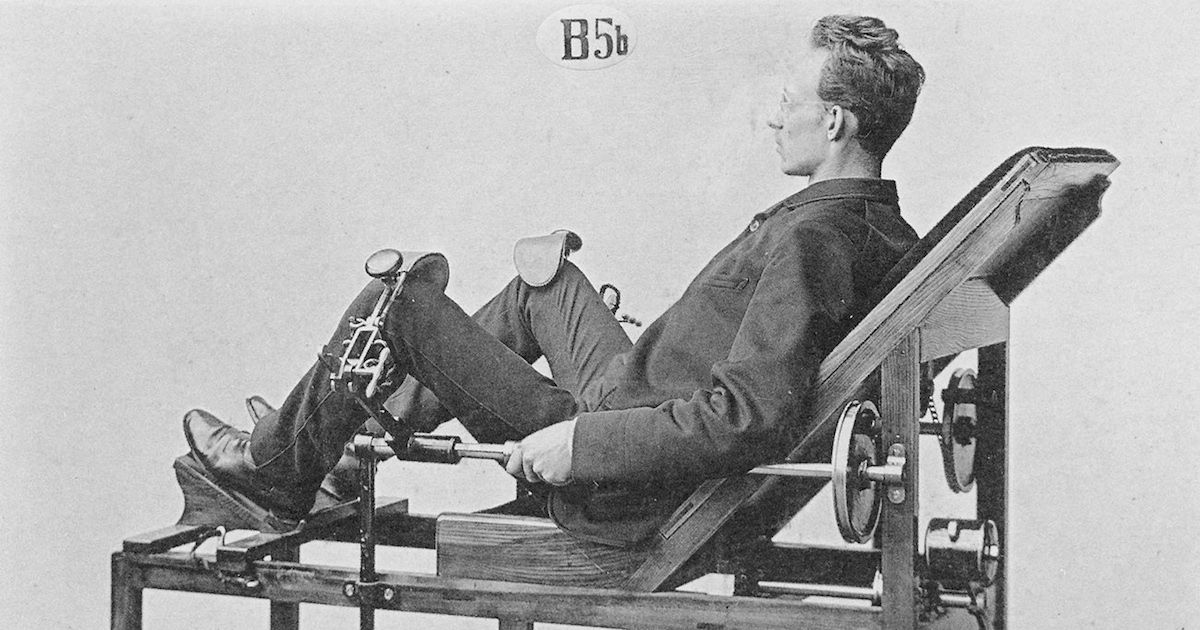
His 27 machines addressed abs, arms, adductors—all the greatest hits—using weights and levers to strengthen muscles through progressive exertion and resistance. Specially trained assistants were on hand to adjust the weights, a luxury that our modern world has seen fit to phase out.
Just as 21st-century fitness centers position themselves as lifesavers of those who spend the bulk of the day hunched in front of a computer, Zander’s inventions targeted sedentary office workers.
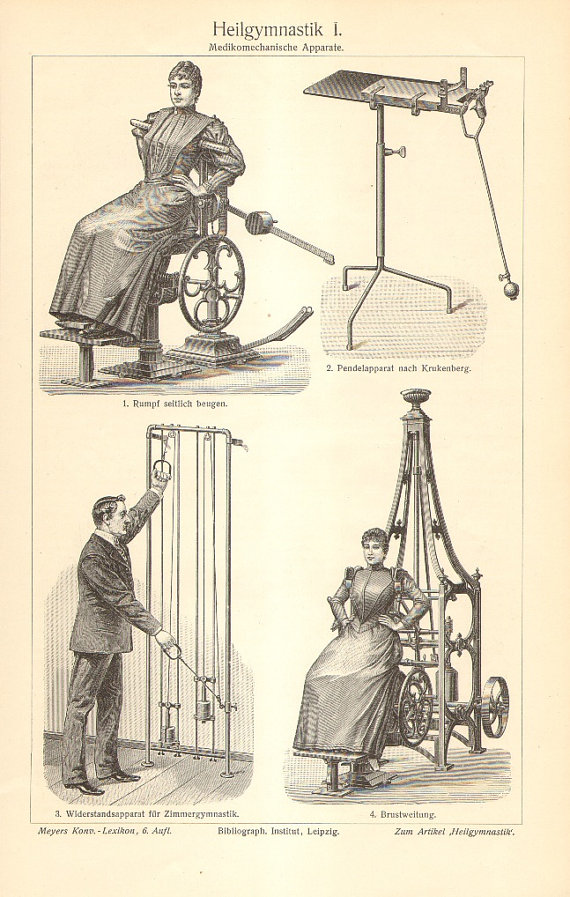
The industrial society that created this new breed of laborer also ensured that the Swedish doctor’s contraptions would garner accolades and attention. They were already a hit in their land of origin when they took a gold medal at Philadelphia’s 1876 Centennial Exhibition.
The flagship Therapeutic Zander Institute in Stockholm expanded, with branches in London and New York City.
The New York Times described the latter as giving the “uninitiated observer an impression of a carefully devised torture chamber more than of a doctor’s office or a gymnasium, both of which functions the institute, to a certain degree, fills.”
Surely no more tortuous than the blood letting, blistering, and purging that were also thought healthful at the time…

See more of Dr. Gustav Zander’s exercise machines here.
Related Content:
Ayun Halliday is an author, illustrator, theater maker and Chief Primatologist of the East Village Inky zine. This month, she appearsas a French Canadian bear who travels to New York City in search of food and meaning in Greg Kotis’ short film, L’Ourse. Follow her @AyunHalliday.
Read More...For Dave Brubeck’s 100th Birthday, Watch Pakistani Musicians Play an Enchanting Version of “Take Five”
How’s this for fusion? Here we have The Sachal Studios Orchestra, based in Lahore, Pakistan, playing an innovative cover of “Take Five,” the jazz standard written by Paul Desmond and originally performed by The Dave Brubeck Quartet in 1959. Brubeck–who would have celebrated his 100th birthday today–called it the “most interesting” version he had ever heard. Once you watch the performance above, you’ll know why.
According to The Guardian, The Sachal Studios Orchestra was created by Izzat Majeed, a philanthropist based in London. When Pakistan fell under the dictatorship of General Zia-ul-Haq during the 1980s, Pakistan’s classical music scene fell on hard times. Many musicians were forced into professions they had never imagined — selling clothes, electrical parts, vegetables, etc. Whatever was necessary to get by. Today, many of these musicians have come together in a 60-person orchestra that plays in a state-of-the-art studio, designed partly by Abbey Road sound engineers.
You can purchase their album, Sachal Jazz: Interpretations of Jazz Standards & Bossa Nova, on Amazon and iTunes. It includes versions of “Take Five” and “The Girl from Ipanema.”
For good measure, we’ve added Sachal’s take on “Eleanor Rigby,” something George Harrison would surely have loved.
Note: A version of this post first appeared on our site back in 2013. But as enchanting as it is, it seemed worth bringing back.
If you would like to support the mission of Open Culture, consider making a donation to our site. It’s hard to rely 100% on ads, and your contributions will help us continue providing the best free cultural and educational materials to learners everywhere. You can contribute through PayPal, Patreon, and Venmo (@openculture). Thanks!
Related Content:
How Dave Brubeck’s Time Out Changed Jazz Music
Watch Jimi Hendrix’s ‘Voodoo Chile’ Performed on a Gayageum, a Traditional Korean Instrument
An Uplifting Musical Surprise for Dave Brubeck in Moscow (1997)
Ultra Orthodox Rabbis Sing Pink Floyd’s “Wish You Were Here” on the Streets of Jerusalem
Read More...Hieronymus Bosch Figurines: Collect Surreal Characters from Bosch’s Paintings & Put Them on Your Bookshelf

Few painters have created as rich a world as Hieronymus Bosch did in The Garden of Earthly Delights. The late 15th- or early 16th-century triptych, which depicts the creation of man, the licentious frolicking of all creatures on a paradisiacal Earth, and the subsequent fall into damnation, draws a scrutiny — and causes an amusement — as intense as ever. As we’ve previously featured here on Open Culture, you can now take a virtual tour of the painting (there’s even an app for it), see it brought to life with modern animation, and hear the song tattooed on the posterior of one of the work’s many characters.
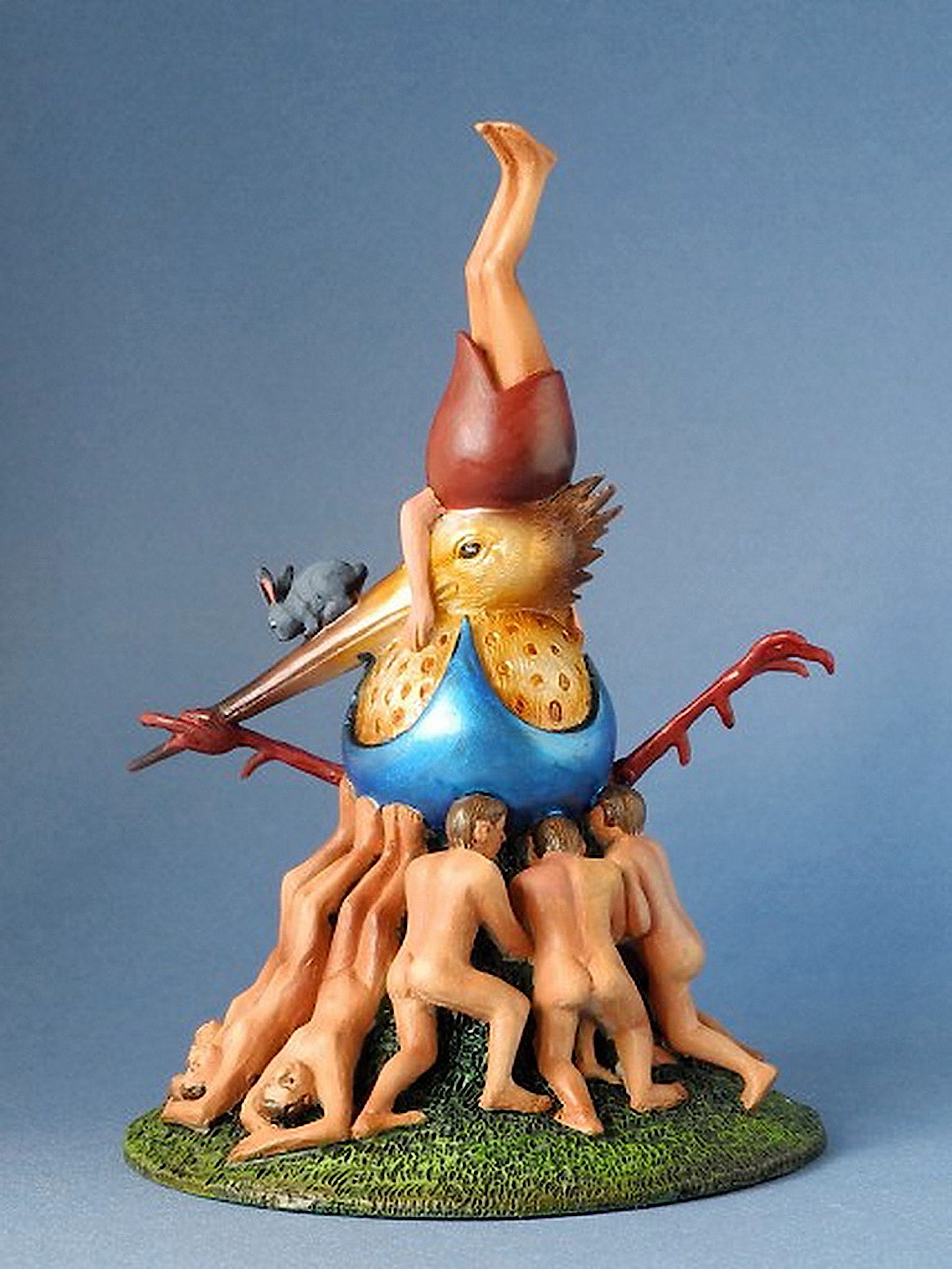
Bosch not only created a world with The Garden of Earthly Delights, he populated it thoroughly. And despite the human-centric story the work appears to take as its basis, the cast with which it retells it extends far beyond mere humanity: the panels feature not just wildlife of all shapes and sizes but a variety of mythical grotesques, from imps to chimeras to hybrids of man and animal to much more besides.
He drew from the same surreal imaginative well to fill his other paintings, and you can now pull out a few of these colorful, menacing, preposterous, and darkly humorous characters yourself in collectible figurine form.

Though “not a big knickknack person,” Dangerous Minds’ Tara McGinley admits to digging this selection of “tiny objects” straight from the mind of Bosch, all “kinda cool-looking in their own obviously weird way” and none “too expensive. The figurines start at around $45, depending on quality, size and detail.” (You can find them on Amazon.) She highlights such issues as “Helmeted Bird Monster,” which according to manufacturers Parastone features a severed foot “swinging from the bird’s helmet referring to the horrible corporal punishments which could be expected in hell.”

“Devil on Night Chair,” one of the most recognizable denizens of The Garden of Earthly Delights’ third panel, comes cast in his famous position, “eating a person on a chair where he will excrete the human remains.” The considerably less satisfied “Fat Belly with Dagger” comes from the third panel of a different triptych, The Temptation of Saint Anthony, the dagger in his belly showing “the consequences of intemperance. His eyes look out at you in acknowledgment.” Its makers promise that “you will look at it in wonder as to how Bosch’s mind conceived of such an unusual little fellow.” Find other artistic scenes featured on Amazon’s Bosch figurine page , and consider them for yourself or as gifts for friends and family. Note: An earlier version of this post appeared on our site in 2017.
If you would like to support the mission of Open Culture, consider making a donation to our site. It’s hard to rely 100% on ads, and your contributions will help us continue providing the best free cultural and educational materials to learners everywhere. You can contribute through PayPal, Patreon, and Venmo (@openculture). Thanks!
Related Content:
Salvador Dalí’s 1973 Cookbook Gets Reissued: Surrealist Art Meets Haute Cuisine
Based in Seoul, Colin Marshall writes and broadcasts on cities and culture. He’s at work on a book about Los Angeles, A Los Angeles Primer, the video series The City in Cinema, the crowdfunded journalism project Where Is the City of the Future?, and the Los Angeles Review of Books’ Korea Blog. Follow him on Twitter at @colinmarshall or on Facebook.
Read More...Why Humans Are Obsessed with Cats
A house cat is not really a fur baby, but it is something rather more remarkable: a tiny conquistador with the whole planet at its feet —Abigail Tucker
As part of its Annals of Obsession video series, The New Yorker invited science journalist Abigail Tucker, author of The Lion in the Living Room, to reflect on “how felines took over the Internet, our homes, and our lives.”
It goes without saying that cats and humans have co-existed for a very long time.
Most of us are acquainted with the high regard in which Ancient Egyptians held Felis catus.
And we may know something of their seafaring history, beginning with the Vikings and continuing on through Unsinkable Sam and other celebrated ship’s cats.
An overwhelming majority of us have spent the last decade or so glued to online examples of their antics—riding robot vacuums, reacting with terror to cucumbers, and pouncing on humans, some of whom have had the temerity to write and record voiceovers that suggest they have insight as to what goes on inside a cat’s hat. (As if!)
It’s gratifying to hear Tucker echo what cat lovers have long suspected (and emblazoned on t‑shirts, coffee mugs, and decorative pillows)—the cats, not the owners, are the ones running the show.
Forgive us. Dogs have owners. Cats have staff.
Cats took a commensal path to domestication, motivated, then as now, by the food they knew to be stored in our settlements.
Tucker describes it as a series of cat controlled takeovers—a process of artificial selection, undertaken on the cats’ own initiative:
House cats are supremely adaptable. They can live anywhere and, while they must have plenty of protein, they eat practically anything that moves, from pelicans to crickets, and many things that don’t, like hot dogs. (Some of their imperiled feline relatives, by contrast, are adapted to hunt only a rare species of chinchilla.) House cats can tweak their sleeping schedules and social lives. They can breed like crazy.
In certain ways the house cat’s rise is tragic, for the same forces that favor them have destroyed many other creatures. House cats are carpetbaggers, arrivistes, and they’re among the most transformative invaders the world has ever seen—except for Homo sapiens, of course. It’s no coincidence that when they show up in ecosystems, lions and other megafauna are usually on their way out.
Aloof as many of their number may be, cats have engineered things in such a way as to be physically irresistible to most humans:
Their big heads and big eyes are so cute!
Their fur is so soft!
We can carry them around!
Dress them in doll clothes (sometimes)!
Their cries mimic the cries of hungry human babies, and elicit a similar response from their human caregivers.
We may not love litter box duty, but with 1 in 3 humans infected by Toxoplasma gondii, we’ll likely be tethered to them for all eternity.
For better or worse, we love them. And so do dog lovers. They just don’t know it yet.
But do not ever imagine that the feeling is reciprocal.
They’re archcarnivores who cannot open their own cans. As Tucker wryly observes:
I think it’s fair to say that we are obsessed and they are not.
Related Content:
GPS Tracking Reveals the Secret Lives of Outdoor Cats
In 1183, a Chinese Poet Describes Being Domesticated by His Own Cats
How Humans Domesticated Cats (Twice)
Ayun Halliday is an author, illustrator, theater maker and Chief Primatologist of the East Village Inky zine. She loves cats, but most recently appeared as a French Canadian bear who travels to New York City in search of food and meaning in Greg Kotis’ short film, L’Ourse. Follow her @AyunHalliday.
Read More...Support Us
We're hoping to rely on loyal readers, rather than erratic ads. Please click the Donate button and support Open Culture. You can use Paypal, Venmo, Patreon, even Crypto! We thank you!

About Us

Open Culture scours the web for the best educational media. We find the free courses and audio books you need, the language lessons & educational videos you want, and plenty of enlightenment in between.
Advertise With Us
FREE UPDATES!
GET OUR DAILY EMAIL
Get the best cultural and educational resources on the web curated for you in a daily email. We never spam. Unsubscribe at any time.
FOLLOW ON SOCIAL MEDIA
Open Culture editor Dan Colman scours the web for the best educational media. He finds the free courses and audio books you need, the language lessons & movies you want, and plenty of enlightenment in between.
Advertise With Us

