88 Philosophy Podcasts to Help You Answer the Big Questions in Life
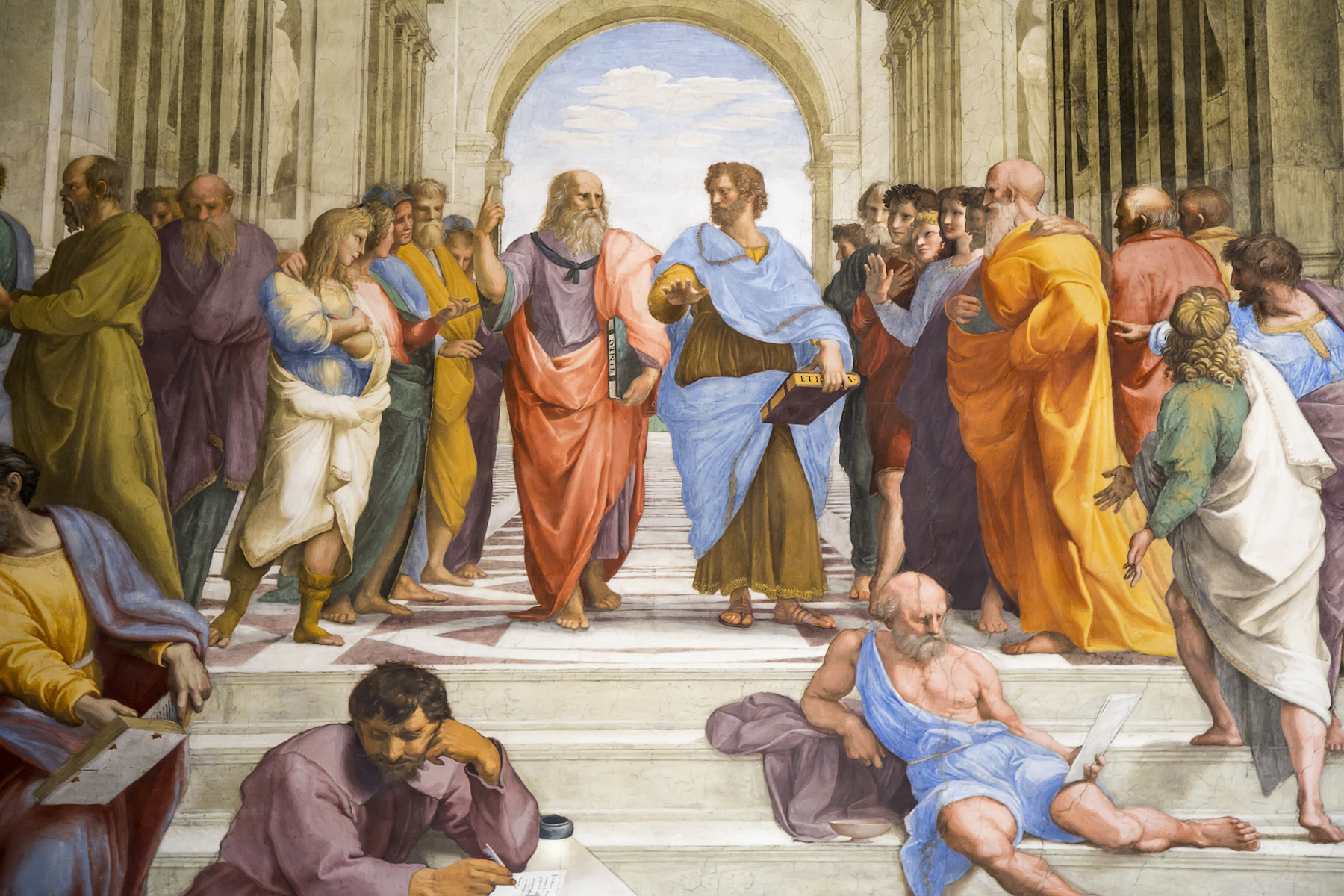
The big questions of philosophy, simmering since antiquity, still press upon us as they did the Athenians of old (and all ancient people who have philosophized): what obligations do we really owe to family, friends, or strangers? Do we live as free agents or beings controlled by fate or the gods (or genes or a computer simulation)? What is a good life? How do we create societies that maximize freedom and happiness (or whatever ultimate values we hold dear)? What is language, what is art, and where did they come from?
These questions may not be answered with a brute appeal to facts, though without science we are groping in the dark. Religion takes big questions seriously but tells converts to take its supernatural answers on faith. “Between theology and science there is a No Man’s Land,” writes Bertrand Russell, “exposed to attack from both sides; this No Man’s Land is philosophy.” Philosophy reaches beyond certainty, to “speculations on matters as to which definite knowledge has, so far, been unascertainable.” And yet, like science, “it appeals to human reason rather than authority.”
The concerns of philosophy have narrowed since Russell’s time, not to mention the time of Socrates, put to death for leading the youth astray. But professors of philosophy still raise the ire of the public, accused of seducing students from the safe spaces of sacred dogma and secular utility. “To study philosophy,” wrote Cicero, “is nothing but to prepare oneself to die.” It is a poetic turn of phrase, and yes, we must confront mortality, but philosophy also asks us to confront the limits of human knowledge and power in the face of the unknown. Dangerous indeed.
Should you decide to embark on this journey yourself, you will meet with no small number of fellow travelers along the way. Bring some earphones, you can hear them in the trove of 88 philosophy podcasts compiled on the philosophy website Daily Nous. “How many philosophy podcasts are there?” asks Daily Nous, who brings us this list. “Over 80, and they take a variety of forms.” See 15 below, with descriptions, see the rest at Daily Nous, and enjoy your sojourn into “no man’s land.”
- 5 Questions (interviews about philosophers themselves w/ Kieran Setiya)
- Embrace the Void (conversations w/ Aaron Rabinowitz)
- Getting Ethics to Work (interviews and discussion w/ Andy Cullison and Kate Berry
- Hi-Phi Nation (edited narratives w/ Barry Lam)
- The History of Philosophy without any Gaps (mix of monologues and interviews w/ Peter Adamson)
- New Books in Philosophy (interviews w/ Carrie Figdor, Alexus McLeod, Marshall Poe, & Robert Talisse)
- Partially Examined Life (“reading group” discussions w/ Mark Linsenmayer, Seth Paskin, Wes Alwan, & Dylan Casey)
- Philosophy Bites (short interviews w/ David Edmonds & Nigel Warburton)
- Philosophy Talk (conversations w/ Stanford Faculty incl. John Perry, formerly Ken Taylor, Ray Briggs, Debra Satz, Josh Landy, et al.)
- Political Philosophy Podcast (interviews w/ Tobias Buckle)
- Philosophers On Medicine (interviews w/ Jonathan Fuller)
- Reductio (edited narratives w/ Andrew Lavin)
- SCI PHI (interviews w/ Nick Zautra)
- Unmute (interviews w/ Myisha Cherry)
- Very Bad Wizards (conversations w/ Tamler Sommers & David Pizarro)
See the full list here. And explore our collection of 200 Free Online Philosophy Courses here.
Related Content:
Free Online Philosophy Courses
Learn Philosophy with a Wealth of Free Courses, Podcasts and YouTube Videos
Oxford’s Free Introduction to Philosophy: Stream 41 Lectures
Josh Jones is a writer and musician based in Durham, NC. Follow him at @jdmagness
Read More...Watch Digital Dancers Electrify the Streets of Istanbul
Are you open to the idea of otherworldly beings moving amongst us, benign but unseen?
Director Gökalp Gönen seems to be in the above video for jazz innovator Ilhan Ersahin’s “Hurri-Mitanni” (Good News).
Things kick off in a decidedly low key manner—a young woman sets off for a nighttime stroll through the streets of Istanbul, her face deliberately obscured by a snugly tied black and white cloth.
Turning a corner, she passes an anonymous figure, wrapped head to toe in similar stripes.
Does this unexpected sight elicit any discernible reaction?
Our guess is no, but we can’t say for sure, as the camera loses interest in the young woman, opting to linger with the svelte and exuberant mummy, who’s dancing like no one is watching.
Elsewhere, other increasingly colorful beings perform variations on the mummy’s box step, alone or in groups.
As their outfits become more fanciful, Gönen employs CGI and 3D animation to unhitch them from the laws of physics and familiar boundaries of human anatomy.
They pixellate, sprout extra legs, project rays reminiscent of string art, appear more vegetable than animal.…
Some grow to Godzilla-like proportions, shedding little humanoid forms and bounding across the Bosporus.
A small spiky version ignores the paws of a curious kitten.
These fantastical, faceless beings are invisible to passerby. Only one, performing on an outdoor stage, seems eager for interaction. None of them seen to mean any harm.
They just wanna boogie…
…or do they?
The director’s statement is not easily parsed in translation:
A group of anonymous wandering the streets. Everywhere is very crowded but identities are very few. Trying to be someone is as difficult as writing your name on the waves left by this fast-moving giant ship. Everyone is everyone and everyone is nobody anymore. This silence could only exist through glowing screens, even if it found itself nooks. On those loud screens, they reminded who actually had the power by entering the places that were said to be inaccessible. But they didn’t even care about this power. The areas where we had passionate conversations about it for days were a “now like this” place for us, but they looked like this to say “no, it was actually like that” but they did not speak much. They had the charm of a cat. When they said, “Look, it was like this,” they became part of everything that made it “like this” and became unnoticeable like paving stones. They just wanted to have a little fun, to be able to live a few years without worry. In five minutes, fifteen seconds at most, they existed and left.
A few creatures who got left on the cutting room floor can be seen dancing on Gönen’s Instagram profile.
via Colossal
Related Content:
The Dance Theatre of Harlem Dances Through the Streets of NYC: A Sight to Behold
Ayun Halliday is an author, illustrator, theater maker and Chief Primatologist of the East Village Inky zine. Follow her @AyunHalliday.
Read More...An Animated Stan Lee Explains Why the F‑Word Is “the Most Useful Word in the English Language” (NSFW)
FYI. The language in this video is not safe for work. And, now, on with the show.
In the last couple years of his life, Stan Lee was ill, his health failing, but he stayed engaged and remained his old wisecracking self. His handpicked successor for editor-in-chief at Marvel, Roy Thomas, tells the story of the last time he saw Lee and showed him his then-new biography of the comics legend, The Stan Lee Story. They talked about the Spider-Man comic strip they’d written together for two decades until a couple years back. Other familiar subjects came and went. Lee “was ready to go” and seemed at peace, Thomas says.
“But he was still talking about doing more cameos. As long as he had the energy for it and didn’t have to travel, Stan was always up to do some more cameos.” Lee’s cameos continue after his death in 2018, as is the way now with deceased icons. He has made three live-action appearances posthumously, in footage shot before his death, one posthumous appearance in an animated superhero film, and another in a Spider-Man video game. Soon, these vignettes may be all popular audiences know of him.
Who knows how much footage–or willingness to create CGI Stan Lees—Disney has in store for future Marvel films. But a memorial in scripted one-liners seems to miss out on a whole lot of Stan Lee. The man could be counted on to make the set on time. (According to Jason Mewes, Lee had dinner with his wife every single night without fail at 6:00 pm sharp.) But he could also be unpredictable in some very delightful ways.
Thomas tells a story, for example, of visiting Lee in the 80s in a California house with marble floors. “At one point he excused himself, and he came back on roller skates…. I’d never seen anyone roller-skating on a marble floor.” The short film above animates another of these unscripted moments, when Lee literally went off-script to deliver an extemporaneous monologue on the f‑word. Of course, “I don’t say it, ‘cause I don’t say dirty words,” he begins, before letting it rip in an argument for the f‑word as “the most useful word in the English language.”
Lee’s off-the-cuff George Carlin routine rolls right into his reason for being in the recording booth: getting a take of his signature exclamation, “Excelsior!”—the word the creator or co-creator of Spider-Man, Thor, Iron Man, Ant Man, Black Widow, Black Panther (and most the rest of the Marvel Universe) reserved for emphasis in his heartfelt, wholesome letters to fans over the decades. After he says his catchphrase, James Whitbrook writes at io9, he goes “right back into having a laugh with everyone around him. It’s a lovely, if profane, remembrance of an icon,” and, unfortunately, not the kind of thing likely to make it in future cameo appearances.
Related Content:
Stan Lee (RIP) Gets an Exuberant Fan Letter from 15-Year-Old George R.R. Martin, 1963
The Great Stan Lee Reads Edgar Allan Poe’s “The Raven”
Josh Jones is a writer and musician based in Durham, NC. Follow him at @jdmagness
Read More...The Great Courses Offers Every Course for $40 Until Midnight Tonight

Here’s a holiday season deal worth mentioning. The Great Courses (formerly The Teaching Company) is offering every course for $40 in digital format (or $60 in DVD format). The deal lasts through midnight on Black Friday.
If you’re not familiar with it, the Great Courses provides a very nice service. They travel across the U.S., recording great professors lecturing on great topics that will appeal to any lifelong learner. They then make the courses available to customers in different formats (DVD, CD, Video & Audio Downloads, etc.). The courses are very polished and complete, and they can be quite reasonably priced, especially when they’re on sale, as they are today. Click here to explore the offer.
Separately, it’s also worth mentioning that the Great Courses Plus–which makes courses available in streaming format as part of a monthly subscription service–is running a Black Friday deal where you can get a free trial for the service, plus 20% of popular plans.
Note: The Great Courses is a partner with Open Culture. So if you purchase a course, it benefits not just you and Great Courses. It benefits Open Culture too. So consider it win-win-win.
Related Content:
1,700 Free Online Courses from Top UniversitiesMasterclass Is Running a “Buy One, Give One Free” Deal (Until November 30)
4,000+ Free Movies Online: Great Classics, Indies, Noir, Westerns, Documentaries & MoreRead More...
With 9,036 Pieces, the Roman Colosseum Is the Largest Lego Set Ever
“For a normal person back in the day,” says LEGO designer/architect Rok Kobe about the Colosseum in Rome, “You had never seen a building that was over a story high. And to be confronted with such an amazing piece of engineering that’s almost 200-meters wide and 50 meters tall, it was unprecedented.”
Similarly, any LEGO fan might feel this awe while greeting this month’s debut of the LEGO Colosseum. At 9036 pieces it has broken the record as the biggest LEGO set in existence, beating out the Star Wars’ Millennium Falcon (7,541 pieces) and the Taj Mahal (5,923 pieces). Every few years LEGO steps up its game, which might possibly end with a neighborhood-devouring replica of the Great Wall of China. But we’re getting ahead of ourselves.
The Colosseum’s facade has been faithfully recreated on all three levels, with the Doric columns at the bottom, the Ionic columns in the middle, and the Corinthian columns on top. And it also adds the contemporary part of the arena that has been rebuilt to show the original level of the arena in Roman times.

The original Colosseum was built over eight years between year 72 AD and 80 AD and between two emperors, Vespasian and Titus. And though we know it as a sandstone-colored structure these days, archeologists have determined it was also colored red, black, and azure. The LEGO version may not be so dramatic, but it does contain a bit more color than the real-life model.
Rok Kobe knows of what he speaks and models. Growing up in Ljubljana, capitol of Slovenia, he would play on the Roman ruins in the city center, especially the Roman Wall. “The five year old would be proud of the adult that got to design this LEGO set,” he says.

At $798, this is not a frivolous purchase. But it will bring an adult hours of fun and keep them occupied.
Related Content:
The Frank Lloyd Wright Lego Set
Cambridge University to Create a Lego Professorship
The LEGO Turing Machine Gives a Quick Primer on How Your Computer Works
Ted Mills is a freelance writer on the arts who currently hosts the Notes from the Shed podcast and is the producer of KCRW’s Curious Coast. You can also follow him on Twitter at @tedmills, and/or watch his films here.
Read More...Toni Morrison’s 1,200 Volume Personal Library is Going on Sale: Get a Glimpse of the Books on Her Tribeca Condo Shelves

Images by Brown Harris Stevens
I will tell you how I began to be a writer.
I was a reader.
Those of us who might have grown up harboring literary ambitions may have been humbled and inspired when we first read Toni Morrison. She proves over and again, in novels, essays, and otherwise, the courage and dedication that serious writing requires. She has also shown us the courage it takes to be a serious reader. “Delving into literature is not escape,” she said in a 2002 interview. It is “always a provocative engagement with the contemporary, the modern world. The issues of the society we live in.”
In her seminal text on reading, Playing in the Dark: Whiteness and the Literary Imagination, Morrison showed us how to read as she does. “As a reader (before becoming a writer),” she wrote, “I read as I had been taught to do. But books revealed themselves rather differently to me as a writer,” in the space of imaginative empathy. “I have to place enormous trust in my ability to imagine others and my willingness to project consciously into the danger zones such others may represent for me.”
Critical readers risk vulnerability, open themselves to shock and surprise: “I want to draw a map… to open as much space for discovery… without the mandate for conquest.” This attitude makes criticism an act of “delight, not disappointment,” Morrison wrote, despite the different, and unequal, positions we come from as readers. “It’s that being open,” she said in 2009, “not scratching for it, not digging for it, not constructing something but being open to the situation and trusting that what you don’t know will be available to you.”

Want to learn to read like that? You can. And you can also, if you have the cash, own and read the books in Morrison’s personal library, the books she thumbed over and read in that same spirit of critical empathy. The over 1,200 books collected at her Tribeca condo can be purchased in their entirety for a price negotiated with her family. In the photos here from realtor Brown Harris Stevens, who currently list her five million dollar, 3 bedroom apartment in a separate sale, certain titles leap out from the spines:
Biographies of Paul Robeson and Charles Dickens, Adam Hochschild’s King Leopold’s Ghost, Eric J. Sundquist’s To Wake the Nations, Angela Davis’ An Autobiography, Cornel West’s Democracy Matters. (Her library seems to be enviably alphabetized, something I’ve meant to get around to for a couple decades now….)
Michelle Sinclair Colman at Galerie lists several more titles in the library, including The Original Illustrated Sherlock Holmes, “books about and by the Obamas and the Clintons, W.E.B. DuBois, Langston Hughes, Zora Neale Hurston, Gayl Jones, Henry Dumas, James Baldwin, and Mark Twain.” On her nightstand, undisturbed, sit Robert A. Caro’s biography of Lyndon Johnson, David Maraniss’s Barack Obama: The Story, and Stephen King’s Revival.
Some other points of interest:
- She owned a beautiful gold illustrated copy of Song of Solomon with the bookmark on Chapter Four.
- She displayed multiple-framed Dewey Decimal catalog library cards of her novels.
- She edited as she read.
And…
- She had a few never-returned library books. The most interesting was a copy of her own book, The Bluest Eye, from the Burnaby Public Library with copious notes, underlines, cross-outs on every single page.
Were these her own notes, underlines, and cross-outs? It isn’t clear, but should you purchase the library, which cannot be pieced out but only owned as a whole, you can find out for yourself. We hope this historic collection will one day end up in a library, maybe digitized for everyone to see. But for now, those of us who can’t afford the purchase price can be content with this rare glimpse into Morrison’s sanctuary, where she did so much writing, thinking, and maybe most importantly for her, so much reading. Images on this page come from Brown Harris Stevens.

Related Content:
Toni Morrison Deconstructs White Supremacy in America
Toni Morrisson: Forget Writing About What You Know; Write About What You Don’t Know
Toni Morrison Dispenses Sound Writing Advice: Tips You Can Apply to Your Own Work
Josh Jones is a writer and musician based in Durham, NC. Follow him at @jdmagness.
Read More...A Free 700-Page Chess Manual Explains 1,000 Chess Tactics in Straightforward English

Image by Michael Maggs, via Wikimedia Commons
FYI: In 2011, Ward Farnsworth published a two-volume collection called Predator at The Chessboard: A Field Guide To Chess Tactics (Volume 1 — Volume 2) where he explains countless chess tactics in plain English. In this 700-page collection, “there are 20 chapters, about 200 topics within them, and over 1,000 [chess] positions discussed.” Now for the even better part: Farnsworth has also made these volumes available free online. Just visit chesstactics.org and scroll down the page. There you will find the content that’s otherwise available in Farnsworth’s books. With this free resource, you can start making yourself a better chess player whenever you have the urge, or especially as you watch The Queen’s Gambit on Netflix.
If you would like to support the mission of Open Culture, consider making a donation to our site. It’s hard to rely 100% on ads, and your contributions will help us continue providing the best free cultural and educational materials to learners everywhere. You can contribute through PayPal, Patreon, and Venmo (@openculture). Thanks!
Related Content:
Claymation Film Recreates Historic Chess Match Immortalized in Kubrick’s 2001: A Space Odyssey
Garry Kasparov Now Teaching an Online Course on Chess
A Human Chess Match Gets Played in Leningrad, 1924
Play Chess Against the Ghost of Marcel Duchamp: A Free Online Chess Game
A Beautiful Short Documentary Takes You Inside New York City’s Last Great Chess Store
A Brief History of Chess: An Animated Introduction to the 1,500-Year-Old Game
Read More...Masterclass Is Running a “Buy One, Give One Free” Deal (Until November 30)

FYI: Masterclass is running a Buy One, Share One Free until November 30.
Here’s the gist: If you buy an All-Access pass to their 90+ courses, you will receive another All-Access Pass to give to someone else at no additional charge. An All-Access pass costs $180 (or $15 per month), and lasts one year. For that fee, you–and a family member or friend–can watch courses created by Annie Leibovitz, Neil Gaiman, Malcolm Gladwell, Werner Herzog, Martin Scorsese, David Mamet, Jane Goodall, Margaret Atwood, Helen Mirren, Herbie Hancock, Alice Waters, Billy Collins and so many more. If you’re thinking this sounds like a pretty good way to get through quarantine, we’d have to agree. The deal is available now.
Note: If you sign up for a MasterClass course by clicking on the links in this post, Open Culture will receive a small fee that helps support our operation.
Related Content
1,700 Free Online Courses from Top UniversitiesFree Online Philosophy Courses
Read More...Famed New Orleans Music Producer Mark Bingham Discusses His Songs and Collaborations: A Nakedly Examined Music Conversation (#136)
You’re most likely to know Mark’s work from the string introduction to REM’s “Shiny Happy People,” but he’s been a staple of the New Orleans recording scene since he moved there in 1982, producing groups like Flat Duo Jets, Glenn Branca, John Scofield, Marianne Faithful, and the Rebirth Brass Band. He and his studio were also featured on the HBO show Treme. He had a whole lifetime of musical development before then, though, first getting signed as a teenager in Los Angeles and recording a single as a solo artist. He then left to study music in Indiana where he was one of two guitarists and several singers for the very adventurous, theatrical Screaming Gypsy Bandits, who released their one album, In the Eye, in 1973. Following the times, he eschewed progressive rock for a more minimalist but still very arty style in New York City with a band called Social Climbers. He’s released two albums since then under his own name in between production work: A jazz-rock inflected singer-songwriter album called I Passed for Human in 1989, and then a more rootsy endeavor called Psalms Of Vengeance in 2009. He is due for a significant archive release within the next year with something like ten albums of additional compositions.
In this episode of Nakedly Examined Music, we pick four of his songs to play in full and discuss. After a short introduction over the song “Flies R All Around Me” by Screaming Gypsy Bandits from Back to Doghead (1970, but not released until 2009), the first full discussion covers “Pissoffgod.com” (featured in the video link in this post) from Psalms of Vengeance (2009). We then turn to “Ash Wednesday and Lent” by Ed Sanders (music by Mark Bingham) from Ed’s album Poems for New Orleans (2007). We then look back to “That’s Why” by Social Climbers from their self-titled album (1981). We conclude with “Blood Moon,” a group improvisation by Michot’s Melody Makers from Cosmic Cajuns from Saturn (2020). This is a band that plays mostly traditional cajun music that Mark was producing and has now for two albums joined as their guitarist.
Want more? Listen to “Flies” in full. Hear the whole Social Climbers album (1981). Mark’s first solo album featured this Coltrane classic. Listen to Mark backing Aaron Neville and Johnny Adams on a Hal Willner album of Kurt Weil tunes. Experience one of the tunes he wrote for Allen Ginsberg to read poetry over. Watch him live with Michot’s Melody Makers.
Nakedly Examined Music is a podcast hosted by Mark Linsenmayer, who also hosts The Partially Examined Life Philosophy Podcast and Pretty Much Pop: A Culture Podcast. He releases music under the name Mark Lint.
Read More...The Story Behind “Alice’s Restaurant,” Arlo Guthrie’s Song That’s Now a Thanksgiving Tradition
Around the country today, along with a food-coma inducing serving of turkey, ham, stuffing and all the trimmings, a great many of you will be following another tradition: listening to Arlo Guthrie’s 1968 song “Alice’s Restaurant.” According to one YouTuber, when her kids were young, she’d “sit them down together and play this/torture them with it from beginning to end.” The replies suggest she’s not alone. Somewhere a child has now grown up and is passing the song down to a younger generation.
“Alice’s Restaurant” is about Thanksgiving in the same way that it’s about a restaurant owned by Alice–very little. Instead, it’s a long shaggy but true tale about Guthrie and his friend Rick Robbins helping their friends out after a Thanksgiving dinner that “couldn’t be beat”. With trash filling up the gutted former small-town Massachusetts church where Alice and her husband were living, the two fill up their VW van with the refuse and illegally dump it in the back woods. Guthrie gets arrested, taken to court, and fined for littering, only to have his new criminal record later disqualify him for the draft.
That’s the destination, but it’s the journey that makes the song, an 18-plus minute “talking blues” that Guthrie would have learned from his dad, folk legend Woody Guthrie. Woody in turn learned it from a 1920s country and Blues musician called Chris Bouchillon, who talked his way through songs because his singing voice wasn’t all that good. And the simple picking style Guthrie traces from Mississippi John Hurt to Pete Seeger and Ramblin’ Jack Elliot all the way back to the motherland: “In its infancy, that’s an African style approach to a six-string guitar and I have always loved it,” he told Rolling Stone.
Guthrie started writing the song, titling it “Alice’s Restaurant Massacree,” an esoteric word meaning a series of absurd events. He workshopped it in coffee houses and live venues, adding to it, taking bits out that weren’t working, playing with the time, from 18 minutes all the way up to 35. In February of 1967 Guthrie was invited to play live on New York City’s WBAI-FM. The recording became a hit, and helped the non-profit station fund-raise, broadcasting the song when a total dollar amount was hit. When the song got too much airplay, they also fund-raised to stop playing the song.
Then came the Newport Folk Festival, where the daytime crowd of 3,500 loved it so much that Guthrie returned for the evening set to play it to 9,500, joined on stage with a who’s‑who of folk legends including Pete Seeger and Oscar Brand. This was a big deal for an 18-year-old musician. The album came in October of that year, where the song took up a whole side. A movie adaptation appeared two years later, with the actual people from the song–including police chief William Obanhein (Officer Obie in the song) and the blind Judge James Hannon–playing themselves in the movie.
The song might not have its staying power if it wasn’t for its themes of resisting authority and bureaucracy, possibly even more than the anti-war message at its end.
“I’ve remained distrustful of authority for my entire life,” Guthrie told Smithsonian Magazine, “I believe it’s one of the great strengths of a democracy, that we take seriously our role as the ultimate authorities by our interest and our votes. Younger people have always had a rebellious streak. It goes with the territory of growing up.”
Guthrie retired from touring, and had retired the song even earlier than that. But it lives on every Thanksgiving in many households. As he told Rolling Stone, that’s a fine legacy:
“Hey if they’re gonna play one song of yours on the radio one day a year, it might as well be the longest one you wrote!”
Related Content:
Hear Two Legends, Lead Belly & Woody Guthrie, Performing on the Same Radio Show (1940)
William S. Burroughs Reads His Sarcastic “Thanksgiving Prayer” in a 1988 Film By Gus Van Sant
F. Scott Fitzgerald’s 13 Tips for What to Do with Your Leftover Thanksgiving Turkey
Ted Mills is a freelance writer on the arts who currently hosts the Notes from the Shed podcast and is the producer of KCRW’s Curious Coast. You can also follow him on Twitter at @tedmills, and/or watch his films here.
Read More...Support Us
We're hoping to rely on loyal readers, rather than erratic ads. Please click the Donate button and support Open Culture. You can use Paypal, Venmo, Patreon, even Crypto! We thank you!

About Us

Open Culture scours the web for the best educational media. We find the free courses and audio books you need, the language lessons & educational videos you want, and plenty of enlightenment in between.
Advertise With Us
FREE UPDATES!
GET OUR DAILY EMAIL
Get the best cultural and educational resources on the web curated for you in a daily email. We never spam. Unsubscribe at any time.
FOLLOW ON SOCIAL MEDIA
Open Culture editor Dan Colman scours the web for the best educational media. He finds the free courses and audio books you need, the language lessons & movies you want, and plenty of enlightenment in between.
Advertise With Us


