How Jackson Pollock Redefined Modern Art: An Introduction
In his lifetime, Jackson Pollock had only one successful art show. It took place at the Betty Parsons Gallery in New York in November 1949, and afterward, his fellow abstract expressionist Willem de Kooning declared that “Jackson has finally broken the ice.” Perhaps, according to Louis Menand’s book The Free World: Art and Thought in the Cold War, he meant that “Pollock was the first American abstractionist to break into the mainstream art world, or he might have meant that Pollock had broken through a stylistic logjam that American painters felt blocked by.” Whatever its intent, de Kooning’s remark annoyed art critic and major Pollock advocate Clement Greenberg, who “thought that it reduced Pollock to a transitional figure.”
It wasn’t necessarily a reduction: as Menand sees it, “all figures are transitional. Not every figure, however, is a hinge, someone who represents a moment when one mode of practice swings over to another.” Pollock was such a hinge, as, in his way, was Greenberg: “After Pollock, people painted differently. After Greenberg, people thought about painting differently.”
When they made their mark, “there was no going back.” Gallerist-YouTuber James Payne examines the nature of that mark in the new Great Art Explained video above, the first of a multi-part series on Pollock’s art and the figures that made its cultural impact possible. Even more important than Greenberg, in Payne’s telling, is Pollock’s fellow artist — and, in time, wife — Lee Krasner, whose own work he also gives its due.
We also see the paintings of American regionalist Thomas Hart Benton, Pollock’s teacher; Mexican muralist David Alfaro Siqueiros, in whose workshop Pollock participated; and even Pablo Picasso, who exerted subtle but detectable influences of his own on Pollock’s work. Other, non-artistic sources of inspiration Payne explores include the psychological theory of Carl Gustav Jung, with whose school of therapy Pollock engaged in the late nineteen-thirties and early forties. It was in those sessions that he produced the “psychoanalytic drawings,” one of several categories of Pollock’s work that will surprise those who know him only through his large-canvas, wholly abstract drip paintings. Each represents one stage of a complex evolutionary process: Pollock may have been the ideal artist for the new, post-war American world, but he hardly came fully formed out of Wyoming.
Related content:
Watch Portrait of an Artist: Jackson Pollock, the 1987 Documentary Narrated by Melvyn Bragg
The MoMA Teaches You How to Paint Like Pollock, Rothko, de Kooning & Other Abstract Painters
Based in Seoul, Colin Marshall writes and broadcasts on cities, language, and culture. His projects include the Substack newsletter Books on Cities and the book The Stateless City: a Walk through 21st-Century Los Angeles. Follow him on the social network formerly known as Twitter at @colinmarshall.
Read More...The Soviet Union Creates a List of 38 Dangerous Rock Bands: Kiss, Pink Floyd, Talking Heads, Village People & More (1985)
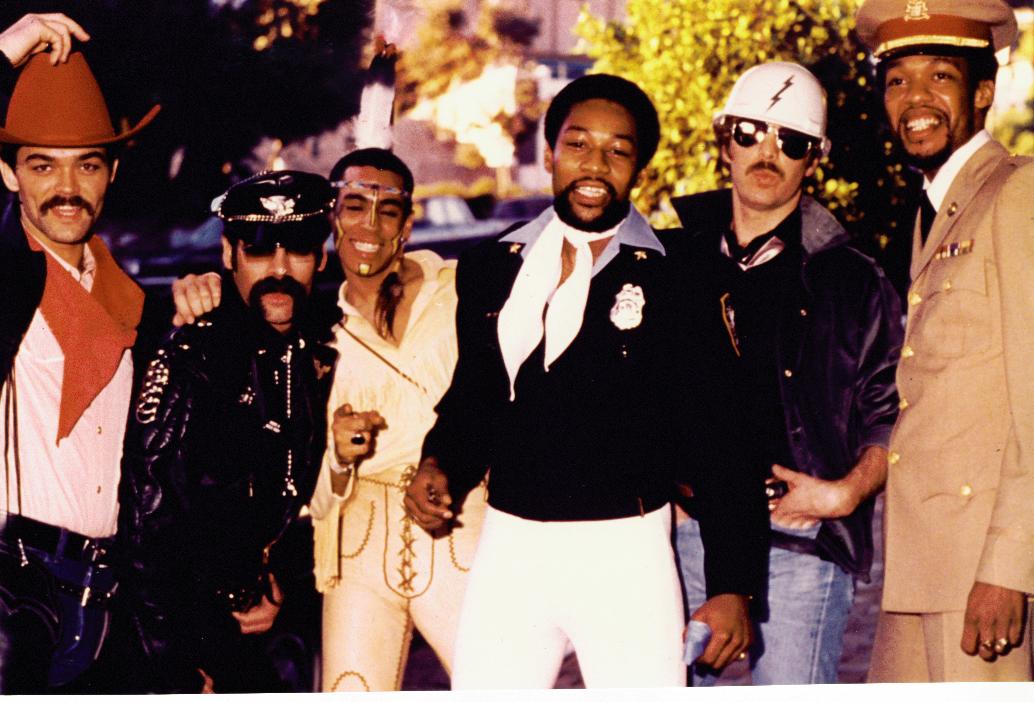
Image by Mario Casciano via Wikimedia Commons
Music is dangerous and powerful, and can be, without intending to, a political weapon. All authoritarian regimes have understood this, including repressive elements in the U.S. throughout the Cold War. I remember having books handed to me before the Berlin Wall came down, by family friends fearful of the evils of popular music—especially punk rock and metal, but also pretty much everything else. The descriptions in these paranoid tracts of the bands I knew and loved sounded so ludicrous and hyperbolic that I couldn’t help suspect that each was in fact a work of satire. They were at the very least anachronistic, yet ideal, types of Poe’s Law.
Such may be your reaction to a list published in 1985 by the Komsomol, the Soviet youth organization formed as the All-Union Leninist Young Communist League in 1918. (Find it below.) Consisting of thirty-eight punk, rock, metal, disco, and New Wave bands, the list is not at all unlike the materials printed around the same time by certain youth organizations I came into contact with.
The mechanisms of state repression in the Soviet Union on the eve of perestroika overmatched comparatively mild attempts at music censorship made by the U.S. government, but the propaganda mechanisms were similar. As in the alarmed pamphlets and books handed to me in churches and summer camps, the Komsomol list describes each band in obtuse and absurd terms, each one a category of the “type of propaganda” on offer.
Black Sabbath, a legitimately scary—and politically astute—band gets pegged along with Iron Maiden for “violence” and “religious obscurantism.” (Nazareth is similarly guilty of “violence” and “religious mysticism.”) A great many artists are charged with only “violence” or with “sex,” which in some cases was kind of their whole métier. A handful of punk bands—the Sex Pistols, the Clash, the Stranglers—are cited for violence, and also simply charged with “punk,” a crime given as the Ramones’ only offense. There are a few oddly specific charges: Pink Floyd is guilty of a “distortion of Soviet foreign policy (‘Soviet aggression in Afghanistan’)” and Talking Heads endorse the “myth of the Soviet military threat.” A couple hilariously incongruous tags offer LOLs: Yazoo and Depeche Mode, two of the gentlest bands of the period, get called out for “punk, violence.” Kiss and the Village People (above), two of the silliest bands on the list, are said to propagate, “neofascism” and “violence.”
- Sex Pistols: punk, violence
- B‑52s: punk, violence
- Madness: punk, violence
- Clash: punk, violence
- Stranglers: punk, violence
- Kiss: neofascism, punk, violence
- Crocus: violence, cult of strong personality
- Styx: violence, vandalism
- Iron Maiden: violence, religious obscuritanism
- Judas Priest: anticommunism, racism
- AC/DC: neofascism, violence
- Sparks: neofascism, racism
- Black Sabbath: violence, religious obscuritanism
- Alice Cooper: violence, vandalism
- Nazareth: violence, religious mysticism
- Scorpions: violence
- Gengis Khan: anticommunism, nationalism
- UFO: violence
- Pink Floyd (1983): distortion of Soviet foreign policy (“Soviet agression in Afghanistan”)***
- Talking Heads: myth of the Soviet military threat
- Perron: eroticism
- Bohannon: eroticism
- Originals: sex
- Donna Summer: eroticism
- Tina Turner: sex
- Junior English: sex
- Canned Heat: homosexuality
- Munich Machine: eroticism
- Ramones: punk
- Van Halen: anti-soviet propaganda
- Julio Iglesias: neofascism
- Yazoo: punk, violence
- Depeche Mode: punk, violence
- Village People: violence
- Ten CC: neofascism
- Stooges: violence
- Boys: punk, violence
- Blondie: punk, violence
The list circulated for “the purpose of intensifying control over the activities of discotheques.” It comes to us from Alexei Yurchak’s Everything Was Forever, Until It Was No More: The Last Soviet Generation, which cites it as an example, writes one reader, of “the contradictory nature of Soviet life, where as citizens participated in the ritualized, pro forma ideological discourse, this very discourse allowed them to carve out what they called ‘normal meaningful life’ that went beyond the state’s ideology.” A large part of that “normal” life involved circulating bootlegs of ideologically suspect music on improvised materials like discarded and stolen X‑Rays. The Komsomol eventually wised up. As Yurchak documents in his book, they co-opted local amateur rock bands and promoted their own events as a counter-attack on the influence of bourgeois culture. You can probably guess how much success they had with this strategy.
See the full list of thirty-eight bands and their “type of propaganda” above.
Note: An earlier version of this post appeared on our site in 2015.
Related Content:
Josh Jones is a writer and musician based in Durham, NC. Follow him at @jdmagness
Read More...The Genius of Brian Wilson (RIP) and How He Turned “Good Vibrations” Into the Beach Boys’ Pocket Symphony
This week, Brian Wilson became the last of the Wilson brothers to shuffle off this mortal coil. Dennis, the first of the Wilsons to go, died young in 1983 — but not before offering this memorable assessment of the family musical project: “Brian Wilson is the Beach Boys. He is the band. We’re his messengers. He is all of it. Period. We’re nothing.” That was a bit harsh: Dennis may not have been a virtuoso drummer, but Beach Boys enthusiasts all credit his faintly despairing songs with enriching the band’s signature emotional landscape. Brian may have written “God Only Knows,” but he did so with his brother Carl’s voice in mind. And could even Brian’s other masterpiece “Good Vibrations” have made the same impact without the participation of his much-resented cousin Mike Love?
Still, without Brian’s orchestration, the other Beach Boys’ voices would never have come together in the powerful way they did, to say nothing of the contributions of the countless studio musicians who played on their recordings. Before “Good Vibrations,” never had a pop song owed so much to so many musicians — and, at the same time, even more to the fertile and unconventional sonic imagination of just one man.
Laboriously crafted over seven months in four different studios, it came out in October of 1966 as the most expensive single ever produced. Its then-epic length of 3:35 filled Capitol Records with doubts about its radio viability, but that turned out to be an astonishingly brief running time to contain the sheer compositional intensity that soon got the song labeled a “pocket symphony.”
“Good Vibrations” and its myriad intricacies are scrutinized to this day, most recently in video essays like the ones you see here. On his Youtube channel Polyphonic, Noah Lefevre calls it “dense enough that you could teach an entire music course on it.” David Hartley grants it the status of “probably the most complex song ever recorded,” and even “the first song ever created using copy and paste.” Long before the era of digital audio workstations, Brian Wilson used wholly analog studio technology to string together “feels,” his name for the disparate fragments of music in his mind. His method contributed to the symphonic construction of “Good Vibrations,” and his willingness to follow the mood wherever it led resulted in the song’s distinctive use of an Electro-Theremin. Despite all this, some listeners still question his centrality to the Beach Boys’ music; for them, there will always be “Kokomo.”
Related content:
How the Beach Boys Created Their Pop Masterpieces: “Good Vibrations,” Pet Sounds, and More
Based in Seoul, Colin Marshall writes and broadcasts on cities, language, and culture. His projects include the Substack newsletter Books on Cities and the book The Stateless City: a Walk through 21st-Century Los Angeles. Follow him on the social network formerly known as Twitter at @colinmarshall.
Read More...An Architectural Tour of Taliesin West, Frank Lloyd Wright’s Iconic Desert Home and Studio
By some estimations, Frank Lloyd Wright’s Taliesin West home-studio complex took shape in 1941. But even then, the Arizona Republic presciently noted that “it may be years before it is considered finished.” The Taliesin West you can see in the new Architectural Digest video above is unlikely to change dramatically over the next few generations, but it’s also quite different from what Wright and his apprentices initially designed and built over their first six years of life and work in the Arizona desert. Much of that change has come since Wright himself last saw Taliesin West in 1959, the final year of his life, as the Taliesin Institute’s Jennifer Gray explains while showing the place off.
Wright enthusiasts can argue about the degree to which the expansions, modifications, and renovations made by the master’s disciples and others are in keeping with his vision. But in a sense, ongoing growth and metamorphosis (as well as damage and regrowth, resulting from the occasional fire) suits a work of architecture made to look and feel as if it had emerged organically from the natural landscape. Arguably, Taliesin West even exhibits a kind of purity not found in other, more famous Wright buildings, created as it was without a client, and thus without a client’s demands and deadlines — not to mention with the benefit of apprentice labor.
Like Wright’s original Taliesin in Spring Green, Wisconsin, Taliesin West was a home, a studio, and most importantly, an educational institution. Wright and his students spent the winters there every year from 1935 on, though it was a completely undeveloped site at first. Just getting there necessitated a vehicular pilgrimage, a great American road trip avant la lettre — and indeed, avant l’autoroute. While the Wrights stayed at an inn, the apprentices camped out on-site, living a hardscrabble but highly educational existence, devoted as it was to building straight from plans that their teacher could have drawn up the day before. Even after Taliesin West was basically built, then hooked up to such luxuries as plumbing and electricity, communal rigors of life there weren’t for every student. Yet it did have its pleasures: it’s not every architecture school, after all, that has its own cabaret.
Related content:
Inside the Beautiful Home Frank Lloyd Wright Designed for His Son (1952)
What Frank Lloyd Wright’s Unusual Windows Tell Us About His Architectural Genius
How Frank Lloyd Wright’s Architecture Evolved Over 70 Years and Changed America
Based in Seoul, Colin Marshall writes and broadcasts on cities, language, and culture. His projects include the Substack newsletter Books on Cities and the book The Stateless City: a Walk through 21st-Century Los Angeles. Follow him on the social network formerly known as Twitter at @colinmarshall.
Read More...The History of the World in One Beautiful, 5‑Foot-Long Chart (1931)
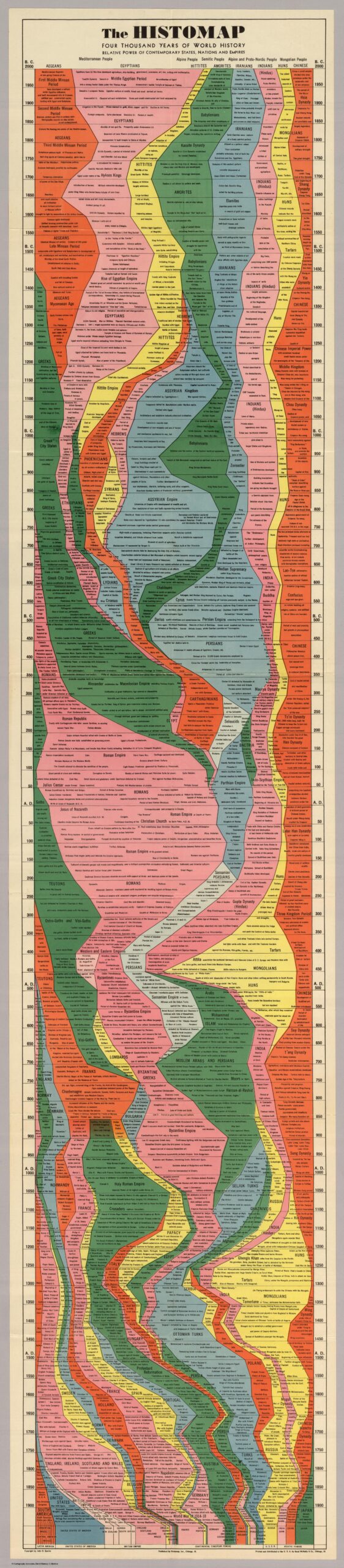
In the image above, we see an impressive pre-internet macro-infographic called a “Histomap.” Its creator John B. Sparks (who later created “histomaps” of religion and evolution) published the graphic in 1931 with Rand McNally. The five-foot-long chart—purportedly covering 4,000 years of “world” history—is, in fact, an example of an early illustration trend called the “outline,” of which Rebecca Onion at Slate writes: “large subjects (the history of the world! every school of philosophy! all of modern physics!) were distilled into a form comprehensible to the most uneducated layman.” Here we have the full description of most every political chart, graph, or animation in U.S.A. Today, most Internet news sites, and, of course, The Onion.
The similarity here isn’t simply one of form. The “outline” functioned in much the same way that simplified animations do—condensing heavy, contentious theoretical freight trains and ideological baggage. Rebecca Onion describes the chart as an artifact very much of its time, presenting a version of history prominent in the U.S. between the wars. Onion writes:
The chart emphasizes domination, using color to show how the power of various “peoples” (a quasi-racial understanding of the nature of human groups, quite popular at the time) evolved throughout history.
Sparks’ map, however, remains an interesting document because of its seeming disinterestedness. While the focus on racialism and imperial conquest may seem to place Sparks in company with populist “scientific” racists of the period like Lothrop Stoddard (whom Tom Buchanan quotes in Fitzgerald’s Gatsby), it would also seem that his design has much in common with early Enlightenment figures whose conception of time was not necessarily linear. Following classical models, thinkers like Thomas Hobbes tended to divide historical epochs into rising and falling actions of various people groups, rather than the gradual ascent of one race over all others towards an end of history. For example, poet Abraham Cowley writes a compressed “universal history” in his 1656 poem “To Mr. Hobs,” moving from Aristotle (the “Stagirite”) to the poem’s subject Thomas Hobbes. The movement is progressive, yet the historical representatives of each civilization receive some equal weight and similar emphasis.
Long did the mighty Stagirite retain
The universal Intellectual reign,
Saw his own Countreys short-liv’ed Leopard slain;
The stronger Roman-Eagle did out-fly,
Oftner renewed his Age, and saw that Dy.
Mecha it self, in spight of Mahumet possest,
And chas’ed by a wild Deluge from the East,
His Monarchy new planted in the West.
But as in time each great imperial race
Degenerates, and gives some new one place:
The period of Cowley recognized theories of racial, cultural, and natural supremacy, but such qualities, as in Sparks’ map, were the product of a long line of succession from equally powerful and noteworthy empires and groups to others, not a social evolution in which a superior race naturally arose. Rand McNally advertised the chart as presenting “the march of civilization, from the mud huts of the ancients thru the monarchistic glamour of the middle ages to the living panorama of life in present day America.” While the blurb is filled with pseudoscientific colonialist talking points, the chart itself has the dated, yet strikingly egalitarian arrangement of information that—like much of the illustration in National Geographic—sought to accommodate the best consensus models of the times, displaying, but not proselytizing, its biases.
Note: An earlier version of this post appeared on our site in 2013.
Related Content:
180,000 Years of Religion Charted on a “Histomap” in 1943
10 Million Years of Evolution Visualized in an Elegant, 5‑Foot Long Infographic from 1931
The History of the World in One Video: Every Year from 200,000 BCE to Today
Josh Jones is a writer and musician based in Durham, NC. Follow him at @jdmagness
Read More...How the BIC Cristal Ballpoint Pen Became the Most Successful Product in History
If you want to see a tour de force of modern technology and design, there’s no need to visit a Silicon Valley showroom. Just feel around your desk for a few moments, and sooner or later you’ll lay a hand on it: the BIC Cristal ballpoint pen, which is described in the Primal Space video above as “possibly the most successful product ever made.” Not long after its introduction in 1950, the Cristal became ubiquitous around the world, so ideally did it suit human needs at a price that would have seemed impossibly cheap not so very long ago — to say nothing of the seventeenth century, when the art of writing demanded mastery of the quill and inkpot.
Of course, writing itself was of little use in those days to humanity’s illiterate majority. That began to change with the invention of the fountain pen, which was certainly more convenient than the quill, but still prohibitively expensive even to most of those who could read. It was only at the end of the nineteenth century, a heady age of American ingenuity, that an inventor called John Loud came up with the first ballpoint pen.
Though crude and impractical, Loud’s design planted the technological seed that would be cultivated thereafter by others, like Laszlo Biro, who understood the advantage of using oil-based rather than traditional water-based ink, and French manufacturer Marcel Bich, who had access to the technology that could bring the ballpoint pen to its final form.
Bich (the foreign pronunciation of whose surname inspired the brand name BIC) figured out how to use Swiss watchmaking machines to mass-produce tiny stainless steel balls to precise specifications. He chose to manufacture the rest of the pen out of molded plastic, a then-new technology. The Cristal’s clear body allowed the ink level to be seen at all times, and its hexagonal shape stopped it from rolling off desks. Its polypropylene lid wouldn’t break when dropped, and it doubled as a clip to boot. What did this “game changer” avant la lettre cost when it came to market? The equivalent of two dollars. As an industrial product, the BIC Cristal has in many respects never been surpassed (over 100 billion have been sold to date), even by the ultra-high-tech cellphones or tablets on which you may be reading this post. Bear that in mind the next time you’re struggling with one, patchily zigzagging back and forth on a page in an attempt to get the ink out that you’re sure must be in there somewhere.
Related content:
Montblanc Unveils a New Line of Miles Davis Pens … and (Kind of) Blue Ink
Based in Seoul, Colin Marshall writes and broadcasts on cities, language, and culture. His projects include the Substack newsletter Books on Cities and the book The Stateless City: a Walk through 21st-Century Los Angeles. Follow him on the social network formerly known as Twitter at @colinmarshall.
Read More...Marie Curie Invented Mobile X‑Ray Units to Help Save Wounded Soldiers in World War I

A hundred years ago, Mobile X‑Ray Units were a brand new innovation, and a godsend for soldiers wounded on the front in WW1. Prior to the advent of this technology, field surgeons racing to save lives operated blindly, often causing even more injury as they groped for bullets and shrapnel whose precise locations remained a mystery.
Marie Curie was just setting up shop at Paris’ Radium Institute, a world center for the study of radioactivity, when war broke out. Many of her researchers left to fight, while Curie personally delivered France’s sole sample of radium by train to the temporarily relocated seat of government in Bordeaux.
“I am resolved to put all my strength at the service of my adopted country, since I cannot do anything for my unfortunate native country just now…,” Curie, a Pole by birth, wrote to her lover, physicist Paul Langevin on New Year’s Day, 1915.
To that end, she envisioned a fleet of vehicles that could bring X‑ray equipment much closer to the battlefield, shifting their coordinates as necessary.
Rather than leaving the execution of this brilliant plan to others, Curie sprang into action.
She studied anatomy and learned how to operate the equipment so she would be able to read X‑ray films like a medical professional.
She learned how to drive and fix cars.
She used her connections to solicit donations of vehicles, portable electric generators, and the necessary equipment, kicking in generously herself. (When she got the French National Bank to accept her gold Nobel Prize medals on behalf of the war effort, she spent the bulk of her prize purse on war bonds.)
She was hampered only by backwards-thinking bureaucrats whose feathers ruffled at the prospect of female technicians and drivers, no doubt forgetting that most of France’s able-bodied men were otherwise engaged.
Curie, no stranger to sexism, refused to bend to their will, delivering equipment to the front line and X‑raying wounded soldiers, assisted by her 17-year-old daughter, Irène, who like her mother, took care to keep her emotions in check while working with maimed and distressed patients.
“In less than two years,” writes Amanda Davis at The Institute, “the number of units had grown substantially, and the Curies had set up a training program at the Radium Institute to teach other women to operate the equipment.” Eventually, they recruited about 150 women, training them to man the Little Curies, as the mobile radiography units came to be known.
Note: An earlier version of this post appeared on our site in 2017.
Related Content:
Marie Curie’s Research Papers Are Still Radioactive a Century Later
An Animated Introduction to the Life & Work of Marie Curie, the First Female Nobel Laureate
Ayun Halliday is an author, illustrator, theater maker and Chief Primatologist of the East Village Inky zine.
Read More...Hear What Shakespeare Sounded Like in the Original Pronunciation
What did Shakespeare’s English sound like to Shakespeare? To his audience? And how can we know such a thing as the phonetic character of the language spoken 400 years ago? These questions and more are addressed in the video above, which profiles a very popular experiment at London’s Globe Theatre, the 1994 reconstruction of Shakespeare’s theatrical home. As linguist David Crystal explains, the theater’s purpose has always been to recapture as much as possible the original look and feel of a Shakespearean production—costuming, music, movement, etc. But until recently, the Globe felt that attempting a play in the original pronunciation would alienate audiences. The opposite proved to be true, and people clamored for more. Above, Crystal and his son, actor Ben Crystal, demonstrate to us what certain Shakespearean passages would have sounded like to their first audiences, and in so doing draw out some subtle wordplay that gets lost on modern tongues.
Shakespeare’s English is called by scholars Early Modern English (not, as many students say, “Old English,” an entirely different, and much older language). Crystal dates his Shakespearean early modern to around 1600. (In his excellent textbook on the subject, linguist Charles Barber bookends the period roughly between 1500 and 1700.) David Crystal cites three important kinds of evidence that guide us toward recovering early modern’s original pronunciation (or “OP”).
1. Observations made by people writing on the language at the time, commenting on how words sounded, which words rhyme, etc. Shakespeare contemporary Ben Jonson tells us, for example, that speakers of English in his time and place pronounced the “R” (a feature known as “rhoticity”). Since, as Crystal points out, the language was evolving rapidly, and there wasn’t only one kind of OP, there is a great deal of contemporary commentary on this evolution, which early modern writers like Jonson had the chance to observe firsthand.
2. Spellings. Unlike today’s very frustrating tension between spelling and pronunciation, Early Modern English tended to be much more phonetic and words were pronounced much more like they were spelled, or vice versa (though spelling was very irregular, a clue to the wide variety of regional accents).
3. Rhymes and puns which only work in OP. The Crystals demonstrate the important pun between “loins” and “lines” (as in genealogical lines) in Romeo and Juliet, which is completely lost in so-called “Received Pronunciation” (or “proper” British English). Two-thirds of Shakespeare’s sonnets, the father and son team claim, have rhymes that only work in OP.
Not everyone agrees on what Shakespeare’s OP might have sounded like. Eminent Shakespeare director Trevor Nunn claims that it might have sounded more like American English does today, suggesting that the language that migrated across the pond retained more Elizabethan characteristics than the one that stayed home.
You can hear an example of this kind of OP in the recording from Romeo and Juliet above. Shakespeare scholar John Barton suggests that OP would have sounded more like modern Irish, Yorkshire, and West Country pronunciations, an accent that the Crystals seem to favor in their interpretations of OP and is much more evident in the reading from Macbeth below (both audio examples are from a CD curated by Ben Crystal).
Whatever the conjecture, scholars tend to use the same set of criteria David Crystal outlines. I recall my own experience with Early Modern English pronunciation in an intensive graduate course on the history of the English language. Hearing a class of amateur linguists read familiar Shakespeare passages in what we perceived as OP—using our phonological knowledge and David Crystal’s criteria—had exactly the effect Ben Crystal described in an NPR interview:
If there’s something about this accent, rather than it being difficult or more difficult for people to understand … it has flecks of nearly every regional U.K. English accent, and indeed American and in fact Australian, too. It’s a sound that makes people — it reminds people of the accent of their home — and so they tend to listen more with their heart than their head.
In other words, despite the strangeness of the accent, the language can sometimes feel more immediate, more universal, and more of the moment, even, than the sometimes stilted, pretentious ways of reading Shakespeare in the accent of a modern London stage actor or BBC news anchor.
For more on this subject, don’t miss this related post: Hear What Hamlet, Richard III & King Lear Sounded Like in Shakespeare’s Original Pronunciation.
Note: An earlier version of this post appeared on our site in 2013.
If you would like to support the mission of Open Culture, consider making a donation to our site. It’s hard to rely 100% on ads, and your contributions will help us continue providing the best free cultural and educational materials to learners everywhere. You can contribute through PayPal, Patreon, and Venmo (@openculture). Thanks!
Related Content:
Take a Virtual Tour of Shakespeare’s Globe Theatre in London
Josh Jones is a writer and musician based in Durham, NC. Follow him at @jdmagness
Read More...An Introduction to George Orwell’s 1984 and How Power Manufactures Truth
Soon after the first election of Donald Trump to the presidency of the United States, George Orwell’s Nineteen Eighty-Four became a bestseller again. Shooting to the top of the American charts, the novel that inspired the term “Orwellian” passed Danielle Steel’s latest opus, the poetry of Rupi Kaur, the eleventh Diary of a Wimpy Kid book, and the memoir of an ambitious young man named J. D. Vance. But how much of its renewed popularity owed to the relevance of a nearly 70-year-old vision of shabby, totalitarian future England to twenty-first century America, and how much to the fact that, as far as influence on popular culture’s image of political dystopia, no other work of literature comes close?
For all the myriad ways one can criticize his two administrations, Trump’s America bears little superficial resemblance to Oceania’s Airstrip One as ruled by The Party. But it can hardly be a coincidence that this period of history has also seen the concept “post-truth” become a fixture in the zeitgeist.
There are many reasons not to want to live in the world Orwell imagines in Nineteen Eighty-Four: the thorough bureaucratization, the lack of pleasure, the unceasing surveillance and propaganda. But none of this is quite so intolerable as what makes it all possible: the rulers’ claim to absolute control over the truth, a form of psychological manipulation hardly limited to regimes we regard as evil.
As James Payne says in his Great Books Explained video on Nineteen Eighty-Four, Orwell worked for the BBC’s overseas service during the war, and there received a troubling education in the use of information as a political weapon. The experience inspired the Ministry of Truth, where the novel’s protagonist Winston Smith spends his days re-writing history, and the dialect of Newspeak, a severely reduced English designed to narrow its speakers’ range of thought. Orwell may have overestimated the degree to which language can be modified from the top down, but as Payne reminds us, we now all hear culture warriors describe reality in highly slanted, politically-charged, and often thought-terminating ways all day long. Everywhere we look, someone is ready to tell us that two plus two make five; if only they were as obvious about it as Big Brother.
Related content:
George Orwell Explains in a Revealing 1944 Letter Why He’d Write 1984
George Orwell’s Harrowing Race to Finish 1984 Before His Death
George Orwell’s Final Warning: Don’t Let This Nightmare Situation Happen. It Depends on You!
What “Orwellian” Really Means: An Animated Lesson About the Use & Abuse of the Term
Aldous Huxley to George Orwell: My Hellish Vision of the Future is Better Than Yours (1949)
Based in Seoul, Colin Marshall writes and broadcasts on cities, language, and culture. His projects include the Substack newsletter Books on Cities and the book The Stateless City: a Walk through 21st-Century Los Angeles. Follow him on the social network formerly known as Twitter at @colinmarshall.
Read More...When the State Department Used Dizzy Gillespie and Jazz to Fight the Cold War (1956)
It’s been said that the United States won the Cold War without firing a shot — a statement, as P. J. O’Rourke once wrote, that doubtless surprised veterans of Korea and Vietnam. But it wouldn’t be entirely incorrect to call the long stare-down between the U.S. and the Soviet Union a battle of ideas. Dwight Eisenhower certainly saw it that way, a worldview that inspired the 1956 creation of the President’s Special International Program for Participation in International Affairs, which aimed to use American culture to improve the country’s image around the world. (That same year, Eisenhower also signed off on the construction of the Interstate Highway System, such was the country’s ambition at the time.)
For an unambiguously American art form, one could hardly do better than jazz, which also had the advantage of counterbalancing U.S.S.R. propaganda focusing on the U.S.’ troubled race relations. And so the State Department picked a series of “jazz ambassadors” to send on carefully planned world tours, beginning with Dizzy Gillespie and his eighteen-piece interracial band (with the late Quincy Jones in the role of music director).
Starting in March of 1956, Gillespie’s ten-week tour featured dates all over Europe, Asia, and South America. These wouldn’t be his last State Department-sponsored tours abroad: in the videos above, you can see a clip from his performance in Germany in 1960. This touring even resulted in live albums like Dizzy in Greece and World Statesman.
Other jazz ambassadors would follow: Louis Armstrong (who quit over the high-school integration crisis in Little Rock), Duke Ellington, Benny Goodman, and Dave Brubeck (whose dim view of the program inspired the musical The Real Ambassadors). But none went quite so far in pursuing their cultural-political interests as Gillespie, who announced himself as a write-in candidate in the 1964 U.S. presidential election. He promised not only to rename the White House the Blues house, but also to appoint a cabinet including Miles Davis as Director of the CIA, Charles Mingus as Secretary of Peace, Armstrong as Secretary of Agriculture, and Ellington as Secretary of State. This jazzed-up administration was, alas, never to take power, but the music itself has left more of a legacy than any government could. Surely the fact that I write these words in a café in Korea soundtracked entirely by jazz speaks for itself.
Related Content:
Dizzy Gillespie Worries About Nuclear & Environmental Disaster in Vintage Animated Films
Louis Armstrong Plays Historic Cold War Concerts in East Berlin & Budapest (1965)
When Louis Armstrong Stopped a Civil War in The Congo (1960)
Dizzy Gillespie Runs for US President, 1964. Promises to Make Miles Davis Head of the CIA
Based in Seoul, Colin Marshall writes and broadcasts on cities, language, and culture. His projects include the Substack newsletter Books on Cities and the book The Stateless City: a Walk through 21st-Century Los Angeles. Follow him on the social network formerly known as Twitter at @colinmarshall.
Read More...Support Us
We're hoping to rely on loyal readers, rather than erratic ads. Please click the Donate button and support Open Culture. You can use Paypal, Venmo, Patreon, even Crypto! We thank you!

About Us

Open Culture scours the web for the best educational media. We find the free courses and audio books you need, the language lessons & educational videos you want, and plenty of enlightenment in between.
Advertise With Us

FREE UPDATES!
GET OUR DAILY EMAIL
Get the best cultural and educational resources on the web curated for you in a daily email. We never spam. Unsubscribe at any time.
FOLLOW ON SOCIAL MEDIA

Open Culture editor Dan Colman scours the web for the best educational media. He finds the free courses and audio books you need, the language lessons & movies you want, and plenty of enlightenment in between.
Advertise With Us


