How Scientists Recreated Ancient Egypt’s Long-Lost Pigment, “Egyptian Blue”

Photo courtesy of Washington State University.
It’s become fashionable, in recent years, to observe that we live in an increasingly beige-and-gray world from which all color is being drained. Whether or not that’s really the case, all of us still enjoy easy access to a range of colors that nobody in the ancient world could have imagined, and not just through our screens. Look around you, and your eye will soon fall upon some object or another whose hue alone would have looked impossibly exotic in the civilization of, say, ancient Egypt. My coffee cup offers a simple but vivid example, with its blue-green, and maybe yours does too.
“Most ancient pigments were derived from natural resources — ochre, charcoal, or lime, for example,” writes Ben Seal at Carnegie Museums of Pittsburgh. “In some cases, Egyptians were able to use lapis lazuli, a metamorphic rock that was only found in Afghanistan, to represent the color blue.” But such a “cost-prohibitive and completely impractical” source, as Seal quotes Carnegie Museum of Natural History Egyptologist Lisa Haney describing it, motivated ancient Egyptians to come up with “a process to emulate its intense ultramarine hue. Without a consistent way to represent the beautiful blues of the world around them, they had to get creative.”
Just this past May, Haney and a team of other researchers from CMNH, Washington State University, and the Smithsonian Institution’s Museum Conservation Institute published a paper on their work of re-creating what’s called “Egyptian blue,” the earliest known synthetic pigment. Extant on artifacts and used also, it seems, in ancient Rome, and at least once in the Renaissance (by no less a Renaissance man than Raphael) its original recipe has since been lost to history. Using period materials like “calcium carbonate that could have been drawn from limestone or seashells; quartz sand; and a copper source” heated to around 1,000 degrees Celsius, Seal writes, “the researchers prepared nearly two dozen powdered pigments in a stunning range of blues.”

Photo courtesy of Washington State University.
The key was to replicate cuprorivaite, “the mineral that gave Egyptian blue such resonance,” and one of those experimental powders turned out to be 50 percent cuprorivaite by volume. The resulting pigment, as Artnet’s Brian Boucher writes, is of more than historical interest, with potential modern uses “due to its optical, magnetic, and biological properties. It emits light in the near-infrared part of the electro-magnetic spectrum, which people can’t see. For that reason, it could be used in applications like dusting for fingerprints and formulating counterfeit-proof inks.” Here in the twenty-first century, we may have all the blues we need, but as in the ancient world, the job of staying one step ahead of counterfeiters is never done.
via Hyperallergic
Related content:
Behold Ancient Egyptian, Greek & Roman Sculptures in Their Original Color
Why Most Ancient Civilizations Had No Word for the Color Blue
Based in Seoul, Colin Marshall writes and broadcasts on cities, language, and culture. His projects include the Substack newsletter Books on Cities and the book The Stateless City: a Walk through 21st-Century Los Angeles. Follow him on the social network formerly known as Twitter at @colinmarshall.
Read More...“The Vertue of the COFFEE Drink”: An Ad for London’s First Cafe Printed Circa 1652
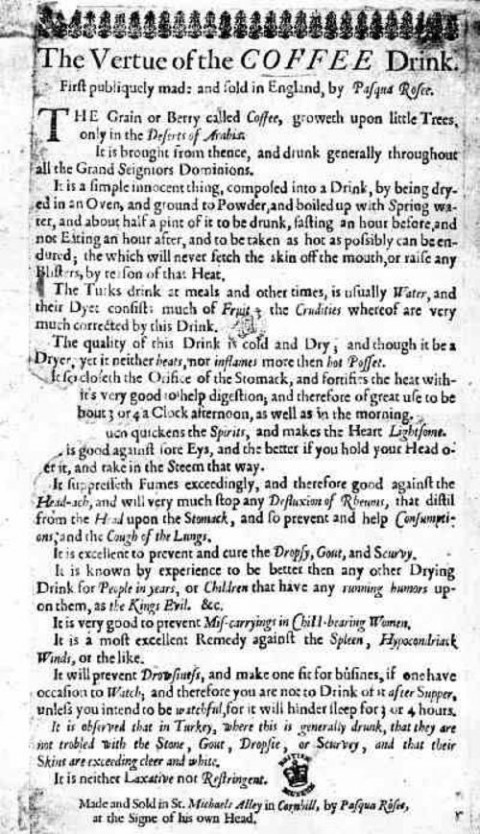
The story of coffee goes back to the 13th century, when it came out of Ethiopia, then spread to Egypt and Yemen. It reached the Middle East, Turkey, and Persia during the 16th century, and then Europe during the early 17th, though not without controversy. In Venice, some called it the ‘bitter invention of Satan,’ but the Pope, upon tasting it, gave it his blessing. By 1652, the first café in London had opened its doors on St. Michael’s Alley, bringing coffee to England—all thanks to a Sicilian immigrant, Pasqua Rosée.
Today, the British Museum houses a handbill that may well be the first advertisement for coffee in England. It proves remarkable for a couple of reasons. First, the ad introduced Brits to what’s now a staple of the Western diet, and eventually they’d bring it to North America. And, what’s more, you can see another instance of the adage that the more things change, the more they stay the same. Advertising is advertising. Then, as now, beverages were sold on their taste and health properties. And, of course, you were encouraged to consume the product not once, but twice a day. You can find a transcription of the text below.
Text:
THE Grain or Berry called Coffee, groweth upon little Trees, only in the Deserts of Arabia.
It is brought from thence, and drunk generally throughout all the Grand Seigniors Dominions.
It is a simple innocent thing, composed into a drink, by being dryed in an Oven, and ground to Powder, and boiled up with Spring water, and about half a pint of it to be drunk, fasting an hour before and not Eating an hour after, and to be taken as hot as possibly can be endured; the which will never fetch the skin off the mouth, or raise any Blisters, by reason of that Heat.
The Turks drink at meals and other times, is usually Water, and their Dyet consists much of Fruit, the Crudities whereof are very much corrected by this Drink.
The quality of this Drink is cold and Dry; and though it be a Dryer, yet it neither heats, nor inflames more than hot Posset.
It forcloseth the Orifice of the Stomack, and fortifies the heat with- [missing text] its very good to help digestion, and therefore of great use to be [missing text] bout 3 or 4 a Clock afternoon, as well as in the morning.
[missing text] quickens the Spirits, and makes the Heart Lightsome.
[missing text]is good against sore Eys, and the better if you hold your Head o’er it, and take in the Steem that way.
It supresseth Fumes exceedingly, and therefore good against the Head-ach, and will very much stop any Defluxion of Rheumas, that distil from the Head upon the Stomach, and so prevent and help Consumptionsand the Cough of the Lungs.
It is very good to prevent Mis-carryings in Child-bearing Women.
It will prevent Drowsiness, and make one fit for Busines, if one have occasion to Watch, and therefore you are not to drink of it after Supper, unless you intend to be watchful, for it will hinder sleep for 3 or 4 hours.
It is observed that in Turkey, where this is generally drunk, that they are not troubled with the Stone, Gout, Dropsie, or Scurvy, and that their Skins are exceeding cleer and white.
It is neither Laxative nor Restringent.
Made and Sold in St. Michaels Alley in Cornhill, by Pasqua Rosee, at the Signe of his own Head.
Note: An earlier version of this post appeared on our site in 2012.
Related Content
“The Virtues of Coffee” Explained in 1690 Ad: The Cure for Lethargy, Scurvy, Dropsy, Gout & More
The Birth of Espresso: The Story Behind the Coffee Shots That Fuel Modern Life
How Humanity Got Hooked on Coffee: An Animated History
The History of Electronic Music in 476 Tracks (1937–2001)

Photo of Karlheinz Stockhausen by Kathinka Pasveer via Wikimedia Commons
You may hear the phrase “electronic music” and think of superstar dubstep DJs in funny helmets at beachside celebrity parties. Alternatively, you may think of the mercurial compositions of Karlheinz Stockhausen, the musique concrete of Pierre Henry, or the otherworldly experimentalism of François Bayle. If you’re in that latter camp of music nerd, then this post may bring you very glad tidings indeed. Ubuweb—that stalwart repository of all things 20th-century avant-garde—now hosts an extraordinary compilation: the 476-song History of Electronic/Electroacoustic Music, originally a 62 CD set. (Hear below Stockhausen’s “Kontact,” Henry’s “Astrologie,” and Bayle’s spare “Theatre d’Ombres” further down.)
Spanning the years 1937–2001, the collection should especially appeal to those with an avant-garde or musicological bent. In fact, the original uploader of this archive of experimental sound, Caio Barros, put these tracks online in 2009 while a student of composition at Brazil’s State University of São Paulo. Barros’ “initiative,” as he writes at Ubuweb, “became some sort of legend” among musicophiles in the know.
And yet, Ubuweb reposts this phenomenal collection with a disclaimer: “It’s a clearly flawed selection,” they write:
There’s few women and almost no one working outside of the Western tradition (where are the Japanese? Chinese? etc.). However, as an effort, it’s admirable and contains a ton of great stuff.
Take it with a grain of salt, or perhaps use it as a provocation to curate a more intelligent, inclusive, and comprehensive selection
It’s a fair critique, though Barros points out that the exclusions mostly have to do with “the way our society and the tradition this music represent works” (sic). And yet, as disciplinary boundaries expand all the time, and histories broaden along with them, that description no longer holds. It would be a fascinating exercise, for example, to listen to these tracks alongside the history of women in electronic music, 1938–2014 that we posted recently.
Also, there’s clearly much more to electronic music than either celebrity DJs or obscure avant-garde composers. Many hundreds of popular electronic composers and musicians—like Brian Eno, Kraftwerk, Bruce Haack, or Clara Rockmore—fall somewhere in-between the worlds of pop/dance/performance and serious composition, and their contributions deserve representation alongside more experimental or classical artists.
All that said, however, there’s no reason you can’t curate your own playlist of the history of electronic music as you see it—drawing from the astounding wealth of music available free at The History of Electroacoustic Music. Or consider this collection a fully immersive course in “traditional, western avant-garde electronic music” from “the area of Europe-America,” as Barros puts it. As that, it succeeds admirably.
Note: An earlier version of this post appeared on our site in 2016.
Related Content:
What is Electronic Music?: Pioneering Electronic Musician Daphne Oram Explains (1969)
Hear Seven Hours of Women Making Electronic Music (1938- 2014)
Josh Jones is a writer and musician based in Durham, NC. Follow him at @jdmagness
Read More...When the Dutch Tried to Live in Concrete Spheres: An Introduction to the Bolwoningen in the Netherlands
In the decades after the Second World War, many countries faced the challenge of rebuilding their housing and infrastructure while also having to accommodate a fast-arriving baby boom. The government of the Netherlands got more creative than most, putting money toward experimental housing projects starting in the late nineteen-sixties. Hoping to happen upon the next revolutionary form of dwelling, it ended up funding designs that, for the most part, strayed none too far from established patterns. Still, there were genuine outliers: by far the most daring proposal came from artist and sculptor Dries Kreijkamp: to build a whole neighborhood out of Bolwoningen, or “ball houses.”
The idea may bring to mind Buckminster Fuller’s geodesic domes, which enjoyed a degree of utopian vogue in the nineteen-sixties and seventies. Like Fuller and most other visionaries, Kreijkamp labored under a certain monomania. His had to do with globes, “the most organic and natural shape possible. After all, roundness is everywhere: we live on a globe, and we’re born from a globe. The globe combines the biggest possible volume with the smallest possible surface area, so you need minimum material for it.” The 50 Bolwoningen built in ‘s‑Hertogenbosch, better known as Den Bosch, were quickly fabricated on-site out of glass fiber reinforced concrete. It wasn’t the polyester Kreijkamp had at first specified, but then, polyester wouldn’t have lasted 40 years.
Since they were put up in 1984, the Bolwoningen have been continuously inhabited. In the video at the top of the post, Youtuber Tom Scott pays a visit to one of them, whose occupant seems reasonably satisfied. (It seems they’re “cozy” in the wintertime.)
Like geodesic domes, their round walls make it difficult to use their theoretically generous interior space efficiently, at least without commissioning custom-made furniture; leaking windows are also a perennial problem. While each Bolwoning can comfortably house one or even two simple-living people, only the most utopia-minded would attempt to raise a family in one of them. As with other round or circular home designs, expansion would be physically impractical even if it were legally possible.
Used as social housing by the local government, the Bolwoningen now enjoy a protected historic status. (As well they might, given their connection with the art and industry of Dutch glassblowing: it was while working in a glass factory that Kreijkamp first began proselytizing for spheres.) And unlike most aesthetically radical housing developments, they haven’t gone to seed, but rather received the necessary maintenance over the decades. The result is an appealing neighborhood for those whose lifestyles are suited to its unusual structures and its contained bucolic setting, of which you can get an idea in the walking video tour just above. By the time Kreijkamp died in 2014, he perhaps felt a certain degree of regret that mass-produced globular homes didn’t prove to be the next big thing. But he did live to see the emergence of the “tiny house” movement, which should retroactively adopt him as one of its leading lights.
Related content:
The Life & Times of Buckminster Fuller’s Geodesic Dome: A Documentary
Goodbye to the Nakagin Capsule Tower, Tokyo’s Strangest and Most Utopian Apartment Building
The Utopian, Socialist Designs of Soviet Cities
Watch an Animated Buckminster Fuller Tell Studs Terkel All About “the Geodesic Life”
Based in Seoul, Colin Marshall writes and broadcasts on cities, language, and culture. His projects include the Substack newsletter Books on Cities and the book The Stateless City: a Walk through 21st-Century Los Angeles. Follow him on the social network formerly known as Twitter at @colinmarshall.
Read More...Elementary School Kids Sing David Bowie’s “Space Oddity” & Other Rock Hits: A Cult Classic Recorded in 1976
In 1976 and 1977 an inspired music teacher in the small school district of Langley Township, British Columbia, a suburb of Vancouver, recorded his elementary school students singing popular songs in a school gym. Two vinyl records were produced over the two years, and families were invited to pay $7 for a copy. The recordings were largely forgotten — just another personal memento stored away in a few homes in Western Canada — until a record collector stumbled across a copy in a thrift store in 2000.
Enthralled by what he heard, the collector sent a sample to a disc jockey at WFMU, an eclectic, listener-supported radio station in New Jersey. The station began playing some of the songs over the airwaves. Listeners were touched by the haunting, ethereal quality of the performances. In 2001, a small record company released a compilation called The Langley Township Music Project: Innocence & Despair.
The record became an underground hit. The Washington Post called it “an album that seems to capture nothing less than the sound of falling in love with music.” Spin said the album “seems to sum up all the reasons music is holy.” And Dwight Gamer of The New York Times wrote that the music was “magic: a kind of celestial pep rally.” Listeners were moved by the ingenuousness of the young voices, the strange authenticity of performances by children too young to understand all of the adult themes in the lyrics. As Hans Fenger, the music teacher who made the recordings, writes in the liner notes:
The kids had a grasp of what they liked: emotion, drama, and making music as a group. Whether the results were good, bad, in tune or out was no big deal — they had élan. This was not the way music was traditionally taught. But then I never liked conventional “children’s music,” which is condescending and ignores the reality of children’s lives, which can be dark and scary. These children hated “cute.” They cherished songs that evoked loneliness and sadness.
You can learn the story of Fenger’s extraordinary music project in the 2002 VH1 documentary above, which includes interviews and a reunion with some of the students. And listen below for a few samples of that touching quality of loneliness and sadness Fenger and others have been talking about.
David Bowie’s ‘Space Oddity’:
One of the most widely praised songs from Innocence & Despair is the 1976 recording of David Bowie’s “Space Oddity.” In a 2001 interview with Mike Appelstein for Scram magazine, Fenger explained the sound effects in the recording. “When I first taught ‘Space Oddity,’ ” he said, “the first part I taught after the song was the kids counting down. They loved that: they’d go ‘TEN!’ They couldn’t say it loud enough; the countdown in the song was the big winner. But as soon as they got to zero, nothing happened. So I brought this old steel guitar. Well, one of the little guys whose name I’ve forgot, I put him on this thing and said, ‘Now listen, when they get to zero, you’re the rocket. So make a lot of noise on this. He’s fooling around with this steel guitar, and I didn’t even think of this, but he intuitively took out a Coke bottle from his lunch and started doing this (imitates a bottle running up and down the fretboard). I just cranked up the volume and turned down the master volume so it was really distorted. And that was the ‘Space Oddity’ sound effect.”
The Beach Boys’ ‘In My Room’:
The children recorded “In My Room” by the Beach Boys in 1977. Fenger told Appelstein it was the ultimate children’s song. “It’s the perfect introspective song for a nine-year-old,” he said, “just as ‘Dust in the Wind’ is the perfect philosophy song for a nine-year-old. Adults may think it’s dumb, but for a child, it’s a very heavy, profound thought. To think that there is nothing, and it’s expressed in such a simple way.”
The Eagles’ ‘Desperado’:
Several of the recordings feature soloists. A young girl named Sheila Behman sang the Eagles’ “Desperado” in 1977. “With ‘Desperado,’ ” said Fenger, “you can see it as a cowboy romantic story, but that’s not the way Sheila heard it. She couldn’t articulate metaphorically what the song was about, but in that sense, I think it was purer because it was unaffected. It’s not as if the kids were trying to be somebody else. They were just trying to be who they were, and they’re doing this music and falling in love with it.”
Note: An earlier version of this post appeared on our site in 2013.
Related Content
David Bowie Urges Kids to READ in a 1987 Poster Sponsored by the American Library Association
When David Bowie Launched His Own Internet Service Provider: The Rise and Fall of BowieNet (1998)
How David Bowie Used William S. Burroughs’ Cut-Up Method to Write His Unforgettable Lyrics
Read More...Hear the Letter of Gratitude That Albert Camus Wrote to His Teacher After Winning the Nobel Prize, as Read by Footballer Ian Wright
When Albert Camus won the Nobel Prize, he wrote a letter to one of his old schoolteachers. “I let the commotion around me these days subside a bit before speaking to you from the bottom of my heart,” the letter begins. “I have just been given far too great an honor, one I neither sought nor solicited. But when I heard the news, my first thought, after my mother, was of you.” For it was from this teacher, a certain Louis Germain, that the young, fatherless Camus received the guidance he needed. “Without you, without the affectionate hand you extended to the small poor child that I was, without your teaching and example, none of all this would have happened.”
Camus ends the letter by assuring Monsieur Germain that “your efforts, your work, and the generous heart you put into it still live in one of your little schoolboys who, despite the years, has never stopped being your grateful pupil.”
In response, Germain recalls his memories of Camus as an unaffected, optimistic pupil. “I think I well know the nice little fellow you were, and very often the child contains the seed of the man he will become,” he writes. Whatever the process of intellectual and artistic evolution over the 30 years or so between leaving the classroom and winning the Nobel, “it gives me very great satisfaction to see that your fame has not gone to your head. You have remained Camus: bravo.”
It isn’t hard to understand why Camus’ letter to his teacher would resonate with the footballer Ian Wright, who reads it aloud in the Letters Live video at the top of the post. A 2005 documentary on his life and career produced the early viral video above, a clip capturing the moment of Wright’s unexpected reunion with his own academic father figure, Sydney Pigden. Coming face to face with his old mentor, who he’d assumed had died, Wright instinctively removes his cap and addresses him as “Mr. Pigden.” In that moment, the student-teacher relationship resumes: “I’m so glad you’ve done so well with yourself,” says Pigden, a sentiment not dissimilar to the one Monsieur Germain expressed to Camus. Most of us, no matter how long we’ve been out of school, have a teacher we hope to do proud; some of us, whether we know it or not, have been that teacher.
Related Content:
Hear Albert Camus Deliver His Nobel Prize Acceptance Speech (1957)
See Albert Camus’ Historic Lecture, “The Human Crisis,” Performed by Actor Viggo Mortensen
Ludwig Wittgenstein’s Short, Strange & Brutal Stint as an Elementary School Teacher
Based in Seoul, Colin Marshall writes and broadcasts on cities, language, and culture. His projects include the Substack newsletter Books on Cities and the book The Stateless City: a Walk through 21st-Century Los Angeles. Follow him on the social network formerly known as Twitter at @colinmarshall.
Read More...Watch Bob Dylan Play “Mr. Tambourine Man” in Color at the 1964 Newport Folk Festival
It was at the 1965 Newport Folk Festival that Bob Dylan famously “went electric,” alienating certain adherents to the folk scene through which he’d come up, but also setting a precedent for the kind of quick-change musical adaptation that he’s kept up into his eighties. At the 1964 Newport Folk Festival, however, all that lay in the future. Yet even then, the young Dylan wasn’t shy of making controversial choices. Take, for example, the choice to play “Mr. Tambourine Man,” a song that — however redolent of the mid-nineteen-sixties when heard today — would hardly have been topical enough to meet the expectations of folk fans who regarded the music’s topicality as its main strength.
At the top of the post, you can watch colorized footage of Dylan’s performance of “Mr. Tambourine Man” at the 1964 Newport Folk Festival; the original black-and-white clip appears below. Consider the resonances it could have set off in the minds of his youthful, clean-cut audience: Rimbaud? Fellini? Lord Buckley? Mardi Gras? Confessions of an English Opium-Eater? Dylanologists have suggested all these sources of inspiration and others. It is possible, of course, that — as Dylan himself once said — the lyrics’ central image is that of guitarist Bruce Langhorne, who played on the song as recorded for Bringing It All Back Home, a musician then known for his ownership of a gigantic tambourine.
Despite its lack of references to the issues of the day, “Mr. Tambourine Man” reflects its historical moment with a clarity that few songs ever have. (Some would say that’s even truer of The Byrds’ cover version, a radio hit that came out just a month after Dylan’s original.) Dylan himself must have sensed that it marked not just the peak of an era, but also that of his own compositional and performative efforts in this particular musical style. Though he did attempt to write a follow-up to the song, its failure to cohere showed him the way forward. Dylan still plays it in concert today, and to enthusiastic reception from his audiences, but in such a way as to reinvent it each time — knowing that he both is and is not the same man who took the stage at Newport those sixty years ago, and that “Mr. Tambourine Man” both is and is not the same song.
Related content:
Bob Dylan’s Historic Newport Folk Festival Performances, 1963–1965
Watch Bob Dylan Make His Debut at the Newport Folk Festival in Colorized 1963 Footage
How Bob Dylan Kept Reinventing His Songwriting Process, Breathing New Life Into His Music
How Bob Dylan Created a Musical & Literary World All His Own: Four Video Essays
“Mr. Tambourine Man” & Other Bob Dylan Classics, Sung Beautifully by Kids
Based in Seoul, Colin Marshall writes and broadcasts on cities, language, and culture. His projects include the Substack newsletter Books on Cities and the book The Stateless City: a Walk through 21st-Century Los Angeles. Follow him on the social network formerly known as Twitter at @colinmarshall.
Read More...Tibetan Musical Notation Is Beautiful
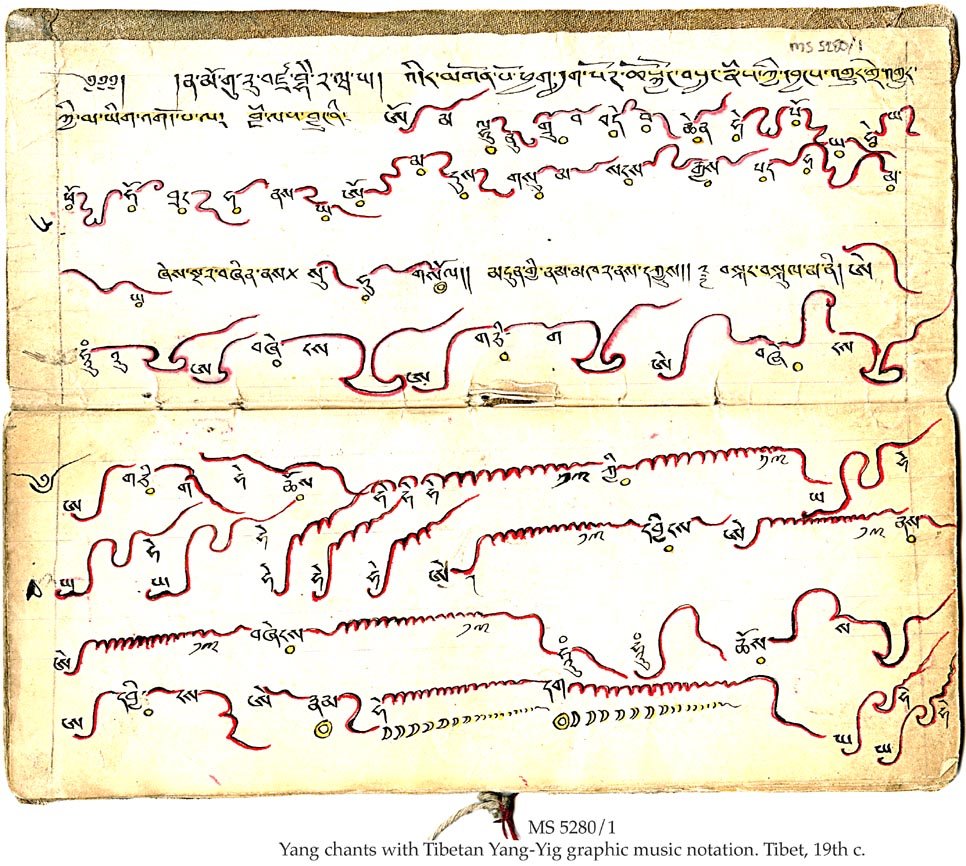
Religions take the cast and hue of the cultures in which they find root. This was certainly true in Tibet when Buddhism arrived in the 7th century. It transformed and was transformed by the native religion of Bon. Of the many creative practices that arose from this synthesis, Tibetan Buddhist music ranks very highly in importance.
As in sacred music in the West, Tibetan music has complex systems of musical notation and a long history of written religious song. “A vital component of Tibetan Buddhist experience,” explains Google Arts & Cultures Buddhist Digital Resource Center, “musical notation allows for the transference of sacred sound and ceremony across generations. A means to memorize sacred text, express devotion, ward off feral spirits, and invoke deities.”

Some of these features may be alien to secular Western Buddhists focused on mindfulness and silent meditation, but to varying degrees, Tibetan schools place considerable value on the aesthetic experience of extra-human realms. As University of Tulsa musicologist John Powell writes, “the use of sacred sound” in Tibetan Buddhism, a “Mantrayana” tradition, acts “as a formula for the transformation of human consciousness.”
Tibetan musical notations, Google points out, “symbolically represent the melodies, rhythm patterns, and instrumental arrangements. In harmony with chanting, visualizations, and hand gestures, [Tibetan] music crucially guides ritual performance.” It is characterized not only by its integration of ritual dance, but also by a large collection of ritual instruments—including the long, Swiss-like horns suited to a mountain environment—and unique forms of polyphonic overtone singing.
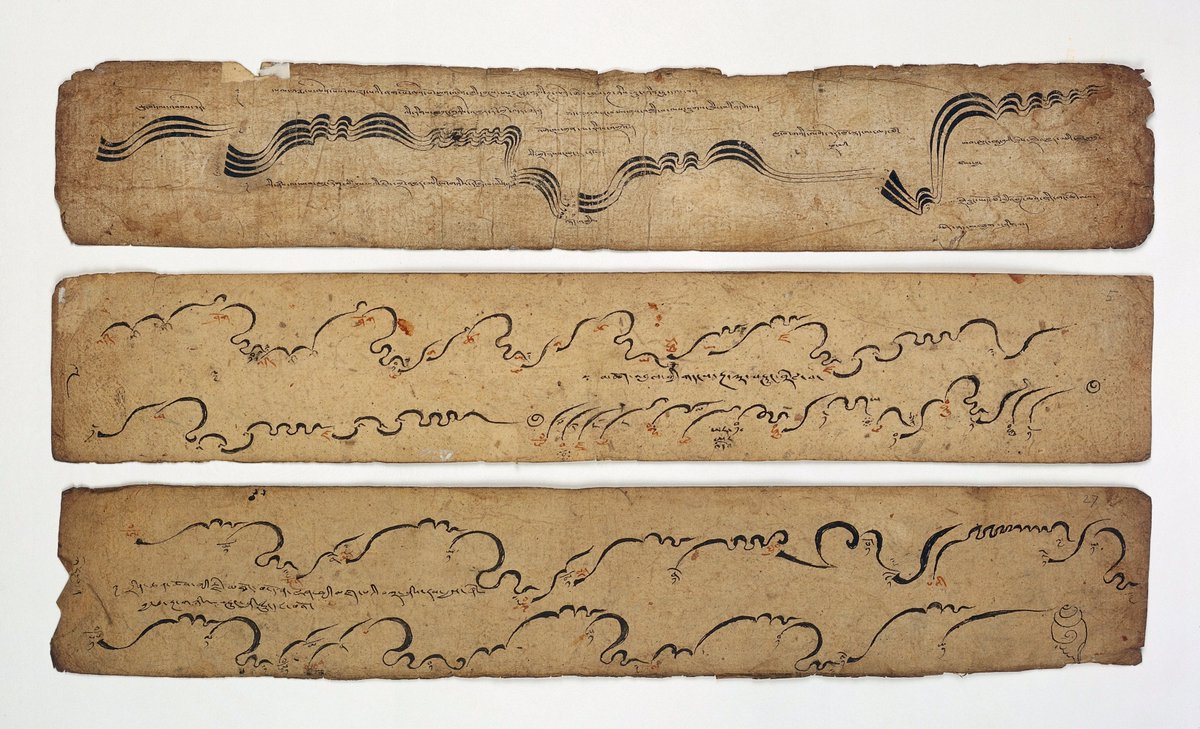
The examples of musical notation you see here came from the appropriately-named Twitter account Musical Notation is Beautiful and typeface designer and researcher Jo De Baerdemaeker. At the top is a 19th century manuscript belonging to the “Yang” tradition, “the most highly involved and regarded chant tradition in Tibetan music,” notes the Schoyen Collection, “and the only one to rely on a system of notation (Yang-Yig).”

The curved lines represent “smoothly effected rises and falls in intonation.” The notation also “frequently contains detailed instructions concerning in what spirit the music should be sung (e.g. flowing like a river, light like bird song) and the smallest modifications to be made to the voice in the utterance of a vowel.” The Yang-Yig goes all the way back to the 6th century, predating Tibetan Buddhism, and “does not record neither the rhythmic pattern nor duration of notes.” Other kinds of music have their own types of notation, such as that in the piece above for voice, drums, trumpets, horns, and cymbals.
Though they articulate and elaborate on religious ideas from India, Tibet’s musical traditions are entirely its own. “It is essential to rethink the entire concept of melody and rhythm” to understand Tibetan Buddhist chant, writes Powell in a detailed overview of Tibetan music’s vocal and instrumental qualities. “Many outside Tibetan culture are accustomed to think of melody as a sequence of rising or falling pitches,” he says. “In Tibetan Tantric chanting, however, the melodic content occurs in terms of vowel modification and the careful contouring of tones.” Hear an example of traditional Tibetan Buddhist chant just above, and learn more about Tibetan musical notation at Google Arts & Culture.
Note: An earlier version of this post appeared on our site in 2019.
Related Content:
Breathtakingly-Detailed Tibetan Book Printed 40 Years Before the Gutenberg Bible
The World’s Largest Collection of Tibetan Buddhist Literature Now Online
Free Online Course: Robert Thurman’s Introduction to Tibetan Buddhism (Recorded at Columbia U)
Leonard Cohen Narrates Film on The Tibetan Book of the Dead, Featuring the Dalai Lama (1994)
Josh Jones is a writer and musician based in Durham, NC. Follow him at @jdmagness
Read More...A Grad Student Asks Carl Sagan If He Believes in God (1994)
?si=yeo1Xsu2ZLuCpQbC
Most scientists are prepared to answer questions about their research from other members of their field; rather fewer have equipped themselves to answer questions from the general public about what Douglas Adams called life, the universe, and everything. Carl Sagan was one of that minority, an expert “science communicator” before science communication was recognized as a field unto itself. In popular books and television productions, most notably Cosmos and its accompanying series Cosmos: A Personal Voyage, he put himself out there in the mass media as an enthusiastic guide to all that was known about the realms beyond our planet. More than a few members of his audience might well have asked themselves where does God fit into all this.
One such person actually put that question to Sagan, at a Q&A session after the latter’s 1994 “lost lecture” at Cornell, titled “The Age of Exploration.” The questioner, a graduate student, asks, “Is there any type of God to you? Like, is there a purpose, given that we’re just sitting on this speck in the middle of this sea of stars?”
In response to this difficult line of inquiry, Sagan opens a more difficult one: “What do you mean when you use the word God?” The student takes another tack, asking, “Given all these demotions” — defined by Sagan himself as the continual humbling of humanity’s self-image in light of new scientific discoveries — “why don’t we just blow ourselves up?” Sagan comes back with yet another question: “If we do blow ourselves up, does that disprove the existence of God?” The student admits that he guesses it does not.
The question eventually gets Sagan considering how “the word ‘God’ covers an enormous range of different ideas.” That range “runs from an outsized, light-skinned male with a long white beard, sitting in a throne in the sky, busily tallying the fall of every sparrow,” for whose existence Sagan knows of no evidence, to “the kind of God that Einstein or Spinoza talked about, which is very close to the sum total of the laws of the universe,” and as such, whose existence even Sagan would have to acknowledge. There’s also “the deist God that many of the founding fathers of this country believed in,” who’s held to have created the universe and then removed himself from the scene. With such a broad range of possible definitions, the concept of God itself becomes useless except as “social lubrication,” a means of seeming to “agree with someone else with whom you do not agree.” Terms of that malleable kind do have their advantages, if not to the scientific mind.
Related content:
Carl Sagan, Stephen Hawking & Arthur C. Clarke Discuss God, the Universe, and Everything Else
150 Renowned Secular Academics & 20 Christian Thinkers Talking About the Existence of God
Bertrand Russell on the Existence of God & the Afterlife (1959)
Bertrand Russell and F.C. Copleston Debate the Existence of God, 1948
What Is Religion Actually For?: Isaac Asimov and Ray Bradbury Weigh In
Based in Seoul, Colin Marshall writes and broadcasts on cities, language, and culture. His projects include the Substack newsletter Books on Cities and the book The Stateless City: a Walk through 21st-Century Los Angeles. Follow him on the social network formerly known as Twitter at @colinmarshall.
Read More...A Free Yale Course on Medieval History: 700 Years in 22 Lectures
In 22 lectures, Yale historian Paul Freedman takes you on a 700-year tour of medieval history. Moving from 284‑1000 AD, this free online course covers “the conversion of Europe to Christianity, the fall of the Roman Empire, the rise of Islam and the Arabs, the ‘Dark Ages,’ Charlemagne and the Carolingian renaissance, and the Viking and Hungarian invasions.” And let’s not forget St. Augustine and the “Splendor of Byzantium.”
You can stream all of the lectures above. Or find them on YouTube and this Yale website.
The Early Middle Ages: 284‑1000 will be added to our list of Free History Courses, a subset of our meta collection, 1,700 Free Online Courses from Top Universities. Below, we’ve added a list of the key texts used in the course:
- Charlemagne’s Courtier: The Complete Einhard. ed. Paul Edward Dutton, Broadview Press, 1998.
- Gregory of Tours: The Merovingians. ed. Alexander Callander Murray, Broadview Press, 2006.
- Procopius, The Secret History. ed. Richard Atwater, University of Michigan Press, 1961.
- Wickham, Chris, The Inheritance of Rome: A History of Europe from 400 to 1000. Viking, 2009.
- Richards, Julian, The Vikings: A Very Short History. Oxford University Press, 2005.
If you would like to support the mission of Open Culture, consider making a donation to our site. It’s hard to rely 100% on ads, and your contributions will help us continue providing the best free cultural and educational materials to learners everywhere. You can contribute through PayPal, Patreon, and Venmo (@openculture). Thanks!
Related Content:
Free Online History Courses
160,000+ Medieval Manuscripts Online: Where to Find Them
The Medieval Masterpiece, the Book of Kells, Is Now Digitized and Available Online
How to Make a Medieval Manuscript: An Introduction in 7 Videos
Read More...Support Us
We're hoping to rely on loyal readers, rather than erratic ads. Please click the Donate button and support Open Culture. You can use Paypal, Venmo, Patreon, even Crypto! We thank you!

About Us

Open Culture scours the web for the best educational media. We find the free courses and audio books you need, the language lessons & educational videos you want, and plenty of enlightenment in between.
Advertise With Us

FREE UPDATES!
GET OUR DAILY EMAIL
Get the best cultural and educational resources on the web curated for you in a daily email. We never spam. Unsubscribe at any time.
FOLLOW ON SOCIAL MEDIA

Open Culture editor Dan Colman scours the web for the best educational media. He finds the free courses and audio books you need, the language lessons & movies you want, and plenty of enlightenment in between.
Advertise With Us