How Four Masters—Michelangelo, Donatello, Verrocchio & Bernini—Sculpted David
More than a few visitors to Florence make a beeline to the Galleria dell’Accademia, and once inside, to Michelangelo’s David, the most famous sculpture in the world. But how many of them, one wonders, then take the time to view the three other Davids in that city alone? At the Bargello, just ten minutes’ walk away, reside two more sculptures of the young man who would be king of Israel and Judah, both of them by Michelangelo’s fellow Renaissance master Donatello. The less renowned, he made of marble in the late fourteen-hundreds; the more renowned, of bronze in the fourteen-forties, is the subject of the Smarthistory video at the top of the post.
“For a thousand years, the Christian West had looked to the soul as the place to focus. The body was seen as the path to corruption, and so it was not to be celebrated,” says the video’s host Steven Zucker. “What we’re seeing here is a return to ancient Greece and Rome’s love of the body, its respect for the body.”
And to the Florentines of the mid-fifteenth century, as co-host Beth Harris explains, this particular body wasn’t just that of “King David from the Bible,” but that of their own republic as well. Seeing themselves as the David-like underdog victorious over the Goliath that was the Duke of Milan, “they felt blessed and chosen by God” as the “heirs of the ancient Roman Republic.”
Whether or not most everyday citizens of the Florentine Republic felt that way, the banking Medici family, who effectively ran the place for centuries, surely must have. Also at the Bargello is another of the Davids they commissioned, sculpted in bronze by Andrea del Verrocchio in the fourteen-seventies. “Verrocchio gives us a very self-assured young man,” says Harris, with the beauty to be expected of a work of this genre, but also with a certain degree of anti-classicist adolescent awkwardness. In that, the work contrasts with Bernini’s, though both artists created a victorious David, standing over the head of Goliath. Michelangelo, of course, did things quite differently thirty years later, sculpting a David out of marble eternally steeling himself for the battle, at just the moment when his colossal foe comes into view.
Donatello, Verrocchio, and Michelangelo’s Davids all date from the Renaissance. The other unignorable sculpture in this tradition was created much later, in the sixteen-twenties, and also far from Florence. The David by Gian Lorenzo Bernini, who would become synonymous with the dramatic extravagance of seventeenth-century Rome, is “like a spring that’s about to unwind,” as Zucker puts it. Unlike when we behold Michelangelo’s contemplative rendition, Harris adds, “here, we’re emotionally, bodily involved,” not just because of the action pose, but also of the physical effort evident in the face. This was the Baroque era, when “the Catholic church is using art as a way to affirm and strengthen the faith of believers.” Ideas about the purpose of art may have changed in the four centuries since, but that hasn’t stopped even the lesser-known Davids from receiving a steady stream of impressed visitors.
Related Content:
Michelangelo’s David: The Fascinating Story Behind the Renaissance Marble Creation
How Michelangelo’s David Still Draws Admiration and Controversy Today
New Video Shows What May Be Michelangelo’s Lost & Now Found Bronze Sculptures
Based in Seoul, Colin Marshall writes and broadcasts on cities, language, and culture. His projects include the Substack newsletter Books on Cities and the book The Stateless City: a Walk through 21st-Century Los Angeles. Follow him on the social network formerly known as Twitter at @colinmarshall.
Read More...Neil deGrasse Tyson Lists 8 (Free) Books Every Intelligent Person Should Read

Image via Wikimedia Commons
A number of years ago, a Reddit user posed the question to Neil deGrasse Tyson: “Which books should be read by every single intelligent person on the planet?”
Below, you will find the book list offered up by the astrophysicist, director of the Hayden Planetarium, and popularizer of science. Where possible, we have included links to free versions of the books.
1.) The Bible (eBook) — “to learn that it’s easier to be told by others what to think and believe than it is to think for yourself.”
2.) The System of the World by Isaac Newton (eBook) — “to learn that the universe is a knowable place.”
3.) On the Origin of Species by Charles Darwin (eBook — Audio Book) — “to learn of our kinship with all other life on Earth.”
4.) Gulliver’s Travels by Jonathan Swift (eBook — Audio Book) — “to learn, among other satirical lessons, that most of the time humans are Yahoos.”
5.) The Age of Reason by Thomas Paine (eBook — Audio Book) — “to learn how the power of rational thought is the primary source of freedom in the world.”
6.) The Wealth of Nations by Adam Smith (eBook — Audio Book) — “to learn that capitalism is an economy of greed, a force of nature unto itself.”
7.) The Art of War by Sun Tsu (eBook — Audio Book) — “to learn that the act of killing fellow humans can be raised to an art.”
8.) The Prince by Machiavelli (eBook — Audio Book) — “to learn that people not in power will do all they can to acquire it, and people in power will do all they can to keep it.”
Tyson concludes by saying: “If you read all of the above works you will glean profound insight into most of what has driven the history of the western world.”
He has also added some more thoughts in the comments section below, saying:
Thanks for this ongoing interest in my book suggestions. From some of your reflections, it looks like the intent of the list was not as clear as I thought. The one-line comment after each book is not a review but a statement about how the book’s content influenced the behavior of people who shaped the western world. So, for example, it does no good to say what the Bible “really” meant, if its actual influence on human behavior is something else. Again, thanks for your collective interest. ‑NDTyson
If you would like to support the mission of Open Culture, consider making a donation to our site. It’s hard to rely 100% on ads, and your contributions will help us continue providing the best free cultural and educational materials to learners everywhere. You can contribute through PayPal, Patreon, and Venmo (@openculture). Thanks!
Note: An earlier version of this post appeared on our site in 2011.
Related Content:
1,000 Free Audio Books: Download Great Books for Free
The Harvard Classics: Download All 51 Volumes as Free eBooks
Neil deGrasse Tyson Offers Advice on How to Be Yourself and Achieve Your Own Greatness
1,700 Free Online Courses from Top UniversitiesNeil deGrasse Tyson Presents a Brief History of Everything in an 8.5 Minute Animation
Read More...
Discover the Only Painting Van Gogh Ever Sold During His Lifetime
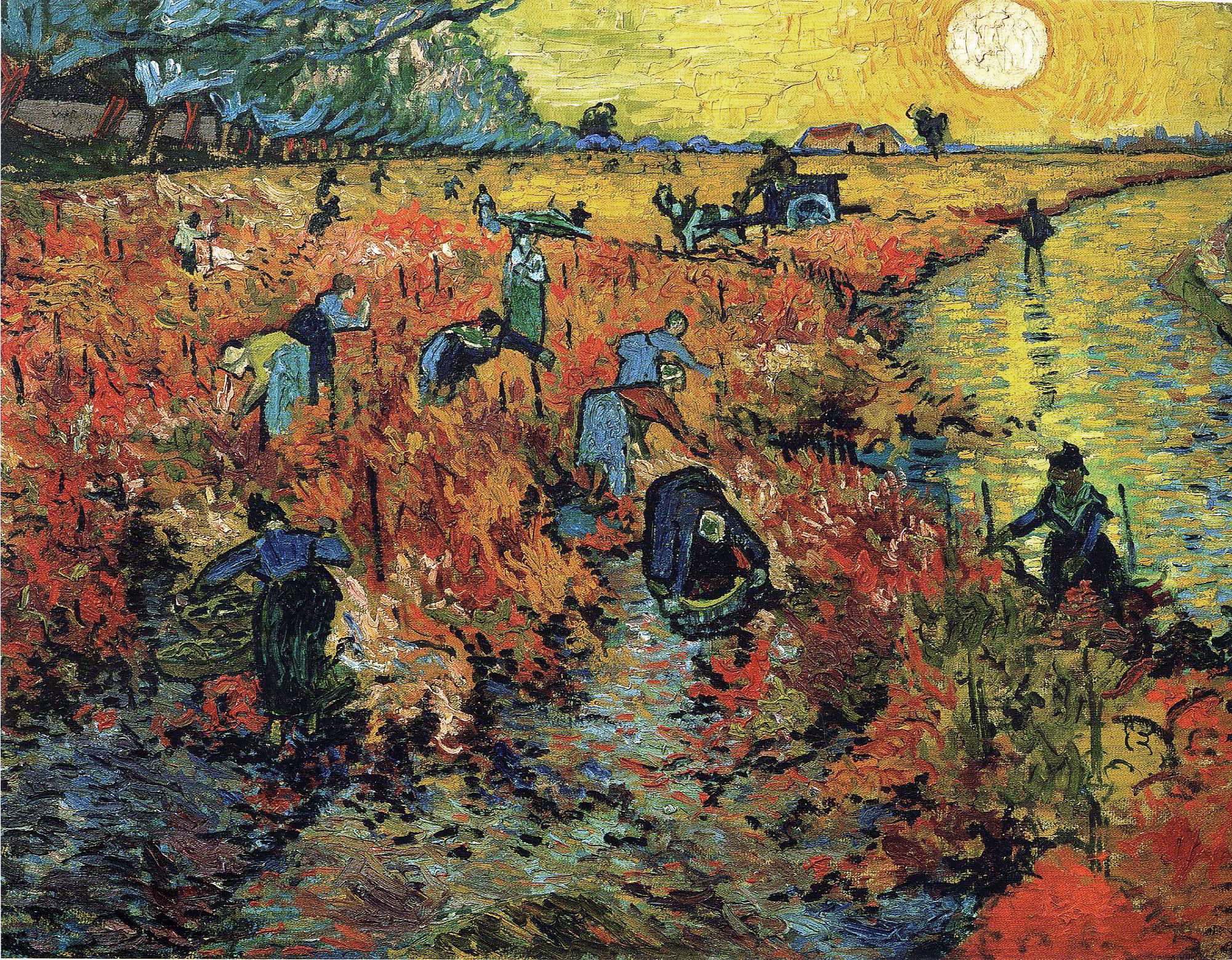
It may have crossed your mind, while beholding paintings of Vincent van Gogh, that you’d like to own one yourself someday. If so, you’ll have to get in line with more than a few billionaires, and even they may never see one go up on the auction block. This would probably come as a surprise to van Gogh himself, who died destitute — and practically unknown — after an artistic career of just ten years. In that time, he managed to sell exactly one painting, at least according to certain definitions of “sell.” Van Gogh did barter paintings for food and art supplies, and he did accept commissions, beginning with one from his art-dealer uncle Cor. But as for sales made to non-relatives through an official show, we only know of one: La vigne rouge.
Known in English as The Red Vineyards near Arles, or simply The Red Vineyard, the painting depicts a landscape van Gogh came across “on a late afternoon walk with Paul Gauguin on 28 October 1888, five days after his friend’s arrival in Arles.” So writes Martin Bailey at The Art Newspaper, who adds that “picking the grapes normally takes place in September in Provence, but the harvest seems to have been late that year.”
To his brother Theo, Vincent described the scene thus: “A red vineyard, completely red like red wine. In the distance it became yellow, and then a green sky with a sun, fields violet and sparkling yellow here and there after the rain in which the setting sun was reflected.” The artist was not, however, moved to set up his canvas then and there; rather, he painted the vineyard the next month, from memory.
Vincent let Theo hang the resulting canvas in his Paris apartment until he asked for it back in order to exhibit it in the annual Brussels show put on by a group called Les Vingt in early 1890. The Red Vineyards’ buyer was one of their number, a certain Anna Boch, the sister of van Gogh’s colleague in impressionism (and onetime portrait subject) Eugène Boch. Though she was no relation, Anna did pay full sticker price for the painting, and van Gogh later expressed some regret about not giving her a “friend’s price.” But whatever it cost her, it was surely a steal compared to its value today, after its purchase by a Russian collector, its revolutionary expropriation, and its long Soviet suppression followed by proud exhibition at Moscow’s Pushkin State Museum of Fine Arts — which, owing to the painting’s fragility, won’t even lend it out.
Related content:
1,500 Paintings & Drawings by Vincent van Gogh Have Been Digitized & Put Online
Vincent Van Gogh’s The Starry Night: Why It’s a Great Painting in 15 Minutes
Based in Seoul, Colin Marshall writes and broadcasts on cities, language, and culture. His projects include the Substack newsletter Books on Cities and the book The Stateless City: a Walk through 21st-Century Los Angeles. Follow him on the social network formerly known as Twitter at @colinmarshall.
Read More...How 16th-Century Artist Joris Hoefnagel Made Insects Beautiful—and Changed Science Forever
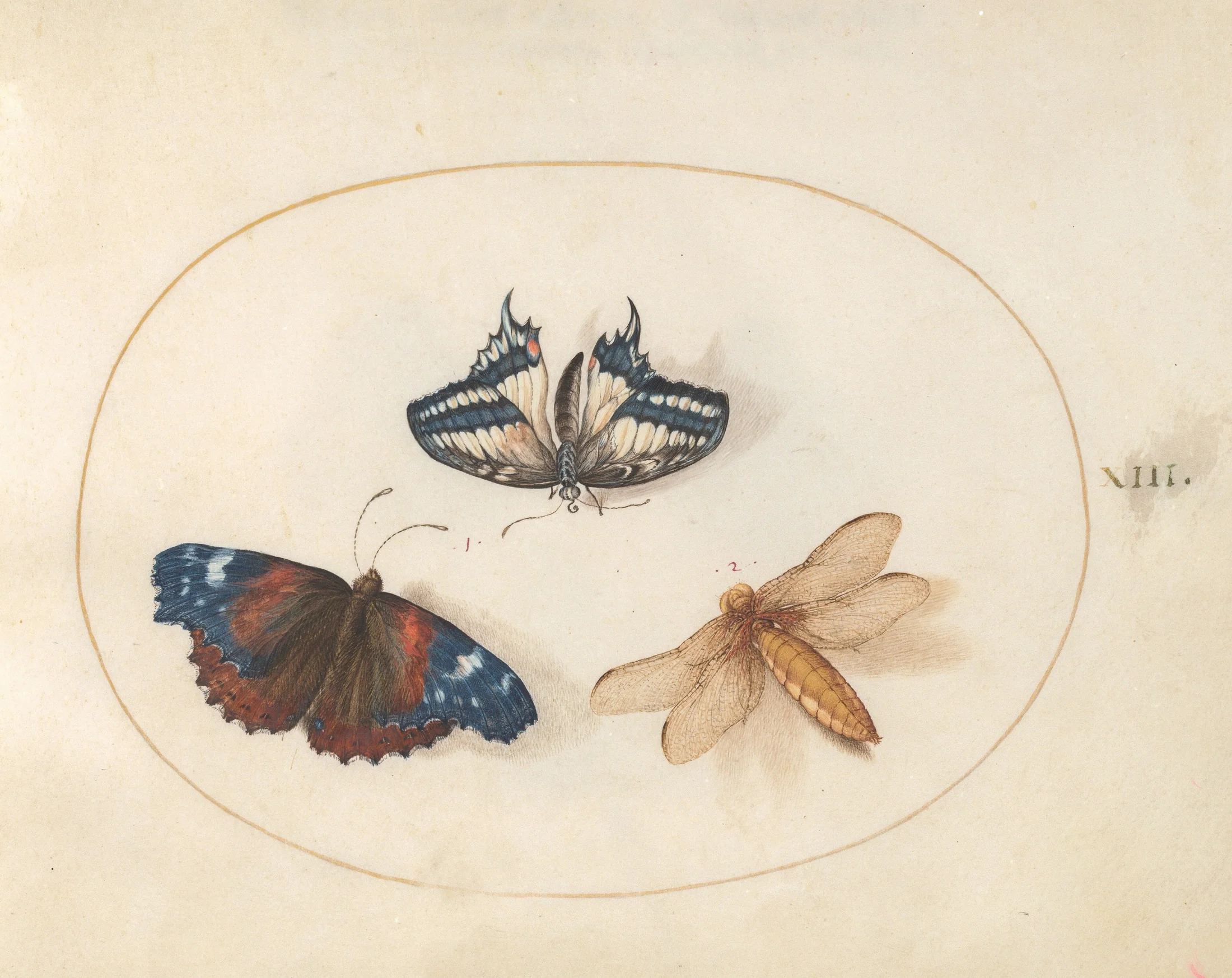
In English, most of the words we’d use to refer to insects sound off-putting at best and fearsome at worst, at least to those without an entomological bent. Dutch, close a linguistic relation though it may be, offers a more endearing alternative in beestjes, which refers to all these “little beasts” in which the artists and scientists of Europe started to take a major interest in the late sixteenth century. As was the style of that era, the magisteria of art and science tended to overlap, a phenomenon nowhere more clearly reflected — at least with regard to the insect kingdom — than in the work of Joris Hoefnagel, a Flemish artist whose illustrations of beestjes combined beauty and accuracy in a manner never seen before.
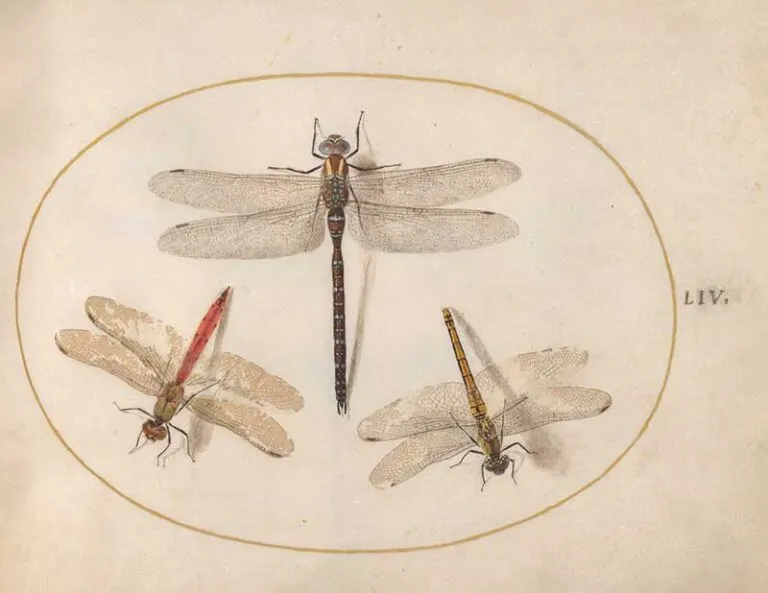
You can now see Hoefnagel’s art up close at the exhibition Little Beasts: Art, Wonder, and the Natural World, which will be up at the National Gallery of Art in Washington, DC until early November. If you won’t be able to make it out to the museum, have a look at the exhibition’s web site, which shows off the splendor of Hoefnagel’s work as published in The Four Elements, a collection of about 300 watercolors grouped into four volumes in the fifteen-seventies and eighties, each one named for an element: Aqua contains water animals; Terra land animals; Aier birds and plants; and Ignis, or “fire,” insects.
“We don’t really know why Hoefnagel put insects in the fire volume,” says Evan “Nerdwriter” Puschak in the new video above. “Maybe because both fire and insects symbolize transformation.”

“What we do know,” Puschak adds, “is that these insect miniatures are magnificently rendered.” Hoefnagel even made improvements on the nature illustrations of his artistic predecessor Albrecht Dürer, whose own abilities to render our world with fidelity had been regarded as nearly superhuman. One particular work that surpasses Dürer is Hoefnagel’s depiction of a stag beetle, which he accompanied with the Latin inscription “SCARABEI UMBRA,” or “the shadow of the stag beetle”: possibly a reference to the unprecedented realism of the insect’s shadow as Hoefnagel rendered it, but in any case a common saying at the time about hollow threats. For however frightening the stag beetle looked, as Hoefnagel well knew, the actual creature was gentle — just another wee beastie after all.
Related Content:
The Genius of Albrecht Dürer Revealed in Four Self-Portraits
Vladimir Nabokov’s Delightful Butterfly Drawings
Two Million Wondrous Nature Illustrations Put Online by The Biodiversity Heritage Library
Captivating Collaboration: Artist Hubert Duprat Uses Insects to Create Golden Sculptures
Watch The Insects’ Christmas from 1913: A Stop Motion Film Starring a Cast of Dead Bugs
Based in Seoul, Colin Marshall writes and broadcasts on cities, language, and culture. His projects include the Substack newsletter Books on Cities and the book The Stateless City: a Walk through 21st-Century Los Angeles. Follow him on the social network formerly known as Twitter at @colinmarshall.
Read More...Iconic Animator Chuck Jones Creates an Oscar-Winning Animation About the Virtues of Universal Health Care (1949)
While our country looks like it might be coming apart at the seams, it’s good to revisit, every once in a while, moments when it did work. And that’s not so that we can feel nostalgic about a lost time, but so that we can remind ourselves how, given the right conditions, things could work well once again.
One example from history (and recently rediscovered by a number of blogs during the AHCA debacle in Congress) is this government propaganda film from 1949—the Harry S. Truman era—that promotes the idea of cradle-to-grave health care, and all for three cents a week. This money went to school nurses, nutritionists, family doctors, and neighborhood health departments.
Directed by Chuck Jones, better known for animating Bugs Bunny, Porky Pig, Daffy Duck, and the Road Runner, “So Much for So Little” follows our main character from infancy—where doctors help immunize babies against whooping cough, diphtheria, rheumatic fever, and smallpox—through school to dating, marriage, becoming parents, and settling into a nice, healthy retirement. Along the way, the government has made sure that health care is nothing to worry about.
The film won an Academy Award in 1950 for Documentary Short Subject—not best sci-fi, despite how radical this all sounds.
So what happened? John Maher at the blog Dot and Line puts it this way:
Partisanship and capitalism and racist zoning policies shattered its idealistic dream that Americans might actually pay communally for their health as well as that of their neighbors and fellow citizens.
Three cents per American per week wouldn’t cut it now in terms of universal health coverage. But according to Maher, quoting a 2009 Kingsepp study on the original Affordable Care Act, taxpayers would have to pay $3.61 a week.
So folks, don’t get despondent, get idealistic. The Greatest Generation came back from WWII with a grand idealism. Maybe this current generation just needs to fight and defeat Nazis all over again…
Note: An earlier version of this post appeared on our site in 2017.
Related Content:
How to Draw Bugs Bunny: A Primer by Legendary Animator Chuck Jones
Ted Mills is a freelance writer on the arts.
Read More...A Visualization of the History of Technology: 1,889 Innovations Across Three Million Years

“Any sufficiently advanced technology is indistinguishable from magic.” So holds the third and most famous of the “three laws” originally articulated by science fiction writer Arthur C. Clarke. Even when it was first published in the late nineteen-sixties, Clarke’s third law would have felt true to any resident of the developed world, surrounded by and wholly dependent on advanced technologies whose workings they could scarcely hope to explain. Naturally, it feels even truer now, a quarter of the way into our digital twenty-first century. Indeed, for all we know about how they really work, our credit cards, our smartphones, our computers, and indeed the internet itself might as well be magic.

To best understand the technology that increasingly makes up our world, we should attempt to understand the evolution of that technology. Those smartphones, for example, couldn’t have been invented in the form we know them without the previous developments of chemically strengthened glass, the multi-touch screen interface, and the camera phone. Each of those individual technologies also has its predecessors: follow the chain back far enough, and eventually you get to the likes of the mobile radio telephone, invented in 1946; the phased array antenna, invented in 1905; and glass, invented around 1500 BC. These and countless other paths can be traced at the Historical Tech Tree, an ambitious project of writer and programmer Étienne Fortier-Dubois.
Fortier-Dubois credits among his inspirations Sid Meier’s Civilization games, with their all-important “tech trees,” and James Burke’s television series Connections, which highlighted the unpredictable processes by which one innovation could lead to others across the centuries or millennia. Even in the seventies, Fortier-Dubois writes, “Burke was already concerned that our lives depend on technological systems that very few people deeply understand. It is, of course, possible to live without comprehending how computers, money, or airplanes work. But when everything around us feels vaguely magical, reliant on experts whose actions we have no way of verifying, it’s easy to lose trust in technological solutions to our current problems.” He offers the Historical Tech Tree as a potential corrective to that loss of understanding and the enervating attitudes it produces.

Fortier-Dubois himself admits that the project “made me realize how little I knew about the objects around me. I didn’t really know that ‘electronics’ meant controlling the flow of electrons with vacuum tubes or semiconductors, or that refining petroleum into kerosene uses fractional distillation, or that WiFi and bluetooth are just the use of certain radio frequencies that can be detected by a specific kind of chip.” Anyone who explores even this early version of the Historical Tech Tree (which, as of this writing, contains 1886 technologies and 2180 connections between them) will find it an educational experience in the same way, providing as it does not just knowledge about technology but a sense of how much of that knowledge we lack. Our civilization has made its way from stone tools to robotaxis, mRNA vaccines, and LLM chatbots; we’d all be better able to inhabit it with even a slightly clearer idea of how it did so. Visit the Historical Tech Tree here.
Related content:
An Interactive Timeline Covering 14 Billion Years of History: From The Big Bang to 2015
The Tree of Languages Illustrated in a Big, Beautiful Infographic
The History of Philosophy Visualized
The History of Modern Art Visualized in a Massive 130-Foot Timeline
Based in Seoul, Colin Marshall writes and broadcasts on cities, language, and culture. His projects include the Substack newsletter Books on Cities and the book The Stateless City: a Walk through 21st-Century Los Angeles. Follow him on the social network formerly known as Twitter at @colinmarshall.
Read More...Hear the World’s Oldest Instrument, the “Neanderthal Flute,” Dating Back Over 43,000 Years
Several years ago, we brought you a transcription and a couple of audio interpretations of the oldest known song in the world, discovered in the ancient Syrian city of Ugarit and dating back to the 14th century B.C.E.. Likely performed on an instrument resembling an ancient lyre, the so-called “Hurrian Cult Song” or “Hurrian Hymn No. 6” sounds otherworldly to our ears, although modern-day musicologists can only guess at the song’s tempo and rhythm.
When we reach even further back in time, long before the advent of systems of writing, we are completely at a loss as to the forms of music prehistoric humans might have preferred. But we do know that music was likely a part of their everyday lives, as it is ours, and we have some sound evidence for the kinds of instruments they played. In 2008, archeologists discovered fragments of flutes carved from vulture and mammoth bones at a Stone Age cave site in southern Germany called Hohle Fels. These instruments date back 42,000 to 43,000 years and may supplant earlier findings of flutes at a nearby site dating back 35,000 years.

Image via the The Archaeology News Network
The flutes are meticulously crafted, reports National Geographic, particularly the mammoth bone flute, which would have been “especially challenging to make.” At the time of their discovery, researchers speculated that the flutes “may have been one of the cultural accomplishments that gave the first European modern-human (Homo sapiens) settlers an advantage over their now extinct Neanderthal-human (Homo neanderthalensis) cousins.” But as with so much of our knowledge about Neanderthals, including new evidence of interbreeding with Homo sapiens, these conclusions may have to be revised.
It is perhaps possible that the much-underestimated Neanderthals made their own flutes. Or so a 1995 discovery of a flute made from a cave bear femur might suggest. Found by archeologist Ivan Turk in a Neanderthal campsite at Divje Babe in northwestern Slovenia, this instrument (above) is estimated to be over 43,000 years old and perhaps as much as 80,000 years old. According to musicologist Bob Fink, the flute’s four finger holes match four notes of a diatonic (Do, Re, Mi…) scale. “Unless we deny it is a flute at all,” Fink argues, the notes of the flute “are inescapably diatonic and will sound like a near-perfect fit within ANY kind of standard diatonic scale, modern or antique.” To demonstrate the point, the curator of the Slovenian National Museum had a clay replica of the flute made. You can hear it played at the top of the post by Slovenian musician Ljuben Dimkaroski.
The prehistoric instrument does indeed produce the whole and half tones of the diatonic scale, so completely, in fact, that Dimkaroski is able to play fragments of several compositions by Beethoven, Verdi, Ravel, Dvořák, and others, as well as some free improvisations “mocking animal voices.” The video’s YouTube page explains his choice of music as “a potpourri of fragments from compositions of various authors,” selected “to show the capabilities of the instrument, tonal range, staccato, legato, glissando….” (Dimkaroski claims to have figured out how to play the instrument in a dream.) Although archeologists have hotly disputed whether or not the flute is actually the work of Neanderthals, as Turk suggested, should it be so, the finding would contradict claims that the close human relatives “left no firm evidence of having been musical.” But whatever its origin, it seems certainly to be a hominid artifact—not the work of predators—and a key to unlocking the prehistory of musical expression.
Note: An earlier version of this post appeared on our site in 2015.
Related Content:
Hear the Oldest Song in the World: A Sumerian Hymn Written 3,400 Years Ago
What Ancient Greek Music Sounded Like: Hear a Reconstruction That is ‘100% Accurate’
Josh Jones is a writer and musician based in Durham, NC. Follow him at @jdmagness
Read More...Watch the Very First YouTube Video, a Defining Moment in Internet History
Given the dominance YouTube has achieved over large swaths of world culture, we’d all expect to remember the first video we watched there. Yet many or most of us don’t: rather, we simply realized, one day in the mid-to-late two-thousands, that we’d developed a daily YouTube habit. Like as not, your own introduction to the platform came through a video too trivial to make much of an impression, assuming you could get it to load at all. (We forget, in this age of instantaneous streaming, how slow YouTube could be at first.) But perhaps the triviality was the point, a precedent set by the first YouTube video ever uploaded, “Me at the Zoo.”
“Alright, so here we are in front of the, uh, elephants,” says YouTube co-founder Jawed Karim, standing before those animals’ enclosure at the San Diego Zoo. “The cool thing about these guys is that, is that they have really, really, really long, um, trunks, and that’s, that’s cool. And that’s pretty much all there is to say.”
The runtime is 19 seconds. The upload date is April 24, 2005, two years before “Charlie Bit My Finger” and “Chocolate Rain,” four years before The Joe Rogan Experience, and seven years before “Gangnam Style.” The pop-cultural force that is MrBeast, then a child known only as Jimmy Donaldson, would have been anticipating his seventh birthday.
“After the zoo, the deluge,” wrote Virginia Heffernan in a 2009 New York Times piece on YouTube’s first four and a half years, when the site contained barely any of the content with which we associate it today. If you have a favorite YouTube channel, it probably didn’t exist then. Heffernan approached the “fail,” “haul,” and “unboxing” videos going viral at the time as new cultural forms, as indeed they were, but the conventions of the YouTube video as we now know them had yet to crystallize. Not everyone who saw the likes of “Me at the Zoo” would have understood the promise of YouTube. Perhaps it didn’t feel particularly revelatory to be informed that elephants have trunks — but then, that’s still more informative than many of the countless explainer videos being uploaded as we speak.
Related Content:
How to Watch Hundreds of Free Movies on YouTube
The Very First Webcam Was Invented to Keep an Eye on a Coffee Pot at Cambridge University
The Complete History of the Music Video: From the 1890s to Today
Based in Seoul, Colin Marshall writes and broadcasts on cities, language, and culture. His projects include the Substack newsletter Books on Cities and the book The Stateless City: a Walk through 21st-Century Los Angeles. Follow him on the social network formerly known as Twitter at @colinmarshall.
Read More...Hear Alan Watts’s 1960s Prediction That Automation Will Necessitate a Universal Basic Income
One of the most propulsive forces in our social and economic lives is the rate at which emerging technology transforms every sphere of human labor. Despite the political leverage obtained by fearmongering about immigrants and foreigners, it’s the robots who are actually taking our jobs. It is happening, as former SEIU president Andy Stern warns in his book Raising the Floor, not in a generation or so, but right now, and exponentially in the next 10–15 years.
Self-driving cars and trucks will eliminate millions of jobs, not only for truckers and taxi (and Uber and Lyft) drivers, but for all of the people who provide goods and services for those drivers. AI will take over for thousands of coders and may even soon write articles like this one (warning us of its impending conquest). What to do? The current buzzword—or buzz-acronym—is UBI, which stands for “Universal Basic Income,” a scheme in which everyone would receive a basic wage from the government for doing nothing at all. UBI, its proponents argue, is the most effective way to mitigate the inevitably massive job losses ahead.
Those proponents include not only labor leaders like Stern, but entrepreneurs like Peter Barnes and Elon Musk (listen to him discuss it below), and political philosophers like Georgetown University’s Karl Widerquist. The idea is an old one; its modern articulation originated with Thomas Paine in his 1795 tract Agrarian Justice. But Thomas Paine did not foresee the robot angle. Alan Watts, on the other hand, knew precisely what lay ahead for post-industrial society back in the 1960s, as did many of his contemporaries.
The English Episcopal priest, lecturer, writer, and popularizer of Eastern religion and philosophy in England and the U.S. gave a talk in which he described “what happens when you introduce technology into production.” Technological innovation enables us to “produce enormous quantities of goods… but at the same time, you put people out of work.”
You can say, but it always creates more jobs, there’ll always be more jobs. Yes, but lots of them will be futile jobs. They will be jobs making every kind of frippery and unnecessary contraption, and one will also at the same time beguile the public into feeling that they need and want these completely unnecessary things that aren’t even beautiful.
Watts goes on to say that this “enormous amount of nonsense employment and busywork, bureaucratic and otherwise, has to be created in order to keep people working, because we believe as good Protestants that the devil finds work for idle hands to do.” People who aren’t forced into wage labor for the profit of others, or who don’t themselves seek to become profiteers, will be trouble for the state, or the church, or their family, friends, and neighbors. In such an ethos, the word “leisure” is a pejorative one.
So far, Watts’ insights are right in line with those of Bertrand Russell and Buckminster Fuller, whose critiques of meaningless work we covered in an earlier post. Russell, writes philosopher Gary Gutting, argued “that immense harm is caused by the belief that work is virtuous.” Harm to our intellects, bodies, creativity, scientific curiosity, environment. Watts also suggests that our fixation on jobs is a relic of a pre-technological age. The whole purpose of machinery, after all, he says, is to make drudgery unnecessary.
Those who lose their jobs—or who are forced to take low-paying service work to survive—now must live in greatly diminished circumstances and cannot afford the surplus of cheaply-produced consumer goods churned out by automated factories. This Neoliberal status quo is thoroughly, economically untenable. “The public has to be provided,” says Watts, “with the means of purchasing what the machines produce.” That is, if we insist on perpetuating economies of scaled-up production. The perpetuation of work, however, simply becomes a means of social control.
Watts has his own theories about how we would pay for a UBI, and every advocate since has varied the terms, depending on their level of policy expertise, theoretical bent, or political persuasion. It’s important to point out, however, that UBI has never been a partisan idea. It has been favored by civil rights leaders like Martin Luther King and controversial conservative writers like Charles Murray; by Keynesians and supply-siders alike. A version of UBI at one time found a proponent in Milton Friedman, as well as Richard Nixon, whose UBI proposal, Stern notes, “was passed twice by the House of Representatives.” (See Stern below discuss UBI and this history.)
During the sixties, a lively debate over UBI took place among economists who foresaw the situation Watts describes and also sought to simplify the Byzantine means-tested welfare system. The usual congressional bickering eventually killed Universal Basic Income in 1972, but most Americans would be surprised to discover how close the country actually came to implementing it, under a Republican president. (There are now existing versions of UBI, or revenue sharing schemes in limited form, in Alaska, and several countries around the world, including the largest experiment in history happening in Kenya.)
To learn more about the long history of basic income ideas, see this chronology at the Basic Income Earth Network. Watts mentions his own source for many of his ideas on the subject, Robert Theobald, whose 1963 Free Men and Free Markets defied left and right orthodoxies, and was consistently mistaken for one or the other. (Theobald introduced the term guaranteed basic income.) Watts, who would be 101 today, had other thoughts on economics in his essay “Wealth Versus Money.” Some of these now seem, writes Maria Popova at Brain Pickings, “bittersweetly naïve” in retrospect. But when it came to technological “disruptions” of capitalism and the effect on work, Watts was cannily perceptive. Perhaps his ideas about basic income were as well.
Note: An earlier version of this post appeared on our site in 2017.
Related Content:
When John Maynard Keynes Predicted a 15-Hour Workweek “in a Hundred Year’s Time” (1930)
Bertrand Russell & Buckminster Fuller on Why We Should Work Less, and Live and Learn More
Charles Bukowski Rails Against 9‑to‑5 Jobs in a Brutally Honest Letter (1986)
The Employment: A Prize-Winning Animation About Why We’re So Disenchanted with Work Today
Josh Jones is a writer and musician based in Durham, NC. Follow him at @jdmagness
Read More...Why Bob Dylan’s Unreleased “Blind Willie McTell” Is Now Considered a Masterpiece
Most Dylanologists disagree about which is the single greatest song in Bob Dylan’s catalog, but few would deny “Blind Willie McTell” a place high in the running. It may come as a surprise — or, to those with a certain idea of Dylan and his fan base, the exact opposite of a surprise — to learn that that song is an outtake, recorded but never quite completed in the studio and available for years only in bootleg form. “Blind Willie McTell” was a product of the sessions for what would become Infidels. Released in 1983, that album was received as something of a return to form after the Christian-themed trilogy of Slow Train Coming, Saved, and Shot of Love that Dylan put out after being born again.
Of the material officially included on Infidels, the greatest impact was probably made by the album’s opener “Jokerman,” at least in the punk rendition Dylan performed on Late Night with David Letterman. Not that every Dylanologist is a fan of that song: in the Daily Maverick, Drew Forrest calls it “random and incoherent,” drawing an unfavorable comparison with “Blind Willie McTell,” which is “sure to be remembered as one of Dylan’s most perfect creations.”
The sources of that perfection are many, as explained by Noah Lefevre in the new, nearly 50-minute long Polyphonic video above on this “unreleased masterpiece,” whose origin and afterlife underscore how thoroughly Dylan inhabits the musical traditions from which he draws.
Like most major Dylan songs, “Blind Willie McTell” exists in several versions, but the one most listeners know (officially released in 1991, eight years after its recording) features Mark Knopfler on twelve-string guitar and Dylan himself on piano. Melodically based on the jazz standard “St. James Infirmary Blues” and named after a real, prolific musician from Georgia, its sparse music and lyrics manage to evoke a panoramic view encompassing the blues, the Bible, the ways of the old South, and indeed, the very history of American music and slavery. Though Dylan himself considered the song unfinished, he came around to see its value after hearing The Band work it into their show, and has by now performed it live himself more than 200 times — none, in adherence to the protean character of blues, folk, and jazz, quite the same as the last.
Related content:
A Massive 55-Hour Chronological Playlist of Bob Dylan Songs: Stream 763 Tracks
“Tangled Up in Blue”: Deciphering a Bob Dylan Masterpiece
How Bob Dylan Kept Reinventing His Songwriting Process, Breathing New Life Into His Music
How Bob Dylan Created a Musical & Literary World All His Own: Four Video Essays
Based in Seoul, Colin Marshall writes and broadcasts on cities, language, and culture. His projects include the Substack newsletter Books on Cities and the book The Stateless City: a Walk through 21st-Century Los Angeles. Follow him on the social network formerly known as Twitter at @colinmarshall.
Read More...Support Us
We're hoping to rely on loyal readers, rather than erratic ads. Please click the Donate button and support Open Culture. You can use Paypal, Venmo, Patreon, even Crypto! We thank you!

About Us

Open Culture scours the web for the best educational media. We find the free courses and audio books you need, the language lessons & educational videos you want, and plenty of enlightenment in between.
Advertise With Us

FREE UPDATES!
GET OUR DAILY EMAIL
Get the best cultural and educational resources on the web curated for you in a daily email. We never spam. Unsubscribe at any time.
FOLLOW ON SOCIAL MEDIA

Open Culture editor Dan Colman scours the web for the best educational media. He finds the free courses and audio books you need, the language lessons & movies you want, and plenty of enlightenment in between.
Advertise With Us


