A Behind-the-Scenes Tour of NPR’s Tiny Desk Concert
Back in 2008, Bob Boilen (host of All Songs Considered) and NPR music critic Stephen Thompson attended a noisy concert where they struggled to hear Laura Gibson perform. Jokingly, Thompson suggested that Gibson perform at Boilen’s office desk instead. She did. And, with that, the NPR Tiny Desk Concert was born. Since then, more than 1,300 musical acts have performed their own stripped-down, authentic shows in the cramped confines of NPR’s headquarters in Washington, D.C. That includes everyone from Taylor Swift to Dua Lipa, to the Pixies, the Grateful Dead’s Bob Weir, and Gary Clark Jr. In the video above, Architectural Digest takes you behind the scenes, showing the set where the magic happens. There you can see “a real desk in a real office, surrounded by shelves packed with priceless mementos left by artists–from Adele’s water bottle to Sabrina Carpenter’s martini glass and even Chappell Roan’s wig.” And you can meet the team behind the production, while learning how Tiny Desk became a beloved series. Below watch a complete playlist of all Tiny Desk Concerts. Enjoy!
Related Content
Jimi Hendrix Unplugged: Two Great Recordings of Hendrix Playing Acoustic Guitar
Read More...The Entire History of English in 22 Minutes
When we speak English, we might say we’re speaking the language of Samuel Johnson, the man who wrote its first dictionary. Or we could say we’re speaking the language of Shakespeare, who coined more English terms than any other individual in history. It would make just as much sense to describe ourselves as speaking the language of the King James Bible, the mass printing of which did so much to standardize English, steamrolling flat many of the countless local variations that existed in the early seventeenth century. But as many an Englishman (and more than a few Americans) would be loath to admit, when we speak English, we are, much of the time, actually speaking French.
“In 1066, the Normans turn up and seize the English throne from the Anglo-Saxons says YouTuber Robwords in the new video above, describing the single most important event in the entire history of the English language, which he recounts in just 22 minutes. “William the Conqueror becomes king, and Norman French becomes the language of England’s élite.”
Under its new ruler, the country’s earls, thanes, and athelings would be called barons, dukes, and princes. “The now-subdued Anglo-Saxons needed to learn French words if they wanted to get by, so English absorbs a whole host of French terms associated with power, justice, art, government, law, and culture — such as power, justice, art, government, law, and culture,” to name just a few.
This thoroughgoing Frenchification gave rise to what we now call Middle English, as distinct from the Old English spoken before. As noted by RobWords, about 85 percent of Old English vocabulary is no longer in use today, yet we’re still “using Old English in every sentence that we utter,” not least when we break out such irregular-seeming plurals as mice, oxen, and wolves. Tuesday, Wednesday, Thursday, and Friday make reference to “the Anglo-Saxons’ pre-Christian gods.” And even in the fast-changing, slang-ridden, internet-influenced, and — for better or for worse — highly “globalized” English we speak today, we can still hear dim echoes of the ancient ancestor linguists call Proto-Indo-European. Perhaps that’s why, despite being so widely spoken, English is still so tricky to learn: when we speak it, we’re speaking not just a language, but many languages all at once.
Related content:
The History of the English Language in Ten Animated Minutes
Tracing English Back to Its Oldest Known Ancestor: An Introduction to Proto-Indo-European
Where Did the English Language Come From?: An Animated Introduction
The Tree of Languages Illustrated in a Big, Beautiful Infographic
The Alphabet Explained: The Origin of Every Letter
Based in Seoul, Colin Marshall writes and broadcasts on cities, language, and culture. His projects include the Substack newsletter Books on Cities and the book The Stateless City: a Walk through 21st-Century Los Angeles. Follow him on the social network formerly known as Twitter at @colinmarshall.
Read More...How the Ancient Greeks Built Their Magnificent Temples: The Art of Ancient Engineering
Doric, Ionic, Corinthian: these, as practically everyone who went through school in the West somehow remembers, are the three varieties of classical column. We may still recall them, more specifically, as representing the three ancient Greek architectural styles. But as ancient-history YouTuber Garrett Ryan points out in the new Told in Stone video above, only Doric and Ionic columns belong fully to ancient Greece; what we think of when we think of Corinthian columns were developed more in the civilization of ancient Rome. The context is an explanation of how the ancient Greeks built their temples, one of the characteristics of their design process being the use of columns aplenty.
It’s one thing to hear about Greek columns in the classroom, and quite another to walk amid them in person. That, perhaps, is why Ryan delivers the opening of his video perched upon the ruins of what’s known as Temple C. Having once stood proudly in Selinus, a city belonging to Magna Graecia (Greek-speaking areas of Italy), it now constitutes one of the prime tourist attractions for antiquity-minded visitors to modern-day Sicily.
Though his channel may be called Told in Stone, Ryan begins his brief history of the Greek temple before that hardy material had even come into use for these purposes. At first, the Greeks fashioned the homes of their gods out of mud brick, with thatched roofs and wooden porches; only from the seventh century BC, “probably inspired by contact with Egypt,” did they start building them to last.
Or they built them to last as long as could be expected, in any case, given the nature of the materials available in the ancient world and the millennia that have passed since then. Take the Temple of Apollo at the Sanctuary of Didyma in modern-day Turkey, which history-and-architecture YouTuber Manuel Bravo pays a visit in the video just above. It may not look as if the nearly 2400 years since its never-technically-completed construction began have been kind, but it’s nevertheless one of the better-preserved temples from ancient Greek civilization in existence (not to mention the largest). Even in its ruined state, it gives what Bravo describes as the impression of — or at least, in its heyday, having been — “a forest of huge columns,” a built version of “the sacred forests that Greeks used to consecrate to the gods.” They’re Ionic columns, in case you were wondering, but don’t sweat it; there won’t be a quiz.
Related content:
A 3D Model Reveals What the Parthenon and Its Interior Looked Like 2,500 Years Ago
How the Parthenon Marbles Ended Up In The British Museum
The History of Ancient Greece in 18 Minutes: A Brisk Primer Narrated by Brian Cox
Based in Seoul, Colin Marshall writes and broadcasts on cities, language, and culture. His projects include the Substack newsletter Books on Cities and the book The Stateless City: a Walk through 21st-Century Los Angeles. Follow him on the social network formerly known as Twitter at @colinmarshall.
Read More...Albert Einstein Tells His Son That the Key to Learning & Happiness Is Losing Yourself in Creativity (or “Finding Flow”)
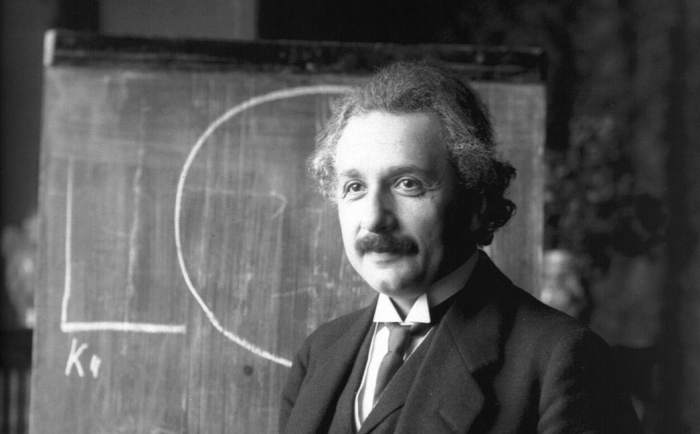
As one particularly astute observer of human emotions might put it, it is a truth universally acknowledged that we can’t all be Albert Einstein. In fact, none of us can. That unique experience was denied even Einstein’s son Hans Albert, though he did go on to his own distinguished career as an engineer and professor of hydraulics. Einstein father and son had a strained relationship, yet the great physicist had a hand in his son’s success, inspiring him to pursue his scientific passion. But Einstein’s paternal encouragement extended further, beyond scientific pursuits and toward a general theory of learning and enjoyment that suggests we can be happiest and most productive when being most ourselves.
While living in Berlin in 1915, Einstein wrote a poignant letter to his son, just two days after finishing his theory of general relativity. His tone swings from buoyant to pained—lamenting his family’s “awkward” separation and proposing to spend more time with Albert, as he calls him. His son can “learn many good and beautiful things from me,” writes Einstein, “These days I have completed one of the most beautiful works of my life.”
Einstein also writes, “I am very pleased that you find joy with the piano. This and carpentry are in my opinion for your age the best pursuits.” An amateur musician himself, Einstein understood the value of developing an informal avocation. “Mainly play the things on the piano which please you,” he tells his son, “even if the teacher does not assign those.” Doing what you love, the way you like to do it, he goes on, “is the way to learn the most, that when you are doing something with such enjoyment that you don’t notice that the time passes.”
This great theme of total immersion in a creative endeavor surfaced several decades later in another scientist’s work, that of Hungarian psychologist Mihaly Csikszentmihalyi, described by Martin Seligman—former President of the American Psychological Association—as “the world’s leading researcher” in the field of positive psychology. Presented in his popular TED talk above, and at more length in his books on the subject, Csikszentmihalyi’s insights into human flourishing mirror Einstein’s: he calls such creative immersion “flow,” or the state of “being completely involved in an activity for its own sake.”
The ego falls away. Time flies. Every action, movement, and thought follows inevitably from the previous one, like playing jazz. Your whole being is involved, and you’re using your skills to the utmost.
Contrary to our usual conceptions of using one’s “skills to the utmost,” Csikszentmihalyi tells us that the reward for entering such a state is not the material benefits it generates, but the positive emotions. These emotions, as Einstein theorized, not only motivate us to become better, but they also provide a source of meaning no amount of financial gain above a minimum level can offer. “The lack of basic material resources contributes to unhappiness,” Csikszentmihalyi’s data demonstrates, “but the increase in material resources does not increase happiness.” While none of us can be Einstein, Csikszentmihalyi tells us we can all benefit from Einstein’s advice, by doing whatever we do to the best of our abilities and without any motive other than sheer pleasure.
Note: An earlier version of this post appeared on our site in 2015.
Related Content:
How to Enter a ‘Flow State’ on Command: Peak Performance Mind Hack Explained in 7 Minutes
How to Get into a Creative “Flow State”: A Short Masterclass
Josh Jones is a writer and musician based in Durham, NC. Follow him at @jdmagness
Read More...Watch Queen’s Brilliant Live Aid Performance: It Happened 40 Years Ago Today (July 13, 1985)
“The last people anyone expected to come out of that gig as being the memorable ones was Queen,” said Bob Geldof in an interview, looking back at the band’s stunning 24 minute set at Live Aid on July 13, 1985. In front of 72,000 people in Wembley Stadium and millions watching worldwide, Queen resuscitated their career with a selection of hits and new material.
The band, as Roger Taylor says in the mini doc here, was “bored” and “in a bit of a trough.” They also had been criticized for playing Sun City in South Africa during the reign of Apartheid.
Going into Live Aid, a lot of the artists didn’t know what to expect of the entire event. Many, including Bob Geldof himself, wondered if the event would flop. But Queen more than any of them seemed to intuit right from the start the importance of the day, though they were very nervous backstage. But once onstage they completely own it, even more so Freddie Mercury who rises to the occasion as a front man and as a singer, giving one of his best performances.
In that short set, Queen gives a full concert worth of energy and the audience responds. Not all were Queen fans, but by the end everybody had become one, singing along to “We Are the Champions” and “We Will Rock You.” Across the Atlantic, the 90,000 strong Philadelphia audience followed suit, watching the jumbotron simulcast.
“Do you know how hard it is to get someone’s attention who’s on the other side of the room?” asks Dave Grohl of Foo Fighters in this other short doc on the set. “Imagine a stadium and making them sing along with you.”
This hot summer concert would turn out to be the zenith of Queen’s career. There would be more albums and singles, but Freddie Mercury would slowly succumb to AIDS, and disappear from public view, until passing in 1991. The Live Aid set stands as one of the band’s final, iconic, and major achievements. Watch it, in all of its glory, above.
You can watch the full Live Aid broadcast on Internet Archive. You can also watch 10+ hours of the best performances here on the Live Aid YouTube channel. Videos will be added to the playlist below throughout the day.
Related Content:
Watch 16 Hours of Historic Live Aid Performances: Queen, Led Zeppelin, Neil Young & Much More
Watch Queen Rehearse & Meticulously Prepare for Their Legendary 1985 Live Aid Performance
Ted Mills is a freelance writer on the arts.
Read More...
Tomorrow Never Knows: How The Beatles Invented the Future With Studio Magic, Tape Loops & LSD
“Tomorrow Never Knows” couldn’t be made today, and not just because the Beatles already made it in 1966. Marking perhaps the single biggest step in the group’s artistic evolution, that song is in every sense a product of its time. The use of psychedelic drugs like LSD was on the rise in the counterculture, as was the awareness of the religion and music of faraway lands such as India. At the same moment, developments in recording-studio technology were making new approaches possible, involving sounds that musicians never would have imagined trying before — and, when brought together, produced a result that many listeners of just a few years earlier would hardly have recognized as music at all.
In the new You Can’t Unhear This video above, host Raymond Schillinger explains all that went into the recording of “Tomorrow Never Knows,” which he calls “arguably the most pivotal song of the Beatles’ career.” It seems that John had undergone some considerable experiences during the group’s five-month-long break after Rubber Soul, given that he turned up to EMI Studios afterward with a song that “defied pretty much every convention of pop music at the time: the lyrics didn’t rhyme, the chord progression didn’t really progress, and instead of romantic love, the subject matter was expanding one’s psychic consciousness through ego death.” A young Geoff Emerick, who’d just been promoted to the role of the Beatles’ recording engineer, rose to the challenge of facilitating an equally non-standard studio process.
The wholly new sonic texture that resulted owes in large part to the use of multiple tape loops, literal sections of audio tape connected at the beginning and end to allow theoretically infinite repetition of their content. This was a fairly new musical technology at the time, and the Beatles made use of it with gusto, creating loops of all manner of sped-up sounds — an orchestra playing, a Mellotron, a reversed Indian sitar, Paul sounding like a seagull — and orchestrating them “live” during recording. (Ringo’s drum track, despite what sounds like a superhuman regularity in this context, was not, in fact a loop.) Other technologically novel elements included John’s double-tracked vocals run through a revolving Leslie speaker and a backwards guitar solo about whose authorship Beatles enthusiasts still argue.
What John had called “The Void,” was retitled after one of Ringo’s signature askew expressions (“a hard day’s night” being another) in order to avoid drawing too much attention as a “drug song.” But listeners tapped into the LSD scene would have recognized lyrical inspiration drawn from The Tibetan Book of the Dead, the ancient work that also informed The Psychedelic Experience, the guidebook by Timothy Leary and Richard Alpert (later Baba Ram Dass) with which John directed his own first trip. But even for the least turned-on Beatle fan, “Tomorrow Never Knows” was “like stepping from a black-and-white world into full color,” as Schillinger puts it. The Beatles might have gone the way of the Rolling Stones and chosen to record in an American studio rather than their home-away-from-home on Abbey Road, the unconventional use of its less-than-cutting-edge gear resulted in what remains a vividly powerful dispatch from the analog era — even here in the twenty-twenties, when consciousness expansion itself has gone digital.
Related content:
How John Lennon Wrote the Beatles’ Best Song, “A Day in the Life”
The Amazing Recording History of The Beatles’ “Here Comes the Sun”
The Experimental Movement That Created The Beatles’ Weirdest Song, “Revolution 9”
How “Strawberry Fields Forever” Contains “the Craziest Edit” in Beatles History
Based in Seoul, Colin Marshall writes and broadcasts on cities, language, and culture. His projects include the Substack newsletter Books on Cities and the book The Stateless City: a Walk through 21st-Century Los Angeles. Follow him on the social network formerly known as Twitter at @colinmarshall.
Read More...The Invisible Horror of The Shining: How Music Makes Stanley Kubrick’s Iconic Film Even More Terrifying
Inexplicable as it may sound to readers of this site, there are movie-lovers who claim not to enjoy the work of Stanley Kubrick. But even his most steadfast non-appreciators have to hand it to him for The Shining, his 1980 Stephen King adaptation widely considered one of the scariest — quite possibly the scariest – film ever made. The visual reasons for its effectiveness well beyond the core audience of Kubrick enthusiasts are many, and they’ve been much scrutinized by twenty-first-century video essayists. But as explained in the Kaptain Kristian video above, a significant portion of the horror of The Shining is invisible. That is, we don’t see it, but hear it; or rather, what we hear greatly intensifies what we see.
One technique powerfully employed in the film has the incongruous name of “Mickey Mousing.” Named after the manner in which classic cartoons were scored in tight synchrony with the movements of their characters, it had fallen into disuse by the nineteen-seventies, when a subtler cinematic style prevailed.
For The Shining, Kubrick and musical editor Gordon Stainforth chose to revive it, assembling scenes to pieces of music like Béla Bartók’s “Music for Strings, Percussion and Celesta” so as to heighten not just shock moments, but also to deepen the sense of dread that pervades the movie from its opening moments. So tight does the correspondence feel between The Shining’s music and its characters’ actions that it comes as a surprise that most of the film was shot without what we hear on the soundtrack playing on the set; some scenes weren’t even intended to have music at all before editing.
Stainforth has said that the overall idea was to use “music as fate”: for example, the “big chords” that accompany the title cards announcing the day of the week, which portend “a doomsday of judgment coming ever closer.” When next you watch The Shining, pay attention to the cues, and notice just how closely they’re associated in your memory with — and how much more frightening they’re made by — their accompanying images: Jack dancing through the ballroom filled with jazz-age ghosts, Danny turning a corner and seeing the pallid twins, the blood flowing out of the elevator, Wendy locking eyes with the man in the bear suit. But then, I suspect that last one would be scary no matter what was on the soundtrack.
Related Content:
How Stanley Kubrick Adapted Stephen King’s The Shining into a Cinematic Masterpiece
Stanley Kubrick’s Annotated Copy of Stephen King’s The Shining
The Classical Music in Stanley Kubrick’s Films: Listen to a Free Four-Hour Playlist
Based in Seoul, Colin Marshall writes and broadcasts on cities, language, and culture. His projects include the Substack newsletter Books on Cities and the book The Stateless City: a Walk through 21st-Century Los Angeles. Follow him on the social network formerly known as Twitter at @colinmarshall.
Read More...A Rabbit Rides a Chariot Pulled by Geese in an Ancient Roman Mosaic (2nd century AD)
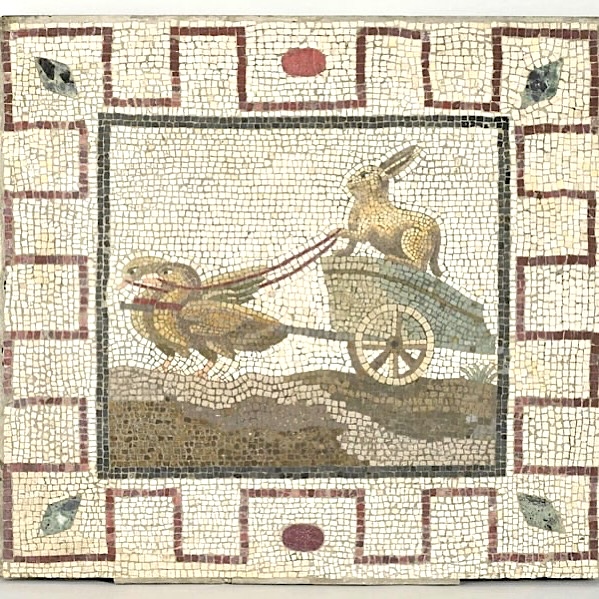
If you head to the Louvre, make sure you visit the Mona Lisa, Venus de Milo, and Liberty Leading the People. But then swing by the Department of Greek, Etruscan, and Roman Antiquities. There you might find (no guarantee!) a Roman mosaic featuring a rabbit riding a chariot pulled by geese. Discovered at Hadrian’s villa in Tivoli, Italy, the mosaic dates back to the 2nd century. About the mosaic, the History Cool Kids writes:
This kind of humorous scene is an example of asária, a type of ancient visual joke where animals behave like humans (anthropomorphism). Such mosaics were popular in Roman domestic decoration, often as floor or wall panels in villas and bathhouses.
This particular mosaic is part of the Louvre’s extensive collection of Greek, Etruscan, and Roman Antiquities. It illustrates how Roman artists loved playful or satirical imagery alongside more serious mythological and realistic scenes. The rabbit, a symbol often associated with fertility and speed, paired with the absurdity of it driving a chariot of geese, reflects both Roman wit and their fondness for decorative exuberance.
Some scholars believe the mosaic plays on a line in Ovid’s Metamorphoses: “Cytherea [Aphrodite] was riding in her dainty chariot, winged by her swans, across the middle air making for Cyprus, when she heard afar Adonis’ dying groans, and thither turned her snowy birds.” But it’s hard to know for sure.
Related Content
Archaeologists Discover a 2,000-Year-Old Roman Glass Bowl in Perfect Condition
Read More...
Paradise Lost Explained: How John Milton Wrote His Epic Religious Poem from Satan’s Perspective
“Paradise Lost is one of the books which the reader admires and lays down, and forgets to take up again,” Samuel Johnson wrote in the late eighteenth century. “None ever wished it longer than it is. Its perusal is a duty rather than a pleasure. We read Milton for instruction, retire harassed and overburdened, and look elsewhere for recreation; we desert our master, and seek for companions.” These nearly two and a half centuries later, how many of us attempt to seek out the instruction of Milton in the first place? What was a literary hit in 1667 has become a work read mostly by specialist scholars — but will, perhaps, become a favorite among viewers of the YouTube channel Hochelaga thanks to its new video above.
The first thing to know about Milton’s epic poem, says Hochelaga host Tommie Trelawny, is that it “tells the story of the Biblical fall of man — but, curiously, from Satan’s perspective.” Even if it’s never occurred to you to set eyes on Paradise Lost, you’ve almost certainly heard one of Satan’s most memorable declarations: “Better to reign in Hell, then serve in Heav’n.”
There’s a decent chance you’ve also run across another, “The mind is its own place, and in it self. Can make a Heav’n of Hell, a Hell of Heav’n,” perhaps without knowing which character speaks it. But if you hear enough of his quotable quotes, you might start to think that this Satan fellow makes some good points after all.
Paradise Lost had a similar effect on some of its God-fearing early readers, who suspiciously started to wonder whose side Milton was really on. What the poem seems to glorify, when read today, isn’t Satan, and it’s not even so much God or man as language itself. Now as then, Milton’s baroque grammar and heavily Latinate vocabulary constituted a good portion of both the work’s challenge and its appeal. Equally notable is his obvious conviction that language is up to the task of addressing the most fundamental truths, questions, and contradictions of existence. Satan may not emerge victorious — and certainly doesn’t at the end of the sequel, Paradise Regained — but if he happens to have the best lines, that just reflects our greater, and thoroughly human, fascination with the bad guys more than the good ones.
Related Content:
William Blake’s Hallucinatory Illustrations of John Milton’s Paradise Lost
Spenser and Milton (Free Course)
A Survival Guide to the Biblical Apocalypse
Did the Tower of Babel Actually Exist?: A Look at the Archaeological Evidence
Based in Seoul, Colin Marshall writes and broadcasts on cities, language, and culture. His projects include the Substack newsletter Books on Cities and the book The Stateless City: a Walk through 21st-Century Los Angeles. Follow him on the social network formerly known as Twitter at @colinmarshall.
Read More...Watch Animated Sheet Music for Miles Davis’ “So What,” Coltrane’s “Giant Steps,” and Charlie Parker’s “Confirmation”
Miles Davis’ Kind of Blue changed jazz. It changed music, period. So I take it very seriously. But when I see the animated sheet music of the first cut, “So What,” I can’t help but think of Charles Schulz’s Peanuts cartoons, and their Vince Guaraldi compositions. I mean no offense to Miles. His modal jazz swings, and it’s fun, as fun to listen to as it is to watch in rising and falling arpeggios. The YouTube uploader, Dan Cohen, gives us this on his channel Animated Sheet Music, with apologies to Jimmy Cobb for the lack of drum notation.
Also from Cohen’s channel, we have Charlie Parker’s music animated. Never one to keep up with his admin, Parker left his estate unable to recuperate royalties from compositions like “Confirmation” (above).
Nonetheless, everyone knows it’s Bird’s tune, and to see it animated above is to see Parker dance a very different step than Miles’ post-bop cool, one filled with complex melodic paragraphs instead of chordal phrases.
And above, we have John Coltrane’s massive “Giant Steps,” with its rapid-fire bursts of quarter notes, interrupted by half-note asides. Coltrane’s iconic 1960 composition displays what Ira Gitler called in a 1958 Downbeat piece, “sheets of sound.” Gitler has said the image he had in his head was of “bolts of cloth undulating as they unfurled,” but he might just as well have thought of sheets of rain, so multitudinous and heavy is Coltrane’s melodic attack.
See Cohen’s Animated Sheet Music channel for two more Charlie Parker pieces, “Au Privave” and “Bloomdido.”
If you would like to support the mission of Open Culture, consider making a donation to our site. It’s hard to rely 100% on ads, and your contributions will help us continue providing the best free cultural and educational materials to learners everywhere. You can contribute through PayPal, Patreon, and Venmo (@openculture). Thanks!
Note: An earlier version of this post appeared on our site in 2013.
Related Content:
Behold John Coltrane’s Handwritten Outline for His Masterpiece A Love Supreme
Josh Jones is a writer and musician based in Durham, NC. Follow him at @jdmagness
Read More...Support Us
We're hoping to rely on loyal readers, rather than erratic ads. Please click the Donate button and support Open Culture. You can use Paypal, Venmo, Patreon, even Crypto! We thank you!

About Us

Open Culture scours the web for the best educational media. We find the free courses and audio books you need, the language lessons & educational videos you want, and plenty of enlightenment in between.
Advertise With Us

FREE UPDATES!
GET OUR DAILY EMAIL
Get the best cultural and educational resources on the web curated for you in a daily email. We never spam. Unsubscribe at any time.
FOLLOW ON SOCIAL MEDIA

Open Culture editor Dan Colman scours the web for the best educational media. He finds the free courses and audio books you need, the language lessons & movies you want, and plenty of enlightenment in between.
Advertise With Us

