The Polish Artist Stanisław Witkiewicz Made Portraits While On Different Psychoactive Drugs, and Noted the Drugs on Each Painting
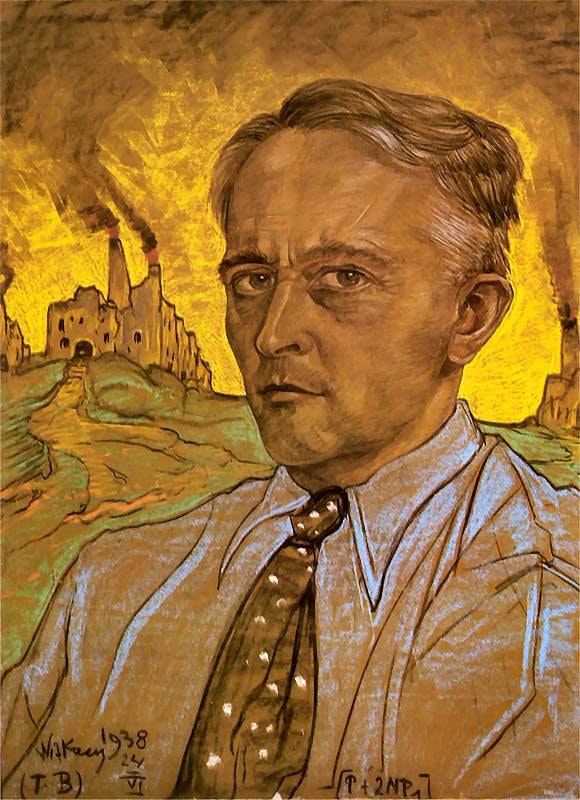
Much of the information in this post comes from Juliette Breton at the Public Domain Review. See her post for more.
At least once a day, staff at art museums and galleries worldwide must hear someone say, “the artist must have been on drugs.” It’s the easiest explanation for art that disturbs, unsettles, confounds our expectations of what art should be. Maybe sometimes artists are on drugs. (R. Crumb tells the story of discovering his inimitable style while on acid.) But maybe it’s not the drugs that make their art seem otherworldly. Maybe mind-altering substances make them more receptive to the source of creativity.…
In any case, artists have long used psychoactive substances to reach higher states of consciousness and cope with a world that doesn’t get their vision. In the early days of LSD experimentation, one psychiatrist even tested the phenomenon. UC Irvine’s Oscar Janiger dosed volunteer subjects at a rented L.A. house, then had them draw or otherwise record their experiences. He ultimately aimed to make a “creativity pill,” testing hundreds of willing subjects between 1954 and 1962.
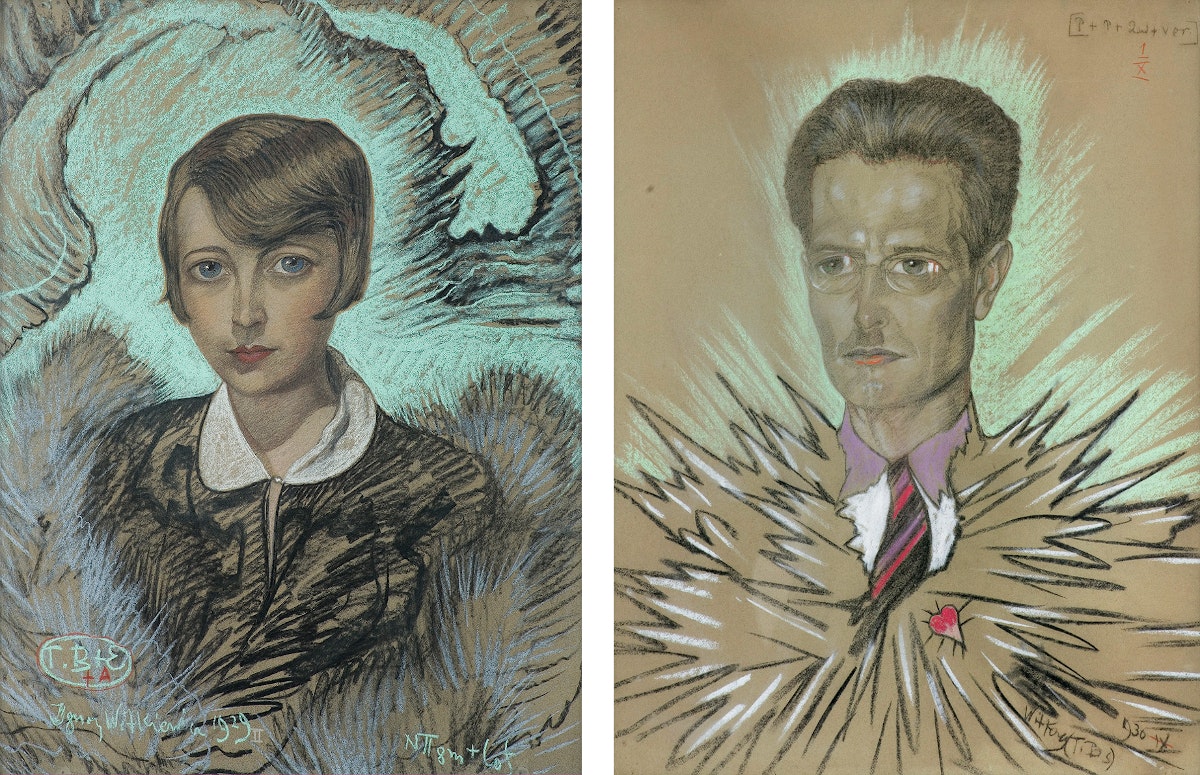
Had Polish artist Stanisław Ignacy Witkiewicz (1885–1939) — who went by “Witkacy” — lived to see the spread of LSD, he would have signed up for every trial. More likely, he would have conducted his own experiments, with himself as the sole test subject. The Warsaw-born artist, writer, philosopher, novelist, and photographer died in 1939, the year after Swiss chemist Albert Hoffman accidentally synthesized acid. Throughout his career, however, Witkacy experimented with just about every other psychoactive substance, anticipating Janiger by decades with his portraits — painted while… yes… he was on lots of drugs.
Unlike his contemporary Dalí, Witkacy did not claim to be drugs. But he was hardly coy about their use. He made notes on each painting to indicate his state of intoxication. “Under the influence of cocaine, mescaline, alcohol, and other narcotic cocktails,” Juliette Bretan writes at the Public Domain Review, “Witkacy prepared numerous studies of clients and friends for his portrait painting company, founded in the mid-1920s.” The drugs induced “different approaches to colour, technique, and composition. The resulting images are surreal — and occasionally horrific.” Sometimes the drugs in question were limited to caffeine, a daily staple of artists everywhere. He also made portraits while abstaining from other addictive substances like nicotine and alcohol.
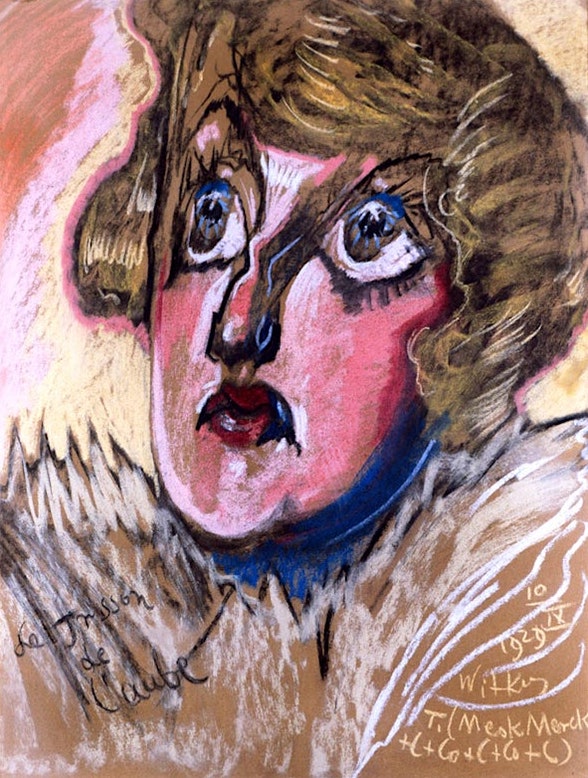
At other times, Witkacy’s notes — written in a kind of code — specified more pronounced usage. He made the portrait above, of Nina Starchurska, in 1929 while on “narcotics of a superior grade,” including mescaline synthesized by Merck and “cocaine + caffeine + cocaine + caffeine + cocaine.” Another portrait of Starchurska (below) made in that same year involved some heavy doses of peyote, among other things.
Witkacy’s investigations were literary as well, culminating in a 1932 book of essays called Narcotics: Nicotine, Alcohol, Cocaine, Peyote, Morphone, Ether + Appendices. The book “owes much to the experimental works of other European psychonauts throughout the nineteenth and twentieth centuries.” Invoking the decadent moralism of Thomas De Quincey and Baudelaire, and it anticipates the utopian, psychedelic prose of Aldous Huxley and Carlos Castaneda.
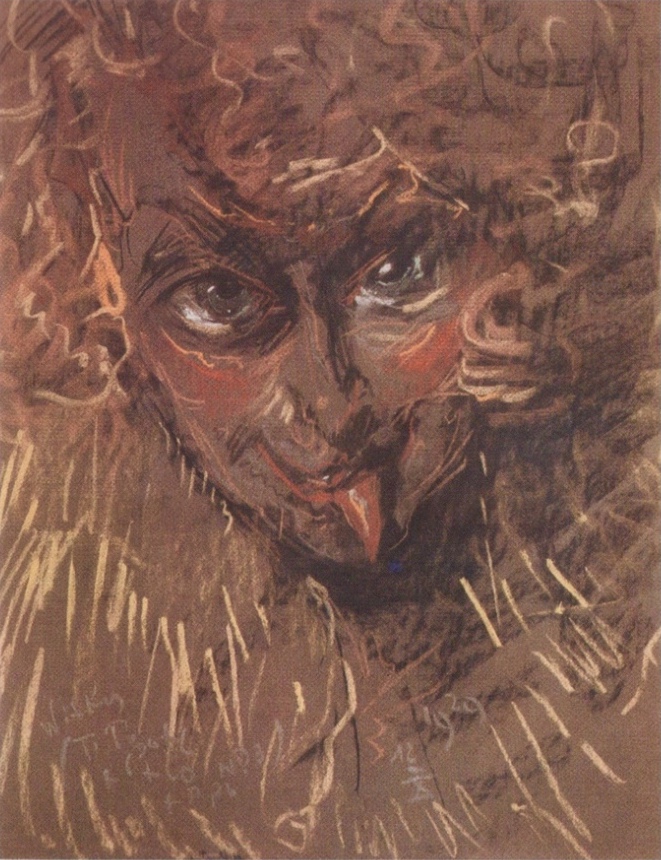
Where he might fulminate, with satirical edge, against the use of drugs, Witkacy also joyously records their liberating effects on his creative consciousness. His chapter on peyote “most closely approximates the spirit” of his paintings, notes Bibiliokept in a review of the recently republished volume:
“Peyote” begins with Witkiewicz taking his first of seven (!) peyote doses at six in the evening and culminating around eight the following morning with “Straggling visions of iridescent wires.” In increments of about 15 minutes, Witkiewicz notes each of his surreal visions. The wild hallucinations are rendered in equally surreal language: “Mundane disumbilicalment on a cone to the barking of flying canine dragons” here, “The birth of a diamond goldfinch” there.
Elsewhere he writes of “elves on a seesaw (Comedic number)” and “a battle of centaurs turned into a battle between fantastical genitalia,” all of which lead him to conclude, “Goya must have known about peyote.”
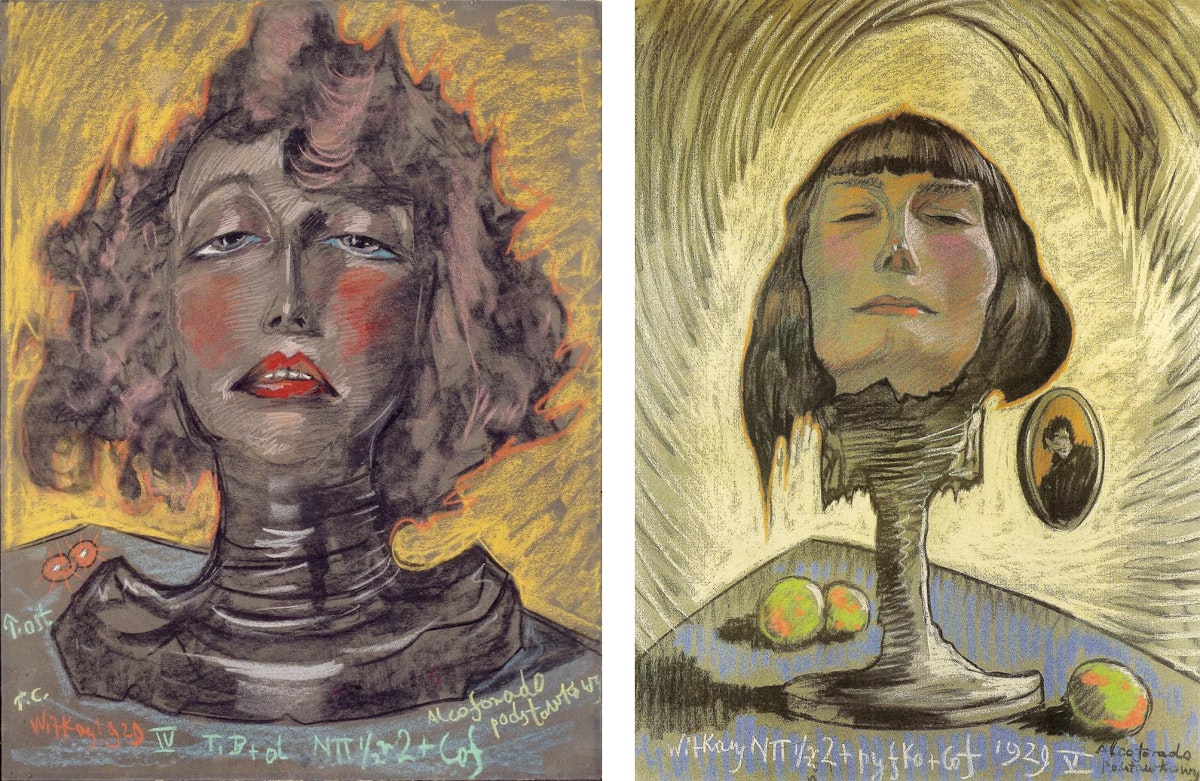
Narcotics functions as a kind of key to Witkacy’s thinking as he made the portraits; part drug diary, part artistic statement of purpose, it includes a “List of Symbols” to help decode his shorthand. The artist committed suicide in 1939 when the Red Army invaded Poland. Had he lived to connect with the psychedelic revolution to come, perhaps he would have been the artist to make psychotropic drug use a respectable form of fine art. Then we might imagine conversations in galleries going something like this: “Excuse me, was this artist on drugs?” “Why yes, in fact. She took large doses of psylocybin when she made this. It’s right here in her manifesto.….”
See many more Witkacy portraits by visiting Juliette Bretan’s post at the Public Domain Review.
Related Content:
R. Crumb Describes How He Dropped LSD in the 60s & Instantly Discovered His Artistic Style
Take a Trip to the LSD Museum, the Largest Collection of “Blotter Art” in the World
Josh Jones is a writer and musician based in Durham, NC. Follow him at @jdmagness
Read More...How Postwar Italian Cinema Created La Dolce Vita and Then the Paparazzi
Those who love the work of Federico Fellini must envy anyone who sees La Dolce Vita for the first time. But today such a viewer, however overwhelmed by the lavish cinematic feast laid before his eyes, will wonder if giving the intrusive tabloid photographer friend of Marcello Mastroianni’s protagonist the name “Paparazzo” isn’t a bit on the nose. Unlike La Dolce Vita’s first audiences in 1960, we’ve been hearing about real-life paparazzi throughout most all of our lives, and thus may not realize that the word itself originally derives from Fellini’s masterpiece. Each time we refer to the paparazzi, we pay tribute to Paparazzo.
In the video essay above, Evan Puschak (better known as the Nerdwriter) traces the origins of paparazzi: not just the word, but the often bothersome professionals denoted by the word. The story begins with the dictator Benito Mussolini, an “avid movie fan and fanboy of film stars” who wrote “more than 100 fawning letters to American actress Anita Page, including several marriage proposals.” Knowing full well “the emotional power of cinema as a tool for propaganda and building cultural prestige,” Mussolini commissioned the construction of Rome’s Cinecittà, the largest film-studio complex in Europe when it opened in 1937 — six years before his fall from power.
During the Second World War, Cinecittà became a vast refugee camp. When peacetime returned, with “the studio space being used and Mussolini’s thumb removed, a new wave of filmmakers took to the streets of Rome to make movies about real life in postwar Italy.” Thus began the age of Italian Neorealism, which brought forth such now-classic pictures as Roberto Rossellini’s Rome, Open City and Vittorio De Sica’s Bicycle Thieves. In the nineteen-fifties, major American productions started coming to Rome: Quo Vadis, Roman Holiday, Ben-Hur, Cleopatra. (It was this era, surely, that inspired an eleven-year-old named Martin Scorsese to storyboard a Roman epic of his own.) All of this created an era known as “Hollywood on the Tiber.”
For a few years, says Puschak, “the Via Veneto was the coolest place in the world.” Yet “while the glitterati cavorted in chic bars and clubs, thousands of others struggled to find their place in the postwar economy.” Some turned to tourist photography, and “soon found they could make even more money snapping photos of celebrities.” It was the most notorious of these, the “Volpe di via Veneto” Tazio Secchiaroli, to whom Fellini reached out asking for stories he could include in the film that would become La Dolce Vita. The newly christened paparazzi were soon seen as the only ones who could bring “the gods of our culture down to the messy earth.” These six decades later, of course, celebrities do it to themselves, social media having turned each of us — famous or otherwise — into our own Paparazzo.
Related content:
Federico Fellini Introduces Himself to America in Experimental 1969 Documentary
Cinecittà Luce and Google to Bring Italy’s Largest Film Archive to YouTube
Mussolini Sends to America a Happy Message, Full of Friendly Feelings, in English (1927)
Based in Seoul, Colin Marshall writes and broadcasts on cities, language, and culture. His projects include the Substack newsletter Books on Cities, the book The Stateless City: a Walk through 21st-Century Los Angeles and the video series The City in Cinema. Follow him on Twitter at @colinmarshall, on Facebook, or on Instagram.
Read More...Coca-Cola Was Originally Sold as an Intellectual Stimulant & Medicine: The Unlikely Story of the Iconic Soft Drink’s Invention
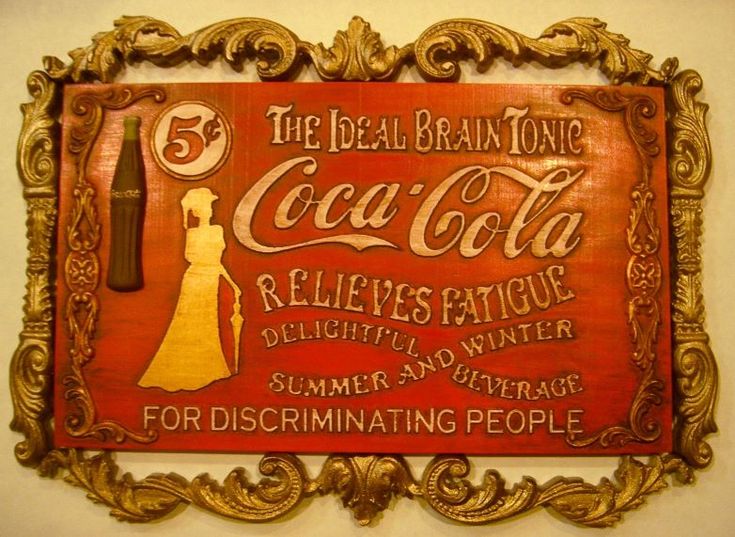
We all know that sweetened, carbonated soft drinks have effects on those who drink them. The most conspicuous, among especially avid consumers, include obesity and its associated health troubles. This, fair to say, was not the intention of John Stith Pemberton, the Georgia pharmacist who in the 1880s came up with the drink that would become Coca-Cola. In that era, writes Smithsonian.com’s Kat Eschner, “people overwhelmed by industrialization and urbanization as well as the holdover of the Civil War and other social changes struggled to gain purchase, turning to patent medicines for cures that doctors couldn’t provide.” And it was in a patent medicine, one of the countless many dubiously ballyhooed in the nineteenth century, that Coca-Cola first appeared.
Injured in the Civil War, Pemberton developed a morphine addiction for which he fruitlessly sought treatment. But then he got word of a new substance with the potential to cure his “morphinism”: cocaine. At the time, cocaine was an ingredient in a wine-based beverage enjoyed by Parisians called Vin Mariani.
“It actually made people feel great, and it was sold as medicine,” writes Eschner. “Combining cocaine and alcohol produces another chemical more potent than what’s normally found in cocaine, enhancing the high.” Adapting Vin Mariani for his own local market, Pemberton introduced what he called “French Wine Coca”: a treatment, as he promoted it, for everything from dyspepsia to neurasthenia to constipation, as well as a “most wonderful invigorator of the sexual organs.”
Coca-Cola carries many associations today, few of them having to do with the life of the mind. Yet it was to upper-class intellectuals, their minds disordered by the rapid development of nineteenth-century America, that Pemberton promoted his invention. It would be called “a valuable Brain Tonic, and a cure for all nervous affections.” Its supposed mental benefits became the main selling point in 1886, when temperance laws in Atlanta prompted a re-engineering of the formula. Even the non-alcoholic version contained “the valuable TONIC and NERVE STIMULANT properties of the Coca plant and Cola nuts,” as advertisements put it, but in the early decades of the twentieth century (long after Pemberton’s death in 1888, by which time he’d sold off his rights to the drink), the Coca-Cola Company phased that ingredient out. If it weren’t illegal, a cocaine-fortified soft drink would now benefit from the retro appeal of the eighties — the eighteen-eighties and nineteen-eighties alike.
Related content:
Do You Drink Soda, Pop or Soft Drinks?: 122 Heatmaps Visualize How People Talk in America
“Soda/Pop/Coke,” A Creative Visual Remix of Harvard’s Famous 2003 Survey of American Dialects
“The Virtues of Coffee” Explained in 1690 Ad: The Cure for Lethargy, Scurvy, Dropsy, Gout & More
The Birth of Espresso: The Story Behind the Coffee Shots That Fuel Modern Life
Discover the Oldest Beer Recipe in History From Ancient Sumeria, 1800 B.C.
Based in Seoul, Colin Marshall writes and broadcasts on cities, language, and culture. His projects include the Substack newsletter Books on Cities, the book The Stateless City: a Walk through 21st-Century Los Angeles and the video series The City in Cinema. Follow him on Twitter at @colinmarshall, on Facebook, or on Instagram.
Read More...Watch Sir Ian McKellen’s 1979 Master Class on Macbeth’s Final Monologue
If only we could have had a teacher as insightful as Sir Ian McKellen explain some Shakespeare to us at an impressionable age.
Above, a 38-year-old McKellen breaks down Macbeth’s famous final soliloquy as part of a 1978 master class in Acting Shakespeare.
He makes it clear early on that relying on Iambic pentameter to convey the meaning of the verse will not cut it.
Instead, he calls upon actors to apply the power of their intellect to every line, analyzing metaphors and imagery, while also noting punctuation, word choice, and of course, the events leading up to the speech.
In this way, he says, “the actor is the playwright and the character simultaneously.”
McKellen was, at the time, deeply immersed in Macbeth, playing the title role opposite Judi Dench in a bare bones Royal Shakespeare Company production that opened in the company’s Stratford studio before transferring to the West End. As McKellen recalled in a longer meditation on the trickiness of staging this particular tragedy:
It was beautifully done on the cheap in The Other Place, the old tin hut along from the main theatre. John Napier’s entire set cost £200 and the costumes were a ragbag of second-hand clothes. My uniform jacket had buttons embossed with ‘Birmingham Fire Service’; my long, leather coat didn’t fit, nor did Banquo’s so we had to wear them slung over the shoulder; Judi Dench, as Lady Macbeth, wore a dyed tea-towel on her head. Somehow it was magic: and black magic, too. A priest used to sit on the front row, whenever he could scrounge a ticket, holding out his crucifix to protect the cast from the evil we were raising.
The New York Times raved about the production, declaring McKellen “the best equipped British actor of his generations:”
Mr. McKellen’s Macbeth is witty; not merely the horror but the absurdity of his actions strikes him from the outset, and he can regard his downfall as an inexorable joke. His wife pulls him along a road that he would travel anyway and he can allow himself scruples, knowing that she will be there to mop them up. Once her prosaic, limited ambition is achieved, she is of no more use to him and he shrugs her off; “she would have died hereafter” is a moment of exasperation that dares our laughter.
What fuels him most is envy, reaching incredulously forward (“The seed of Banquo kings?”) and backward to color the despair of “Duncan is in his grave.” The words, and the mind behind them, are rancid, and it is this mood that takes possession of his last scenes. Everything disgusts him, and his only reason for fighting to the death is that the thought of subjection is the most disgusting of all.
McKellen begins his examination of the text by noting how “she would have died hereafter” sets up the final soliloquy’s preoccupation with time, and its passage.
Tomorrow, and tomorrow, and tomorrow,
Creeps in this petty pace from day to day,
To the last syllable of recorded time;
And all our yesterdays have lighted fools
The way to dusty death. Out, out, brief candle!
Life’s but a walking shadow, a poor player,
That struts and frets his hour upon the stage,
And then is heard no more. It is a tale
Told by an idiot, full of sound and fury,
Signifying nothing.
McKellen makes a true meal of “out, out, brief candle”, relating it to Lady Macbeth’s final appearance, the fools proceeding to their dusty death earlier in the monologue, and Elizabethan stage lighting.
He speculates that Shakespeare’s description of life as a “poor player” was a deliberate attempt by the playwright to give the actor an interpretive hook they could relate to. In performance, the theatrical metaphor should remind the audience that they’re watching a pretense even as they’re invested in the character’s fate.
The production’s success inspired director Trevor Nunn to film it. McKellen recalled that everyone was already so well acquainted with the material, it took just two weeks to get it in the can:
The claustrophobia of the stage production was exactly captured. Trevor had used a similar technique with Antony and Cleopatra on the box. No one else should ever be allowed to televise Shakespeare…There is so much I was proud of: discovering how to play a soliloquy direct into the eyes of everyone in the audience; making them laugh at Macbeth’s gallows humor; working alongside Judi Dench’s finest performance.
For more expert advice from McKellen, Patrick Stewart, Ben Kingsley and other notables, watch the RSC’s 9‑part Playing Shakespeare series here.
– Ayun Halliday is the Chief Primatologist of the East Village Inky zine and creator, most recently of Creative, Not Famous: The Small Potato Manifesto. Follow her @AyunHalliday.
Read More...The History of Iron Maiden: A Documentary Streaming Free Online
From the official Iron Maiden YouTube channel comes the two-part documentary The History of Iron Maiden. Released in 2004, Part 1: The Early Days (above) moves from the band’s beginnings in London’s East End in 1975, to the Piece of Mind album and tour in 1983. Part 2 (below) was later included on the Live After Death DVD release in 2008.
The History of Iron Maiden will be added to our collection of Free Documentaries, a subset of our collection 4,000+ Free Movies Online: Great Classics, Indies, Noir, Westerns, Documentaries & More.
If you would like to support the mission of Open Culture, consider making a donation to our site. It’s hard to rely 100% on ads, and your contributions will help us continue providing the best free cultural and educational materials to learners everywhere. You can contribute through PayPal, Patreon, and Venmo (@openculture). Thanks!
Related Content
1980s Metalhead Kids Are Alright: Scientific Study Shows That They Became Well-Adjusted Adults
Who Invented Heavy Metal Music?: A Search for Origins
Read More...In 1968, Stanley Kubrick Makes Predictions for 2001: Humanity Will Conquer Old Age, Watch 3D TV & Learn German in 20 Minutes
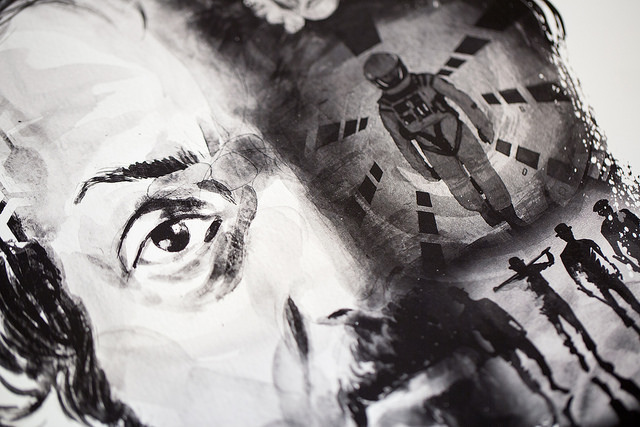
Image by Moody Man, via Flickr Commons
1968. Revolution was in the air and the future seemed bright. That year, Stanley Kubrick released his masterpiece 2001: A Space Odyssey – a big-budget, experimental rumination on the evolution of mankind. The film was a huge box office hit when it came out; its mind-bending metaphysics resonated with the culture’s newfound interest in chemically altered states and in spirituality.
In the September issue from that year, Playboy magazine published a lengthy interview with Kubrick. Even at a time when public figures were supposed to sound like intellectuals (boy, times have changed), Kubrick comes across as insanely well read. During the course of the interview, he quotes from the likes of media critic Marshall McLuhan, Winston Churchill, and 19th Century poet Matthew Arnold along with a handful of prominent academics.
Kubrick is characteristically cagey about offering any explanations of his enigmatic movie but he does readily expound on philosophical questions about God, the meaning of life (or lack thereof) and the possibility of extraterrestrial life. But perhaps the most interesting part of the 17-page interview is his vision of what 2001 might look like. It’s fascinating to see what he got right, what might be right a bit further into the future, and what’s completely wrong. Check them out below:
“Within ten years, in fact, I believe that freezing of the dead will be a major industry in the United States and throughout the world; I would recommend it as a field of investment for imaginative speculators.”
“Perhaps the greatest breakthrough we may have made by 2001 is the possibility that man may be able to eliminate old age.”
“I’m sure we’ll have sophisticated 3‑D holographic television and films, and it’s possible that completely new forms of entertainment and education will be devised.”
“You might have a machine that taps the brain and ushers you into a vivid dream experience in which you are the protagonist in a romance or an adventure. On a more serious level, a similar machine could directly program you with knowledge: in this way, you might, for example, easily be able to learn fluent German in 20 minutes.”
“I believe by 2001 we will have devised chemicals with no adverse physical, mental or genetic results that can give wings to the mind and enlarge perception beyond its present evolutionary capacities…there should be fascinating drugs available by 2001; what use we make of them will be the crucial question.”
“The so-called sexual revolution, mid-wifed by the pill, will be extended. Through drugs, or perhaps via the sharpening or even mechanical amplification of latent ESP functions, it may be possible for each partner to simultaneously experience the sensations of the other; or we may eventually emerge into polymorphous sexual beings, with male and female components blurring, merging and interchanging. The potentialities for exploring new areas of sexual experience are virtually boundless.”
“Looking into the distant future, I suppose it’s not inconceivable that a semisentient robot-computer subculture could evolve that might one day decide it no longer needed man.”
For such a famously pessimistic filmmaker, Kubrick’s vision of the future is remarkably groovy – lots of sex, drugs and holographic television. He wasn’t, of course, the only one out there who thought about the future. You can see more bold predictions below:
Isaac Asimov Predicts in 1964 What the World Will Look Like Today — in 2014
Arthur C. Clarke Predicts the Future in 1964 … And Kind of Nails It
Walter Cronkite Imagines the Home of the 21st Century … Back in 1967
The Internet Imagined in 1969
Marshall McLuhan Announces That The World is a Global Village
Note: Note: An earlier version of this post appeared on our site in November 2014.
Jonathan Crow is a Los Angeles-based writer and filmmaker whose work has appeared in Yahoo!, The Hollywood Reporter, and other publications. You can follow him at @jonccrow.
Read More...Draw Along with Beloved Cartoonist & Educator Lynda Barry: Free Drawing Exercises Online
How do you rescue a day that’s gone pear shaped?
Stopping to drink a glass of water is one of our longtime go tos.
If there’s a box of matches handy, we might perform Yoko Ono’s Lightning Piece.
Most recently, we’ve taken to grabbing some paper and a trusty black felt tip to spend a few minutes doing one of beloved cartoonist and educator Lynda Barry’s all-ages draw-alongs.
Barry began uploading these videos early in the pandemic, for “friends at home who are about to turn four or five or six or seven or any age really.”
Each demonstration begins with an oval. There’s no prologue. Just dive on in and copy the motions of Barry’s slow moving, refreshingly unmanicured hands, captured in a DIY god shot.
Less than four minutes later, voila! A smiling crocodile! (It’s magical how a facial expression can be changed with one simple line.)
The soundtracks to these little narration-free exercises are an extra treat. We’ve always admired Barry’s musical taste. It’s a real mood booster to cover a cheetah in spots to the tune of a marimba orchestra.
Barry’s also a big cumbia fan, conjuring a kitty to Lito Barrientos’ Cumbia En Do Menor, a lion to Los Mirlos’ Cumbia de los Pajaritos, and a Stegosaurus to Romulo Caicedo’s Cumbia Cavela.
Now that you’ve got a cheetah under your belt, you’re ready to progress to a ScorpionLeopard, one of Draw Along with Lynda B’s “strange animals.”
Barry does offer some commentary as these cryptids take shape.
We suspect her pioneering work with a group of four-year-olds in the University of Wisconsin’s Draw Bridge program leads her to anticipate the sorts of burning questions a pre-schooler might have with regard to these beasts. Her classroom experience is evident. Whereas others might think a steady stream of bright chatter is necessary to keep very young participants engaged, Barry’s thoughtful words develop in real time along with her drawing:
This is a tough animal. It has a big stinger on the back. This is a rough animal… angry. Put the eyebrows like this. It makes them look angry. What kind of teeth do you think this animal has? I don’t think they have little bitty teeth. I think they have big fangs.
Others in the “strange animal” family: a CatDogSealFish, an octophant, and a catterfly (featuring a cameo by Barry’s inquisitive pooch’s snout.)
Draw along with Lynda Barry on this YouTube playlist.
Related Content
Watch Cartoonist Lynda Barry’s Two-Hour Drawing Workshop
- Ayun Halliday is the Chief Primatologist of the East Village Inky zine and author, most recently, of Creative, Not Famous: The Small Potato Manifesto. Follow her @AyunHalliday.
Read More...What Did People Do Before the Invention of Eyeglasses?
You remember it — one of the most heartbreaking scenes on TV. A man longs for nothing more than time to read, to be free of all those people Sartre told us make our hells. Finally granted his wish by the H‑Bomb, he then accidentally break his glasses, rendering himself unable make out a word. Oh, cruel irony! Not an optometrist or optician in sight! Surely, there are “Time Enough at Last” jokes at eye care conventions worldwide.
Morality tales wrapped in science fiction might make us think about all sorts of things, but one of the most obvious questions when we witness the fate of Mr. Henry Bemis, “charter member in the fraternity of dreamers,” might be, but what did people do before corrective lenses? Were millions forced to accept his fate, living out their lives with farsightedness, nearsightedness, and other defects that impede vision? How did early humans survive in times much less hospitable to disabilities? At least there were others to read and describe things for them.…
In truth, the Twilight Zone is not far off the mark. Or at least nearsightedness and reading are closely linked. “As long as primates have been around, there’s probably been myopia,” says professor of ophthalmology Ivan Schwab. But Schwab argues in his book Evolution’s Witness: How Eyes Evolved that the rise of reading likely caused skyrocketing rates of myopia over the past three hundred years. “Though genes and nutrition may play a role in nearsightedness,” Natalie Jacewicz writes at NPR, “[Schwab] says education and myopia seem to be linked, suggesting that when people do a lot of close work, their eyes grow longer.”
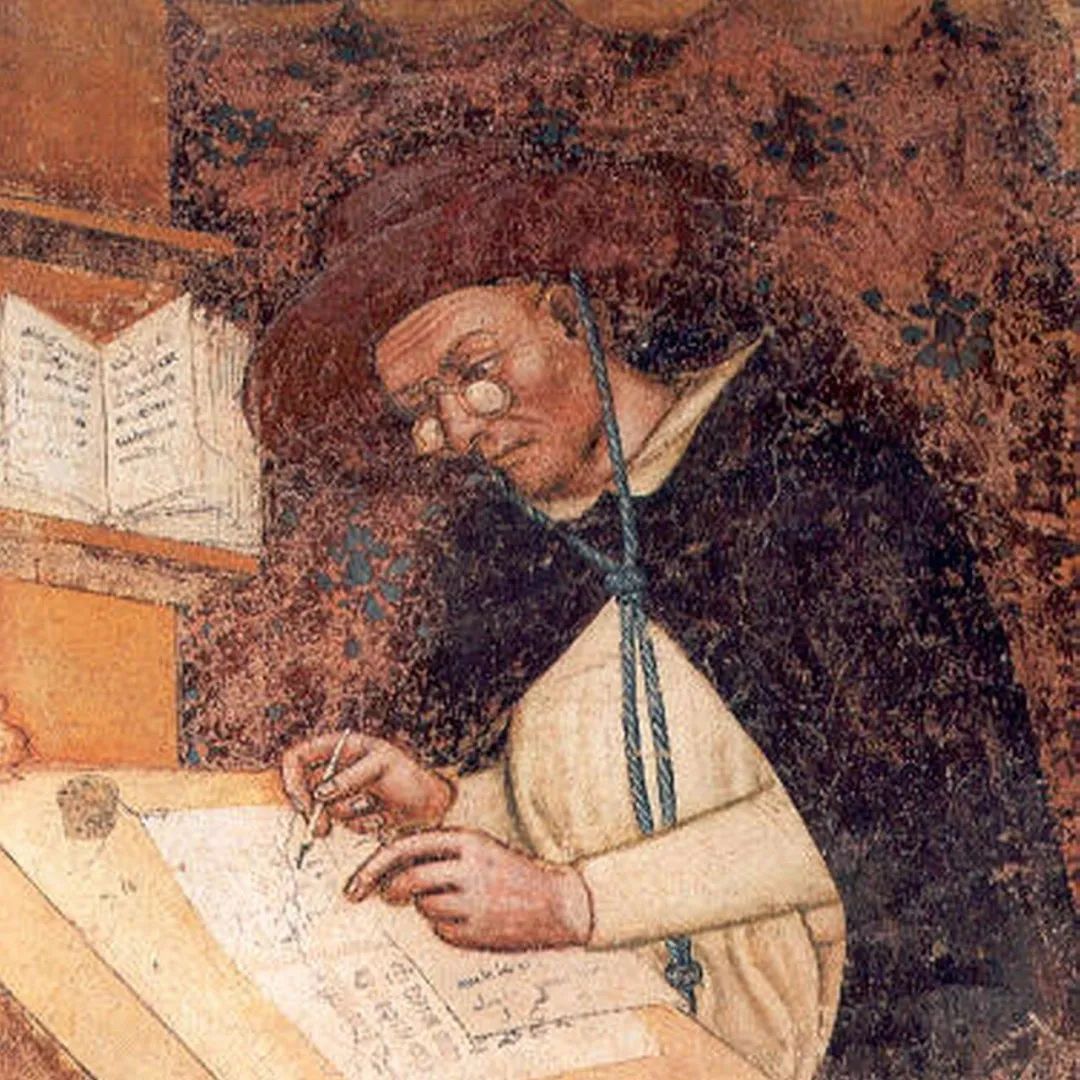
As the History Dose video above explains, the oldest image of a pair of glasses dates from a 1351 painting of Cardinal Hugh of Saint-Cher. The painting is an anachronism — spectacles, the narrator tells us, were invented 23 years earlier in Pisa, after the cardinal’s death. They “gradually spread across Europe and travelled the Silk Road to China.” (The oldest surviving pair of glasses dates from around 1475). So what happened before 1286? As you’ll learn, glasses were not the only way to enlarge small items. In fact, humans have been using some form of magnifying lens to read small print (or manuscript or cuneiform or what-have-you) for thousands of years. Those lenses, however, corrected presbyopia, or far-sightedness.
Those with myopia were mostly out of luck until the invention of sophisticated lens-grinding techniques and improved vision tests. But for most of human history, unless you were a sailor or a soldier, you “likely spent your day as an artisan, smith, or farm worker,” occupations where distance vision didn’t matter as much. In fact, artisans like medieval scribes and illuminators, says Neil Handley — museum curator of the College of Optometrists, London — were “actually encouraged to remain in their myopic condition, because it was actually ideal for them doing this job.”
It wasn’t until well after the time of Gutenberg that wearing lenses on one’s face became a thing — and hardly a popular thing at first. Early glasses were held up to the eyes, not worn. They were heavy, thick, and fragile. In the 15th century, “because… they were unusual and rare,” says Handley, “they were seen as having magical powers” and their wearers viewed as “in league with the devil, immoral.” That stigma went away, even if glasses picked up other associations that sometimes made their users the subject of taunts. But by the nineteenth century, glasses were common around the world.
Given that we all spend most of our time interacting with small text and images on handheld screens, it seems maybe they haven’t spread widely enough. “More than a billion, and maybe as many as 2.5 billion, people in the world need but don’t have glasses to correct for various vision impairments,” notes Livescience, citing figures from The New York Times. For many people, especially in the developing world, the question of how to get by in the world without eyeglasses is still a very pressing, present-day issue.
Related Content:
The World’s Oldest Surviving Pair of Glasses (Circa 1475)
James Joyce, With His Eyesight Failing, Draws a Sketch of Leopold Bloom (1926)
Josh Jones is a writer and musician based in Durham, NC. Follow him at @jdmagness
Read More...Jim Morrison Accurately Predicts the Future of Electronic Music in 1969
Jim Morrison didn’t fare particularly well, health-wise, in the last years of his life. Alcoholism took a heavy toll, as we know. “Images of him with the shaggy beard, hair receding at the temples, and excess flesh gathering around the armpits,” writes Rob Fischer at Rolling Stone, “can resemble, in retrospect, T.J. Miller more than Father John Misty. This is the out-to-seed drunkard that Val Kilmer portrays in Oliver Stone’s iconic film The Doors.” It is also an unfortunate caricature that leaves out the creative and intellectual energy still left in the artist once called “the first major male sex symbol since James Dean died and Marlon Brando got a paunch.”
There was always more to Morrison than that, and in the 1969 interview above, filmed over a week in L.A. with Rolling Stone’s Jerry Hopkins, he is still “remarkably sharp,” Fischer writes.
Even though the conversations included many rounds of whiskey, scotch and beer, his responses give the impression of a thoughtful and engaged artist struggling to realize the full extent of his already colossal powers of expression. He was reading widely, writing poetry, gravitating more towards filmmaking, all while longing to reconnect with the explosive energy that comes with playing small venues and clubs like the Whiskey a Go Go.
Morrison and the Doors were experimental artists, taking musical risks and selling them with sex. The Doors were the first rock band, for example, to use the new Moog synthesizer on an album. Even before Wendy Carlos’ Switched-On Bach introduced popular audiences to the technology of audio synthesis in 1968, the band brought jazz musician Paul Beaver into the 1967 recordings sessions for Strange Days to use Moog for effects on several tracks and to distort Morrison’s voice.
Beaver, an early adopter of the synthesizer, produced two seminal Moog records in the late sixties: The Zodiac: Cosmic Sounds (1967) with Mort Garson and double album The Nonesuch Guide to Electronic Music (1968) with Bernie Krause.
Therefore, when Morrison, in his astute analysis of American music, “predicts” the future of electronic music in 1969 during the course of his interview with Hopkins, he knows of what he speaks. He’s already seen it, and being the hip guy that he was, he had likely heard the work of electronic pioneers Silver Apples and maybe even of the band White Noise, a side project of BBC Radiophonic Workshop composer Delia Derbyshire that produced music far ahead of its time that very year — music made almost exactly the way he describes:
I can kind of envision one person with a lot of machines, tapes and electronics set up, singing or speaking while using machines.…
At the end of the brief clip at the top, we hear Hopkins ignore this idea and move Morrison back to talking about rock. But Jim had already moved on — and so had the culture, he knew. The music he describes was happening all around him, and we might imagine he was a little frustrated that other people couldn’t hear it. What Morrison brought to it, however — or might have, had he lived — was the lyrical, the sensual, the performative, the melodramatic, and the truly frightening, all qualities it would take new wave and goth acts like Echo and Bunnymen, Depeche Mode, and a host of Doors-influenced dark wave bands to bring to fruition in the electronic music of future past.
Related Content:
How the Moog Synthesizer Changed the Sound of Music
This Is “The End”: A Video Exploration of The Doors’ Existential Epic
Josh Jones is a writer and musician based in Durham, NC. Follow him at @jdmagness
Read More...The Story of Googie Architecture, the Iconic Architectural Style of Los Angeles
When I lived in Los Angeles, I enjoyed no breakfast spot more than Pann’s. The place had it all: not just signature plates ranging from biscuits and gravy to chicken and waffles, but tropical landscaping, stone walls, a slanted roof, banquettes in burgundy and counter seats in cream, and as the pièce de résistance, a neon sign that lit up one letter at a time. Built in 1958, Pann’s stands today as quite possibly the most immaculate surviving example of Googie, a mid-twentieth-century aesthetic that takes its name from another Los Angeles coffee shop opened nearly a decade earlier. Though designed by no less serious a modern architect than Frank Lloyd Wright protégé John Lautner, Googie’s gave rise to perhaps the least serious of all architectural movements.
“It’s a style built on exaggeration; on dramatic angles; on plastic and steel and neon and wide-eyed technological optimism,” writes Matt Novak at Smithsonian magazine. “It draws inspiration from Space Age ideals and rocketship dreams. We find Googie at the 1964 New York World’s Fair, the Space Needle in Seattle, the mid-century design of Disneyland’s Tomorrowland, in Arthur Radebaugh‘s postwar illustrations, and in countless coffee shops and motels across the U.S.”
But the acknowledged cradle of Googie is Los Angeles, whose explosive development alongside that of mid-twentieth-century American “car culture” encouraged the ultra-commercial architectural experimentation whose first priority was to catch the eye of the motorist — and ideally, the hungry motorist.
You can hear the history of Googie told in the Cheddar Explain video “How Los Angeles Got Its Iconic Architecture Style,” which adapts Novak’s Smithsonian piece. In “Googie Architecture: From Diners to Donuts,” photographer Ahok Sinha goes into more detail about how the style turned “architecture into a form of advertising.” Like all the most effective advertising, Googie drew from the zeitgeist, incorporating the striking shapes and advanced materials connected in the public mind with notions of speed and technology embodied not just by automobiles but even more so by rockets. For Googie was the architecture of the Space Race: it’s no accident that the creators of The Jetsons, which aired in 1962 and 1963, rendered all the show’s settings in the same style.
It could fairly be said that no one architect invented Googie, that it emerged almost spontaneously as a product of American popular culture. But “for some reason, we got stuck with the name,” says architect Victor Newlove, of Armet Davis Newlove and Associates, in the interview clip above. For good reason, perhaps: to that firm’s credit are several locations of the diner chains Bob’s Big Boy (where for years David Lynch’s took his daily milkshake) and Norms, both of which are still in business in Los Angeles today. Its architects Eldon Davis and Helen Liu Fong also designed Pann’s, which for many Googie enthusiasts remains an unsurpassable achievement — and one whose competition, since the moon landing and the end it put to not just the Space Race but the sensibility it inspired, has been dwindling one demolition at a time.
Related content:
The Modernist Gas Stations of Frank Lloyd Wright and Mies van der Rohe
1,300 Photos of Famous Modern American Homes Now Online, Courtesy of USC
That Far Corner: Frank Lloyd Wright in Los Angeles – A Free Online Documentary
Based in Seoul, Colin Marshall writes and broadcasts on cities, language, and culture. His projects include the Substack newsletter Books on Cities, the book The Stateless City: a Walk through 21st-Century Los Angeles and the video series The City in Cinema. Follow him on Twitter at @colinmarshall or on Facebook.
Read More...Support Us
We're hoping to rely on loyal readers, rather than erratic ads. Please click the Donate button and support Open Culture. You can use Paypal, Venmo, Patreon, even Crypto! We thank you!

About Us

Open Culture scours the web for the best educational media. We find the free courses and audio books you need, the language lessons & educational videos you want, and plenty of enlightenment in between.
Advertise With Us

FREE UPDATES!
GET OUR DAILY EMAIL
Get the best cultural and educational resources on the web curated for you in a daily email. We never spam. Unsubscribe at any time.
FOLLOW ON SOCIAL MEDIA

Open Culture editor Dan Colman scours the web for the best educational media. He finds the free courses and audio books you need, the language lessons & movies you want, and plenty of enlightenment in between.
Advertise With Us


