Hayao Miyazaki’s My Neighbor Totoro Is Getting Adapted for the Stage by The Royal Shakespeare Company & Jim Henson’s Creature Shop

The films of Hayao Miyazaki’s Studio Ghibli have won immense worldwide acclaim, in large part because they so fully inhabit their medium. Their characters, their stories, their worlds: all can come fully to life only in animation. Still, it’s true that some of their material did originate in other forms. The pre-Ghibli breakout feature Nausicaä of the Valley of the Wind, for instance, began as a comic book written and drawn by Miyazaki (who at first laid down the condition that it not be adapted for the screen). Four years later, by the time of My Neighbor Totoro, the nature of Ghibli’s visions had become inseparable from that of animation itself.
Now, almost three and a half decades after Totoro’s original release, the production of a stage version is well underway. Playbill’s Raven Brunner reports that the show “will open in London’s West End at The Barbican theatre for a 15-week engagement October 8‑January 21, 2023.
The production will be presented by the Royal Shakespeare Company and executive producer Joe Hisaishi.” Japan’s most famous film composer, Hisaishi scored Totoro as well as all of Miyazaki’s other Ghibli films so far, including Porco Rosso, Princess Mononoke, and Spirited Away (itself adapted for the stage in Japan earlier this year).
As you can see in the video just above, the RSC production of Totoro also involves Jim Henson’s Creature Shop. “The puppets being built at Creature Shop are based on designs created by Basil Twist, one of the UK’s most innovative puppeteers,” writes Deadline’s Baz Bamigboye, and they’ll be supplemented by the work of another master, “Mervyn Millar, of Britain’s cutting-edge Significant Object puppet studio.” Even such an assembly of puppet-making expertise will find it a formidable challenge to re-create the denizens of the enchanted countryside in which Totoro’s young protagonists find themselves — to say nothing of the titular wood spirit himself, with all his mass, mischief, and overall benevolence. As for how they’re rigging up the cat bus, Ghibli fans will have to wait until next year to find out.
Related content:
Studio Ghibli Producer Toshio Suzuki Teaches You How to Draw Totoro in Two Minutes
Jim Henson Teaches You How to Make Puppets in Vintage Primer From 1969
Based in Seoul, Colin Marshall writes and broadcasts on cities, language, and culture. His projects include the Substack newsletter Books on Cities, the book The Stateless City: a Walk through 21st-Century Los Angeles and the video series The City in Cinema. Follow him on Twitter at @colinmarshall, on Facebook, or on Instagram.
Read More...Marie Curie’s Ph.D. Thesis on Radioactivity–Which Made Her the First Woman in France to Receive a Doctoral Degree in Physics
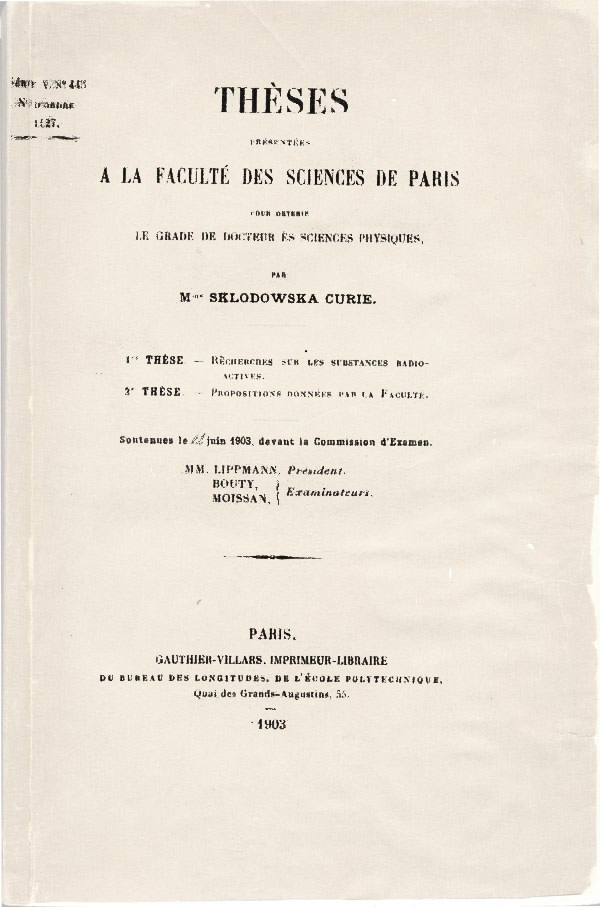
For her groundbreaking research on radioactivity, Marie Curie won the Nobel Prize. Or rather, she won two, one for physics and another for chemistry, making her the only Nobel Laureate in more than one science. What’s more, her first Nobel came in 1903, the very same year she completed her PhD thesis at the Sorbonne. In Recherches sur les substances radioactives (or Research on Radioactive Substances), Curie “talks about the discovery of the new elements radium and polonium, and also describes how she gained one of the first understandings of the new physical phenomenon of radioactivity.”
So says science Youtuber Toby Hendy in the introduction below to Curie’s thesis–a thesis that made her the first woman in France to receive a doctoral degree in physics. “Following on from the discovery of X‑rays by Wilhelm Roentgen in 1895 and Henri Becquerel’s discovery that uranium salts emitted similar penetration properties,” says The Document Centre, Curie “investigated uranium rays as a starting point, but in the process discovered that the air around uranium rays is made to conduct electricity.”
Her deduction that “the process was caused by properties of the atoms themselves” — a revolutionary finding that overturned previously held notions in physics — led her eventually to discover radium and polonium, which would get her that second Nobel in 1911.
Unlike her Nobel Prize in physics, which she shared with her husband Pierre and the physicist Henri Becquerel, Marie Curie won her Nobel Prize in chemistry alone. By 1911 Pierre had been dead for half a decade, but Marie’s scientific genius couldn’t be stopped from continuing their pioneering research as far as she could take it in her own lifetime. She clearly knew how vast a field her work, with and without her husband, had opened up: “Our researches upon the new radio-active bodies have given rise to a scientific movement,” she writes at the end of Recherches sur les substances radioactives. That movement continues to make discoveries more than a century later — and her original thesis itself remains radioactive.
Related content:
An Animated Introduction to the Life & Work of Marie Curie, the First Female Nobel Laureate
Marie Curie Invented Mobile X‑Ray Units to Help Save Wounded Soldiers in World War I
Marie Curie’s Research Papers Are Still Radioactive 100+ Years Later
Based in Seoul, Colin Marshall writes and broadcasts on cities, language, and culture. His projects include the Substack newsletter Books on Cities, the book The Stateless City: a Walk through 21st-Century Los Angeles and the video series The City in Cinema. Follow him on Twitter at @colinmarshall, on Facebook, or on Instagram.
Read More...The Only Surviving Manuscript of John Milton’s Paradise Lost Gets Published in Book Form for the First Time
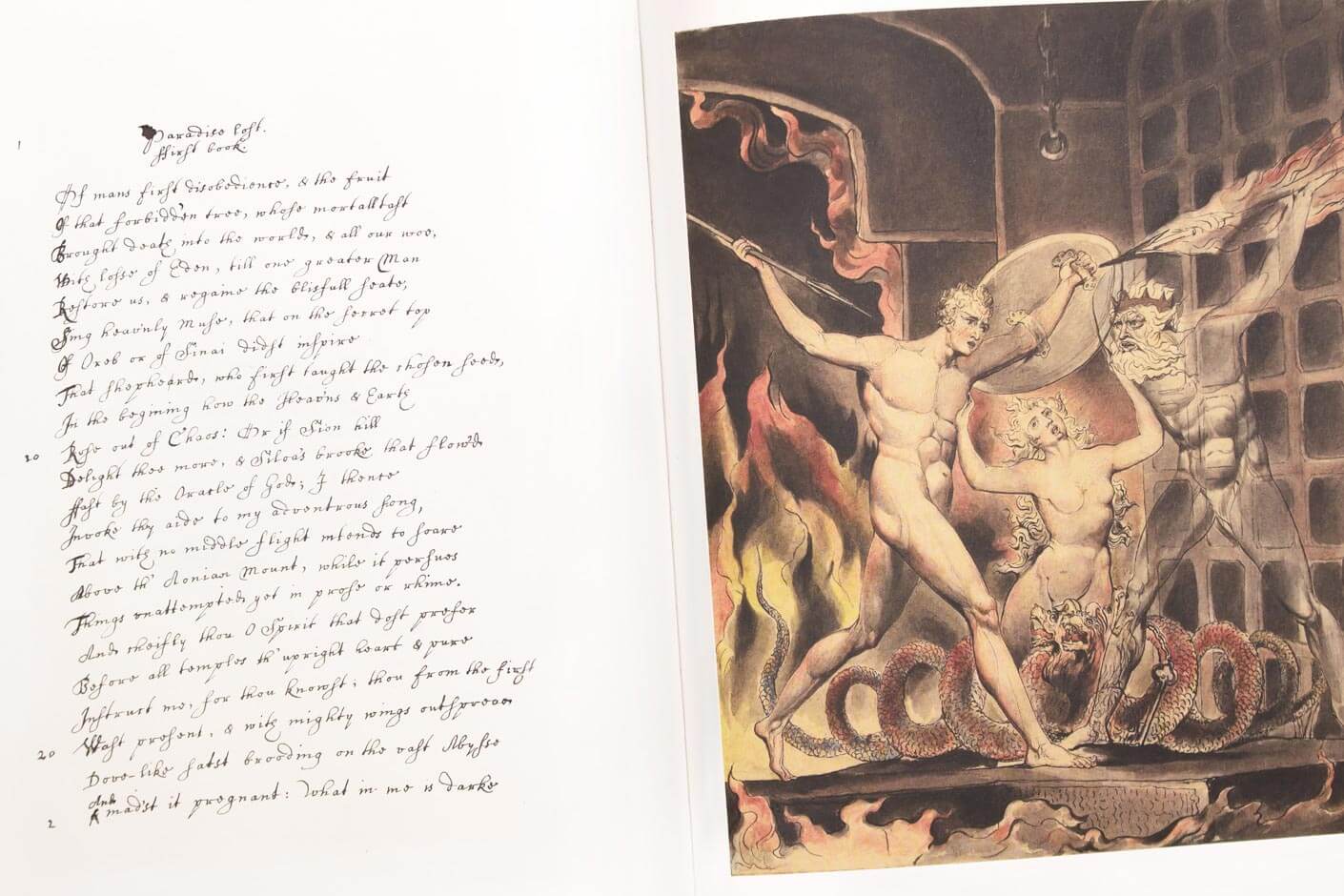
In The Marriage of Heaven and Hell, William Blake adds a note to the text that became a famous adage about John Milton’s Paradise Lost: the 10,000-line, 17th century blank verse epic about the war between heaven and hell and the failed testing of God’s premium product, human beings. Milton “wrote in fetters when he wrote of Angels & God, and at liberty when he wrote Devils & Hell,” Blake declared, “because he was a true Poet and of the Devil’s party without knowing it.” The statement inspired “other Romantic and Gothic writers to view Satan as a hero,” the British Library writes.
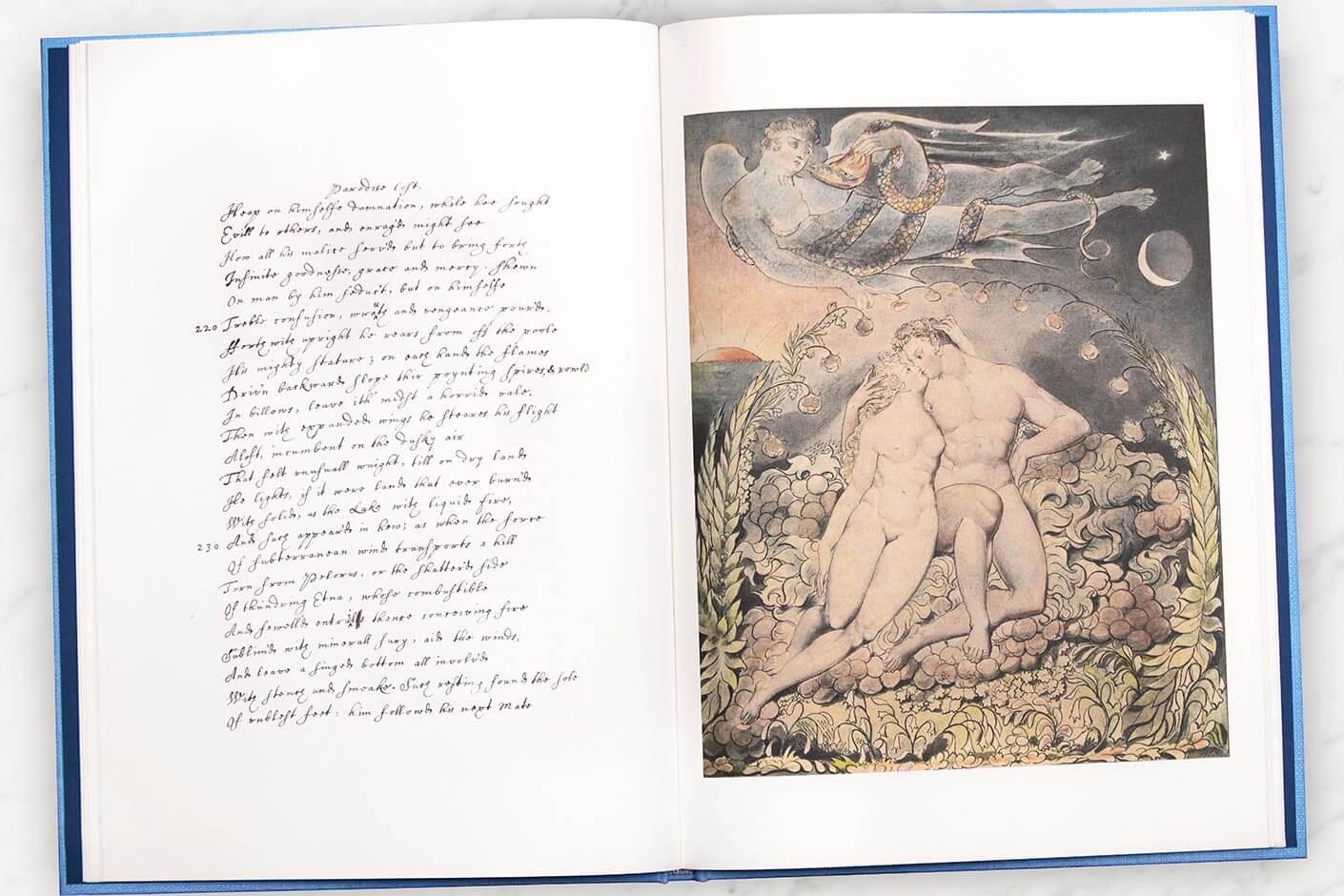
Blake himself illustrated Paradise Lost in three separate commissions over the course of his career as an engraver and printer. His deep admiration for the poem helped it become a “Bible of the Romantic movement,” writes the manuscript publisher SP Books in their introduction to a rare new book publication of the only surviving manuscript of the work.
Only 1,000 numbered, large format copies of this printing are available. (We do hope a subsequent edition will appear, maybe with a transcription and annotations. But it will not be as beautiful as this sky-blue cloth-covered book with Blake’s full-color illustrations.)
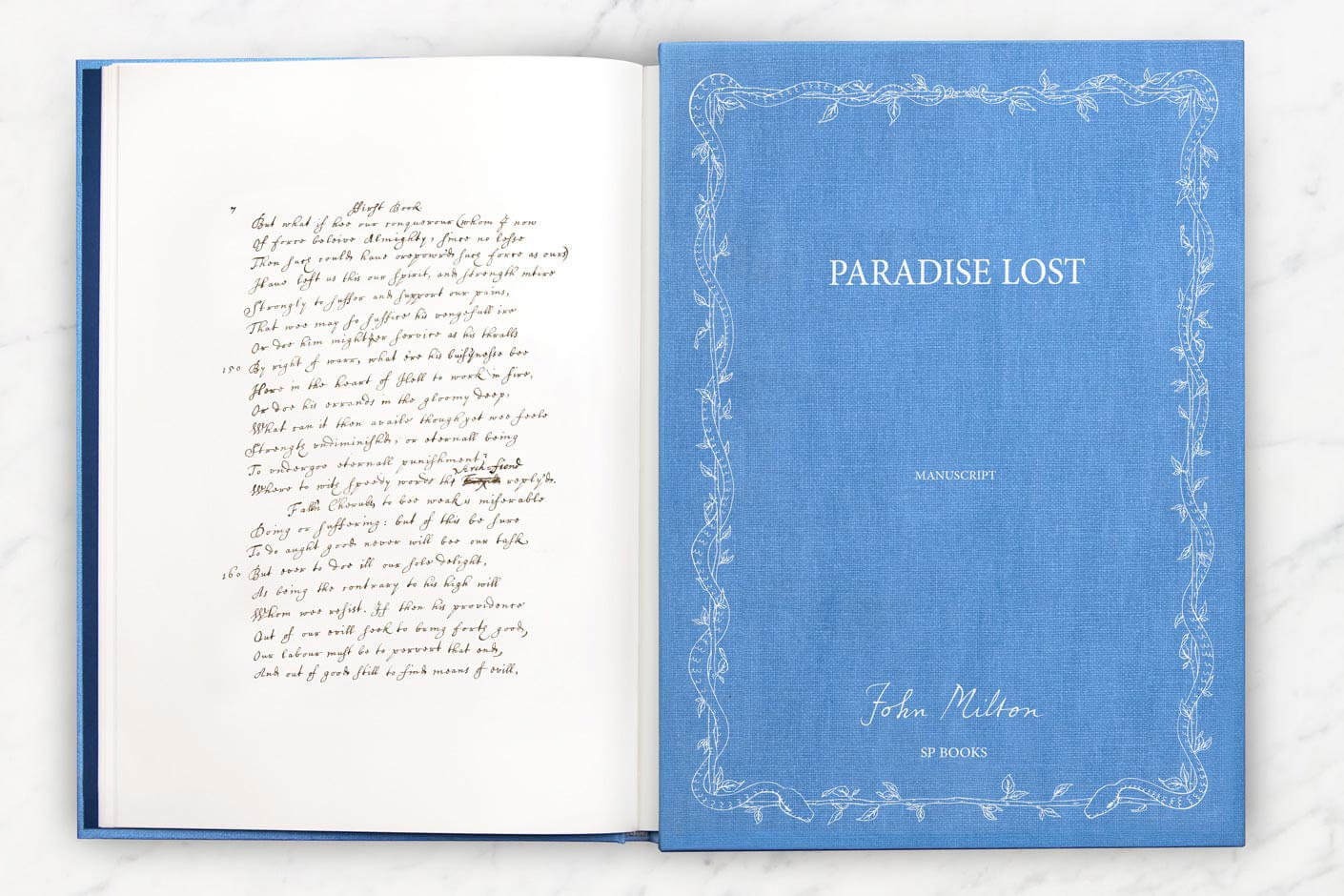
The book preserves the only part of the poem that survives in manuscript: 798 lines from Book One of Paradise Lost. These are not in Milton’s hand — he had been blind since 1652, and the poem was first published in 1667. He conceived the epic in his 50s, his career in government over after the English Civil Wars and the brief period of the Cromwells’ Protectorate ended in the Restoration of Charles II. “Milton composed ‘Paradise Lost’ aloud, in bed or (per witnesses) ‘leaning backwards obliquely in an easy chair,’ ” Lauren Christensen writes at The New York Times, “memorizing the stanzas to be transcribed in another’s hand.”
These first few hundred lines show why Satan seems so noble to Milton’s readers; speeches by and about him portray his doomed campaign as a righteous assault on heavenly tyranny. The Romantics’ use of Paradise Lost reflects their own preoccupations, while also echoing contemporary suspicions of the poem. “The authorities were concerned,” for example, Tom Paulin notes at The London Review of Books, by an image in Book One describing Satan:
as when the sun new ris’n
Looks through the horizontal misty air
Shorn of his beams, or from behind the moon
In dim eclipse disastrous twilight sheds
On half the nations, and with fear of changePerplexes monarchs.
“According to Milton’s early biographer, the Irish republican John Toland, Charles II’s Licenser for the Press regarded these lines as subversive,” Paulin points out, “and wanted to suppress the whole poem.” It’s surprising he was able to publish at all. Milton had vociferously supported the Puritan revolutionaries who overthrew the king’s father, Charles I, and removed his head. Milton later published several pamphlets in defense of regicide. In 1660, when Richard Cromwell’s Protectorate fell apart and Charles II returned, Milton’s works were banned by royal decree and the poet went into hiding until a general pardon.
Later critics have pointed to Milton’s political writings as evidence that he knew exactly whose party he was of. California State University’s Michael Bryson has gone so far as to argue that Milton was a secret atheist. In any case, he was a passionate believer in the overthrow of kings and the establishment of republics (for which he has become a libertarian hero). Paulin sums up the critical case for Paradise Lost as an allegory for the “lost cause” of the revolution:
Milton knew that the poem he was dictating to his amaneuensis would be scrutinized by the recently restored monarch’s Licenser of the Press, so he coded the English people’s formation of a republic as the creation of the “heavens and earth.” The idea passed the censor by, just as it has passed by many readers, but it was nonetheless Milton’s founding intention in composing his epic.
The charge that Milton made Satan a hero is hard to ignore when, reading Book One, we find the poet giving the Chief of Fallen Angels the best lines, as anyone who’s read Paradise Lost will remember. If you haven’t, just see the classic example below.
The mind is its own place, and in itself
Can make a Heav’n of Hell, a Hell of Heav’n.
What matter where, if I be still the same,
And what I should be, all but less than he
Whom Thunder hath made greater? Here at least
We shall be free; th’Almighty hath not built
Here for his envy, will not drive us hence:
Here we may reign secure, and in my choice
To reign is worth ambition though in Hell:
Better to reign in Hell, than serve in Heav’n.
Learn more about this rare manuscript edition at The New York Times’ review and purchase one (if one remains) at SP Books.
Related Content:
The Otherworldly Art of William Blake: An Introduction to the Visionary Poet and Painter
Spenser and Milton (Free Course)
Josh Jones is a writer and musician based in Durham, NC. Follow him at @jdmagness
Read More...Karl Marx & the Flaws of Capitalism: Lex Fridman Talks with Professor Richard Wolff
Lex Fridman, a Russian-American computer scientist and artificial intelligence researcher, hosts a popular podcast where he often interviews academics and helps them reach a surprisingly large audience. In recent weeks, he’s had long and wide-ranging conversations with NYU social psychologist Jonathan Haidt, Princeton historian Stephen Kotkin (on the history of Russia and the Ukraine war), and Stanford historian Norman Naimark (on genocide). Above you can now find his conversation with Marxist economist, Richard Wolff.
Fridman prefaces the lengthy conversation by saying, “This is a heavy topic, in general, and for me personally, given my family history in the Soviet Union, in Russia and Ukraine. Today, the words Marxism, Socialism and Communism are used to attack and divide, much more than to understand and learn. With this podcast, I seek the latter. I believe we need to study the ideas of Karl Marx, as well as their various implementations throughout the 20th and 21st centuries.… We need to consider seriously the ideas we demonize, and to challenge the ideas we dogmatically accept as true, even when doing so is at times unpleasant and dangerous.”
You can listen to their engaging conversation above, or find it on various podcasts platforms. Along the way, Wolff underscores the glaring deficiencies of capitalism, and why populists on the left and right are now looking for alternatives. And Fridman asks whether capitalism, despite its faults, may still be the best option we have. Wolff and Fridman undoubtedly have different worldviews, but the conversation is civil and deep, and worth your time.
Related Content
A Short Animated Introduction to Karl Marx
5 Free Online Courses on Marx’s Capital from Prof. David Harvey
Marxism by Raymond Geuss: A Free Course
Read More...The Oldest House in New York City: Meet the Wyckoff House (1652)
Most 21st-century Brooklyn public elementary schoolers have taken or will take a field trip to the Wyckoff House, a modest wooden cabin surrounded by tire shops and fast food outlets.
The oldest building in NYC by a longshot, it was also the first structure in the five boroughs to achieve historic landmark status.
Primary sources place the original occupants, Pieter Claesen Wyckoff and his wife, Grietje Van Ness-Wyckoff, in the original part of the house around 1652. A single room with a packed earth floor, unglazed windows, a large open hearth, and doors at either end, it would have been pretty tight quarters for a family of 13, as host Thijs Roes of the history series New Netherland Now notes, during his above tour of the premises.
Two parlors were added in the 18th-century, and three bedrooms in the early 19th. Typical Dutch Colonial features include an H frame structure, shingled walls, split Dutch doors, and deep, flared “spring” eaves.
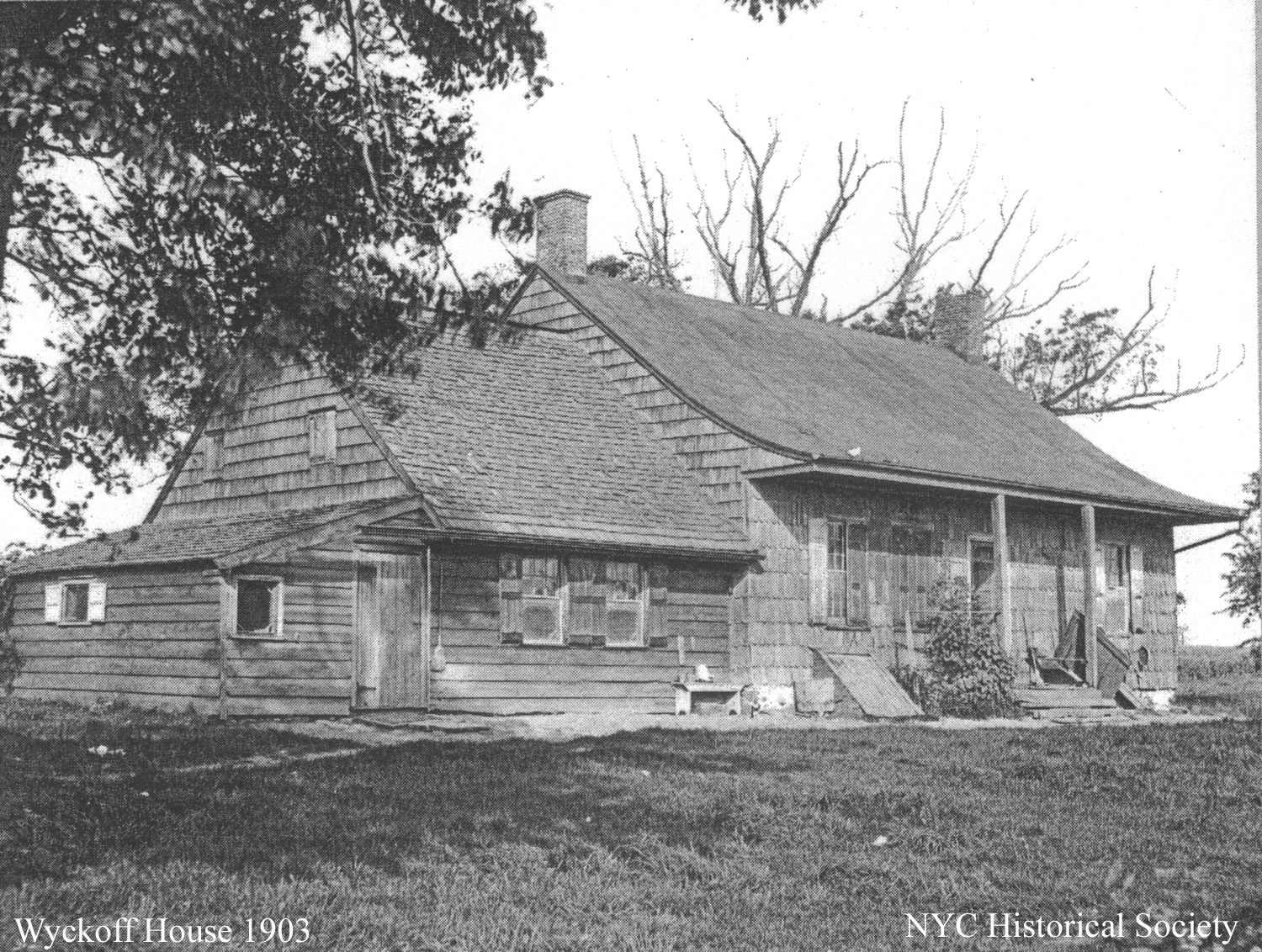
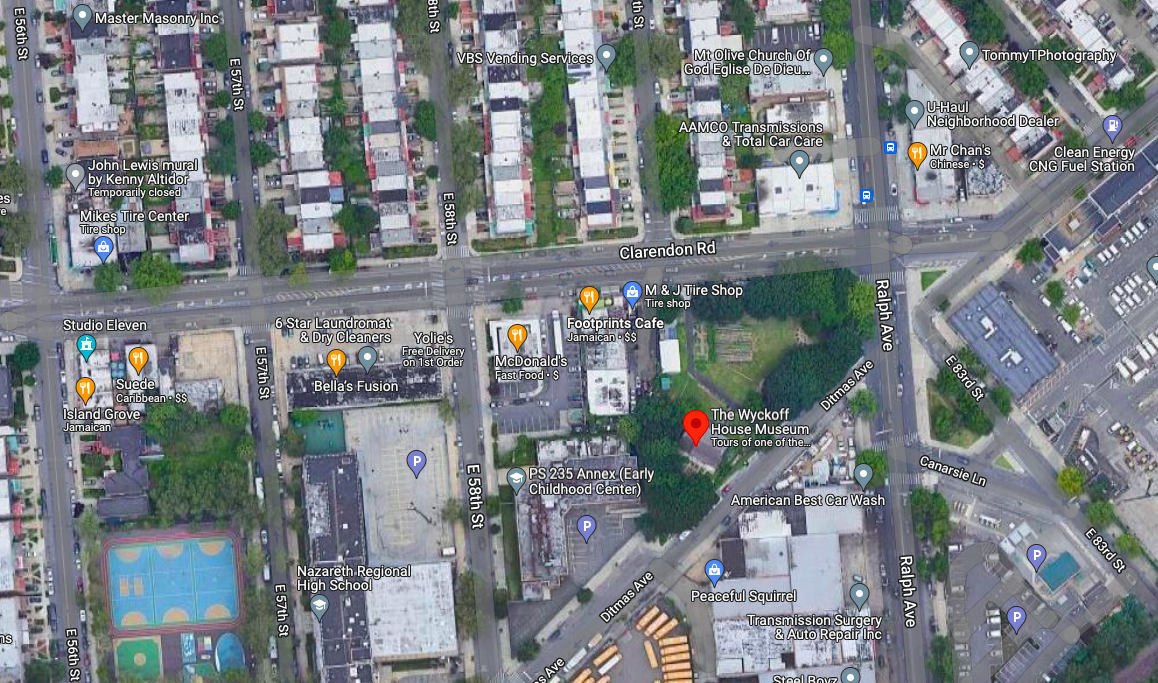
Its survival is a miracle in a metropolis known for its constant flux.
In the early 20th-century, descendants of Pieter and Grietje partnered with community activists to save the home from demolition, eventually donating it to the New York City Parks Department.
A late 70s fire (possibly not the first) necessitated major renovations. (And last year, flooding from Hurricane Ida clobbered its HVAC and electrical system, putting a temporary kibosh on public visits to the interior.)
Back in 2015, Roes’ companion, architectural historian Heleen Westerhuijs, was invited to inspect the attic, where she discovered impressive original beams alongside 20th-century reinforcements.
While the directors of the homestead actively recognize the community that now surrounds it with events like an upcoming celebration of Haitian culture and Vodou, and hands on activities include urban farming and composting, the original settlers of New Netherland (aka New Amsterdam, aka New York City) remain a major focus.
Any American or Canadian with the surname Wyckoff (or one of its more than 50 variants) can and should consider it their ancestral home, as they are almost certainly descended from Pieter and Grietje. While many thousands now bear the name, Pieter was the first. Volunteer genealogist Lynn Wyckoff explains:
After the English assumed control of New Netherland, residents practicing patronymics (a naming system that utilized one’s father’s name in place of a surname) were required to adopt, or freeze, surnames that could be passed down each generation. Pieter Claesen chose the name Wykhof, which most of his descendants have spelled Wyckoff. Despite many unfounded claims over the years regarding both Pieter’s ancestry and choice of surname, there is no record of Pieter’s parentage; but there is substantial evidence that he chose the name Wykhof in recognition of a farm by the same name outside of Marienhafe, Germany where his family were likely tenants.
A handful of Wyckoff family members left comments on the New Netherland Now video, including Donald, who wrote of his visit:
It was an odd feeling to touch the hand-hewn surface of a supporting beam cut and installed by my ancestor, hundreds of years ago. Since I am a Wyckoff, I was allowed to see some of the “off tour” bits of the house. I live over 3k miles away, so my feet will probably never touch the ground there again. But I’m glad NY and a lot of wonderful people have maintained my ancestral home so well and for so many years. Hopefully it has many hundreds of years of life remaining so that people can recall a time when Flatbush was more of a farm than a city.
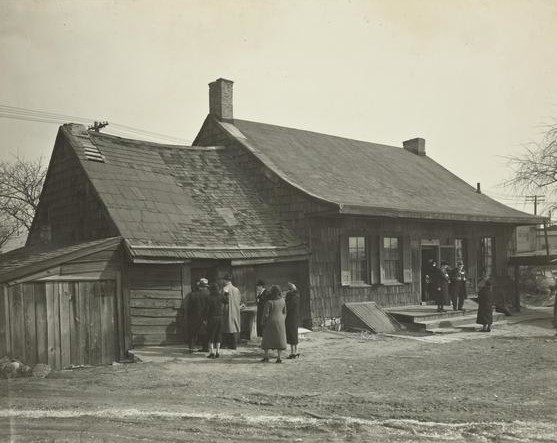
If you are a Wyckoff (or one of its variants), you’re invited to keep the Wyckoff Association’s family tree up to date by sending word of births, deaths, marriages, and any pertinent genealogical details such as education, military service, profession, places of residence and the like.
Explore a collection of educational activities, lessons, and color pages related to the Wyckoff House here.
Related Content
Immaculately Restored Film Lets You Revisit Life in New York City in 1911
New York City: A Social History (A Free Online Course from N.Y.U
- Ayun Halliday is the author, most recently, of Creative, Not Famous: The Small Potato Manifesto. Her family’s trips to the Wyckoff House were included in the latest, NYC museum-themed issue of her zine, the East Village Inky. Follow her @AyunHalliday.
Read More...Enter the Franz Kafka Caption Contest for a Chance to Win a New Book of the Author’s Drawings (Until June 13)
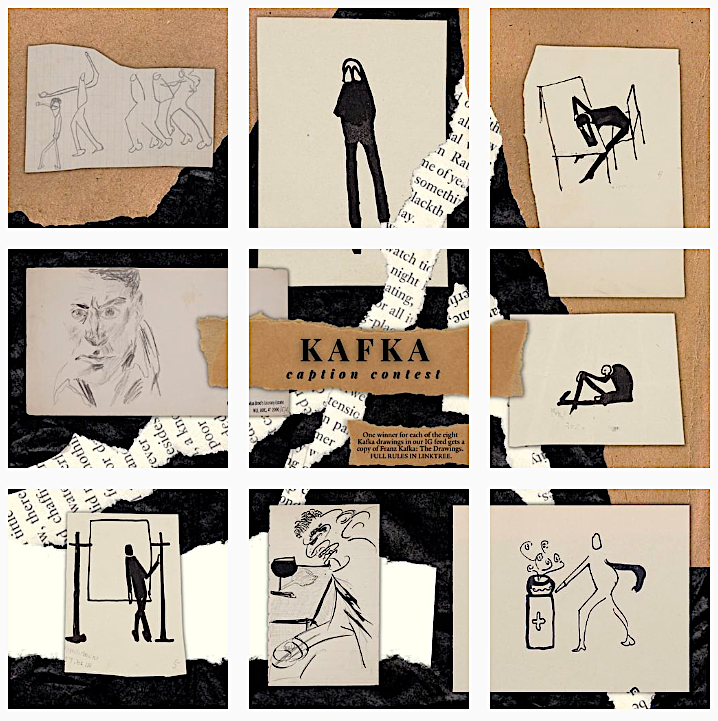
Imagine if Franz Kafka were charged with picking the winning entries in The New Yorker’s weekly cartoon caption contest.
The punchlines might become a little more obscure.
If that idea fills you with perverse pleasure, perhaps you should toddle over to Yale University Press’s Instagram to contribute some possible captions for eight of the inky drawings the tortured author made in a black notebook between 1901 and 1907.
The intended meaning of these images, included in the new book, Franz Kafka: The Drawings, are as up for grabs as any uncaptioned cartoon on the back page of The New Yorker.
In Conversations with Kafka, author Gustav Janouch recalled how their significance proved elusive even to their creator, and also the frustration his friend expressed regarding his artistic abilities:
I should so like to be able to draw. As a matter of fact, I am always trying to. But nothing comes of it. My drawings are purely personal picture writing, whose meaning even I cannot discover after a time.
Kafka seems to have gone easier on himself in a 1913 letter to fiancée Felice Bauer:
I was once a great draftsman, you know… These drawings gave me greater satisfaction in those days—it’s years ago—than anything else.
Artist Philip Hartigan, who referenced the drawings in a journal and sketchbook class for writing students nails it when he describes how Kafka’s “quick minimum movements … convey the typical despairing mood of his fiction in just a few lines.”
You have until June 13 to make explicit what Kafka did not by leaving your proposed caption for each drawing as a comment on Yale University Press’s Instagram, along the hashtag #KafkaCaptionContest.
Winners will receive a copy of Franz Kafka: The Drawings. Entries will be judged by editor Andreas Kilcher of and theorist Judith Butler, who contributed an essay that you might consider mining for material:
Was it a muffled death? Or perhaps it was no death at all, just a tumbling of intercourse, a sexual flurry?
Yes, that might go nicely with Kafka’s drawing of a seated figure collapsed over a table, below.
https://images.app.goo.gl/mGfZzLcpRXuyqqU68
Some alternate proposals from contest hopefuls:
I needed to bathe my battered knuckles with my tears.
He studied his newly acquired rare stamp with a powerful loupe.
How can I make sure that all my letters and papers will be destroyed after my death? I know — I’ll ask my closest friend to take care of it!
This last is a reference to Kafka’s literary executor, Max Brod, who defied Kafka’s explicit wish that all of his work be burned upon his death, save The Metamorphosis, and five short stories: The Judgment, The Stoker, In the Penal Colony, A Country Doctor and A Hunger Artist.
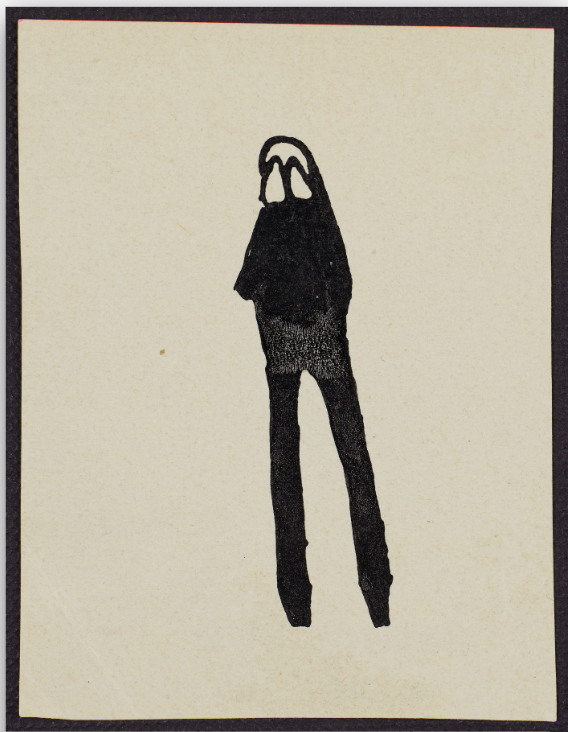
Brod cut Kafka’s drawing of the standing figure, above, from his sketchbook and kept in an envelope with a few others. Some of the current caption suggestions for this haunting, never before seen image:
my face is an umbrella to my tears
I couldn’t face myself.
I am the Walrus goo goo g’joob
https://images.app.goo.gl/e6v8xbuRin3qWcS56
Of the eight drawings in the caption contest, Drinker, may offer the most narrative possibilities. A representative sampling of the inventiveness that’s come over the transom thusfar:
I, period
Angered by the impudence of the cabernet, i had only the courage to berate its shadow
Waiter! There’s a roach in my wine.
Enter Yale University Press’ Kafka Caption Contest (or get a feel for the competition) here. Entries will be accepted through June 13. Full contest rules are here. Good luck!
Explore the drawings and other contents of Franz Kafka’s black notebook here.
Purchase Franz Kafka: The Drawings, the first book to publish the entirety of the author’s graphic output, here.
- Ayun Halliday is the Chief Primatologist of the East Village Inky zine and author, most recently, of Creative, Not Famous: The Small Potato Manifesto. Follow her @AyunHalliday.
Read More...Werner Herzog’s New Novel, The Twilight World, Tells the Story of the WWII Japanese Soldier Who Famously Refused to Surrender

As everyone knows, Japan conceded defeat in the Second World War on August 15, 1945. But as many also know, certain individual Japanese soldiers refused to surrender, each continuing to fight the war for decades in his own way. The most famous was Lieutenant Onoda Hiroo, who hid out in the Philippines mounting guerrilla attacks — at first with a few fellow soldiers, and finally alone — until 1974. Onoda became a celebrity upon retuning to his homeland, and his admirers weren’t only Japanese. In Tokyo to direct an opera in 1997, Werner Herzog requested an introduction to one man only: the soldier who’d fought the war for 30 years.
Now Onoda has become the subject of one of Herzog’s latest projects: not a film, but a novel called The Twilight World. In his native German (brought into English by translator-critic Michael Hofmann), Herzog has written of not just his own meeting with Onoda but narrated Onoda’s own long experience in the Philippines.
“Onoda’s war is of no meaning for the cosmos, for history, for the course of the war,” goes one passage quoted by A. O. Scott in The Atlantic. “Onoda’s war is formed from the union of an imaginary nothing and a dream, but Onoda’s war, sired by nothing, is nevertheless overwhelming, an event extorted from eternity.”
One thinks of the protagonists of Herzog’s films, both imagined and real: the steamship-dragging rubber baron Brian Sweeney Fitzgerald, the downed Navy pilot Dieter Dengler, the deluded conquistador Lope de Aguirre, the ill-fated wildlife activist Timothy Treadwell. In Onoda’s case as well, Scott writes, “Herzog declines to treat him as a joke. He is clearly fascinated by the absurdity of this hero’s situation, and also determined to defend the dignity of a man who had no choice but to persevere in an impossible mission.” Anyone familiar with Herzog’s career, full of harrowing encounters and unpredictable turns but clearly operating by an iron logic all its own, can imagine why he saw in Onoda a kindred spirit.
Eight years after his death at the age of 91, Onoda remains a figure of general fascination, the subject of history videos viewed by millions as well as last year’s Onoda: 10,000 Nights of the Jungle, a feature by French director Arthur Harari. Of course, “the guy who stays in the field long after the war is over is, to modern eyes, a comical, cautionary figure, an avatar of patriotism carried to ridiculous extremes,” writes Scott. “We rarely pause to look for motives other than blind obedience, or to imagine what those years of phantom combat in the wilderness must have felt like.” Perhaps we twenty-first century Westerners simply lack the imaginative power necessary to do so — all of us, that, is except Werner Herzog. You can pre-order his novel, The Twilight World, now. It hits the shelves next week, on June 14th.
Related content:
Werner Herzog Offers 24 Pieces of Filmmaking and Life Advice
Werner Herzog Discovers the Ecstasy of Skateboarding: “That’s Kind of My People”
Based in Seoul, Colin Marshall writes and broadcasts on cities, language, and culture. His projects include the Substack newsletter Books on Cities, the book The Stateless City: a Walk through 21st-Century Los Angeles and the video series The City in Cinema. Follow him on Twitter at @colinmarshall, on Facebook, or on Instagram.
Read More...Dying from Overwork: Disturbing Looks Inside Japan’s Karoshi and China’s “996” Work System
By most measures, Japan boasts the highest life expectancy in the world. But that ranking, of course, doesn’t mean that every Japanese person sees old age. Though the country’s rate of violent crime is low enough to be the envy of most of the world, its suicide rate isn’t, and it says even more that the Japanese language has a word that refers specifically to death by overwork. I first encountered it nearly thirty years ago in a Dilbert comic strip. “In Japan, employees occasionally work themselves to death. It’s called karōshi,” says Dilbert’s pointy-haired boss. “I don’t want that to happen to anybody in my department. The trick is to take a break as soon as you see a bright light and hear dead relatives beckon.”
You can see the phenomenon of karōshi examined more seriously in the short Nowness video at the top of the post. In it, a series of Japanese salarymen (a Japanese English term now well-known around the world) speak to the exhausting and unceasing rigors of their everyday work schedules — and, in some cases, to the emptiness of the homes that await them each night.
The CNBC segment just above investigates what can be done about such labor conditions, which even in white-collar workplaces contribute to the heart attacks, strokes, and other immediate causes of deaths ultimately ascribed to karōshi. In a grim irony, Japan has the lowest productivity among the G7 nations: its people work hard, yet their companies are hardly working.
Initiatives to put a stop to the ill effects of overwork, up to and including karōshi, include mandatory vacation days and office lights that switch off automatically at 10:00 p.m. Among the latest is “Premium Friday,” a program explained in the Vice video above. Developed by Keidanren, Japan’s oldest business lobby, it was initially received as “a direct response to karōshi,” but it has its origins in marketing. “We wanted to create a national event that bolstered consumption,” says the director of Keidanren’s industrial policy bureau. By that logic, it made good sense to let workers out early on Fridays — let them out to shop. But Premium Friday has yet to catch on in most Japanese enterprises, aware as they are that Japan’s economic might no longer intimidates the world.
The aforementioned low productivity, along with a rapidly aging and even contracting population, contributed to Japan’s loss of its position as the world’s second-largest economy. It was overtaken in 2011 by China, a country with overwork problems of its own. The Vice report above covers the “996” system, which stands for working from 9:00 a.m. to 9:00 p.m, six days a week. Prevalent in Chinese tech companies, it has been blamed for stress, illness, and death among employees. Laws limiting working hours have thus far proven ineffective, or at least circumventable. Certain pundits never stop insisting that the future is Chinese; if they’re right, all this ought to give pause to the workers of the world, Eastern and Western alike.
Related content:
The Employment: A Prize-Winning Animation About Why We’re So Disenchanted with Work Today
Charles Bukowski Rails Against 9‑to‑5 Jobs in a Brutally Honest Letter (1986)
Based in Seoul, Colin Marshall writes and broadcasts on cities, language, and culture. His projects include the Substack newsletter Books on Cities, the book The Stateless City: a Walk through 21st-Century Los Angeles and the video series The City in Cinema. Follow him on Twitter at @colinmarshall, on Facebook, or on Instagram.
Read More...Discover the Dystopian Surrealist Art of Polish Painter & Photographer Zdzisław Beksiński
“In the medieval tradition, Beksinski seems to believe art to be a forewarning about the fragility of the flesh — whatever pleasures we know are doomed to perish — thus, his paintings manage to evoke at once the process of decay and the ongoing struggle for life. They hold within them a secret poetry, stained with blood and rust.” — Guillermo del Toro
The life and death of Polish painter, photographer, and sculptor Zdzisław Beksiński has been sensationalized, made into a cursed tragedy in the telling of events late in his life that, taken together, all seem horrifying enough: the death of the artist’s wife from cancer in 1998, the suicide of his son, Tomasz, one year later, and, finally, his own stabbing death in 2005 at the hands of his caretaker’s teenage son. If we add to this account Beksiński’s childhood in Nazi-occupied, then Soviet-occupied Poland, we have ample reason to speculate about the meaning of his nightmarish visions.
But the “Nightmare Artist,” as he’s called in the video above, wants us to stay away from making meaning of any kind. Unlike artists whose work can seem inseparable from their statements of purpose (or personal or historical tragedies), Beksiński had nothing to say about his art or his life.
He preferred that others keep silent as well, though he himself hated silence, working to loud classical music and rock. Music, he said — not literature, film, history, or even other artists — was his only inspiration. The impression we get from these scant details and Beksiński’s disturbing work, is of an individual probably best left alone.
Judging an artist’s body of work by the worst things that have happened to them, however, is manifestly unfair. For the majority of his life, Beksiński embodied the famous Flaubert quote about a regular, orderly creative life. He studied architecture, went on to supervise construction projects and then design buses. Like many people, he hated his job (he left the bus company in 1967). He developed a passion for photography, sculpture, and painting. With no formal art training, he struck out on a successful fifty-year career as a prolific Surrealist, becoming a master of oil painting. Was he tormented? Those who knew him describe him as mild-mannered, pleasant, even funny. He seems to have been quite content.
Do we resist interpretation as Beksiński wanted? How can we, when the imagery of death in his work seems itself to interpret events that inevitably shaped his world? Beksiński was born in Sanok, in southern Poland, in 1929. When the Nazis came to Poland a decade later, Sanok’s population was “about 30% Jewish,” notes the Collector, “nearly all of which was eliminated by the war’s end.” Decades later, Nazi iconography and crowds of gaunt, corpse-like figures began to recur in Beksiński’s paintings, which he described as “photographing dreams.” These horrors predominate in his most popular work, even though Beksiński’s vision had more breadth than casual fans might know.
His sense of humor is evident in his photography, and in early, more abstract, paintings, he displays a much lighter touch. (See a broad sampling of Beksiński’s work at Artnet.) In the 90s, he began experimenting with computer graphics and “was granted his wish of being able to add surrealistic alterations to photographs,” bringing his career “full circle as he returned to his first medium,” notes Culture.pl. Yet, like his contemporary H.R. Giger, where Beksiński’s name is known, he’s usually known as a painter of nightmares and heavy metal album covers — and for good reason.
The Several Circles video on Beksiński above (which opens with a content warning) shows why his “epic universe of hellscapes” has proven so inescapable to the critics who embraced his work, the gallerists who sold it, and those who have discovered it since the artist’s tragic death.
Related Content:
An Introduction to Surrealism: The Big Aesthetic Ideas Presented in Three Videos
The Forgotten Women of Surrealism: A Magical, Short Animated Film
Josh Jones is a writer and musician based in Durham, NC. Follow him at @jdmagness
Read More...The Scream Explained: What’s Really Happening in Edvard Munch’s World-Famous Painting
The Scream is not screaming. “One of the famous in the images of art,” Edvard Munch’s most widely seen painting “has become, for us, a universal symbol of angst and anxiety.” Munch painted it in 1893, when “Europe was at the birth of the modern era, and the image reflects the anxieties that troubled the world.” However many fin-de-siècle Europeans felt like screaming for one reason or another, the central figure of The Scream isn’t one of them: “rather, it is holding its hands over its ears, to block out the scream.” So gallerist and Youtuber James Payne reveals on the latest episode of his series Great Art Explained, which doesn’t just examine Munch’s iconic work of art, but places it in the context of his career and his time.
During most of Munch’s life, “European cities were going through truly exceptional changes. Industrialization and economic shifts brought fear, obsessions, diseases, political unrest, and radicalism. Questions were being raised about society, and the changing role of man within it: about our psyche, our social responsibilities, and most radical of all, about the existence of God.” It was hardly the most suitable time or place for the mentally troubled, but then, Munch seems to have possessed more psychological fortitude than he let the public know. A savvy self-promoter, he understood the value of living like someone whose terrible perceptions keep him on the brink of total breakdown.
But then, Munch never did have it easy. “His mother and his sister both died of tuberculosis. His father and grandfather suffered from depression, and another sister, Laura, from pneumonia. His only brother would later die of pneumonia.” He found solace in art, a pursuit strongly opposed by his religious father, and eventually joined the bohemian world, a milieu that encouraged him to let his inner world shape his aesthetic. Drawing inspiration from the French Impressionists and the drama of August Strindberg, Munch eventually found his way to starting a cycle of paintings called The Frieze of Life.
It was during his work on The Frieze of Life that, according to a diary entry of January 22nd, 1892, Munch found himself walking along a fjord. “I felt tired and ill. I stopped and looked out over the fjord — the sun was setting, and the clouds turning blood red. I sensed a scream passing through nature; it seemed to me that I heard the scream. I painted this picture, painted the clouds as actual blood. The color shrieked.” The fjord was on the way back from the asylum to which his beloved younger sister had recently been confined; Payne imagines that her “screams of terror must have haunted him as he walked away.” From these grim origins, The Scream emerged to become an oft-referenced and highly relatable image — even to those who see in it nothing more than their own frustration at receiving too much e‑mail.
Related content:
How Edvard Munch Signaled His Bohemian Rebellion with Cigarettes (1895): A Video Essay
Explore 7,600 Works of Art by Edvard Munch: They’re Now Digitized and Free Online
The Life & Work of Edvard Munch, Explored by Patti Smith and Charlotte Gainsbourg
Edvard Munch’s Famous Painting “The Scream” Animated to Pink Floyd’s Primal Music
The Edvard Munch Scream Action Figure
Based in Seoul, Colin Marshall writes and broadcasts on cities, language, and culture. His projects include the Substack newsletter Books on Cities, the book The Stateless City: a Walk through 21st-Century Los Angeles and the video series The City in Cinema. Follow him on Twitter at @colinmarshall, on Facebook, or on Instagram.
Read More...Support Us
We're hoping to rely on loyal readers, rather than erratic ads. Please click the Donate button and support Open Culture. You can use Paypal, Venmo, Patreon, even Crypto! We thank you!

About Us

Open Culture scours the web for the best educational media. We find the free courses and audio books you need, the language lessons & educational videos you want, and plenty of enlightenment in between.
Advertise With Us

FREE UPDATES!
GET OUR DAILY EMAIL
Get the best cultural and educational resources on the web curated for you in a daily email. We never spam. Unsubscribe at any time.
FOLLOW ON SOCIAL MEDIA

Open Culture editor Dan Colman scours the web for the best educational media. He finds the free courses and audio books you need, the language lessons & movies you want, and plenty of enlightenment in between.
Advertise With Us

