Architect Breaks Down Five of the Most Iconic New York City Apartments
Real estate is a perennially hot topic in New York City, as is gentrification.
Above, architect Michael Wyetzner, breaks down the defining features of several typical NYC apartments.
You’re on your own to truffle up the sort of rent a 340 square feet studio commands in an East Village tenement these days.
The ancestors would be shocked, for sure. My late mother-in-law never tired of causing young jaws to drop by revealing how she once paid $27/month for a 1 bedroom on Sheridan Square…and her mother, who immigrated at the turn of the century, couldn’t wait to put the Lower East Side behind her.
He may not truck in final sales figures, but Wyetzner drops in a wealth of interesting factual tidbits as he sketches layouts with a black Pentel Sign Pen. His tone is more Lower East Side Tenement Museum tour guide than the comments section of a real estate blog where salty New Yorkers flaunt their street cred.
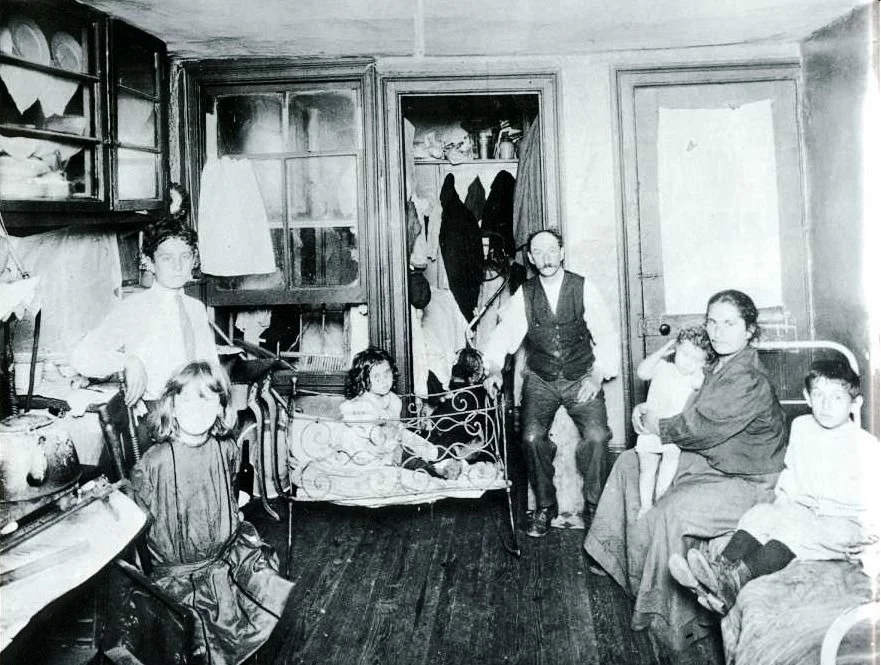
For instance, those enfilade tenement apartments–to employ the grand architectural term Wyetzner just taught us–were not only dark, but dangerously under-ventilated until 1901, when reforms stipulated that air shafts must be opened up between side by side buildings.
This public health initiative changed the shape of tenement buildings, but did little to stop the poverty and overcrowding that activist/photographer Jacob Riis famously documented in How the Other Half Lives.
(Another measure decreed that building owners must supply one indoor toilet …per 20 people!)
While we’re on the topic of toilets, did you know that there was a time when every brownstone backyard boasted its own privy?
Homeowners who’ve spent millions on what many conceive of as the most romantic of New York City buildings (then millions more on gut renovations) proudly display old bottles and other refuse excavated from the site where privys once stood. The former residents turn their outhouses into garbage chutes upon achieving indoor plumbing.
Laying aside its distinctive color, a brownstone’s most iconic feature is surely its stoop.
Stoops grabbed hold of the American public’s imagination thanks to Sesame Street, the Harlem photographs of Gordon Parks and the films of Spike Lee, who learned of Martin Luther King’s assassination as an 11-year-old, sitting on his.
“Not porch!,” he emphasized during a Tonight Show appearance. ”In Brooklyn, it’s stoops. Stoops!”
(Forgive me if I delve into NYC real estate prices for a sec: the Bed-Stuy brownstone from Lee‘s semi-autobiographical Crooklyn, above, just went on the market for $4.5 million.)
There’s no question that brownstone stoops make excellent hang out spots, but that’s not the reason they rose to prominence.
As Esther Crain writes in Ephemeral New York, the Commissioners’ Plan of 1811 which led to the city’s gridlike layout negated the possibility of alleys:
Without a back door to a rowhouse accessed through an alley, servants and workers would enter and exit a residence using the same front stoop the owners used—which wasn’t too popular, at least with the owners.
But a tall stoop set back from the sidewalk allowed for a side door that led to the lower level of the house. While the owners continued to go up and down the stoop to get to the parlor floor (and see and be seen by their neighbors), everyone else was relegated to the side…And of course, as New York entered the Gilded Age of busy streets filled with dust, ash, refuse, and enormous piles of horse manure, a very high stoop helped keep all the filth from getting into the house.
Flash forward a hundred and fifty some years, and, as Wyetzner notes, a stoop’s top step offers a highly scenic view of the Hefty bags the neighbors haul to the curb the night before New York’s Strongest roll through.
Wyetzner also provides the historical context behind such architecturally distinctive digs as SoHo’s astronomically priced light-filled lofts, the always desirable Classic Six residences on the Upper East and Upper West Sides, one-room studios both modern and original flavor, and our blighted public housing projects.
If you’re itching to play along from home, check out the New York Times’ regular feature The Hunt, which invites readers to trail a single, family, or couple deliberating between three properties in New York City.
A sample: “After a mouse infestation at her West Village rental, a single mother needed a better spot for her family, including a son with autism.”
Review the layouts and click here to see whether she chose a brand-new 127-unit building with a rooftop pool, a Harlem brownstone duplex with a backyard rights, or an updated one bedroom in a downtown co-op from 1910.
Related Content
New York Public Library Puts 20,000 Hi-Res Maps Online & Makes Them Free to Download and Use
- Ayun Halliday is the Chief Primatologist of the East Village Inky zine and author, most recently, of Creative, Not Famous: The Small Potato Manifesto. She has lived in all manner of New York City apartments, but hopes to never move again. Follow her @AyunHalliday.
Read More...The Evolution of the Electric Guitar: An Introduction to Every Major Variety of the Instrument That Made Rock-and-Roll
The past century has seen many stylistic changes in popular culture, none more dramatic than in music. We need only hear a few measures of a song to place it in the right decade. The sound of an era’s music reflects the state of its technology: whenever engineering can make possible tools like multitrack recorders, tape loops, samplers, and synthesizers — to say nothing of listening media like cylinders, vinyl records, and online streaming — the soundtrack of the zeitgeist has been transformed. But in living memory, surely no development has made quite so powerful an impact on popular music as the electric guitar.
“Almost all guitars currently on the market are either a direct descendant of, or very similar to, a handful of instruments that came to life during the span of one decade: the fifties.” With these words, Dutch Youtuber Paul Davids launches into a video journey through the evolution of the electric guitar as we know it, beginning in 1950 with the Fender Telecaster.
Davids doesn’t just explain the components and construction of that venerable instrument, he plays it — just as he does a variety of other electric guitars, each with a sound representative of its era. Even if you don’t know them by name, they’ll all sound familiar from a variety of musical contexts.
The invention of the electric guitar made possible the birth of rock and roll, which shows no few signs of frailty even here in the twenty-first century. The earliest models produced are ever more highly valued for their sound, their feel, and their apparent simplicity, a quality many rockers hold in the utmost regard. But despite long adhering to the same basic form, the electric guitar has incorporated a great variety of innovations — in its pickups, its vibrato systems, and much else besides — whose combinations and permutations have given rise to entire subgenres like surf, heavy metal, rockabilly, and grunge. Like rock itself, the electric guitar arrived having already attained a kind of perfection, but possessed too much vitality to stand still.
Related content:
Behold the First Electric Guitar: The 1931 “Frying Pan”
The World’s First Bass Guitar (1936)
The Story of the Guitar: The Complete Three-Part Documentary
Oxford Scientist Explains the Physics of Playing Electric Guitar Solos
Based in Seoul, Colin Marshall writes and broadcasts on cities, language, and culture. His projects include the Substack newsletter Books on Cities, the book The Stateless City: a Walk through 21st-Century Los Angeles and the video series The City in Cinema. Follow him on Twitter at @colinmarshall, on Facebook, or on Instagram.
Read More...When Sliced Bread Got Banned During World War II
Home baked sourdough had its moment during the early days of the pandemic, but otherwise bread has been much maligned throughout the 21st century, at least in the Western World, where carbs are vilified by body-conscious consumers.
This was hardly the case on January 18, 1943, when Americans woke up to the news that the War Foods Administration, headed by Secretary of Agriculture Claude R. Wickard, had banned the sale of sliced bread.
The reasons driving the ban were a bit murky, though by this point, Americans were well acquainted with rationing, which had already limited access to high-demand items as sugar, coffee, gasoline and tires.
Though why sliced bread, of all things?
Might depriving the public of their beloved pre-sliced bread help the war effort, by freeing up some critical resource, like steel?

Not according to The History Guy, Lance Geiger, above.
War production regulations prohibited the sale of industrial bread slicing equipment for the duration, though presumably, existing commercial bakeries wouldn’t have been in the market for more machines, just the odd repair part here and there.
Wax paper then? It kept sliced bread fresh prior to the invention of plastic bags. Perhaps the Allies had need of it?
No, unlike nylon, there were no shortages of waxed paper.
Flour had been strictly regulated in Great Britain during the first World War, but this wasn’t a problem stateside in WWII, where it remained relatively cheap and easy to procure, with plenty leftover to supply overseas troops. 1942’s wheat crop had been the second largest on record.
There were other rationales having to do with eliminating food waste and relieving economic pressure for bakers, but none of these held up upon examination. This left the War Production Office, the War Price Administration, and the Office of Agriculture vying to place blame for the ban on each other, and in some cases, the American baking industry itself!
While the ill considered ban lasted just two months, the public uproar was considerable.

Although pre-sliced bread hadn’t been around all that long, in the thirteen-and-a-half years since its introduction, consumers had grown quite dependent on its convenience, and how nicely those uniform slices fit into the slots of their pop up toasters, another recently-patented invention.
A great pleasure of the History Guy’s coverage is the name checking of local newspapers covering the Sliced Bread Ban:
An absence of data did not prevent a reporter for the Wilmington News Journal from speculating that “it is believed that the majority of American housewives are not proficient bread slicers.”
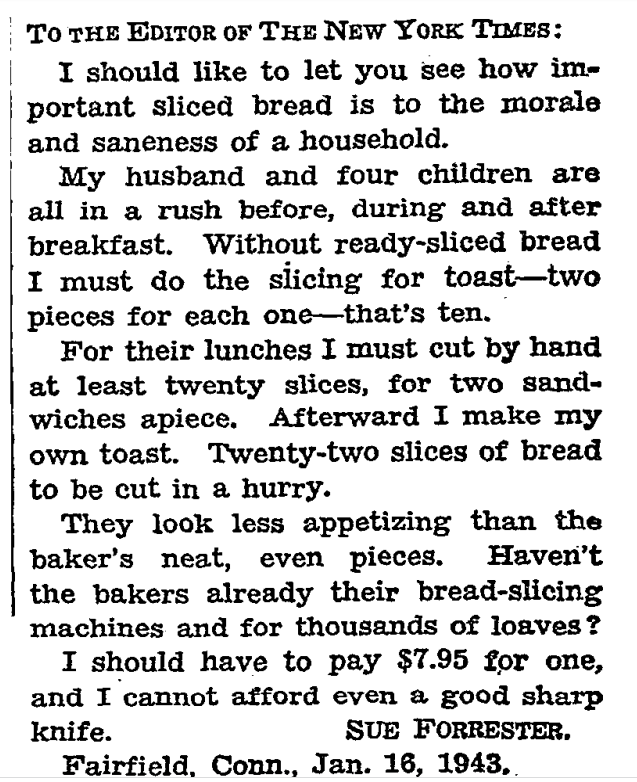
One such housewife, having spent a hectic morning hacking a loaf into toast and sandwiches for her husband and children, wrote a letter to the New York Times, passionately declaring “how important sliced bread is to the morale and saneness of a household.”
The more stiff upper lipped patriotism of Vermont home economics instructor Doris H. Steele found a platform in the Barre Times:
In Grandmother’s day, the loaf of bread had a regular place at the family table. Grandmother had an attractive board for the bread to stand on and a good sharp knife alongside. Grandmother knew that a steady hand and a sharp knife were the secrets of slicing bread. She sliced as the family asked for bread and in this way, she didn’t waste any bread by cutting more than the family could eat. Let’s all contribute to the war effort by slicing our own bread.
Then, as now, celebrities felt compelled to weigh in.
New York City Mayor Fiorello LaGuardia found it ludicrous that bakeries should be prevented from putting their existing equipment to use.
And Hollywood actress Olivia de Havilland approved of the ban on the grounds that packaged slices were too thick.
Watch more of the History Guy’s videos here.
Related Content
How to Bake Ancient Roman Bread Dating Back to 79 AD: A Video Primer
See Ridley Scott’s 1973 Bread Commercial—Voted England’s Favorite Advertisement of All Time
Take a Virtual Tour of the World’s Only Sourdough Library
- Ayun Halliday is the Chief Primatologist of the East Village Inky zine and author, most recently, of Creative, Not Famous: The Small Potato Manifesto. Follow her @AyunHalliday.
Read More...All of the Different Kinds of Acoustic Guitars, and the Different Woods They’re Made Of: The Ultimate Acoustic Guitar Guide
If you’re just starting out on acoustic guitar, buying your first instrument might seem simple enough…. Head to your local music shop (or ecommerce retailer), thrust out your hand, and say something like, “Give me a beginner guitar now!” Pay your money, take your lessons, Bob’s your uncle, right?
Ah, but say you encounter one of those things known as a guitar salesperson? And say that person has some questions… “Ok, we’ve got traditional-style dreadnoughts with cutaways or no cutaways. We’ve got concert sized guitars, parlor guitars, classical, all sorts!” And you, formerly confident shopper, now find yourself at sea. What’s the difference?
They’re already on to talking about different materials used in making guitars and you check out. You imagine a pursuit where you know what you’re doing: I could learn harmonica…. How many kinds of those are there?
Fear not, beginner, YouTube guitar educator Paul Davids is here to teach us the types of acoustic guitars we’re likely to encounter in the wild, as well as the different kinds of “tone woods” and why they make a difference.
Tone wood simply means the kinds of trees used to make the guitar – maple, mahogany, rosewood, spruce, etc. – and it’s called “tone wood” instead of just “wood” for a reason. Among makers and players of electric guitars, a never-ending argument persists about how much tone wood matters. There should be little debate when it comes to acoustic guitars.
The sound of an acoustic guitar comes from the pick, or the fingers, and from the neck, where the strings’ contact with the fretboard travels down to the resonating chamber of the body and gets sent out into the world. At each of these contact points, the properties of the wood in question naturally condition the shape of the sound waves.
Enlisting the help of Eastwood Guitars Pepijn ‘t Hart above, who donated the guitars in the first video for demonstration purposes, Davids demonstrates beyond question that different woods used to construct the back, sides, and top of an acoustic guitar have a tremendous effect on the tone.
From brighter to darker, treblier to bassier, or whatever you want to call the range of tones, you’ll hear them in these examples of different materials used to make the same sized guitars. Why is this important? As Hart explains, an acoustic guitar is basically its own amplifier. While you can adjust the tone somewhat with technique, the first thing you need to do as an acoustic guitar player is determine the best type of instrument you’ll need for the kind of music you’re playing.
Guitarists may also need to consider (eventually), the kinds of musicians they’re playing with. A heavy rock ensemble with rumbling bass and drums will require a much brighter guitar to cut through the mix, whereas accompanying a banjo player or violinist will call for more low end.
You can still grab the first beginner acoustic guitar you find online and call it a day. But if you’re serious about learning the instrument – and learning to play in a musical tradition, be it folk, blues, country, classical, rock, or whatever – you’ll need this essential information. Davids and Hart make it fun and easy to acquire in the two-part educational series above.
Related Content:
Musician Plays the Last Stradivarius Guitar in the World, the “Sabionari” Made in 1679
What Does a $275,000 Classical Guitar Sound Like?
Josh Jones is a writer and musician based in Durham, NC. Follow him at @jdmagness
Read More...The Only Written Eye-Witness Account of Pompeii’s Destruction: Hear Pliny the Younger’s Letters on the Mount Vesuvius Eruption
Though my shocked soul recoils, my tongue shall tell. — Pliny the Younger
A great deal of what we know — or think we know — about the destruction of Pompeii and Herculaneum in 79 AD comes filtered through modern mythologies like the 1834 novel The Last Days of Pompeii. Written by Edward Bulwer-Lytton (the first novelist to start a tale with “It was a dark and stormy night”), the book’s Romantic fascination with civilizational decay was one stream of thinking that blames Pompeiians themselves, in part, for their destruction. That blame manifests as explicit, or more subtle, suggestions of divine punishment. Or it can look like chiding impractical residents who didn’t get out in time or took the wrong route out of town to avoid the heavy downpour of molten rock and ash, as though a volcanic eruption were a traffic jam in a thunderstorm.…
Blame is a reflexive defense against the horrifying possibility that the screaming figures frozen in ash could be us. There’s little to counter our certainty from Pompeiians themselves. Somewhere between 10,000 to 12,000 people got out in time (approximately 2,000 were killed), but there are no existing accounts from the city’s former residents-turned- refugees. If they had anything to say about it later, we’ll never know. We do, however, have an eyewitness account of the destruction. Its author, Pliny the Younger, watched from a vantage point above the immediate scenes of panic and death: his villa across the bay of Naples in Misenum. He also happened to be nephew to the great Roman naturalist and military campaigner Pliny the Elder, and an adept writer and keen observer of nature himself.
Pliny the Younger’s letters — published in 9 volumes during his lifetime, 10 afterward — hold more interest for historians than their descriptions of Vesuvius. In his long life, “he was a poet, a senator, a public official,” Joan Acocella writes at The New Yorker. He had firsthand knowledge of “celebrated crimes” among the Roman elite. But the destruction of Pompeii was formative: his uncle died in an attempted evacuation of the city by sea, a major event for Pliny and for Roman arms and letters. While the Younger had been at leisure in Misenum, the Elder had been at work, “in active command of the fleet,” his nephew writes in a letter to his friend, fellow lawyer, and later famed historian Publius Cornelius Tacitus. Pliny begins with an explanation, more or less, for why he’s still alive.
When his uncle saw the “cloud of unusual size and appearance” rising over the bay, he “ordered a boat made ready, telling me I could come with him if I wished.” Had the cautious nephew accepted his invitation, Pliny the Younger would probably have died at the age of 18, something he surely meditated upon from time to time in later life. In the letter, he styles his uncle as a “hero” for his rescue attempts. Pliny wasn’t there himself to see these events, but he imagines what his uncle said and did. He even describes Pliny the Elder’s dramatic collapse and death in Stabiae, several miles away across the Bay. It’s hard to sift the facts from literary embellishment, but Pliny’s descriptions of Vesuvius itself are vivid and terrifying. The mountain, he writes, was covered in “broad sheets of fire and leaping flames… their bright glare emphasized by the darkness of night.”
His observations of the initial eruption seem highly credible given his actual location:
It was not clear at that distance from which mountain the cloud was rising (it was afterwards known to be Vesuvius); its general appearance can best be expressed as being like an umbrella pine, for it rose to a great height on a sort of trunk and then split off into branches, I imagine because it was thrust upwards by the first blast and then left unsupported as the pressure subsided, or else it was borne down by its own weight so that it spread out and gradually dispersed. In places it looked white, elsewhere blotched and dirty, according to the amount of soil and ashes it carried with it.
Pliny seems to want to write more about what he saw, but he obliges Tacitus’ request to tell the story of his uncle’s death. “You will pick out of this narrative whatever is most important,” he concludes. “For a letter is one thing, a history another; it is one thing writing as a friend, another thing writing to the public.” You can hear the letter read in full in the YouTube video above from Voices of the Past.
The line between public history and private correspondence may not be so clear as Pliny imagined, especially when his letters are the only eyewitness sources we have. In a second missive to Tacitus, per his friend’s request, Pliny describes the scene back in Misenum on the second day of the eruption. He and his mother had debated what to do, and finally decided to evacuate. Here, writing about events he experienced firsthand, he strays from the narrative conventions of his first letter, conveying the chaotic atmosphere of terror all around him as they left. The letter is harrowing, and worth quoting at length.
Though Pliny himself, at the end of the letter, pronounces it unworthy of inclusion in Tacitus’ history, it remains the one firsthand account to which we can turn when imagining the experience.
Ashes were already falling, not as yet very thickly. I looked round: a dense black cloud was coming up behind us, spreading over the earth like a flood. ‘Let us leave the road while we can still see,’ I said, ‘or we shall be knocked down and trampled underfoot in the dark by the crowd behind.’ We had scarcely sat down to rest when darkness fell, not the dark of a moonless or cloudy night, but as if the lamp had been put out in a closed room.
You could hear the shrieks of women, the wailing of infants, and the shouting of men; some were calling their parents, others their children or their wives, trying to recognize them by their voices. People bewailed their own fate or that of their relatives, and there were some who prayed for death in their terror of dying. Many besought the aid of the gods, but still more imagined there were no gods left, and that the universe was plunged into eternal darkness for evermore.
There were people, too, who added to the real perils by inventing fictitious dangers: some reported that part of Misenum had collapsed or another part was on fire, and though their tales were false they found others to believe them. A gleam of light returned, but we took this to be a warning of the approaching flames rather than daylight. However, the flames remained some distance off; then darkness came on once more and ashes began to fall again, this time in heavy showers. We rose from time to time and shook them off, otherwise we should have been buried and crushed beneath their weight. I could boast that not a groan or cry of fear escaped me in these perils, but I admit that I derived some poor consolation in my mortal lot from the belief that the whole world was dying with me and I with it.
Related Content:
Pompeii Rebuilt: A Tour of the Ancient City Before It Was Entombed by Mount Vesuvius
Josh Jones is a writer and musician based in Durham, NC. Follow him at @jdmagness
Read More...Every Style of Beer Explained: An Expert Breaks Down 100 Types of Beer, from Malty Lagers, to London Brown Ales, to Bock Beer
There was a time when one could hardly hope to enter polite society without knowing one’s Cabernets from one’s Pinots and one’s Chardonnays from one’s Rieslings. That time has not quite gone, exactly, and indeed, a greater variety of pleasures await the oenophile today than ever before. But in the twenty-first century, and especially in twenty-first century urban America, one must command a certain knowledge of beer. Even those who partake only of the occasional glass will, after a decade or two, develop a sense that they prefer a lager, say, or a stout, or the perennially trendy IPA. Yet many will also be at a loss to explain what they like about their preferred beer’s flavor, let alone its origins.
Enter Master Cicerone Pat Fahey, whose title bespeaks his vast knowledge of beer: of its nature, of its making, of its history. He puts his mastery of the subject on full display in the hourlong Wired video above, in which he breaks down every style of beer. Not most styles: every style, beginning with lagers malty and hoppy, moving through an even wider variety of ales, and ending with an extended consideration of lesser-known beers and their variations. Most all of us have sampled American lager, English porter, and even German pilsner. But can you remember when last you threw back a Flanders red ale, a doppelbock, or a wee heavy?
Fahey knows his beers, but he also knows how to talk about them to the general public. His explanatory technique involves providing generous amounts of context, not just about the parts of the world in which these beers originate (a geography and language lesson in itself) but about the ways they’ve been consumed and produced throughout history. Of that last he has a fair amount to work with, since the oldest recipe for beer, previously featured here on Open Culture, dates to 1800 B.C. The nearly four millennia of beer evolution since then have produced the formidable tap rows with which the bars of Portland, Austin, and San Diego confront us today — and which, with Fahey’s guidance, we can more credibly navigate.
Related content:
Beer Archaeology: Yes, It’s a Thing
Discover the Oldest Beer Recipe in History From Ancient Sumeria, 1800 B.C.
Watch Beer Ferment in Time-Lapse Motion, and Then Learn How to Make Beer with an Animated Video
An Archaeologist Creates the Definitive Guide to Beer Cans
Based in Seoul, Colin Marshall writes and broadcasts on cities, language, and culture. His projects include the Substack newsletter Books on Cities, the book The Stateless City: a Walk through 21st-Century Los Angeles and the video series The City in Cinema. Follow him on Twitter at @colinmarshall, on Facebook, or on Instagram.
Read More...The Oakland Public Library Puts Online a Collection of Items Forgotten in Library Books: Love Notes, Doodles & More
Librarians are champions of organization, and among its best practitioners.
Books are shelved according to the Dewey Decimal system.
Categories are assigned using Library of Congress Rule Interpretations, Library of Congress Subject Headings, and Library of Congress Classification.
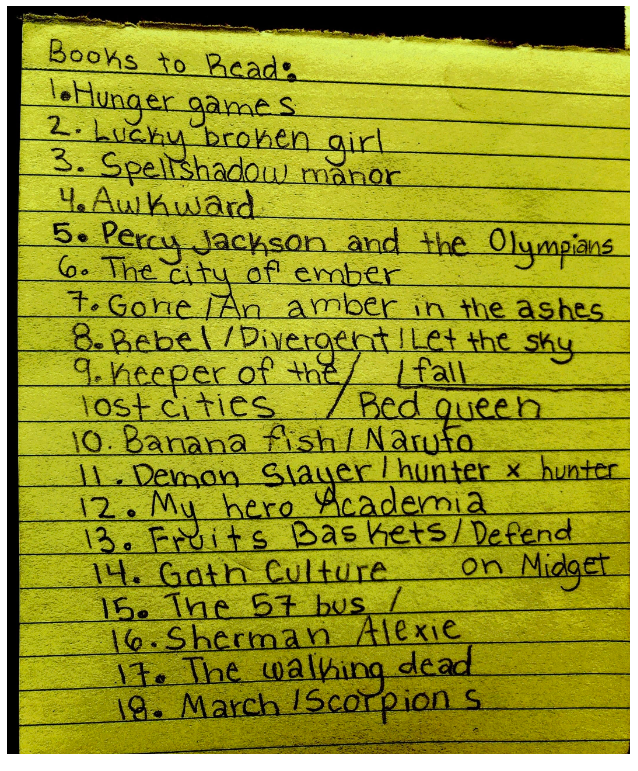
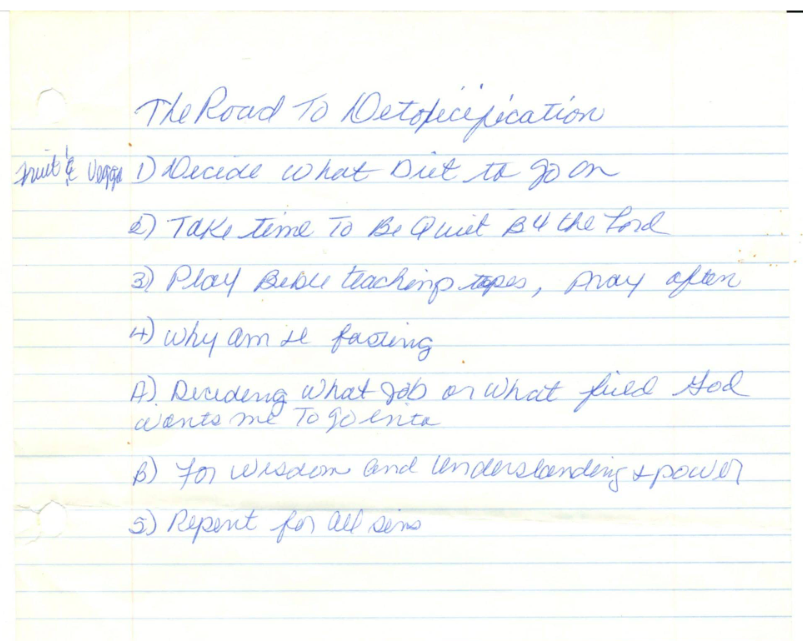
And Sharon McKellar, the Teen Services Department Head at the Oakland Public Library, collects ephemera she and other staffers find in books returned to the OPL’s 18 locations.


It’s an impulse many share.
Eventually, she began scanning them to share on her employer’s website, inspired by Found Magazine, a crowdsourced collection of found letters, birthday cards, kids’ homework, to-do lists, handwritten poems, doodles, dirty pictures, etc.
As Found’s creators, Davy Rothbart and Jason Bitner, write on the magazine’s website:
We certainly didn’t invent the idea of found stuff being cool. Every time we visit our friends in other towns, someone’s always got some kind of unbelievable discovered note or photo on their fridge. We decided to make a bunch of projects so that everyone can check out all the strange, hilarious and heartbreaking things people have picked up and passed our way.
McKellar told NPR that her project “lets us be a little bit nosy. In a very anonymous way, it’s like reading people’s secret diaries a little bit but without knowing who they are.”
The finds, which she stores in a box under her desk prior to scanning and posting, are pushing 600, with more arriving all the time.
Searchable categories include notes, creative writing, art, and photos.
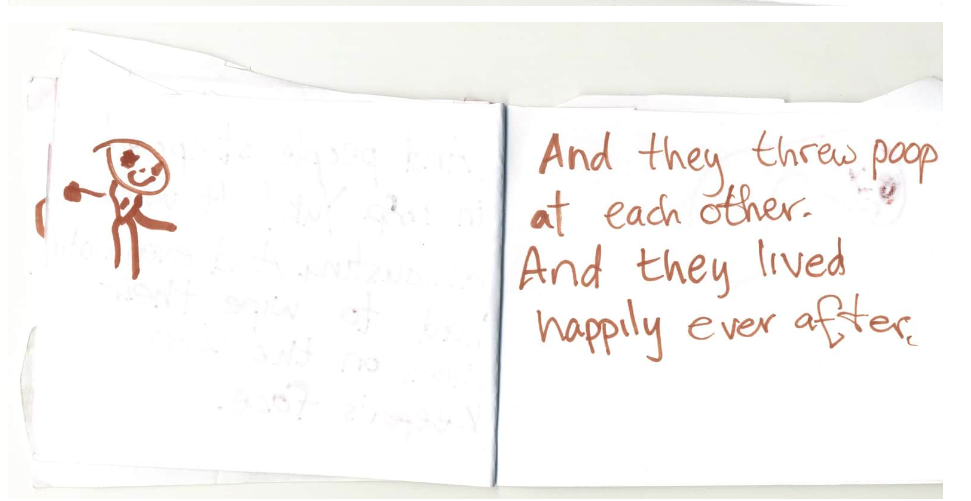
One artifact, the scatological one-of-a-kind zine Mr Men #48, excerpted above, spans four categories, including kids, a highly fertile source of both humor and heartbreak.

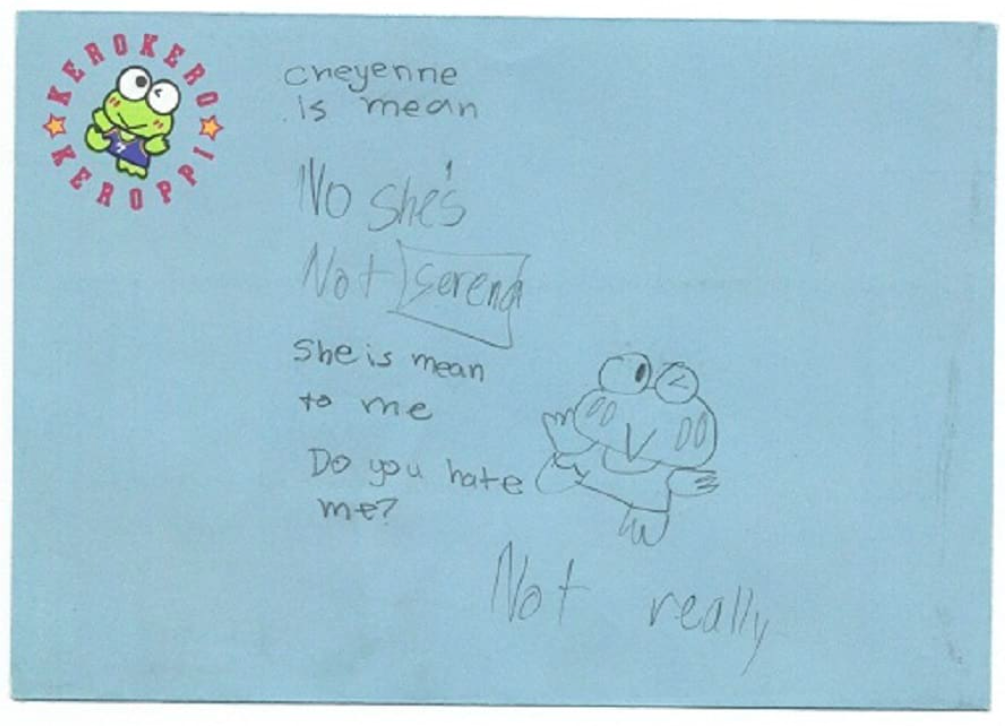
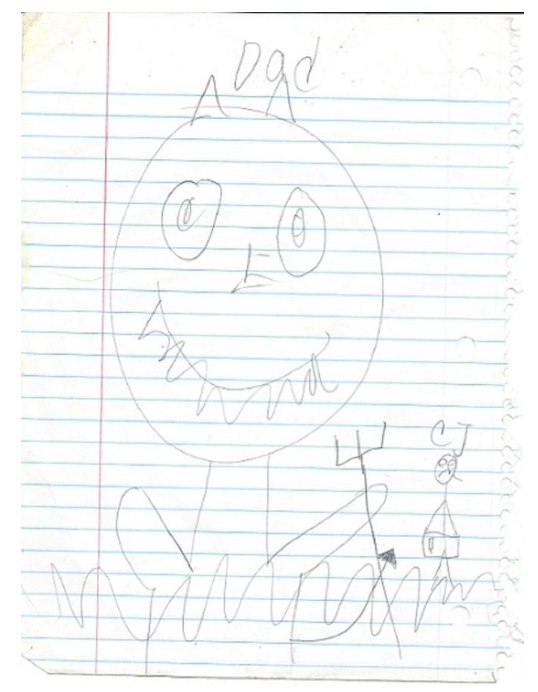
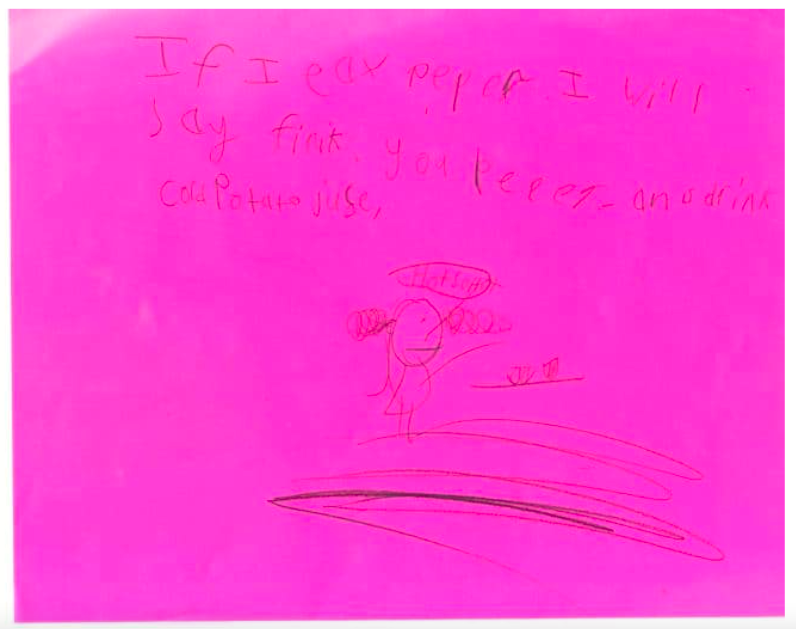
There’s a distinctly different vibe to the items that children forge for themselves or each other, as opposed to work created for school, or as presents for the adults in their lives.
McKellar admits to having a sweet spot for their inadvertent contributions, which comprise the bulk of the collection.
She also catalogues the throwaway flyers, ticket stubs and lists that adult readers use to mark their place in a book, but when it comes to placeholders with more obvious potential for sentimental value, she finds herself wondering if a library patron has accidentally lost track of a precious object:
Does the person miss that item? Do they regret having lost it or were they careless with it because they actually didn’t share those deep and profound feelings with the person who wrote [it]?
Actual bookmarks are not exempt…

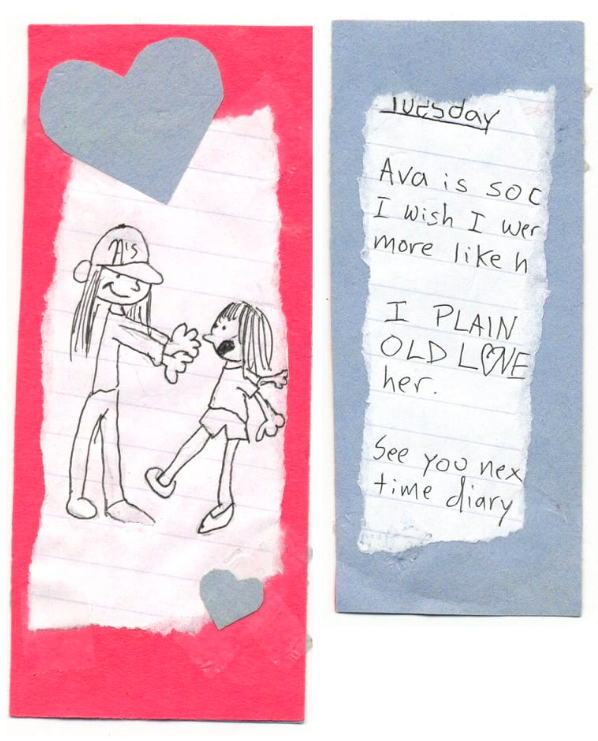
Future plans include a possible writing contest for short stories inspired by items in the collection.
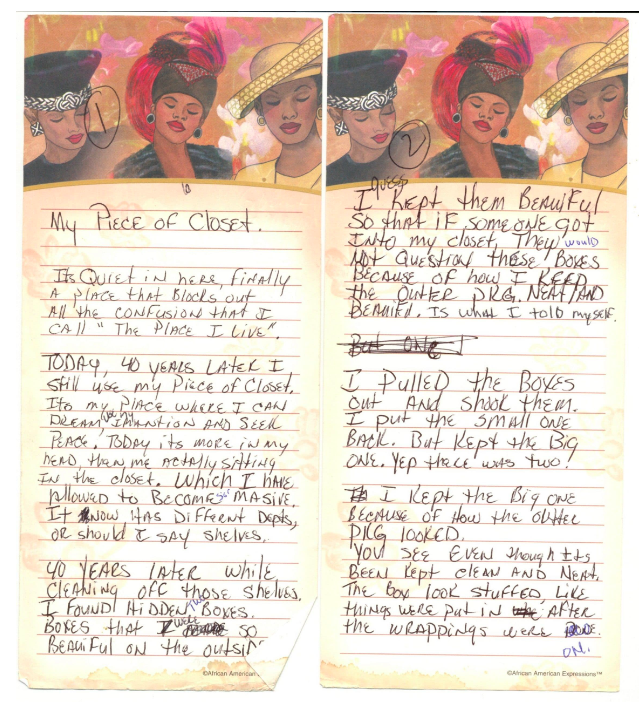
Browse the Found in a Library Book collection here.
Related Content
The New York Public Library Creates a List of 125 Books That They Love
- Ayun Halliday is the Chief Primatologist of the East Village Inky zine and author, most recently, of Creative, Not Famous: The Small Potato Manifesto. Follow her @AyunHalliday.
Read More...Watch Hundreds of Polish Films Free Online: Feature Films, Documentaries, Animations & More
The Polish film industry has produced a few internationally-known auteurs, including Andrzej Wajda, Krzysztof Kieślowski, and Roman Polanski, but a handful of critically-lauded directors cannot represent the scope of any national cinema. Without a wider appreciation of Poland’s film history, we lack crucial context for understanding its most famous artists. Now, a new archive called 35mm.online gives us hundreds of films and animations by Polish filmmakers, a unique opportunity to immerse oneself in the country’s cinematic art like never before.
Polish film history can broadly be divided into films made before WWII and those made after, when the country came under strict Communist control. The first period includes a silent film industry that began with the origins of cinema itself and made a star of actress Pola Negri, whose films were screened in Berlin with German-language title cards. Many movies made in the sound era took direction, no pun intended, from filmmaker Aleksander Ford, a champion of Communist aesthetic theory. “Cinema cannot be a cabaret,” he once told the Soviet Kino magazine, “it must be a school.” Ford made realist films about social issues and propaganda films during the war.
In 1945, Ford took control of the Polish film industry as director of the nationalized state production company, Film Polski. The company had a monopoly on production, distribution, and exhibition, and in Poland, as in most Eastern Bloc nations in the Cold War, the challenge of evading censors put far more pressure on filmmakers than market demands. “Under the Communist regime,” Dark Kuzma writes at Movie Maker, “Polish authorities waged war on moviemakers.… Any critique of the Soviet Union or the Polish People’s Republic was silenced,” beginning with a 1945 film titled 2x2=4, by Antoni Bohdziewicz.
Ford didn’t last long as an administrator, though he returned in the 50s to help advise and oversee productions. Film Polski became the Central Office of Cinematography in 1951, and enforced even stricter controls on Polish filmmakers. But as control of the film industry centralized, academic bureaucrats took over for savvy filmmakers like Ford. “Polish censors,” Kuzma notes, “were highly literary, capable of deciphering even the most sophisticated ‘subversions’ in books, newspapers and other written forms — but they were quite impotent when it came to evaluating images.”
Polish filmmakers could not make any overt narrative critiques and “were forced to learn how to say something without saying it directly, how to depict a reality that did not officially exist,” says Oscar-nominated Polish cinematographer Ryszard Lenczewski. Necessity led to a creative symbolic language viewers had to decode:
This was a responsibility we all felt: to create layered images, images with double meanings that dared viewers to interpret them differently. It was all in the details — like using wider lenses to show things you would not be able to show any other way. Something may be occurring in the background, slightly blurred. Sometimes all the film needs was to not include something or someone in the frame.
The need for clandestine cinematic methods became fully apparent in 1982, when a commission met and determined even stricter rules for Polish film, partially in reaction to the filmmaker Ryszard Bugajski’s Interrogation, an unsparing depiction of “Stalin-era political life.” (See an excerpted scene at the top). A transcript of the proceedings, which included Bugajski, made their way out of the country in secret and was reported on in The New York Times. Bugajski feared his film would not see release, and he was right, though Interrogation circulated in samizdat VHS form for years, attaining cult status. It was eventually released years later and would become one of the most popular films of the time.
After Interrogation, Polish filmmakers began to employ even more distinctive symbolic vocabularies, from sci-fi satire in 1984’s hugely popular Sexmission (trailer above), to the use of heavily saturated colors, a feature so many Polish films of the 1980s and 90s share and which characterizes the work of Kieślowski, one of the most revered of Polish directors among Polish and non-Polish cinephiles alike. Best known for his early 90s trilogy Three Colors: Blue, Red and White, the director began using specific colors to convey meaning earlier in his career.
Camera operator Sławomir Idziak, who worked on Kieślowski’s 1988 A Short Film About Killing (see trailer above), remembers, “I shot the film in this hideous yellow-greenish color to subtly hint at the director’s idea that the country could be a killer, just like the main character. I remember one reviewer in Cannes writing that because the screen assumes the color of urine, it encapsulates the reality of Communist Poland. That was beautiful.”
Filmmaker Barbara Sass went on to make several films in which specific color plays significant roles, starting with her 1980, festival-winning debut, Without Love. She surrounds her yellow-haired main character, played by Dorota Stalińska, with a sickly hospital yellow, then immerses her in the dim red light of a photographic darkroom. Her many later films employed bold uses of color to similar effect. These films represent only a tiny sampling of the nearly 4,000 Polish films hosted on 35mm.online, a joint project of the Polish Film Institute and “one of Poland’s oldest film studios, Wytwόrnia Filmόw Dokumentalnych i Fabularnych (WFDiF), (Documentary and Feature Film Studios),” notes The first News.
The collection includes 160 features, 71 documentaries 474 animated short films, and 10 animated features. We’ve barely scratched the surface of Polish cinema history and there are hundreds of animations yet to watch (read some of their grim descriptions at MetaFilter). So get to watching at 35mm.online.
Note: To enable English subtitles, click the “Enable Subtitles” button beneath each film. (The first button.) Then go to the “Setttings” button and choose English subtiles.
via MetaFilter
Related Content:
50 Film Posters From Poland: From The Empire Strikes Back to Raiders of the Lost Ark
An Introduction to Stanislaw Lem, the Great Polish Sci-Fi Writer, by Jonathan Lethem
Free Online: Watch Stalker, Mirror, and Other Masterworks by Soviet Auteur Andrei Tarkovsky
Josh Jones is a writer and musician based in Durham, NC. Follow him at @jdmagness.
Read More...A Virtual Tour of Frank Lloyd Wright’s Lost Japanese Masterpiece, the Imperial Hotel in Tokyo
Tokyo once had a hotel by Frank Lloyd Wright. Such an architectural asset, one might assume, would be preserved at all costs, yet this one was demolished in 1967. But the fact that Wright’s Imperial Hotel stood for only 45 years won’t surprise anyone familiar with Japanese building culture, nor will the fact that it was only one of a series of Imperial Hotels that have occupied the same site. As evidenced by the Ise Grand Shrine, which has been demolished and rebuilt every twenty years since the eighth century, a structure’s value in Japan has nothing to do with its longevity. Still, this explanation may not satisfy Wright enthusiasts, the great majority of whom have only been able to see the master’s most famous Japanese building in photographs, diagrams, and postcards.
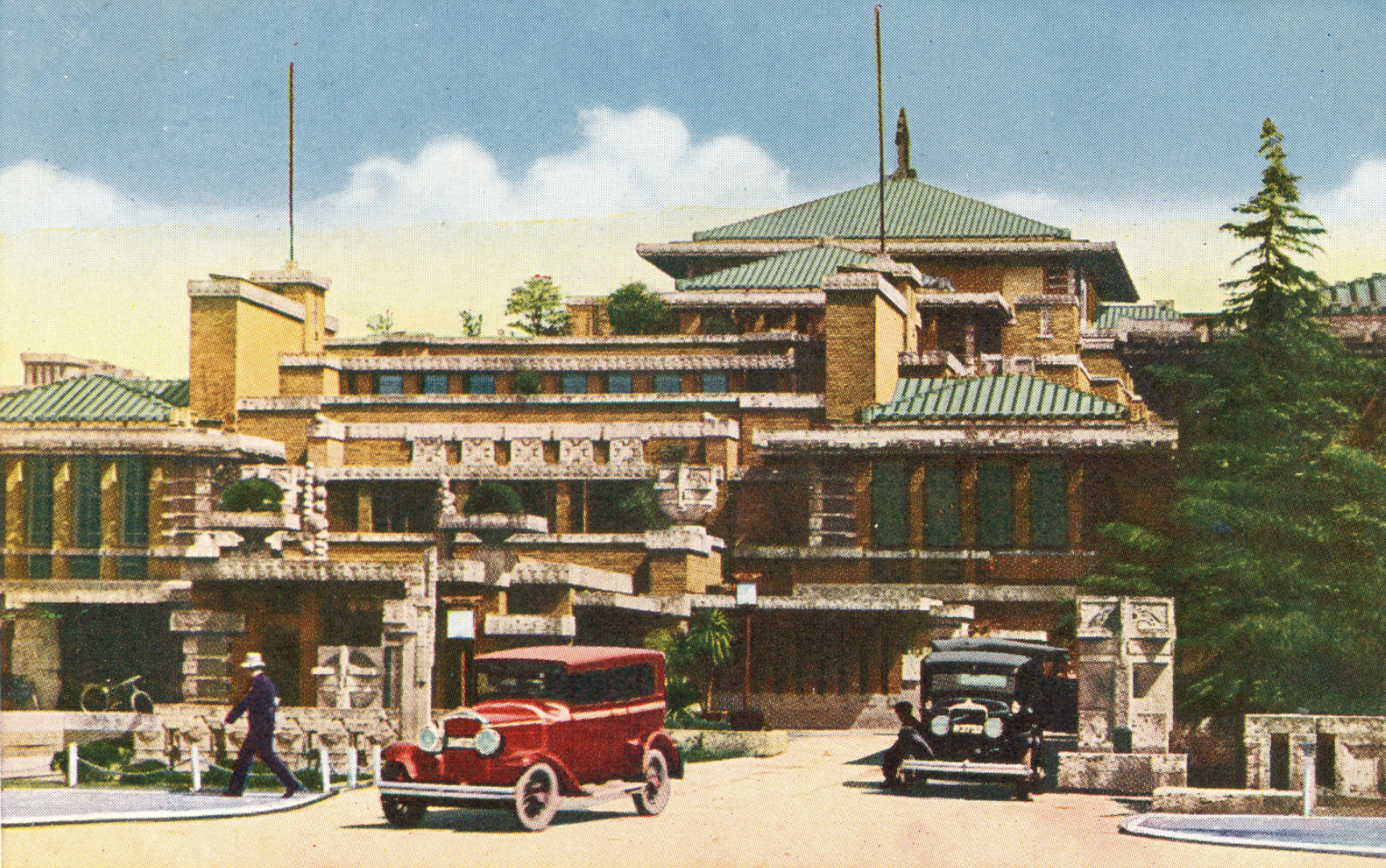
Just this year, the Frank Lloyd Trust has given us a way to experience it as nobody could in its heyday: a virtual tour video “shot” from the perspective of a flying drone. (Watch above.) It comes as an entry in Frank Lloyd Wright: The Lost Works, which “brings Wright’s demolished and unrealized structures to life through immersive digital animations reconstructed from Wright’s original plans and drawings, along with archival photographs.”
Here we have Wright’s East-meets-West masterpiece reconstructed just as it must have looked when it opened on September 1st, 1923 — the same day, coincidentally, as the Great Kantō earthquake that devastated Tokyo. The Imperial Hotel took some damage, but came through intact.
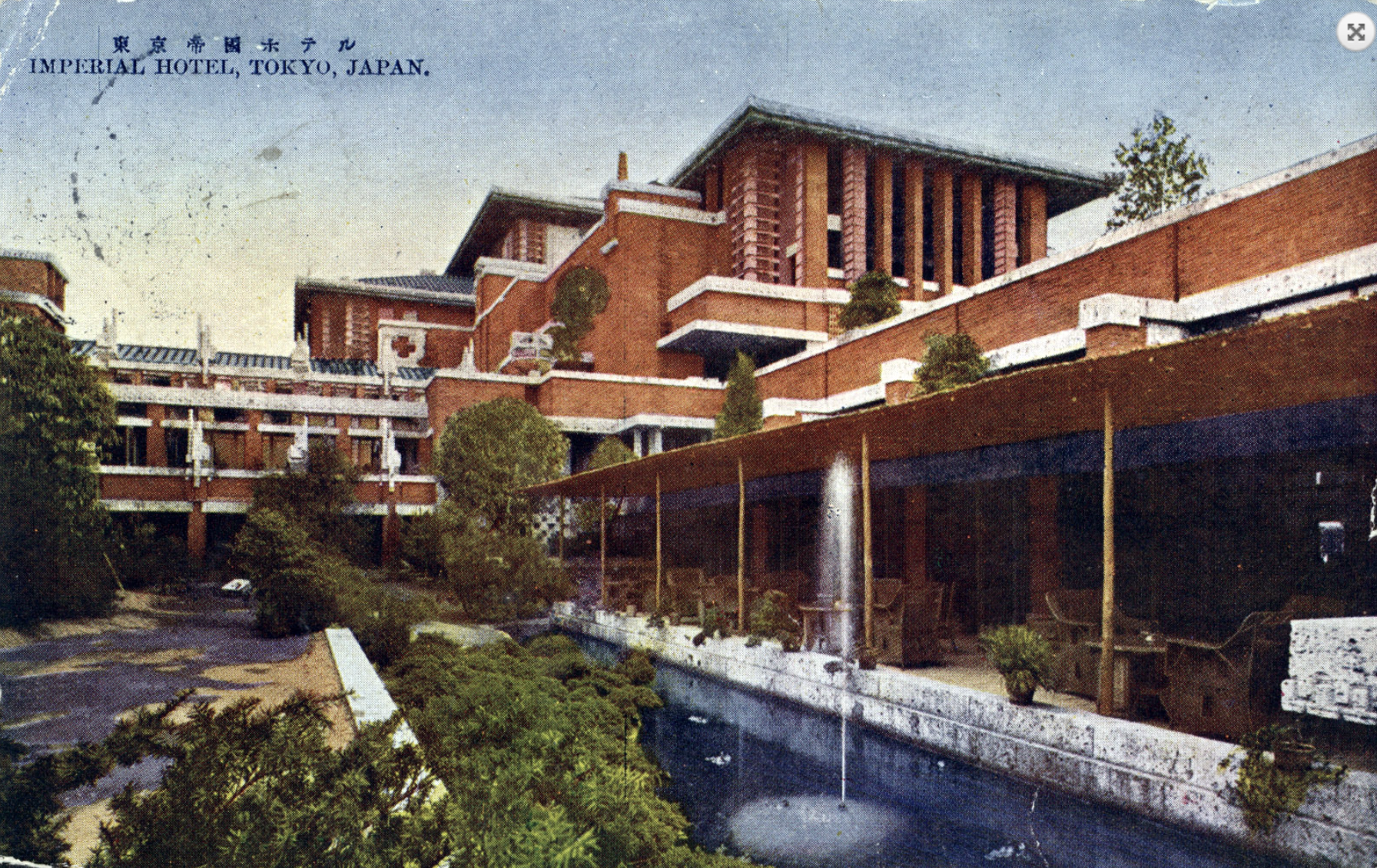
A lesser earthquake had already struck the previous year, but it left the hotel unharmed despite its still being under construction. (The same can’t be said of the fragile remains of the original Imperial Hotel, built in 1890 and gutted by fire in 1922, that Wright had been commissioned to replace.) But over subsequent decades, time took its toll in other ways: “the Wright-designed Imperial would eventually be considered by the post-war traveler to be dark and musty,” writes Steve Sundberg at Old Tokyo, “and its un-air-conditioned rooms too small. The hotel’s foundation, too, had by then settled unevenly into the soft subsoil; its long hallways and corridors came to have a wavy, rubbery appearance about them.”
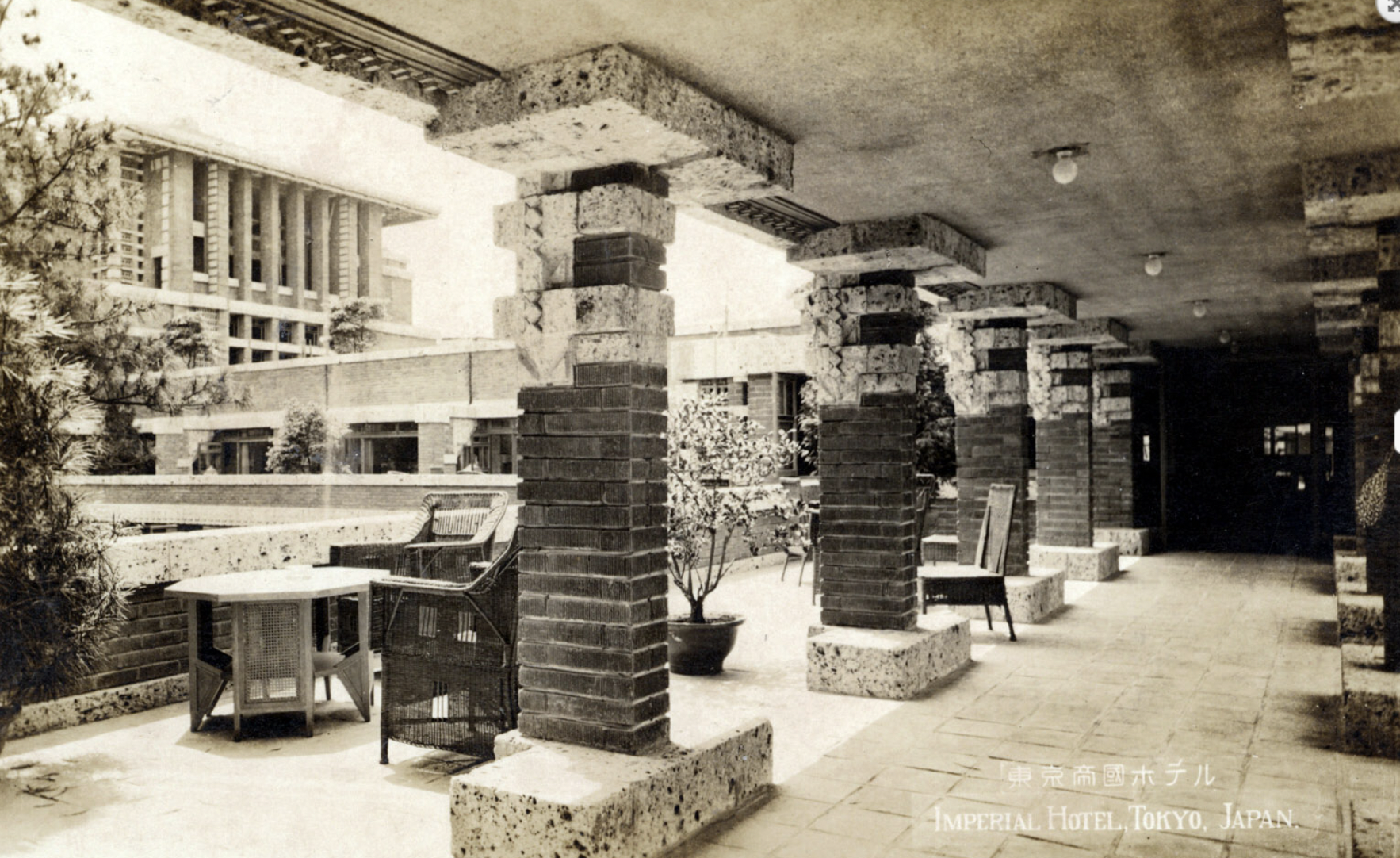
Even when new, the Imperial Hotel had its discomforts: Sundberg quotes a 1925 Far Eastern Review article calling it “a hundred years ahead of the age in its architectural features and fifty years behind in many things which make for the comfort of its patrons.” Wright “sacrificed everything to his art, raising a monument to his genius and bequeathing to the Japanese the difficult task of making it a financial success.” It was financial exigencies, in part, that motivated its demolition and replacement with a third, high-rise Imperial Hotel in 1967 — whose own impending demolition and replacement was announced just last year. France-based Japanese architect Tsuyoshi Tane has produced a design for the fourth Imperial Hotel; what tribute, if any, it pays Wright’s legacy we’ll only find out when it opens in 2036.
Related content:
Take a 360° Virtual Tour of Taliesin, Frank Lloyd Wright’s Personal Home & Studio
That Far Corner: Frank Lloyd Wright in Los Angeles – A Free Online Documentary
Why Japan Has the Oldest Businesses in the World? Hōshi, a 1300-Year-Old Hotel, Offers Clues
Wabi-Sabi: A Short Film on the Beauty of Traditional Japan
Based in Seoul, Colin Marshall writes and broadcasts on cities, language, and culture. His projects include the Substack newsletter Books on Cities, the book The Stateless City: a Walk through 21st-Century Los Angeles and the video series The City in Cinema. Follow him on Twitter at @colinmarshall, on Facebook, or on Instagram.
Read More...The German Cast of Hamilton Sings the Title Track, “Alexander Hamilton” in German
Lin-Manuel Miranda’s Hamilton is coming to Hamburg in October 2022. And this video gives audiences a taste of what awaits them: The title track “Alexander Hamilton” sung in German. Enjoy…
If you would like to support the mission of Open Culture, consider making a donation to our site. It’s hard to rely 100% on ads, and your contributions will help us continue providing the best free cultural and educational materials to learners everywhere. You can contribute through PayPal, Patreon, and Venmo (@openculture). Thanks!
via Metafilter
Related Content
“Alexander Hamilton” Performed with American Sign Language
Lin-Manuel Miranda Breaks Down How He Wrote Hamilton‘s Big Hit, “My Shot”
A Whiskey-Fueled Lin-Manuel Miranda Reimagines Hamilton as a Girl on Drunk History
Read More...Support Us
We're hoping to rely on loyal readers, rather than erratic ads. Please click the Donate button and support Open Culture. You can use Paypal, Venmo, Patreon, even Crypto! We thank you!

About Us

Open Culture scours the web for the best educational media. We find the free courses and audio books you need, the language lessons & educational videos you want, and plenty of enlightenment in between.
Advertise With Us

FREE UPDATES!
GET OUR DAILY EMAIL
Get the best cultural and educational resources on the web curated for you in a daily email. We never spam. Unsubscribe at any time.
FOLLOW ON SOCIAL MEDIA

Open Culture editor Dan Colman scours the web for the best educational media. He finds the free courses and audio books you need, the language lessons & movies you want, and plenty of enlightenment in between.
Advertise With Us

